𝗙𝗨𝗟𝗟 𝗦𝗧𝗢𝗥𝗬 The HOA President Parked a Bulldozer on My Land and Told Me My Backyard Was No Longer Mine.
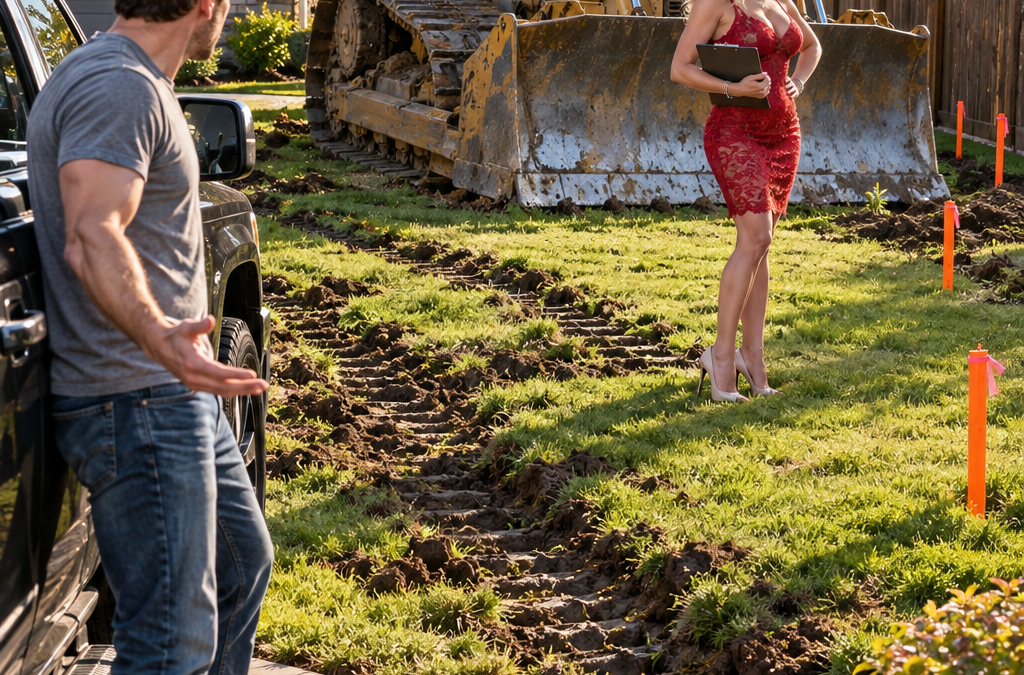
𝗙𝗨𝗟𝗟 𝗦𝗧𝗢𝗥𝗬
The fine was seventy-five dollars.
No warning.
No request to correct the problem.
Just an official-looking notice informing me that payment was due within ten business days.
I stood in my kitchen holding the letter and laughing.
Half an inch.
My grass was half an inch too tall.
I’d spent the previous Saturday mowing it.
I went outside with a tape measure, crouched beside the front walkway, and checked several spots.
A few blades were slightly longer than others.
Apparently, I’d committed a landscaping offense serious enough to deserve financial punishment.
I paid the fine.
Not because I agreed.
Because I had work, responsibilities, and better things to do than argue over seventy-five dollars.
I told myself every neighborhood had someone who took the rules too seriously.
A week later, I received another notice.
My mailbox post was painted the wrong shade of white.
Not the wrong color.
The wrong shade.
The fine was one hundred dollars.
I carried the letter outside and stared at the mailbox.
It was white.
Plain, ordinary white.
The same white it had been when I purchased the property.
I checked the architectural guidelines.
They required a specific approved shade, but the difference between my post and the sample photograph was nearly impossible to see.
I called the HOA office.
Karen answered.
“Maple Crest Estates. Karen speaking.”
“Hi, Karen. It’s Scott. I got a letter about my mailbox.”
“Oh, yes. Your little color issue.”
“It’s white.”
“Not the approved white.”
“Can you tell me what makes it unacceptable?”
“It’s inconsistent with the community’s visual harmony.”
I looked through my kitchen window.
Three houses across the street had mailbox posts in three noticeably different shades.
“Karen, there are other mailboxes on this street that don’t match.”
A pause.
Then her voice cooled.
“Are you reporting your neighbors?”
“No. I’m asking why mine is being singled out.”
“Scott, that’s a very confrontational way to approach a simple correction.”
“I’m not being confrontational.”
“Then pay the fine and correct the violation.”
The call ended before I could respond.
I paid that fine too.
One hundred seventy-five dollars wasn’t enough to justify a major fight, and I still believed the easiest way to deal with someone like Karen was to avoid giving her attention.
My neighbor Diane disagreed.
She lived in the pale-yellow house beside mine, a woman in her early sixties with silver hair, gardening gloves permanently tucked into her back pocket, and the cautious manner of someone who had learned that speaking freely could be expensive.
One afternoon, she found me repainting the mailbox post.
She watched quietly for a moment.
“She got you too?”
I glanced up.
“Apparently, my white wasn’t white enough.”
Diane didn’t smile.
“Don’t make jokes about her where she can hear.”
I laughed.
“She’s the HOA president, Diane. Not the governor.”
Diane looked toward the street.
“That’s what people usually say in the beginning.”
Something in her expression made me put down the brush.
“What do you mean?”
She lowered her voice.
“Don’t cross Karen Whitfield.”
“Why?”
“Because she doesn’t stop when she wins.”
I waited.
Diane shifted her weight.
“She wants people afraid of disagreeing with her. And once she decides you’re a problem, she’ll keep finding reasons to punish you.”
“Over lawn maintenance?”
“Over anything.”
I shook my head.
“She can’t just do whatever she wants.”
Diane looked at my house, then at me.
“She’s taken people’s houses before, Scott.”
I stopped smiling.
“What?”
“People got behind on fines. The fines became liens. Lawyers got involved. Some owners couldn’t afford to fight. They sold and left.”
“That’s not the same as taking someone’s house.”
“No,” Diane said quietly. “But the result looks remarkably similar when you’re the one packing.”
I wanted to dismiss her warning.
It sounded exaggerated.
Surely an HOA couldn’t simply decide that a homeowner should lose everything.
Surely there were rules, hearings, courts, and people whose job was to prevent that kind of abuse.
Diane must have seen the skepticism on my face.
“Just keep your paperwork,” she said.
Then she walked back to her garden.
I remember watching her go and thinking that she had probably been involved in some petty neighborhood disagreement years earlier and never gotten over it.
I was wrong.
And by the time I realized how wrong, Karen had already begun planning what to do with my property.
The survey stakes appeared about two weeks later.
I found them on a Thursday evening after work.
Bright orange markers stood in a straight line across the rear portion of my backyard, approximately eleven feet inside my fence.
At first, I thought a utility company had marked something.
Then I noticed the narrow strips of fluorescent tape tied to each stake.
They continued along the exact area where I’d planned my shed.
I walked the line twice.
No notice.
No permission request.
No explanation.
Someone had entered my enclosed backyard and driven wooden stakes into the ground.
I called Karen.
She answered on the fourth ring.
“Scott. What a lovely surprise.”
“Why are there survey stakes in my backyard?”
A pause.
Then she made a little sound, almost a laugh.
“Oh. Those.”
“Yes. Those.”
“We’re updating the property boundaries.”
I stared at the nearest orange marker.
“Who is ‘we’?”
“The association.”
“Why?”
“There’s an old discrepancy in the recorded documents.”
“What discrepancy?”
“An administrative matter.”
“Karen, someone came through my gate and marked off part of my land. That’s not an administrative matter.”
Her tone became indulgent.
“Sweetheart, you really should let professionals handle these things.”
“I’d be happy to. Send me the survey.”
“The records are under review.”
“Then why is someone staking my property before the review is complete?”
“Because we’re preparing for the community pool expansion.”
I waited for her to explain.
She didn’t.
“What does a pool expansion have to do with my backyard?”
“That area may fall within the association’s common property.”
“According to whom?”
“The original survey.”
“Which original survey?”
“The one from 1998.”
I looked toward the back fence.
“I have a deed that says otherwise.”
“Old documents sometimes contain errors.”
“Then send me whatever shows mine is wrong.”
“We’ll provide the appropriate information when the review is finished.”
“Until then, nobody comes onto my property again.”
Her voice hardened.
“Scott, homeowners are obligated to cooperate with approved community improvements.”
“Not by giving away their land.”
“You’re becoming difficult.”
“No. I’m asking for proof.”
Silence.
Then she said, “I really hope we can resolve this without consequences.”
The line went dead.
That evening, I pulled out every document from my closing folder.
I spread them across the dining room table.
The deed.
The title policy.
The original subdivision plat.
The boundary description.
The property tax records.
I checked the numbers until my eyes hurt.
Every document I possessed placed the rear property line where my fence stood.
Not eleven feet forward.
Not along Karen’s orange stakes.
At the fence.
I photographed the markers, measured their distance from the existing boundary, and emailed Karen requesting the complete 1998 survey and an explanation of the claimed adjustment.
She didn’t answer.
I emailed again.
Nothing.
A week passed.
Then another.
During that time, two contractors appeared behind the neighboring lots carrying measuring equipment.
A white pickup marked with a construction company’s logo drove slowly past my house three times.
Once, I heard heavy machinery operating beyond the row of trees.
Whenever I asked Karen for documentation, she gave the same answer.
The records were under review.
The phrase became a wall I couldn’t get through.
I began to understand what Diane had meant.
Karen wasn’t trying to convince me.
She was trying to exhaust me.
If she could delay long enough, make the situation complicated enough, and keep me uncertain enough, maybe I’d accept whatever document she eventually placed in front of me.
Then the two-thousand-dollar fine arrived.
The violation notice stated that my backyard fence encroached upon common property and had been constructed without authorization.
I read it three times.
Two thousand dollars.
For a fence I’d built two years earlier, long before moving into the house full-time.
A fence that had stood in plain sight.
A fence included in the property photographs, title review, and mortgage valuation.
A fence nobody had objected to until Karen wanted the land behind it.
I went straight to the HOA office.
It occupied a small brick building near the entrance to the subdivision, with flower beds, polished windows, and a brass plaque bearing the association’s name.
Karen sat behind a wide desk.
Of course, she was wearing the red dress.
She looked up when I entered.
“Scott. You should really schedule an appointment.”
I dropped the violation letter onto her desk.
“Explain this.”
She looked at it without touching it.
“Your encroachment penalty.”
“My fence doesn’t encroach on anything.”
“Our records indicate otherwise.”
“Then show me the records.”
“I’ve explained that they’re being reviewed.”
“You can’t fine me for violating a boundary you haven’t established.”
Karen leaned back.
“You signed an agreement to follow our governing documents.”
“I signed an agreement to follow lawful restrictions on my property.”
“Don’t lecture me about the law.”
“Then stop pretending you’re above it.”
Her expression changed.
The charm disappeared so quickly it almost startled me.
“Do you know how many homeowners I’ve dealt with in this position?” she asked.
“I don’t care.”
“You should. Because most of them eventually understand that cooperation is less expensive than resistance.”
“Is that a threat?”
“It’s advice.”
I placed both hands on her desk.
“Withdraw the fine. Stop entering my property. And provide the survey.”
She looked at my hands.
Then at my face.
“You have ten business days to pay.”
“I won’t.”
“Then you’ll face additional enforcement.”
“Go ahead.”
That was the first time I saw genuine anger in her eyes.
Not irritation.
Not wounded pride.
Anger.
I had refused to play the role she expected.
And she looked as though I had insulted her in front of an audience.
When I turned to leave, she called after me.
“Scott?”
I stopped.
“You really shouldn’t make enemies when you’ve only just moved into a neighborhood.”
I didn’t answer.
But driving home, I felt the first unpleasant tightening in my stomach.
I had gone to her office hoping to resolve the problem.
Instead, I’d given her a reason to escalate it.
The HOA appeal hearing took place the following Wednesday.
Five board members sat behind a long folding table in the community clubhouse.
Karen occupied the center chair.
The others sat on either side, their expressions suggesting they’d rather be anywhere else.
I brought my deed, photographs, the original plat, and a written timeline of every communication I’d had with Karen.
I had prepared carefully.
I thought facts would matter.
That was my mistake.
“Mr. Scott,” Karen began, using my first name as though it were a formal title, “you have five minutes to present your appeal.”
I stood.
“The fine is based on a disputed boundary line. According to my recorded deed—”
“I think we understand your position,” she interrupted.
“I haven’t explained it yet.”
“Please continue.”
I held up a copy of the plat.
“The existing fence follows the property boundary reflected in my purchase documents. The association has not supplied any certified survey contradicting that boundary.”
Karen tapped her pen.
“The records are under review.”
“Then how can a violation be confirmed?”
One board member, a gray-haired man sitting near the end, shifted uncomfortably.
I turned toward him.
“I’m asking all of you. How can the HOA impose a penalty without establishing that I violated anything?”
The room remained silent.
Karen cleared her throat.
“This hearing isn’t a courtroom.”
“No. But the money you’re demanding is real.”
Her smile tightened.
“Do you have anything else?”
“Yes. I want a written explanation of who authorized surveyors to enter my property. I also want clarification regarding the proposed pool expansion.”
“That project is outside the scope of this appeal.”
“It’s the reason you’re claiming my land.”
“That’s your interpretation.”
“It’s what you told me.”
Karen glanced toward the board.
“I believe we’ve heard enough.”
I looked at the clock.
I’d been speaking for less than two minutes.
“You’re not even going to review the documents?”
“We’ve reviewed the materials available.”
“You haven’t looked at anything I brought.”
She ignored me.
“All in favor of upholding the enforcement action?”
Four hands went up.
Karen’s.
And three others.
The gray-haired man hesitated before raising his hand too.
Only one board member voted against the fine.
Four to one.
My appeal was denied before I’d finished explaining why the violation didn’t exist.
I stood there holding my documents, feeling stupid for having believed that the hearing would be fair.
“Payment is due according to the original notice,” Karen said.
I looked directly at her.
“You decided this before I walked in.”
“That is an unfair accusation.”
“Then tell me what evidence persuaded you.”
“The board has spoken.”
“Which means you have.”
She pushed back her chair.
“Be careful, Scott.”
I gathered my papers.
“No. I think I’ve been careful long enough.”
As I walked toward the exit, I heard her voice behind me.
“Defiance won’t change the boundary.”
I turned.
“Neither will a vote.”
For the first time that evening, nobody said anything.
Outside, I stood beside my truck in the dark and let the anger settle.
It wasn’t the fine anymore.
Not really.
It was the knowledge that five people had sat in judgment of something that could threaten my financial future, and four had treated the decision like a formality.
I wondered how many other homeowners had walked into that room carrying proof and walked out feeling powerless.
Two days later, I learned something that made the hearing even uglier.
I was speaking with a longtime resident near the mailboxes when the subject of the board came up.
He mentioned Karen’s son, Michael.
“Michael Whitfield?” I asked.
“Yeah. He’s been on the board a while.”
I stared at him.
“Which one is Michael?”
He described the younger man who had sat quietly near Karen during my hearing.
The one introduced as an independent board member.
The one who had barely looked at my documents.
The one whose hand had gone up immediately when Karen called for the vote.
“That’s her son?”
The neighbor frowned.
“You didn’t know?”
“No.”
“Oh.”
He glanced toward Karen’s house, then lowered his voice.
“Well, now you do.”
Suddenly, that four-to-one vote looked different.
So did the pool project.
Michael had participated in a decision directly supporting a proposal his mother was pushing with extraordinary determination.
And the association had presented him as independent.
Maybe his relationship should have been disclosed.
Maybe it didn’t automatically disqualify him under the governing documents.
But Karen hadn’t offered the information.
She had simply allowed me to believe the people judging my appeal were detached from her personal interests.
I began asking questions about the proposed pool.
The existing community pool was small but perfectly functional.
I’d seen families using it on weekends.
There were no obvious signs that it needed expansion.
Some residents said the project had been discussed for years.
Others remembered vague announcements about future recreational improvements.
Almost nobody could explain exactly what was being built, how much it would cost, or why the expansion required land near my backyard.
The one thing everyone seemed to know was that Karen wanted it.
Badly.
I pulled out a map of the subdivision.
My lot sat beside a broad strip of designated common space.
If the HOA pushed the boundary eleven feet into my yard, the resulting area would create a wider, flatter construction footprint.
My backyard received excellent sunlight.
The ground sloped gently away from the houses.
It was precisely the kind of location a developer would choose for a pool and surrounding deck.
I stared at the map for a long time.
Karen wasn’t fighting over eleven feet because she loved accurate property records.
She wanted that land because it solved a construction problem.
And she believed she had enough authority to take it.
I hired a licensed surveyor the next morning.
His name was Thomas Reed.
He was in his late fifties, with weathered hands, a practical manner, and very little interest in neighborhood politics.
When I explained the dispute, he didn’t offer sympathy.
He asked for documents.
I gave him everything.
He studied the deed, subdivision plat, prior title materials, and photographs.
Then he came to my property with equipment and spent most of a Saturday taking measurements.
I followed him around the yard, trying not to interfere.
At one point, he stopped near the orange stakes and looked toward the fence.
“Who put those in?”
“HOA contractors, apparently.”
“Did they give you a survey?”
“No.”
He made a note.
“Interesting.”
That single word didn’t help my nerves.
“Interesting good or interesting bad?”
He looked at me.
“Interesting enough that I’m going to check the original recorded description before I tell you anything.”
The next four days felt longer than they should have.
I went to work.
Came home.
Checked my email.
Walked through the backyard.
Looked at the orange stakes.
Every time I saw them, I imagined concrete covering the grass.
A pool deck replacing the spot where I planned to build my shed.
A fence moved forward because a woman in a red dress had decided it was inconvenient.
When Thomas finally called, I answered before the second ring.
“I finished the survey,” he said.
“And?”
“Your fence follows the recorded property boundary within normal surveying tolerances.”
I sat down.
“You’re sure?”
“Yes.”
“What about the 1998 discrepancy?”
“There is a clerical inconsistency in the historical HOA survey materials. But it doesn’t establish ownership of the eleven-foot strip they’re claiming.”
I closed my eyes.
“Explain that to me like I’m not a surveyor.”
He paused.
“An old drawing contains an incorrect reference. Your legal description and the controlling recorded documents don’t support moving your property line. An error on an association document doesn’t magically transfer your land to the association.”
I looked out at the backyard.
For the first time in weeks, I felt something loosen in my chest.
“So the eleven feet are mine.”
“According to the controlling documents and the measurements, yes.”
“And my fence?”
“Inside your boundary.”
I swallowed.
“Can you put that in writing?”
“Already have.”
His certified report arrived the next day.
I printed three copies.
One went into a folder with my deed.
One went to Karen by certified mail.
The third stayed on my kitchen table, where I could see it every morning.
I expected the report to end the dispute.
That was another mistake.
Karen responded five days later.
Her letter stated that the HOA did not accept my surveyor’s conclusions and reserved the right to pursue enforcement while its own records remained under review.
No competing survey.
No professional explanation.
No evidence contradicting Thomas.
Just another declaration that she intended to proceed.
I called her.
“Did you read the report?”
“Of course.”
“Then you know the fence is on my land.”
“Your surveyor has an opinion.”
“He’s licensed by the state.”
“So are plenty of people who make mistakes.”
“Then hire your own surveyor and show me where he’s wrong.”
Karen laughed softly.
“You’re becoming rather obsessed with this.”
“Because you’re trying to take my property.”
“Scott, you’re making this sound so dramatic.”
“You sent people into my yard.”
“To improve the community.”
“Without permission.”
“Homeowners need to understand that individual preferences sometimes have to yield to the greater good.”
“My deed isn’t an individual preference.”
Her voice dropped.
“Do you really want to spend years fighting over a strip of grass?”
I gripped the phone.
“Do you?”
For a moment, neither of us spoke.
Then she said, very slowly, “I have far more patience than you do.”
She hung up.
That night, I bought a small audio recorder and reorganized every document I had.
From then on, I documented every interaction.
Every voicemail.
Every letter.
Every visit.
Every threat.
I saved emails in separate folders and backed up the files.
When Karen appeared at my door, I noted the date and time. I made sure recordings were lawful where I lived and told her whenever I was recording an in-person conversation.
I installed a security camera facing the backyard gate.
Another watched the driveway.
I wasn’t trying to provoke her.
I was trying to create a record strong enough that someone outside Maple Crest Estates would eventually have to pay attention.
The more I learned, the more frightening the situation became.
Through public records and conversations with residents, I discovered that Karen had spent years approaching homeowners about narrow strips of land and easement rights.
A few had signed agreements without fully understanding what they were giving up.
Some believed the association needed access for maintenance.
Others thought they were correcting old boundary errors.
Most had been told the changes were routine.
The transactions involved different properties, different dates, and different explanations.
But the pattern was difficult to ignore.
Karen repeatedly used uncertainty about property rights to obtain control over land adjacent to common areas.
And now she wanted mine.
One afternoon, I showed Diane copies of several recorded easement documents.
She sat across from me at my kitchen table, turning the pages with trembling fingers.
“I remember this one,” she murmured.
She pointed to an older agreement.
“The Hendersons.”
“You knew them?”
“They lived two streets over.”
“Why did they sign?”
“Karen told them a drainage easement needed to be corrected. They were afraid of getting sued.”
I leaned forward.
“Was that true?”
Diane shook her head.
“I don’t know. Nobody on the board ever received the full documentation.”
I looked at her.
“You were on the board?”
She went still.
For several seconds, the only sound was the refrigerator humming behind us.
Then she nodded.
“Years ago.”
“Why didn’t you tell me?”
“Because being on that board is something I’ve spent a long time trying to forget.”
She folded her hands.
“Karen forced me out.”
“How?”
“Same way she’s trying to force you out of your own rights. Pressure. Accusations. Closed-door conversations. Making everyone believe I was the problem.”
“What happened?”
Diane looked toward the window.
“I started asking where the money was going.”
Her voice was almost a whisper.
“And after that, Karen made sure I was never comfortable in this neighborhood again.”
I sat back.
For the first time, I realized that the woman next door hadn’t been exaggerating when she warned me.
She had been remembering.
Diane left my house that evening without saying much more.
But the next morning, just before seven, she knocked on my front door.
She was wearing an old blue cardigan, and her face looked pale.
In her right hand was a small black flash drive.
“What’s this?” I asked.
“Something I should have given someone a long time ago.”
I stepped aside.
She didn’t come in immediately.
Instead, she looked across the street, then toward the corner.
“Is Karen home?”
“I don’t know.”
“Let’s not stand out here.”
I closed the door behind her.
At the kitchen table, Diane placed the flash drive between us.
“When I was on the board, I started keeping copies of financial statements. Budget reports. Payment approvals. Meeting minutes. I knew something wasn’t right, but every time I asked questions, Karen said I was misunderstanding the accounting.”
“Why didn’t you go to the authorities?”
Diane looked down.
“Because she convinced everyone I was unstable. She said I was trying to sabotage the neighborhood. People stopped talking to me. I started getting violation notices. Then she threatened legal action if I disclosed confidential association records.”
I looked at the drive.
“And you’ve kept this all these years?”
“I was afraid to throw it away.”
Her voice cracked slightly.
“I was afraid to use it too.”
I didn’t know what to say.
She pushed the drive toward me.
“You’re still willing to fight her. I wasn’t.”
“Diane—”
“Just look at it.”
After she left, I plugged the drive into my laptop.
There were folders labeled by year.
Budgets.
Bank statements.
Board resolutions.
Vendor agreements.
Invoices.
I opened the oldest folder and started reading.
At first, the numbers looked ordinary.
Monthly dues.
Insurance payments.
Landscaping expenses.
Administrative costs.
Reserve fund contributions.
Then I noticed transfers from the reserve account to a category labeled professional consulting services.
The amounts varied.
Five thousand dollars.
Seven thousand.
Twelve thousand.
Then a payment for forty thousand dollars.
I clicked on the supporting invoice.
The description read:
Landscape development planning and community enhancement consultation.
Forty thousand dollars.
For landscaping advice.
I searched the vendor’s name.
Then I stared at the screen.
The company belonged to Karen’s brother-in-law.
I checked the next year.
More consulting fees.
Another year.
More payments.
Road paving reserves had been reduced.
Roof repair funds had been redirected.
Maintenance projects had been postponed while the association continued collecting dues and approving consulting expenses.
I opened photograph archives from community maintenance reports.
Cracked pavement.
Damaged roofing on the clubhouse.
Drainage problems that residents had repeatedly requested be repaired.
The money designated for those projects appeared to be going somewhere else.
I sat in front of my laptop until nearly two in the morning.
The longer I read, the colder I felt.
This wasn’t a woman obsessing over grass height.
This wasn’t about mailbox colors or neighborhood aesthetics.
Those rules were the surface of something much larger.
Karen controlled the board.
She controlled access to financial information.
She controlled which projects received funding.
And she seemed to have surrounded herself with people who either benefited from her decisions or were too intimidated to challenge them.
I found board meeting summaries where consulting expenses had been approved with almost no discussion.
In several instances, Karen had described the services as essential to future amenities.
The pool project appeared repeatedly.
But there were no complete construction drawings, no final cost breakdown, and no clear explanation of how residents would benefit.
Just increasingly expensive preparation work.
I leaned back and rubbed my eyes.
I wanted to believe there was an innocent explanation.
Maybe the consulting company had done legitimate work that wasn’t documented in the files.
Maybe some expenses had been categorized incorrectly.
Maybe there were missing reports that would make everything understandable.
But I couldn’t ignore the pattern.
Not when Karen was simultaneously trying to claim eleven feet of my backyard for another project nobody could clearly explain.
The following afternoon, I showed Diane what I’d found.
We sat at the same kitchen table.
I pointed to the forty-thousand-dollar payment.
“Tell me this company actually did something.”
Diane looked at the screen.
“Not that I ever saw.”
“Did they submit plans?”
“Not to the board.”
“Design documents?”
“Nothing I received.”
“Site visits?”
She shook her head.
I took a breath.
“Your reserve fund was paying Karen’s brother-in-law for landscaping advice, and nobody asked what he delivered?”
“I did.”
I looked at her.
“That’s when everything started?”
She nodded.
“That’s when Karen decided I had to go.”
Diane stared at the invoice.
“I kept hoping somebody else would notice. I told myself it wasn’t my responsibility anymore.”
“She made it dangerous to ask questions.”
“That’s what frightens me, Scott. She didn’t just make me afraid of her. She made me ashamed of being afraid.”
I closed the laptop.
For several seconds, neither of us spoke.
Then I said, “We need to get this to somebody who can investigate it.”
Diane looked alarmed.
“If she finds out—”
“She already wants my property. She’s threatening my house. What am I supposed to do? Pretend I haven’t seen this?”
“I’m not asking you to ignore it.”
“Then help me.”
Her eyes filled.
“I don’t know if I can survive going through it again.”
That stopped me.
I’d been thinking about the money.
The survey.
The legal consequences.
But Diane was sitting in front of me with her hands clenched together, reliving years of humiliation because I was asking her to confront the person who had caused it.
I softened my voice.
“You’ve already helped. More than you know.”
She wiped her eyes.
“Be careful with those files.”
“I will.”
“And Scott?”
“Yeah?”
“Don’t underestimate how desperate she’ll become if she thinks you’re getting close.”
I wish I’d understood that warning sooner.
Over the next several days, Karen’s behavior changed.
She stopped pretending the situation was a misunderstanding.
Her emails became shorter.
Her notices became more aggressive.
The association began sending demands for payment with references to collection costs and additional legal remedies.
Then she appeared at my front door on a Sunday afternoon.
I had been in the garage organizing tools when I heard her knock.
She stood on the porch wearing that same red lace dress, carrying an iced tea and smiling as though she’d come to invite me to a barbecue.
“Scott. There you are.”
“What do you want, Karen?”
She glanced past me into the house.
“May I come in?”
“No.”
Her expression tightened for a fraction of a second.
Then she recovered.
“Well, aren’t we guarded today?”
“You’ve threatened me repeatedly. I think that’s reasonable.”
She gave a theatrical little sigh.
“I came to offer you a chance to resolve this amicably.”
“Then withdraw the fines and recognize the survey.”
“That’s not what I meant.”
“Then what did you mean?”
She took a sip of tea.
“I think you’ve become emotionally attached to a very small portion of land.”
“It’s my land.”
“Eleven feet, Scott.”
“Eleven feet you’re trying to take.”
“You could save yourself a tremendous amount of trouble by cooperating with the association.”
I took out my recorder.
“I’m recording this conversation.”
Karen’s eyes moved to the device.
“Really?”
“Yes.”
“How dramatic.”
“Then say exactly what you came here to say.”
She studied me for a moment.
“Your account is delinquent. If you refuse to resolve the balance, the association may record a lien against your property.”
I felt my stomach tighten.
She noticed.
Of course she noticed.
“A lien?” I asked.
“That’s correct.”
“Over fines I’m disputing?”
“Over unpaid association obligations.”
“Which you created.”
“Which the board upheld.”
“You mean the board where your own son voted?”
Her smile disappeared.
“Michael is a duly elected director.”
“You never disclosed that relationship at the hearing.”
“It wasn’t necessary.”
“Convenient.”
She stepped closer.
“Scott, I don’t think you understand the situation. A lien can become a very serious financial problem.”
“Is that what you want?”
“I want compliance.”
“With a boundary claim you can’t prove.”
She lowered her voice.
“I want you to understand that this association has resources you don’t.”
There it was.
Not even disguised.
I looked directly at her.
“Are you threatening to take my house?”
“I’m explaining the consequences of refusing to pay.”
“And if I give you the eleven feet?”
She smiled again.
“Then perhaps this unpleasantness can finally end.”
I felt something hot and unpleasant rise in my chest.
She had just tied the threat against my home to the land she wanted.
“Get off my porch.”
“Scott—”
“Leave.”
Her eyes hardened.
“You’re going to regret the way you’ve treated me.”
“No, Karen. I’m going to remember it.”
I closed the door.
Then I stood there for a long time, looking at the wood grain, listening to my own breathing.
I’d spent years building the financial stability that made homeownership possible.
I hadn’t inherited money.
Nobody had handed me a house.
Every repair had come out of my savings.
Every mortgage payment represented hours of work.
And a woman who had never contributed a dollar toward any of it was calmly explaining that she could put the entire thing at risk if I refused to give her what she wanted.
That night, I looked up what an HOA lien could mean.
The words were worse than I expected.
Collection proceedings.
Attorney fees.
Interest.
Possible foreclosure under certain conditions.
I understood that an HOA couldn’t simply announce ownership of a house. Legal procedures and limitations existed.
But I also understood something more frightening.
A dispute didn’t have to be legitimate to become expensive.
And I didn’t have unlimited money.
I could win eventually and still lose years of savings getting there.
I began sleeping badly.
At work, I caught myself reading the same emails twice.
I checked my security cameras during lunch.
I stopped leaving my paperwork spread across the dining room table because the sight of it made my home feel like an office for a lawsuit.
Then Tuesday came.
The morning with the bulldozer.
I’d driven to the hardware store shortly after sunrise to pick up supplies before work.
When I came home, Karen was standing beside the machine as though it were a gift she’d ordered.
“That portion is no longer yours,” she’d told me.
The operator had started the engine.
And suddenly all the threats, letters, and survey stakes were no longer theoretical.
I walked toward the bulldozer.
“Shut it down!” I shouted.
The operator looked at Karen.
She lifted her clipboard.
“Proceed with the site preparation.”
I stepped into the operator’s line of sight, remaining well clear of the blade.
“I’m the property owner, and I’m telling you this boundary is disputed. You do not have my permission to work here.”
The operator hesitated.
Karen snapped, “You’re working for the association, not for him.”
I pulled my phone from my pocket.
“Then let me make sure your company understands what it’s being asked to do.”
I photographed the machine.
Its company name.
Its identification number.
The tracks across my lawn.
The orange stakes.
Karen.
Everything.
“Are you seriously doing this?” she demanded.
“Yes.”
“You’re obstructing an authorized project.”
“Show me the authorization.”
She waved the clipboard.
“I have the board approval.”
“Board approval doesn’t transfer ownership.”
“Scott, move away from the equipment.”
“I’m nowhere near it. I’m asking the operator not to cross my property line.”
The operator shut the engine off.
The sudden silence felt enormous.
Karen whipped around.
“Why did you stop?”
The man opened the cab door.
“Ma’am, he’s saying this is his property.”
“And I’m saying it’s ours.”
“Do you have paperwork showing that?”
Karen stared at him.
“You were hired to do a job.”
“Yes, ma’am. But I’m not tearing up somebody’s yard if there’s a title dispute.”
For the first time, I saw Karen lose control of a person she expected to obey.
Her cheeks flushed.
She pointed at me.
“This man is interfering with community infrastructure.”
I kept recording.
“Tell him about the eleven feet.”
“Excuse me?”
“Tell him you’re claiming eleven feet of my backyard based on an old clerical error that my licensed surveyor already disproved.”
She looked toward the operator.
Then back at me.
“You have no right to discuss confidential association matters with contractors.”
“He’s about to operate heavy equipment on my land. I’d say he has a right to know.”
Karen stepped closer.
Her voice dropped.
“Put that phone away.”
“No.”
“I am warning you.”
“I know. You’ve been warning me for weeks.”
She leaned toward me.
“You’re going to lose everything over your stubbornness.”
I felt the old fear rise.
But this time, I didn’t look away.
“Then you’re going to have to explain why.”
I called the sheriff’s nonemergency number and reported a property dispute involving construction equipment.
Karen called someone on her phone.
Within twenty minutes, two neighbors stood near the sidewalk watching.
Within forty minutes, a deputy arrived.
He listened to both sides.
Karen talked first.
She spoke quickly, confidently, producing board resolutions and pointing toward the orange stakes.
She described me as an uncooperative homeowner who was preventing an approved community improvement.
Then the deputy turned to me.
I handed him my deed and Thomas Reed’s survey report.
“I understand this is a civil property dispute,” I said. “I’m not asking you to decide ownership. I’m asking that nobody damage my yard while the boundary is contested.”
The deputy examined the documents.
He spoke with the equipment operator.
Then he turned to Karen.
“Ma’am, I can’t determine title ownership here. But with these conflicting claims, moving the equipment across the disputed area could create additional problems.”
Karen crossed her arms.
“Are you ordering us to stop?”
“I’m advising everyone to avoid escalating the situation and to resolve the boundary question through the proper legal process.”
She looked furious.
“This project has been approved.”
“That doesn’t settle the ownership question.”
For a brief moment, nobody moved.
Then Karen turned to the operator.
“Stand down until I speak with counsel.”
The machine remained parked.
That wasn’t enough for me.
I wanted it gone.
But at least the blade hadn’t touched the disputed strip.
By early afternoon, I had contacted a property attorney named Ellen Brooks.
I emailed her the deed, the survey, the violation notices, and photographs of the bulldozer.
Her response was the first legally grounded reassurance I’d received since the dispute began.
She believed I had strong documentation supporting my boundary and advised that we move quickly to demand the cessation of unauthorized work.
She also warned me not to assume Karen would stop.
“People who are willing to use heavy machinery to pressure a property owner usually aren’t concerned about maintaining a friendly relationship,” she said during our call.
“I figured that part out.”
“Good. Then document everything and don’t enter an argument you can’t prove later.”
“She says she can file a lien.”
“She may attempt it. Whether it is enforceable is another matter.”
“Can she take my house?”
“Not simply because she wants eleven feet of your backyard. But if she starts collection proceedings, we’ll need to challenge them properly.”
I looked through the window toward the bulldozer.
“How expensive is this going to get?”
Ellen didn’t answer immediately.
“That depends on how far she’s willing to take it.”
By one-thirty that afternoon, six hours after I first pulled into the driveway, I had retained counsel, sent formal notice objecting to entry, documented a sheriff’s visit, and learned how quickly a disagreement over grass could become a battle over ownership and financial survival.
The bulldozer was eventually moved off my property.
But Karen wasn’t finished.
She was just changing tactics.
A certified letter arrived three days later.
I recognized the association’s return address before I opened it.
Inside was a formal demand that I sell the disputed land to the HOA.
Karen had apparently decided that if she couldn’t establish ownership through the old survey, she would try to purchase the property.
The letter described the sale as a reasonable compromise.
The offered price was eight thousand dollars.
I stared at the number.
Eight thousand.
The property, including its development potential and the value of the contiguous land, represented a six-figure component of my home’s overall value. Even a permanent loss of that eleven-foot strip would affect how I could use the yard and could significantly damage the value of the lot.
Karen wasn’t offering me a fair deal.
She was offering me a small amount of money to surrender a property right while threatening to make refusal financially painful.
I took the letter to Ellen.
She read it silently.
Then she placed it on her desk.
“This is useful.”
I blinked.
“Useful?”
“She has now put an acquisition proposal in writing. That’s relevant because she’s also claiming the association already owns the land.”
I leaned forward.
“If it’s already theirs, why would they need to buy it?”
“Exactly.”
For the first time, I smiled in that office.
It was a tired smile.
But it was real.
Ellen drafted a response declining the offer, reaffirming my boundary, and demanding that the association withdraw the encroachment fine.
We sent it.
For four days, nothing happened.
I allowed myself to hope Karen had finally understood that she couldn’t simply intimidate me into surrendering.
Then the lien appeared.
I learned about it through a notice from the county recorder’s office.
The document contained my property information, the HOA’s name, and a claimed outstanding balance that included fines, collection charges, and administrative costs.
My hands went cold.
I checked the parcel number twice.
It was my house.
My address.
My legal description.
The threat Karen had delivered on my porch was now a recorded claim against my property.
I called Ellen immediately.
“She filed it.”
“I see the notice,” Ellen said. “Send me the full copy.”
“She actually did it.”
“Scott, listen carefully. A recorded lien is not a foreclosure. We can challenge this.”
“But it’s on my title.”
“Yes. And we will address it.”
I sat down on the stairs.
“How can she do this when she knows the survey is wrong?”
Ellen’s voice was steady.
“Because filing a claim and proving a claim are different things.”
That sentence stayed with me.
Filing a claim and proving a claim.
Karen didn’t need to be right to hurt me.
She only needed to create a problem large enough to frighten me into giving up.
I barely slept that night.
At two in the morning, I was sitting at the kitchen table with the lien notice beside my mortgage statement.
I thought about every late shift I’d worked.
Every vacation I’d skipped.
Every weekend I’d spent repairing that house instead of going somewhere enjoyable.
I thought about the first time I’d walked through the finished rooms after moving in.
The smell of fresh paint.
The light through the kitchen windows.
The quiet.
I had felt proud.
Not because the house was impressive.
Because it was mine.
Now the same kitchen felt unfamiliar.
The papers spread across the table made it look as though ownership were a temporary condition that could be challenged by someone with enough influence.
I opened my laptop and looked at the financial files Diane had given me.
Then I looked at Karen’s recorded threats.
I had been treating the land dispute and the questionable HOA finances as two separate problems.
But Karen had linked them herself.
The pool project.
The payments for community enhancement.
The aggressive land acquisitions.
The lack of transparent accounting.
The unusual financial pressure on residents.
I couldn’t prove exactly how all of it fit together.
But I had enough evidence to justify asking somebody with investigative authority to find out.
The next morning, I told Ellen I wanted to submit a formal complaint to the state attorney general’s office.
She reviewed the documents with me and helped organize the material so the allegations were clearly distinguished from what the records actually established.
I didn’t want exaggeration.
I didn’t want revenge dressed up as evidence.
I wanted an investigator to look at the same documents and ask the questions Karen had spent years preventing anyone from asking.
We included Thomas Reed’s certified survey.
The historical subdivision documents.
Copies of the disputed fines.
The denied appeal.
The lien filing.
Karen’s written purchase offer.
Records of past easement transactions.
The financial statements from Diane.
The consulting invoices.
And the recordings of Karen’s threats.
I wrote a timeline explaining what had happened from the first grass-height violation to the bulldozer arriving on my land.
At the end, I included one simple request.
I wanted the association’s use of its authority and its handling of homeowner funds independently investigated.
Before submitting everything, I called Diane.
“I’m filing the complaint.”
She didn’t speak for several seconds.
Then she asked, “Are you including the financial records?”
“Yes.”
A long silence.
“She’ll know I helped you.”
“Maybe.”
Diane’s breathing changed.
“Scott, I don’t think you understand what this could mean for me.”
I closed my eyes.
“I do. And if you don’t want to be involved any further, I’ll respect that.”
“I want her stopped.”
Her voice shook.
“I’ve wanted her stopped for years.”
“Then we have to let someone outside this neighborhood look at the evidence.”
She was quiet.
Finally, she said, “Do it.”
I submitted the complaint.
I expected an acknowledgment.
Maybe a form letter.
Maybe a request for additional information sometime in the distant future.
What happened next was far more serious.
Within days, I received a request for supporting documentation from an investigator reviewing the allegations.
Ellen helped me respond.
Diane was contacted.
Other homeowners were interviewed.
Records that had previously been impossible for residents to obtain began receiving official scrutiny.
The financial irregularities attracted particular attention.
An investigator asked about the forty-thousand-dollar consulting payment.
Then about other transfers.
Then about the pool project.
The questions weren’t limited to my property anymore.
They extended into years of association spending.
Six years, as it turned out.
Nearly six years of money being diverted through transactions investigators considered suspicious.
I didn’t know the full scope immediately.
I only knew Karen had stopped sending cheerful emails.
And for the first time since I’d met her, she seemed to be losing control of the story.
At the next neighborhood gathering, people were whispering.
Residents who had never spoken to me before approached quietly and asked whether I really had evidence of missing reserve funds.
I told them there was an investigation and that I wasn’t going to speculate.
Some looked relieved.
Others looked frightened.
A man named Robert, who lived near the entrance, told me he’d been saving for a new roof while paying special assessments he never understood.
Another woman said her street had been promised resurfacing three years earlier.
A retired couple described water damage in the clubhouse that the HOA claimed it couldn’t afford to repair.
Different stories.
The same unanswered question.
Where had the money gone?
Then the county authorities became involved.
Investigators obtained financial records beyond the copies Diane had preserved.
Bank transfers.
Vendor payments.
Internal approvals.
Contracts.
The records showed that association money had been routed through consulting arrangements and other expenditures that did not match the work supposedly performed.
Karen’s brother-in-law was part of the investigation.
And the pool project, the centerpiece of her campaign to take my land, began to look nothing like the public amenity she had described.
According to the records investigators uncovered, the proposed construction was structured to benefit a restricted private group rather than the community at large.
Plans and related agreements contained access arrangements that residents had never been told about.
The association would have supplied the land rights and funding, while private interests connected to Karen would have received the primary benefit.
The phrase community pool expansion had been used to justify something very different.
I remember Ellen calling me when that information emerged.
“Scott, the property dispute is only part of what they’re investigating now.”
I sat down.
“What do you mean?”
“They’ve identified possible misuse of association funds tied to the pool development.”
I looked through the window at the empty section of backyard where the orange stakes still stood.
“So she wasn’t building it for the neighborhood?”
“Not according to the arrangements investigators are examining.”
I didn’t speak.
All those weeks.
All those fines.
The hearing.
The threats.
The bulldozer.
The lien.
Karen had told me over and over that I was selfish for resisting a project intended to benefit everyone.
She had made me feel as though protecting my property was somehow an attack on the community.
And the entire time, the project had been designed around private benefit.
I felt sick.
Then furious.
Not the explosive anger I’d felt when the bulldozer started.
Something colder.
I thought of Diane being forced off the board.
The residents paying dues for repairs that never happened.
The homeowners who had sold property rights because they believed Karen was speaking for the association.
I thought about the way she smiled whenever she threatened me.
She hadn’t simply been confident.
She’d believed nobody would ever look closely enough to challenge her.
The financial investigation intensified.
Authorities obtained orders restricting access to association accounts and preserving funds while a forensic audit proceeded.
Board records were subpoenaed.
Meeting recordings were requested.
Documents from previous years were examined.
The association’s bookkeeping became a matter of official investigation rather than Karen’s personal explanation.
The remaining board members began distancing themselves from decisions they had once approved without question.
Michael Whitfield was suddenly very difficult to reach.
Karen’s public confidence started to fracture.
At one emergency neighborhood meeting, she tried to address residents from the front of the clubhouse.
She wore the red lace dress, just as she always did.
Her hair was immaculate.
Her makeup was flawless.
But the room no longer responded to her the way it once had.
“These allegations,” she began, “are being spread by individuals who have personal grievances against the board.”
Someone from the back called out, “Where’s the reserve money?”
Karen stiffened.
“Financial information is being reviewed by the appropriate parties.”
A woman stood.
“That’s what you’ve been telling us for years.”
“Please sit down.”
“No. I’ve paid dues here for eleven years. I want to know why the roads haven’t been repaired.”
Karen lifted a hand.
“This meeting is not the place for irresponsible accusations.”
Another resident spoke.
“Then when is the place?”
The room stirred.
Karen raised her voice.
“I will not permit this association to descend into chaos because of a handful of disgruntled homeowners.”
I was standing near the rear wall beside Diane.
Karen spotted me.
Her expression changed.
“You.”
The room quieted.
She pointed directly at me.
“This entire situation began because one man refused to cooperate with an approved community project.”
I felt Diane tense beside me.
I stepped forward.
“No, Karen. This began when you claimed land you couldn’t prove the HOA owned.”
“You have no right to disrupt this meeting.”
“And it continued when you fined me, threatened a lien, and sent a bulldozer onto my property.”
Several people turned toward her.
Her voice sharpened.
“You are deliberately misrepresenting what happened.”
“Then release the records.”
A murmur moved through the room.
Karen stared at me.
“What?”
“Release the complete financial records. The pool contracts. The consulting invoices. Let every homeowner see where their money went.”
Her face flushed.
“Those documents contain confidential information.”
“Then let the investigators determine what needs to remain confidential.”
She slammed her clipboard against the table.
“I have done more for this community than any of you!”
The room went silent.
Her breathing was quick.
She looked around as though waiting for someone to come to her defense.
Nobody did.
Then Diane stepped forward.
Her voice was quiet but clear.
“You’ve done plenty, Karen.”
Karen’s eyes widened.
“Diane.”
“I asked you about the money years ago.”
“Diane, don’t start.”
“You told people I was lying.”
“I will not entertain your delusions.”
Diane flinched.
I saw it.
Even after all those years, Karen knew exactly where to strike.
But Diane didn’t retreat.
“You forced me off the board because I wanted to see the invoices.”
Karen’s voice rose.
“You were removed because you were disruptive!”
“And now investigators want to see those same invoices.”
There was a low ripple of conversation.
Karen looked as though she’d been slapped.
For a moment, I thought she might actually apologize.
Not because she felt remorse.
Because the room had stopped obeying her.
Instead, she gathered her papers.
“This meeting is adjourned.”
A man near the front stood.
“You don’t get to make that decision by yourself anymore.”
Karen stopped.
She looked from one face to another.
No one moved to help her.
No one apologized for questioning her.
No one appeared frightened enough to silence the others.
She walked out.
And I watched the woman who had ruled Maple Crest Estates through fear discover that fear wasn’t permanent.
The next several days brought more information.
Residents organized to demand independent oversight.
The board’s financial authority was placed under scrutiny.
Records from previous years were compared against bank statements and vendor documentation.
The scope of the suspected embezzlement became impossible to dismiss as a bookkeeping mistake.
Through Ellen and the official notices that followed, I learned investigators believed Karen had been diverting association funds for nearly six years.
Money earmarked for road paving, roofing, and community maintenance had been used in transactions that benefited people connected to her.
The consulting fees weren’t an isolated irregularity.
They were part of a larger pattern.
And the pool project had given her a reason to seek control of more property while presenting herself as a visionary community leader.
My eleven feet had been one small piece of that plan.
One narrow strip of ground.
One homeowner she expected to intimidate.
I wondered what would have happened if I’d paid the two-thousand-dollar fine.
If I’d signed the eight-thousand-dollar sale agreement.
If I’d accepted her explanation that a 1998 clerical error made my backyard someone else’s property.
The thought disturbed me more than I wanted to admit.
Because I had nearly done the first version of that.
I’d paid the grass fine.
I’d paid the mailbox fine.
I’d told myself it was easier than arguing.
Karen had seen that willingness to avoid conflict and mistaken it for weakness.
She had kept pushing until compliance meant surrendering something I couldn’t replace.
Then, one Friday afternoon, she came to my house again.
I was sitting at the kitchen table reviewing a letter from Ellen when I saw Karen’s SUV pull into the driveway.
She got out slowly.
No clipboard.
No entourage.
No sunglasses.
She still wore the red lace dress, but something about her looked different.
The confident posture was gone.
Her shoulders were tense.
Her face was pale beneath her makeup.
She walked to the front door and knocked.
I opened it without inviting her inside.
“Karen.”
“Scott.”
For several seconds, she simply stood there.
Then she gave a thin smile.
“I was hoping we could talk.”
“About what?”
“Everything.”
I folded my arms.
“My attorney handles the property dispute.”
“This doesn’t have to involve attorneys.”
“It already does.”
She glanced toward the street.
“Could we speak privately?”
I looked at her.
“You threatened me on this porch. You can talk on this porch.”
Her expression tightened.
“Please.”
It was the first time I’d heard her use that word without sounding sarcastic.
I kept the door open but stayed where I was.
“Go ahead.”
She took a shaky breath.
“I think things have gotten out of hand.”
I didn’t answer.
“There have been misunderstandings,” she continued. “People have made assumptions. The financial situation is more complicated than it looks.”
“Then explain it to the investigators.”
She swallowed.
“Scott, you know how these things work. Documents get interpreted a certain way. People start talking. Suddenly everything looks much worse than it is.”
“Did you take the money?”
Her eyes flickered.
“That’s an outrageous question.”
“It’s a simple one.”
“I came here in good faith.”
“You came here because you want something.”
She looked away.
Then back at me.
“We can work something out.”
“What kind of arrangement?”
“I can make the lien disappear.”
I felt my jaw tighten.
“The lien should never have existed.”
“I can have the fines canceled.”
“They were never justified.”
“And the boundary dispute can be resolved in your favor.”
I stared at her.
“In my favor?”
She nodded quickly.
“You keep the land. The association withdraws its claim. Everything returns to normal.”
I thought about the orange survey stakes.
The bulldozer.
The nights I’d spent awake wondering whether I could afford to keep my home.
“You mean I get to keep the property I already own?”
Karen’s mouth tightened.
“There’s no need to be cruel.”
That almost made me laugh.
Cruel.
She was standing on my porch, asking for kindness after months of deliberately trying to frighten me into surrendering my land.
“What do you want in return?”
She glanced over her shoulder.
“Your complaint has created problems for a lot of people.”
“My complaint didn’t create the financial records.”
“Scott—”
“The records were already there.”
“You’re not listening.”
“Then tell me what you want.”
Her voice became barely audible.
“I need you to clarify that you may have misunderstood my intentions.”
I stared at her.
She continued quickly.
“You could explain that our disagreements were personal. That you became upset during an ordinary association dispute. That some of your statements were made under stress.”
“You want me to tell investigators I exaggerated?”
“I want you to help everyone move forward.”
“You want me to undermine my own complaint.”
“I want you to be reasonable.”
The word struck me.
Reasonable.
For months, Karen had used that word to mean obedience.
She had called herself reasonable while demanding money she couldn’t justify.
Reasonable while withholding evidence.
Reasonable while threatening my home.
And now, with investigators examining her financial records, she wanted me to become reasonable enough to protect her.
I felt no satisfaction.
Only exhaustion.
“Karen,” I said, “you had a hundred chances to stop.”
She blinked.
“Excuse me?”
“When I asked about the first boundary claim, you could have shown me the documents.”
“Scott—”
“When I hired a surveyor, you could have reviewed his report.”
“Please.”
“When I appealed, you could have let the board consider the evidence.”
Her lips trembled.
“When you threatened a lien, you could have walked away. When you brought that bulldozer here, you could have told the operator to shut it down.”
“You’re making me sound like some kind of criminal.”
I looked at her.
“I’m telling you what you did.”
Her eyes filled.
For a moment, her expression almost resembled genuine distress.
Then she whispered, “You have no idea what you’re doing to me.”
I felt something inside me harden.
“That’s the problem, Karen. You still think this is something I’m doing to you.”
She stared at me.
I continued.
“You took people’s money. You threatened homeowners. You used the association like it belonged to you. And now you’re standing here asking me to pretend it didn’t happen.”
“You don’t understand the pressure I was under.”
“Then explain it to your lawyer.”
She shook her head.
“Scott, please. We can still make this go away.”
Before I could answer, a vehicle turned onto the street.
Then another.
The first was a sheriff’s car.
The second was an unmarked county vehicle.
I noticed them because Karen noticed them.
Her face changed instantly.
All the color seemed to drain out of it.
She stepped backward.
“No.”
The sheriff’s car slowed near my driveway.
Karen looked toward her SUV.
Then at me.
“Did you call them?”
“No.”
“Scott, did you do this?”
“I didn’t know they were coming.”
The vehicles stopped.
Two officers got out.
One approached the porch.
“Karen Whitfield?”
Karen said nothing.
“Ma’am, we need to speak with you.”
Her breathing became rapid.
“There must be some mistake.”
The officer identified himself and explained that he had a warrant for her arrest in connection with the financial investigation.
Karen stared at him.
Then she looked at me.
For a fraction of a second, I saw the woman I’d first met three months earlier.
The woman who believed her authority was absolute.
She straightened.
“I am the president of the Maple Crest Estates Homeowners Association.”
The officer remained calm.
“Ma’am, I understand.”
“You don’t understand. I have responsibilities. I have a board. I have residents depending on me.”
“We need you to come with us.”
“This is outrageous.”
The second officer stepped closer.
Karen’s voice rose.
“Do you know who I am?”
Nobody answered immediately.
Then the first officer said, “Mrs. Whitfield, you need to cooperate.”
Her gaze darted toward the neighbors who were beginning to appear on their porches.
She saw Diane standing in her doorway.
Robert across the street.
Two people walking dogs who had stopped to watch.
The audience she’d spent years controlling was witnessing the one thing she had never imagined happening.
Someone was telling her no.
And she couldn’t threaten them with an HOA fine.
Karen turned toward me one last time.
“Scott.”
I said nothing.
“You can’t let them do this.”
The desperation in her voice surprised me.
Not because I felt responsible.
Because she sounded genuinely convinced that I possessed some power to undo the consequences of her own actions.
“Tell them,” she whispered. “Tell them we worked it out.”
I looked at the officer.
Then back at Karen.
“We didn’t.”
Her face crumpled.
“Please.”
I thought about every time I had asked her for documentation.
Every time she’d smiled and refused.
Every time she’d explained that consequences were coming if I didn’t obey.
I thought about Diane trembling at my kitchen table.
The families who had paid assessments while their roads deteriorated.
The homeowners who had given up property rights because Karen convinced them they had no choice.
Then I spoke.
“I’m not going to lie for you.”
The officer guided Karen away from the porch.
She resisted verbally, demanding explanations and insisting the charges were a misunderstanding.
But she eventually allowed herself to be escorted to the patrol car.
I watched as the officer opened the rear door.
Karen stopped and looked back at my house.
Her expression was a mixture of disbelief, humiliation, and anger.
For once, she couldn’t dictate what happened next.
The door closed.
The vehicle pulled away.
And the street went quiet.
I stood on the porch for a long time.
Diane walked slowly across the lawn.
She looked at the empty space where the sheriff’s car had been.
“Is it true?” she asked.
I nodded.
“They arrested her.”
Diane covered her mouth.
Her eyes filled with tears.
For a moment, I thought she might collapse.
I stepped closer.
“You okay?”
She nodded, then shook her head.
“I don’t know.”
We stood together in the afternoon sunlight.
Then she whispered, “I spent years thinking nobody would ever believe me.”
I looked at her.
“They believed the records.”
She let out a broken laugh.
“Yes.”
She wiped her face.
“Yes, they did.”
I wanted to feel triumphant.
I’d imagined that moment during sleepless nights.
Imagined Karen finally facing someone she couldn’t intimidate.
Imagined the satisfaction of seeing the woman who had threatened my house lose the authority she had abused.
But the feeling was different when it happened.
There was relief.
Enormous relief.
And anger that hadn’t disappeared.
And sadness for the people who had suffered long before I moved into Maple Crest.
Mostly, there was exhaustion.
I hadn’t wanted to become the center of a neighborhood scandal.
I hadn’t wanted to hire a lawyer or examine six years of financial statements.
I’d wanted to build a shed.
That was all.
A shed in my own backyard.
Karen had turned that ordinary plan into something that consumed my life.
Within forty-eight hours of her arrest, Karen was removed from her position as HOA president.
The board entered an emergency restructuring process under outside scrutiny.
Her son no longer participated in decisions affecting the investigation or my dispute.
Other directors faced difficult questions about what they had approved, what they had ignored, and whether their conduct had allowed the misuse of funds to continue.
The financial investigation did not end with Karen’s arrest.
It expanded.
The forensic audit documented irregular transfers, questionable consulting arrangements, and failures of financial oversight.
The criminal case proceeded through the courts.
Karen faced embezzlement and fraud charges, and her brother-in-law’s consulting company remained under scrutiny.
But the immediate threat to my property began to collapse.
Ellen challenged the recorded lien using the certified survey, the governing documents, the enforcement history, and the new evidence surrounding the association’s conduct.
Without Karen controlling the response, the HOA could no longer maintain the same unsupported position.
The association withdrew its boundary claim.
The disputed fines were vacated.
The lien was released and the county records updated accordingly.
I remember the day Ellen called with confirmation.
“Scott, it’s done.”
I was standing in the garage.
“What’s done?”
“The lien release has been recorded.”
I gripped the workbench.
“Officially?”
“Officially.”
“And the eleven feet?”
“The association has acknowledged your recorded boundary. Your survey stands. The encroachment claim is withdrawn.”
I looked through the open garage door toward the backyard.
My backyard.
Not common area.
Not a future pool deck.
Not Karen’s opportunity.
Mine.
“Scott?” Ellen asked.
I realized I hadn’t spoken.
“Yeah.”
“You still there?”
I swallowed.
“Yeah. I’m here.”
She continued explaining the remaining paperwork.
But I barely heard it.
I was staring at the fence.
The same fence Karen had tried to use as evidence against me.
The same fence I’d built with my own hands.
For months, every time I looked at it, I saw a possible loss.
Now it was just a fence again.
I thanked Ellen and ended the call.
Then I walked outside.
The orange survey stakes were still in the ground.
I’d left them there because they were evidence.
I crouched beside the first one.
For a moment, I remembered standing in that exact spot wondering whether the boundary of my home could be moved by someone else’s ambition.
Then I gripped the stake and pulled.
It resisted.
I twisted it.
Pulled harder.
The wood came free with a small clump of dirt.
I tossed it onto the grass.
Then I moved to the next.
And the next.
Eleven feet of stolen certainty.
One orange marker at a time.
When I finished, I stood in the middle of the yard holding the last stake.
The grass was damaged where the bulldozer had rolled across it.
There were small bare patches near the fence.
The soil needed attention.
But the land was still mine.
I hadn’t realized how much of myself I’d been holding rigid until that moment.
My shoulders dropped.
My breath came out unevenly.
And I sat down in the grass.
Not because I was defeated.
Because for the first time in months, I didn’t have to prepare for another threat.
The financial damage to the neighborhood took longer to repair.
Authorities pursued recovery of diverted funds, and the association began the difficult process of reconstructing its finances under independent oversight.
Residents demanded open budgets, competitive vendor bidding, proper documentation, and meaningful access to meeting records.
The reserve funds that had been misused were eventually replenished through the recovery and restitution process, though the work of repairing the roads and neglected facilities still had to be scheduled.
Some of the damage couldn’t be fixed with money alone.
People had sold homes.
People had spent years avoiding their neighbors.
Some had stopped attending meetings because they believed their votes didn’t matter.
Trust was harder to restore than a bank account.
But Maple Crest began changing.
Meetings became less theatrical and more practical.
People asked questions without lowering their voices.
Financial reports were distributed.
Board decisions were documented.
When someone disagreed with a proposal, the disagreement was discussed rather than treated as disloyalty.
It wasn’t perfect.
No neighborhood is.
But for the first time, the association began functioning like an organization accountable to homeowners instead of a kingdom answerable to one person.
Diane attended the first open financial meeting after Karen’s removal.
I sat beside her.
She listened as the new leadership reviewed the budget, explained pending repairs, and answered questions about recovering the missing funds.
At one point, the acting board chair asked whether anyone had concerns about the proposed oversight policies.
Diane slowly raised her hand.
I felt her hesitate.
Then she spoke.
“I’d like all consulting contracts to be reviewed by someone who doesn’t have a personal relationship with the people being paid.”
There was a brief silence.
Then several residents nodded.
The chair wrote it down.
“That’s a reasonable safeguard. We’ll include it in the review.”
Diane looked stunned.
She turned toward me.
“That’s it?”
I smiled.
“That’s it.”
“They didn’t argue.”
“No.”
“They didn’t tell me I was being disruptive.”
“No.”
She sat back.
Then she laughed.
A real laugh.
I hadn’t heard her laugh like that before.
It made me realize just how long she’d lived under Karen’s shadow.
I learned another lesson during those months.
I’d spent most of my adult life believing that if I followed the rules, avoided unnecessary conflict, and treated people reasonably, most problems could be solved through ordinary conversation.
That belief wasn’t completely wrong.
But it was incomplete.
Rules are only as trustworthy as the people enforcing them.
A fair process matters only when those responsible for it are willing to examine evidence.
And authority, when it operates without accountability, can make even an ordinary person feel helpless inside their own home.
Karen hadn’t needed to physically force me out.
She’d tried something more calculated.
She imposed small penalties until I became accustomed to paying them.
She withheld information until I questioned my own understanding.
She surrounded herself with loyal board members who gave her decisions the appearance of legitimacy.
She used financial threats to make surrender seem cheaper than resistance.
And when none of that worked, she brought a bulldozer.
Every step had been designed to make the next one feel unavoidable.
The reason she failed wasn’t that I was stronger than the homeowners she’d pressured before me.
It wasn’t that I had special influence.
And it certainly wasn’t that I enjoyed confrontation.
I was terrified more than once.
There were nights when I considered accepting the eight thousand dollars just to end the uncertainty.
There were mornings when the sight of another certified letter made my stomach turn before I even opened it.
There were moments when I wondered whether I was risking the home I’d worked so hard to own over a principle that nobody else seemed willing to defend.
What kept me going was the evidence.
Thomas’s survey.
Diane’s records.
The recorded threats.
The documents Karen probably assumed nobody would bother reading.
And the realization that giving up wouldn’t necessarily make the danger stop.
It would only teach Karen that the same tactics worked.
As the investigation proceeded, I occasionally saw updates about her case.
She faced a lengthy legal process and serious potential penalties.
The public humiliation she suffered after her arrest was undeniable, especially in a neighborhood where she’d made her reputation depend on appearing untouchable.
I didn’t celebrate that humiliation.
I was more interested in whether the homeowners would get their money back and whether the systems that enabled her would be changed.
I wanted the people she’d intimidated to understand that asking questions wasn’t misconduct.
I wanted financial oversight that didn’t depend on one courageous board member secretly saving statements.
And selfishly, I wanted my life back.
I wanted to go to work without checking security cameras every hour.
I wanted to open my mailbox without wondering what imaginary violation awaited me.
I wanted a Saturday morning that belonged to me.
One afternoon, several months after Karen’s arrest, Diane came over while I was measuring lumber in the backyard.
She stopped beside the fence.
“You’re really building it.”
I looked up.
“Building what?”
She smiled.
“The shed.”
I laughed.
“That’s the plan.”
She walked over to the spot where I’d laid out the corners.
“Right here?”
“Right here.”
She looked toward the common area beyond the fence.
“Hard to believe this was all supposed to become part of that pool.”
I followed her gaze.
The expansion project had been abandoned.
The existing community pool remained open under legitimate association management, and residents were focusing on overdue maintenance rather than expensive promises.
“I don’t think I’ll ever hear the word ‘community improvement’ the same way again,” I said.
Diane chuckled.
Then she grew serious.
“Scott, I never really thanked you.”
“You gave me the records.”
“I should have done something years ago.”
I set down the tape measure.
“Diane, you did do something. You kept the evidence when nobody else would.”
“I was scared.”
“I know.”
“I still feel foolish about that.”
“Don’t.”
She looked at me.
I gestured toward the house.
“You watched Karen make people’s lives miserable for years. You saw what happened when you questioned her. Being scared wasn’t foolish.”
Diane’s eyes shone.
“But you weren’t scared.”
I laughed softly.
“Diane, I was scared out of my mind.”
She looked surprised.
“Really?”
“Absolutely. Every time the mailbox opened, I thought my house was disappearing one piece of paper at a time.”
She smiled sadly.
“I guess you didn’t show it.”
“Oh, I showed it. Just not to Karen.”
Diane looked at the grass where the orange stakes had once stood.
“You know what I think?”
“What?”
“I think she got so used to people backing down that she forgot somebody might actually keep asking questions.”
I considered that.
Then nodded.
“Maybe.”
Diane touched the top rail of the fence.
“I’m glad it was you.”
I shook my head.
“I’m glad it wasn’t just me.”
She looked toward the trees.
Neither of us spoke for a while.
A breeze moved through the leaves.
Somewhere down the street, a lawn mower started.
It was an ordinary afternoon in an ordinary neighborhood.
And that was exactly what made it feel extraordinary.
The first weekend I worked on the shed, Robert came over to help me carry lumber.
Another neighbor offered a power tool.
Diane brought lemonade.
People stopped to ask about the design, not about liens or lawsuits.
I had almost forgotten what it was like to have a conversation in my own yard that didn’t involve legal documents.
By sunset, the frame was taking shape.
I stepped back and studied it.
The walls weren’t finished.
The roof wasn’t on.
There was sawdust on my boots and dirt on my hands.
But I could see the building I’d imagined years earlier.
Something small.
Something useful.
Something I’d chosen for myself.
I thought about that Tuesday morning when the bulldozer had been parked where I was standing.
Karen had smiled at me from beside the machine and explained that my backyard was no longer mine.
She had been so certain.
Certain her title would intimidate me.
Certain her board would protect her.
Certain I would pay whatever she demanded or surrender whatever she wanted.
She never considered that the homeowner she was trying to frighten might be the person who finally exposed what she’d been doing.
But I didn’t need to think about Karen for long.
There was work to finish.
I picked up my hammer.
Diane called from the porch.
“Scott, you want some more lemonade?”
“Sure.”
She glanced toward the unfinished shed.
“Think you’ll have it done soon?”
I looked at the walls, the lumber, and the clear stretch of land beyond them.
“Yeah,” I said. “I think I finally will.”
For the first time since moving into Maple Crest Estates, I wasn’t measuring my future in violation notices, legal deadlines, or threats from an HOA president.
I was measuring it in boards, nails, and ordinary weekends.
Karen Whitfield still had years of court proceedings ahead of her.
The neighborhood was still recovering from the damage she’d caused.
But my lien was gone.
My property rights were secure.
The residents had recovered control of their association and their reserve funds.
And the eleven feet Karen had tried so hard to take were exactly where they’d always belonged.
Inside my fence.
Part of my backyard.
Mine.
I drove the final nail into the frame as the sun dropped behind the trees.
The sound carried across the grass.
Clean.
Solid.
Final.
And this time, nobody was standing nearby with a clipboard telling me I needed permission to own what was already mine.








