𝗙𝗨𝗟𝗟 𝗦𝗧𝗢𝗥𝗬 The HOA President Ordered Them to Keep Digging for Her $6 Million Clubhouse Until the Excavator Exposed My Gas Line
𝗣𝗔𝗥𝗧 𝟮
He hesitated.
Karen stepped closer.
“We’re already behind because of weather delays. The pool expansion opens in three weeks.”
David looked toward me.
Then at the survey.
Then at Karen.
“I’m not comfortable digging until we confirm this.”
She lowered her voice.
That was the version of Karen she used when she wanted obedience to look voluntary.
“David.”
She smiled.
“The permits are signed.”
He said nothing.
“The plans are approved.”
Still nothing.
“You’ve worked with us for eighteen months.”
“Yes.”
“Then you know I don’t stop a six-million-dollar project every time Mark shows up waving old paperwork.”
My anger tightened.
“Old paperwork?”
She looked at me.
“Yes.”
“That survey predates your clubhouse because the property does.”
She rolled her eyes.
“Here we go.”
“No.”
I stepped closer to David.
“Show me your utility locate.”
That got his attention.
He glanced toward the trailer.
“What?”
“The gas locate.”
“We had utility marking completed.”
“Show me.”
Karen interrupted.
“You don’t have authority to review project documentation.”
“I have authority to know why you’re excavating over my gas line.”
“That is not your line.”
I laughed once.
“Keep saying it.”
David looked increasingly uneasy.
He walked toward the job trailer.
Karen followed him.
“You don’t need to show him anything.”
“I need to check it myself.”
“You’ve already checked it.”
“I checked the excavation permit.”
“And?”
“I want the actual utility sheets.”
Karen stopped.
Her expression hardened.
“Fine.”
David disappeared inside.
I stood beside the trench.
The excavator operator stayed in his cab.
He looked down at me.
“You know there’s gas here?”
“Yes.”
He immediately climbed out.
That told me everything.
“You weren’t told?”
He shook his head.
“We had marks farther east.”
“How far?”
He pointed.
“Past that retaining wall.”
Nearly thirty feet away.
Wrong.
Very wrong.
David returned carrying plans.
He spread them across a plywood table.
The construction drawing showed the pool-expansion trench.
The utility plan showed a gas route.
But the line on the project drawing sat east of the route on my original survey.
The two documents disagreed.
David frowned.
“This shouldn’t happen.”
Karen stood behind him.
“It’s a drafting difference.”
“No.”
He traced the lines.
“The locate is based on this drawing.”
I put my survey beside it.
“My line is based on recorded utility records.”
Karen scoffed.
“Your records.”
“Yes.”
“Exactly.”
David looked at her.
“What does that mean?”
“He supplied them.”
“They’re official.”
“According to him.”
I took out my phone.
Opened the scanned utility records.
County reference.
Installation date.
Inspection notes.
Coordinates.
David compared them.
His face tightened.
“Karen.”
She sighed.
“What now?”
“This route predates the clubhouse.”
“So?”
“It’s in the work zone.”
“Then reroute it.”
I stared at her.
“You just told him to reroute my gas line?”
“If necessary.”
“Without asking me?”
“The project cannot stop because you refuse to cooperate.”
“It’s my utility.”
“It crosses our construction corridor.”
“No.”
I pointed toward the ground.
“Your construction corridor crosses my property.”
She stepped toward me.
“You are not stopping this project.”
“I’m not the one who designed a pool over a gas line.”
“You’re exaggerating.”
“I hope I am.”
Then the excavator operator called out.
“David.”
Everyone turned.
He had walked toward the trench.
He pointed down.
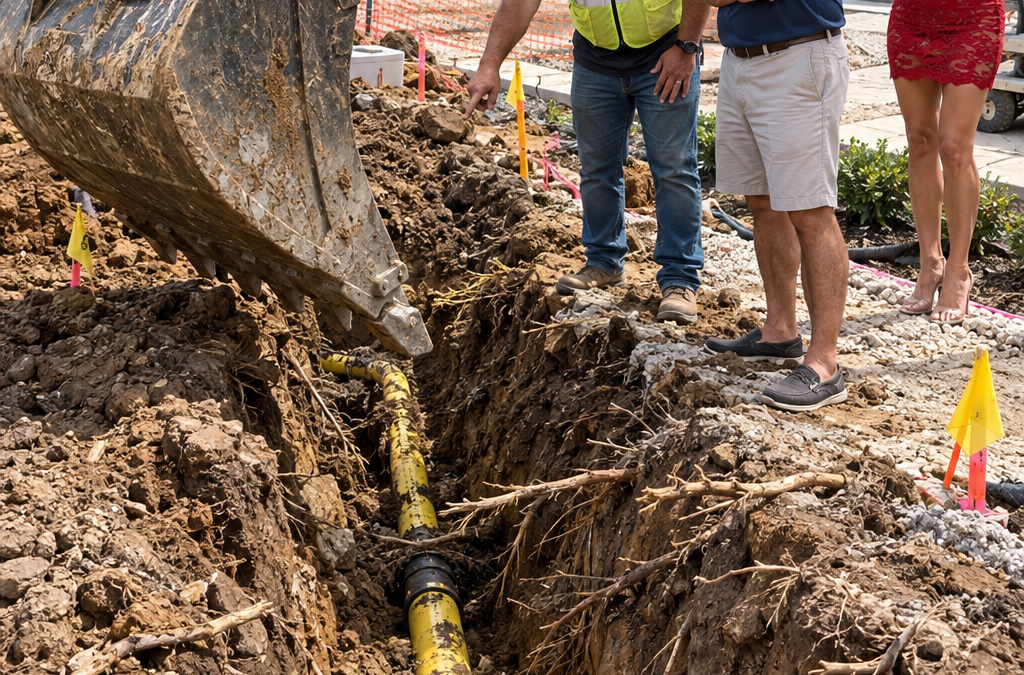
Something yellow was visible in the soil.
Not marking paint.
Not warning tape.
A physical line.
David walked over.
I followed.
Karen came too.
The bucket had peeled away soil near the buried utility.
The line itself appeared intact from where we stood.
But it was exposed.
The operator backed away.
“That’s gas.”
I looked at Karen.
“That is my gas line.”
She said nothing.
David immediately raised his hand.
“Nobody moves equipment.”
Karen finally found her voice.
“We can work around it.”
David turned toward her.
“No.”
“It hasn’t ruptured.”
“We don’t know that.”
“It’s clearly intact.”
“You can’t tell that from here.”
He pulled out his phone.
Karen stepped toward him.
“Who are you calling?”
“Utility emergency contact.”
“You don’t need to create a panic.”
He stared at her.
“A buried gas line has been exposed by excavation.”
“Exposed is not damaged.”
“Maybe.”
He dialed anyway.
For the first time that day, Karen stopped trying to control the crew.
I think that was when she understood the argument had changed.
Before the yellow line appeared, she believed this was another property dispute.
Mark versus HOA.
Survey versus development map.
Private land versus community project.
Now the line was visible.
Gas didn’t care about HOA politics.
David gave dispatch the location.
Explained the excavation.
Specified that the line appeared exposed but not obviously severed.
The person on the phone asked questions.
Line pressure.
Distance to structures.
Whether anyone smelled gas.
Whether there was hissing.
None.
Good.
Still not enough.
David ended the call.
“Utility emergency team is coming.”
Karen folded her arms.
“Fine.”
David looked at her.
“We’re clearing the immediate site.”
Her expression changed.
“What?”
“No one works near the trench.”
“We have crews all over the pool deck.”
“Not anymore.”
“You’re shutting down the entire site over an intact line?”
He stared at her.
“Until professionals tell us it’s safe, yes.”
Karen’s face reddened.
“You cannot shut down my clubhouse.”
I almost laughed at the phrase.
My clubhouse.
Not Pine Ridge’s.
Not the community’s.
Hers.
David remained calm.
“I’m shutting down work near a potential gas hazard.”
“This is absurd.”
A foreman approached.
“David?”
“Clear excavation crews. Move equipment back. No ignition sources near the trench.”
The foreman nodded.
Karen stepped between them.
“Hold on.”
Neither listened.
Workers began moving.
Engines farther away shut down.
Power tools stopped.
The excavator sat silent.
The open trench suddenly became the center of everyone’s attention.
Then emergency responders arrived.
First the gas utility crew.
Two trucks.
Specialized detection equipment.
Then fire department personnel.
Then a county utility inspector.
Karen watched from beside the pool fence.
The utility supervisor introduced himself.
“Where’s the exposure?”
David showed him.
“Anyone strike the line?”
“Not knowingly.”
“Bucket contact?”
“We don’t know.”
The supervisor’s expression tightened.
“Everyone farther back.”
We moved.
He and a technician approached with detection equipment.
Karen started explaining.
“This is part of an HOA construction project. The line wasn’t shown correctly on our—”
The supervisor held up one hand.
“I need the site quiet.”
Karen stopped.
That alone was worth remembering.
A technician tested around the trench.
Then nearby soil.
Then utility entry points.
The fire captain arrived.
“What’s the closest occupied structure?”
Everyone turned toward the clubhouse.
Maybe seventy yards away.
The captain looked at the building.
“Clear it.”
Karen stared.
“What?”
“Clear the clubhouse.”
“That building is nowhere near the trench.”
“Underground gas can migrate.”
“There is no evidence of a leak.”
“And until we establish that, I’m not keeping people inside.”
Karen stepped toward him.
“We have residents in there.”
“Not for long.”
“You’re evacuating a six-million-dollar facility because a pipe is visible?”
The captain looked at her.
“I don’t care what the building cost.”
That ended the conversation.
Staff moved through the clubhouse.
Gym cleared.
Meeting rooms emptied.
Kitchen staff sent outside.
Residents in the lounge directed toward the parking area.
A yoga class came out carrying mats.
Two people from the board walked outside still holding coffee.
One woman asked Karen what was happening.
Karen said, “Routine utility inspection.”
I looked at her.
She saw me.
I didn’t say anything.
The building kept emptying.
Within ten minutes, the clubhouse that Karen had spent months treating like a palace was nearly vacant.
Six million dollars of stone, glass, polished wood, fitness equipment, meeting rooms, and luxury amenities sat silent because someone had failed to account properly for a buried gas line.
The pool expansion stopped completely.
The excavator remained beside the trench.
Bucket raised.
Engine off.
Nobody touched anything.
Inspectors started with the excavation.
Then utility entry points.
Then the clubhouse.
They used gas detection equipment inside mechanical spaces.
Utility chases.
Lower-level rooms.
Drain areas.
Any place gas might accumulate or migrate.
Residents waited in the parking lot.
Karen paced.
She called someone.
Then someone else.
Probably lawyers.
Board members.
Project managers.
Maybe everyone.
I stayed near my truck.
David joined me.
“You were right.”
I shook my head.
“Not yet.”
He looked toward the crews.
“The line is where your survey showed.”
“That part I knew.”
He rubbed his forehead.
“How did this get missed?”
“Good question.”
Karen heard.
She came over.
“It wasn’t missed.”
David looked at her.
“What?”
“The construction plan showed a utility corridor.”
“Wrong location.”
“No.”
She pointed toward my survey.
“His drawing conflicts with the project map.”
I stared at her.
“The pipe is physically in the ground.”
“That doesn’t establish who owns the corridor.”
David actually laughed.
Not loudly.
More disbelief than humor.
“Karen, the line is exactly where his utility record shows.”
She looked at him.
“We don’t know that yet.”
The county inspector called us over.
Karen arrived first.
He had several drawings spread across the hood of a utility truck.
“Who has the property records?”
I handed him mine.
Original survey.
Utility installation record.
Current parcel map.
He studied them.
Then compared them to the HOA construction set.
The discrepancy was obvious.
The gas route on the original utility record crossed the area the HOA had excavated.
The construction plan showed the route elsewhere.
Wrong.
The inspector traced the line with his finger.
“This utility was installed when?”
I gave him the year.
He looked at Karen.
“When was the clubhouse expansion designed?”
She answered.
Years later.
He nodded.
“So the gas infrastructure predates the project.”
“Yes.”
Karen interrupted.
“But the utility corridor is within the HOA development area.”
The inspector looked toward me.
“Whose parcel is this?”
I showed the boundary.
He compared.
Then looked toward Karen.
“The excavation crosses this parcel.”
Her expression hardened.
“We dispute that.”
I stared at her.
“Still?”
She ignored me.
The inspector looked toward the construction plans.
“Where’s your site boundary verification?”
David produced the project packet.
The inspector reviewed it.
Then the recorded parcel data.
Then the utility map.
His expression changed.
“This work zone was based on the development plan, not the recorded utility alignment.”
Karen said, “The project engineer approved it.”
“Approval doesn’t make the underlying data correct.”
“Everyone signed off.”
“Somebody didn’t account for this line.”
She folded her arms.
“Then the line should have been relocated.”
I looked at her.
“By whom?”
Karen turned.
“What?”
“Who should have relocated it?”
“The utility owner.”
“Who was never contacted.”
She paused.
I continued.
“Who wasn’t asked.”
Silence.
“Who never gave permission.”
Karen’s face tightened.
“You’re making this personal.”
I laughed softly.
“You dug around a gas line on my property.”
She stared at me.
“It became personal before I arrived.”
The utility supervisor returned.
“No elevated readings inside the building so far.”
The fire captain nodded.
“Good.”
Karen immediately stepped forward.
“Then we can reopen.”
“No.”
Her expression dropped.
“We’re continuing checks.”
“How long?”
“Until we’re finished.”
“You’ve already tested.”
“We’re verifying.”
Karen looked toward the residents standing outside.
“This is costing us money.”
The captain looked at her.
“Safety isn’t billed by your schedule.”
I almost admired him.
The inspection continued.
Technicians tested around the trench.
They checked whether the line had been scraped.
Measured exposure.
Inspected coatings.
Verified location.
Then they traced the line farther in both directions.
The yellow utility route matched my records almost exactly.
That was the part Karen could no longer dismiss.
The physical line didn’t care what her development plan showed.
The county inspector marked the original utility route over the clubhouse site plan.
The two documents looked like a mistake waiting to happen.
Pool expansion trench.
Gas line.
Same space.
I stood beside David.
“Who approved excavation?”
He shook his head.
“Project management assumed utility conflict had been cleared.”
“Assumed.”
“Yes.”
Karen heard us.
She came over.
“I assumed the corridor had been cleared because the plans were approved.”
I looked at her.
There it was.
Finally.
Not total accountability.
But something close.
“You assumed.”
“Yes.”
“That’s the problem.”
“I was relying on professionals.”
“So was I when I brought you the survey.”
She looked away.
I continued.
“Assumptions aren’t recorded property rights.”
“I understand that now.”
“Do you?”
Her eyes narrowed.
“I just admitted it.”
“You also kept telling workers to dig after I showed you the line.”
“That was before it was exposed.”
“That makes it worse.”
She stared at me.
“How?”
“Because documents were enough to stop.”
I pointed toward the trench.
“You waited until the ground proved it.”
She didn’t answer.
By midafternoon, the clubhouse remained closed.
Residents became increasingly annoyed.
Rumors spread.
Someone said the gas line had ruptured.
It hadn’t.
Another said the entire clubhouse might explode.
Also not true.
Another claimed the pool project had been built on my land.
Partly true, but not exactly the issue under immediate investigation.
The official problem was simpler.
Excavation had occurred where existing gas infrastructure should have been identified and protected.
Potential contact required inspection.
That inspection required a safety response.
A safety response didn’t care about Karen’s opening date.
The construction crew lost the entire day.
Possibly more.
Equipment rental.
Labor.
Inspection costs.
Engineering review.
Potential redesign.
Karen knew the numbers were climbing.
Every hour made her more agitated.
At one point, she pulled David aside.
I could hear enough to understand.
“We need this reopened today.”
“I don’t control that.”
“Call them.”
“They’re already here.”
“Tell them we need clearance.”
David stared at her.
“They know.”
“We have an event Saturday.”
“Cancel it if necessary.”
Her expression turned furious.
“You don’t cancel a donor event because of a utility review.”
David looked toward the trench.
“You do if the building isn’t cleared.”
Karen lowered her voice.
“This makes the board look incompetent.”
David’s answer was quiet.
“I’m more concerned about looking alive.”
She walked away.
By late afternoon, utility inspectors determined there was no confirmed gas release into the clubhouse.
That was the good news.
The line itself had been exposed but not catastrophically ruptured.
However, the utility company still required a detailed inspection of the exposed section.
Construction could not resume within the area.
The clubhouse could reopen only after the fire department and utility personnel completed their checks.
Karen tried to spin it immediately.
She told residents there had been “no actual emergency.”
The county inspector corrected her in front of everyone.
“There was a potential utility hazard requiring evaluation.”
Karen smiled tightly.
“But no gas leak.”
“No confirmed migration.”
“That’s what I said.”
“No.”
He looked at her.
“You said no emergency.”
The parking lot went silent.
He continued.
“Unauthorized or improperly planned excavation near natural-gas infrastructure is treated seriously for a reason.”
That was the moment Karen stopped talking.
Again.
The clubhouse received conditional clearance that evening.
The construction area did not.
Pool work remained suspended.
The next morning, engineers arrived.
So did utility planners.
The entire site plan was reviewed.
Not just the trench.
The utility corridor.
Property boundary.
Pool expansion footprint.
Drainage.
Electrical.
Water.
Gas.
Everything.
Nobody wanted another surprise buried under six million dollars of amenities.
I attended with my attorney.
Karen arrived late.
No red dress this time.
Jeans.
Boots.
White blouse.
That told me how serious things had become.
She looked exhausted.
The project engineer spread revised drawings across a table.
“We have two problems.”
Karen crossed her arms.
“Only two?”
He ignored the sarcasm.
“First, the utility route on the construction set does not match the recorded gas installation.”
I nodded.
“Second?”
“The excavation corridor overlaps private property.”
Karen’s face hardened.
“How much?”
He showed her.
The pool expansion itself could remain mostly within Pine Ridge land.
But part of the proposed utility trench and service area crossed my parcel.
That meant the project had not only ignored the gas line.
It had also treated my land as if it were available for construction.
I looked at Karen.
“Still think the HOA owns the corridor?”
She didn’t answer.
The engineer continued.
“We need a revised alignment.”
“How long?”
“Depends on utility coordination.”
“How much delay?”
“Unknown.”
Karen closed her eyes briefly.
The six-million-dollar clubhouse had already been completed.
The pool expansion was supposed to be a relatively simple addition.
Now it required redesign because the original plan had buried two bad assumptions.
Wrong utility route.
Wrong usable boundary.
The engineer proposed shifting the trench east.
Avoiding my parcel.
Maintaining required clearance from the gas line.
Relocating some pool equipment.
Adjusting drainage.
Expensive.
Annoying.
Possible.
Karen asked, “Can Mark grant temporary access instead?”
Everyone looked at me.
“No.”
She glared.
“You didn’t even ask what for.”
“I know enough.”
“It could reduce the delay.”
“No.”
“You’re punishing the entire community.”
I stared at her.
“Your project excavated around my gas service without permission.”
“No one intentionally endangered anything.”
“That isn’t the standard.”
Her jaw tightened.
“We made a planning error.”
“Correct it.”
She looked toward the engineer.
“Can we route around?”
“Yes.”
“Then do it.”
That was the last time Karen argued about ownership on that project.
The revised plan took several weeks.
The utility company marked the corridor clearly.
New locate documentation was produced.
Survey stakes established the boundary.
The pool-service trench shifted east.
Protective clearance was maintained around the gas line.
The section disturbed on my property was restored.
Everything went through additional review.
Slow.
Expensive.
Correct.
The clubhouse reopened fully after the safety inspection.
Residents returned.
Fitness classes resumed.
Meetings restarted.
Karen rescheduled her donor event.
The pool construction eventually continued.
For the rest of the project, utility markings appeared everywhere.
Bright paint.
Flags.
Warning tape.
Survey stakes.
No one dug anywhere without asking questions first.
I joked with David that the site looked like a utility-awareness convention.
He laughed.
“Better than another evacuation.”
“No argument.”
The pool finished later than planned.
Karen hated the delay.
The residents didn’t care much once summer arrived.
Kids swam.
Families used the deck.
The clubhouse looked beautiful.
Nobody standing beside the pool could see the argument beneath it.
That’s often how construction works.
People see the finished surface.
Concrete.
Tile.
Landscaping.
Water.
They don’t see the utility coordination, surveys, permits, conflicts, corrections, and mistakes hidden underneath.
In this case, one of those mistakes almost became far more serious.
I kept the original construction plan.
A copy, anyway.
The one showing the trench crossing through the wrong area.
I kept it beside my utility survey.
Two drawings.
Two different versions of the same ground.
One was based on recorded infrastructure.
The other was based on what the project team had assumed.
Reality chose the first.
It always does eventually.
Karen remained HOA president through the end of that year.
The gas-line incident damaged her reputation.
Not because a catastrophic accident happened.
It didn’t.
That was important.
No explosion.
No injuries.
No destroyed clubhouse.
The utility response worked.
The workers stopped.
The inspection happened.
The building was cleared.
That was the correct outcome.
What damaged Karen was the reason it happened.
Residents learned she had insisted construction continue even after I brought documentation showing a gas line and property-boundary conflict.
David’s account became known.
So did the operator’s.
The board began asking questions.
Had Karen been pushing schedules over safety?
Why had the utility documentation not been reconciled?
Why had property ownership not been confirmed?
Who signed off?
Karen blamed consultants.
Consultants blamed incomplete source information.
The engineering company pointed to the HOA’s development base map.
The HOA pointed to contractor review.
Everyone pointed somewhere.
The board eventually ordered a full project audit.
The conclusion was less dramatic than rumors suggested.
No conspiracy.
No secret corruption.
Just sloppy assumptions, poor coordination, pressure to maintain schedule, and a president too arrogant to stop when challenged.
Sometimes that’s all disaster needs.
At the next annual election, Karen faced opposition.
Susan ran.
David publicly supported her.
Residents remembered the evacuation.
Karen lost.
Not overwhelmingly.
But clearly.
Susan became HOA president.
Her first major policy required independent boundary verification and current utility-location confirmation before any HOA project involving excavation near private parcels.
I attended the meeting where it passed.
Susan looked at me.
“Any comment?”
“Yes.”
Everyone waited.
“Good rule.”
People laughed.
Karen didn’t.
She sat in the back.
Red lace dress again.
Apparently retirement from leadership had not changed her wardrobe.
After the meeting, she approached me.
“Happy?”
I looked at her.
“About what?”
“You got what you wanted.”
“I wanted you to stop digging around my gas line.”
“That happened.”
“Yes.”
“So?”
“So I’m good.”
She folded her arms.
“You made me look reckless.”
I stared at her.
“You ordered them to keep excavating after I showed you the survey.”
“I trusted our approved plans.”
“You trusted the document that told you what you wanted to hear.”
Her eyes narrowed.
“That’s unfair.”
“Maybe.”
I looked toward the clubhouse.
“But the gas line didn’t move because your plan said it should be somewhere else.”
She said nothing.
I continued.
“That’s the part you never understood.”
“What?”
“Reality doesn’t negotiate with authority.”
For once, she had no comeback.
She walked away.
A year later, the clubhouse pool needed maintenance.
A contractor discovered a valve issue near the service trench.
Before anyone touched a shovel, they contacted the utility company.
They pulled the revised records.
Marked the gas corridor.
Verified the boundary.
Then worked.
Nobody called me.
Nobody needed to.
The system finally worked the way it should.
That felt like victory.
Not Karen losing an election.
Not her standing outside the evacuated clubhouse looking furious.
Not the construction delay.
The real victory was boring.
A contractor checked before digging.
That was all.
People sometimes ask why I didn’t sue Pine Ridge.
I considered it.
My attorney considered it.
The excavation crossed my property.
There were costs.
Restoration.
Professional review.
Legal fees.
The HOA ultimately covered those costs through settlement and project correction.
I could have pushed farther.
I didn’t.
I wanted the line protected.
The land restored.
The utility corridor documented.
That happened.
Litigation isn’t a hobby.
At least it shouldn’t be.
The best outcome was not destroying the HOA.
It was making sure nobody ever repeated the same mistake.
The gas line remained exactly where it had always been.
The clubhouse remained.
The pool remained.
My property remained mine.
Nobody had to lose everything.
They just had to respect what was already there.
That lesson mattered because Karen had viewed the problem backward.
To her, the new clubhouse project was the central fact.
Everything older had to adapt.
Old boundary?
Move around the clubhouse.
Existing gas line?
Relocate it.
Private property?
Treat it as utility corridor.
Ranch use?
Secondary.
But land doesn’t work according to whichever project happens to be newest and most expensive.
Existing rights matter.
Existing infrastructure matters.
Recorded utilities matter.
You don’t get to erase them because a new set of architectural drawings looks cleaner.
My father installed that gas line years before Pine Ridge built its clubhouse.
I remember the work.
I was younger then.
We had contractors on the property for days.
My father kept asking them to verify depth.
Route.
Valves.
Access.
I joked that he worried too much.
He said something I didn’t appreciate until years later.
“Once this is underground, people forget it exists.”
He was right.
Grass grew.
Years passed.
Pine Ridge expanded.
New people arrived.
Maps changed.
The gas line disappeared from sight.
But underground isn’t the same as nonexistent.
That’s true of utilities.
Property records.
Easements.
Old agreements.
All kinds of things.
People build new plans on top of old facts and assume what’s unseen no longer matters.
Then an excavator exposes it.
The most vivid memory from that day isn’t Karen shouting.
It isn’t the sheriff.
There wasn’t one.
It isn’t some explosion because, thankfully, there wasn’t one of those either.
It’s the excavator operator climbing out of his cab the moment he saw yellow.
He understood immediately.
No debate.
No ego.
No HOA politics.
He saw a gas line and stopped.
That simple decision protected everyone.
I thanked him later.
His name was Miguel.
He looked confused when I did.
“I just stopped the machine.”
“Exactly.”
He shrugged.
“Anybody would.”
I looked toward the clubhouse.
“Not everybody.”
He laughed.
Months later, I ran into David at a hardware store.
He was buying conduit.
I was buying fencing staples.
He saw me.
“Gas line guy.”
I smiled.
“Pool guy.”
We shook hands.
“How’s the clubhouse?”
“Still standing.”
“Good.”
“How’s the line?”
“Still underground.”
“Better.”
He became serious.
“I should’ve stopped the work sooner.”
“You did stop it.”
“After the operator exposed it.”
“You questioned the plans before that.”
“Not enough.”
I nodded.
“That’s fair.”
He looked uncomfortable.
Then I said, “You learned.”
“So did everyone.”
That was true.
Pine Ridge started posting utility diagrams with every major capital project.
Contractors attended pre-excavation meetings.
Survey verification became standard.
Susan even invited utility representatives to review planned work near subdivision boundaries.
Karen used to call that bureaucracy.
I called it cheaper than evacuating a six-million-dollar clubhouse.
The old trench disappeared.
Topsoil restored.
Grass regrew.
Pool landscaping covered the revised construction path.
If you visit Pine Ridge today, you’d never know anything happened.
People walk from the clubhouse to the pool carrying towels.
Children run barefoot across the deck.
Residents grill outside.
Nobody looks toward the ground wondering where the gas line sits.
They don’t need to.
Someone finally documented it correctly.
I still know where it is.
Every foot.
I have the updated digital records.
Hard copies too.
One set in my office.
One with my attorney.
One with the utility company.
Maybe that sounds excessive.
It doesn’t to me anymore.
Because I watched a project team armed with permits, architects, engineers, contractors, and millions of dollars dig across it as though it didn’t exist.
I also keep one photograph from the evacuation.
Not for revenge.
The clubhouse parking lot is full.
Residents are standing outside.
Fire crew near the entrance.
Utility trucks beside the excavation.
The pool project silent.
And Karen stands near the curb in her red lace dress looking toward the trench.
You can see the exact moment she understands this is no longer a fight she can win by speaking louder.
The photograph reminds me of something important.
Authority has limits.
Plans have limits.
Confidence has limits.
Physics doesn’t.
Natural gas doesn’t care that the HOA voted unanimously.
A buried line doesn’t move because the clubhouse cost six million dollars.
A property boundary doesn’t disappear because a project schedule is inconvenient.
And an excavator bucket doesn’t ask whether Karen thinks the map is right.
That’s why the check has to happen before the digging.
Not after.
Before.
Before the trench.
Before the concrete.
Before the pool.
Before residents are standing in a parking lot waiting for gas detectors to clear the building.
The revised construction plans now show the utility corridor in bold.
The boundary is clearly marked.
There is almost no chance anyone could repeat the same mistake without deliberately ignoring the drawings.
I like that.
Clarity is valuable.
My family property remains outside Pine Ridge.
The gas infrastructure remains protected.
The clubhouse operates.
The pool exists.
And every side ended up with what it was legally entitled to.
That might not be the explosive ending people expect from an HOA story.
No one went to prison.
Nobody lost the clubhouse.
The project wasn’t destroyed.
Karen wasn’t dragged away in handcuffs.
Instead, a bad plan met a hard fact.
The project stopped.
Professionals checked the danger.
The building was evacuated.
Records were compared.
The plan was corrected.
Then construction resumed safely.
That’s what accountability looks like when everyone is lucky enough to catch the mistake before someone gets hurt.
I consider us very lucky.
Karen spent months afterward acting as though the evacuation had been an embarrassing overreaction.
I disagreed then.
I disagree now.
I’d rather stand outside a six-million-dollar clubhouse for ten hours unnecessarily than sit inside one for ten seconds when gas has migrated somewhere nobody expected.
Safety sometimes looks inconvenient right up until the day inconvenience saves somebody.
The original pool opening was delayed.
Karen hated that.
The new opening happened later in the summer.
Susan invited me.
I almost didn’t go.
Then I decided I should.
The pool looked good.
Families everywhere.
Music.
Food.
Kids jumping into the water.
Susan stood beside me.
“Worth the trouble?”
I looked around.
“For you?”
She laughed.
“For everybody.”
I looked toward the revised utility corridor, now hidden beneath finished landscaping.
“Yes.”
She nodded.
“Karen would hate hearing that.”
“Why?”
“Because it suggests stopping the project was part of making it successful.”
I smiled.
“She never liked stopping.”
“No.”
“That was the problem.”
A few minutes later, I walked toward the edge of the property.
The boundary marker remained exactly where it had been before the first shovel touched dirt.
Small.
Metal.
Easy to overlook.
Just like the gas line had been.
I looked back at the clubhouse.
Six million dollars.
Stone.
Glass.
Pool.
Landscaping.
Then down at the survey marker.
Maybe twenty dollars of metal.
One mattered more than the other when deciding where construction could legally happen.
That still makes me smile.
Karen believed expensive projects created authority.
They don’t.
They create expense.
Authority comes from actual rights.
And safety comes from knowing what’s under the ground before you put a machine into it.
That day, Pine Ridge thought it was simply digging a trench for a pool expansion.
Then the bucket uncovered the yellow line they had never properly accounted for.
Suddenly, the project stopped.
The utility company took over the site.
Emergency responders cleared the clubhouse.
Gas detectors moved through a six-million-dollar building while residents waited outside.
And every person on that construction site finally understood what I had been trying to tell Karen from the moment I unfolded my survey.
The line was already there.
The property boundary was already there.
The records were already there.
All they had to do was look before they dug.
𝗧𝗛𝗘 𝗘𝗡𝗗
The HOA President Ordered Them to Keep Digging for Her $6 Million Clubhouse Until the Excavator Exposed My Gas Line
The excavator bucket stopped less than three feet from a yellow gas line that had been buried on my property for years.
That was the first moment Karen stopped talking.
Until then, she had been shouting.
At me.
At the superintendent.
At anyone who hesitated.
“Keep digging!” she snapped. “The HOA owns this corridor!”
I stood at the edge of the trench staring down at exposed soil, ripped roots, and the bright yellow utility marker running through the excavation.
Then I looked at Karen.
“That is my gas line.”
For the first time since I had arrived at the construction site, her face went still.
Behind us stood Pine Ridge’s new clubhouse—a six-million-dollar stone-and-glass building the HOA had spent two years bragging about.
In front of it, workers were expanding the pool deck.
At least that had been the plan.
Now an excavator sat frozen beside an open trench that crossed straight through my property and dangerously close to buried natural-gas infrastructure nobody on Karen’s construction team seemed to have accounted for correctly.
The operator killed the engine.
Silence settled over the site.
Karen hated silence.
She filled it immediately.
“That line is inside the HOA utility corridor.”
“No.”
I looked down into the trench.
“It isn’t.”
Her eyes flashed.
“Don’t start this again.”
“I’m not starting anything.”
I pointed toward the exposed line.
“Your excavator already did.”
My name is Mark Bennett.
My family had owned the land beside Pine Ridge long before the first decorative entrance sign went up, long before the clubhouse existed, and long before Karen Whitmore decided a homeowners association presidency somehow gave her control over everything visible from her community.
The trouble with the clubhouse project had started months earlier.
At first, it looked harmless.
Pine Ridge had built a new recreational complex near its western boundary.
Clubhouse.
Gym.
Meeting rooms.
Event hall.
Outdoor kitchen.
Large pool.
The entire project reportedly cost around six million dollars.
Residents loved it.
Karen loved it more.
She treated that building like a monument to herself.
Every HOA newsletter included photographs of her standing beside some new feature.
Karen at the ribbon cutting.
Karen beside the fireplace.
Karen inspecting landscaping.
Karen smiling beside the pool.
Always dressed the same way.
Forty years old.
Blonde.
Beautiful.
Perfect makeup.
And the red lace dress.
Tight.
Low-cut.
Designed to emphasize a very full figure.
Completely ridiculous at a construction site.
Karen knew people noticed.
She used that.
Around contractors she wanted to impress, she became charming.
Around board members who questioned her, flirtatious.
Around residents who resisted her, cold and vicious.
I had seen every version.
That afternoon, she had arrived at the excavation wearing the red dress beneath a white blazer, sunglasses pushed into her hair, and the expression of someone who had already decided everyone else was wrong.
I had gone there because my ranch manager called me.
“Mark, there’s an excavator past the west boundary.”
“How far?”
“Looks like thirty or forty feet.”
“Into our parcel?”
“Unless the county moved the property line overnight.”
That was enough.
I drove over.
When I arrived, a trench ran across a strip of land I knew very well.
My father had installed underground utility infrastructure there years before.
The gas service fed several buildings on our side of the property.
We had complete utility drawings.
Recorded easement information.
Survey coordinates.
Everything.
The line had never been a secret.
But the HOA’s pool-expansion plan had apparently been drawn as though the land were empty.
I parked outside the construction fencing and walked toward the site supervisor.
His name was David Mercer.
He had overseen most of the clubhouse project.
David was experienced enough that I immediately knew this wasn’t going to be comfortable for him once he understood what had happened.
“David.”
He looked up.
“Mark.”
“What are you doing on my parcel?”
He glanced toward the trench.
“We’re extending drainage and pool utilities through the west service corridor.”
“There is no HOA service corridor here.”
His expression changed slightly.
“We’re inside the project boundary.”
“No.”
I pointed toward the trench.
“You’re inside mine.”
Before David could answer, Karen appeared.
She had been near the clubhouse entrance talking to two board members.
The moment she saw me, she marched across the site.
“What are you doing here?”
I almost laughed.
“This is my land.”
“No, it isn’t.”
That was her opening line.
Not hello.
Not what’s wrong.
Just denial.
I pulled a folded survey from my truck.
“The boundary runs right through this construction area.”
Karen barely looked.
“The clubhouse plans were approved.”
“Approved plans don’t change property ownership.”
“This is HOA-controlled land.”
“No.”
“You keep saying that as if repetition makes it true.”
I stared at her.
“That’s interesting coming from you.”
David tried to interrupt.
“Maybe we should verify before continuing.”
Karen snapped toward him.
“Verify what?”
“The parcel boundary.”
“It has already been verified.”
“By whom?”
“Our design team.”
David looked toward me.
“Do you have the recorded survey?”
“Yes.”
I opened it.
The western boundary line was clear.
So was the utility route.
Yellow notation.
Buried gas service.
Installed years before Pine Ridge had ever submitted plans for the clubhouse.
David crouched beside the drawing.
Karen stayed standing.
“Those documents are old.”
I looked up.
“So is the gas line.”
“That doesn’t mean your interpretation is correct.”
I pointed toward the excavation.
“Want to keep digging and find out?”
She glared.
“That sounds like a threat.”
“No.”
I folded the paper.
“It’s a warning.”
Karen crossed her arms.
“The HOA has authority over all utility corridors associated with the clubhouse.”
“This isn’t associated with the clubhouse.”
“It crosses the development area.”
“The development area crossed my property.”
“You’re being deliberately obstructive.”
David looked toward the equipment operator.
“Hold excavation.”
Karen immediately turned.
“No.”
He blinked.
“What?”
“Continue.”
“Karen.”
“The board has a schedule.”
“I understand.”
“Then keep working.”
He hesitated.
Karen stepped closer.
“We’re already behind because of weather delays. The pool expansion opens in three weeks.”
David looked toward me.
Then at the survey.
Then at Karen.
“I’m not comfortable digging until we confirm this.”
She lowered her voice.
That was the version of Karen she used when she wanted obedience to look voluntary.
“David.”
She smiled.
“The permits are signed.”
He said nothing.
“The plans are approved.”
Still nothing.
“You’ve worked with us for eighteen months.”
“Yes.”
“Then you know I don’t stop a six-million-dollar project every time Mark shows up waving old paperwork.”
My anger tightened.
“Old paperwork?”
She looked at me.
“Yes.”
“That survey predates your clubhouse because the property does.”
She rolled her eyes.
“Here we go.”
“No.”
I stepped closer to David.
“Show me your utility locate.”
That got his attention.
He glanced toward the trailer.
“What?”
“The gas locate.”
“We had utility marking completed.”
“Show me.”
Karen interrupted.
“You don’t have authority to review project documentation.”
“I have authority to know why you’re excavating over my gas line.”
“That is not your line.”
I laughed once.
“Keep saying it.”
David looked increasingly uneasy.
He walked toward the job trailer.
Karen followed him.
“You don’t need to show him anything.”
“I need to check it myself.”
“You’ve already checked it.”
“I checked the excavation permit.”
“And?”
“I want the actual utility sheets.”
Karen stopped.
Her expression hardened.
“Fine.”
David disappeared inside.
I stood beside the trench.
The excavator operator stayed in his cab.
He looked down at me.
“You know there’s gas here?”
“Yes.”
He immediately climbed out.
That told me everything.
“You weren’t told?”
He shook his head.
“We had marks farther east.”
“How far?”
He pointed.
“Past that retaining wall.”
Nearly thirty feet away.
Wrong.
Very wrong.
David returned carrying plans.
He spread them across a plywood table.
The construction drawing showed the pool-expansion trench.
The utility plan showed a gas route.
But the line on the project drawing sat east of the route on my original survey.
The two documents disagreed.
David frowned.
“This shouldn’t happen.”
Karen stood behind him.
“It’s a drafting difference.”
“No.”
He traced the lines.
“The locate is based on this drawing.”
I put my survey beside it.
“My line is based on recorded utility records.”
Karen scoffed.
“Your records.”
“Yes.”
“Exactly.”
David looked at her.
“What does that mean?”
“He supplied them.”
“They’re official.”
“According to him.”
I took out my phone.
Opened the scanned utility records.
County reference.
Installation date.
Inspection notes.
Coordinates.
David compared them.
His face tightened.
“Karen.”
She sighed.
“What now?”
“This route predates the clubhouse.”
“So?”
“It’s in the work zone.”
“Then reroute it.”
I stared at her.
“You just told him to reroute my gas line?”
“If necessary.”
“Without asking me?”
“The project cannot stop because you refuse to cooperate.”
“It’s my utility.”
“It crosses our construction corridor.”
“No.”
I pointed toward the ground.
“Your construction corridor crosses my property.”
She stepped toward me.
“You are not stopping this project.”
“I’m not the one who designed a pool over a gas line.”
“You’re exaggerating.”
“I hope I am.”
Then the excavator operator called out.
“David.”
Everyone turned.
He had walked toward the trench.
He pointed down.
Something yellow was visible in the soil.
Not marking paint.
Not warning tape.
A physical line.
David walked over.
I followed.
Karen came too.
The bucket had peeled away soil near the buried utility.
The line itself appeared intact from where we stood.
But it was exposed.
The operator backed away.
“That’s gas.”
I looked at Karen.
“That is my gas line.”
She said nothing.
David immediately raised his hand.
“Nobody moves equipment.”
Karen finally found her voice.
“We can work around it.”
David turned toward her.
“No.”
“It hasn’t ruptured.”
“We don’t know that.”
“It’s clearly intact.”
“You can’t tell that from here.”
He pulled out his phone.
Karen stepped toward him.
“Who are you calling?”
“Utility emergency contact.”
“You don’t need to create a panic.”
He stared at her.
“A buried gas line has been exposed by excavation.”
“Exposed is not damaged.”
“Maybe.”
He dialed anyway.
For the first time that day, Karen stopped trying to control the crew.
I think that was when she understood the argument had changed.
Before the yellow line appeared, she believed this was another property dispute.
Mark versus HOA.
Survey versus development map.
Private land versus community project.
Now the line was visible.
Gas didn’t care about HOA politics.
David gave dispatch the location.
Explained the excavation.
Specified that the line appeared exposed but not obviously severed.
The person on the phone asked questions.
Line pressure.
Distance to structures.
Whether anyone smelled gas.
Whether there was hissing.
None.
Good.
Still not enough.
David ended the call.
“Utility emergency team is coming.”
Karen folded her arms.
“Fine.”
David looked at her.
“We’re clearing the immediate site.”
Her expression changed.
“What?”
“No one works near the trench.”
“We have crews all over the pool deck.”
“Not anymore.”
“You’re shutting down the entire site over an intact line?”
He stared at her.
“Until professionals tell us it’s safe, yes.”
Karen’s face reddened.
“You cannot shut down my clubhouse.”
I almost laughed at the phrase.
My clubhouse.
Not Pine Ridge’s.
Not the community’s.
Hers.
David remained calm.
“I’m shutting down work near a potential gas hazard.”
“This is absurd.”
A foreman approached.
“David?”
“Clear excavation crews. Move equipment back. No ignition sources near the trench.”
The foreman nodded.
Karen stepped between them.
“Hold on.”
Neither listened.
Workers began moving.
Engines farther away shut down.
Power tools stopped.
The excavator sat silent.
The open trench suddenly became the center of everyone’s attention.
Then emergency responders arrived.
First the gas utility crew.
Two trucks.
Specialized detection equipment.
Then fire department personnel.
Then a county utility inspector.
Karen watched from beside the pool fence.
The utility supervisor introduced himself.
“Where’s the exposure?”
David showed him.
“Anyone strike the line?”
“Not knowingly.”
“Bucket contact?”
“We don’t know.”
The supervisor’s expression tightened.
“Everyone farther back.”
We moved.
He and a technician approached with detection equipment.
Karen started explaining.
“This is part of an HOA construction project. The line wasn’t shown correctly on our—”
The supervisor held up one hand.
“I need the site quiet.”
Karen stopped.
That alone was worth remembering.
A technician tested around the trench.
Then nearby soil.
Then utility entry points.
The fire captain arrived.
“What’s the closest occupied structure?”
Everyone turned toward the clubhouse.
Maybe seventy yards away.
The captain looked at the building.
“Clear it.”
Karen stared.
“What?”
“Clear the clubhouse.”
“That building is nowhere near the trench.”
“Underground gas can migrate.”
“There is no evidence of a leak.”
“And until we establish that, I’m not keeping people inside.”
Karen stepped toward him.
“We have residents in there.”
“Not for long.”
“You’re evacuating a six-million-dollar facility because a pipe is visible?”
The captain looked at her.
“I don’t care what the building cost.”
That ended the conversation.
Staff moved through the clubhouse.
Gym cleared.
Meeting rooms emptied.
Kitchen staff sent outside.
Residents in the lounge directed toward the parking area.
A yoga class came out carrying mats.
Two people from the board walked outside still holding coffee.
One woman asked Karen what was happening.
Karen said, “Routine utility inspection.”
I looked at her.
She saw me.
I didn’t say anything.
The building kept emptying.
Within ten minutes, the clubhouse that Karen had spent months treating like a palace was nearly vacant.
Six million dollars of stone, glass, polished wood, fitness equipment, meeting rooms, and luxury amenities sat silent because someone had failed to account properly for a buried gas line.
The pool expansion stopped completely.
The excavator remained beside the trench.
Bucket raised.
Engine off.
Nobody touched anything.
Inspectors started with the excavation.
Then utility entry points.
Then the clubhouse.
They used gas detection equipment inside mechanical spaces.
Utility chases.
Lower-level rooms.
Drain areas.
Any place gas might accumulate or migrate.
Residents waited in the parking lot.
Karen paced.
She called someone.
Then someone else.
Probably lawyers.
Board members.
Project managers.
Maybe everyone.
I stayed near my truck.
David joined me.
“You were right.”
I shook my head.
“Not yet.”
He looked toward the crews.
“The line is where your survey showed.”
“That part I knew.”
He rubbed his forehead.
“How did this get missed?”
“Good question.”
Karen heard.
She came over.
“It wasn’t missed.”
David looked at her.
“What?”
“The construction plan showed a utility corridor.”
“Wrong location.”
“No.”
She pointed toward my survey.
“His drawing conflicts with the project map.”
I stared at her.
“The pipe is physically in the ground.”
“That doesn’t establish who owns the corridor.”
David actually laughed.
Not loudly.
More disbelief than humor.
“Karen, the line is exactly where his utility record shows.”
She looked at him.
“We don’t know that yet.”
The county inspector called us over.
Karen arrived first.
He had several drawings spread across the hood of a utility truck.
“Who has the property records?”
I handed him mine.
Original survey.
Utility installation record.
Current parcel map.
He studied them.
Then compared them to the HOA construction set.
The discrepancy was obvious.
The gas route on the original utility record crossed the area the HOA had excavated.
The construction plan showed the route elsewhere.
Wrong.
The inspector traced the line with his finger.
“This utility was installed when?”
I gave him the year.
He looked at Karen.
“When was the clubhouse expansion designed?”
She answered.
Years later.
He nodded.
“So the gas infrastructure predates the project.”
“Yes.”
Karen interrupted.
“But the utility corridor is within the HOA development area.”
The inspector looked toward me.
“Whose parcel is this?”
I showed the boundary.
He compared.
Then looked toward Karen.
“The excavation crosses this parcel.”
Her expression hardened.
“We dispute that.”
I stared at her.
“Still?”
She ignored me.
The inspector looked toward the construction plans.
“Where’s your site boundary verification?”
David produced the project packet.
The inspector reviewed it.
Then the recorded parcel data.
Then the utility map.
His expression changed.
“This work zone was based on the development plan, not the recorded utility alignment.”
Karen said, “The project engineer approved it.”
“Approval doesn’t make the underlying data correct.”
“Everyone signed off.”
“Somebody didn’t account for this line.”
She folded her arms.
“Then the line should have been relocated.”
I looked at her.
“By whom?”
Karen turned.
“What?”
“Who should have relocated it?”
“The utility owner.”
“Who was never contacted.”
She paused.
I continued.
“Who wasn’t asked.”
Silence.
“Who never gave permission.”
Karen’s face tightened.
“You’re making this personal.”
I laughed softly.
“You dug around a gas line on my property.”
She stared at me.
“It became personal before I arrived.”
The utility supervisor returned.
“No elevated readings inside the building so far.”
The fire captain nodded.
“Good.”
Karen immediately stepped forward.
“Then we can reopen.”
“No.”
Her expression dropped.
“We’re continuing checks.”
“How long?”
“Until we’re finished.”
“You’ve already tested.”
“We’re verifying.”
Karen looked toward the residents standing outside.
“This is costing us money.”
The captain looked at her.
“Safety isn’t billed by your schedule.”
I almost admired him.
The inspection continued.
Technicians tested around the trench.
They checked whether the line had been scraped.
Measured exposure.
Inspected coatings.
Verified location.
Then they traced the line farther in both directions.
The yellow utility route matched my records almost exactly.
That was the part Karen could no longer dismiss.
The physical line didn’t care what her development plan showed.
The county inspector marked the original utility route over the clubhouse site plan.
The two documents looked like a mistake waiting to happen.
Pool expansion trench.
Gas line.
Same space.
I stood beside David.
“Who approved excavation?”
He shook his head.
“Project management assumed utility conflict had been cleared.”
“Assumed.”
“Yes.”
Karen heard us.
She came over.
“I assumed the corridor had been cleared because the plans were approved.”
I looked at her.
There it was.
Finally.
Not total accountability.
But something close.
“You assumed.”
“Yes.”
“That’s the problem.”
“I was relying on professionals.”
“So was I when I brought you the survey.”
She looked away.
I continued.
“Assumptions aren’t recorded property rights.”
“I understand that now.”
“Do you?”
Her eyes narrowed.
“I just admitted it.”
“You also kept telling workers to dig after I showed you the line.”
“That was before it was exposed.”
“That makes it worse.”
She stared at me.
“How?”
“Because documents were enough to stop.”
I pointed toward the trench.
“You waited until the ground proved it.”
She didn’t answer.
By midafternoon, the clubhouse remained closed.
Residents became increasingly annoyed.
Rumors spread.
Someone said the gas line had ruptured.
It hadn’t.
Another said the entire clubhouse might explode.
Also not true.
Another claimed the pool project had been built on my land.
Partly true, but not exactly the issue under immediate investigation.
The official problem was simpler.
Excavation had occurred where existing gas infrastructure should have been identified and protected.
Potential contact required inspection.
That inspection required a safety response.
A safety response didn’t care about Karen’s opening date.
The construction crew lost the entire day.
Possibly more.
Equipment rental.
Labor.
Inspection costs.
Engineering review.
Potential redesign.
Karen knew the numbers were climbing.
Every hour made her more agitated.
At one point, she pulled David aside.
I could hear enough to understand.
“We need this reopened today.”
“I don’t control that.”
“Call them.”
“They’re already here.”
“Tell them we need clearance.”
David stared at her.
“They know.”
“We have an event Saturday.”
“Cancel it if necessary.”
Her expression turned furious.
“You don’t cancel a donor event because of a utility review.”
David looked toward the trench.
“You do if the building isn’t cleared.”
Karen lowered her voice.
“This makes the board look incompetent.”
David’s answer was quiet.
“I’m more concerned about looking alive.”
She walked away.
By late afternoon, utility inspectors determined there was no confirmed gas release into the clubhouse.
That was the good news.
The line itself had been exposed but not catastrophically ruptured.
However, the utility company still required a detailed inspection of the exposed section.
Construction could not resume within the area.
The clubhouse could reopen only after the fire department and utility personnel completed their checks.
Karen tried to spin it immediately.
She told residents there had been “no actual emergency.”
The county inspector corrected her in front of everyone.
“There was a potential utility hazard requiring evaluation.”
Karen smiled tightly.
“But no gas leak.”
“No confirmed migration.”
“That’s what I said.”
“No.”
He looked at her.
“You said no emergency.”
The parking lot went silent.
He continued.
“Unauthorized or improperly planned excavation near natural-gas infrastructure is treated seriously for a reason.”
That was the moment Karen stopped talking.
Again.
The clubhouse received conditional clearance that evening.
The construction area did not.
Pool work remained suspended.
The next morning, engineers arrived.
So did utility planners.
The entire site plan was reviewed.
Not just the trench.
The utility corridor.
Property boundary.
Pool expansion footprint.
Drainage.
Electrical.
Water.
Gas.
Everything.
Nobody wanted another surprise buried under six million dollars of amenities.
I attended with my attorney.
Karen arrived late.
No red dress this time.
Jeans.
Boots.
White blouse.
That told me how serious things had become.
She looked exhausted.
The project engineer spread revised drawings across a table.
“We have two problems.”
Karen crossed her arms.
“Only two?”
He ignored the sarcasm.
“First, the utility route on the construction set does not match the recorded gas installation.”
I nodded.
“Second?”
“The excavation corridor overlaps private property.”
Karen’s face hardened.
“How much?”
He showed her.
The pool expansion itself could remain mostly within Pine Ridge land.
But part of the proposed utility trench and service area crossed my parcel.
That meant the project had not only ignored the gas line.
It had also treated my land as if it were available for construction.
I looked at Karen.
“Still think the HOA owns the corridor?”
She didn’t answer.
The engineer continued.
“We need a revised alignment.”
“How long?”
“Depends on utility coordination.”
“How much delay?”
“Unknown.”
Karen closed her eyes briefly.
The six-million-dollar clubhouse had already been completed.
The pool expansion was supposed to be a relatively simple addition.
Now it required redesign because the original plan had buried two bad assumptions.
Wrong utility route.
Wrong usable boundary.
The engineer proposed shifting the trench east.
Avoiding my parcel.
Maintaining required clearance from the gas line.
Relocating some pool equipment.
Adjusting drainage.
Expensive.
Annoying.
Possible.
Karen asked, “Can Mark grant temporary access instead?”
Everyone looked at me.
“No.”
She glared.
“You didn’t even ask what for.”
“I know enough.”
“It could reduce the delay.”
“No.”
“You’re punishing the entire community.”
I stared at her.
“Your project excavated around my gas service without permission.”
“No one intentionally endangered anything.”
“That isn’t the standard.”
Her jaw tightened.
“We made a planning error.”
“Correct it.”
She looked toward the engineer.
“Can we route around?”
“Yes.”
“Then do it.”
That was the last time Karen argued about ownership on that project.
The revised plan took several weeks.
The utility company marked the corridor clearly.
New locate documentation was produced.
Survey stakes established the boundary.
The pool-service trench shifted east.
Protective clearance was maintained around the gas line.
The section disturbed on my property was restored.
Everything went through additional review.
Slow.
Expensive.
Correct.
The clubhouse reopened fully after the safety inspection.
Residents returned.
Fitness classes resumed.
Meetings restarted.
Karen rescheduled her donor event.
The pool construction eventually continued.
For the rest of the project, utility markings appeared everywhere.
Bright paint.
Flags.
Warning tape.
Survey stakes.
No one dug anywhere without asking questions first.
I joked with David that the site looked like a utility-awareness convention.
He laughed.
“Better than another evacuation.”
“No argument.”
The pool finished later than planned.
Karen hated the delay.
The residents didn’t care much once summer arrived.
Kids swam.
Families used the deck.
The clubhouse looked beautiful.
Nobody standing beside the pool could see the argument beneath it.
That’s often how construction works.
People see the finished surface.
Concrete.
Tile.
Landscaping.
Water.
They don’t see the utility coordination, surveys, permits, conflicts, corrections, and mistakes hidden underneath.
In this case, one of those mistakes almost became far more serious.
I kept the original construction plan.
A copy, anyway.
The one showing the trench crossing through the wrong area.
I kept it beside my utility survey.
Two drawings.
Two different versions of the same ground.
One was based on recorded infrastructure.
The other was based on what the project team had assumed.
Reality chose the first.
It always does eventually.
Karen remained HOA president through the end of that year.
The gas-line incident damaged her reputation.
Not because a catastrophic accident happened.
It didn’t.
That was important.
No explosion.
No injuries.
No destroyed clubhouse.
The utility response worked.
The workers stopped.
The inspection happened.
The building was cleared.
That was the correct outcome.
What damaged Karen was the reason it happened.
Residents learned she had insisted construction continue even after I brought documentation showing a gas line and property-boundary conflict.
David’s account became known.
So did the operator’s.
The board began asking questions.
Had Karen been pushing schedules over safety?
Why had the utility documentation not been reconciled?
Why had property ownership not been confirmed?
Who signed off?
Karen blamed consultants.
Consultants blamed incomplete source information.
The engineering company pointed to the HOA’s development base map.
The HOA pointed to contractor review.
Everyone pointed somewhere.
The board eventually ordered a full project audit.
The conclusion was less dramatic than rumors suggested.
No conspiracy.
No secret corruption.
Just sloppy assumptions, poor coordination, pressure to maintain schedule, and a president too arrogant to stop when challenged.
Sometimes that’s all disaster needs.
At the next annual election, Karen faced opposition.
Susan ran.
David publicly supported her.
Residents remembered the evacuation.
Karen lost.
Not overwhelmingly.
But clearly.
Susan became HOA president.
Her first major policy required independent boundary verification and current utility-location confirmation before any HOA project involving excavation near private parcels.
I attended the meeting where it passed.
Susan looked at me.
“Any comment?”
“Yes.”
Everyone waited.
“Good rule.”
People laughed.
Karen didn’t.
She sat in the back.
Red lace dress again.
Apparently retirement from leadership had not changed her wardrobe.
After the meeting, she approached me.
“Happy?”
I looked at her.
“About what?”
“You got what you wanted.”
“I wanted you to stop digging around my gas line.”
“That happened.”
“Yes.”
“So?”
“So I’m good.”
She folded her arms.
“You made me look reckless.”
I stared at her.
“You ordered them to keep excavating after I showed you the survey.”
“I trusted our approved plans.”
“You trusted the document that told you what you wanted to hear.”
Her eyes narrowed.
“That’s unfair.”
“Maybe.”
I looked toward the clubhouse.
“But the gas line didn’t move because your plan said it should be somewhere else.”
She said nothing.
I continued.
“That’s the part you never understood.”
“What?”
“Reality doesn’t negotiate with authority.”
For once, she had no comeback.
She walked away.
A year later, the clubhouse pool needed maintenance.
A contractor discovered a valve issue near the service trench.
Before anyone touched a shovel, they contacted the utility company.
They pulled the revised records.
Marked the gas corridor.
Verified the boundary.
Then worked.
Nobody called me.
Nobody needed to.
The system finally worked the way it should.
That felt like victory.
Not Karen losing an election.
Not her standing outside the evacuated clubhouse looking furious.
Not the construction delay.
The real victory was boring.
A contractor checked before digging.
That was all.
People sometimes ask why I didn’t sue Pine Ridge.
I considered it.
My attorney considered it.
The excavation crossed my property.
There were costs.
Restoration.
Professional review.
Legal fees.
The HOA ultimately covered those costs through settlement and project correction.
I could have pushed farther.
I didn’t.
I wanted the line protected.
The land restored.
The utility corridor documented.
That happened.
Litigation isn’t a hobby.
At least it shouldn’t be.
The best outcome was not destroying the HOA.
It was making sure nobody ever repeated the same mistake.
The gas line remained exactly where it had always been.
The clubhouse remained.
The pool remained.
My property remained mine.
Nobody had to lose everything.
They just had to respect what was already there.
That lesson mattered because Karen had viewed the problem backward.
To her, the new clubhouse project was the central fact.
Everything older had to adapt.
Old boundary?
Move around the clubhouse.
Existing gas line?
Relocate it.
Private property?
Treat it as utility corridor.
Ranch use?
Secondary.
But land doesn’t work according to whichever project happens to be newest and most expensive.
Existing rights matter.
Existing infrastructure matters.
Recorded utilities matter.
You don’t get to erase them because a new set of architectural drawings looks cleaner.
My father installed that gas line years before Pine Ridge built its clubhouse.
I remember the work.
I was younger then.
We had contractors on the property for days.
My father kept asking them to verify depth.
Route.
Valves.
Access.
I joked that he worried too much.
He said something I didn’t appreciate until years later.
“Once this is underground, people forget it exists.”
He was right.
Grass grew.
Years passed.
Pine Ridge expanded.
New people arrived.
Maps changed.
The gas line disappeared from sight.
But underground isn’t the same as nonexistent.
That’s true of utilities.
Property records.
Easements.
Old agreements.
All kinds of things.
People build new plans on top of old facts and assume what’s unseen no longer matters.
Then an excavator exposes it.
The most vivid memory from that day isn’t Karen shouting.
It isn’t the sheriff.
There wasn’t one.
It isn’t some explosion because, thankfully, there wasn’t one of those either.
It’s the excavator operator climbing out of his cab the moment he saw yellow.
He understood immediately.
No debate.
No ego.
No HOA politics.
He saw a gas line and stopped.
That simple decision protected everyone.
I thanked him later.
His name was Miguel.
He looked confused when I did.
“I just stopped the machine.”
“Exactly.”
He shrugged.
“Anybody would.”
I looked toward the clubhouse.
“Not everybody.”
He laughed.
Months later, I ran into David at a hardware store.
He was buying conduit.
I was buying fencing staples.
He saw me.
“Gas line guy.”
I smiled.
“Pool guy.”
We shook hands.
“How’s the clubhouse?”
“Still standing.”
“Good.”
“How’s the line?”
“Still underground.”
“Better.”
He became serious.
“I should’ve stopped the work sooner.”
“You did stop it.”
“After the operator exposed it.”
“You questioned the plans before that.”
“Not enough.”
I nodded.
“That’s fair.”
He looked uncomfortable.
Then I said, “You learned.”
“So did everyone.”
That was true.
Pine Ridge started posting utility diagrams with every major capital project.
Contractors attended pre-excavation meetings.
Survey verification became standard.
Susan even invited utility representatives to review planned work near subdivision boundaries.
Karen used to call that bureaucracy.
I called it cheaper than evacuating a six-million-dollar clubhouse.
The old trench disappeared.
Topsoil restored.
Grass regrew.
Pool landscaping covered the revised construction path.
If you visit Pine Ridge today, you’d never know anything happened.
People walk from the clubhouse to the pool carrying towels.
Children run barefoot across the deck.
Residents grill outside.
Nobody looks toward the ground wondering where the gas line sits.
They don’t need to.
Someone finally documented it correctly.
I still know where it is.
Every foot.
I have the updated digital records.
Hard copies too.
One set in my office.
One with my attorney.
One with the utility company.
Maybe that sounds excessive.
It doesn’t to me anymore.
Because I watched a project team armed with permits, architects, engineers, contractors, and millions of dollars dig across it as though it didn’t exist.
I also keep one photograph from the evacuation.
Not for revenge.
The clubhouse parking lot is full.
Residents are standing outside.
Fire crew near the entrance.
Utility trucks beside the excavation.
The pool project silent.
And Karen stands near the curb in her red lace dress looking toward the trench.
You can see the exact moment she understands this is no longer a fight she can win by speaking louder.
The photograph reminds me of something important.
Authority has limits.
Plans have limits.
Confidence has limits.
Physics doesn’t.
Natural gas doesn’t care that the HOA voted unanimously.
A buried line doesn’t move because the clubhouse cost six million dollars.
A property boundary doesn’t disappear because a project schedule is inconvenient.
And an excavator bucket doesn’t ask whether Karen thinks the map is right.
That’s why the check has to happen before the digging.
Not after.
Before.
Before the trench.
Before the concrete.
Before the pool.
Before residents are standing in a parking lot waiting for gas detectors to clear the building.
The revised construction plans now show the utility corridor in bold.
The boundary is clearly marked.
There is almost no chance anyone could repeat the same mistake without deliberately ignoring the drawings.
I like that.
Clarity is valuable.
My family property remains outside Pine Ridge.
The gas infrastructure remains protected.
The clubhouse operates.
The pool exists.
And every side ended up with what it was legally entitled to.
That might not be the explosive ending people expect from an HOA story.
No one went to prison.
Nobody lost the clubhouse.
The project wasn’t destroyed.
Karen wasn’t dragged away in handcuffs.
Instead, a bad plan met a hard fact.
The project stopped.
Professionals checked the danger.
The building was evacuated.
Records were compared.
The plan was corrected.
Then construction resumed safely.
That’s what accountability looks like when everyone is lucky enough to catch the mistake before someone gets hurt.
I consider us very lucky.
Karen spent months afterward acting as though the evacuation had been an embarrassing overreaction.
I disagreed then.
I disagree now.
I’d rather stand outside a six-million-dollar clubhouse for ten hours unnecessarily than sit inside one for ten seconds when gas has migrated somewhere nobody expected.
Safety sometimes looks inconvenient right up until the day inconvenience saves somebody.
The original pool opening was delayed.
Karen hated that.
The new opening happened later in the summer.
Susan invited me.
I almost didn’t go.
Then I decided I should.
The pool looked good.
Families everywhere.
Music.
Food.
Kids jumping into the water.
Susan stood beside me.
“Worth the trouble?”
I looked around.
“For you?”
She laughed.
“For everybody.”
I looked toward the revised utility corridor, now hidden beneath finished landscaping.
“Yes.”
She nodded.
“Karen would hate hearing that.”
“Why?”
“Because it suggests stopping the project was part of making it successful.”
I smiled.
“She never liked stopping.”
“No.”
“That was the problem.”
A few minutes later, I walked toward the edge of the property.
The boundary marker remained exactly where it had been before the first shovel touched dirt.
Small.
Metal.
Easy to overlook.
Just like the gas line had been.
I looked back at the clubhouse.
Six million dollars.
Stone.
Glass.
Pool.
Landscaping.
Then down at the survey marker.
Maybe twenty dollars of metal.
One mattered more than the other when deciding where construction could legally happen.
That still makes me smile.
Karen believed expensive projects created authority.
They don’t.
They create expense.
Authority comes from actual rights.
And safety comes from knowing what’s under the ground before you put a machine into it.
That day, Pine Ridge thought it was simply digging a trench for a pool expansion.
Then the bucket uncovered the yellow line they had never properly accounted for.
Suddenly, the project stopped.
The utility company took over the site.
Emergency responders cleared the clubhouse.
Gas detectors moved through a six-million-dollar building while residents waited outside.
And every person on that construction site finally understood what I had been trying to tell Karen from the moment I unfolded my survey.
The line was already there.
The property boundary was already there.
The records were already there.
All they had to do was look before they dug.








