𝗙𝗨𝗟𝗟 𝗦𝗧𝗢𝗥𝗬 The HOA President Ordered Our Neighborhood’s Water Pump Station Demolished While 860 Families Were Still Depending on It
𝗙𝗨𝗟𝗟 𝗦𝗧𝗢𝗥𝗬
I learned how serious those words were on a Tuesday morning.
That day started like hundreds of others.
I had taken my pickup down the maintenance lane shortly after seven.
The air was cool, and a thin layer of dew covered the grass.
I was planning to trim the fence line, clear some weeds around the drainage ditch, and inspect a section of ground where runoff had washed soil toward the station’s access path.
I parked near the gate and stepped out with my gloves tucked into my back pocket.
The pump was humming.
Everything sounded normal.
I walked along the fence, checking for debris.
Near the northwest corner, I found a fallen branch and dragged it away from the utility access.
Then I heard tires crunching over the gravel.
I turned.
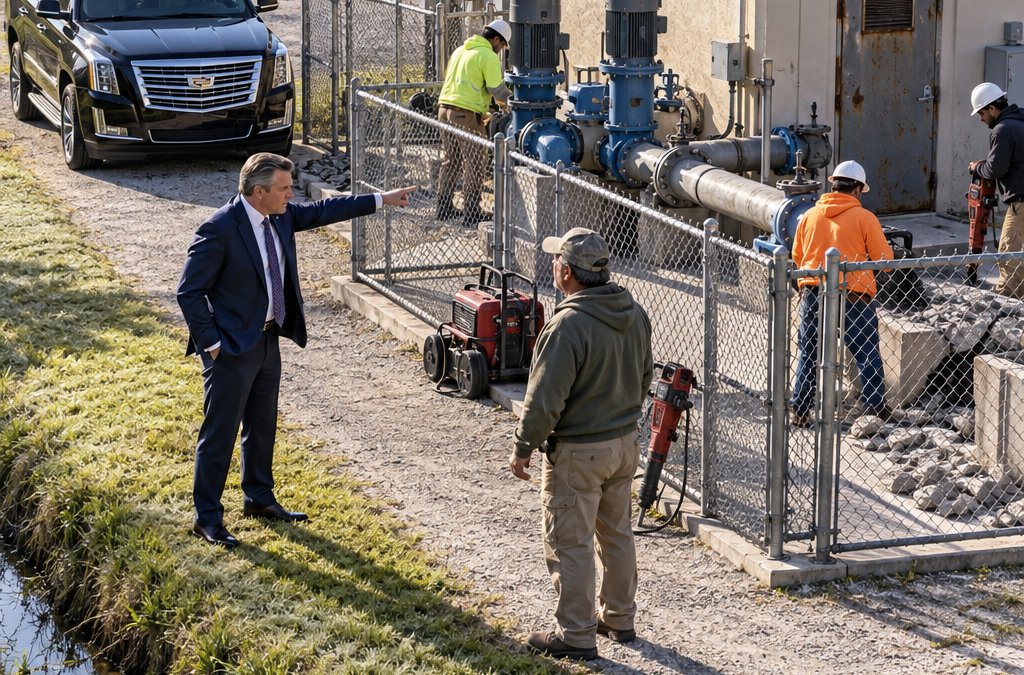
A black luxury SUV was coming down the maintenance lane.
Behind it followed two white contractor trucks and a flatbed trailer carrying equipment.
I stood still.
That road wasn’t normally used by HOA board members.
Utility crews came through occasionally, but they used marked service vehicles and usually notified the maintenance office.
The SUV stopped directly in front of the gate.
The driver’s door opened.
And out stepped Hoa Karen.
I had known him for almost three years.
He was the president of our homeowners association, a fifty-year-old man who looked like he had been professionally polished every morning before leaving his house.
His dark hair was combed straight back, with just enough silver near the temples to make him appear distinguished.
His face was clean-shaven.
His expensive suits fit perfectly across his shoulders.
His shoes were always so shiny that I sometimes wondered whether he had ever walked across an ordinary dirt road in his life.
That morning, he wore a charcoal-gray suit, a pale blue shirt, and a burgundy silk tie secured with a silver tie clip.
A gold watch gleamed on his wrist.
He carried a leather clipboard against his chest.
Even standing in gravel beside an old pump station, he looked as though he expected somebody to photograph him for a business magazine.
But his appearance wasn’t what made people uncomfortable.
It was the way he spoke.
Hoa Karen never entered a conversation as an equal.
He entered as a man expecting obedience.
He believed being HOA president gave him the authority to approve, forbid, inspect, and control almost anything within the neighborhood.
If somebody challenged him, his voice became quieter.
His smile became thinner.
And his threats arrived disguised as reasonable explanations.
I’d seen him make a retired woman cry over an exterior paint color that was barely different from the HOA’s approved shade.
I’d watched him threaten a young family with escalating fines because their children’s bicycles were visible from the street.
And I’d once heard him tell a homeowner that living in the community was a privilege granted by the association.
That last statement had bothered me.
A neighborhood was supposed to be a place where people lived.
Hoa Karen treated it like a private kingdom.
He spotted me beside the fence and gave me a polished smile.
“Good morning.”
I nodded.
“Morning, Mr. Karen. Something wrong?”
“Quite the opposite.”
He glanced toward the building.
“We’re finally taking care of this eyesore.”
I followed his gaze.
“The pump station?”
“Exactly.”
Two contractors climbed out of the first truck.
A third man began unloading equipment from the trailer.
I looked back at Hoa Karen.
“What kind of work are you doing?”
He tapped the clipboard.
“Removal.”
I frowned.
“Removal of what?”
“The building, eventually. And the equipment inside.”
For a moment, I thought I’d misunderstood.
“You mean renovation?”
He shook his head.
“No. Removal. The board has decided this structure is unnecessary.”
I stared at him.
The pump continued humming behind the fence.
“Unnecessary?”
He smiled.
“That’s what I said.”
I looked at the contractors.
One had already opened a toolbox.
Another was examining the gate.
I stepped closer.
“Mr. Karen, that’s an active water pump station.”
“I’m aware of what it is.”
“It serves a huge section of the neighborhood.”
His smile disappeared.
“That has been taken into consideration.”
“By whom?”
“The association.”
I waited.
He seemed irritated that I expected more.
“The board reviewed the site improvement proposal and determined that the structure is obsolete.”
“Did the water utility determine that?”
He shifted the clipboard beneath his arm.
“We don’t need outside interference every time we improve community property.”
“Water infrastructure isn’t landscaping.”
His eyes narrowed.
“I don’t believe I asked for your opinion.”
I looked at the building again.
“Where’s the utility work order?”
He didn’t answer.
“Has the county water authority approved this?”
“The HOA approved it.”
“That’s not the same thing.”
He gave a short, humorless laugh.
“You seem confused about how this neighborhood operates.”
“No. I understand exactly how it operates. That’s why I’m telling you this station is important.”
He stepped closer.
The scent of expensive cologne reached me.
“Listen carefully. The association has authority over common facilities and community improvements. We are modernizing this area. That building is outdated, unattractive, and no longer consistent with the neighborhood’s standards.”
I couldn’t believe what I was hearing.
“You think it’s unnecessary because it’s ugly?”
“I think it’s unnecessary because the board has determined it is.”
“Did anybody check what those pipes actually do?”
His expression hardened.
“I am not going to debate engineering details with a groundskeeper.”
I felt heat rising in my face.
I had spent years caring for the ground around that station.
I knew where the access pipes entered the building.
I knew when technicians came for routine maintenance.
I knew the hum of the equipment.
And I knew enough to understand that a working pump could not simply be removed because someone disliked the appearance of its building.
I kept my voice level.
“I’m not telling you how to run your board. I’m telling you that you need a qualified water-system operator here before anybody disconnects anything.”
Hoa Karen turned to the contractors.
“Gentlemen, you may proceed.”
The nearest worker looked between us.
“Sir, is this equipment confirmed out of service?”
Hoa Karen answered immediately.
“Yes. The association has approved the removal.”
The contractor hesitated.
“Do you have documentation from the utility operator?”
Hoa Karen opened his clipboard and showed him a page.
I couldn’t read the details from where I stood, but I recognized the HOA letterhead.
“Here is your written authorization,” Hoa Karen said. “You were hired to perform a job, not conduct another review.”
The worker glanced at his colleague.
I stepped toward them.
“That document is from the homeowners association. The station is still running.”
Hoa Karen’s voice snapped.
“Stay out of this.”
I turned back toward him.
“People depend on that equipment.”
“People depend on elected community leadership to make decisions, too.”
“Then make a decision that doesn’t put their water at risk.”
His face reddened.
For a second, I thought he might order me off the property.
Instead, he straightened his tie.
“You’re here to maintain the grounds. I suggest you concentrate on the responsibilities you’re actually qualified to perform.”
That was when I realized how dangerous his confidence had become.
He wasn’t going to listen.
Not to me.
Not to the obvious sound of the running equipment.
Not even to the hesitation of the contractors standing in front of him.
He had already decided the building was unnecessary.
And in Hoa Karen’s mind, admitting uncertainty was worse than making a mistake.
I stepped away from the gate.
But I didn’t leave.
I took out my phone.
And I started recording.
The first photograph showed the pump station with its exterior equipment intact.
The second showed the contractor trucks and their identification markings.
Then I photographed the gate, the pipes entering the building, the control cabinet visible through the doorway, and the equipment being unloaded.
I recorded the date and time.
I also wrote down the names of the workers when I could identify them.
Hoa Karen watched me.
“What are you doing?”
“Documenting the work.”
“For what purpose?”
“So there’s a record of what happens.”
He laughed.
“Are you threatening legal action?”
“I’m making sure nobody has to guess who was here.”
His eyes narrowed.
“This is unnecessary.”
“So is tearing apart a working water station without utility approval.”
He looked at the contractor.
“Get started.”
And the men began working.
At first, they removed exterior panels and opened the utility access area.
One worker examined the pipe connections.
Another prepared tools beside the doorway.
The whole process looked painfully ordinary.
Men carrying equipment.
Metal tools clinking against concrete.
A clipboard being signed.
The kind of scene that might have passed unnoticed if somebody drove by without knowing what the building did.
But I knew.
I could feel my heartbeat growing faster.
I had watched maintenance crews work inside the station before.
They followed procedures.
They checked identification numbers and operating conditions.
They coordinated with the utility.
They didn’t simply arrive with an HOA president and start dismantling equipment.
I approached the contractor again.
“Has anybody contacted the water-system operator?”
He looked uncomfortable.
“Management says the equipment’s being retired.”
“Whose management?”
“The project contact.”
He glanced toward Hoa Karen.
I lowered my voice.
“That pump is still operating. Please don’t disconnect it until somebody from the utility confirms the system can handle it.”
The contractor looked toward the open doorway.
Then back at me.
“I understand your concern.”
“Then stop.”
He hesitated.
“I’m following the work authorization I’ve been given.”
I felt a helpless kind of anger.
I didn’t blame him for wanting to finish his assignment.
But I couldn’t understand how a document from the HOA had become more convincing than the running machinery in front of him.
Hoa Karen called from behind us.
“Is there a problem?”
The contractor straightened.
“No, sir.”
“Then continue.”
I stepped back.
I wasn’t going to grab tools, block the workers, or put myself beside energized equipment.
I knew how easily a confrontation around machinery could turn into an injury.
So I stayed outside the work area.
And I kept recording.
About twenty minutes later, one of the workers called another man over to the main pump assembly.
They examined the connections.
A tool turned.
A panel opened.
Someone checked the wiring.
I could no longer see every movement inside the building, but I could hear the work progressing.
Then a worker called out that the pump was ready to be taken out of service.
I looked directly at Hoa Karen.
“Last chance. Call the water utility before you do this.”
He glanced at his watch.
“Proceed.”
A moment later, the steady hum disappeared.
The sound I had heard beside that building for years stopped so abruptly that the silence felt physical.
I looked toward the doorway.
The active pump had been disconnected from service.
For several seconds, I heard nothing but the contractor’s tools and the wind moving through the weeds outside the fence.
Then Hoa Karen smiled.
“There,” he said. “One problem solved.”
I stared at him.
He looked satisfied.
Almost proud.
As though he had personally removed an abandoned shed that was lowering property values.
I glanced at the disconnected equipment.
“That wasn’t a problem,” I said quietly.
He closed his clipboard.
“It was, and now it isn’t.”
“You need to stop the rest of the work until the utility checks the system.”
His face hardened again.
“The project is under control.”
I looked through the doorway.
The building was silent.
For the first time in years, that silence frightened me.
And Hoa Karen had no idea why.
I stayed beside the fence for another forty minutes.
The contractors continued removing the components they had been instructed to take out of service.
They worked around the disconnected pump, labeled sections of equipment, and carried smaller parts toward the trailer.
I photographed everything visible from outside the restricted work area.
The disconnected assembly.
The open control cabinet.
The exposed connections.
The equipment placed beside the trucks.
At one point, a worker asked whether the remaining demolition should begin immediately.
Hoa Karen glanced at his clipboard.
“Let’s finish removing the mechanical equipment first. We can bring the demolition machinery in once the building is ready.”
The casual way he said it made my stomach tighten.
He wasn’t merely planning to disconnect a pump.
He intended to remove the entire station.
I approached him one last time.
“Do you understand what happens if this equipment is required to maintain water pressure?”
He sighed.
“You’re still here?”
“Answer the question.”
His eyes flashed.
“I don’t have to answer questions from you.”
“Then answer them for the 860 households connected to this system.”
He stepped toward me.
“Those residents elected this board to make decisions.”
“They didn’t elect you to dismantle their water supply.”
His jaw clenched.
“Be very careful how you speak to me.”
I held his gaze.
“People are going to turn on their faucets tonight, Mr. Karen. If there’s no water, they’re not going to care how expensive your suit is or how many board members voted for this.”
He gave a cold smile.
“You’re imagining disasters because you don’t like change.”
“No. I’m looking at a running pump you just ordered disconnected.”
He turned away.
“You’re dismissed.”
I almost laughed.
Dismissed.
As though he had the authority to send me away from a problem I’d spent years helping prevent.
But there was nothing more I could accomplish by arguing.
I returned to my truck, saved the photographs, and wrote down the time the station had fallen silent.
I also recorded Hoa Karen’s explanation that the HOA had approved the removal and that he considered the structure unnecessary.
Before leaving, I looked back at the building.
The open doorway exposed the dark interior.
The ventilation fan was still turning, but the familiar vibration of the pump was gone.
One of the contractors was carrying another component toward the trailer.
Hoa Karen stood beside his SUV, speaking into his phone.
He was smiling again.
I wondered who he was calling.
A board member?
A developer?
Somebody he wanted to impress with how efficiently he’d eliminated another problem from his neighborhood?
I climbed into my truck.
For the first time in years, I drove away from that station wishing I could hear the pump running behind me.
By early afternoon, the first signs appeared.
I was home when my kitchen faucet began behaving strangely.
I’d filled a glass of water an hour earlier without noticing anything unusual.
Now, when I turned the handle, the flow seemed weaker.
Not completely gone.
Just noticeably reduced.
I let it run for several seconds.
The stream narrowed, then recovered slightly.
I turned it off.
My stomach tightened.
I checked the bathroom sink.
The pressure was lower there, too.
I stood in the doorway listening to the water.
I’d lived with that system long enough to know that brief fluctuations happened.
Routine maintenance.
High demand.
Occasional supply changes.
But this was different.
A working pump had been disconnected that morning, and now my water pressure was falling.
I wasn’t going to call it proof without measurements.
But I wasn’t going to pretend it was a coincidence, either.
I called the HOA office.
The receptionist answered.
“Brookhaven Community Association. How may I help you?”
“I need to report a possible water pressure problem.”
There was a pause.
“You’re the third person who’s called about that.”
I gripped the phone.
“Third?”
“Yes. We’ve had a few residents asking whether maintenance is being performed.”
“Do you know what happened at the pump station this morning?”
“I’m sorry?”
“The facility behind the eastern maintenance lane. Hoa Karen brought contractors there and ordered a pump disconnected.”
Another pause.
“I haven’t been given any information about that.”
“Please tell whoever handles utility complaints that the station needs to be checked immediately.”
“I can pass along your message.”
“Make sure you tell them an active pump was removed from service.”
“Yes, sir.”
I hung up.
Then I opened the neighborhood’s online community page.
Three messages had already appeared.
One resident asked whether there was a scheduled water interruption.
Another complained that the upstairs shower had almost no pressure.
A third said her washing machine had stopped filling properly.
I read the messages twice.
Then I looked toward the eastern side of the neighborhood.
The pump station was less than a mile away.
But I suddenly felt as though it were much farther.
I could document what had happened.
I could warn people.
I could explain why the station mattered.
What I couldn’t do was reconnect industrial water equipment by myself.
And I knew better than to try.
A mistake involving electricity, pressurized pipes, or contaminated connections could make an already serious situation worse.
That was the part Hoa Karen had never understood.
Some systems couldn’t be controlled by intimidation.
They required competence.
By late afternoon, the complaints were multiplying.
The community page had become a stream of questions.
People wanted to know why their faucets were slowing.
Some reported that water was still flowing downstairs but barely reaching upstairs bathrooms.
Others said their showers had become useless.
One woman wrote that she had been trying to rinse shampoo from her daughter’s hair when the pressure dropped so badly that she had to finish with water from a pitcher.
Another resident said the kitchen faucet was producing only a thin stream.
I drove to see my neighbor, Mrs. Delaney, who lived two houses down.
She was in her seventies and had been part of the community longer than I had.
When she opened the door, she was carrying an empty plastic pitcher.
“Have you got water?” she asked before I could speak.
“Not much pressure.”
“Mine’s almost gone.”
She led me into the kitchen.
The faucet sputtered, then produced a weak trickle.
She turned it off.
“Is the county doing repairs?”
I hesitated.
“I think I know what happened.”
She looked at me.
“What?”
“The HOA had contractors disconnect equipment at the pump station this morning.”
Her expression changed.
“Why would they do that?”
“Mr. Karen says the building is unnecessary.”
She stared at me.
“Unnecessary?”
“That’s what he told me.”
She looked at the faucet.
Then back at me.
“Well, somebody ought to tell my kitchen sink.”
Under different circumstances, I might have laughed.
Instead, I helped her fill two containers with the water she could still get.
I reminded her to keep the containers clean and to follow any official water-use guidance if the utility issued a notice.
Then I checked whether she had enough drinking water for the evening.
Before I left, she touched my arm.
“Please tell me somebody is fixing this.”
I wanted to give her a confident answer.
I couldn’t.
“People are being notified,” I said. “I’m doing everything I can to get the problem in front of the right people.”
She looked exhausted.
“All I wanted was to make dinner.”
That sentence stayed with me.
It was so ordinary.
So small.
She wasn’t asking for anything extraordinary.
She wanted to wash vegetables.
Boil potatoes.
Clean her dishes.
Go to bed without wondering whether the bathroom would work in the morning.
I drove home feeling angrier than I had at the pump station.
Hoa Karen had treated the equipment like an eyesore.
Mrs. Delaney was treating it like what it was.
The reason her home functioned.
Around six that evening, I called the HOA office again.
This time, the receptionist sounded overwhelmed.
“We’re receiving a high volume of calls.”
“I know. I’m calling about the pump station.”
“Mr. Karen has issued a statement.”
“What statement?”
“That the pressure fluctuations are temporary and the association is addressing the situation.”
“Does he acknowledge that his contractors disconnected the pump?”
“I’m not authorized to discuss that.”
“Then ask him to call me.”
“I’ll leave another message.”
“Please tell him hundreds of people may be affected.”
She lowered her voice.
“Sir, I think he knows.”
I sat with the phone in my hand after the call ended.
I tried to imagine Hoa Karen standing in his enormous kitchen, perhaps under the warm light of expensive pendant fixtures, listening to complaints from residents he had spent years ordering around.
I wondered whether his own faucets were running.
I wondered whether he was beginning to understand.
Then my phone rang.
It was him.
“What exactly are you trying to accomplish?” he demanded.
No greeting.
No introduction.
Just anger.
“I’m trying to get the water system restored.”
“You’ve been alarming residents with speculation.”
“People are reporting falling pressure.”
“Temporary fluctuations.”
“Your crew disconnected a main pump this morning.”
“That work was authorized.”
“By the HOA. Not by the water-system operator.”
He exhaled sharply.
“Do you understand how disruptive your accusations are?”
“Do you understand how disruptive it is when families can’t get water?”
He ignored the question.
“I’ve had board members calling me all afternoon because people are spreading rumors that the association damaged public infrastructure.”
“Then tell them what happened.”
“I know what happened.”
“Good. Then tell them.”
His voice dropped.
“You are making this situation worse.”
I felt my grip tighten on the phone.
“No, Mr. Karen. Turning off equipment without proper authorization made this situation worse. People asking why their water isn’t working isn’t the problem.”
There was a long silence.
Then he said, “The association will handle it.”
“How?”
“We have professionals.”
“Are they water-system operators?”
“We have contractors.”
“That’s not what I asked.”
He snapped, “I don’t answer to you.”
I stood in my kitchen, looking at the weak stream still coming from the faucet.
“Then answer to the families who are going to wake up without water tomorrow.”
He hung up.
I stared at the phone.
For a moment, I wanted to throw it across the room.
Instead, I placed it carefully on the counter.
Then I opened my notebook and wrote down the time of the call.
I recorded exactly what he had said.
The evening passed slowly.
More complaints appeared.
Residents compared pressure levels.
Some reported that their water was nearly gone.
Others still had limited service.
That uneven pattern made sense to me.
A system serving hundreds of homes doesn’t always fail everywhere at exactly the same moment.
Different elevations, pipe locations, stored pressure, and demand can create different symptoms.
But the overall picture was becoming impossible to ignore.
The neighborhood was losing reliable water service.
I went outside shortly before midnight.
The street was quiet.
Porch lights glowed behind neatly trimmed hedges.
A sprinkler head near one driveway made a clicking sound, but no water emerged.
I stood beneath the streetlight and looked toward the eastern maintenance lane.
Somewhere behind those houses sat the little building Hoa Karen had declared unnecessary.
I thought about walking down there.
But the contractors were gone, and I had no reason to enter an unattended utility facility.
I had photographs.
I had timestamps.
I had the record of what had happened.
What the neighborhood needed now wasn’t another argument.
It needed the people legally responsible for the water system to examine it.
I went back inside.
The next morning, the situation was worse.
At six-thirty, I turned on the kitchen faucet.
The water came out in a thin, uneven stream.
Then slowed.
Then nearly stopped.
I checked the bathroom.
The result was the same.
Outside, I could hear neighbors talking in their driveways.
Some had already been awake for hours.
I stepped onto my porch.
Across the street, a man was carrying bottled water from his garage.
Farther down, a woman was standing beside her car with a phone pressed to her ear.
Another resident walked over wearing a bathrobe beneath his jacket.
“Do you have water?”
“Almost none.”
He shook his head.
“My wife couldn’t shower. We’ve got two kids trying to get ready for school. The upstairs bathroom’s useless.”
Before I could answer, another neighbor joined us.
“What’s going on? The HOA says it’s temporary.”
I looked at their faces.
Tired.
Confused.
Increasingly angry.
I said, “Yesterday morning, the HOA president ordered contractors to disconnect equipment at the community pump station.”
The man in the bathrobe stared at me.
“You’re kidding.”
“I watched it happen.”
“Why?”
“He said the station was unnecessary.”
The second neighbor let out a disbelieving laugh.
“How can it be unnecessary if we’re all standing here without water?”
“I’ve been asking that question since yesterday.”
They exchanged looks.
The first man took out his phone.
“I’m calling the county.”
I nodded.
“Tell them there’s an active pump station with disconnected equipment. I have photographs of the work.”
He stepped aside to make the call.
By eight o’clock, news of the disruption had spread across the neighborhood.
The community page was overflowing.
Parents were frustrated.
People who worked early shifts had left home without showering.
Residents were worried about sanitation and whether the water was safe to use.
Families with small children were trying to make breakfast while conserving whatever clean water they had available.
People who had never attended an HOA meeting were suddenly demanding to know who had authorized the removal of a working pump.
The association office was overwhelmed.
I learned later that the phone had barely stopped ringing since the previous afternoon.
Hoa Karen continued insisting that the problem was temporary.
He told residents that the board had made a necessary facilities decision.
He promised the association was working toward a resolution.
But he still would not admit that disconnecting the pump was connected to the pressure loss.
That was what finally turned frustration into outrage.
People could tolerate an equipment failure.
Machines break.
Pipes leak.
Water systems require repairs.
What they couldn’t tolerate was being told nothing was wrong while their homes were losing water.
By midmorning, county water authorities had been contacted and were coordinating a response.
The situation was no longer something Hoa Karen could contain within the HOA office.
And that changed everything.
I was near the maintenance lane when the county vehicles arrived.
There were two utility trucks and a county inspection vehicle.
Several officials stepped out wearing work boots and identification badges.
One carried a hard case containing testing equipment.
Another had a folder of system records.
The lead official introduced himself as Martin Ellis.
He was a broad-shouldered man in his late fifties, with a weathered face and the calm, direct manner of somebody who had spent his career solving problems that couldn’t be fixed with speeches.
“Who’s responsible for this property?” he asked.
I explained my maintenance role.
“I maintain the grounds. I don’t operate the pumps.”
“Did you report the problem?”
“I reported what I saw yesterday. I also documented the equipment removal.”
He looked toward the building.
“Show me what you recorded.”
I opened the photographs on my phone.
The first image showed the station before work began.
The second showed the contractor vehicles.
Then came the open cabinet, the exposed equipment, and the disconnected pump assembly.
Martin looked carefully at each image.
“What time was this?”
“Just after eight yesterday morning.”
“And this one?”
“About twenty minutes later.”
He looked at the photograph showing the pump connection.
“Did you see them take it out of service?”
“Yes. The station’s normal hum stopped immediately afterward.”
He looked toward the other officials.
“We need to inspect the installation.”
I pointed toward the gate.
“The contractors left the equipment disconnected.”
Martin nodded.
“Let us handle it.”
That was exactly what I wanted to hear.
The officials entered the secured area after confirming the appropriate access.
They began inspecting the pipes, valves, controls, electrical connections, and disconnected pump equipment.
I stayed outside.
One technician examined the control cabinet.
Another reviewed the system layout.
Martin studied the pipework with a seriousness I hadn’t seen from anyone connected to the HOA.
He wasn’t interested in whether the building was attractive.
He wasn’t interested in HOA landscaping standards.
He wanted to know what the equipment did and why it was no longer operating.
A few minutes later, Hoa Karen arrived.
His black SUV came down the maintenance lane faster than I’d ever seen it move.
He parked beside the county vehicles and climbed out.
For once, he hadn’t dressed quite as carefully.
His tie sat slightly crooked, and the top button of his shirt was undone.
He still wore an expensive navy suit.
But his face looked tired.
He walked directly toward Martin.
“I’m Hoa Karen, president of the homeowners association.”
Martin turned.
“Mr. Karen. Were you responsible for authorizing work at this facility?”
Hoa Karen straightened.
“The association approved a modernization project.”
“What work was authorized?”
“Removal of obsolete equipment and eventual demolition of the outdated structure.”
Martin looked toward the building.
“Who determined the equipment was obsolete?”
Hoa Karen hesitated.
“The board reviewed the matter.”
“Who performed the engineering assessment?”
“Our contractors were engaged to carry out the project.”
“That’s not what I asked.”
Hoa Karen shifted his weight.
“We relied on the information presented to the association.”
Martin held out his hand.
“Can I see the utility authorization for removing this pump?”
Hoa Karen blinked.
“The HOA authorized it.”
“I understand that. I’m asking for authorization from the entity responsible for operating this water infrastructure.”
The president’s expression tightened.
“We control community facilities.”
Martin glanced toward the station.
“Control of neighborhood maintenance decisions is not the same as authority to remove an active component from a regulated water system.”
Hoa Karen folded his arms.
“You’re making this sound more serious than it is.”
Martin looked directly at him.
“Mr. Karen, we have reports of major pressure loss across a community served by this system. My team is standing in front of a disconnected pump. I’m trying to establish who approved that work.”
The silence was uncomfortable.
Hoa Karen looked at me.
I could see the accusation forming before he spoke.
“This man has been interfering with the project since yesterday.”
Martin turned.
“Did he disconnect the equipment?”
“No.”
“Did he authorize the removal?”
“No.”
“Then I’ll speak with him separately if I need more information.”
Hoa Karen’s face reddened.
“I am the HOA president.”
Martin nodded.
“And I’m asking you a technical and regulatory question. Who authorized the removal of this pump?”
For the first time since I’d known him, Hoa Karen had no immediate answer.
He opened his clipboard.
Flipped through the pages.
Pulled out the HOA work order.
Then held it toward Martin.
“Here.”
Martin read the document.
His expression didn’t change.
“This is signed by you.”
“Yes.”
“On behalf of the HOA.”
“Correct.”
“Where is the utility operator’s approval?”
Hoa Karen stared at him.
“We believed the station was no longer required.”
Martin’s voice became quieter.
“Believed?”
The single word seemed to hang in the air.
Hoa Karen looked toward the open building.
“The association was advised that improvements could be made.”
“By whom?”
“The development and maintenance committee.”
Martin looked at the page again.
“Was a licensed water operator consulted?”
No answer.
“Was a system impact assessment completed?”
Hoa Karen swallowed.
“The board believed—”
“Did anyone test the effect of removing this pump on community pressure?”
Hoa Karen finally lowered the clipboard.
“No formal pressure assessment was included in the board packet.”
Martin nodded once.
Then he turned toward his team.
“Let’s finish the inspection and get readings.”
I watched Hoa Karen’s face.
The confidence was beginning to disappear.
Not all at once.
It was more like watching a carefully constructed wall develop cracks.
He still stood straight.
Still kept his shoulders back.
Still tried to look authoritative.
But the officials weren’t asking him for permission.
They weren’t looking to him for leadership.
They were examining facts.
And the facts were refusing to cooperate with him.
The inspectors began taking pressure measurements at designated points around the pump station.
They checked the control cabinet and reviewed the disconnected equipment against the utility’s system records.
Additional readings were obtained from locations in the neighborhood.
Technicians compared operating conditions with the system’s normal pressure requirements.
The work took time.
Nobody rushed to declare a conclusion before the measurements were complete.
I appreciated that.
I had spent more than a day listening to Hoa Karen announce what was true because he wanted it to be true.
Now I was watching professionals verify what was actually happening.
At one point, Martin approached me.
“Did the station operate normally before yesterday?”
“As far as I could tell. I heard the pumps running when I arrived. There hadn’t been an obvious problem during my grounds work.”
“Any recent failures you reported?”
“Nothing like this.”
He nodded.
“And you’re certain the contractor disconnected the active pump yesterday morning?”
“I recorded the time. The station went quiet immediately afterward.”
“Can you send those photographs and notes to the office?”
“Yes.”
“Please do.”
I emailed everything to the address he provided.
Then I stepped back.
Hoa Karen stood beside his SUV, talking rapidly into his phone.
I couldn’t hear the whole conversation.
But I heard enough.
“No, don’t issue another statement yet.”
A pause.
“I don’t care what people are saying online.”
Another pause.
“Tell the board we’re waiting for the county’s findings.”
He ended the call and looked toward the station.
I wondered whether he was beginning to calculate the consequences.
Not just the embarrassment.
The actual consequences.
Hundreds of homes had been affected.
Contractors had altered active infrastructure.
The association had authorized work without establishing the necessary technical approval.
And now county officials were documenting everything.
A technician emerged from the station and spoke quietly to Martin.
They reviewed the readings.
Then Martin walked toward us.
Hoa Karen straightened immediately.
“Well?”
Martin looked at him.
“The preliminary findings show that this station is a critical component of the neighborhood’s water service.”
Hoa Karen’s expression went blank.
Martin continued.
“The disconnected pump was part of the active pressure-support arrangement. Taking it out of service disrupted the system’s ability to maintain appropriate pressure under demand.”
I felt my shoulders loosen slightly.
Someone had finally said it plainly.
The pump mattered.
The little building mattered.
The equipment Hoa Karen wanted to remove was not obsolete.
It was doing a job.
And the neighborhood was suffering because that job had been interrupted.
Hoa Karen glanced toward the pipes.
“Are you saying that one pump caused all these problems?”
“I’m saying the system records, the equipment condition, the operating history, and the pressure measurements are consistent with the loss of this station’s pumping function causing the service disruption.”
“But surely there are other pumps.”
“There are other components in the water system. That doesn’t make this station unnecessary.”
Hoa Karen looked confused.
“Then why wasn’t that explained to us?”
Martin’s eyes narrowed.
“Who did you ask?”
No one spoke.
The question was devastating because it was so simple.
Who did you ask?
Not who voted.
Not who signed.
Not who wanted the building removed.
Who had actually checked?
Hoa Karen looked down at his clipboard.
He had no answer.
Martin continued.
“This facility cannot be dismantled based solely on an HOA decision. The system needs to be restored as quickly and safely as possible.”
The president swallowed.
“What does that involve?”
“Qualified personnel will assess the disconnected components, restore the required equipment, and conduct appropriate operational and water-quality checks before service is confirmed stable.”
“How long will that take?”
“We’re prioritizing it. But we’re not going to skip safety procedures.”
Hoa Karen opened his mouth.
Then closed it.
Martin looked toward the contractors’ equipment still positioned near the building.
“Who performed the removal?”
Hoa Karen gave him the company name.
The officials contacted the appropriate parties and began coordinating the restoration.
The contractors who had carried out the work were brought back to assist under the direction of qualified utility personnel.
When they arrived, their expressions were very different from the previous morning.
Nobody smiled.
Nobody joked about an old building being removed.
They unloaded tools and waited for instructions.
The same men who had disconnected the pump now had to help reverse the work.
But this time, there was an important difference.
The decisions were being directed by people who understood the system and its requirements.
Hoa Karen attempted to approach one of the workers.
“Make sure this is handled efficiently.”
Martin turned toward him.
“Mr. Karen, please allow the restoration crew to work.”
“I only meant—”
“I understand. They have instructions.”
Hoa Karen stepped back.
I saw his hands tighten around the clipboard.
He wasn’t accustomed to being dismissed.
Especially not in front of me.
For hours, the crews worked.
The pump and related equipment had to be assessed before being returned to operation.
Connections were checked.
Electrical systems were inspected.
Control functions were verified.
Technicians examined the pipework to make sure the earlier removal hadn’t created additional problems.
The water system had to be handled carefully.
The goal was not simply to make a motor run again.
The goal was to restore safe, reliable service to hundreds of homes.
I stayed nearby, outside the work area.
At one point, Mrs. Delaney called.
“Any news?”
“They’ve confirmed the pump station is critical. The county is supervising the repairs.”
“Oh, thank God.”
“They’re working on restoring service.”
“Is Mr. Karen there?”
I looked across the gravel.
He stood beside his SUV with his arms folded, staring at the building.
“Yes.”
“What does he have to say for himself?”
I hesitated.
“Not much right now.”
She gave a tired laugh.
“That might be a first.”
Then her voice softened.
“I hope they can fix it. I’ve been saving every drop I can.”
“They’re doing everything properly.”
“Good. Tell those workers we appreciate them.”
I promised I would.
When the call ended, I watched a technician climb carefully into the control area.
I thought about the contrast.
Yesterday, Hoa Karen had demanded that the work proceed because he had already made a decision.
Today, the restoration crew checked each step because the equipment mattered more than anybody’s pride.
That was what competent authority looked like.
It didn’t need to shout.
It needed to know what it was doing.
By late afternoon, the restoration work had reached the testing stage.
The technicians had reconnected the necessary equipment and completed their initial inspections.
One operator reviewed the control readings.
Another confirmed the required system conditions.
Martin stood nearby, communicating with the downstream monitoring personnel.
I stayed several yards away.
Then I heard it.
A low mechanical sound.
Familiar.
Steady.
The pump station was running again.
For a second, I felt a tightness in my throat.
It was such an ordinary sound.
Just machinery operating inside a concrete building.
Yet after everything that had happened, it was one of the best sounds I’d heard in years.
The technicians continued checking the system.
Pressure readings were taken.
Operating conditions were observed.
The utility assessed the appropriate water-quality and service requirements before confirming the system’s recovery.
There was no dramatic announcement.
No cheering at the station.
Just experienced people watching gauges, checking readings, and communicating with crews across the neighborhood.
Gradually, the pressure began returning.
The first confirmation came from one of the lower sections.
Then another service area reported improvement.
Then another.
I watched Martin review the information.
His expression remained serious, but the tension around his eyes eased.
“Readings are improving,” he said.
I looked toward the neighborhood.
“Does that mean it’s fixed?”
“It means we’re seeing the response we expected. We still need to verify stable conditions.”
I nodded.
He returned to work.
I appreciated that he wouldn’t promise more than the evidence supported.
Hoa Karen had done enough promising for all of us.
About an hour later, my phone rang again.
Mrs. Delaney.
I answered immediately.
“Hello?”
“I’ve got water!”
Her voice was so loud I had to hold the phone away from my ear.
I smiled.
“Good pressure?”
“Better than this morning. Much better.”
“Follow whatever notices the utility issues, but that’s a good sign.”
She was quiet for a moment.
Then she said, “I never thought I’d be so happy to hear a faucet.”
I looked toward the pump station.
“Neither did I.”
The calls and messages continued.
Residents began reporting improvement.
Kitchen faucets were flowing normally again in some sections.
Upstairs showers were recovering.
Homes that had been dealing with severe pressure loss were finally seeing service return.
The utility kept monitoring the network, addressing remaining pressure fluctuations and confirming that the system was operating safely.
By the time the restoration was complete and the necessary checks had been satisfied, the approximately 860 connected homes were receiving normal water service again.
The neighborhood could function.
Families could wash dishes.
Prepare meals.
Take showers.
Flush toilets.
Fill washing machines.
Do the small, ordinary things people should never have to beg an HOA president to protect.
I stood beside my truck as the evening light began fading.
The pump station hummed behind the fence.
For the first time in two days, I let myself believe the immediate crisis was ending.
Then I looked across the maintenance lane.
Hoa Karen was still there.
He had taken off his suit jacket and folded it over one arm.
His tie hung loose.
His carefully styled hair had begun to fall out of place.
He looked exhausted.
I walked toward him.
He saw me coming and straightened.
For a moment, the old arrogance returned to his eyes.
“Well,” he said, “at least the problem has been resolved.”
I stared at him.
“At least?”
He frowned.
“What do you want me to say?”
I looked toward the building.
“I want you to understand what happened.”
He sighed.
“We had an unfortunate misunderstanding about the equipment.”
“No.”
His eyes narrowed.
I continued.
“A misunderstanding is when two people confuse an appointment time. You ordered contractors to disconnect equipment serving hundreds of homes after being warned that the system was active.”
He looked away.
“We relied on information available to us.”
“You didn’t verify it.”
“The board approved the project.”
“The board doesn’t operate the water system.”
His face tightened.
“Must you keep repeating that?”
“Yes. Because you still sound like you think the problem was that somebody caught you.”
He turned sharply.
“That’s not fair.”
I felt the last of my patience disappear.
“Fair?”
I pointed toward the neighborhood.
“Mrs. Delaney couldn’t make dinner properly last night. Families woke up without enough water to shower. Parents were trying to get children ready for school. Hundreds of people spent hours wondering when their water would come back.”
He opened his mouth.
I kept going.
“And yesterday, while I was standing right here asking you to contact the utility, you told me I was a groundskeeper who didn’t understand authority.”
His face flushed.
I stepped closer.
“I understood enough to know that building mattered.”
He looked toward the station.
For several seconds, he said nothing.
Then he muttered, “The county will review the matter.”
“Yes,” I said. “They will.”
His eyes shifted back toward me.
“What is that supposed to mean?”
“It means this isn’t finished just because the water is running.”
He gave me a bitter look.
“You’ve always had a problem with my leadership.”
I shook my head.
“I’ve had a problem with the way you confuse leadership with ownership.”
He stared at me.
I continued.
“You can tell people what color to paint their fences. You can hold meetings and approve landscaping budgets. But that doesn’t make you the owner of every system in this neighborhood.”
He tightened his grip on his jacket.
“You’re enjoying humiliating me.”
“No. I spent two days worried about people who didn’t have reliable water. I would have preferred never having this conversation.”
He looked at the building again.
The pump hummed steadily.
This time, he didn’t call it unnecessary.
I walked away.
That evening, the HOA held an emergency meeting.
By then, practically everyone in the neighborhood knew what had happened.
The association sent out a notice announcing an urgent discussion of the water service disruption.
The wording was careful.
It referred to recent maintenance activity and unexpected system pressure issues.
It promised an explanation and an opportunity for residents to ask questions.
It did not mention that the HOA president had ordered an active pump disconnected.
That omission angered people almost as much as the interruption itself.
When I arrived at the clubhouse, the parking lot was overflowing.
Cars lined both sides of the entrance road.
People were standing near the doors, talking in tight groups.
Inside, every chair was occupied.
Residents filled the aisles and crowded along the walls.
Several hundred people had come.
I had never seen anything like it.
Normally, HOA meetings attracted a few dozen homeowners, most of whom came to argue about budgets, landscaping, or parking regulations.
This time, people weren’t discussing decorative fences.
They wanted to know why their homes had lost water.
I recognized neighbors who had never attended a meeting before.
Young parents.
Retired couples.
People still wearing work clothes.
A man holding a sleeping toddler.
An older woman with a cane.
Mrs. Delaney sat near the front.
When she spotted me, she waved.
I made my way toward her.
“Saved you a seat,” she whispered.
“Thanks.”
She leaned closer.
“I’ve been waiting all day to hear what that man has to say.”
I glanced toward the stage.
Hoa Karen stood behind a long table with several board members.
He had changed into a fresh suit.
His tie was straight again.
His hair had been combed carefully into place.
He looked polished.
Controlled.
Almost exactly like the man who had arrived at the pump station the previous morning.
But the room was different.
People weren’t smiling at him.
Nobody seemed impressed by his appearance.
The noise was loud enough that he had to tap the microphone several times before the meeting began.
“Good evening, everyone,” he said.
A few people stopped talking.
Others continued.
He raised his voice.
“Thank you for coming on such short notice.”
Someone near the back shouted, “We want to know why the water went out!”
Several people applauded.
Hoa Karen lifted one hand.
“Please. We will address all concerns in an orderly manner.”
Another voice called, “Was it your project?”
He looked toward the board members.
“We’ll get to that.”
A man stood in the second row.
“My mother had almost no water for a full day. She lives alone. Why wasn’t anyone told what was happening?”
Hoa Karen adjusted the microphone.
“The association became aware of pressure irregularities and worked to resolve the issue.”
The man shook his head.
“Pressure irregularities? My mother couldn’t fill a pot!”
More people started talking.
Hoa Karen’s jaw tightened.
“If everyone will allow me to finish—”
A woman near the aisle stood.
“Did you order the pump station shut down?”
The room went quiet.
Hoa Karen paused.
Then he said, “The board authorized improvements to an outdated facility.”
The woman stared at him.
“That’s not what I asked.”
He frowned.
“The project was approved through the association’s normal procedures.”
“Did you order it shut down?”
He looked around the room.
“I personally oversaw the approved work.”
A murmur spread through the crowd.
The woman sat slowly.
Someone behind her said, “Unbelievable.”
Hoa Karen tried to continue.
But the questions came faster.
“Who told you the station wasn’t needed?”
“Did the utility approve it?”
“Why weren’t we notified?”
“Who is paying for the repairs?”
“Are we going to lose water again?”
“Was anybody checking the pressure before the equipment was removed?”
The questions overlapped until the room became almost impossible to control.
Hoa Karen raised both hands.
“Enough. Enough!”
The crowd gradually quieted.
He leaned toward the microphone.
“I understand people are upset, but this association cannot function if every maintenance decision is treated as a public controversy.”
For several seconds, nobody spoke.
Then Mrs. Delaney stood beside me.
She wasn’t a loud woman.
I’d known her for years, and I had rarely heard her raise her voice.
But she stood straight, resting one hand on the back of her chair.
“Mr. Karen,” she said, “I couldn’t get enough water out of my kitchen faucet to make dinner yesterday.”
He looked at her.
“I’m sorry you experienced an inconvenience.”
She stared at him.
“An inconvenience?”
The word hung in the room.
She continued.
“I’m seventy-four years old. I live by myself. I pay my bills. I follow the association’s rules. And I don’t expect much from anybody.”
Her voice trembled slightly.
“But I do expect the water to work in my house.”
Several people nodded.
She looked directly at Hoa Karen.
“You keep calling things inconvenient whenever they happen to somebody else.”
The room fell silent.
I could feel my throat tightening.
Mrs. Delaney took a breath.
“The pump station wasn’t bothering me. It wasn’t bothering my neighbors. We didn’t ask you to remove it.”
She pointed toward the floor.
“So why did you decide we didn’t need it?”
Hoa Karen looked down at his notes.
“The board believed—”
“Did you ask the people who operate it?”
He didn’t answer.
She waited.
Then she said quietly, “That’s what I thought.”
She sat.
The room erupted in applause.
Hoa Karen looked stunned.
For years, he’d used the HOA meeting room as a place to exercise control.
He decided who spoke.
How long they spoke.
What questions were acceptable.
Which complaints deserved attention.
But this time, the residents weren’t waiting for permission to be concerned.
Their water had stopped working.
And no amount of polished language could make that disappear.
When the county officials stepped forward, the room settled.
Martin Ellis stood beside a representative from the water authority.
He didn’t bring a dramatic presentation.
He brought the system findings.
And that was enough.
“Good evening,” he began. “We’re here to explain the preliminary findings concerning the water service disruption and the restoration work completed today.”
People leaned forward.
Martin spoke slowly and clearly.
“The facility behind the eastern section of your neighborhood is an active pump station. It plays a critical role in maintaining water service and pressure within this community.”
Someone near the back called, “How many homes?”
“Approximately 860 are connected to the system served by this infrastructure.”
A low murmur moved through the room.
Martin continued.
“Yesterday, contractors working under HOA authorization disconnected a major pump component. That work was not supported by the required authorization from the water-system operator.”
People turned toward Hoa Karen.
He stared at the table.
Martin explained that the station had been inspected and that the pressure measurements supported a direct connection between the equipment removal and the neighborhood’s service problems.
He described the restoration process and the checks performed before normal operation was confirmed.
Then he said something that seemed to settle over the entire room.
“Critical water infrastructure cannot simply be removed because a property manager or neighborhood board considers it unnecessary.”
Nobody interrupted.
“Changes to an operating water system require appropriate technical evaluation, coordination, and authorization. Those requirements exist to protect the people who depend on the system.”
A man near the front raised his hand.
“Was the pump broken?”
Martin answered.
“The available records and inspection findings do not indicate that the removal was necessary because of a pump failure.”
Another resident asked, “Was the building dangerous?”
“No structural emergency requiring demolition was identified in our review.”
A woman across the aisle spoke.
“Then why were they tearing it down?”
Martin looked toward Hoa Karen.
“The association will need to explain its decision-making process. Our role tonight is to establish what happened to the water system and what is required to protect service.”
The room turned toward the HOA president.
He seemed to shrink beneath the attention.
One board member shifted uncomfortably in his chair.
Another lowered her eyes.
For the first time, I wondered how much the rest of the board had actually understood when they approved the project.
Had they questioned the utility records?
Had they asked what the station did?
Or had they trusted Hoa Karen because he spoke confidently and never tolerated disagreement?
A resident stood.
“Mr. Karen, did you tell the board the station was no longer operational?”
Hoa Karen’s face reddened.
“We were informed that it was obsolete.”
“By whom?”
He hesitated.
“That information came through the facilities review.”
“Who conducted it?”
He looked toward another board member.
The man shook his head slightly.
Hoa Karen turned back to the crowd.
“The association relied on the materials presented.”
Someone shouted, “You keep saying that!”
Another voice called, “Who signed the work order?”
The room quieted.
Hoa Karen stared at the microphone.
Finally, he said, “I did.”
A long silence followed.
Then a man near the back spoke in a voice that carried across the room.
“So you personally ordered the equipment removed without checking whether it was needed?”
Hoa Karen looked down.
“I believed the decision had been properly reviewed.”
The man shook his head.
“Believing isn’t checking.”
I felt those words settle somewhere deep inside me.
That was the entire problem.
Hoa Karen had believed his authority was enough.
He had believed the board’s approval could replace technical expertise.
He had believed a small, ugly building was unnecessary because he didn’t understand its purpose.
And when someone challenged him, he had treated the warning as an insult.
Martin returned to the microphone.
“The immediate service issue has been addressed, but our review of the authorization and removal process is continuing. The appropriate parties will be required to maintain compliance with the applicable water-system requirements.”
He looked around the room.
“The most important thing residents should understand is that this station remains part of your operating water infrastructure. Any future changes must follow the proper review process.”
A resident asked whether the water would remain stable.
Martin explained that the restored system was operating normally and that monitoring would continue as appropriate.
He didn’t promise that no mechanical problem could ever happen again.
No responsible operator would make such a promise.
But he confirmed that the unauthorized removal had been reversed and that the immediate pressure problem had been resolved.
That was the reassurance people needed.
The meeting continued for nearly two hours.
Residents demanded better oversight.
They wanted to know who could authorize work on shared infrastructure.
They wanted the HOA’s maintenance procedures reviewed.
They wanted clear communication whenever essential services were at risk.
Several board members acknowledged that the process needed to change.
Hoa Karen listened.
He answered when directly questioned.
But the sharp certainty that had defined him for years was gone.
At one point, he tried to describe the removal as a well-intentioned improvement project.
A woman interrupted.
“Then improve the landscaping around it. Don’t remove the machinery keeping water in our homes.”
The room applauded again.
Hoa Karen didn’t argue.
I watched him closely.
He wasn’t suddenly a different man.
A single embarrassing meeting couldn’t erase years of arrogance.
But he was finally being forced to confront a truth he’d spent his entire presidency avoiding.
The HOA had limits.
Its president had limits.
And those limits mattered most when people’s safety and essential services were involved.
Near the end of the meeting, Hoa Karen stood and approached the microphone again.
The room grew quiet.
He placed both hands on the table.
“For the record,” he began, “the association did not intend to interrupt water service.”
Nobody responded.
He looked toward Martin, then at the residents.
“Our intention was to improve the appearance and efficiency of the maintenance area.”
He swallowed.
“However, the work proceeded without the necessary technical verification.”
A few people shifted in their seats.
He continued.
“That was a serious mistake.”
I leaned back.
It was the first time I’d heard him use the word mistake without attaching somebody else’s name to it.
He looked across the room.
“I understand that residents were inconvenienced and concerned. I also understand that the disruption affected daily life throughout the neighborhood.”
Mrs. Delaney folded her arms.
He paused.
Then added, “The association will cooperate with the ongoing review and ensure that no further work is performed on this facility without the required authorization.”
There was scattered applause.
Not much.
Certainly nothing like the reaction he’d probably imagined receiving when he first announced the demolition project.
But it was something.
A beginning.
He turned toward his seat.
Before he sat down, his eyes met mine.
For a moment, I saw the same man who had stood beside the pump station and told me to mind my place.
Only now, he had nothing left to say.
After the meeting, several neighbors approached me.
Some wanted to see the photographs.
Others asked how long I’d known the pump station was important.
A few thanked me for documenting the work.
I accepted their words, but I was careful about one thing.
I hadn’t restored the water system.
The qualified utility crews had done that.
I hadn’t diagnosed every technical problem.
The county officials had investigated and tested the infrastructure.
I had done what I could.
I’d recognized a dangerous decision.
I’d warned the people making it.
And when they refused to listen, I’d preserved the evidence.
That evidence helped the officials establish exactly what had happened.
It wasn’t glamorous.
It didn’t involve shouting louder than Hoa Karen.
It involved taking photographs, recording times, keeping notes, and refusing to let someone rewrite the facts after the consequences appeared.
As I walked toward the parking lot, Mrs. Delaney caught up with me.
“That was quite a meeting.”
I smiled.
“I’ve seen quieter football games.”
She laughed.
Then her expression softened.
“You know, I never paid any attention to that pump station.”
“Most people don’t.”
“I drove past it for years. Thought it was just some old utility building.”
“It is an old utility building.”
She looked at me.
“But it matters.”
I nodded.
“More than people realize.”
She glanced back toward the clubhouse.
“Do you think he’ll ever admit he should have listened to you?”
I thought about Hoa Karen standing behind the microphone.
“I don’t know.”
She smiled faintly.
“Well, at least now he knows we have faucets.”
That made me laugh.
It was the first real laugh I’d had since the contractors arrived.
A few days later, I returned to the pump station.
The morning was clear and cool.
The maintenance lane was empty.
There were no contractor trucks.
No flatbed trailer.
No polished black SUV.
Just my pickup and the familiar little building behind the fence.
I parked near the gate and stepped out.
The grass along the access lane had begun growing again.
A few leaves had collected against the northwest corner.
The drainage ditch was clear.
The door was closed.
The equipment had been restored and secured.
The control system was operating normally.
And through the walls came that familiar mechanical hum.
Steady.
Unremarkable.
Beautiful.
I stood there listening.
For years, the sound had been ordinary background noise.
Something I barely noticed while trimming weeds or dragging fallen branches away from the fence.
Now it felt different.
I thought about the families who depended on it.
The parents getting children ready for school.
The retirees making breakfast.
The people starting laundry before work.
The thousands of ordinary tasks happening inside homes throughout the neighborhood.
Nobody needed to applaud the pump.
Nobody needed to build a monument beside it.
They simply needed it to keep working.
I walked along the fence, checking the ground as I always had.
Near the southern corner, I found a small patch of weeds growing through the gravel.
I pulled them out.
A few yards farther down, a loose branch had fallen against the fence.
I moved it aside.
Simple work.
Nothing impressive.
But I had come to understand that protecting important things often involved simple work done consistently.
Checking.
Maintaining.
Documenting.
Asking questions when something didn’t seem right.
The very habits Hoa Karen had dismissed as unimportant were the habits that helped keep problems from becoming disasters.
I stopped near the gate and looked at the building.
There was still rust on the hinges.
The paint still needed attention.
The ventilation housing was still old-fashioned.
It would never win an architectural award.
It would never appear on a glossy brochure advertising luxury homes.
And none of that mattered.
The building was doing what it was supposed to do.
That was enough.
I remembered Hoa Karen standing in almost the same spot, his expensive shoes planted in the gravel, pointing toward the station as though he were ordering a dead tree removed.
I remembered the confidence in his voice.
The contempt in his eyes.
The way he’d dismissed my warning because he believed a maintenance worker had no right to question a president.
Then I remembered the county official asking him who had authorized the removal.
The silence that followed.
The measurements.
The restoration.
The emergency meeting.
Hundreds of residents sitting together, finally understanding the value of something they’d barely noticed before.
Hoa Karen had wanted to improve the appearance of the neighborhood.
Instead, he had exposed how little he understood about what made it function.
And the lesson had been expensive in ways that had nothing to do with paint, landscaping, or property values.
Families had lost reliable water service.
Residents had spent hours worrying about basic household needs.
Qualified crews had been pulled into urgent restoration work.
The county had opened a serious review.
And the HOA’s authority had been challenged in front of the very people it was supposed to serve.
All because one man couldn’t accept that some decisions required expertise he didn’t possess.
I leaned against the fence.
The pump hummed behind me.
I thought about what might have happened if nobody had questioned the work.
If the contractors had continued.
If the building had been demolished.
If the necessary equipment had been damaged beyond immediate restoration.
I didn’t allow myself to imagine every possible consequence.
There was no reason to turn a resolved problem into a nightmare.
The facts were serious enough.
The pump had been removed from service.
Water pressure had fallen.
Hundreds of families had been affected.
Authorities had investigated.
The system had been restored.
And the evidence showed why the interruption had occurred.
That was the story.
No exaggeration required.
Before leaving, I took one final photograph of the station.
Not because I expected another confrontation.
Not because I wanted to embarrass Hoa Karen.
I photographed it because I had learned how quickly an ordinary working facility could become the center of a crisis when the wrong person decided it was unnecessary.
Then I saved the picture with the rest of my maintenance records.
I climbed into my truck.
Started the engine.
And listened for a moment before driving away.
The pump was still humming.
All across the neighborhood, water was flowing.
Somewhere, Mrs. Delaney was probably making breakfast.
Somewhere else, a child was brushing his teeth before school.
People were turning on faucets without thinking about the pipes, pumps, controls, and workers that made those simple moments possible.
That was exactly how the system was supposed to function.
Quietly.
Reliably.
Without needing the attention of an HOA president determined to leave his mark on everything he could see.
As I turned onto the main road, I passed Brookhaven’s beautifully maintained entrance.
The stone sign was clean.
The landscaping was perfect.
Every decorative shrub had been trimmed into the shape the board preferred.
For years, those were the things Hoa Karen had used to measure the success of his leadership.
But after what happened, I knew the residents would look at their neighborhood differently.
They understood that a community wasn’t protected merely because its entrance looked expensive or its lawns were perfectly maintained.
A community depended on systems that had to work.
Water.
Drainage.
Electricity.
Road access.
Infrastructure that rarely attracted attention until somebody interfered with it.
And no matter how powerful a homeowners association believed itself to be, it could not replace engineering knowledge, operating procedures, or lawful authorization with a clipboard and a vote.
I drove home knowing the immediate crisis was over.
The pump station was secure.
The county was continuing its review.
The association had committed to following the required approval process.
And the approximately 860 homes connected to the system had their normal water service back.
Hoa Karen had spent years convincing people that his authority extended to everything within the neighborhood.
But he had finally encountered something his confidence couldn’t control.
A functioning water system.
Its documented requirements.
And the measurable consequences of his own decision.
He had called the pump station unnecessary.
The entire neighborhood had learned otherwise.
And in the end, I hadn’t needed to win an argument with him.
I had only needed the truth to be properly recorded, the right professionals to examine the evidence, and the system itself to show everyone why that little building mattered.
Because authority doesn’t make a person knowledgeable.
Confidence doesn’t make a decision correct.
And a unanimous HOA vote can’t turn critical infrastructure into something the community no longer needs.
Sometimes the strongest answer to a man who believes he controls everything isn’t another argument.
It’s the facts he can no longer deny.








