𝗙𝗨𝗟𝗟 𝗦𝗧𝗢𝗥𝗬 The HOA President Ordered My Power Cut in Front of Me, but She Never Checked Who Actually Owned the Electrical Grid
𝗙𝗨𝗟𝗟 𝗦𝗧𝗢𝗥𝗬
I entered the account.
The screen loaded.
Transformer ID.
Ownership.
Operating company.
Authorized service contact.
I turned the phone toward him.
“That’s the line.”
David leaned closer.
His expression changed slightly.
Linda stepped between us.
“He’s bluffing.”
I looked at her.
“Based on what?”
“Because homeowners do not own utility networks.”
“Usually.”
She folded her arms.
“There. You admit it.”
“I said usually.”
“David, stop wasting time.”
David ignored her.
“Can I get the utility account number?”
I read it aloud.
“Contact number?”
I gave him that too.
Linda laughed again.
“Oh, this is ridiculous.”
David pulled out his phone.
“Better ridiculous than wrong.”
He dialed.
Linda stood beside him tapping one heel against the gravel.
Her impatience became more visible with every second.
I knew why.
This wasn’t supposed to be an investigation.
It was supposed to be theater.
She had brought a crew to my property so I could watch her exercise authority.
The trench.
The trucks.
The equipment.
The board paperwork.
It was all meant to make resistance feel pointless.
What she hadn’t planned for was someone asking the most basic question first.
Who owns the system?
David spoke into his phone.
“Yes, I’m on site for a service disconnect.”
He paused.
“Briarwood Estates.”
Another pause.
He looked at the work order.
“Mark Bennett property.”
The person on the other end said something.
David looked toward the transformer.
“Pad-mounted unit, west side of the property. Private feeder coming off the southern distribution line.”
His brow furrowed.
“That’s correct.”
He listened.
Then turned away from Linda.
“Yes. I can hold.”
Karen threw her hands up.
“This is wasting time.”
I didn’t answer.
David waited.
Then the person returned.
He listened for maybe twenty seconds.
His entire expression changed.
Not confusion anymore.
Alarm.
He looked at his workers.
“Stop.”
They were already standing still.
David raised his voice.
“Everybody off the cabinet. Back away from the transformer.”
Two workers moved immediately.
Another closed his toolbox.
Linda stared.
“What are you doing?”
David ended the call.
“We’re done.”
“No, you’re not.”
“Yes, we are.”
“I hired you.”
“You hired us for landscaping support and what we believed was authorized utility work.”
“It is authorized.”
“No.”
His voice became firmer.
“That system is privately controlled.”
Linda blinked.
“So?”
David looked at her as though he wasn’t sure she understood the words.
“So we don’t have permission to touch it.”
“The HOA controls the utilities.”
“No, ma’am.”
I almost felt sorry for her.
Almost.
Linda turned toward me.
“What is he talking about?”
I slid my phone back into my pocket.
“The utility company is not owned by the HOA.”
She stared at me.
“Then who owns it?”
I let the silence sit for a moment.
Maybe longer than necessary.
David looked between us.
One of the workers stopped coiling cable.
Linda’s face hardened.
“Well?”
“I do.”
The words landed quietly.
That made them hit harder.
Linda stared.
Then laughed.
A sharp, disbelieving sound.
“You own the utility company.”
“Yes.”
“No, you don’t.”
I shrugged.
“Then I’m sure David’s call was an elaborate coincidence.”
She turned toward him.
“Is he telling the truth?”
David looked at me.
Then at her.
“The service operator confirmed that the infrastructure feeding this section belongs to Bennett Utility Management.”
Linda’s face went still.
I opened the application again.
Then the corporate record attached to the account.
David recognized the name immediately.
“Bennett Utility Management.”
He looked down at his own work packet.
Then back at the document.
“Same name.”
Linda shook her head.
“No.”
She snatched the work packet from his hand.
“That’s a vendor.”
“No,” I said. “That’s my company.”
“You run an electrical company?”
“I own a private utility management company.”
“Since when?”
“Long before you decided my meter box offended the HOA.”
She stared at me.
For the first time since I’d known her, Karen—Linda, the woman who had spent years treating the board presidency like a private crown—had no immediate response.
I had moved into Briarwood Estates four years earlier.
At the time, I didn’t tell anyone much about my work.
That was deliberate.
I had spent nearly twenty years in utility infrastructure.
Started as an electrical engineer.
Moved into distribution planning.
Later, I bought a small regional infrastructure company when its founder retired.
Bennett Utility Management specialized in privately owned distribution systems serving mixed developments, rural subdivisions, industrial campuses, and properties that weren’t connected through the standard ownership model people assumed.
Briarwood was one of those systems.
The developer had built the neighborhood’s internal electrical distribution under a private utility arrangement.
Years later, my company acquired the operating assets.
Most homeowners didn’t know.
They didn’t need to.
They received power.
Bills were processed.
Maintenance happened.
Emergency repairs got made.
The HOA managed landscaping, architectural standards, common-area rules, and the usual collection of suburban concerns.
My company managed the electrical infrastructure.
The separation had always been clear.
At least, it was clear to anyone who read the documents.
Linda had never been very interested in documents that limited her authority.
When I first moved into Briarwood, she was already HOA president.
She introduced herself the day after I closed.
Red lace dress.
Clipboard.
Perfume strong enough to reach me before she did.
“Welcome to Briarwood.”
“Thank you.”
She looked past me toward the house.
“You’ll need to replace those exterior fixtures.”
I glanced behind me.
“I moved in yesterday.”
“They’re outdated.”
“They work.”
“That isn’t the standard.”
That was my introduction.
Within two weeks, I received a violation because my garbage cans had been visible twelve minutes after collection time.
Then a warning about my garage door color.
Then another because my truck was allegedly parked too close to the sidewalk.
I paid the first fine.
Not because Linda was right.
Because I didn’t want the aggravation.
That was a mistake.
She interpreted payment as submission.
The complaints became stranger.
My backyard lighting was too bright.
Then too dim.
A small equipment cabinet near the side fence was visually inconsistent with residential character.
That one amused me because the cabinet contained monitoring equipment connected to the electrical network.
Linda called it an unauthorized utility box.
I told her it predated my ownership.
She told me ownership transfer didn’t erase compliance obligations.
I asked her to show me the applicable rule.
She gave me three unrelated pages from the architectural guidelines.
I disputed the fine.
She denied my appeal herself.
That was when our relationship changed.
Linda didn’t mind residents misunderstanding rules.
She minded residents reading them.
From then on, every disagreement became personal.
At board meetings, she called me uncooperative.
She told neighbors I believed I was above community standards.
Once, she actually said, “Mr. Bennett seems to think technical knowledge gives him special privileges.”
I responded, “No. I think technical knowledge helps me notice when you’re making things up.”
That did not improve the relationship.
The electrical dispute started with a landscaping complaint.
A strip of my side yard contained a transformer, underground feeder access, and service equipment.
Because of clearance requirements, I kept landscaping around it minimal.
No decorative shrubs.
No deep-rooted plants.
No stone wall.
Nothing that would obstruct utility access.
Linda hated it.
She wanted the area screened with hedges.
I refused.
“You can’t plant large shrubs over utility clearance.”
“The landscape committee approved them.”
“The landscape committee doesn’t control electrical safety.”
“You use that excuse for everything.”
“Because you keep trying to landscape around high-voltage equipment.”
She eventually sent me a violation notice.
Failure to maintain screening vegetation.
I responded with the utility clearance requirements.
She sent another fine.
Then a third.
I appealed.
The board tabled the issue.
I thought that was the end.
Instead, Linda decided the exposed infrastructure itself was the violation.
Her solution was breathtaking.
If the equipment serving my property created an aesthetic problem, she would have the service disconnected temporarily while the area was “corrected.”
That was how I ended up standing beside a trench while a hired crew prepared to touch equipment the HOA did not own.
Back in the driveway, Linda was still staring at the company document on my phone.
“This doesn’t make sense.”
“It makes perfect sense.”
“You never told the board.”
“The board never asked.”
“You had an obligation to disclose ownership.”
“No.”
“Yes.”
“For what purpose?”
“Conflict of interest.”
I laughed.
“What conflict?”
“You live here and control infrastructure.”
“My company operates the infrastructure under recorded agreements.”
“The HOA should have been informed.”
“It was.”
Her eyes narrowed.
“What?”
“The operating agreement is in the association records.”
David looked away.
That hurt her.
I continued.
“The developer transferred copies when the system changed ownership.”
“I’ve never seen them.”
“That sounds like a board-records problem.”
Her cheeks turned red.
“You concealed this.”
“No, Linda.”
I pointed toward the transformer.
“You never bothered to find out who owned the thing you were ordering disconnected.”
She looked at David.
“Could you continue if the HOA provides separate authorization?”
David shook his head.
“Not from the HOA.”
“What would you need?”
“Authorization from the utility owner.”
She slowly turned toward me.
I smiled.
“No.”
Her eyes flashed.
“You cannot use your business to obstruct HOA enforcement.”
“I’m not.”
“You are refusing service.”
“I’m refusing to authorize an illegal disconnection of my own property because you dislike my landscaping.”
“This isn’t illegal.”
David cleared his throat.
“Ms. Harrison.”
She snapped toward him.
“What?”
“We’re pulling out.”
Her expression went hard.
“You’ll still complete the trench work.”
“We’ll restore what we disturbed under the landscaping scope.”
“No. I need the line shut down.”
“We’re not touching it.”
“I’ll hire another contractor.”
I stepped closer.
“You can hire fifty.”
She glared at me.
“None of them can lawfully disconnect that feeder without utility authorization.”
David nodded.
“He’s right.”
Linda stared at him.
“You work for me.”
“No.”
He folded the paperwork.
“My company works under a contract. That doesn’t mean I follow unauthorized instructions.”
The workers began packing.
Insulated tools went back into cases.
The cable was rolled.
A safety barrier was placed around the trench.
Linda stood there watching the entire operation she had orchestrated collapse in less than ten minutes.
The image was almost surreal.
She had arrived expecting to watch my power disappear.
Instead, every worker was leaving because she had never bothered to check who actually owned the infrastructure.
She finally turned back to me.
“We received complaints.”
I blinked.
“What?”
“About your property.”
“And?”
“The transformer area is unsightly.”
“Did those complaints give you ownership of the electrical grid?”
“I didn’t say ownership.”
“You ordered a disconnection.”
“As an enforcement action.”
“You had no authority.”
“We believed we did.”
“No.”
I shook my head.
“You believed nobody would challenge you.”
Linda’s face changed.
She stepped toward me.
“Be careful, Mark.”
“About what?”
“Your attitude.”
I laughed softly.
“There it is.”
“What?”
“The threat you use when the rules don’t support you.”
Her hands curled around the folder.
“You think because you own some little utility company—”
“Don’t.”
She stopped.
“What?”
“Don’t pretend this is about my company now.”
I lowered my voice.
“This is about you standing beside high-voltage equipment and ordering people to disconnect it because you wanted to punish a homeowner.”
“I was enforcing board decisions.”
“You didn’t verify the authority.”
“I had paperwork.”
“For landscaping.”
She looked toward David’s crew.
They were almost finished loading.
I continued.
“You could have caused an outage.”
“That wasn’t going to happen.”
“You don’t know that.”
Her eyes narrowed.
“I know enough.”
“No.”
For the first time, I let some anger into my voice.
“You know HOA enforcement.”
I pointed toward the transformer.
“You don’t know electrical distribution. You don’t know switching procedures. You don’t know isolation boundaries. You don’t know what else is fed through that equipment.”
She said nothing.
“You ordered workers to touch equipment you didn’t understand with authorization you didn’t have.”
I stepped closer.
“That isn’t leadership.”
She stared at me.
Then turned.
“Board meeting. Tonight.”
I almost laughed.
“You’re calling a board meeting?”
“Yes.”
“To discuss the fact that I own the utility company?”
“To discuss your failure to disclose a material interest affecting the community.”
I shook my head.
“Read your records before the meeting.”
She marched toward her SUV.
Her heels slipped once in the gravel.
She caught herself.
Nobody laughed.
That probably made it worse.
Linda drove straight to the HOA office.
I know because David told me later.
He remained behind while his crew finished securing the site.
When the last truck was ready to leave, he approached me.
“Mr. Bennett.”
“Mark is fine.”
“I owe you an apology.”
“You stopped before anyone touched anything.”
“Still.”
He glanced toward the trench.
“We should have verified the utility permit before mobilizing.”
“You were given bad information.”
“That’s not an excuse.”
I respected that.
“What exactly did Linda tell you?”
“That the HOA controlled all infrastructure within the subdivision and the service disconnect was part of a property-compliance project.”
I nodded.
“She gave you anything from my company?”
“Just the landscaping authorization packet.”
“No switching order?”
“No.”
“System diagram?”
“No.”
“Utility release?”
“No.”
“That should have stopped it.”
“Yes.”
He looked embarrassed.
“It will next time.”
I held out my hand.
He shook it.
“No hard feelings.”
“Appreciate that.”
Then he smiled faintly.
“For what it’s worth, when the utility dispatcher realized the account belonged to the company owner, there was a long pause.”
I laughed.
“I can imagine.”
“They thought I was joking.”
“They weren’t the only ones.”
After David left, I stood beside the transformer.
The trench remained open but secured.
I opened the network plans on my tablet.
The feeder serving my house was not isolated.
More importantly, that transformer was tied into a private distribution section feeding several utility monitoring systems beyond my property.
Linda’s order could have interrupted more than my lights.
The consequences probably wouldn’t have been catastrophic.
The equipment had protection.
Modern systems are designed around faults and mistakes.
But that wasn’t the point.
The point was that she had ordered a technical operation she did not understand solely because she believed the HOA presidency gave her universal authority.
I took photographs.
Saved the work order.
Recorded the crew information.
Then sent everything to my attorney, Rachel Bennett.
No relation.
She called within fifteen minutes.
“She ordered your power disconnected?”
“Yes.”
“Why?”
“Landscaping dispute.”
Silence.
Then she said, “I’m going to need you to repeat that because I’m hoping I misunderstood.”
“She wanted the transformer area screened. I refused because of clearance requirements. She hired a crew and ordered them to shut off my power.”
Rachel exhaled.
“Please tell me nobody touched utility equipment.”
“David stopped.”
“Good.”
“She didn’t have a permit.”
“Obviously.”
“She thinks the board controls utilities.”
“Also obviously wrong.”
“I know.”
Rachel was quiet.
“Do you want to take action?”
I looked toward Linda’s disappearing SUV.
“Not yet.”
“Why?”
“I want to see what she tells the board.”
The emergency meeting started at seven.
I didn’t attend.
That was deliberate.
Linda wanted confrontation.
I wanted records.
One board member, Thomas Reid, called me afterward.
Thomas had served as treasurer for three years.
He wasn’t exactly my friend, but he had always been reasonable.
His first words were, “Mark, I owe you an apology.”
“That’s becoming popular today.”
He gave a tired laugh.
“I assume Linda told you?”
“She said there’d be a meeting.”
Thomas sighed.
“She told us the electrical project failed because you withheld utility information.”
“Did she mention the authorization only covered landscaping?”
Pause.
“No.”
“Did she mention David stopped the work after verifying ownership?”
“No.”
“Did she mention she ordered him to continue anyway?”
Another pause.
“No.”
I leaned back in my chair.
“What did she tell you?”
“That you used a privately held company to interfere with legitimate HOA enforcement.”
I laughed.
“That’s creative.”
“We pulled the original development records.”
“And?”
Thomas sounded embarrassed.
“Bennett Utility Management is listed.”
“Of course it is.”
“The operating agreement is from six years ago.”
“Correct.”
“Before Linda became president.”
“Correct.”
“She said she never knew.”
“That might be true.”
“But it’s in the records.”
“Yes.”
Thomas sighed.
“There’s more.”
“What?”
“The original complaint.”
I waited.
“Nobody inspected your property.”
I sat forward.
“What do you mean?”
“The landscaping committee received a complaint saying you had removed required screening vegetation around utility equipment.”
“I never had screening vegetation there.”
“I know that now.”
“Who filed the complaint?”
“We’re checking.”
“What was the evidence?”
“None.”
I stared at the wall.
“So Linda authorized excavation and an electrical disconnection based on an unverified complaint.”
“Yes.”
“Did anyone review utility clearance requirements?”
“No.”
“Did anyone contact the utility operator?”
“No.”
Thomas sounded miserable.
“We approved a project without understanding what it involved.”
I didn’t answer.
Then he said, “I’m sorry.”
“You should be.”
“I know.”
“What happens now?”
“We’re voting tomorrow to cancel the project.”
“What about Linda?”
Silence.
“That’s more complicated.”
I laughed softly.
“It always is.”
The next morning, I returned to the site at seven.
The trench was still there.
No utility crew.
No trucks.
No Linda.
For the first time in days, the property was quiet.
David arrived twenty minutes later with two workers.
They were there to backfill the nonessential section of the trench and restore the landscaping disturbance.
He stepped out carrying coffee.
“Morning.”
“Morning.”
“Board called last night.”
“What did they say?”
“Project canceled.”
“Entirely?”
“Entirely.”
He looked toward the transformer.
“And management made it very clear nobody from our company touches that equipment without direct authorization from Bennett Utility.”
“Good policy.”
He smiled.
“Should’ve been the first policy.”
The crew began work.
Half an hour later, Linda arrived.
I almost didn’t recognize her posture.
Same red lace dress.
Same blonde hair.
Same black SUV.
But no clipboard.
That was new.
She walked toward me slowly.
David noticed.
He gave me a look, then deliberately moved away.
Linda stopped several feet from me.
“The board has canceled the work.”
“I heard.”
“We reviewed the records.”
“Good.”
She looked toward the transformer.
“We should have verified ownership first.”
I waited.
That was as close to an apology as I’d ever heard from her.
I wasn’t going to rescue her from the silence.
She finally continued.
“The complaint suggested you had removed required landscaping.”
“There was never required landscaping there.”
“We know that now.”
“You could have known before digging.”
She pressed her lips together.
“Yes.”
“And before ordering my power disconnected.”
Her face tightened.
“I was acting on the information available.”
“No.”
I shook my head.
“You were acting before you verified the information available.”
“That isn’t entirely fair.”
“It is exactly fair.”
She looked at me.
“Do you want an apology?”
“I want boundaries respected.”
“This has become very personal for you.”
I laughed.
“You tried to shut off electricity to my house.”
She looked away.
“Temporarily.”
“That’s supposed to help?”
“No.”
She sighed.
“I admit the utility ownership should have been confirmed.”
“Before workers touched anything.”
“Yes.”
“The permit should have been reviewed.”
“Yes.”
“The complaint should have been verified.”
“Yes.”
I looked at her.
“And the HOA should never assume its authority extends into privately owned infrastructure.”
She hesitated.
Then said, “Yes.”
That was the moment I realized Linda had finally understood at least one part of the problem.
Maybe not humility.
Maybe not yet.
But limitation.
For years, Linda had treated the HOA presidency as if every issue inside Briarwood eventually came under her control.
Lawns.
Mailboxes.
Vehicles.
Paint.
Fences.
Landscaping.
Parking.
And somehow, in her mind, electrical infrastructure had become just another item on the list.
It wasn’t.
Community rules only function when everyone understands where those rules stop.
I told her that.
“Authority isn’t real because you speak confidently.”
She looked at me.
“I’m aware.”
“Are you?”
Her eyes narrowed.
I continued before she could answer.
“The board can enforce legitimate covenants.”
“I know.”
“You can manage common property.”
“I know.”
“You can adopt rules through the correct process.”
She folded her arms.
“I understand how an HOA works.”
“Then understand the other half.”
“What?”
“You don’t own everything inside the neighborhood.”
She said nothing.
I pointed toward the transformer.
“That equipment belongs to a utility company.”
Then toward my house.
“That property belongs to me.”
Then toward the road.
“Some infrastructure belongs to the municipality.”
I looked back at her.
“Different systems. Different owners. Different authority.”
Her face softened slightly.
Not because she liked hearing it.
Because she couldn’t argue anymore.
The workers finished backfilling the trench.
David approached.
“All set.”
I inspected the restored area.
“Looks good.”
He looked at Linda.
Then at me.
“Anything else?”
“No.”
Linda said nothing.
David and his crew drove away.
The transformer remained untouched.
My power had never gone out.
The system stayed exactly as it had been before Karen decided an HOA landscaping complaint somehow justified a utility disconnection.
Later that afternoon, the board issued a formal notice to residents.
The electrical project had been canceled.
No service interruption was authorized.
The association acknowledged that the relevant infrastructure was privately owned and outside HOA operational control.
They also adopted a temporary rule requiring independent verification before any future project involving utility systems.
Thomas sent me a copy.
At the bottom, he had handwritten:
Should have done this first.
I smiled.
He wasn’t wrong.
A week later, Rachel encouraged me to attend the next regular board meeting.
“You don’t have to sue them,” she said.
“I wasn’t planning to.”
“But you should make sure the minutes reflect what happened.”
So I went.
The clubhouse was packed.
Word had spread.
Neighborhood gossip moved faster than electricity.
Linda sat at the center table.
Red lace dress beneath a black blazer.
Thomas sat beside her.
Two other directors looked uncomfortable.
When resident comments opened, I stood.
Linda immediately stiffened.
I carried no folder.
No presentation.
Just one sheet of paper.
“I want the record to reflect five facts.”
The room quieted.
Linda’s eyes stayed on me.
“First, the complaint against my utility area was never independently verified.”
Thomas nodded.
“Second, the HOA’s work authorization covered landscaping excavation, not electrical disconnection.”
Another director nodded.
“Third, the board did not verify who owned the electrical infrastructure before hiring a contractor.”
Whispers began.
“Fourth, the crew stopped work after contacting the actual utility operator.”
Linda looked down.
“And fifth, my electricity remained connected because the HOA had no authority to order its disconnection.”
I placed the paper on the table.
“That’s all.”
A woman near the back raised her hand.
“Wait.”
Linda looked irritated.
Resident comment wasn’t supposed to become a discussion.
The woman continued anyway.
“So the HOA tried to shut off someone’s power without checking who owned the line?”
Thomas answered.
“Yes.”
The room erupted.
Another homeowner asked, “Could they have done that to any of us?”
Thomas said, “No work should have proceeded without proper utility authorization.”
Someone else asked, “Why did it proceed at all?”
Linda leaned toward her microphone.
“The board acted based on the information presented at the time.”
I looked at her.
The same excuse.
A man named Eric spoke from the second row.
“But you didn’t check the information.”
Linda stared at him.
“We’ve already addressed that.”
“No, I’m asking why.”
“Because the complaint appeared credible.”
“Who filed it?”
“We do not publicly disclose complainants.”
Eric laughed.
“So somebody complains about landscaping and you disconnect electricity?”
“We did not disconnect electricity.”
“Because Mark stopped you.”
The room got louder.
Linda struck the gavel.
“Order.”
It didn’t work immediately.
That was new.
Before the utility incident, Linda’s gavel could silence a room.
Now people had seen a clear example of what happened when nobody questioned her assumptions.
Thomas eventually took the microphone.
“This was a failure of process.”
Linda turned toward him.
He continued.
“We need to acknowledge that.”
I saw anger flash across her face.
But she stayed silent.
Thomas went on.
“The board approved work without sufficient review. That will not happen again.”
A homeowner shouted, “How do we know?”
Thomas answered, “Because we’re changing the approval process.”
That meeting became the beginning of something larger.
People started asking questions.
Not just about electrical work.
About everything.
Who reviewed fines?
Who verified complaints?
Who approved contractors?
Who checked property boundaries?
Who decided whether a rule actually authorized an action?
Linda hated every second.
She had built her authority on speed.
Complaint.
Decision.
Fine.
Order.
Compliance.
Questions slowed that machine down.
Within two months, the board adopted a requirement that major enforcement actions receive documentation before approval.
Projects touching utilities needed written owner authorization.
Property complaints required photographs or inspection records.
No one person could authorize service interruption.
None of those rules were revolutionary.
That was the disturbing part.
They were ordinary safeguards.
They simply hadn’t existed because everyone assumed no board president would ever be reckless enough to order someone’s power disconnected over landscaping.
They had underestimated Linda.
So had I.
The strange part was that my relationship with the neighborhood actually improved afterward.
Before the incident, most people knew me only as the guy who argued with Linda at meetings.
Afterward, residents began stopping me near the mailbox.
One asked how the utility arrangement worked.
Another wanted to understand why the transformer couldn’t be hidden behind shrubs.
I explained root clearances.
Working space.
Ventilation.
Emergency access.
Suddenly, the ugly equipment Karen hated became understandable.
People didn’t have to like looking at it.
They simply understood why it existed.
One Saturday, three residents helped me install low decorative fencing outside the required clearance zone.
It screened the transformer from the road without interfering with maintenance.
The solution took four hours.
No threats.
No fines.
No trench.
No attempted disconnection.
Just people solving a problem together.
Thomas came by while we worked.
He looked at the fence.
“This would’ve been a lot cheaper.”
I laughed.
“A little.”
He shook his head.
“Linda wanted hedges.”
“Hedges grow roots.”
“I know that now.”
“You could have asked.”
He looked embarrassed.
“Yeah.”
We stood quietly for a moment.
Then he said, “Do you think she meant to punish you?”
I knew exactly who he meant.
“Linda?”
“Yes.”
I considered the question.
“I think she wanted obedience.”
“That’s not the same thing.”
“No.”
I tightened a bolt.
“But when obedience becomes the goal, punishment usually follows.”
Thomas nodded slowly.
Linda remained president through the end of her term.
Barely.
She never tried another utility stunt.
In fact, she became almost obsessively cautious whenever infrastructure came up.
At one meeting, someone suggested moving a streetlight.
Linda immediately said, “We need written utility authorization.”
I nearly laughed out loud.
She heard me.
Our eyes met.
Neither of us said anything.
Progress, I suppose.
At the following election, Linda lost the presidency.
She didn’t lose because of one transformer.
There had been years of tension before that.
Fines.
Selective enforcement.
Aggressive meetings.
Residents tired of feeling watched.
But the attempted power disconnection became the story everyone remembered.
It made something abstract visible.
People could debate whether a lawn was too long.
They could disagree about mailbox colors.
They could argue over parking.
But almost everyone understood that an HOA president should not order electrical equipment disconnected without knowing who owned it.
Thomas became the new president.
His first board meeting lasted nearly four hours because he let people ask every question they wanted.
By the end, he looked exhausted.
I shook his hand afterward.
“Still glad you ran?”
He laughed.
“Ask me next year.”
Linda attended that meeting.
She sat in the back.
No podium.
No gavel.
Still wearing the red lace dress.
Some habits apparently survive electoral defeat.
She left before resident comments ended.
I didn’t speak to her.
There was nothing left to say.
The utility company continued operating exactly as before.
Most residents never noticed any difference.
That’s how infrastructure should work.
When it’s functioning, nobody thinks about it.
Electricity arrives.
Transformers hum.
Protection systems sit quietly in cabinets.
Crews inspect equipment.
Storms cause problems.
Workers fix them.
No drama.
I preferred it that way.
Months after the incident, David called me.
“Got a minute?”
“Sure.”
“We changed company policy.”
“Because of Briarwood?”
“Partly.”
“What changed?”
“No utility-adjacent work begins until ownership and authorization are independently verified.”
I smiled.
“That’s good.”
“My safety director uses your job as an example now.”
“Great. I’m training material.”
David laughed.
“Could be worse.”
“True.”
Then he became serious.
“You know, if you hadn’t been there that morning, we probably would’ve stopped anyway.”
“Probably?”
He groaned.
“Fair.”
I laughed.
He continued.
“But you caught it before anyone touched the cabinet.”
“That’s what matters.”
“Yeah.”
He paused.
“Still feel bad about it.”
“Don’t.”
“You sure?”
“You listened when the facts changed.”
That was more than Linda had done.
“That’s enough.”
After we hung up, I walked outside.
The transformer sat behind the decorative fence we’d installed.
You could still see the top.
Good.
I wanted emergency crews to find it easily.
The landscaping around it was simple.
Low grass.
Shallow-rooted plants beyond the clearance perimeter.
Safe.
Functional.
Not quite the manicured wall of greenery Linda had imagined.
But better.
One evening, I found an old copy of the original violation notice in my desk.
Insufficient screening of utility equipment visible from common roadway.
Under corrective action, Linda had written:
Install evergreen landscaping or remove exposed utility service.
I stared at that sentence.
Remove exposed utility service.
That phrase had eventually become, shut off his power.
A ridiculous escalation when you looked at it backward.
But that’s how overreach happens.
Rarely all at once.
First someone assumes authority over something small.
Then the next step feels only slightly larger.
Then another.
Eventually, a woman with a landscaping complaint is ordering workers toward a high-voltage transformer.
Every step feels reasonable to the person taking it because nobody forced them to stop and ask the first question.
Do I actually have the authority to do this?
Linda never asked.
David did.
That was why nothing happened.
I framed the canceled work order.
Not because I wanted a trophy.
Because it reminded me of something useful.
Official-looking paperwork is not the same as legal authority.
A title is not ownership.
A board vote is not a utility permit.
Confidence is not expertise.
And saying “the HOA approved it” does not magically give someone control over systems they do not own.
Briarwood became calmer after Thomas took over.
Not perfect.
No neighborhood is.
People still argued about parking.
Someone complained about basketball hoops.
A mailbox debate lasted three meetings.
Normal suburban nonsense.
But the atmosphere changed.
Residents asked questions without immediately being called difficult.
The board checked documents before threatening anyone.
Contractors received proper scopes.
And nobody tried to disconnect my electricity.
That felt like progress.
The funniest moment came almost a year later.
A transformer on the north side of the neighborhood failed during a summer storm.
Lightning struck nearby.
The protection system isolated the fault.
Twelve houses lost power.
My operations team responded.
I went out too because I happened to be home.
Crews worked for three hours.
Near midnight, power came back.
Residents standing outside applauded.
Thomas brought bottled water.
Then I saw Linda.
She stood at the end of the sidewalk.
Red lace dress under a light coat.
She watched my crew close the cabinet.
For a moment, I wondered whether she would walk away.
Instead, she approached.
Slowly.
“Mark.”
“Linda.”
She looked toward the utility trucks.
“Thank you.”
I almost asked her to repeat it.
I resisted.
“You’re welcome.”
She hesitated.
Then said, “I didn’t understand any of this.”
I looked toward the transformer.
“No.”
Her mouth tightened.
Normally that would have started an argument.
This time she nodded.
“No, I didn’t.”
That was probably the most honest thing I ever heard her say.
She walked home.
I watched her leave.
Then one of my technicians came over.
“Who was that?”
I smiled.
“Former HOA president.”
He looked after her.
“The one from the story?”
“Yep.”
He laughed.
“No way.”
“Unfortunately.”
I looked at the repaired transformer.
“Come on. Let’s finish.”
Today, most people in Briarwood know Bennett Utility Management operates the neighborhood’s private electrical infrastructure.
Not because I brag about it.
Because after what happened, the board made ownership information available to residents.
Emergency contacts.
Maintenance responsibilities.
Clear divisions between HOA authority and utility authority.
That transparency was useful.
It also prevented the exact confusion Linda used to justify her actions.
I never wanted special treatment because of the company.
That was the irony.
If the utility had belonged to somebody else, I would have defended the same boundary.
Ownership determines who has authority.
Safety procedures determine who can work on the equipment.
Not the HOA president’s mood.
Not a landscaping complaint.
Not whether my house looked the way Linda wanted.
Sometimes neighbors ask whether I deliberately kept quiet about owning the company so I could embarrass her.
No.
The truth is less dramatic.
It simply wasn’t relevant.
I didn’t introduce myself by saying, Hello, I’m Mark and I own part of your electrical distribution system.
Most people don’t introduce themselves by listing their corporate holdings.
I paid HOA dues.
Followed legitimate neighborhood rules.
Ran my business.
Went home.
Linda decided lack of knowledge was evidence of deception only after her own failure to check became public.
That wasn’t my problem.
Her mistake came from assuming every system inside the physical boundaries of Briarwood automatically belonged to the HOA.
But communities are layered.
Private homes.
Common areas.
Public roads.
Utility easements.
Private infrastructure.
Municipal infrastructure.
Telecommunications equipment.
Water systems.
Drainage rights.
Owning authority over one layer does not grant authority over all the others.
That sounds obvious.
It wasn’t obvious to Linda.
Or maybe it was, and power had simply made her careless.
Either way, that morning beside the transformer taught the entire neighborhood something more useful than any HOA newsletter ever had.
Before you give an order, verify the right to give it.
Before you touch equipment, verify who owns it.
Before you threaten someone’s property, verify the law.
And before an HOA president tells a crew to cut the electricity to a homeowner’s house, someone should probably ask the homeowner whether the utility company happens to be his.
I still remember Linda’s face when she asked the question.
“Then who owns it?”
She expected some distant corporation.
Some faceless utility board.
Something she could argue around.
Instead, the answer was standing three feet away.
Me.
Not because that made me more important than anyone else.
Because it made one fact impossible for her to ignore.
The power line was never hers to control.
Neither was I.
𝗧𝗛𝗘 𝗘𝗡𝗗
The HOA President Ordered My Power Cut in Front of Me, but She Never Checked Who Actually Owned the Electrical Grid
The first thing Linda said when she reached my driveway was, “Shut his power off.”
No greeting.
No warning.
No attempt to explain why six utility workers were standing beside an open trench less than twenty feet from a high-voltage transformer on my property.
Just an order.
“Disconnect him now.”
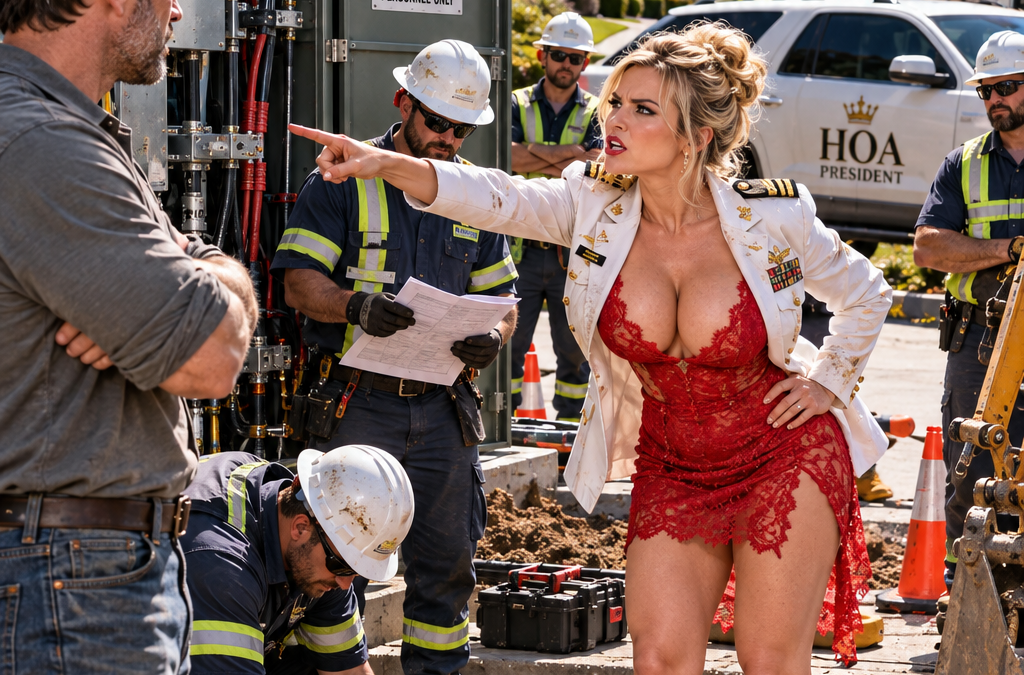
I stood beside my truck staring at her while a compact excavator idled behind the crew.
Orange cones surrounded the trench.
Heavy insulated cable was visible beneath layers of soil and conduit.
A utility truck had been backed toward the transformer enclosure, and two workers were laying out tools beside a disconnect cabinet that had absolutely no business being touched without proper authorization.
Linda Harrison marched toward the crew as if she owned all of it.
She was forty years old, blonde, beautiful in a way she deliberately turned into part of her authority, and dressed—as always—in the same tight red lace dress that seemed almost absurd anywhere outside a cocktail party.
The dress clung to her curvy figure and exposed enough of her large chest that I had seen more than one HOA board member forget what he had been saying when she leaned across a table.
Linda knew exactly what she was doing.
She flirted when charm could get her obedience.
She humiliated people when charm failed.
And when neither worked, she simply issued orders louder.
That morning, she wore black heels despite the mud around the trench.
A fitted cream jacket hung open over the red lace.
Her sunglasses rested on top of perfectly styled hair.
She pointed toward the transformer.
“David, what are you waiting for?”
The crew foreman turned toward her.
David Mercer was in his late forties, broad-shouldered, sunburned, and visibly uncomfortable.
“We’re still verifying the line.”
Linda’s expression hardened.
“I already gave you authorization.”
David looked toward me.
Then toward the transformer.
Then back at the paperwork in his hand.
“This equipment doesn’t look like HOA infrastructure.”
Linda threw one hand up.
“It supplies a house inside the neighborhood.”
“That doesn’t necessarily mean the HOA owns it.”
She snapped her head toward him.
“I hired your company to do a job.”
“And we’re going to do it if the paperwork supports it.”
“It does.”
David looked down at the work order.
I stepped closer.
“David, before anybody puts a tool on that cabinet, you might want to check what voltage you’re standing next to.”
One of his workers immediately stopped unrolling cable.
Linda turned toward me.
“Stay out of this, Mark.”
I looked at her.
“My electrical service is the thing you’re trying to disconnect.”
“You’ve been given multiple compliance notices.”
“What does that have to do with a transformer?”
“Everything.”
“No.”
I pointed toward the open enclosure.
“It has absolutely nothing to do with that.”
Her mouth tightened.
“You have refused to cooperate with neighborhood standards for months.”
“And your solution is to cut my electricity?”
“Temporary utility suspension is an enforcement option.”
I laughed once.
“No, it isn’t.”
Linda stepped toward me.
“You don’t decide what options the HOA has.”
“On private electrical infrastructure?”
“Yes.”
“No.”
Her face flushed.
Behind her, David unfolded a second sheet from the work packet.
He studied it.
Then frowned.
“Ms. Harrison.”
She ignored him.
“You’ve been warned repeatedly about your property.”
“Linda.”
David raised his voice slightly.
She turned.
“What?”
“This authorization is for landscaping excavation.”
Silence.
Linda stared at him.
“What?”
“The document you gave me.”
He lifted the paper.
“It authorizes trench access associated with landscaping modifications. It doesn’t authorize electrical disconnection.”
She stepped closer and snatched at the paperwork.
David didn’t release it.
“The utility work is included.”
“Where?”
“In the project scope.”
David pointed toward the page.
“I don’t see it.”
Her eyes flicked across the text.
Then back toward him.
“You were told what needed to be done.”
“That isn’t the same thing as authorization.”
Linda’s posture changed.
Not much.
But I knew her well enough by then to recognize when confidence was turning into anger.
She hated being questioned in front of witnesses.
Especially workers she considered beneath her.
I folded my arms.
“Who gave you permission to order my power disconnected?”
Linda looked at me.
“The board.”
“The board owns my electric service?”
“The board has jurisdiction over all neighborhood utilities.”
“That is completely false.”
“Don’t tell me what authority I have.”
“I know exactly what authority you have.”
She stepped toward me.
“You’ve spent months challenging every board decision.”
“Because half of them aren’t legal.”
Her eyes flashed.
“David, continue.”
David didn’t move.
The workers didn’t move either.
One had already taken a step away from the transformer.
Linda pointed toward the cabinet.
“Disconnect the line.”
David shook his head.
“Not until I verify ownership.”
“You already have everything you need.”
“No, ma’am.”
That word—no—landed harder than anything I had said.
Linda stared at him.
For years, people inside Briarwood Estates had learned that saying no to Linda came with a price.
A fine.
A warning.
A committee review.
Public humiliation at a meeting.
But David didn’t live there.
He didn’t care about her title.
He cared about what happened if his crew disconnected privately controlled high-voltage equipment without authority.
I reached into my pocket.
Linda immediately pointed at me.
“What are you doing?”
“Getting the information David needs.”
“Put your phone away.”
I ignored her.
I opened the utility management application I used to monitor the neighborhood distribution network.
A one-line diagram appeared.
Feeders.
Transformers.
Load points.
Service IDs.
Switch status.
Linda laughed.
“You really expect us to believe you’re some kind of utility operator now?”
I looked at David.
“What service number are they trying to isolate?”
He checked the work order.
“Briarwood West feeder, service branch twelve.”
I entered the account.
The screen loaded.
Transformer ID.
Ownership.
Operating company.
Authorized service contact.
I turned the phone toward him.
“That’s the line.”
David leaned closer.
His expression changed slightly.
Linda stepped between us.
“He’s bluffing.”
I looked at her.
“Based on what?”
“Because homeowners do not own utility networks.”
“Usually.”
She folded her arms.
“There. You admit it.”
“I said usually.”
“David, stop wasting time.”
David ignored her.
“Can I get the utility account number?”
I read it aloud.
“Contact number?”
I gave him that too.
Linda laughed again.
“Oh, this is ridiculous.”
David pulled out his phone.
“Better ridiculous than wrong.”
He dialed.
Linda stood beside him tapping one heel against the gravel.
Her impatience became more visible with every second.
I knew why.
This wasn’t supposed to be an investigation.
It was supposed to be theater.
She had brought a crew to my property so I could watch her exercise authority.
The trench.
The trucks.
The equipment.
The board paperwork.
It was all meant to make resistance feel pointless.
What she hadn’t planned for was someone asking the most basic question first.
Who owns the system?
David spoke into his phone.
“Yes, I’m on site for a service disconnect.”
He paused.
“Briarwood Estates.”
Another pause.
He looked at the work order.
“Mark Bennett property.”
The person on the other end said something.
David looked toward the transformer.
“Pad-mounted unit, west side of the property. Private feeder coming off the southern distribution line.”
His brow furrowed.
“That’s correct.”
He listened.
Then turned away from Linda.
“Yes. I can hold.”
Karen threw her hands up.
“This is wasting time.”
I didn’t answer.
David waited.
Then the person returned.
He listened for maybe twenty seconds.
His entire expression changed.
Not confusion anymore.
Alarm.
He looked at his workers.
“Stop.”
They were already standing still.
David raised his voice.
“Everybody off the cabinet. Back away from the transformer.”
Two workers moved immediately.
Another closed his toolbox.
Linda stared.
“What are you doing?”
David ended the call.
“We’re done.”
“No, you’re not.”
“Yes, we are.”
“I hired you.”
“You hired us for landscaping support and what we believed was authorized utility work.”
“It is authorized.”
“No.”
His voice became firmer.
“That system is privately controlled.”
Linda blinked.
“So?”
David looked at her as though he wasn’t sure she understood the words.
“So we don’t have permission to touch it.”
“The HOA controls the utilities.”
“No, ma’am.”
I almost felt sorry for her.
Almost.
Linda turned toward me.
“What is he talking about?”
I slid my phone back into my pocket.
“The utility company is not owned by the HOA.”
She stared at me.
“Then who owns it?”
I let the silence sit for a moment.
Maybe longer than necessary.
David looked between us.
One of the workers stopped coiling cable.
Linda’s face hardened.
“Well?”
“I do.”
The words landed quietly.
That made them hit harder.
Linda stared.
Then laughed.
A sharp, disbelieving sound.
“You own the utility company.”
“Yes.”
“No, you don’t.”
I shrugged.
“Then I’m sure David’s call was an elaborate coincidence.”
She turned toward him.
“Is he telling the truth?”
David looked at me.
Then at her.
“The service operator confirmed that the infrastructure feeding this section belongs to Bennett Utility Management.”
Linda’s face went still.
I opened the application again.
Then the corporate record attached to the account.
David recognized the name immediately.
“Bennett Utility Management.”
He looked down at his own work packet.
Then back at the document.
“Same name.”
Linda shook her head.
“No.”
She snatched the work packet from his hand.
“That’s a vendor.”
“No,” I said. “That’s my company.”
“You run an electrical company?”
“I own a private utility management company.”
“Since when?”
“Long before you decided my meter box offended the HOA.”
She stared at me.
For the first time since I’d known her, Karen—Linda, the woman who had spent years treating the board presidency like a private crown—had no immediate response.
I had moved into Briarwood Estates four years earlier.
At the time, I didn’t tell anyone much about my work.
That was deliberate.
I had spent nearly twenty years in utility infrastructure.
Started as an electrical engineer.
Moved into distribution planning.
Later, I bought a small regional infrastructure company when its founder retired.
Bennett Utility Management specialized in privately owned distribution systems serving mixed developments, rural subdivisions, industrial campuses, and properties that weren’t connected through the standard ownership model people assumed.
Briarwood was one of those systems.
The developer had built the neighborhood’s internal electrical distribution under a private utility arrangement.
Years later, my company acquired the operating assets.
Most homeowners didn’t know.
They didn’t need to.
They received power.
Bills were processed.
Maintenance happened.
Emergency repairs got made.
The HOA managed landscaping, architectural standards, common-area rules, and the usual collection of suburban concerns.
My company managed the electrical infrastructure.
The separation had always been clear.
At least, it was clear to anyone who read the documents.
Linda had never been very interested in documents that limited her authority.
When I first moved into Briarwood, she was already HOA president.
She introduced herself the day after I closed.
Red lace dress.
Clipboard.
Perfume strong enough to reach me before she did.
“Welcome to Briarwood.”
“Thank you.”
She looked past me toward the house.
“You’ll need to replace those exterior fixtures.”
I glanced behind me.
“I moved in yesterday.”
“They’re outdated.”
“They work.”
“That isn’t the standard.”
That was my introduction.
Within two weeks, I received a violation because my garbage cans had been visible twelve minutes after collection time.
Then a warning about my garage door color.
Then another because my truck was allegedly parked too close to the sidewalk.
I paid the first fine.
Not because Linda was right.
Because I didn’t want the aggravation.
That was a mistake.
She interpreted payment as submission.
The complaints became stranger.
My backyard lighting was too bright.
Then too dim.
A small equipment cabinet near the side fence was visually inconsistent with residential character.
That one amused me because the cabinet contained monitoring equipment connected to the electrical network.
Linda called it an unauthorized utility box.
I told her it predated my ownership.
She told me ownership transfer didn’t erase compliance obligations.
I asked her to show me the applicable rule.
She gave me three unrelated pages from the architectural guidelines.
I disputed the fine.
She denied my appeal herself.
That was when our relationship changed.
Linda didn’t mind residents misunderstanding rules.
She minded residents reading them.
From then on, every disagreement became personal.
At board meetings, she called me uncooperative.
She told neighbors I believed I was above community standards.
Once, she actually said, “Mr. Bennett seems to think technical knowledge gives him special privileges.”
I responded, “No. I think technical knowledge helps me notice when you’re making things up.”
That did not improve the relationship.
The electrical dispute started with a landscaping complaint.
A strip of my side yard contained a transformer, underground feeder access, and service equipment.
Because of clearance requirements, I kept landscaping around it minimal.
No decorative shrubs.
No deep-rooted plants.
No stone wall.
Nothing that would obstruct utility access.
Linda hated it.
She wanted the area screened with hedges.
I refused.
“You can’t plant large shrubs over utility clearance.”
“The landscape committee approved them.”
“The landscape committee doesn’t control electrical safety.”
“You use that excuse for everything.”
“Because you keep trying to landscape around high-voltage equipment.”
She eventually sent me a violation notice.
Failure to maintain screening vegetation.
I responded with the utility clearance requirements.
She sent another fine.
Then a third.
I appealed.
The board tabled the issue.
I thought that was the end.
Instead, Linda decided the exposed infrastructure itself was the violation.
Her solution was breathtaking.
If the equipment serving my property created an aesthetic problem, she would have the service disconnected temporarily while the area was “corrected.”
That was how I ended up standing beside a trench while a hired crew prepared to touch equipment the HOA did not own.
Back in the driveway, Linda was still staring at the company document on my phone.
“This doesn’t make sense.”
“It makes perfect sense.”
“You never told the board.”
“The board never asked.”
“You had an obligation to disclose ownership.”
“No.”
“Yes.”
“For what purpose?”
“Conflict of interest.”
I laughed.
“What conflict?”
“You live here and control infrastructure.”
“My company operates the infrastructure under recorded agreements.”
“The HOA should have been informed.”
“It was.”
Her eyes narrowed.
“What?”
“The operating agreement is in the association records.”
David looked away.
That hurt her.
I continued.
“The developer transferred copies when the system changed ownership.”
“I’ve never seen them.”
“That sounds like a board-records problem.”
Her cheeks turned red.
“You concealed this.”
“No, Linda.”
I pointed toward the transformer.
“You never bothered to find out who owned the thing you were ordering disconnected.”
She looked at David.
“Could you continue if the HOA provides separate authorization?”
David shook his head.
“Not from the HOA.”
“What would you need?”
“Authorization from the utility owner.”
She slowly turned toward me.
I smiled.
“No.”
Her eyes flashed.
“You cannot use your business to obstruct HOA enforcement.”
“I’m not.”
“You are refusing service.”
“I’m refusing to authorize an illegal disconnection of my own property because you dislike my landscaping.”
“This isn’t illegal.”
David cleared his throat.
“Ms. Harrison.”
She snapped toward him.
“What?”
“We’re pulling out.”
Her expression went hard.
“You’ll still complete the trench work.”
“We’ll restore what we disturbed under the landscaping scope.”
“No. I need the line shut down.”
“We’re not touching it.”
“I’ll hire another contractor.”
I stepped closer.
“You can hire fifty.”
She glared at me.
“None of them can lawfully disconnect that feeder without utility authorization.”
David nodded.
“He’s right.”
Linda stared at him.
“You work for me.”
“No.”
He folded the paperwork.
“My company works under a contract. That doesn’t mean I follow unauthorized instructions.”
The workers began packing.
Insulated tools went back into cases.
The cable was rolled.
A safety barrier was placed around the trench.
Linda stood there watching the entire operation she had orchestrated collapse in less than ten minutes.
The image was almost surreal.
She had arrived expecting to watch my power disappear.
Instead, every worker was leaving because she had never bothered to check who actually owned the infrastructure.
She finally turned back to me.
“We received complaints.”
I blinked.
“What?”
“About your property.”
“And?”
“The transformer area is unsightly.”
“Did those complaints give you ownership of the electrical grid?”
“I didn’t say ownership.”
“You ordered a disconnection.”
“As an enforcement action.”
“You had no authority.”
“We believed we did.”
“No.”
I shook my head.
“You believed nobody would challenge you.”
Linda’s face changed.
She stepped toward me.
“Be careful, Mark.”
“About what?”
“Your attitude.”
I laughed softly.
“There it is.”
“What?”
“The threat you use when the rules don’t support you.”
Her hands curled around the folder.
“You think because you own some little utility company—”
“Don’t.”
She stopped.
“What?”
“Don’t pretend this is about my company now.”
I lowered my voice.
“This is about you standing beside high-voltage equipment and ordering people to disconnect it because you wanted to punish a homeowner.”
“I was enforcing board decisions.”
“You didn’t verify the authority.”
“I had paperwork.”
“For landscaping.”
She looked toward David’s crew.
They were almost finished loading.
I continued.
“You could have caused an outage.”
“That wasn’t going to happen.”
“You don’t know that.”
Her eyes narrowed.
“I know enough.”
“No.”
For the first time, I let some anger into my voice.
“You know HOA enforcement.”
I pointed toward the transformer.
“You don’t know electrical distribution. You don’t know switching procedures. You don’t know isolation boundaries. You don’t know what else is fed through that equipment.”
She said nothing.
“You ordered workers to touch equipment you didn’t understand with authorization you didn’t have.”
I stepped closer.
“That isn’t leadership.”
She stared at me.
Then turned.
“Board meeting. Tonight.”
I almost laughed.
“You’re calling a board meeting?”
“Yes.”
“To discuss the fact that I own the utility company?”
“To discuss your failure to disclose a material interest affecting the community.”
I shook my head.
“Read your records before the meeting.”
She marched toward her SUV.
Her heels slipped once in the gravel.
She caught herself.
Nobody laughed.
That probably made it worse.
Linda drove straight to the HOA office.
I know because David told me later.
He remained behind while his crew finished securing the site.
When the last truck was ready to leave, he approached me.
“Mr. Bennett.”
“Mark is fine.”
“I owe you an apology.”
“You stopped before anyone touched anything.”
“Still.”
He glanced toward the trench.
“We should have verified the utility permit before mobilizing.”
“You were given bad information.”
“That’s not an excuse.”
I respected that.
“What exactly did Linda tell you?”
“That the HOA controlled all infrastructure within the subdivision and the service disconnect was part of a property-compliance project.”
I nodded.
“She gave you anything from my company?”
“Just the landscaping authorization packet.”
“No switching order?”
“No.”
“System diagram?”
“No.”
“Utility release?”
“No.”
“That should have stopped it.”
“Yes.”
He looked embarrassed.
“It will next time.”
I held out my hand.
He shook it.
“No hard feelings.”
“Appreciate that.”
Then he smiled faintly.
“For what it’s worth, when the utility dispatcher realized the account belonged to the company owner, there was a long pause.”
I laughed.
“I can imagine.”
“They thought I was joking.”
“They weren’t the only ones.”
After David left, I stood beside the transformer.
The trench remained open but secured.
I opened the network plans on my tablet.
The feeder serving my house was not isolated.
More importantly, that transformer was tied into a private distribution section feeding several utility monitoring systems beyond my property.
Linda’s order could have interrupted more than my lights.
The consequences probably wouldn’t have been catastrophic.
The equipment had protection.
Modern systems are designed around faults and mistakes.
But that wasn’t the point.
The point was that she had ordered a technical operation she did not understand solely because she believed the HOA presidency gave her universal authority.
I took photographs.
Saved the work order.
Recorded the crew information.
Then sent everything to my attorney, Rachel Bennett.
No relation.
She called within fifteen minutes.
“She ordered your power disconnected?”
“Yes.”
“Why?”
“Landscaping dispute.”
Silence.
Then she said, “I’m going to need you to repeat that because I’m hoping I misunderstood.”
“She wanted the transformer area screened. I refused because of clearance requirements. She hired a crew and ordered them to shut off my power.”
Rachel exhaled.
“Please tell me nobody touched utility equipment.”
“David stopped.”
“Good.”
“She didn’t have a permit.”
“Obviously.”
“She thinks the board controls utilities.”
“Also obviously wrong.”
“I know.”
Rachel was quiet.
“Do you want to take action?”
I looked toward Linda’s disappearing SUV.
“Not yet.”
“Why?”
“I want to see what she tells the board.”
The emergency meeting started at seven.
I didn’t attend.
That was deliberate.
Linda wanted confrontation.
I wanted records.
One board member, Thomas Reid, called me afterward.
Thomas had served as treasurer for three years.
He wasn’t exactly my friend, but he had always been reasonable.
His first words were, “Mark, I owe you an apology.”
“That’s becoming popular today.”
He gave a tired laugh.
“I assume Linda told you?”
“She said there’d be a meeting.”
Thomas sighed.
“She told us the electrical project failed because you withheld utility information.”
“Did she mention the authorization only covered landscaping?”
Pause.
“No.”
“Did she mention David stopped the work after verifying ownership?”
“No.”
“Did she mention she ordered him to continue anyway?”
Another pause.
“No.”
I leaned back in my chair.
“What did she tell you?”
“That you used a privately held company to interfere with legitimate HOA enforcement.”
I laughed.
“That’s creative.”
“We pulled the original development records.”
“And?”
Thomas sounded embarrassed.
“Bennett Utility Management is listed.”
“Of course it is.”
“The operating agreement is from six years ago.”
“Correct.”
“Before Linda became president.”
“Correct.”
“She said she never knew.”
“That might be true.”
“But it’s in the records.”
“Yes.”
Thomas sighed.
“There’s more.”
“What?”
“The original complaint.”
I waited.
“Nobody inspected your property.”
I sat forward.
“What do you mean?”
“The landscaping committee received a complaint saying you had removed required screening vegetation around utility equipment.”
“I never had screening vegetation there.”
“I know that now.”
“Who filed the complaint?”
“We’re checking.”
“What was the evidence?”
“None.”
I stared at the wall.
“So Linda authorized excavation and an electrical disconnection based on an unverified complaint.”
“Yes.”
“Did anyone review utility clearance requirements?”
“No.”
“Did anyone contact the utility operator?”
“No.”
Thomas sounded miserable.
“We approved a project without understanding what it involved.”
I didn’t answer.
Then he said, “I’m sorry.”
“You should be.”
“I know.”
“What happens now?”
“We’re voting tomorrow to cancel the project.”
“What about Linda?”
Silence.
“That’s more complicated.”
I laughed softly.
“It always is.”
The next morning, I returned to the site at seven.
The trench was still there.
No utility crew.
No trucks.
No Linda.
For the first time in days, the property was quiet.
David arrived twenty minutes later with two workers.
They were there to backfill the nonessential section of the trench and restore the landscaping disturbance.
He stepped out carrying coffee.
“Morning.”
“Morning.”
“Board called last night.”
“What did they say?”
“Project canceled.”
“Entirely?”
“Entirely.”
He looked toward the transformer.
“And management made it very clear nobody from our company touches that equipment without direct authorization from Bennett Utility.”
“Good policy.”
He smiled.
“Should’ve been the first policy.”
The crew began work.
Half an hour later, Linda arrived.
I almost didn’t recognize her posture.
Same red lace dress.
Same blonde hair.
Same black SUV.
But no clipboard.
That was new.
She walked toward me slowly.
David noticed.
He gave me a look, then deliberately moved away.
Linda stopped several feet from me.
“The board has canceled the work.”
“I heard.”
“We reviewed the records.”
“Good.”
She looked toward the transformer.
“We should have verified ownership first.”
I waited.
That was as close to an apology as I’d ever heard from her.
I wasn’t going to rescue her from the silence.
She finally continued.
“The complaint suggested you had removed required landscaping.”
“There was never required landscaping there.”
“We know that now.”
“You could have known before digging.”
She pressed her lips together.
“Yes.”
“And before ordering my power disconnected.”
Her face tightened.
“I was acting on the information available.”
“No.”
I shook my head.
“You were acting before you verified the information available.”
“That isn’t entirely fair.”
“It is exactly fair.”
She looked at me.
“Do you want an apology?”
“I want boundaries respected.”
“This has become very personal for you.”
I laughed.
“You tried to shut off electricity to my house.”
She looked away.
“Temporarily.”
“That’s supposed to help?”
“No.”
She sighed.
“I admit the utility ownership should have been confirmed.”
“Before workers touched anything.”
“Yes.”
“The permit should have been reviewed.”
“Yes.”
“The complaint should have been verified.”
“Yes.”
I looked at her.
“And the HOA should never assume its authority extends into privately owned infrastructure.”
She hesitated.
Then said, “Yes.”
That was the moment I realized Linda had finally understood at least one part of the problem.
Maybe not humility.
Maybe not yet.
But limitation.
For years, Linda had treated the HOA presidency as if every issue inside Briarwood eventually came under her control.
Lawns.
Mailboxes.
Vehicles.
Paint.
Fences.
Landscaping.
Parking.
And somehow, in her mind, electrical infrastructure had become just another item on the list.
It wasn’t.
Community rules only function when everyone understands where those rules stop.
I told her that.
“Authority isn’t real because you speak confidently.”
She looked at me.
“I’m aware.”
“Are you?”
Her eyes narrowed.
I continued before she could answer.
“The board can enforce legitimate covenants.”
“I know.”
“You can manage common property.”
“I know.”
“You can adopt rules through the correct process.”
She folded her arms.
“I understand how an HOA works.”
“Then understand the other half.”
“What?”
“You don’t own everything inside the neighborhood.”
She said nothing.
I pointed toward the transformer.
“That equipment belongs to a utility company.”
Then toward my house.
“That property belongs to me.”
Then toward the road.
“Some infrastructure belongs to the municipality.”
I looked back at her.
“Different systems. Different owners. Different authority.”
Her face softened slightly.
Not because she liked hearing it.
Because she couldn’t argue anymore.
The workers finished backfilling the trench.
David approached.
“All set.”
I inspected the restored area.
“Looks good.”
He looked at Linda.
Then at me.
“Anything else?”
“No.”
Linda said nothing.
David and his crew drove away.
The transformer remained untouched.
My power had never gone out.
The system stayed exactly as it had been before Karen decided an HOA landscaping complaint somehow justified a utility disconnection.
Later that afternoon, the board issued a formal notice to residents.
The electrical project had been canceled.
No service interruption was authorized.
The association acknowledged that the relevant infrastructure was privately owned and outside HOA operational control.
They also adopted a temporary rule requiring independent verification before any future project involving utility systems.
Thomas sent me a copy.
At the bottom, he had handwritten:
Should have done this first.
I smiled.
He wasn’t wrong.
A week later, Rachel encouraged me to attend the next regular board meeting.
“You don’t have to sue them,” she said.
“I wasn’t planning to.”
“But you should make sure the minutes reflect what happened.”
So I went.
The clubhouse was packed.
Word had spread.
Neighborhood gossip moved faster than electricity.
Linda sat at the center table.
Red lace dress beneath a black blazer.
Thomas sat beside her.
Two other directors looked uncomfortable.
When resident comments opened, I stood.
Linda immediately stiffened.
I carried no folder.
No presentation.
Just one sheet of paper.
“I want the record to reflect five facts.”
The room quieted.
Linda’s eyes stayed on me.
“First, the complaint against my utility area was never independently verified.”
Thomas nodded.
“Second, the HOA’s work authorization covered landscaping excavation, not electrical disconnection.”
Another director nodded.
“Third, the board did not verify who owned the electrical infrastructure before hiring a contractor.”
Whispers began.
“Fourth, the crew stopped work after contacting the actual utility operator.”
Linda looked down.
“And fifth, my electricity remained connected because the HOA had no authority to order its disconnection.”
I placed the paper on the table.
“That’s all.”
A woman near the back raised her hand.
“Wait.”
Linda looked irritated.
Resident comment wasn’t supposed to become a discussion.
The woman continued anyway.
“So the HOA tried to shut off someone’s power without checking who owned the line?”
Thomas answered.
“Yes.”
The room erupted.
Another homeowner asked, “Could they have done that to any of us?”
Thomas said, “No work should have proceeded without proper utility authorization.”
Someone else asked, “Why did it proceed at all?”
Linda leaned toward her microphone.
“The board acted based on the information presented at the time.”
I looked at her.
The same excuse.
A man named Eric spoke from the second row.
“But you didn’t check the information.”
Linda stared at him.
“We’ve already addressed that.”
“No, I’m asking why.”
“Because the complaint appeared credible.”
“Who filed it?”
“We do not publicly disclose complainants.”
Eric laughed.
“So somebody complains about landscaping and you disconnect electricity?”
“We did not disconnect electricity.”
“Because Mark stopped you.”
The room got louder.
Linda struck the gavel.
“Order.”
It didn’t work immediately.
That was new.
Before the utility incident, Linda’s gavel could silence a room.
Now people had seen a clear example of what happened when nobody questioned her assumptions.
Thomas eventually took the microphone.
“This was a failure of process.”
Linda turned toward him.
He continued.
“We need to acknowledge that.”
I saw anger flash across her face.
But she stayed silent.
Thomas went on.
“The board approved work without sufficient review. That will not happen again.”
A homeowner shouted, “How do we know?”
Thomas answered, “Because we’re changing the approval process.”
That meeting became the beginning of something larger.
People started asking questions.
Not just about electrical work.
About everything.
Who reviewed fines?
Who verified complaints?
Who approved contractors?
Who checked property boundaries?
Who decided whether a rule actually authorized an action?
Linda hated every second.
She had built her authority on speed.
Complaint.
Decision.
Fine.
Order.
Compliance.
Questions slowed that machine down.
Within two months, the board adopted a requirement that major enforcement actions receive documentation before approval.
Projects touching utilities needed written owner authorization.
Property complaints required photographs or inspection records.
No one person could authorize service interruption.
None of those rules were revolutionary.
That was the disturbing part.
They were ordinary safeguards.
They simply hadn’t existed because everyone assumed no board president would ever be reckless enough to order someone’s power disconnected over landscaping.
They had underestimated Linda.
So had I.
The strange part was that my relationship with the neighborhood actually improved afterward.
Before the incident, most people knew me only as the guy who argued with Linda at meetings.
Afterward, residents began stopping me near the mailbox.
One asked how the utility arrangement worked.
Another wanted to understand why the transformer couldn’t be hidden behind shrubs.
I explained root clearances.
Working space.
Ventilation.
Emergency access.
Suddenly, the ugly equipment Karen hated became understandable.
People didn’t have to like looking at it.
They simply understood why it existed.
One Saturday, three residents helped me install low decorative fencing outside the required clearance zone.
It screened the transformer from the road without interfering with maintenance.
The solution took four hours.
No threats.
No fines.
No trench.
No attempted disconnection.
Just people solving a problem together.
Thomas came by while we worked.
He looked at the fence.
“This would’ve been a lot cheaper.”
I laughed.
“A little.”
He shook his head.
“Linda wanted hedges.”
“Hedges grow roots.”
“I know that now.”
“You could have asked.”
He looked embarrassed.
“Yeah.”
We stood quietly for a moment.
Then he said, “Do you think she meant to punish you?”
I knew exactly who he meant.
“Linda?”
“Yes.”
I considered the question.
“I think she wanted obedience.”
“That’s not the same thing.”
“No.”
I tightened a bolt.
“But when obedience becomes the goal, punishment usually follows.”
Thomas nodded slowly.
Linda remained president through the end of her term.
Barely.
She never tried another utility stunt.
In fact, she became almost obsessively cautious whenever infrastructure came up.
At one meeting, someone suggested moving a streetlight.
Linda immediately said, “We need written utility authorization.”
I nearly laughed out loud.
She heard me.
Our eyes met.
Neither of us said anything.
Progress, I suppose.
At the following election, Linda lost the presidency.
She didn’t lose because of one transformer.
There had been years of tension before that.
Fines.
Selective enforcement.
Aggressive meetings.
Residents tired of feeling watched.
But the attempted power disconnection became the story everyone remembered.
It made something abstract visible.
People could debate whether a lawn was too long.
They could disagree about mailbox colors.
They could argue over parking.
But almost everyone understood that an HOA president should not order electrical equipment disconnected without knowing who owned it.
Thomas became the new president.
His first board meeting lasted nearly four hours because he let people ask every question they wanted.
By the end, he looked exhausted.
I shook his hand afterward.
“Still glad you ran?”
He laughed.
“Ask me next year.”
Linda attended that meeting.
She sat in the back.
No podium.
No gavel.
Still wearing the red lace dress.
Some habits apparently survive electoral defeat.
She left before resident comments ended.
I didn’t speak to her.
There was nothing left to say.
The utility company continued operating exactly as before.
Most residents never noticed any difference.
That’s how infrastructure should work.
When it’s functioning, nobody thinks about it.
Electricity arrives.
Transformers hum.
Protection systems sit quietly in cabinets.
Crews inspect equipment.
Storms cause problems.
Workers fix them.
No drama.
I preferred it that way.
Months after the incident, David called me.
“Got a minute?”
“Sure.”
“We changed company policy.”
“Because of Briarwood?”
“Partly.”
“What changed?”
“No utility-adjacent work begins until ownership and authorization are independently verified.”
I smiled.
“That’s good.”
“My safety director uses your job as an example now.”
“Great. I’m training material.”
David laughed.
“Could be worse.”
“True.”
Then he became serious.
“You know, if you hadn’t been there that morning, we probably would’ve stopped anyway.”
“Probably?”
He groaned.
“Fair.”
I laughed.
He continued.
“But you caught it before anyone touched the cabinet.”
“That’s what matters.”
“Yeah.”
He paused.
“Still feel bad about it.”
“Don’t.”
“You sure?”
“You listened when the facts changed.”
That was more than Linda had done.
“That’s enough.”
After we hung up, I walked outside.
The transformer sat behind the decorative fence we’d installed.
You could still see the top.
Good.
I wanted emergency crews to find it easily.
The landscaping around it was simple.
Low grass.
Shallow-rooted plants beyond the clearance perimeter.
Safe.
Functional.
Not quite the manicured wall of greenery Linda had imagined.
But better.
One evening, I found an old copy of the original violation notice in my desk.
Insufficient screening of utility equipment visible from common roadway.
Under corrective action, Linda had written:
Install evergreen landscaping or remove exposed utility service.
I stared at that sentence.
Remove exposed utility service.
That phrase had eventually become, shut off his power.
A ridiculous escalation when you looked at it backward.
But that’s how overreach happens.
Rarely all at once.
First someone assumes authority over something small.
Then the next step feels only slightly larger.
Then another.
Eventually, a woman with a landscaping complaint is ordering workers toward a high-voltage transformer.
Every step feels reasonable to the person taking it because nobody forced them to stop and ask the first question.
Do I actually have the authority to do this?
Linda never asked.
David did.
That was why nothing happened.
I framed the canceled work order.
Not because I wanted a trophy.
Because it reminded me of something useful.
Official-looking paperwork is not the same as legal authority.
A title is not ownership.
A board vote is not a utility permit.
Confidence is not expertise.
And saying “the HOA approved it” does not magically give someone control over systems they do not own.
Briarwood became calmer after Thomas took over.
Not perfect.
No neighborhood is.
People still argued about parking.
Someone complained about basketball hoops.
A mailbox debate lasted three meetings.
Normal suburban nonsense.
But the atmosphere changed.
Residents asked questions without immediately being called difficult.
The board checked documents before threatening anyone.
Contractors received proper scopes.
And nobody tried to disconnect my electricity.
That felt like progress.
The funniest moment came almost a year later.
A transformer on the north side of the neighborhood failed during a summer storm.
Lightning struck nearby.
The protection system isolated the fault.
Twelve houses lost power.
My operations team responded.
I went out too because I happened to be home.
Crews worked for three hours.
Near midnight, power came back.
Residents standing outside applauded.
Thomas brought bottled water.
Then I saw Linda.
She stood at the end of the sidewalk.
Red lace dress under a light coat.
She watched my crew close the cabinet.
For a moment, I wondered whether she would walk away.
Instead, she approached.
Slowly.
“Mark.”
“Linda.”
She looked toward the utility trucks.
“Thank you.”
I almost asked her to repeat it.
I resisted.
“You’re welcome.”
She hesitated.
Then said, “I didn’t understand any of this.”
I looked toward the transformer.
“No.”
Her mouth tightened.
Normally that would have started an argument.
This time she nodded.
“No, I didn’t.”
That was probably the most honest thing I ever heard her say.
She walked home.
I watched her leave.
Then one of my technicians came over.
“Who was that?”
I smiled.
“Former HOA president.”
He looked after her.
“The one from the story?”
“Yep.”
He laughed.
“No way.”
“Unfortunately.”
I looked at the repaired transformer.
“Come on. Let’s finish.”
Today, most people in Briarwood know Bennett Utility Management operates the neighborhood’s private electrical infrastructure.
Not because I brag about it.
Because after what happened, the board made ownership information available to residents.
Emergency contacts.
Maintenance responsibilities.
Clear divisions between HOA authority and utility authority.
That transparency was useful.
It also prevented the exact confusion Linda used to justify her actions.
I never wanted special treatment because of the company.
That was the irony.
If the utility had belonged to somebody else, I would have defended the same boundary.
Ownership determines who has authority.
Safety procedures determine who can work on the equipment.
Not the HOA president’s mood.
Not a landscaping complaint.
Not whether my house looked the way Linda wanted.
Sometimes neighbors ask whether I deliberately kept quiet about owning the company so I could embarrass her.
No.
The truth is less dramatic.
It simply wasn’t relevant.
I didn’t introduce myself by saying, Hello, I’m Mark and I own part of your electrical distribution system.
Most people don’t introduce themselves by listing their corporate holdings.
I paid HOA dues.
Followed legitimate neighborhood rules.
Ran my business.
Went home.
Linda decided lack of knowledge was evidence of deception only after her own failure to check became public.
That wasn’t my problem.
Her mistake came from assuming every system inside the physical boundaries of Briarwood automatically belonged to the HOA.
But communities are layered.
Private homes.
Common areas.
Public roads.
Utility easements.
Private infrastructure.
Municipal infrastructure.
Telecommunications equipment.
Water systems.
Drainage rights.
Owning authority over one layer does not grant authority over all the others.
That sounds obvious.
It wasn’t obvious to Linda.
Or maybe it was, and power had simply made her careless.
Either way, that morning beside the transformer taught the entire neighborhood something more useful than any HOA newsletter ever had.
Before you give an order, verify the right to give it.
Before you touch equipment, verify who owns it.
Before you threaten someone’s property, verify the law.
And before an HOA president tells a crew to cut the electricity to a homeowner’s house, someone should probably ask the homeowner whether the utility company happens to be his.
I still remember Linda’s face when she asked the question.
“Then who owns it?”
She expected some distant corporation.
Some faceless utility board.
Something she could argue around.
Instead, the answer was standing three feet away.
Me.
Not because that made me more important than anyone else.
Because it made one fact impossible for her to ignore.
The power line was never hers to control.
Neither was I.








