𝗙𝗨𝗟𝗟 𝗦𝗧𝗢𝗥𝗬 The HOA President Ordered Me to Tear Down My New Gate and Threatened to Bring the Sheriff Onto My 60 Acres
𝗙𝗨𝗟𝗟 𝗦𝗧𝗢𝗥𝗬
The gate wasn’t intended to keep out legitimate visitors.
It was intended to keep my livestock area secure, discourage trespassing, and give me control over who entered my driveway.
A perfectly ordinary improvement.
Or so I thought.
The work took several days.
On the first morning, I removed the old chain and began dismantling the rusted frame.
By afternoon, I had the damaged gate off its hinges.
The following day, I worked on the posts.
The old ones were rotted near ground level, so I removed them and prepared proper foundations for the replacements.
I measured carefully.
Then I measured again.
I wasn’t about to spend good money installing a gate that sagged after the first winter.
By the third day, the new posts stood straight.
The fourth day brought the metal gate itself.
When I finally hung it, I stepped backward and studied the entrance.
For the first time, the property looked secure.
Not fortified.
Not hostile.
Simply cared for.
I opened the gate, drove my truck through, and closed it behind me.
The latch settled into place with a solid metallic click.
I stood there smiling like a fool.
It was such a small victory.
After years of saving and searching, I had finally completed the first major improvement on land that belonged to me.
That satisfaction lasted less than twenty minutes.
I heard a vehicle approaching from the county road.
A black SUV slowed near the entrance.
The driver’s window lowered.
A man wearing dark sunglasses leaned toward the opening and stared at the gate.
He didn’t smile.
I was holding a cordless drill when he stepped out.
He wore a cream-colored shirt beneath a navy blazer, tailored gray trousers, and polished loafers that looked painfully out of place on the gravel.
His hair shone in the sunlight.
He examined the gate without acknowledging me.
Then he spoke.
“What’s this supposed to be?”
I glanced behind me.
“The gate?”
“Obviously.”
“It’s a new entrance gate.”
He looked at me as though I had deliberately misunderstood him.
“I can see that. Why was I not informed?”
I lowered the drill.
“Excuse me?”
“Why wasn’t this alteration submitted for approval?”
I studied him.
I had never met the man.
“Approval from whom?”
He removed his sunglasses slowly.
“Karen. President of the homeowners association.”
I waited.
He seemed to expect some immediate recognition.
When none came, his expression tightened.
“You’re the new owner?”
“Michael.”
I offered my name without extending my hand.
His eyes moved across the driveway.
“Well, Michael, you’ve created a problem.”
I looked toward the gate.
“It opens and closes fine.”
“That isn’t the problem.”
“Then what is?”
He adjusted his watch.
“This entrance interferes with a community access route.”
For a moment, I thought I had misheard him.
“A what?”
“A community access route.”
I looked down the driveway, which disappeared between two rows of trees before reaching the farmhouse.
Then I looked back at Karen.
“This is my private driveway.”
He smiled.
A thin, condescending expression that didn’t reach his eyes.
“That’s a rather simplistic understanding of how community access works.”
I felt my patience begin to tighten.
“Then explain it.”
He gestured toward the entrance.
“Residents have historically used this route. You can’t simply place a gate across it without authorization.”
“Used it to reach what?”
“Our community.”
I looked down the road.
The association’s development wasn’t behind my property.
It wasn’t even connected to the driveway as far as I knew.
“Karen, this road goes to my farmhouse and barn.”
“That doesn’t change the historical access arrangement.”
“What arrangement?”
“The community route.”
“Do you have an easement?”
His expression changed.
Only slightly.
But I noticed.
“Excuse me?”
“A recorded easement. A right-of-way agreement. Anything showing that the association has a legal right to use this driveway.”
He stared at me.
“I’m the HOA president.”
“I understand that.”
“Then you should understand that these matters are handled through the association.”
“My property isn’t in your association.”
He gave a short laugh.
“You’re making an awfully confident statement for someone who just moved here.”
I set the drill on the back of my truck.
“Confidence has nothing to do with it. I reviewed the property records before closing.”
He stepped closer to the gate.
“That gate is unacceptable.”
“Why?”
“It obstructs access.”
“Access you haven’t established exists.”
His smile disappeared.
“You need to remove it.”
I felt heat rise behind my ears.
“No.”
The word hung between us.
Karen looked genuinely surprised.
Not offended.
Surprised.
As though nobody had warned him that the new owner might refuse his instructions.
He folded his arms.
“You seem determined to start your relationship with this community on the wrong foot.”
“I’m not starting a relationship with your community. I’m replacing a broken gate on my land.”
“Your attitude is unfortunate.”
“My survey is available if you’d like to review it.”
He looked toward the gate again.
Then back at me.
“I’m giving you an opportunity to resolve this voluntarily.”
“Show me the recorded access right, and I’ll review it.”
“I don’t carry the entire association archive in my vehicle.”
“Then bring the relevant document next time.”
His jaw tightened.
“You may regret being this difficult.”
The words were quiet.
Almost conversational.
But there was nothing friendly about them.
I looked directly at him.
“Are you threatening me?”
He put on his sunglasses.
“I’m advising you to think carefully.”
Then he turned, returned to his SUV, and drove away.
I stood beside the gate until the black vehicle disappeared down the county road.
The drill lay where I had left it.
The new latch gleamed in the afternoon sunlight.
For the first time since purchasing the property, I felt that familiar tightening in my stomach.
The feeling that somebody else’s problem was about to become mine.
That evening, I spread my purchase documents across the kitchen table.
The farmhouse was quiet except for an old ceiling fan clicking above me.
I examined the survey first.
Sixty acres.
Clear boundary lines.
The driveway running from the county road into my property.
No indication that it was an HOA-controlled route.
I checked the deed.
Then the title documents.
Then the recorded easements identified during the purchase.
Nothing supported Karen’s claim.
I wasn’t arrogant enough to assume that my documents necessarily contained every answer about historical access.
Property law could be complicated.
Old easements sometimes survived changes in ownership.
A road could look private while still carrying a recorded right of use.
But that was exactly why I had asked Karen for evidence.
If a legitimate right existed, I wanted to see it.
I wasn’t going to destroy someone else’s legal access.
I also wasn’t going to tear down a gate simply because a well-dressed stranger claimed that my land belonged to his neighborhood.
I placed the survey on top of the stack.
Then I looked through the kitchen window.
The new gate stood at the far end of the driveway.
For several minutes, I wondered whether I should call Karen the following morning and try to smooth things over.
Maybe there had been a misunderstanding.
Maybe he had confused my property with another parcel.
Maybe a calm discussion would settle everything.
I considered those possibilities because I wanted peace more than I wanted an argument.
But something about the way he had spoken bothered me.
He hadn’t asked whether I knew about an access route.
He hadn’t shown concern about accidentally blocking a legitimate easement.
He had simply demanded that I remove the gate.
And when I asked for proof, he warned me that I would regret refusing.
I went to bed hoping he wouldn’t return.
He came back the next morning.
This time, he brought an audience.
I was carrying a toolbox toward the barn when I heard several vehicles slowing near the entrance.
At first, I assumed somebody had stopped to ask directions.
Then I saw Karen’s SUV.
Behind it came two pickup trucks and a silver sedan.
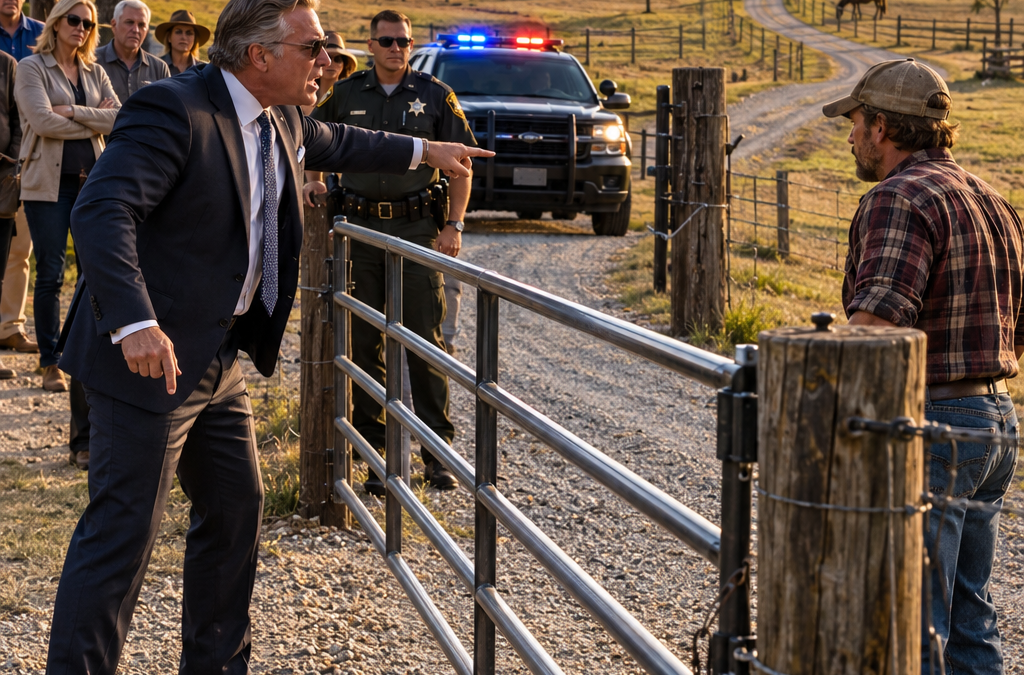
Six people gathered near my new gate.
Karen stood at the front.
His jacket was charcoal gray, his white shirt perfectly pressed, and his hair looked as though he had stepped directly out of a barbershop.
He was speaking before I reached them.
“Here he is.”
I stopped on my side of the gate.
“Morning, Karen.”
He didn’t return the greeting.
“Michael, these are residents from the neighboring community.”
I looked at the group.
Several appeared uncomfortable.
One older man held his arms across his chest.
A woman beside the sedan kept glancing between Karen and the entrance.
Another neighbor stood behind him with a phone in his hand.
I wasn’t sure whether he was recording.
Karen gestured toward the metal gate.
“I wanted them to see what you’ve done.”
I took a slow breath.
“What I’ve done is replace a broken gate.”
“He’s blocking the access route,” Karen announced to the group.
I looked at him.
“Did you bring the document I asked for?”
His jaw tightened.
“We’re beyond that.”
“No, we’re not.”
He turned toward the neighbors.
“You see what I’m dealing with?”
The older man shifted his weight.
“Karen says this driveway has always been available.”
I looked at him.
“Have you personally used it?”
He hesitated.
“Not recently.”
“How long ago?”
“Well, I can’t say exactly.”
“Do you know where it goes?”
He looked toward Karen.
Karen immediately stepped forward.
“That’s irrelevant.”
“No,” I said. “It’s actually pretty relevant.”
The woman near the sedan spoke.
“We were told the gate could block emergency access.”
I turned toward her.
“Emergency access to what?”
She glanced at Karen.
“To the community.”
I pointed down the county road.
“Your development has its own entrance and road system. This driveway ends at my farmhouse and barn.”
Karen shook his head.
“You’re intentionally ignoring the historical arrangement.”
“Then show me the arrangement.”
His eyes narrowed.
“Everyone has always used this driveway.”
I felt my patience disappear.
“Everyone isn’t a legal document, Karen.”
The older man looked down.
Somebody behind him coughed.
Karen’s expression hardened.
“Are you calling these people liars?”
“No. I’m asking whether anyone can establish a legal right to cross my property.”
He took a step toward the gate.
“We’re not going to stand here while you lecture residents about technicalities.”
“Property rights aren’t technicalities.”
“You can’t isolate yourself from the surrounding community.”
“I’m not isolating myself. I’m securing my land.”
“You’ve deliberately obstructed access.”
“Show me proof.”
His voice rose.
“I shouldn’t have to produce paperwork every time a newcomer decides to disregard established community expectations!”
I looked at the neighbors.
Then back at him.
“You’re asking me to remove a gate I legally installed. Yes, you need paperwork.”
Karen pointed at me.
“That attitude is exactly why enforcement becomes necessary.”
I gripped the handle of my toolbox.
For a second, I wanted to tell him exactly what I thought of his enforcement.
I wanted to ask whether he had ever done a day’s physical work in those polished shoes.
I wanted to tell him he could take his community standards and enforce them somewhere they actually applied.
Instead, I set the toolbox down.
“Karen, I am not removing the gate without evidence that it blocks a lawful right of access.”
He stared at me.
“Then I’ll call the police.”
The woman near the sedan looked startled.
“Karen, is that really necessary?”
He didn’t even turn toward her.
“He’s refusing to comply.”
I felt a knot tighten in my chest.
This had started as a conversation between two property owners.
Now there were neighbors at my gate.
And Karen was threatening to bring law enforcement into it.
I knew the records favored my position.
But I also knew how quickly a misunderstanding could become dangerous when people started treating confidence as authority.
I looked at Karen.
“You’re free to call the sheriff.”
His eyes flashed.
“Don’t think I won’t.”
“I didn’t say you wouldn’t.”
He pulled out his phone.
“Then we’ll settle this officially.”
He walked a few steps away and made the call.
I couldn’t hear every word, but I heard enough.
“Unauthorized obstruction.”
“Community access.”
“Refusing to remove the barrier.”
Each phrase sounded carefully chosen.
He was describing my gate as though I had driven onto someone else’s property and blocked a public road.
I looked toward the neighbors.
The older man avoided my eyes.
The woman who had questioned Karen appeared increasingly uneasy.
I understood their position.
They had arrived believing their HOA president knew something I didn’t.
He had likely told them I was blocking a route they were entitled to use.
And now they were standing on the edge of a stranger’s driveway while their president tried to involve the police.
Nobody seemed particularly eager to be there anymore.
Karen ended the call.
He returned to the gate wearing a satisfied expression.
“A deputy is on the way.”
I nodded.
“Good.”
He frowned.
“Good?”
“Maybe he’ll ask you the question you keep avoiding.”
Karen smiled coldly.
“You’ll be less confident when law enforcement explains how access rights work.”
I looked down at my toolbox.
Then at the new gate.
The latch was secure.
The hinges were straight.
I had installed everything within the entrance shown on my survey.
I had done nothing I knew to be unlawful.
Yet I could feel my heartbeat in my throat.
Because being right didn’t guarantee that the next hour would be easy.
And Karen had made it clear he wasn’t interested in resolving anything quietly.
Less than an hour later, a sheriff’s patrol vehicle appeared on the gravel county road.
It slowed behind the waiting vehicles.
Karen straightened immediately.
He smoothed the front of his jacket.
Then he moved toward the patrol vehicle before the deputy had even opened his door.
I watched him.
There was something almost theatrical about the transformation.
A moment earlier, Karen had been irritated and impatient.
Now he was the concerned community representative.
Calm.
Professional.
Reasonable.
The polished version of the man who had just threatened me.
The driver’s door opened.
A deputy stepped out.
He looked to be in his forties, with a steady expression and the practical movements of someone accustomed to arriving at disputes where both sides claimed to be completely right.
His nameplate read MILLER.
“Morning,” he said. “I’m Deputy James Miller. Who called?”
Karen stepped forward.
“I did, Deputy. Karen, president of the homeowners association.”
He extended his hand.
Miller shook it briefly.
“What’s the issue?”
Karen pointed at my gate.
“This individual has installed an unauthorized barrier across a long-established community access route. We’ve attempted to resolve the matter peacefully, but he refuses to cooperate.”
I felt my jaw tighten.
This individual.
Not Michael.
Not the property owner.
Not even the gentleman behind the gate.
Just an obstacle to his authority.
Deputy Miller looked toward me.
“Sir, are you the owner?”
“Yes. Michael. I purchased these sixty acres recently.”
“All right. Let me hear what happened.”
Karen opened his mouth again.
Miller raised a hand.
“I’ll hear from both of you. One at a time.”
Karen closed his mouth.
I almost smiled.
Almost.
Karen began his explanation anyway.
He claimed the driveway had historically served the nearby development.
He described the gate as an obstruction.
He said he had brought concerned residents to confirm the route’s importance.
He mentioned safety.
He mentioned access.
He mentioned my supposed refusal to cooperate.
What he didn’t mention was a recorded easement.
When Karen finished, Miller looked at him.
“Do you have documentation showing that the association has a legal right to use this driveway?”
Karen paused.
“Our community has used the route for years.”
“All right. Do you have a recorded easement or right-of-way agreement?”
“Not with me.”
Miller nodded.
“Do you know whether one exists?”
“These access arrangements sometimes predate current paperwork.”
“That’s possible. But do you have anything establishing this particular road as an association access route?”
Karen’s face tightened.
“The residents can confirm its historical use.”
Deputy Miller glanced toward the group.
“Historical use may be relevant to some legal questions, but it doesn’t automatically establish that I can order a property owner to remove a gate. I need to understand what legal right you’re claiming.”
Karen looked irritated.
“You’re making this sound more complicated than it is.”
Miller didn’t react.
“Property access disputes can be complicated.”
Then he turned to me.
“Michael, what documents do you have?”
I reached into my truck and retrieved the folder I had prepared that morning.
“My purchase survey, property description, and relevant title information.”
I handed him the survey.
He unfolded it against the hood of his patrol vehicle.
Karen moved closer.
I stayed on the other side.
Miller traced the boundary lines with his finger.
“This is your parcel?”
“Yes.”
“And this is the driveway?”
“Correct.”
“It connects to the county road here?”
“Yes.”
“And continues into the property?”
“To the farmhouse and barn.”
Miller examined the surrounding parcels.
“Where does the association’s claimed access road appear on the county map?”
Karen looked over his shoulder.
“What?”
“The access road you’re describing. Where is it shown?”
Karen stared at the survey.
“The map may not reflect historic community use.”
“All right. Do you have a separate county road map showing the route?”
“No.”
“An easement description?”
“Not with me.”
“A recorded agreement?”
Karen’s lips tightened.
“I’ve already explained that the route has been used historically.”
Miller looked at him.
“And I’ve heard that explanation. But I can’t order somebody to remove a gate from private property based on an unsupported claim.”
The wind moved through the trees.
Nobody spoke for several seconds.
I watched Karen’s face.
His carefully controlled expression was beginning to fracture.
He looked toward the neighbors, clearly expecting support.
The older man shifted uncomfortably.
The woman near the sedan folded her arms.
Nobody offered the missing document.
Karen cleared his throat.
“There’s also the appearance issue.”
Miller looked up.
“The appearance issue?”
“That gate violates neighborhood standards.”
I stared at Karen.
For a moment, I honestly thought I might laugh.
He had brought the sheriff to my property over an alleged access obstruction.
Now, when that argument began falling apart, he was complaining about how the gate looked.
Miller studied the metal structure.
“It appears to be a gate.”
“It’s industrial,” Karen said. “Completely inconsistent with the community aesthetic.”
I looked at him.
“Karen, there is no neighborhood on my sixty acres.”
His face reddened.
“You’re adjacent to one.”
“That doesn’t make my farm part of it.”
Miller turned toward Karen.
“Whether the association likes the gate’s appearance isn’t something I’m here to enforce. The question is whether it’s blocking a legally protected access route.”
Karen’s voice sharpened.
“And what if it is?”
“Then the relevant evidence needs to be reviewed. But I can’t establish that from what you’ve shown me today.”
Karen folded his arms.
“So you’re doing nothing.”
Miller’s expression remained calm.
“I’m documenting the dispute and explaining the limits of what can be determined here.”
“This is unacceptable.”
“I’m not going to order him to remove the gate without a legal basis.”
Karen stared at the deputy.
Then he looked at me.
There was something in his expression that made my stomach tighten.
Not disappointment.
Not embarrassment.
Resentment.
The kind that grows when a person accustomed to giving orders discovers somebody can refuse them.
I looked toward Miller.
“Deputy, am I required to remove this gate today?”
“Based on the information presented, I have no basis to require that. If someone believes there’s an enforceable easement, that may need to be resolved through the appropriate legal process.”
I nodded.
“Thank you.”
Karen let out a bitter laugh.
“Well, this isn’t finished.”
Miller looked at him.
“Mr. Karen, if you have additional documentation, you can pursue the matter through the proper channels. But I suggest everyone avoid escalating a boundary dispute.”
Karen adjusted his watch.
“I intend to take this to the HOA board.”
“That’s your choice,” Miller said.
Karen turned toward me.
“You’ve made a mistake, Michael.”
My mouth went dry.
I looked directly at him.
“No, Karen. I installed a gate.”
He stared at me.
Then he walked toward his SUV.
The neighbors began moving back to their vehicles.
The woman near the sedan paused beside my gate.
“I’m sorry,” she said quietly.
I looked at her.
“For what?”
“I didn’t realize there was a question about whether we actually had access.”
I nodded.
“That’s why I asked for the records.”
She glanced toward Karen.
“He made it sound very certain.”
“I know.”
She hesitated.
Then she returned to her car.
The vehicles left one by one.
Karen drove away last.
Deputy Miller handed back my survey.
“Keep copies of everything,” he said.
“I already started.”
“Good. If it becomes a civil property dispute, those documents will matter.”
I looked toward the gate.
“Am I going to have to keep dealing with this?”
Miller gave me a measured look.
“I can’t predict what the association will do. But don’t assume a claim is valid just because somebody repeats it confidently.”
Then he returned to his patrol vehicle.
I watched him leave.
For a few moments, I stood alone beside the metal gate.
I should have felt victorious.
The deputy hadn’t ordered me to remove it.
Karen hadn’t produced an easement.
The neighbors had seen that his story was questionable.
But I didn’t feel victorious.
I felt exhausted.
Because Karen’s final expression had told me something the deputy couldn’t.
He wasn’t finished.
And I was right.
The first HOA letter arrived three days later.
It was printed on heavy white paper with the association’s logo at the top.
NOTICE OF NONCOMPLIANCE
The letter alleged that my entrance gate interfered with established community access.
It demanded corrective action.
It warned that continued refusal could result in further enforcement measures.
I stood in my kitchen reading the notice while the coffee maker finished brewing.
For several seconds, I stared at the paper.
Then I read the heading again.
Noncompliance.
With what?
I wasn’t a member of their association.
I hadn’t signed their covenants.
Karen still hadn’t identified a recorded access right.
Yet here was another official-looking letter telling me I was failing to comply.
I placed it on the table.
I considered calling Karen.
I considered writing a furious response explaining that even the deputy had refused to support his demand.
But I remembered how quickly he had twisted every previous conversation.
If I called him angry, he’d describe me as aggressive.
If I refused to talk, he’d describe me as uncooperative.
If I tried to explain, he’d ignore the explanation and issue another demand.
So I did something different.
I dated the envelope.
I made a copy.
And I filed it.
Two days later, another letter arrived.
This one concerned the gate’s appearance.
It claimed the structure was inconsistent with the neighborhood’s architectural character.
The language suggested that I needed to submit an application for approval.
I read that one twice.
Then I walked outside and looked at the gate.
It stood between two sturdy posts.
It didn’t block the county road.
It didn’t cross a neighbor’s driveway.
It didn’t display anything offensive.
It simply opened and closed.
I shook my head.
“You’re causing quite a scandal,” I told it.
The gate, wisely, said nothing.
By the end of the week, I had received another warning referring to community safety and the possibility of additional compliance requirements.
The claims were changing.
The demand wasn’t.
Karen wanted the gate removed.
And he wanted me to accept that his association could tell me what to do.
The letters began affecting me more than I expected.
At night, I would sit at the kitchen table looking through them, trying to anticipate what Karen might attempt next.
Could he persuade the board to impose fines?
Could he create some kind of claim against the property?
Could he drag me into a lawsuit?
Could he persuade people I had blocked an emergency route?
I knew that an HOA couldn’t simply manufacture legal authority by sending letters.
But defending property rights could still become expensive.
The thought of paying an attorney because I had replaced a rotten gate made me sick.
I had saved for years to buy the land.
I had budgeted for fencing, drainage work, tools, and repairs to the farmhouse.
I hadn’t planned to spend that money proving I was allowed to close my own driveway.
One evening, I sat on the porch watching the sunset across the western pasture.
The grass moved in long waves under the wind.
Beyond the fence, the treeline turned almost black against the orange sky.
It was exactly the sort of evening I had imagined when I bought the property.
Yet I barely noticed it.
I kept looking toward the entrance.
Waiting for another vehicle.
Another confrontation.
Another attempt to turn my home into a battlefield.
That realization made me angry.
Not at the land.
Not at the gate.
At Karen.
He had managed to make me nervous on sixty acres I owned outright.
I went inside, pulled out the first letter, and laid it beside the newest one.
Then I opened my laptop.
I wasn’t going to keep arguing about a supposed road nobody could show me.
I wanted the original records.
Not Karen’s interpretation.
Not a modern association diagram.
Not somebody’s memory about where residents used to drive.
The actual county records.
The following morning, I contacted the county records office.
I explained that I needed historical property maps, older access records, and any available documents identifying rights-of-way near my parcel and the neighboring development.
The clerk asked for the parcel number.
I gave it to her.
She checked the records.
Then she explained which maps and historical documents were available for review.
I arranged to examine them.
When I arrived at the county office, I brought my survey, deed description, notebook, and copies of Karen’s notices.
The building was plain and quiet.
Nothing about it suggested that the answers inside might determine whether I could keep a gate on my own land.
The clerk helped me locate the relevant historical maps.
Some were old enough that the paper had yellowed around the edges.
The lettering was faded.
Parcel numbers had changed over the years.
Certain roads had been renamed.
It took patience to compare everything accurately.
I spent hours tracing property boundaries and identifying the original routes that had served the area.
At first, I found nothing surprising.
The county road existed long before the neighboring development.
My driveway appeared as a private entrance to the acreage.
The surrounding land had been divided and transferred over time.
Then I found an older map showing a route near the future HOA development.
I leaned closer.
There it was.
A road corridor that appeared to correspond with the access Karen had been describing.
For a moment, my stomach dropped.
Maybe he had been right about the route existing.
Maybe I had overlooked something.
I studied the map more carefully.
I followed the road from its starting point.
Across the older parcel boundaries.
Toward the land that would eventually become the residential development.
Then I looked at where it ended.
I blinked.
I traced it again.
The route didn’t cross my property.
It ended at a completely different parcel.
I sat back slowly.
Then I leaned forward and checked the boundary lines a third time.
The historical access route Karen had been invoking was real enough to appear on the old map.
But it wasn’t my driveway.
It never crossed my sixty acres.
Its recorded location was somewhere else entirely.
I compared it against my purchase survey.
The difference was unmistakable.
The two routes weren’t the same.
They didn’t share a boundary.
They didn’t connect to the same entrance.
Karen had been insisting that my gate obstructed a historic community route that had never run through my land.
I felt an almost physical release in my chest.
Then another thought followed.
He had been so certain.
He had brought neighbors.
He had called the sheriff.
He had sent official notices.
And apparently, he hadn’t bothered to confirm which property the historic route actually crossed.
I asked the clerk for copies of the relevant maps and records.
I checked the dates and references.
Then I organized everything before leaving.
I didn’t want to make the same mistake Karen had made.
I wasn’t going to assume that one map settled every possible legal question.
I wanted someone qualified to compare the historical documents against the current survey and confirm what they meant.
So I called a property attorney.
His office was in town, above a row of older storefronts.
When I arrived for the appointment, I carried a folder thick enough to make his eyebrows rise.
“That much trouble over a gate?” he asked.
I set it on his desk.
“Apparently, it’s the most dangerous gate in the county.”
He smiled briefly.
“Tell me what happened.”
I started with the purchase.
Then the installation.
Karen’s first visit.
The neighbors.
Deputy James Miller.
The letters.
The county records.
The attorney listened without interrupting.
When I finished, he opened the folder and began examining the documents.
He studied the deed description.
Then the current survey.
Then the historical map.
He placed the older records beside the modern boundary information and compared them carefully.
For several minutes, he didn’t speak.
I watched his face.
Finally, he tapped the older map.
“This is the route the association president claims your gate obstructs?”
“That’s what I believe he’s referring to.”
“And this is your driveway?”
“Yes.”
He moved his finger between them.
“They aren’t the same route.”
“That’s what I found.”
He examined the rest of the available title information.
“Based on these records, I don’t see support for the association’s claim that its historic route crosses your parcel.”
I felt my shoulders loosen.
“Does that mean I can keep the gate?”
“Nothing you’ve shown me establishes an HOA right to require its removal. We’d still want to account for any valid recorded rights not included in this packet, but the documents strongly support your position.”
I nodded.
“That’s all I’ve been asking Karen to look at.”
The attorney picked up one of the notices.
“Has the association identified a specific easement?”
“No.”
“A recorded covenant binding your property?”
“No.”
“A court order?”
“No.”
He set down the letter.
“Then they appear to be making demands without providing the legal foundation for them.”
I looked at the map.
“Why would he keep doing this?”
The attorney leaned back.
“I can’t tell you what motivates him. Sometimes people genuinely misunderstand old property arrangements. Sometimes they become so accustomed to a certain practice that they assume it gives them legal rights.”
“And sometimes?”
He looked at me.
“Sometimes they don’t like being told no.”
I thought about Karen standing beside his SUV.
The polished jacket.
The confident smile.
The warning that I would regret refusing him.
“That sounds familiar,” I said.
My attorney didn’t smile.
“Whatever his motivation, you shouldn’t remove the gate simply to satisfy an unsupported demand.”
“Then what should I do?”
“Document everything. Preserve the correspondence. Keep your copies of the surveys and historical records. And attend the next HOA board meeting where this matter is being discussed.”
I frowned.
“I’m not a member.”
“I understand. But if the board is considering action based on the president’s claim, it may be useful to present the records directly, provided they’ll allow you to address the meeting.”
I stared at the papers.
“You think they’ll listen?”
“I think people are more likely to understand a boundary dispute when they can see the actual boundaries.”
I considered that.
Karen had controlled every previous confrontation.
He had chosen the time.
He had chosen the audience.
He had told the neighbors what to believe.
He had called the sheriff.
And he had sent the notices.
But the next board meeting would give me a chance to do something he apparently hadn’t expected.
Put the original records in front of everyone.
I looked at the attorney.
“All right.”
He nodded.
“Stay factual. Don’t turn it into a personal fight.”
I gave a tired laugh.
“I think Karen has already done that.”
“Then don’t help him.”
That advice stayed with me.
Over the following days, I prepared.
I copied the current survey.
I copied the historical maps.
I marked the locations of the two different routes so they could be compared without confusion.
I arranged Karen’s letters by date.
I created a simple timeline of what had happened.
And I reviewed the documents until I could explain them without becoming angry.
It wasn’t easy.
Every time I read one of Karen’s warnings, I remembered the way he had stood at my gate and spoken to me like an employee refusing an order.
Every time I looked at the sheriff’s incident notes, I remembered the neighbors gathering behind him.
I remembered how exposed I’d felt standing beside my own truck while a patrol vehicle pulled onto the road.
And I remembered that Karen had seemed pleased by my discomfort.
I wanted the board to understand what he had done.
But my attorney was right.
If I walked into that meeting furious, Karen would make the meeting about my temper.
So I practiced explaining the facts.
The property was sixty acres.
The driveway was private.
The recorded survey showed its boundaries.
The historical route claimed by the association ended on another parcel.
The HOA had never supplied a recorded instrument granting it access across my property.
The gate remained within my entrance.
Those were the facts.
Everything else was noise.
The evening of the meeting arrived under a gray sky.
I loaded my folder into the truck and drove toward the development.
Its entrance looked almost theatrical.
Two stone columns stood beside the road.
Carefully trimmed shrubs lined the approach.
A large sign displayed the community name in polished lettering.
I slowed as I passed it.
I had driven past the entrance several times since buying my property.
But this was the first time I had entered knowing that people inside might be discussing how to control land they didn’t own.
The meeting was being held in the community clubhouse.
Cars filled most of the parking spaces.
More than I expected.
Apparently, Karen had made the gate a major issue.
I parked near the edge of the lot.
For a moment, I sat behind the wheel with both hands resting on the steering wheel.
My folder lay on the passenger seat.
I could have driven home.
The thought came without warning.
I could have avoided the staring, the accusations, and whatever new claims Karen had prepared.
I could have gone back to my farmhouse, closed the gate, and waited for the next letter.
But I knew what would happen if I did.
Karen would control the story again.
He would tell the board that I had refused to cooperate.
He would tell the neighbors that I had ignored their concerns.
He would turn my absence into evidence of guilt.
I picked up the folder.
Then I got out.
Inside, the clubhouse was crowded.
Rows of folding chairs faced a long table where the board members sat.
Residents stood along the walls talking in low voices.
Several people turned when I entered.
I recognized the older man from my gate.
He looked surprised to see me.
The woman who had apologized after the sheriff’s visit gave me a small nod.
I returned it.
Then I saw Karen.
He stood near the front of the room.
Navy blazer.
White shirt.
Expensive watch.
Glossy, perfectly arranged hair.
He was speaking with two board members, holding a folder beneath one arm.
When he saw me, he stopped talking.
His eyes moved toward the documents in my hand.
Then he smiled.
It was the same smile he’d given me beside the gate.
The smile of a man who believed he was about to win.
“Michael,” he said loudly enough for nearby residents to hear. “I’m glad you finally decided to cooperate.”
I stopped several feet away.
“I’m here to present the property records.”
His smile thinned.
“We’ve already reviewed the association’s concerns.”
“Then the board should have no problem reviewing the county’s records.”
A few people nearby turned toward us.
Karen lowered his voice.
“You’d be wise not to turn this meeting into a spectacle.”
I looked at him.
“You brought six neighbors and a sheriff’s deputy to my driveway.”
His eyes hardened.
“This isn’t the place for accusations.”
“Good. Then let’s stick to the documents.”
He stared at me for a second.
Then he turned away.
I took a seat near the center of the room.
My hands were sweating.
I placed the folder on my lap and listened as the meeting began.
The board handled several routine matters.
Maintenance expenses.
Landscaping.
A discussion about upcoming repairs to a shared facility.
Karen presided with practiced confidence.
He spoke smoothly.
He nodded at the right moments.
He thanked residents for their participation.
Watching him, I understood why people might trust him.
If you had never been on the receiving end of his demands, he appeared composed and capable.
A man who knew how to get things done.
But when the discussion turned to my property, I saw the other Karen emerge.
His posture changed.
His voice became firmer.
He opened his folder and looked toward the audience.
“Next, we need to address an ongoing access obstruction involving a neighboring landowner.”
Several heads turned toward me.
Karen continued.
“As many of you know, the recently acquired sixty-acre parcel near the county road has undergone unauthorized modifications to its entrance.”
I felt my jaw tighten.
Unauthorized by whom?
He went on.
“A substantial metal gate has been installed across a route historically used in connection with community access.”
He paused.
“The owner has repeatedly refused to cooperate with our requests to correct the problem.”
Someone behind me whispered something.
Karen looked toward the board.
“I’ve made every reasonable effort to resolve this informally. Unfortunately, those efforts have been met with resistance.”
I gripped the folder.
He was doing exactly what I’d expected.
Presenting himself as the reasonable authority.
Presenting me as the obstacle.
Ignoring the one question that mattered.
Where was the legal right of access?
Karen continued.
“We need to determine appropriate next steps to protect the interests of our residents.”
I raised my hand.
He looked at me.
“Yes, Michael?”
“I’d like to present the county records concerning the alleged access route.”
He smiled politely.
“We’ve already reviewed the situation.”
“Have you reviewed the original historical maps?”
His smile faltered.
“The board has access to our community documents.”
“That’s not what I asked.”
A board member near the end of the table leaned forward.
“Mr. Michael, do you have documents relevant to the property boundary?”
“Yes.”
Karen turned toward him.
“I don’t believe it’s necessary to let this become an extended debate.”
The board member looked at me.
“Are they official county records?”
“Copies obtained directly from the county records office.”
The man nodded.
“Then I’d like to see them.”
Karen’s face tightened.
“There’s no reason to delay the board’s business.”
Another board member spoke.
“If we’re discussing potential action involving an access right, I think we should examine the evidence.”
I saw Karen’s fingers tighten around his folder.
For the first time that evening, somebody at the front of the room had challenged his control of the discussion.
Not aggressively.
Not personally.
But directly.
Karen looked toward the audience.
“Very well,” he said. “We’ll allow a brief presentation.”
I stood.
My legs felt heavier than they should have.
I carried the folder to the front table.
Several residents leaned forward as I opened it.
I began with the purchase survey.
“My name is Michael. I own the sixty-acre property being discussed.”
I placed the survey where the board could see it.
“I bought the land after reviewing the deed, survey, and recorded property information. The entrance gate I installed stands on the private driveway shown here.”
I pointed to the boundary.
“This is the county road.”
Then the driveway.
“This is my entrance.”
Then the acreage.
“This is the property I purchased.”
One board member leaned closer.
“Does your parcel fall inside the association?”
“No.”
Karen interrupted.
“That doesn’t eliminate historical access rights.”
I looked at him.
“Correct. If a valid easement existed, that would have to be considered. That’s why I asked you to identify one.”
The room grew quieter.
I removed the next document.
“This is one of the letters the association sent me.”
I placed it beside the survey.
“It claims my gate obstructs a community access route.”
I looked toward the board.
“I asked Karen several times to show me the recorded right-of-way or other document establishing that claim.”
A woman on the board looked at Karen.
“Did we provide him with one?”
Karen shifted in his chair.
“We’ve been operating from our understanding of historical use.”
“Was there a recorded easement?” she asked.
“The route has existed for years.”
I felt frustration rise.
He was doing it again.
Answering a question with a different statement.
But I didn’t interrupt.
I reached into the folder and removed the historical map.
“That brings me to the next document.”
I laid it on the table.
“This is an original county map showing the historical route that appears to correspond with the access Karen has described.”
Several board members leaned forward.
Karen stared at the map.
I could tell immediately that he hadn’t expected it.
I pointed to the route.
“This is the historical access corridor.”
Then I pointed to the location of my property.
“And this is where my sixty acres are located.”
I paused.
“The route does not cross my parcel.”
Nobody spoke.
I moved my finger to the end of the historical road.
“It terminates at a completely different property.”
The woman on the board leaned closer.
“Can you show us that again?”
I did.
Slowly.
I traced the route.
Then the boundary.
Then the distance between the historical road and my entrance.
“The county records show two different locations,” I explained. “The association’s claimed route is not the driveway I gated.”
Karen stood abruptly.
“That’s misleading.”
Every head turned toward him.
I kept my hand resting on the map.
“Which part?”
“You’re oversimplifying decades of community use.”
“Then show the board the record that places your access right across my driveway.”
He looked toward the board.
“This is precisely the kind of technical manipulation that has made the owner so difficult to deal with.”
I felt anger rise through my chest.
But I remembered my attorney’s advice.
Stay factual.
I looked at the board.
“I’m not asking anyone to accept my interpretation without examining the documents. The county map is here. My purchase survey is here. Anyone can compare them.”
Karen pointed toward the historical map.
“That doesn’t prove there was never an informal access arrangement.”
“No,” I said. “But you haven’t identified a legally enforceable right over my land, and you’re demanding that I remove my gate as though that right is established.”
An older resident raised his hand.
The board allowed him to speak.
“Karen, I was one of the people you asked to go out to the property.”
Karen looked uncomfortable.
The man continued.
“You told us that driveway had always been our access route.”
“That’s correct.”
“But this map shows the old route somewhere else.”
Karen folded his arms.
“Maps can be interpreted in different ways.”
The man shook his head.
“Not when the road ends on a different property.”
A low murmur moved through the room.
The woman who had apologized to me earlier raised her hand.
“I have a question.”
The board recognized her.
She looked directly at Karen.
“Before you asked us to go to Michael’s gate, had you checked the original county records?”
Karen’s expression hardened.
“I reviewed the materials available to the association.”
“That wasn’t my question.”
The room became very still.
She continued.
“Did you verify that the community actually had a right to use his driveway?”
Karen looked toward the board.
“We were acting in good faith to protect community access.”
The woman frowned.
“But did you verify it?”
He didn’t answer.
I felt something change.
For weeks, Karen had used the neighbors as evidence that I was wrong.
Now those same neighbors were asking him the question I had asked from the beginning.
And he still had nothing to show them.
A board member reached for the historical map.
“Let’s look at the parcel references.”
The others leaned in.
For several minutes, they compared the old map with the current survey.
They checked the road alignment.
They examined the boundaries.
They looked at the documents Karen had supplied.
I stood quietly while they worked.
My heartbeat was so loud that I could hear it in my ears.
This was the moment I had been preparing for.
Not the shouting.
Not the argument.
The examination.
I had brought the records because I wanted the board to make its decision based on something more reliable than Karen’s confidence.
One board member pointed to the older map.
“This route clearly terminates at the neighboring parcel.”
Another nodded.
“And the current survey places Michael’s driveway entirely within his property.”
Karen leaned forward.
“You’re ignoring the broader community implications.”
The woman on the board looked at him.
“Karen, we’re trying to determine whether we have an actual access right.”
He raised his voice.
“And I’m telling you that losing access could create serious problems.”
A man near the center of the table answered.
“Then we need evidence of the access right before we can claim someone has obstructed it.”
Karen stared at him.
“You’re willing to abandon years of community practice because of one map?”
“Not one map,” the man said. “The original county records and the current survey.”
Karen looked around the table.
His expression had changed completely.
The polished confidence was still there in fragments.
The straight posture.
The carefully controlled tone.
The expensive jacket.
But the authority he had been projecting no longer seemed to have the same effect.
People were no longer nodding because he spoke.
They were looking at the documents.
And the documents didn’t support his story.
A younger homeowner near the back raised his hand.
“Can I ask something?”
The board recognized him.
He looked toward Karen.
“If the HOA doesn’t have an access easement over that property, why did we send the owner violation notices?”
Karen answered quickly.
“Because he refused to cooperate with legitimate community concerns.”
The homeowner frowned.
“But what rule was he violating?”
Karen opened his mouth.
Then stopped.
I could see him searching for another explanation.
The appearance of the gate.
Community standards.
Historical practice.
Emergency access.
All the arguments he’d used before.
But the board was now asking the same question behind every one of them.
What gave the association authority over my land?
Karen looked toward me.
“This entire situation could have been avoided if Michael had simply agreed to remove the gate temporarily.”
I stared at him.
After everything, he still wanted the blame to belong to me.
I spoke before I could talk myself out of it.
“No, Karen.”
The room went quiet.
I looked directly at him.
“This could have been avoided if you’d answered my first question.”
His eyes narrowed.
“You have no idea how much responsibility comes with managing a community.”
“Maybe not. But I know what responsibility looks like when you make a mistake.”
He straightened.
“I haven’t made a mistake.”
I pointed to the historical map.
“You told my neighbors I blocked a road that never crossed my property.”
“That’s your interpretation.”
“You brought the sheriff to my gate.”
“Because you refused to cooperate.”
“You sent letters demanding changes to land your association doesn’t govern.”
“The board has a duty—”
“And every time I asked for proof, you threatened something worse.”
My voice grew stronger.
I didn’t shout.
I didn’t need to.
“I spent seven years looking for that property. Seven years saving money, reviewing deeds, checking surveys, and trying to find a place where I could live without somebody else deciding how I was allowed to use my land.”
I looked around the room.
“I didn’t buy those sixty acres to interfere with anybody’s neighborhood.”
Several people watched silently.
“I bought them because I wanted a place where I could work, maintain my fences, repair an old farmhouse, and close my gate at night without asking permission.”
Karen looked away.
I continued.
“When Karen first approached me, I didn’t insult him. I didn’t threaten him. I asked him to show me the legal right he claimed.”
I tapped the folder.
“He couldn’t.”
I looked at the board.
“So I checked my documents again.”
I placed another letter beside the map.
“Then I got a warning.”
Another.
“Then another demand.”
Another.
“Then threats of enforcement.”
I looked toward the room.
“Then he brought neighbors to my entrance and told them I was blocking their road.”
The older man lowered his eyes.
“Then he called the sheriff.”
My voice tightened.
“I stood at the gate of land I legally own and watched a patrol vehicle pull up because a man who had never shown me an easement decided my refusal made me a problem.”
Nobody interrupted.
I took a breath.
“I want you to understand something. I wasn’t afraid of showing my documents. I had them ready.”
I looked directly at Karen.
“What bothered me was that you seemed determined to make me afraid of saying no.”
His face flushed.
“That’s an outrageous accusation.”
I nodded once.
“Then explain why every attempt I made to resolve this resulted in another threat.”
He opened his mouth.
No answer came.
I turned back toward the board.
“I’m not here asking you to punish anybody. I’m asking you to look at the records and stop making demands against property you don’t control.”
The silence afterward felt heavier than anything that had happened all evening.
I suddenly became aware of how tightly I was holding the edge of the table.
I released it.
My fingers ached.
The woman on the board looked toward the documents.
“Thank you, Michael.”
I nodded.
Then I stepped back.
Karen remained standing.
For a moment, I thought he would launch into another speech.
He looked ready.
His shoulders were rigid.
His mouth formed the beginning of a sentence.
Then the board member seated nearest him spoke.
“Karen, we need to review the basis for the notices.”
He turned sharply.
“What?”
“The documents Michael has provided appear inconsistent with the access claim we’ve been relying on.”
Karen stared at him.
“You’re taking his side?”
“We’re reviewing property records.”
“The residents expect this board to defend their interests.”
“And that includes making sure we’re not asserting rights we don’t have.”
A few homeowners murmured in agreement.
Karen looked toward the audience.
“This is unbelievable.”
The woman on the board spoke.
“Do we have any recorded instrument showing an association access right over Michael’s parcel?”
Karen hesitated.
“Not in the materials here.”
“Have we identified any covenant placing his property under our architectural standards?”
“No, but—”
“Then what is the basis for demanding removal of his gate?”
Karen’s face went red.
“The preservation of established community expectations.”
The board member shook his head slowly.
“Expectations aren’t the same as property rights.”
I stood motionless.
Those were the words I had been waiting to hear.
Not because they were clever.
Because they were true.
Karen had built the entire confrontation around the idea that his expectations should become my obligations.
Now the people responsible for the association were questioning that assumption.
The board spent several more minutes reviewing the documents.
One member compared the historical route to the county map again.
Another checked the parcel boundaries.
A third examined the letters the association had sent me.
Their discussion became quieter and more focused.
Karen attempted to interrupt several times.
Each time, somebody asked him to identify the legal basis for his position.
Each time, he returned to the same vague claims about history, community standards, and cooperation.
Finally, the board’s conclusion became clear.
The available records did not establish that the association’s historic access route crossed my sixty acres.
The route shown on the original county map ended at another property.
My entrance gate stood on my private driveway.
And the association had not produced a valid basis for requiring me to remove it.
The board acknowledged that the complaint against my property had rested on an incorrect assumption.
The notices could not be justified on the authority Karen had claimed.
I felt my knees weaken slightly.
I hadn’t realized how much tension I’d been carrying until that moment.
For weeks, Karen had treated the outcome as inevitable.
He had told me I would regret refusing him.
He had brought witnesses.
He had called law enforcement.
He had sent letters designed to make me feel trapped.
And now, in front of the very board he believed would support him, the facts had finally been examined.
His authority had reached its actual boundary.
And stopped.
Karen looked around the table.
His face had lost the confident color it carried when he entered.
“This sets a dangerous precedent,” he said.
The older board member looked at him.
“What precedent?”
“Allowing neighboring property owners to disregard association concerns.”
The man shook his head.
“Recognizing that we don’t control property outside our jurisdiction isn’t a dangerous precedent.”
Karen’s mouth tightened.
“It’s weakness.”
“No,” the board member replied. “It’s respecting the limits of our authority.”
Karen stared at him.
For a second, I thought he might simply walk out.
Instead, he adjusted his watch.
Then his jacket.
Then the folder in front of him.
Small, controlled movements.
The habits of a man trying desperately to restore an appearance of composure.
But the room had changed.
Residents who had followed his instructions were now exchanging questioning looks.
The older man who had come to my gate was speaking quietly with the woman beside him.
Someone near the back asked why the association hadn’t checked the county records before sending enforcement notices.
Another resident wanted to know whether other decisions had been based on similar assumptions.
Karen tried to answer.
His explanations no longer carried the same weight.
The room wasn’t openly hostile.
People weren’t shouting for his resignation.
There was no dramatic uprising.
But the unquestioning confidence that had surrounded him earlier was gone.
I watched residents begin doing something Karen seemed to find almost unbearable.
They asked questions.
Specific questions.
And they expected specific answers.
For a man who had built so much of his authority around being obeyed, that was a serious loss.
Eventually, the board moved the meeting forward.
The access complaint against my property was no longer being treated as an established violation.
The documents would remain part of the record.
I was thanked for presenting the information.
I gathered my folder.
My hands were still unsteady.
But the feeling was different now.
Not fear.
Relief.
As I turned to leave, Karen stepped toward me.
For a moment, I braced myself.
I expected another warning.
Another threat.
A promise that he would find some other way to make me remove the gate.
Instead, he spoke quietly.
“I hope you’re satisfied.”
I looked at him.
There was no trace of the smooth smile he’d worn when I entered.
His expensive jacket was still perfectly fitted.
His hair was still immaculate.
His watch still gleamed under the clubhouse lights.
But his confidence had become something brittle.
“I’m satisfied that the records were finally reviewed,” I said.
He looked past me.
“You embarrassed the association.”
I shook my head.
“No, Karen. I brought the documents you should have checked before threatening me.”
His eyes narrowed.
“You could have handled this privately.”
I stared at him.
“I tried.”
He looked away.
I continued.
“I asked you at my gate. I checked my purchase records. I asked for proof again when you brought the neighbors. I explained the survey to the deputy. Every time, you had an opportunity to review the facts.”
Karen said nothing.
“You decided it had to become a public fight.”
His jaw tightened.
Then he took a step backward.
“I have other matters to attend to.”
I nodded.
“So do I.”
And for the first time since meeting him, I walked away without feeling that I needed to defend one more thing.
Outside, the evening air was cool.
The parking lot had begun to empty.
I walked toward my truck carrying the folder under one arm.
Near the entrance, I heard someone call my name.
“Michael.”
I turned.
It was the older man who had stood beside Karen during the confrontation at my gate.
He approached slowly.
“Can I speak to you?”
“Sure.”
He looked uncomfortable.
“I wanted to apologize.”
I waited.
He glanced toward the clubhouse.
“When Karen asked us to come out there, he told us you were blocking an access road that had been used for years.”
I nodded.
“I understand.”
“He made it sound like everything had already been verified.”
“That was the problem.”
The man looked down.
“I should’ve asked more questions.”
I considered what to say.
Part of me wanted to remind him how it had felt standing in front of a group of strangers who seemed to believe I was stealing something from them.
I wanted him to understand that his presence had made Karen’s threat more intimidating.
But I also recognized that he was trying to acknowledge his mistake.
So I kept my answer simple.
“Next time somebody tells you a neighbor is violating your rights, ask to see the records before showing up at their gate.”
He nodded.
“Fair enough.”
Then he extended his hand.
I shook it.
He returned to his vehicle.
I climbed into my truck and sat for a moment before starting the engine.
My folder rested on the passenger seat.
For weeks, it had felt like a burden.
A collection of papers I was forced to carry because someone else refused to respect my ownership.
Now it felt different.
It wasn’t a weapon.
It wasn’t a trophy.
It was evidence.
And evidence had accomplished what all my earlier arguments couldn’t.
It had forced the discussion away from Karen’s personality and back to the actual property rights.
I started the truck.
The drive home took me past the development’s carefully maintained entrance and onto the quiet county road.
The farther I drove, the fewer houses I saw.
Streetlights gave way to dark fields.
Decorative landscaping gave way to old fences and stands of trees.
The air coming through the open window smelled of cut grass and damp earth.
I felt my shoulders slowly relax.
By the time I reached my property, the last light had disappeared behind the hills.
My headlights swept across the entrance.
There stood the gate.
Exactly where I had installed it.
Strong metal frame.
Straight posts.
Secure latch.
Nothing had changed.
And somehow, everything had changed.
I parked beside the entrance and stepped out.
The night was cool.
Crickets called from the grass.
A faint breeze moved through the trees.
I walked to the gate and placed my hand on the metal.
For several seconds, I simply stood there.
I thought about the day Karen first arrived.
How confidently he had told me the gate was unacceptable.
How quickly he had shifted from demanding compliance to threatening consequences.
I remembered the crowd of neighbors.
The sheriff’s patrol vehicle.
The letters piling up on my kitchen table.
The hours spent tracing old maps.
The attorney’s office.
The crowded clubhouse.
And the moment the board finally understood that the supposed community route had never crossed my property.
I had bought sixty acres because I wanted a place where I could make my own decisions.
Yet within weeks, I had found myself defending the most ordinary decision imaginable.
Replacing a broken entrance gate.
I looked down the driveway.
It stretched into darkness toward the farmhouse.
Every foot of it had been shown on the survey I reviewed before buying the land.
Every document I had relied on was still there.
The facts hadn’t changed.
What changed was that the people who had been listening only to Karen finally looked at those facts for themselves.
I opened the gate and drove through.
Then I stepped out and closed it behind me.
The latch clicked into place.
A small sound.
Solid.
Final.
I stood there with one hand resting on the gate.
For the first time in weeks, I didn’t wonder whether Karen’s SUV would appear around the corner.
I didn’t mentally rehearse another argument.
I didn’t search for the perfect sentence that might make him understand.
The association had reviewed the records.
The claimed access route had been shown to end elsewhere.
The complaint against my gate had lost its foundation.
And Karen had been forced to answer questions from the very neighbors who once accepted his claims without hesitation.
I knew that didn’t mean every future disagreement would disappear.
People like Karen didn’t always become reasonable because their assumptions had been exposed.
But I no longer needed him to become reasonable.
I needed the property boundary to be respected.
And the evidence had finally made that boundary impossible to ignore.
I drove up to the farmhouse.
The porch light cast a warm yellow circle across the steps.
Inside, the rooms smelled faintly of old wood and fresh paint.
I placed the folder on the kitchen table.
Then I went to the sink, washed my hands, and poured a glass of water.
For a moment, I stood at the window looking toward the dark pasture.
I thought about the money I had saved.
The years I’d spent searching.
The excitement of signing the deed.
The satisfaction of installing that gate.
Karen had taken a piece of that happiness and turned it into weeks of frustration.
He had made me question whether buying the land had been a mistake.
That was what angered me most.
Not the letters themselves.
Not the wasted time.
The way his intimidation had followed me into the place I had purchased to escape exactly that kind of control.
I set the glass down.
Then I looked at the folder.
I had spent so much time preparing to defend the property that I had almost forgotten to enjoy it.
That night, I sat on the porch longer than usual.
The sky was clear.
Stars stretched above the pasture.
Somewhere beyond the barn, an owl called.
I listened to the wind moving through the grass and felt something I hadn’t experienced since the first week after closing.
Quiet satisfaction.
The following morning, I woke before sunrise.
Old habits.
I made coffee, pulled on my boots, and stepped outside.
The eastern sky was turning pale pink.
Dew covered the pasture.
The broken fence along the western boundary was still waiting for repairs.
The barn still needed work.
There were dozens of things to do.
Ordinary things.
My things.
I carried my coffee down the driveway.
When I reached the entrance, I stopped.
The metal gate stood firmly between its posts.
I checked the hinges.
Perfectly aligned.
I tested the latch.
Smooth.
I ran my hand along the top rail.
For such a simple piece of equipment, it had caused an extraordinary amount of trouble.
I laughed quietly.
Then I looked toward the county road.
No waiting vehicles.
No gathering neighbors.
No sheriff’s patrol car.
No immaculate HOA president standing beside a black SUV, ready to explain why his preferences should become my obligations.
Just an empty road.
The land was quiet.
I thought about the meeting.
About the moment Karen looked at the historical map and realized other people could see the difference between the route he claimed and the driveway I owned.
About the homeowners who began questioning him.
About the board members who finally insisted on examining the evidence.
I didn’t know whether Karen would ever admit he was wrong.
I doubted it.
Men who built their identities around control often had difficulty acknowledging that they had overstepped.
But I didn’t need his apology.
I didn’t need him to approve of my gate.
And I certainly didn’t need his permission to enjoy land that had never belonged to his association.
What mattered was that the board had recognized the error.
The claimed community route was not my driveway.
The association had no established right to order my gate removed on the basis it had asserted.
The police had not forced me to open it.
And the neighbors had finally seen the documents for themselves.
The dispute that had threatened to consume my first weeks on the property had reached a clear resolution.
I could return to the work I’d actually planned to do.
I turned and looked across the acreage.
Sixty acres.
A farmhouse.
An old barn.
A creek.
A lot of broken fencing.
And more quiet mornings than I could count.
I had wanted this life for years.
I wasn’t going to let Karen define it.
I walked back toward the farmhouse, finished my coffee, and gathered the tools I needed for the western fence.
There were posts to replace.
Wire to tighten.
Real problems that required real work.
I spent the morning repairing what the previous owner had left behind.
The work was slow.
My hands grew sore.
Mud clung to my boots.
By noon, I was sweaty, tired, and thoroughly satisfied.
Nobody interrupted.
Nobody demanded that I submit a compliance application.
Nobody appeared to tell me the fencing wasn’t consistent with an imaginary neighborhood standard.
At lunch, I sat on the porch steps with a sandwich and looked over the pasture.
A breeze moved through the grass.
The repaired section of fence stood straight.
Beyond it, the treeline stretched toward the far end of my property.
I thought about something my attorney had said.
Sometimes people don’t like being told no.
It was such a simple observation.
But it explained so much about Karen.
He had mistaken years of being obeyed for unlimited authority.
He had treated community expectations like recorded law.
He had assumed his position allowed him to extend the association’s reach into land it didn’t own.
And when I asked him to prove his claim, he responded by increasing the pressure.
First a warning.
Then a crowd.
Then the sheriff.
Then the letters.
Then the board.
Every attempt to make me surrender had pushed the dispute further into the open.
And the more people examined the records, the weaker his position became.
In the end, the thing that defeated his argument wasn’t anger.
It wasn’t a clever insult.
It wasn’t even the presence of the sheriff.
It was the original county map.
A piece of paper that had existed long before Karen became president.
A map showing that the historical route he had used to justify his demands ended at an entirely different property.
I smiled to myself.
He had tried to turn the county’s own records into an inconvenience.
But records didn’t care how expensive his jacket was.
They didn’t care how many meetings he’d chaired.
They didn’t care how confidently he spoke.
They showed what they showed.
And no amount of intimidation could move a road from one parcel to another.
I finished my sandwich and went back to work.
By late afternoon, another section of fence was repaired.
I put away my tools and walked toward the entrance one last time.
The sun was lowering behind the trees.
Long shadows stretched across the driveway.
The gate stood exactly where I wanted it.
I opened it.
Looked out at the empty county road.
Then closed it again.
The latch clicked.
I rested my palm against the metal and took a long breath.
I had searched seven years for a place where I could live on my own terms.
For a few frightening weeks, Karen had almost convinced me that owning the land wasn’t enough to protect that freedom.
But he had been wrong.
Not because I had more influence.
Not because I knew more important people.
And not because I could shout louder.
He had been wrong because my property rights didn’t depend on his approval.
They depended on the law, the recorded documents, and the boundaries that existed whether he respected them or not.
I looked back toward the farmhouse.
The porch light had come on automatically.
The fields were quiet.
The broken fences could wait until tomorrow.
For the first time since buying the property, I felt completely at home.
Karen had come to my driveway expecting me to surrender control of my land simply because he demanded it.
Instead, his own efforts to intimidate me had forced his association to confront the truth about what it did—and did not—own.
And as I walked back toward the farmhouse under the fading evening sky, I knew something with absolute certainty.
Those sixty acres were never his to control.
The gate was staying.
And the peace I had worked seven years to find finally belonged to me again.








