𝗙𝗨𝗟𝗟 𝗦𝗧𝗢𝗥𝗬 The HOA President Ordered Me to Get Permission to Fish From My Own Dock and Threatened to Send the Police When I Refused
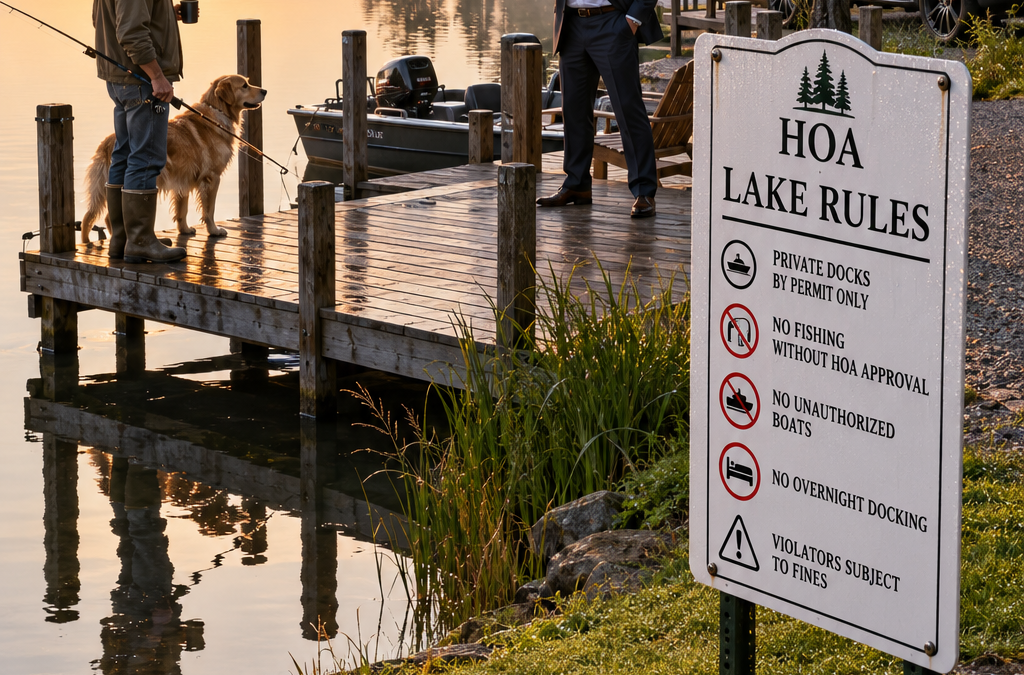
𝗙𝗨𝗟𝗟 𝗦𝗧𝗢𝗥𝗬
Most of the people who used the private road drove slowly because the gravel was uneven near the bend.
This driver came down it as though he expected the road to move out of his way.
A large black luxury SUV rounded the trees and stopped near my dock.
The vehicle was polished so carefully that the morning sunlight reflected off its hood in a clean white streak.
The driver’s door opened.
A man stepped out.
He appeared to be about fifty, with silver beginning to show at his temples and dark hair combed neatly away from his forehead.
His navy suit fit perfectly.
His white shirt looked freshly pressed.
A silk pocket square sat folded in his breast pocket, and his expensive leather shoes seemed spectacularly unsuited for walking across damp grass.
He closed the door, adjusted his cuffs, and looked toward the sign.
Then he looked at me.
There was no uncertainty in his expression.
He approached with the smooth, deliberate confidence of a man who had spent years giving instructions and expecting people to follow them.
“Good morning,” he said.
His smile was polished but cold.
“Beautiful day.”
“It was,” I answered.
He glanced at my fishing rod.
Then at the dock.
Then at the sign.
“I see you’ve discovered our new regulations.”
I looked at him.
“Your regulations?”
“Correct.”
He extended one hand.
“Preston Karen. President of the homeowners association.”
I shook his hand briefly.
His grip was firm, practiced, and just a little too long.
“All right, Mr. Karen.”
He smiled again.
“You can call me Karen. Most residents do.”
“I’m not a resident of your association.”
He gave a short laugh.
“We’ll get to that.”
Something about the way he said it made me look at him more carefully.
He wasn’t introducing himself.
He was establishing a hierarchy.
In his mind, the conversation had already been decided.
He was the president.
I was the person who needed correcting.
Karen turned toward the water and spread one arm.
“As I’m sure you’re aware, the board has been reviewing recreational use of the lake. We’ve had concerns about liability, unauthorized fishing, boating activity, and the general lack of supervision around the shoreline.”
I waited.
“Effective immediately,” he continued, “all fishing activity requires association authorization. That includes residents, guests, and anyone accessing the lake from adjacent property.”
“Anyone?”
“Anyone.”
“Even somebody fishing from this dock?”
“Especially somebody fishing from this dock. Private docks create additional complications when people assume the rules don’t apply to them.”
I looked down at the old boards beneath my boots.
My father had helped me rebuild that dock years earlier.
We had replaced the rotting supports one summer, working in the heat until our shirts were soaked through.
It had stood through thunderstorms, ice, and more than one season of high water.
Now a stranger was explaining that using it required permission.
“Who authorized that sign?” I asked.
Karen blinked.
“The board, obviously.”
“Who authorized you to put it here?”
“The association controls the lake’s recreational areas.”
“That’s not what I asked.”
His smile faded slightly.
“I don’t think you’re understanding how neighborhood governance works.”
“I understand it well enough. I’m asking who gave you permission to install a sign on this property.”
He glanced toward the house.
Then back at me.
“This shoreline falls within the community’s lake management area.”
“According to what?”
“Our governing documents.”
“Which governing documents?”
“The association declaration and regulations.”
“Do those documents identify this property by parcel number?”
His jaw tightened.
“I don’t carry the entire association archive in my vehicle.”
“Then how do you know this land belongs to you?”
He let out a quiet, impatient breath.
“Every property around this lake is subject to the association’s authority. That’s the entire purpose of having an HOA.”
“No, it isn’t.”
His eyes narrowed.
“Excuse me?”
“An association has authority over the property and people legally subject to it. That doesn’t automatically include every piece of land it can see from the neighborhood.”
Karen straightened his jacket.
“Sir, I appreciate that you may have been accustomed to doing things differently before the community developed. But neighborhoods evolve. Rules change.”
“Property ownership doesn’t change because somebody puts up a sign.”
His expression hardened.
There it was.
The first crack in that expensive, carefully maintained exterior.
“You’re taking a very confrontational position over a simple fishing permit.”
“I’m standing on my dock asking why your association installed a sign on my land.”
“This is not exclusively your shoreline.”
“Who told you that?”
“The association’s records.”
“Then I’d like to see them.”
Karen laughed.
Not because anything was funny.
He laughed the way some people do when they want to make another person feel foolish.
“You’re seriously asking me to prove the HOA has authority over the neighborhood lake?”
“I’m asking you to prove it owns the property you’re trying to regulate.”
He looked toward his SUV.
Then back at me.
“Listen carefully. I am not going to spend my morning debating established community rules with someone who clearly hasn’t taken the time to read them.”
I felt an unpleasant warmth rising beneath my collar.
But I kept my voice level.
“Then perhaps you should read my property records.”
For the first time, Karen hesitated.
Only for a moment.
Then he recovered.
“Your property records?”
“Yes.”
“What would those have to do with the association’s lake?”
“Quite a bit.”
He folded his arms.
“By all means, explain.”
I pointed toward my house.
“I can do better than explain.”
I picked up my coffee and started walking toward the path.
Karen called after me.
“Where exactly are you going?”
“To get the paperwork.”
He gave another dismissive laugh.
“Old tax records aren’t going to override HOA regulations.”
I stopped and turned.
“Neither are HOA regulations going to override a deed.”
For a second, he looked genuinely annoyed.
Then he pulled out his phone.
I left him standing beside the sign.
As I walked back toward the house, I noticed how strange the morning had become.
Twenty minutes earlier, I had been thinking about fishing.
Now I was opening the door to my study because a man I’d never met had decided he could control something that had belonged to my family long before his association existed.
The property folder sat in the bottom drawer of an old filing cabinet.
It was thick, worn at the edges, and secured with two faded elastic straps.
My father had kept it in a metal lockbox for most of his life.
When I took over responsibility for the property, he placed that folder in front of me at the kitchen table.
“Don’t lose this,” he told me.
I remember smiling.
“I know where the property lines are.”
“Knowing where they are and being able to prove where they are are two different things.”
He opened the folder and showed me the deed.
Then the older survey.
Then the legal description.
He pointed out the recorded boundaries, the references to the lake, and the documents showing how the property had passed through the family.
“People forget things,” he said. “Paper doesn’t have to.”
At the time, it had sounded like one more piece of practical advice from a man who believed in keeping receipts and fixing broken hinges before they caused real trouble.
Standing in my study years later, I understood why he had been so careful.
I lifted the folder onto my desk.
Inside were copies of the original deed, later conveyance records, county survey maps, tax parcel descriptions, and a newer professional boundary survey I had commissioned after the development began expanding toward my property.
I had ordered that updated survey for exactly one reason.
I wanted to know that the new construction hadn’t shifted any practical boundaries or created future confusion.
The surveyor had examined the recorded descriptions, located the relevant monuments, and prepared an updated drawing of the parcel.
His findings matched the older records.
The lake lay within my property’s documented boundaries.
The surrounding subdivision occupied separate parcels beyond those boundaries.
It was not a close call.
I placed the old deed, the county map, and the newer survey near the front of the folder.
Then I carried everything back outside.
Karen was standing beside his SUV.
He had his phone to his ear.
I could hear him speaking before I reached the dock.
“No, I’m telling you, he’s refusing to acknowledge the regulations.”
He listened.
“Yes. I’m handling it.”
He ended the call when he saw me.
“Well?”
I placed the folder on the dock railing.
“Here’s what you wanted.”
He approached reluctantly.
I opened the first document.
“This is the original deed describing the property acquired by my family decades before the subdivision was built.”
Karen leaned forward just enough to glance at it.
“This is very old.”
“It is.”
“That doesn’t mean it’s current.”
“No. That’s why I also brought the later conveyance records and the current survey.”
I unfolded the county map.
The paper made a dry, crackling sound in the morning air.
“Here’s the parcel boundary.”
Karen looked down.
Then he looked away.
“You’re showing me a map.”
“A recorded property map.”
“These things are complicated.”
“Not this part.”
I placed my finger on the line enclosing the lake.
“That boundary includes the entire lake parcel and connects directly to the rest of my land.”
Karen stared at the page for less than five seconds.
Then he straightened.
“You’re interpreting it incorrectly.”
“Which part?”
“The boundary.”
“Then show me the correct interpretation.”
He glanced at the trees.
“You’re confusing ownership of adjacent land with recreational control of a community amenity.”
“Where is the deed transferring the lake to your association?”
“That’s not how planned communities operate.”
“Then tell me how they operate.”
His face changed.
His polite expression collapsed into something sharper.
“Sir, I am not here to give you a seminar on property law.”
“And I’m not here to surrender my property because you don’t like what the documents say.”
Karen put both hands on his hips.
He seemed to be searching for the correct response to someone who wasn’t intimidated by his title.
Finally, he pointed toward the sign.
“The board approved those rules. They’re effective. Whether you agree with them is irrelevant.”
“Not if you’re trying to enforce them against someone who never joined your association.”
“Everyone benefits from neighborhood management.”
“That doesn’t make everyone a member.”
“You’re benefiting from the surrounding community.”
“That doesn’t put my name on your declaration.”
He took a step closer.
“Let me make this extremely clear. You will follow the posted lake rules, or the association will begin enforcement proceedings.”
“What enforcement proceedings?”
“Fines, formal notices, and whatever additional measures our counsel considers appropriate.”
I looked at him steadily.
“Fines against whom?”
“Against you.”
“For violating an agreement I never signed?”
His nostrils flared.
“You keep repeating that as though it’s some kind of magic phrase.”
“It’s a relevant fact.”
“You’re being deliberately difficult.”
“No. I’m asking you to identify the legal basis for what you’re demanding.”
He jabbed a finger toward the water.
“That lake is part of this community.”
“It’s surrounded by your community.”
“There’s no meaningful difference.”
“There’s a very meaningful difference.”
For several seconds, we stared at each other.
I could hear small waves striking the dock supports.
A bird called from somewhere in the trees.
The ordinary sounds of a peaceful morning seemed absurd against the conversation taking place.
Karen broke the silence.
“Put your fishing equipment away.”
I looked at my rod.
“No.”
His head tilted.
“What did you say?”
“I said no.”
“You don’t have authorization.”
“I don’t need authorization from your HOA to fish from my own dock on my own property.”
He looked genuinely offended.
As though refusal itself were misconduct.
Then he spoke slowly.
“You are making a serious mistake.”
I closed the folder.
“You’re free to have your attorney contact me.”
“Oh, I intend to.”
“Good.”
“But first, I’m going to give you one opportunity to comply voluntarily.”
He pointed at my fishing rod.
“Remove your equipment from the dock. Stop using the lake until the association reviews your situation.”
“And if I don’t?”
Karen reached into his jacket and removed his phone.
“Then I’ll call the police.”
I waited.
He seemed disappointed that I didn’t react.
“Do you understand what I’m telling you?”
“Yes.”
“And?”
“And you’re welcome to call.”
His face flushed.
“I don’t think you understand the seriousness of refusing a direct instruction from the president of this association.”
I looked at the sign.
Then at him.
“Mr. Karen, you are president of an HOA, not the owner of every piece of land near it.”
The words landed harder than I expected.
He went completely still.
Then he smiled.
It was not a pleasant smile.
“All right.”
He tapped his phone.
“Let’s see how confident you are when law enforcement arrives.”
He stepped away and began making the call.
I didn’t interrupt him.
I didn’t raise my voice.
And I didn’t leave.
Instead, I opened the folder again and arranged the documents in order.
Original deed.
Chain of ownership.
County map.
Updated professional survey.
As Karen spoke to the dispatcher, I heard fragments of his description.
“Unauthorized use.”
“Refusing to comply.”
“Association-controlled property.”
“Potential trespass situation.”
That last phrase made me look up.
Trespass.
He was standing on my property, beside a sign his association had installed without my permission, telling someone over the phone that I might be trespassing.
For the first time that morning, I felt something colder than irritation.
It wasn’t fear of Karen himself.
It was the realization that he was willing to involve the police based on an ownership claim he had refused to verify.
I had seen enough disputes turn ugly to understand what could happen when one person made an official accusation and the other was suddenly expected to defend himself.
The stakes had changed.
A ridiculous sign was one thing.
A false understanding presented to law enforcement was another.
I thought about my father.
He had spent years teaching me to maintain fences, read surveys, keep boundaries marked, and settle disagreements without making enemies.
He would have hated this.
Not because he was afraid of confrontation.
But because he believed a man should know the difference between authority and arrogance.
Karen ended his call.
He slipped the phone into his pocket with visible satisfaction.
“They’re on their way.”
“All right.”
“Are you still refusing to comply?”
“Yes.”
“You could have avoided all of this.”
“So could you.”
He shook his head.
“People like you are the reason associations need strict enforcement.”
“People like me?”
“Property owners who think their personal preferences outweigh the interests of an entire community.”
I looked toward the houses beyond the eastern shoreline.
There were families living there.
Children who rode bicycles along the neighborhood paths.
Retired couples who walked beside the water in the evening.
People who had come to appreciate the lake for reasons that probably resembled my own.
I had never considered them enemies.
“I have no problem with your community,” I said. “I have a problem with you claiming authority over property you haven’t proven you own.”
Karen waved one hand.
“That’s the same tired argument.”
“Then answering it should be easy.”
He didn’t answer.
Instead, he walked toward the SUV and leaned against its front fender.
He crossed his arms.
Then he waited.
I remained on the dock.
The minutes passed slowly.
I could feel the morning warming around us.
The mist had disappeared.
A breeze pushed faint ripples across the lake.
Usually, this would have been the hour when I made my first cast.
Instead, my fishing rod rested against the railing while a man in a tailored suit waited for the police to remove me from my own shoreline.
At one point, Karen glanced at the rod.
“You know, putting that away would be a good start.”
“A good start toward what?”
“Demonstrating cooperation.”
“I’ve offered you documents. I’ve answered your questions. I’ve asked you to provide the basis for your claim. That’s cooperation.”
“You’re still refusing an instruction.”
“An instruction you may not have the authority to give.”
He looked away.
It was becoming clear that Karen measured cooperation differently.
To him, cooperation meant obedience.
Questions were challenges.
Documents were obstacles.
And anyone who refused to accept his position was automatically creating trouble.
I started to understand how a man like him could rise to the presidency of a neighborhood association.
He was polished.
Confident.
Organized.
Probably very good at speaking in meetings where nobody interrupted.
I could imagine him standing at the front of a clubhouse, explaining new regulations while everyone nodded because disagreeing seemed more exhausting than complying.
Maybe some of his rules were sensible.
Maybe the association genuinely had concerns about safety around the lake.
But those concerns did not give him ownership.
And the more I watched him, the more I suspected that ownership wasn’t the only thing he wanted.
He wanted recognition.
He wanted the right to decide.
Most of all, he wanted me to acknowledge that his title mattered more than my documents.
That was something I could not give him.
Just under twenty minutes after his call, I heard tires moving over the gravel road.
A police cruiser appeared around the bend.
The blue and red lights flashed briefly against the trunks of the trees.
My stomach tightened.
I hadn’t done anything wrong.
I knew that.
But knowing it didn’t make the sight of a police vehicle arriving at my property feel ordinary.
Karen immediately stepped away from his SUV.
He adjusted his jacket.
Smoothed his tie.
And moved toward the cruiser before it had fully stopped.
The transformation was almost impressive.
The man who had been pointing at me and threatening enforcement minutes earlier now wore an expression of patient concern.
He looked like a responsible official inconvenienced by an unreasonable resident.
The officer stepped out.
He was calm, perhaps in his forties, with the measured movements of someone accustomed to arriving in the middle of other people’s arguments.
“Morning, gentlemen.”
“Officer,” Karen said quickly, extending his hand. “Preston Karen. President of the homeowners association. I’m the person who called.”
The officer shook his hand.
“All right. What’s going on?”
Karen launched immediately into his explanation.
“We recently adopted updated regulations governing this community lake. Unfortunately, this gentleman has refused to comply. He’s insisting that our rules don’t apply to him, and he’s continuing unauthorized use of association-controlled recreational property.”
The officer looked toward me.
I stood beside the dock railing with the folder open.
Karen continued.
“We’ve attempted to handle this respectfully, but he’s become uncooperative. I thought it would be best to involve law enforcement before the situation escalated.”
I almost laughed.
Not because it was funny.
Because I had spent the entire morning trying to keep the situation from escalating.
The officer held up one hand.
“Okay. Let’s slow down.”
Karen stopped.
The officer turned toward me.
“Sir, can you tell me what happened from your perspective?”
“Certainly.”
I pointed toward the sign.
“I came down to fish this morning and found that newly installed beside my dock. Mr. Karen arrived and informed me that his association controlled the lake and that I needed HOA permission to fish here.”
The officer looked at the sign.
“All right.”
“I explained that I’m not a member of the association and that this lake is within my property’s recorded boundaries. I brought out the ownership records and surveys, but Mr. Karen wouldn’t review them.”
Karen interrupted.
“That’s not accurate. I reviewed what he presented.”
The officer glanced at him.
“You’ll have a chance to explain. Let him finish.”
Karen pressed his lips together.
I continued.
“When I refused to stop fishing based on his association rules, he threatened fines and called the police.”
The officer nodded slowly.
“Are you saying there’s a disagreement over property ownership?”
“Yes.”
Karen immediately stepped forward.
“No. That’s not what this is.”
The officer turned.
“What is it, then?”
“This is an enforcement matter. The association governs the lake.”
“Does the association own the lake?”
Karen hesitated.
“Officer, the lake is a community amenity.”
“That wasn’t my question.”
For the first time, I saw real uncertainty flicker across Karen’s face.
He recovered quickly.
“The lake is surrounded by association properties. It has always been treated as part of the neighborhood.”
The officer looked toward the water.
Then at the houses visible beyond the trees.
“Okay. Do you have documentation showing the association owns it?”
Karen glanced toward his SUV.
“Our governing documents establish the association’s authority.”
“Do you have a deed or recorded ownership document?”
“Not physically with me.”
The officer nodded.
Then he turned back to me.
“You said you have property records?”
I lifted the folder.
“Yes, sir.”
“May I take a look?”
“Of course.”
I handed him the first document.
The original deed.
The officer took his time.
He read the legal description.
Then he examined the older survey.
He looked at the county map, turning it slightly to compare the orientation with the shoreline.
Karen stood beside him, visibly impatient.
“Officer, with respect, I don’t believe this is necessary. We have an established neighborhood association. The rules are posted.”
The officer didn’t look up.
“Mr. Karen, I’m trying to understand the property issue.”
“There is no property issue.”
The officer pointed to the deed.
“Then what am I looking at?”
Karen went quiet.
I stepped closer, careful not to crowd the officer.
“That deed describes the lake parcel as part of the land acquired by my family. The adjoining acreage eventually developed into the subdivision, but this parcel was never conveyed to the developer or the HOA.”
The officer moved his finger along a line of text.
“And you have later records showing the property remained in your family?”
“Yes.”
I handed him the next pages.
He studied them.
Then he looked toward the lake.
His expression had changed.
Not dramatically.
He wasn’t shocked.
He wasn’t angry.
He simply looked more interested than he had a few minutes earlier.
“Let me make sure I understand something,” he said.
“Go ahead.”
He pointed toward the opposite shore.
“Are you saying you own the entire lake?”
I nodded.
“The recorded property boundary includes the lake and the land described with it.”
Karen gave a sharp laugh.
“That’s absurd.”
The officer looked at him.
“Why?”
“Because there are dozens of homes around it.”
“That doesn’t answer the ownership question.”
Karen gestured toward the neighborhood.
“The lake is part of the community’s identity. People bought homes here because of it.”
“I understand that,” the officer said. “But I’m asking whether the association has title to the property.”
Karen’s mouth opened.
Then closed.
I reached into the folder.
“There’s another document.”
I unfolded the original property map.
It had been copied carefully from the older records, preserving the survey references and the lines defining the tract.
The paper was large enough that I needed to lay it across the dock railing.
One corner kept lifting in the breeze.
The officer placed a hand over it.
I pointed toward my house.
“That’s the main property.”
Then I moved my finger along the line extending toward the water.
“This is the recorded boundary.”
I traced the curve.
It ran beyond the dock, followed the outer limits shown on the survey, and continued around the lake before reconnecting with the rest of the parcel.
The lake wasn’t shown as an HOA common area.
It wasn’t described as land jointly owned by the neighboring homeowners.
It was part of the property identified in my family’s recorded documents.
The officer bent closer.
He followed the line with his finger.
Then he studied the parcel references.
For several seconds, he said nothing.
I watched Karen.
His arms were crossed.
His jaw was tight.
He kept glancing between the officer and the map, as though waiting for some hidden mistake to announce itself.
Finally, the officer straightened.
“Mr. Karen, have you ever seen the original deed for this lake property?”
Karen adjusted his cuffs.
“I’m familiar with the association’s documents.”
“That’s not what I asked.”
A brief silence followed.
Then Karen said, “No, I have not personally reviewed that particular deed.”
“Has anyone on the board?”
“I can’t speak for every board member.”
“Do you have a deed showing the association acquired this parcel?”
Karen looked at the map.
Then at his phone.
“Our documents list the lake as a community feature.”
“That may be how it’s described to residents,” the officer replied. “But a description in an HOA rule book isn’t the same thing as a recorded deed.”
Karen’s cheeks reddened.
I could almost see him fighting to keep control of the conversation.
He had arrived expecting the officer to enforce his instructions.
Instead, the officer was asking the one question Karen had avoided from the beginning.
Where was the evidence of ownership?
Karen unlocked his phone.
“Give me a moment.”
He began scrolling.
The officer waited.
I waited.
Karen opened what appeared to be an association document.
He enlarged a page with two fingers.
Then another.
He turned the phone sideways.
Finally, he held it out.
“Here. This clearly establishes association authority over neighborhood amenities.”
The officer looked at the screen.
“What document is this?”
“The bylaws.”
“Does it identify ownership of the lake parcel?”
“It describes the association’s powers.”
“Does it contain a recorded conveyance of the lake?”
Karen lowered the phone slightly.
“It establishes our responsibility for common areas.”
The officer nodded.
“Then we need to know whether this lake is actually one of those common areas.”
Karen’s face hardened.
“Officer, with all due respect, you’re making this unnecessarily complicated.”
The officer’s expression remained neutral.
“Property ownership can be complicated. That’s why we’re looking at the documents.”
I unfolded the newer county map beside the old one.
“This might help.”
The officer leaned over it.
“What’s that?”
“The updated survey.”
Karen immediately looked up.
“Updated?”
“Yes.”
I had been holding it until the officer finished examining the older records.
Now I opened the professional survey completely.
Its lines were crisp.
Its labels were legible.
The boundary monuments, parcel references, and measured courses had been checked against the existing land records.
I pointed to the surveyor’s certification.
“This was prepared after the neighborhood began expanding around my property. I wanted to make sure there wouldn’t be any confusion as the new houses went up.”
The officer examined the page.
Then he looked back at the old deed.
“The boundary hasn’t changed?”
“No.”
“And this professional survey matches the older description?”
“Yes.”
Karen stepped forward abruptly.
“Wait.”
Both of us looked at him.
“Who hired that surveyor?”
“I did.”
He smiled with sudden satisfaction.
“Well, there you go.”
I frowned.
“There I go where?”
“Of course a surveyor hired by you would produce a document favoring your position.”
The officer looked at the certification.
“That’s not how a professional boundary survey is supposed to work.”
Karen waved a hand.
“People can pay professionals to say almost anything.”
I felt my patience thinning.
“Are you accusing the surveyor of falsifying his work?”
“I’m questioning the credibility of a document you conveniently happen to possess.”
“I commissioned the survey because I wanted the boundaries verified.”
“According to you.”
“According to the recorded deed, the county records, and the licensed surveyor who checked the boundary.”
Karen pointed toward the lake.
“You’re telling me an entire neighborhood has somehow been wrong about this property for years?”
“I’m telling you the neighborhood association doesn’t have a deed showing it owns the lake.”
“Impossible.”
“Then produce one.”
His eyes flashed.
“You don’t get to dictate how this association operates.”
The officer intervened.
“Mr. Karen.”
Karen stopped.
“Right now,” the officer said, “the documents I’ve been shown indicate that this gentleman has a legitimate recorded ownership claim. If the association has competing documentation, that’s something your board and legal counsel will need to address through the appropriate process.”
Karen looked stunned.
“You’re taking his side?”
“I’m not taking sides.”
“You’re accepting his documents.”
“I’m reviewing the information available.”
“But I called because he’s violating association regulations.”
The officer looked toward the sign.
“Those regulations don’t establish ownership of land that isn’t part of the association.”
Karen took a breath.
I could see the anger working behind his eyes.
He had spent the morning insisting that my refusal was the problem.
Now he was being told that the association’s authority itself was the question.
And he did not seem accustomed to having his authority questioned in front of another man.
Especially a man wearing a police uniform.
A car door closed somewhere behind us.
I turned.
An older neighbor had stopped along the path leading toward the shoreline.
A woman stood a little farther back, looking between the cruiser and Karen’s SUV.
Apparently, the flashing lights had attracted attention.
Within a few minutes, several more people appeared near the trees.
Some were walking dogs.
One had come down with a coffee mug.
Another stood with his hands in his pockets, watching the conversation from a respectful distance.
Karen noticed them immediately.
His posture changed.
He straightened his back and lowered his voice.
“Officer, I think we should discuss this privately.”
The officer glanced at the gathering neighbors.
“There’s nothing preventing us from discussing the documents here, as long as everyone remains calm.”
Karen looked irritated.
He had wanted authority.
Now he had an audience.
And that audience was beginning to hear information the association president apparently hadn’t known.
An older man stepped forward.
“What’s going on?”
Karen answered before I could speak.
“Just a misunderstanding about lake regulations. It’s being handled.”
The neighbor looked at the survey spread across the railing.
“What kind of misunderstanding?”
“An administrative matter.”
I spoke quietly.
“The association installed a sign requiring HOA permission to fish on this lake. I’ve been explaining that the lake is part of my property, not association-owned land.”
The neighbor blinked.
“Your property?”
“Yes.”
He looked toward the opposite shore.
“The whole lake?”
“The property records include the entire lake parcel.”
The neighbor stared.
Then he looked at Karen.
“I thought the HOA owned it.”
Karen lifted his chin.
“The association has always managed lake-related matters.”
“That’s not what he said.”
“I understand what he said.”
The neighbor looked back at me.
“You mean you’ve owned this all along?”
“My family has.”
A woman behind him spoke.
“But when we bought our house, they told us the neighborhood had a community lake.”
I nodded.
“I know the lake was advertised as one of the things people would enjoy living near.”
“Then how does that work?”
“Living near something doesn’t automatically make it common property. Any ownership or access rights have to come from the actual documents or permission.”
Her face tightened.
“So those fishing rules?”
“The HOA can make rules for its members within its legal authority,” I explained. “But it can’t automatically impose those rules on land it doesn’t own.”
The woman turned toward Karen.
“Did the board know this?”
Karen’s expression became dangerously controlled.
“The board acted on the information available to it.”
“Did you check the deed?”
“We relied on our governing documents.”
“That’s not what she asked,” the older man said.
Karen looked at him sharply.
“With respect, this isn’t a public hearing.”
The neighbor crossed his arms.
“Then why did you call the police?”
For a moment, Karen had no answer.
I could hear the wind moving through the leaves above the dock.
The officer stepped forward.
“Everyone, let me clarify something.”
The small group quieted.
“I’m not here to make a final legal determination of title. That would be a matter for the appropriate civil process if there’s a genuine dispute. But based on what’s been presented, this is not a situation where I’m going to detain or remove this gentleman for refusing an HOA fishing rule.”
Karen opened his mouth.
The officer continued.
“An association rule book is not a deed. If the HOA believes it owns or has enforceable rights over this property, it needs to establish those rights with the proper documentation.”
The older neighbor nodded.
“That seems reasonable.”
Karen looked furious.
He turned toward the officer.
“So you’re telling me we can’t enforce our regulations?”
“I’m telling you that the authority you’re claiming is disputed, and the ownership documents matter.”
“We have a responsibility to the residents.”
“That responsibility doesn’t give the association powers it doesn’t legally possess.”
Karen looked toward the people gathering near the shoreline.
He seemed to realize that the conversation was slipping beyond his control.
Then he made one final attempt to reclaim it.
“Fine,” he said. “Let’s assume, for the sake of argument, that he has some ownership interest in the lake. That doesn’t mean he can disregard the safety rules we’ve established for the community.”
I looked at him.
“Some ownership interest?”
“Yes.”
“Mr. Karen, you’ve seen the documents.”
“I’ve seen your interpretation of them.”
“Then point to the part that’s wrong.”
He glanced at the survey.
I waited.
The officer waited.
The neighbors waited.
Karen’s gaze moved across the page.
He seemed to be looking for something he could challenge without fully understanding what he was seeing.
Finally, he tapped near one of the boundary labels.
“What about this line?”
“That’s the adjoining parcel boundary.”
“And who owns the land beyond it?”
“The neighboring lots.”
“Which are members of the HOA.”
“Some of them, yes.”
“There you are.”
I looked at him.
“Where am I?”
“Those lots have shoreline access.”
“Some may have rights that need to be determined from their individual records. That doesn’t transfer ownership of the entire lake to the association.”
Karen’s voice rose.
“But their properties touch the lake.”
“That doesn’t make the HOA the owner.”
He slapped one palm lightly against the railing.
“You’re twisting everything.”
I felt the old wood vibrate beneath his hand.
For the first time, I stepped directly into his line of sight.
“Stop.”
He looked at me.
“Excuse me?”
“Stop treating my property like something you get to claim because it’s convenient for your board.”
The shoreline went quiet.
I kept my voice controlled, but I could feel my heart pounding.
“You came down my private road. You stood on my dock. You told me I needed your permission to fish. When I showed you the deed, you laughed. When I showed you the survey, you dismissed it. Then you called the police and described me as someone refusing lawful authority.”
Karen’s jaw tightened.
I continued.
“I’ve owned this property for years. My family owned it before me. We maintained the shoreline when there was no HOA, no clubhouse, and no neighborhood entrance. You don’t get to arrive in an expensive SUV and rewrite that history because a board approved a sign.”
Karen stared at me.
His face had gone red beneath the perfectly groomed hair.
“Are you finished?”
“Almost.”
I pointed toward the property map.
“If your association has legal rights here, prove them. I’ll review the evidence. But until then, stop threatening me with fines and stop pretending your rules transfer ownership.”
The officer stepped slightly closer, not aggressively, but enough to keep the discussion from getting out of hand.
“Let’s keep our voices down.”
I nodded.
“You’re right.”
Karen gave a bitter smile.
“Very impressive speech.”
“It wasn’t a speech.”
“No?”
“It was a request for you to respect the records.”
He looked toward the neighbors.
I could see him calculating.
A few minutes earlier, he had expected them to support him automatically.
Now their expressions were different.
They weren’t looking at me as a troublemaker.
They were looking at the paperwork.
And at the man who had apparently never checked it.
The older neighbor spoke again.
“Preston, did the HOA actually buy the lake?”
Karen hesitated.
“The association assumed responsibility for the lake as part of the neighborhood’s development.”
“That’s not the same thing.”
“We’ve managed recreational standards for years.”
“But did we buy it?”
Karen’s silence answered more clearly than any speech.
The woman holding the coffee mug shook her head.
“So we’ve been told to get permission to fish on somebody else’s property?”
Karen turned toward her.
“The permit system was designed to ensure responsible use.”
“That wasn’t my question.”
“These matters aren’t as simple as people want them to be.”
The neighbor beside her looked at the sign.
“It looked pretty simple when you put the rules up.”
That sentence seemed to hit Karen harder than anything I had said.
He had treated the sign as proof of power.
The neighbors were beginning to see it as evidence of an assumption.
I looked down at the document beneath my hands.
My father had been right about one thing.
A person could argue with your memory.
They could challenge your recollection.
They could insist that circumstances had changed and that your understanding was outdated.
But a properly recorded property description gave the conversation somewhere solid to stand.
The officer studied the updated survey one final time.
Then he handed it back to me.
“Thank you for bringing these out.”
“Of course.”
“I’d recommend keeping copies available, especially if the association intends to pursue this.”
“I intend to.”
He turned to Karen.
“Mr. Karen, if the board believes it has a competing ownership claim, it should consult legal counsel and review the county land records.”
Karen crossed his arms.
“We will.”
“But this isn’t a criminal trespass matter based on what I’ve seen today. I’m not detaining anyone or ordering this gentleman off the property.”
Karen’s lips compressed into a thin line.
The officer continued.
“And I’d strongly suggest resolving the question of where the association’s authority begins and ends before issuing additional enforcement notices concerning this lake.”
For several seconds, Karen didn’t speak.
Then he said, very quietly, “Understood.”
The officer looked at both of us.
“Anything else I need to know before I leave?”
I shook my head.
“No, sir.”
Karen said nothing.
The officer thanked us for cooperating.
Then he walked toward his cruiser.
I watched him get in.
The engine started.
The vehicle turned carefully on the private road and moved back toward the trees.
The flashing lights were off.
A few moments later, the cruiser disappeared around the bend.
The confrontation should have ended there.
But Karen remained beside my dock.
He stood motionless, watching the road long after the officer had gone.
His expensive shoes were dusty.
The cuffs of his trousers had picked up moisture from the grass.
And for the first time since he arrived, he looked like a man who had walked into a situation without understanding it.
I folded the survey.
Then the older map.
I placed the deeds back into the folder.
Karen finally turned toward me.
“This is not over.”
I looked up.
“I didn’t expect you to change your mind in one morning.”
“You’ve embarrassed this association.”
“No. You made an ownership claim without checking it.”
His eyes narrowed.
“You think because one officer declined to act, you’ve won something?”
“I wasn’t trying to win anything.”
“Don’t insult my intelligence.”
“I’m telling you the truth.”
He glanced toward the neighbors, who were still standing nearby.
“You’ve created confusion about the community’s rights.”
“The records were there before either of us arrived.”
“Residents expect the board to protect their interests.”
“Then protecting their interests should include telling them what the HOA actually owns.”
That stopped him.
For a moment, I saw something beneath the anger.
Not remorse.
Not yet.
Something closer to fear.
Because Karen’s authority depended on the appearance of certainty.
He had promised people that the association controlled the lake.
He had approved rules based on that assumption.
He had installed a sign.
And now several residents had watched that assumption collapse under questions he couldn’t answer.
The problem was no longer a stubborn property owner.
It was the possibility that the board had been governing something it did not own.
Karen stepped closer.
“You have no idea how much work goes into running this association.”
“I believe it’s a lot.”
“We maintain standards. We handle complaints. We protect property values. We deal with residents who think rules should apply to everybody except themselves.”
“That sounds difficult.”
He seemed almost surprised by my answer.
Then his expression hardened again.
“Then perhaps you should appreciate why I can’t allow people to undermine our authority.”
I met his eyes.
“Authority that rests on the wrong property records needs to be corrected.”
He looked away.
For several seconds, his attention settled on the lake.
I wondered what he saw.
I saw the place where my father had taught me to fish.
The bend where the reeds grew thick every summer.
The old oak leaning over the southern bank.
The reflection of a sky slowly turning blue.
Karen seemed to see an asset.
A feature.
Something that made the houses around it more desirable and gave his association another reason to collect permissions and enforce rules.
That difference mattered.
I didn’t believe he hated the lake.
I believed he wanted to control it.
And because he had become accustomed to controlling so many things around the neighborhood, he had stopped asking whether some things were ever his to control.
Finally, he spoke.
“The board will review this.”
“Good.”
“Our attorney may contact you.”
“That’s fine.”
“We may have additional documentation.”
“Then I’ll be happy to look at it.”
He stared at me.
I wasn’t giving him anything to fight against.
No threat.
No insult.
No promise of retaliation.
Just the same request I had made from the beginning.
Show me the deed.
Karen turned sharply and walked toward his SUV.
He opened the door.
Then stopped.
Without looking back, he said, “I expect you not to interfere with association business in the meantime.”
I answered calmly.
“And I expect the association not to install anything else on my property without permission.”
He climbed into the vehicle.
The engine started.
Gravel crunched beneath the tires.
He drove away faster than he had arrived.
I watched the black SUV disappear between the trees.
Then I looked at the sign.
It was still standing.
White.
Green.
Official-looking.
An announcement of authority nobody had bothered to verify.
One of the neighbors approached me after Karen left.
He was an older man who had lived across the lake for several years.
He looked embarrassed.
“Well,” he said, “I owe you an apology.”
I shook my head.
“For what?”
“I always assumed the association owned this place.”
“A lot of people did.”
“I’ve told visitors it was our neighborhood lake. Didn’t even think to ask whether that was legally true.”
“You weren’t trying to take anything from me.”
He looked toward the water.
“I guess I should have known better. You’ve been here longer than any of us.”
“That doesn’t mean you should have known the records.”
He nodded slowly.
Then he asked, “Does this mean you don’t want us fishing here anymore?”
The question surprised me.
Not because it was unreasonable.
Because beneath the confusion and embarrassment, I could hear genuine worry.
People had built routines around the lake.
Children came down with their parents.
Retired neighbors walked its shoreline.
Families watched ducks from the areas where they were allowed to gather.
For some of them, the lake was part of why they had chosen to live there.
I understood that feeling.
Better than Karen ever had.
“I haven’t told anyone they can’t enjoy it respectfully,” I said.
The neighbor looked relieved.
“I don’t want to interfere with whatever legal rights people may have, either. Those should be checked against the actual records. But the HOA can’t just claim ownership and use that claim to control everyone.”
He looked toward the sign.
“Especially not you.”
“Especially not without evidence.”
A woman stepped forward.
“My grandson fishes along the bank sometimes. He’s careful. Always picks up his trash.”
I smiled.
“That’s the sort of thing I’ve never had a problem with, provided he’s somewhere he’s allowed to be.”
She nodded.
“I just don’t want this turning into a fight between the neighborhood and you.”
“Neither do I.”
Another neighbor asked if he could see the survey.
I unfolded it again.
This time, nobody laughed.
Nobody interrupted.
They leaned closer, asking ordinary questions.
Where did the property line run?
Had the lake always been included?
When had the neighborhood been built?
Was the association map wrong?
I answered what I knew.
Where I wasn’t certain about individual access rights, I said so.
I wasn’t interested in replacing Karen’s unsupported certainty with my own exaggerated claims.
Ownership was one issue.
Access was another.
Association authority was another.
Those things could overlap, but they weren’t interchangeable.
I wanted the residents to understand that distinction.
One neighbor pointed to the original deed date.
“Your family owned this before any of our houses existed?”
“Long before.”
He shook his head.
“That’s remarkable.”
I looked toward the house.
“To me, it’s just home.”
The woman with the coffee mug studied the map.
“So the developers built around it?”
“Yes. They developed the surrounding land. The association came later.”
“And the lake was never transferred?”
“Not according to the records I’ve reviewed.”
She glanced toward the road where Karen had disappeared.
“Then somebody should have checked before putting those signs up.”
I nodded.
“That’s all I’ve been saying.”
After a while, the neighbors drifted back toward their homes.
Some apologized again.
Others thanked me for explaining the situation.
One offered to help remove the sign.
I declined.
Not because I wanted it there.
Because I didn’t want to turn a boundary dispute into another argument about damaged property or missing evidence.
The sign had already been photographed.
I wanted the association to take responsibility for what it had installed.
I carried the folder back to the house.
Then I returned to the dock.
For a moment, I considered picking up my fishing rod.
But the morning felt different now.
The water was calm.
The trees were still.
Yet I couldn’t shake the sound of Karen describing me as uncooperative to the police.
That word bothered me.
Uncooperative.
I had lived beside those neighbors for years without trouble.
I had never demanded that they admire my property records.
I had never placed a sign on their lawns.
I had never told their families they needed my approval to enjoy the things they legally owned.
And still, a man who had crossed onto my land without permission had accused me of refusing authority.
I stood at the end of the dock and looked across the water.
My father had once told me that a property boundary wasn’t a declaration of war.
It was simply a way of knowing where one person’s rights ended and another person’s began.
I wished Karen understood that.
I also knew he might never understand it willingly.
The next few days were quieter than I expected.
No police returned.
No association representative appeared at my door.
Nobody attempted to move my fishing equipment or block access to the dock.
But the sign remained.
Every time I walked past it, I felt the same irritation.
Not because I believed the sign had changed anything legally.
It hadn’t.
But because it represented the kind of quiet assumption that could grow into a serious problem if nobody challenged it.
People often treat printed rules as though the printing itself creates authority.
A professional-looking sign seems official.
A confident person with a title sounds credible.
A rule repeated often enough begins to feel established.
That was how the confusion had developed.
Nobody had stopped to ask the first question.
Who owned the lake?
On the third day after the police visit, I learned that the association had scheduled an emergency meeting.
The neighbors wanted answers.
Several had contacted the board after hearing what happened.
Apparently, the story had spread quickly.
Some residents were angry that the association had installed regulations without verifying its authority.
Others were concerned about what the disagreement meant for their access to the water.
A few simply wanted to know whether the board had been truthful about the lake.
I decided to attend.
Not because I wanted a public confrontation.
I had already had enough of those.
But because the issue involved my property, and I wanted the facts discussed where the residents could hear them.
When I arrived at the meeting, the room was already crowded.
Rows of folding chairs faced a long table at the front.
Board members sat behind nameplates and stacks of papers.
There were more people than I normally saw at neighborhood gatherings.
The atmosphere was tense.
Small conversations stopped and started as residents took their seats.
I recognized several faces from the dock.
They nodded when they saw me.
An older neighbor gestured toward an empty chair near the aisle.
I sat down with my folder on my lap.
At the front of the room stood Preston Karen.
He looked immaculate.
Dark tailored suit.
White shirt.
Polished shoes.
Hair combed precisely into place.
If the previous confrontation had affected his confidence, he had made certain nobody could see it in his appearance.
But his expression told a different story.
He wasn’t smiling.
He was watching the room.
Measuring it.
Trying to determine whether the people seated before him were still prepared to accept his explanations.
He cleared his throat.
“Thank you all for attending on short notice.”
The room quieted.
“As you’re aware, questions have recently arisen concerning the association’s recreational management of the lake.”
I listened.
“Certain claims have been made regarding ownership and boundaries. The board considers those claims serious and intends to address them appropriately.”
A man near the front raised his hand.
“Are the claims true?”
Karen looked at him.
“We’re reviewing the relevant information.”
“Did the HOA buy the lake?”
Karen adjusted his microphone.
“As I’ve explained, this is a more complex issue than people may realize.”
The man remained standing.
“That’s a yes-or-no question.”
A murmur moved through the room.
Karen’s face tightened.
“Please allow me to finish.”
The man sat down.
Karen continued.
“Our association has long considered the lake an integral part of the community. We have developed rules intended to protect residents, promote safety, and ensure responsible recreational use.”
A woman spoke from the second row.
“That doesn’t mean we own it.”
Karen paused.
“No one is suggesting that ownership questions should be ignored.”
“Then why weren’t they checked before the signs went up?”
Another murmur.
Karen looked toward the other board members.
One lowered his gaze to the papers in front of him.
The change in the room was unmistakable.
At the dock, Karen had controlled the opening conversation.
He had arrived with an answer and expected compliance.
Now he was facing homeowners who wanted evidence.
And those homeowners were not satisfied with being told that the board knew best.
Karen lifted a printed document.
“I have the association’s governing map.”
He placed it on the table in front of him.
“This map has been part of our administrative records.”
A resident in the front row leaned forward.
“Can we see it?”
Karen hesitated.
Then he turned the page toward the audience.
Another board member stood and helped display a larger version.
I recognized the neighborhood layout immediately.
The streets curved around the lake.
Lots were marked with numbers.
Common areas were shaded.
The clubhouse, paths, landscaped entrances, and other association-maintained parcels were identified.
And in the center sat the lake.
Marked separately.
Not as one of the common-area parcels.
Not enclosed within the association’s property boundary.
Just a lake, drawn beside the development.
The room grew quiet.
A board member leaned over the map.
He pointed at the shaded sections.
“These are the parcels identified as association common areas.”
A resident asked, “And the lake?”
The board member looked toward Karen.
Then back at the page.
“The lake is shown separately.”
“What does that mean?”
“It means we need to look at the recorded ownership documents rather than assume it’s included.”
Karen’s jaw tightened.
I watched him carefully.
This was the moment I had hoped would happen at the dock.
Not humiliation.
Not an admission extracted through anger.
Just the simple act of comparing an assumption to a record.
The association’s own map was telling them something they had never bothered to examine closely.
A man near the middle of the room spoke.
“So the board made rules for property it didn’t verify it owned?”
No one answered immediately.
Then Karen said, “The board acted in good faith based on longstanding community practice.”
A woman shook her head.
“Good faith doesn’t make the deed disappear.”
Another resident asked, “Were we ever told the lake was privately owned?”
Karen said, “The association has always focused on its management responsibilities.”
“That’s not an answer.”
He pressed his fingertips against the table.
“Let’s maintain some order.”
I could hear the strain in his voice.
He wanted control of the room.
He was accustomed to control.
But the residents were no longer interested in being managed away from the central question.
They wanted the truth.
Finally, one of the board members turned toward me.
“Would you be willing to explain the documents you showed the officer?”
I stood.
Every face in the room seemed to turn in my direction.
For a moment, I felt the weight of their attention.
I wasn’t a public speaker.
I didn’t enjoy confrontations.
And I certainly hadn’t planned to spend part of my week explaining the history of my family’s property to a room full of neighbors.
But I thought about the sign.
The police cruiser.
Karen’s finger pointing at my fishing rod.
Then I opened the folder.
“Yes,” I said. “I would.”
I walked toward the front.
Karen shifted slightly as I approached.
He didn’t offer his hand.
I didn’t expect him to.
I placed the documents on the table.
“This is the original deed describing the property acquired by my family. These are the later ownership records. And this is the updated professional survey prepared after development began around the lake.”
I unfolded the survey.
The board members leaned closer.
I pointed out the boundary.
“This is the parcel. This is the lake. And these are the surrounding neighborhood lots.”
A board member adjusted his glasses.
He followed the line with one finger.
“And your survey matches the original description?”
“Yes.”
“Has the property ever been transferred to the association?”
“Not according to the records I’ve examined.”
Another board member asked, “Have you ever signed an agreement placing your property under the HOA?”
“No.”
“Have you ever paid association dues?”
“No.”
“Did the developer purchase the lake from your family?”
“No.”
Those answers were short.
But they seemed to settle over the room more heavily than any long explanation could have.
Karen leaned forward.
“We should be careful not to draw premature conclusions.”
I looked at him.
“I agree.”
He seemed momentarily surprised.
I continued.
“If the association has a deed, an easement, or another recorded document establishing rights over this property, it should be reviewed. I’m not asking anyone to ignore valid legal rights. I’m asking you not to invent them.”
A few residents nodded.
Karen looked down.
I turned toward the audience.
“I’ve lived with this lake for most of my life. My family cared for it before the neighborhood was built. We’ve maintained the shoreline, watched the water levels, repaired storm damage, and tried to keep the place peaceful.”
I paused.
“I understand why people enjoy living near it. I understand why you want to fish here, walk near the water, and let your children appreciate the place.”
Several people were listening closely.
“I’m not here because I want to make your lives difficult.”
I looked briefly toward Karen.
“I’m here because somebody installed a sign on my property and told me I needed association permission to fish from my own dock. When I asked for proof of authority, I was threatened with fines and police involvement.”
The room went completely still.
I continued.
“That should concern you, too.”
A woman in the third row nodded slowly.
“Because next time it could be one of us,” she said.
I didn’t answer immediately.
Then I said, “Because any organization with authority over people’s property should understand exactly where that authority comes from.”
A board member lowered his eyes to the map.
The older neighbor from the dock raised his hand.
“Can I say something?”
Karen looked reluctant.
But another board member nodded.
“Go ahead.”
The neighbor stood.
“I was there when the officer came. I saw the documents. I also saw the way this gentleman was treated before anyone bothered to read them.”
Karen shifted in his chair.
The neighbor continued.
“I’ve lived here long enough to appreciate what the board does. I know maintaining a neighborhood isn’t easy. But I don’t want our association making claims about somebody else’s land just because we’ve always assumed the lake belonged to us.”
He paused.
“And I don’t want the police called on a neighbor for asking us to prove something.”
A few people murmured agreement.
Then the woman with the coffee mug spoke.
“I have grandchildren who fish near that lake. I don’t want to lose the chance for them to enjoy it. But I also don’t want us acting like someone else’s property is ours.”
She looked at me.
“You’ve always been respectful to the people around here.”
I nodded.
“Thank you.”
“Then maybe we should start by being respectful back.”
The room seemed to settle after that.
The tone changed.
People were still concerned.
But the questions became more practical.
Could the association correct its map?
Would the fishing signs be removed?
What rights, if any, were recorded for individual properties?
Could residents continue enjoying the lake in ways that were lawful and respectful?
Could the board consult the appropriate records before issuing new rules?
Those were questions I was willing to discuss.
They were the questions Karen should have asked before driving down my private road.
One board member spoke at length about the need to review deeds and any recorded easements.
Another suggested that the association stop presenting the lake as an HOA-owned common area until the ownership question had been properly addressed.
Several residents agreed.
Karen sat very still.
His hands rested flat on the table.
The polished confidence he had displayed on my dock seemed to have drained away.
He hadn’t become a different man.
I could still see irritation in the set of his jaw.
But he could no longer pretend the issue was a simple refusal to follow neighborhood rules.
The evidence had become too visible.
Finally, Karen spoke.
“The board will arrange for a formal review of the relevant property documents.”
He paused.
“In the meantime, the recently installed fishing-permit signs will be removed from the disputed shoreline, and the association will refrain from attempting to enforce those rules against this property.”
Nobody applauded.
There was no dramatic celebration.
Just a collective release of tension.
People shifted in their chairs.
Some nodded.
Others exchanged quiet remarks.
For me, that was enough.
I hadn’t come to the meeting to watch anyone suffer.
I had come because the truth needed to be placed where it could no longer be ignored.
Karen looked directly at me.
“We will be in contact if further documentation is required.”
I met his gaze.
“That’s fine.”
He said nothing more.
The meeting continued for a while.
Residents discussed the association’s actual responsibilities and the need to be clearer about which areas were common property.
I answered a few more questions.
I also made one point that mattered to me.
“I don’t want people to think this means they suddenly have to fear the lake,” I said. “I’ve never objected to respectful enjoyment of the property where access is permitted. I just want the boundaries and everyone’s rights understood.”
A resident asked whether that meant the neighborhood could continue discussing reasonable access.
“Of course,” I answered. “But those conversations need to begin with respect, not an assumption that the association owns everything.”
That became the difference.
For the first time, I wasn’t standing across from someone issuing instructions.
I was speaking with neighbors who wanted to understand how we could live beside one another without pretending our interests were identical.
We didn’t settle every practical question that night.
There were details to review.
Individual deeds.
Possible access provisions.
Questions about which areas people had been using and under what understanding.
Those things deserved careful attention.
But the central conflict had changed.
The association could no longer honestly describe its rule book as proof that it owned my lake.
And I no longer had a man standing on my dock threatening to summon law enforcement because I refused to acknowledge a nonexistent membership.
When the meeting ended, several residents approached me.
Some thanked me for bringing the records.
Others apologized for how Karen had behaved.
One younger man admitted that he had supported the new fishing rules because he thought they would help reduce litter.
“I still think we need to keep the place clean,” he said.
“So do I.”
“I just didn’t realize the HOA wasn’t the owner.”
“That’s why checking the records matters.”
He nodded.
“Fair enough.”
An older woman touched my arm gently.
“Your father would have been proud of the way you handled this.”
I looked at her.
She had known my family long before many of the new houses were built.
For a moment, I couldn’t think of anything to say.
Then I answered quietly.
“I hope so.”
That meant more to me than the meeting itself.
Because the dispute had never been only about fishing.
It was about a place my family had protected.
A place where my father had taught me that a promise should mean something.
A place where I had learned that you could be generous without giving up the right to say no.
I had carried those lessons into the meeting along with the old papers.
And I was leaving with something that felt close to peace.
As I walked toward the parking area, I noticed Karen standing near the entrance.
His SUV was parked beneath a light.
He was speaking quietly with another board member.
When he saw me, he stopped.
For a second, I thought he might turn away.
Instead, he walked toward me.
His suit was still immaculate.
His hair was still perfectly arranged.
But there was less certainty in his movements now.
“One moment,” he said.
I stopped.
“What can I do for you?”
He looked toward the building.
Then back at me.
“I want you to understand something.”
I waited.
“I have spent years trying to maintain standards in this community.”
“I understand.”
“Residents expect leadership. They expect decisions. If every decision turns into an argument, nothing gets accomplished.”
“Decisions need a legitimate basis.”
He looked irritated.
Then he sighed.
“Yes. You’ve made that clear.”
I didn’t respond.
For several seconds, neither of us spoke.
Finally, Karen glanced toward the folder under my arm.
“That original deed,” he said. “Your father kept it?”
“My family kept it.”
“For all those years?”
“Yes.”
He looked away.
I wasn’t sure whether he was embarrassed by the question or by how little he had known about the property.
Then he said, “The board should have reviewed the ownership records before approving the signs.”
It wasn’t a warm apology.
It wasn’t even an explicit admission that he had mistreated me.
But it was the first accurate statement I had heard him make about the dispute without trying to attach an excuse.
“Yes,” I said. “It should have.”
He nodded once.
“I expect we’ll have more to discuss.”
“Probably.”
Then I added, “I don’t have a problem with your neighborhood, Mr. Karen. I never did.”
He looked back at me.
“I know that now.”
For a moment, I wondered whether he really meant it.
I couldn’t tell.
But I didn’t need to.
His understanding was his responsibility.
My responsibility was to protect what my family owned without turning the people around me into enemies.
Karen stepped aside.
I walked toward my truck.
Behind me, the clubhouse lights glowed against the darkening sky.
I could hear residents talking near the entrance.
Their voices sounded different from the tense conversations before the meeting.
There was still uncertainty.
But there was also relief.
The kind that comes when people finally stop pretending a problem is something other than what it is.
Over the following days, the association began correcting its position.
The new signs were taken down.
The board made it clear that its fishing-permit regulations were not being imposed on my property.
Residents who had questions about access were directed toward the actual records rather than being told that the HOA automatically controlled the lake.
The association could continue managing its own common areas.
It could continue enforcing valid rules against the members and property subject to its governing documents.
But it could not use those documents to convert my lake into association property.
That boundary mattered.
Not just on the survey.
In the way people treated one another.
I noticed the difference almost immediately.
Neighbors who previously spoke about the lake as though it belonged to the HOA began asking more careful questions.
Some wanted to understand which shoreline areas they could use.
Others wanted to know whether long-standing recreational arrangements could continue.
I listened.
Where something was clearly within my discretion, I tried to be reasonable.
Where recorded rights might be involved, I encouraged people to verify them.
I had no interest in making the lake feel like a hostile place.
I simply wanted everyone to understand that permission and ownership were different things.
And, for the most part, they did.
One afternoon, the older neighbor from across the water stopped near the path.
He was carrying a fishing pole and a small tackle box.
“Morning,” he said, although it was nearly noon.
I smiled.
“You’re a little late.”
He laughed.
“Fish don’t seem to care.”
He hesitated.
Then asked, “Mind if I fish from the place we’ve been using near the eastern bank? I wanted to make sure it’s all right.”
I appreciated the question.
We talked briefly about the location.
I had no objection to his respectful use of that spot.
He thanked me.
Then he walked toward the water.
That was all it took.
No glossy signs.
No threats.
No expensive SUV.
Just two neighbors speaking to each other like adults.
I watched him settle beside the bank.
He cast his line.
The lure made a small splash.
Then the lake returned to stillness.
I thought about how easily the entire confrontation could have been avoided.
Karen could have arrived that first morning and said the association was considering safety guidelines.
He could have asked about the property boundaries.
He could have requested a copy of the recorded survey.
We could have discussed litter, fishing access, and practical concerns without turning the conversation into a challenge to my ownership.
Instead, he had chosen to command.
Then threaten.
Then call the police.
And each time the evidence contradicted him, he had treated the contradiction as an attack.
It was a costly way to discover something that had been sitting in the county records for decades.
The longer I thought about it, the more I understood that the problem wasn’t simply an incorrect assumption.
People make incorrect assumptions all the time.
They buy homes without reading every recorded document.
They repeat descriptions from sales materials.
They trust maps without checking what the boundaries actually mean.
Most of those mistakes can be corrected.
The dangerous part comes when someone with authority refuses correction because admitting uncertainty feels like losing power.
Karen had been handed several opportunities to resolve the misunderstanding quietly.
He could have looked at my deed.
He could have examined the county map.
He could have requested the updated survey.
He could have walked back to his vehicle and told the board that further research was necessary.
Instead, he had doubled down.
He had turned a question about ownership into a test of obedience.
The police visit forced the distinction into the open.
The emergency meeting made it impossible for the board to ignore.
And the documents finally gave the neighbors a clear picture of what had always been true.
My family had owned the lake before the subdivision.
The neighborhood had grown around it.
The association had never acquired the property simply by treating it as a community feature.
That was the truth.
Not an insult to the homeowners.
Not a declaration that nobody else could enjoy the water.
Just the truth.
A week after the original confrontation, I woke before sunrise again.
I made coffee.
Picked up my fishing rod.
And stepped outside.
The air was cool.
The sky above the trees was beginning to turn pale.
Thin mist rested over the lake, softening the far shoreline.
For the first time in days, I walked toward the dock without thinking about police cruisers or association meetings.
When I reached the place where the sign had stood, I stopped.
The metal posts were gone.
Only two small patches of disturbed soil remained beside the path.
Grass would grow through them soon.
Before long, nobody looking at the shoreline would know that an official-looking sign had stood there announcing rules that were never properly grounded in ownership.
I looked at the empty space for a moment.
Then I continued toward the dock.
The boards creaked beneath my boots.
I set my coffee on the railing.
The lake stretched out in front of me, smooth and dark beneath the early light.
A heron lifted slowly from the reeds.
Across the water, a small movement disturbed the surface near the far bank.
Somewhere behind me, leaves rustled in the wind.
I leaned against the railing and let the quiet settle around me.
My father had been gone from that dock for years, but I could still picture him sitting in his canvas chair.
I could still hear his voice telling me to be patient.
To pay attention.
To know the difference between what someone said and what they could prove.
I thought about the folder waiting in my study.
The old deed.
The surveys.
The careful property descriptions.
Years of records that had seemed unimportant until somebody tried to replace them with a laminated rule.
My father had kept those documents because he understood that protecting a place sometimes meant preparing for people who did not respect it.
But he had also taught me something else.
That the purpose of protecting your home was not to spend the rest of your life fighting.
It was to preserve the chance to live there in peace.
I picked up my rod.
Checked the line.
And made my first cast.
The lure traveled through the cool morning air and landed with a soft splash beyond the dock.
Small rings spread across the water.
Then disappeared.
I watched the line settle.
No one came down the road.
No one ordered me to stop.
No one demanded a permit.
There was no polished SUV beside the trees, no angry voice insisting that a title gave its holder unlimited control, and no police officer standing on my dock trying to determine why two people claimed authority over the same shoreline.
There was only the lake.
My lake.
The same stretch of water my grandfather had known.
The same place where my father had taught me to fish.
The same quiet shoreline that had survived storms, construction, changing neighbors, and the slow expansion of a community around it.
The HOA still existed.
Its residents still had their homes.
Its board still had legitimate responsibilities.
And people could still enjoy the lake where they had lawful access or permission, as they had for years.
Nothing about respecting the deed required hostility between us.
It simply required everyone to recognize that the association’s authority had a boundary.
And that boundary was not something its president could move by raising his voice.
I took a slow sip of coffee.
The line shifted gently with the current.
For a moment, I thought I felt a bite.
I waited.
Then smiled.
Some things were worth defending precisely because they were so ordinary.
A quiet morning.
A familiar dock.
A family memory.
A place where you could stand without needing to justify your presence to someone who had never bothered to learn its history.
Karen had arrived believing that a position of authority entitled him to control whatever lay within sight of his neighborhood.
He had left understanding that authority could be questioned, documents could be examined, and ownership could not be created by assumption.
I hadn’t needed to threaten him.
I hadn’t needed to shout him down.
I had only needed to bring out the records my family had preserved.
The sun rose higher.
Warm light spread across the water.
And as I stood on the dock, listening to the trees and watching my fishing line, I finally felt the morning become what it should have been from the beginning.
Peaceful.
The HOA could manage its neighborhood.
But the lake was still part of my family’s property.
And no matter how impressive a man’s title, his suit, or his vehicle might be, none of those things could change the words written in a deed decades before he arrived.








