𝗙𝗨𝗟𝗟 𝗦𝗧𝗢𝗥𝗬 The HOA President Mocked My Truck in Front of the Entire Neighborhood and Never Asked Why I Had Chosen House 44
𝗙𝗨𝗟𝗟 𝗦𝗧𝗢𝗥𝗬
“The original metes-and-bounds description appears to attach at least part of that land to the parcel that became forty-four Whitmore.”
“Mine.”
“Potentially.”
“Potentially isn’t mine.”
“Correct.”
“So what do we do?”
“Nothing yet.”
I laughed.
“That’s your legal advice?”
“My legal advice is buy the house if you like the house. The title to the home itself is clean. But I’m going to preserve everything related to the old parcel description because somebody may have made an error twenty years ago.”
“Could it become a problem?”
“Only if somebody forces the issue.”
I signed the closing documents.
That line stayed in the back of my mind.
But I didn’t buy 44 Whitmore Circle because of a green belt.
I bought it because I wanted to live there.
Two weeks later, I moved in.
Three days after that, I attended my first HOA meeting.
That was where I met Vivien properly.
Technically, I had seen her before.
She had driven past my house twice during move-in.
The first time in a white SUV.
The second time in a golf cart.
Both times, she slowed near my truck.
I noticed.
I didn’t think much of it.
At the HOA meeting, I learned that Vivien Chalk had been president of Sycamore Ridge for six consecutive years.
That should have told me something.
She was in her late fifties.
Perfectly arranged blond hair.
Expensive glasses.
Always dressed like she might need to appear in a real-estate advertisement without warning.
Vivien had strong opinions about nearly everything.
Mailbox finishes.
Lawn edging.
Holiday lights.
Fence materials.
Basketball hoops.
Driveway stains.
Someone told me later she maintained a spreadsheet documenting neighborhood violations back to 2018.
Color coded.
Red for active.
Yellow for pending.
Green for resolved.
I believed it.
The meeting was held in the community room beside the pool.
Thirty-two homeowners attended.
I arrived five minutes early.
Plain gray jacket.
Dark jeans.
Work boots.
Bottle of water.
I took a folding chair near the back.
I wasn’t trying to make an entrance.
I wanted to learn how things worked.
Vivien was discussing gutter maintenance when she noticed me.
She stopped.
Not after finishing her sentence.
In the middle of it.
Everyone turned.
She looked directly at me.
Then she smiled.
Thin.
Controlled.
“I’m sorry,” she said. “Did someone invite a guest?”
A few people glanced at each other.
I looked behind me, half hoping there actually was a guest she meant.
There wasn’t.
Vivien continued.
“This meeting is for Sycamore Ridge homeowners.”
I lifted my hand slightly.
“I’m a homeowner.”
She tilted her head.
“You are?”
“Moved into forty-four.”
There was a tiny pause.
“Forty-four Whitmore?”
“That’s right.”
Her eyes moved over me.
The jacket.
Boots.
Probably the truck she had seen outside.
“You bought forty-four?”
“Yes.”
Then she laughed.
Small.
Sharp.
Not amused.
The kind of laugh designed to make the room understand that somebody had missed a joke at their own expense.
“Well,” she said, “we’ll have to see how long that lasts.”
Nobody laughed.
That made what came next worse.
Vivien glanced around the room.
“No offense, honey, but your jacket probably cost less than our monthly landscaping fees.”
Silence.
Thirty-two adults.
Not one voice.
A man near the wall looked down.
A woman in the second row started studying her phone.
Someone coughed.
I could feel the humiliation she expected me to feel.
That was the purpose of the comment.
Not humor.
Hierarchy.
She wanted the room to know she had evaluated me.
I did not meet the standard.
For several seconds, I simply looked at her.
Then I nodded.
“Good to know.”
I unscrewed the cap from my water bottle.
Took a drink.
And pulled out my phone.
Vivien smiled as if she had won.
She continued the meeting.
Inside, I was angry.
I’d be lying if I claimed otherwise.
Money does not make public humiliation painless.
Success does not remove the human instinct to defend yourself when someone deliberately tries to make you look small.
I wanted to tell her exactly what my company had sold for.
I wanted to ask what she had built.
I wanted to ask how much her approval was supposed to be worth.
I wanted to watch her face change.
Instead, I checked an email from Rebecca.
The subject line read:
WHITMORE TITLE RESEARCH UPDATE.
I opened it.
Desmond, I found the original developer conveyance. We need to talk.
I looked toward Vivien.
She was lecturing someone about visible garden hoses.
I put my phone away.
The meeting lasted another hour.
When it ended, people gathered in small groups.
Nobody approached me at first.
That told me even more about Vivien’s position than the insult had.
The room wasn’t comfortable with her.
It was afraid of becoming her next target.
I left.
Outside, my truck was parked near the entrance.
A man with white hair stood beside it.
“Desmond?”
“Yeah.”
“I’m Wendell Baker.”
We shook hands.
He was probably in his late sixties.
Broad shoulders.
Hands like he’d spent his life building things.
“I’m at eighteen Sycamore.”
“Nice to meet you.”
He glanced toward the meeting room.
“Vivien shouldn’t have said that.”
“No.”
“She does things like that.”
“I gathered.”
Wendell looked embarrassed.
“Most people aren’t like her.”
“I didn’t assume they were.”
“Still.”
I opened my truck.
He looked at the dent above the wheel.
“You planning to replace this thing?”
I laughed.
“Apparently I’m required to.”
He smiled.
“Don’t let her get to you.”
“I don’t plan to.”
That night, I called Rebecca.
“What did you find?”
She sounded energized.
“Okay. I have the original subdivision documents.”
“And?”
“The green belt issue is real.”
I sat down.
“How real?”
“Very.”
“Explain it to me like I’m not a title attorney.”
“The developer originally owned one large eastern parcel. When the subdivision was platted, most of the common areas were transferred to the HOA through a master deed.”
“Most.”
“Not the eastern amenity strip.”
I stared at the wall.
“Why?”
“I can’t tell yet. Could’ve been oversight. Could’ve been related to phasing.”
“And where did it go?”
“When lot forty-four was carved out, the legal description appears to include the underlying strip.”
“Appears?”
“Desmond.”
“I know. Lawyer word.”
“I had another title examiner review it.”
“And?”
“Same conclusion.”
“So I own the walking path?”
“Potentially the land under it, yes.”
“The flower beds?”
“If they’re inside the description.”
“The fountain?”
“Improvements are a separate issue.”
“Of course they are.”
“Don’t do anything.”
“I haven’t.”
“And don’t tell the HOA.”
“Why?”
“Because I want a third review.”
“You’re enjoying this.”
“Professionally.”
I looked out my front window.
Across the street, decorative lights illuminated the entrance to the green belt.
Residents used the path every evening.
Vivien had apparently selected the fountain herself during a beautification project two years earlier.
I had no desire to take any of it from the neighborhood.
But I suddenly understood why Rebecca had insisted we preserve the old records.
Someone had spent years maintaining land the HOA might not actually own.
I filed that knowledge away.
Exactly where it would have stayed if Vivien had left me alone.
She did not.
The first violation notice arrived four days later.
My truck.
According to the letter, my pickup violated Section 9.4 of Sycamore Ridge’s vehicle appearance standards.
I read the rule.
It prohibited commercial vehicles displaying external business signage, heavy equipment, recreational vehicles parked beyond specified periods, and vehicles deemed inoperable.
My truck was none of those things.
No commercial markings.
Current registration.
Operational.
Personal use.
Vivien’s notice described it as an “aesthetically incompatible work vehicle.”
That phrase did not exist in the rule.
I wrote back.
Please identify the specific language in Section 9.4 prohibiting a privately owned, registered, operable pickup truck without commercial markings.
I copied Rebecca.
Two days later, the violation was “held for review.”
Then came the porch light.
Wrong color temperature.
Apparently Sycamore Ridge permitted warm white fixtures in a specific range.
The bulb left by the previous owner was cooler.
I replaced it.
Cost nine dollars.
I mailed a photo and receipt.
Then came the grass notice.
The letter claimed my front lawn exceeded the permissible height.
I walked outside with a ruler.
The difference between compliant and noncompliant grass was so small I felt ridiculous measuring it.
I cut the lawn.
Documented it.
Responded in writing.
Every time.
Calm.
Precise.
No insults.
No threats.
Rebecca received copies.
“You realize she’s testing you,” she said after the third letter.
“I know.”
“Do you want me to send something?”
“Not yet.”
“Why?”
“Because I want to see how far she goes.”
“That’s usually something lawyers say, not clients.”
“Maybe I’m learning.”
The fourth notice concerned a trash bin visible from the street for forty minutes after the permitted retrieval window.
That one made me laugh.
I had been on a business call.
The garbage truck ran late.
Apparently Vivien’s clock did not.
I moved the bin.
Answered the letter.
Saved everything.
Then Wendell appeared at my door.
He carried two coffees.
“Peace offering.”
“For what?”
“The neighborhood.”
I let him inside.
We sat at my kitchen island.
He had worked as a contractor for thirty-eight years before retiring.
“She’s been doing this forever,” he said.
“Vivien?”
“Yeah.”
“Why does everyone tolerate it?”
Wendell rubbed his jaw.
“Because fighting her is exhausting.”
That answer sounded familiar.
“How?”
“She’ll fine you. Send letters. Put things on meeting agendas. Call management. If you push back, suddenly your fence has a problem.”
“Nobody runs against her?”
“People have.”
“What happened?”
“She turns meetings into war.”
I took a sip of coffee.
“So everyone gave up.”
“Pretty much.”
“That’s not healthy.”
“No kidding.”
He hesitated.
“What she said at the meeting bothered a lot of us.”
“Not enough for anyone to say something.”
His face tightened.
“You’re right.”
I hadn’t meant it as an attack.
But it landed that way.
“I didn’t expect strangers to defend me.”
“Maybe somebody should have.”
For a while, neither of us spoke.
Then Wendell asked, “What are you going to do?”
“About what?”
“Her.”
I smiled.
“I think I might have an idea.”
Rebecca’s third title review came back the next week.
Then a fourth.
Because once a finding becomes valuable, I become extremely suspicious of findings I want to be true.
Three separate title professionals reached essentially the same conclusion.
The eastern green belt had never been conveyed from the original tract into HOA ownership.
The legal description tied the land to 44 Whitmore Circle.
My parcel.
Rebecca called it one of the strangest subdivision mistakes she’d seen in years.
“How did nobody notice?”
“Because the HOA used it continuously.”
“For twenty years.”
“Pretty much.”
“They landscaped it.”
“Yes.”
“Built a fountain.”
“Yes.”
“Maintained the path.”
“Yes.”
“So don’t they have some kind of adverse possession argument?”
“Possibly an argument. Not necessarily a winning one.”
“Why?”
“Lots of reasons. Nature of use. Recorded maps. Whether possession was hostile or under mistaken common-area assumptions. Whether the HOA’s use satisfies every element required. It’s not simple.”
“Nothing ever is.”
“But title ownership is strong enough that I recommend a quiet-title action.”
I sat back.
“Do it.”
“You’re sure?”
“I want the record clean.”
“What do you intend to do with the land?”
“Nothing.”
“Desmond.”
“I don’t want the green belt.”
“Then why file?”
“Because I want everybody to know who does.”
She went quiet.
“You have a plan.”
“I have an outcome I’d prefer.”
“Which is?”
“I’ll tell you after we confirm everything.”
The petition was filed quietly.
No dramatic lawsuit announcement.
No press.
No threats.
Rebecca served the necessary parties.
A land title firm prepared a formal ownership analysis.
Six weeks after my first HOA meeting, every homeowner in Sycamore Ridge received a certified letter.
That wasn’t my idea.
It was a notice required because the title dispute affected common-area interests and association representations.
The letter explained that the ownership of the eastern amenity strip was under formal review.
It identified 44 Whitmore Circle.
It referenced the original legal description.
It informed owners that records indicated the strip had never been properly transferred to the HOA.
By noon, my phone started ringing.
Wendell called first.
“Tell me this is real.”
“It’s real.”
“The green belt?”
“Looks like it.”
“The whole thing?”
“Most of it.”
“The fountain?”
“The dirt under the fountain.”
He started laughing.
I pulled the phone away from my ear.
“What?”
“I’m sorry.”
“You don’t sound sorry.”
“I’ve spent six years listening to Vivien call that fountain her legacy.”
I laughed despite myself.
“Don’t start a rumor.”
“Too late. The neighborhood group chat looks like the stock market crashed.”
The HOA called an emergency meeting for Thursday.
I received formal notice.
Rebecca advised me to attend.
“Say very little.”
“I usually do.”
“Don’t antagonize Vivien.”
“She seems capable of doing that herself.”
“Desmond.”
“I’ll behave.”
I drove to the meeting in my old silver pickup.
Same dent.
Same sticker.
Same gray jacket.
Same boots.
The difference was where I sat.
Front row.
The room was fuller than the first meeting.
Nearly every chair occupied.
People stood along the walls.
Vivien entered with two board members and an attorney named Philip Grant.
She looked confident.
At first.
Then she saw me.
Her eyes moved from my jacket to my boots.
This time she didn’t smile.
Philip began.
“We’re here to address a recently filed title action concerning what has historically been maintained and represented as the Sycamore Ridge eastern common green.”
Historically represented.
Careful words.
He explained that the HOA was reviewing documents.
Vivien interrupted.
“This is clearly an administrative error.”
Philip looked toward her.
That was the first sign their preparation had not gone smoothly.
She continued.
“That land has been part of Sycamore Ridge since the beginning.”
Rebecca, seated beside me, whispered, “Don’t.”
I hadn’t moved.
Vivien looked directly at me.
“You cannot suddenly claim community property because of a paperwork technicality.”
I answered calmly.
“I’m not claiming anything suddenly.”
“You filed a lawsuit.”
“A quiet-title petition.”
“Same difference.”
“No.”
The room stayed silent.
Vivien folded her arms.
“This is absurd.”
Rebecca stood.
“I’m Rebecca Lin, counsel for Mr. Okafor. Three independent title reviews have reached the same conclusion. The original common-area transfer omitted the eastern strip. The recorded legal description remained attached to what became forty-four Whitmore Circle.”
Vivien shook her head.
“No.”
Philip touched her arm.
She pulled away.
“It has to be a mistake.”
Wendell spoke from the back.
“It’s been his since the original deed.”
Every head turned.
Vivien stared at him.
“Excuse me?”
Wendell crossed his arms.
“I read the title report.”
“You’re not an attorney.”
“No. I build houses. I can still read a property description.”
A few people smiled.
Vivien looked around the room.
For allies.
The same people who had avoided eye contact when she insulted me six weeks earlier were suddenly looking everywhere but at her.
Phones.
Floor.
Ceiling.
Paperwork.
Nobody rushed to defend her.
I felt no satisfaction in that.
Not yet.
Mostly, I felt tired.
I hadn’t wanted a neighborhood war.
I wanted a deck.
Vivien turned to me.
“What exactly do you want?”
Her voice was different.
No honey.
No laugh.
No judgment of my jacket.
Just uncertainty.
I looked at Rebecca.
She nodded.
I stood.
“I don’t want the green belt.”
A murmur went through the room.
Vivien blinked.
“What?”
“I don’t want your walking path. I don’t want the fountain. I don’t want the flower beds.”
“Then why are we here?”
“Because the land is attached to my deed. That needs to be resolved correctly.”
She stared.
I continued.
“If the title is confirmed in my favor, I’m willing to deed the green belt to the association.”
The room became still.
“No payment,” I said.
Vivien’s expression changed again.
“You’ll give it to the HOA?”
“To the community.”
“At no cost?”
“Yes.”
Philip leaned toward her and whispered something.
She ignored him.
“What’s the catch?”
“There are conditions.”
Of course there were.
I hadn’t spent six weeks documenting harassment so I could pretend it never happened.
I held up one finger.
“Every vehicle violation issued against me regarding my truck gets withdrawn permanently.”
Vivien opened her mouth.
I continued before she could speak.
“Two. I want a formal written apology on HOA letterhead for what you said to me at my first meeting.”
Her face went pale.
People shifted in their seats.
“You publicly mocked my clothes and implied I couldn’t afford to live here. I want the apology to acknowledge that.”
“This is personal.”
“It became personal when you made it personal.”
She looked toward Philip.
He said nothing.
“Third,” I continued, “the board’s enforcement process gets restructured.”
Vivien laughed once.
There was no humor in it.
“You don’t get to rewrite our governance because of a title dispute.”
“I’m not asking to.”
“That’s exactly what you’re doing.”
“No. I’m telling you the conditions under which I will voluntarily transfer land that appears to belong to me.”
Silence.
I continued.
“I want a three-person compliance review committee. No single board officer should be able to target a homeowner with repeated discretionary violations without review.”
A woman near the wall said quietly, “That sounds reasonable.”
Vivien looked toward her.
The woman didn’t look away.
That mattered.
I finished.
“Thirty days.”
Vivien stared at me.
“And if we refuse?”
“Then we’ll let the quiet-title process finish.”
“What does that mean?”
Rebecca answered.
“If ownership is confirmed, Mr. Okafor will decide what happens to his property.”
Vivien’s face tightened.
“You’d remove the green belt?”
I looked at her.
“I didn’t say that.”
“But you could.”
“I suppose.”
“You could close the path.”
“I suppose.”
“The fountain.”
“It’s an improvement on disputed land.”
“This is blackmail.”
Philip finally spoke.
“Vivien.”
She turned.
“What?”
“It’s not blackmail.”
The room went dead quiet.
He chose his next words carefully.
“Mr. Okafor is proposing a settlement of a legitimate title dispute.”
For the first time, I saw Vivien frightened.
Not devastated.
Not defeated.
Frightened.
Because the lawyer she expected to validate her authority had just validated mine instead.
I sat down.
Rebecca leaned toward me.
“That went better than I expected.”
“I thought you said not to antagonize her.”
“You were polite.”
“High praise.”
The meeting continued for nearly two hours.
Homeowners asked questions.
Lots of them.
How had the title mistake happened?
Had HOA dues been spent improving land it didn’t own?
Did the association have insurance coverage?
Would assessments increase?
Why had the issue never been identified?
Then the questions changed.
Why was one person issuing so many violations?
Why did the board president maintain her own tracking system?
How many enforcement letters had been reviewed by anyone else?
Why were some homeowners repeatedly targeted while others received warnings?
Vivien sat through all of it.
The room she had controlled for six years had changed.
Not because I gave a speech.
Because people finally realized she was not inevitable.
Power has a strange architecture.
Sometimes everyone obeys one person because everyone else obeys that person.
The moment a few people stop, the whole structure can collapse faster than anyone expects.
Nine days after the emergency meeting, Vivien Chalk resigned as president of the Sycamore Ridge HOA.
I learned about it from Wendell.
He called at 7:12 in the morning.
“She’s gone.”
I was making coffee.
“Who?”
“You know who.”
“I need caffeine before riddles.”
“Vivien resigned.”
I stopped.
“When?”
“Board got the letter last night.”
“Why?”
“Personal reasons.”
I laughed.
“Of course.”
“Apparently she believes new leadership will help the community move forward.”
“That’s almost mature.”
“Don’t ruin the moment.”
Two other board members remained.
An interim election was scheduled.
A temporary compliance committee was created immediately.
The truck violation disappeared from my account.
So did several other questionable notices issued to neighbors.
Then, on a Tuesday morning, an envelope arrived.
Sycamore Ridge Homeowners Association.
Official letterhead.
My name.
I opened it at the kitchen counter.
Mr. Okafor,
On behalf of the Sycamore Ridge Homeowners Association, we apologize for the comments made regarding your appearance, vehicle, and presumed financial status during your first association meeting.
Those remarks were inappropriate, inconsistent with the standards of respect expected in this community, and should not have been made.
The association recognizes that homeownership, community participation, and personal worth are not measured by clothing, vehicles, income assumptions, or outward appearance.
Please accept this formal apology.
It was signed by the interim board.
Below that was Vivien’s signature.
In ink.
I read it twice.
Then once more.
I didn’t feel triumphant.
I thought I would.
Instead, I remembered the first meeting.
Thirty-two people.
That silence.
The way I had felt everybody trying not to look at me.
Humiliation lingers in the body longer than logic suggests it should.
The apology couldn’t erase that.
But it acknowledged it.
That mattered.
Wendell visited that afternoon.
“Did you get it?”
“Yes.”
“Frame it.”
“Absolutely not.”
“Desmond.”
“No.”
“That woman insulted your jacket in front of the neighborhood and then had to sign an apology saying clothes don’t determine personal worth.”
I stared at him.
“You’re enjoying this too much.”
“Frame it.”
So I did.
Not in the living room.
That would have been strange.
I put it in my office.
Beside a framed photograph from the 2019 fishing trip.
The same trip that produced the faded sticker on my truck.
The title action resolved the following month.
Ownership of the eastern strip was confirmed according to the corrected chain of title.
For a short period, the most visible common space in Sycamore Ridge legally belonged to me.
Then I signed it away.
Free and clear.
No purchase price.
No revenge conditions.
No easement fees.
No annual payment.
I deeded the green belt to the HOA properly so there would never be another question.
Rebecca watched me sign.
“You’re sure?”
“Yes.”
“You could negotiate money.”
“I have enough money.”
“You could negotiate permanent restrictions.”
“The board restructuring is already happening.”
“You could keep some rights.”
“I don’t want them.”
She smiled.
“You really only wanted them to stop bothering you.”
“I’ve been saying that from the beginning.”
“You realize most people wouldn’t give valuable land away after being treated like this.”
“It’s not giving away something I planned to use.”
“It’s still yours.”
“Not for long.”
I signed.
The transfer recorded.
Sycamore Ridge finally owned its green belt for real.
Wendell organized a block gathering afterward.
I tried to tell him not to.
That worked about as well as telling rain not to fall.
Someone brought folding tables.
Someone else brought food.
There was a cake.
The decoration was supposed to depict the green belt.
It looked more like a green rectangle with a gray worm through the middle.
I told the woman who made it that it was perfect.
I arrived in the silver truck.
Gray jacket.
Work boots.
Nobody said a word about any of them.
Actually, that isn’t true.
Wendell pointed at the truck.
“Still driving that thing?”
“Still runs.”
“Now you’re just keeping it to annoy people.”
“Possibly.”
He laughed.
I stayed for two hours.
Longer than I planned.
People introduced themselves.
Some apologized.
That part became uncomfortable.
A woman named Rachel approached me while I was standing near the food table.
“I should have said something that first meeting.”
“You didn’t know me.”
“That doesn’t matter.”
I didn’t answer.
She continued.
“When Vivien said that about your jacket, I thought it was awful.”
“So did I.”
“But I stayed quiet.”
“So did everybody.”
She looked embarrassed.
“That’s the problem.”
I understood what she meant.
“You don’t owe me anything.”
“I think we all owed each other more than we were giving.”
That was a better sentence than anything I had prepared.
I nodded.
“Maybe.”
Over the next few months, Sycamore Ridge changed.
Not completely.
No neighborhood suddenly becomes perfect because one difficult president resigns.
People still argued about landscaping.
They still disagreed about holiday decorations.
Somebody still sent too many emails about parking.
But the governance changed.
Three people reviewed discretionary enforcement actions.
Homeowners were given clearer appeal procedures.
Meeting agendas were published earlier.
Violation records had to cite actual rule language instead of invented interpretations.
No president maintained a private punishment spreadsheet anymore.
Wendell ran for the board.
He lost by two votes.
I gave him absolutely no sympathy.
“People don’t appreciate leadership,” he complained.
“You spent your campaign telling everyone you didn’t want the job.”
“I wanted them to know I wasn’t power hungry.”
“You convinced them.”
He stared at me.
“You’re a terrible friend.”
“Probably.”
The strangest thing was how little my financial status mattered after everything ended.
During the conflict, several people learned about my company.
Corporate records are public if someone knows where to look.
The acquisition amount circulated.
Suddenly, people understood that Vivien’s assumption had not just been rude.
It had been spectacularly wrong.
Some expected me to enjoy that.
I didn’t.
The lesson was never that she should have treated me better because I was wealthy.
That would have missed the point completely.
She should have treated me better if I had been broke.
If I’d bought the house with a thirty-year mortgage.
If the truck had been all I owned.
If the jacket came from a thrift store instead of my father.
If I worked two jobs.
If I was unemployed.
If I had ten million dollars.
If I had ten dollars.
None of those facts would have changed the basic requirement of respect.
That was what bothered me most about people telling the story afterward.
They loved the twist.
Vivien mocked poor man.
Poor man secretly rich.
Vivien humiliated.
It makes a satisfying narrative.
But it wasn’t the real story.
The real story was that Vivien believed wealth determined who deserved dignity.
My bank account only exposed the stupidity of her assumption.
It did not create my worth.
I never told her that directly.
I don’t know if she would have understood it.
The last time I saw her was about six months after she resigned.
I was at a garden center buying lumber and hardware for the back deck.
Yes.
I finally built it.
I had a cart stacked with pressure-treated boards when I heard someone say my name.
“Desmond.”
I turned.
Vivien stood near a display of outdoor planters.
For a moment, neither of us spoke.
She looked different without the HOA setting around her.
Smaller somehow.
Not physically.
Ordinary.
No table.
No microphone.
No clipboard.
No homeowners waiting for her approval.
Just another person buying something on a Saturday.
“Vivien.”
She looked at my cart.
“Building something?”
“Deck.”
She nodded.
“I remember that was in your original architectural request.”
I almost smiled.
“Of course you do.”
A little color appeared in her face.
“I suppose I deserved that.”
I didn’t answer.
She looked toward the parking lot.
“Still driving the truck?”
“Yes.”
“Why?”
That question genuinely surprised me.
“What do you mean?”
“You could drive anything.”
“So?”
“I don’t know.”
I rested both hands on the cart.
“Vivien, you still think the truck needs an explanation.”
She became quiet.
I continued.
“I like it.”
“That’s it?”
“That’s it.”
She looked uncomfortable.
“I was wrong about you.”
“No.”
Her eyes came back to mine.
“You were wrong to think it mattered.”
She frowned slightly.
“What?”
“You thought I didn’t belong because of what I wore and what I drove. Finding out I had money didn’t make that judgment wrong. It was wrong before you knew anything else about me.”
She stared at me.
For once, there was no immediate answer.
I almost left it there.
Then she said quietly, “The board got out of control.”
“You were the board president.”
“I know.”
“That’s not the same as saying it happened to you.”
She looked down.
“No.”
There was something honest in that answer.
Maybe the first thing I had ever heard from her that felt completely unprotected.
“I thought I was protecting property values.”
“From my truck?”
She almost smiled.
“When you say it that way, it sounds ridiculous.”
“It was ridiculous.”
“I know that now.”
I believed she knew at least part of it.
Whether she regretted hurting people or simply regretted losing power, I couldn’t say.
Maybe both.
People are rarely simple enough to fit neatly into villain and victim.
But actions still have consequences.
I wished her well.
Then I pushed my cart toward checkout.
When I reached the parking lot, the silver truck was sitting exactly where I left it.
Dented.
Crooked bumper.
Fishing sticker fading further every year.
I put the lumber in the bed.
For the first time, I laughed thinking about the original HOA meeting.
Not because Vivien had been humiliated later.
Because the entire premise seemed absurd.
A jacket.
A truck.
Thirty-two adults sitting silently while one woman tried to decide who belonged in a neighborhood by looking at clothing.
I drove home.
That summer, I finished the deck.
I did most of the planning myself but hired Wendell to help with the framing.
He complained constantly.
Mostly because I refused to let him work for free.
“You’re insulting me,” he said.
“I’m paying market rate.”
“Friends don’t charge friends.”
“Retired contractors apparently do.”
“I offered.”
“And I declined.”
He pointed at me with a drill.
“Rich people are impossible.”
I laughed.
“Careful. Vivien started that way.”
He nearly dropped the drill.
The deck took three weeks.
When it was finished, I put two chairs near the eastern side where I could see the green belt through the trees.
The fountain was visible in winter when the leaves dropped.
Children rode bikes along the path.
Older couples walked in the evening.
People pushed strollers.
The land looked exactly the way it had before the title dispute.
That pleased me.
Winning did not need to leave a scar.
I could have fenced it.
I could have demanded rent.
I could have threatened access.
I could have turned the entire thing into a monument to being right.
I didn’t.
Because the people using that green belt had not insulted me.
Most had not harassed me.
They were just neighbors.
Some had been silent when they should have spoken.
I understood why.
Fear doesn’t always look dramatic.
Sometimes fear looks like staring at your phone while somebody else is being humiliated because you know the person doing the humiliating controls the violation notices.
Sycamore Ridge had allowed Vivien to become powerful because challenging her became more uncomfortable than complying with her.
That happened slowly.
One ignored insult.
One unreasonable fine.
One uncontested interpretation.
Then another.
Eventually, behavior that should have shocked people became routine.
I’ve seen the same thing happen in companies.
One executive becomes untouchable.
Employees stop questioning strange decisions.
People laugh at jokes that aren’t funny.
Meetings become performances.
The leader begins believing silence means agreement.
It doesn’t.
Sometimes silence means everyone is waiting for one person to move first.
I happened to be that person.
Not because I was brave.
I wasn’t trying to start a movement.
I simply had a deed.
And I read it.
People still ask whether I planned the entire confrontation from the beginning.
I didn’t.
That’s probably the most important part.
When Rebecca first told me about the green belt discrepancy, I had no idea Vivien existed.
I could have completed the title correction quietly after closing.
Maybe transferred the strip to the HOA without anyone noticing.
Maybe never acted at all.
I didn’t move into Sycamore Ridge hoping to expose an HOA president.
I moved there hoping to build a deck.
The title issue became leverage only because Vivien created a reason for me to use leverage.
She looked at a stranger and decided she knew him.
That was her first mistake.
She assumed the truck represented my finances.
Second mistake.
She assumed the jacket represented my status.
Third.
Then she assumed my silence represented weakness.
That was the one that mattered.
Silence is complicated.
Sometimes people stay quiet because they’re afraid.
Sometimes because they’re tired.
Sometimes because they are calculating.
Vivien never considered the third possibility.
At the first meeting, while she was laughing at my jacket, I wasn’t thinking about revenge.
I was thinking about Rebecca’s email.
Original developer conveyance.
We need to talk.
Six weeks later, the entire neighborhood was gathered in the same room.
Same folding chairs.
Same walls.
Same president.
But everything had changed.
Not because I became richer in those six weeks.
Not because I changed my clothes.
Not because the truck disappeared.
The only thing that changed was information.
At the first meeting, Vivien believed she understood who had power.
At the second meeting, she understood the deed.
That difference was enough.
The formal apology still hangs in my office.
Wendell was right.
I should frame it.
Not because I enjoy looking at Vivien’s signature.
I barely notice it anymore.
I keep it because it reminds me how quickly people can reduce one another to appearances.
Below it, I eventually added a photograph.
My father and me.
Fishing trip.
He’s wearing a camouflage cap.
I’m wearing the gray jacket.
The silver truck is behind us.
Same bumper sticker.
Same dent.
My father died a year later.
That jacket is one of the few pieces of clothing I still have from him.
Vivien saw cheap fabric.
I saw my father.
That’s the danger of judging people by what they carry.
You rarely know what you’re actually looking at.
The truck wasn’t evidence that I lacked money.
The jacket wasn’t evidence that I lacked standards.
Quiet wasn’t evidence that I lacked confidence.
And an old property description wasn’t evidence that a strip of land belonged to the people who had landscaped it longest.
Assumptions feel efficient.
That’s why people make them.
Facts take longer.
Facts require documents.
Questions.
Patience.
Sometimes three title firms.
I learned that building a company.
Vivien learned it in a community room on a Thursday night.
I still live at 44 Whitmore Circle.
The house feels more like mine now.
The deck is finished.
My office looks out toward the backyard.
I work less than I used to.
That’s intentional.
The truck has another dent.
That one is my fault too.
Wendell claims I’m trying to destroy it before it can die naturally.
I tell him I’m adding character.
The HOA sends fewer letters these days.
The newsletters are still four pages.
Some traditions survive reform.
Once a year, I attend the budget meeting.
Not because I enjoy it.
Because communities work better when people show up before something goes wrong.
The current president is a woman named Denise Mercer.
She teaches high school history.
At her first meeting, she announced that anyone was allowed to question the board without being treated as hostile.
A homeowner immediately spent fifteen minutes arguing about pet waste stations.
Democracy is imperfect.
I considered that progress.
One evening, about two years after the title dispute, I was sitting on my deck when Wendell came through the side gate.
He didn’t knock.
We had reached that stage of friendship.
He carried two beers.
“Remember the first meeting?”
“Unfortunately.”
“I’ve been thinking.”
“That sounds dangerous.”
He ignored me.
“Why didn’t you say anything?”
“When?”
“When she mocked you.”
“I did.”
“You said ‘good to know.'”
“That was something.”
“You could have destroyed her right there.”
“How?”
“You could’ve told everyone about your company.”
I shook my head.
“That wouldn’t have destroyed anything.”
“It would’ve shut her up.”
“Maybe.”
“Why didn’t you?”
I looked toward the trees.
The evening light was catching the fountain.
“Because then the lesson would’ve been that she picked the wrong rich guy.”
Wendell became quiet.
“I wasn’t rich when I started the company,” I said. “There were years I had less money than probably half the people in that room.”
He sat down.
“If she’d met me then, would the joke have been okay?”
“No.”
“Exactly.”
He nodded slowly.
“So you never wanted her to know.”
“I didn’t care whether she knew.”
“Until people found out anyway.”
“That’s different.”
We sat there.
After a while, Wendell smiled.
“Still glad she had to apologize.”
“Me too.”
I’m not above that.
The irony wasn’t wasted on me.
But the thing I remember most isn’t Vivien’s resignation.
It isn’t the apology.
It isn’t the title report.
It isn’t the shocked faces when everyone realized the HOA did not own its own green belt.
It’s that silence after she insulted me.
Thirty-two people.
Nobody laughed.
Nobody agreed.
Nobody defended me either.
That silence taught me more about Sycamore Ridge than any governing document.
Vivien’s real power had never been the presidency.
It was everybody else’s belief that opposing her would cost too much.
The green belt changed that calculation.
For the first time, continuing to let Vivien operate unchecked seemed more expensive than confronting her.
That was all it took.
Power shifted.
Nine days later she was gone.
I didn’t defeat a queen.
There had never been one.
There was only a woman with a title, a spreadsheet, and thirty-two neighbors who had forgotten that an HOA president works for the homeowners.
Once they remembered, the kingdom disappeared.
My house is still there.
So is the green belt.
The fountain still runs.
My truck still sits in the driveway.
My gray jacket is hanging by the back door as I write this.
The apology is framed upstairs.
And the deed to the green belt belongs to the association now, exactly where it probably should have belonged from the beginning.
Everything ended where it should have started.
Clear boundaries.
Shared respect.
No one person deciding who belonged based on clothing, money, or the condition of a truck.
Vivien once looked at me in front of an entire room and saw a man she thought would be easy to embarrass.
She saw old boots.
A dented pickup.
A cheap jacket.
She never bothered to look any deeper.
If she had, maybe none of this would have happened.
But that is the thing about people who judge too quickly.
They rarely understand what they are actually risking.
Sometimes the man sitting quietly in the back row really is exactly what he looks like.
A tired man in an old jacket who just wants to be left alone.
And sometimes the document sitting quietly in his closing file matters far more than the person holding the microphone realizes.
Vivien spent six years teaching Sycamore Ridge to pay attention to appearances.
It took one deed to remind everyone that appearances have never decided ownership.
And one old silver truck to remind them they shouldn’t decide a person’s worth either.
𝗧𝗛𝗘 𝗘𝗡𝗗
The HOA President Mocked My Truck in Front of the Entire Neighborhood and Never Asked Why I Had Chosen House 44
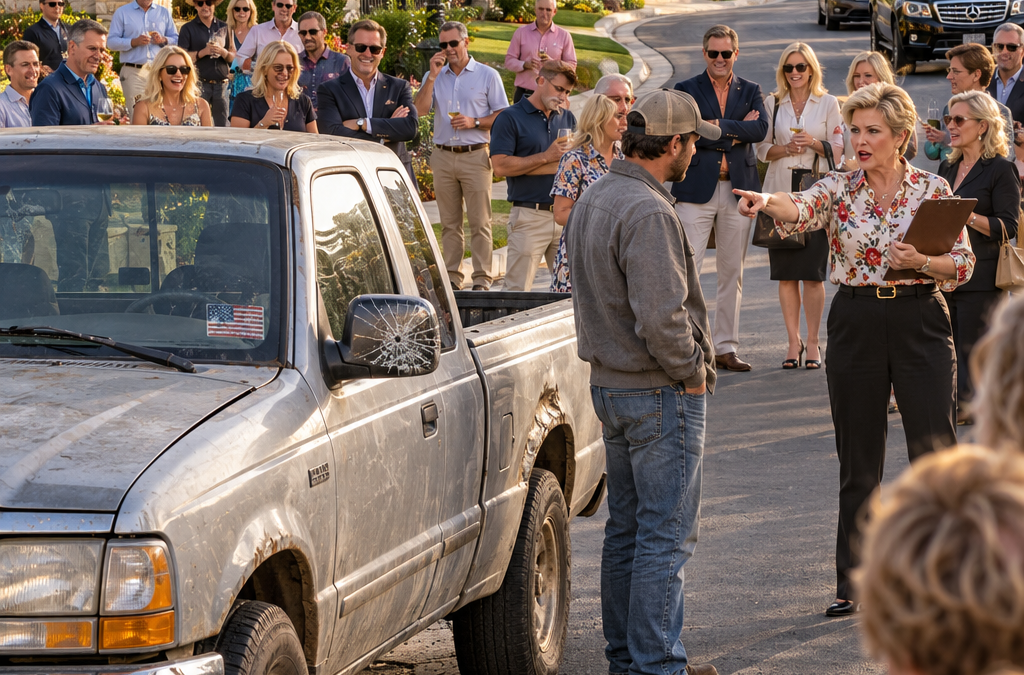
Vivien Chalk pointed at my old silver pickup, laughed at my jacket, and told thirty-two of my new neighbors that men like me usually did not last long in Sycamore Ridge.
I said nothing because six weeks earlier, while signing the papers for my house, I had noticed one line buried in the title history that could change who actually controlled the most photographed piece of land in her neighborhood.
My name is Desmond Okafor.
I had been driving the same silver pickup for eleven years when I moved into Sycamore Ridge.
The truck had a cracked passenger-side mirror.
There was a shallow dent above the rear wheel from the time I misjudged a concrete bollard outside a warehouse in Birmingham.
The front bumper was slightly crooked.
And on the back window was a faded sticker from a fishing trip I took with three college friends in 2019.
People had told me for years to replace it.
I could afford to.
That wasn’t the point.
The truck started every morning.
The air-conditioning worked.
I knew exactly how the steering wheel felt in my hands.
I knew which cup holder tilted just enough to spill coffee if I took a turn too quickly.
I had driven it through some of the most important years of my life.
So I kept it.
The same was true of my gray jacket.
It wasn’t expensive.
It wasn’t fashionable.
The cuffs were worn and the zipper stuck halfway up if I pulled too hard.
But it was comfortable.
My late father had given it to me before a winter fishing trip.
That meant more to me than any label stitched inside a collar.
None of that would have mattered if Vivien Chalk had simply minded her own business.
But people like Vivien rarely do.
I bought 44 Whitmore Circle because I wanted peace.
That was the whole reason.
For nearly fifteen years, my life had revolved around work.
I had built a logistics technology company from a rented office above an auto-parts store into a national platform used by freight operators, regional warehouses, and manufacturing firms.
When we started, there were four of us.
Three laptops.
One folding table.
A secondhand printer that jammed whenever humidity rose.
And more confidence than cash.
Ten years later, we employed hundreds of people.
Eighteen months before I bought the house at Sycamore Ridge, the company was acquired.
The final transaction price was the sort of number people suddenly become interested in when they learn it belongs to you.
Seven digits before the decimal point.
I retained a silent ownership position through the transition, stepped away from daily operations, and promised myself I would never again spend another decade measuring my life by quarterly reports.
I didn’t announce the sale publicly beyond what was legally necessary.
I didn’t buy a sports car.
I didn’t move into a penthouse.
I didn’t suddenly develop an interest in watches that cost as much as houses.
I wanted a quiet office.
A decent kitchen.
Trees.
A back deck.
Enough space to sit outside at night without listening to traffic.
That led me to Sycamore Ridge.
The community sat outside a midsized Tennessee town, developed around a series of curved streets and old sycamore trees that had somehow survived the bulldozers.
The entrance had stone pillars.
Every mailbox matched.
Trash bins had to be stored behind approved screening.
The HOA newsletter arrived monthly whether anybody wanted it or not and managed to fill four pages discussing irrigation schedules, holiday decorations, parking, landscaping, and reminders about approved exterior paint colors.
I didn’t love that kind of environment.
But I had lived under HOA rules before.
Most were annoying rather than dangerous.
The house at 44 Whitmore Circle made the compromise worthwhile.
Two stories.
Brick front.
Large home office.
Wide backyard.
A stand of trees along the eastern side.
And enough room behind the kitchen for the deck I had wanted for years.
I paid cash.
The closing was simple.
Or it should have been.
My attorney, Rebecca Lin, had already reviewed the title commitment when she called me the evening before closing.
“There’s something weird in the old parcel description.”
“Weird bad?”
“I don’t think so.”
“That’s not comforting.”
She laughed.
“It’s probably nothing. But the original developer assembled Sycamore Ridge from several parcels. House forty-four sits on what used to be the eastern tract.”
“Okay.”
“There’s a strip running along the back and eastern edge that’s described differently from the rest of the common areas.”
“How differently?”
“The HOA’s maps show it as community green space.”
I remembered the strip.
A landscaped path ran through it.
Flower beds.
Benches.
A small decorative stone fountain.
Residents used it for walking.
Community photos seemed to be taken there constantly.
“Is that a problem?”
“Probably not. I’m checking the transfer.”
“What transfer?”
“The original conveyance from the developer to the HOA.”
Rebecca became quiet.
I knew that silence.
Lawyers use it when they don’t want to speculate.
“What?”
“I don’t see the strip in the conveyance.”
I leaned back in my chair.
“So who owns it?”
“That’s what I’m trying to determine.”
The next morning she called again.
“This is odd.”
“You keep saying words I don’t like.”
“The current tax map treats the green belt as part of the common area.”
“Okay.”
“But tax maps aren’t deeds.”
“I know.”
“The original metes-and-bounds description appears to attach at least part of that land to the parcel that became forty-four Whitmore.”
“Mine.”
“Potentially.”
“Potentially isn’t mine.”
“Correct.”
“So what do we do?”
“Nothing yet.”
I laughed.
“That’s your legal advice?”
“My legal advice is buy the house if you like the house. The title to the home itself is clean. But I’m going to preserve everything related to the old parcel description because somebody may have made an error twenty years ago.”
“Could it become a problem?”
“Only if somebody forces the issue.”
I signed the closing documents.
That line stayed in the back of my mind.
But I didn’t buy 44 Whitmore Circle because of a green belt.
I bought it because I wanted to live there.
Two weeks later, I moved in.
Three days after that, I attended my first HOA meeting.
That was where I met Vivien properly.
Technically, I had seen her before.
She had driven past my house twice during move-in.
The first time in a white SUV.
The second time in a golf cart.
Both times, she slowed near my truck.
I noticed.
I didn’t think much of it.
At the HOA meeting, I learned that Vivien Chalk had been president of Sycamore Ridge for six consecutive years.
That should have told me something.
She was in her late fifties.
Perfectly arranged blond hair.
Expensive glasses.
Always dressed like she might need to appear in a real-estate advertisement without warning.
Vivien had strong opinions about nearly everything.
Mailbox finishes.
Lawn edging.
Holiday lights.
Fence materials.
Basketball hoops.
Driveway stains.
Someone told me later she maintained a spreadsheet documenting neighborhood violations back to 2018.
Color coded.
Red for active.
Yellow for pending.
Green for resolved.
I believed it.
The meeting was held in the community room beside the pool.
Thirty-two homeowners attended.
I arrived five minutes early.
Plain gray jacket.
Dark jeans.
Work boots.
Bottle of water.
I took a folding chair near the back.
I wasn’t trying to make an entrance.
I wanted to learn how things worked.
Vivien was discussing gutter maintenance when she noticed me.
She stopped.
Not after finishing her sentence.
In the middle of it.
Everyone turned.
She looked directly at me.
Then she smiled.
Thin.
Controlled.
“I’m sorry,” she said. “Did someone invite a guest?”
A few people glanced at each other.
I looked behind me, half hoping there actually was a guest she meant.
There wasn’t.
Vivien continued.
“This meeting is for Sycamore Ridge homeowners.”
I lifted my hand slightly.
“I’m a homeowner.”
She tilted her head.
“You are?”
“Moved into forty-four.”
There was a tiny pause.
“Forty-four Whitmore?”
“That’s right.”
Her eyes moved over me.
The jacket.
Boots.
Probably the truck she had seen outside.
“You bought forty-four?”
“Yes.”
Then she laughed.
Small.
Sharp.
Not amused.
The kind of laugh designed to make the room understand that somebody had missed a joke at their own expense.
“Well,” she said, “we’ll have to see how long that lasts.”
Nobody laughed.
That made what came next worse.
Vivien glanced around the room.
“No offense, honey, but your jacket probably cost less than our monthly landscaping fees.”
Silence.
Thirty-two adults.
Not one voice.
A man near the wall looked down.
A woman in the second row started studying her phone.
Someone coughed.
I could feel the humiliation she expected me to feel.
That was the purpose of the comment.
Not humor.
Hierarchy.
She wanted the room to know she had evaluated me.
I did not meet the standard.
For several seconds, I simply looked at her.
Then I nodded.
“Good to know.”
I unscrewed the cap from my water bottle.
Took a drink.
And pulled out my phone.
Vivien smiled as if she had won.
She continued the meeting.
Inside, I was angry.
I’d be lying if I claimed otherwise.
Money does not make public humiliation painless.
Success does not remove the human instinct to defend yourself when someone deliberately tries to make you look small.
I wanted to tell her exactly what my company had sold for.
I wanted to ask what she had built.
I wanted to ask how much her approval was supposed to be worth.
I wanted to watch her face change.
Instead, I checked an email from Rebecca.
The subject line read:
WHITMORE TITLE RESEARCH UPDATE.
I opened it.
Desmond, I found the original developer conveyance. We need to talk.
I looked toward Vivien.
She was lecturing someone about visible garden hoses.
I put my phone away.
The meeting lasted another hour.
When it ended, people gathered in small groups.
Nobody approached me at first.
That told me even more about Vivien’s position than the insult had.
The room wasn’t comfortable with her.
It was afraid of becoming her next target.
I left.
Outside, my truck was parked near the entrance.
A man with white hair stood beside it.
“Desmond?”
“Yeah.”
“I’m Wendell Baker.”
We shook hands.
He was probably in his late sixties.
Broad shoulders.
Hands like he’d spent his life building things.
“I’m at eighteen Sycamore.”
“Nice to meet you.”
He glanced toward the meeting room.
“Vivien shouldn’t have said that.”
“No.”
“She does things like that.”
“I gathered.”
Wendell looked embarrassed.
“Most people aren’t like her.”
“I didn’t assume they were.”
“Still.”
I opened my truck.
He looked at the dent above the wheel.
“You planning to replace this thing?”
I laughed.
“Apparently I’m required to.”
He smiled.
“Don’t let her get to you.”
“I don’t plan to.”
That night, I called Rebecca.
“What did you find?”
She sounded energized.
“Okay. I have the original subdivision documents.”
“And?”
“The green belt issue is real.”
I sat down.
“How real?”
“Very.”
“Explain it to me like I’m not a title attorney.”
“The developer originally owned one large eastern parcel. When the subdivision was platted, most of the common areas were transferred to the HOA through a master deed.”
“Most.”
“Not the eastern amenity strip.”
I stared at the wall.
“Why?”
“I can’t tell yet. Could’ve been oversight. Could’ve been related to phasing.”
“And where did it go?”
“When lot forty-four was carved out, the legal description appears to include the underlying strip.”
“Appears?”
“Desmond.”
“I know. Lawyer word.”
“I had another title examiner review it.”
“And?”
“Same conclusion.”
“So I own the walking path?”
“Potentially the land under it, yes.”
“The flower beds?”
“If they’re inside the description.”
“The fountain?”
“Improvements are a separate issue.”
“Of course they are.”
“Don’t do anything.”
“I haven’t.”
“And don’t tell the HOA.”
“Why?”
“Because I want a third review.”
“You’re enjoying this.”
“Professionally.”
I looked out my front window.
Across the street, decorative lights illuminated the entrance to the green belt.
Residents used the path every evening.
Vivien had apparently selected the fountain herself during a beautification project two years earlier.
I had no desire to take any of it from the neighborhood.
But I suddenly understood why Rebecca had insisted we preserve the old records.
Someone had spent years maintaining land the HOA might not actually own.
I filed that knowledge away.
Exactly where it would have stayed if Vivien had left me alone.
She did not.
The first violation notice arrived four days later.
My truck.
According to the letter, my pickup violated Section 9.4 of Sycamore Ridge’s vehicle appearance standards.
I read the rule.
It prohibited commercial vehicles displaying external business signage, heavy equipment, recreational vehicles parked beyond specified periods, and vehicles deemed inoperable.
My truck was none of those things.
No commercial markings.
Current registration.
Operational.
Personal use.
Vivien’s notice described it as an “aesthetically incompatible work vehicle.”
That phrase did not exist in the rule.
I wrote back.
Please identify the specific language in Section 9.4 prohibiting a privately owned, registered, operable pickup truck without commercial markings.
I copied Rebecca.
Two days later, the violation was “held for review.”
Then came the porch light.
Wrong color temperature.
Apparently Sycamore Ridge permitted warm white fixtures in a specific range.
The bulb left by the previous owner was cooler.
I replaced it.
Cost nine dollars.
I mailed a photo and receipt.
Then came the grass notice.
The letter claimed my front lawn exceeded the permissible height.
I walked outside with a ruler.
The difference between compliant and noncompliant grass was so small I felt ridiculous measuring it.
I cut the lawn.
Documented it.
Responded in writing.
Every time.
Calm.
Precise.
No insults.
No threats.
Rebecca received copies.
“You realize she’s testing you,” she said after the third letter.
“I know.”
“Do you want me to send something?”
“Not yet.”
“Why?”
“Because I want to see how far she goes.”
“That’s usually something lawyers say, not clients.”
“Maybe I’m learning.”
The fourth notice concerned a trash bin visible from the street for forty minutes after the permitted retrieval window.
That one made me laugh.
I had been on a business call.
The garbage truck ran late.
Apparently Vivien’s clock did not.
I moved the bin.
Answered the letter.
Saved everything.
Then Wendell appeared at my door.
He carried two coffees.
“Peace offering.”
“For what?”
“The neighborhood.”
I let him inside.
We sat at my kitchen island.
He had worked as a contractor for thirty-eight years before retiring.
“She’s been doing this forever,” he said.
“Vivien?”
“Yeah.”
“Why does everyone tolerate it?”
Wendell rubbed his jaw.
“Because fighting her is exhausting.”
That answer sounded familiar.
“How?”
“She’ll fine you. Send letters. Put things on meeting agendas. Call management. If you push back, suddenly your fence has a problem.”
“Nobody runs against her?”
“People have.”
“What happened?”
“She turns meetings into war.”
I took a sip of coffee.
“So everyone gave up.”
“Pretty much.”
“That’s not healthy.”
“No kidding.”
He hesitated.
“What she said at the meeting bothered a lot of us.”
“Not enough for anyone to say something.”
His face tightened.
“You’re right.”
I hadn’t meant it as an attack.
But it landed that way.
“I didn’t expect strangers to defend me.”
“Maybe somebody should have.”
For a while, neither of us spoke.
Then Wendell asked, “What are you going to do?”
“About what?”
“Her.”
I smiled.
“I think I might have an idea.”
Rebecca’s third title review came back the next week.
Then a fourth.
Because once a finding becomes valuable, I become extremely suspicious of findings I want to be true.
Three separate title professionals reached essentially the same conclusion.
The eastern green belt had never been conveyed from the original tract into HOA ownership.
The legal description tied the land to 44 Whitmore Circle.
My parcel.
Rebecca called it one of the strangest subdivision mistakes she’d seen in years.
“How did nobody notice?”
“Because the HOA used it continuously.”
“For twenty years.”
“Pretty much.”
“They landscaped it.”
“Yes.”
“Built a fountain.”
“Yes.”
“Maintained the path.”
“Yes.”
“So don’t they have some kind of adverse possession argument?”
“Possibly an argument. Not necessarily a winning one.”
“Why?”
“Lots of reasons. Nature of use. Recorded maps. Whether possession was hostile or under mistaken common-area assumptions. Whether the HOA’s use satisfies every element required. It’s not simple.”
“Nothing ever is.”
“But title ownership is strong enough that I recommend a quiet-title action.”
I sat back.
“Do it.”
“You’re sure?”
“I want the record clean.”
“What do you intend to do with the land?”
“Nothing.”
“Desmond.”
“I don’t want the green belt.”
“Then why file?”
“Because I want everybody to know who does.”
She went quiet.
“You have a plan.”
“I have an outcome I’d prefer.”
“Which is?”
“I’ll tell you after we confirm everything.”
The petition was filed quietly.
No dramatic lawsuit announcement.
No press.
No threats.
Rebecca served the necessary parties.
A land title firm prepared a formal ownership analysis.
Six weeks after my first HOA meeting, every homeowner in Sycamore Ridge received a certified letter.
That wasn’t my idea.
It was a notice required because the title dispute affected common-area interests and association representations.
The letter explained that the ownership of the eastern amenity strip was under formal review.
It identified 44 Whitmore Circle.
It referenced the original legal description.
It informed owners that records indicated the strip had never been properly transferred to the HOA.
By noon, my phone started ringing.
Wendell called first.
“Tell me this is real.”
“It’s real.”
“The green belt?”
“Looks like it.”
“The whole thing?”
“Most of it.”
“The fountain?”
“The dirt under the fountain.”
He started laughing.
I pulled the phone away from my ear.
“What?”
“I’m sorry.”
“You don’t sound sorry.”
“I’ve spent six years listening to Vivien call that fountain her legacy.”
I laughed despite myself.
“Don’t start a rumor.”
“Too late. The neighborhood group chat looks like the stock market crashed.”
The HOA called an emergency meeting for Thursday.
I received formal notice.
Rebecca advised me to attend.
“Say very little.”
“I usually do.”
“Don’t antagonize Vivien.”
“She seems capable of doing that herself.”
“Desmond.”
“I’ll behave.”
I drove to the meeting in my old silver pickup.
Same dent.
Same sticker.
Same gray jacket.
Same boots.
The difference was where I sat.
Front row.
The room was fuller than the first meeting.
Nearly every chair occupied.
People stood along the walls.
Vivien entered with two board members and an attorney named Philip Grant.
She looked confident.
At first.
Then she saw me.
Her eyes moved from my jacket to my boots.
This time she didn’t smile.
Philip began.
“We’re here to address a recently filed title action concerning what has historically been maintained and represented as the Sycamore Ridge eastern common green.”
Historically represented.
Careful words.
He explained that the HOA was reviewing documents.
Vivien interrupted.
“This is clearly an administrative error.”
Philip looked toward her.
That was the first sign their preparation had not gone smoothly.
She continued.
“That land has been part of Sycamore Ridge since the beginning.”
Rebecca, seated beside me, whispered, “Don’t.”
I hadn’t moved.
Vivien looked directly at me.
“You cannot suddenly claim community property because of a paperwork technicality.”
I answered calmly.
“I’m not claiming anything suddenly.”
“You filed a lawsuit.”
“A quiet-title petition.”
“Same difference.”
“No.”
The room stayed silent.
Vivien folded her arms.
“This is absurd.”
Rebecca stood.
“I’m Rebecca Lin, counsel for Mr. Okafor. Three independent title reviews have reached the same conclusion. The original common-area transfer omitted the eastern strip. The recorded legal description remained attached to what became forty-four Whitmore Circle.”
Vivien shook her head.
“No.”
Philip touched her arm.
She pulled away.
“It has to be a mistake.”
Wendell spoke from the back.
“It’s been his since the original deed.”
Every head turned.
Vivien stared at him.
“Excuse me?”
Wendell crossed his arms.
“I read the title report.”
“You’re not an attorney.”
“No. I build houses. I can still read a property description.”
A few people smiled.
Vivien looked around the room.
For allies.
The same people who had avoided eye contact when she insulted me six weeks earlier were suddenly looking everywhere but at her.
Phones.
Floor.
Ceiling.
Paperwork.
Nobody rushed to defend her.
I felt no satisfaction in that.
Not yet.
Mostly, I felt tired.
I hadn’t wanted a neighborhood war.
I wanted a deck.
Vivien turned to me.
“What exactly do you want?”
Her voice was different.
No honey.
No laugh.
No judgment of my jacket.
Just uncertainty.
I looked at Rebecca.
She nodded.
I stood.
“I don’t want the green belt.”
A murmur went through the room.
Vivien blinked.
“What?”
“I don’t want your walking path. I don’t want the fountain. I don’t want the flower beds.”
“Then why are we here?”
“Because the land is attached to my deed. That needs to be resolved correctly.”
She stared.
I continued.
“If the title is confirmed in my favor, I’m willing to deed the green belt to the association.”
The room became still.
“No payment,” I said.
Vivien’s expression changed again.
“You’ll give it to the HOA?”
“To the community.”
“At no cost?”
“Yes.”
Philip leaned toward her and whispered something.
She ignored him.
“What’s the catch?”
“There are conditions.”
Of course there were.
I hadn’t spent six weeks documenting harassment so I could pretend it never happened.
I held up one finger.
“Every vehicle violation issued against me regarding my truck gets withdrawn permanently.”
Vivien opened her mouth.
I continued before she could speak.
“Two. I want a formal written apology on HOA letterhead for what you said to me at my first meeting.”
Her face went pale.
People shifted in their seats.
“You publicly mocked my clothes and implied I couldn’t afford to live here. I want the apology to acknowledge that.”
“This is personal.”
“It became personal when you made it personal.”
She looked toward Philip.
He said nothing.
“Third,” I continued, “the board’s enforcement process gets restructured.”
Vivien laughed once.
There was no humor in it.
“You don’t get to rewrite our governance because of a title dispute.”
“I’m not asking to.”
“That’s exactly what you’re doing.”
“No. I’m telling you the conditions under which I will voluntarily transfer land that appears to belong to me.”
Silence.
I continued.
“I want a three-person compliance review committee. No single board officer should be able to target a homeowner with repeated discretionary violations without review.”
A woman near the wall said quietly, “That sounds reasonable.”
Vivien looked toward her.
The woman didn’t look away.
That mattered.
I finished.
“Thirty days.”
Vivien stared at me.
“And if we refuse?”
“Then we’ll let the quiet-title process finish.”
“What does that mean?”
Rebecca answered.
“If ownership is confirmed, Mr. Okafor will decide what happens to his property.”
Vivien’s face tightened.
“You’d remove the green belt?”
I looked at her.
“I didn’t say that.”
“But you could.”
“I suppose.”
“You could close the path.”
“I suppose.”
“The fountain.”
“It’s an improvement on disputed land.”
“This is blackmail.”
Philip finally spoke.
“Vivien.”
She turned.
“What?”
“It’s not blackmail.”
The room went dead quiet.
He chose his next words carefully.
“Mr. Okafor is proposing a settlement of a legitimate title dispute.”
For the first time, I saw Vivien frightened.
Not devastated.
Not defeated.
Frightened.
Because the lawyer she expected to validate her authority had just validated mine instead.
I sat down.
Rebecca leaned toward me.
“That went better than I expected.”
“I thought you said not to antagonize her.”
“You were polite.”
“High praise.”
The meeting continued for nearly two hours.
Homeowners asked questions.
Lots of them.
How had the title mistake happened?
Had HOA dues been spent improving land it didn’t own?
Did the association have insurance coverage?
Would assessments increase?
Why had the issue never been identified?
Then the questions changed.
Why was one person issuing so many violations?
Why did the board president maintain her own tracking system?
How many enforcement letters had been reviewed by anyone else?
Why were some homeowners repeatedly targeted while others received warnings?
Vivien sat through all of it.
The room she had controlled for six years had changed.
Not because I gave a speech.
Because people finally realized she was not inevitable.
Power has a strange architecture.
Sometimes everyone obeys one person because everyone else obeys that person.
The moment a few people stop, the whole structure can collapse faster than anyone expects.
Nine days after the emergency meeting, Vivien Chalk resigned as president of the Sycamore Ridge HOA.
I learned about it from Wendell.
He called at 7:12 in the morning.
“She’s gone.”
I was making coffee.
“Who?”
“You know who.”
“I need caffeine before riddles.”
“Vivien resigned.”
I stopped.
“When?”
“Board got the letter last night.”
“Why?”
“Personal reasons.”
I laughed.
“Of course.”
“Apparently she believes new leadership will help the community move forward.”
“That’s almost mature.”
“Don’t ruin the moment.”
Two other board members remained.
An interim election was scheduled.
A temporary compliance committee was created immediately.
The truck violation disappeared from my account.
So did several other questionable notices issued to neighbors.
Then, on a Tuesday morning, an envelope arrived.
Sycamore Ridge Homeowners Association.
Official letterhead.
My name.
I opened it at the kitchen counter.
Mr. Okafor,
On behalf of the Sycamore Ridge Homeowners Association, we apologize for the comments made regarding your appearance, vehicle, and presumed financial status during your first association meeting.
Those remarks were inappropriate, inconsistent with the standards of respect expected in this community, and should not have been made.
The association recognizes that homeownership, community participation, and personal worth are not measured by clothing, vehicles, income assumptions, or outward appearance.
Please accept this formal apology.
It was signed by the interim board.
Below that was Vivien’s signature.
In ink.
I read it twice.
Then once more.
I didn’t feel triumphant.
I thought I would.
Instead, I remembered the first meeting.
Thirty-two people.
That silence.
The way I had felt everybody trying not to look at me.
Humiliation lingers in the body longer than logic suggests it should.
The apology couldn’t erase that.
But it acknowledged it.
That mattered.
Wendell visited that afternoon.
“Did you get it?”
“Yes.”
“Frame it.”
“Absolutely not.”
“Desmond.”
“No.”
“That woman insulted your jacket in front of the neighborhood and then had to sign an apology saying clothes don’t determine personal worth.”
I stared at him.
“You’re enjoying this too much.”
“Frame it.”
So I did.
Not in the living room.
That would have been strange.
I put it in my office.
Beside a framed photograph from the 2019 fishing trip.
The same trip that produced the faded sticker on my truck.
The title action resolved the following month.
Ownership of the eastern strip was confirmed according to the corrected chain of title.
For a short period, the most visible common space in Sycamore Ridge legally belonged to me.
Then I signed it away.
Free and clear.
No purchase price.
No revenge conditions.
No easement fees.
No annual payment.
I deeded the green belt to the HOA properly so there would never be another question.
Rebecca watched me sign.
“You’re sure?”
“Yes.”
“You could negotiate money.”
“I have enough money.”
“You could negotiate permanent restrictions.”
“The board restructuring is already happening.”
“You could keep some rights.”
“I don’t want them.”
She smiled.
“You really only wanted them to stop bothering you.”
“I’ve been saying that from the beginning.”
“You realize most people wouldn’t give valuable land away after being treated like this.”
“It’s not giving away something I planned to use.”
“It’s still yours.”
“Not for long.”
I signed.
The transfer recorded.
Sycamore Ridge finally owned its green belt for real.
Wendell organized a block gathering afterward.
I tried to tell him not to.
That worked about as well as telling rain not to fall.
Someone brought folding tables.
Someone else brought food.
There was a cake.
The decoration was supposed to depict the green belt.
It looked more like a green rectangle with a gray worm through the middle.
I told the woman who made it that it was perfect.
I arrived in the silver truck.
Gray jacket.
Work boots.
Nobody said a word about any of them.
Actually, that isn’t true.
Wendell pointed at the truck.
“Still driving that thing?”
“Still runs.”
“Now you’re just keeping it to annoy people.”
“Possibly.”
He laughed.
I stayed for two hours.
Longer than I planned.
People introduced themselves.
Some apologized.
That part became uncomfortable.
A woman named Rachel approached me while I was standing near the food table.
“I should have said something that first meeting.”
“You didn’t know me.”
“That doesn’t matter.”
I didn’t answer.
She continued.
“When Vivien said that about your jacket, I thought it was awful.”
“So did I.”
“But I stayed quiet.”
“So did everybody.”
She looked embarrassed.
“That’s the problem.”
I understood what she meant.
“You don’t owe me anything.”
“I think we all owed each other more than we were giving.”
That was a better sentence than anything I had prepared.
I nodded.
“Maybe.”
Over the next few months, Sycamore Ridge changed.
Not completely.
No neighborhood suddenly becomes perfect because one difficult president resigns.
People still argued about landscaping.
They still disagreed about holiday decorations.
Somebody still sent too many emails about parking.
But the governance changed.
Three people reviewed discretionary enforcement actions.
Homeowners were given clearer appeal procedures.
Meeting agendas were published earlier.
Violation records had to cite actual rule language instead of invented interpretations.
No president maintained a private punishment spreadsheet anymore.
Wendell ran for the board.
He lost by two votes.
I gave him absolutely no sympathy.
“People don’t appreciate leadership,” he complained.
“You spent your campaign telling everyone you didn’t want the job.”
“I wanted them to know I wasn’t power hungry.”
“You convinced them.”
He stared at me.
“You’re a terrible friend.”
“Probably.”
The strangest thing was how little my financial status mattered after everything ended.
During the conflict, several people learned about my company.
Corporate records are public if someone knows where to look.
The acquisition amount circulated.
Suddenly, people understood that Vivien’s assumption had not just been rude.
It had been spectacularly wrong.
Some expected me to enjoy that.
I didn’t.
The lesson was never that she should have treated me better because I was wealthy.
That would have missed the point completely.
She should have treated me better if I had been broke.
If I’d bought the house with a thirty-year mortgage.
If the truck had been all I owned.
If the jacket came from a thrift store instead of my father.
If I worked two jobs.
If I was unemployed.
If I had ten million dollars.
If I had ten dollars.
None of those facts would have changed the basic requirement of respect.
That was what bothered me most about people telling the story afterward.
They loved the twist.
Vivien mocked poor man.
Poor man secretly rich.
Vivien humiliated.
It makes a satisfying narrative.
But it wasn’t the real story.
The real story was that Vivien believed wealth determined who deserved dignity.
My bank account only exposed the stupidity of her assumption.
It did not create my worth.
I never told her that directly.
I don’t know if she would have understood it.
The last time I saw her was about six months after she resigned.
I was at a garden center buying lumber and hardware for the back deck.
Yes.
I finally built it.
I had a cart stacked with pressure-treated boards when I heard someone say my name.
“Desmond.”
I turned.
Vivien stood near a display of outdoor planters.
For a moment, neither of us spoke.
She looked different without the HOA setting around her.
Smaller somehow.
Not physically.
Ordinary.
No table.
No microphone.
No clipboard.
No homeowners waiting for her approval.
Just another person buying something on a Saturday.
“Vivien.”
She looked at my cart.
“Building something?”
“Deck.”
She nodded.
“I remember that was in your original architectural request.”
I almost smiled.
“Of course you do.”
A little color appeared in her face.
“I suppose I deserved that.”
I didn’t answer.
She looked toward the parking lot.
“Still driving the truck?”
“Yes.”
“Why?”
That question genuinely surprised me.
“What do you mean?”
“You could drive anything.”
“So?”
“I don’t know.”
I rested both hands on the cart.
“Vivien, you still think the truck needs an explanation.”
She became quiet.
I continued.
“I like it.”
“That’s it?”
“That’s it.”
She looked uncomfortable.
“I was wrong about you.”
“No.”
Her eyes came back to mine.
“You were wrong to think it mattered.”
She frowned slightly.
“What?”
“You thought I didn’t belong because of what I wore and what I drove. Finding out I had money didn’t make that judgment wrong. It was wrong before you knew anything else about me.”
She stared at me.
For once, there was no immediate answer.
I almost left it there.
Then she said quietly, “The board got out of control.”
“You were the board president.”
“I know.”
“That’s not the same as saying it happened to you.”
She looked down.
“No.”
There was something honest in that answer.
Maybe the first thing I had ever heard from her that felt completely unprotected.
“I thought I was protecting property values.”
“From my truck?”
She almost smiled.
“When you say it that way, it sounds ridiculous.”
“It was ridiculous.”
“I know that now.”
I believed she knew at least part of it.
Whether she regretted hurting people or simply regretted losing power, I couldn’t say.
Maybe both.
People are rarely simple enough to fit neatly into villain and victim.
But actions still have consequences.
I wished her well.
Then I pushed my cart toward checkout.
When I reached the parking lot, the silver truck was sitting exactly where I left it.
Dented.
Crooked bumper.
Fishing sticker fading further every year.
I put the lumber in the bed.
For the first time, I laughed thinking about the original HOA meeting.
Not because Vivien had been humiliated later.
Because the entire premise seemed absurd.
A jacket.
A truck.
Thirty-two adults sitting silently while one woman tried to decide who belonged in a neighborhood by looking at clothing.
I drove home.
That summer, I finished the deck.
I did most of the planning myself but hired Wendell to help with the framing.
He complained constantly.
Mostly because I refused to let him work for free.
“You’re insulting me,” he said.
“I’m paying market rate.”
“Friends don’t charge friends.”
“Retired contractors apparently do.”
“I offered.”
“And I declined.”
He pointed at me with a drill.
“Rich people are impossible.”
I laughed.
“Careful. Vivien started that way.”
He nearly dropped the drill.
The deck took three weeks.
When it was finished, I put two chairs near the eastern side where I could see the green belt through the trees.
The fountain was visible in winter when the leaves dropped.
Children rode bikes along the path.
Older couples walked in the evening.
People pushed strollers.
The land looked exactly the way it had before the title dispute.
That pleased me.
Winning did not need to leave a scar.
I could have fenced it.
I could have demanded rent.
I could have threatened access.
I could have turned the entire thing into a monument to being right.
I didn’t.
Because the people using that green belt had not insulted me.
Most had not harassed me.
They were just neighbors.
Some had been silent when they should have spoken.
I understood why.
Fear doesn’t always look dramatic.
Sometimes fear looks like staring at your phone while somebody else is being humiliated because you know the person doing the humiliating controls the violation notices.
Sycamore Ridge had allowed Vivien to become powerful because challenging her became more uncomfortable than complying with her.
That happened slowly.
One ignored insult.
One unreasonable fine.
One uncontested interpretation.
Then another.
Eventually, behavior that should have shocked people became routine.
I’ve seen the same thing happen in companies.
One executive becomes untouchable.
Employees stop questioning strange decisions.
People laugh at jokes that aren’t funny.
Meetings become performances.
The leader begins believing silence means agreement.
It doesn’t.
Sometimes silence means everyone is waiting for one person to move first.
I happened to be that person.
Not because I was brave.
I wasn’t trying to start a movement.
I simply had a deed.
And I read it.
People still ask whether I planned the entire confrontation from the beginning.
I didn’t.
That’s probably the most important part.
When Rebecca first told me about the green belt discrepancy, I had no idea Vivien existed.
I could have completed the title correction quietly after closing.
Maybe transferred the strip to the HOA without anyone noticing.
Maybe never acted at all.
I didn’t move into Sycamore Ridge hoping to expose an HOA president.
I moved there hoping to build a deck.
The title issue became leverage only because Vivien created a reason for me to use leverage.
She looked at a stranger and decided she knew him.
That was her first mistake.
She assumed the truck represented my finances.
Second mistake.
She assumed the jacket represented my status.
Third.
Then she assumed my silence represented weakness.
That was the one that mattered.
Silence is complicated.
Sometimes people stay quiet because they’re afraid.
Sometimes because they’re tired.
Sometimes because they are calculating.
Vivien never considered the third possibility.
At the first meeting, while she was laughing at my jacket, I wasn’t thinking about revenge.
I was thinking about Rebecca’s email.
Original developer conveyance.
We need to talk.
Six weeks later, the entire neighborhood was gathered in the same room.
Same folding chairs.
Same walls.
Same president.
But everything had changed.
Not because I became richer in those six weeks.
Not because I changed my clothes.
Not because the truck disappeared.
The only thing that changed was information.
At the first meeting, Vivien believed she understood who had power.
At the second meeting, she understood the deed.
That difference was enough.
The formal apology still hangs in my office.
Wendell was right.
I should frame it.
Not because I enjoy looking at Vivien’s signature.
I barely notice it anymore.
I keep it because it reminds me how quickly people can reduce one another to appearances.
Below it, I eventually added a photograph.
My father and me.
Fishing trip.
He’s wearing a camouflage cap.
I’m wearing the gray jacket.
The silver truck is behind us.
Same bumper sticker.
Same dent.
My father died a year later.
That jacket is one of the few pieces of clothing I still have from him.
Vivien saw cheap fabric.
I saw my father.
That’s the danger of judging people by what they carry.
You rarely know what you’re actually looking at.
The truck wasn’t evidence that I lacked money.
The jacket wasn’t evidence that I lacked standards.
Quiet wasn’t evidence that I lacked confidence.
And an old property description wasn’t evidence that a strip of land belonged to the people who had landscaped it longest.
Assumptions feel efficient.
That’s why people make them.
Facts take longer.
Facts require documents.
Questions.
Patience.
Sometimes three title firms.
I learned that building a company.
Vivien learned it in a community room on a Thursday night.
I still live at 44 Whitmore Circle.
The house feels more like mine now.
The deck is finished.
My office looks out toward the backyard.
I work less than I used to.
That’s intentional.
The truck has another dent.
That one is my fault too.
Wendell claims I’m trying to destroy it before it can die naturally.
I tell him I’m adding character.
The HOA sends fewer letters these days.
The newsletters are still four pages.
Some traditions survive reform.
Once a year, I attend the budget meeting.
Not because I enjoy it.
Because communities work better when people show up before something goes wrong.
The current president is a woman named Denise Mercer.
She teaches high school history.
At her first meeting, she announced that anyone was allowed to question the board without being treated as hostile.
A homeowner immediately spent fifteen minutes arguing about pet waste stations.
Democracy is imperfect.
I considered that progress.
One evening, about two years after the title dispute, I was sitting on my deck when Wendell came through the side gate.
He didn’t knock.
We had reached that stage of friendship.
He carried two beers.
“Remember the first meeting?”
“Unfortunately.”
“I’ve been thinking.”
“That sounds dangerous.”
He ignored me.
“Why didn’t you say anything?”
“When?”
“When she mocked you.”
“I did.”
“You said ‘good to know.'”
“That was something.”
“You could have destroyed her right there.”
“How?”
“You could’ve told everyone about your company.”
I shook my head.
“That wouldn’t have destroyed anything.”
“It would’ve shut her up.”
“Maybe.”
“Why didn’t you?”
I looked toward the trees.
The evening light was catching the fountain.
“Because then the lesson would’ve been that she picked the wrong rich guy.”
Wendell became quiet.
“I wasn’t rich when I started the company,” I said. “There were years I had less money than probably half the people in that room.”
He sat down.
“If she’d met me then, would the joke have been okay?”
“No.”
“Exactly.”
He nodded slowly.
“So you never wanted her to know.”
“I didn’t care whether she knew.”
“Until people found out anyway.”
“That’s different.”
We sat there.
After a while, Wendell smiled.
“Still glad she had to apologize.”
“Me too.”
I’m not above that.
The irony wasn’t wasted on me.
But the thing I remember most isn’t Vivien’s resignation.
It isn’t the apology.
It isn’t the title report.
It isn’t the shocked faces when everyone realized the HOA did not own its own green belt.
It’s that silence after she insulted me.
Thirty-two people.
Nobody laughed.
Nobody agreed.
Nobody defended me either.
That silence taught me more about Sycamore Ridge than any governing document.
Vivien’s real power had never been the presidency.
It was everybody else’s belief that opposing her would cost too much.
The green belt changed that calculation.
For the first time, continuing to let Vivien operate unchecked seemed more expensive than confronting her.
That was all it took.
Power shifted.
Nine days later she was gone.
I didn’t defeat a queen.
There had never been one.
There was only a woman with a title, a spreadsheet, and thirty-two neighbors who had forgotten that an HOA president works for the homeowners.
Once they remembered, the kingdom disappeared.
My house is still there.
So is the green belt.
The fountain still runs.
My truck still sits in the driveway.
My gray jacket is hanging by the back door as I write this.
The apology is framed upstairs.
And the deed to the green belt belongs to the association now, exactly where it probably should have belonged from the beginning.
Everything ended where it should have started.
Clear boundaries.
Shared respect.
No one person deciding who belonged based on clothing, money, or the condition of a truck.
Vivien once looked at me in front of an entire room and saw a man she thought would be easy to embarrass.
She saw old boots.
A dented pickup.
A cheap jacket.
She never bothered to look any deeper.
If she had, maybe none of this would have happened.
But that is the thing about people who judge too quickly.
They rarely understand what they are actually risking.
Sometimes the man sitting quietly in the back row really is exactly what he looks like.
A tired man in an old jacket who just wants to be left alone.
And sometimes the document sitting quietly in his closing file matters far more than the person holding the microphone realizes.
Vivien spent six years teaching Sycamore Ridge to pay attention to appearances.
It took one deed to remind everyone that appearances have never decided ownership.
And one old silver truck to remind them they shouldn’t decide a person’s worth either.








