𝗙𝗨𝗟𝗟 𝗦𝗧𝗢𝗥𝗬 The HOA President Mocked My $22,400 Claim Without Realizing One Missing Deed Could Put His Entire Lake at Risk
𝗙𝗨𝗟𝗟 𝗦𝗧𝗢𝗥𝗬
The workers.
Their truck.
The license plate.
The contractor’s name printed across the door.
By the time the foreman returned, Gerald Foss was walking into my backyard.
He had come through the side gate without knocking.
That should have told me everything.
“Darren.”
He said my name as though I were the one creating a problem.
“What is this?”
“Necessary drainage maintenance.”
“You sent an excavator through my yard.”
“The northern shoreline pipe requires replacement.”
“So you called me?”
Gerald’s expression barely moved.
“This falls under lake maintenance.”
“That wasn’t my question.”
“We sent notice that drainage work would occur this month.”
“You sent a neighborhood email saying lake maintenance would occur. You did not say heavy equipment would cross my lot.”
“The association maintains access rights around the lake.”
“Show me the access right.”
He glanced toward the contractor.
Then back at me.
“Don’t make this more difficult than it needs to be.”
That sentence stayed with me.
Because suddenly I was angry.
Not loud.
Not out of control.
But deeply angry.
There is something uniquely insulting about watching another person damage what you own while explaining that your objection is the inconvenience.
“My wall is cracked,” I said.
“We’ll evaluate it.”
“My irrigation system is broken.”
“Again, we’ll evaluate it.”
“You tore through forty feet of sod.”
“Darren.”
Gerald lowered his voice.
“There are eighty-seven homes in Cedarbrook Commons. Stormwater management has to serve the community as a whole. Sometimes individual owners experience minor disruption for necessary infrastructure.”
“Minor?”
“It can be repaired.”
“Then stop the work until we establish your legal right to be here.”
Gerald looked directly at me.
“No.”
The word was quiet.
The contractor foreman shifted uncomfortably.
I stepped toward Gerald.
“You are refusing to stop construction on my property after I’ve challenged your authorization?”
“The association has an implied easement for maintenance related to the lake.”
“Recorded where?”
His jaw tightened.
“Speak to the board’s counsel if you have questions.”
“I am asking you.”
“And I’ve answered.”
He turned toward the foreman.
“Continue.”
I looked at the foreman.
“If that machine moves another foot across my property, document that your company has been explicitly notified that access is disputed.”
He looked from me to Gerald.
That was enough.
The contractor stopped work.
Gerald was furious.
I could see it even though his voice remained controlled.
“This project delay may result in additional costs.”
“Then perhaps you should have called me before driving an excavator through my backyard.”
He left without another word.
I stood beside the damaged wall after everyone was gone and looked across the lake.
For the first time since buying the house, the view did not feel peaceful.
It felt like evidence.
Over the next four days, I obtained three repair estimates.
The retaining wall damage was worse than it appeared.
The cracked section had shifted enough that patching would not be structurally reliable. A contractor recommended removing and rebuilding part of the wall.
The irrigation main had to be excavated and replaced.
The damaged lawn required grading and new sod.
Several landscape plants were destroyed.
One drainage swale I had carefully shaped the year before had been compacted by the excavator tracks and would need restoration.
The lowest complete estimate was $21,780.
The highest was $23,060.
I submitted a claim for $22,400.
I attached photographs.
Videos.
Repair estimates.
A site sketch.
A written chronology.
And a request for the recorded document supporting Gerald’s claim of an implied maintenance easement across my property.
I sent everything by certified mail and email.
Gerald answered three days later.
Two sentences.
“The Cedarbrook Commons Homeowners Association possesses implied access rights over properties adjacent to the community lake for purposes of inspection, repair, drainage, and maintenance. Any temporary disturbance to landscaping resulting from necessary maintenance is incidental to the Association’s lawful exercise of those rights and is the responsibility of the individual homeowner.”
I read it once.
Then again.
Then a third time.
By the sixth reading, the anger had disappeared.
That was probably the moment Gerald lost.
Because once I stopped being angry, I became curious.
“Implied access rights.”
That phrase bothered me.
Not because implied easements are impossible.
They are not.
Depending on the facts and jurisdiction, property rights can arise in ways that are not obvious from one page of a deed.
But people use the word “implied” too casually.
Especially when they want to skip the part where they prove something.
I printed the email.
Then I opened the closing file from when I bought my house.
My deed contained several recorded easements.
A utility easement.
A drainage easement along part of the side boundary.
A public service easement near the front setback.
Nothing granting the HOA blanket access to the rear yard.
I checked the title policy.
Nothing.
The survey from my purchase showed the lake boundary and several reference points, but no HOA access corridor across my backyard.
That was strange.
Not impossible.
But strange.
I emailed Gerald.
“Please provide the instrument, plat notation, declaration provision, or other recorded document establishing the access right referenced in your response.”
He did not answer.
Two days later, however, he did something I had not expected.
He forwarded my damage claim to the entire neighborhood.
I found out because Claudette called me.
“Darren,” she said, “have you checked your email?”
“No.”
“You should.”
I opened my laptop.
The subject line read:
CLARIFICATION REGARDING LAKE MAINTENANCE DISPUTE.
Gerald had written nearly eight hundred words.
He explained that a homeowner adjacent to the lake had submitted what he called an “extraordinary demand for over twenty-two thousand dollars” after routine drainage work.
He claimed the board had a fiduciary duty to reject unreasonable attempts to shift ordinary landscaping expenses onto the association.
He warned residents that frivolous claims threatened to increase everyone’s dues.
Then he wrote the sentence that changed everything.
“While certain individuals may believe proximity to the lake grants them special ownership privileges, the lake remains a community asset under the exclusive authority of the Cedarbrook Commons Homeowners Association.”
Certain individuals.
He did not name me.
He did not need to.
Attached to the email was a redacted copy of my invoice.
Gerald had circled $22,400 in red.
At the bottom he had added:
“Residents are encouraged to consider whether demands of this nature reflect responsible community membership.”
I stared at the screen.
Then Claudette spoke.
“You still there?”
“Yes.”
“He’s trying to embarrass you.”
“I noticed.”
“You know what the funny thing is?”
“What?”
“Half the neighborhood is probably cheering for you.”
I leaned back.
“Why?”
She laughed without humor.
“Because he’s written up almost everybody here for something ridiculous. My grandson’s eight-minute fishing violation. Tom Wheeler’s shed paint. Marianne’s flower boxes. Remember the Hendersons?”
“Vaguely.”
“Gerald fined them because their daughter’s graduation banner stayed up forty-eight hours too long.”
I rubbed my forehead.
“Claudette, I wasn’t trying to start a neighborhood rebellion. I just want the damage repaired.”
“I know.”
She paused.
“But Gerald doesn’t know how to handle someone who asks him to prove things.”
That sentence stayed with me too.
After we hung up, I looked again at the phrase in Gerald’s email.
Exclusive authority.
Then I looked at the survey.
The rear property line caught my attention.
Most people looking at that survey would have seen the dark outline of Lot 27 and the lake beyond it.
I saw bearings and distances.
My deed description did not stop neatly at the visible shoreline.
The boundary extended beyond the retaining wall.
According to the survey, part of my parcel continued into the lake basin.
I pulled out a ruler.
Then a scale.
Then I found the digital closing survey on my computer and enlarged it.
Approximately twelve feet.
I sat there for a while.
The waterline had probably shifted over the years.
That happens.
Shorelines move.
Surveys do not necessarily follow wherever the water happens to be on a particular afternoon.
But if my deeded boundary extended into the basin, Gerald’s claim that everything associated with the lake was exclusively HOA property suddenly looked much less certain.
That night I barely slept.
The next morning, I went to the county recorder’s office.
I had not visited one in years.
Most current property information can be searched online, but old subdivisions often have documents that make more sense when you can see the complete recorded pages, marginal notes, references, and plat books.
I started with Cedarbrook Commons.
The subdivision had been developed in 2003 by Cedarbrook Land Holdings, LLC.
I pulled the original plat.
Then the declaration.
Then amendments.
Then deeds.
Then releases.
Then utility easements.
Then drainage documents.
I created a list.
I was looking for one thing first.
Gerald’s access right.
I found drainage easements elsewhere in the neighborhood.
I found utility corridors.
I found common-area descriptions.
I found pedestrian access provisions near the community dock.
I found restrictions on structures near the lake.
What I did not find was a general HOA easement across every lakefront lot.
I went back another day.
Then again on Saturday.
The deeper I went, the more interesting the records became.
The original subdivision plat labeled the lake as a separate parcel.
The declaration referred repeatedly to the association maintaining it.
A development memorandum described the lake as an amenity intended for eventual conveyance to Cedarbrook Commons Homeowners Association.
Intended.
That word mattered.
I searched for the deed accomplishing that transfer.
Nothing.
I searched under Cedarbrook Land Holdings.
Nothing.
I searched under the HOA.
Nothing.
I checked variant spellings.
Parcel numbers.
Recording dates.
No deed.
At first I assumed I had missed it.
So I started again.
On the third week, a clerk named Sandra watched me working through the index.
“You looking for the lake transfer?” she asked.
I turned.
“How did you know?”
“You’ve pulled the same subdivision books three times.”
I smiled.
“Does that mean I’m officially becoming a problem?”
“It means you’re thorough.”
“I can’t find a deed from the developer to the HOA.”
She moved closer.
“What year?”
“Approximately 2003 or 2004.”
She typed on her terminal.
We searched again.
Eventually, she found a reference to an instrument number.
For about thirty seconds, I thought that was it.
Then she frowned.
“That’s odd.”
“What?”
“The instrument was assigned.”
“And?”
“No recorded image.”
“Meaning?”
“It may have been prepared but never completed.”
I felt the skin on my arms tighten.
“Can that happen?”
“It can.”
“Could something be missing digitally?”
“Possible. We’d need to check the physical record and grantor index.”
We did.
Nothing.
I drove home with copies of everything I had found.
My kitchen table disappeared beneath paper.
My engineering background had taught me not to fall in love with a theory too early.
Facts first.
Conclusions later.
So I made three columns.
What I knew.
What I suspected.
What I needed verified.
I knew the HOA had entered my property without my consent.
I knew I had found no recorded blanket access easement.
I knew my surveyed property boundary extended into the lake basin.
I knew the development documents contemplated transfer of the lake parcel to the HOA.
And I knew I could not find a recorded deed proving that transfer had actually happened.
What I suspected was much larger.
Too large for me to handle alone.
That was when I hired Patricia Ennis.
Patricia was a real estate attorney with twenty-six years of experience in title disputes, easement litigation, boundary cases, and quiet-title actions.
She had gray beginning at her temples, spoke quickly, and had the unsettling ability to read forty pages of documents while apparently listening to every word you said.
At our first meeting, I placed a binder on her desk.
She looked at it.
“What’s this?”
“My homework.”
She opened it.
Tabs.
Plat.
Declaration.
Deed.
Survey.
Lake parcel history.
HOA correspondence.
Damage photographs.
Contractor estimates.
Her eyebrows went up.
“You’re an engineer.”
“Is it that obvious?”
“Only engineers and retired detectives bring me indexed binders.”
She spent nearly an hour reviewing everything before speaking.
Finally, she tapped Gerald’s email.
“First issue. The association may have some maintenance rights under the governing documents, but I don’t see what he’s describing here.”
“The implied easement.”
“Correct. I’m not saying one cannot exist. I’m saying he doesn’t get one merely by typing the word implied in an email.”
That was the first time I smiled.
Then she opened the survey.
“This interests me more.”
“My boundary?”
“Yes.”
“It extends into the basin.”
“It appears to.”
“Does that mean I own part of the lake?”
Patricia leaned back.
“This is where people get themselves into trouble. Waterfront law is not as simple as ‘my yard touches water, therefore I own water.’ Riparian or littoral rights depend on the kind of water body, title history, recorded boundaries, local law, and how the parcel was created.”
“So don’t celebrate.”
“Definitely don’t celebrate.”
She tapped the survey again.
“But do keep asking questions.”
Then I showed her what I had found regarding the missing HOA deed.
For the first time, her expression changed.
“Where did you get this?”
“County records.”
“You searched the complete grantor and grantee index?”
“Three times.”
“Developer name variations?”
“Yes.”
“Parcel number?”
“Yes.”
“Association name?”
“Yes.”
She picked up the phone.
“Give me a week.”
Six days later, Patricia called.
“Are you sitting down?”
“I can be.”
“Sit.”
I did.
“The lake conveyance was prepared in 2003.”
“I knew that.”
“No, you knew documents said it was intended. I found the actual deed.”
My pulse jumped.
“So Gerald was right?”
“I didn’t say it was recorded.”
I said nothing.
Patricia continued.
“The developer executed a deed conveying the lake tract to the association. The closing attorney apparently prepared the recording packet. An instrument number was reserved. But the deed itself never entered the land records.”
“How?”
“Best reconstruction? Clerical failure. Possibly a rejected filing that was never corrected. There are correspondence notes suggesting the recorder’s office flagged an incomplete acknowledgment.”
“So who owns the lake?”
“That’s the interesting question.”
“The HOA doesn’t?”
“Not by virtue of that unrecorded deed.”
I stood and walked toward the kitchen window.
The lake was visible through the trees.
“So Gerald has spent twenty years telling everyone the HOA owns something it may never have legally received.”
“That’s a fair summary.”
I watched sunlight moving across the water.
“What happens now?”
“We do not storm into court tomorrow claiming you own a lake.”
“Good.”
“First, I trace the chain of title all the way back. Then I determine how your parcel description interacts with the lake tract. Then we evaluate possession, maintenance history, assessment records, tax records, and whether anyone else has a superior claim.”
“What about adverse possession?”
“Potentially relevant, but don’t make the mistake of thinking twenty years of maintenance automatically gives the HOA title. The legal elements matter. Continuous use is one thing. Exclusive, hostile possession under a claim of right is another. The association spent those years expressly allowing dozens of residents to use the lake as a common amenity.”
“So their own community-access system could complicate their claim.”
“Exactly.”
“And mine?”
“Your strongest argument may not be adverse possession at all.”
“What is it?”
“Title.”
One word.
That was when I understood the scale of Gerald’s mistake.
He thought we were still arguing about sod.
Patricia was looking at ownership.
Over the next month, she reconstructed the development history.
Some nights she emailed me records after ten.
The original developer had subdivided the land into residential lots and several tracts.
Roads.
Drainage parcels.
Small common areas.
The lake tract had been intended for the HOA.
But the conveyance failure had created a defect that nobody corrected.
Over the years, houses were sold and resold.
Boards changed.
Management companies changed.
Everybody behaved as though the lake belonged to the association.
Nobody checked the underlying deed.
My lot was unusually important because its original metes-and-bounds description overlapped the basin in a way later HOA diagrams ignored.
Two surveyors reviewed it independently.
Both agreed that my deeded parcel extended approximately twelve feet beyond the ordinary visible shoreline.
That did not automatically hand me the entire lake.
Patricia made that clear repeatedly.
But it gave me standing.
And standing gave us a path into court.
Before filing anything, Patricia sent a letter to the HOA.
It was six pages long.
Unlike Gerald’s emails, it contained citations.
Recording numbers.
Plat references.
Survey references.
Dates.
She demanded compensation for the property damage.
She disputed the claimed maintenance easement.
And near the end, she informed the association that we were preparing a quiet-title action concerning legal rights in the lake parcel.
Gerald received the letter on a Monday.
By Monday evening, Cedarbrook Commons had an “Emergency Community Meeting” scheduled for Wednesday.
I almost did not attend.
Patricia advised me not to speak substantively about the case.
“Listen,” she said. “Do not debate him. Do not reveal our strategy. If he makes accusations, let him.”
“What if he lies?”
“Then he gives us more paper.”
The meeting was held in the clubhouse.
I arrived ten minutes early.
The room was already crowded.
Normally, HOA meetings attracted twelve people.
That night, more than sixty homeowners showed up.
Gerald sat behind a folding table with the other two board members, Margaret Bell and Owen Price.
A stack of papers rested in front of him.
When I entered, conversations softened.
Claudette was sitting near the back.
She patted the chair beside her.
“You’re famous.”
“Apparently.”
“You look terrible.”
“Thank you.”
“Nervous?”
“A little.”
“Good. Means you’re not Gerald.”
Despite everything, I laughed.
At seven precisely, Gerald called the meeting to order.
He spent ten minutes discussing procedure.
Then he reached me.
“As many residents know, the association recently received a legal communication from Mr. Darren Whitlock challenging long-established community property rights.”
Several people turned toward me.
Gerald continued.
“This board considers the allegations meritless.”
I remained silent.
“Nevertheless, because Mr. Whitlock has chosen to escalate a routine maintenance matter into threatened litigation, the association must protect itself.”
A man near the front raised his hand.
“Protect itself from what?”
Gerald ignored him.
He held up a sheet.
“Mr. Whitlock is interfering with required drainage work, obstructing community infrastructure, disputing association authority, and making unauthorized claims against common property.”
Claudette whispered, “Here we go.”
Gerald announced that the board was considering six separate enforcement violations against me.
Interference with association maintenance.
Obstruction of drainage infrastructure.
Unauthorized modification near the lake.
Failure to permit required access.
Conduct detrimental to community property.
And one vaguely worded violation involving legal expenses caused by a homeowner.
I almost admired the creativity.
A woman across the aisle spoke.
“Can the HOA fine someone for hiring a lawyer?”
Gerald’s expression hardened.
“That is not what I said.”
“Sounded like it.”
Several people murmured.
Then Gerald looked at me.
“Mr. Whitlock, do you intend to continue asserting ownership claims over the community lake?”
I could feel every face in the room turn.
Patricia’s advice echoed in my head.
Listen.
Do not debate.
I stood.
“My attorney has communicated my position in writing. I won’t discuss active legal issues outside counsel.”
Gerald gave a small smile.
“Of course.”
That smile irritated me more than shouting would have.
He addressed the room.
“This is precisely the type of adversarial behavior that damages communities.”
Claudette stood.
“No, Gerald.”
The room went quiet.
Gerald blinked.
Claudette was sixty-seven years old, five feet two, and had spent thirty-four years teaching eighth grade.
I had never seen anyone command silence more efficiently.
“You sent all of us Darren’s private damage claim,” she said. “You tried to make the neighborhood angry at him because your contractor tore up his yard.”
“Mrs. Barlow—”
“And now you’re threatening six fines because he asked you to prove you had permission?”
“This meeting will remain orderly.”
“It is orderly. You just don’t like the question.”
Someone clapped.
Then another person.
Gerald struck the table with his palm.
“Enough.”
The room settled.
But something had changed.
For years Gerald’s authority had depended on everyone confronting him individually.
One homeowner against the board.
One violation letter at a time.
One private appeal at a time.
That night, everyone was in the same room.
They could see each other’s frustration.
Gerald could see it too.
The meeting ended without a vote on my fines.
Two days later, the association hired an attorney named Martin Kessler.
Patricia knew him.
“Competent,” she said.
“Should I be worried?”
“You should always take competent opposing counsel seriously.”
“That sounds reassuring.”
“It’s supposed to.”
The HOA denied the damage claim again.
Then Martin sent a formal response defending the association’s historical control over the lake.
He argued that decades of management, maintenance, homeowner assessments, and common use established strong equitable rights.
Patricia responded with the recorded chain of title.
Martin requested more time.
Then more documents.
Then a continuance after we filed.
The quiet-title case moved slowly.
That was the hardest part.
People imagine lawsuits as dramatic confrontations.
Most of the time, they are waiting.
Waiting for filings.
Waiting for discovery.
Waiting for surveys.
Waiting for hearings.
Waiting for someone to answer a question they have already spent weeks avoiding.
Meanwhile, I still lived beside the lake.
Every morning I saw it.
Every evening Gerald walked past my house.
We rarely spoke.
Once, about two months into the case, I was checking temporary repairs near the retaining wall when he stopped on the path.
“You’ve created a serious problem for this neighborhood.”
I stood.
“No, Gerald.”
He stared at me.
“You could have handled this reasonably.”
“I sent you an invoice.”
“For an absurd amount.”
“I sent three contractor estimates.”
“You could have allowed the drainage work to continue.”
“You could have asked permission.”
“The HOA does not need a homeowner’s permission to maintain community property.”
“There it is again.”
“What?”
“The assumption.”
His face tightened.
“You seem to be enjoying this.”
That surprised me.
“Enjoying what?”
“Trying to dismantle something eighty-seven families rely on.”
I looked toward the lake.
“Do you know what I wanted the morning this started?”
He said nothing.
“I wanted your contractor to stop destroying my yard.”
Gerald looked away.
“That’s all.”
“This has gone far beyond your yard.”
“Because you pushed it there.”
He scoffed.
“You hired a lawyer.”
“After you claimed rights you couldn’t document.”
“You threatened ownership.”
“After I discovered the organization claiming exclusive authority over the lake couldn’t produce a recorded deed.”
For a moment, neither of us spoke.
Then Gerald said quietly, “You don’t understand what you’re doing.”
That was the first time I heard fear in his voice.
Not much.
But enough.
“I understand exactly what I’m doing,” I said.
He walked away.
Three months after filing, two court-appointed or mutually accepted survey experts reviewed the relevant boundaries.
Both confirmed the essential fact.
My deed extended into the lake basin.
More importantly, the HOA could not demonstrate recorded title to the lake tract.
Its attorney tried several alternative theories.
Prescriptive rights.
Implied easement.
Equitable ownership.
Historical community use.
Developer intent.
Patricia never denied that the developer had clearly intended for the HOA to receive the lake.
Intent was obvious.
But intended ownership and recorded ownership were not the same thing.
At one hearing, the judge asked Martin a question that changed the tone of the case.
“Counsel, can you identify for the court the recorded instrument by which your client obtained fee title?”
Martin stood with a folder open in front of him.
“Your Honor, our position is that the development documents, combined with more than two decades of continuous control—”
“That wasn’t my question.”
Silence.
The judge repeated it.
“Can you identify the recorded conveyance?”
Martin looked down.
“No, Your Honor.”
I did not smile.
Patricia had warned me.
Never celebrate in a courtroom before the judge is finished.
Still, something inside me shifted.
For months, Gerald had treated his authority as self-evident.
Now somebody with actual authority had asked him, through his lawyer, to show the paper.
And there was no paper.
The final hearing occurred on a Tuesday morning in March.
Rain had fallen all night.
The courthouse steps were still wet when I arrived.
Patricia met me near security carrying the same thick case file she had built over months.
“You sleep?”
“About forty minutes.”
“That’s forty more than some clients.”
“How are you?”
“Ready.”
Gerald arrived with Martin fifteen minutes later.
He looked older than he had the previous spring.
His shoulders were slightly rounded.
Margaret Bell came with him.
Owen Price did not.
We entered the courtroom.
There was no jury.
No dramatic gallery packed with neighbors.
Just lawyers.
Parties.
Files.
A clerk.
A judge.
And more than twenty years of neglected property records.
The judge reviewed the history carefully.
The failed 2003 conveyance.
The subdivision documents.
The plat.
The surveys.
The association’s management history.
My parcel description.
The disputed easement.
The physical occupation and use of the shoreline.
The various competing theories of ownership.
Then he began ruling.
I remember surprisingly little of the legal language.
What I remember is Patricia touching my arm once.
I remember Martin becoming absolutely still.
I remember Gerald staring straight ahead.
The court rejected the HOA’s claim that its long history of maintenance alone established the fee ownership it had been asserting.
The court found no recorded blanket maintenance easement authorizing the entry across my property in the manner Gerald had claimed.
And based on the title evidence, parcel descriptions, boundary history, and arguments Patricia had assembled, the court entered judgment establishing ownership of the disputed lake parcel in my name.
For a moment, I thought I had misunderstood.
I looked at Patricia.
She gave one small nod.
Mine.
The lake Gerald had spent years calling exclusively HOA property was now legally titled to me.
Gerald turned.
Our eyes met.
I had imagined that moment many times during the case.
In those imaginary versions, I felt victorious.
Vindicated.
Maybe even smug.
The real emotion was stranger.
I felt tired.
Then relief.
Then sadness.
Because the entire thing had been avoidable.
Twenty-two thousand four hundred dollars.
An apology.
A repair agreement.
A simple acknowledgment that somebody should have called before driving heavy machinery across privately owned land.
That was all it had taken to prevent everything.
Instead Gerald had needed to win.
He had needed me to be wrong.
He had needed the neighborhood to laugh at me with him.
And now he was sitting in a courtroom listening to a judge explain that the foundation of his authority over the lake had never been what he believed.
Outside the courthouse, Patricia stopped me.
“Before you do anything,” she said, “go home.”
“That’s your legal advice?”
“That’s my human advice.”
“What happens now?”
“Implementation. Recording. Access arrangements. Insurance. Maintenance obligations. We do this carefully.”
I looked toward the courthouse doors.
Gerald had not come out yet.
“And the residents?”
“That’s up to you.”
That question mattered to me more than the victory.
I never wanted to take the lake away from the people who had used it for years.
Children learned to kayak there.
Families fished there.
Claudette’s grandson had probably spent half his summers on that shoreline.
My dispute was with the board’s abuse of authority, not with my neighbors.
So Patricia and I created a use agreement.
Existing Cedarbrook residents would continue to have reasonable access for kayaking, fishing, swimming, and other traditional uses.
Nothing dramatic changed for families.
No fences appeared.
No giant PRIVATE LAKE signs.
No one lost the place they had enjoyed for years.
What changed was authority.
The HOA could no longer pretend it possessed unlimited rights.
Any maintenance requiring entry onto my deeded land required written notice and permission.
Major work required a formal access request at least thirty days in advance, except genuine emergencies.
Contractors had to provide insurance information.
Restoration obligations had to be defined.
No excavator was ever going to appear in my backyard again because somebody on a board felt entitled to send it there.
The lake amenity assessments were also restructured.
Residents who wanted licensed access paid under the new agreement, and the funds were directed toward actual lake maintenance, insurance, and reserves rather than disappearing into the HOA’s general authority.
I insisted on transparent accounting.
Claudette came to my house the day after the new arrangement was announced.
She stood on my patio looking across the water.
“So.”
“So.”
“You own a lake.”
“Apparently.”
She laughed.
“You realize how ridiculous that sounds.”
“Every morning.”
“Are you going to make my grandson stop fishing at six?”
I looked at her.
“Tell him he can stay until sunset.”
Her eyes widened.
“Gerald may feel that from wherever he is.”
“He’ll survive.”
She became quiet.
Then she said, “Thank you.”
“For what?”
“For not punishing everybody else.”
That hit me harder than I expected.
“I never wanted that.”
“I know.”
Six weeks after the judgment, Gerald resigned from the board.
His resignation letter was short.
He cited personal reasons.
He did not mention me.
He did not mention the lawsuit.
He did not mention the $22,400 invoice.
About a month later, a FOR SALE sign appeared in front of his house.
I saw him only once after that.
I was retrieving my mail when he stopped at the curb.
For several seconds, neither of us spoke.
Finally, he said, “I hope you’re satisfied.”
I could have said many things.
I could have reminded him of the neighborhood email.
The six threatened violations.
The meeting.
The months of legal expenses.
The damage to my property.
Instead I said, “I wish you’d paid for the wall.”
Gerald stared at me.
I continued.
“That’s what this was about when it started.”
His expression changed slightly.
Maybe he understood.
Maybe he did not.
“I was protecting the association,” he said.
“No. You were protecting your certainty.”
He looked toward the lake.
“You think you’re going to run it better?”
“I’m not trying to run people.”
That was the difference between us.
Gerald nodded once, almost imperceptibly, then walked away.
The new Cedarbrook board elected Marianne Keller as president.
Three days after taking office, she mailed me a handwritten card.
Darren,
We recognize that the past year created unnecessary conflict and expense for everyone involved. The new board hopes we can establish a respectful working relationship based on clear documentation, transparency, and cooperation.
Congratulations on the resolution of your case.
Marianne
I called her that afternoon.
We met for coffee.
Then again two weeks later.
There were no threats.
No speeches.
No attempts to establish dominance.
We talked about erosion.
Insurance.
Algae control.
Drainage.
Resident access.
Actual problems.
The kind adults can solve when nobody is trying to turn every disagreement into a contest over who has more power.
Cedarbrook became quieter.
Violation letters dropped sharply.
The board revised its enforcement policy.
Homeowners received warnings before fines.
Appeals became meaningful.
Meeting minutes were published on time.
Contracts above a certain amount required multiple bids.
And before the HOA asserted rights over someone’s property, the board checked whether those rights actually existed.
It should not have taken a lawsuit to produce those changes.
But sometimes institutions do not correct themselves until somebody forces them to look at the documents they have spent years assuming were there.
As for my backyard, the wall was rebuilt.
The irrigation line was repaired.
The sod grew back.
By late summer, you could barely tell an excavator had ever crossed the lawn.
I kept one photograph, though.
It shows the tracks cutting through the grass toward the lake.
The broken sprinkler pipe is visible in the foreground.
Gerald is standing near the retaining wall with one hand in his pocket.
Whenever I see that photograph, I think about how ordinary the moment looked.
Nobody looking at it would imagine what followed.
A damaged lawn.
A cracked wall.
An arrogant email.
A trip to the recorder’s office.
One missing deed.
Months of litigation.
A courtroom.
A lake.
And an entire neighborhood discovering that authority is not the same thing as ownership.
The $22,400 invoice remained unresolved for a while after the quiet-title judgment.
I had not forgotten it.
Neither had Patricia.
Once the ownership case was finished, we returned to the original property-damage claim.
The conversation was noticeably different.
The new board reviewed the contractor photographs, estimates, and correspondence.
Marianne called me.
“I’ve gone through everything.”
“And?”
A pause.
“I don’t understand why this wasn’t resolved when you submitted it.”
I looked through my kitchen window toward the water.
“Neither do I.”
“The board would like to settle the claim.”
I closed my eyes briefly.
Not because the amount surprised me.
Because those were the words I should have heard nearly a year earlier.
“What are you proposing?”
“The documented restoration cost, subject to final receipts, and reimbursement of the portion not already covered through contractor insurance.”
“Send it to Patricia.”
“We will.”
Then Marianne said something else.
“Darren?”
“Yes?”
“I’m sorry.”
Two words.
That was it.
No legal language.
No explanation.
No lecture about community interests.
Just an apology.
I realized then how cheap those words would have been at the beginning.
And how expensive Gerald’s refusal to say them had become.
The final payment covered the damage.
I deposited the check without ceremony.
No champagne.
No photograph.
No victory party.
That evening, I carried a chair down to the edge of the lake.
The sun was dropping behind the houses.
A teenager paddled a kayak toward the northern shore.
Two children were fishing with their father near the community access point.
Farther down, Claudette’s grandson was standing ankle-deep in the water.
It was after six.
I smiled.
For four years, I had thought the lake was the best thing about my property.
Then for nearly a year, I had looked at it and seen conflict.
That evening, for the first time in months, it became water again.
Nothing more.
Nothing less.
Wind moved through the trees.
Small waves tapped against the retaining wall.
I thought about Gerald.
Not with anger anymore.
People like him often believe their downfall begins when somebody challenges them.
It does not.
It begins earlier.
It begins when authority becomes identity.
When being questioned feels like being disrespected.
When admitting uncertainty becomes impossible.
When winning a small argument becomes more important than solving a small problem.
Gerald had not lost control of the lake because I was stronger than he was.
He lost it because he was so certain nobody would ever make him prove that control belonged to him.
He saw a homeowner with damaged grass and a cracked wall.
He thought embarrassment would make me retreat.
He thought six fines would make me afraid.
He thought twenty years of repetition had transformed an assumption into a legal fact.
But paper does not care how confident you are.
A survey does not care how long you have been president.
A deed does not become recorded because everyone has behaved for twenty years as though it was.
And a boundary does not move because somebody with an HOA title decides your objection is inconvenient.
I still live at Cedarbrook Commons.
Most mornings, I drink coffee by the same kitchen window.
The lake still reflects the trees.
People still kayak.
Children still fish.
The neighborhood still contributes to maintaining the water they enjoy.
From a distance, almost nothing looks different.
But I know exactly where my property ends now.
So does the HOA.
And whenever contractors need to cross private land, they knock first.
That may be the simplest legacy of everything that happened.
Not the court judgment.
Not Gerald’s resignation.
Not even the lake.
A knock on the door.
A request instead of a command.
Proof instead of assumption.
Respect before authority.
All of it could have started there.
Gerald chose another path.
I merely followed the paper until there was nowhere left for him to hide.
𝗧𝗛𝗘 𝗘𝗡𝗗
The HOA President Mocked My $22,400 Claim Without Realizing One Missing Deed Could Put His Entire Lake at Risk
The HOA president laughed at the $22,400 bill I sent him after his contractor tore through my backyard, then forwarded my claim to the entire neighborhood as if humiliating me would make the damage disappear.
What Gerald Foss did not know was that while he was mocking me, I was sitting at my kitchen table with twenty-three years of property records spread across it, staring at a mistake that could change who had the right to control the lake behind my house.
My name is Darren Whitlock.
I was forty-three years old when I learned that there is a particular kind of confidence people develop when nobody has challenged them in a very long time.
It is not the confidence that comes from actually knowing the rules.
It is the confidence that comes from assuming everyone else is too intimidated, too tired, or too uninformed to question you.
Gerald Foss had that kind of confidence.
For years, he had run the Cedarbrook Commons Homeowners Association as though the neighborhood had been built around his personal authority.
Gerald was a retired insurance adjuster in his early sixties, tall, narrow-shouldered, always clean-shaven, always wearing pressed khakis and collared shirts even when he was walking his trash cans to the curb. He spoke slowly, like a man accustomed to having his words recorded in meeting minutes, and he had a habit of lowering his voice whenever someone challenged him.
That was one of the things I disliked most about him.
Gerald never needed to shout.
He had perfected something worse.
He could make a threat sound like administrative procedure.
When I moved into Cedarbrook Commons four years earlier, I knew almost nothing about him.
What I cared about was the lake.
The listing described it as a three-acre private community lake, but the photographs had not done it justice.
My first morning in the house, I stood barefoot in the kitchen before sunrise with a cup of coffee in my hand and watched a layer of mist floating above the water.
The lake began almost directly beyond my backyard.
A short slope of grass led from my patio to a concrete retaining wall, and beyond that wall the water stretched north toward a stand of pine and oak trees.
In the summer, sunlight broke across the surface in pieces.
In autumn, the trees reflected red and gold over the water.
At night, when the neighborhood went quiet, I could sit on my back steps and hear frogs near the shoreline and the occasional splash of a fish.
That view was the reason I had paid more for the property than I originally intended.
I am a civil engineer.
For most of my career, I have worked on municipal infrastructure—stormwater systems, road improvements, grading plans, retaining structures, drainage studies.
That probably explains why I notice things other people ignore.
Grades.
Property pins.
Drainage slopes.
Cracks.
Setbacks.
Easements.
Where a pipe enters the ground and where it has to emerge.
I do not consider myself suspicious by nature.
I just believe that when someone tells you something belongs somewhere, there ought to be a drawing, a deed, an easement, a permit, or some other piece of paper capable of proving it.
At Cedarbrook Commons, however, most people treated the HOA’s authority as if it existed independently of paper.
If Gerald said the board had the right to do something, most homeowners assumed he had checked.
I did too.
At least in the beginning.
The association managed the lake.
That was how everything was presented when I bought the house.
Every homeowner paid a monthly amenity assessment that included lake maintenance.
The HOA hired landscapers to trim vegetation around certain sections of shoreline. They arranged algae treatment. They posted safety notices. They set the rules for kayaking, fishing, and swimming.
There were plenty of rules.
No fishing after six in the evening.
No dogs within fifteen feet of the community shoreline.
No gasoline-powered watercraft.
No floating docks without written approval.
No swimming outside designated areas.
Guests required homeowner supervision.
Boats could not remain near the common access area overnight.
Gerald loved those rules.
He sent reminders constantly.
Sometimes I received emails about violations I had never even considered possible.
One family was warned because their twelve-year-old son left a kayak beside the community dock for forty-five minutes while he went home for lunch.
Another homeowner received a notice because her Labrador walked into the water outside the approved dog access area.
My neighbor Claudette once told me Gerald had photographed her grandson fishing at 6:08 p.m.
Eight minutes.
He sent the photograph with the violation letter.
Claudette had kept it.
She showed it to me one afternoon while we were talking over the fence.
“There are people who enjoy lakes,” she said, “and there are people who enjoy having rules about lakes. Gerald is definitely the second kind.”
I laughed.
At the time, it seemed harmless enough.
Annoying, yes.
But harmless.
My philosophy was simple.
Pay the dues.
Follow the reasonable rules.
Ignore the unreasonable personalities.
Enjoy my house.
For the first two and a half years, that worked.
Then, on a Wednesday morning in April, I woke to the sound of diesel equipment outside my bedroom window.
At first, I thought it was garbage collection.
Then came the distinctive hydraulic whine of an excavator.
That sound wakes a civil engineer faster than an alarm clock.
I sat up.
Another engine revved.
Then I heard something scrape against concrete.
I pulled on jeans and went downstairs.
When I opened the curtains overlooking my backyard, I stopped.
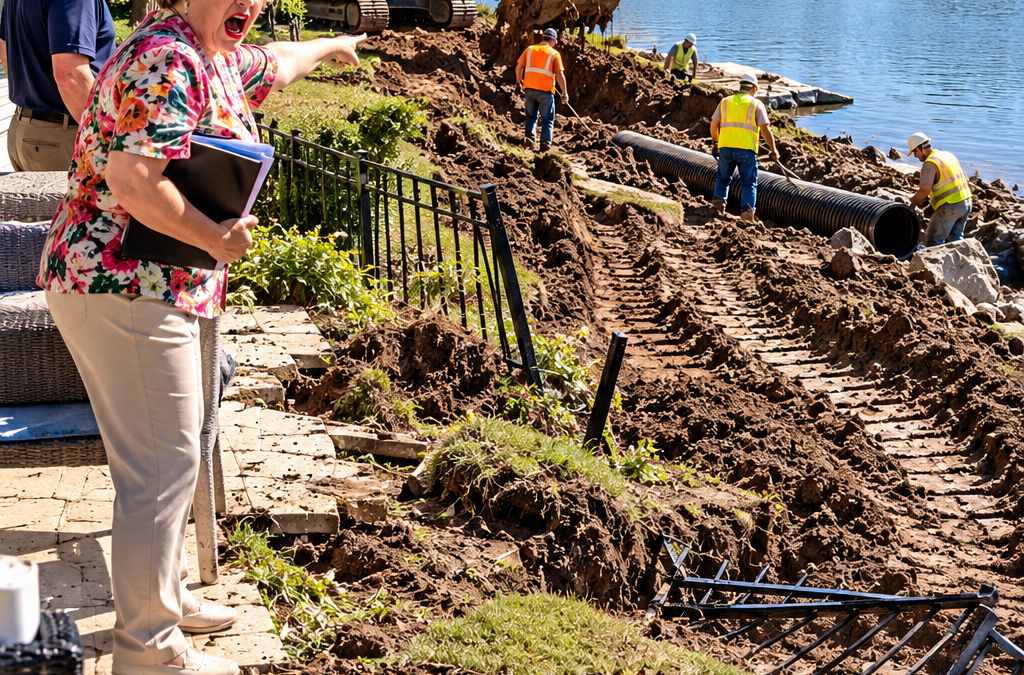
A compact excavator was halfway across my lawn.
Its steel tracks had carved two dark trenches through the grass.
Three men in reflective vests were standing beside the retaining wall.
Another worker had already removed several sections of ornamental grass I had planted the previous summer.
For a few seconds, I simply stared.
My brain was trying to place the scene into some logical category.
Maybe utility emergency.
Maybe broken water line.
Maybe something dangerous enough that notification had been impossible.
Then the excavator bucket swung toward my retaining wall.
I ran outside.
“Stop!”
The operator either did not hear me or chose not to.
I crossed the patio.
“Stop the machine!”
One of the workers turned.
He raised an arm toward the operator, who finally throttled down.
The sudden quiet was almost shocking.
“What are you doing?” I asked.
A heavyset man wearing an orange vest stepped toward me.
“Drainage project.”
“On whose authorization?”
“The association.”
“This is my property.”
He looked toward the house, then toward the lake.
“HOA said they had access.”
“Did they give you an easement?”
He hesitated.
“I’d have to ask the project manager.”
“Then ask him.”
The operator shut off the excavator.
Another worker climbed out of a shallow trench beside the wall.
That was when I saw the broken concrete.
A section of the retaining wall, roughly five feet long, had cracked near the top corner. One slab had shifted outward.
My stomach tightened.
“When did you start?”
“Maybe forty minutes ago.”
I looked behind the excavator.
Forty feet of lawn had been chewed into mud.
A line of sprinkler heads lay broken beside one track.
The trench crossed exactly where my irrigation main ran.
I already knew what I was going to find.
I walked to the exterior control valve and activated the irrigation zone.
Water surfaced from the torn ground almost immediately.
I shut it off.
The foreman watched me.
“Your machine broke the irrigation line.”
“We can note it.”
“You’ve also damaged my retaining wall.”
“Sir, we’re working under the HOA.”
“I don’t care who hired you. You’re standing on privately deeded property.”
That changed his expression.
Contractors understand those words.
“Let me make a call.”
He stepped away.
I pulled out my phone and began taking photographs.
Every track.
Every trench.
Every broken sprinkler head.
Every section of wall.
I recorded video from the patio to the shoreline.
I photographed the excavator’s position.
The workers.
Their truck.
The license plate.
The contractor’s name printed across the door.
By the time the foreman returned, Gerald Foss was walking into my backyard.
He had come through the side gate without knocking.
That should have told me everything.
“Darren.”
He said my name as though I were the one creating a problem.
“What is this?”
“Necessary drainage maintenance.”
“You sent an excavator through my yard.”
“The northern shoreline pipe requires replacement.”
“So you called me?”
Gerald’s expression barely moved.
“This falls under lake maintenance.”
“That wasn’t my question.”
“We sent notice that drainage work would occur this month.”
“You sent a neighborhood email saying lake maintenance would occur. You did not say heavy equipment would cross my lot.”
“The association maintains access rights around the lake.”
“Show me the access right.”
He glanced toward the contractor.
Then back at me.
“Don’t make this more difficult than it needs to be.”
That sentence stayed with me.
Because suddenly I was angry.
Not loud.
Not out of control.
But deeply angry.
There is something uniquely insulting about watching another person damage what you own while explaining that your objection is the inconvenience.
“My wall is cracked,” I said.
“We’ll evaluate it.”
“My irrigation system is broken.”
“Again, we’ll evaluate it.”
“You tore through forty feet of sod.”
“Darren.”
Gerald lowered his voice.
“There are eighty-seven homes in Cedarbrook Commons. Stormwater management has to serve the community as a whole. Sometimes individual owners experience minor disruption for necessary infrastructure.”
“Minor?”
“It can be repaired.”
“Then stop the work until we establish your legal right to be here.”
Gerald looked directly at me.
“No.”
The word was quiet.
The contractor foreman shifted uncomfortably.
I stepped toward Gerald.
“You are refusing to stop construction on my property after I’ve challenged your authorization?”
“The association has an implied easement for maintenance related to the lake.”
“Recorded where?”
His jaw tightened.
“Speak to the board’s counsel if you have questions.”
“I am asking you.”
“And I’ve answered.”
He turned toward the foreman.
“Continue.”
I looked at the foreman.
“If that machine moves another foot across my property, document that your company has been explicitly notified that access is disputed.”
He looked from me to Gerald.
That was enough.
The contractor stopped work.
Gerald was furious.
I could see it even though his voice remained controlled.
“This project delay may result in additional costs.”
“Then perhaps you should have called me before driving an excavator through my backyard.”
He left without another word.
I stood beside the damaged wall after everyone was gone and looked across the lake.
For the first time since buying the house, the view did not feel peaceful.
It felt like evidence.
Over the next four days, I obtained three repair estimates.
The retaining wall damage was worse than it appeared.
The cracked section had shifted enough that patching would not be structurally reliable. A contractor recommended removing and rebuilding part of the wall.
The irrigation main had to be excavated and replaced.
The damaged lawn required grading and new sod.
Several landscape plants were destroyed.
One drainage swale I had carefully shaped the year before had been compacted by the excavator tracks and would need restoration.
The lowest complete estimate was $21,780.
The highest was $23,060.
I submitted a claim for $22,400.
I attached photographs.
Videos.
Repair estimates.
A site sketch.
A written chronology.
And a request for the recorded document supporting Gerald’s claim of an implied maintenance easement across my property.
I sent everything by certified mail and email.
Gerald answered three days later.
Two sentences.
“The Cedarbrook Commons Homeowners Association possesses implied access rights over properties adjacent to the community lake for purposes of inspection, repair, drainage, and maintenance. Any temporary disturbance to landscaping resulting from necessary maintenance is incidental to the Association’s lawful exercise of those rights and is the responsibility of the individual homeowner.”
I read it once.
Then again.
Then a third time.
By the sixth reading, the anger had disappeared.
That was probably the moment Gerald lost.
Because once I stopped being angry, I became curious.
“Implied access rights.”
That phrase bothered me.
Not because implied easements are impossible.
They are not.
Depending on the facts and jurisdiction, property rights can arise in ways that are not obvious from one page of a deed.
But people use the word “implied” too casually.
Especially when they want to skip the part where they prove something.
I printed the email.
Then I opened the closing file from when I bought my house.
My deed contained several recorded easements.
A utility easement.
A drainage easement along part of the side boundary.
A public service easement near the front setback.
Nothing granting the HOA blanket access to the rear yard.
I checked the title policy.
Nothing.
The survey from my purchase showed the lake boundary and several reference points, but no HOA access corridor across my backyard.
That was strange.
Not impossible.
But strange.
I emailed Gerald.
“Please provide the instrument, plat notation, declaration provision, or other recorded document establishing the access right referenced in your response.”
He did not answer.
Two days later, however, he did something I had not expected.
He forwarded my damage claim to the entire neighborhood.
I found out because Claudette called me.
“Darren,” she said, “have you checked your email?”
“No.”
“You should.”
I opened my laptop.
The subject line read:
CLARIFICATION REGARDING LAKE MAINTENANCE DISPUTE.
Gerald had written nearly eight hundred words.
He explained that a homeowner adjacent to the lake had submitted what he called an “extraordinary demand for over twenty-two thousand dollars” after routine drainage work.
He claimed the board had a fiduciary duty to reject unreasonable attempts to shift ordinary landscaping expenses onto the association.
He warned residents that frivolous claims threatened to increase everyone’s dues.
Then he wrote the sentence that changed everything.
“While certain individuals may believe proximity to the lake grants them special ownership privileges, the lake remains a community asset under the exclusive authority of the Cedarbrook Commons Homeowners Association.”
Certain individuals.
He did not name me.
He did not need to.
Attached to the email was a redacted copy of my invoice.
Gerald had circled $22,400 in red.
At the bottom he had added:
“Residents are encouraged to consider whether demands of this nature reflect responsible community membership.”
I stared at the screen.
Then Claudette spoke.
“You still there?”
“Yes.”
“He’s trying to embarrass you.”
“I noticed.”
“You know what the funny thing is?”
“What?”
“Half the neighborhood is probably cheering for you.”
I leaned back.
“Why?”
She laughed without humor.
“Because he’s written up almost everybody here for something ridiculous. My grandson’s eight-minute fishing violation. Tom Wheeler’s shed paint. Marianne’s flower boxes. Remember the Hendersons?”
“Vaguely.”
“Gerald fined them because their daughter’s graduation banner stayed up forty-eight hours too long.”
I rubbed my forehead.
“Claudette, I wasn’t trying to start a neighborhood rebellion. I just want the damage repaired.”
“I know.”
She paused.
“But Gerald doesn’t know how to handle someone who asks him to prove things.”
That sentence stayed with me too.
After we hung up, I looked again at the phrase in Gerald’s email.
Exclusive authority.
Then I looked at the survey.
The rear property line caught my attention.
Most people looking at that survey would have seen the dark outline of Lot 27 and the lake beyond it.
I saw bearings and distances.
My deed description did not stop neatly at the visible shoreline.
The boundary extended beyond the retaining wall.
According to the survey, part of my parcel continued into the lake basin.
I pulled out a ruler.
Then a scale.
Then I found the digital closing survey on my computer and enlarged it.
Approximately twelve feet.
I sat there for a while.
The waterline had probably shifted over the years.
That happens.
Shorelines move.
Surveys do not necessarily follow wherever the water happens to be on a particular afternoon.
But if my deeded boundary extended into the basin, Gerald’s claim that everything associated with the lake was exclusively HOA property suddenly looked much less certain.
That night I barely slept.
The next morning, I went to the county recorder’s office.
I had not visited one in years.
Most current property information can be searched online, but old subdivisions often have documents that make more sense when you can see the complete recorded pages, marginal notes, references, and plat books.
I started with Cedarbrook Commons.
The subdivision had been developed in 2003 by Cedarbrook Land Holdings, LLC.
I pulled the original plat.
Then the declaration.
Then amendments.
Then deeds.
Then releases.
Then utility easements.
Then drainage documents.
I created a list.
I was looking for one thing first.
Gerald’s access right.
I found drainage easements elsewhere in the neighborhood.
I found utility corridors.
I found common-area descriptions.
I found pedestrian access provisions near the community dock.
I found restrictions on structures near the lake.
What I did not find was a general HOA easement across every lakefront lot.
I went back another day.
Then again on Saturday.
The deeper I went, the more interesting the records became.
The original subdivision plat labeled the lake as a separate parcel.
The declaration referred repeatedly to the association maintaining it.
A development memorandum described the lake as an amenity intended for eventual conveyance to Cedarbrook Commons Homeowners Association.
Intended.
That word mattered.
I searched for the deed accomplishing that transfer.
Nothing.
I searched under Cedarbrook Land Holdings.
Nothing.
I searched under the HOA.
Nothing.
I checked variant spellings.
Parcel numbers.
Recording dates.
No deed.
At first I assumed I had missed it.
So I started again.
On the third week, a clerk named Sandra watched me working through the index.
“You looking for the lake transfer?” she asked.
I turned.
“How did you know?”
“You’ve pulled the same subdivision books three times.”
I smiled.
“Does that mean I’m officially becoming a problem?”
“It means you’re thorough.”
“I can’t find a deed from the developer to the HOA.”
She moved closer.
“What year?”
“Approximately 2003 or 2004.”
She typed on her terminal.
We searched again.
Eventually, she found a reference to an instrument number.
For about thirty seconds, I thought that was it.
Then she frowned.
“That’s odd.”
“What?”
“The instrument was assigned.”
“And?”
“No recorded image.”
“Meaning?”
“It may have been prepared but never completed.”
I felt the skin on my arms tighten.
“Can that happen?”
“It can.”
“Could something be missing digitally?”
“Possible. We’d need to check the physical record and grantor index.”
We did.
Nothing.
I drove home with copies of everything I had found.
My kitchen table disappeared beneath paper.
My engineering background had taught me not to fall in love with a theory too early.
Facts first.
Conclusions later.
So I made three columns.
What I knew.
What I suspected.
What I needed verified.
I knew the HOA had entered my property without my consent.
I knew I had found no recorded blanket access easement.
I knew my surveyed property boundary extended into the lake basin.
I knew the development documents contemplated transfer of the lake parcel to the HOA.
And I knew I could not find a recorded deed proving that transfer had actually happened.
What I suspected was much larger.
Too large for me to handle alone.
That was when I hired Patricia Ennis.
Patricia was a real estate attorney with twenty-six years of experience in title disputes, easement litigation, boundary cases, and quiet-title actions.
She had gray beginning at her temples, spoke quickly, and had the unsettling ability to read forty pages of documents while apparently listening to every word you said.
At our first meeting, I placed a binder on her desk.
She looked at it.
“What’s this?”
“My homework.”
She opened it.
Tabs.
Plat.
Declaration.
Deed.
Survey.
Lake parcel history.
HOA correspondence.
Damage photographs.
Contractor estimates.
Her eyebrows went up.
“You’re an engineer.”
“Is it that obvious?”
“Only engineers and retired detectives bring me indexed binders.”
She spent nearly an hour reviewing everything before speaking.
Finally, she tapped Gerald’s email.
“First issue. The association may have some maintenance rights under the governing documents, but I don’t see what he’s describing here.”
“The implied easement.”
“Correct. I’m not saying one cannot exist. I’m saying he doesn’t get one merely by typing the word implied in an email.”
That was the first time I smiled.
Then she opened the survey.
“This interests me more.”
“My boundary?”
“Yes.”
“It extends into the basin.”
“It appears to.”
“Does that mean I own part of the lake?”
Patricia leaned back.
“This is where people get themselves into trouble. Waterfront law is not as simple as ‘my yard touches water, therefore I own water.’ Riparian or littoral rights depend on the kind of water body, title history, recorded boundaries, local law, and how the parcel was created.”
“So don’t celebrate.”
“Definitely don’t celebrate.”
She tapped the survey again.
“But do keep asking questions.”
Then I showed her what I had found regarding the missing HOA deed.
For the first time, her expression changed.
“Where did you get this?”
“County records.”
“You searched the complete grantor and grantee index?”
“Three times.”
“Developer name variations?”
“Yes.”
“Parcel number?”
“Yes.”
“Association name?”
“Yes.”
She picked up the phone.
“Give me a week.”
Six days later, Patricia called.
“Are you sitting down?”
“I can be.”
“Sit.”
I did.
“The lake conveyance was prepared in 2003.”
“I knew that.”
“No, you knew documents said it was intended. I found the actual deed.”
My pulse jumped.
“So Gerald was right?”
“I didn’t say it was recorded.”
I said nothing.
Patricia continued.
“The developer executed a deed conveying the lake tract to the association. The closing attorney apparently prepared the recording packet. An instrument number was reserved. But the deed itself never entered the land records.”
“How?”
“Best reconstruction? Clerical failure. Possibly a rejected filing that was never corrected. There are correspondence notes suggesting the recorder’s office flagged an incomplete acknowledgment.”
“So who owns the lake?”
“That’s the interesting question.”
“The HOA doesn’t?”
“Not by virtue of that unrecorded deed.”
I stood and walked toward the kitchen window.
The lake was visible through the trees.
“So Gerald has spent twenty years telling everyone the HOA owns something it may never have legally received.”
“That’s a fair summary.”
I watched sunlight moving across the water.
“What happens now?”
“We do not storm into court tomorrow claiming you own a lake.”
“Good.”
“First, I trace the chain of title all the way back. Then I determine how your parcel description interacts with the lake tract. Then we evaluate possession, maintenance history, assessment records, tax records, and whether anyone else has a superior claim.”
“What about adverse possession?”
“Potentially relevant, but don’t make the mistake of thinking twenty years of maintenance automatically gives the HOA title. The legal elements matter. Continuous use is one thing. Exclusive, hostile possession under a claim of right is another. The association spent those years expressly allowing dozens of residents to use the lake as a common amenity.”
“So their own community-access system could complicate their claim.”
“Exactly.”
“And mine?”
“Your strongest argument may not be adverse possession at all.”
“What is it?”
“Title.”
One word.
That was when I understood the scale of Gerald’s mistake.
He thought we were still arguing about sod.
Patricia was looking at ownership.
Over the next month, she reconstructed the development history.
Some nights she emailed me records after ten.
The original developer had subdivided the land into residential lots and several tracts.
Roads.
Drainage parcels.
Small common areas.
The lake tract had been intended for the HOA.
But the conveyance failure had created a defect that nobody corrected.
Over the years, houses were sold and resold.
Boards changed.
Management companies changed.
Everybody behaved as though the lake belonged to the association.
Nobody checked the underlying deed.
My lot was unusually important because its original metes-and-bounds description overlapped the basin in a way later HOA diagrams ignored.
Two surveyors reviewed it independently.
Both agreed that my deeded parcel extended approximately twelve feet beyond the ordinary visible shoreline.
That did not automatically hand me the entire lake.
Patricia made that clear repeatedly.
But it gave me standing.
And standing gave us a path into court.
Before filing anything, Patricia sent a letter to the HOA.
It was six pages long.
Unlike Gerald’s emails, it contained citations.
Recording numbers.
Plat references.
Survey references.
Dates.
She demanded compensation for the property damage.
She disputed the claimed maintenance easement.
And near the end, she informed the association that we were preparing a quiet-title action concerning legal rights in the lake parcel.
Gerald received the letter on a Monday.
By Monday evening, Cedarbrook Commons had an “Emergency Community Meeting” scheduled for Wednesday.
I almost did not attend.
Patricia advised me not to speak substantively about the case.
“Listen,” she said. “Do not debate him. Do not reveal our strategy. If he makes accusations, let him.”
“What if he lies?”
“Then he gives us more paper.”
The meeting was held in the clubhouse.
I arrived ten minutes early.
The room was already crowded.
Normally, HOA meetings attracted twelve people.
That night, more than sixty homeowners showed up.
Gerald sat behind a folding table with the other two board members, Margaret Bell and Owen Price.
A stack of papers rested in front of him.
When I entered, conversations softened.
Claudette was sitting near the back.
She patted the chair beside her.
“You’re famous.”
“Apparently.”
“You look terrible.”
“Thank you.”
“Nervous?”
“A little.”
“Good. Means you’re not Gerald.”
Despite everything, I laughed.
At seven precisely, Gerald called the meeting to order.
He spent ten minutes discussing procedure.
Then he reached me.
“As many residents know, the association recently received a legal communication from Mr. Darren Whitlock challenging long-established community property rights.”
Several people turned toward me.
Gerald continued.
“This board considers the allegations meritless.”
I remained silent.
“Nevertheless, because Mr. Whitlock has chosen to escalate a routine maintenance matter into threatened litigation, the association must protect itself.”
A man near the front raised his hand.
“Protect itself from what?”
Gerald ignored him.
He held up a sheet.
“Mr. Whitlock is interfering with required drainage work, obstructing community infrastructure, disputing association authority, and making unauthorized claims against common property.”
Claudette whispered, “Here we go.”
Gerald announced that the board was considering six separate enforcement violations against me.
Interference with association maintenance.
Obstruction of drainage infrastructure.
Unauthorized modification near the lake.
Failure to permit required access.
Conduct detrimental to community property.
And one vaguely worded violation involving legal expenses caused by a homeowner.
I almost admired the creativity.
A woman across the aisle spoke.
“Can the HOA fine someone for hiring a lawyer?”
Gerald’s expression hardened.
“That is not what I said.”
“Sounded like it.”
Several people murmured.
Then Gerald looked at me.
“Mr. Whitlock, do you intend to continue asserting ownership claims over the community lake?”
I could feel every face in the room turn.
Patricia’s advice echoed in my head.
Listen.
Do not debate.
I stood.
“My attorney has communicated my position in writing. I won’t discuss active legal issues outside counsel.”
Gerald gave a small smile.
“Of course.”
That smile irritated me more than shouting would have.
He addressed the room.
“This is precisely the type of adversarial behavior that damages communities.”
Claudette stood.
“No, Gerald.”
The room went quiet.
Gerald blinked.
Claudette was sixty-seven years old, five feet two, and had spent thirty-four years teaching eighth grade.
I had never seen anyone command silence more efficiently.
“You sent all of us Darren’s private damage claim,” she said. “You tried to make the neighborhood angry at him because your contractor tore up his yard.”
“Mrs. Barlow—”
“And now you’re threatening six fines because he asked you to prove you had permission?”
“This meeting will remain orderly.”
“It is orderly. You just don’t like the question.”
Someone clapped.
Then another person.
Gerald struck the table with his palm.
“Enough.”
The room settled.
But something had changed.
For years Gerald’s authority had depended on everyone confronting him individually.
One homeowner against the board.
One violation letter at a time.
One private appeal at a time.
That night, everyone was in the same room.
They could see each other’s frustration.
Gerald could see it too.
The meeting ended without a vote on my fines.
Two days later, the association hired an attorney named Martin Kessler.
Patricia knew him.
“Competent,” she said.
“Should I be worried?”
“You should always take competent opposing counsel seriously.”
“That sounds reassuring.”
“It’s supposed to.”
The HOA denied the damage claim again.
Then Martin sent a formal response defending the association’s historical control over the lake.
He argued that decades of management, maintenance, homeowner assessments, and common use established strong equitable rights.
Patricia responded with the recorded chain of title.
Martin requested more time.
Then more documents.
Then a continuance after we filed.
The quiet-title case moved slowly.
That was the hardest part.
People imagine lawsuits as dramatic confrontations.
Most of the time, they are waiting.
Waiting for filings.
Waiting for discovery.
Waiting for surveys.
Waiting for hearings.
Waiting for someone to answer a question they have already spent weeks avoiding.
Meanwhile, I still lived beside the lake.
Every morning I saw it.
Every evening Gerald walked past my house.
We rarely spoke.
Once, about two months into the case, I was checking temporary repairs near the retaining wall when he stopped on the path.
“You’ve created a serious problem for this neighborhood.”
I stood.
“No, Gerald.”
He stared at me.
“You could have handled this reasonably.”
“I sent you an invoice.”
“For an absurd amount.”
“I sent three contractor estimates.”
“You could have allowed the drainage work to continue.”
“You could have asked permission.”
“The HOA does not need a homeowner’s permission to maintain community property.”
“There it is again.”
“What?”
“The assumption.”
His face tightened.
“You seem to be enjoying this.”
That surprised me.
“Enjoying what?”
“Trying to dismantle something eighty-seven families rely on.”
I looked toward the lake.
“Do you know what I wanted the morning this started?”
He said nothing.
“I wanted your contractor to stop destroying my yard.”
Gerald looked away.
“That’s all.”
“This has gone far beyond your yard.”
“Because you pushed it there.”
He scoffed.
“You hired a lawyer.”
“After you claimed rights you couldn’t document.”
“You threatened ownership.”
“After I discovered the organization claiming exclusive authority over the lake couldn’t produce a recorded deed.”
For a moment, neither of us spoke.
Then Gerald said quietly, “You don’t understand what you’re doing.”
That was the first time I heard fear in his voice.
Not much.
But enough.
“I understand exactly what I’m doing,” I said.
He walked away.
Three months after filing, two court-appointed or mutually accepted survey experts reviewed the relevant boundaries.
Both confirmed the essential fact.
My deed extended into the lake basin.
More importantly, the HOA could not demonstrate recorded title to the lake tract.
Its attorney tried several alternative theories.
Prescriptive rights.
Implied easement.
Equitable ownership.
Historical community use.
Developer intent.
Patricia never denied that the developer had clearly intended for the HOA to receive the lake.
Intent was obvious.
But intended ownership and recorded ownership were not the same thing.
At one hearing, the judge asked Martin a question that changed the tone of the case.
“Counsel, can you identify for the court the recorded instrument by which your client obtained fee title?”
Martin stood with a folder open in front of him.
“Your Honor, our position is that the development documents, combined with more than two decades of continuous control—”
“That wasn’t my question.”
Silence.
The judge repeated it.
“Can you identify the recorded conveyance?”
Martin looked down.
“No, Your Honor.”
I did not smile.
Patricia had warned me.
Never celebrate in a courtroom before the judge is finished.
Still, something inside me shifted.
For months, Gerald had treated his authority as self-evident.
Now somebody with actual authority had asked him, through his lawyer, to show the paper.
And there was no paper.
The final hearing occurred on a Tuesday morning in March.
Rain had fallen all night.
The courthouse steps were still wet when I arrived.
Patricia met me near security carrying the same thick case file she had built over months.
“You sleep?”
“About forty minutes.”
“That’s forty more than some clients.”
“How are you?”
“Ready.”
Gerald arrived with Martin fifteen minutes later.
He looked older than he had the previous spring.
His shoulders were slightly rounded.
Margaret Bell came with him.
Owen Price did not.
We entered the courtroom.
There was no jury.
No dramatic gallery packed with neighbors.
Just lawyers.
Parties.
Files.
A clerk.
A judge.
And more than twenty years of neglected property records.
The judge reviewed the history carefully.
The failed 2003 conveyance.
The subdivision documents.
The plat.
The surveys.
The association’s management history.
My parcel description.
The disputed easement.
The physical occupation and use of the shoreline.
The various competing theories of ownership.
Then he began ruling.
I remember surprisingly little of the legal language.
What I remember is Patricia touching my arm once.
I remember Martin becoming absolutely still.
I remember Gerald staring straight ahead.
The court rejected the HOA’s claim that its long history of maintenance alone established the fee ownership it had been asserting.
The court found no recorded blanket maintenance easement authorizing the entry across my property in the manner Gerald had claimed.
And based on the title evidence, parcel descriptions, boundary history, and arguments Patricia had assembled, the court entered judgment establishing ownership of the disputed lake parcel in my name.
For a moment, I thought I had misunderstood.
I looked at Patricia.
She gave one small nod.
Mine.
The lake Gerald had spent years calling exclusively HOA property was now legally titled to me.
Gerald turned.
Our eyes met.
I had imagined that moment many times during the case.
In those imaginary versions, I felt victorious.
Vindicated.
Maybe even smug.
The real emotion was stranger.
I felt tired.
Then relief.
Then sadness.
Because the entire thing had been avoidable.
Twenty-two thousand four hundred dollars.
An apology.
A repair agreement.
A simple acknowledgment that somebody should have called before driving heavy machinery across privately owned land.
That was all it had taken to prevent everything.
Instead Gerald had needed to win.
He had needed me to be wrong.
He had needed the neighborhood to laugh at me with him.
And now he was sitting in a courtroom listening to a judge explain that the foundation of his authority over the lake had never been what he believed.
Outside the courthouse, Patricia stopped me.
“Before you do anything,” she said, “go home.”
“That’s your legal advice?”
“That’s my human advice.”
“What happens now?”
“Implementation. Recording. Access arrangements. Insurance. Maintenance obligations. We do this carefully.”
I looked toward the courthouse doors.
Gerald had not come out yet.
“And the residents?”
“That’s up to you.”
That question mattered to me more than the victory.
I never wanted to take the lake away from the people who had used it for years.
Children learned to kayak there.
Families fished there.
Claudette’s grandson had probably spent half his summers on that shoreline.
My dispute was with the board’s abuse of authority, not with my neighbors.
So Patricia and I created a use agreement.
Existing Cedarbrook residents would continue to have reasonable access for kayaking, fishing, swimming, and other traditional uses.
Nothing dramatic changed for families.
No fences appeared.
No giant PRIVATE LAKE signs.
No one lost the place they had enjoyed for years.
What changed was authority.
The HOA could no longer pretend it possessed unlimited rights.
Any maintenance requiring entry onto my deeded land required written notice and permission.
Major work required a formal access request at least thirty days in advance, except genuine emergencies.
Contractors had to provide insurance information.
Restoration obligations had to be defined.
No excavator was ever going to appear in my backyard again because somebody on a board felt entitled to send it there.
The lake amenity assessments were also restructured.
Residents who wanted licensed access paid under the new agreement, and the funds were directed toward actual lake maintenance, insurance, and reserves rather than disappearing into the HOA’s general authority.
I insisted on transparent accounting.
Claudette came to my house the day after the new arrangement was announced.
She stood on my patio looking across the water.
“So.”
“So.”
“You own a lake.”
“Apparently.”
She laughed.
“You realize how ridiculous that sounds.”
“Every morning.”
“Are you going to make my grandson stop fishing at six?”
I looked at her.
“Tell him he can stay until sunset.”
Her eyes widened.
“Gerald may feel that from wherever he is.”
“He’ll survive.”
She became quiet.
Then she said, “Thank you.”
“For what?”
“For not punishing everybody else.”
That hit me harder than I expected.
“I never wanted that.”
“I know.”
Six weeks after the judgment, Gerald resigned from the board.
His resignation letter was short.
He cited personal reasons.
He did not mention me.
He did not mention the lawsuit.
He did not mention the $22,400 invoice.
About a month later, a FOR SALE sign appeared in front of his house.
I saw him only once after that.
I was retrieving my mail when he stopped at the curb.
For several seconds, neither of us spoke.
Finally, he said, “I hope you’re satisfied.”
I could have said many things.
I could have reminded him of the neighborhood email.
The six threatened violations.
The meeting.
The months of legal expenses.
The damage to my property.
Instead I said, “I wish you’d paid for the wall.”
Gerald stared at me.
I continued.
“That’s what this was about when it started.”
His expression changed slightly.
Maybe he understood.
Maybe he did not.
“I was protecting the association,” he said.
“No. You were protecting your certainty.”
He looked toward the lake.
“You think you’re going to run it better?”
“I’m not trying to run people.”
That was the difference between us.
Gerald nodded once, almost imperceptibly, then walked away.
The new Cedarbrook board elected Marianne Keller as president.
Three days after taking office, she mailed me a handwritten card.
Darren,
We recognize that the past year created unnecessary conflict and expense for everyone involved. The new board hopes we can establish a respectful working relationship based on clear documentation, transparency, and cooperation.
Congratulations on the resolution of your case.
Marianne
I called her that afternoon.
We met for coffee.
Then again two weeks later.
There were no threats.
No speeches.
No attempts to establish dominance.
We talked about erosion.
Insurance.
Algae control.
Drainage.
Resident access.
Actual problems.
The kind adults can solve when nobody is trying to turn every disagreement into a contest over who has more power.
Cedarbrook became quieter.
Violation letters dropped sharply.
The board revised its enforcement policy.
Homeowners received warnings before fines.
Appeals became meaningful.
Meeting minutes were published on time.
Contracts above a certain amount required multiple bids.
And before the HOA asserted rights over someone’s property, the board checked whether those rights actually existed.
It should not have taken a lawsuit to produce those changes.
But sometimes institutions do not correct themselves until somebody forces them to look at the documents they have spent years assuming were there.
As for my backyard, the wall was rebuilt.
The irrigation line was repaired.
The sod grew back.
By late summer, you could barely tell an excavator had ever crossed the lawn.
I kept one photograph, though.
It shows the tracks cutting through the grass toward the lake.
The broken sprinkler pipe is visible in the foreground.
Gerald is standing near the retaining wall with one hand in his pocket.
Whenever I see that photograph, I think about how ordinary the moment looked.
Nobody looking at it would imagine what followed.
A damaged lawn.
A cracked wall.
An arrogant email.
A trip to the recorder’s office.
One missing deed.
Months of litigation.
A courtroom.
A lake.
And an entire neighborhood discovering that authority is not the same thing as ownership.
The $22,400 invoice remained unresolved for a while after the quiet-title judgment.
I had not forgotten it.
Neither had Patricia.
Once the ownership case was finished, we returned to the original property-damage claim.
The conversation was noticeably different.
The new board reviewed the contractor photographs, estimates, and correspondence.
Marianne called me.
“I’ve gone through everything.”
“And?”
A pause.
“I don’t understand why this wasn’t resolved when you submitted it.”
I looked through my kitchen window toward the water.
“Neither do I.”
“The board would like to settle the claim.”
I closed my eyes briefly.
Not because the amount surprised me.
Because those were the words I should have heard nearly a year earlier.
“What are you proposing?”
“The documented restoration cost, subject to final receipts, and reimbursement of the portion not already covered through contractor insurance.”
“Send it to Patricia.”
“We will.”
Then Marianne said something else.
“Darren?”
“Yes?”
“I’m sorry.”
Two words.
That was it.
No legal language.
No explanation.
No lecture about community interests.
Just an apology.
I realized then how cheap those words would have been at the beginning.
And how expensive Gerald’s refusal to say them had become.
The final payment covered the damage.
I deposited the check without ceremony.
No champagne.
No photograph.
No victory party.
That evening, I carried a chair down to the edge of the lake.
The sun was dropping behind the houses.
A teenager paddled a kayak toward the northern shore.
Two children were fishing with their father near the community access point.
Farther down, Claudette’s grandson was standing ankle-deep in the water.
It was after six.
I smiled.
For four years, I had thought the lake was the best thing about my property.
Then for nearly a year, I had looked at it and seen conflict.
That evening, for the first time in months, it became water again.
Nothing more.
Nothing less.
Wind moved through the trees.
Small waves tapped against the retaining wall.
I thought about Gerald.
Not with anger anymore.
People like him often believe their downfall begins when somebody challenges them.
It does not.
It begins earlier.
It begins when authority becomes identity.
When being questioned feels like being disrespected.
When admitting uncertainty becomes impossible.
When winning a small argument becomes more important than solving a small problem.
Gerald had not lost control of the lake because I was stronger than he was.
He lost it because he was so certain nobody would ever make him prove that control belonged to him.
He saw a homeowner with damaged grass and a cracked wall.
He thought embarrassment would make me retreat.
He thought six fines would make me afraid.
He thought twenty years of repetition had transformed an assumption into a legal fact.
But paper does not care how confident you are.
A survey does not care how long you have been president.
A deed does not become recorded because everyone has behaved for twenty years as though it was.
And a boundary does not move because somebody with an HOA title decides your objection is inconvenient.
I still live at Cedarbrook Commons.
Most mornings, I drink coffee by the same kitchen window.
The lake still reflects the trees.
People still kayak.
Children still fish.
The neighborhood still contributes to maintaining the water they enjoy.
From a distance, almost nothing looks different.
But I know exactly where my property ends now.
So does the HOA.
And whenever contractors need to cross private land, they knock first.
That may be the simplest legacy of everything that happened.
Not the court judgment.
Not Gerald’s resignation.
Not even the lake.
A knock on the door.
A request instead of a command.
Proof instead of assumption.
Respect before authority.
All of it could have started there.
Gerald chose another path.
I merely followed the paper until there was nowhere left for him to hide.








