𝗙𝗨𝗟𝗟 𝗦𝗧𝗢𝗥𝗬 The HOA President Locked My Wife Out of Our Farm—Then the Court Order She Tried to Hide Turned Against Her
𝗙𝗨𝗟𝗟 𝗦𝗧𝗢𝗥𝗬
Every time she lacked legal authority, she invented a phrase that sounded close enough to frighten people.
Our farm had been there before Briarwood.
My grandfather bought the original acreage when the road was still dirt. My father expanded the east pasture, poured concrete in the equipment shed, and built the main access lane wide enough for semis and grain trucks.
By the time Emma and I took over, we had upgraded the barns, improved drainage, and installed the steel gate at the entrance.
Then the subdivision went up along the western boundary.
At first, things were tolerable.
Some residents waved.
Kids liked watching the horses near the fence.
A few neighbors bought eggs from us.
Then Karen became president.
Within months, she began sending letters.
The first claimed our farm entrance created “unauthorized visual disruption” because the gate was visible from the subdivision road.
I ignored it.
The second accused us of “commercial traffic impacts” because feed trucks passed near a Briarwood entrance.
I replied with property records showing the farm lane had legal access long before Briarwood existed.
The third letter claimed the HOA had “review authority” over the gate because of a disputed strip near the roadside.
That was when I called a lawyer.
The dispute itself was ridiculous but dangerous.
An old farm access lane and the newer subdivision road met near a shared frontage area. Briarwood’s internal map shaded part of the roadside approach in HOA green, but our deed and older easement documents clearly preserved farm access across the entrance.
Karen claimed the HOA map controlled.
Our attorney said recorded property rights controlled.
Karen sent security to “observe.”
We filed in court.
The judge issued an order during the dispute stating that our access to the farm entrance could not be blocked while the matter was being resolved.
Plain language.
No ambiguity.
The gate had to remain usable.
Karen’s attorney received a copy.
The HOA received a copy.
We received a certified copy.
I slept better after that.
I should not have.
Because Karen Whitfield didn’t hear “court order” as “stop.”
She heard it as “find another angle.”
That morning, her angle was a chain.
When I turned onto the farm approach road, I saw Emma’s SUV parked just outside the gate.
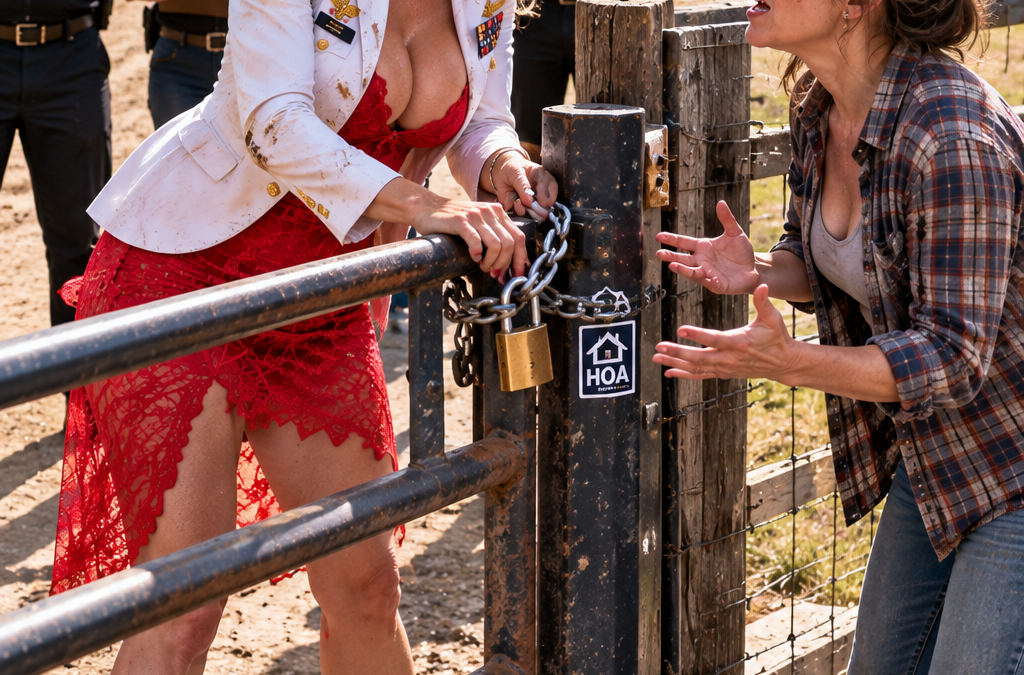
Beyond her, the main steel gate was wrapped with a heavy chain and a large padlock that absolutely did not belong to us.
On the lock housing was a small white sticker.
BRIARWOOD ESTATES HOA.
Like a brand on stolen property.
Karen stood near the gate with two private security guards.
They wore black polos and utility belts. One was younger, broad-shouldered, visibly uncertain. The other looked older and tired in the way men look when they know they’re being paid to stand on the wrong side of a problem.
Karen stood between them as if they were her personal deputies.
Her red lace dress showed beneath a cream blazer. She had one hand on her hip, the other holding her phone. Her sunglasses were perched on her head, though the morning was still gray.
Emma stood several feet away, arms folded, phone held casually at her side.
Recording.
Good.
The moment Karen saw my truck, her chin lifted.
She wanted me to arrive angry.
She wanted the guards to see a furious farmer charging toward her.
She wanted to turn my reaction into justification.
I parked slowly.
Got out.
Took the folder from the passenger seat.
Closed the truck door.
Then walked toward the gate without raising my voice.
Emma’s face softened with relief when she saw the folder in my hand.
Karen noticed it too.
Her eyes narrowed.
“David.”
“Karen.”
She pointed at the folder.
“What is that?”
“You know what it is.”
“No, I don’t.”
“Then you’ll learn.”
She stepped forward.
“This gate is closed pending HOA review.”
I looked at the chain.
“Who installed the lock?”
“The association authorized security control of this entrance.”
“Who physically installed the lock?”
She smiled.
“The association did.”
“That’s not an answer.”
“It’s the only answer you’re getting.”
One of the guards shifted his weight.
I looked at him.
“Did you lock this gate?”
He glanced at Karen.
Karen snapped, “You don’t answer him.”
I looked back at her.
“You brought guards to my farm and now you’re telling them not to answer the property owner?”
“This entrance is subject to HOA control.”
“No, it isn’t.”
“It absolutely is.”
I opened the folder.
Karen’s expression changed the second she saw the court seal.
It was small.
Almost imperceptible.
But I caught it.
So did Emma.
The smugness tightened into calculation.
She recognized the document.
“Before you continue,” I said, “I want you to explain something.”
Karen folded her arms.
“I don’t owe you explanations.”
“You locked my wife out of our farm.”
“The gate was secured.”
“You locked my wife out.”
“Your wife has no authority to access the property during an HOA restriction.”
Emma spoke for the first time.
“Would you repeat that?”
Karen turned toward her.
“What?”
Emma lifted the phone slightly.
“You said I have no authority to enter. Would you repeat that?”
Karen smiled, thinking she was performing for future evidence in her favor.
“Gladly. You have no authority to enter through this gate while the HOA’s restriction remains in effect.”
Emma looked at me.
Her eyes said everything.
Recorded.
Karen continued, louder now.
“The HOA has taken control of this entrance until the access dispute is resolved.”
I almost couldn’t believe she said it so clearly.
“Karen,” I said, “the access dispute was already addressed.”
“No. It was not.”
“Yes, it was.”
“The HOA attorney advised the board that we retain control rights.”
“Show me that in writing.”
Her mouth tightened.
“The order is not as simple as you think.”
“Show me the HOA order.”
“We don’t need to carry privileged legal communications to a roadside confrontation.”
“You locked a gate.”
“For safety.”
“What safety issue?”
“Unauthorized entry.”
“By my wife?”
“By anyone attempting to use a disputed entrance.”
I looked toward the guards.
“Did she tell you there was a court order?”
The younger guard looked uncomfortable.
Karen snapped, “They are not here to debate legal documents.”
I ignored her.
“Did she tell you?”
The older guard finally said, “We were told the HOA had authority to secure the gate.”
“Were you shown the court order?”
Karen whirled on him.
“Enough.”
He looked at her.
“Ma’am, if there’s an order, we need to know.”
“There is no order preventing the HOA from protecting its interests.”
I raised the folder.
“There is an order protecting our access.”
For the first time that morning, Karen stopped talking.
Not for long.
But long enough.
I opened the certified copy and turned to the relevant paragraph.
Emma moved closer.
The guards leaned slightly without meaning to.
Karen stayed rigid.
I read aloud.
“Pending final resolution of the underlying property-access dispute, the Miller family shall retain uninterrupted access through the existing main farm entrance, and no party shall obstruct, lock, barricade, or otherwise interfere with reasonable ingress or egress.”
The words landed harder than any shouting could have.
No party.
Obstruct.
Lock.
Barricade.
Interfere.
Karen’s lock hung from the gate like evidence.
The younger guard looked at it.
Then at Karen.
“Ma’am.”
She didn’t look at him.
Instead, she smiled at me.
A brittle, furious smile.
“You are reading selectively.”
I handed the order toward her.
“Read it yourself.”
She didn’t take it.
“I’ve been briefed.”
“By whom?”
“Our attorney.”
“What did your attorney say?”
“That the HOA retained authority to enforce access protocols.”
“Where does the order say that?”
“Legal interpretation is not done on the side of a road.”
“Then why did you enforce your interpretation on the side of a road?”
Her face flushed.
Emma’s phone remained recording.
Karen knew it now.
Her eyes flicked to it repeatedly.
I asked again.
“Where is the written order allowing you to lock this gate?”
She said nothing.
“Show me.”
Nothing.
“You told my wife you had an official order.”
Karen’s eyes narrowed.
“I said the HOA had authority.”
Emma said calmly, “You said official order.”
Karen turned toward her.
“Don’t twist my words.”
Emma lifted the phone.
“You’re on video.”
The older guard took one step back from the gate.
That tiny movement mattered.
He was distancing himself from the lock.
The younger guard asked, “Mrs. Whitfield, did the HOA actually review that paragraph?”
Karen glared at him.
“You were hired for security, not legal analysis.”
“If we’re enforcing something that violates a court order, that’s a problem for us too.”
“I am telling you it doesn’t.”
“But you won’t read it.”
Karen’s mouth opened.
Closed.
The control she had arrived with was slipping.
She had expected my wife alone.
She had expected intimidation to work.
A locked gate.
Two guards.
A confident speech about HOA authority.
A refusal to show paperwork.
She had not expected the court order to appear in my hand before eight in the morning.
She had definitely not expected her own admission to be recorded.
Emma stepped beside me.
“Karen, when I asked you to show me the order, why did you refuse?”
Karen looked at her with open contempt.
“Because I don’t answer to you.”
Emma nodded once.
“Thank you.”
“Don’t thank me.”
“No. That was clear.”
Karen realized too late she had done it again.
I took a breath and called our attorney.
Priya answered on the second ring.
“David?”
“I’m at the farm gate. HOA locked it. Karen is here with security. I have the court order.”
A pause.
“Is the gate still locked?”
“Yes.”
“Is she claiming authority?”
“Yes.”
“Are you recording?”
“Emma is.”
“Good. Call the sheriff’s civil division and the court clerk’s emergency line listed in the order packet. Do not cut the lock yourself unless instructed. Keep everyone there.”
Karen heard enough to stiffen.
“We are not waiting around while you stage a legal performance.”
I ended the call.
“You’re going to wait.”
“I will do no such thing.”
“Then remove the lock.”
“No.”
“Then wait.”
Her voice sharpened.
“This entrance remains closed.”
The older guard said quietly, “Ma’am, I don’t think we should continue blocking it until this is clarified.”
Karen turned on him.
“If you walk away from this post, your company will hear about it.”
He held her gaze.
“They can hear about the court order too.”
I almost admired him then.
Not because he’d been right from the beginning.
He hadn’t.
But because he was starting to understand that Karen’s confidence was not a shield.
She started pacing.
That was new.
Karen didn’t pace when she was winning.
She stood still and made other people come to her.
Now she was walking near the gate, phone in hand, stabbing at the screen.
“Answer,” she hissed.
No one did.
Emma whispered to me, “She told me earlier I was trespassing.”
“Did you get it?”
“All of it.”
“What else?”
“She said the HOA had taken control of the entrance. She said I had no authority to enter. She said she didn’t have to show me anything because I wasn’t the legal owner.”
My jaw tightened.
Emma was on the deed.
Karen knew that.
She had simply assumed Emma would be easier to bully.
That made me angrier than the lock.
“She said that?”
Emma nodded.
“Word for word.”
Karen suddenly turned.
“I am warning both of you. If you attempt to open that gate, it will be treated as interference with HOA security measures.”
I looked at the chain.
“Karen, the only interference here is yours.”
“You keep pretending this order says whatever benefits you.”
“It says uninterrupted access.”
“Pending resolution.”
“Correct.”
“The dispute isn’t resolved.”
“Which is why access is protected until it is.”
She faltered.
Only slightly.
But enough.
She had trapped herself.
The court order existed precisely because the dispute was unresolved. It preserved our access until the final issue could be decided.
Karen had decided to reverse it.
Not through court.
Through a padlock.
The sheriff’s civil deputy arrived forty minutes later.
His name was Deputy Harris.
Gray hair.
Calm voice.
No patience for theater.
A county representative from the court clerk’s office arrived shortly after, because Priya had escalated the issue through the contact listed on the order.
By then, Karen had shifted strategy.
She was no longer claiming she didn’t know about the order.
Now she claimed the order was misunderstood.
“Deputy,” she said, stepping forward, “this is a civil access dispute involving HOA-managed entrance controls.”
Deputy Harris looked at the gate.
“Who placed the lock?”
Karen hesitated.
“The association secured the entrance.”
“Who ordered that?”
“The board authorized security protocols.”
“Who specifically ordered the gate locked?”
Karen’s lips tightened.
“I did.”
Emma’s phone captured it.
Deputy Harris wrote it down.
Then he turned to me.
“Mr. Miller, you have the order?”
I handed it to him.
He read silently.
No drama.
No expression.
Just reading.
Karen tried to interrupt.
“Deputy, our attorney has interpreted—”
He raised one hand.
“I’ll read first.”
She stopped.
The quiet authority in his voice was different from Karen’s.
Karen demanded silence.
Deputy Harris earned it.
He read the relevant section twice.
Then asked, “Mrs. Whitfield, were you served with this order?”
Karen folded her arms.
“The HOA received a copy.”
“Did you personally review it?”
“I was briefed.”
“That wasn’t my question.”
Her face tightened.
“I reviewed portions.”
“Did you review the paragraph about obstructing ingress and egress?”
She said nothing.
The county representative, Ms. Coleman, stepped beside Harris and examined the document.
She compared it with the copy on her tablet.
“This is the filed order.”
Karen said quickly, “The HOA has subsequent instructions from counsel.”
Ms. Coleman looked at her.
“Do you have a subsequent court order?”
“Our counsel advised—”
“Do you have a subsequent court order?”
Karen’s jaw flexed.
“No.”
“Then the filed order remains operative unless modified by the court.”
Karen’s voice sharpened.
“You’re oversimplifying.”
Ms. Coleman didn’t flinch.
“No, ma’am. I’m identifying the controlling document.”
I saw the security guards exchange a look.
Their entire morning had changed.
They had arrived believing they were enforcing an HOA directive.
Now they were standing beside a locked gate that two officials were comparing against a court order saying not to lock it.
Deputy Harris asked, “Mrs. Whitfield, what is the basis for keeping this gate locked right now?”
“HOA access protocols.”
“Where are they?”
She opened her folder and produced a printed sheet with the Briarwood logo.
It looked official.
Everything Karen made looked official.
Harris read it.
Then looked back at the court order.
“These don’t say the same thing.”
Karen lifted her chin.
“They supplement each other.”
Ms. Coleman said, “An HOA instruction does not supplement a court order unless the order allows it.”
“It does not prohibit reasonable security.”
Harris pointed to the paragraph.
“It prohibits locking, barricading, or otherwise interfering with reasonable access.”
Karen snapped, “This is not interference. It is managed entry.”
Emma finally spoke.
“Managed entry where you told me I had no authority to enter.”
Karen turned on her.
“You were argumentative.”
Emma’s voice stayed calm.
“I asked for the order.”
“You were obstructive.”
“I asked for the order.”
“You refused to respect security personnel.”
“I asked for the order.”
Karen’s mouth closed.
The repetition did what shouting would not have done.
It exposed how simple the issue was.
My wife had asked for the authority behind the lock.
Karen refused.
Ms. Coleman looked at Emma.
“You have recording?”
Emma nodded.
She played it.
Karen’s voice came from the phone, crisp and unmistakable.
The gate will remain locked.
The HOA has taken control of the property entrance.
You have no authority to enter.
I don’t have to show you anything.
Karen’s face changed as her own words played back.
No edits.
No interpretation.
Just her voice.
The younger guard stared at the ground.
The older guard rubbed his forehead.
Deputy Harris asked Karen, “Is that accurate?”
She tried to recover.
“It lacks context.”
“What context changes ‘the HOA has taken control of the property entrance’?”
She didn’t answer.
Ms. Coleman said, “The order does not allow the HOA to take control of the entrance.”
Karen’s tone turned icy.
“With respect, you are not my attorney.”
“No, ma’am. I represent the court record.”
That shut her down.
Deputy Harris looked at the guards.
“Who has the key?”
The younger guard looked at Karen.
She didn’t move.
Harris asked again.
“Who has the key?”
The older guard said, “She does.”
Karen’s head snapped toward him.
His expression stayed neutral.
Harris looked at her.
“Mrs. Whitfield, remove the lock.”
She stiffened.
“I want my attorney on the phone.”
“You can call your attorney after you stop obstructing the access protected by this order.”
“This is outrageous.”
“No. This is straightforward.”
“I am not being treated fairly.”
I almost laughed.
My wife had been locked out of her own farm, and Karen had decided she was the victim.
Deputy Harris’s voice remained calm.
“Remove the lock.”
Karen stood still for several seconds.
Every person there watched her.
Me.
Emma.
The guards.
The deputy.
The county representative.
Even Luis, who had arrived from the barn and stopped near the fence without saying a word.
Karen reached into her purse.
Her hand trembled slightly when she pulled out the key.
It was the first honest thing I’d seen from her all morning.
She walked to the gate.
The lock clicked.
The chain loosened.
Metal scraped against steel as she pulled it away.
No one cheered.
No one shouted.
The silence was better.
It forced her to hear every sound.
The chain she had ordered onto my gate.
The lock opening.
The authority she had claimed falling apart one metal link at a time.
She handed the lock to one of the guards.
He didn’t take it immediately.
Then he did, reluctantly.
Emma walked to the gate.
Put both hands on the frame.
And pulled it open.
The hinges groaned.
The entrance cleared.
For the first time that morning, my wife could enter our farm.
She got into her SUV.
Drove slowly through the gate.
Past Karen.
Past the guards.
Past the deputy.
Onto the property she legally owned.
I watched her go, and only then did I realize how tense my shoulders had been.
Karen stood beside me, breathing hard.
“This isn’t over,” she said.
I looked at her.
“It is for today.”
“You think one paragraph protects you forever?”
“I think a court order protects me until the court changes it.”
“You love hiding behind paperwork.”
I turned toward her.
“No, Karen. I love when paperwork stops people like you from putting chains on other people’s gates.”
Her eyes narrowed.
“You have no idea what you’ve started.”
“Actually, I do.”
I looked at the chain in the guard’s hand.
“You started it. We preserved it.”
Priya filed notice with the court that afternoon.
We submitted photographs.
The video.
The HOA sticker.
The lock.
The names of the guards.
Deputy Harris’s incident notes.
Ms. Coleman’s confirmation.
Karen’s recorded admission.
Everything.
The timeline was brutally clear.
The HOA received the court order.
Karen ordered the gate locked anyway.
She confronted my wife.
Refused to produce written authority.
Claimed HOA control.
Denied access.
Then removed the lock only after officials confronted her with the actual order.
There was no confusion left for her to hide inside.
At the next HOA meeting, Karen tried to spin it.
Of course she did.
She stood at the front of the clubhouse in the red lace dress and blazer, face composed, voice smooth.
“Recent events at the Miller property have been mischaracterized.”
I sat in the back beside Emma.
We had not planned to speak unless necessary.
Karen continued.
“The board acted in good faith to preserve disputed access rights and prevent unauthorized entry.”
Emma leaned toward me.
“Unauthorized by whom?”
“Exactly.”
Karen clicked to the next slide.
She actually had slides.
A photograph of the farm gate appeared on the projector, carefully cropped so the HOA lock wasn’t visible.
“The entrance remains subject to ongoing legal review.”
I raised my hand.
She ignored me.
I kept it raised.
Several residents turned.
Finally, she sighed.
“David.”
“Why did you crop the lock out of the photo?”
Her face tightened.
“This presentation is not an evidentiary proceeding.”
“No. It’s apparently fiction.”
A few people murmured.
Karen’s eyes flashed.
“You are out of order.”
I stood.
“Did the board vote to lock my farm gate?”
Silence.
She lifted her chin.
“The board authorized reasonable security measures.”
“Did the board vote to lock my farm gate?”
The vice president, a nervous man named Harold, looked down at his papers.
Karen didn’t answer.
I turned to him.
“Harold?”
He swallowed.
“No formal vote was taken on the specific lock.”
Karen whipped toward him.
“Harold.”
He flinched but kept going.
“We discussed access concerns. We did not authorize blocking the gate in violation of a court order.”
The room changed.
That was how power cracks.
Not all at once.
One nervous person tells one piece of truth.
Karen’s face went pale with rage.
“The chair recognizes no further discussion.”
Emma stood.
“Karen told me I had no authority to enter my own farm.”
Karen pointed at her.
“Sit down.”
Emma didn’t.
“I asked to see the order. She refused. Then she admitted the HOA had locked the gate.”
A resident near the front asked, “Is that recorded?”
Emma lifted her phone.
“Yes.”
The room went silent.
Karen’s entire performance depended on controlling what people knew.
The recording destroyed that.
Harold whispered something to another board member.
Karen slammed her folder shut.
“This meeting is adjourned.”
A woman in the second row said, “No, it isn’t.”
Karen froze.
The woman continued.
“We need to know whether the board is exposing the HOA to legal liability.”
Another resident said, “And whether our dues are paying for security guards to violate court orders.”
Then another.
“Who authorized the lock?”
Questions came from every direction.
Karen tried to speak over them.
It didn’t work.
For the first time in years, the room did not bend around her anger.
The HOA attorney was consulted the following week.
The security company terminated its assignment with the HOA pending clarification of legal boundaries.
Harold sent us a formal letter acknowledging that the gate should not have been locked under the existing order.
Karen did not sign it.
She didn’t have to.
Her signature was already on the morning itself.
On the sticker.
On the guards.
On the refusal.
On the recording.
The court later took the incident seriously.
Priya didn’t ask for drama.
She didn’t need to.
She presented facts.
The order.
The lock.
The video.
The official confirmation.
Karen’s statements.
The judge’s expression grew colder with every page.
Karen’s attorney argued misunderstanding.
Overzealous protection of association interests.
Temporary security.
Ambiguous access language.
The judge read the paragraph aloud.
The same paragraph I had read at the gate.
Then asked one question.
“What part of ‘no party shall obstruct, lock, barricade, or otherwise interfere’ was unclear?”
Karen’s attorney had no good answer.
Because there wasn’t one.
The court clarified the order in even stronger language.
The main farm entrance was to remain open and unobstructed for us, our employees, contractors, deliveries, guests, and all reasonable farm-related access unless modified by further court order.
Not HOA instruction.
Not board preference.
Court order.
Karen was warned directly that future interference could bring sanctions.
She sat motionless while the judge spoke.
No clipboard.
No guards.
No gate behind her.
Just the law she had tried to step around.
Afterward, in the courthouse hallway, she passed Emma and me without speaking.
That was fine.
Her silence was the closest thing to wisdom she’d shown in months.
Life on the farm returned to normal slowly.
Normal sounds came back first.
The rattle of the gate.
Tractor engines.
Feed deliveries.
The truck from the co-op.
Emma’s SUV rolling through the entrance without stopping.
Every time I heard that gate open, I remembered how it had looked wrapped in chain.
I hated that memory.
But I kept the lock.
The older guard gave it to Deputy Harris, and eventually, through the process, we obtained it back as part of the preserved evidence.
It sits on a shelf in my office now.
Heavy.
Ugly.
Expensive-looking.
A perfect symbol of Karen’s mistake.
She thought a lock could decide ownership.
She thought a sticker could turn private property into HOA-controlled land.
She thought my wife would panic, apologize, and leave.
She thought I wouldn’t arrive with the court order.
Most of all, she thought people would obey first and verify later.
That had always been her real power.
Not law.
Not title.
Not truth.
Momentum.
She acted quickly, loudly, and confidently enough that people assumed she must have authority.
But confidence is not authority.
A clipboard is not authority.
Two security guards are not authority.
A sticker on a lock is not authority.
A court order is.
I learned something that morning too.
Not about Karen.
I already knew who she was.
I learned something about Emma.
I knew my wife was strong.
But watching her stand there calmly, phone recording, asking Karen to repeat herself instead of shouting back, reminded me why Karen had underestimated her.
Karen mistook calm for weakness.
She mistook politeness for fear.
Emma gave her enough rope to record the truth.
By the time I arrived, Karen had already built half the case against herself.
Weeks later, Emma drove through the gate just after sunrise.
I was near the barn, checking a water line.
She rolled down the window and smiled.
“No chain today.”
“No chain.”
She looked toward the road.
“You think she’ll try again?”
“Not at this gate.”
Emma nodded.
“Good.”
She drove on toward the equipment shed.
I watched the gate swing lightly in the morning breeze after she passed.
Open.
Unblocked.
Ours.
People talk about property rights like they’re abstract.
Documents.
Legal descriptions.
Orders.
Deeds.
But that morning, property rights looked very simple.
My wife trying to enter her own farm.
A locked gate.
A woman with no authority telling her she didn’t belong.
And a court order saying otherwise.
Karen wanted the gate to decide who had power.
It didn’t.
The paper did.
The recording did.
The truth did.
And when the chain finally came off, it wasn’t loud.
There was no shouting.
No fight.
No dramatic speech.
Just metal sliding away from steel.
My wife opening the gate.
And Karen standing there with the key in her hand, forced to obey the order she had tried to hide.
𝗧𝗛𝗘 𝗘𝗡𝗗
The HOA President Locked My Wife Out of Our Farm—Then the Court Order She Tried to Hide Turned Against Her
My wife called me at 6:12 in the morning, and I knew from the sound of her breathing that something was wrong before she said a single word.
“David, the gate is locked.”
I was halfway through buttoning my work shirt, one hand still on the collar, standing in our kitchen with coffee going cold on the counter.
“What gate?”
“The main farm gate.”
I stopped moving.
For a second, I thought I had misunderstood her.
That gate sat at the front entrance to our farm, the wide steel one my father and I had installed fifteen years earlier after a feed truck slid off the old gravel approach during a storm. Every truck, tractor, vet vehicle, hay delivery, fuel service, and family car used that entrance.
It wasn’t decorative.
It wasn’t optional.
It was the throat of the whole farm.
“What do you mean it’s locked?” I asked.
“I mean there’s a chain around it. Heavy chain. New lock. I can’t open it.”
“Did we put it there?”
“No.”
“Is there a notice?”
“No.”
“County tag? Sheriff notice? Utility company?”
“Nothing.”
Then she went quiet.
“What?” I asked.
“There’s an HOA sticker near the lock.”
The room suddenly felt very still.
I set the coffee cup down.
“Say that again.”
“An HOA sticker. Small one. On the lock housing.”
I closed my eyes.
Of course.
Karen Whitfield.
No storm.
No emergency.
No county order.
No phone call.
Just a locked farm gate with an HOA sticker slapped beside it like a flag planted after conquest.
“Emma,” I said carefully, “do not cut it. Do not argue with anyone. Do not let anyone bait you into shouting. Start recording if anyone approaches.”
“I already am.”
That was my wife.
Calm under pressure.
Smarter than people expected because she didn’t waste energy trying to prove it.
“I’ll be there in twenty minutes,” I said.
“David?”
“Yeah?”
“Who gave them permission to lock our gate?”
I looked toward the file cabinet in the hallway where I kept the court order Karen had spent months pretending didn’t exist.
“No one.”
The line went quiet again.
Then Emma said, “She’s here.”
My stomach tightened.
“Karen?”
“Yes.”
I heard distant voices through the phone.
Sharp.
Female.
Commanding.
“Don’t engage,” I said.
“Too late.”
“Emma—”
“I’m recording.”
Then she hung up.
I grabbed the folder from the file cabinet so fast that several pages slid sideways. I checked the front to make sure the certified copy was inside.
It was.
Stamped.
Signed.
Filed.
The court order Karen Whitfield had received two weeks earlier.
The same court order that protected our right to use the main farm entrance during the ongoing property-access dispute.
The same court order she had not mentioned when she wrapped a chain around my gate.
By the time I got in the truck, my hands were already tight on the steering wheel.
But I wasn’t scared.
Not yet.
I was angry in that cold, clear way that arrives when somebody does something so arrogant that your emotions burn clean through panic and leave only focus behind.
Karen had pushed before.
Letters.
Fines.
Threats.
Board notices.
False accusations about road use.
But locking the main farm gate while my wife was trying to enter our own property?
That was different.
That was no longer paperwork.
That was force.
And Karen had finally been careless enough to put her force against a court order.
My name is David Miller.
My wife, Emma, and I own a working farm just beyond the edge of Briarwood Estates, a subdivision that liked to advertise “peaceful country living” while complaining about every real feature of the country.
Roosters too loud.
Tractors too early.
Hay trailers too dusty.
Barn lights too bright.
Cows too close to the fence.
The road too muddy after rain.
The road too noisy after gravel.
The smell of manure during planting season.
The sound of equipment during harvest.
The normal, unavoidable reality of agriculture had become, in their newsletters, a series of “community concerns.”
Most of those concerns came from one person.
Karen Whitfield.
She was forty, beautiful in a sharp, expensive way, and cruel enough to make beauty feel like another weapon in her hand. She always dressed as though she expected cameras: fitted red lace dress, tailored blazer, heels too polished for gravel roads, blonde hair arranged perfectly even when she was standing beside a ditch.
She had been HOA president for seven years.
In that time, Briarwood Estates had stopped functioning like a homeowners association and started functioning like Karen’s personal border patrol.
She believed every piece of land touching the subdivision existed under her influence.
Not ownership.
Influence.
That was her favorite vague word.
“Community influence.”
“Shared access influence.”
“Visual influence.”
“Traffic influence.”
Every time she lacked legal authority, she invented a phrase that sounded close enough to frighten people.
Our farm had been there before Briarwood.
My grandfather bought the original acreage when the road was still dirt. My father expanded the east pasture, poured concrete in the equipment shed, and built the main access lane wide enough for semis and grain trucks.
By the time Emma and I took over, we had upgraded the barns, improved drainage, and installed the steel gate at the entrance.
Then the subdivision went up along the western boundary.
At first, things were tolerable.
Some residents waved.
Kids liked watching the horses near the fence.
A few neighbors bought eggs from us.
Then Karen became president.
Within months, she began sending letters.
The first claimed our farm entrance created “unauthorized visual disruption” because the gate was visible from the subdivision road.
I ignored it.
The second accused us of “commercial traffic impacts” because feed trucks passed near a Briarwood entrance.
I replied with property records showing the farm lane had legal access long before Briarwood existed.
The third letter claimed the HOA had “review authority” over the gate because of a disputed strip near the roadside.
That was when I called a lawyer.
The dispute itself was ridiculous but dangerous.
An old farm access lane and the newer subdivision road met near a shared frontage area. Briarwood’s internal map shaded part of the roadside approach in HOA green, but our deed and older easement documents clearly preserved farm access across the entrance.
Karen claimed the HOA map controlled.
Our attorney said recorded property rights controlled.
Karen sent security to “observe.”
We filed in court.
The judge issued an order during the dispute stating that our access to the farm entrance could not be blocked while the matter was being resolved.
Plain language.
No ambiguity.
The gate had to remain usable.
Karen’s attorney received a copy.
The HOA received a copy.
We received a certified copy.
I slept better after that.
I should not have.
Because Karen Whitfield didn’t hear “court order” as “stop.”
She heard it as “find another angle.”
That morning, her angle was a chain.
When I turned onto the farm approach road, I saw Emma’s SUV parked just outside the gate.
Beyond her, the main steel gate was wrapped with a heavy chain and a large padlock that absolutely did not belong to us.
On the lock housing was a small white sticker.
BRIARWOOD ESTATES HOA.
Like a brand on stolen property.
Karen stood near the gate with two private security guards.
They wore black polos and utility belts. One was younger, broad-shouldered, visibly uncertain. The other looked older and tired in the way men look when they know they’re being paid to stand on the wrong side of a problem.
Karen stood between them as if they were her personal deputies.
Her red lace dress showed beneath a cream blazer. She had one hand on her hip, the other holding her phone. Her sunglasses were perched on her head, though the morning was still gray.
Emma stood several feet away, arms folded, phone held casually at her side.
Recording.
Good.
The moment Karen saw my truck, her chin lifted.
She wanted me to arrive angry.
She wanted the guards to see a furious farmer charging toward her.
She wanted to turn my reaction into justification.
I parked slowly.
Got out.
Took the folder from the passenger seat.
Closed the truck door.
Then walked toward the gate without raising my voice.
Emma’s face softened with relief when she saw the folder in my hand.
Karen noticed it too.
Her eyes narrowed.
“David.”
“Karen.”
She pointed at the folder.
“What is that?”
“You know what it is.”
“No, I don’t.”
“Then you’ll learn.”
She stepped forward.
“This gate is closed pending HOA review.”
I looked at the chain.
“Who installed the lock?”
“The association authorized security control of this entrance.”
“Who physically installed the lock?”
She smiled.
“The association did.”
“That’s not an answer.”
“It’s the only answer you’re getting.”
One of the guards shifted his weight.
I looked at him.
“Did you lock this gate?”
He glanced at Karen.
Karen snapped, “You don’t answer him.”
I looked back at her.
“You brought guards to my farm and now you’re telling them not to answer the property owner?”
“This entrance is subject to HOA control.”
“No, it isn’t.”
“It absolutely is.”
I opened the folder.
Karen’s expression changed the second she saw the court seal.
It was small.
Almost imperceptible.
But I caught it.
So did Emma.
The smugness tightened into calculation.
She recognized the document.
“Before you continue,” I said, “I want you to explain something.”
Karen folded her arms.
“I don’t owe you explanations.”
“You locked my wife out of our farm.”
“The gate was secured.”
“You locked my wife out.”
“Your wife has no authority to access the property during an HOA restriction.”
Emma spoke for the first time.
“Would you repeat that?”
Karen turned toward her.
“What?”
Emma lifted the phone slightly.
“You said I have no authority to enter. Would you repeat that?”
Karen smiled, thinking she was performing for future evidence in her favor.
“Gladly. You have no authority to enter through this gate while the HOA’s restriction remains in effect.”
Emma looked at me.
Her eyes said everything.
Recorded.
Karen continued, louder now.
“The HOA has taken control of this entrance until the access dispute is resolved.”
I almost couldn’t believe she said it so clearly.
“Karen,” I said, “the access dispute was already addressed.”
“No. It was not.”
“Yes, it was.”
“The HOA attorney advised the board that we retain control rights.”
“Show me that in writing.”
Her mouth tightened.
“The order is not as simple as you think.”
“Show me the HOA order.”
“We don’t need to carry privileged legal communications to a roadside confrontation.”
“You locked a gate.”
“For safety.”
“What safety issue?”
“Unauthorized entry.”
“By my wife?”
“By anyone attempting to use a disputed entrance.”
I looked toward the guards.
“Did she tell you there was a court order?”
The younger guard looked uncomfortable.
Karen snapped, “They are not here to debate legal documents.”
I ignored her.
“Did she tell you?”
The older guard finally said, “We were told the HOA had authority to secure the gate.”
“Were you shown the court order?”
Karen whirled on him.
“Enough.”
He looked at her.
“Ma’am, if there’s an order, we need to know.”
“There is no order preventing the HOA from protecting its interests.”
I raised the folder.
“There is an order protecting our access.”
For the first time that morning, Karen stopped talking.
Not for long.
But long enough.
I opened the certified copy and turned to the relevant paragraph.
Emma moved closer.
The guards leaned slightly without meaning to.
Karen stayed rigid.
I read aloud.
“Pending final resolution of the underlying property-access dispute, the Miller family shall retain uninterrupted access through the existing main farm entrance, and no party shall obstruct, lock, barricade, or otherwise interfere with reasonable ingress or egress.”
The words landed harder than any shouting could have.
No party.
Obstruct.
Lock.
Barricade.
Interfere.
Karen’s lock hung from the gate like evidence.
The younger guard looked at it.
Then at Karen.
“Ma’am.”
She didn’t look at him.
Instead, she smiled at me.
A brittle, furious smile.
“You are reading selectively.”
I handed the order toward her.
“Read it yourself.”
She didn’t take it.
“I’ve been briefed.”
“By whom?”
“Our attorney.”
“What did your attorney say?”
“That the HOA retained authority to enforce access protocols.”
“Where does the order say that?”
“Legal interpretation is not done on the side of a road.”
“Then why did you enforce your interpretation on the side of a road?”
Her face flushed.
Emma’s phone remained recording.
Karen knew it now.
Her eyes flicked to it repeatedly.
I asked again.
“Where is the written order allowing you to lock this gate?”
She said nothing.
“Show me.”
Nothing.
“You told my wife you had an official order.”
Karen’s eyes narrowed.
“I said the HOA had authority.”
Emma said calmly, “You said official order.”
Karen turned toward her.
“Don’t twist my words.”
Emma lifted the phone.
“You’re on video.”
The older guard took one step back from the gate.
That tiny movement mattered.
He was distancing himself from the lock.
The younger guard asked, “Mrs. Whitfield, did the HOA actually review that paragraph?”
Karen glared at him.
“You were hired for security, not legal analysis.”
“If we’re enforcing something that violates a court order, that’s a problem for us too.”
“I am telling you it doesn’t.”
“But you won’t read it.”
Karen’s mouth opened.
Closed.
The control she had arrived with was slipping.
She had expected my wife alone.
She had expected intimidation to work.
A locked gate.
Two guards.
A confident speech about HOA authority.
A refusal to show paperwork.
She had not expected the court order to appear in my hand before eight in the morning.
She had definitely not expected her own admission to be recorded.
Emma stepped beside me.
“Karen, when I asked you to show me the order, why did you refuse?”
Karen looked at her with open contempt.
“Because I don’t answer to you.”
Emma nodded once.
“Thank you.”
“Don’t thank me.”
“No. That was clear.”
Karen realized too late she had done it again.
I took a breath and called our attorney.
Priya answered on the second ring.
“David?”
“I’m at the farm gate. HOA locked it. Karen is here with security. I have the court order.”
A pause.
“Is the gate still locked?”
“Yes.”
“Is she claiming authority?”
“Yes.”
“Are you recording?”
“Emma is.”
“Good. Call the sheriff’s civil division and the court clerk’s emergency line listed in the order packet. Do not cut the lock yourself unless instructed. Keep everyone there.”
Karen heard enough to stiffen.
“We are not waiting around while you stage a legal performance.”
I ended the call.
“You’re going to wait.”
“I will do no such thing.”
“Then remove the lock.”
“No.”
“Then wait.”
Her voice sharpened.
“This entrance remains closed.”
The older guard said quietly, “Ma’am, I don’t think we should continue blocking it until this is clarified.”
Karen turned on him.
“If you walk away from this post, your company will hear about it.”
He held her gaze.
“They can hear about the court order too.”
I almost admired him then.
Not because he’d been right from the beginning.
He hadn’t.
But because he was starting to understand that Karen’s confidence was not a shield.
She started pacing.
That was new.
Karen didn’t pace when she was winning.
She stood still and made other people come to her.
Now she was walking near the gate, phone in hand, stabbing at the screen.
“Answer,” she hissed.
No one did.
Emma whispered to me, “She told me earlier I was trespassing.”
“Did you get it?”
“All of it.”
“What else?”
“She said the HOA had taken control of the entrance. She said I had no authority to enter. She said she didn’t have to show me anything because I wasn’t the legal owner.”
My jaw tightened.
Emma was on the deed.
Karen knew that.
She had simply assumed Emma would be easier to bully.
That made me angrier than the lock.
“She said that?”
Emma nodded.
“Word for word.”
Karen suddenly turned.
“I am warning both of you. If you attempt to open that gate, it will be treated as interference with HOA security measures.”
I looked at the chain.
“Karen, the only interference here is yours.”
“You keep pretending this order says whatever benefits you.”
“It says uninterrupted access.”
“Pending resolution.”
“Correct.”
“The dispute isn’t resolved.”
“Which is why access is protected until it is.”
She faltered.
Only slightly.
But enough.
She had trapped herself.
The court order existed precisely because the dispute was unresolved. It preserved our access until the final issue could be decided.
Karen had decided to reverse it.
Not through court.
Through a padlock.
The sheriff’s civil deputy arrived forty minutes later.
His name was Deputy Harris.
Gray hair.
Calm voice.
No patience for theater.
A county representative from the court clerk’s office arrived shortly after, because Priya had escalated the issue through the contact listed on the order.
By then, Karen had shifted strategy.
She was no longer claiming she didn’t know about the order.
Now she claimed the order was misunderstood.
“Deputy,” she said, stepping forward, “this is a civil access dispute involving HOA-managed entrance controls.”
Deputy Harris looked at the gate.
“Who placed the lock?”
Karen hesitated.
“The association secured the entrance.”
“Who ordered that?”
“The board authorized security protocols.”
“Who specifically ordered the gate locked?”
Karen’s lips tightened.
“I did.”
Emma’s phone captured it.
Deputy Harris wrote it down.
Then he turned to me.
“Mr. Miller, you have the order?”
I handed it to him.
He read silently.
No drama.
No expression.
Just reading.
Karen tried to interrupt.
“Deputy, our attorney has interpreted—”
He raised one hand.
“I’ll read first.”
She stopped.
The quiet authority in his voice was different from Karen’s.
Karen demanded silence.
Deputy Harris earned it.
He read the relevant section twice.
Then asked, “Mrs. Whitfield, were you served with this order?”
Karen folded her arms.
“The HOA received a copy.”
“Did you personally review it?”
“I was briefed.”
“That wasn’t my question.”
Her face tightened.
“I reviewed portions.”
“Did you review the paragraph about obstructing ingress and egress?”
She said nothing.
The county representative, Ms. Coleman, stepped beside Harris and examined the document.
She compared it with the copy on her tablet.
“This is the filed order.”
Karen said quickly, “The HOA has subsequent instructions from counsel.”
Ms. Coleman looked at her.
“Do you have a subsequent court order?”
“Our counsel advised—”
“Do you have a subsequent court order?”
Karen’s jaw flexed.
“No.”
“Then the filed order remains operative unless modified by the court.”
Karen’s voice sharpened.
“You’re oversimplifying.”
Ms. Coleman didn’t flinch.
“No, ma’am. I’m identifying the controlling document.”
I saw the security guards exchange a look.
Their entire morning had changed.
They had arrived believing they were enforcing an HOA directive.
Now they were standing beside a locked gate that two officials were comparing against a court order saying not to lock it.
Deputy Harris asked, “Mrs. Whitfield, what is the basis for keeping this gate locked right now?”
“HOA access protocols.”
“Where are they?”
She opened her folder and produced a printed sheet with the Briarwood logo.
It looked official.
Everything Karen made looked official.
Harris read it.
Then looked back at the court order.
“These don’t say the same thing.”
Karen lifted her chin.
“They supplement each other.”
Ms. Coleman said, “An HOA instruction does not supplement a court order unless the order allows it.”
“It does not prohibit reasonable security.”
Harris pointed to the paragraph.
“It prohibits locking, barricading, or otherwise interfering with reasonable access.”
Karen snapped, “This is not interference. It is managed entry.”
Emma finally spoke.
“Managed entry where you told me I had no authority to enter.”
Karen turned on her.
“You were argumentative.”
Emma’s voice stayed calm.
“I asked for the order.”
“You were obstructive.”
“I asked for the order.”
“You refused to respect security personnel.”
“I asked for the order.”
Karen’s mouth closed.
The repetition did what shouting would not have done.
It exposed how simple the issue was.
My wife had asked for the authority behind the lock.
Karen refused.
Ms. Coleman looked at Emma.
“You have recording?”
Emma nodded.
She played it.
Karen’s voice came from the phone, crisp and unmistakable.
The gate will remain locked.
The HOA has taken control of the property entrance.
You have no authority to enter.
I don’t have to show you anything.
Karen’s face changed as her own words played back.
No edits.
No interpretation.
Just her voice.
The younger guard stared at the ground.
The older guard rubbed his forehead.
Deputy Harris asked Karen, “Is that accurate?”
She tried to recover.
“It lacks context.”
“What context changes ‘the HOA has taken control of the property entrance’?”
She didn’t answer.
Ms. Coleman said, “The order does not allow the HOA to take control of the entrance.”
Karen’s tone turned icy.
“With respect, you are not my attorney.”
“No, ma’am. I represent the court record.”
That shut her down.
Deputy Harris looked at the guards.
“Who has the key?”
The younger guard looked at Karen.
She didn’t move.
Harris asked again.
“Who has the key?”
The older guard said, “She does.”
Karen’s head snapped toward him.
His expression stayed neutral.
Harris looked at her.
“Mrs. Whitfield, remove the lock.”
She stiffened.
“I want my attorney on the phone.”
“You can call your attorney after you stop obstructing the access protected by this order.”
“This is outrageous.”
“No. This is straightforward.”
“I am not being treated fairly.”
I almost laughed.
My wife had been locked out of her own farm, and Karen had decided she was the victim.
Deputy Harris’s voice remained calm.
“Remove the lock.”
Karen stood still for several seconds.
Every person there watched her.
Me.
Emma.
The guards.
The deputy.
The county representative.
Even Luis, who had arrived from the barn and stopped near the fence without saying a word.
Karen reached into her purse.
Her hand trembled slightly when she pulled out the key.
It was the first honest thing I’d seen from her all morning.
She walked to the gate.
The lock clicked.
The chain loosened.
Metal scraped against steel as she pulled it away.
No one cheered.
No one shouted.
The silence was better.
It forced her to hear every sound.
The chain she had ordered onto my gate.
The lock opening.
The authority she had claimed falling apart one metal link at a time.
She handed the lock to one of the guards.
He didn’t take it immediately.
Then he did, reluctantly.
Emma walked to the gate.
Put both hands on the frame.
And pulled it open.
The hinges groaned.
The entrance cleared.
For the first time that morning, my wife could enter our farm.
She got into her SUV.
Drove slowly through the gate.
Past Karen.
Past the guards.
Past the deputy.
Onto the property she legally owned.
I watched her go, and only then did I realize how tense my shoulders had been.
Karen stood beside me, breathing hard.
“This isn’t over,” she said.
I looked at her.
“It is for today.”
“You think one paragraph protects you forever?”
“I think a court order protects me until the court changes it.”
“You love hiding behind paperwork.”
I turned toward her.
“No, Karen. I love when paperwork stops people like you from putting chains on other people’s gates.”
Her eyes narrowed.
“You have no idea what you’ve started.”
“Actually, I do.”
I looked at the chain in the guard’s hand.
“You started it. We preserved it.”
Priya filed notice with the court that afternoon.
We submitted photographs.
The video.
The HOA sticker.
The lock.
The names of the guards.
Deputy Harris’s incident notes.
Ms. Coleman’s confirmation.
Karen’s recorded admission.
Everything.
The timeline was brutally clear.
The HOA received the court order.
Karen ordered the gate locked anyway.
She confronted my wife.
Refused to produce written authority.
Claimed HOA control.
Denied access.
Then removed the lock only after officials confronted her with the actual order.
There was no confusion left for her to hide inside.
At the next HOA meeting, Karen tried to spin it.
Of course she did.
She stood at the front of the clubhouse in the red lace dress and blazer, face composed, voice smooth.
“Recent events at the Miller property have been mischaracterized.”
I sat in the back beside Emma.
We had not planned to speak unless necessary.
Karen continued.
“The board acted in good faith to preserve disputed access rights and prevent unauthorized entry.”
Emma leaned toward me.
“Unauthorized by whom?”
“Exactly.”
Karen clicked to the next slide.
She actually had slides.
A photograph of the farm gate appeared on the projector, carefully cropped so the HOA lock wasn’t visible.
“The entrance remains subject to ongoing legal review.”
I raised my hand.
She ignored me.
I kept it raised.
Several residents turned.
Finally, she sighed.
“David.”
“Why did you crop the lock out of the photo?”
Her face tightened.
“This presentation is not an evidentiary proceeding.”
“No. It’s apparently fiction.”
A few people murmured.
Karen’s eyes flashed.
“You are out of order.”
I stood.
“Did the board vote to lock my farm gate?”
Silence.
She lifted her chin.
“The board authorized reasonable security measures.”
“Did the board vote to lock my farm gate?”
The vice president, a nervous man named Harold, looked down at his papers.
Karen didn’t answer.
I turned to him.
“Harold?”
He swallowed.
“No formal vote was taken on the specific lock.”
Karen whipped toward him.
“Harold.”
He flinched but kept going.
“We discussed access concerns. We did not authorize blocking the gate in violation of a court order.”
The room changed.
That was how power cracks.
Not all at once.
One nervous person tells one piece of truth.
Karen’s face went pale with rage.
“The chair recognizes no further discussion.”
Emma stood.
“Karen told me I had no authority to enter my own farm.”
Karen pointed at her.
“Sit down.”
Emma didn’t.
“I asked to see the order. She refused. Then she admitted the HOA had locked the gate.”
A resident near the front asked, “Is that recorded?”
Emma lifted her phone.
“Yes.”
The room went silent.
Karen’s entire performance depended on controlling what people knew.
The recording destroyed that.
Harold whispered something to another board member.
Karen slammed her folder shut.
“This meeting is adjourned.”
A woman in the second row said, “No, it isn’t.”
Karen froze.
The woman continued.
“We need to know whether the board is exposing the HOA to legal liability.”
Another resident said, “And whether our dues are paying for security guards to violate court orders.”
Then another.
“Who authorized the lock?”
Questions came from every direction.
Karen tried to speak over them.
It didn’t work.
For the first time in years, the room did not bend around her anger.
The HOA attorney was consulted the following week.
The security company terminated its assignment with the HOA pending clarification of legal boundaries.
Harold sent us a formal letter acknowledging that the gate should not have been locked under the existing order.
Karen did not sign it.
She didn’t have to.
Her signature was already on the morning itself.
On the sticker.
On the guards.
On the refusal.
On the recording.
The court later took the incident seriously.
Priya didn’t ask for drama.
She didn’t need to.
She presented facts.
The order.
The lock.
The video.
The official confirmation.
Karen’s statements.
The judge’s expression grew colder with every page.
Karen’s attorney argued misunderstanding.
Overzealous protection of association interests.
Temporary security.
Ambiguous access language.
The judge read the paragraph aloud.
The same paragraph I had read at the gate.
Then asked one question.
“What part of ‘no party shall obstruct, lock, barricade, or otherwise interfere’ was unclear?”
Karen’s attorney had no good answer.
Because there wasn’t one.
The court clarified the order in even stronger language.
The main farm entrance was to remain open and unobstructed for us, our employees, contractors, deliveries, guests, and all reasonable farm-related access unless modified by further court order.
Not HOA instruction.
Not board preference.
Court order.
Karen was warned directly that future interference could bring sanctions.
She sat motionless while the judge spoke.
No clipboard.
No guards.
No gate behind her.
Just the law she had tried to step around.
Afterward, in the courthouse hallway, she passed Emma and me without speaking.
That was fine.
Her silence was the closest thing to wisdom she’d shown in months.
Life on the farm returned to normal slowly.
Normal sounds came back first.
The rattle of the gate.
Tractor engines.
Feed deliveries.
The truck from the co-op.
Emma’s SUV rolling through the entrance without stopping.
Every time I heard that gate open, I remembered how it had looked wrapped in chain.
I hated that memory.
But I kept the lock.
The older guard gave it to Deputy Harris, and eventually, through the process, we obtained it back as part of the preserved evidence.
It sits on a shelf in my office now.
Heavy.
Ugly.
Expensive-looking.
A perfect symbol of Karen’s mistake.
She thought a lock could decide ownership.
She thought a sticker could turn private property into HOA-controlled land.
She thought my wife would panic, apologize, and leave.
She thought I wouldn’t arrive with the court order.
Most of all, she thought people would obey first and verify later.
That had always been her real power.
Not law.
Not title.
Not truth.
Momentum.
She acted quickly, loudly, and confidently enough that people assumed she must have authority.
But confidence is not authority.
A clipboard is not authority.
Two security guards are not authority.
A sticker on a lock is not authority.
A court order is.
I learned something that morning too.
Not about Karen.
I already knew who she was.
I learned something about Emma.
I knew my wife was strong.
But watching her stand there calmly, phone recording, asking Karen to repeat herself instead of shouting back, reminded me why Karen had underestimated her.
Karen mistook calm for weakness.
She mistook politeness for fear.
Emma gave her enough rope to record the truth.
By the time I arrived, Karen had already built half the case against herself.
Weeks later, Emma drove through the gate just after sunrise.
I was near the barn, checking a water line.
She rolled down the window and smiled.
“No chain today.”
“No chain.”
She looked toward the road.
“You think she’ll try again?”
“Not at this gate.”
Emma nodded.
“Good.”
She drove on toward the equipment shed.
I watched the gate swing lightly in the morning breeze after she passed.
Open.
Unblocked.
Ours.
People talk about property rights like they’re abstract.
Documents.
Legal descriptions.
Orders.
Deeds.
But that morning, property rights looked very simple.
My wife trying to enter her own farm.
A locked gate.
A woman with no authority telling her she didn’t belong.
And a court order saying otherwise.
Karen wanted the gate to decide who had power.
It didn’t.
The paper did.
The recording did.
The truth did.
And when the chain finally came off, it wasn’t loud.
There was no shouting.
No fight.
No dramatic speech.
Just metal sliding away from steel.
My wife opening the gate.
And Karen standing there with the key in her hand, forced to obey the order she had tried to hide.








