𝗙𝗨𝗟𝗟 𝗦𝗧𝗢𝗥𝗬 The HOA President Kept Driving Through My Private Ranch Gate, Never Asking Why I Finally Stopped Arguing
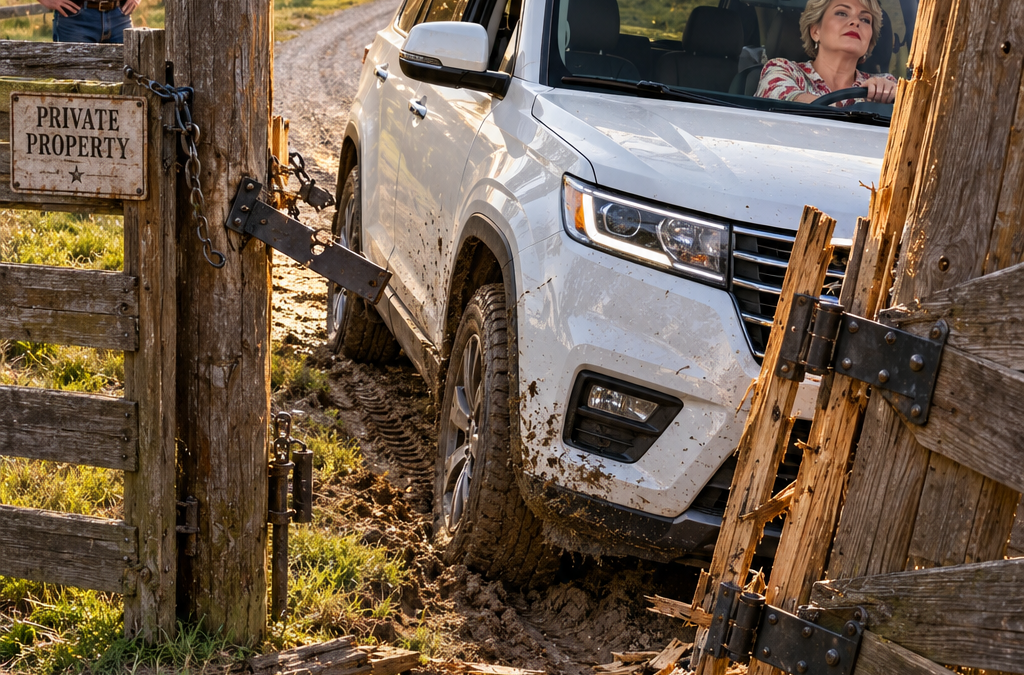
𝗙𝗨𝗟𝗟 𝗦𝗧𝗢𝗥𝗬
She folded her arms.
“The HOA needs to understand surrounding access options.”
“Then the HOA can look at a map.”
“Maps don’t show everything.”
“Neither does driving through somebody else’s gate.”
That annoyed her.
“I am not damaging anything.”
“That’s not the point.”
“Then what is?”
“Permission.”
She gave me the look people give when they think a simpler explanation is hiding behind a complicated objection.
“The gate was open.”
“It was closed.”
“Not locked.”
“A closed gate does not become public because it isn’t locked.”
She sighed.
“I’m trying to do my job.”
“And I’m asking you to stay off my land.”
“I’ll note the concern.”
“No.”
I looked directly at her.
“Don’t note it as a concern. Understand it as a boundary.”
For several seconds, neither of us spoke.
Then she got back into the SUV.
“Fine.”
She drove out.
I closed the gate again.
That evening I checked the deed and survey anyway.
Not because I doubted myself.
Because property disputes become much easier when memory is replaced by paper.
The survey was clear.
My parcel extended beyond the gate.
The entire entrance sat inside my boundary.
The gravel road beyond it ran through my land.
There was no recorded HOA right-of-way.
No blanket access easement.
No community road agreement.
There was an emergency-services provision farther south, but it followed a completely different route and had nothing to do with my ranch entrance.
I put the survey back in the desk.
Problem solved.
At least I thought so.
The third time Karen came through, she didn’t even slow down.
I was near the house when I heard the gate bang.
Not swing.
Bang.
I walked toward the road just in time to see her SUV moving away from me.
She must have pushed the gate with the front of the vehicle or forced it against the stop without getting out.
That was the moment irritation became something else.
I got into my truck and drove after her.
She had stopped near the north fence.
I parked behind her.
She stepped out.
“You following me?”
“This is my ranch.”
“Yes, I know.”
“Do you?”
She sighed.
“What now?”
“You drove through my gate again.”
“We need periodic access.”
“No.”
“There’s infrastructure along the neighborhood boundary.”
“On your side.”
“We still need visual access from this side.”
“Then ask.”
“I shouldn’t have to request permission every single time the association needs to inspect adjacent areas.”
“Yes, Karen.”
I stepped closer, keeping my voice calm.
“You absolutely should.”
She looked irritated.
“Why are you making this so difficult?”
“I’m not.”
“You’re treating a simple access issue like trespassing.”
“Because you’re entering property after being told not to.”
“We’re not strangers.”
“That doesn’t matter.”
“I’m the HOA president.”
“That matters even less.”
Her expression hardened.
“The association has responsibilities.”
“So do I.”
“The road is the obvious access path.”
“Need isn’t ownership.”
She stared at me.
“What?”
“Needing to use a road doesn’t mean you own the road.”
“I never said the HOA owned your ranch.”
“Then stop driving through it like you do.”
For once, she didn’t immediately respond.
I pointed toward the entrance.
“Turn around.”
She looked toward the north fence.
Then at me.
“This is unreasonable.”
“Turn around.”
She did.
I followed at a distance.
When we reached the gate, she drove through.
I got out to close it.
That’s when I noticed the latch.
Bent.
Not destroyed.
But bent enough that the two gate panels no longer met properly.
The lower hinge on the right side had started loosening from the post.
Fresh tire marks cut through the dirt where vehicles had been turning too sharply.
I stood there staring.
A gate can take abuse.
It’s built for weather.
Animals pushing against it.
Years of opening and closing.
But repeated vehicles forcing through an entrance eventually leave evidence.
I put one hand on the latch.
It didn’t line up.
I had to lift the gate slightly to close it.
That made the decision for me.
Up until then, I had treated the problem as a conversation.
Karen apparently treated my words as negotiable.
I wasn’t interested in having a fourth conversation.
I called a contractor the next morning.
His first question was:
“You want another gate?”
“No.”
“Automatic opener?”
“No.”
“What are you trying to stop?”
“Vehicles entering without permission.”
He looked at the existing fence.
“Lock it.”
“I still need ranch access.”
“Chain?”
“Someone determined enough can cut it.”
He nodded.
“What about emergency access?”
“Can’t block that either.”
He walked the entrance.
Measured.
Looked at the fence line.
Then said:
“Bollards.”
“That’s what I was thinking.”
Heavy-duty steel bollards.
Not plastic markers.
Not decorative posts.
Steel.
Deep anchored.
Positioned so an unauthorized vehicle couldn’t simply shove through the gate or swing wide around it.
At the same time, I didn’t want to create a hazard or block legitimate emergency access.
We measured everything carefully.
Property line.
Road width.
Gate swing.
Pedestrian clearance.
Equipment clearance.
The configuration had to secure the entrance without extending onto anyone else’s land.
That mattered to me.
I wasn’t going to stop Karen from ignoring my boundary by ignoring somebody else’s.
The contractor suggested removable center posts for controlled vehicle access.
I chose a configuration that allowed me to open the ranch entrance when needed while preventing someone from treating the closed gate as something they could push past.
The outer steel posts would be permanent.
The placement left proper walking clearance and kept the fence line intact.
He asked:
“Expecting trouble?”
“No.”
He looked at the bent latch.
“Looks like you already have it.”
Fair.
Installation started the next morning.
Deep holes.
Concrete.
Steel.
Measurements checked twice.
I stayed there most of the day.
Not because I distrusted the contractor.
Because once those posts went in, I wanted there to be zero question where they stood.
Everything was inside my property.
No road shoulder.
No HOA land.
No public right-of-way.
Mine.
By sunset, the entrance looked different.
More serious.
The steel bollards stood solid on either side of the controlled opening.
The repaired gate sat between them.
The latch worked again.
The hinges were tightened.
No vehicle could simply angle around the end because the existing fence directed traffic back toward the entrance.
For the first time in weeks, I looked at the gate and felt relief.
No shouting.
No lawyer.
No police.
No HOA meeting.
Just infrastructure.
There is something satisfying about fixing a problem with something that doesn’t argue.
Steel doesn’t care whether somebody thinks a boundary is inconvenient.
I went home.
The next morning was clear.
I was drinking coffee when I heard an engine approaching.
I knew before I looked.
Karen.
Same white SUV.
Same speed.
She came down the road toward the gate the way she always did.
Then stopped.
Hard.
Not dangerously.
Just suddenly enough that the front end dipped slightly.
She sat behind the windshield.
Staring.
I watched from a distance.
For several seconds, she didn’t move.
Then she backed up.
Turned the steering wheel.
Approached from the left.
Stopped again.
Backed up.
Tried the right side.
No opening.
The fence line did exactly what it was supposed to do.
There was no shortcut around the bollards.
No soft shoulder wide enough to bypass them.
No way to nose the SUV through without deliberately damaging property.
Eventually, the driver’s door opened.
Karen got out.
She stared at the steel.
Then at me.
“What did you do?”
I walked toward the gate.
“Morning.”
“What are these?”
“Bollards.”
“I can see that.”
“Then why’d you ask?”
Her face tightened.
“You’ve blocked the road.”
“No.”
“You absolutely have.”
“I secured my entrance.”
“The HOA uses this road.”
“You use this road.”
“As HOA president.”
“Without permission.”
“We’ve already discussed this.”
“Several times.”
I pointed toward the latch.
“You bent that.”
“I did not.”
“Your vehicle did.”
“You can’t prove that.”
I didn’t care enough to argue.
“The gate was being damaged. So I protected it.”
“You can’t just install steel barriers on an access route.”
“It’s not your access route.”
She folded her arms.
“We have a right to reach the rear boundary.”
“Show me.”
She stared.
“What?”
“Show me the document.”
“The HOA has always used surrounding routes for maintenance access.”
“Not this one.”
“Because you’re the first owner who’s made it an issue.”
That sentence told me everything.
Not:
We have an easement.
Not:
It’s recorded.
Not:
Here’s the agreement.
Instead:
Nobody complained before.
I walked back toward the house.
“Wait here.”
I returned with the survey.
The same one I’d checked after the second incident.
I unfolded it across the hood of my truck.
Karen approached.
I pointed to the marked boundary.
“Here’s the subdivision.”
Then my parcel.
“Here’s the ranch.”
Then the road.
“Here’s this entrance.”
She leaned closer.
“The road runs adjacent to community property.”
“Adjacent isn’t inside.”
“The HOA needs boundary access.”
“Need is not ownership.”
“You keep repeating that.”
“Because you keep ignoring it.”
I traced the property line.
“The gate is here.”
Then the gravel road.
“The road runs across my property.”
I showed her the recorded easements.
“This is the emergency-services corridor.”
She followed the line.
“It’s south.”
“Correct.”
“This is utility access.”
“Also not here.”
She kept reading.
For the first time since I’d known her, Karen became quiet because of a document rather than because she was preparing another argument.
Then she pointed.
“The subdivision map shows access continuing near this boundary.”
“Near.”
“Yes.”
“Not through.”
She looked toward the bollards.
“We still need a route.”
“Then request one.”
“From you?”
“Yes.”
“Every time?”
“Unless we negotiate something different.”
She shook her head.
“That’s impractical.”
“Maybe.”
“HOA operations can’t depend on whether you’re available.”
“Then use the access routes the HOA actually owns.”
“You are obstructing community operations.”
“I’m stopping unauthorized driving across private land.”
She pulled out her phone.
“I need to call the board.”
“Go ahead.”
She walked several yards away.
I could hear pieces.
Steel posts.
Vehicle access.
Private road.
Claims he owns it.
Survey.
She kept looking at me while she spoke.
I waited.
No satisfaction.
No smile.
I wasn’t enjoying it.
I wanted the situation resolved.
If the HOA had a legitimate easement I had somehow missed, I would deal with that.
Property rights work both ways.
You don’t get to shout “mine” louder than the paper.
After several minutes, Karen ended the call.
“The board is sending a surveyor.”
“Good.”
She blinked.
“Good?”
“Yes.”
“You don’t object?”
“Why would I?”
“Most homeowners become defensive when an HOA requests verification.”
“I’m not in your HOA.”
“You know what I mean.”
“I do.”
I folded my survey.
“Have whoever comes contact me first. I don’t want strangers walking the ranch without notice.”
She exhaled.
“Again with permission.”
“Yes.”
“I’ll let them know.”
That afternoon, I received a call.
Professional surveyor.
He explained that the HOA had retained him to verify the boundary near the ranch entrance.
I agreed immediately.
We met the next morning.
Karen attended.
So did another HOA representative.
No crowd.
No drama.
Just measurements.
The surveyor located the monument references.
Checked existing pins.
Used the recorded plat.
Compared my legal description with the HOA’s subdivision survey.
He moved along the fence.
Set equipment.
Took readings.
Less than an hour.
I stayed out of his way.
Karen did not.
She asked questions every few minutes.
“Are you measuring from the subdivision monument?”
“Yes.”
“And the road?”
“I’ll get there.”
“This older fence isn’t necessarily the legal boundary.”
“Correct.”
She glanced toward me as if that helped her.
I said nothing.
A fence can be wrong.
That’s why we were surveying.
He finished the field work.
Then reviewed his measurements.
Karen stood beside him.
“So?”
He pointed toward the gate.
“The entrance is inside his parcel.”
Her face didn’t move.
“How far?”
He gave her the measurement.
She looked toward the road.
“And the gravel access?”
“Also on his parcel through this section.”
“What about HOA access rights?”
He shook his head.
“I’m verifying boundary, not title rights.”
I respected that.
A surveyor should say what he knows and stop there.
Karen asked:
“So you’re not saying we’re prohibited from using it.”
“I’m saying the physical road here is on his side of the property line.”
She looked at me.
I pulled out the title documents.
“We already checked recorded easements.”
The surveyor examined them briefly.
He was careful.
“I’d have your attorney interpret rights.”
“Agreed.”
Karen looked frustrated.
“I thought you said there was nothing.”
“I said there’s nothing granting unrestricted HOA vehicle access.”
“You’re playing with words.”
“No.”
I looked at the surveyor.
“Is there any ambiguity about where this gate sits?”
He shook his head.
“Not from what I’m seeing.”
“The bollards?”
“Inside the parcel.”
“The fence?”
“Generally tracks the boundary closely here.”
I nodded.
“Thank you.”
Karen stared at the steel posts.
Months of argument reduced to coordinates.
That’s one reason I like surveys.
They aren’t emotional.
They don’t care who chairs the board.
They don’t care who has lived somewhere longer.
They don’t care who thinks a road would be more convenient if it belonged to them.
They measure.
Karen walked toward her SUV.
I stopped her.
“Karen.”
She turned.
“I’m not trying to make things difficult for your neighborhood.”
She looked skeptical.
“If the HOA ever needs legitimate temporary access across the ranch, call me.”
“For maintenance?”
“If there’s a real need.”
“So now you’re offering access.”
“By permission.”
She rolled her eyes slightly.
“That’s exactly the point I’ve been making.”
“No.”
I stepped closer to the gate.
“The point you’ve been making is that you shouldn’t have to ask.”
She said nothing.
“Those are not the same thing.”
The surveyor packed his equipment.
The other HOA representative had suddenly become fascinated by his phone.
Karen finally said:
“So what happens if there’s an emergency?”
“Use the recorded emergency route.”
“And if that route is blocked?”
“Call emergency services. If they need this entrance, I’ll make sure they get through.”
“What if you’re not home?”
“The removable section has an emergency provision.”
Her eyes moved toward the bollards.
I had planned for that.
Of course I had.
I wasn’t trying to build a fortress.
I was preventing casual unauthorized entry.
Karen’s argument shifted again.
“So you spent all this money because I drove through a gate?”
“No.”
“Then why?”
“Because asking you to stop didn’t work.”
She looked at me for a long time.
That was probably the first moment she understood the situation from my side.
Maybe not emotionally.
Practically.
Every conversation had given her another chance.
The bollards existed because those conversations failed.
Finally she nodded.
Once.
“I’ll tell the board.”
“Good.”
She got into her SUV.
Started the engine.
For a second, I wondered whether she’d make one last attempt to argue with the steel.
She didn’t.
She turned around.
Drove back toward the subdivision.
I watched until the white SUV disappeared beyond the trees.
Then closed the gate.
It latched cleanly.
That sound felt better than I expected.
Metal meeting metal.
Click.
Secure.
The next morning was quiet.
No SUV.
No phone call.
No violation letter.
I walked the fence line after breakfast.
Checked the repaired hinge.
Solid.
Checked the latch.
Straight.
The tire ruts near the entrance were still visible.
Rain would eventually soften them.
Grass would return.
For weeks, I had found myself watching the road whenever I heard an engine.
That habit faded slowly.
A truck passed outside.
Kept going.
Another vehicle turned toward Willow Ridge.
Didn’t approach the ranch.
Normal.
That was all I had wanted.
Normal.
Some people hear a story like this and expect a dramatic ending.
Police arriving.
A lawsuit.
A screaming board meeting.
Some enormous fine reversed in court.
None of that happened.
And I’m glad.
Not every boundary needs a battle.
Sometimes it needs clarification.
Sometimes a better latch.
Sometimes four steel posts sunk deep enough that people finally stop pretending they didn’t understand the word private.
The HOA never admitted wrongdoing formally.
I never demanded an apology.
The board sent me a short email after receiving the survey report.
It acknowledged the confirmed property boundary and stated that future access requests would be coordinated in advance.
That was enough.
I saved the email with the survey.
Not as a trophy.
As a record.
If Karen resigned tomorrow and another president took over, I didn’t want to repeat the entire conversation.
Paper remembers better than people.
For the next few months, the bollards became ordinary.
At first, neighbors slowed down to look.
Some probably thought I was being dramatic.
A few asked questions.
One man from the subdivision stopped while I was checking the gate.
“Those because of Karen?”
I looked at him.
“Those are because people kept driving through.”
He laughed.
“So Karen.”
I didn’t answer.
I had no interest in turning the woman into neighborhood entertainment.
She had crossed a boundary repeatedly.
The boundary was now respected.
That was the objective.
I learned later that Karen had genuinely believed the ranch road was available to the association.
That didn’t excuse ignoring me.
But it explained part of her certainty.
Someone on an older board had apparently referred to my road as “rear access” years earlier.
Maybe they used it with a previous owner’s permission.
Maybe somebody had left the gate open.
Maybe the phrase survived longer than the permission behind it.
That’s how assumptions become dangerous.
One person says:
We use that road.
Years later, someone else hears:
We have access to that road.
Eventually:
That’s our access road.
Then a president drives through the gate and can’t understand why the landowner is objecting.
Language drifts.
Property lines don’t.
At least not without documents.
I thought about the previous owner.
He may have let people through.
I had no problem with that.
His permission was his to give.
Mine was mine.
That’s another thing people misunderstand.
A neighbor being generous for ten years does not mean the next owner has surrendered the same choice.
Courtesy isn’t ownership.
Permission isn’t title.
Habit isn’t necessarily an easement.
And convenience is not a property right.
The bollards made those distinctions visible.
Months later, I received my first legitimate request from the HOA.
A drainage contractor needed to inspect a culvert near the subdivision’s rear corner.
Using my ranch road would save them from bringing equipment down a steeper HOA-maintained track.
The board emailed.
Included the date.
Company name.
Purpose.
Approximate time.
Insurance information.
They asked.
I said yes.
That morning, I opened the controlled vehicle access.
The contractor drove through.
Did the work.
Left.
I closed the gate.
No conflict.
That mattered.
Because the story was never:
Nobody may ever cross my land.
The story was:
You do not decide for me that you can.
Consent sounds inconvenient to people accustomed to getting what they want.
Once they get used to asking, it becomes remarkably simple.
Karen was with the contractor that morning.
She stayed in her SUV near the subdivision boundary.
When the work was finished, she walked over.
“Everything okay?”
“Fine.”
“The contractor said this route saved almost an hour.”
“Probably.”
She hesitated.
“Thank you.”
“You’re welcome.”
Then she looked at the bollards.
“You know, I still think they’re excessive.”
I smiled.
“I know.”
She almost smiled back.
“But effective.”
“Very.”
She nodded.
Then walked away.
That was as close to an apology as I ever got.
I didn’t need more.
Over time, our relationship became civil.
Not friendly.
We didn’t share coffee.
I didn’t attend HOA meetings because, again, I wasn’t a member.
But Karen stopped appearing on my ranch without notice.
If the board had a question about fencing near the shared boundary, they emailed.
If I planned work that might affect runoff toward the subdivision, I let them know.
That’s what neighbors are supposed to do.
Communicate without pretending proximity erases ownership.
A year after the bollards went in, one of the ranch gate hinges needed adjustment.
Normal wear.
I called the same contractor.
He looked at the steel posts.
“Any more unwanted traffic?”
“No.”
He tapped one with his boot.
“Told you.”
“You did.”
“People respect concrete.”
“Apparently more than conversation.”
He laughed.
“Concrete doesn’t negotiate.”
I remembered that.
Because it captured something I’d learned.
For months, I had treated the problem as if I needed Karen to agree with me.
I didn’t.
I needed her to respect the boundary.
Agreement is emotional.
Boundaries are practical.
She could think I was unreasonable forever.
She could believe the road should have been shared.
She could believe the HOA deserved easier access.
None of those opinions changed the survey.
I didn’t need to defeat her argument.
I needed to stop unauthorized vehicles.
Once I understood that, the solution became straightforward.
Repair the gate.
Protect it.
Document the boundary.
Leave legitimate access possible.
Then stop arguing.
There is a strange peace in realizing not every conflict deserves persuasion.
Some people hear your explanation.
Others hear an invitation to negotiate.
If the issue is preference, negotiation may be useful.
If the issue is where your deed ends and someone else’s authority begins, eventually you need something firmer.
Not anger.
Evidence.
Not threats.
Structure.
I had both.
Survey.
Steel.
That was enough.
I still walk the entrance most mornings.
Old habit.
Check fence tension.
Look for animal tracks.
Make sure the latch is seated.
The tire marks Karen left are gone now.
Grass filled them months ago.
The bent hardware was replaced.
The post that had started loosening is reinforced.
Unless you knew the history, you would never look at the gate and imagine there had been a dispute.
That’s probably how it should be.
Good boundaries become boring once they’re respected.
People sometimes assume private property means hostility.
It doesn’t.
My ranch isn’t private because I hate neighbors.
It’s private because it’s a working ranch.
There are animals.
Equipment.
Terrain people don’t know.
A driver cutting across the wrong pasture can leave a gate open.
A loose cow can become a highway accident.
A vehicle can damage irrigation.
A visitor can get hurt near machinery.
Control of access isn’t ego.
It’s responsibility.
Karen saw a road.
I saw everything the road led through.
That difference mattered.
The HOA also had responsibilities.
Emergency plans.
Maintenance.
Drainage.
Community access.
I didn’t dispute any of those.
I disputed the idea that responsibility on their side created authority on mine.
It didn’t.
Once we separated those two ideas, everything became easier.
They needed access sometimes.
I owned the route.
So they asked.
I could say yes when reasonable.
No when not.
If they ever needed permanent rights, there were proper channels.
Survey.
Easement.
Negotiation.
Recording.
Compensation if appropriate.
That’s what property systems are for.
They’re much better than somebody in a white SUV deciding a closed gate doesn’t really mean closed.
The surveyor who settled the disagreement mailed me the final marked copy afterward.
I framed nothing.
It went into my land-record binder.
But I made several copies.
One in the house.
One in the ranch office.
One digital.
Maybe that sounds excessive.
It didn’t anymore.
If there’s one thing land teaches you, it’s that memory is unreliable.
Fences move.
Owners change.
People repeat things until assumptions sound like facts.
Documents matter.
The survey wasn’t powerful because it gave me rights I didn’t have before.
It was powerful because it made an existing fact difficult to ignore.
The gate was mine before the surveyor arrived.
The road was mine before Karen finally believed it.
The bollards did not create the boundary.
They protected it.
That’s an important distinction.
A few years from now, I might sell the ranch.
Maybe not.
If I do, the next owner will receive a thick folder.
Deed.
Survey.
Easements.
Bollard layout.
Correspondence with the HOA.
The email acknowledging the boundary.
The drainage-access requests.
Everything.
I don’t want the next owner standing at the same gate arguing the same point.
And I don’t want some future HOA president relying on a rumor that the ranch road has “always been community access.”
History becomes clearer when somebody bothers to document it.
That may be the most useful result of the whole episode.
The next person won’t have to argue.
He can open the binder.
One afternoon, long after the conflict had faded, I was repairing fence near the subdivision boundary when Karen walked by on the HOA side.
She stopped.
“Still guarding the frontier?”
I looked at the fence.
“Looks quiet.”
She smiled.
“I was joking.”
“I know.”
She stood there a moment.
Then said:
“I honestly thought we had access.”
“I know.”
“I wasn’t trying to steal your road.”
“I know that too.”
She seemed surprised.
“Then why were you so angry?”
I leaned against the post.
“Because after I told you otherwise, you kept acting like what you thought mattered more than what I owned.”
She considered that.
“Fair.”
I waited.
She looked toward the ranch road.
“The old board president told me that route had always been used.”
“Maybe it was.”
“So you understand why I thought—”
“I understand why you asked.”
She looked at me.
“But not why I kept using it.”
“Exactly.”
She nodded slowly.
“I should’ve checked.”
“Would’ve saved me some steel.”
She laughed.
“Those things aren’t going anywhere.”
“No.”
“Probably survive both of us.”
“That’s the idea.”
She continued walking.
No apology.
No need.
The acknowledgment was enough.
We had finally reached the same conclusion by different routes.
Assumptions should be checked before they’re enforced.
That lesson applies far beyond ranch gates.
Authority based on memory should make you nervous.
So should authority based on convenience.
“We’ve always done it this way” is not the same thing as “we have the legal right.”
Sometimes those statements overlap.
Sometimes they don’t.
The only safe way to know is to look.
When Karen finally did, the argument ended in under an hour.
Months of frustration.
Three warnings.
A damaged gate.
A contractor.
Steel bollards.
All because nobody had bothered at the beginning to unfold the survey.
I did not win anything.
That’s not how I see it.
I still owned exactly what I owned before.
Karen lost no land.
The HOA lost no recorded right.
The neighborhood still functioned.
The only thing that disappeared was an assumption.
Those can be surprisingly expensive.
Mine cost a repaired gate and several steel posts.
Could have been worse.
If I had screamed the first time, maybe the dispute would have become personal faster.
If I had blocked legitimate emergency access, I could have created a real problem.
If Karen had damaged the gate more seriously, we might have ended up dealing with insurance or attorneys.
Instead, the outcome was boring.
I prefer boring.
Karen turned around.
The gate stayed closed.
The HOA began asking.
The ranch kept operating.
No court.
No sheriff.
No screaming crowd.
Just a boundary finally treated like a boundary.
People sometimes ask why I didn’t simply lock the gate from the beginning.
I could have.
But I needed regular access.
Ranch hands.
Deliveries.
Veterinary visits.
Equipment.
Emergency vehicles if necessary.
A lock would have created its own complications.
The bollard setup gave me control without making the entrance unusable.
That was the important part.
Boundaries don’t have to be absolute walls.
They just need to be controlled by the person who actually owns them.
That’s what Karen had been taking from me without understanding it.
Control.
Every time she drove through, she made the decision for me.
The fourth visit never happened.
That’s what I remember most.
Not her face when she first saw the steel.
Not the surveyor confirming the line.
Not even the quiet email from the HOA afterward.
The fourth visit.
The one that didn’t happen.
No engine at the gate.
No bang against the latch.
No tires across the entrance.
No conversation I’d already had three times.
Silence.
Some problems announce their resolution with court orders or apologies.
Mine sounded like nothing.
And standing beside that closed gate on a quiet morning, nothing sounded perfect.
The ranch road stretched behind me.
Cattle moved in the distance.
The steel posts stood exactly where the contractor had measured them.
The fence followed the survey.
The gate closed properly.
Everything was where it belonged.
Including Karen.
On the other side of the property line.
That wasn’t punishment.
It wasn’t revenge.
It wasn’t even victory.
It was simply ownership being respected.
Which was all I had asked for from the beginning.
𝗧𝗛𝗘 𝗘𝗡𝗗
The HOA President Kept Driving Through My Private Ranch Gate, Never Asking Why I Finally Stopped Arguing
I had told Karen three separate times that the gate marked the entrance to private ranch land, yet every few days her SUV still came through as if my property line were nothing more than a suggestion.
By the time she damaged the latch, loosened the hinges, and carved another set of tire tracks across my entrance, I stopped trying to convince her with words and decided the boundary could speak for itself.
I had one simple rule on my ranch.
The gate stayed closed.
Not locked twenty-four hours a day.
Not guarded.
Not covered in warning signs.
Closed.
That was it.
The ranch sat along the western edge of a newer residential development, where neat streets and landscaped entrances gradually gave way to open pasture, cedar fence, scrub grass, and the long gravel road that crossed my property.
I had owned the place long enough that most of the people nearby knew where the subdivision ended and where my land began.
The fence made it obvious.
So did the gate.
Two heavy wooden panels hung from steel hinges between thick posts.
A PRIVATE PROPERTY sign was mounted beside the latch.
Beyond it, the gravel road curved through my pasture toward the barn and equipment shed.
There was no clubhouse back there.
No HOA facility.
No public trail.
No neighborhood shortcut.
Just my land.
The ranch wasn’t enormous by western standards, but it was large enough that I relied on gates for more than privacy.
A gate controls animals.
It controls unfamiliar vehicles.
It lets me know who is supposed to be on the property and who isn’t.
When you’re responsible for livestock, machinery, fencing, water systems, and acreage that stretches beyond what you can see from the house, a closed gate isn’t decoration.
It’s part of how the place functions.
Everybody who lived nearby seemed to understand that.
Everybody except Karen.
Karen was the HOA president.
I had known who she was before she ever drove onto my land because people talked about her.
She had a reputation for becoming involved in things whether they belonged to the HOA or not.
Trash cans left out too long.
Mailbox colors.
Parking positions.
Landscaping.
Fence stains.
She had a way of speaking that turned preferences into regulations before you’d had time to ask where the regulation was written.
I wasn’t part of her association.
That distinction mattered.
My ranch bordered the neighborhood, but my parcel was separate.
I didn’t pay HOA dues.
My deed carried no HOA covenants.
Their board could make rules for the houses behind their entrance monument.
They couldn’t make rules for my cattle pasture.
For a while, Karen seemed to understand that.
Then she discovered my ranch road.
The first time she came through the gate, I thought it was a mistake.
I was near the barn when I saw a white SUV moving slowly along the gravel road.
At first I assumed it belonged to someone delivering feed.
Then the vehicle came closer and I recognized Karen behind the wheel.
She stopped near the barn.
Rolled down the window.
“Morning.”
I walked over.
“Morning.”
She looked around.
“Beautiful property.”
“Thank you.”
“I’ve never been back here.”
“I figured.”
She didn’t seem to hear the meaning underneath that.
“I wanted to see where this road connects.”
“It doesn’t.”
She frowned.
“It looks like it continues toward the north side of the subdivision.”
“It goes toward my north pasture.”
“Oh.”
She glanced down the road.
“We’ve been looking at emergency access routes.”
“Okay.”
“One of the board members thought this might connect.”
“It doesn’t.”
She smiled.
“Good to know.”
Then she turned the SUV around.
I walked beside her window as she approached the entrance.
“Karen.”
She stopped.
“Yeah?”
“This is private.”
She looked toward the gate.
“I know.”
“No, I mean the road.”
“I understand.”
“If you need to come onto the ranch again, call me first.”
Her expression changed just slightly.
“Of course.”
She drove away.
I closed the gate.
That should have been the end of it.
A week later, she came through again.
This time I was repairing fence on the lower pasture.
I heard tires on gravel.
When I looked up, the same white SUV was moving through the gate.
Karen drove farther than she had the first time.
She stopped near a fork in the ranch road and got out with her phone.
I walked toward her.
“Karen.”
She looked almost surprised to see me.
“Oh. Hi.”
“What are you doing?”
“Just checking the access.”
“We already checked it.”
“I’m mapping possible HOA service routes.”
I stared at her.
“This isn’t an HOA service route.”
“I know currently it isn’t.”
“Currently?”
She pointed toward the gravel road.
“This is the most direct path toward the rear edge of our neighborhood.”
“Across my ranch.”
“Yes.”
“No.”
Her eyebrows rose.
“I’m not proposing anything permanent.”
“You’re standing on private property after I told you to call before coming here.”
“I didn’t think you meant official HOA business.”
I almost laughed.
“What else would I mean?”
She folded her arms.
“The HOA needs to understand surrounding access options.”
“Then the HOA can look at a map.”
“Maps don’t show everything.”
“Neither does driving through somebody else’s gate.”
That annoyed her.
“I am not damaging anything.”
“That’s not the point.”
“Then what is?”
“Permission.”
She gave me the look people give when they think a simpler explanation is hiding behind a complicated objection.
“The gate was open.”
“It was closed.”
“Not locked.”
“A closed gate does not become public because it isn’t locked.”
She sighed.
“I’m trying to do my job.”
“And I’m asking you to stay off my land.”
“I’ll note the concern.”
“No.”
I looked directly at her.
“Don’t note it as a concern. Understand it as a boundary.”
For several seconds, neither of us spoke.
Then she got back into the SUV.
“Fine.”
She drove out.
I closed the gate again.
That evening I checked the deed and survey anyway.
Not because I doubted myself.
Because property disputes become much easier when memory is replaced by paper.
The survey was clear.
My parcel extended beyond the gate.
The entire entrance sat inside my boundary.
The gravel road beyond it ran through my land.
There was no recorded HOA right-of-way.
No blanket access easement.
No community road agreement.
There was an emergency-services provision farther south, but it followed a completely different route and had nothing to do with my ranch entrance.
I put the survey back in the desk.
Problem solved.
At least I thought so.
The third time Karen came through, she didn’t even slow down.
I was near the house when I heard the gate bang.
Not swing.
Bang.
I walked toward the road just in time to see her SUV moving away from me.
She must have pushed the gate with the front of the vehicle or forced it against the stop without getting out.
That was the moment irritation became something else.
I got into my truck and drove after her.
She had stopped near the north fence.
I parked behind her.
She stepped out.
“You following me?”
“This is my ranch.”
“Yes, I know.”
“Do you?”
She sighed.
“What now?”
“You drove through my gate again.”
“We need periodic access.”
“No.”
“There’s infrastructure along the neighborhood boundary.”
“On your side.”
“We still need visual access from this side.”
“Then ask.”
“I shouldn’t have to request permission every single time the association needs to inspect adjacent areas.”
“Yes, Karen.”
I stepped closer, keeping my voice calm.
“You absolutely should.”
She looked irritated.
“Why are you making this so difficult?”
“I’m not.”
“You’re treating a simple access issue like trespassing.”
“Because you’re entering property after being told not to.”
“We’re not strangers.”
“That doesn’t matter.”
“I’m the HOA president.”
“That matters even less.”
Her expression hardened.
“The association has responsibilities.”
“So do I.”
“The road is the obvious access path.”
“Need isn’t ownership.”
She stared at me.
“What?”
“Needing to use a road doesn’t mean you own the road.”
“I never said the HOA owned your ranch.”
“Then stop driving through it like you do.”
For once, she didn’t immediately respond.
I pointed toward the entrance.
“Turn around.”
She looked toward the north fence.
Then at me.
“This is unreasonable.”
“Turn around.”
She did.
I followed at a distance.
When we reached the gate, she drove through.
I got out to close it.
That’s when I noticed the latch.
Bent.
Not destroyed.
But bent enough that the two gate panels no longer met properly.
The lower hinge on the right side had started loosening from the post.
Fresh tire marks cut through the dirt where vehicles had been turning too sharply.
I stood there staring.
A gate can take abuse.
It’s built for weather.
Animals pushing against it.
Years of opening and closing.
But repeated vehicles forcing through an entrance eventually leave evidence.
I put one hand on the latch.
It didn’t line up.
I had to lift the gate slightly to close it.
That made the decision for me.
Up until then, I had treated the problem as a conversation.
Karen apparently treated my words as negotiable.
I wasn’t interested in having a fourth conversation.
I called a contractor the next morning.
His first question was:
“You want another gate?”
“No.”
“Automatic opener?”
“No.”
“What are you trying to stop?”
“Vehicles entering without permission.”
He looked at the existing fence.
“Lock it.”
“I still need ranch access.”
“Chain?”
“Someone determined enough can cut it.”
He nodded.
“What about emergency access?”
“Can’t block that either.”
He walked the entrance.
Measured.
Looked at the fence line.
Then said:
“Bollards.”
“That’s what I was thinking.”
Heavy-duty steel bollards.
Not plastic markers.
Not decorative posts.
Steel.
Deep anchored.
Positioned so an unauthorized vehicle couldn’t simply shove through the gate or swing wide around it.
At the same time, I didn’t want to create a hazard or block legitimate emergency access.
We measured everything carefully.
Property line.
Road width.
Gate swing.
Pedestrian clearance.
Equipment clearance.
The configuration had to secure the entrance without extending onto anyone else’s land.
That mattered to me.
I wasn’t going to stop Karen from ignoring my boundary by ignoring somebody else’s.
The contractor suggested removable center posts for controlled vehicle access.
I chose a configuration that allowed me to open the ranch entrance when needed while preventing someone from treating the closed gate as something they could push past.
The outer steel posts would be permanent.
The placement left proper walking clearance and kept the fence line intact.
He asked:
“Expecting trouble?”
“No.”
He looked at the bent latch.
“Looks like you already have it.”
Fair.
Installation started the next morning.
Deep holes.
Concrete.
Steel.
Measurements checked twice.
I stayed there most of the day.
Not because I distrusted the contractor.
Because once those posts went in, I wanted there to be zero question where they stood.
Everything was inside my property.
No road shoulder.
No HOA land.
No public right-of-way.
Mine.
By sunset, the entrance looked different.
More serious.
The steel bollards stood solid on either side of the controlled opening.
The repaired gate sat between them.
The latch worked again.
The hinges were tightened.
No vehicle could simply angle around the end because the existing fence directed traffic back toward the entrance.
For the first time in weeks, I looked at the gate and felt relief.
No shouting.
No lawyer.
No police.
No HOA meeting.
Just infrastructure.
There is something satisfying about fixing a problem with something that doesn’t argue.
Steel doesn’t care whether somebody thinks a boundary is inconvenient.
I went home.
The next morning was clear.
I was drinking coffee when I heard an engine approaching.
I knew before I looked.
Karen.
Same white SUV.
Same speed.
She came down the road toward the gate the way she always did.
Then stopped.
Hard.
Not dangerously.
Just suddenly enough that the front end dipped slightly.
She sat behind the windshield.
Staring.
I watched from a distance.
For several seconds, she didn’t move.
Then she backed up.
Turned the steering wheel.
Approached from the left.
Stopped again.
Backed up.
Tried the right side.
No opening.
The fence line did exactly what it was supposed to do.
There was no shortcut around the bollards.
No soft shoulder wide enough to bypass them.
No way to nose the SUV through without deliberately damaging property.
Eventually, the driver’s door opened.
Karen got out.
She stared at the steel.
Then at me.
“What did you do?”
I walked toward the gate.
“Morning.”
“What are these?”
“Bollards.”
“I can see that.”
“Then why’d you ask?”
Her face tightened.
“You’ve blocked the road.”
“No.”
“You absolutely have.”
“I secured my entrance.”
“The HOA uses this road.”
“You use this road.”
“As HOA president.”
“Without permission.”
“We’ve already discussed this.”
“Several times.”
I pointed toward the latch.
“You bent that.”
“I did not.”
“Your vehicle did.”
“You can’t prove that.”
I didn’t care enough to argue.
“The gate was being damaged. So I protected it.”
“You can’t just install steel barriers on an access route.”
“It’s not your access route.”
She folded her arms.
“We have a right to reach the rear boundary.”
“Show me.”
She stared.
“What?”
“Show me the document.”
“The HOA has always used surrounding routes for maintenance access.”
“Not this one.”
“Because you’re the first owner who’s made it an issue.”
That sentence told me everything.
Not:
We have an easement.
Not:
It’s recorded.
Not:
Here’s the agreement.
Instead:
Nobody complained before.
I walked back toward the house.
“Wait here.”
I returned with the survey.
The same one I’d checked after the second incident.
I unfolded it across the hood of my truck.
Karen approached.
I pointed to the marked boundary.
“Here’s the subdivision.”
Then my parcel.
“Here’s the ranch.”
Then the road.
“Here’s this entrance.”
She leaned closer.
“The road runs adjacent to community property.”
“Adjacent isn’t inside.”
“The HOA needs boundary access.”
“Need is not ownership.”
“You keep repeating that.”
“Because you keep ignoring it.”
I traced the property line.
“The gate is here.”
Then the gravel road.
“The road runs across my property.”
I showed her the recorded easements.
“This is the emergency-services corridor.”
She followed the line.
“It’s south.”
“Correct.”
“This is utility access.”
“Also not here.”
She kept reading.
For the first time since I’d known her, Karen became quiet because of a document rather than because she was preparing another argument.
Then she pointed.
“The subdivision map shows access continuing near this boundary.”
“Near.”
“Yes.”
“Not through.”
She looked toward the bollards.
“We still need a route.”
“Then request one.”
“From you?”
“Yes.”
“Every time?”
“Unless we negotiate something different.”
She shook her head.
“That’s impractical.”
“Maybe.”
“HOA operations can’t depend on whether you’re available.”
“Then use the access routes the HOA actually owns.”
“You are obstructing community operations.”
“I’m stopping unauthorized driving across private land.”
She pulled out her phone.
“I need to call the board.”
“Go ahead.”
She walked several yards away.
I could hear pieces.
Steel posts.
Vehicle access.
Private road.
Claims he owns it.
Survey.
She kept looking at me while she spoke.
I waited.
No satisfaction.
No smile.
I wasn’t enjoying it.
I wanted the situation resolved.
If the HOA had a legitimate easement I had somehow missed, I would deal with that.
Property rights work both ways.
You don’t get to shout “mine” louder than the paper.
After several minutes, Karen ended the call.
“The board is sending a surveyor.”
“Good.”
She blinked.
“Good?”
“Yes.”
“You don’t object?”
“Why would I?”
“Most homeowners become defensive when an HOA requests verification.”
“I’m not in your HOA.”
“You know what I mean.”
“I do.”
I folded my survey.
“Have whoever comes contact me first. I don’t want strangers walking the ranch without notice.”
She exhaled.
“Again with permission.”
“Yes.”
“I’ll let them know.”
That afternoon, I received a call.
Professional surveyor.
He explained that the HOA had retained him to verify the boundary near the ranch entrance.
I agreed immediately.
We met the next morning.
Karen attended.
So did another HOA representative.
No crowd.
No drama.
Just measurements.
The surveyor located the monument references.
Checked existing pins.
Used the recorded plat.
Compared my legal description with the HOA’s subdivision survey.
He moved along the fence.
Set equipment.
Took readings.
Less than an hour.
I stayed out of his way.
Karen did not.
She asked questions every few minutes.
“Are you measuring from the subdivision monument?”
“Yes.”
“And the road?”
“I’ll get there.”
“This older fence isn’t necessarily the legal boundary.”
“Correct.”
She glanced toward me as if that helped her.
I said nothing.
A fence can be wrong.
That’s why we were surveying.
He finished the field work.
Then reviewed his measurements.
Karen stood beside him.
“So?”
He pointed toward the gate.
“The entrance is inside his parcel.”
Her face didn’t move.
“How far?”
He gave her the measurement.
She looked toward the road.
“And the gravel access?”
“Also on his parcel through this section.”
“What about HOA access rights?”
He shook his head.
“I’m verifying boundary, not title rights.”
I respected that.
A surveyor should say what he knows and stop there.
Karen asked:
“So you’re not saying we’re prohibited from using it.”
“I’m saying the physical road here is on his side of the property line.”
She looked at me.
I pulled out the title documents.
“We already checked recorded easements.”
The surveyor examined them briefly.
He was careful.
“I’d have your attorney interpret rights.”
“Agreed.”
Karen looked frustrated.
“I thought you said there was nothing.”
“I said there’s nothing granting unrestricted HOA vehicle access.”
“You’re playing with words.”
“No.”
I looked at the surveyor.
“Is there any ambiguity about where this gate sits?”
He shook his head.
“Not from what I’m seeing.”
“The bollards?”
“Inside the parcel.”
“The fence?”
“Generally tracks the boundary closely here.”
I nodded.
“Thank you.”
Karen stared at the steel posts.
Months of argument reduced to coordinates.
That’s one reason I like surveys.
They aren’t emotional.
They don’t care who chairs the board.
They don’t care who has lived somewhere longer.
They don’t care who thinks a road would be more convenient if it belonged to them.
They measure.
Karen walked toward her SUV.
I stopped her.
“Karen.”
She turned.
“I’m not trying to make things difficult for your neighborhood.”
She looked skeptical.
“If the HOA ever needs legitimate temporary access across the ranch, call me.”
“For maintenance?”
“If there’s a real need.”
“So now you’re offering access.”
“By permission.”
She rolled her eyes slightly.
“That’s exactly the point I’ve been making.”
“No.”
I stepped closer to the gate.
“The point you’ve been making is that you shouldn’t have to ask.”
She said nothing.
“Those are not the same thing.”
The surveyor packed his equipment.
The other HOA representative had suddenly become fascinated by his phone.
Karen finally said:
“So what happens if there’s an emergency?”
“Use the recorded emergency route.”
“And if that route is blocked?”
“Call emergency services. If they need this entrance, I’ll make sure they get through.”
“What if you’re not home?”
“The removable section has an emergency provision.”
Her eyes moved toward the bollards.
I had planned for that.
Of course I had.
I wasn’t trying to build a fortress.
I was preventing casual unauthorized entry.
Karen’s argument shifted again.
“So you spent all this money because I drove through a gate?”
“No.”
“Then why?”
“Because asking you to stop didn’t work.”
She looked at me for a long time.
That was probably the first moment she understood the situation from my side.
Maybe not emotionally.
Practically.
Every conversation had given her another chance.
The bollards existed because those conversations failed.
Finally she nodded.
Once.
“I’ll tell the board.”
“Good.”
She got into her SUV.
Started the engine.
For a second, I wondered whether she’d make one last attempt to argue with the steel.
She didn’t.
She turned around.
Drove back toward the subdivision.
I watched until the white SUV disappeared beyond the trees.
Then closed the gate.
It latched cleanly.
That sound felt better than I expected.
Metal meeting metal.
Click.
Secure.
The next morning was quiet.
No SUV.
No phone call.
No violation letter.
I walked the fence line after breakfast.
Checked the repaired hinge.
Solid.
Checked the latch.
Straight.
The tire ruts near the entrance were still visible.
Rain would eventually soften them.
Grass would return.
For weeks, I had found myself watching the road whenever I heard an engine.
That habit faded slowly.
A truck passed outside.
Kept going.
Another vehicle turned toward Willow Ridge.
Didn’t approach the ranch.
Normal.
That was all I had wanted.
Normal.
Some people hear a story like this and expect a dramatic ending.
Police arriving.
A lawsuit.
A screaming board meeting.
Some enormous fine reversed in court.
None of that happened.
And I’m glad.
Not every boundary needs a battle.
Sometimes it needs clarification.
Sometimes a better latch.
Sometimes four steel posts sunk deep enough that people finally stop pretending they didn’t understand the word private.
The HOA never admitted wrongdoing formally.
I never demanded an apology.
The board sent me a short email after receiving the survey report.
It acknowledged the confirmed property boundary and stated that future access requests would be coordinated in advance.
That was enough.
I saved the email with the survey.
Not as a trophy.
As a record.
If Karen resigned tomorrow and another president took over, I didn’t want to repeat the entire conversation.
Paper remembers better than people.
For the next few months, the bollards became ordinary.
At first, neighbors slowed down to look.
Some probably thought I was being dramatic.
A few asked questions.
One man from the subdivision stopped while I was checking the gate.
“Those because of Karen?”
I looked at him.
“Those are because people kept driving through.”
He laughed.
“So Karen.”
I didn’t answer.
I had no interest in turning the woman into neighborhood entertainment.
She had crossed a boundary repeatedly.
The boundary was now respected.
That was the objective.
I learned later that Karen had genuinely believed the ranch road was available to the association.
That didn’t excuse ignoring me.
But it explained part of her certainty.
Someone on an older board had apparently referred to my road as “rear access” years earlier.
Maybe they used it with a previous owner’s permission.
Maybe somebody had left the gate open.
Maybe the phrase survived longer than the permission behind it.
That’s how assumptions become dangerous.
One person says:
We use that road.
Years later, someone else hears:
We have access to that road.
Eventually:
That’s our access road.
Then a president drives through the gate and can’t understand why the landowner is objecting.
Language drifts.
Property lines don’t.
At least not without documents.
I thought about the previous owner.
He may have let people through.
I had no problem with that.
His permission was his to give.
Mine was mine.
That’s another thing people misunderstand.
A neighbor being generous for ten years does not mean the next owner has surrendered the same choice.
Courtesy isn’t ownership.
Permission isn’t title.
Habit isn’t necessarily an easement.
And convenience is not a property right.
The bollards made those distinctions visible.
Months later, I received my first legitimate request from the HOA.
A drainage contractor needed to inspect a culvert near the subdivision’s rear corner.
Using my ranch road would save them from bringing equipment down a steeper HOA-maintained track.
The board emailed.
Included the date.
Company name.
Purpose.
Approximate time.
Insurance information.
They asked.
I said yes.
That morning, I opened the controlled vehicle access.
The contractor drove through.
Did the work.
Left.
I closed the gate.
No conflict.
That mattered.
Because the story was never:
Nobody may ever cross my land.
The story was:
You do not decide for me that you can.
Consent sounds inconvenient to people accustomed to getting what they want.
Once they get used to asking, it becomes remarkably simple.
Karen was with the contractor that morning.
She stayed in her SUV near the subdivision boundary.
When the work was finished, she walked over.
“Everything okay?”
“Fine.”
“The contractor said this route saved almost an hour.”
“Probably.”
She hesitated.
“Thank you.”
“You’re welcome.”
Then she looked at the bollards.
“You know, I still think they’re excessive.”
I smiled.
“I know.”
She almost smiled back.
“But effective.”
“Very.”
She nodded.
Then walked away.
That was as close to an apology as I ever got.
I didn’t need more.
Over time, our relationship became civil.
Not friendly.
We didn’t share coffee.
I didn’t attend HOA meetings because, again, I wasn’t a member.
But Karen stopped appearing on my ranch without notice.
If the board had a question about fencing near the shared boundary, they emailed.
If I planned work that might affect runoff toward the subdivision, I let them know.
That’s what neighbors are supposed to do.
Communicate without pretending proximity erases ownership.
A year after the bollards went in, one of the ranch gate hinges needed adjustment.
Normal wear.
I called the same contractor.
He looked at the steel posts.
“Any more unwanted traffic?”
“No.”
He tapped one with his boot.
“Told you.”
“You did.”
“People respect concrete.”
“Apparently more than conversation.”
He laughed.
“Concrete doesn’t negotiate.”
I remembered that.
Because it captured something I’d learned.
For months, I had treated the problem as if I needed Karen to agree with me.
I didn’t.
I needed her to respect the boundary.
Agreement is emotional.
Boundaries are practical.
She could think I was unreasonable forever.
She could believe the road should have been shared.
She could believe the HOA deserved easier access.
None of those opinions changed the survey.
I didn’t need to defeat her argument.
I needed to stop unauthorized vehicles.
Once I understood that, the solution became straightforward.
Repair the gate.
Protect it.
Document the boundary.
Leave legitimate access possible.
Then stop arguing.
There is a strange peace in realizing not every conflict deserves persuasion.
Some people hear your explanation.
Others hear an invitation to negotiate.
If the issue is preference, negotiation may be useful.
If the issue is where your deed ends and someone else’s authority begins, eventually you need something firmer.
Not anger.
Evidence.
Not threats.
Structure.
I had both.
Survey.
Steel.
That was enough.
I still walk the entrance most mornings.
Old habit.
Check fence tension.
Look for animal tracks.
Make sure the latch is seated.
The tire marks Karen left are gone now.
Grass filled them months ago.
The bent hardware was replaced.
The post that had started loosening is reinforced.
Unless you knew the history, you would never look at the gate and imagine there had been a dispute.
That’s probably how it should be.
Good boundaries become boring once they’re respected.
People sometimes assume private property means hostility.
It doesn’t.
My ranch isn’t private because I hate neighbors.
It’s private because it’s a working ranch.
There are animals.
Equipment.
Terrain people don’t know.
A driver cutting across the wrong pasture can leave a gate open.
A loose cow can become a highway accident.
A vehicle can damage irrigation.
A visitor can get hurt near machinery.
Control of access isn’t ego.
It’s responsibility.
Karen saw a road.
I saw everything the road led through.
That difference mattered.
The HOA also had responsibilities.
Emergency plans.
Maintenance.
Drainage.
Community access.
I didn’t dispute any of those.
I disputed the idea that responsibility on their side created authority on mine.
It didn’t.
Once we separated those two ideas, everything became easier.
They needed access sometimes.
I owned the route.
So they asked.
I could say yes when reasonable.
No when not.
If they ever needed permanent rights, there were proper channels.
Survey.
Easement.
Negotiation.
Recording.
Compensation if appropriate.
That’s what property systems are for.
They’re much better than somebody in a white SUV deciding a closed gate doesn’t really mean closed.
The surveyor who settled the disagreement mailed me the final marked copy afterward.
I framed nothing.
It went into my land-record binder.
But I made several copies.
One in the house.
One in the ranch office.
One digital.
Maybe that sounds excessive.
It didn’t anymore.
If there’s one thing land teaches you, it’s that memory is unreliable.
Fences move.
Owners change.
People repeat things until assumptions sound like facts.
Documents matter.
The survey wasn’t powerful because it gave me rights I didn’t have before.
It was powerful because it made an existing fact difficult to ignore.
The gate was mine before the surveyor arrived.
The road was mine before Karen finally believed it.
The bollards did not create the boundary.
They protected it.
That’s an important distinction.
A few years from now, I might sell the ranch.
Maybe not.
If I do, the next owner will receive a thick folder.
Deed.
Survey.
Easements.
Bollard layout.
Correspondence with the HOA.
The email acknowledging the boundary.
The drainage-access requests.
Everything.
I don’t want the next owner standing at the same gate arguing the same point.
And I don’t want some future HOA president relying on a rumor that the ranch road has “always been community access.”
History becomes clearer when somebody bothers to document it.
That may be the most useful result of the whole episode.
The next person won’t have to argue.
He can open the binder.
One afternoon, long after the conflict had faded, I was repairing fence near the subdivision boundary when Karen walked by on the HOA side.
She stopped.
“Still guarding the frontier?”
I looked at the fence.
“Looks quiet.”
She smiled.
“I was joking.”
“I know.”
She stood there a moment.
Then said:
“I honestly thought we had access.”
“I know.”
“I wasn’t trying to steal your road.”
“I know that too.”
She seemed surprised.
“Then why were you so angry?”
I leaned against the post.
“Because after I told you otherwise, you kept acting like what you thought mattered more than what I owned.”
She considered that.
“Fair.”
I waited.
She looked toward the ranch road.
“The old board president told me that route had always been used.”
“Maybe it was.”
“So you understand why I thought—”
“I understand why you asked.”
She looked at me.
“But not why I kept using it.”
“Exactly.”
She nodded slowly.
“I should’ve checked.”
“Would’ve saved me some steel.”
She laughed.
“Those things aren’t going anywhere.”
“No.”
“Probably survive both of us.”
“That’s the idea.”
She continued walking.
No apology.
No need.
The acknowledgment was enough.
We had finally reached the same conclusion by different routes.
Assumptions should be checked before they’re enforced.
That lesson applies far beyond ranch gates.
Authority based on memory should make you nervous.
So should authority based on convenience.
“We’ve always done it this way” is not the same thing as “we have the legal right.”
Sometimes those statements overlap.
Sometimes they don’t.
The only safe way to know is to look.
When Karen finally did, the argument ended in under an hour.
Months of frustration.
Three warnings.
A damaged gate.
A contractor.
Steel bollards.
All because nobody had bothered at the beginning to unfold the survey.
I did not win anything.
That’s not how I see it.
I still owned exactly what I owned before.
Karen lost no land.
The HOA lost no recorded right.
The neighborhood still functioned.
The only thing that disappeared was an assumption.
Those can be surprisingly expensive.
Mine cost a repaired gate and several steel posts.
Could have been worse.
If I had screamed the first time, maybe the dispute would have become personal faster.
If I had blocked legitimate emergency access, I could have created a real problem.
If Karen had damaged the gate more seriously, we might have ended up dealing with insurance or attorneys.
Instead, the outcome was boring.
I prefer boring.
Karen turned around.
The gate stayed closed.
The HOA began asking.
The ranch kept operating.
No court.
No sheriff.
No screaming crowd.
Just a boundary finally treated like a boundary.
People sometimes ask why I didn’t simply lock the gate from the beginning.
I could have.
But I needed regular access.
Ranch hands.
Deliveries.
Veterinary visits.
Equipment.
Emergency vehicles if necessary.
A lock would have created its own complications.
The bollard setup gave me control without making the entrance unusable.
That was the important part.
Boundaries don’t have to be absolute walls.
They just need to be controlled by the person who actually owns them.
That’s what Karen had been taking from me without understanding it.
Control.
Every time she drove through, she made the decision for me.
The fourth visit never happened.
That’s what I remember most.
Not her face when she first saw the steel.
Not the surveyor confirming the line.
Not even the quiet email from the HOA afterward.
The fourth visit.
The one that didn’t happen.
No engine at the gate.
No bang against the latch.
No tires across the entrance.
No conversation I’d already had three times.
Silence.
Some problems announce their resolution with court orders or apologies.
Mine sounded like nothing.
And standing beside that closed gate on a quiet morning, nothing sounded perfect.
The ranch road stretched behind me.
Cattle moved in the distance.
The steel posts stood exactly where the contractor had measured them.
The fence followed the survey.
The gate closed properly.
Everything was where it belonged.
Including Karen.
On the other side of the property line.
That wasn’t punishment.
It wasn’t revenge.
It wasn’t even victory.
It was simply ownership being respected.
Which was all I had asked for from the beginning.








