𝗙𝗨𝗟𝗟 𝗦𝗧𝗢𝗥𝗬 The HOA President Kept Driving Across My Lawn Like It Was Her Private Road Until I Changed One Thing
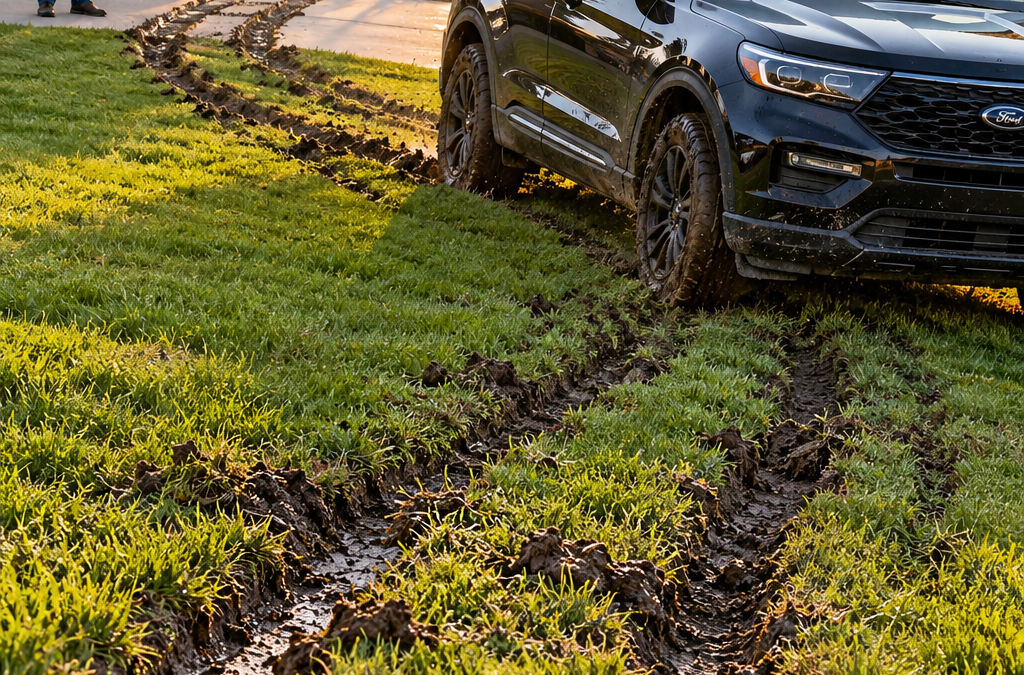
𝗙𝗨𝗟𝗟 𝗦𝗧𝗢𝗥𝗬
The lawn meant something to me, though probably more than it should have.
My father had been obsessive about his yard when I was growing up.
Not in a competitive suburban way.
He simply liked taking care of something visible.
His job had been unpredictable.
Factory maintenance.
Night shifts.
Layoffs.
Overtime.
Problems he could not control.
But Saturday morning grass was simple.
Mow straight.
Edge clean.
Water when needed.
Fix bare spots.
I inherited some of that.
My lawn was not perfect.
There were clover patches.
A maple tree that shaded one section too heavily.
Dandelions every spring no matter what I did.
But it was mine.
I had spent years getting the lower section healthy after drainage improvements.
Watching tires repeatedly cross it felt less like damage and more like disrespect.
The third crossing happened while I was away.
I came home from work and found fresh tracks.
The fourth happened two days later.
Then the fifth.
By then, there was practically a path.
The grass had been compressed flat.
Soil exposed in several spots.
Whoever was doing it had become comfortable enough to follow almost exactly the same line every time.
That changed the question.
It wasn’t:
Who accidentally drove here?
It was:
Who thinks they are entitled to keep doing this?
I considered installing a camera.
Then realized I already had one overlooking the garage.
I adjusted its angle.
The next morning, nothing.
Next afternoon, nothing.
Then on Saturday around eleven-thirty, my phone sent a motion alert.
I opened the camera feed.
White BMW.
Coming from the Crestwood side.
The car slowed at the curb.
Turned.
Drove directly across my grass.
Not cautiously.
Not accidentally.
Deliberately.
The driver cut diagonally through my property and exited near the second road.
I zoomed in.
The face was visible.
Karen Whitmore.
President of the Crestwood Hills HOA.
I knew her by sight.
Everyone did.
Late fifties.
Short blonde hair.
Always dressed as if she might be photographed at a ribbon cutting.
She had served as HOA president for almost eight years.
I had spoken to her maybe three times.
Once at a county drainage meeting.
Once about a lost dog.
Once when Crestwood wanted permission to temporarily stage landscaping equipment near my side boundary and I said yes.
Until then, I had no issue with her.
I saved the video.
Then waited.
The next day, the BMW appeared again.
This time I was outside.
I heard tires leave pavement.
Turned.
There she was.
She crossed exactly where the camera had shown.
As she reached the far edge, I raised one hand.
“Karen.”
She stopped.
Lowered the passenger window.
“Yes?”
I walked toward the road, keeping a few feet away from her car.
“Can I ask why you’re driving across my lawn?”
She looked almost confused by the question.
“This?”
She gestured behind her.
“Yes.”
“It’s the shortcut.”
I waited.
That was apparently the entire explanation.
“What shortcut?”
“Between Sycamore and Crestview.”
“I know where it goes.”
“Then you know.”
I looked back at the flattened grass.
“That’s my property.”
Karen nodded as though I had stated something irrelevant.
“Everyone uses it.”
“No, they don’t.”
“They have for years.”
“I’ve owned this house six years.”
“The previous owners allowed it.”
That caught my attention.
“Who told you that?”
“It was always open.”
“Open isn’t the same as permitted.”
She sighed.
“Nathan, this has never been a problem.”
“It is now.”
Her face tightened slightly.
“We’re talking about a strip of grass.”
“I’m talking about my land.”
“The shortcut saves HOA staff from driving all the way around the block.”
“How far is the road?”
She looked toward the intersection.
“You know how far.”
I did.
The legal public route added less than a minute.
Maybe forty-five seconds.
Possibly a minute and fifteen if somebody stopped at the intersection.
I looked at her.
“So you’re crossing my property to save a minute.”
“That’s oversimplifying it.”
“How?”
“It’s efficient.”
I almost laughed.
“Efficient for whom?”
She folded her arms.
“The board has discussed this access.”
That sentence changed everything.
Until then, I could have believed Karen had simply inherited an old habit.
Now I understood the board knew.
“You discussed crossing my lawn?”
“The access corridor.”
“It’s not an access corridor.”
“It has historically functioned as one.”
“Where’s the easement?”
She hesitated.
“We don’t need to get legalistic.”
“Then don’t call it an access corridor.”
Her face reddened.
“Nathan, nobody is hurting anything.”
I pointed toward the ruts.
“That grass disagrees.”
“We can repair it.”
“Or you can stop driving across it.”
She gave me the expression people use when they believe the other person is being unnecessarily difficult.
“You’re making this bigger than it needs to be.”
“No.”
I kept my voice calm.
“I’m making it exactly as big as the property line.”
Karen started the BMW forward.
Before she left, she said:
“I’ll discuss it with the board.”
“Good.”
Then she drove onto the public road.
For once.
That evening, I pulled out my closing documents.
Survey.
Plat.
Title report.
Old deed.
I spread everything across the dining room table.
Laura walked past.
“You’re doing the map thing.”
“I’m doing the map thing.”
“Should I be worried?”
“Not unless you plan to drive across the lawn.”
She sat beside me.
The survey was clear.
Our lower boundary extended beyond the visible lawn edge and wrapped the entire strip Karen had been crossing.
No public right-of-way.
No private access easement.
No utility access relevant to vehicles.
No HOA reservation.
Nothing.
The nearest Crestwood common property ended several feet beyond my boundary.
The subdivision map showed the proper road connection clearly.
Sycamore Lane to Ridgeview Drive.
Legal.
Paved.
Maintained.
Open.
The so-called shortcut had never been necessary.
It was simply convenient.
I checked historical aerial images online.
Years earlier, before I bought the property, the grass strip had apparently been more worn.
There may indeed have been informal use.
But informal use was not automatically permanent legal access.
Nothing in my title recognized a right for HOA vehicles.
I called the title company Monday morning.
Then an attorney I had used for a property drainage issue several years earlier.
Her name was Rachel Evans.
I sent the survey.
She called that afternoon.
“You’re outside the HOA, correct?”
“Completely.”
“No covenants?”
“None.”
“No easement in favor of Crestwood Hills?”
“None.”
“Have they given you any document claiming one?”
“No.”
“Then stop them.”
“That simple?”
“Don’t make it more complicated than it is.”
“What about historical use?”
“Long-term use can create legal arguments in some circumstances, but that doesn’t mean every shortcut becomes an easement because people got used to it.”
“So what should I do?”
“Put them on written notice.”
I did.
Short letter.
No threats.
No emotional language.
I stated that vehicles associated with Crestwood Hills had repeatedly crossed my parcel without permission.
I attached the survey.
I formally revoked any implied or informal permission that might have existed under prior ownership.
I instructed all HOA employees, board members, contractors, and agents to use public roads.
Certified mail.
Email copy.
Delivery confirmation.
Karen responded the next morning.
Two sentences.
The board acknowledges your correspondence and is reviewing historical access practices. You are advised not to interfere with established community operations while that review is ongoing.
I read it twice.
Laura read it once.
“What does that mean?”
“It means she plans to keep doing it.”
“Can she?”
“No.”
“So?”
I folded the letter.
“So now I know this isn’t going to stop because I asked.”
I did not want a fence.
That was my first thought.
I loved the open view.
The lower yard sloped toward mature trees and a drainage basin.
A six-foot privacy fence would solve the vehicle problem and ruin the landscape.
Boulders would work, but I worried about someone hitting one at night.
Concrete barriers would make my house look like a government facility.
I wanted something safe.
Legal.
Visible when needed.
Unobtrusive when not.
That is when I called Daniel Ruiz.
Daniel was a licensed landscape contractor who had installed retaining walls and drainage on several properties nearby.
He came out Tuesday morning.
I showed him the tire tracks.
Then the survey pins.
“What do you want?”
“Stop cars.”
“Fence.”
“No.”
“Boulders.”
“No.”
He looked at me.
“Moat?”
“Tempting.”
He laughed.
“What are you thinking?”
“Decorative posts.”
“Okay.”
“With retractable barriers between them.”
His face changed.
“Now you’re making this interesting.”
We walked the line.
Everything had to remain well inside my property.
Not on the boundary.
Not near public right-of-way.
I wanted no ambiguity.
Daniel proposed stone-faced bollard columns matching the house landscaping.
Between selected posts, low-profile retractable vehicle barriers could rise when activated.
When lowered, they would sit nearly flush and blend with the edge treatment.
A small sensor and remote control would operate them.
No spikes.
No hidden hazards.
Nothing designed to damage a vehicle.
That mattered.
I wanted to prevent entry.
Not create an accident.
Daniel checked county setback requirements.
Called in utility marking.
Prepared a simple site plan.
Rachel reviewed placement.
Everything legal.
Everything inside my parcel.
Installation started Thursday morning.
Karen drove past on the public road while the crew was working.
She slowed.
Did not stop.
I saw her looking.
Daniel noticed too.
“Friend?”
“Something like that.”
By afternoon, the work was finished.
Six decorative stone posts.
Low native grasses planted around them.
Barrier channels between two sections.
Electrical controls concealed inside one post.
When lowered, the system looked like upscale landscaping.
You had to know what you were seeing to recognize it as vehicle control.
Laura walked around it.
“This looks better than before.”
“That’s the idea.”
“And it won’t launch anybody’s BMW into the air?”
“No.”
“Good.”
“The barriers rise before the lawn line.”
“Also good.”
Daniel tested them.
Up.
Down.
Emergency stop.
Manual release.
Pressure sensor.
Everything worked.
I paid him.
He handed me the permit documentation and installation packet.
“Keep these.”
I laughed.
“You know me too well.”
I did not send Karen another letter.
The first one was enough.
She had been formally told not to cross.
I had no obligation to issue a press release announcing landscaping on my own property.
I expected we would wait days.
We waited about two hours.
Just after lunch, I heard the BMW.
I was in the garage.
Laura was upstairs.
The white car approached from Sycamore Lane.
Slowed.
Turned toward the grass.
Exactly like before.
Karen clearly expected the same path.
Then she saw the new posts.
The BMW stopped.
For a few seconds, she simply stared.
Then moved forward slightly.
The vehicle-detection system activated.
The retractable barriers rose.
Slowly.
Clearly.
Well before the BMW reached them.
Karen braked.
No contact.
No damage.
She sat there.
Hands on the steering wheel.
Expression frozen.
I walked out of the garage.
She opened the door.
“What is this?”
“Landscaping.”
“Don’t be cute.”
“I’m not.”
“You installed barriers.”
“Yes.”
“Across the community access.”
“No.”
“Across the route.”
“Across my lawn.”
Her voice sharpened.
“You cannot obstruct HOA access.”
I looked toward the public road.
“Your access is right there.”
“That’s not the established route.”
“Then show me the easement.”
“We’ve already discussed this.”
“You discussed it.”
“Same thing.”
“No.”
She stepped closer.
“The HOA has used this passage for years.”
“I gave you written notice terminating any informal use.”
“You can’t just do that.”
“Apparently I can.”
“You are creating an emergency-access problem.”
That was new.
“What emergency?”
“Community vehicles may need this route.”
“Fire trucks use the public street.”
“Maintenance.”
“Public street.”
“Security.”
“Public street.”
She pointed at the barriers.
“These are illegal.”
“No.”
“You didn’t submit them to architectural review.”
I stared at her.
Then actually laughed.
Karen looked offended.
“I’m not in your HOA.”
“Your property is adjacent.”
“Still not in it.”
“Changes affecting community appearance can fall under—”
“Stop.”
My voice was still calm.
But firmer.
“You don’t have architectural authority over my property.”
She took out her phone.
“Fine.”
“Who are you calling?”
“The board.”
“Tell them I said hello.”
She made one call.
Then another.
Within minutes, she was standing beside her BMW telling someone I had placed an illegal obstruction across community access.
I did not argue.
I had learned something over years of dealing with people:
Once someone decides they are going to summon authority, let authority arrive.
The facts become easier when a neutral person is looking at them.
About fifteen minutes later, a sheriff’s cruiser came down the road.
Deputy Mark Sullivan stepped out.
Mid-forties.
Calm.
Karen immediately walked toward him.
“Officer, thank God.”
Sullivan looked at her.
“Deputy.”
“Yes, deputy. This homeowner has installed a dangerous obstruction across an HOA access lane.”
He looked toward the stone posts.
Then toward me.
“Anyone hit it?”
“No.”
Karen answered anyway.
“Not yet.”
Sullivan looked at her.
“Okay.”
She continued.
“This has been used as a community crossing for years. He suddenly blocked it without permission.”
“Whose property?”
“Technically his, but—”
Sullivan raised one hand.
“Let’s start there.”
I nearly smiled.
He came to me.
“Sir?”
“Nathan Cole.”
“These yours?”
“Yes.”
“Installed today?”
“Yesterday.”
“Purpose?”
“To prevent vehicles from crossing my private lawn.”
He nodded.
“Property documents?”
“Inside.”
“I’ll wait.”
I returned with a folder.
Survey.
County parcel map.
Contractor plan.
Utility clearance.
Photos showing placement.
My certified notice to the HOA.
Sullivan read slowly.
Then walked the line himself.
He found two survey markers.
Checked distances.
Compared the barrier position.
The entire system sat several feet inside my property.
He looked toward the public road.
“Where does that go?”
“Ridgeview.”
“Connects to Sycamore?”
“Yes.”
He walked back to his cruiser.
Checked the county road map on his computer.
Returned.
Karen approached.
“Well?”
Sullivan looked at her.
“These barriers are on his property.”
“That’s not the issue.”
“It is one issue.”
“The HOA has access rights.”
“Do you have an easement?”
Karen crossed her arms.
“This route has been used historically.”
“Do you have a recorded easement?”
“The board has documentation.”
“Do you have it with you?”
“No.”
“Then I can’t enforce something you haven’t shown exists.”
She pointed at the ground.
“You can see the tracks.”
Sullivan looked.
“I can.”
“Doesn’t that prove use?”
“It proves vehicles drove here.”
“Exactly.”
“It doesn’t automatically prove a legal right.”
Her face tightened.
“This is absurd.”
Sullivan remained calm.
“There’s an open public road less than a hundred yards away.”
“It creates unnecessary travel.”
“How much?”
Karen said nothing.
I answered:
“Less than a minute.”
Sullivan looked toward her BMW.
Then toward the road.
“Ma’am, I’m not seeing an emergency here.”
“The barrier is dangerous.”
“It stopped before your vehicle reached it.”
“It could damage someone.”
“Then don’t drive into it.”
That sentence ended the practical argument.
Karen stared at him.
“You are taking his side.”
“No.”
Sullivan handed the survey back to me.
“I’m looking at the property line.”
He turned toward her.
“If the HOA believes it has a legal easement, you can have counsel address that through the proper civil process.”
“And until then?”
“Use the road.”
She looked as though those three words physically hurt.
“But we’ve always used this route.”
Sullivan shrugged slightly.
“Not today.”
For several seconds, nobody spoke.
Then Karen returned to the BMW.
Got in.
Started the engine.
Backed carefully away.
Turned onto Sycamore Lane.
Followed the public road.
The whole maneuver took perhaps fifty seconds longer than crossing my yard.
Sullivan watched her disappear.
Then looked at me.
“You’re going to hear more about this.”
“I assume so.”
“Keep the documents.”
“I will.”
He glanced at the folder.
“I can tell.”
Then he left.
I expected a legal threat by dinner.
Instead, Crestwood’s board apparently had an argument.
One member called me that evening.
His name was Paul Jensen.
I had met him once.
“Nathan?”
“Yes.”
“This is Paul from Crestwood.”
“I remember.”
“I wanted to ask something.”
“Go ahead.”
“Did Karen have permission to cross your property?”
“No.”
“Ever?”
“Not from me.”
“What about the old owners?”
“I don’t know what informal arrangement they may have had.”
“Was there an easement?”
“No.”
Silence.
Then:
“That’s what I thought.”
“Why?”
“We just pulled the plats.”
“And?”
“There’s no access easement.”
“Correct.”
He sounded embarrassed.
“I honestly thought that strip was HOA common area.”
“A lot of people apparently did.”
“Karen always called it the maintenance cut-through.”
“She called it that to me too.”
“Nobody checked.”
“There it is.”
Paul sighed.
“I’m sorry.”
“You didn’t drive across my lawn.”
“No, but I voted on things assuming the route was ours.”
I appreciated that.
“Then now you know.”
The board meeting that night became heated.
I learned pieces from Paul and another resident later.
Several board members had no idea the shortcut crossed my parcel.
Karen had described it for years as “legacy access.”
Nobody asked what legacy meant.
HOA landscapers occasionally used it.
Maintenance carts.
Karen.
A security vehicle.
Over time, habit became assumption.
Assumption became language.
Language became perceived authority.
That process fascinated me.
Nothing legal had changed.
Only what people believed.
Once the survey was projected onto the clubhouse wall, the argument became difficult to sustain.
My parcel shaded one color.
HOA common land another.
The shortcut sat clearly inside mine.
One board member reportedly asked:
“Why have we been driving over this man’s lawn?”
Karen answered:
“The prior owner never objected.”
Paul said:
“That’s not the same as owning it.”
Another member asked:
“Do we have any written permission?”
No.
“Any easement?”
No.
“Any agreement?”
No.
Then someone asked:
“Why are we spending legal time over forty-five seconds of driving?”
That was the question that finally killed the issue.
Crestwood’s attorney advised the board not to claim an easement without evidence.
He also reminded them my certified letter had formally revoked informal permission.
The board voted to instruct staff and officers to use public roads.
Karen voted against it.
The vote passed anyway.
I received the official letter two days later.
The HOA acknowledged no recorded vehicular easement had been identified across my parcel.
All HOA employees, officers, contractors, and vendors would use public roadways unless future written access was mutually agreed.
That was all I ever wanted.
Not apology.
Not payment.
Not revenge.
Stop driving across my lawn.
Simple.
Within a week, the old tracks began disappearing.
I raked the compressed sections.
Added topsoil.
Seeded.
Watered.
The weather cooperated.
Green returned.
The stone posts settled visually into the landscaping.
Neighbors started complimenting them.
One woman walking her dog stopped.
“Those are new, right?”
“Yes.”
“Beautiful.”
“Thank you.”
“What are they?”
“Boundary markers.”
That was technically true.
A teenager from Crestwood knew better.
He looked at the retractable panel seams.
“Those are barriers.”
“Good eye.”
“That’s awesome.”
“Hopefully boring.”
He laughed.
Karen did not use the shortcut again.
Neither did anyone else.
For about a month, I saw her BMW take the proper road.
Every time, it added less than a minute.
The neighborhood survived.
No maintenance collapse.
No emergency-response crisis.
No civilization-ending inconvenience.
Just a slightly longer turn.
Laura found the whole thing increasingly funny.
One morning we stood near the lower lawn drinking coffee.
Karen’s BMW passed on Ridgeview in the distance.
Laura looked at her watch.
“Tragic.”
“What?”
“She lost forty-eight seconds.”
“Thoughts and prayers.”
“Do you think Crestwood will recover?”
“Time will tell.”
We laughed.
That was when I realized the whole dispute had stopped bothering me.
My anger had never really been about grass.
Grass grows back.
What bothered me was the idea that repeated use could become ownership simply because nobody challenged it.
That is how boundaries disappear.
Not always through dramatic theft.
Sometimes through convenience.
Someone cuts across once.
Then twice.
Then everyone says:
We’ve always done it.
Eventually the person who objects gets treated like the unreasonable one.
That interested me enough to ask Rachel about it later.
“Why do people assume use creates rights?”
She smiled.
“Because habits feel official after enough time.”
“Legally?”
“Legally, facts matter.”
“Permission?”
“Matters.”
“Duration?”
“Can matter.”
“Documents?”
“Definitely.”
“Objection?”
“Very much.”
I looked toward the restored grass.
“So putting it in writing mattered.”
“Absolutely.”
“What if I’d just yelled at Karen?”
“Then you’d have a neighborhood argument.”
“And instead?”
“You created notice.”
That word sounded dull.
Notice.
But dull words often carry serious weight.
Notice.
Consent.
Boundary.
Easement.
Revocation.
Property law is full of ordinary words that become important when somebody tries to pretend assumptions are rights.
Months later, Crestwood replaced one of its maintenance contractors.
The new crew came to my house by mistake.
A truck slowed near the lower lawn.
I walked outside.
The driver stopped.
“Is this the cut-through to Sycamore?”
“No.”
He looked at his map.
“HOA map shows something here.”
“Old map.”
He looked at the stone posts.
“Ah.”
“Public road is around the corner.”
“Got it.”
He backed up.
No argument.
No phone calls.
No sheriff.
That was how easy the interaction could have been from the beginning.
The HOA also updated its internal maps.
Paul emailed me a copy.
The old “maintenance cut-through” label was gone.
PRIVATE PARCEL – NO ACCESS.
I stared at those four words longer than necessary.
Not because I needed the HOA’s map to establish ownership.
The county survey already did that.
But language matters.
A bad assumption had been embedded in the organization’s vocabulary.
Now it wasn’t.
The following spring, I reseeded the entire lower lawn.
Not because it needed that much work.
Because I wanted the tire path completely gone.
I rented an aerator.
Spread compost.
Seed.
Water.
Within six weeks, you could not tell where cars had crossed.
Daniel stopped by one afternoon.
He was doing another project nearby.
Looked at the grass.
“No tracks.”
“No.”
“Barrier still working?”
I triggered it.
The posts rose.
“Beautiful.”
“Hasn’t needed to stop anybody in months.”
“Best security system is the one people respect before they hit it.”
That was true.
The physical barrier solved the immediate problem.
But the survey solved the dispute.
Without the survey, the posts would have been a fight.
With it, they were simply landscaping inside a property boundary.
I thought about that distinction often.
People sometimes respond to property disputes emotionally.
Fence first.
Chain first.
Block first.
Anger first.
Sometimes that is understandable.
But if you do not know where your line actually is, you can create a bigger problem while trying to solve the first one.
I was fortunate.
My survey was recent.
Pins visible.
No ambiguous easement.
Everything clean.
So I used the paperwork before the stone.
That order mattered.
Karen remained HOA president for another year.
We rarely spoke.
Then one afternoon she appeared at my front door.
She did not drive across the lawn.
She parked on the road.
Walked up the driveway.
Rang the bell.
I opened it.
“Karen.”
“Nathan.”
She looked uncomfortable.
“I wanted to ask you something.”
“Okay.”
“Crestwood is replacing drainage pipe near the south entrance.”
“I heard.”
“We need temporary access for equipment.”
I waited.
She continued.
“It would be easier to stage one excavator near the lower edge of your property.”
There was a long pause.
“Are you asking permission?”
Her face tightened.
Then, to her credit:
“Yes.”
I almost smiled.
“For how long?”
“Two days.”
“What area?”
She showed me a site plan.
Specific section.
Far from the lawn we’d fought over.
Contractor insured.
Restoration included.
Everything documented.
I read it.
“That’s fine.”
Her eyebrows lifted.
“Really?”
“Yes.”
“I assumed you’d say no.”
“Why?”
“After everything.”
“This is different.”
“How?”
“You’re asking.”
She stared at me.
Then nodded.
“I suppose that’s fair.”
I signed a temporary access agreement Rachel drafted.
Two days.
Specific area.
No permanent rights created.
Contractor restored everything.
No drama.
That interaction mattered more to me than the earlier sheriff visit.
Karen finally understood the distinction I had been trying to explain.
Permission is not weakness.
Ownership does not mean saying no to everything.
It means your yes belongs to you.
The HOA needed access.
They asked.
I evaluated.
We agreed.
Everyone got what they needed.
No tire tracks.
No accusations.
No BMW stopped in front of rising barriers.
Just paperwork.
Years passed.
The decorative posts became part of the property.
People forgot why they were installed.
New Crestwood residents probably assume they have always been there.
The retractable barriers still work.
I test them every few months.
Mostly because machinery likes to fail when ignored.
The lawn still looks good.
Dad would approve.
Maybe criticize the edging.
He always did.
Sometimes I stand near that lower corner and think about how ridiculous the original conflict was.
A minute.
That was the entire incentive.
Someone decided one minute of saved driving justified repeatedly crossing private property.
Then habit inflated that convenience into perceived entitlement.
That is what amazed me.
Not Karen’s behavior specifically.
Human behavior generally.
We get used to something.
Then we start believing we deserve it.
A parking space.
A view.
A path.
A favor.
Someone else’s flexibility.
At first we appreciate it.
Then we expect it.
Then one day, when the owner says no, we call them difficult.
That is how courtesy becomes obligation in people’s minds.
The previous owners may genuinely have allowed vehicles across.
Maybe they told Karen:
Sure, go ahead.
Maybe they never noticed.
Maybe they did not care.
None of those possibilities bothered me.
What bothered me was Karen believing their tolerance permanently transferred with the deed.
It didn’t.
When I bought the property, I bought the right to decide how it was used, subject to whatever lawful recorded rights existed.
There were none.
That was the end of it.
The sheriff did not give me that right.
The contractor did not.
The barriers did not.
The survey documented it.
The deed conveyed it.
The rest was enforcement.
I saw Deputy Sullivan once at a gas station months later.
He recognized me.
“How’s the Great Lawn War?”
“Peace treaty holding.”
He laughed.
“Anybody hit the barriers?”
“No.”
“Good.”
“Karen uses the road.”
“Miracle.”
I smiled.
“Appreciate how you handled it.”
He shrugged.
“Property line was clear.”
“Still.”
“Those calls get ugly when people think ‘we’ve always done it’ means law.”
“Apparently.”
He filled his coffee.
Then said:
“You did the smart thing putting everything inside your line.”
“I had advice.”
“Most people don’t check.”
I knew what he meant.
People build fences on assumptions.
Place rocks near roads.
Block driveways.
Then discover easements.
Setbacks.
Rights-of-way.
Utility corridors.
The solution becomes another dispute.
I had no interest in that.
I wanted the least dramatic permanent answer.
That was what I got.
The irony is that the barrier almost never rises anymore.
There is no need.
Once Crestwood officially told staff there was no access, behavior changed.
The stone posts themselves became enough.
A visual reminder.
Boundary.
Not hostility.
Just definition.
That may be what I value most about them.
They do not look angry.
No giant PRIVATE PROPERTY signs.
No barbed wire.
No concrete wall.
Just landscaping.
But everybody understands.
This far.
No farther without permission.
Laura once asked whether I would install them again if I could rewind the whole thing.
“Immediately?”
“No.”
“Why?”
“I’d still ask first.”
“Even after five crossings?”
“Probably.”
“Then letter?”
“Yes.”
“Then barriers?”
“Yes.”
She nodded.
“You’re getting mature.”
“Don’t spread that around.”
Because despite everything, confrontation should not be the first tool.
People make mistakes.
Sometimes they inherit bad assumptions.
Sometimes nobody has looked at the map in twenty years.
Give them a chance to correct it.
Karen had that chance.
She chose not to.
Then the next step became necessary.
I never considered the barrier revenge.
Revenge would have been designed to harm.
Hidden cable.
Deep trench.
Something meant to damage a car.
I wanted the opposite.
I wanted nobody hurt.
Nobody’s property damaged.
Nobody able to say they did not understand.
That is why the system raised before a vehicle reached the grass.
It made the boundary visible.
Karen stopped.
That was success.
The BMW remained intact.
My lawn remained intact.
We both went home.
That is what good boundaries should do.
Prevent conflict, not create punishment.
Crestwood’s next president after Karen was Paul Jensen.
He lasted three years.
One of the first things he did was call me.
“Want to join the HOA?”
I laughed.
“Absolutely not.”
“Had to ask.”
“No, you didn’t.”
“Fair.”
We got along.
He even invited Laura and me to the neighborhood summer picnic despite us being outside the association.
I went.
Karen was there.
We nodded at each other.
Nothing awkward.
No speeches.
By then, the whole issue had become something people joked about.
One resident raised his drink.
“To public roads.”
I answered:
“Underrated infrastructure.”
Everyone laughed.
Even Karen.
That surprised me.
Maybe enough time had passed.
Maybe she had learned.
Maybe people simply grow tired of being angry.
Whatever the reason, I was glad.
I never wanted an enemy.
I wanted a lawn.
That is the simplest version.
Today, the lower corner is greener than it was before any vehicle crossed it.
The stone columns are partly softened by ornamental grass.
One has ivy beginning to climb the side.
The retractable system still disappears almost completely when lowered.
New neighbors sometimes ask what the posts are.
I usually say:
“Long story.”
Most don’t ask again.
Sometimes one does.
Then I tell them the truth.
An HOA president thought my lawn was a road.
I showed her it wasn’t.
People expect some explosive ending.
A lawsuit.
Arrest.
Thousands in damages.
Board collapse.
There was none.
There did not need to be.
The documents were clear.
The deputy was reasonable.
The board eventually corrected itself.
Karen took the road.
That was enough.
Not every dispute needs destruction to feel resolved.
Sometimes the best ending is grass growing back.
Tracks disappearing.
Traffic moving where it belongs.
A neighbor learning to ask.
A boundary no longer argued about.
There is a photograph on my phone from the morning after the first barrier test.
Early sunlight.
Fresh stone posts.
Wet grass.
No tire tracks beyond them.
I kept it for years.
Not because I was proud of beating Karen.
Because the picture represented something very simple.
Order restored without anyone getting hurt.
When people hear stories about HOA conflicts, they usually want the dramatic part.
The confrontation.
The yelling.
The moment somebody gets humiliated.
For me, the important moment happened later.
Karen standing at my front door with a site plan.
Asking permission.
That was the real ending.
Not because I had trained her.
Not because I had power over her.
Because two adults finally understood the same basic principle.
You can need something from another person’s property.
You can even have a very good reason.
That still does not make it yours.
Ask.
And accept the answer.
My father used to say a fence was only useful if both people knew which side they were on.
I never understood that as a child.
I thought fences were about keeping things out.
Now I think he meant something else.
Clear boundaries make good relationships possible.
Without them, every favor can become expectation.
Every shortcut can become entitlement.
Every act of patience can be mistaken for surrender.
The stone posts along my lawn are not a wall.
I can see through them.
Walk between them.
Lower the barriers.
Raise them.
They do not block the view.
They simply mark a decision.
This land begins here.
If you want to cross it, ask me.
That is all I wanted from the beginning.
The HOA president once told me everyone used my lawn.
Today nobody does.
Not because I yelled louder.
Not because I damaged a car.
Not because I threatened anyone.
Because I checked the survey, put the answer in writing, and made the property line impossible to pretend away.
The tire tracks disappeared.
The grass came back.
And the road forty-five seconds away remained exactly where it had been the entire time.
𝗧𝗛𝗘 𝗘𝗡𝗗
The HOA President Kept Driving Across My Lawn Like It Was Her Private Road Until I Changed One Thing
The first time the HOA vehicle crossed my front lawn, I assumed the driver had made a mistake.
By the fifth set of tire tracks carved through grass I had spent years maintaining, I realized somebody had decided my property was more convenient than the road—and whoever it was clearly expected me to keep accepting it.
My name is Nathan Cole.
I had owned my house for six years when the shortcut problem started.
The property sat on the outer edge of Crestwood Hills, close enough to the neighborhood that people assumed I belonged to its HOA but technically outside the recorded association boundary.
That distinction had never mattered much before.
I liked most of the people who lived there.
My road connected with theirs.
I used the same grocery store, the same hardware store, the same county park.
Some mornings I waved to Crestwood residents while they walked dogs past my mailbox.
My property just happened to be older than the development.
The house had been built long before Crestwood Hills existed.
So had the lot lines.
When the subdivision was eventually planned around us, the developer curved the new streets around several existing parcels rather than incorporating them.
Mine was one of those parcels.
I paid county taxes.
Maintained my own drainage.
Maintained my own fencing.
Paid no HOA dues.
Signed no covenants.
Asked no HOA permission.
That arrangement worked perfectly for years.
Then someone apparently discovered that driving across the lower corner of my lawn could save approximately forty-five seconds.
The first time I saw the tracks, I barely noticed them.
Two shallow lines across the grass between my driveway and the side street.
They started near the pavement on the Crestwood side, cut diagonally across perhaps sixty feet of my property, then rejoined another residential road.
I assumed a delivery driver had missed a turn.
Or a landscaping truck.
Maybe somebody avoiding construction.
It annoyed me, but not enough to think seriously about it.
I raked the tire marks.
Pressed some soil back into place.
Watered the damaged grass.
Then moved on.
Three days later, it happened again.
Same angle.
Same path.
This time the tracks were deeper.
The ground had been damp from rain.
Two muddy grooves cut through the lawn.
I stood there after breakfast staring at them.
My wife, Laura, came outside carrying coffee.
“What happened?”
“Someone drove through again.”
She looked toward the street.
“Same place?”
“Exactly.”
“Maybe they think it’s a road.”
“It’s grass.”
“People miss obvious things.”
I crouched and touched the rut.
“Not twice.”
Laura knew that tone.
“What are you thinking?”
“Nothing yet.”
That was true.
I was not angry yet.
Mostly curious.
The lawn meant something to me, though probably more than it should have.
My father had been obsessive about his yard when I was growing up.
Not in a competitive suburban way.
He simply liked taking care of something visible.
His job had been unpredictable.
Factory maintenance.
Night shifts.
Layoffs.
Overtime.
Problems he could not control.
But Saturday morning grass was simple.
Mow straight.
Edge clean.
Water when needed.
Fix bare spots.
I inherited some of that.
My lawn was not perfect.
There were clover patches.
A maple tree that shaded one section too heavily.
Dandelions every spring no matter what I did.
But it was mine.
I had spent years getting the lower section healthy after drainage improvements.
Watching tires repeatedly cross it felt less like damage and more like disrespect.
The third crossing happened while I was away.
I came home from work and found fresh tracks.
The fourth happened two days later.
Then the fifth.
By then, there was practically a path.
The grass had been compressed flat.
Soil exposed in several spots.
Whoever was doing it had become comfortable enough to follow almost exactly the same line every time.
That changed the question.
It wasn’t:
Who accidentally drove here?
It was:
Who thinks they are entitled to keep doing this?
I considered installing a camera.
Then realized I already had one overlooking the garage.
I adjusted its angle.
The next morning, nothing.
Next afternoon, nothing.
Then on Saturday around eleven-thirty, my phone sent a motion alert.
I opened the camera feed.
White BMW.
Coming from the Crestwood side.
The car slowed at the curb.
Turned.
Drove directly across my grass.
Not cautiously.
Not accidentally.
Deliberately.
The driver cut diagonally through my property and exited near the second road.
I zoomed in.
The face was visible.
Karen Whitmore.
President of the Crestwood Hills HOA.
I knew her by sight.
Everyone did.
Late fifties.
Short blonde hair.
Always dressed as if she might be photographed at a ribbon cutting.
She had served as HOA president for almost eight years.
I had spoken to her maybe three times.
Once at a county drainage meeting.
Once about a lost dog.
Once when Crestwood wanted permission to temporarily stage landscaping equipment near my side boundary and I said yes.
Until then, I had no issue with her.
I saved the video.
Then waited.
The next day, the BMW appeared again.
This time I was outside.
I heard tires leave pavement.
Turned.
There she was.
She crossed exactly where the camera had shown.
As she reached the far edge, I raised one hand.
“Karen.”
She stopped.
Lowered the passenger window.
“Yes?”
I walked toward the road, keeping a few feet away from her car.
“Can I ask why you’re driving across my lawn?”
She looked almost confused by the question.
“This?”
She gestured behind her.
“Yes.”
“It’s the shortcut.”
I waited.
That was apparently the entire explanation.
“What shortcut?”
“Between Sycamore and Crestview.”
“I know where it goes.”
“Then you know.”
I looked back at the flattened grass.
“That’s my property.”
Karen nodded as though I had stated something irrelevant.
“Everyone uses it.”
“No, they don’t.”
“They have for years.”
“I’ve owned this house six years.”
“The previous owners allowed it.”
That caught my attention.
“Who told you that?”
“It was always open.”
“Open isn’t the same as permitted.”
She sighed.
“Nathan, this has never been a problem.”
“It is now.”
Her face tightened slightly.
“We’re talking about a strip of grass.”
“I’m talking about my land.”
“The shortcut saves HOA staff from driving all the way around the block.”
“How far is the road?”
She looked toward the intersection.
“You know how far.”
I did.
The legal public route added less than a minute.
Maybe forty-five seconds.
Possibly a minute and fifteen if somebody stopped at the intersection.
I looked at her.
“So you’re crossing my property to save a minute.”
“That’s oversimplifying it.”
“How?”
“It’s efficient.”
I almost laughed.
“Efficient for whom?”
She folded her arms.
“The board has discussed this access.”
That sentence changed everything.
Until then, I could have believed Karen had simply inherited an old habit.
Now I understood the board knew.
“You discussed crossing my lawn?”
“The access corridor.”
“It’s not an access corridor.”
“It has historically functioned as one.”
“Where’s the easement?”
She hesitated.
“We don’t need to get legalistic.”
“Then don’t call it an access corridor.”
Her face reddened.
“Nathan, nobody is hurting anything.”
I pointed toward the ruts.
“That grass disagrees.”
“We can repair it.”
“Or you can stop driving across it.”
She gave me the expression people use when they believe the other person is being unnecessarily difficult.
“You’re making this bigger than it needs to be.”
“No.”
I kept my voice calm.
“I’m making it exactly as big as the property line.”
Karen started the BMW forward.
Before she left, she said:
“I’ll discuss it with the board.”
“Good.”
Then she drove onto the public road.
For once.
That evening, I pulled out my closing documents.
Survey.
Plat.
Title report.
Old deed.
I spread everything across the dining room table.
Laura walked past.
“You’re doing the map thing.”
“I’m doing the map thing.”
“Should I be worried?”
“Not unless you plan to drive across the lawn.”
She sat beside me.
The survey was clear.
Our lower boundary extended beyond the visible lawn edge and wrapped the entire strip Karen had been crossing.
No public right-of-way.
No private access easement.
No utility access relevant to vehicles.
No HOA reservation.
Nothing.
The nearest Crestwood common property ended several feet beyond my boundary.
The subdivision map showed the proper road connection clearly.
Sycamore Lane to Ridgeview Drive.
Legal.
Paved.
Maintained.
Open.
The so-called shortcut had never been necessary.
It was simply convenient.
I checked historical aerial images online.
Years earlier, before I bought the property, the grass strip had apparently been more worn.
There may indeed have been informal use.
But informal use was not automatically permanent legal access.
Nothing in my title recognized a right for HOA vehicles.
I called the title company Monday morning.
Then an attorney I had used for a property drainage issue several years earlier.
Her name was Rachel Evans.
I sent the survey.
She called that afternoon.
“You’re outside the HOA, correct?”
“Completely.”
“No covenants?”
“None.”
“No easement in favor of Crestwood Hills?”
“None.”
“Have they given you any document claiming one?”
“No.”
“Then stop them.”
“That simple?”
“Don’t make it more complicated than it is.”
“What about historical use?”
“Long-term use can create legal arguments in some circumstances, but that doesn’t mean every shortcut becomes an easement because people got used to it.”
“So what should I do?”
“Put them on written notice.”
I did.
Short letter.
No threats.
No emotional language.
I stated that vehicles associated with Crestwood Hills had repeatedly crossed my parcel without permission.
I attached the survey.
I formally revoked any implied or informal permission that might have existed under prior ownership.
I instructed all HOA employees, board members, contractors, and agents to use public roads.
Certified mail.
Email copy.
Delivery confirmation.
Karen responded the next morning.
Two sentences.
The board acknowledges your correspondence and is reviewing historical access practices. You are advised not to interfere with established community operations while that review is ongoing.
I read it twice.
Laura read it once.
“What does that mean?”
“It means she plans to keep doing it.”
“Can she?”
“No.”
“So?”
I folded the letter.
“So now I know this isn’t going to stop because I asked.”
I did not want a fence.
That was my first thought.
I loved the open view.
The lower yard sloped toward mature trees and a drainage basin.
A six-foot privacy fence would solve the vehicle problem and ruin the landscape.
Boulders would work, but I worried about someone hitting one at night.
Concrete barriers would make my house look like a government facility.
I wanted something safe.
Legal.
Visible when needed.
Unobtrusive when not.
That is when I called Daniel Ruiz.
Daniel was a licensed landscape contractor who had installed retaining walls and drainage on several properties nearby.
He came out Tuesday morning.
I showed him the tire tracks.
Then the survey pins.
“What do you want?”
“Stop cars.”
“Fence.”
“No.”
“Boulders.”
“No.”
He looked at me.
“Moat?”
“Tempting.”
He laughed.
“What are you thinking?”
“Decorative posts.”
“Okay.”
“With retractable barriers between them.”
His face changed.
“Now you’re making this interesting.”
We walked the line.
Everything had to remain well inside my property.
Not on the boundary.
Not near public right-of-way.
I wanted no ambiguity.
Daniel proposed stone-faced bollard columns matching the house landscaping.
Between selected posts, low-profile retractable vehicle barriers could rise when activated.
When lowered, they would sit nearly flush and blend with the edge treatment.
A small sensor and remote control would operate them.
No spikes.
No hidden hazards.
Nothing designed to damage a vehicle.
That mattered.
I wanted to prevent entry.
Not create an accident.
Daniel checked county setback requirements.
Called in utility marking.
Prepared a simple site plan.
Rachel reviewed placement.
Everything legal.
Everything inside my parcel.
Installation started Thursday morning.
Karen drove past on the public road while the crew was working.
She slowed.
Did not stop.
I saw her looking.
Daniel noticed too.
“Friend?”
“Something like that.”
By afternoon, the work was finished.
Six decorative stone posts.
Low native grasses planted around them.
Barrier channels between two sections.
Electrical controls concealed inside one post.
When lowered, the system looked like upscale landscaping.
You had to know what you were seeing to recognize it as vehicle control.
Laura walked around it.
“This looks better than before.”
“That’s the idea.”
“And it won’t launch anybody’s BMW into the air?”
“No.”
“Good.”
“The barriers rise before the lawn line.”
“Also good.”
Daniel tested them.
Up.
Down.
Emergency stop.
Manual release.
Pressure sensor.
Everything worked.
I paid him.
He handed me the permit documentation and installation packet.
“Keep these.”
I laughed.
“You know me too well.”
I did not send Karen another letter.
The first one was enough.
She had been formally told not to cross.
I had no obligation to issue a press release announcing landscaping on my own property.
I expected we would wait days.
We waited about two hours.
Just after lunch, I heard the BMW.
I was in the garage.
Laura was upstairs.
The white car approached from Sycamore Lane.
Slowed.
Turned toward the grass.
Exactly like before.
Karen clearly expected the same path.
Then she saw the new posts.
The BMW stopped.
For a few seconds, she simply stared.
Then moved forward slightly.
The vehicle-detection system activated.
The retractable barriers rose.
Slowly.
Clearly.
Well before the BMW reached them.
Karen braked.
No contact.
No damage.
She sat there.
Hands on the steering wheel.
Expression frozen.
I walked out of the garage.
She opened the door.
“What is this?”
“Landscaping.”
“Don’t be cute.”
“I’m not.”
“You installed barriers.”
“Yes.”
“Across the community access.”
“No.”
“Across the route.”
“Across my lawn.”
Her voice sharpened.
“You cannot obstruct HOA access.”
I looked toward the public road.
“Your access is right there.”
“That’s not the established route.”
“Then show me the easement.”
“We’ve already discussed this.”
“You discussed it.”
“Same thing.”
“No.”
She stepped closer.
“The HOA has used this passage for years.”
“I gave you written notice terminating any informal use.”
“You can’t just do that.”
“Apparently I can.”
“You are creating an emergency-access problem.”
That was new.
“What emergency?”
“Community vehicles may need this route.”
“Fire trucks use the public street.”
“Maintenance.”
“Public street.”
“Security.”
“Public street.”
She pointed at the barriers.
“These are illegal.”
“No.”
“You didn’t submit them to architectural review.”
I stared at her.
Then actually laughed.
Karen looked offended.
“I’m not in your HOA.”
“Your property is adjacent.”
“Still not in it.”
“Changes affecting community appearance can fall under—”
“Stop.”
My voice was still calm.
But firmer.
“You don’t have architectural authority over my property.”
She took out her phone.
“Fine.”
“Who are you calling?”
“The board.”
“Tell them I said hello.”
She made one call.
Then another.
Within minutes, she was standing beside her BMW telling someone I had placed an illegal obstruction across community access.
I did not argue.
I had learned something over years of dealing with people:
Once someone decides they are going to summon authority, let authority arrive.
The facts become easier when a neutral person is looking at them.
About fifteen minutes later, a sheriff’s cruiser came down the road.
Deputy Mark Sullivan stepped out.
Mid-forties.
Calm.
Karen immediately walked toward him.
“Officer, thank God.”
Sullivan looked at her.
“Deputy.”
“Yes, deputy. This homeowner has installed a dangerous obstruction across an HOA access lane.”
He looked toward the stone posts.
Then toward me.
“Anyone hit it?”
“No.”
Karen answered anyway.
“Not yet.”
Sullivan looked at her.
“Okay.”
She continued.
“This has been used as a community crossing for years. He suddenly blocked it without permission.”
“Whose property?”
“Technically his, but—”
Sullivan raised one hand.
“Let’s start there.”
I nearly smiled.
He came to me.
“Sir?”
“Nathan Cole.”
“These yours?”
“Yes.”
“Installed today?”
“Yesterday.”
“Purpose?”
“To prevent vehicles from crossing my private lawn.”
He nodded.
“Property documents?”
“Inside.”
“I’ll wait.”
I returned with a folder.
Survey.
County parcel map.
Contractor plan.
Utility clearance.
Photos showing placement.
My certified notice to the HOA.
Sullivan read slowly.
Then walked the line himself.
He found two survey markers.
Checked distances.
Compared the barrier position.
The entire system sat several feet inside my property.
He looked toward the public road.
“Where does that go?”
“Ridgeview.”
“Connects to Sycamore?”
“Yes.”
He walked back to his cruiser.
Checked the county road map on his computer.
Returned.
Karen approached.
“Well?”
Sullivan looked at her.
“These barriers are on his property.”
“That’s not the issue.”
“It is one issue.”
“The HOA has access rights.”
“Do you have an easement?”
Karen crossed her arms.
“This route has been used historically.”
“Do you have a recorded easement?”
“The board has documentation.”
“Do you have it with you?”
“No.”
“Then I can’t enforce something you haven’t shown exists.”
She pointed at the ground.
“You can see the tracks.”
Sullivan looked.
“I can.”
“Doesn’t that prove use?”
“It proves vehicles drove here.”
“Exactly.”
“It doesn’t automatically prove a legal right.”
Her face tightened.
“This is absurd.”
Sullivan remained calm.
“There’s an open public road less than a hundred yards away.”
“It creates unnecessary travel.”
“How much?”
Karen said nothing.
I answered:
“Less than a minute.”
Sullivan looked toward her BMW.
Then toward the road.
“Ma’am, I’m not seeing an emergency here.”
“The barrier is dangerous.”
“It stopped before your vehicle reached it.”
“It could damage someone.”
“Then don’t drive into it.”
That sentence ended the practical argument.
Karen stared at him.
“You are taking his side.”
“No.”
Sullivan handed the survey back to me.
“I’m looking at the property line.”
He turned toward her.
“If the HOA believes it has a legal easement, you can have counsel address that through the proper civil process.”
“And until then?”
“Use the road.”
She looked as though those three words physically hurt.
“But we’ve always used this route.”
Sullivan shrugged slightly.
“Not today.”
For several seconds, nobody spoke.
Then Karen returned to the BMW.
Got in.
Started the engine.
Backed carefully away.
Turned onto Sycamore Lane.
Followed the public road.
The whole maneuver took perhaps fifty seconds longer than crossing my yard.
Sullivan watched her disappear.
Then looked at me.
“You’re going to hear more about this.”
“I assume so.”
“Keep the documents.”
“I will.”
He glanced at the folder.
“I can tell.”
Then he left.
I expected a legal threat by dinner.
Instead, Crestwood’s board apparently had an argument.
One member called me that evening.
His name was Paul Jensen.
I had met him once.
“Nathan?”
“Yes.”
“This is Paul from Crestwood.”
“I remember.”
“I wanted to ask something.”
“Go ahead.”
“Did Karen have permission to cross your property?”
“No.”
“Ever?”
“Not from me.”
“What about the old owners?”
“I don’t know what informal arrangement they may have had.”
“Was there an easement?”
“No.”
Silence.
Then:
“That’s what I thought.”
“Why?”
“We just pulled the plats.”
“And?”
“There’s no access easement.”
“Correct.”
He sounded embarrassed.
“I honestly thought that strip was HOA common area.”
“A lot of people apparently did.”
“Karen always called it the maintenance cut-through.”
“She called it that to me too.”
“Nobody checked.”
“There it is.”
Paul sighed.
“I’m sorry.”
“You didn’t drive across my lawn.”
“No, but I voted on things assuming the route was ours.”
I appreciated that.
“Then now you know.”
The board meeting that night became heated.
I learned pieces from Paul and another resident later.
Several board members had no idea the shortcut crossed my parcel.
Karen had described it for years as “legacy access.”
Nobody asked what legacy meant.
HOA landscapers occasionally used it.
Maintenance carts.
Karen.
A security vehicle.
Over time, habit became assumption.
Assumption became language.
Language became perceived authority.
That process fascinated me.
Nothing legal had changed.
Only what people believed.
Once the survey was projected onto the clubhouse wall, the argument became difficult to sustain.
My parcel shaded one color.
HOA common land another.
The shortcut sat clearly inside mine.
One board member reportedly asked:
“Why have we been driving over this man’s lawn?”
Karen answered:
“The prior owner never objected.”
Paul said:
“That’s not the same as owning it.”
Another member asked:
“Do we have any written permission?”
No.
“Any easement?”
No.
“Any agreement?”
No.
Then someone asked:
“Why are we spending legal time over forty-five seconds of driving?”
That was the question that finally killed the issue.
Crestwood’s attorney advised the board not to claim an easement without evidence.
He also reminded them my certified letter had formally revoked informal permission.
The board voted to instruct staff and officers to use public roads.
Karen voted against it.
The vote passed anyway.
I received the official letter two days later.
The HOA acknowledged no recorded vehicular easement had been identified across my parcel.
All HOA employees, officers, contractors, and vendors would use public roadways unless future written access was mutually agreed.
That was all I ever wanted.
Not apology.
Not payment.
Not revenge.
Stop driving across my lawn.
Simple.
Within a week, the old tracks began disappearing.
I raked the compressed sections.
Added topsoil.
Seeded.
Watered.
The weather cooperated.
Green returned.
The stone posts settled visually into the landscaping.
Neighbors started complimenting them.
One woman walking her dog stopped.
“Those are new, right?”
“Yes.”
“Beautiful.”
“Thank you.”
“What are they?”
“Boundary markers.”
That was technically true.
A teenager from Crestwood knew better.
He looked at the retractable panel seams.
“Those are barriers.”
“Good eye.”
“That’s awesome.”
“Hopefully boring.”
He laughed.
Karen did not use the shortcut again.
Neither did anyone else.
For about a month, I saw her BMW take the proper road.
Every time, it added less than a minute.
The neighborhood survived.
No maintenance collapse.
No emergency-response crisis.
No civilization-ending inconvenience.
Just a slightly longer turn.
Laura found the whole thing increasingly funny.
One morning we stood near the lower lawn drinking coffee.
Karen’s BMW passed on Ridgeview in the distance.
Laura looked at her watch.
“Tragic.”
“What?”
“She lost forty-eight seconds.”
“Thoughts and prayers.”
“Do you think Crestwood will recover?”
“Time will tell.”
We laughed.
That was when I realized the whole dispute had stopped bothering me.
My anger had never really been about grass.
Grass grows back.
What bothered me was the idea that repeated use could become ownership simply because nobody challenged it.
That is how boundaries disappear.
Not always through dramatic theft.
Sometimes through convenience.
Someone cuts across once.
Then twice.
Then everyone says:
We’ve always done it.
Eventually the person who objects gets treated like the unreasonable one.
That interested me enough to ask Rachel about it later.
“Why do people assume use creates rights?”
She smiled.
“Because habits feel official after enough time.”
“Legally?”
“Legally, facts matter.”
“Permission?”
“Matters.”
“Duration?”
“Can matter.”
“Documents?”
“Definitely.”
“Objection?”
“Very much.”
I looked toward the restored grass.
“So putting it in writing mattered.”
“Absolutely.”
“What if I’d just yelled at Karen?”
“Then you’d have a neighborhood argument.”
“And instead?”
“You created notice.”
That word sounded dull.
Notice.
But dull words often carry serious weight.
Notice.
Consent.
Boundary.
Easement.
Revocation.
Property law is full of ordinary words that become important when somebody tries to pretend assumptions are rights.
Months later, Crestwood replaced one of its maintenance contractors.
The new crew came to my house by mistake.
A truck slowed near the lower lawn.
I walked outside.
The driver stopped.
“Is this the cut-through to Sycamore?”
“No.”
He looked at his map.
“HOA map shows something here.”
“Old map.”
He looked at the stone posts.
“Ah.”
“Public road is around the corner.”
“Got it.”
He backed up.
No argument.
No phone calls.
No sheriff.
That was how easy the interaction could have been from the beginning.
The HOA also updated its internal maps.
Paul emailed me a copy.
The old “maintenance cut-through” label was gone.
PRIVATE PARCEL – NO ACCESS.
I stared at those four words longer than necessary.
Not because I needed the HOA’s map to establish ownership.
The county survey already did that.
But language matters.
A bad assumption had been embedded in the organization’s vocabulary.
Now it wasn’t.
The following spring, I reseeded the entire lower lawn.
Not because it needed that much work.
Because I wanted the tire path completely gone.
I rented an aerator.
Spread compost.
Seed.
Water.
Within six weeks, you could not tell where cars had crossed.
Daniel stopped by one afternoon.
He was doing another project nearby.
Looked at the grass.
“No tracks.”
“No.”
“Barrier still working?”
I triggered it.
The posts rose.
“Beautiful.”
“Hasn’t needed to stop anybody in months.”
“Best security system is the one people respect before they hit it.”
That was true.
The physical barrier solved the immediate problem.
But the survey solved the dispute.
Without the survey, the posts would have been a fight.
With it, they were simply landscaping inside a property boundary.
I thought about that distinction often.
People sometimes respond to property disputes emotionally.
Fence first.
Chain first.
Block first.
Anger first.
Sometimes that is understandable.
But if you do not know where your line actually is, you can create a bigger problem while trying to solve the first one.
I was fortunate.
My survey was recent.
Pins visible.
No ambiguous easement.
Everything clean.
So I used the paperwork before the stone.
That order mattered.
Karen remained HOA president for another year.
We rarely spoke.
Then one afternoon she appeared at my front door.
She did not drive across the lawn.
She parked on the road.
Walked up the driveway.
Rang the bell.
I opened it.
“Karen.”
“Nathan.”
She looked uncomfortable.
“I wanted to ask you something.”
“Okay.”
“Crestwood is replacing drainage pipe near the south entrance.”
“I heard.”
“We need temporary access for equipment.”
I waited.
She continued.
“It would be easier to stage one excavator near the lower edge of your property.”
There was a long pause.
“Are you asking permission?”
Her face tightened.
Then, to her credit:
“Yes.”
I almost smiled.
“For how long?”
“Two days.”
“What area?”
She showed me a site plan.
Specific section.
Far from the lawn we’d fought over.
Contractor insured.
Restoration included.
Everything documented.
I read it.
“That’s fine.”
Her eyebrows lifted.
“Really?”
“Yes.”
“I assumed you’d say no.”
“Why?”
“After everything.”
“This is different.”
“How?”
“You’re asking.”
She stared at me.
Then nodded.
“I suppose that’s fair.”
I signed a temporary access agreement Rachel drafted.
Two days.
Specific area.
No permanent rights created.
Contractor restored everything.
No drama.
That interaction mattered more to me than the earlier sheriff visit.
Karen finally understood the distinction I had been trying to explain.
Permission is not weakness.
Ownership does not mean saying no to everything.
It means your yes belongs to you.
The HOA needed access.
They asked.
I evaluated.
We agreed.
Everyone got what they needed.
No tire tracks.
No accusations.
No BMW stopped in front of rising barriers.
Just paperwork.
Years passed.
The decorative posts became part of the property.
People forgot why they were installed.
New Crestwood residents probably assume they have always been there.
The retractable barriers still work.
I test them every few months.
Mostly because machinery likes to fail when ignored.
The lawn still looks good.
Dad would approve.
Maybe criticize the edging.
He always did.
Sometimes I stand near that lower corner and think about how ridiculous the original conflict was.
A minute.
That was the entire incentive.
Someone decided one minute of saved driving justified repeatedly crossing private property.
Then habit inflated that convenience into perceived entitlement.
That is what amazed me.
Not Karen’s behavior specifically.
Human behavior generally.
We get used to something.
Then we start believing we deserve it.
A parking space.
A view.
A path.
A favor.
Someone else’s flexibility.
At first we appreciate it.
Then we expect it.
Then one day, when the owner says no, we call them difficult.
That is how courtesy becomes obligation in people’s minds.
The previous owners may genuinely have allowed vehicles across.
Maybe they told Karen:
Sure, go ahead.
Maybe they never noticed.
Maybe they did not care.
None of those possibilities bothered me.
What bothered me was Karen believing their tolerance permanently transferred with the deed.
It didn’t.
When I bought the property, I bought the right to decide how it was used, subject to whatever lawful recorded rights existed.
There were none.
That was the end of it.
The sheriff did not give me that right.
The contractor did not.
The barriers did not.
The survey documented it.
The deed conveyed it.
The rest was enforcement.
I saw Deputy Sullivan once at a gas station months later.
He recognized me.
“How’s the Great Lawn War?”
“Peace treaty holding.”
He laughed.
“Anybody hit the barriers?”
“No.”
“Good.”
“Karen uses the road.”
“Miracle.”
I smiled.
“Appreciate how you handled it.”
He shrugged.
“Property line was clear.”
“Still.”
“Those calls get ugly when people think ‘we’ve always done it’ means law.”
“Apparently.”
He filled his coffee.
Then said:
“You did the smart thing putting everything inside your line.”
“I had advice.”
“Most people don’t check.”
I knew what he meant.
People build fences on assumptions.
Place rocks near roads.
Block driveways.
Then discover easements.
Setbacks.
Rights-of-way.
Utility corridors.
The solution becomes another dispute.
I had no interest in that.
I wanted the least dramatic permanent answer.
That was what I got.
The irony is that the barrier almost never rises anymore.
There is no need.
Once Crestwood officially told staff there was no access, behavior changed.
The stone posts themselves became enough.
A visual reminder.
Boundary.
Not hostility.
Just definition.
That may be what I value most about them.
They do not look angry.
No giant PRIVATE PROPERTY signs.
No barbed wire.
No concrete wall.
Just landscaping.
But everybody understands.
This far.
No farther without permission.
Laura once asked whether I would install them again if I could rewind the whole thing.
“Immediately?”
“No.”
“Why?”
“I’d still ask first.”
“Even after five crossings?”
“Probably.”
“Then letter?”
“Yes.”
“Then barriers?”
“Yes.”
She nodded.
“You’re getting mature.”
“Don’t spread that around.”
Because despite everything, confrontation should not be the first tool.
People make mistakes.
Sometimes they inherit bad assumptions.
Sometimes nobody has looked at the map in twenty years.
Give them a chance to correct it.
Karen had that chance.
She chose not to.
Then the next step became necessary.
I never considered the barrier revenge.
Revenge would have been designed to harm.
Hidden cable.
Deep trench.
Something meant to damage a car.
I wanted the opposite.
I wanted nobody hurt.
Nobody’s property damaged.
Nobody able to say they did not understand.
That is why the system raised before a vehicle reached the grass.
It made the boundary visible.
Karen stopped.
That was success.
The BMW remained intact.
My lawn remained intact.
We both went home.
That is what good boundaries should do.
Prevent conflict, not create punishment.
Crestwood’s next president after Karen was Paul Jensen.
He lasted three years.
One of the first things he did was call me.
“Want to join the HOA?”
I laughed.
“Absolutely not.”
“Had to ask.”
“No, you didn’t.”
“Fair.”
We got along.
He even invited Laura and me to the neighborhood summer picnic despite us being outside the association.
I went.
Karen was there.
We nodded at each other.
Nothing awkward.
No speeches.
By then, the whole issue had become something people joked about.
One resident raised his drink.
“To public roads.”
I answered:
“Underrated infrastructure.”
Everyone laughed.
Even Karen.
That surprised me.
Maybe enough time had passed.
Maybe she had learned.
Maybe people simply grow tired of being angry.
Whatever the reason, I was glad.
I never wanted an enemy.
I wanted a lawn.
That is the simplest version.
Today, the lower corner is greener than it was before any vehicle crossed it.
The stone columns are partly softened by ornamental grass.
One has ivy beginning to climb the side.
The retractable system still disappears almost completely when lowered.
New neighbors sometimes ask what the posts are.
I usually say:
“Long story.”
Most don’t ask again.
Sometimes one does.
Then I tell them the truth.
An HOA president thought my lawn was a road.
I showed her it wasn’t.
People expect some explosive ending.
A lawsuit.
Arrest.
Thousands in damages.
Board collapse.
There was none.
There did not need to be.
The documents were clear.
The deputy was reasonable.
The board eventually corrected itself.
Karen took the road.
That was enough.
Not every dispute needs destruction to feel resolved.
Sometimes the best ending is grass growing back.
Tracks disappearing.
Traffic moving where it belongs.
A neighbor learning to ask.
A boundary no longer argued about.
There is a photograph on my phone from the morning after the first barrier test.
Early sunlight.
Fresh stone posts.
Wet grass.
No tire tracks beyond them.
I kept it for years.
Not because I was proud of beating Karen.
Because the picture represented something very simple.
Order restored without anyone getting hurt.
When people hear stories about HOA conflicts, they usually want the dramatic part.
The confrontation.
The yelling.
The moment somebody gets humiliated.
For me, the important moment happened later.
Karen standing at my front door with a site plan.
Asking permission.
That was the real ending.
Not because I had trained her.
Not because I had power over her.
Because two adults finally understood the same basic principle.
You can need something from another person’s property.
You can even have a very good reason.
That still does not make it yours.
Ask.
And accept the answer.
My father used to say a fence was only useful if both people knew which side they were on.
I never understood that as a child.
I thought fences were about keeping things out.
Now I think he meant something else.
Clear boundaries make good relationships possible.
Without them, every favor can become expectation.
Every shortcut can become entitlement.
Every act of patience can be mistaken for surrender.
The stone posts along my lawn are not a wall.
I can see through them.
Walk between them.
Lower the barriers.
Raise them.
They do not block the view.
They simply mark a decision.
This land begins here.
If you want to cross it, ask me.
That is all I wanted from the beginning.
The HOA president once told me everyone used my lawn.
Today nobody does.
Not because I yelled louder.
Not because I damaged a car.
Not because I threatened anyone.
Because I checked the survey, put the answer in writing, and made the property line impossible to pretend away.
The tire tracks disappeared.
The grass came back.
And the road forty-five seconds away remained exactly where it had been the entire time.








