𝗙𝗨𝗟𝗟 𝗦𝗧𝗢𝗥𝗬 The HOA President Had My Truck Dragged Away at Dawn, Then Threatened to Take My Home When I Refused to Surrender
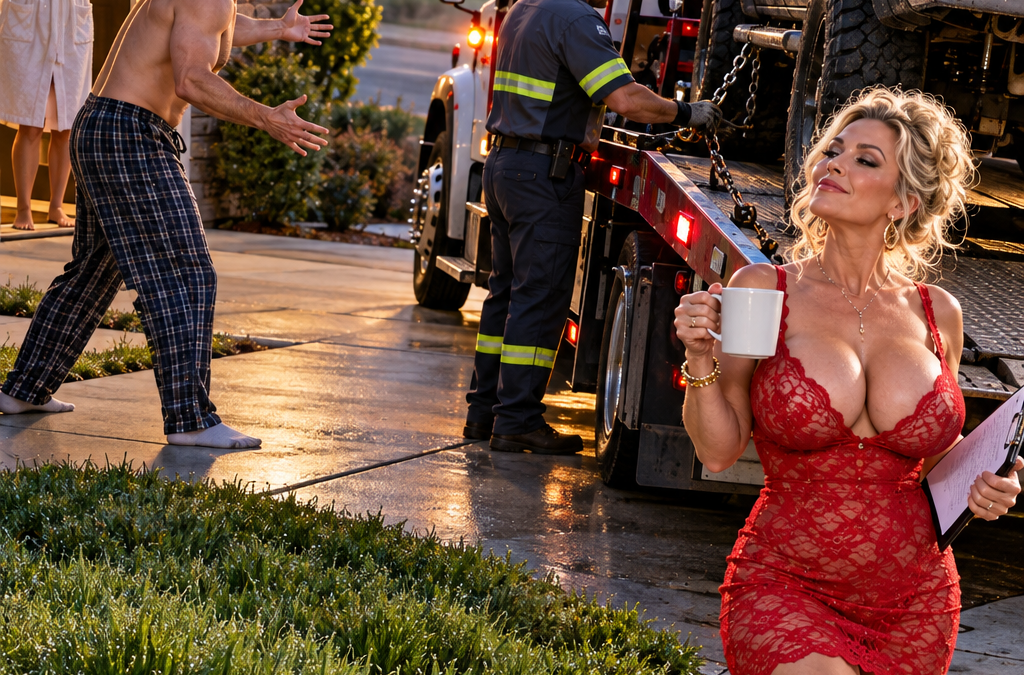
𝗙𝗨𝗟𝗟 𝗦𝗧𝗢𝗥𝗬
That was pretty much my philosophy when Jenna and I decided to buy our house.
We wanted a place with a decent backyard where our daughter could play.
Somewhere with good schools, quiet streets, and enough room for my truck without having to park it three blocks away.
Brook Haven Estates seemed perfect.
The houses were neat without looking expensive enough to make us uncomfortable.
There were mature trees lining the sidewalks, small flower beds beside the mailboxes, and a community clubhouse that looked like something out of a real estate brochure.
When we first toured the property, our daughter ran straight into the backyard and began explaining where she wanted her swing set.
Jenna stood beside me near the sliding glass door.
“It’s a little bigger than we planned,” she whispered.
I looked at the yard.
Then at the garage.
Then at our daughter, who was already pretending the oak tree belonged to her.
“Maybe that’s a good thing.”
Jenna smiled.
It was the kind of smile that made every overtime shift and every canceled vacation seem worth it.
We signed the paperwork three weeks later.
I thought the hardest part would be unpacking.
I was wrong.
The first time I saw Carly Whitfield, she was standing near the community entrance talking to a landscaper.
She was forty years old, strikingly beautiful, with long blonde hair, immaculate makeup, and an exaggerated hourglass figure that she displayed with unapologetic confidence.
Her favorite outfit was a tight red lace dress with a low neckline and a fitted waist. It emphasized her generous bust and made her impossible to overlook whenever she walked into a room.
She wore that dress so consistently that it almost seemed like a uniform.
Sometimes she added a blazer.
Sometimes a silk robe when she stepped outside early.
But underneath, there was always that same unmistakable red lace.
She knew she attracted attention.
And she knew how to use it.
Her manner could shift from flirtatious charm to icy contempt in the space of a heartbeat.
People who agreed with her received bright smiles and affectionate touches on the arm.
People who challenged her got something very different.
I learned that distinction sooner than I expected.
Carly had lived in Brook Haven for fifteen years.
During that time, she’d become the neighborhood’s dominant political figure, even before officially taking the presidency.
Three previous board presidents had resigned after conflicts with her.
At the time, I didn’t know that.
All I knew was that she was a friendly-looking woman standing near the entrance with a clipboard.
She waved when I drove past.
I waved back.
That was our first interaction.
Our second came two weeks later.
I found a violation notice attached to my front door.
It stated that my pickup truck violated Section 4.2 of the community’s residential vehicle regulations.
I stood on the porch reading it.
Then looked at the driveway.
My truck was a dark blue, full-size pickup.
Four doors.
Factory suspension.
Standard tires.
No commercial signage.
No company equipment.
Nothing unusual except the small dent near the rear bumper that I’d been meaning to repair.
It was the truck I used to take my daughter to soccer practice, bring home lumber from the hardware store, and haul mulch for the yard.
I had owned it for years.
According to the HOA, however, it was an unacceptable commercial-style vehicle.
I laughed.
Actually laughed.
I assumed somebody had made a clerical error.
I showed the notice to Jenna.
She read it, looked through the window at the truck, and raised an eyebrow.
“Are they serious?”
“I doubt it. Probably somebody checked the wrong box.”
“Can you call them?”
“Of course.”
I set the notice on the kitchen counter.
At that point, the idea that a pickup truck could threaten our family’s security seemed ridiculous.
The following afternoon, our neighbor Denise leaned over the backyard fence while I was assembling the swing set.
She was a middle-aged woman with short brown hair and a practical personality. She rarely spoke unless she had something useful to say.
That day, she seemed unusually tense.
“Ray, did you get a letter about your truck?”
I stopped tightening a bolt.
“Yeah. Why?”
She glanced toward the street.
“Carly’s building a file on you.”
I laughed.
“A file?”
Denise didn’t smile.
“I’m serious.”
“For what? Owning a pickup?”
“That’s how she starts.”
I leaned against the swing-set frame.
“Denise, it’s a parking notice. I’ll call the office, explain the situation, and we’ll move on.”
She looked at me for a long moment.
“Last year, the Andersons lost their house after a fight over HOA fines.”
I frowned.
“What kind of fines?”
“Grass height. Landscaping. Things that started small.”
My smile disappeared.
“Are you saying they were foreclosed on over their lawn?”
“That’s what the dispute became.”
I stared at her.
“That can’t be the whole story.”
“Maybe not. But it should tell you something.”
She lowered her voice.
“Carly doesn’t like people questioning her.”
I thanked her for the warning.
Then went back to assembling the swing set.
I remember thinking Denise was probably exaggerating.
People disliked HOA presidents all the time.
Someone always complained about the rules.
Surely there was more to the Andersons’ situation.
I didn’t understand that denial was one of the reasons Carly had remained powerful for so long.
Every new resident assumed the previous victims must have done something wrong.
Until the notices started arriving at their own doors.
The second letter came five days later.
This one included a fifty-dollar fine.
My truck was described as an oversized commercial-grade vehicle creating an aesthetic disturbance and reducing neighborhood property values.
I read that sentence three times.
An aesthetic disturbance.
I walked outside and examined my truck as though it might have transformed overnight into an eighteen-wheeler.
Jenna watched from the doorway.
“Well?”
“Apparently, I’ve been driving a public nuisance.”
She smiled weakly.
“Can we just fix whatever they want?”
“There’s nothing to fix.”
I called the HOA office.
A woman answered and told me that Carly personally reviewed every violation before it was issued.
“Then I’d like to speak with Carly.”
“Mrs. Whitfield handles enforcement matters at board meetings.”
“When’s the next meeting?”
“Thursday evening.”
I wrote down the time.
Then I hung up.
Still, I wasn’t angry.
Not yet.
I genuinely believed a reasonable conversation would settle everything.
On Thursday, I put on a clean button-down shirt, gathered my vehicle registration and HOA documents, and went to the clubhouse.
I expected maybe ten people sitting around a folding table.
Instead, I walked into a room arranged like a miniature courtroom.
Carly sat at the head of a long table.
A small wooden gavel rested beside her paperwork.
Two board members sat on either side, looking uncomfortable and largely silent.
She wore her usual red lace dress beneath a fitted black blazer.
When I entered, she looked up and smiled.
“Mr. Doyle.”
Something about her tone told me she had been expecting me.
I waited through several agenda items before my turn came.
Finally, Carly looked at her clipboard.
“We have a residential vehicle compliance matter.”
I stood.
“That’s me.”
She glanced at my paperwork.
“Your vehicle falls within the prohibited commercial-grade classification.”
“It’s a personal pickup truck.”
“The regulations are clear.”
“Then maybe you can show me where my truck fits that definition.”
She leaned back.
“It’s a large utility vehicle.”
“It’s a factory-stock pickup.”
“Those are often used commercially.”
“So are minivans. So are SUVs.”
Her smile tightened.
“Mr. Doyle, we’re not discussing hypothetical vehicles.”
“Neither am I. I’m discussing the truck parked in my driveway.”
One of the board members shifted in his chair.
Carly noticed.
She picked up her gavel.
“Section 4.2 exists to protect the residential character of our neighborhood.”
“I understand that. But I use my truck to take my daughter to school and soccer practice. I’m not hauling freight.”
“The bylaws don’t care about your intentions.”
She leaned forward.
“Only your compliance.”
The room went quiet.
I looked at the other board members.
Neither met my eyes.
“Can I appeal this?”
“You’re doing so now.”
“Then I’m asking the board to reconsider.”
Carly wrote something on her clipboard.
“Appeal denied.”
I stared at her.
“There wasn’t even a vote.”
“Further noncompliance may result in additional fines.”
She looked toward the next resident.
“Moving on.”
I stood there for another second.
Then gathered my papers.
By the time I reached the parking lot, I was furious.
Not because I’d lost fifty dollars.
Because the meeting hadn’t been a discussion.
It had been a performance designed to remind me who held power.
Within a week, another violation arrived.
This time, my trash cans had allegedly been visible outside the approved collection window.
I checked our security camera footage.
The cans had been brought inside before the deadline.
I sent the screenshots to the HOA.
The response stated that the violation had already been processed.
No explanation.
No acknowledgment of the evidence.
Just another charge.
When I complained, Denise came over that evening.
She listened quietly.
Then said, “Now you understand.”
I shook my head.
“She can’t just make up violations.”
“She doesn’t think anyone will stop her.”
“Then somebody should.”
Denise looked toward my house.
Through the window, Jenna was helping our daughter with homework.
“You have a family, Ray. That’s what she counts on.”
“What do you mean?”
“She makes fighting so exhausting that people decide peace is worth the money.”
I looked at the notice in my hand.
Denise continued.
“She likes control. Once she realizes you’re afraid of losing something, she pushes harder.”
“So what am I supposed to do?”
“Fight smart.”
I almost laughed.
“What’s that supposed to mean?”
“Don’t give her a scene. Give her a record.”
That night, I created a folder on my computer.
I saved the original truck violation, the fine, the trash-can notice, and every email.
I copied the HOA bylaws into a separate folder.
Then I began photographing my driveway every morning.
Every notice was scanned.
Every payment demand was recorded.
Every phone call was followed by an email confirming what had been discussed.
It felt excessive.
I didn’t realize those files would eventually become evidence in court.
For the next several weeks, Carly found new ways to make our lives miserable.
Our living-room curtains were allegedly the wrong shade when viewed from the street.
A garden gnome near our flower bed was described as excessively whimsical.
The portable basketball hoop I’d purchased for our daughter was deemed structurally noncompliant, although nobody could explain which provision it violated.
Every notice carried Carly’s signature.
Every penalty seemed slightly more aggressive than the last.
I started dreading the sound of the mailbox closing.
Some mornings, Jenna would retrieve the mail before I got home.
She would place the latest envelope on the kitchen counter without saying anything.
I could tell by her expression whether another letter had arrived.
One evening, she sat across from me while I reviewed a new fine.
“Ray, maybe we should just pay them.”
I looked up.
“We’ve already paid some.”
“I know.”
“And it didn’t stop.”
She rubbed her forehead.
“I don’t care about proving a point. I just want our daughter to feel comfortable here.”
That hurt.
Because I wanted exactly the same thing.
I looked through the window at the swing set.
Our daughter was outside, laughing as she tried to make the swing go higher.
“I know,” I said quietly.
“Then maybe this isn’t worth it.”
I stared at the notice.
“Maybe.”
But I didn’t believe it.
The next morning, I began photographing other properties around Brook Haven.
Not to embarrass neighbors.
To compare enforcement.
Two streets over, an SUV with oversized tires sat in a driveway.
Another home had a fishing boat parked beside the garage.
Several houses had mismatched curtains.
A large decorative statue stood near one front porch.
None appeared to be receiving the same relentless enforcement.
Then I noticed something that made the situation even stranger.
Across the street lived Frank, a retired police officer in his late sixties.
He owned a pickup nearly identical to mine.
Same general size.
Same type of suspension.
No special storage building.
It sat in his driveway every day.
I walked over one afternoon.
“Frank, can I ask you something?”
He was stacking firewood beside his garage.
“Sure.”
“Has the HOA ever fined you for your truck?”
He looked at mine across the street.
Then back at me.
“Nope.”
“Not once?”
“Not once.”
“Any idea why?”
He gave me a dry smile.
“Carly likes me.”
I waited.
He shrugged.
“I bring her firewood every winter.”
I stared at him.
“That’s the difference?”
Frank picked up another log.
“That’s the only difference I know about.”
Then he looked directly at me.
“Ray, the rules around here have never really been about the rules.”
I understood what he meant.
Residents who praised Carly, helped her, and avoided disagreeing with her seemed to enjoy considerable flexibility.
People she disliked received a very different interpretation of the bylaws.
I wasn’t being punished because of my truck.
I was being punished because I had questioned her authority in public.
Once I saw that pattern, I couldn’t unsee it.
The fines climbed to two hundred dollars per week.
New notices warned of additional collection charges and a possible lien against our home.
Jenna stopped opening HOA emails.
I began checking my bank account more often than necessary, calculating what would happen if we had to spend thousands of dollars defending ourselves.
Our mortgage was manageable.
Our savings were real.
But neither was unlimited.
And the thought that someone could threaten our house over my truck made my stomach turn.
I finally called an attorney.
Her name was Priya Anand.
She specialized in property disputes and homeowners association litigation.
Her office was in a brick building downtown, with legal books stacked along one wall and a large wooden desk covered in organized files.
I arrived carrying a thick binder.
Priya looked at it.
“That’s quite a collection.”
“You haven’t seen the photographs.”
She smiled slightly.
“Then let’s start at the beginning.”
For nearly an hour, I explained everything.
The pickup.
The first fifty-dollar fine.
The trash cans.
The curtains.
The garden gnome.
The basketball hoop.
The other vehicles that were never cited.
Priya listened carefully.
Then she spread the photographs across her desk.
“You’ve documented similar vehicles receiving different treatment.”
“Yes.”
“And the association has not identified a clear distinction between them?”
“Not one they can explain.”
She nodded.
“Selective enforcement can be a serious legal issue.”
I leaned forward.
“So I’m not crazy?”
“No. But whether their conduct is legally actionable depends on the governing documents, procedures, and evidence.”
She tapped the binder.
“Keep doing what you’re doing. Save everything. Don’t argue in person if you can avoid it.”
“What if she keeps increasing the fines?”
“Then each improper action potentially adds to the record.”
I looked down at the notices.
“I’m tired of being treated like a criminal in my own driveway.”
Priya’s expression softened.
“I understand. But don’t give Carly a confrontation she can twist into a complaint against you.”
She closed the binder.
“Let her put her decisions in writing.”
A few days later, Carly did exactly that.
And she made a mistake that changed everything.
The email arrived on a Monday morning.
It was a response to a complaint I’d submitted about the vehicle classification.
Carly had apparently intended to forward an internal message to another board member.
Instead, she included me in the correspondence.
The relevant sentence appeared halfway down the email chain.
He’ll sell within a year, just like the Hendersons did. Works every time if you’re patient.
I stared at the screen.
Then read it again.
The Hendersons.
She hadn’t merely mentioned another household.
She had openly compared her treatment of me with a previous family’s departure.
My hands began shaking.
For weeks, I’d wondered whether Carly was deliberately trying to force us out.
Now I had her own words suggesting that was exactly what she intended.
I forwarded the email to Priya immediately.
She called within ten minutes.
“Ray, did this come directly from the association?”
“Yes.”
“Keep the entire email chain. Headers, timestamps, everything.”
“Do you think this matters?”
“It matters a great deal.”
Her voice became firmer.
“This may help establish a pattern of deliberate harassment.”
I sat down.
“What do we do?”
“First, we find out what happened to the Hendersons.”
I searched old community social media posts until I located their names.
They had moved away two years earlier.
I sent a short message explaining who I was and why I was contacting them.
I didn’t expect a response.
It came that evening.
Mrs. Henderson wrote that Carly had spent months fining them over their fence color.
Every correction produced a new objection.
They had eventually spent so much money defending themselves that moving seemed cheaper than staying.
We couldn’t afford to fight her anymore. We just left.
I read those words sitting beside Jenna on the couch.
She leaned toward me.
“What is it?”
I handed her the phone.
She read the message.
Then looked up.
“She did this to another family?”
I nodded.
Jenna’s eyes filled.
“Ray, what if that’s what she’s trying to do to us?”
I didn’t answer immediately.
Because I no longer had the luxury of pretending otherwise.
That night, after our daughter went to bed, Jenna and I sat at the kitchen table.
The house was silent except for the refrigerator humming.
“I don’t want to lose this place,” she whispered.
“Neither do I.”
“We worked so hard for it.”
“I know.”
She wiped her eyes.
“What if we can’t afford to keep fighting?”
I reached across the table and took her hand.
“We’re going to be careful.”
“That’s not an answer.”
She was right.
So I gave her the only honest one I had.
“I don’t know how expensive this gets. But I know what happens if we surrender now. She finds another reason to threaten us.”
Jenna stared at our joined hands.
Then whispered, “I just don’t want our daughter growing up afraid of the woman who runs the neighborhood.”
Something inside me hardened.
Neither did I.
From that point forward, I attended every HOA meeting I was permitted to attend.
With Priya’s guidance, I documented the proceedings and recorded conversations where it was lawful to do so.
I stopped improvising responses.
I stopped arguing over every insult.
I simply asked questions and let Carly answer.
She hated it.
Her fines became more aggressive.
Her smiles became thinner.
At one meeting, she announced that our daughter’s chalk drawings on the driveway violated community appearance standards.
I stared at her.
“Chalk drawings?”
“Unauthorized artistic modifications to exterior pavement.”
The words were so absurd that I nearly laughed.
“My daughter is seven.”
“Age is irrelevant.”
“She drew flowers.”
“Mr. Doyle, decorative modifications require approval.”
I opened my mouth.
Priya, who had accompanied me, touched my arm.
“Don’t,” she whispered.
I looked at her.
“Let her explain it.”
So I turned back to Carly.
“Can you identify the section that prohibits washable sidewalk chalk?”
Carly looked down at her papers.
“Community aesthetics fall under the board’s general authority.”
“Does the rule distinguish temporary chalk from permanent alterations?”
“That determination belongs to the board.”
“Has the board voted on that interpretation?”
Her face tightened.
“I am not going to debate children’s drawings with you.”
“Then why are you fining me for them?”
Someone near the back of the room laughed.
Carly struck her gavel.
“Order!”
I sat down.
Priya leaned toward me.
“That’s exactly what I wanted.”
“What?”
“Her own explanation.”
That night, Jenna asked whether we should move.
She wasn’t angry.
That made it worse.
She looked defeated.
“I’m tired, Ray.”
I sat beside her on the bed.
“I know.”
“Every time the phone rings, I think it’s another problem.”
I stared at the floor.
“Me too.”
“Our daughter asked why the mean lady doesn’t like her flowers.”
I closed my eyes.
That hurt more than the fines.
More than Carly’s threats.
Our daughter had started noticing.
“She shouldn’t have to think about this,” Jenna continued.
“No.”
“So maybe we leave.”
I looked at her.
For a moment, I wanted to say yes.
Sell the house.
Move somewhere else.
Forget Carly Whitfield ever existed.
But then I remembered the Hendersons.
And the Andersons.
And Denise’s exhausted warning.
If we left, Carly would congratulate herself.
Then she’d find somebody else.
“No,” I said finally.
Jenna looked at me.
“We’re not running because she wants us gone.”
“You sound so sure.”
I wasn’t.
But I took her hand.
“If we run, she wins again. And some other family gets crushed after us.”
Jenna was silent for a long moment.
Then she leaned against my shoulder.
“Promise me you’ll be careful.”
“I promise.”
I meant it.
Unfortunately, Carly was becoming less careful with every passing week.
The next major discovery came from Denise.
One evening, I returned home and found a thick envelope beneath our front door.
There was no return address.
Inside were copies of HOA financial records.
Handwritten notes highlighted payments to a landscaping company owned by Carly’s brother-in-law.
Several invoices were startlingly high.
Others contained descriptions so vague I couldn’t tell what work had supposedly been performed.
There were repeated payments for routine services.
Large charges for landscape consultation.
And approvals bearing Carly’s signature.
I called Denise.
“Did you leave something at my door?”
A pause.
“Did you look at it?”
“Yes.”
“Then you know why I couldn’t put my name on it.”
I sat down at the kitchen table.
“Where did you get these?”
“From records people have been collecting for years.”
“Why didn’t anybody say something?”
Her voice cracked.
“Because we were afraid.”
I looked at the papers.
“Denise—”
“She threatened people, Ray. Some of us have watched her do it for years.”
I didn’t know what to say.
She took a shaky breath.
“Please don’t tell her where they came from.”
“I won’t.”
After we hung up, I examined the invoices again.
I didn’t know enough about accounting to determine whether they proved fraud.
But they raised questions I couldn’t ignore.
Why was Carly’s relative receiving so much community money?
Why were the prices so high?
Why did several contracts appear to lack normal supporting documentation?
And why did Carly seem to have approved them herself?
I sent the documents to Priya that night.
My message contained one sentence.
I think we found something much bigger than parking.
Priya called at eight the following morning.
Her voice was unusually tense.
“Ray, these landscaping contracts are a serious red flag.”
I sat upright.
“How serious?”
“The company appears to be charging roughly three times comparable market rates on some services.”
I looked toward the hallway to make sure Jenna couldn’t hear.
“Is that illegal?”
“Not automatically. But we need to know how the contracts were approved, whether the required bidding procedures were followed, and whether the work was actually completed.”
She paused.
“The records suggest Carly may have bypassed the board’s own purchasing safeguards.”
My mouth went dry.
“So this isn’t just favoritism?”
“It could be much worse.”
Priya explained that the association’s procurement requirements called for competitive bids above certain thresholds.
The landscaping contracts appeared to exceed those thresholds repeatedly.
And the available records suggested Carly had approved major expenditures without the proper process.
We submitted a formal request for five years of financial statements, invoices, contracts, bidding records, and meeting minutes.
Carly denied it within twenty-four hours.
Her response cited privacy concerns.
Priya read the letter and shook her head.
“Privacy doesn’t automatically allow a board to conceal association financial records from owners.”
She prepared a legal demand identifying the records we were entitled to inspect and the procedures the association had failed to follow.
Meanwhile, my truck fines reached eight hundred dollars.
Then the lien notice arrived.
Jenna found it in the mailbox.
I knew something was wrong the moment I walked into the kitchen.
She was sitting at the table with the envelope open in front of her.
Her face was pale.
“Ray.”
I stopped.
“What happened?”
She pushed the document toward me.
It was a formal notice threatening a lien against our home based on accumulated HOA charges.
I read the first paragraph.
Then the second.
The words seemed to blur.
The association claimed we owed fines, administrative costs, and collection expenses.
If the charges remained unpaid, the notice warned of further enforcement.
Jenna’s hands were shaking.
“This could affect our mortgage.”
I nodded slowly.
“It might.”
“Ray, what are we going to do?”
I wanted to tell her the notice was meaningless.
That Carly was bluffing.
That nobody could possibly threaten our home over a pickup truck.
But I had learned too much to make promises I couldn’t support.
“We’re calling Priya.”
Jenna looked at me.
“Are you sure we shouldn’t just pay?”
I stared at the document.
Eight hundred dollars.
Enough to hurt.
Not enough to destroy us.
But if Carly could force us to pay that amount under threat, she’d know exactly how to get more.
I put the paper down.
“No.”
Jenna closed her eyes.
“Ray—”
“We’re going to challenge it.”
“And if we lose?”
I couldn’t answer right away.
Because for the first time, I was genuinely afraid.
Not angry.
Not frustrated.
Afraid.
The thought of losing our house made my chest feel tight.
I’d carried furniture through those rooms.
Built the swing set.
Watched our daughter draw flowers on the driveway.
Jenna had already begun planning a garden for the spring.
It was our home.
And a woman with a clipboard was trying to turn it into leverage.
Priya acted quickly.
She challenged the lien process and sought emergency relief, arguing that the disputed fines reflected selective enforcement, retaliation, and procedural defects.
The court granted a temporary hold while the dispute was examined.
When Priya called with the news, I was standing in the garage beside my truck.
I leaned against the fender.
“So she can’t enforce it right now?”
“The court has temporarily restrained that action.”
I closed my eyes.
“Thank God.”
“Ray, listen carefully. This is temporary relief, not a final decision.”
“I understand.”
“Keep documenting everything.”
“I will.”
For the first time in months, Carly had encountered something her title couldn’t override.
A court order.
She came to my house that evening.
I saw her through the security camera before she rang the bell.
Red lace dress.
Black heels.
Perfect blonde hair.
She looked furious.
I opened the door but remained inside.
“Carly.”
She smiled without warmth.
“You think a lawyer scares me?”
I didn’t answer.
“I’ve been running things here for fifteen years.”
“I’m aware.”
“I’ve dealt with difficult homeowners before.”
“So I’ve heard.”
Her eyes narrowed.
“I always win, Mr. Doyle.”
I looked at her for a moment.
Then said, “Then you won’t mind an independent review of the association’s financial records.”
Her expression changed.
Just slightly.
But enough.
“What exactly are you implying?”
“I’m asking a question.”
“You’d better be careful making accusations.”
“I haven’t made one.”
She stepped closer.
“You think you can destroy my reputation because you don’t like a parking rule?”
I kept my hand on the door.
“No, Carly. I think homeowners deserve to know where their money goes.”
Her face hardened.
“Don’t start something you can’t finish.”
I closed the door.
For several seconds, I stood there listening to her heels move down the porch steps.
Then I looked at the security camera monitor.
She was still standing beside my driveway, staring at my truck.
I didn’t understand why that detail unsettled me so much.
The following morning, I found out.
Two of my truck’s tires had been slashed.
I discovered the damage when I stepped outside to leave for work.
At first, I thought one tire had simply gone flat.
Then I walked around the vehicle.
A second tire was ruined.
There were visible cuts in the rubber.
I crouched beside the front wheel.
My stomach turned.
Someone had deliberately damaged my truck.
Jenna came outside.
“What happened?”
I didn’t look at her.
“Somebody cut the tires.”
She covered her mouth.
“Ray.”
Our daughter appeared behind her.
“Daddy, is the truck broken?”
I turned immediately.
“Hey, sweetheart. Go inside with Mom.”
“Can you fix it?”
I forced a smile.
“Of course.”
She looked at the tires.
“Did somebody hurt it?”
I swallowed.
“Go inside, okay?”
When the door closed, I sat on the edge of the driveway.
I felt helpless.
We had crossed another line.
Fines and letters were one thing.
Physical damage to property was another.
I suspected Carly.
Of course I did.
She had threatened me the night before.
She had stared at my truck.
She had every reason to want me frightened.
But suspicion wasn’t proof.
And I knew better than to accuse someone of vandalism without evidence.
I called the police and filed a report.
An officer documented the damage.
I gave him the relevant background and explained the ongoing HOA dispute.
He asked whether our cameras had captured anyone approaching the truck.
Unfortunately, the angle of our system didn’t cover the part of the driveway where the damage occurred.
No clear footage.
No identified suspect.
The report was all we had.
That afternoon, Frank came over.
He examined the cuts in the tires.
“That’s deliberate.”
“Yeah.”
“Anybody see anything?”
“No.”
He looked down the street.
Then back at me.
“I’ve got an idea.”
The next day, Frank installed a small trail camera on his porch, aimed discreetly toward my driveway and the section of street beyond it.
He’d originally purchased it to identify raccoons that kept getting into his trash.
Now it had a more important purpose.
“She’s careful,” he said quietly as he adjusted the angle.
“You think Carly did it?”
Frank didn’t answer immediately.
“I think whoever did it doesn’t want to be caught.”
He tightened the mounting bracket.
“But careful people still make mistakes.”
I thanked him.
Then went inside and told Jenna about the camera.
She looked relieved.
Then worried.
“Is this how we live now?”
I looked toward the window.
“What do you mean?”
“Watching the street. Checking cameras. Wondering who’s coming onto our property at night.”
I had no answer.
She stared at me.
“This is supposed to be our home, Ray.”
I pulled her into my arms.
“I know.”
But for the first time, I wondered whether fighting Carly might cost us more than money.
The damage had already reached our daughter.
Our marriage was strained.
Our savings were being drained by legal expenses and repairs.
And every time I heard a vehicle slow near our house, I looked toward the window.
I hated what I’d become.
Carly wasn’t finished.
She called an emergency board meeting to introduce a new regulation banning commercial-style vehicles with modified suspensions.
The wording was absurdly specific.
It described exactly the type of vehicle Carly claimed my pickup to be.
Except my truck wasn’t modified.
It had its factory suspension.
Factory dimensions.
No commercial registration.
Still, Carly pushed the rule as an urgent community safety measure.
At the meeting, I stood and addressed the board.
“My truck is stock.”
Carly barely looked at me.
“The regulation applies to vehicle classifications.”
“Then why does the wording describe modifications my truck doesn’t have?”
“It’s intended to prevent future problems.”
“What problems?”
“Excessive vehicle size and neighborhood appearance concerns.”
I looked around the room.
Several residents seemed uncomfortable.
Then a quiet board member named Sam Okafor raised his hand.
Sam was a middle-aged accountant with glasses and a careful manner.
He rarely spoke during meetings.
That evening, however, he looked directly at Carly.
“Why does this rule appear to target one resident?”
The room fell silent.
Carly’s head snapped toward him.
“Because he’s the problem.”
The words came out before she could soften them.
Sam blinked.
“I’m asking about the justification.”
“And I’ve given it to you.”
“Shouldn’t we evaluate whether the restriction is necessary for the entire community?”
Carly leaned forward.
“Some of us actually care about standards, Sam.”
His jaw tightened.
He looked down at his papers.
For a moment, I thought he would surrender like the others.
Then he spoke again.
“I don’t support the proposed rule.”
Carly stared at him.
It was a small rebellion.
But I could see how much it angered her.
The vote passed three to two.
Sam voted against it.
As the result was announced, Carly gripped her pen so tightly that it snapped.
Ink marked her fingers.
She stared at the broken plastic.
Then slowly placed it on the table.
I watched her.
For the first time, I saw a crack in the image she’d spent years constructing.
She wasn’t invincible.
She was simply accustomed to people being too frightened to oppose her.
Sam approached me in the parking lot afterward.
He looked over his shoulder before speaking.
“Ray, can we talk?”
“Sure.”
He lowered his voice.
“I’ve seen some of the financial statements.”
My pulse quickened.
“Okay.”
“Things don’t add up.”
I didn’t move.
He swallowed.
“I think Carly’s been taking money from this association for years.”
The words seemed to hang between us.
“Have you told anybody?”
He shook his head.
“Not officially.”
“Why not?”
He looked ashamed.
“Because she threatened my job once.”
I stared at him.
“What?”
“She knows my employer. She told me she’d make a call if I kept challenging her.”
I felt anger rise through my chest.
“That’s intimidation.”
“I know.”
“Will you talk to my attorney?”
He hesitated.
Then nodded.
“I’m tired of watching her destroy people.”
A few days later, Sam met privately with Priya.
He provided a formal statement describing Carly’s threats, questionable financial approvals, and the board’s history of avoiding independent scrutiny.
Priya documented his testimony carefully.
She also advised him on preserving any recordings or written evidence he possessed.
Afterward, she called me.
“Ray, Sam’s information is important.”
“Can he help prove the financial misconduct?”
“He may be able to explain how certain approvals occurred. That matters.”
“Is he safe?”
Priya paused.
“We’re taking precautions.”
I thought about Sam’s expression in the parking lot.
He had looked genuinely frightened.
A grown man afraid that an HOA president could interfere with his career.
Carly’s influence had spread far beyond the clubhouse.
Then Frank’s camera captured something unusual.
At approximately two in the morning, a vehicle matching Carly’s SUV moved slowly past my house.
It passed once.
Then returned several minutes later.
The footage didn’t show anyone approaching the truck or damaging it.
And it couldn’t establish who was driving.
But the timing was unsettling.
Frank called me over to view it.
We watched the grainy recording together.
“There,” he said.
The SUV rolled past beneath a streetlight.
Then disappeared.
A short time later, it returned.
Frank folded his arms.
“Interesting.”
I stared at the screen.
“Could be her.”
“Could be.”
“Doesn’t prove anything.”
“Nope.”
He looked at me.
“But keep it.”
I sent the footage to Priya.
She preserved it with the vandalism report and our growing record of possible harassment.
I refused to pretend it proved more than it did.
But I also refused to throw away another piece of evidence.
Soon afterward, we challenged the new vehicle rule as retaliatory and selectively enforced.
The dispute attracted a small mention in local news.
It wasn’t a major story.
Just a brief report about a Brook Haven homeowner challenging unusual HOA restrictions.
But that little article changed the atmosphere in the neighborhood.
People began contacting me.
A woman named Teresa sent a message describing how Carly had fined her elderly mother for a wheelchair ramp.
The ramp had been installed so her mother could enter and leave her home safely.
Carly had called it unsightly.
The family spent months fighting the violation.
Another resident, Marcus, explained that his children’s above-ground pool had suddenly been banned in the middle of summer.
No clear advance warning.
No consistent safety explanation.
Just another restriction imposed after Carly decided it offended community standards.
Then came messages about landscaping fines.
Parking permits.
Exterior decorations.
Threatening letters.
People described the same patterns again and again.
Carly targeted homeowners who lacked the time, money, or confidence to challenge her.
I began organizing the stories in a private group chat.
I named it Brook Haven Truth.
I didn’t invite people indiscriminately.
Everyone who joined had a direct experience or relevant documents to share.
Within a week, eleven households were participating.
Some were angry.
Some were frightened.
A few simply seemed relieved that someone else understood what they’d endured.
One evening, I sat at the kitchen table reading their messages.
Jenna looked over my shoulder.
“Eleven families?”
I nodded.
“And those are just the ones who joined.”
She pulled out a chair.
“Ray, this is bigger than us.”
“I know.”
She looked at the screen.
For a long moment, she said nothing.
Then she reached for my hand.
“I’m starting to understand why you couldn’t just pay the fines.”
I looked at her.
“I wish it hadn’t taken all this.”
“So do I.”
She squeezed my fingers.
“But I’m proud of you.”
Those words nearly broke me.
Because I’d spent so many nights worrying that my determination was hurting the people I loved.
Hearing Jenna say she understood gave me strength I hadn’t realized I needed.
Priya reviewed the homeowners’ accounts and suggested that coordinated civil action might be appropriate.
The pattern mattered.
Eleven separate experiences could establish something a single complaint might not.
She looked at the collection of notices spread across her desk.
“This stopped being about your truck a long time ago.”
I nodded.
“That’s what I’m beginning to realize.”
“This is about whether one person used association authority to intimidate an entire community.”
Meanwhile, Carly sent a neighborhood-wide email praising residents who respected community standards.
She specifically thanked Frank for being a model neighbor.
Frank read the message and laughed without humor.
“She thinks compliments buy silence.”
He folded the printed email in half.
“She should know better.”
The next escalation came almost immediately.
Denise texted me late one evening.
Emergency board meeting tomorrow. Carly is pushing another rule.
I called her.
“What now?”
“She wants mandatory landscaping services for every home.”
I sat upright.
“Through which company?”
Denise was silent for a moment.
Then she said, “Her brother-in-law’s.”
I closed my eyes.
Of course.
Residents were already paying inflated rates for questionable landscaping services.
Now Carly wanted a rule that could force every homeowner to purchase additional work through the same connected company.
It was an almost perfect financial arrangement.
Create mandatory services.
Direct homeowners toward a favored vendor.
Control the approvals.
Collect the payments.
And punish anyone who resisted.
There was one problem.
Carly had changed the meeting procedures to restrict who could participate.
Under the newly adopted rules, only homeowners classified as compliant were allowed to provide certain forms of input.
My unresolved violations made me ineligible under her interpretation.
I called Priya.
“She barred me from participating.”
Priya was quiet.
“Send me the notice.”
I forwarded it.
She read it and sighed.
“She’s trying to use compliance status to silence the people challenging her.”
“Can she do that?”
“We’ll evaluate the bylaws and applicable law. But don’t give her an excuse to remove you from the meeting.”
Sam agreed to attend.
He said he’d document the proceedings and preserve what was said.
I worried about him.
He had already challenged Carly publicly.
She knew he was beginning to resist.
Still, he insisted.
“Enough is enough,” he told me.
The next day, Sam sent Priya an audio recording of the meeting.
We listened together in her office.
Carly’s voice came through clearly.
She described mandatory association-managed landscaping as a way to guarantee uniform property values.
A board member asked who would provide the services.
Carly named her brother-in-law’s company.
Another asked whether competing bids would be considered.
She dismissed the concern.
“We already have a trusted vendor.”
Sam questioned the financial justification.
Carly’s voice sharpened.
“We don’t need to reinvent the process every time somebody becomes suspicious.”
Priya paused the recording.
She looked at me.
“This is significant.”
I stared at the speaker.
“She’s doing it right in front of them.”
“Yes.”
“Doesn’t she realize how this looks?”
Priya leaned back.
“People who control a process for a long time sometimes stop imagining anyone will examine it independently.”
I thought about Carly sitting at the head of the table.
Her gavel.
Her polished smile.
Her certainty.
“She thinks she’s untouchable.”
Priya nodded.
“Then we need to make sure every step we take can withstand scrutiny.”
Our evidence now included financial discrepancies, records requests, resident testimony, documented threats, meeting recordings, and the suspicious vehicle rules.
I thought we were close to forcing meaningful accountability.
Then Carly made her most outrageous move yet.
She scheduled a vote to expel me from Brook Haven Estates.
The notice arrived by certified mail.
I opened it in the kitchen while Jenna prepared dinner.
The heading described a special disciplinary proceeding concerning my continued residency and persistent noncompliance.
I read it once.
Then twice.
I felt as though someone had punched me in the stomach.
Jenna looked over.
“What is it?”
I handed her the letter.
She read it.
Her face drained of color.
“They’re voting to make us leave?”
I shook my head.
“They can’t just do that.”
“How do you know?”
“Because we own the house.”
She looked at me desperately.
“Ray, they already threatened the mortgage. They tried to put a lien on us. What if they find another way?”
I didn’t answer.
Instead, I called Priya.
She read the notice and let out a short, incredulous laugh.
“An expulsion vote?”
“Yes.”
“Ray, an HOA cannot simply exile a homeowner because the president dislikes him.”
“Then why would she call this meeting?”
“To frighten you. Possibly to create another record she thinks will support future enforcement.”
I rubbed my forehead.
“What do we do?”
“We prepare.”
The vote was scheduled for Saturday.
Six days away.
Six days to organize everything we had.
Priya immediately began reviewing the governing documents, the financial records, and the history of Carly’s actions.
Sam agreed to provide additional information.
Denise contacted residents who were willing to testify.
Frank prepared the original camera files.
I reached out to the Hendersons.
I didn’t want to pressure them.
They had already suffered enough.
But I believed the neighborhood needed to hear what had happened.
Mrs. Henderson called me that evening.
“We’ll come,” she said.
I hesitated.
“Are you sure?”
“Yes.”
“You don’t owe me anything.”
“I know.”
Her voice became firm.
“But she made us feel ashamed for leaving. I want people to know why we did.”
I thanked her.
After we hung up, I sat alone in the garage.
My truck stood beside me.
The replacement tires were new.
The body was covered in a thin layer of dust.
I ran my hand along the fender.
The truck wasn’t special.
It wasn’t expensive enough to change our lives.
It wasn’t worth the anxiety, legal fees, or sleepless nights we’d endured.
And yet giving it up now would have meant allowing Carly to decide what my family could own.
That was the real issue.
I thought about the Andersons.
The Hendersons.
Teresa’s mother.
Marcus and his children.
Eleven households quietly hoping someone might finally stop the woman who had bullied them for years.
I couldn’t abandon them.
But I also couldn’t ignore Jenna’s fear.
That night, after our daughter fell asleep, I sat beside my wife.
“I’m scared,” I admitted.
Jenna looked at me.
It was the first time I’d said it aloud.
“Of losing the case?”
“Of losing everything.”
She leaned against me.
“So am I.”
I stared at the wall.
“I keep wondering if I’m being stubborn.”
“You are stubborn.”
I almost smiled.
She continued.
“But there’s a difference between stubbornness and refusing to be pushed out of your own home.”
I looked at her.
“You really believe that?”
She nodded.
“I just want us to come through this together.”
I wrapped my arm around her.
“We will.”
I hoped it was true.
Saturday arrived gray and humid.
The clubhouse parking lot was already full when we got there.
Cars lined both sides of the street.
People stood near the entrance talking in low voices.
I recognized residents from the group chat.
Some nodded as I walked past.
Others gave me small, encouraging smiles.
Jenna squeezed my hand.
Priya waited near the door carrying two thick binders.
“Ready?” she asked.
I looked through the windows at the crowded room.
“No.”
She smiled slightly.
“Good. That means you understand what’s at stake.”
Inside, Carly sat at the head of the table.
Her fitted blazer hung over the same red lace dress, her blonde hair styled perfectly, her makeup immaculate.
She looked as though she’d prepared for a formal ceremony.
A gavel lay beside her.
But I noticed something different.
The room wasn’t quiet because people respected her.
It was quiet because they were waiting to see what happened.
Carly looked toward me.
Her smile was razor thin.
“Mr. Doyle. So glad you could attend.”
I sat beside Jenna.
Priya took the chair next to us.
Carly struck the gavel.
“This special meeting concerns persistent violations of Brook Haven community standards.”
She lifted a document.
“Today, we will consider whether Mr. Doyle’s continued noncompliance warrants formal community expulsion procedures.”
A murmur spread through the room.
My heart hammered.
Carly continued.
“This association cannot allow one resident to undermine the standards that protect all our investments.”
Priya stood.
“Before any vote, I’d like to submit evidence directly relevant to the board’s legal authority and the purpose of this proceeding.”
Carly’s smile faltered.
“This is a community meeting, Counselor. Not a courtroom.”
“It’s a meeting whose minutes and decisions may be examined in litigation.”
Priya placed her binder on the table.
“So I suggest the board consider the evidence carefully.”
Carly leaned back.
“Sit down.”
Priya remained standing.
“Are you refusing to allow relevant information into the meeting record?”
Carly’s eyes narrowed.
For several seconds, nobody moved.
Then one board member cleared his throat.
“Perhaps we should hear it.”
Carly turned toward him.
He didn’t look away.
It was the first sign that her control over the room had weakened.
Priya opened the binder.
“Let’s begin with the stated reason for this proceeding.”
She placed the email chain on the table and asked permission to display it.
A board member agreed.
The message appeared on the clubhouse screen.
He’ll sell within a year, just like the Hendersons did. Works every time if you’re patient.
The room changed instantly.
Several people leaned forward.
Someone gasped.
A woman whispered, “She actually wrote that?”
Carly stood.
“That is private correspondence.”
Priya remained composed.
“It’s correspondence that was sent to my client.”
“It’s being taken out of context.”
“Then please explain the context.”
Carly’s face flushed.
“I was discussing a difficult homeowner.”
“By comparing him to another family who left the neighborhood after repeated enforcement actions?”
“That is not what happened.”
Priya turned toward the audience.
“Mr. and Mrs. Henderson are here today.”
Two people stood near the back.
I recognized them from the photographs they’d sent me.
Mrs. Henderson was visibly nervous.
Her husband held her hand.
Carly stared at them.
For a second, I saw real fear in her eyes.
Mrs. Henderson spoke.
“She did this to us too.”
Her voice shook.
“We were fined again and again over our fence. Every time we fixed something, there was another problem.”
Her husband stepped closer.
“We spent money we didn’t have. We couldn’t afford to keep fighting.”
Mrs. Henderson looked directly at Carly.
“You made us feel like criminals in our own home.”
The room fell silent.
“We finally sold because we couldn’t live like that anymore.”
I saw tears in her eyes.
“We weren’t bad neighbors. We just wanted peace.”
Carly struck the table.
“This is a coordinated attack!”
Nobody responded.
“These people are being manipulated by a bitter homeowner!”
I felt Jenna’s hand tighten around mine.
Priya didn’t raise her voice.
“Mrs. Whitfield, these residents are describing their own experiences.”
“They’re lying!”
Mrs. Henderson flinched.
Her husband put an arm around her.
Something hot and furious rose in my chest.
I started to stand.
Priya glanced toward me.
One small movement.
A reminder.
Let the evidence speak.
I sat back down.
Then Sam Okafor stood.
He looked nervous.
His hands trembled slightly.
But he didn’t sit.
“Carly, I need to say something.”
Her head snapped toward him.
“Sam, sit down.”
He swallowed.
“I can’t stay quiet anymore.”
“I said sit down.”
His voice grew stronger.
“I’ve watched you threaten people who disagreed with you.”
Carly’s expression changed.
“You don’t know what you’re doing.”
Sam looked down briefly.
Then back at her.
“I know exactly what I’m doing.”
Her voice dropped.
“Remember what we discussed about your job.”
The room became deathly quiet.
Sam’s face tightened.
“I remember.”
He pulled out his phone.
“You threatened my employment because I questioned financial decisions.”
Carly stood so abruptly her chair scraped across the floor.
“That is a lie.”
Sam looked toward Priya.
Then pressed play.
Carly’s recorded voice filled the room.
She was warning him that opposing her could have consequences beyond the association.
There was no shouting on the recording.
That made it more chilling.
Her tone was casual.
Certain.
The voice of someone accustomed to making threats without fear of being challenged.
When the recording ended, nobody spoke.
Sam lowered the phone.
“You told me nobody would believe me.”
He looked around the room.
“I believed you for a long time.”
Carly’s face had gone pale.
She pointed at him.
“You’ve violated my trust.”
Sam nodded slowly.
“Yes.”
Then he said, “I finally did.”
The room erupted in whispers.
Carly reached for her handbag.
“I’m calling my attorney.”
Priya nodded.
“Please do.”
Then she opened the second binder.
“Because we also need to discuss the association’s landscaping contracts.”
Carly stopped moving.
I felt my heart pounding.
This was the moment we’d prepared for.
Priya placed copies of the financial records before the board.
The court-ordered production had arrived the previous day.
For years, Carly had controlled access to those documents.
Now we had invoices, contracts, payment records, and approval histories.
The figures were worse than we’d expected.
Payments stretched back three years within the most thoroughly documented period.
Several invoices claimed work that residents said had never been performed.
Others charged amounts far above comparable market rates.
Contracts had been awarded to Carly’s brother-in-law’s company without the competitive process required under the association’s governing rules.
And many approvals carried only Carly’s signature.
Priya displayed a summary prepared with accounting assistance.
“Based on the records examined so far, approximately one hundred forty thousand dollars in expenditures appears potentially improper.”
The clubhouse erupted.
“One hundred forty thousand?”
“Where did the money go?”
“That’s our reserve fund!”
People began talking over one another.
Carly struck the gavel repeatedly.
“Order!”
Nobody listened.
She raised her voice.
“These documents are forged!”
Priya looked at her.
“They were produced through the legal process.”
“Then somebody altered them!”
“That’s a serious accusation.”
“This is a conspiracy!”
I looked at the screen.
One hundred forty thousand dollars.
For months, she’d been threatening me over eight hundred.
She’d pursued the Hendersons over their fence.
Teresa’s elderly mother over a wheelchair ramp.
Families over trash cans, chalk drawings, and children’s swimming pools.
And all that time, enormous sums of association money had been flowing through contracts connected to her family.
I felt sick.
Not because the evidence surprised me.
Because of how much suffering it suggested could have been hidden behind ordinary financial paperwork.
Carly turned toward the residents.
“You have no idea what it takes to run this community!”
Nobody answered.
“I sacrificed fifteen years for this neighborhood!”
A man near the front stood.
“We paid you to serve the neighborhood. We didn’t give you permission to treat it like your business.”
Carly pointed at him.
“Sit down!”
He remained standing.
“No.”
That single word seemed to shake her more than the shouting.
Then Frank rose from his chair.
He held up his phone.
“Since we’re discussing conspiracies, there’s something else people should know.”
I turned toward him.
He looked at Carly.
“My trail camera recorded a vehicle matching yours driving past Ray’s property at two in the morning.”
Carly’s eyes widened.
Frank continued.
“Twice. Around the time his truck’s tires were slashed.”
A wave of murmurs moved through the room.
Carly laughed nervously.
“I drive through my own neighborhood.”
“Of course you do,” Frank replied.
“Then what’s your point?”
“My point is that the footage exists, it’s preserved, and investigators can decide whether it’s relevant.”
He lowered the phone.
“I’m not accusing you of cutting his tires. I’m asking why you were there at that hour.”
Carly opened her mouth.
Then closed it.
“I couldn’t sleep,” she said finally.
Nobody spoke.
“I was just driving around.”
Frank nodded.
“Then you can explain that to the appropriate people.”
Carly looked around the room.
The polished, confident woman who had once controlled every meeting seemed to be searching desperately for somewhere to direct her anger.
But the usual tools weren’t working.
Threats.
Insults.
Gavel strikes.
Accusations of disloyalty.
People weren’t retreating anymore.
Priya turned back to the board.
“We are asking you to suspend Mrs. Whitfield’s authority pending a full independent investigation.”
One of the board’s officers stood.
He looked visibly shaken.
Then he opened the bylaws.
After reviewing the relevant provisions concerning board misconduct, he read the procedure for emergency suspension.
Carly stared at him.
“You cannot be serious.”
He didn’t answer.
Another board member spoke.
“I move that Carly Whitfield be suspended immediately pending investigation.”
The words landed like a physical blow.
Carly gripped the table.
“No.”
The motion was seconded.
She shook her head.
“No. I will not allow this.”
The vote proceeded.
Nearly everyone supported the suspension.
Only Carly opposed it.
I watched her raise her hand against the motion.
The gesture would have been almost ridiculous if the situation hadn’t been so serious.
When the result was announced, the room went silent.
Carly Whitfield had been suspended.
For fifteen years, she’d treated Brook Haven like her private kingdom.
Now the board had voted to remove her authority.
She stared at the people around the table.
“After everything I’ve done for you?”
Nobody replied.
Her eyes found mine.
There was hatred in her expression.
Pure and unmistakable.
“You did this.”
I stood slowly.
“No, Carly.”
My voice sounded steadier than I felt.
“You did.”
She looked as though she might come toward me.
Priya moved slightly closer.
Then Carly grabbed her handbag.
“This isn’t over.”
Before she could leave, officers arrived.
Priya had arranged for the financial concerns and supporting records to be formally reported, and law enforcement was there to document the allegations and secure information for further investigation.
The officers did not declare anyone guilty in the clubhouse.
They asked questions.
Identified witnesses.
And requested the relevant records.
Carly tried to regain her composure.
She smiled at one officer.
Then at the other.
Her voice became sweet again.
“Gentlemen, this is all a misunderstanding.”
Neither officer seemed impressed.
They spoke with her outside.
As she was escorted from the meeting area, she turned toward me.
“This isn’t over, Doyle.”
I looked at her.
I thought about Jenna crying over the lien notice.
Our daughter asking whether somebody had hurt her father’s truck.
The Hendersons leaving their home.
Sam fearing for his job.
Denise spending years too frightened to speak.
“No,” I said quietly.
“But it isn’t yours to control anymore.”
She didn’t answer.
She walked toward the patrol car outside, her red lace dress visible beneath her open blazer.
For the first time since I’d met her, nobody moved aside because she demanded it.
The following weeks exposed even more than we’d imagined.
The financial investigation expanded.
Auditors examined old contracts, reserve withdrawals, vendor payments, and board approvals.
Investigators began tracing questionable transactions beyond the three years initially reviewed.
The records suggested irregularities reaching back nine years and involving multiple earlier board administrations.
Some documents showed payments for landscaping projects that apparently had never been completed.
Others contained inflated charges.
Investigators also uncovered problems with bidding records and financial authorizations.
Carly’s brother-in-law’s landscaping company became a central focus.
What had started as a dispute over my pickup had revealed a much broader pattern of suspected fraud.
The Hendersons filed a civil lawsuit.
Teresa and Marcus pursued claims relating to the treatment of their households.
Several other families joined related actions.
I continued with my own case.
Priya challenged the vehicle enforcement, the fines, the attempted lien, and the unauthorized towing of my truck.
She also pursued the resulting financial damage.
The tow company quickly realized the situation was more serious than an ordinary parking dispute.
Its records indicated that Carly had provided false or misleading permit information to justify removing my vehicle.
The company faced potential liability for participating in an unauthorized tow.
Eventually, it agreed to settle with me.
The agreement covered damage to my truck, towing-related losses, legal expenses accumulated at that stage, and a formal written apology.
When I received the apology, I held it for a long time.
I remembered that morning.
Standing in my socks on cold concrete.
The chain rattling beneath my truck.
Carly smiling over her coffee.
For months, I’d replayed that scene in my head.
Now a company involved in the tow was admitting the action should not have happened.
It didn’t erase what we’d endured.
But it mattered.
Then Priya turned her attention toward the broader financial and harassment claims.
She reviewed our paid fines, legal bills, vehicle damages, documented distress, and the history of selective enforcement.
Other residents provided their own records.
The association’s insurance arrangements and applicable coverage became part of the negotiations, although responsibility for intentional misconduct and any punitive components remained contested.
Priya was careful about how the claims were presented.
She didn’t simply demand an enormous figure and hope someone would pay it.
She documented the losses.
The improper charges.
The damage to our property.
The consequences of the attempted lien.
The financial cost of defending ourselves.
And the pattern of harassment that had surrounded those events.
One afternoon, she sat across from me in her office.
“We have enough evidence to pursue a substantial resolution.”
I looked at the files.
“How substantial?”
She gave me a figure.
I stared at her.
“You think that’s realistic?”
“I think we can support the demand. Whether the other side agrees is another matter.”
“And if they don’t?”
“We prepare for trial.”
I leaned back.
I was exhausted.
The conflict had consumed months of my life.
There were times when I forgot what ordinary weekends felt like.
Before Carly, Saturday meant breakfast with Jenna, soccer practice, fixing things around the house, and maybe grilling dinner.
Now Saturday meant legal paperwork.
Emails.
Evidence.
Phone calls.
More evidence.
I wanted it to end.
But I didn’t want to settle for a meaningless apology while other families remained financially damaged.
The first mediation session was tense.
Carly’s attorney attempted to characterize the disputes as misunderstandings arising from aggressive but well-intentioned community management.
Priya disagreed.
She presented the documentation without raising her voice.
The email about making me sell.
The selective vehicle enforcement.
The irregular notices.
The attempted lien.
The tow authorization.
The financial records.
The broader testimony.
When the defense proposed a settlement far below our supported losses, Priya declined.
“We’re prepared to proceed.”
The attorney leaned forward.
“Litigation is expensive for everyone.”
Priya nodded.
“Yes.”
“There’s no guarantee a jury would award what you’re demanding.”
“There’s no guarantee they wouldn’t find the documented conduct deeply troubling.”
Silence.
Priya closed her binder.
“If you believe your position is defensible, we’ll present the evidence to a jury.”
Negotiations changed after that.
The insurers and other parties reassessed their exposure.
The discussions became more serious.
Three weeks later, Priya called.
“Ray, we have an offer.”
I sat down.
“How much?”
She told me.
Two hundred eighty thousand dollars.
I didn’t speak.
For a moment, I thought I’d misheard.
“Ray?”
“I’m here.”
“The proposed settlement is two hundred eighty thousand dollars, structured to resolve your documented damages and associated claims.”
I looked toward the kitchen window.
My truck sat in the driveway.
The same truck Carly had tried to force out of the neighborhood.
“Two hundred eighty thousand?”
“Yes.”
I covered my eyes.
Jenna was standing near the doorway.
She must have recognized something in my expression.
“What happened?”
I held out the phone.
“Priya, can you tell Jenna?”
My wife listened.
Her eyes widened.
Then filled with tears.
She sat beside me.
When the call ended, she leaned forward and buried her face in her hands.
I put an arm around her.
For months, I’d seen her frightened.
Angry.
Exhausted.
Sometimes quietly resentful of the fight that had taken over our lives.
Now she was crying from relief.
“We can breathe again,” she whispered.
I held her.
“Yes.”
The settlement didn’t erase the months of fear.
It didn’t restore the sleepless nights.
It didn’t give our daughter back every afternoon she’d watched her parents worry.
But it gave us financial security.
It meant our efforts had been taken seriously.
And it helped confirm that what Carly had done wasn’t simply a matter of neighbors having different opinions about rules.
Other affected families reached settlements or continued pursuing their own remedies according to their circumstances.
The Hendersons received compensation for the harm they had suffered.
Teresa’s family finally obtained acknowledgment of the improper treatment surrounding the wheelchair ramp.
Marcus was able to challenge the restrictions that had disrupted his children’s summer.
For the first time in years, Brook Haven residents began discussing the HOA without lowering their voices.
Sam Okafor emerged as one of the strongest voices for reform.
After cooperating with the investigation and taking steps to protect his employment rights, he remained in his job and later successfully ran for HOA president.
Denise attended the meeting where his election was announced.
When he took the position, she cried.
I asked her afterward whether she was okay.
She laughed through her tears.
“I just never thought I’d see the day.”
Sam’s first priorities were straightforward.
Financial transparency.
Independent review of major contracts.
Clear appeal procedures.
Consistent enforcement.
He repealed the vehicle restriction Carly had pushed through to target my truck.
Then the board began reviewing other rules that had been applied selectively or without adequate justification.
Sam addressed the residents at his first meeting as president.
“Rules should protect the community,” he said.
He paused.
“They should never be used to punish someone because a board member dislikes them.”
The room applauded.
I looked toward Jenna.
She smiled.
For once, an HOA meeting ended without me feeling sick to my stomach.
But Carly’s criminal case was still moving forward.
Prosecutors continued reviewing the evidence of financial misconduct.
Charges involving embezzlement, fraud, document falsification, and witness-related intimidation formed part of the case as the investigation progressed.
Carly hired a defense attorney.
Her representatives argued that the disputed contracts reflected ordinary business decisions and that she had believed the costs were appropriate.
The prosecution disagreed.
Investigators had assembled years of financial records, witness testimony, and evidence suggesting payments had been approved improperly.
The case drew local media attention.
Reporters began describing the downfall of Brook Haven’s once-dominant HOA president.
I hated seeing our neighborhood associated with scandal.
But I understood why the story attracted attention.
People could imagine a dispute over a truck.
They could imagine a petty fine.
What was harder to accept was that such ordinary conflicts had existed alongside years of alleged financial misconduct.
Six months after the clubhouse confrontation, the criminal trial began.
The courthouse was crowded.
Residents filled rows of seats.
Some had never attended a criminal proceeding before.
The Hendersons sat together near the back.
Denise was there.
Frank.
Sam.
Teresa.
Marcus.
Jenna sat beside me.
Our daughter stayed with family.
I didn’t want her watching what would unfold.
When Carly entered the courtroom, I barely recognized the woman I’d once seen marching across my driveway.
She no longer moved with the same theatrical confidence.
Her blonde hair was neatly styled, and she had chosen a restrained jacket over her familiar red lace dress.
But the confidence she’d once displayed seemed brittle.
She looked smaller.
Older.
Not because her appearance had changed dramatically.
Because she was no longer controlling the room.
In the clubhouse, Carly could interrupt people.
Threaten fines.
Strike her gavel.
Declare a question out of order.
Here, the judge controlled the proceedings.
The attorneys asked the questions.
The evidence had to withstand examination.
And her title as former HOA president meant nothing.
The prosecution laid out years of questionable financial activity.
Invoices.
Contracts.
Bank records.
Bidding irregularities.
Testimony from vendors and residents.
Accounting analysis.
Evidence suggested that landscaping work had been billed at inflated amounts and that some services described in invoices had not been performed as claimed.
The defense argued that Carly had relied on contractors and believed the charges were legitimate.
But the financial records presented a difficult picture.
I sat through testimony describing transactions I recognized from Denise’s original envelope.
Those pages had once seemed like mysterious numbers.
Now accountants and investigators were explaining how they fit into the broader case.
I thought about the evening I’d opened that envelope in my kitchen.
How frightened I’d been.
How little I’d understood.
And how close I’d come to deciding it wasn’t my problem.
When my turn came to testify, I felt my mouth go dry.
I walked to the witness stand and took the oath.
Priya had helped me prepare, but nothing fully prepared me for speaking under oath in a room filled with people who had lived through the same nightmare.
The prosecutor asked about the truck violations.
I described the first notice.
The fifty-dollar fine.
The meeting where Carly refused to explain why my personal pickup was considered commercial.
The escalating penalties.
The lien threat.
Then the attempted tow.
I remembered the steel chain.
The early morning cold.
Jenna standing in the doorway.
Carly smiling with her coffee.
I described what happened as clearly as I could.
No exaggeration.
No dramatics.
Just the truth.
The prosecutor asked about the tire damage.
I explained that two tires had been deliberately slashed and that I’d filed a police report.
I also made clear that I hadn’t seen who did it.
I wasn’t going to invent certainty simply because I suspected Carly.
Then I described the email.
The one comparing me with the Hendersons.
The prosecutor displayed it.
Even after all that time, seeing those words made my stomach tighten.
He’ll sell within a year.
I looked toward the jury.
“That was when I realized she wasn’t just trying to make me follow a parking rule.”
The prosecutor waited.
“What did you believe she was trying to do?”
I swallowed.
“Make my family leave.”
The courtroom was silent.
The defense questioned my interpretation.
They suggested I had been hostile toward Carly and had exaggerated ordinary disagreements.
I answered each question carefully.
I acknowledged that I disliked her conduct.
I acknowledged that I’d challenged the board.
I acknowledged that I’d gathered evidence.
Then the attorney asked whether I’d deliberately tried to undermine Carly’s presidency.
I looked at him.
“I tried to stop her from using the association to threaten my family.”
He paused.
“Isn’t that simply your personal opinion?”
I thought about Jenna crying at the kitchen table.
Our daughter asking why she couldn’t draw on the driveway.
My truck being taken away.
“No,” I said.
“Those are things that happened.”
Sam testified after me.
I watched him walk toward the witness stand.
Months earlier, he’d been too frightened to question Carly publicly.
Now his voice was steady.
He described the financial approvals he’d questioned.
The pressure he felt inside the board.
And the threat concerning his employment.
He explained why he’d remained quiet.
“I was afraid of what she could do.”
The prosecutor asked what changed.
Sam looked toward the audience.
“I watched too many people get hurt.”
His answer was simple.
It was also devastating.
The Hendersons testified about the months leading to their departure.
Mrs. Henderson cried while describing how they’d sold their home because they couldn’t afford to keep defending themselves.
Her husband explained the financial consequences.
They hadn’t wanted revenge.
They’d wanted to live in peace.
Frank testified about the trail camera footage.
The original recordings had been preserved and reviewed.
He explained what the camera captured.
A vehicle matching Carly’s SUV near my home in the early morning hours.
He did not claim the footage showed anyone slashing tires.
He simply established what the recording documented.
I appreciated that.
The case didn’t need exaggeration.
The financial records and testimony were serious enough.
Over the course of the trial, prosecutors connected years of transactions with witnesses who explained how the contracts had been approved and how the claimed services compared with the work actually performed.
The defense continued arguing that Carly had acted in good faith.
That any accounting irregularities were mistakes.
That she had trusted the wrong people.
That the allegations reflected resentment from residents who disliked strict enforcement.
But the jury had more than resentment to consider.
It had records.
Payments.
Approvals.
Testimony.
And documents that could be compared with actual transactions.
When closing arguments ended, I felt physically exhausted.
Jenna squeezed my hand.
“Whatever happens, you told the truth.”
I nodded.
“That has to be enough.”
The jury deliberated for just under six hours.
Those hours felt longer than the entire preceding week.
I sat with Jenna in a courthouse hallway.
Frank paced near a vending machine.
Denise kept checking the time.
Sam sat quietly with his hands folded.
Nobody wanted to say what we were all thinking.
What if the jury didn’t see it the way we did?
What if years of work ended without accountability?
What if Carly walked away convinced she’d been vindicated?
When we were called back into the courtroom, my heart hammered so hard I could feel it in my throat.
The jury entered.
Everyone stood.
Then sat.
The verdict was read.
Guilty.
On the embezzlement charges.
Guilty.
On the fraud and document falsification counts.
Guilty on the witness-related offense involving Sam.
The courtroom seemed to stop breathing.
Carly’s face went pale.
Her attorney leaned toward her.
She stared straight ahead.
For several seconds, she didn’t move.
I looked at Jenna.
Tears were running down her cheeks.
She pressed a hand over her mouth.
I reached for her.
We didn’t speak.
There was nothing to say.
The woman who had once threatened to force us from our home had now been convicted of serious crimes.
The judge scheduled sentencing for the following month.
Outside the courthouse, reporters gathered near the entrance.
Microphones appeared.
Cameras turned toward the residents.
Someone recognized me.
“Mr. Doyle! Can you tell us how you feel?”
I stopped.
Jenna stood beside me.
For a moment, I considered walking away.
I didn’t want fame.
I didn’t want to become the neighborhood’s public face forever.
But I thought about the Hendersons.
Teresa’s mother.
Marcus.
Sam.
Denise.
Then I looked toward the cameras.
“This was never really about a truck.”
A reporter leaned closer.
“What was it about?”
I took a breath.
“It was about protecting people who were being pressured and frightened in their own homes.”
I looked down briefly.
“People who didn’t have the money or energy to fight alone.”
Another reporter began asking a question.
I shook my head.
“That’s all I have to say.”
Then Jenna and I walked toward the parking lot.
For the first time in months, I didn’t feel as though Carly was waiting around the corner with another threat.
One month later, sentencing day arrived.
The courthouse was quieter.
Carly stood before the judge, her former confidence almost completely gone.
The prosecution described the prolonged nature of her misconduct and the damage inflicted on the association and its residents.
The defense requested leniency.
Carly’s attorney discussed her years of community involvement and argued that she should not be defined solely by the offenses.
The judge considered the evidence, the financial losses, and the circumstances established at trial.
Then the sentence was announced.
Four years in state prison.
Restitution was ordered as well, with the financial recovery process directed toward the losses established through the criminal proceedings.
The judge’s words seemed to echo through the courtroom.
Four years.
I watched Carly’s expression.
She looked stunned.
As though she’d understood the possibility intellectually but had never truly believed it could happen to her.
For fifteen years, she’d been able to influence outcomes by raising her voice and threatening consequences.
Now she was the one facing consequences.
There was no clipboard to hide behind.
No HOA gavel.
No board members afraid to disagree.
Just a courtroom.
A verdict.
And a sentence.
The financial consequences continued afterward.
Assets were pursued to satisfy restitution obligations.
Carly’s property in Brook Haven eventually went to auction as part of the recovery process.
I found that strangely sad.
Not because I believed she should escape accountability.
But because the woman who had repeatedly threatened other people’s homes had ultimately lost her own.
The irony was impossible to ignore.
A young family with two children bought the property.
Within their first weekend, they began removing Carly’s meticulously approved landscaping.
Shrubs came out.
Decorative borders disappeared.
The rigid flower-bed arrangement she’d once praised as a neighborhood standard was replaced with something brighter and more personal.
Nobody fined them.
Nobody appeared with a clipboard.
Nobody claimed the children’s toys damaged property values.
The neighborhood had finally begun acting like a place where people lived instead of a showroom controlled by one woman.
Sam’s leadership continued to change Brook Haven.
He instituted clearer financial reporting.
Major expenditures received independent review.
Board meetings became more open.
Residents were encouraged to ask questions without being treated as troublemakers.
The selectively enforced vehicle restriction disappeared.
So did numerous other rules that had served little purpose beyond giving Carly reasons to punish people.
I attended one of Sam’s early meetings.
He looked around the room and smiled nervously.
“I know some of you are still getting used to asking questions.”
A few people laughed.
He continued.
“Please do. That’s how this is supposed to work.”
I leaned back in my chair.
That simple invitation felt almost revolutionary.
Later that summer, the eleven households from our original group chat organized a neighborhood barbecue.
It was held in the common area near the clubhouse.
There were folding tables, coolers filled with lemonade and soda, paper plates, and enough food to feed twice the number of people who attended.
Frank stood beside a grill wearing an apron that said he’d rather be fishing.
Denise brought homemade potato salad.
Teresa arrived with her family.
Marcus brought his children.
Sam appeared without a clipboard, looking more relaxed than I’d ever seen him.
Jenna sat beneath a tree with several other parents while our daughter played nearby.
My truck was parked proudly in the driveway.
Freshly repaired.
Clean.
No threatening notices tucked beneath the windshield wipers.
No questionable permit restrictions.
Just a truck.
I stood beside it for a moment, running my hand along the hood.
It seemed ridiculous that this ordinary machine had become the center of such an extraordinary fight.
Frank walked over holding two plates of burgers.
“Still got that thing, huh?”
I smiled.
“Wouldn’t dream of selling it now.”
He laughed.
“Probably worth more in sentimental value than blue book.”
“That’s not saying much.”
We both laughed.
Then he nodded toward his house.
“Trail camera’s still working.”
“Catch anything interesting?”
“Three raccoons and a very suspicious squirrel.”
I shook my head.
“Sounds like a dangerous neighborhood.”
“The worst.”
We laughed again.
It felt good.
Not the forced laughter I’d used at HOA meetings.
Real laughter.
The kind that comes when your body finally stops expecting the next bad thing.
Later, Denise approached me.
Her eyes were wet.
“Ray, can I tell you something?”
“Of course.”
She looked around at the people enjoying themselves.
“I almost sold my house twice.”
I stared at her.
“Because of Carly?”
She nodded.
“I kept telling myself I could tolerate another year.”
Her voice trembled.
“Then another.”
I put a hand on her shoulder.
“I’m sorry.”
She shook her head.
“You don’t understand.”
She smiled through her tears.
“You gave us permission to fight back.”
I started to protest.
She raised a hand.
“We needed someone stubborn enough to start.”
I looked toward Jenna.
Our daughter was kneeling on the driveway, drawing flowers with sidewalk chalk.
Pink.
Yellow.
Blue.
Little crooked petals spreading across the concrete.
For months, those drawings had represented another possible fine.
Now they were simply children’s art.
I swallowed.
“I’m glad we stayed.”
Denise nodded.
“So am I.”
The Hendersons visited Brook Haven a few weeks later.
They walked slowly through the neighborhood, stopping near their former house.
The new owners had planted flowers beside the fence Carly once objected to.
Mrs. Henderson stood looking at them.
I approached quietly.
“You okay?”
She nodded.
“It’s strange being back.”
I looked at the house.
“I’m sorry you had to leave.”
She shook her head.
“We did what we could at the time.”
Her husband put his arm around her.
“We’re happy where we are now.”
I smiled.
“That’s good.”
Mrs. Henderson looked at me.
“I’m just glad nobody else has to go through what we did.”
That was the part that mattered.
We couldn’t give them back the years they’d spent afraid.
We couldn’t undo the move.
But their experience had finally been acknowledged.
And the settlement had provided meaningful compensation for losses they’d carried alone.
Other changes followed.
Teresa’s elderly mother received a written apology from the new board concerning the wheelchair-ramp dispute.
Marcus reinstalled his family’s above-ground pool.
His children spent the rest of the summer splashing happily in the backyard.
The landscaping company connected to Carly’s brother-in-law eventually folded as the scandal and criminal proceedings destroyed its reputation and business relationships.
The county courthouse became strangely familiar to me.
I returned once more to check on documents related to restitution and outstanding financial matters.
The clerk behind the counter looked at my identification.
Then smiled.
“Wait a minute. You’re the truck guy.”
I laughed.
“Apparently.”
She shook her head.
“People here still talk about that case.”
I smiled awkwardly.
“Hopefully for the right reasons.”
She handed back my paperwork.
“Let’s just say it was memorable.”
I walked outside feeling strangely embarrassed.
I’d never wanted to be known for fighting an HOA president.
I wanted to be known as Jenna’s husband.
Our daughter’s dad.
The guy who helped neighbors fix lawnmowers and spent too much time polishing an aging pickup.
But if people remembered my case because it encouraged homeowners to document misconduct and question improper authority, I could live with that.
One evening, Jenna asked whether we should consider moving.
We were sitting on the porch after dinner.
The sun was setting behind the trees.
Our daughter was inside watching a movie.
Jenna looked toward the street.
“We could start somewhere completely fresh.”
I turned toward her.
“Do you want to?”
She considered the question.
“I don’t know.”
I waited.
She continued.
“There are so many memories here now. Some good. Some terrible.”
I looked at the house across the street.
Frank’s porch light had just turned on.
Farther down, Denise was watering her flowers.
A few children rode bicycles beneath the trees.
For the first time since moving in, Brook Haven looked the way I’d imagined it would when we first toured the house.
Quiet.
Safe.
Ordinary.
I took Jenna’s hand.
“I want to stay.”
She looked at me.
“Really?”
“Yes.”
“After everything?”
I nodded.
“We fought for this place.”
She smiled faintly.
“And now?”
“Now I think it’s finally becoming what it was supposed to be.”
She leaned against my shoulder.
“Then we’ll stay.”
Not long afterward, Sam invited me to join the HOA board.
We met near the clubhouse after a residents’ meeting.
He looked genuinely hopeful.
“You’ve already done more work than half the people who’ve served.”
I laughed.
“That’s exactly why I’m declining.”
He smiled.
“Are you sure?”
“Absolutely.”
“We could use someone willing to ask difficult questions.”
“Sam, I’ve spent enough evenings staring at financial records to last a lifetime.”
He laughed.
“Fair enough.”
I shook his hand.
“But I’ll keep attending meetings.”
He nodded.
“Good. Someone still needs to keep us honest.”
I looked toward the clubhouse.
“That’s everybody’s job now.”
Sam smiled.
“Exactly.”
Life began settling into a rhythm I barely remembered.
Saturday mornings meant coffee instead of legal paperwork.
Jenna started growing tomatoes and herbs in the backyard.
Our daughter spent afternoons swinging beneath the oak tree and decorating the driveway with chalk drawings.
I repaired the dent in the truck’s rear bumper.
Frank helped me change the brake pads.
Denise occasionally dropped by with leftovers or news from the neighborhood.
We didn’t talk about Carly much.
Not because we wanted to forget what happened.
Because we finally had other things worth discussing.
The criminal sentence proceeded.
Carly began serving her term at a state facility several hours away.
I never visited.
Never wrote.
Never tried to contact her.
I didn’t need an apology from her to understand what we’d accomplished.
I didn’t need to watch her suffer.
I had already spent too much time allowing her decisions to shape my life.
The real victory was being able to stop thinking about her.
Two years later, Brook Haven Estates received recognition as one of the county’s best-managed residential communities.
Sam had helped transform the board into something residents could actually trust.
Financial summaries were accessible.
Major contracts were reviewed.
Meetings included genuine discussion.
Homeowners disagreed sometimes.
Of course they did.
That was normal.
But disagreement no longer meant punishment.
People could question decisions without fearing an unexpected fine.
A board member could vote against the president without being threatened.
A homeowner could own a pickup truck without being treated as a threat to property values.
The neighborhood Carly had nearly destroyed through intimidation became a model of the kind of community leadership she’d always claimed to represent.
Denise eventually sold her house.
Not because she was frightened.
She simply wanted something smaller.
She moved three streets away, close enough that we still saw her regularly.
Frank kept the trail camera mounted on his porch.
Most weeks, it recorded raccoons, stray cats, and the occasional delivery driver.
He jokingly called it Brook Haven’s silent guardian.
The Hendersons returned for another visit.
This time, they didn’t look at their old house with sadness.
They came to a neighborhood gathering, laughed with old friends, and left smiling.
Priya continued working on HOA-related cases.
Occasionally, she’d call and tell me that our dispute had become a useful example in discussions about selective enforcement, financial oversight, and homeowner rights.
I always laughed when she mentioned it.
“Still talking about my truck?”
“Your truck is practically a legal teaching aid now.”
“Does that make it more valuable?”
“Only if you sell it with the case files.”
I laughed.
But I never sold it.
I also kept the original violation letters.
Every one.
The fifty-dollar fine.
The truck notices.
The trash-can complaint.
The garden gnome citation.
The basketball hoop accusation.
The absurd complaint about our daughter’s chalk drawings.
The eight-hundred-dollar demand.
The lien notice.
Even the paperwork from the attempted expulsion.
They sit in a thick folder on a shelf in my garage.
Sometimes I look at them.
Not often.
Just enough to remember how quickly ordinary life can become something frightening when authority goes unchecked.
One night, long after the trial and settlements were finished, Jenna found me looking through the folder.
She stood in the garage doorway.
“Why do you still keep those?”
I looked down at the papers.
“I don’t know.”
She stepped closer.
“Doesn’t it bother you?”
“Sometimes.”
“Then why not throw them away?”
I thought about her question.
The pages were yellowing slightly.
A few had coffee stains.
Others were creased from being folded and unfolded so many times.
They represented one of the most exhausting periods of our marriage.
I could throw them away.
Nobody would blame me.
But I wasn’t ready.
“Because I want to remember how it started.”
Jenna sat beside me.
“With a truck.”
I smiled.
“With a fifty-dollar fine.”
She shook her head.
“All that over fifty dollars.”
“No,” I said.
She looked at me.
“It was never really about fifty dollars.”
She nodded slowly.
We sat quietly.
Then she asked the question I’d been expecting for a long time.
“Do you regret fighting so hard?”
I looked at her.
I could have given her an easy answer.
Told her it had all been worth it because we won.
Because Carly went to prison.
Because we received a settlement.
Because the HOA changed.
But that wouldn’t have been entirely honest.
We’d paid a price.
Months of fear.
Legal bills.
Strain on our marriage.
Sleepless nights.
A frightened child.
Damage to our property.
A period of our lives that should have been filled with ordinary family memories but had instead become dominated by confrontation.
I hated that part.
And I always would.
But regret?
I shook my head.
“Never.”
Jenna watched me.
“Not even a little?”
I put the papers back into the folder.
“I regret what it cost us.”
She nodded.
“But I don’t regret refusing to let her do it.”
I looked toward the open garage door.
My truck sat outside beneath the porch light.
“For a while, I thought being a good neighbor meant staying quiet. Paying the fine. Avoiding an argument.”
Jenna listened.
“I thought if I gave Carly what she wanted, she’d eventually leave us alone.”
I closed the folder.
“But people like that don’t stop because you’re reasonable. They stop when someone makes it impossible for them to keep hurting people without consequences.”
Jenna leaned against me.
“You were scared the whole time.”
I laughed softly.
“Terrified.”
“I knew.”
“Was it that obvious?”
“To me.”
I put my arm around her.
She rested her head on my shoulder.
For several minutes, we sat together in the garage.
No arguments.
No emergency calls.
No threatening letters.
Just the quiet hum of the neighborhood around us.
The following Saturday, I woke just before six.
For an instant, I felt the old panic.
I remembered the sound of the chain.
The tow truck engine.
Carly’s voice.
Rules are rules, Mr. Doyle.
Then I opened my eyes.
The house was silent.
Jenna was sleeping beside me.
No trucks outside.
No shouting.
No emergency.
I went downstairs and made coffee.
The kitchen window faced the driveway.
My pickup stood exactly where it had stood two years earlier.
The same dark blue paint.
The same factory suspension.
New tires.
A repaired bumper.
No permit dispute.
No violation notice.
I carried my coffee outside.
The morning air was cool.
A few birds moved through the trees.
Across the street, Frank’s porch light was still on.
Farther down the block, someone’s sprinkler clicked rhythmically across the lawn.
Then I noticed something near my front tire.
Pink chalk.
A crooked flower.
Our daughter had drawn it the previous afternoon.
Another flower sat beside it.
Then a yellow sun.
She had written DAD’S TRUCK beneath the drawings in uneven block letters.
I stared at them.
Two years earlier, Carly would have called those marks unauthorized artistic modifications.
She would have sent a warning.
Then a fine.
Then another threat.
I imagined her marching up the driveway in that red lace dress, clipboard pressed against her chest, explaining why a child’s drawing endangered neighborhood property values.
The thought no longer made me angry.
It simply seemed absurd.
I took another sip of coffee.
For years, I’d believed courage meant being unafraid.
Then Carly Whitfield taught me something different.
Courage was sitting across from your frightened wife and admitting you didn’t know whether you could afford to keep fighting.
It was standing before a board that had already decided you were the problem.
It was preserving evidence instead of throwing a punch.
It was telling the truth under oath even when your hands were shaking.
It was watching neighbors find the courage to speak because someone else had finally gone first.
And sometimes, it was as ordinary as refusing to surrender the keys to your own truck.
I looked at the driveway.
At the chalk flowers.
At the house behind me.
Everything Carly had tried to turn into leverage was still here.
My family.
Our home.
My truck.
And the ordinary life we’d almost lost while fighting to protect it.
I set my coffee on the porch railing and walked toward the pickup.
I rested one hand against the hood.
The metal was cool beneath my palm.
For a moment, I remembered standing in that same driveway at six in the morning, barefoot and furious, watching a tow truck drag away something I had worked hard to own.
Back then, I thought the worst thing Carly could do was take my truck.
I hadn’t understood that the real danger was what would happen if I let her convince me I had no right to resist.
I looked once more at our daughter’s chalk flowers.
Then I smiled.
The truck was still in my driveway.
The tires were new.
The permit was current.
And nobody in Brook Haven Estates was afraid of a woman with a clipboard anymore.








