𝗙𝗨𝗟𝗟 𝗦𝗧𝗢𝗥𝗬 The HOA President Had Been Inside My House for Months, and the Camera Finally Showed Me What She Was Doing
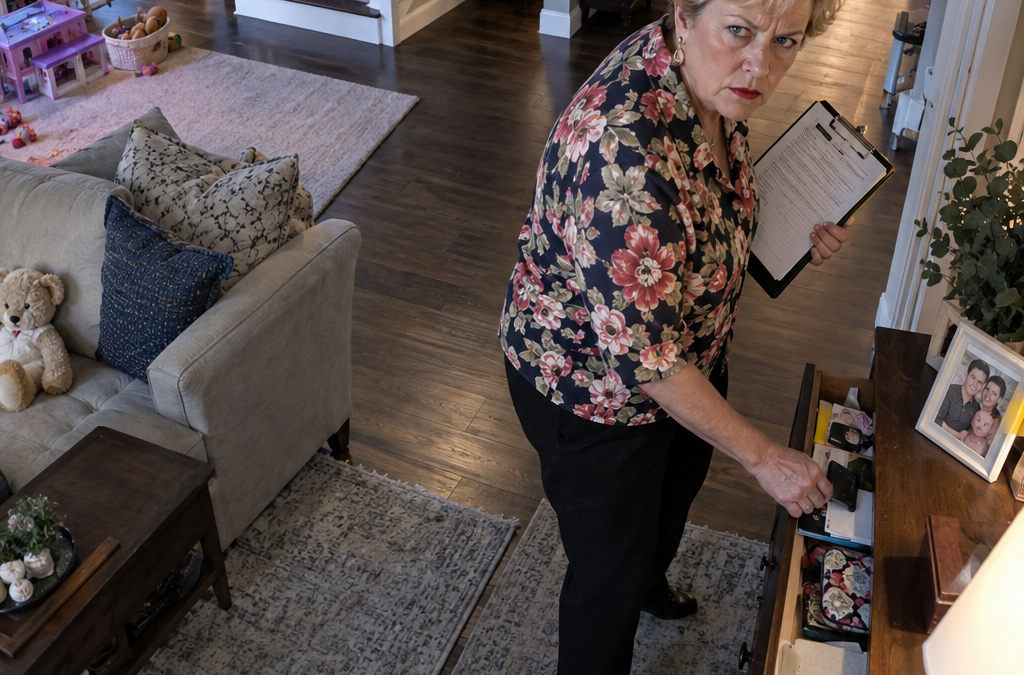
𝗙𝗨𝗟𝗟 𝗦𝗧𝗢𝗥𝗬
That answer should have bothered me more than it did.
Instead, I did what people do when they are new and trying not to become the difficult neighbor.
I stepped aside.
“All right.”
She entered.
That was the first time I allowed Renata Hollands into my home.
And for months afterward, I would replay that moment and wish I had kept my hand on the door.
She spent maybe fifteen minutes inside.
At first, the inspection seemed harmless.
She commented on the hardwood floors.
Asked whether we planned to repaint the living room.
Noted that previous owners had installed plantation shutters.
She checked the smoke detector near the kitchen.
Then she opened a closet.
That surprised me.
“What are you checking?”
“Vent clearance.”
She glanced inside, made a mark on her clipboard, and closed it.
Upstairs, she stepped into the hallway bathroom.
Then our guest bedroom.
Then our master bedroom.
Diane came out of the laundry room carrying towels and looked at me.
Her face asked the question she didn’t say aloud.
Why is this woman walking through our bedroom?
I shrugged.
Renata kept moving.
She opened another door.
My home office.
“Actually,” I said, “that’s just my office.”
“Won’t take a second.”
Before I could stop her, she stepped inside.
There were boxes on the floor and files stacked on my desk from the move.
Nothing confidential from work.
I knew better than to bring client material home casually.
But there were mortgage documents.
Tax paperwork.
Insurance files.
Family records.
Renata looked around, wrote something down, then turned.
“Everything looks fine.”
She smiled.
“Welcome to Maplewood Terrace.”
And that was it.
At least I thought it was.
Over the next month, the HOA became what I had expected.
Annoying.
But manageable.
We received a warning because our recycling bin remained visible from the street until the morning after collection.
Another letter complained that the basketball hoop Caleb wanted would need architectural approval.
A third reminded us that exterior holiday decorations had to come down by January 15 even though it was already February and we hadn’t put any up.
I laughed at that one.
Diane didn’t.
“These people have too much time.”
“It’s an HOA.”
“That’s not an excuse.”
We adjusted.
Most people did.
Nobody wanted a war over trash cans.
Then little things started happening inside the house.
The first was so small I almost feel ridiculous describing it.
Diane kept a ceramic bowl on the kitchen island.
Blue and white.
Her mother had given it to us.
She always turned the floral pattern toward the dining room because, according to her, that was the only direction it looked right.
One evening I came home from work and noticed the bowl had been rotated.
Maybe ninety degrees.
I turned it back without thinking.
Then paused.
I couldn’t remember touching it earlier.
I asked Diane.
“No.”
“Kids?”
“Probably.”
Caleb denied it.
Lily denied it.
Nobody cared enough for the conversation to last longer than thirty seconds.
A week later, I noticed a framed family photo in the upstairs hallway hanging slightly crooked.
The frame had a small brass hook that normally kept it level.
It looked as if someone had lifted it and put it back carelessly.
I fixed it.
Again, nothing.
Then one Thursday I came home before Diane.
The moment I stepped inside, I smelled perfume.
Light.
Floral.
Not strong.
But definitely there.
Diane didn’t wear floral perfume.
The scent lasted maybe five minutes.
I walked through the house checking rooms.
Nothing missing.
Nothing broken.
No windows open.
The doors were locked.
When Diane got home, I mentioned it.
She stared at me.
“Perfume?”
“Yeah.”
“Like whose?”
“If I knew whose perfume it was, I’d probably have a bigger problem.”
She gave me a look.
“Very funny.”
“I’m serious.”
“You think somebody came in?”
“I don’t know.”
“Was the alarm on?”
We hadn’t installed a real alarm system yet.
The house came with sensors, but the previous owners had canceled monitoring.
It was one of those jobs on our list.
Call alarm company.
Replace upstairs blinds.
Fix loose deck board.
The endless inventory of new-home ownership.
“The doors were locked.”
“Then maybe it was something from a candle.”
“We don’t have floral candles.”
She shrugged.
“Cleaning product?”
Maybe.
That became my answer.
Maybe.
Maybe I had moved the bowl.
Maybe one of the kids touched the photograph.
Maybe the smell came from detergent.
Maybe moving into a new house had made me hyperaware of things I didn’t understand yet.
Then the letters changed.
The first detailed violation notice arrived in April.
It accused us of an improperly anchored shelving unit in the garage.
I read the description twice.
The shelves were large metal racks I had installed along the rear wall.
The notice said the unit had been secured to a load-bearing wall using fasteners not approved for structural penetration.
I stood in the kitchen staring at the paper.
Diane came in.
“What now?”
I handed it to her.
She read it.
“How would they know?”
That was the question.
The shelving wasn’t visible from the driveway.
Not even if the garage door was open.
It sat around a corner created by an interior storage room.
To inspect the fasteners, someone would have to walk into the garage, open a door, step around the shelving, and look behind the frame.
“They saw it during the walkthrough?” Diane suggested.
I shook my head.
“I installed those shelves three weeks after she came.”
She looked at me.
Neither of us said anything.
I called the HOA office.
Renata answered.
“Maplewood Terrace Association.”
“It’s Marcus Webb.”
Her voice warmed immediately.
“Marcus. How are you?”
“I got a violation notice about garage shelving.”
“Yes.”
“How did you inspect it?”
There was a pause.
Not long.
Maybe one second.
But I noticed.
“We conduct routine compliance reviews.”
“From where?”
“I’m sorry?”
“Where was whoever reviewed it standing?”
“Marcus, I’m not sure I understand the question.”
“The shelving is inside my garage.”
“Interior structural changes can fall under association standards.”
“That wasn’t my question.”
Her voice cooled.
“The association receives reports from various sources.”
“What sources?”
“We don’t disclose complaints submitted by residents.”
“So a neighbor came inside my garage?”
“I didn’t say that.”
“Then who saw the shelves?”
Another pause.
“If you’d like to appeal the violation, there is a process described on the second page.”
Then she ended the call politely.
I appealed it.
The fine was withdrawn.
I thought that meant somebody at the HOA realized they had overreached.
Then another letter came.
This one cited a water stain on the ceiling in our guest bedroom.
I felt something cold move through my stomach.
The stain was small.
Maybe eight inches across.
It had appeared after heavy rain.
I had already contacted a roofer.
But there was no way to see it from outside.
The guest room was on the back side of the house.
Its curtains were usually closed.
The stain was directly over the bed.
I carried the letter upstairs.
Stood under it.
Looked toward the windows.
Then toward the door.
Diane found me there.
“Marcus?”
I handed her the notice.
She read it.
Her face changed.
“Okay.”
That was all she said.
Then again.
“Okay.”
Not casually this time.
“What?”
“You were right.”
“About what?”
“Somebody’s been in here.”
Hearing her say it made the thought suddenly real.
Until then, I had been suspicious.
Now it felt like evidence.
“Maybe the previous owners reported the leak.”
“This says inspection date April eighteenth.”
We had owned the house for two months.
Diane sat on the edge of the bed.
“Who has a key?”
“Us.”
“Realtor?”
“No. Locks were supposed to be rekeyed before closing.”
“Previous owners?”
“Not if they did the rekey.”
“HOA?”
I looked at her.
She looked at me.
Neither of us liked that answer.
The next day, I posted on the neighborhood forum.
Nothing dramatic.
I didn’t accuse anyone.
I wrote:
Has anyone received HOA violation notices describing interior conditions that aren’t visible from outside? We’ve received two recently and I’m trying to understand the inspection process.
The first reply came within five minutes.
Patricia Lane.
Unit seven.
Yes. Why?
I messaged her privately.
She called me ten minutes later.
Patricia was a nurse.
Divorced.
Lived alone most of the week because her teenage daughter spent alternating weeks with her father.
“I’ve had weird stuff happen,” she said.
“What kind of stuff?”
“Back door.”
“What about it?”
“I’ve come home twice and found it unlocked.”
“Are you sure you locked it?”
“Marcus, I’m an ER nurse. I leave at five-thirty in the morning. I check the stove. I check the doors. I check the dog gate. Same routine every day.”
“When?”
“Once in February. Once last month.”
“Anything missing?”
“No.”
“Anything moved?”
She hesitated.
“Maybe.”
“What?”
“A chair. Kitchen chair. It was pulled out.”
That alone wasn’t much.
Then she added, “And my bedroom closet door was open.”
I felt my hand tighten around the phone.
“Did you report it?”
“To who? Police? What would I say? Somebody opened my closet?”
After Patricia, more responses appeared.
Gordon Ellis lived three houses down.
He said he’d returned from a two-day work trip and found his basement door slightly open.
He rarely used the basement during the week.
He had assumed his adult son had stopped by.
His son denied it.
Simone Alvarez messaged me directly.
Her message was longer.
I think somebody moved documents in my office.
I called her.
She sounded embarrassed.
“You probably think I’m crazy.”
“I don’t.”
“I keep tax files in folders on the left side of my desk. One morning they were on the right.”
“Anybody else in your house?”
“My husband.”
“Could he have moved them?”
“That’s what I assumed.”
“And?”
“He assumed I did.”
She went quiet.
“I haven’t slept well since your post.”
Neither had I.
The next week, I started paying attention differently.
Before leaving the house, I photographed rooms.
Nothing elaborate.
Just quick pictures.
Kitchen.
Living room.
Office.
Hallway.
I placed a tiny piece of clear tape near the top edge of the office door.
If someone opened it, the tape would detach.
For six days, nothing happened.
On the seventh, the tape was hanging loose.
I stood there staring at it.
Maybe humidity.
Maybe the adhesive failed.
Maybe one of the kids entered the office.
I asked them.
No.
I asked Diane.
No.
I checked the lock.
No damage.
That night, after everyone went to bed, I pulled out the HOA bylaws.
All fourteen pages from the welcome packet.
Then I found the longer governing documents online.
Seventy-three pages.
Declarations.
Rules.
Amendments.
Board procedures.
Architectural standards.
Most people would rather have dental surgery than read HOA governing documents.
For me, it was familiar territory.
I spent my working life reading documents where one sentence could change the entire meaning of a case.
At 12:40 in the morning, I found Section 11.
Inspection Rights.
Paragraph D.
I read it slowly.
The association could inspect portions of a property for compliance when reasonably necessary.
That part made my stomach drop.
Then I kept reading.
Interior access required written notice delivered at least seventy-two hours before entry, except in emergencies involving immediate threats to life, safety, or common property.
I read it again.
Seventy-two hours.
Written notice.
We had never received any.
I kept going.
The documents did not authorize any board member to maintain unrestricted individual access to occupied homes.
I searched for “master key.”
Nothing.
“Keys.”
Nothing.
“Access.”
Dozens of results.
None gave Renata permission to enter houses secretly.
The next morning, I called a real estate attorney named Andrew Mercer.
Not connected to the HOA.
Not from my firm.
I wanted independent advice.
I explained the situation.
He listened without interrupting.
When I finished, he asked one question.
“Do you have proof she entered?”
“No.”
“Then right now you have suspicious circumstances.”
“That’s what I thought.”
“But you may be right.”
“What should I do?”
“Document.”
That word again.
Document.
“What about calling the police?”
“You can. But without evidence of entry, don’t expect much.”
“So cameras.”
“Absolutely.”
“Do I tell the HOA?”
“No.”
That answer surprised me.
“Why?”
“Because if someone is entering illegally, you don’t warn them you’re collecting evidence.”
I didn’t tell Diane about the attorney.
Not because I wanted to hide something from her.
Because I wasn’t sure.
If I was wrong, I didn’t want to turn our new home into a crime scene in her mind.
I bought two small indoor cameras.
Then remembered the old trail camera in the garage.
I used it for camping.
Motion activated.
Infrared.
Timestamped.
Not sophisticated.
But reliable.
The opportunity came sooner than expected.
Diane planned to visit her mother in Ohio for several days.
I decided to take Caleb and Lily to a state park for a long weekend.
The night before we left, I mounted the trail camera on a bookshelf in the living room.
It faced the front door.
One indoor camera went upstairs near the hallway.
The second faced the office.
I tested all three.
Then I stood in the living room feeling ridiculous.
Maybe we’d come back and find nothing.
Maybe all of this had a simple explanation.
I almost hoped it did.
We left Friday morning.
Three days.
I didn’t check the feeds remotely.
Partly because the trail camera didn’t support that.
Partly because I didn’t want to spend the trip obsessing.
The kids deserved better than that.
We hiked.
Cooked over a fire.
Caleb dropped a marshmallow into the dirt and ate it anyway.
Lily found a salamander and spent thirty minutes trying to name it.
For stretches of time, I forgot about Renata.
Sunday afternoon, we came home.
Everything looked normal.
Front door locked.
No broken windows.
No mail scattered.
I sent the kids upstairs.
Then removed the trail camera.
I inserted the memory card into my laptop.
There were seventeen motion clips.
Most were us leaving.
One showed a delivery driver placing a package on the porch visible through the window.
Another showed shifting light.
Then I reached the clip timestamped Saturday.
11:14 a.m.
I clicked.
The living room was empty.
For three seconds, nothing moved.
Then the front doorknob turned.
I leaned closer.
The door opened.
No knock.
No doorbell.
No hesitation.
A key had been inserted from outside.
And Renata Hollands walked into my house.
I stopped breathing.
She wore beige slacks, a pale blouse, and the same navy jacket I remembered from our first meeting.
Clipboard under her left arm.
She entered calmly.
Closed the door.
Locked it behind her.
Then stood in my living room and looked around.
Not like someone worried she might be caught.
Like someone beginning a routine.
She walked toward the kitchen.
The camera captured her opening one cabinet.
Then another.
She wrote something down.
She touched Diane’s ceramic bowl.
Turned it slightly.
I felt a wave of nausea.
That bowl.
Months earlier.
The stupid little detail I had dismissed.
It hadn’t been paranoia.
The next clip showed Renata returning through the living room carrying her clipboard.
Then disappearing toward the stairs.
I switched to the upstairs camera.
There she was.
Opening the guest bedroom.
Walking inside.
Looking at the ceiling.
Photographing the water stain.
She entered our master bedroom.
Opened the closet.
I paused the video.
My hand was shaking.
I wanted to stop watching.
But I didn’t.
She touched clothes.
Moved a storage box.
Looked behind the bathroom door.
Then she went into my office.
The third camera captured almost everything.
She stood behind my desk.
Opened a drawer.
Looked through a stack of mail.
Picked up one of our insurance documents.
Then she lifted a folder.
My tax folder.
She opened it.
Flipped through several pages.
Photographed something.
I felt heat rise through my body.
Not anger at first.
Violation.
That is the only word that fits.
Watching a stranger stand inside your home when you’re not there changes something in you.
The rooms stop feeling neutral.
Every object she touched seemed contaminated by the knowledge of her hands.
The desk.
The drawer.
The folder.
The door.
I watched her move through the place where my children slept.
The place where my wife changed clothes.
The place where we kept family records.
Thirty-one minutes after entering, Renata walked downstairs.
She stopped near the living room.
Checked her clipboard.
Adjusted Diane’s bowl again.
Then unlocked the front door.
Stepped outside.
Locked it with the same key.
Gone.
I stayed on the couch for almost twenty minutes.
Caleb came downstairs once.
“Dad?”
“Yeah?”
“You okay?”
I closed the laptop.
“Yeah.”
I wasn’t.
That evening, after the kids were asleep, I called Diane.
“Can you talk?”
Her voice changed immediately.
“What happened?”
“I got her.”
“What?”
“Renata.”
Silence.
“She came inside.”
Diane didn’t speak for several seconds.
“You’re sure?”
“I have video.”
Another pause.
“Where did she go?”
“Everywhere.”
“Marcus.”
“Bedroom. Office. Guest room. Garage.”
“Our bedroom?”
“Yes.”
I heard her inhale sharply.
“Did she touch anything?”
“Yes.”
“What?”
I couldn’t answer immediately.
Because the thing I was most afraid to tell her wasn’t that Renata touched clothing.
It was the office.
“The tax files.”
Diane went silent.
“She opened them?”
“Yes.”
“Oh my God.”
Then she said something I had been thinking for hours.
“How many times has she done this?”
I didn’t know.
And that was worse than the video.
The video proved one entry.
But the bowl.
The perfume.
The photograph.
The notices.
How many other days?
How many other homes?
At 9:00 that night, I uploaded the front-door footage and several interior clips to the neighborhood forum.
I included no dramatic caption.
Just facts.
This footage was recorded inside my home yesterday while my family was away. No notice was provided. No permission was given. Renata Hollands entered using a key we did not authorize her to possess and remained inside for approximately thirty-one minutes.
I attached timestamps.
Then I went to bed.
I barely slept.
By six the next morning, my phone was vibrating continuously.
Comments.
Messages.
Missed calls.
The video had moved beyond Maplewood Terrace.
Residents downloaded it.
Shared it.
Posted it to local groups.
Someone sent it to a reporter.
By nine in the morning, more than four thousand people had shared copies.
Two local news stations contacted me before lunch.
I declined interviews.
At least for the moment.
The neighborhood forum became chaos.
People who had dismissed small incidents were suddenly remembering everything.
Unlocked doors.
Moved objects.
Open cabinets.
Strange odors.
Detailed violation notices.
Simone posted publicly that someone had moved her tax files.
Patricia wrote about the back door.
Gordon described the basement.
A family on Hawthorne Lane said they’d received a violation for an unapproved treadmill in a basement room with no exterior windows.
Another resident said the HOA had cited a damaged bathroom exhaust fan.
A bathroom on the second floor.
Impossible to see from outside.
One comment appeared over and over.
How did she get a key?
That question became the center of everything.
The board announced an emergency meeting for Tuesday evening.
I attended.
So did almost everyone else.
The Maplewood Terrace clubhouse held maybe seventy people comfortably.
More than a hundred showed up.
People stood along the walls.
Others crowded the hallway.
A television reporter waited outside.
Renata sat at the front table with two board members and a man I didn’t recognize.
Attorney.
I knew immediately.
She looked exactly as she always did.
Hair perfect.
Clipboard present.
Calm.
That angered people more than an apology probably would have.
The meeting began with shouting.
“How did you get inside his house?”
“Have you been in mine?”
“Who gave you a key?”
“Did you enter when children were home?”
The board tried to restore order.
Finally Renata stood.
She waited until the room quieted.
Then she read from a prepared statement.
“Maplewood Terrace governing documents authorize the association to conduct inspections when necessary to verify compliance with community standards.”
People started murmuring.
She raised her voice slightly.
“Section 11, paragraph D, specifically grants the board inspection rights in cases of suspected violations.”
Then she looked across the room.
Not at everyone.
At me.
“I acted within the authority granted to my position.”
A man behind me shouted, “You went through his desk!”
Renata didn’t flinch.
“Documentation of potential violations may require review of interior conditions.”
I stood.
“Did you provide seventy-two hours’ written notice?”
The room went quiet.
Renata’s eyes narrowed.
Her attorney leaned toward her.
I continued.
“Section 11, paragraph D.”
She knew exactly what I meant.
For the first time that evening, her confidence cracked.
Only slightly.
“The association has discretion when circumstances require immediate inspection.”
“What emergency existed in my house Saturday morning?”
She didn’t answer.
I held up a copy of the bylaws.
“Was there a fire?”
“No.”
“Flood?”
“Marcus, this isn’t—”
“Gas leak?”
Her attorney raised a hand.
“I advise that questions be submitted through proper channels.”
That caused another explosion of voices.
I waited.
Then said, “Fine. Here’s another question. Who issued Renata a master key to my home?”
No answer.
The meeting dissolved from there.
But I left knowing something important.
For forty-eight hours after the video surfaced, people had genuinely feared Renata might somehow be protected.
HOAs have strange authority.
People sign documents at closing they barely read.
Boards enforce rules that residents assume must be legal because they’re printed on official letterhead.
Renata had spent nineteen years building that assumption.
She spoke like authority.
Walked like authority.
Issued fines like authority.
For people who didn’t know the documents, it was easy to believe she could be right.
But I knew paperwork.
And more importantly, I knew the difference between authority written into a contract and authority somebody simply claimed.
Andrew sent the cease-and-desist notice the next morning.
It was delivered to Renata personally.
The letter demanded immediate termination of all unauthorized entries.
Preservation of all HOA records.
Preservation of access logs.
Key records.
Inspection records.
Photographs.
Board correspondence.
Emails.
Messages.
Anything relating to interior inspections.
It also put the association on notice that destruction of relevant material could have legal consequences.
That was when the situation changed from neighborhood scandal to formal investigation.
Within a week, three residents filed separate complaints.
Patricia had smart-lock logs showing her back door had been opened at 10:22 one morning while she was at the hospital.
She also had a camera from her garage showing Renata’s car parked nearby.
Gordon found video from a neighbor’s doorbell camera showing Renata walking toward his house during the weekend he was away.
Simone had photographs showing the precise arrangement of documents before one of the suspected entries.
Her husband also discovered a motion record from an old security sensor they had never properly activated.
Each piece alone was circumstantial.
Together, they formed a pattern.
The HOA’s insurer became involved.
That terrified the board more than the residents’ anger did.
Insurance companies do not like surprises.
Especially surprises involving repeated unauthorized entry into private homes.
The carrier launched an investigation.
They requested records.
That was when Renata resigned.
Her resignation letter was short.
She cited personal reasons.
Nobody believed it.
She didn’t apologize.
She didn’t acknowledge wrongdoing.
She simply stopped being president.
For a few days, people thought that was the end.
Then the investigator found the key records.
Or, more accurately, discovered there were no records.
Maplewood Terrace had maintained certain emergency access keys years earlier when several homes shared an old centralized security arrangement.
But that system had been discontinued.
Modern policy did not authorize the HOA president to retain a universal master key.
No board vote had given Renata one.
No management company had issued one.
No locksmith invoice existed.
No access register listed her.
Yet the video clearly showed a working key.
Investigators started tracing its origin.
The answer came from a contractor named Henry Moore.
Six years earlier, he had performed repair work in several Maplewood homes after a water-main problem.
Temporary keys had been provided for scheduled access.
Henry remembered Renata.
Very well.
She had asked to borrow a key ring while “verifying which houses were affected.”
He thought she was assisting the association.
He handed it over briefly.
Apparently briefly was long enough.
The investigation concluded that one of those keys had been copied.
Not officially.
Not by the association.
By Renata.
The key she’d used to enter my house had never belonged to her.
She had created her own access.
Six years earlier.
When Andrew told me, I didn’t react immediately.
I just stared at him.
“Six years?”
“That’s when they believe the copy originated.”
“She’s been doing this for six years?”
“We can’t prove every entry.”
“How many houses?”
“They don’t know yet.”
That uncertainty spread through Maplewood Terrace like poison.
People changed locks.
All of them.
Within days, locksmith trucks lined the street.
Homeowners installed cameras.
Doorbell systems.
Window sensors.
Deadbolts.
Patricia replaced every exterior lock even though investigators thought only one key had been compromised.
“I don’t care,” she told me. “I need to know they’re different.”
Simone had a harder time.
She called me one afternoon.
Her voice sounded exhausted.
“I can’t work in my office.”
I knew immediately what she meant.
“I sit down, and all I think about is her standing there.”
“You changed the locks.”
“I know.”
“You have cameras.”
“I know.”
“But it still doesn’t feel private.”
“No.”
There wasn’t anything useful I could say.
Because Diane felt the same way.
For weeks, she checked the deadbolt twice before bed.
Sometimes three times.
She moved our personal files into a locking cabinet.
She stopped leaving jewelry on the dresser.
Once, I came upstairs and found her standing in the bedroom doorway.
She was staring at the closet.
“What?”
“I keep wondering if she opened everything.”
I didn’t answer.
“Drawers too?”
“I don’t know.”
“That’s what makes me sick.”
The damage wasn’t stolen property.
Nothing valuable had disappeared.
It was worse in a quieter way.
Renata had taken certainty.
The ordinary certainty that your house is yours when the door closes.
That your bedroom remains private.
That a drawer stays closed unless you open it.
That a stranger cannot look through your papers simply because she considers herself responsible for neighborhood standards.
We eventually learned that the unauthorized entries had probably been happening off and on for nearly five years.
Some residents had moved away before anyone discovered it.
Others never knew whether their homes had been entered.
There was no complete record.
Renata hadn’t documented everything.
That fact made legal accountability complicated.
But socially, there was no coming back.
The woman who had spent nineteen years knowing everybody’s business had finally given people a reason to ask how she knew so much.
Stories surfaced.
She once confronted a couple about remodeling a basement bathroom before the permit application had been submitted.
At the time, they assumed a contractor told her.
Another homeowner remembered Renata commenting on expensive wine stored in a cabinet that couldn’t be seen from any exterior window.
Someone else said she had known about a medical oxygen machine weeks before the family discussed it publicly.
Each memory sounded different after the camera footage.
I began to understand how long she had relied on one simple advantage.
Nobody compared notes.
That was the real reason it continued.
Patricia thought the unlocked door was her mistake.
Gordon thought his son had opened the basement.
Simone blamed her husband.
I blamed the kids.
Diane blamed me.
Every household created a harmless explanation because the alternative sounded absurd.
Who would imagine the HOA president was secretly unlocking doors and inspecting homes while residents worked?
It sounded paranoid.
Until it was recorded.
The insurer completed its investigation several weeks later.
The board’s remaining members met with residents.
That was the first HOA meeting I attended where nobody sat at the front like royalty.
Three folding tables formed a rectangle.
Residents sat around them.
No raised platform.
No speeches.
The acting board president was a quiet man named Michael Reyes.
He began with one sentence.
“What happened should never have been possible.”
I respected him immediately for saying that.
No excuses.
No language about misunderstandings.
No attempt to protect the institution.
He proposed changes.
Mandatory term limits.
No board member could serve as president indefinitely.
All inspection requests had to be documented.
Written notice had to be verified.
No unsupervised interior inspection under any circumstance except a genuine emergency involving immediate safety risk.
And even then, entry would require law enforcement, emergency personnel, or the homeowner’s express permission whenever practical.
No board member could possess a residential key.
Ever.
The entire key system was abolished.
The bylaws were amended.
Residents voted overwhelmingly in favor.
I supported every change.
Not because I suddenly loved HOAs.
I didn’t.
But rules weren’t really the problem.
Unaccountable authority was.
Renata had spent nineteen years convincing Maplewood Terrace that she was indispensable.
That she knew everything because she cared more.
That people who challenged her were difficult.
That every question wasted time.
That every objection threatened community standards.
Eventually, people stopped asking how she knew things.
That’s what allowed the line to move.
First she inspected what was visible.
Then maybe garages.
Then interiors.
Then desks.
Once nobody stopped her, she no longer seemed to recognize the difference between responsibility and entitlement.
Three months after she resigned, a moving truck appeared outside her house.
No announcement.
No post on the forum.
No farewell barbecue.
I happened to be outside installing a new deadbolt when the truck arrived.
Diane came onto the porch carrying two glasses of lemonade.
She looked down the street.
“That’s her house.”
“Yeah.”
We watched movers carry boxes out.
Renata appeared once.
She stood near the driveway giving instructions.
For a second, she looked toward us.
Our eyes met.
She didn’t wave.
Neither did I.
Then she turned away.
Diane handed me the lemonade.
“You never told me.”
“About what?”
“The attorney.”
I knew what she meant.
“I wasn’t sure.”
“You were sure enough to call one.”
“I was suspicious enough.”
She leaned against the porch railing.
“You had the bylaws marked up before the camera caught her.”
“Yes.”
“And you didn’t say anything.”
“I didn’t want to scare you if I was wrong.”
She stared at me.
“You realize I was already scared.”
“I know.”
“No. I mean before the video.”
I looked at her.
She continued.
“I thought I was imagining things too.”
That hurt.
More than I expected.
I had spent so much time trying to be certain before accusing anyone that I hadn’t noticed Diane was also living with the same uncertainty.
“I should’ve told you.”
“Probably.”
“I’m sorry.”
She looked toward Renata’s house again.
Then she laughed.
A strange laugh.
Half relief.
Half disbelief.
“What?”
“Nothing.”
“What?”
She shook her head.
“We bought this place because we wanted privacy.”
I laughed too.
Not because it was funny.
Because sometimes there’s nothing else left to do.
I finished installing the deadbolt that afternoon.
Heavy steel.
Long screws into the frame.
A lock I chose myself.
When I closed the door and turned it for the first time, the sound was small.
Click.
That was all.
But it meant more than it should have.
For months, every lock in the house had felt questionable.
Now this one was mine.
Nobody else had a copy.
Nobody else had authority.
Nobody else had permission.
I stood on the porch afterward.
The street looked exactly the same as it had when we moved in.
Same trees.
Same sidewalks.
Same houses.
But the neighborhood felt different.
People talked now.
Not gossip.
Actual conversation.
If someone received a strange notice, they asked others.
If the board proposed something unusual, residents read the documents.
Meetings had attendance.
People requested records.
Questions no longer made you a troublemaker.
They made you responsible.
Simone eventually moved her desk to another room.
She said it helped.
Patricia installed a camera over her kitchen door and another near the hallway.
Gordon replaced his basement lock.
A few residents sold their homes.
They couldn’t get comfortable again.
I understood.
Diane and I stayed.
Partly because leaving felt like allowing Renata to take something else from us.
Our house hadn’t betrayed us.
A person had.
That distinction mattered.
Over time, the rooms became ours again.
The bowl stayed on the kitchen island.
I teased Diane about its direction once.
She didn’t laugh.
So I never did again.
The family photograph in the hallway remained perfectly level.
The guest-room ceiling was repaired.
I rebuilt the garage shelving even though nothing had actually been wrong with it.
I wanted the old violation notice to become meaningless.
My office changed the most.
I installed a lock on the file cabinet.
Moved sensitive paperwork out of desk drawers.
Added a camera facing the door.
For months, I checked the feed every time we were away.
Then one day I realized I hadn’t checked it for almost a week.
That felt like progress.
There was no dramatic moment when everything became normal again.
Trust returned slowly.
In pieces.
A weekend trip without checking the camera every hour.
A night when Diane only tested the deadbolt once.
The first time Simone joked about the HOA without sounding angry.
The first neighborhood meeting where people discussed landscaping instead of legal exposure.
Ordinary things.
That’s what recovery looked like.
I sometimes think about the first afternoon Renata came to our door.
Clipboard.
Smile.
Authority.
If I could go back, would I refuse to let her inside?
Absolutely.
But I also know why I didn’t.
Most people are conditioned to cooperate with confidence.
Someone says something is required.
Someone carries official paperwork.
Someone speaks as though the question has already been settled.
We don’t always challenge them because challenging authority is tiring.
Especially when you’re busy.
Working.
Raising children.
Paying bills.
Trying to fix the dishwasher.
Renata understood that.
Maybe not consciously at first.
But she learned how powerful exhaustion could be.
People tolerated her because resisting her required more energy than complying.
That worked until she crossed a boundary that couldn’t be explained away.
A locked front door.
A private desk.
A camera.
Thirty-one minutes.
That footage stripped away all of the language she had been hiding behind.
Inspection.
Compliance.
Standards.
Stewardship.
Authority.
The video showed something much simpler.
A woman entering a house that wasn’t hers.
Without permission.
Using a key she wasn’t supposed to have.
Everything else was decoration.
Months later, Andrew mailed me the final copy of the amended HOA rules.
I read them at the kitchen table.
Diane sat across from me paying bills.
There it was.
New language.
No association director, officer, employee, volunteer, contractor, or representative shall enter the interior of an occupied residential property without the express consent of the homeowner, except where legally authorized emergency circumstances exist.
It was strange seeing something so obvious written formally.
Don’t enter other people’s homes.
It shouldn’t have needed seventy words of legal language.
But apparently it did.
Caleb walked through the kitchen while I was reading.
“What’s that?”
“HOA rules.”
He made a face.
“Those are boring.”
“Very.”
“Why are you reading them?”
I thought about explaining.
Then decided not to.
“Because sometimes boring things matter.”
He accepted that answer and kept walking.
He was nine.
I didn’t want him understanding yet how easily adults could turn ordinary authority into something invasive.
Maybe someday.
Not then.
A few months after Renata moved, I saw the new owners renovating her old house.
Young couple.
No children.
They painted the front door blue.
Renata had once fined another resident because their shade of blue wasn’t on the approved palette.
The revised board approved it without complaint.
I stood in my driveway looking at that door longer than necessary.
Diane noticed.
“You’re smiling.”
“Am I?”
“Yes.”
“It’s a nice blue.”
She knew exactly why that amused me.
The neighborhood went on.
That’s what neighborhoods do.
Trees dropped leaves.
Lawns grew.
Garbage trucks came Tuesday mornings.
Children raced scooters down sidewalks.
New people moved in who had never met Renata Hollands.
For them, the story was just something longtime residents mentioned.
The former HOA president.
The master key.
The viral video.
But for those of us who were there, it remained more personal.
People often asked me whether I was glad the video went viral.
I never knew how to answer.
Yes, because visibility forced action.
No, because thousands of strangers watched the inside of my home become evidence.
They saw my living room.
My hallway.
The doorway to our bedroom.
My office.
The place where my family lived became content for people who would never understand what it felt like to sit on that couch and watch someone walk through it without permission.
I don’t resent them.
But I don’t celebrate the viral part either.
What mattered wasn’t the number of shares.
It was Patricia realizing she hadn’t forgotten to lock her door.
Simone realizing she hadn’t misplaced her files.
Gordon realizing his son hadn’t lied.
Diane realizing the perfume wasn’t imagination.
And me realizing that instinct has value even before evidence catches up.
That may be the part I remember most.
For months, I kept telling myself I needed proof before I was allowed to feel uncomfortable.
Legally, that made sense.
Emotionally, it didn’t.
I didn’t need a timestamp to know something felt wrong.
I needed a timestamp to prove who was responsible.
Those are different things.
Today, Maplewood Terrace still has an HOA.
Some people expected me to campaign for its elimination.
I didn’t.
The board manages common landscaping.
Coordinates repairs.
Maintains insurance.
Sends reminders.
Occasionally issues fines.
But now the president changes.
Records are accessible.
Residents ask questions.
And nobody has a master key.
Especially not the president.
Every few months, I still see one of Renata’s old violation notices tucked in the file cabinet.
Improper garage shelving.
Water stain.
Interior maintenance concern.
I keep them.
Not because I enjoy remembering.
Because they remind me how absurd authority looks once you know it was never legitimate.
The paper was official.
The logo was real.
The signatures were real.
The intrusion wasn’t.
One Saturday almost a year after everything happened, we took another family trip.
Three days.
Same kind of trip as before.
Before leaving, I stood in the living room.
For a moment, I looked toward the camera.
It was still mounted near the bookshelf.
Diane noticed.
“You checking it?”
I shook my head.
“No.”
“You sure?”
“Yeah.”
I locked the front door.
Tested it once.
Then walked to the car.
We came back Sunday evening.
I opened the door.
The house smelled like our house.
Coffee grounds.
Wood.
Whatever detergent Diane bought.
Nothing disturbed.
The bowl exactly where she left it.
Photo straight.
Office closed.
I walked through every room without thinking about Renata.
It wasn’t until later that night that I realized what had happened.
Nothing.
Nothing had happened.
And after everything we’d gone through, nothing felt like a gift.
I stood in the hallway outside the kids’ rooms.
Both doors partly open.
Caleb asleep with a book beside him.
Lily curled under a blanket covered in stars.
Diane came up behind me.
“You okay?”
“Yeah.”
This time, I meant it.
I looked down the staircase toward the front door.
The deadbolt was locked.
The house was quiet.
Private.
Ours.
Renata Hollands had spent years behaving as if every front door in Maplewood Terrace was simply another boundary she had permission to cross.
In the end, it wasn’t the viral video that defeated her.
It wasn’t my profession.
It wasn’t even the lawyer.
Those things exposed her.
What defeated her was something far simpler.
A locked door was supposed to mean no.
She had convinced herself that her title made her exempt from that word.
It didn’t.
And once the rest of Maplewood Terrace finally understood that, her nineteen years of authority disappeared faster than any of us would have believed possible.
I still have the trail camera.
It sits on a shelf in the garage now.
Most of the time I use it for exactly what it was designed for.
Deer.
Raccoons.
The occasional fox near a campsite.
But every time I pick it up, I remember Saturday at 11:14 in the morning.
The front door opening.
Renata walking in.
Clipboard in hand.
Completely certain she belonged there.
And I remember the thing she never understood until it was too late.
My home did not become hers simply because she had found a way inside.
𝗧𝗛𝗘 𝗘𝗡𝗗
The HOA President Had Been Inside My House for Months, and the Camera Finally Showed Me What She Was Doing
The first time I realized someone had been inside my house while my family was gone, I blamed myself for being paranoid.
Then the HOA sent me a violation notice describing a room no one could see from outside, and I understood that somebody knew far more about my home than they had any right to know.
My name is Marcus Webb, and when my wife, Diane, and I moved into Maplewood Terrace, we thought we were buying the safest house we had ever owned.
That was part of the appeal.
We had rented for years.
Apartment complexes.
Duplexes.
A small townhouse where the neighbor on the other side of the wall played bass guitar until two in the morning.
None of those places had ever really felt permanent.
Every lease renewal reminded us that somebody else owned the walls.
Every repair request required permission.
Every time the kids asked whether they could paint a bedroom, plant something in the yard, or hang a basketball hoop, the answer depended on a landlord.
So when we finally saved enough for a down payment, we were careful.
Painfully careful.
We toured houses for almost six months.
We checked school districts.
Commute times.
Property taxes.
Crime statistics.
Foundation reports.
Roof ages.
Drainage.
Insurance estimates.
I had worked as a paralegal for eleven years, so paperwork didn’t scare me.
If anything, I trusted documents more than sales pitches.
Diane joked that I could turn buying a toaster into discovery litigation.
She wasn’t entirely wrong.
Maplewood Terrace seemed almost suspiciously perfect.
The neighborhood had been established for decades.
Tall maples lined both sides of the streets.
The houses weren’t identical, but they all looked maintained.
People waved when we drove through.
Children rode bicycles in little groups until streetlights came on.
The lawns were neat without looking artificial.
At the entrance stood a carved wooden sign surrounded by flowers.
MAPLEWOOD TERRACE.
ESTABLISHED 1987.
Underneath it, in smaller letters:
A COMMUNITY BUILT ON PRIDE.
I should probably tell you that I noticed the word community.
I should also tell you that I didn’t understand yet how people like Renata Hollands could use that word as a weapon.
We moved in during February.
Cold rain.
Gray skies.
Cardboard boxes everywhere.
Our son Caleb was nine.
Our daughter Lily had just turned six.
They spent the first afternoon racing up and down the stairs because they had never lived in a two-story house before.
Diane stood in the kitchen surrounded by half-unpacked boxes and cried.
Not dramatically.
Just quietly.
I came around the island and put my arms around her.
“We did it,” she whispered.
We had.
After years of watching rent disappear every month, we finally owned something.
At least that was what we believed.
Two weeks later, Renata Hollands knocked on our door.
I remember the sound clearly.
Three fast knocks.
Confident.
Not the tentative knock of a stranger.
I opened the door and found a woman in her late fifties standing on the porch with a clipboard tucked under one arm.
She had carefully styled blond hair, a navy jacket, pearl earrings, and the kind of smile that looked practiced rather than spontaneous.
“Marcus Webb?”
“Yes.”
She extended her hand.
“Renata Hollands. HOA president.”
I shook it.
“Nice to meet you.”
“I’ve been meaning to stop by since you moved in.”
She looked past me into the foyer.
Not subtly.
Her eyes moved over the staircase, the hallway, and the stack of unopened boxes against the living room wall.
“Settling in?”
“Trying.”
She laughed.
“That’s always the worst part.”
Then she tapped her clipboard.
“I’m just here for your welcome walkthrough.”
“My what?”
“Your onboarding inspection.”
I thought I had missed something in the closing documents.
“I’m sorry?”
“Nothing serious,” she said. “Just a quick walkthrough to make sure the property meets association standards before your official onboarding is complete.”
I had read the HOA packet.
Fourteen pages.
Glossy cover.
Photograph of a sunset over the neighborhood pond.
Rules about fences, paint colors, exterior lights, trash containers, roof materials, landscaping, sheds, holiday decorations.
I remembered nothing about an interior walkthrough.
“I don’t remember seeing that.”
Renata smiled.
“It’s standard.”
That answer should have bothered me more than it did.
Instead, I did what people do when they are new and trying not to become the difficult neighbor.
I stepped aside.
“All right.”
She entered.
That was the first time I allowed Renata Hollands into my home.
And for months afterward, I would replay that moment and wish I had kept my hand on the door.
She spent maybe fifteen minutes inside.
At first, the inspection seemed harmless.
She commented on the hardwood floors.
Asked whether we planned to repaint the living room.
Noted that previous owners had installed plantation shutters.
She checked the smoke detector near the kitchen.
Then she opened a closet.
That surprised me.
“What are you checking?”
“Vent clearance.”
She glanced inside, made a mark on her clipboard, and closed it.
Upstairs, she stepped into the hallway bathroom.
Then our guest bedroom.
Then our master bedroom.
Diane came out of the laundry room carrying towels and looked at me.
Her face asked the question she didn’t say aloud.
Why is this woman walking through our bedroom?
I shrugged.
Renata kept moving.
She opened another door.
My home office.
“Actually,” I said, “that’s just my office.”
“Won’t take a second.”
Before I could stop her, she stepped inside.
There were boxes on the floor and files stacked on my desk from the move.
Nothing confidential from work.
I knew better than to bring client material home casually.
But there were mortgage documents.
Tax paperwork.
Insurance files.
Family records.
Renata looked around, wrote something down, then turned.
“Everything looks fine.”
She smiled.
“Welcome to Maplewood Terrace.”
And that was it.
At least I thought it was.
Over the next month, the HOA became what I had expected.
Annoying.
But manageable.
We received a warning because our recycling bin remained visible from the street until the morning after collection.
Another letter complained that the basketball hoop Caleb wanted would need architectural approval.
A third reminded us that exterior holiday decorations had to come down by January 15 even though it was already February and we hadn’t put any up.
I laughed at that one.
Diane didn’t.
“These people have too much time.”
“It’s an HOA.”
“That’s not an excuse.”
We adjusted.
Most people did.
Nobody wanted a war over trash cans.
Then little things started happening inside the house.
The first was so small I almost feel ridiculous describing it.
Diane kept a ceramic bowl on the kitchen island.
Blue and white.
Her mother had given it to us.
She always turned the floral pattern toward the dining room because, according to her, that was the only direction it looked right.
One evening I came home from work and noticed the bowl had been rotated.
Maybe ninety degrees.
I turned it back without thinking.
Then paused.
I couldn’t remember touching it earlier.
I asked Diane.
“No.”
“Kids?”
“Probably.”
Caleb denied it.
Lily denied it.
Nobody cared enough for the conversation to last longer than thirty seconds.
A week later, I noticed a framed family photo in the upstairs hallway hanging slightly crooked.
The frame had a small brass hook that normally kept it level.
It looked as if someone had lifted it and put it back carelessly.
I fixed it.
Again, nothing.
Then one Thursday I came home before Diane.
The moment I stepped inside, I smelled perfume.
Light.
Floral.
Not strong.
But definitely there.
Diane didn’t wear floral perfume.
The scent lasted maybe five minutes.
I walked through the house checking rooms.
Nothing missing.
Nothing broken.
No windows open.
The doors were locked.
When Diane got home, I mentioned it.
She stared at me.
“Perfume?”
“Yeah.”
“Like whose?”
“If I knew whose perfume it was, I’d probably have a bigger problem.”
She gave me a look.
“Very funny.”
“I’m serious.”
“You think somebody came in?”
“I don’t know.”
“Was the alarm on?”
We hadn’t installed a real alarm system yet.
The house came with sensors, but the previous owners had canceled monitoring.
It was one of those jobs on our list.
Call alarm company.
Replace upstairs blinds.
Fix loose deck board.
The endless inventory of new-home ownership.
“The doors were locked.”
“Then maybe it was something from a candle.”
“We don’t have floral candles.”
She shrugged.
“Cleaning product?”
Maybe.
That became my answer.
Maybe.
Maybe I had moved the bowl.
Maybe one of the kids touched the photograph.
Maybe the smell came from detergent.
Maybe moving into a new house had made me hyperaware of things I didn’t understand yet.
Then the letters changed.
The first detailed violation notice arrived in April.
It accused us of an improperly anchored shelving unit in the garage.
I read the description twice.
The shelves were large metal racks I had installed along the rear wall.
The notice said the unit had been secured to a load-bearing wall using fasteners not approved for structural penetration.
I stood in the kitchen staring at the paper.
Diane came in.
“What now?”
I handed it to her.
She read it.
“How would they know?”
That was the question.
The shelving wasn’t visible from the driveway.
Not even if the garage door was open.
It sat around a corner created by an interior storage room.
To inspect the fasteners, someone would have to walk into the garage, open a door, step around the shelving, and look behind the frame.
“They saw it during the walkthrough?” Diane suggested.
I shook my head.
“I installed those shelves three weeks after she came.”
She looked at me.
Neither of us said anything.
I called the HOA office.
Renata answered.
“Maplewood Terrace Association.”
“It’s Marcus Webb.”
Her voice warmed immediately.
“Marcus. How are you?”
“I got a violation notice about garage shelving.”
“Yes.”
“How did you inspect it?”
There was a pause.
Not long.
Maybe one second.
But I noticed.
“We conduct routine compliance reviews.”
“From where?”
“I’m sorry?”
“Where was whoever reviewed it standing?”
“Marcus, I’m not sure I understand the question.”
“The shelving is inside my garage.”
“Interior structural changes can fall under association standards.”
“That wasn’t my question.”
Her voice cooled.
“The association receives reports from various sources.”
“What sources?”
“We don’t disclose complaints submitted by residents.”
“So a neighbor came inside my garage?”
“I didn’t say that.”
“Then who saw the shelves?”
Another pause.
“If you’d like to appeal the violation, there is a process described on the second page.”
Then she ended the call politely.
I appealed it.
The fine was withdrawn.
I thought that meant somebody at the HOA realized they had overreached.
Then another letter came.
This one cited a water stain on the ceiling in our guest bedroom.
I felt something cold move through my stomach.
The stain was small.
Maybe eight inches across.
It had appeared after heavy rain.
I had already contacted a roofer.
But there was no way to see it from outside.
The guest room was on the back side of the house.
Its curtains were usually closed.
The stain was directly over the bed.
I carried the letter upstairs.
Stood under it.
Looked toward the windows.
Then toward the door.
Diane found me there.
“Marcus?”
I handed her the notice.
She read it.
Her face changed.
“Okay.”
That was all she said.
Then again.
“Okay.”
Not casually this time.
“What?”
“You were right.”
“About what?”
“Somebody’s been in here.”
Hearing her say it made the thought suddenly real.
Until then, I had been suspicious.
Now it felt like evidence.
“Maybe the previous owners reported the leak.”
“This says inspection date April eighteenth.”
We had owned the house for two months.
Diane sat on the edge of the bed.
“Who has a key?”
“Us.”
“Realtor?”
“No. Locks were supposed to be rekeyed before closing.”
“Previous owners?”
“Not if they did the rekey.”
“HOA?”
I looked at her.
She looked at me.
Neither of us liked that answer.
The next day, I posted on the neighborhood forum.
Nothing dramatic.
I didn’t accuse anyone.
I wrote:
Has anyone received HOA violation notices describing interior conditions that aren’t visible from outside? We’ve received two recently and I’m trying to understand the inspection process.
The first reply came within five minutes.
Patricia Lane.
Unit seven.
Yes. Why?
I messaged her privately.
She called me ten minutes later.
Patricia was a nurse.
Divorced.
Lived alone most of the week because her teenage daughter spent alternating weeks with her father.
“I’ve had weird stuff happen,” she said.
“What kind of stuff?”
“Back door.”
“What about it?”
“I’ve come home twice and found it unlocked.”
“Are you sure you locked it?”
“Marcus, I’m an ER nurse. I leave at five-thirty in the morning. I check the stove. I check the doors. I check the dog gate. Same routine every day.”
“When?”
“Once in February. Once last month.”
“Anything missing?”
“No.”
“Anything moved?”
She hesitated.
“Maybe.”
“What?”
“A chair. Kitchen chair. It was pulled out.”
That alone wasn’t much.
Then she added, “And my bedroom closet door was open.”
I felt my hand tighten around the phone.
“Did you report it?”
“To who? Police? What would I say? Somebody opened my closet?”
After Patricia, more responses appeared.
Gordon Ellis lived three houses down.
He said he’d returned from a two-day work trip and found his basement door slightly open.
He rarely used the basement during the week.
He had assumed his adult son had stopped by.
His son denied it.
Simone Alvarez messaged me directly.
Her message was longer.
I think somebody moved documents in my office.
I called her.
She sounded embarrassed.
“You probably think I’m crazy.”
“I don’t.”
“I keep tax files in folders on the left side of my desk. One morning they were on the right.”
“Anybody else in your house?”
“My husband.”
“Could he have moved them?”
“That’s what I assumed.”
“And?”
“He assumed I did.”
She went quiet.
“I haven’t slept well since your post.”
Neither had I.
The next week, I started paying attention differently.
Before leaving the house, I photographed rooms.
Nothing elaborate.
Just quick pictures.
Kitchen.
Living room.
Office.
Hallway.
I placed a tiny piece of clear tape near the top edge of the office door.
If someone opened it, the tape would detach.
For six days, nothing happened.
On the seventh, the tape was hanging loose.
I stood there staring at it.
Maybe humidity.
Maybe the adhesive failed.
Maybe one of the kids entered the office.
I asked them.
No.
I asked Diane.
No.
I checked the lock.
No damage.
That night, after everyone went to bed, I pulled out the HOA bylaws.
All fourteen pages from the welcome packet.
Then I found the longer governing documents online.
Seventy-three pages.
Declarations.
Rules.
Amendments.
Board procedures.
Architectural standards.
Most people would rather have dental surgery than read HOA governing documents.
For me, it was familiar territory.
I spent my working life reading documents where one sentence could change the entire meaning of a case.
At 12:40 in the morning, I found Section 11.
Inspection Rights.
Paragraph D.
I read it slowly.
The association could inspect portions of a property for compliance when reasonably necessary.
That part made my stomach drop.
Then I kept reading.
Interior access required written notice delivered at least seventy-two hours before entry, except in emergencies involving immediate threats to life, safety, or common property.
I read it again.
Seventy-two hours.
Written notice.
We had never received any.
I kept going.
The documents did not authorize any board member to maintain unrestricted individual access to occupied homes.
I searched for “master key.”
Nothing.
“Keys.”
Nothing.
“Access.”
Dozens of results.
None gave Renata permission to enter houses secretly.
The next morning, I called a real estate attorney named Andrew Mercer.
Not connected to the HOA.
Not from my firm.
I wanted independent advice.
I explained the situation.
He listened without interrupting.
When I finished, he asked one question.
“Do you have proof she entered?”
“No.”
“Then right now you have suspicious circumstances.”
“That’s what I thought.”
“But you may be right.”
“What should I do?”
“Document.”
That word again.
Document.
“What about calling the police?”
“You can. But without evidence of entry, don’t expect much.”
“So cameras.”
“Absolutely.”
“Do I tell the HOA?”
“No.”
That answer surprised me.
“Why?”
“Because if someone is entering illegally, you don’t warn them you’re collecting evidence.”
I didn’t tell Diane about the attorney.
Not because I wanted to hide something from her.
Because I wasn’t sure.
If I was wrong, I didn’t want to turn our new home into a crime scene in her mind.
I bought two small indoor cameras.
Then remembered the old trail camera in the garage.
I used it for camping.
Motion activated.
Infrared.
Timestamped.
Not sophisticated.
But reliable.
The opportunity came sooner than expected.
Diane planned to visit her mother in Ohio for several days.
I decided to take Caleb and Lily to a state park for a long weekend.
The night before we left, I mounted the trail camera on a bookshelf in the living room.
It faced the front door.
One indoor camera went upstairs near the hallway.
The second faced the office.
I tested all three.
Then I stood in the living room feeling ridiculous.
Maybe we’d come back and find nothing.
Maybe all of this had a simple explanation.
I almost hoped it did.
We left Friday morning.
Three days.
I didn’t check the feeds remotely.
Partly because the trail camera didn’t support that.
Partly because I didn’t want to spend the trip obsessing.
The kids deserved better than that.
We hiked.
Cooked over a fire.
Caleb dropped a marshmallow into the dirt and ate it anyway.
Lily found a salamander and spent thirty minutes trying to name it.
For stretches of time, I forgot about Renata.
Sunday afternoon, we came home.
Everything looked normal.
Front door locked.
No broken windows.
No mail scattered.
I sent the kids upstairs.
Then removed the trail camera.
I inserted the memory card into my laptop.
There were seventeen motion clips.
Most were us leaving.
One showed a delivery driver placing a package on the porch visible through the window.
Another showed shifting light.
Then I reached the clip timestamped Saturday.
11:14 a.m.
I clicked.
The living room was empty.
For three seconds, nothing moved.
Then the front doorknob turned.
I leaned closer.
The door opened.
No knock.
No doorbell.
No hesitation.
A key had been inserted from outside.
And Renata Hollands walked into my house.
I stopped breathing.
She wore beige slacks, a pale blouse, and the same navy jacket I remembered from our first meeting.
Clipboard under her left arm.
She entered calmly.
Closed the door.
Locked it behind her.
Then stood in my living room and looked around.
Not like someone worried she might be caught.
Like someone beginning a routine.
She walked toward the kitchen.
The camera captured her opening one cabinet.
Then another.
She wrote something down.
She touched Diane’s ceramic bowl.
Turned it slightly.
I felt a wave of nausea.
That bowl.
Months earlier.
The stupid little detail I had dismissed.
It hadn’t been paranoia.
The next clip showed Renata returning through the living room carrying her clipboard.
Then disappearing toward the stairs.
I switched to the upstairs camera.
There she was.
Opening the guest bedroom.
Walking inside.
Looking at the ceiling.
Photographing the water stain.
She entered our master bedroom.
Opened the closet.
I paused the video.
My hand was shaking.
I wanted to stop watching.
But I didn’t.
She touched clothes.
Moved a storage box.
Looked behind the bathroom door.
Then she went into my office.
The third camera captured almost everything.
She stood behind my desk.
Opened a drawer.
Looked through a stack of mail.
Picked up one of our insurance documents.
Then she lifted a folder.
My tax folder.
She opened it.
Flipped through several pages.
Photographed something.
I felt heat rise through my body.
Not anger at first.
Violation.
That is the only word that fits.
Watching a stranger stand inside your home when you’re not there changes something in you.
The rooms stop feeling neutral.
Every object she touched seemed contaminated by the knowledge of her hands.
The desk.
The drawer.
The folder.
The door.
I watched her move through the place where my children slept.
The place where my wife changed clothes.
The place where we kept family records.
Thirty-one minutes after entering, Renata walked downstairs.
She stopped near the living room.
Checked her clipboard.
Adjusted Diane’s bowl again.
Then unlocked the front door.
Stepped outside.
Locked it with the same key.
Gone.
I stayed on the couch for almost twenty minutes.
Caleb came downstairs once.
“Dad?”
“Yeah?”
“You okay?”
I closed the laptop.
“Yeah.”
I wasn’t.
That evening, after the kids were asleep, I called Diane.
“Can you talk?”
Her voice changed immediately.
“What happened?”
“I got her.”
“What?”
“Renata.”
Silence.
“She came inside.”
Diane didn’t speak for several seconds.
“You’re sure?”
“I have video.”
Another pause.
“Where did she go?”
“Everywhere.”
“Marcus.”
“Bedroom. Office. Guest room. Garage.”
“Our bedroom?”
“Yes.”
I heard her inhale sharply.
“Did she touch anything?”
“Yes.”
“What?”
I couldn’t answer immediately.
Because the thing I was most afraid to tell her wasn’t that Renata touched clothing.
It was the office.
“The tax files.”
Diane went silent.
“She opened them?”
“Yes.”
“Oh my God.”
Then she said something I had been thinking for hours.
“How many times has she done this?”
I didn’t know.
And that was worse than the video.
The video proved one entry.
But the bowl.
The perfume.
The photograph.
The notices.
How many other days?
How many other homes?
At 9:00 that night, I uploaded the front-door footage and several interior clips to the neighborhood forum.
I included no dramatic caption.
Just facts.
This footage was recorded inside my home yesterday while my family was away. No notice was provided. No permission was given. Renata Hollands entered using a key we did not authorize her to possess and remained inside for approximately thirty-one minutes.
I attached timestamps.
Then I went to bed.
I barely slept.
By six the next morning, my phone was vibrating continuously.
Comments.
Messages.
Missed calls.
The video had moved beyond Maplewood Terrace.
Residents downloaded it.
Shared it.
Posted it to local groups.
Someone sent it to a reporter.
By nine in the morning, more than four thousand people had shared copies.
Two local news stations contacted me before lunch.
I declined interviews.
At least for the moment.
The neighborhood forum became chaos.
People who had dismissed small incidents were suddenly remembering everything.
Unlocked doors.
Moved objects.
Open cabinets.
Strange odors.
Detailed violation notices.
Simone posted publicly that someone had moved her tax files.
Patricia wrote about the back door.
Gordon described the basement.
A family on Hawthorne Lane said they’d received a violation for an unapproved treadmill in a basement room with no exterior windows.
Another resident said the HOA had cited a damaged bathroom exhaust fan.
A bathroom on the second floor.
Impossible to see from outside.
One comment appeared over and over.
How did she get a key?
That question became the center of everything.
The board announced an emergency meeting for Tuesday evening.
I attended.
So did almost everyone else.
The Maplewood Terrace clubhouse held maybe seventy people comfortably.
More than a hundred showed up.
People stood along the walls.
Others crowded the hallway.
A television reporter waited outside.
Renata sat at the front table with two board members and a man I didn’t recognize.
Attorney.
I knew immediately.
She looked exactly as she always did.
Hair perfect.
Clipboard present.
Calm.
That angered people more than an apology probably would have.
The meeting began with shouting.
“How did you get inside his house?”
“Have you been in mine?”
“Who gave you a key?”
“Did you enter when children were home?”
The board tried to restore order.
Finally Renata stood.
She waited until the room quieted.
Then she read from a prepared statement.
“Maplewood Terrace governing documents authorize the association to conduct inspections when necessary to verify compliance with community standards.”
People started murmuring.
She raised her voice slightly.
“Section 11, paragraph D, specifically grants the board inspection rights in cases of suspected violations.”
Then she looked across the room.
Not at everyone.
At me.
“I acted within the authority granted to my position.”
A man behind me shouted, “You went through his desk!”
Renata didn’t flinch.
“Documentation of potential violations may require review of interior conditions.”
I stood.
“Did you provide seventy-two hours’ written notice?”
The room went quiet.
Renata’s eyes narrowed.
Her attorney leaned toward her.
I continued.
“Section 11, paragraph D.”
She knew exactly what I meant.
For the first time that evening, her confidence cracked.
Only slightly.
“The association has discretion when circumstances require immediate inspection.”
“What emergency existed in my house Saturday morning?”
She didn’t answer.
I held up a copy of the bylaws.
“Was there a fire?”
“No.”
“Flood?”
“Marcus, this isn’t—”
“Gas leak?”
Her attorney raised a hand.
“I advise that questions be submitted through proper channels.”
That caused another explosion of voices.
I waited.
Then said, “Fine. Here’s another question. Who issued Renata a master key to my home?”
No answer.
The meeting dissolved from there.
But I left knowing something important.
For forty-eight hours after the video surfaced, people had genuinely feared Renata might somehow be protected.
HOAs have strange authority.
People sign documents at closing they barely read.
Boards enforce rules that residents assume must be legal because they’re printed on official letterhead.
Renata had spent nineteen years building that assumption.
She spoke like authority.
Walked like authority.
Issued fines like authority.
For people who didn’t know the documents, it was easy to believe she could be right.
But I knew paperwork.
And more importantly, I knew the difference between authority written into a contract and authority somebody simply claimed.
Andrew sent the cease-and-desist notice the next morning.
It was delivered to Renata personally.
The letter demanded immediate termination of all unauthorized entries.
Preservation of all HOA records.
Preservation of access logs.
Key records.
Inspection records.
Photographs.
Board correspondence.
Emails.
Messages.
Anything relating to interior inspections.
It also put the association on notice that destruction of relevant material could have legal consequences.
That was when the situation changed from neighborhood scandal to formal investigation.
Within a week, three residents filed separate complaints.
Patricia had smart-lock logs showing her back door had been opened at 10:22 one morning while she was at the hospital.
She also had a camera from her garage showing Renata’s car parked nearby.
Gordon found video from a neighbor’s doorbell camera showing Renata walking toward his house during the weekend he was away.
Simone had photographs showing the precise arrangement of documents before one of the suspected entries.
Her husband also discovered a motion record from an old security sensor they had never properly activated.
Each piece alone was circumstantial.
Together, they formed a pattern.
The HOA’s insurer became involved.
That terrified the board more than the residents’ anger did.
Insurance companies do not like surprises.
Especially surprises involving repeated unauthorized entry into private homes.
The carrier launched an investigation.
They requested records.
That was when Renata resigned.
Her resignation letter was short.
She cited personal reasons.
Nobody believed it.
She didn’t apologize.
She didn’t acknowledge wrongdoing.
She simply stopped being president.
For a few days, people thought that was the end.
Then the investigator found the key records.
Or, more accurately, discovered there were no records.
Maplewood Terrace had maintained certain emergency access keys years earlier when several homes shared an old centralized security arrangement.
But that system had been discontinued.
Modern policy did not authorize the HOA president to retain a universal master key.
No board vote had given Renata one.
No management company had issued one.
No locksmith invoice existed.
No access register listed her.
Yet the video clearly showed a working key.
Investigators started tracing its origin.
The answer came from a contractor named Henry Moore.
Six years earlier, he had performed repair work in several Maplewood homes after a water-main problem.
Temporary keys had been provided for scheduled access.
Henry remembered Renata.
Very well.
She had asked to borrow a key ring while “verifying which houses were affected.”
He thought she was assisting the association.
He handed it over briefly.
Apparently briefly was long enough.
The investigation concluded that one of those keys had been copied.
Not officially.
Not by the association.
By Renata.
The key she’d used to enter my house had never belonged to her.
She had created her own access.
Six years earlier.
When Andrew told me, I didn’t react immediately.
I just stared at him.
“Six years?”
“That’s when they believe the copy originated.”
“She’s been doing this for six years?”
“We can’t prove every entry.”
“How many houses?”
“They don’t know yet.”
That uncertainty spread through Maplewood Terrace like poison.
People changed locks.
All of them.
Within days, locksmith trucks lined the street.
Homeowners installed cameras.
Doorbell systems.
Window sensors.
Deadbolts.
Patricia replaced every exterior lock even though investigators thought only one key had been compromised.
“I don’t care,” she told me. “I need to know they’re different.”
Simone had a harder time.
She called me one afternoon.
Her voice sounded exhausted.
“I can’t work in my office.”
I knew immediately what she meant.
“I sit down, and all I think about is her standing there.”
“You changed the locks.”
“I know.”
“You have cameras.”
“I know.”
“But it still doesn’t feel private.”
“No.”
There wasn’t anything useful I could say.
Because Diane felt the same way.
For weeks, she checked the deadbolt twice before bed.
Sometimes three times.
She moved our personal files into a locking cabinet.
She stopped leaving jewelry on the dresser.
Once, I came upstairs and found her standing in the bedroom doorway.
She was staring at the closet.
“What?”
“I keep wondering if she opened everything.”
I didn’t answer.
“Drawers too?”
“I don’t know.”
“That’s what makes me sick.”
The damage wasn’t stolen property.
Nothing valuable had disappeared.
It was worse in a quieter way.
Renata had taken certainty.
The ordinary certainty that your house is yours when the door closes.
That your bedroom remains private.
That a drawer stays closed unless you open it.
That a stranger cannot look through your papers simply because she considers herself responsible for neighborhood standards.
We eventually learned that the unauthorized entries had probably been happening off and on for nearly five years.
Some residents had moved away before anyone discovered it.
Others never knew whether their homes had been entered.
There was no complete record.
Renata hadn’t documented everything.
That fact made legal accountability complicated.
But socially, there was no coming back.
The woman who had spent nineteen years knowing everybody’s business had finally given people a reason to ask how she knew so much.
Stories surfaced.
She once confronted a couple about remodeling a basement bathroom before the permit application had been submitted.
At the time, they assumed a contractor told her.
Another homeowner remembered Renata commenting on expensive wine stored in a cabinet that couldn’t be seen from any exterior window.
Someone else said she had known about a medical oxygen machine weeks before the family discussed it publicly.
Each memory sounded different after the camera footage.
I began to understand how long she had relied on one simple advantage.
Nobody compared notes.
That was the real reason it continued.
Patricia thought the unlocked door was her mistake.
Gordon thought his son had opened the basement.
Simone blamed her husband.
I blamed the kids.
Diane blamed me.
Every household created a harmless explanation because the alternative sounded absurd.
Who would imagine the HOA president was secretly unlocking doors and inspecting homes while residents worked?
It sounded paranoid.
Until it was recorded.
The insurer completed its investigation several weeks later.
The board’s remaining members met with residents.
That was the first HOA meeting I attended where nobody sat at the front like royalty.
Three folding tables formed a rectangle.
Residents sat around them.
No raised platform.
No speeches.
The acting board president was a quiet man named Michael Reyes.
He began with one sentence.
“What happened should never have been possible.”
I respected him immediately for saying that.
No excuses.
No language about misunderstandings.
No attempt to protect the institution.
He proposed changes.
Mandatory term limits.
No board member could serve as president indefinitely.
All inspection requests had to be documented.
Written notice had to be verified.
No unsupervised interior inspection under any circumstance except a genuine emergency involving immediate safety risk.
And even then, entry would require law enforcement, emergency personnel, or the homeowner’s express permission whenever practical.
No board member could possess a residential key.
Ever.
The entire key system was abolished.
The bylaws were amended.
Residents voted overwhelmingly in favor.
I supported every change.
Not because I suddenly loved HOAs.
I didn’t.
But rules weren’t really the problem.
Unaccountable authority was.
Renata had spent nineteen years convincing Maplewood Terrace that she was indispensable.
That she knew everything because she cared more.
That people who challenged her were difficult.
That every question wasted time.
That every objection threatened community standards.
Eventually, people stopped asking how she knew things.
That’s what allowed the line to move.
First she inspected what was visible.
Then maybe garages.
Then interiors.
Then desks.
Once nobody stopped her, she no longer seemed to recognize the difference between responsibility and entitlement.
Three months after she resigned, a moving truck appeared outside her house.
No announcement.
No post on the forum.
No farewell barbecue.
I happened to be outside installing a new deadbolt when the truck arrived.
Diane came onto the porch carrying two glasses of lemonade.
She looked down the street.
“That’s her house.”
“Yeah.”
We watched movers carry boxes out.
Renata appeared once.
She stood near the driveway giving instructions.
For a second, she looked toward us.
Our eyes met.
She didn’t wave.
Neither did I.
Then she turned away.
Diane handed me the lemonade.
“You never told me.”
“About what?”
“The attorney.”
I knew what she meant.
“I wasn’t sure.”
“You were sure enough to call one.”
“I was suspicious enough.”
She leaned against the porch railing.
“You had the bylaws marked up before the camera caught her.”
“Yes.”
“And you didn’t say anything.”
“I didn’t want to scare you if I was wrong.”
She stared at me.
“You realize I was already scared.”
“I know.”
“No. I mean before the video.”
I looked at her.
She continued.
“I thought I was imagining things too.”
That hurt.
More than I expected.
I had spent so much time trying to be certain before accusing anyone that I hadn’t noticed Diane was also living with the same uncertainty.
“I should’ve told you.”
“Probably.”
“I’m sorry.”
She looked toward Renata’s house again.
Then she laughed.
A strange laugh.
Half relief.
Half disbelief.
“What?”
“Nothing.”
“What?”
She shook her head.
“We bought this place because we wanted privacy.”
I laughed too.
Not because it was funny.
Because sometimes there’s nothing else left to do.
I finished installing the deadbolt that afternoon.
Heavy steel.
Long screws into the frame.
A lock I chose myself.
When I closed the door and turned it for the first time, the sound was small.
Click.
That was all.
But it meant more than it should have.
For months, every lock in the house had felt questionable.
Now this one was mine.
Nobody else had a copy.
Nobody else had authority.
Nobody else had permission.
I stood on the porch afterward.
The street looked exactly the same as it had when we moved in.
Same trees.
Same sidewalks.
Same houses.
But the neighborhood felt different.
People talked now.
Not gossip.
Actual conversation.
If someone received a strange notice, they asked others.
If the board proposed something unusual, residents read the documents.
Meetings had attendance.
People requested records.
Questions no longer made you a troublemaker.
They made you responsible.
Simone eventually moved her desk to another room.
She said it helped.
Patricia installed a camera over her kitchen door and another near the hallway.
Gordon replaced his basement lock.
A few residents sold their homes.
They couldn’t get comfortable again.
I understood.
Diane and I stayed.
Partly because leaving felt like allowing Renata to take something else from us.
Our house hadn’t betrayed us.
A person had.
That distinction mattered.
Over time, the rooms became ours again.
The bowl stayed on the kitchen island.
I teased Diane about its direction once.
She didn’t laugh.
So I never did again.
The family photograph in the hallway remained perfectly level.
The guest-room ceiling was repaired.
I rebuilt the garage shelving even though nothing had actually been wrong with it.
I wanted the old violation notice to become meaningless.
My office changed the most.
I installed a lock on the file cabinet.
Moved sensitive paperwork out of desk drawers.
Added a camera facing the door.
For months, I checked the feed every time we were away.
Then one day I realized I hadn’t checked it for almost a week.
That felt like progress.
There was no dramatic moment when everything became normal again.
Trust returned slowly.
In pieces.
A weekend trip without checking the camera every hour.
A night when Diane only tested the deadbolt once.
The first time Simone joked about the HOA without sounding angry.
The first neighborhood meeting where people discussed landscaping instead of legal exposure.
Ordinary things.
That’s what recovery looked like.
I sometimes think about the first afternoon Renata came to our door.
Clipboard.
Smile.
Authority.
If I could go back, would I refuse to let her inside?
Absolutely.
But I also know why I didn’t.
Most people are conditioned to cooperate with confidence.
Someone says something is required.
Someone carries official paperwork.
Someone speaks as though the question has already been settled.
We don’t always challenge them because challenging authority is tiring.
Especially when you’re busy.
Working.
Raising children.
Paying bills.
Trying to fix the dishwasher.
Renata understood that.
Maybe not consciously at first.
But she learned how powerful exhaustion could be.
People tolerated her because resisting her required more energy than complying.
That worked until she crossed a boundary that couldn’t be explained away.
A locked front door.
A private desk.
A camera.
Thirty-one minutes.
That footage stripped away all of the language she had been hiding behind.
Inspection.
Compliance.
Standards.
Stewardship.
Authority.
The video showed something much simpler.
A woman entering a house that wasn’t hers.
Without permission.
Using a key she wasn’t supposed to have.
Everything else was decoration.
Months later, Andrew mailed me the final copy of the amended HOA rules.
I read them at the kitchen table.
Diane sat across from me paying bills.
There it was.
New language.
No association director, officer, employee, volunteer, contractor, or representative shall enter the interior of an occupied residential property without the express consent of the homeowner, except where legally authorized emergency circumstances exist.
It was strange seeing something so obvious written formally.
Don’t enter other people’s homes.
It shouldn’t have needed seventy words of legal language.
But apparently it did.
Caleb walked through the kitchen while I was reading.
“What’s that?”
“HOA rules.”
He made a face.
“Those are boring.”
“Very.”
“Why are you reading them?”
I thought about explaining.
Then decided not to.
“Because sometimes boring things matter.”
He accepted that answer and kept walking.
He was nine.
I didn’t want him understanding yet how easily adults could turn ordinary authority into something invasive.
Maybe someday.
Not then.
A few months after Renata moved, I saw the new owners renovating her old house.
Young couple.
No children.
They painted the front door blue.
Renata had once fined another resident because their shade of blue wasn’t on the approved palette.
The revised board approved it without complaint.
I stood in my driveway looking at that door longer than necessary.
Diane noticed.
“You’re smiling.”
“Am I?”
“Yes.”
“It’s a nice blue.”
She knew exactly why that amused me.
The neighborhood went on.
That’s what neighborhoods do.
Trees dropped leaves.
Lawns grew.
Garbage trucks came Tuesday mornings.
Children raced scooters down sidewalks.
New people moved in who had never met Renata Hollands.
For them, the story was just something longtime residents mentioned.
The former HOA president.
The master key.
The viral video.
But for those of us who were there, it remained more personal.
People often asked me whether I was glad the video went viral.
I never knew how to answer.
Yes, because visibility forced action.
No, because thousands of strangers watched the inside of my home become evidence.
They saw my living room.
My hallway.
The doorway to our bedroom.
My office.
The place where my family lived became content for people who would never understand what it felt like to sit on that couch and watch someone walk through it without permission.
I don’t resent them.
But I don’t celebrate the viral part either.
What mattered wasn’t the number of shares.
It was Patricia realizing she hadn’t forgotten to lock her door.
Simone realizing she hadn’t misplaced her files.
Gordon realizing his son hadn’t lied.
Diane realizing the perfume wasn’t imagination.
And me realizing that instinct has value even before evidence catches up.
That may be the part I remember most.
For months, I kept telling myself I needed proof before I was allowed to feel uncomfortable.
Legally, that made sense.
Emotionally, it didn’t.
I didn’t need a timestamp to know something felt wrong.
I needed a timestamp to prove who was responsible.
Those are different things.
Today, Maplewood Terrace still has an HOA.
Some people expected me to campaign for its elimination.
I didn’t.
The board manages common landscaping.
Coordinates repairs.
Maintains insurance.
Sends reminders.
Occasionally issues fines.
But now the president changes.
Records are accessible.
Residents ask questions.
And nobody has a master key.
Especially not the president.
Every few months, I still see one of Renata’s old violation notices tucked in the file cabinet.
Improper garage shelving.
Water stain.
Interior maintenance concern.
I keep them.
Not because I enjoy remembering.
Because they remind me how absurd authority looks once you know it was never legitimate.
The paper was official.
The logo was real.
The signatures were real.
The intrusion wasn’t.
One Saturday almost a year after everything happened, we took another family trip.
Three days.
Same kind of trip as before.
Before leaving, I stood in the living room.
For a moment, I looked toward the camera.
It was still mounted near the bookshelf.
Diane noticed.
“You checking it?”
I shook my head.
“No.”
“You sure?”
“Yeah.”
I locked the front door.
Tested it once.
Then walked to the car.
We came back Sunday evening.
I opened the door.
The house smelled like our house.
Coffee grounds.
Wood.
Whatever detergent Diane bought.
Nothing disturbed.
The bowl exactly where she left it.
Photo straight.
Office closed.
I walked through every room without thinking about Renata.
It wasn’t until later that night that I realized what had happened.
Nothing.
Nothing had happened.
And after everything we’d gone through, nothing felt like a gift.
I stood in the hallway outside the kids’ rooms.
Both doors partly open.
Caleb asleep with a book beside him.
Lily curled under a blanket covered in stars.
Diane came up behind me.
“You okay?”
“Yeah.”
This time, I meant it.
I looked down the staircase toward the front door.
The deadbolt was locked.
The house was quiet.
Private.
Ours.
Renata Hollands had spent years behaving as if every front door in Maplewood Terrace was simply another boundary she had permission to cross.
In the end, it wasn’t the viral video that defeated her.
It wasn’t my profession.
It wasn’t even the lawyer.
Those things exposed her.
What defeated her was something far simpler.
A locked door was supposed to mean no.
She had convinced herself that her title made her exempt from that word.
It didn’t.
And once the rest of Maplewood Terrace finally understood that, her nineteen years of authority disappeared faster than any of us would have believed possible.
I still have the trail camera.
It sits on a shelf in the garage now.
Most of the time I use it for exactly what it was designed for.
Deer.
Raccoons.
The occasional fox near a campsite.
But every time I pick it up, I remember Saturday at 11:14 in the morning.
The front door opening.
Renata walking in.
Clipboard in hand.
Completely certain she belonged there.
And I remember the thing she never understood until it was too late.
My home did not become hers simply because she had found a way inside.








