𝗙𝗨𝗟𝗟 𝗦𝗧𝗢𝗥𝗬 The HOA President Gave Me Until Friday to Move My Dead Father’s Camaro, but Her Tow Truck Came Before Sunrise.
𝗙𝗨𝗟𝗟 𝗦𝗧𝗢𝗥𝗬
Mostly, we talked about life.
My jobs.
His health.
Things neither of us found easy to discuss while sitting face-to-face.
Working beside each other made those conversations easier.
Then Dad got sick.
At first, he insisted it was nothing serious.
He was stubborn that way.
By the time we understood how ill he really was, the days seemed to move faster than either of us wanted.
I spent as much time with him as I could.
We stopped making ambitious plans.
Some afternoons, we simply sat in the garage looking at the Camaro.
He’d run his hand along the blue fender and tell me what still needed attention.
The last time we sat out there together, he looked toward the car and said, “Don’t let anybody turn this thing into junk, Alex.”
I smiled.
“Nobody’s going to do that, Dad.”
He nodded.
“Good.”
I didn’t realize how much those words would hurt me later.
When he died, I felt as though someone had removed the center of my life.
His funeral was full of neighbors, relatives, and people he’d helped over the years.
They told stories.
They laughed.
They cried.
They reminded me that my father had meant something to people beyond our family.
But when the services ended and everyone returned to their own lives, I was left with his empty house.
His tools.
His clothes.
His workbench.
And the Camaro.
Six months after his death, I moved into the house permanently.
I wasn’t ready to sell it.
I wasn’t ready to empty the garage.
I told myself I was preserving what he’d built.
The truth was that I wasn’t prepared to let go.
I had worked as a paralegal for eleven years before changing careers, and I was accustomed to paperwork, deadlines, and complicated situations.
But none of that experience prepared me for sorting through my father’s belongings.
Every drawer contained something that stopped me.
A photograph.
An old receipt.
A note in his handwriting.
A wrench he’d modified because the factory version didn’t fit a particular bolt.
I began organizing the house slowly.
The garage was the hardest.
Boxes filled the space where I wanted to park the Camaro.
So for the first week after moving in, I left the car in the driveway beneath its fitted cover.
It was registered.
It was insured.
It was clean.
Its tires were properly inflated.
There wasn’t a leaking fluid line or loose part anywhere.
It wasn’t an abandoned vehicle.
It was a restored classic car parked on private property.
I never imagined anyone could interpret that as a problem.
Then Karen arrived.
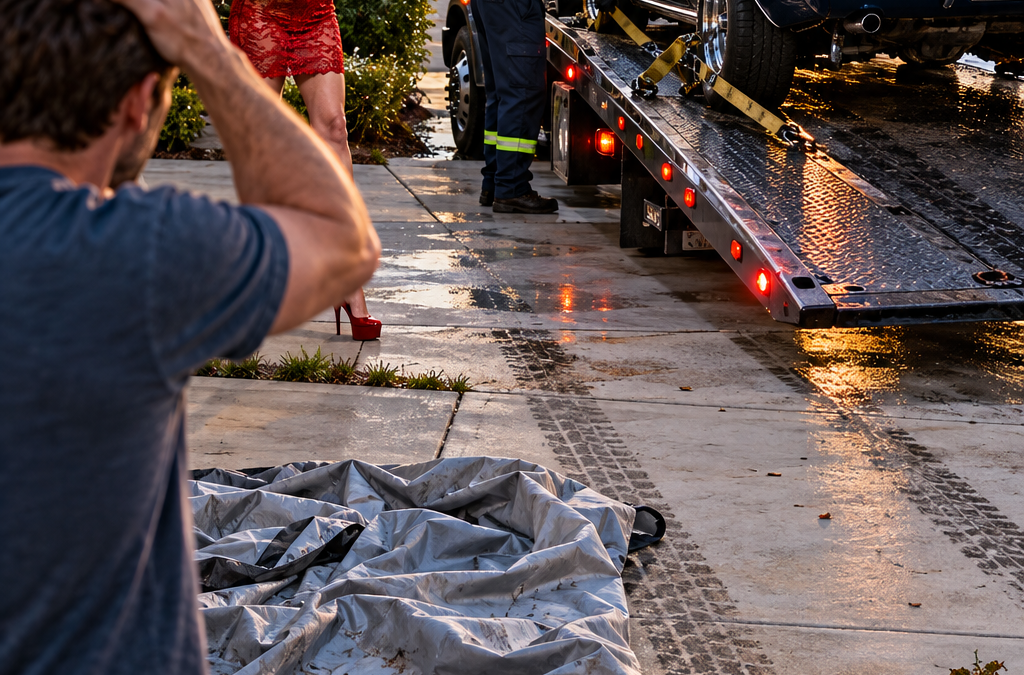
It was a warm afternoon, and I was carrying boxes into the garage when I heard heels clicking against the driveway.
I turned.
Karen stood near the Camaro, clipboard balanced against one hip.
The red lace dress hugged her figure, and the low neckline contrasted strangely with the official-looking HOA identification badge clipped near her shoulder.
Her silver hair was arranged in a perfect bun.
She looked from the covered car to me.
“Alexander Cole?”
“That’s me.”
“I’m Karen Whitfield. HOA president.”
She extended her hand.
I shook it.
She held my hand a second longer than necessary and smiled.
“I remember your father. Such a quiet man.”
“Thank you.”
“Though he was occasionally stubborn.”
I wasn’t sure how to respond.
Karen glanced toward the Camaro.
“Now, about this.”
“What about it?”
She tapped the clipboard.
“We have a problem with unauthorized vehicle storage.”
I looked at the car.
“That’s my vehicle.”
“It’s covered.”
“Yes.”
“And it’s been sitting here.”
“For a few days.”
She tilted her head.
“Covered vehicles can create an abandoned appearance. That affects neighborhood standards.”
I stared at her.
“The car is registered and insured.”
“I’m sure you believe that.”
I frowned.
“I don’t believe it. I know it.”
Her smile tightened.
“Well, we do have rules.”
“I understand. But I’m not storing junk in the driveway.”
Her eyes brightened slightly.
“Then you’ll have no problem moving it.”
“I plan to put it in the garage once I finish clearing the space.”
“Excellent.”
She wrote something down.
“Please make sure that happens promptly.”
Then she walked away.
I watched her cross the street.
She stopped beside another house and photographed a mailbox.
I shook my head and returned to my boxes.
Three days later, a yellow violation notice appeared on my front door.
It read:
UNAUTHORIZED VEHICLE STORAGE — DRIVEWAY. REMOVE WITHIN 48 HOURS OR VEHICLE WILL BE TOWED AT OWNER’S EXPENSE.
I called the HOA office.
A woman named Priya answered.
Her voice sounded tired.
I explained the situation.
“Yes, Mr. Cole,” she said. “I have the notice here.”
“Can you tell me why a covered, registered car in my driveway qualifies as abandoned?”
There was a pause.
“Mrs. Whitfield personally flagged the vehicle.”
“On what basis?”
“She determined that it appeared abandoned.”
“Did anyone inspect it?”
Another pause.
“Not that I’m aware of.”
I rubbed my forehead.
“Can I appeal?”
“You can submit a written request.”
“How long does that take?”
“Ordinarily, residents receive the appeal period stated in the bylaws.”
“Then why does the notice say forty-eight hours?”
Priya lowered her voice.
“Mrs. Whitfield designated it an emergency.”
I looked through the window at the Camaro.
“What emergency?”
She didn’t answer immediately.
Then she said, “I’m sorry, Mr. Cole. I can only tell you what’s in the file.”
Something in her voice suggested there was more she wanted to say.
But I didn’t push.
Instead, I printed the HOA bylaws.
I highlighted the relevant sections.
Then I walked to Karen’s house.
She lived near the center of the neighborhood in a large property with immaculate landscaping and flower beds so perfectly coordinated they looked artificial.
Karen answered the door wearing her familiar red lace dress.
She glanced at the papers in my hand.
“Oh, sweetheart. Are we doing paperwork?”
I ignored the condescension.
“I’d like to discuss the Camaro.”
Her smile faded slightly.
“I thought that was settled.”
“The notice says you’ll tow it within forty-eight hours.”
“Correct.”
“Your bylaws provide a seventy-two-hour appeal period before this kind of enforcement.”
She crossed her arms.
“Emergency authority allows exceptions.”
“What’s the emergency?”
“An improperly stored vehicle.”
“It’s my father’s car.”
She sighed.
“Alexander, everyone believes their property is special.”
“He died six months ago.”
For a moment, I hoped that would make her understand.
I wasn’t asking for permanent special treatment.
I needed a few more days to clear boxes from the garage.
But Karen didn’t soften.
Instead, she looked past me toward the street.
“Then perhaps you should have thought about that before parking junk in a family neighborhood.”
Junk.
The word struck me harder than I expected.
I felt my chest tighten.
“That car took my father twenty-two years to restore.”
“Sentiment doesn’t override community standards.”
“I’m not asking it to.”
“Then move it.”
“I’ll have the garage cleared this week.”
She studied me for a moment.
Then smiled again.
“Friday.”
“What?”
“You have until Friday.”
I exhaled.
“Fine. Friday.”
She leaned against the doorframe.
“See? Cooperation can be so pleasant.”
I walked away without answering.
I should have gone home and moved the car immediately.
I know that now.
But I believed I’d reached an agreement.
Karen had given me until Friday.
And I intended to meet that deadline.
That evening, I spoke with Frank Delgado, a quiet neighbor who lived across the street.
He’d known my father for years.
When he saw me carrying boxes, he crossed over.
“Getting the garage cleared?”
“Trying.”
He glanced toward the Camaro.
“Your dad would be glad to see you keeping her.”
I smiled faintly.
“Karen doesn’t agree.”
Frank’s expression changed.
“What did she say?”
“She wants the car moved by Friday.”
He looked toward Karen’s house.
“Get it inside sooner if you can.”
“Why?”
He hesitated.
“She’s not someone you want to trust with deadlines.”
I laughed.
“She can’t just take a registered vehicle from my driveway.”
Frank didn’t smile.
“Alex, I’ve seen her do things that make no sense.”
“Like what?”
He looked uncomfortable.
“Just be careful.”
I thought he was exaggerating.
At that point, I still believed that an HOA president could be unreasonable without being dangerous.
I didn’t understand that Karen had spent years teaching residents to obey her by making examples of anyone who resisted.
That night, I returned to Dad’s garage.
I moved boxes.
Sorted tools.
Separated things I could donate from things I couldn’t bear to lose.
Near the back of his workbench, beneath a stack of old repair manuals, I found a small leather notebook.
The cover was stained with oil.
The edges were worn.
Inside, Dad had recorded his Camaro restoration work.
Dates.
Parts.
Hours.
Repairs.
Small victories.
Frustrating setbacks.
He’d kept those entries for twenty-two years.
I sat on an overturned bucket reading them.
There were almost four thousand hours recorded.
One entry described spending an entire weekend trying to remove a stubborn bolt.
Another celebrated the first time the rebuilt engine started.
Some entries were technical.
Others were personal.
I found notes about birthdays, holidays, and the afternoons I’d spent helping him.
Then I came across a page dated when I was sixteen.
Taught Alex to change the oil today. He got grease on his shirt. Best day.
I read it three times.
Then I closed the notebook and pressed it against my forehead.
For a few minutes, I couldn’t breathe properly.
I’d spent months trying to be strong after Dad died.
Trying to manage his estate.
Trying to return to work.
Trying to make practical decisions.
But sitting in that garage surrounded by his tools, I felt like a little boy who just wanted his father back.
I eventually carried the notebook inside.
I intended to finish clearing the garage the following morning and move the Camaro before Friday.
Instead, I fell asleep on the couch with the notebook beside me.
And before sunrise, Karen’s truck came.
The police officer investigating the missing car had barely finished examining the driveway when I called the HOA office again.
Priya answered.
I tried to keep my voice steady.
“My Camaro is gone.”
There was silence.
“Mr. Cole?”
“The car. Someone took it.”
I heard papers moving.
Then Priya inhaled sharply.
“Oh, no.”
“What?”
“There’s an emergency removal order.”
My stomach dropped.
“Who authorized it?”
“Mrs. Whitfield.”
“When?”
“Six o’clock this morning.”
I looked at the clock.
It was Thursday.
“Priya, she gave me until Friday.”
“I know.”
“Today is Thursday.”
Her voice became very quiet.
“Yes, sir.”
“Then why was it removed?”
“I don’t understand.”
“Where is it?”
She read a name from the file.
“Higgins Auto Recovery.”
I wrote it down.
Then she whispered, “Mr. Cole, the paperwork doesn’t look right.”
“What do you mean?”
“I shouldn’t discuss internal records without authorization.”
“Priya, that’s my dead father’s car.”
Her breathing changed.
“I know. I’m sorry.”
I hung up and turned to the officer.
“Karen ordered it removed.”
He made another note.
“Do you have documentation of the Friday deadline?”
“Yes.”
“Keep it.”
I didn’t yet understand how important that instruction would become.
I drove straight to Higgins Auto Recovery.
The entire trip, I kept imagining the Camaro sitting behind a fence, waiting for me to pay a ridiculous towing fee.
I was angry.
Frightened.
But still hopeful.
The car was valuable.
It was registered.
Surely no reputable towing company would destroy a vehicle without contacting the owner.
I walked into Higgins carrying the registration documents.
A broad-shouldered dispatcher named Doug sat behind the counter.
“Can I help you?”
“My car was towed from Meadow Hollow Estates this morning. A blue 1969 Camaro SS.”
He typed into his computer.
“Plate number?”
I gave it to him.
He searched.
Then frowned.
“One second.”
His fingers moved across the keyboard again.
He looked toward the back office.
“That’s strange.”
My pulse quickened.
“What’s strange?”
He read from the screen.
“This wasn’t entered as a standard tow-and-hold.”
“What does that mean?”
“It was classified as junk removal.”
I stared at him.
“Junk?”
“Abandoned vehicle disposal.”
“That’s impossible.”
Doug looked up.
“Sir, the paperwork says the owner consented to scrapping.”
I felt my stomach turn.
“I didn’t consent to anything.”
He looked back at the screen.
The color began draining from his face.
“Where is my car?”
Doug hesitated.
“Ferris Salvage and Scrap.”
I gripped the counter.
“That’s a junkyard.”
“Yes.”
“They crush cars there.”
He stood.
“Sir, I need to make a call.”
The next few minutes remain a blur.
Doug spoke to someone on the phone.
He asked questions.
He became visibly uncomfortable.
Then he told me we needed to go to the salvage yard.
I followed him in my car.
Twenty minutes later, we pulled through the entrance to Ferris Salvage and Scrap.
The yard sat on the edge of town behind a rusting metal fence.
Rows of wrecked vehicles stretched across the property.
There were stacked car bodies, stripped engines, twisted frames, and piles of metal waiting to be processed.
The smell of oil and rust hung in the air.
A forklift moved somewhere behind a row of crushed trucks.
I got out before Doug had fully stopped.
“Where is it?”
He raised a hand.
“Let me talk to the manager.”
I didn’t listen.
I started walking.
Then running.
I called out my father’s license plate number.
I searched every row.
Blue cars.
Old cars.
Crushed cars.
I couldn’t stop.
My breathing became ragged.
My shoes slipped on loose gravel.
I kept imagining that I would round a corner and see the Camaro intact, dusty but unharmed.
Then I saw a patch of familiar blue paint.
At first, I didn’t recognize the shape.
It was too flat.
Too short.
Too destroyed.
I walked closer.
A crushed rectangle of steel sat on top of a pile of scrap.
One twisted section of the body still carried the distinctive blue finish Dad had spent months perfecting.
A piece of chrome trim protruded from the wreckage.
I knew that trim.
I’d helped him fit it.
I stopped.
The world seemed to tilt.
“No.”
I heard my own voice.
“No. No, no, no.”
I stumbled forward.
My knees struck the gravel.
I reached toward the metal, but there was nothing left to touch that felt like a car.
The Camaro was gone.
The engine Dad had rebuilt.
The seats he’d restored.
The dashboard we’d carefully cleaned.
The body he’d painted.
All of it had been crushed into a block of metal.
I began crying so hard I couldn’t speak.
Doug approached slowly.
He stopped several feet away.
“Sir…”
I shook my head.
I didn’t want his apology.
I wanted my father.
I wanted the Saturday afternoons.
The sound of the engine starting.
The smell of the garage.
The way Dad grinned when a repair finally worked.
I wanted the car back.
And there was nothing anyone could do.
A yard manager eventually approached with an intake sheet.
He looked confused.
“The disposal authorization says the owner consented.”
I lifted my head.
“What?”
He showed me the form.
OWNER CONSENTED TO SCRAP.
VEHICLE DEEMED ABANDONED JUNK.
Beneath the declaration was a signature.
Karen Whitfield.
Not mine.
Not my father’s.
Karen’s.
I stared at the document.
“She signed this?”
The manager nodded.
“She’s listed as the authorizing party.”
“She doesn’t own the car.”
He looked toward Doug.
“That’s what I was told.”
“She doesn’t own the car,” I repeated.
My voice was shaking.
“She doesn’t own my driveway. She doesn’t own my father’s property. She doesn’t have permission to sign anything.”
The manager said nothing.
I looked again at the crushed Camaro.
Twenty-two years.
Four thousand hours.
One woman had turned all of that into scrap because she didn’t like seeing a car cover in a driveway.
Then another thought occurred to me.
The original notice gave me until Friday.
This was Thursday.
Karen hadn’t simply enforced a rule.
She had acted before her own deadline.
And she’d signed a disposal authorization she had no right to sign.
Something inside me changed.
The grief remained.
It would always remain.
But beneath it, I felt anger harden into determination.
I stood slowly.
“Can I have a copy of that paperwork?”
The manager hesitated.
I looked directly at him.
“Someone destroyed my property based on a document signed by a person who didn’t own it. I need a copy.”
He glanced at Doug.
Then nodded.
I photographed every page.
The intake sheet.
The authorization.
The disposal classification.
The timestamps.
I took pictures of the crushed Camaro from several angles.
I photographed the remaining blue paint and the identifying pieces still visible.
My hands shook throughout.
But I kept going.
Because I understood one thing clearly.
The car couldn’t be saved.
The evidence still could.
I stayed outside the salvage yard for almost two hours after that.
I sat behind the steering wheel of my own car, staring through the windshield.
My phone rang several times.
I ignored it.
I thought about driving to Karen’s house.
I imagined pounding on her door.
I imagined demanding that she look at photographs of what she’d done.
But I knew what would happen.
She would call me unstable.
Threatening.
Harassing.
She would use my anger as another weapon.
I’d worked in the legal field for eleven years.
I knew how quickly a bad confrontation could turn a victim into the person everyone wanted to blame.
So I didn’t go to her house.
Instead, I opened the notes application on my phone.
I created a file titled EVIDENCE.
Then I wrote down everything.
The violation date.
The deadline.
The time of the tow.
The name of the towing company.
The disposal authorization.
Karen’s signature.
The location of the salvage yard.
The condition of the car.
When I finished, I sat there and made myself a promise.
Karen Whitfield was going to answer for what she’d done.
Not through threats.
Not through violence.
Through records.
Witnesses.
Legal action.
Every signature she’d thought nobody would check.
My father used to say patience was the only tool that never rusted.
For the first time since his death, I understood how much I needed that lesson.
The next morning, I drove to the county recorder’s office and began gathering publicly accessible records related to Meadow Hollow Estates.
I also submitted formal requests for HOA documents that weren’t available through county filings.
I wanted meeting minutes.
Enforcement policies.
Financial statements.
Vehicle removal records.
Board authorizations.
Anything that could establish exactly what powers Karen had been granted.
The first discovery made me sit back in my chair.
The association’s governing documents required a seventy-two-hour appeal opportunity for ordinary vehicle removal violations.
Emergency action had narrow conditions.
And nothing in the documents authorized Karen to sign away ownership of a resident’s vehicle for destruction.
That alone was serious.
Then I began comparing removal records.
There were forty-one emergency removal orders over a three-year period.
Forty-one.
Each appeared to bypass the normal appeal window.
Some notices offered only twenty-four hours.
Others were classified as immediate safety actions.
Several lacked clear documentation explaining why an emergency existed.
I stared at the list.
For a while, I’d believed I was one unfortunate homeowner targeted by an overzealous HOA president.
Now I was looking at a pattern affecting dozens of families.
I photographed documents and cataloged every date.
I compared authorization signatures.
I checked board meeting minutes.
And the more I examined the records, the more the same question bothered me.
Why had Karen been so determined to remove people’s vehicles before they could appeal?
My father’s Camaro wasn’t blocking a road.
It wasn’t leaking fuel.
It wasn’t creating a hazard.
It was parked quietly on my property.
Yet she’d arranged to have it destroyed before her own deadline expired.
Why the rush?
I requested security footage from the gated entrance and the camera whose view included the street near my driveway.
Priya responded within the hour.
Her email contained a video file.
Mr. Cole, this is the footage retained for the relevant morning. Please preserve the original copy.
I opened it immediately.
The timestamp read 5:47 a.m.
Karen appeared in the frame.
She was wearing a bathrobe thrown over what looked like her familiar red lace dress.
Her silver hair was loosely pinned back.
She stood at the edge of my driveway speaking to the tow truck driver.
Then she pointed directly toward the covered Camaro.
The truck moved into position.
Karen stepped aside.
I watched the operator secure my father’s car.
The Camaro rose.
Its wheels left the ground.
And Karen stood watching.
I replayed the footage.
Then again.
On the third viewing, I noticed her expression.
She was smiling.
Not a broad, joyful smile.
A small, satisfied smile.
The kind someone wears when a plan works exactly as intended.
My stomach turned.
I watched the footage six times.
On the final viewing, I noticed something near the edge of the frame.
A black sedan sat farther down the street.
Its headlights were off.
Its engine appeared to be running.
The car remained parked while the tow truck removed the Camaro.
Then it drove away.
I enlarged the image as much as the recording allowed.
I saved still frames.
The plate wasn’t clear enough for me to identify confidently, but I preserved the footage.
Later, investigators would determine that the sedan was connected to Chester Ferris, the owner of the salvage yard.
That discovery would become important.
Because it suggested the salvage operation hadn’t merely received an unexpected vehicle after the tow.
Someone associated with the yard had been present while Karen supervised its removal.
The more I learned, the harder it became to believe the destruction was accidental.
I started contacting the families named in the removal records.
I didn’t call everyone at once.
I worked carefully.
One homeowner at a time.
Some refused to discuss their experiences.
Others became nervous as soon as I mentioned Karen.
One man told me his vehicle had been removed while he was out of town, and he had paid the charges rather than fight.
A woman said she’d been threatened with additional penalties when she questioned a tow.
Several residents ended conversations quickly.
They still lived in Meadow Hollow.
Karen still controlled the board.
And they were afraid of what she might do if she learned they were helping me.
I understood.
I’d seen what happened when she decided someone was disobedient.
Then I contacted Marjorie Fen.
Marjorie was an elderly widow whose late husband’s fishing boat trailer had been removed eighteen months earlier.
She agreed to meet at a diner two towns away.
When I arrived, she was already sitting in a booth with a cup of coffee.
She wore a pale blue sweater and held her purse tightly against her side.
“Alexander?”
“Yes, ma’am.”
She smiled faintly.
“You look like your father.”
The words caught me off guard.
“You knew him?”
“Everyone knew Richard.”
I sat down.
She studied my face.
“I’m sorry about the Camaro.”
My throat tightened.
“Thank you.”
She stirred her coffee.
“I heard what happened. I couldn’t believe she’d gone that far.”
I took out my notebook.
“Would you tell me about your husband’s trailer?”
Marjorie looked down.
“Arthur loved fishing.”
Her voice softened.
“He didn’t have much patience for fancy hobbies. But he could sit by a lake for ten hours and come home happier than when he left.”
She smiled at the memory.
“After he died, I kept the trailer. It wasn’t worth much. I just wasn’t ready to give it away.”
I nodded.
“I understand.”
She looked directly at me.
“Karen gave me twenty-four hours to remove it.”
“What was the violation?”
“Improper equipment storage.”
“Did she allow you to appeal?”
“No.”
“What happened?”
“I called the office. They said the president had classified it as an emergency removal.”
Her hands tightened around the coffee cup.
“The trailer was gone before I could arrange for someone to move it.”
“What did the towing company say?”
“They said it had been transferred for disposal.”
I felt anger rise in my chest.
“Did you get it back?”
Marjorie shook her head.
“It disappeared from the yard within a week.”
She looked embarrassed.
“I thought perhaps I hadn’t understood the rules. Karen spoke so confidently. She made me feel foolish for asking questions.”
I leaned forward.
“Marjorie, you weren’t foolish.”
She gave a sad smile.
“That’s easy to say afterward.”
I hesitated.
Then asked the question that had been bothering me.
“Did you ever hear anything about Karen receiving money from these removals?”
Marjorie’s expression changed.
“Why do you ask?”
“Because something about the speed of the process doesn’t make sense.”
She considered that.
“Arthur’s trailer was sold for scrap rights. I learned that later.”
“Who bought them?”
“I don’t know. But I remember thinking somebody made money from something that belonged to us.”
She stared out the diner window.
“I just wanted to keep one piece of my husband.”
I couldn’t speak for a moment.
Then I reached across the table and gently touched her hand.
“That’s what I wanted too.”
We sat quietly.
I realized then that the Camaro wasn’t the only piece of someone’s life Karen had destroyed.
There were other fathers.
Other husbands.
Other families.
Other objects that looked worthless to strangers but carried years of memory for the people who owned them.
Karen had treated those things as disposable.
And I was beginning to suspect she had profited from their destruction.
That afternoon, I returned to Ferris Salvage.
This time, I wasn’t there to look at the wreckage.
I wanted answers.
The owner, Chester Ferris, was a thin, wiry man with weathered hands and a cautious expression.
He met me near the office.
“I remember you,” he said.
“The Camaro.”
He looked away.
“Yeah.”
I didn’t waste time.
“Does Karen Whitfield have a standing arrangement with your business?”
His posture stiffened.
“What kind of arrangement?”
“Vehicles removed from Meadow Hollow. Scrap sales. Referral payments.”
He looked toward the yard.
For several seconds, he said nothing.
Then he muttered, “I probably shouldn’t talk about that.”
I felt my pulse quicken.
“Chester, that car belonged to my father.”
“I know.”
“No, I don’t think you do.”
He looked at me.
“My father spent twenty-two years restoring it. Karen signed a document saying I consented to its destruction. I never did.”
Chester rubbed his jaw.
He seemed to be calculating something.
Finally, he said, “She gets a cut.”
I stared at him.
“What?”
“Twenty percent.”
My mouth went dry.
“Twenty percent of what?”
“Scrap value. Every vehicle she refers.”
The words seemed to hang between us.
My father’s Camaro.
Marjorie’s trailer.
Dozens of other removals.
Karen had been receiving money.
I took a slow breath.
“How long has this been happening?”
Chester looked uncomfortable.
“A few years.”
“Do you have records?”
He hesitated.
I held his gaze.
“Chester, someone is going to investigate this. You can explain it now, or you can explain it when investigators start asking why you destroyed registered vehicles based on HOA paperwork.”
He closed his eyes briefly.
Then sighed.
“Come inside.”
He led me into a cramped office.
A filing cabinet stood beside the desk.
Chester opened the lower drawer and removed a folder.
On the tab, written in black marker, were two characters.
K REFERRALS.
He placed it on the desk.
Inside were records of forty-one vehicle referrals.
Names.
Dates.
Amounts.
Payments.
Signatures.
I felt my heartbeat in my throat.
The entries corresponded to the emergency removal orders I’d found.
Every one.
Chester explained that Karen had received cash commissions calculated from the scrap proceeds.
Twenty percent.
The same pattern appeared repeatedly.
A violation notice.
An accelerated removal.
A vehicle sent for disposal.
A payment connected to Karen.
I photographed the pages with Chester’s permission while he explained the records.
When I finished, I looked at him.
“Did you know she didn’t own these vehicles?”
He swallowed.
“She said the association had authority.”
“Did you check?”
He didn’t answer.
“Did you know she was signing owner-consent forms?”
He looked down.
“I relied on the paperwork.”
I felt furious.
But I kept my voice controlled.
“My father is dead. That car was one of the last things he left me.”
Chester rubbed his face.
“I’m sorry.”
I wanted to tell him his apology meant nothing.
I wanted to ask how much money it took to make someone stop caring whether a car belonged to the person ordering its destruction.
Instead, I gathered my notes.
“Keep every original record.”
He looked up.
“What?”
“Don’t destroy anything. Not one invoice. Not one message. Not one payment record.”
He nodded slowly.
I left with copies of documents that transformed the situation.
Karen hadn’t simply been abusing HOA rules.
She had apparently been operating a kickback arrangement.
Manufacture a reason to remove property.
Avoid the appeals process.
Send the vehicle to a cooperating salvage yard.
Collect a percentage.
Repeat.
I sat in my car with the folder on the passenger seat and stared at the steering wheel.
My father’s Camaro had been worth far more than scrap.
But to Karen, the only value that mattered was the amount she could collect.
That thought made me feel physically sick.
I drove home, spread the documents across the kitchen table, and started organizing them.
I knew better than to assume every suspicious act automatically proved a specific crime.
But the evidence raised serious questions about theft, fraud, forgery, unauthorized property disposal, and breach of fiduciary duty.
And this time, I wasn’t going to settle for an apology.
The next morning, I went to the county sheriff’s office.
I filed a formal report alleging theft and destruction of property.
I brought the towing documents, the HOA notice, the surveillance recording, and the salvage referral records.
The detective assigned to the case was a woman named Reyes.
She looked tired when I entered her office.
That changed when she began reading.
She flipped through the documents.
Then returned to the first page.
“Where did you get these records?”
“County filings, HOA documents, and the salvage yard.”
She looked at the kickback entries.
“Did the yard owner provide these voluntarily?”
“Yes.”
Reyes raised an eyebrow.
“You’ve done a lot of work.”
“I used to be a paralegal.”
“That explains the organization.”
She studied the records again.
“Forty-one removals?”
“Over three years.”
“And twenty percent paid to Whitfield?”
“That’s what the salvage records show.”
She leaned back.
“Mr. Cole, you’ve built a substantial starting file.”
I swallowed.
“Does that mean something can be done?”
“It means we have specific allegations and documents we can investigate.”
She tapped the folder.
“We’ll need original records, witness interviews, and financial confirmation.”
I nodded.
“I understand.”
Reyes looked at me carefully.
“Can I ask you something?”
“Sure.”
“Why go this far?”
For a moment, I couldn’t speak.
Then I took out my phone and showed her the photograph of Dad standing beside the restored Camaro.
His hand rested on the hood.
He was smiling.
“That was my father,” I said.
“He spent twenty-two years on that car.”
Reyes looked at the photograph.
Then at me.
“I understand.”
I shook my head.
“No offense, Detective, but I don’t think anybody really does.”
She didn’t argue.
Instead, she said, “Then let’s make sure the records tell the whole story.”
For the first time since seeing the crushed Camaro, I felt something resembling hope.
But Karen wasn’t finished.
Word spread quickly through Meadow Hollow.
Within days, neighbors knew I’d filed a police report against the HOA president.
Some avoided me.
Others watched from their porches when I drove home.
Karen responded with another yellow notice.
It was taped to my front door.
HARASSMENT OF HOA LEADERSHIP — SECTION 14.2.
The document imposed another fine and warned of escalating enforcement if I continued making allegedly false accusations against board members.
I took it inside.
Opened the bylaws.
Checked the enforcement sections.
Then checked again.
There was no Section 14.2 authorizing that fine.
Karen had invented it.
I sat at my kitchen table and laughed.
It wasn’t because anything was funny.
It was the strange laughter that comes when someone has become so openly unreasonable that you no longer know how to react.
I photographed the notice.
Added it to my folder.
And forwarded it to Detective Reyes.
Karen had just created another piece of evidence.
That evening, Frank crossed the street carrying two bottles of beer.
He found me sitting on the front porch.
“Mind if I join you?”
“Not at all.”
He handed me a bottle.
For a while, we sat without speaking.
Then he said, “I owe you an apology.”
I looked at him.
“For what?”
“I knew Karen had done things like this before.”
“You warned me.”
“Not enough.”
He stared toward the road.
“She did something similar to my brother’s boat two years ago.”
I turned.
“What happened?”
“Emergency violation. Removal. Fees. Whole ugly mess.”
“Did your brother fight?”
“Not really. He didn’t have the money.”
Frank took a drink.
“I told myself staying out of it was the smart thing. I had a house to protect.”
I understood that.
More than he knew.
“Frank, she wanted people afraid.”
He nodded.
“That’s exactly what she wanted.”
I hesitated.
Then told him about Chester’s kickback records.
Frank stared at me.
“You’re kidding.”
“I wish I were.”
“Twenty percent?”
“Every referral.”
His expression shifted from disbelief to anger.
“That miserable woman.”
Then he looked toward his house.
“Wait here.”
He returned several minutes later with his laptop.
“I’ve got a security camera facing my driveway,” he said.
“Okay.”
“Last spring, it caught something strange. I saved it because I couldn’t figure out why Karen was messing around near a neighbor’s boat.”
He opened the file.
The footage was taken late at night.
A boat sat beside a nearby driveway.
Karen appeared in the camera’s view.
She moved toward the boat carrying a container.
Then she began siphoning gasoline from its fuel system.
I leaned forward.
“What the hell?”
Frank nodded grimly.
“The next morning, she reported the boat for unsafe fuel storage.”
I watched the footage again.
The sequence was unmistakably suspicious.
Karen had interfered with the boat before submitting a complaint about its condition.
Another manufactured emergency.
Another removal opportunity.
Another possible referral payment.
I sat back.
“This is bigger than the Camaro.”
Frank nodded.
“Yeah.”
His voice was quiet.
“Much bigger.”
The next morning, I brought the video to Detective Reyes.
She watched it without speaking.
When it ended, she replayed the relevant portion.
Then she looked at me.
“This strengthens the pattern.”
“Can you arrest her?”
“Not based solely on this recording. We still need to establish the full chain of events and financial connections.”
“What happens next?”
“We’re pursuing additional records.”
She paused.
“Financial accounts. Communications. Possibly the HOA email system.”
I nodded.
“How long?”
“I can’t promise you a timeline.”
I looked down at my hands.
“I understand.”
Reyes leaned forward.
“Mr. Cole, don’t confront her. Let us investigate.”
“I won’t.”
“Good.”
I meant it.
But staying quiet became harder as the days passed.
For two weeks, Meadow Hollow felt like a neighborhood waiting for a storm.
Karen changed her behavior.
The woman who had once prowled the streets photographing mailboxes suddenly became the friendliest person in Ohio.
She organized community appreciation gatherings.
She distributed lemonade.
She smiled for photographs.
She spoke about unity and neighborhood pride.
The red lace dress remained her uniform, but her expression softened whenever residents were watching.
I recognized the performance immediately.
She was trying to rebuild support before the investigation reached her.
One Saturday, she hosted a barbecue near the clubhouse.
I attended.
Not because I forgave her.
Not because I wanted free food.
I wanted to see whether she understood how much trouble she was in.
Karen spotted me near the drinks table.
She approached with a bright smile.
“Alexander.”
“Karen.”
She leaned close, lowering her voice.
“I hear you’ve been making quite a fuss.”
I looked at her.
“I filed a police report.”
“Yes. A little misunderstanding.”
“Forty-one families don’t sound like a misunderstanding.”
Her smile faltered.
Only for a second.
Then she recovered.
“I don’t know what you’re talking about.”
“Then perhaps you should ask your lawyer.”
She studied me.
“You’re very confident.”
“No.”
I shook my head.
“I’m very angry.”
For the first time, she seemed uncertain.
I continued quietly.
“You destroyed my father’s car before the deadline you gave me. And you signed paperwork claiming I consented.”
She looked away.
“Those documents were prepared through approved procedures.”
“Then you have nothing to worry about.”
Her eyes narrowed.
I watched the flirtatious warmth disappear.
“Be careful, Alexander.”
I held her gaze.
“I have been.”
She turned and walked away.
I didn’t follow.
I didn’t raise my voice.
I simply watched her return to the barbecue and begin smiling at another group of residents.
That evening, Detective Reyes called.
I was in the kitchen when my phone rang.
I answered immediately.
“Detective?”
“We obtained the warrant.”
I sat down.
“For her records?”
“Financial records and additional communications.”
My heart began racing.
“What did you find?”
Reyes paused.
“Significant unexplained cash deposits.”
“How much?”
“More than eighty-six thousand dollars over approximately three years.”
I stared at the wall.
Eighty-six thousand.
“The deposits align closely with the referral records.”
I gripped the phone.
“Chester’s folder?”
“Yes.”
She continued.
“We’re also reviewing board meeting minutes that appear to contain forged signatures.”
My mouth went dry.
“Forged?”
“Signatures purportedly approving expanded emergency removal authority.”
I thought of the yellow notices.
The seventy-two-hour appeal window.
The forms Karen had used to justify destroying people’s property.
“She gave herself authority she didn’t have.”
“That’s one of the issues we’re examining.”
I rubbed my forehead.
For a moment, I couldn’t speak.
Then I asked the question that had been living inside me since the salvage yard.
“Detective, is there anything that can bring the car back?”
The silence on the line was gentle.
“No, Alex.”
I closed my eyes.
“I know.”
“But we can work to stop this from happening again.”
I pressed the phone against my forehead after the call ended.
I wanted to feel victorious.
Eighty-six thousand dollars.
Forged documents.
Forty-one removals.
The evidence was growing stronger.
But the Camaro was still a crushed block of steel.
Nothing in a bank account could recreate the hours Dad had spent with that car.
Nothing could give me another Saturday beside him.
I stayed on the kitchen floor for a long time.
Then I picked up his leather notebook.
I opened it to the oil-change entry.
Taught Alex to change the oil today. He got grease on his shirt. Best day.
I read it until the words blurred.
The following Thursday, Meadow Hollow’s board scheduled an emergency meeting.
Karen intended to address what she called false accusations against HOA leadership.
I knew she planned to attack my credibility again.
I also knew Detective Reyes had been gathering the evidence necessary to challenge her.
Still, I wasn’t prepared for what happened.
The clubhouse was crowded.
Board members sat behind a long table.
Residents filled rows of folding chairs.
Frank sat near the back.
I took a seat in the front row with a manila folder on my lap.
Karen entered wearing her red lace dress, silver hair pulled into its severe bun, chin raised.
She looked beautiful.
Confident.
Untouchable.
She sat at the head of the table and picked up the gavel.
“First order of business,” she announced, “the malicious allegations being spread by a disgruntled resident.”
She glanced directly at me.
I felt my jaw tighten.
Then the clubhouse door opened.
Detective Reyes stepped inside.
She was in uniform.
The room fell quiet.
“Actually,” Reyes said, “I think we should address the actual business first.”
Karen froze.
For a moment, she simply stared.
Then she forced a smile.
“Detective. This is a private HOA meeting.”
“I’m aware.”
“May I ask why you’re interrupting?”
Reyes approached the table.
“We need to discuss the evidence collected during an investigation into unauthorized vehicle removals, financial transfers, and falsified association records.”
The smile vanished.
Karen looked toward the board.
“This is outrageous.”
Reyes remained composed.
She outlined the investigation.
The removal orders.
The missing appeal periods.
The forged authorizations.
The salvage referral records.
The payments.
The suspicious bank deposits.
The security footage.
Every statement seemed to remove another layer of Karen’s authority.
One board member leaned forward.
“Forged meeting minutes?”
Reyes nodded.
“That’s among the evidence under investigation.”
Another asked, “What payments?”
Reyes described the referral arrangement documented at Ferris Salvage.
Twenty percent of scrap proceeds paid to Karen.
A murmur moved through the room.
Karen struck the gavel.
“Order!”
Nobody stopped whispering.
She struck it again.
“This is a misunderstanding!”
I felt something cold settle inside me.
That word.
Misunderstanding.
She had used it at the barbecue.
She had used it when confronted about the Camaro.
Now she was using it in front of a detective and an entire neighborhood.
I stood.
“My father’s car wasn’t a misunderstanding.”
Karen turned toward me.
“Alexander, sit down.”
“No.”
Her eyes widened.
I held up the photograph of the crushed Camaro.
“You called this junk.”
Several people leaned forward.
I continued.
“My father spent twenty-two years restoring that car. He worked almost four thousand hours on it.”
My voice shook.
“You gave me until Friday to move it. Then you had it towed Thursday morning.”
Karen’s face tightened.
“The vehicle violated storage regulations.”
“You sent it to a crusher.”
“I acted on behalf of the association.”
I looked directly at her.
“Did the association authorize you to collect twenty percent of its scrap value?”
The room erupted.
People gasped.
Someone cursed.
Frank laughed once, bitterly.
Karen stood abruptly.
“That is a vicious accusation!”
Reyes stepped forward.
“Mrs. Whitfield, the financial records indicate payments consistent with that arrangement.”
Karen looked toward the exit.
Then toward the board.
Her lips parted.
For the first time since I’d met her, she appeared genuinely afraid.
“This is all being taken out of context.”
Reyes continued calmly.
The forged board authorizations had been reviewed.
The removal records showed a consistent pattern.
The available evidence supported allegations of theft, fraud, and forgery.
Karen took a step back.
“I was protecting the neighborhood.”
I looked at her.
“By destroying property that didn’t belong to you?”
She stared at me.
“By taking money from a salvage yard?”
“Alexander—”
“By forging the signatures of people who trusted you?”
Her eyes filled with panic.
“Please.”
That word surprised me.
Please.
Karen Whitfield had never sounded pleading before.
She looked at Reyes.
“Can we discuss this privately?”
Reyes’s expression remained firm.
“Mrs. Whitfield, you’re under arrest.”
For one second, Karen didn’t move.
Then she shook her head.
“No.”
Reyes stepped closer.
Karen looked toward the board members.
Nobody intervened.
“You can’t do this,” she whispered.
Reyes instructed her to turn around.
The handcuffs closed around her wrists.
The sound was small.
Metal clicking against metal.
But I’ll remember it for the rest of my life.
Karen’s shoulders sagged.
Her beautiful red dress looked strangely out of place beneath the harsh fluorescent lights.
She had ruled Meadow Hollow for five years.
She had frightened dozens of homeowners into silence.
She had used her position to take property, invent emergencies, and profit from people who trusted the HOA to protect them.
Now she was being led out of the clubhouse in handcuffs.
As Reyes escorted her past me, Karen looked up.
Her expression was filled with rage.
“This isn’t over.”
I met her eyes.
“You’re right.”
She looked confused.
“The Camaro is still gone.”
She said nothing.
Reyes guided her through the door.
For a moment, the entire room remained silent.
Then everyone began talking at once.
Some residents were furious.
Others looked stunned.
Several approached me.
A few apologized for believing Karen’s accusations.
Frank crossed the room and placed a hand on my shoulder.
“You did it, Alex.”
I looked toward the doorway.
“I didn’t get the car back.”
His smile faded.
“I know.”
And that was the terrible truth beneath the victory.
Karen had been arrested.
But my father was still dead.
And the car was still scrap metal.
The arrest was only the beginning.
Karen was released on bail within hours.
She hired an attorney.
And almost immediately, her legal team began looking for a way to limit the damage.
By then, I’d hired a civil attorney of my own.
Her name was Patricia Inguin.
She was sharp, direct, and unimpressed by Karen’s reputation.
Patricia reviewed the police investigation, the vehicle appraisal, and the documentation I’d preserved.
She understood that the Camaro had value far beyond the amount someone might pay for a damaged classic car.
Dad had restored it to a high standard over decades.
Its replacement and restoration value required proper appraisal.
The destruction had also caused financial losses and severe emotional harm.
We pursued civil claims connected to the unauthorized disposal, fraud, and damages arising from Karen’s conduct.
One afternoon, Patricia called me into her office.
“Karen’s attorney has made an offer.”
I sat down.
“How much?”
“Fifteen thousand dollars.”
I stared at her.
“That’s a joke.”
Patricia didn’t smile.
“It’s far below the valuation and damages we’re pursuing.”
I looked toward the window.
Fifteen thousand dollars.
For the car.
For the forged paperwork.
For the deliberate destruction.
For the nights I’d spent trying to understand why someone would do that to my father.
“Tell them no.”
Patricia nodded.
“I expected that.”
“I want the full case.”
“Then that’s what we’ll pursue.”
Within an hour, Karen’s attorney contacted Patricia again.
The offer increased to fifty thousand dollars.
I didn’t hesitate.
“No.”
Patricia studied me.
“Alex, I want you to think carefully about settlement decisions. Litigation has risks.”
“I know.”
“Money doesn’t undo what happened.”
“I know that too.”
I looked down at my father’s notebook, which I’d brought with me.
“But she doesn’t get to decide what his work was worth after destroying it for a kickback.”
Patricia closed her folder.
“Understood.”
We continued.
The investigation expanded as more victims came forward.
Marjorie contacted Detective Reyes and provided records concerning her husband’s trailer.
Three more families described sudden removal orders, inconsistent deadlines, and missing property.
Their statements supported the pattern already visible in the documents.
The HOA board, suddenly confronted with possible liability and a criminal investigation involving its president, voted unanimously to suspend Karen.
For the first time in years, Meadow Hollow began operating without her directing every decision.
An emergency election followed.
Frank Delgado was nominated as interim president.
I laughed when he told me.
“You?”
He grinned.
“Apparently, people want somebody who doesn’t tow their cars for fun.”
“You sure you want the headache?”
“Somebody has to make sure the rules are actually followed.”
He looked at me.
“Besides, your dad always said a neighborhood belongs to the neighbors.”
I smiled.
“He did.”
Frank’s election changed the atmosphere.
Residents began attending meetings.
They asked for financial records.
They demanded explanations for past enforcement actions.
Priya, the HOA assistant, began cooperating with the new board.
She had spent years working under Karen’s threats and demands.
Now she could finally speak without worrying that one wrong sentence would cost her job.
But the case wasn’t finished.
Karen’s criminal trial was scheduled for approximately eight weeks later.
Our civil lawsuit continued moving forward.
Patricia began taking depositions.
Chester Ferris testified under oath about the referral payments.
His voice was flat and resigned.
He confirmed that Karen received twenty percent of the scrap value from vehicles she sent to his yard.
He confirmed that he maintained records of the arrangement.
He confirmed that Karen sometimes contacted him before the affected residents had even received their removal notices.
When Patricia asked why he had continued participating, Chester looked down.
“She told me the association had authority.”
“Did you independently verify that?”
“No.”
“Did you profit from the arrangement?”
“Yes.”
“Did you know vehicles were being destroyed without their owners’ consent?”
Chester hesitated.
Then admitted that he had relied on Karen’s paperwork despite having reason to question some of the authorizations.
His cooperation did not erase his responsibility.
But it helped establish what had happened.
Then Priya testified.
She looked frightened when she entered the deposition room.
I had only spoken with her a handful of times.
But I remembered her voice on the phone the morning the Camaro disappeared.
The notice said Friday. Today is Thursday.
Under oath, she admitted that Karen had ordered certain enforcement notices to be backdated.
The purpose was to make removal deadlines appear legitimate after the fact.
I felt sick hearing it.
Karen hadn’t merely ignored the rules.
She had altered the paperwork to conceal what she’d done.
The notices weren’t mistakes.
The deadlines weren’t misunderstandings.
They were part of the scheme.
Every deposition strengthened the case.
Then Patricia’s investigator uncovered something that changed how I understood Karen’s motives.
She was deeply in debt.
Financial records indicated she owed more than one hundred forty thousand dollars on a second mortgage.
A mortgage her husband, Gerald, apparently hadn’t known about.
Karen had been hiding serious financial trouble while presenting herself as the flawless queen of Meadow Hollow.
The scrap payments weren’t simply extra spending money.
They were part of her desperate attempt to manage debts she’d concealed from the people closest to her.
That didn’t make her actions sympathetic.
It made them more frightening.
Because it explained why she had grown increasingly aggressive.
Why deadlines shortened.
Why she invented emergencies.
Why she took risks that would have seemed irrational to someone who wasn’t desperate.
She needed money.
And she’d discovered that frightened homeowners were easier to exploit than people willing to challenge her authority.
The investigation also revealed that Gerald had filed for divorce shortly after her arrest.
He cited financial deception and the collapse of trust in their marriage.
I hadn’t expected that.
For years, Karen had appeared untouchable.
Now her position, finances, marriage, and freedom were all in danger.
I thought I would feel delighted.
Instead, I felt exhausted.
I didn’t want to spend my life celebrating someone else’s destruction.
I wanted my father back.
I wanted his car.
I wanted to walk into the garage and hear him say, “Pass me that wrench, Alex.”
None of those things were possible.
But I could make sure Karen never did this to another family.
The criminal trial began on a gray Tuesday morning.
I arrived early.
The courthouse hallways smelled of floor polish and coffee.
Residents from Meadow Hollow filled much of the public seating.
Marjorie was there.
Frank was there.
Several families whose vehicles had been removed sat together.
The room felt like a gathering of people who had spent years carrying the same secret fear.
Karen sat at the defense table.
She wore a gray blazer over a red lace dress, the neckline still visible beneath the jacket.
Her silver hair was pulled into its usual tight bun.
But the confidence had disappeared.
She kept her hands folded.
She rarely looked toward the gallery.
When the prosecutor began presenting the case, the evidence came in carefully documented pieces.
Forty-one removal orders.
Forty-one names.
Forty-one families who had been denied the normal process required by their governing documents.
The prosecutor showed how emergency classifications had been used to bypass appeal periods.
How removal notices had been altered.
How signatures had been forged to create the appearance of board authorization.
Then came the financial records.
The kickback folder.
The cash deposits.
More than eighty-six thousand dollars entering Karen’s accounts over three years, closely matching the recorded referral payments.
The evidence that had once sat scattered across my kitchen table was now being presented to a jury.
I watched the jurors examine each document.
I watched them take notes.
And I remembered how easily Karen had dismissed my questions when all I had was a yellow notice and a copy of the bylaws.
Then the prosecutor played the security footage.
The clubhouse camera recording from 5:47 a.m.
Karen standing in my driveway.
Her bathrobe over the red lace dress.
Her arm extended toward the Camaro.
The tow truck moving into position.
My father’s car being lifted away.
The black sedan parked down the street.
I stared at the screen.
I had watched that video countless times.
But seeing it in a courtroom was different.
Every detail had weight.
Every movement meant something.
The prosecutor established that the removal happened before the stated deadline.
Then she displayed the authorization signed by Karen.
OWNER CONSENTED TO SCRAP.
I felt my throat tighten.
My father had never consented.
I had never consented.
Yet Karen had signed the document as though the car belonged to her.
Chester Ferris testified next.
He described the arrangement.
“She would call me the night before,” he said.
“Sometimes before the notice had even been posted.”
The prosecutor asked him whether the payments were tied to vehicles sent for disposal.
“Yes.”
“Did Mrs. Whitfield receive a percentage?”
“Twenty percent.”
“Did she know the vehicles would be scrapped?”
“Yes.”
I watched Karen.
She sat rigidly.
Her jaw was tight.
She looked as though she wanted to disappear.
Marjorie testified about Arthur’s fishing trailer.
Her voice trembled when she described keeping it after her husband’s death.
She explained how quickly it had been removed.
How she had never been given a meaningful opportunity to appeal.
How she felt ashamed for questioning someone who claimed to be protecting the neighborhood.
I looked down at my hands.
Marjorie’s story hurt because it was so familiar.
Then Frank’s security footage was shown.
Karen siphoning gasoline from another resident’s boat.
The subsequent safety complaint.
Another manufactured emergency.
Another property removal.
The pattern was difficult to deny.
But the hardest moment came when I was called to testify.
I walked to the witness stand carrying my father’s leather notebook.
My hands were cold.
The prosecutor asked me to describe the Camaro.
I explained how Dad bought it.
How he restored it.
How long he worked.
How I helped.
I talked about the garage.
The tools.
The weekends.
Then I was asked what the car meant to me.
For a moment, I couldn’t speak.
I opened the notebook.
Found the entry I’d read so many times.
And held it carefully.
“My father kept a record of almost every hour he spent on that car.”
I swallowed.
“Almost four thousand hours over twenty-two years.”
The courtroom was silent.
I looked down and read.
“Taught Alex to change the oil today. He got grease on his shirt. Best day.”
My voice broke on the final two words.
I stopped.
Took a breath.
Then looked toward the jury.
“That’s what the car was.”
I felt tears gathering.
“It wasn’t just an old Chevrolet.”
I looked toward Karen.
“It was every Saturday my father spent teaching me something.”
She looked away.
“It was every time he told me not to give up because a repair was difficult.”
My voice shook.
“It was one of the few places where we could talk about anything.”
I held up the notebook.
“And when he died, I thought I still had a piece of that.”
I paused.
“Then Mrs. Whitfield decided it was junk.”
The prosecutor asked whether I had given permission for the car to be scrapped.
“No.”
“Did you authorize Karen Whitfield to sign disposal documents?”
“No.”
“Did you receive notice that the car would be destroyed?”
“No.”
I looked down at the notebook.
“I was supposed to have until Friday.”
The courtroom remained quiet.
When I stepped down, Frank squeezed my shoulder as I passed.
I could barely look at him.
The defense attempted to explain Karen’s conduct as the result of financial stress and impaired judgment.
Her attorney argued that she had made poor decisions while overwhelmed by debt.
He suggested that the HOA enforcement process had been misunderstood and that some records could reflect administrative confusion.
I listened.
I tried to be fair.
Financial pressure can make people desperate.
Mistakes happen.
People can misunderstand rules.
But forty-one removals weren’t one mistake.
Forged signatures weren’t confusion.
Payments tied to scrap referrals weren’t harmless bookkeeping errors.
And the decision to crush my father’s Camaro before the deadline had expired was not something that happened because Karen was having a bad morning.
It was part of a pattern.
The prosecution made that clear.
By the time closing arguments ended, the evidence had been presented in a way I could never have managed alone.
The jury had seen the documents.
The recordings.
The financial trail.
The testimony from families who’d lost property.
Now all I could do was wait.
The jury deliberated for six hours.
Six hours.
I spent most of that time in the courthouse hallway.
Frank sat beside me.
Marjorie quietly knitted something in her lap.
Nobody had much to say.
Every time a door opened, I looked up.
I tried not to imagine the verdict.
I knew evidence mattered.
I knew we’d assembled a substantial case.
But I’d also learned how dangerous it could be to assume that being right guaranteed a good outcome.
When the jury finally returned, I felt my heartbeat in my throat.
We stood as instructed.
The foreperson held the verdict forms.
On the grand theft auto charge, Karen was found guilty.
I closed my eyes.
On the fraud charge, guilty.
My knees felt weak.
On the forgery charge, guilty.
Someone behind me began crying quietly.
On the breach-of-fiduciary-duty count, guilty.
Four guilty verdicts.
For a moment, I couldn’t move.
I heard the judge speaking.
I heard papers rustling.
I heard Frank exhale beside me.
But all I could think about was the morning I’d knelt in gravel beside the crushed remains of my father’s car.
Back then, I’d felt completely powerless.
Now the court had formally recognized the crimes that had been committed.
Karen sat motionless.
Her face was blank.
She stared straight ahead as though refusing to acknowledge what had happened.
The judge scheduled sentencing for three weeks later.
Karen was placed under strict house arrest with electronic monitoring while she awaited sentencing.
I walked out of the courthouse into bright afternoon sunlight.
Frank clapped a hand on my shoulder.
“Alex.”
I looked at him.
“Your dad would’ve been proud.”
That was when I finally cried.
Not because of the money.
Not because Karen had been convicted.
Because for the first time since Dad’s death, I felt as though I’d done something that honored him.
He’d always believed that patience mattered.
That careful work mattered.
That doing a job properly mattered, even when nobody was watching.
I had taken the thing Karen trusted most—paperwork—and used it to expose what she’d been hiding.
Two days after the verdict, Karen’s attorney contacted Patricia again.
This time, the settlement negotiations were different.
The criminal convictions had fundamentally changed the civil case.
The evidence supporting our claims was overwhelming.
Karen’s attorney understood the financial risk of continuing.
Eventually, the civil matter settled for a total of three hundred twelve thousand dollars, covering the Camaro’s appraised restoration value, emotional-distress damages, and legal fees.
When Patricia told me the amount, I sat quietly.
Three hundred twelve thousand dollars.
More money than I’d ever imagined receiving in connection with my father’s car.
And still, I would have given every dollar back if someone could have returned the Camaro exactly as it had been before Karen touched it.
Patricia understood.
“This is accountability, Alex. Not replacement.”
I nodded.
“I know.”
The settlement didn’t erase the loss.
It acknowledged it.
That distinction mattered.
Sentencing day arrived cold and overcast.
The courthouse looked gray beneath a low sky.
I sat with Frank and several other Meadow Hollow residents.
Karen entered wearing a subdued outfit, the red lace still visible beneath her jacket.
Her hair was tightly arranged.
Her face showed little emotion.
The judge reviewed the evidence and the seriousness of the offenses.
He described the calculated nature of the scheme.
The repeated exploitation of residents.
The falsified records.
The financial benefit Karen had received.
Then he addressed her directly.
“Forty-one families trusted the association to protect their community.”
Karen stared straight ahead.
“You turned that trust into a personal criminal enterprise.”
I felt the words settle over the courtroom.
The judge continued.
He described how Karen had deliberately exploited homeowners who lacked the resources or confidence to challenge her.
How she had manufactured urgency.
How she had bypassed protections designed to prevent abuse.
How she had used the authority of a neighborhood organization for personal financial gain.
Then he imposed the sentence.
Four years in state prison.
The judgment also included a permanent prohibition against Karen serving in HOA leadership.
I watched her.
She didn’t cry.
She didn’t apologize.
Her jaw remained tight.
Even then, I could see the stubborn refusal to admit what she’d done.
When the deputies approached, she stood slowly.
For a moment, I thought she would leave without looking at me.
Then she turned.
Our eyes met across the courtroom.
Her expression was bitter.
“It was just a car,” she said quietly.
Those five words hurt more than I expected.
After everything.
After the trial.
After the testimony.
After the notebook.
She still didn’t understand.
I stood.
“No, Karen.”
My voice was steady.
“It was my father.”
She looked away.
And that was the last thing I ever said to Karen Whitfield.
After the sentencing, Meadow Hollow held its first genuine election in years.
There was no atmosphere of intimidation.
No whispered warning about what might happen to residents who supported the wrong candidate.
No sudden violations appearing on people’s doors after they asked questions.
Frank Delgado was elected permanent HOA president.
He didn’t campaign with promises of perfection.
He simply promised that the rules would apply to everyone, including the board.
The new leadership began rewriting the bylaws.
Mandatory appeal windows were strengthened.
Independent financial audits were introduced.
Emergency removal authority was clearly restricted.
Term limits were established.
Documentation requirements became more rigorous.
The board also reviewed past enforcement actions and worked to correct the abuses that could still be remedied.
It didn’t happen overnight.
There were arguments.
There were administrative problems.
There were residents who wanted every rule abolished and others who wanted strict standards retained.
But those disagreements happened openly.
People could speak without fearing retaliation.
That alone transformed the neighborhood.
Priya kept her job.
The new board valued her experience and understood the pressure she’d been under while working for Karen.
She no longer had to backdate notices or carry out instructions she knew were questionable.
I saw her one afternoon near the clubhouse.
She approached me hesitantly.
“Mr. Cole?”
“Priya.”
She looked nervous.
“I wanted to apologize.”
I shook my head.
“You helped me.”
“Not enough.”
“You sent the footage.”
Her eyes filled.
“I should’ve said something sooner.”
I thought about that.
Then I said, “You were afraid.”
She nodded.
“Everyone was.”
I looked toward the clubhouse.
“That’s what Karen counted on.”
Priya wiped her eyes.
“I’m glad she’s gone.”
“So am I.”
Chester Ferris faced consequences as well.
He had knowingly participated in the disposal arrangement and profited from the scheme.
By cooperating fully with investigators and surrendering the illicit proceeds, he avoided prison as part of the resolution of his own case.
He eventually sold the salvage business and moved away.
I never contacted him again.
There was nothing left for us to discuss.
My father’s Camaro was gone.
Chester’s testimony helped establish the truth.
Both things could be true.
Marjorie visited me one afternoon with a homemade pie.
I opened the door and found her standing on the porch.
“Thought you might like this.”
I smiled.
“You didn’t have to do that.”
“I know.”
She stepped inside.
We sat at the kitchen table with coffee.
For a while, we talked about ordinary things.
The neighborhood.
The new board.
Frank’s attempts to modernize the meeting procedures.
Then Marjorie became quiet.
“Alex, there’s something I wanted to tell you.”
I looked up.
“What’s that?”
“You gave people their voices back.”
I shook my head.
“I didn’t do it alone.”
“No. But you started asking questions when everyone else was afraid.”
She folded her hands.
“For a long time, I thought losing Arthur’s trailer was just something I had to accept. I thought I’d been foolish. I thought I should’ve known better.”
Her voice trembled.
“Then you showed me I wasn’t the problem.”
I felt my throat tighten.
“Marjorie—”
She reached across the table.
“Forty-one families, Alex. That’s not nothing.”
I looked toward the window.
The sunlight fell across the driveway where Dad’s Camaro had once stood.
“No,” I said quietly.
“It’s not.”
Part of the settlement money eventually became something I knew my father would have loved.
I established a small community scholarship in his name for young people interested in automotive restoration and mechanics.
I wanted students who didn’t have expensive equipment or connections to have an opportunity to learn practical skills.
To understand engines.
To restore neglected machines.
To discover the satisfaction of repairing something with their own hands.
The first time I explained the scholarship to Frank, he grinned.
“Richard Cole would’ve loved that.”
I smiled.
“He would’ve insisted the kids learn to change oil before touching anything else.”
Frank laughed.
“And he’d make them clean the tools before going home.”
“Absolutely.”
It felt right.
Karen had destroyed something my father built.
I couldn’t reverse that.
But I could use part of the restitution to help other people build something of their own.
I kept Dad’s leather notebook.
Of all the possessions he left behind, it became the one I treasured most.
Sometimes I read a page before bed.
Sometimes I opened it at random.
A note about an engine part.
A description of a repair.
An entry celebrating a successful test drive.
A reminder to order a replacement gasket.
Four thousand hours preserved in handwriting.
No salvage yard could crush that.
No HOA president could sign it away.
No amount of money could replace it.
And the older I grew, the more I understood that the notebook wasn’t really about the car.
It was a record of patience.
A record of love.
A record of a man who spent thousands of hours building something because the work itself mattered to him.
Some evenings, I still sit in the garage.
The space where the Camaro belonged remains painfully empty.
I could buy another classic car.
I could find another 1969 Camaro SS.
I could spend years restoring it.
Maybe someday I will.
But it wouldn’t be Dad’s.
It wouldn’t contain the same bolt he struggled to remove.
The same dashboard we cleaned together.
The same engine we listened to while talking about things neither of us knew how to say directly.
Some losses can’t be repaired.
That’s something I learned through all of this.
Justice can punish wrongdoing.
It can restore money.
It can remove corrupt people from positions of power.
It can prevent the same harm from happening again.
But it cannot recreate every moment that was taken.
Karen served her sentence in a state facility a couple of hours from Meadow Hollow.
Gerald finalized their divorce.
The house they had shared remained with him, while other assets and obligations were resolved through the legal process.
Her name no longer appeared on HOA notices.
Her photograph disappeared from the clubhouse.
The intimidating clipboard vanished.
And the little yellow violation letters that had once terrified homeowners became reminders of why the new board insisted on fair procedures.
Meadow Hollow slowly began to feel like the neighborhood my father remembered.
Children played in driveways.
Residents greeted each other without looking over their shoulders.
Homeowners attended meetings because they wanted to participate, not because they feared what might happen if they stayed away.
Frank took his responsibilities seriously.
He sometimes called me before difficult meetings to ask whether a proposed procedure seemed fair.
I always gave him the same advice.
“Read the bylaws. Follow the process. Give people a chance to be heard.”
He would laugh.
“You sound like your father.”
That was the best compliment he could have given me.
I still occasionally drove past the old Ferris Salvage property.
Chester had sold the business.
The sign changed.
The yard looked different.
But every time I passed, I remembered standing in the gravel beside that flattened piece of blue metal.
I remembered the helplessness.
The anger.
The promise I’d made inside my car.
And I thought about how different the outcome might have been if I’d simply accepted Karen’s authority.
If I hadn’t requested the records.
If Priya hadn’t sent the footage.
If Marjorie hadn’t spoken.
If Frank hadn’t saved his camera recording.
If Chester hadn’t kept the payment records.
If Detective Reyes hadn’t followed the evidence.
The case was never about one extraordinary act.
It was a series of people deciding that the truth mattered more than staying comfortable.
Karen’s greatest weapon had been isolation.
She made each resident believe they were alone.
She made them think their complaint was too small.
Their property wasn’t valuable enough.
Their rights weren’t important enough.
Their grief wasn’t worth defending.
And once people accepted that, she could keep taking.
A little money.
A boat trailer.
A vehicle.
A piece of someone’s past.
My father’s Camaro was the last thing she took before someone finally forced her to answer for the pattern.
I wish it hadn’t cost us that car.
I wish I’d moved it into the garage the first afternoon Karen appeared.
I wish I’d recognized the danger sooner.
But wishing doesn’t change the past.
What mattered was what we did after the damage.
On the anniversary of Dad’s death, I spent the morning in the garage.
I cleaned his workbench.
Organized his tools.
Wiped dust from the old photographs hanging on the wall.
Then I sat on the same stool he’d used for years and opened the leather notebook.
I found an entry near the end of the restoration.
Dad had written that the Camaro was finally running the way he’d always imagined.
Below the mechanical notes, he’d added a sentence.
Worth every hour.
I stared at those words.
Then I looked around the garage.
For years, I’d believed the Camaro itself was the last piece of my father I had left.
When Karen destroyed it, I felt as though she’d taken him away a second time.
But sitting there with his notebook, I finally understood something.
Dad hadn’t left me only a car.
He’d left me the patience to work through impossible problems.
The discipline to pay attention to details.
The stubborn belief that the right thing was worth doing even when it took longer than anyone expected.
And the courage to stand up for people who couldn’t stand up alone.
Karen had destroyed the machine.
She hadn’t destroyed what my father taught me while we built it.
I closed the notebook and rested my hand on its worn leather cover.
Outside, someone started a lawn mower.
A familiar Saturday sound.
I smiled.
I could almost hear Dad telling me to stop sitting around and get something useful done.
So I stood.
Opened the garage door.
And stepped into the sunlight.
Meadow Hollow was quiet.
Peaceful.
Free from the woman who had ruled it through fear for five years.
I knew the neighborhood would never be perfect.
No community ever is.
There would always be disagreements about fences, lawns, parking, and maintenance.
But the people living there now understood something they hadn’t understood before.
An HOA president isn’t a monarch.
A clipboard isn’t a badge of unlimited authority.
And nobody gets to destroy another person’s property simply because they’ve decided the rules belong to them.
Karen Whitfield believed she could reduce my father’s life’s work to scrap metal and collect twenty percent of the proceeds.
She believed nobody would check the paperwork.
She believed fear would keep everyone quiet.
She was wrong.
I never got the Camaro back.
I never will.
But I helped give forty-one families something Karen had taken from them.
The right to speak.
The right to question.
The right to live in their own homes without fearing that a woman in a red lace dress might decide their property was worth more to her as scrap.
And I kept something even more important.
My father’s lesson.
Patience wasn’t weakness.
Quiet resolve wasn’t surrender.
And the truth, when protected by evidence and pursued with determination, could outlast even the cruelest person who tried to bury it.
I went back inside the garage and placed Dad’s notebook on the workbench.
For a moment, I imagined him standing beside me, wiping grease from his hands with an old rag.
I imagined telling him everything.
The Camaro.
Karen.
The investigation.
The trial.
The scholarship.
I imagined him listening without interrupting.
Then he’d probably shake his head, smile that familiar crooked smile, and say, “Well, Alex, you sure made a mess of things.”
And I’d laugh.
Because he’d know exactly what I meant when I answered.
“Yeah, Dad. But I cleaned it up.”
The Camaro was gone.
The memories weren’t.
And for the first time since I’d found that crushed blue metal in the salvage yard, I could stand in my father’s garage without thinking only about what Karen had taken.
I could finally remember everything he’d given me.








