𝗙𝗨𝗟𝗟 𝗦𝗧𝗢𝗥𝗬 The HOA President Gave Me Sixty Days to Lose My Home Over Six Inches of Fence
𝗙𝗨𝗟𝗟 𝗦𝗧𝗢𝗥𝗬
The kind of illness that makes time feel cruel because every conversation suddenly sounds unfinished.
The last time I saw her awake, I told her the financing had been approved.
She squeezed my hand.
“Good,” she whispered.
Then she smiled.
“Don’t forget the roses.”
I never did.
When I received the keys, I drove straight to her old house, where I’d already collected several cuttings from the rose bushes she’d tended for years.
I brought them to Maple Ridge in small pots.
For a while, they sat near the kitchen window while I figured out where to plant them.
That was how the house became more than a purchase.
It became the place where I intended to keep my promise.
And I believed I’d finally found peace.
Maple Ridge looked perfect on paper.
Tree-lined streets.
Trimmed lawns.
Quiet cul-de-sacs.
A community pool.
Walking trails.
A small playground near the clubhouse.
The real estate brochure called it a neighborhood built around shared values and responsible ownership.
I liked the sound of that.
I’d spent my life working hard and paying my bills.
Responsible ownership seemed like something I could handle.
The seller’s disclosures included the HOA documents.
I read them.
At least, I read what I was given.
There were rules about maintaining the yard, keeping exterior structures in good condition, and obtaining approval for certain changes.
Some were irritating.
Most seemed ordinary.
I didn’t intend to paint the house purple or park abandoned vehicles on the lawn.
I figured I’d be fine.
My realtor, Pam Fletcher, congratulated me at closing.
“You worked hard for this one,” she said.
I smiled.
“Nine years.”
She handed me the keys.
“Then enjoy it.”
I intended to.
For the first two weeks, I did.
I unpacked.
Painted the guest bedroom.
Organized the garage.
Fixed a loose cabinet hinge.
Mowed the lawn.
And spent one long Saturday repairing the rear fence, where several boards had warped.
The fence repair seemed simple.
A contractor replaced the damaged sections and leveled the uneven top line.
The new portion measured six inches higher than the existing design standard listed in the documents I had received.
I didn’t notice at first.
It was a privacy fence facing my backyard, and from the street it was barely visible.
The contractor told me the extra height followed the original posts more cleanly and made the replacement sturdy.
I told him it looked fine.
Six inches.
That was the detail Derrick Crane would eventually turn into a foreclosure threat.
The first violation letter arrived fourteen days after closing.
It was printed on thick cream-colored paper with the Maple Ridge HOA logo at the top.
NOTICE OF ARCHITECTURAL NONCOMPLIANCE.
The alleged violation was my mailbox post.
Wrong shade of black.
I stood beside the mailbox reading the letter.
Then looked at the post.
Black.
Not blue.
Not brown.
Black.
Apparently, the problem was that it wasn’t the correct kind of black.
I laughed.
Actually laughed.
Then I put the letter on the kitchen counter and went to work.
I figured somebody on the board was overly particular.
Every neighborhood had one person who took rules too seriously.
I had no idea Maple Ridge had built an entire governing system around that personality.
The second notice arrived eleven days later.
This one involved my trash cans.
The association claimed I had placed them at the curb too early.
By eleven minutes.
I read the sentence twice.
Eleven minutes.
Somebody had apparently stood near my property, watched the clock, and recorded the moment I rolled my bins onto the curb.
The fine was fifty dollars.
I was exhausted from two consecutive double shifts.
My feet hurt.
I hadn’t slept properly in days.
So I paid it.
I opened the HOA’s online portal, entered my credit card information, and submitted the payment.
Fifty dollars.
A stupid expense.
But I told myself it wasn’t worth a fight.
That evening, my neighbor Sylvia knocked on my door.
Sylvia was sixty-seven, a retired school librarian with silver hair, bright eyes, and a habit of saying exactly what she thought.
She lived next door in a white house with blue shutters and a garden that looked like something from a magazine.
She brought over a plate of lemon cookies as a welcome gift.
We sat on the porch talking about the neighborhood.
She asked how I was settling in.
I mentioned the trash-can fine.
She stopped smiling.
“You paid it?”
“Yeah.”
Her expression changed.
“Oh, Brian.”
I frowned.
“What?”
She looked down the street before answering.
“Never just pay him.”
“Who?”
“Derrick Crane.”
I shook my head.
“Should I know that name?”
“He’s the HOA president.”
“Okay.”
Sylvia leaned closer.
“He’s been running this neighborhood like a private kingdom for years.”
I laughed.
“Over trash cans?”
“Over anything he can use.”
I looked at her.
She wasn’t smiling.
“You’re serious.”
“Very.”
She sat back.
“That man smells fear the way a shark smells blood.”
I glanced toward the mailbox.
“Well, it’s fifty dollars. I’m not worried.”
Sylvia sighed.
“That’s what everyone says at first.”
I should have listened.
Instead, I thanked her for the cookies and went back inside.
Two weeks later, another fine arrived.
Then another.
Each one fifty dollars.
The violations became increasingly vague.
Improper lawn presentation.
Temporary obstruction of driveway visibility.
Unapproved exterior equipment placement.
One notice complained about a garden hose I’d left coiled beside the garage.
Another cited my porch light as inconsistent with the neighborhood’s approved illumination standards.
I checked the documents I’d received at closing.
I couldn’t find most of the rules.
When I called the HOA office, the person answering the phone directed me to the online portal.
When I searched the portal, the rules seemed to change depending on which file I opened.
I started feeling as though I was missing something obvious.
Maybe I hadn’t understood the covenant language.
Maybe the association had amendments I hadn’t received.
Maybe everybody else knew rules that nobody had explained to me.
That uncertainty was exactly what Derrick Crane relied upon.
I met him for the first time on a Thursday evening.
I had just finished mowing the front yard.
The sun was low, and I was coiling the garden hose when a black luxury SUV rolled slowly down Alder Court.
It stopped in front of my driveway.
A man stepped out.
He appeared to be about fifty, tall and carefully groomed, with dark hair combed neatly away from his face and silver beginning to show at his temples.
He wore a perfectly tailored charcoal suit, a white shirt, and a dark burgundy tie.
His black leather shoes looked expensive enough that I wondered why he was willing to risk getting grass on them.
A heavy watch flashed beneath his cuff.
Everything about him seemed deliberate.
His posture.
His haircut.
The smooth way he closed the vehicle door.
The faint smile that appeared before he spoke.
“Brian Whitfield?”
“That’s me.”
He extended one hand.
“Derrick Crane. President of the Maple Ridge Homeowners Association.”
I shook it.
His grip was firm and lasted a second longer than necessary.
“Nice to meet you.”
His eyes moved toward my lawn.
Then the mailbox.
Then the hose.
“Settling in?”
“Trying to.”
He smiled.
“I understand you’ve had a few adjustment issues.”
I frowned.
“Adjustment issues?”
“Compliance matters.”
“Oh. The fines.”
He nodded.
“New residents sometimes struggle with standards.”
I looked toward the hose.
“I’m not sure what the problem is.”
“Well, consistency is important.”
“Sure.”
“Maple Ridge maintains a certain level of presentation. Residents invest substantial amounts of money to live here.”
“So did I.”
His smile tightened.
“Of course. Which is why I’m sure you’ll appreciate the importance of cooperation.”
I noticed how carefully he pronounced the last word.
Cooperation.
As though it meant something more specific than working together.
I tried to keep the conversation friendly.
“I’d appreciate a copy of the rules you’re citing. Some of them don’t appear in the documents I received.”
Crane adjusted his cuffs.
“Our standards are updated periodically.”
“Then I need the current version.”
“You can submit a request.”
“I already did.”
He looked mildly irritated.
“Then I’m sure the office will handle it.”
I nodded.
“Okay.”
He started walking toward his SUV.
Then stopped.
“One more thing.”
I waited.
“Your fence.”
I looked toward the backyard.
“What about it?”
“The replacement section is above the permitted height.”
“By how much?”
“Six inches.”
I stared at him.
“Six inches?”
“Standards exist for a reason.”
“The fence isn’t visible from most of the street.”
“Visibility is irrelevant.”
I rubbed my forehead.
“Are you planning to fine me?”
He smiled.
“That depends on your cooperation.”
There was that word again.
I felt irritation rise.
But I kept my voice level.
“I’ll review the applicable rule.”
Crane studied me.
Then nodded as though granting permission.
“Very good.”
He climbed back into his SUV.
As he drove away, I noticed Sylvia standing on her porch.
She watched the vehicle disappear around the corner.
Then looked at me.
Her expression said everything.
The following week, Crane began appearing regularly.
Sometimes he walked along the curb in the evening.
Sometimes his SUV crawled past my house.
Often, he held his phone at chest height, photographing something.
The lawn.
The porch light.
The garden hose.
The fence.
Once, I watched him photograph a small patch of grass near my mailbox.
I stepped onto the porch.
“Evening, Derrick.”
He lowered the phone.
“Mr. Whitfield.”
I smiled and waved.
“Beautiful weather.”
His jaw tightened.
Then he walked away.
I began doing it every time I saw him.
A cheerful wave.
A pleasant greeting.
Nothing confrontational.
For some reason, it infuriated him.
He wanted me anxious.
He wanted me avoiding his gaze.
He wanted me to look guilty simply because he had pointed a phone in my direction.
My calmness seemed to offend him more than an argument would have.
At first, I considered that a victory.
A small one.
A stupid one.
I didn’t understand how dangerous the game was becoming.
Then the rose-bush letter arrived.
It was Monday.
I’d worked the weekend and was finally enjoying a day off.
I was kneeling beside the flower bed near the front porch, checking the soil around one of my mother’s rose cuttings.
The plant had struggled at first.
For weeks, its leaves looked weak and pale.
I’d almost convinced myself it wouldn’t survive the move.
Then, one spring morning, new growth appeared.
A tiny green shoot.
Then another.
By the time the fine arrived, it had produced its first deep red bloom.
I remember touching the edge of the petal with one finger.
It felt like something my mother had left behind was still growing.
Then I checked the mailbox.
The envelope bore the familiar HOA logo.
Inside was a notice demanding two thousand dollars.
UNAUTHORIZED LANDSCAPING INSTALLATION.
I read the amount.
Then looked toward the rose bush.
Two thousand dollars.
For a plant.
A plant smaller than my kitchen chair.
I stood in the driveway with the letter trembling between my fingers.
There had to be a mistake.
I called the HOA office immediately.
A woman answered.
I explained the fine.
There was a long pause.
Then she sighed.
“Mr. Whitfield, Mr. Crane handles landscaping violations personally now.”
“Why?”
“I couldn’t say.”
“Two thousand dollars for a rose bush?”
“That’s the amount on the notice.”
“Can I speak with him?”
“You can request a hearing.”
“I’ve requested hearings about the other fines. Nobody responds.”
Another pause.
Then she said quietly, “Good luck getting through to him.”
The line went silent after we said goodbye.
I stared at the phone.
Then at the flower bed.
I thought about digging up the rose bush.
Moving it into the backyard.
Perhaps hiding it beside the garage where Crane couldn’t photograph it.
The thought lasted only a moment.
Then I remembered my mother standing in this very yard, smiling at the old trellis.
Don’t forget the roses.
I wasn’t going to pull it out because a man with a clipboard disliked it.
Not without knowing whether the rule was real.
That afternoon, I drove to the county records office.
I requested the original recorded covenants and available amendments for Maple Ridge.
A clerk helped me locate the subdivision records.
I sat at a small table reading through thick pages of legal language.
Architectural standards.
Landscaping restrictions.
Amendment procedures.
Voting requirements.
My eyes began to hurt.
But I kept reading.
Then I noticed something.
The landscaping provision in the original recorded documents wasn’t the same as the rule cited in my fine.
I checked the amendment history.
The newer restriction appeared in a document prepared only a few months earlier.
It supposedly had been approved before I moved in.
But the supporting meeting dates didn’t make sense.
A board meeting had allegedly occurred on a date when the association’s published calendar showed no such meeting.
The amendment referenced approval procedures that weren’t reflected in the available records.
And the language had been presented to homeowners as though it had existed long before.
I took copies.
Then drove directly to my realtor’s office.
Pam Fletcher was sitting behind her desk when I arrived.
She looked surprised.
“Brian. Everything okay?”
I placed the documents in front of her.
“No.”
She studied my face.
Then the papers.
“What’s happened?”
I explained.
The mailbox.
The trash cans.
The fence.
The rose bush.
The two-thousand-dollar fine.
Then I showed her the original covenants and the newer version Crane was enforcing.
Pam read silently.
Her expression changed.
She checked the dates.
Then compared the provisions.
Finally, she looked up.
“Brian, this isn’t right.”
“What do you mean?”
“These documents don’t match the recorded restrictions I provided at closing.”
“I know.”
She examined the amendment.
“He’s claiming these changes were approved before you bought the house?”
“Yes.”
Pam looked pale.
“That doesn’t align with the records I have.”
I leaned forward.
“Can he just change the rules?”
“Not however he wants. The amendment process has to comply with the governing documents and applicable law.”
She pointed to the date.
“And he certainly can’t make a change retroactive just because it’s convenient.”
My stomach tightened.
“You think he backdated this?”
“I think you need an attorney to examine it.”
I looked toward the window.
Outside, cars moved through the parking lot.
Ordinary people going about ordinary lives.
I felt as though I’d stepped into a different world.
A world where a neighborhood rule could change without warning, then be used to charge me thousands of dollars.
Pam touched the documents.
“Brian, keep everything.”
I looked back at her.
“What?”
“Every letter. Every email. Every version of the rules. Everything.”
I nodded.
That evening, I bought a large accordion folder.
Then another.
I arranged every notice by date.
Mailbox.
Trash cans.
Lawn.
Garden hose.
Porch light.
Fence.
Landscaping.
Late fees.
I printed my payment confirmations.
Saved screenshots from the HOA portal.
Downloaded the covenant files.
Photographed my property from multiple angles.
Then I created a locked cloud folder and uploaded digital copies.
I made a separate spreadsheet with the dates and amounts.
Every fine.
Every appeal.
Every response.
Every time I’d seen Crane photographing my property.
I had spent nine years saving for a house.
I wasn’t going to lose it because I failed to organize my paperwork.
But Crane noticed something had changed.
I stopped calling the office to ask how to make him happy.
I stopped offering compromises before receiving proof of the rule.
I began asking precise questions.
Which covenant provision?
Which recorded amendment?
What date was the membership vote?
Who attended?
What authority supported the fine amount?
The association’s answers became shorter.
Then colder.
Then threatening.
The total climbed.
Some charges were only fifty dollars.
Others were larger.
Late fees accumulated.
Administrative penalties appeared.
Enforcement expenses were added.
By the time the claimed balance passed four thousand dollars, I had lost track of how many separate notices Crane had issued.
Then the certified letter arrived.
NOTICE OF LIEN THRESHOLD REACHED.
According to the association, my unpaid balance had reached the amount necessary for further collection action.
I sat at my kitchen table holding the letter.
Four thousand dollars.
For a mailbox post.
Trash cans.
A garden hose.
A fence six inches too tall.
And a rose bush my mother had wanted me to plant.
I felt something break inside me.
Not loudly.
Not dramatically.
Just a sudden exhaustion so deep that I couldn’t imagine arguing anymore.
I looked around the kitchen.
I’d painted those walls myself.
Replaced the old faucet.
Installed shelves above the laundry area.
Spent my first Christmas there alone, eating a frozen dinner because I hadn’t yet figured out how to cook anything worth serving.
Every room held a memory of the life I’d been trying to build.
And now someone was treating the entire house like collateral for petty fines.
I genuinely considered selling.
Not because I wanted to.
Because I was tired.
I imagined finding a smaller place outside Maple Ridge.
Somewhere without an HOA.
Somewhere nobody photographed my lawn.
I told myself I could start over.
Then I remembered how hard it had been to get here.
Nine years.
Double shifts.
Winters at the plant.
My mother’s voice in the kitchen.
I lowered my head onto the table.
For the first time since the notices began, I cried.
Not long.
Just enough that the anger and exhaustion finally came out.
Then someone knocked.
I wiped my face and opened the door.
Sylvia stood on the porch holding a shoebox.
She looked at me.
Then at the letter on the table behind me.
“Oh, Brian.”
I stepped aside.
She walked in.
Set the box on the kitchen table.
And said, “I’ve been collecting these for six years.”
I stared at her.
“What is it?”
She lifted the lid.
Inside were old letters.
Photocopies.
Photographs.
Envelopes.
Handwritten notes.
Some were yellowed.
Others looked almost new.
She began sorting through them.
“You’re not the first person Derrick has done this to.”
My stomach tightened.
“What?”
She pulled out a packet.
“The Hendersons. They lived on Maple Court before you moved here.”
Another.
“The Porter family.”
Then another.
“The Alvarezes.”
I looked at the documents.
“Who are they?”
“People who moved away because of him.”
I sat down.
Sylvia remained standing.
“For years, people thought he was just strict. Then the fines started getting worse. Certain homeowners got targeted over and over.”
She placed a notice in front of me.
A fine over an improperly angled satellite dish.
Another for unauthorized garden decoration.
Another for a driveway stain.
The amounts increased.
Late fees accumulated.
Collection notices followed.
Then liens.
In several cases, the owners sold their homes quickly.
At a loss.
Because they were frightened of foreclosure or further legal expenses.
I looked up.
“How do you have these?”
Sylvia sat across from me.
“People talked to me.”
“Why?”
“Because I listened.”
She opened another packet.
“Some left copies before they moved. Some sent me letters afterward. I kept them because I knew something wasn’t right.”
I stared at the shoebox.
Six years of warnings.
Six years of people disappearing from a neighborhood that advertised itself as peaceful.
“Why didn’t anyone stop him?”
Sylvia’s expression grew sad.
“People were scared, Brian. And some were ashamed.”
I looked at the Alvarez file.
There were multiple fine notices.
Collection letters.
A property listing.
A final sale document.
I read the name aloud.
“Alvarez.”
Sylvia nodded.
“They lived here almost fifteen years.”
“What happened?”
“Derrick filed a lien over the satellite dish. Then the fees kept growing.”
I studied the paperwork.
Their house had sold far below what similar homes were listed for at the time.
“Did they fight it?”
“They tried.”
“What happened?”
“They couldn’t afford to keep fighting.”
Sylvia looked down.
“Mrs. Alvarez cried when they moved.”
I felt a cold anger growing in my chest.
This wasn’t just about me.
Crane had done it before.
Again and again.
I looked at Sylvia.
“Where are they now?”
She handed me an old forwarding address.
“That’s the last information I have.”
I spent the next two days trying to reach the Alvarez family.
I drove past their former home.
I contacted an old neighbor.
I followed the forwarding information Sylvia had saved.
Eventually, I found a working telephone number.
Mrs. Alvarez answered.
Her voice was cautious when I introduced myself.
I explained that I lived in Maple Ridge and had received HOA fines from Derrick Crane.
There was a long silence.
Then she asked, “How much?”
I told her about the four-thousand-dollar balance.
Her breathing changed.
“Oh, honey.”
I closed my eyes.
She sounded exhausted just hearing the number.
I told her about Sylvia’s shoebox.
About the letters.
About my mother’s rose bush.
Mrs. Alvarez began crying.
“He ruined our credit,” she whispered.
I gripped the phone.
“I’m sorry.”
“We tried to fight him. My husband wrote letters. We asked for hearings. Every time we thought we’d settled something, another charge appeared.”
I listened.
She continued.
“We finally sold because we couldn’t take it anymore. We were afraid we’d lose everything if we waited.”
Her voice broke.
“We’d raised our children in that house.”
I looked toward my own living room.
“Did you know who handled the sale?”
She hesitated.
“Why?”
“I’m trying to understand whether there’s a pattern.”
She gave me the name of the real estate agency.
I wrote it down.
Then stared at the page.
I’d seen that name before.
On another document in Sylvia’s shoebox.
I thanked Mrs. Alvarez.
She asked me one final question before hanging up.
“Brian?”
“Yes?”
“Are you going to fight him?”
I looked toward the rose bush outside my kitchen window.
“I think I have to.”
After the call, I spread the old property listings across my table.
The Hendersons.
The Porters.
The Alvarezes.
Different homes.
Different years.
Similar circumstances.
And the same real estate agency appearing again and again.
I contacted Pam.
When I explained what I’d found, she became quiet.
Then she asked me to send the listing information.
She called back later that afternoon.
“Brian, do you know who works at that agency?”
“No.”
“Derrick Crane’s brother-in-law.”
I sat completely still.
“What?”
“His brother-in-law is a real estate agent there.”
I looked at the names again.
Pam continued.
“I can’t tell you this proves a conspiracy. But the relationship is real, and the pattern deserves investigation.”
I stared at the papers.
Every family Crane had pressured into selling seemed to end up using the same agency.
Every distressed sale created an opportunity for someone connected to him to earn a commission.
The fines weren’t necessarily just about collecting fifty dollars.
They could make people desperate.
And desperate homeowners sold quickly.
Often cheaply.
I felt sick.
The mailbox.
The trash cans.
The rose bush.
The fence.
None of it looked random anymore.
It looked engineered.
Patient.
Cruel.
A system designed to make ordinary homeowners feel that staying in their own houses was more expensive than leaving.
I thought about Crane standing at my curb in his expensive suit, smiling while he photographed my property.
He hadn’t been enforcing standards.
He had been applying pressure.
And now I wondered whether he’d chosen me because I was new.
Because I lived alone.
Because I worked long hours.
Because he knew how hard I’d struggled to buy the house.
I called Ray, a coworker I’d known for years.
He listened as I explained everything.
Then he said, “Brian, you need a lawyer.”
“I know.”
“No, I mean now. Not next week.”
I looked toward the growing stack of documents.
“I’m scared of what it’s going to cost.”
Ray was quiet.
Then he said, “You’re already being threatened with thousands in charges. Waiting won’t make that cheaper.”
He was right.
The next morning, I called Marcus Deng.
Marcus was a real estate litigation attorney with a reputation for being calm, methodical, and extremely difficult to intimidate.
His office was downtown, above a bank.
I arrived carrying three folders and Sylvia’s shoebox.
Marcus was in his early forties, with closely cropped hair, dark-framed glasses, and the patient expression of a man accustomed to hearing complicated explanations from frightened people.
He shook my hand.
“Brian Whitfield?”
“Yes.”
“Come in.”
We sat at a large wooden conference table.
He looked at the stack of documents.
“That’s quite a collection.”
I gave a tired smile.
“I wish it were smaller.”
He opened the first folder.
“Start at the beginning.”
For nearly two hours, I told him everything.
The house.
My mother.
The first fine.
The trash cans.
The fence.
The rose bush.
The changed bylaws.
The photographs.
The lien threshold.
Sylvia’s letters.
The Alvarez family.
The real estate agency.
Marcus didn’t interrupt often.
He asked for dates.
Specific language.
Payment amounts.
Copies of notices.
When I finished, he sat silently reading.
Then he looked up.
“This is fraud, Brian.”
I felt my stomach drop.
He continued.
“At minimum, we have serious questions about the validity of the fines, the amendment process, the collection practices, and possible conflicts of interest.”
I looked at the documents.
“Can they take my house?”
Marcus leaned forward.
“Not simply because Derrick Crane says they can.”
“But there’s a lien notice.”
“Then we challenge it.”
He held up the disputed amendment.
“And we examine whether he had authority to impose these charges in the first place.”
I nodded.
“What about the other families?”
He looked toward Sylvia’s shoebox.
“If their accounts are accurate, this may involve a much larger pattern.”
I felt my hands tightening beneath the table.
“What do we do?”
Marcus opened a legal pad.
“First, we demand the association’s records.”
He began writing.
“Full financial statements. Fine revenue. Collection accounts. Meeting minutes. Amendment records. Board votes. Enforcement policies.”
I leaned forward.
“Will they give those to us?”
“They have disclosure obligations under applicable law. If they refuse, we address that through the proper legal process.”
He paused.
“And Brian?”
“Yes?”
“Stop communicating with Crane directly.”
I nodded.
“All right.”
“Everything goes through my office now.”
For the first time in weeks, I felt a small measure of relief.
Not because the problem was solved.
Because I was no longer fighting alone.
Marcus sent a formal records request.
Crane’s response was predictable.
Delay.
First, the HOA claimed the request was too broad.
Then it said certain records were confidential.
Then it requested additional time.
Then the board announced it needed to review the request at its next meeting.
The meeting was postponed.
Marcus followed up.
Another delay.
Weeks passed.
Meanwhile, new violation notices continued arriving.
One complained about the fence again.
Another cited landscaping maintenance.
The fees grew.
I stopped opening the envelopes immediately.
I would bring them inside, place them on the kitchen table, and sit there for several minutes before forcing myself to read them.
I hated what those letters were doing to me.
They had turned my home into a place of dread.
I used to look forward to pulling into the driveway after a long shift.
Now I watched the mailbox as though it might contain something poisonous.
Then came that Tuesday morning.
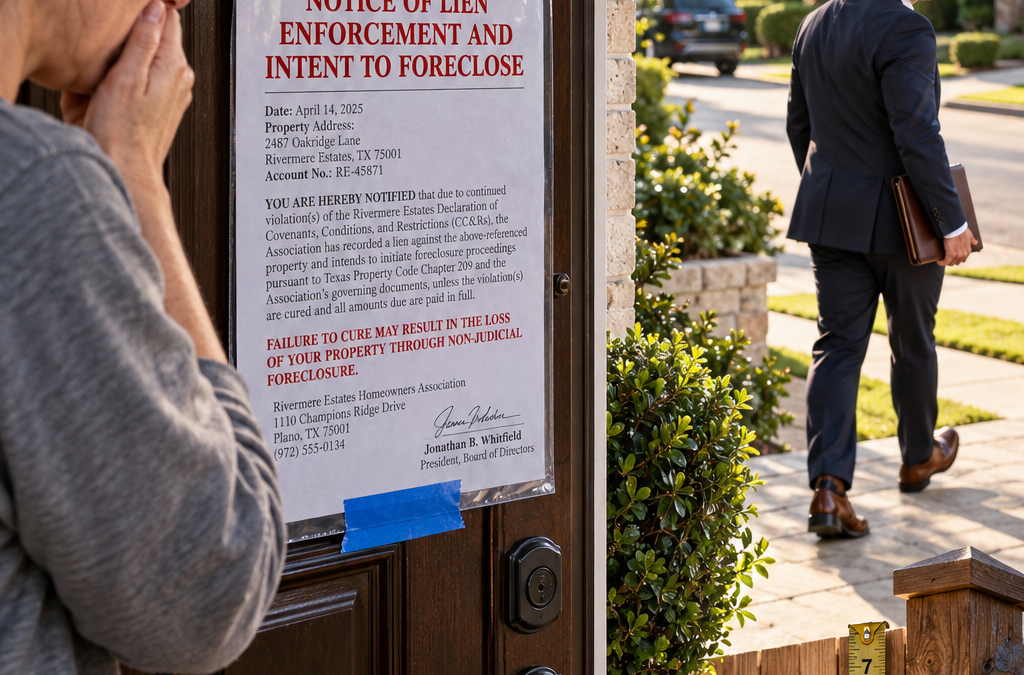
The foreclosure notice.
The blue tape.
The sixty-day deadline.
The moment I’d been afraid of for months.
After finding it, I called Marcus.
He answered on the third ring.
“Brian?”
“They taped a foreclosure notice to my door.”
His voice changed.
“Send me a photograph.”
I did.
He read it while I stood on the porch.
Then he asked, “Have you received any court documents?”
“Not yet. Just this notice.”
“All right. Don’t pay anything in response to this without discussing it with me.”
I looked toward the house.
“Marcus, they’re going to take it.”
“Brian, listen carefully. A notice isn’t the same thing as a completed foreclosure. We have legal remedies.”
My throat tightened.
“Sixty days.”
“I see the deadline.”
“What if we can’t stop it?”
“We’re going to act immediately.”
I wanted to believe him.
But that night, belief wasn’t enough.
I lay awake staring at the ceiling.
Every time I closed my eyes, I imagined the house being sold.
I imagined strangers carrying furniture through the front door.
I imagined the rose bush being torn out because some future owner didn’t care where it came from.
At two in the morning, I got up.
Walked into the kitchen.
Turned on the light.
Then stood beside the window looking at the flower bed.
The rose bush had grown.
There were three blooms now.
I remembered my mother’s hands.
How carefully she handled the cuttings.
How she showed me where to trim the stems.
How she insisted that roses could survive difficult conditions if their roots were healthy.
I pressed one hand against the window.
“I’m trying, Mom,” I whispered.
Then I went back to the table and opened my document folder.
I wasn’t going to let Derrick Crane be the only person deciding what happened next.
The following morning, Marcus called.
His voice sounded different.
More focused.
Almost energized.
“Brian, the financial records finally came through.”
I sat up.
“And?”
“They’re a disaster for Crane.”
I held my breath.
Marcus continued.
“The association’s official ledgers don’t reconcile with the fine payments. Substantial amounts collected from homeowners never reached the HOA’s designated account.”
I stared at the wall.
“Where did they go?”
“We’ve traced multiple transfers to an account associated with Crane.”
For several seconds, I couldn’t speak.
“What?”
“Brian, it appears he was diverting fine revenue.”
My stomach turned.
All those notices.
All those payments.
All those neighbors frightened into compliance.
The money wasn’t simply supporting neighborhood maintenance.
At least part of it was being redirected.
Marcus continued.
“The records suggest this has been happening for at least four years.”
I closed my eyes.
Four years.
Long enough to build an entire pattern.
Long enough to ruin families.
Long enough to convince everyone that his authority was normal.
“Are you certain?”
“We have enough evidence to make formal reports and seek further investigation. The final criminal findings will be for the authorities.”
I looked toward the foreclosure notice lying on my table.
Marcus spoke again.
“We’re not just fighting a lien anymore, Brian.”
I swallowed.
“What are we doing?”
“We’re reporting suspected financial crimes.”
I sat silently.
Then asked, “What about my house?”
“We’re requesting emergency relief to stop the lien enforcement while the claims are examined.”
I looked at the framed photograph of my mother beside the kitchen door.
For the first time since Tuesday morning, I felt something stronger than fear.
Hope.
Marcus filed the appropriate emergency request with the court.
The filing challenged the underlying fines, the disputed amendments, and the collection process.
It also described the evidence suggesting misconduct in the association’s finances.
At the same time, formal complaints were submitted to the state attorney general’s consumer protection authorities and other appropriate investigators.
The records were preserved.
The financial discrepancies were documented.
And the alleged relationship between distressed sales and Crane’s brother-in-law became part of the broader inquiry.
I didn’t celebrate.
Not yet.
The sixty-day deadline was still hanging over me.
But at least the case had moved out of Crane’s private world of notices and penalties.
It was now being examined by people who didn’t report to him.
That alone changed everything.
Then the story reached the press.
Her name was Jenna Ruiz.
She was a local investigative reporter, the kind who spent more time reading court records than attending ribbon-cutting ceremonies.
She first heard about the Alvarez family through someone familiar with their situation.
Then she contacted Mrs. Alvarez.
Then other former residents.
Eventually, she called me.
“Mr. Whitfield, I’m looking into allegations involving Maple Ridge’s homeowners association.”
I sat at my kitchen table.
“All right.”
“I understand you’ve received a foreclosure notice over accumulated fines.”
“Yes.”
“And that some of the fines involve landscaping and a fence?”
I gave a tired laugh.
“Among other things.”
She paused.
“Would you be willing to speak with me?”
I looked toward the folders stacked beside the coffee maker.
“Yes.”
Jenna came to my house two days later.
She brought a photographer and a small recorder.
We sat on the porch.
I told her about the first fine.
The mailbox.
The trash cans.
The rose bush.
The fence.
Then I showed her the original bylaws and the amended version.
She read the documents carefully.
“These dates don’t match,” she said.
“That’s what my realtor noticed.”
She looked toward the flower bed.
“That rose bush?”
I nodded.
“From my mother’s cuttings.”
Jenna lowered the recorder slightly.
“Your mother?”
I told her about the day we toured the house.
The kitchen window.
The promise.
The plants.
For a moment, her expression softened.
Then she looked at the foreclosure notice.
“Two thousand dollars for that plant?”
“That’s what the fine says.”
She shook her head.
I showed her Sylvia’s shoebox.
The letters.
The former residents.
The distressed property listings.
The common real estate agency.
Jenna took notes without rushing.
Then she asked whether Sylvia would speak.
I called her.
She came over ten minutes later.
Carrying the shoebox herself.
Jenna interviewed us separately.
She also contacted former residents, examined public records, requested HOA meeting documents, and sought a response from Derrick Crane.
I knew she was doing serious work because she didn’t promise me a dramatic story.
She kept asking for evidence.
Dates.
Documents.
Independent confirmation.
That was exactly what I wanted.
The article appeared on a Friday morning.
Its headline described allegations that the Maple Ridge HOA president had fabricated fines and diverted association money.
My photograph appeared beside the story.
I was standing in front of the rose bush.
The foreclosure notice was pictured below.
Jenna described the disputed bylaw amendments, the financial discrepancies, and the families who had sold their homes after escalating HOA penalties.
She included Crane’s response.
He denied wrongdoing and characterized the complaints as misunderstandings about association enforcement and accounting.
The article made clear that the allegations were under investigation.
But it also made the underlying documents impossible to ignore.
Within an hour, the Maple Ridge neighborhood group chat exploded.
Messages arrived faster than I could read them.
Some residents were angry.
Others were frightened.
Several wanted copies of the original covenants.
A few accused me of trying to destroy the neighborhood.
But those messages quickly disappeared beneath a wave of homeowners sharing their own experiences.
A retired man said he’d paid hundreds of dollars over patio furniture.
A young couple posted a warning letter about decorative stones.
Another homeowner described being charged for leaving a holiday wreath up after the approved date.
Then someone shared an old fine notice signed by Crane.
Another followed.
Then another.
The pattern was suddenly visible to everyone.
For years, people had experienced the pressure individually.
Each family thought it was alone.
Each homeowner felt embarrassed.
Each person worried that everyone else must somehow be following the rules correctly.
Now they were comparing documents.
And realizing how many of them had been targeted.
Sylvia called me that afternoon.
“Brian.”
“Yeah?”
“Have you seen the group chat?”
“I’ve barely stopped reading it.”
She sounded almost breathless.
“People are talking.”
“I know.”
“Really talking.”
I looked toward the rose bush.
“What do you think happens next?”
There was a pause.
Then she said, “We stop being afraid.”
The next board meeting was scheduled for Monday evening.
By six-thirty, the clubhouse parking lot was overflowing.
Residents parked along the street.
People stood near the entrance holding folders.
Others carried printed copies of Jenna’s article.
I arrived with Marcus.
Sylvia walked beside us carrying her shoebox.
The clubhouse doors were open.
Inside, every chair was occupied.
People stood along the walls.
Some sat on the floor near the back.
I’d never seen so many Maple Ridge residents gathered in one place.
The atmosphere felt electric.
Anger.
Fear.
Curiosity.
And something else.
Determination.
At the front of the room sat Derrick Crane.
He wore a tailored dark navy suit, a white shirt, and a burgundy silk tie.
His hair was brushed perfectly into place.
His expression was controlled.
But I noticed something immediately.
He wasn’t smiling.
Seven board members sat at the long table.
Two had supported Crane for more than a decade.
They looked uncomfortable.
The others avoided eye contact with the crowd.
Crane tapped his microphone.
“Good evening.”
The room quieted.
He began with a prepared statement.
He called the allegations unfortunate.
Misleading.
Sensationalized.
He said the association’s financial irregularities were the result of accounting categorization issues.
He insisted that enforcement decisions had been made in good faith.
Then he looked toward me.
“Certain residents have chosen to turn ordinary compliance matters into public attacks against this association.”
I felt Marcus shift beside me.
Crane continued.
“Let me assure everyone that our standards exist to protect property values.”
Someone near the front stood.
“Where did the fine money go?”
Crane paused.
“We’re conducting an internal review.”
A woman called out.
“Why wasn’t it in the HOA account?”
He adjusted his tie.
“As I said, there are accounting classifications that require clarification.”
Another man stood.
“Then explain the transfers to your personal account.”
The room erupted.
Crane raised both hands.
“Order.”
Nobody listened.
He struck the table with his palm.
“I said order!”
The room quieted gradually.
His face had reddened.
For the first time, I saw fear beneath the polished exterior.
Not remorse.
Fear of losing control.
He looked toward the board.
“We cannot conduct business if residents insist on making unsupported accusations.”
Sylvia stood.
She was holding the shoebox.
Her hands trembled slightly.
But her voice was steady.
“Derrick, I’d like to read something.”
Crane looked at her sharply.
“Mrs. Bennett, this is not the time.”
She lifted the first letter.
“It’s from the Alvarez family.”
He stiffened.
Sylvia continued.
“They lived here fifteen years before your fines forced them into a rushed sale.”
“That’s an inaccurate characterization.”
She ignored him.
She read from the letter.
Not every word.
Just the passages describing the repeated fines, the failed appeals, the collection threats, and the fear of losing their home.
The room grew quiet.
Then she opened another envelope.
The Henderson family.
Another set of violations.
Another distressed sale.
Another family who had left Maple Ridge feeling defeated.
Crane tried to interrupt.
Sylvia kept reading.
A third letter followed.
A homeowner described paying fines they didn’t understand because they were afraid of legal action.
The more Sylvia read, the quieter the room became.
I watched Crane.
His face had gone from red to an ashen gray.
He kept glancing toward his allies on the board.
One stared at the table.
The other shifted uncomfortably in his chair.
Sylvia lowered the final letter.
Then she looked directly at Crane.
“These people trusted this association.”
He said nothing.
“They paid their assessments. Maintained their homes. Raised their families here.”
Her voice cracked.
“And you made them afraid of their own mailboxes.”
Someone in the audience began crying.
Another resident nodded slowly.
Sylvia continued.
“I’ve kept these letters for six years because I knew something was wrong. I just didn’t know how to prove it.”
She looked toward the crowded room.
“But now we know.”
Crane leaned toward the microphone.
“This is emotional manipulation.”
The words echoed through the clubhouse.
For several seconds, nobody moved.
Then a man in the front row stood.
“Emotional manipulation?”
Crane looked at him.
The man held up a fine notice.
“You charged my father six hundred dollars because his porch railing was supposedly the wrong color.”
Crane opened his mouth.
“My father paid because he thought you could put a lien on his house.”
Another homeowner rose.
“You fined us for a garden statue.”
Another.
“For a mailbox.”
Another.
“For a fence that had been there twenty years.”
The room filled with voices.
Crane raised his hands again.
But nobody was waiting for permission to speak anymore.
I stood near the aisle, listening.
For months, I’d felt isolated.
As though I were the only person who couldn’t understand the rules.
Now I was surrounded by people telling versions of the same story.
The details were different.
The fear was identical.
Marcus leaned toward me.
“Brian, stay calm.”
I nodded.
I wasn’t going to give Crane an excuse to make me the problem.
Then the board vice president stood.
He was an older man named Howard Price.
I’d seen him at a few association events.
He wasn’t known for challenging Crane.
But that night, his expression was grim.
“I move that the board suspend Mr. Crane’s authority pending independent investigation and remove him from the presidency in accordance with our governing procedures.”
The room went silent.
Crane stared at him.
“Howard.”
Howard didn’t look away.
“We need to protect the association.”
Crane’s face hardened.
“You’ve worked with me for twelve years.”
“Yes.”
“And you’re going to betray me because of a newspaper article?”
Howard pointed toward the documents on the table.
“Not because of an article.”
He paused.
“Because of the records.”
Another board member seconded the motion.
Crane looked around the table.
His breathing had become visible.
He leaned toward the microphone.
“This is absurd. I have dedicated eleven years to this community.”
Howard answered quietly.
“And the community deserves an independent investigation.”
The board proceeded with the vote.
One member raised his hand.
Then another.
Then another.
I counted.
Four.
Five.
Six.
The seventh board member hesitated.
He had been one of Crane’s strongest supporters for years.
He looked toward the crowd.
Then toward the documents.
Finally, he raised his hand.
Seven to zero.
Derrick Crane was removed from the HOA presidency that night.
For several seconds, nobody spoke.
Then the room erupted.
Some people applauded.
Others cried.
A few simply sat motionless, as though they couldn’t believe what had happened.
I looked toward Crane.
He remained seated.
His hands rested flat on the table.
His face was pale.
The expensive suit was immaculate.
His hair was perfectly arranged.
But all the confidence had drained from his expression.
For years, he’d treated the HOA presidency as something that belonged to him.
Now seven people had taken it away in front of the very residents he’d intimidated.
He stood slowly.
Adjusted his jacket.
Then walked toward the exit.
As he passed my row, he stopped.
Our eyes met.
For a moment, I expected another threat.
Another warning that I would regret challenging him.
Instead, he said quietly, “I hope you’re satisfied.”
I looked at him.
Then thought about the foreclosure notice.
My mother’s roses.
The Alvarez family.
Sylvia’s shoebox.
“I’m not satisfied,” I said.
His jaw tightened.
“Of course not.”
“I’ll be satisfied when the people you hurt have their records corrected and their money returned.”
His expression turned cold.
Then he walked away.
I watched him leave the clubhouse.
No applause followed him.
No loyal supporters rushed to his defense.
He simply disappeared through the door.
And for the first time since moving to Maple Ridge, I felt the neighborhood breathe.
The civil proceedings continued.
Crane’s removal from office didn’t automatically erase the fines or undo the financial damage.
Marcus still had to challenge the lien.
The disputed amendments still needed legal review.
The association’s financial records still required an independent accounting.
But the emergency court proceedings prevented the threatened foreclosure from advancing while the underlying claims were examined.
That was the first time I truly slept through the night.
I remember waking the next morning and realizing the sun was already up.
For months, I’d been waking before dawn with my heart racing.
Now I’d slept nearly eight uninterrupted hours.
I lay in bed staring at the ceiling.
Then smiled.
It felt like a miracle.
The state opened a formal investigation into the suspected embezzlement.
Investigators examined the financial transfers, altered records, and possible connections between enforcement practices and distressed home sales.
The association cooperated through its newly appointed leadership.
Several residents provided statements.
The former homeowners’ files were reviewed.
Sylvia’s letters became part of the broader record.
The financial evidence was difficult to dismiss.
Thousands of dollars had been collected under questionable fines.
Substantial amounts had not been deposited into the HOA’s official accounts.
Records pointed toward Crane’s personal finances.
The questions surrounding his brother-in-law’s real estate activity also came under professional review.
I followed the developments carefully.
But I no longer spent every waking moment consumed by them.
I had learned something important.
There was a difference between pursuing accountability and allowing another person to occupy your thoughts forever.
Crane had already taken enough of my time.
I wanted my house back in the most complete sense.
Not just the deed.
The peace.
The ordinary routines.
The pleasure of sitting on my porch without wondering whether a camera was pointed toward my lawn.
Several weeks after the emergency board meeting, Marcus called.
“Brian, I’ve got good news.”
I was at the plant, sitting in the break room between shifts.
I stepped into a quiet hallway.
“What happened?”
“The lien has been voided.”
I closed my eyes.
For a moment, the sounds of machinery faded into the background.
“Say that again.”
“The lien is void. The foreclosure threat based on those disputed charges is gone.”
I leaned against the wall.
My knees felt weak.
“And the fines?”
“The unsupported charges are being reversed, and the association has agreed to refund the amounts you paid.”
I stared at the concrete floor.
Nine years.
Nine years of overtime.
Nine years of saving.
Three months of fear.
And now the house was no longer under that threat.
I pressed one hand over my eyes.
“Marcus.”
“Yeah?”
“Thank you.”
He was quiet for a moment.
Then said, “You did the hard part, Brian.”
I shook my head.
“No. I just didn’t know when to quit.”
He laughed softly.
“Sometimes that’s exactly the hard part.”
After we hung up, I stayed in the hallway for another minute.
A coworker walked past and asked whether I was okay.
I nodded.
“Yeah.”
Then I smiled.
“Yeah, I think I am.”
The association began correcting the records.
The fabricated or improperly adopted landscaping provisions were struck from the enforceable documents through the appropriate process.
The fines tied to those unsupported provisions were reversed.
The lien against my house was formally cleared.
Payments I’d made under the disputed notices were refunded.
The new board announced a full review of past enforcement actions and financial practices.
Homeowners who believed they’d been improperly charged were given a way to submit documentation.
The atmosphere in Maple Ridge changed almost immediately.
Neighbors stopped whispering when Crane’s name came up.
People compared letters openly.
Residents asked questions at meetings without looking toward the door.
Some of the homeowners who’d once defended Crane admitted that they’d trusted him because he always sounded certain.
Others said they had known something was wrong but feared becoming his next target.
The truth was uncomfortable.
For years, Maple Ridge had allowed a man with a polished appearance and a commanding voice to substitute intimidation for leadership.
Now the community had to rebuild trust.
That process wasn’t easy.
Some residents wanted to eliminate every rule.
Others wanted strict rules with clearer procedures.
There were arguments about budgets.
Landscaping.
Maintenance.
Financial transparency.
But those arguments felt different.
People were debating actual decisions.
They were demanding records.
They were asking who had voted and what authority supported each policy.
That was what a functioning association should have been doing all along.
Sylvia attended nearly every meeting.
She always brought a notebook.
Sometimes she brought the shoebox too.
Not because she expected to read the letters again.
Because she believed nobody should forget what happened when residents stopped asking questions.
One evening, I walked over to her house with a plate of homemade cookies.
She opened the door and looked at them suspiciously.
“What’s this?”
“A peace offering.”
She burst out laughing.
“Brian, after everything you’ve been through, you’d better be careful with peace offerings.”
I laughed too.
“At least these aren’t subject to architectural approval.”
She waved me inside.
We sat in her kitchen drinking lemonade.
For the first time since we’d met, we talked about things that had nothing to do with Derrick Crane.
Her grandchildren.
My work at the plant.
The vegetables I wanted to grow.
The little garden behind her house.
Eventually, she looked at me.
“You know, your mother would be proud.”
I lowered my glass.
For a moment, I couldn’t speak.
Sylvia continued.
“You fought for that house.”
I looked toward the window.
“I almost gave up.”
“I know.”
“I was sitting at my kitchen table trying to convince myself selling would be easier.”
She nodded.
“That’s what he wanted.”
I looked back at her.
“You think so?”
“I know so.”
She leaned forward.
“People like Derrick don’t always need to win an argument. Sometimes they only need to make staying feel impossible.”
I thought about the Alvarez family.
Their frightened phone call.
The rushed sale.
The damaged credit.
The years they’d spent in a house they loved before the fines became unbearable.
Sylvia was right.
Crane’s greatest weapon hadn’t been the HOA rulebook.
It had been exhaustion.
He made every small disagreement expensive.
Every appeal frustrating.
Every request for proof feel like defiance.
Until people stopped asking whether he was right and started asking how to escape him.
I looked at Sylvia.
“Thank you for keeping those letters.”
Her expression softened.
“I wish I’d been able to do something sooner.”
“You did.”
She shook her head.
“I watched families leave.”
“You also kept the evidence.”
She looked down at her hands.
“Sometimes I wondered why.”
I smiled faintly.
“Now you know.”
The state investigation continued.
Weeks later, news broke that Crane was facing felony charges connected to the financial misconduct allegations.
The case had not yet reached a final criminal verdict, but the charges made clear that investigators had found evidence serious enough to pursue prosecution.
His brother-in-law’s real estate license was also under review.
The agency’s role in the distressed sales became part of the scrutiny.
I read the article sitting at my kitchen table.
There was a photograph of Crane leaving a government building.
He wore a dark suit.
His hair was still neatly combed.
But his expression looked different.
Tired.
Angry.
Defensive.
For a long time, I stared at the picture.
I expected satisfaction.
Maybe even joy.
Instead, I felt a strange sadness.
Not for what Crane had lost.
For what he’d chosen to do with the power people had trusted him to exercise.
He could have helped maintain a good neighborhood.
He could have organized improvements.
Resolved disputes.
Protected common areas.
Made sure the pool stayed clean and the sidewalks were repaired.
Instead, he’d turned ordinary homeowners into targets.
He had used rules to frighten people.
Money to reward himself.
And his authority to make residents believe they had no choice but to comply.
I folded the newspaper.
Then placed it in the document folder.
It belonged with the rest of the evidence.
Not because I wanted to celebrate his downfall.
Because someday I wanted to remember how easily the situation could have gone differently.
If I had sold.
If Sylvia had thrown away the letters.
If Mrs. Alvarez had refused to speak.
If Marcus hadn’t demanded the financial records.
If Jenna hadn’t investigated.
Crane might still have been sitting at the front of the clubhouse, telling homeowners to lower their voices and pay their fines.
A few weeks later, I drove past his house.
I hadn’t intended to.
I was returning from the hardware store and took the shorter route through the eastern part of Maple Ridge.
His property appeared near the end of a quiet street.
The lawn was still immaculate.
The stone columns still framed the entrance.
The flower beds were perfectly maintained.
But something new stood near the curb.
A real estate sign.
FOR SALE.
I slowed slightly.
Then continued driving.
I didn’t stop.
I didn’t take a photograph.
I didn’t feel any urge to knock on his door.
The irony was obvious enough.
A man connected to years of distressed home sales was now listing his own house while facing the consequences of his conduct.
I didn’t need to make the moment crueler.
I had spent months feeling as though my home was under attack.
I knew what uncertainty about housing could do to a person.
Even someone who had caused enormous harm.
The difference was that my situation had been manufactured through unsupported fines and intimidation.
His was unfolding through investigations into his own actions.
I drove home.
The sky was turning orange.
A warm wind moved through the trees.
When I reached Alder Court, I noticed Sylvia standing beside her garden.
She waved.
I waved back.
Then pulled into my driveway.
My house looked exactly as I remembered it from the first day I saw it with my mother.
The porch.
The windows.
The old trellis.
The backyard fence.
Even the mailbox post was still the same shade of black.
I shut off the engine.
Then sat there for a moment.
I had spent nine years saving for that view.
I wasn’t going to let the last three months be the only memories attached to it.
That weekend, I returned to the rose garden.
The original bush had suffered during the dispute.
Between the stress, long work shifts, and time spent meeting attorneys, I’d neglected it more than I wanted to admit.
Several branches had dried.
One stem had broken in a storm.
The first blooms had faded.
But the roots were still healthy.
I knelt beside it with a pair of pruning shears.
I remembered my mother showing me how to cut just above a healthy bud.
How to remove dead growth without damaging the rest.
How to be patient when a plant looked weak.
I worked slowly.
Then I prepared another cutting from the plants she’d left behind.
I planted it beside the original bush, in the same flower bed facing the street.
The soil was dark and damp.
I pressed it gently around the roots.
Then stepped back.
For months, that tiny stretch of garden had represented everything Derrick Crane wanted to punish.
Now it was simply a garden again.
A place where something beautiful could grow.
I went inside and found the photograph of my mother standing beside the roses at our old rental house.
She was wearing a faded blue sweater.
Her hair was pinned back.
Her face was turned toward the camera, smiling with the quiet satisfaction she always had after finishing work in the yard.
I carried the photograph outside.
Set it on the porch railing.
Then looked at the new cutting.
“Kept my promise,” I whispered.
For a moment, my throat tightened.
I thought about how much I wished she could have seen the house after I finally moved in.
The painted rooms.
The repaired fence.
The kitchen window she’d loved.
The roses.
I wondered what she’d have said about Derrick Crane.
Probably something simple.
Something practical.
She never had much patience for people who bullied others.
I could almost hear her voice.
Brian, don’t let somebody’s fancy clothes make you forget what you know is right.
I laughed softly.
Then wiped my eyes.
As the sun began to set, Sylvia appeared at the edge of the driveway.
She was carrying a pitcher of lemonade and two glasses.
“Thought you might need this.”
I stood.
“You’re a mind reader.”
She looked toward the rose bush.
“Another one?”
I nodded.
“From my mother’s cuttings.”
She smiled.
“Good.”
We sat on the porch steps.
The afternoon light stretched across the front lawn.
Children rode bicycles near the corner.
Somebody was grilling dinner down the street.
A dog barked once, then fell silent.
Everything felt ordinary.
And after months of fear, ordinary was extraordinary.
Sylvia poured lemonade.
Then looked toward my backyard.
“Fence still six inches too tall?”
I laughed.
“According to Derrick’s imaginary kingdom, yes.”
She smiled.
“Good.”
I took a drink.
The lemonade was cold and sweet.
For a while, we sat without speaking.
Then Sylvia asked, “You ever think about moving now that it’s over?”
I considered the question.
A few months earlier, I’d been ready to sell just to escape.
Now I looked around.
The porch.
The garden.
The driveway.
The house my mother had helped me choose.
“No,” I said.
She nodded.
“Didn’t think so.”
I smiled.
“I worked too hard to get here.”
Sylvia looked toward the rose bush.
“And you still have work to do.”
I laughed.
“That I do.”
The sun sank lower.
For the first time in months, Maple Ridge felt like the neighborhood I’d believed I was buying into.
People were outside.
Talking.
Laughing.
Living.
Nobody was standing near my curb photographing the grass.
Nobody was timing the trash cans.
Nobody was sending notices over the color of a mailbox post.
And nobody was threatening to take my house because a fence stood six inches higher than an improperly adopted standard.
I leaned back against the porch step.
My mother had been right about the house.
It was the one.
But I’d learned something she never would have wanted me to discover the hard way.
A home wasn’t protected simply because your name appeared on the deed.
Sometimes you had to defend it against people who understood exactly how to exploit fear.
Crane had spent years building a system that punished residents for questioning him.
He made compliance expensive.
Resistance exhausting.
And escape look like the easiest option.
He’d expected me to follow the same path as the families before me.
Pay the first fine.
Then another.
Become frightened.
Fall behind.
Finally sell before the pressure destroyed me.
But the pattern had broken.
Because Sylvia kept the letters.
Because Mrs. Alvarez answered the phone.
Because Pam noticed the amended bylaws.
Because Marcus followed the money.
Because Jenna asked the questions Crane didn’t want answered.
And because the neighbors finally realized they were stronger together than they had ever been while they were afraid.
The foreclosure notice was still in my folder.
I hadn’t thrown it away.
I kept it beside the court documents clearing the lien and the records correcting the fines.
Sometimes I looked at it.
Not because I enjoyed remembering the fear.
Because I wanted to remember how quickly an official-looking piece of paper could make a person question everything he’d worked for.
On that Tuesday morning, I’d stood on my porch believing someone might take my house.
Now I sat on those same steps with a glass of lemonade, watching a rose bush grow from my mother’s cuttings.
The difference wasn’t that Derrick Crane had suddenly become powerless.
It was that his claims had finally been tested against evidence.
And the evidence had exposed him.
My house remained mine.
The fabricated fines were gone.
The lien was void.
The foreclosure threat had ended.
The HOA was rebuilding under leadership that could be questioned.
The state was investigating the money Crane had diverted.
His brother-in-law’s real estate activities were under review.
And the families he’d pressured were no longer invisible.
I looked toward the street.
A warm breeze moved through the new rose leaves.
The late sunlight touched the top of the backyard fence.
Six inches.
Such a small measurement.
Small enough to seem ridiculous.
But large enough for a man like Derrick Crane to build a campaign around if nobody challenged him.
I thought about the first day he stood at my curb in that immaculate suit.
How confidently he’d spoken.
How certain he’d been that his title gave him the right to tell me what I could do with my own home.
Then I thought about the board meeting.
Seven votes.
Zero against removing him.
A room full of homeowners who had finally stopped being afraid.
For years, Crane had treated Maple Ridge like something he owned.
In the end, he discovered that he had only been trusted to help govern it.
And trust was something he had spent years destroying.
Sylvia nudged my shoulder.
“What are you smiling about?”
I looked toward the garden.
“Nothing.”
She raised an eyebrow.
“That doesn’t look like nothing.”
I laughed.
Then I nodded toward the rose bush.
“I was just thinking my mother would have liked this evening.”
Sylvia smiled.
“I think she would have.”
We stayed outside until the porch lights came on.
The air cooled.
The neighborhood settled.
And somewhere beyond the trees, the last sounds of the evening faded into quiet.
When Sylvia finally stood to leave, she took the empty glasses and hugged me.
Not a polite neighborly hug.
A real one.
The kind that says somebody understands what you’ve survived even when you don’t have the words to explain it.
“Welcome home, Brian,” she whispered.
I closed my eyes.
Then hugged her back.
“Thanks, Sylvia.”
After she left, I walked into the yard and stopped beside the rose bush.
The new cutting stood small and fragile in the soil.
Beside it, the older plant had begun producing fresh growth.
I touched one leaf gently.
Then looked toward the house.
Nine years of double shifts.
Nine years of saving.
One promise to my mother.
Three months of threats.
And one neighborhood finally forced to confront the truth.
I hadn’t bought the house to make a statement.
I hadn’t moved to Maple Ridge looking for a fight.
I wanted a quiet place to live.
A yard.
A porch.
A garden.
A home where I could remember the people who had loved me.
Derrick Crane had almost taken that away.
But he had made one mistake.
He believed that because fear had worked on other people, it would eventually work on everyone.
He never considered what would happen when one frightened homeowner started saving every letter.
When one quiet neighbor opened a shoebox.
When old records met new questions.
And when an entire community discovered that the man enforcing its rules had been breaking them himself.
I stood in the fading light, looking at the home I’d worked so hard to buy.
Then I turned off the garden hose, checked the front door, and stepped inside.
No foreclosure notice waited on the porch.
No threatening letter lay on the kitchen table.
The house was quiet.
The roses were growing.
And for the first time since I moved to Maple Ridge, I finally felt what I’d spent nine years working toward.
I was home.
And nobody was taking that away from me.








