𝗙𝗨𝗟𝗟 𝗦𝗧𝗢𝗥𝗬 The HOA President Fined Me Three Days After My Wife’s Funeral, and That Letter Became the First Crack in His Empire
𝗙𝗨𝗟𝗟 𝗦𝗧𝗢𝗥𝗬
I called him.
I should not have called him.
Not that morning.
Not while my hands were shaking and Sarah’s coffee mug was still in the sink because I couldn’t bring myself to wash it.
But I called anyway.
He answered on the third ring, his voice clipped, smooth, and cheerful.
“Daniel.”
He knew why I was calling.
That made me hate him before I even spoke.
“Harold, I got the fine.”
“Then you understand the association’s position.”
“My wife just died.”
There was a pause.
Not a human pause.
Not the kind where sympathy searches for words.
A calculating pause.
Like he was deciding which phrase would sound least cruel while changing nothing.
“I understand that’s difficult,” he said finally.
“Difficult?”
“But the bylaws are crystal clear.”
I looked out at the lawn.
“Sarah died two days before you came over with a measuring tape.”
“Mr. Anderson, section 4.7 does not contain a bereavement exception.”
I gripped the phone.
“You fined me forty-eight hours after my wife died.”
“The property remained noncompliant through two mowing cycles.”
“I was holding her hand while she was dying.”
Another pause.
This time shorter.
“The fine stands.”
I hung up because if I kept listening to his voice, I was going to say something Sarah would have told me not to say.
Sarah had always said, “Pick your battles, Daniel.”
She said it about bills, contractors, neighbors, rude waiters, politicians on television, and our daughter when Emily was thirteen and determined to win every argument using volume alone.
Pick your battles.
I picked none.
That had been my first mistake.
When we moved to Pelican Shores six years earlier, Harold Croft was just another homeowner. He was fifty, polished, sharp-eyed, and vain in the quiet expensive way men get when they confuse grooming with character.
He wore linen blazers even in August heat. His hair was silver at the temples and combed backward so precisely it seemed weatherproof. He kept his beard trimmed close along his jaw and always smelled faintly of citrus cologne. His shoes were spotless, even after rain.
Nobody called him Karen to his face.
But behind his back, almost everyone did.
Harold Croft was the HOA Karen of Pelican Shores.
He had become president after running unopposed. Nobody wanted the job badly enough to challenge him, which we later learned was exactly what he had counted on. Within months, he turned a sleepy association into a private government with himself at the center.
He carried a laminated copy of the bylaws everywhere.
I mean everywhere.
At meetings.
At neighborhood barbecues.
At the community pool.
Once, during a Fourth of July cookout, he pulled it from the side pocket of his linen blazer to explain why a resident’s temporary folding canopy exceeded acceptable color contrast.
People laughed at first.
Then they stopped laughing.
Because Harold did not treat the bylaws as guidelines.
He treated them as weapons.
Our first fine was for mailbox paint.
Apparently, our post did not match approved Coastal Palette 7.
The letter included a color sample so faded from photocopying that Sarah held it beside the mailbox and said, “This could be white, cream, bone, sand, or printer toner having a bad day.”
We paid the $150.
Then came Emily’s soccer goal.
She had left it in the side yard for two weeks after summer practice ended. Harold cited us for visible recreational equipment.
Another $150.
Then recycling bins visible from the street by eight inches.
I still do not know how a man measures visibility by inches unless he wakes up hoping to be disliked.
Another $150.
I paid.
Every time.
Sarah would read the letters, sigh, and say, “Pick your battles, Daniel.”
So I picked none.
I paid because I was busy.
Because I didn’t want a neighborhood fight.
Because I thought small fines were easier than dealing with Harold’s cold little smile across a boardroom table.
Because I did not yet understand that paying without protest teaches a bully where the soft spots are.
By the time Sarah got sick, Harold had already trained half the neighborhood to obey before asking whether the rule existed.
Pelican Shores looked peaceful from the outside.
White stucco homes.
Tile roofs.
Manicured lawns.
Gulf views.
A community pool.
A clubhouse with wicker furniture and bad coffee.
But beneath that postcard surface, everyone knew Harold had favorites.
His friends on the west side could leave Christmas lights up until February.
They could park golf carts in driveways overnight.
They could keep palm fronds piled by the curb for days.
The east side got fined for everything.
A hose left uncoiled.
A planter half an inch outside the approved setback.
A lawn ornament visible from the sidewalk.
People muttered.
Nobody organized.
Not before Sarah died.
After the $4,200 letter, I hired a lawn service immediately.
The man who answered the phone heard something in my voice and squeezed me in that afternoon. He and his crew arrived with mowers, edgers, blowers, hedge trimmers, and a kindness I had not expected.
“Sorry about your wife,” he said quietly while writing the invoice.
I looked up.
“How did you know?”
“Phil told me. He said if I couldn’t get here today, he’d mow it himself.”
I swallowed hard.
“Thank you.”
Eight hundred dollars later, the property looked perfect.
Grass trimmed to three and a half inches.
Hedges squared.
Edges clean.
Flower beds cleared.
Palm debris removed.
I took photographs of everything.
Then I wrote Harold a respectful letter.
I explained Sarah’s death.
The timing.
The medical bills.
The immediate correction of the violation.
I requested a fine reduction or waiver given the circumstances.
I did not accuse him of cruelty.
I did not mention the measuring tape.
I did not write what I wanted to write.
Two days later, his response arrived by email.
Denied.
The form was cold.
Box checked.
Fine upheld.
Reason: HOA Resolution 2019-C.
Fines may not be waived except by unanimous board vote requiring formal meeting scheduling of no less than thirty days.
Thirty days.
Harold knew exactly what he was doing.
A waiver vote would require a formal meeting.
His three board allies were women from his church book club who treated him like a prophet in Italian loafers.
I already knew how that vote would go.
That night, I sat at the kitchen table with Sarah’s old laptop open and a glass of bourbon I never touched.
The house felt hollow.
Emily had gone back to college because I insisted she should, though the goodbye nearly broke both of us. She called every night, and every night I told her I was fine.
I was not fine.
I was a widower surrounded by medical bills, sympathy cards, and legal threats over grass.
The bourbon sat beside the laptop until the ice melted.
I opened every HOA document available on the Pelican Shores website.
Bylaws.
Covenants.
Architectural standards.
Fine schedules.
Meeting minutes.
Amendments.
Resolutions.
I read until midnight.
Then one.
Then two.
My eyes burned.
My back hurt.
At 3:07 a.m., I found it.
Resolution 2019-C.
The same resolution Harold had cited to deny my fine reduction.
At first, it looked legitimate.
Formal language.
Fine waiver restrictions.
Meeting requirements.
Unanimous board approval.
Then I opened the meeting minutes where it was supposedly adopted.
Only two of the three required board members had been present.
The bylaws required three for quorum on enforcement policy changes.
No quorum.
No valid ratification.
I leaned closer.
Read it again.
Then a third time.
The resolution did not legally exist.
At least, not if the bylaws meant what they said.
The $4,200 fine rested on a policy Harold had no authority to use.
My coffee was cold by then.
I had no memory of making it.
For the first time since Sarah died, I felt something other than grief or exhaustion.
Purpose.
Not peace.
Not hope exactly.
A direction.
I called Marcus Webb at 7:30 a.m.
Marcus had been my college roommate before becoming a real estate attorney in Tampa. Back then, he slept through economics lectures and survived on vending machine crackers. Now he billed in fifteen-minute increments and used phrases like “statutory exposure” with terrifying ease.
He answered groggy.
“Daniel?”
“I need legal advice.”
“At 7:30 in the morning?”
“My HOA fined me forty-two hundred dollars three days after Sarah’s funeral.”
He was silent.
Then his voice changed.
“Tell me everything.”
I did.
I told him about the fines, Sarah’s death, Resolution 2019-C, and the missing quorum.
He listened without interrupting.
When I finished, he said, “Document everything.”
“I have.”
“Don’t tip Harold off.”
“Why?”
“Because if he built one enforcement action on a void resolution, there may be others.”
I looked toward the stack of printed documents.
“Marcus.”
“Pull every resolution he’s ever issued. Every fine schedule. Every board vote. And Daniel?”
“Yeah?”
His voice dropped.
“This might be bigger than you think.”
He was right.
I submitted a formal records request under Florida Statute 720.303, requesting inspection and copies of the HOA’s financial records, enforcement logs, meeting minutes, violation records, vendor contracts, and board resolutions.
The statute gave the association a deadline.
Harold took eleven business days.
When the binders finally arrived, they were heavily edited.
Pages missing.
Sections blacked out.
Vendor names abbreviated.
Enforcement notes incomplete.
It was the kind of production that told me two things at once.
One, Harold did not want me to see everything.
Two, he did not yet realize I had already started comparing documents.
The first real twist came on a Thursday morning.
Phil Okafor knocked on my front door holding a grocery bag.
Inside were two years of HOA correspondence organized in manila envelopes.
Phil was sixty-eight, tall, Black, retired from the postal service, and precise in a way I had always admired. His lawn was perfect. His house was perfect. His mailbox was cleaner than mine had ever been.
He stood in my foyer with the bag in both hands.
“I heard about your fine,” he said.
I nodded.
“Everyone has.”
“Harold fined me seventeen times.”
I stared at him.
“Seventeen?”
“Over two years.”
“For what?”
“Pressure washing. Palm fronds. Trash bins. Driveway discoloration. Porch light color. One for a birdbath.”
“A birdbath?”
He gave me a tired smile.
“Apparently, mine disrupted the coastal aesthetic.”
He handed me the bag.
“I think we should compare notes.”
We sat at my dining table for four hours.
Sarah and I had eaten anniversary dinners at that table. Emily had done homework there. Sarah had spread Christmas cookie dough across it every December.
Now it was covered with HOA violation notices.
Between Phil’s records and mine, a pattern emerged.
Harold was not enforcing rules evenly.
He was targeting specific homeowners.
Eight of us.
All on the east side of Pelican Shores.
Phil.
Me.
The Nguyen family.
The Patel sisters.
A same-sex couple named Laura and Beth Hensley.
An older Filipino-American widow named Marisol Reyes.
And one more household that had recently sold under pressure after repeated enforcement threats.
Meanwhile, the west side, where Harold’s closest friends lived, had almost no fines in three years.
Not fewer.
Almost none.
And the violations were visible.
Phil had photographs.
I took more.
West-side homes with recycling bins left near garages.
Grass taller than mine had ever been.
Unapproved planters.
Holiday lights outside the allowed window.
A soccer goal larger than the one Emily had left out years earlier.
No citations.
No fines.
No letters.
I called Marcus.
“Selective enforcement,” he said after reviewing the first batch.
“I figured.”
“Depending on the pattern and demographics, this may implicate more than HOA law.”
I looked at Phil across the table.
“What do you mean?”
“Fair Housing Act issues, potentially. Who are the targeted homeowners?”
I listed them.
Phil was Black.
I was Latino on my mother’s side, though my last name Anderson often let people miss it until they met me or saw my mother, Elena Rivera, at a family barbecue.
The Nguyens were Vietnamese-American.
The Patel sisters were Indian-American.
Laura and Beth were married.
Marisol Reyes was Filipino-American.
Marcus went quiet for a long moment.
“Send me everything,” he said finally. “Tonight.”
I almost stopped there.
I want to be honest about that.
I was exhausted.
I was grieving.
I had no appetite, no patience, and no desire to become the center of a neighborhood lawsuit.
I am not a litigious person.
I pay bills on time.
I avoid conflict in grocery store lines.
I once apologized to a man who backed into my shopping cart.
But this was no longer about my grass.
It was about eight families and a man who had used rules like a filter, letting his friends pass through while crushing people he did not like.
Over the next three weeks, I became meticulous.
It gave me something to do besides miss Sarah.
Every morning, I walked Pelican Shores with my phone and a notebook.
I photographed properties.
Logged dates.
Compared visible conditions with citation records.
Mapped fines against addresses.
Marked board votes against enforcement spikes.
Compared satellite imagery with violation dates.
Phil helped.
So did Laura and Beth.
Mrs. Nguyen brought me copies of every letter Harold had sent her family, each one stored in a folder beside handwritten notes.
Marisol Reyes gave me a shoebox full of receipts and said, “I knew someday someone would ask.”
Marcus filed formal records requests with the county and sent additional legal demands to the HOA.
What came back next landed like a freight train on a quiet morning.
Harold had been routing HOA management fees to a company called Coastal Community Solutions LLC.
At first, the name meant nothing to me.
It sounded like a generic property vendor.
Then Marcus pulled the registration.
Owner: Harold Croft.
Registered address: a private mailbox used by Harold.
The company had billed Pelican Shores $67,000 over four years for administrative services.
No competitive bid.
No proper board authorization.
No independent approval.
And the contract?
Signed by Harold Croft as vendor.
Countersigned by Harold Croft as HOA president.
I sat in Marcus’s office while he showed me the documents on a screen.
“He contracted with himself,” I said.
Marcus nodded.
“That is self-dealing.”
“Is that illegal?”
“Florida law is not ambiguous about fiduciary duties. This may create civil liability, statutory violations, and depending on the money trail, potential criminal exposure.”
He sounded almost excited.
Marcus never sounded excited.
Not even when his team won the national championship in college.
“We’re filing,” he said.
My mouth went dry.
“A lawsuit?”
“A twelve-count civil complaint.”
I looked toward the window.
My reflection looked older than it had six months earlier.
Tired eyes.
Unshaven jaw.
Grief sitting on my shoulders like wet sand.
“What if I can’t handle this?”
Marcus turned from the screen.
“Daniel, you don’t have to handle all of it. That’s why you have counsel.”
“I mean emotionally.”
His expression softened.
For a moment, he wasn’t my attorney.
He was my college roommate again, the man who once drove me to the emergency room after I cut my hand opening a bottle with a pocketknife like an idiot.
“Sarah would be furious,” he said quietly.
I looked at him.
“At me?”
“At him.”
I laughed once.
It came out broken.
“Yeah.”
“Then let’s make him explain himself.”
Seven homeowners joined the complaint.
Phil.
The Nguyens.
The Patels.
Laura and Beth.
Marisol.
Me.
The claims covered selective enforcement, breach of fiduciary duty, fraudulent financial practices, improper fines, violations of Florida HOA statutes, and related misconduct connected to Coastal Community Solutions.
The morning the complaint was served, I watched from Phil’s porch.
The process server knocked on Harold’s door at 8:14 a.m.
Harold answered wearing a pale linen shirt and white pants, already dressed like he had a brunch reservation with someone he intended to impress.
He reached for the envelope with his usual composed expression.
Then he read the first page.
The color drained from his face like the tide going out.
I am not proud of what I felt in that moment.
Actually, yes.
I am.
I absolutely am.
For once, Harold Croft was holding paper he could not control.
His attorney responded fast.
Three motions to dismiss.
One claimed lack of standing.
One argued failure to state claims.
One tried to force arbitration under an outdated provision no longer valid after later amendments.
Marcus knocked them down one by one.
He was surgical.
He did not rant.
He cited statutes, meeting minutes, bank records, and Harold’s own signatures.
Each time Harold’s attorney tried to make the case look like grief-fueled revenge, Marcus brought it back to documents.
That was when the third twist arrived.
Her name was Tracy Bell.
She was the HOA bookkeeper.
Quiet.
Overlooked.
The kind of person residents passed at meetings without noticing because Harold had trained everyone to look at him.
Tracy contacted Marcus voluntarily.
He called me afterward.
“Daniel, sit down.”
“I am sitting.”
“Good. The bookkeeper reached out.”
I sat straighter.
“Why?”
“She kept copies.”
“Of what?”
“Receipts. Transfers. Emails. Reclassification instructions.”
My heart began pounding.
Marcus continued.
“She says Harold instructed her to code personal expenses as HOA costs.”
I closed my eyes.
“What kind of expenses?”
“A lawnmower for his private yard billed to HOA landscaping. A Sarasota resort weekend labeled board training. Personal office equipment. Meals. Travel. Repairs unrelated to common property.”
“How much?”
“Preliminary total, fifty-three thousand dollars over three years.”
I opened my eyes.
The kitchen was dim.
Sarah’s mug was still on the shelf where I had finally placed it after washing it two weeks earlier.
Fifty-three thousand dollars.
On top of the $67,000 self-dealing contract.
On top of the selective fines.
On top of the void resolution used to deny my grieving request.
For a moment, I could not speak.
Then I asked, “Why now?”
Marcus said, “Because Tracy says she was afraid. And because after the complaint was filed, Harold told her to start deleting emails.”
That sentence moved the case from ugly to explosive.
Tracy gave a sworn statement.
She produced copies.
Emails from Harold.
Forwarded receipts.
Instructions to reclassify charges.
Internal notes.
Bank transfer records.
The Florida Department of Business and Professional Regulation opened its own investigation.
The county attorney’s office requested our documentation.
The HOA’s insurer got involved.
The board members who had spent years nodding beside Harold suddenly began insisting they had never understood the full picture.
I believed some of them.
Not all.
By March, Harold was removed from the board by court-ordered injunction.
The order restricted his access to association funds, records, enforcement systems, and communications tied to the disputed matters.
For the first time in six years, Pelican Shores belonged to its residents more than to Harold Croft.
The civil trial lasted four days.
Four long days under fluorescent courtroom lights, listening to Harold’s attorney describe me as a grieving widower seeking vengeance.
He said I had turned ordinary fines into a personal crusade because I could not process my loss.
He said Phil was a disgruntled troublemaker.
He implied the Nguyens and Patels had misunderstood standard enforcement procedures.
He called Laura and Beth overly sensitive.
He suggested Coastal Community Solutions had provided valuable administrative support.
He said Harold had made mistakes, perhaps, but no one could run an association perfectly.
I sat there with my hands folded, hearing Sarah’s voice in my head.
Pick your battles, Daniel.
I had picked this one.
Phil testified first.
Calm.
Precise.
Postal-worker memory.
He described each fine, each letter, each photograph, each west-side violation left untouched.
Laura testified about being fined for a pride flag garden marker while Harold’s friends displayed larger political signs without citation.
Mrs. Nguyen testified about receiving four violations in one month after questioning a pool assessment.
Marisol Reyes cried when describing how she had skipped medical appointments to pay fines because Harold had threatened escalation.
Then Tracy testified.
That changed the air in the courtroom.
She did not look like a person seeking revenge.
She looked like a woman who had carried a heavy thing too long.
She explained the emails.
The reclassifications.
The personal expenses.
The fear of losing her job.
Marcus walked her through the documents one by one.
Lawnmower.
Sarasota resort stay.
Meals.
Office equipment.
Coastal Community Solutions invoices.
The contract signed by Harold on both sides.
Then I testified.
I had dreaded it.
More than anything.
More than seeing Harold.
More than hearing the defense call me vengeful.
I dreaded saying Sarah’s name under oath.
Marcus approached gently.
“Mr. Anderson, when did you receive the $4,200 fine?”
“Three days after my wife’s funeral.”
“What was your wife’s name?”
My throat closed.
I looked down.
Then back up.
“Sarah.”
“How long were you married?”
“Nineteen years.”
“What was happening during the period the HOA says your lawn remained noncompliant?”
I swallowed.
“My wife was dying in our home.”
The courtroom went still.
I could feel Harold’s attorney watching, waiting for me to seem too emotional.
So I did what Sarah would have wanted.
I stayed steady.
I explained the medical bills.
The lawn service.
The respectful waiver request.
The denial based on Resolution 2019-C.
The night I found the quorum defect.
The records request.
Phil’s bag of letters.
The pattern.
The documents.
Marcus projected the void resolution on the screen.
Then the meeting minutes showing only two board members present.
Then he showed Harold’s denial form citing that invalid resolution as the reason I could not receive mercy three days after burying my wife.
I did not look at Harold.
I looked at the jury.
“At first, I thought it was cruelty,” I said. “Then I realized it was also a system.”
Harold testified on the third day.
He wore a navy suit and a soft gray tie.
No linen blazer.
No laminated bylaws.
His voice was controlled.
He said he loved Pelican Shores.
He said enforcement was difficult.
He said some homeowners took rules personally.
He said Coastal Community Solutions had saved the HOA money.
He said any personal charges were coding errors made by others.
He said selective enforcement was an illusion created by incomplete comparisons.
Then Marcus cross-examined him.
“Mr. Croft, did you sign this contract as president of the HOA?”
“Yes.”
“And did you sign this same contract as owner of Coastal Community Solutions?”
“I signed in both capacities, yes.”
“Did you disclose in the minutes that you personally owned the vendor?”
“I believe the board was aware.”
“Please identify where that disclosure appears.”
Harold looked at the document.
Then another.
Then another.
“I would need to review the complete file.”
Marcus nodded.
“Let’s talk about Resolution 2019-C.”
Harold’s jaw tightened.
Marcus displayed the minutes.
“How many board members were required for quorum?”
“Three.”
“How many were present?”
“Two.”
“Was Resolution 2019-C validly adopted?”
Harold’s attorney objected.
The judge overruled.
Harold hesitated.
“I believed it was enforceable.”
“That was not my question.”
The courtroom held its breath.
Finally, Harold said, “No.”
One word.
Small.
Fatal.
Marcus moved next to the fines.
Then the demographic pattern.
Then the personal expenses.
Then the email instructing Tracy to recode the Sarasota stay as board training.
Harold kept saying he did not recall.
He would have to check the file.
He relied on staff.
He acted in good faith.
By the time he stepped down, the polished man who had ruled Pelican Shores with a laminated handbook looked smaller.
Not broken.
Men like Harold rarely break in public.
But exposed.
The jury deliberated for three hours.
I sat in the hallway with Phil on one side and Marcus on the other.
Nobody said much.
At one point, Phil handed me a peppermint from his pocket like we were waiting outside a doctor’s office.
“You okay?” he asked.
“No.”
“Me neither.”
“Sarah would have liked you,” I said.
He smiled sadly.
“I think I would have liked her too.”
When the jury returned, my hands went cold.
Actual damages: $44,800 split among seven plaintiffs.
Punitive damages: $180,000.
Attorney’s fees: entirely Harold’s responsibility under the court order.
The HOA was placed under court-supervised independent management.
A criminal referral for financial fraud was forwarded to the state attorney.
Harold Croft’s name became attached to a public record that would follow him everywhere he tried to reinvent himself.
I did not cheer.
No one did.
The verdict was not a party.
It was a release of pressure that had been building for years.
Phil closed his eyes.
Laura started crying.
Mrs. Nguyen held her husband’s hand.
Marisol whispered a prayer in Spanish.
I sat still until Marcus touched my shoulder.
“We won,” he said quietly.
I nodded.
Then I thought of Sarah.
Not dramatically.
Not like a movie.
Just a sudden memory of her standing in the backyard years earlier, barefoot in the grass, telling me I cut it too short and laughing when I said Harold would probably measure that too.
For a moment, I could almost hear her.
Pick your battles, Daniel.
I had.
The months after the verdict were strange.
The world did not immediately become peaceful.
Court orders had to be enforced.
Management had to be replaced.
Accounts had to be audited.
Refunds had to be calculated.
Residents had to learn how to run an association without fear disguised as order.
But things changed.
The new independent manager sent letters that sounded like they were written by a human being rather than a machine designed to punish people.
Fine procedures were revised.
Every enforcement action required documented evidence, board review, and clear citation of valid rules.
Selective enforcement complaints were reviewed.
The east-side homeowners received refunds and corrections.
The void resolution was removed from the books.
Vendor contracts were examined.
Coastal Community Solutions was terminated.
Harold’s allies resigned one by one.
Some apologized.
Some did not.
I found I did not need every apology.
What I needed was quiet.
Real quiet.
Not the old Pelican Shores quiet, where people swallowed anger because Harold had trained them to.
The new quiet.
The kind that comes after the truth has spoken loudly enough.
Six months later, I sat on my back porch with a glass of bourbon.
The first one I had actually intended to drink.
The grass was exactly three and a half inches tall.
I checked.
Not because I feared a fine.
Because the number made me laugh.
The Gulf was swallowing the sun in bands of orange and red. The water glowed, then darkened. Pelicans skimmed low over the surface, and the jasmine beneath the kitchen window had started blooming again.
Emily was coming home the next weekend.
We planned to clean out Sarah’s closet together.
I was dreading it.
I was also ready.
Grief had not left the house.
I understood by then that grief does not leave.
It changes rooms.
It stops sitting on your chest every morning and starts waiting quietly in places you can visit when you have the strength.
Sarah was still in the porch swing.
The kitchen window.
The hydrangeas.
The books she left behind.
The voice in my head telling me to pick my battles.
For nineteen years, she had helped me decide which fights mattered.
The last one, I had to choose without her.
I lifted the bourbon.
“To you,” I said.
The glass caught the sunset.
I drank.
It burned just enough.
Across the street, Phil was walking his dog.
He raised a hand.
I raised mine back.
A breeze moved through the grass.
Three and a half inches.
Perfectly legal.
Perfectly mine.
The house at 14 Sandpiper Lane was still standing.
The back deck still needed sealing.
The roses needed trimming.
The mailbox was still painted Coastal Palette 7, though I was considering changing it out of principle.
The bills were not gone.
The grief was not gone.
Sarah was not coming back.
But Harold Croft had not taken my home.
He had not taken Phil’s dignity.
He had not taken the neighborhood forever.
And he had not reduced my wife’s death to a line item on a violation ledger without consequence.
I sat there until the sun disappeared completely.
For the first time in months, I did not feel like I was waiting for the next envelope, the next threat, the next blow.
I felt tired.
I felt older.
I felt sad.
But beneath all of that, steady as the tide, I felt something else.
I felt that the battle I had chosen had been the right one.
And somewhere in the quiet of that Gulf evening, I could almost hear Sarah answer.
About time, Daniel.
𝗧𝗛𝗘 𝗘𝗡𝗗
The HOA President Fined Me Three Days After My Wife’s Funeral, and That Letter Became the First Crack in His Empire
The certified letter arrived on a Tuesday, three days after I buried my wife of nineteen years. Harold Croft decided my grief was worth exactly four thousand two hundred dollars.
My name is Daniel Anderson, and the morning I opened that envelope, I was standing barefoot on my back porch at 14 Sandpiper Lane with my hand still smelling faintly of funeral flowers.
The Gulf was calm that morning.
That almost made it worse.
The water behind my house was flat and silver, the kind Sarah used to call “sleeping water.” Pelicans skimmed low over the surface, and the air smelled of salt, cut grass, and the jasmine Sarah had planted beneath the kitchen window six years earlier when we first moved into Pelican Shores.
For a few seconds, I forgot there was a letter in my hand.
I stood there staring toward the water, waiting for my wife to call from inside the house.
Daniel, don’t let the coffee burn.
Daniel, you left the hose running.
Daniel, come look at this sunset.
But the house behind me was quiet.
Too quiet.
Three days earlier, I had stood beside a grave while our daughter, Emily, held my arm so tightly her fingers left half-moon marks in my skin. Sarah had died after eleven months of treatments that had taken her hair, her appetite, her strength, and finally her breath.
She was fifty-one years old.
She had loved blue hydrangeas, black coffee, crossword puzzles, and leaving books open facedown even though I told her it ruined the spine.
She had also loved that house.
Our house.
The three-bedroom beach home at 14 Sandpiper Lane was never the largest property in Pelican Shores, but it was ours in every way that mattered.
Sarah and I had bought it together.
Renovated it together.
Raised Emily in it.
We painted every room ourselves the first summer, replacing the previous owner’s beige walls with soft coastal colors Sarah chose from sample cards spread across the dining table. I rebuilt the back deck with my brother-in-law over two humid weekends. Sarah planted herbs by the kitchen door and roses along the side fence.
Every corner held some small evidence of us.
A mark on the garage wall where we measured Emily’s height.
A loose tile Sarah always said we would fix next year.
The old porch swing where she used to sit wrapped in a blanket during winter mornings, watching the gulls fight over nothing.
Then she got sick.
And everything else fell behind.
The lawn.
The recycling bins.
The mailbox paint Harold hated.
The little maintenance jobs Sarah and I used to handle on Saturdays.
In the last weeks, I barely noticed any of it.
My world had narrowed to medication schedules, insurance calls, hospital parking garages, and the fragile rhythm of Sarah’s breathing in the hospital bed we had set up in the downstairs guest room.
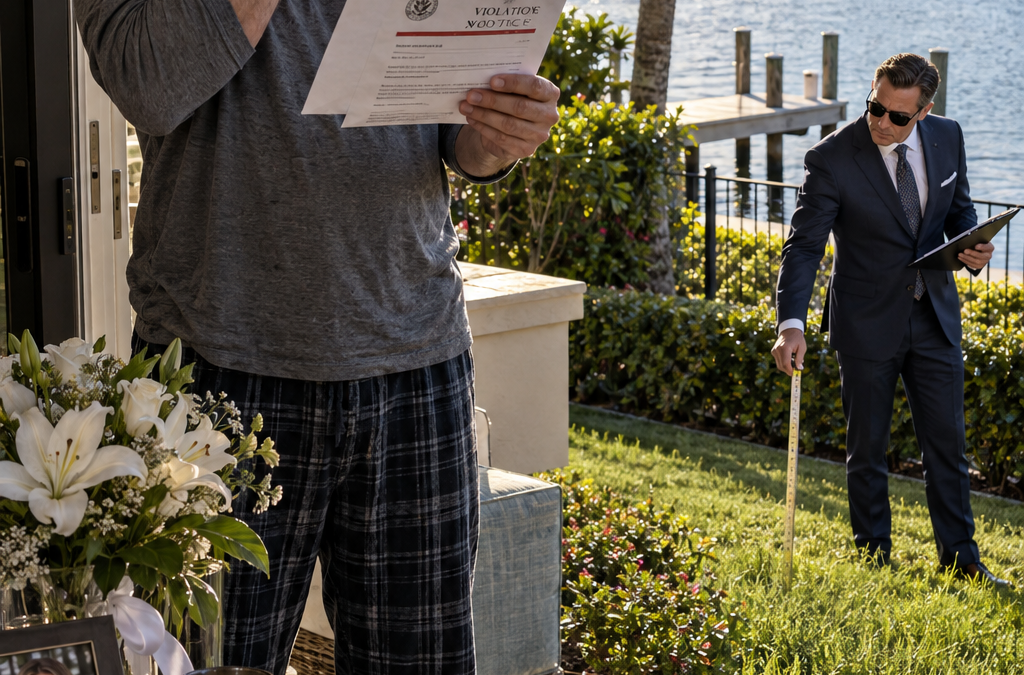
Forty-eight hours after her last breath, Harold Croft walked my property with a measuring tape and a camera.
I found out because my neighbor Phil Okafor saw him.
Phil lived two houses down, retired from the postal service, and had the kind of memory that made him impossible to beat at card games. He called me the evening before Sarah’s funeral.
“Daniel,” he said quietly, “I wasn’t going to bother you with this, but you should know Harold was at your place this morning.”
I sat at the kitchen table with funeral programs spread in front of me.
“What?”
“On your lawn. Taking pictures.”
I closed my eyes.
“Of what?”
“The grass. Side yard mostly. He had that little measuring stick he uses.”
For a moment, I said nothing.
Then I looked through the window toward the lawn.
It was overgrown.
Not wild.
Not abandoned.
Just neglected by a man whose wife had been dying in the next room.
“Thank you for telling me,” I said.
“I hated to call.”
“I’m glad you did.”
I hung up and sat in the kitchen until the room went dark.
I didn’t cry.
I had done enough crying beside Sarah’s bed, in hospital bathrooms, in the car where Emily couldn’t hear me.
Instead, I stared at the dining table where Sarah used to fold napkins before family dinners and thought about a grown man measuring grass outside a house where a woman had just died.
Then the certified letter arrived.
Pelican Shores Homeowners Association.
Formal Notice of Maximum Fine Assessment.
Violation: Lawn height exceeding four inches.
Repeat offense.
Section 4.7.
Two consecutive mowing cycles missed.
Maximum allowable fine applied.
Administrative review fee.
Compliance documentation fee.
Late enforcement processing fee.
Total due: $4,200.
I read the number again and again.
Four thousand two hundred dollars.
That was what Harold Croft believed grief should cost.
I called him.
I should not have called him.
Not that morning.
Not while my hands were shaking and Sarah’s coffee mug was still in the sink because I couldn’t bring myself to wash it.
But I called anyway.
He answered on the third ring, his voice clipped, smooth, and cheerful.
“Daniel.”
He knew why I was calling.
That made me hate him before I even spoke.
“Harold, I got the fine.”
“Then you understand the association’s position.”
“My wife just died.”
There was a pause.
Not a human pause.
Not the kind where sympathy searches for words.
A calculating pause.
Like he was deciding which phrase would sound least cruel while changing nothing.
“I understand that’s difficult,” he said finally.
“Difficult?”
“But the bylaws are crystal clear.”
I looked out at the lawn.
“Sarah died two days before you came over with a measuring tape.”
“Mr. Anderson, section 4.7 does not contain a bereavement exception.”
I gripped the phone.
“You fined me forty-eight hours after my wife died.”
“The property remained noncompliant through two mowing cycles.”
“I was holding her hand while she was dying.”
Another pause.
This time shorter.
“The fine stands.”
I hung up because if I kept listening to his voice, I was going to say something Sarah would have told me not to say.
Sarah had always said, “Pick your battles, Daniel.”
She said it about bills, contractors, neighbors, rude waiters, politicians on television, and our daughter when Emily was thirteen and determined to win every argument using volume alone.
Pick your battles.
I picked none.
That had been my first mistake.
When we moved to Pelican Shores six years earlier, Harold Croft was just another homeowner. He was fifty, polished, sharp-eyed, and vain in the quiet expensive way men get when they confuse grooming with character.
He wore linen blazers even in August heat. His hair was silver at the temples and combed backward so precisely it seemed weatherproof. He kept his beard trimmed close along his jaw and always smelled faintly of citrus cologne. His shoes were spotless, even after rain.
Nobody called him Karen to his face.
But behind his back, almost everyone did.
Harold Croft was the HOA Karen of Pelican Shores.
He had become president after running unopposed. Nobody wanted the job badly enough to challenge him, which we later learned was exactly what he had counted on. Within months, he turned a sleepy association into a private government with himself at the center.
He carried a laminated copy of the bylaws everywhere.
I mean everywhere.
At meetings.
At neighborhood barbecues.
At the community pool.
Once, during a Fourth of July cookout, he pulled it from the side pocket of his linen blazer to explain why a resident’s temporary folding canopy exceeded acceptable color contrast.
People laughed at first.
Then they stopped laughing.
Because Harold did not treat the bylaws as guidelines.
He treated them as weapons.
Our first fine was for mailbox paint.
Apparently, our post did not match approved Coastal Palette 7.
The letter included a color sample so faded from photocopying that Sarah held it beside the mailbox and said, “This could be white, cream, bone, sand, or printer toner having a bad day.”
We paid the $150.
Then came Emily’s soccer goal.
She had left it in the side yard for two weeks after summer practice ended. Harold cited us for visible recreational equipment.
Another $150.
Then recycling bins visible from the street by eight inches.
I still do not know how a man measures visibility by inches unless he wakes up hoping to be disliked.
Another $150.
I paid.
Every time.
Sarah would read the letters, sigh, and say, “Pick your battles, Daniel.”
So I picked none.
I paid because I was busy.
Because I didn’t want a neighborhood fight.
Because I thought small fines were easier than dealing with Harold’s cold little smile across a boardroom table.
Because I did not yet understand that paying without protest teaches a bully where the soft spots are.
By the time Sarah got sick, Harold had already trained half the neighborhood to obey before asking whether the rule existed.
Pelican Shores looked peaceful from the outside.
White stucco homes.
Tile roofs.
Manicured lawns.
Gulf views.
A community pool.
A clubhouse with wicker furniture and bad coffee.
But beneath that postcard surface, everyone knew Harold had favorites.
His friends on the west side could leave Christmas lights up until February.
They could park golf carts in driveways overnight.
They could keep palm fronds piled by the curb for days.
The east side got fined for everything.
A hose left uncoiled.
A planter half an inch outside the approved setback.
A lawn ornament visible from the sidewalk.
People muttered.
Nobody organized.
Not before Sarah died.
After the $4,200 letter, I hired a lawn service immediately.
The man who answered the phone heard something in my voice and squeezed me in that afternoon. He and his crew arrived with mowers, edgers, blowers, hedge trimmers, and a kindness I had not expected.
“Sorry about your wife,” he said quietly while writing the invoice.
I looked up.
“How did you know?”
“Phil told me. He said if I couldn’t get here today, he’d mow it himself.”
I swallowed hard.
“Thank you.”
Eight hundred dollars later, the property looked perfect.
Grass trimmed to three and a half inches.
Hedges squared.
Edges clean.
Flower beds cleared.
Palm debris removed.
I took photographs of everything.
Then I wrote Harold a respectful letter.
I explained Sarah’s death.
The timing.
The medical bills.
The immediate correction of the violation.
I requested a fine reduction or waiver given the circumstances.
I did not accuse him of cruelty.
I did not mention the measuring tape.
I did not write what I wanted to write.
Two days later, his response arrived by email.
Denied.
The form was cold.
Box checked.
Fine upheld.
Reason: HOA Resolution 2019-C.
Fines may not be waived except by unanimous board vote requiring formal meeting scheduling of no less than thirty days.
Thirty days.
Harold knew exactly what he was doing.
A waiver vote would require a formal meeting.
His three board allies were women from his church book club who treated him like a prophet in Italian loafers.
I already knew how that vote would go.
That night, I sat at the kitchen table with Sarah’s old laptop open and a glass of bourbon I never touched.
The house felt hollow.
Emily had gone back to college because I insisted she should, though the goodbye nearly broke both of us. She called every night, and every night I told her I was fine.
I was not fine.
I was a widower surrounded by medical bills, sympathy cards, and legal threats over grass.
The bourbon sat beside the laptop until the ice melted.
I opened every HOA document available on the Pelican Shores website.
Bylaws.
Covenants.
Architectural standards.
Fine schedules.
Meeting minutes.
Amendments.
Resolutions.
I read until midnight.
Then one.
Then two.
My eyes burned.
My back hurt.
At 3:07 a.m., I found it.
Resolution 2019-C.
The same resolution Harold had cited to deny my fine reduction.
At first, it looked legitimate.
Formal language.
Fine waiver restrictions.
Meeting requirements.
Unanimous board approval.
Then I opened the meeting minutes where it was supposedly adopted.
Only two of the three required board members had been present.
The bylaws required three for quorum on enforcement policy changes.
No quorum.
No valid ratification.
I leaned closer.
Read it again.
Then a third time.
The resolution did not legally exist.
At least, not if the bylaws meant what they said.
The $4,200 fine rested on a policy Harold had no authority to use.
My coffee was cold by then.
I had no memory of making it.
For the first time since Sarah died, I felt something other than grief or exhaustion.
Purpose.
Not peace.
Not hope exactly.
A direction.
I called Marcus Webb at 7:30 a.m.
Marcus had been my college roommate before becoming a real estate attorney in Tampa. Back then, he slept through economics lectures and survived on vending machine crackers. Now he billed in fifteen-minute increments and used phrases like “statutory exposure” with terrifying ease.
He answered groggy.
“Daniel?”
“I need legal advice.”
“At 7:30 in the morning?”
“My HOA fined me forty-two hundred dollars three days after Sarah’s funeral.”
He was silent.
Then his voice changed.
“Tell me everything.”
I did.
I told him about the fines, Sarah’s death, Resolution 2019-C, and the missing quorum.
He listened without interrupting.
When I finished, he said, “Document everything.”
“I have.”
“Don’t tip Harold off.”
“Why?”
“Because if he built one enforcement action on a void resolution, there may be others.”
I looked toward the stack of printed documents.
“Marcus.”
“Pull every resolution he’s ever issued. Every fine schedule. Every board vote. And Daniel?”
“Yeah?”
His voice dropped.
“This might be bigger than you think.”
He was right.
I submitted a formal records request under Florida Statute 720.303, requesting inspection and copies of the HOA’s financial records, enforcement logs, meeting minutes, violation records, vendor contracts, and board resolutions.
The statute gave the association a deadline.
Harold took eleven business days.
When the binders finally arrived, they were heavily edited.
Pages missing.
Sections blacked out.
Vendor names abbreviated.
Enforcement notes incomplete.
It was the kind of production that told me two things at once.
One, Harold did not want me to see everything.
Two, he did not yet realize I had already started comparing documents.
The first real twist came on a Thursday morning.
Phil Okafor knocked on my front door holding a grocery bag.
Inside were two years of HOA correspondence organized in manila envelopes.
Phil was sixty-eight, tall, Black, retired from the postal service, and precise in a way I had always admired. His lawn was perfect. His house was perfect. His mailbox was cleaner than mine had ever been.
He stood in my foyer with the bag in both hands.
“I heard about your fine,” he said.
I nodded.
“Everyone has.”
“Harold fined me seventeen times.”
I stared at him.
“Seventeen?”
“Over two years.”
“For what?”
“Pressure washing. Palm fronds. Trash bins. Driveway discoloration. Porch light color. One for a birdbath.”
“A birdbath?”
He gave me a tired smile.
“Apparently, mine disrupted the coastal aesthetic.”
He handed me the bag.
“I think we should compare notes.”
We sat at my dining table for four hours.
Sarah and I had eaten anniversary dinners at that table. Emily had done homework there. Sarah had spread Christmas cookie dough across it every December.
Now it was covered with HOA violation notices.
Between Phil’s records and mine, a pattern emerged.
Harold was not enforcing rules evenly.
He was targeting specific homeowners.
Eight of us.
All on the east side of Pelican Shores.
Phil.
Me.
The Nguyen family.
The Patel sisters.
A same-sex couple named Laura and Beth Hensley.
An older Filipino-American widow named Marisol Reyes.
And one more household that had recently sold under pressure after repeated enforcement threats.
Meanwhile, the west side, where Harold’s closest friends lived, had almost no fines in three years.
Not fewer.
Almost none.
And the violations were visible.
Phil had photographs.
I took more.
West-side homes with recycling bins left near garages.
Grass taller than mine had ever been.
Unapproved planters.
Holiday lights outside the allowed window.
A soccer goal larger than the one Emily had left out years earlier.
No citations.
No fines.
No letters.
I called Marcus.
“Selective enforcement,” he said after reviewing the first batch.
“I figured.”
“Depending on the pattern and demographics, this may implicate more than HOA law.”
I looked at Phil across the table.
“What do you mean?”
“Fair Housing Act issues, potentially. Who are the targeted homeowners?”
I listed them.
Phil was Black.
I was Latino on my mother’s side, though my last name Anderson often let people miss it until they met me or saw my mother, Elena Rivera, at a family barbecue.
The Nguyens were Vietnamese-American.
The Patel sisters were Indian-American.
Laura and Beth were married.
Marisol Reyes was Filipino-American.
Marcus went quiet for a long moment.
“Send me everything,” he said finally. “Tonight.”
I almost stopped there.
I want to be honest about that.
I was exhausted.
I was grieving.
I had no appetite, no patience, and no desire to become the center of a neighborhood lawsuit.
I am not a litigious person.
I pay bills on time.
I avoid conflict in grocery store lines.
I once apologized to a man who backed into my shopping cart.
But this was no longer about my grass.
It was about eight families and a man who had used rules like a filter, letting his friends pass through while crushing people he did not like.
Over the next three weeks, I became meticulous.
It gave me something to do besides miss Sarah.
Every morning, I walked Pelican Shores with my phone and a notebook.
I photographed properties.
Logged dates.
Compared visible conditions with citation records.
Mapped fines against addresses.
Marked board votes against enforcement spikes.
Compared satellite imagery with violation dates.
Phil helped.
So did Laura and Beth.
Mrs. Nguyen brought me copies of every letter Harold had sent her family, each one stored in a folder beside handwritten notes.
Marisol Reyes gave me a shoebox full of receipts and said, “I knew someday someone would ask.”
Marcus filed formal records requests with the county and sent additional legal demands to the HOA.
What came back next landed like a freight train on a quiet morning.
Harold had been routing HOA management fees to a company called Coastal Community Solutions LLC.
At first, the name meant nothing to me.
It sounded like a generic property vendor.
Then Marcus pulled the registration.
Owner: Harold Croft.
Registered address: a private mailbox used by Harold.
The company had billed Pelican Shores $67,000 over four years for administrative services.
No competitive bid.
No proper board authorization.
No independent approval.
And the contract?
Signed by Harold Croft as vendor.
Countersigned by Harold Croft as HOA president.
I sat in Marcus’s office while he showed me the documents on a screen.
“He contracted with himself,” I said.
Marcus nodded.
“That is self-dealing.”
“Is that illegal?”
“Florida law is not ambiguous about fiduciary duties. This may create civil liability, statutory violations, and depending on the money trail, potential criminal exposure.”
He sounded almost excited.
Marcus never sounded excited.
Not even when his team won the national championship in college.
“We’re filing,” he said.
My mouth went dry.
“A lawsuit?”
“A twelve-count civil complaint.”
I looked toward the window.
My reflection looked older than it had six months earlier.
Tired eyes.
Unshaven jaw.
Grief sitting on my shoulders like wet sand.
“What if I can’t handle this?”
Marcus turned from the screen.
“Daniel, you don’t have to handle all of it. That’s why you have counsel.”
“I mean emotionally.”
His expression softened.
For a moment, he wasn’t my attorney.
He was my college roommate again, the man who once drove me to the emergency room after I cut my hand opening a bottle with a pocketknife like an idiot.
“Sarah would be furious,” he said quietly.
I looked at him.
“At me?”
“At him.”
I laughed once.
It came out broken.
“Yeah.”
“Then let’s make him explain himself.”
Seven homeowners joined the complaint.
Phil.
The Nguyens.
The Patels.
Laura and Beth.
Marisol.
Me.
The claims covered selective enforcement, breach of fiduciary duty, fraudulent financial practices, improper fines, violations of Florida HOA statutes, and related misconduct connected to Coastal Community Solutions.
The morning the complaint was served, I watched from Phil’s porch.
The process server knocked on Harold’s door at 8:14 a.m.
Harold answered wearing a pale linen shirt and white pants, already dressed like he had a brunch reservation with someone he intended to impress.
He reached for the envelope with his usual composed expression.
Then he read the first page.
The color drained from his face like the tide going out.
I am not proud of what I felt in that moment.
Actually, yes.
I am.
I absolutely am.
For once, Harold Croft was holding paper he could not control.
His attorney responded fast.
Three motions to dismiss.
One claimed lack of standing.
One argued failure to state claims.
One tried to force arbitration under an outdated provision no longer valid after later amendments.
Marcus knocked them down one by one.
He was surgical.
He did not rant.
He cited statutes, meeting minutes, bank records, and Harold’s own signatures.
Each time Harold’s attorney tried to make the case look like grief-fueled revenge, Marcus brought it back to documents.
That was when the third twist arrived.
Her name was Tracy Bell.
She was the HOA bookkeeper.
Quiet.
Overlooked.
The kind of person residents passed at meetings without noticing because Harold had trained everyone to look at him.
Tracy contacted Marcus voluntarily.
He called me afterward.
“Daniel, sit down.”
“I am sitting.”
“Good. The bookkeeper reached out.”
I sat straighter.
“Why?”
“She kept copies.”
“Of what?”
“Receipts. Transfers. Emails. Reclassification instructions.”
My heart began pounding.
Marcus continued.
“She says Harold instructed her to code personal expenses as HOA costs.”
I closed my eyes.
“What kind of expenses?”
“A lawnmower for his private yard billed to HOA landscaping. A Sarasota resort weekend labeled board training. Personal office equipment. Meals. Travel. Repairs unrelated to common property.”
“How much?”
“Preliminary total, fifty-three thousand dollars over three years.”
I opened my eyes.
The kitchen was dim.
Sarah’s mug was still on the shelf where I had finally placed it after washing it two weeks earlier.
Fifty-three thousand dollars.
On top of the $67,000 self-dealing contract.
On top of the selective fines.
On top of the void resolution used to deny my grieving request.
For a moment, I could not speak.
Then I asked, “Why now?”
Marcus said, “Because Tracy says she was afraid. And because after the complaint was filed, Harold told her to start deleting emails.”
That sentence moved the case from ugly to explosive.
Tracy gave a sworn statement.
She produced copies.
Emails from Harold.
Forwarded receipts.
Instructions to reclassify charges.
Internal notes.
Bank transfer records.
The Florida Department of Business and Professional Regulation opened its own investigation.
The county attorney’s office requested our documentation.
The HOA’s insurer got involved.
The board members who had spent years nodding beside Harold suddenly began insisting they had never understood the full picture.
I believed some of them.
Not all.
By March, Harold was removed from the board by court-ordered injunction.
The order restricted his access to association funds, records, enforcement systems, and communications tied to the disputed matters.
For the first time in six years, Pelican Shores belonged to its residents more than to Harold Croft.
The civil trial lasted four days.
Four long days under fluorescent courtroom lights, listening to Harold’s attorney describe me as a grieving widower seeking vengeance.
He said I had turned ordinary fines into a personal crusade because I could not process my loss.
He said Phil was a disgruntled troublemaker.
He implied the Nguyens and Patels had misunderstood standard enforcement procedures.
He called Laura and Beth overly sensitive.
He suggested Coastal Community Solutions had provided valuable administrative support.
He said Harold had made mistakes, perhaps, but no one could run an association perfectly.
I sat there with my hands folded, hearing Sarah’s voice in my head.
Pick your battles, Daniel.
I had picked this one.
Phil testified first.
Calm.
Precise.
Postal-worker memory.
He described each fine, each letter, each photograph, each west-side violation left untouched.
Laura testified about being fined for a pride flag garden marker while Harold’s friends displayed larger political signs without citation.
Mrs. Nguyen testified about receiving four violations in one month after questioning a pool assessment.
Marisol Reyes cried when describing how she had skipped medical appointments to pay fines because Harold had threatened escalation.
Then Tracy testified.
That changed the air in the courtroom.
She did not look like a person seeking revenge.
She looked like a woman who had carried a heavy thing too long.
She explained the emails.
The reclassifications.
The personal expenses.
The fear of losing her job.
Marcus walked her through the documents one by one.
Lawnmower.
Sarasota resort stay.
Meals.
Office equipment.
Coastal Community Solutions invoices.
The contract signed by Harold on both sides.
Then I testified.
I had dreaded it.
More than anything.
More than seeing Harold.
More than hearing the defense call me vengeful.
I dreaded saying Sarah’s name under oath.
Marcus approached gently.
“Mr. Anderson, when did you receive the $4,200 fine?”
“Three days after my wife’s funeral.”
“What was your wife’s name?”
My throat closed.
I looked down.
Then back up.
“Sarah.”
“How long were you married?”
“Nineteen years.”
“What was happening during the period the HOA says your lawn remained noncompliant?”
I swallowed.
“My wife was dying in our home.”
The courtroom went still.
I could feel Harold’s attorney watching, waiting for me to seem too emotional.
So I did what Sarah would have wanted.
I stayed steady.
I explained the medical bills.
The lawn service.
The respectful waiver request.
The denial based on Resolution 2019-C.
The night I found the quorum defect.
The records request.
Phil’s bag of letters.
The pattern.
The documents.
Marcus projected the void resolution on the screen.
Then the meeting minutes showing only two board members present.
Then he showed Harold’s denial form citing that invalid resolution as the reason I could not receive mercy three days after burying my wife.
I did not look at Harold.
I looked at the jury.
“At first, I thought it was cruelty,” I said. “Then I realized it was also a system.”
Harold testified on the third day.
He wore a navy suit and a soft gray tie.
No linen blazer.
No laminated bylaws.
His voice was controlled.
He said he loved Pelican Shores.
He said enforcement was difficult.
He said some homeowners took rules personally.
He said Coastal Community Solutions had saved the HOA money.
He said any personal charges were coding errors made by others.
He said selective enforcement was an illusion created by incomplete comparisons.
Then Marcus cross-examined him.
“Mr. Croft, did you sign this contract as president of the HOA?”
“Yes.”
“And did you sign this same contract as owner of Coastal Community Solutions?”
“I signed in both capacities, yes.”
“Did you disclose in the minutes that you personally owned the vendor?”
“I believe the board was aware.”
“Please identify where that disclosure appears.”
Harold looked at the document.
Then another.
Then another.
“I would need to review the complete file.”
Marcus nodded.
“Let’s talk about Resolution 2019-C.”
Harold’s jaw tightened.
Marcus displayed the minutes.
“How many board members were required for quorum?”
“Three.”
“How many were present?”
“Two.”
“Was Resolution 2019-C validly adopted?”
Harold’s attorney objected.
The judge overruled.
Harold hesitated.
“I believed it was enforceable.”
“That was not my question.”
The courtroom held its breath.
Finally, Harold said, “No.”
One word.
Small.
Fatal.
Marcus moved next to the fines.
Then the demographic pattern.
Then the personal expenses.
Then the email instructing Tracy to recode the Sarasota stay as board training.
Harold kept saying he did not recall.
He would have to check the file.
He relied on staff.
He acted in good faith.
By the time he stepped down, the polished man who had ruled Pelican Shores with a laminated handbook looked smaller.
Not broken.
Men like Harold rarely break in public.
But exposed.
The jury deliberated for three hours.
I sat in the hallway with Phil on one side and Marcus on the other.
Nobody said much.
At one point, Phil handed me a peppermint from his pocket like we were waiting outside a doctor’s office.
“You okay?” he asked.
“No.”
“Me neither.”
“Sarah would have liked you,” I said.
He smiled sadly.
“I think I would have liked her too.”
When the jury returned, my hands went cold.
Actual damages: $44,800 split among seven plaintiffs.
Punitive damages: $180,000.
Attorney’s fees: entirely Harold’s responsibility under the court order.
The HOA was placed under court-supervised independent management.
A criminal referral for financial fraud was forwarded to the state attorney.
Harold Croft’s name became attached to a public record that would follow him everywhere he tried to reinvent himself.
I did not cheer.
No one did.
The verdict was not a party.
It was a release of pressure that had been building for years.
Phil closed his eyes.
Laura started crying.
Mrs. Nguyen held her husband’s hand.
Marisol whispered a prayer in Spanish.
I sat still until Marcus touched my shoulder.
“We won,” he said quietly.
I nodded.
Then I thought of Sarah.
Not dramatically.
Not like a movie.
Just a sudden memory of her standing in the backyard years earlier, barefoot in the grass, telling me I cut it too short and laughing when I said Harold would probably measure that too.
For a moment, I could almost hear her.
Pick your battles, Daniel.
I had.
The months after the verdict were strange.
The world did not immediately become peaceful.
Court orders had to be enforced.
Management had to be replaced.
Accounts had to be audited.
Refunds had to be calculated.
Residents had to learn how to run an association without fear disguised as order.
But things changed.
The new independent manager sent letters that sounded like they were written by a human being rather than a machine designed to punish people.
Fine procedures were revised.
Every enforcement action required documented evidence, board review, and clear citation of valid rules.
Selective enforcement complaints were reviewed.
The east-side homeowners received refunds and corrections.
The void resolution was removed from the books.
Vendor contracts were examined.
Coastal Community Solutions was terminated.
Harold’s allies resigned one by one.
Some apologized.
Some did not.
I found I did not need every apology.
What I needed was quiet.
Real quiet.
Not the old Pelican Shores quiet, where people swallowed anger because Harold had trained them to.
The new quiet.
The kind that comes after the truth has spoken loudly enough.
Six months later, I sat on my back porch with a glass of bourbon.
The first one I had actually intended to drink.
The grass was exactly three and a half inches tall.
I checked.
Not because I feared a fine.
Because the number made me laugh.
The Gulf was swallowing the sun in bands of orange and red. The water glowed, then darkened. Pelicans skimmed low over the surface, and the jasmine beneath the kitchen window had started blooming again.
Emily was coming home the next weekend.
We planned to clean out Sarah’s closet together.
I was dreading it.
I was also ready.
Grief had not left the house.
I understood by then that grief does not leave.
It changes rooms.
It stops sitting on your chest every morning and starts waiting quietly in places you can visit when you have the strength.
Sarah was still in the porch swing.
The kitchen window.
The hydrangeas.
The books she left behind.
The voice in my head telling me to pick my battles.
For nineteen years, she had helped me decide which fights mattered.
The last one, I had to choose without her.
I lifted the bourbon.
“To you,” I said.
The glass caught the sunset.
I drank.
It burned just enough.
Across the street, Phil was walking his dog.
He raised a hand.
I raised mine back.
A breeze moved through the grass.
Three and a half inches.
Perfectly legal.
Perfectly mine.
The house at 14 Sandpiper Lane was still standing.
The back deck still needed sealing.
The roses needed trimming.
The mailbox was still painted Coastal Palette 7, though I was considering changing it out of principle.
The bills were not gone.
The grief was not gone.
Sarah was not coming back.
But Harold Croft had not taken my home.
He had not taken Phil’s dignity.
He had not taken the neighborhood forever.
And he had not reduced my wife’s death to a line item on a violation ledger without consequence.
I sat there until the sun disappeared completely.
For the first time in months, I did not feel like I was waiting for the next envelope, the next threat, the next blow.
I felt tired.
I felt older.
I felt sad.
But beneath all of that, steady as the tide, I felt something else.
I felt that the battle I had chosen had been the right one.
And somewhere in the quiet of that Gulf evening, I could almost hear Sarah answer.
About time, Daniel.








