𝗙𝗨𝗟𝗟 𝗦𝗧𝗢𝗥𝗬 The HOA President Filed 30 Complaints Against My Ranch and Never Asked What I Did at the Courthouse
𝗙𝗨𝗟𝗟 𝗦𝗧𝗢𝗥𝗬
I laughed.
He didn’t.
“New president over there. Feifer.”
“Don’t know her.”
“She knows you.”
That made me stop.
“What does that mean?”
“Says your fence is too high.”
I looked at the split-rail fence beside us.
It had stood in roughly the same place since my father installed it.
“According to who?”
“Her.”
“That fence isn’t in Avalon Ridge.”
Earl shrugged.
“Apparently nobody told her.”
I went back to work.
That should have been the end of it.
Three days later, the first complaint arrived.
It wasn’t even sent to me directly.
The county code office forwarded it because my parcel number appeared on the filing.
COMPLAINT: FENCE HEIGHT / VISUAL OBSTRUCTION.
The allegation stated that a portion of my split-rail fence exceeded the preferred sightline standard for properties adjacent to Avalon Ridge.
Preferred sightline standard.
I called the county code officer who handled rural parcels.
His name was Mike.
He’d been there almost as long as I had worked at the courthouse.
“Mike.”
He sighed before I finished introducing myself.
“You got the fence complaint.”
“I did.”
“You can throw it away.”
“Not actionable?”
“Not even close.”
“My land isn’t in the HOA.”
“I know.”
“It’s not in the subdivision.”
“I know.”
“The fence predates half those houses.”
“I know, Caleb.”
I leaned back in my chair.
“Then why send it?”
“Procedure. If someone files against a parcel, we document and forward.”
“Who filed it?”
He already knew I knew.
“Derinda Feifer.”
I thanked him and put the paper in a desk drawer.
Complaint number one.
I didn’t answer Derinda.
That was deliberate.
If there had been an actual concern—loose livestock, drainage crossing a property line, fence damage—I would have walked over, knocked on a door, and talked.
But arguing about an HOA sightline rule that had no jurisdiction over my ranch seemed like a waste of everyone’s time.
Apparently my silence encouraged her.
The second complaint came eleven days later.
BARN COLOR / EXCESSIVE VISUAL IMPACT.
That one actually made me laugh.
My east barn is red.
Not bright candy red.
Barn red.
The sort of color barns have been painted since somebody realized iron oxide helped preserve wood.
According to Derinda, the barn presented what she called a “visually aggressive contrast” against Avalon Ridge’s architectural palette.
I read that phrase twice.
Visually aggressive.
The barn had been red since 1987.
Avalon Ridge hadn’t existed then.
Derinda probably hadn’t even been thinking about moving to the county when my father painted it.
I put the complaint behind the first one.
Then came the third.
Livestock visibility.
The fourth.
Agricultural odor.
The fifth.
Dust generated from my gravel driveway.
The sixth.
Exterior lighting.
I had one yard light outside the equipment building.
It turned off automatically at ten.
Derinda’s complaint claimed illumination after nine p.m. disrupted residential enjoyment.
The seventh concerned cattle noise.
Apparently one of my cows had committed the grave offense of making cow sounds.
By complaint number eight, I bought a folder.
Plain brown accordion folder.
Nothing dramatic.
I wrote FEIFER / AVALON RIDGE across the tab.
Every new complaint went inside.
Stamped.
Dated.
Filed.
I still didn’t call Derinda.
Then she began showing up at county code meetings.
Not court.
Administrative meetings.
She brought photographs.
Maps.
Printed HOA guidelines.
She argued that my ranch was negatively affecting surrounding property values.
The county staff explained repeatedly that my property was zoned agricultural and sat outside Avalon Ridge jurisdiction.
Three hundred feet outside it at the closest point.
That fact did not seem to interest her.
Complaint number twelve concerned the appearance of my cattle feeders.
Number thirteen alleged excessive equipment visibility.
Fourteen involved a utility trailer parked near the barn.
At number fifteen, I called my attorney.
That probably sounds strange.
A property lawyer hiring a property lawyer.
A judge hiring one sounds stranger.
But anyone who understands the system knows why.
The fastest way to make a bad situation worse is to represent yourself when you have a personal stake.
My attorney was Rachel Donnelly.
She had practiced land-use law for nearly twenty years.
Sharp.
Patient.
Almost impossible to provoke.
I brought her the folder.
She flipped through the complaints slowly.
“Fifteen?”
“So far.”
“How many actionable?”
“Zero.”
She looked up.
“Why is she doing this?”
“You’d have to ask her.”
“Have you?”
“No.”
Rachel tapped the folder.
“Good.”
“Good?”
“You’re a sitting judge. The less direct conflict, the better.”
“I know.”
“Does she know what you do?”
“I have no idea.”
“You haven’t told her?”
“No reason to.”
Rachel smiled faintly.
“Let’s keep it that way.”
Not because we were setting some trap.
Because my position was irrelevant to whether Derinda’s complaints had merit.
My ranch either violated the law or it didn’t.
My job shouldn’t change that answer.
Rachel sent a short letter to the county code office requesting copies of all filings involving my parcel and asking that future notices go through her office.
She also confirmed in writing that Hargrove Ranch was outside Avalon Ridge’s recorded jurisdiction.
That was all.
No threat.
No accusation.
No mention of harassment.
Yet.
The complaints continued.
Number sixteen alleged a manure pile was visible from a community walking path.
It was compost.
Number seventeen complained about temporary hay storage.
Number eighteen alleged runoff from my north pasture entered association land.
County engineering checked.
It didn’t.
Number nineteen concerned the “industrial appearance” of my stock trailer.
Number twenty alleged commercial operations inconsistent with surrounding residential character.
It was a ranch.
Of course it was inconsistent with surrounding residential character.
The ranch had been there first.
By the third month, I started to recognize Derinda’s writing style before seeing her signature.
“Negative visual impact.”
“Community harmony.”
“Residential compatibility.”
“Corridor standards.”
“Enhanced neighborhood character.”
She wrote as if enough decorative language could turn preference into law.
One Friday afternoon, Rachel called me.
“You’re at twenty-three.”
“I know.”
“She’s escalating.”
“What’s twenty-three?”
“Hay shed.”
I closed my eyes.
“What about it?”
“Shadow.”
I thought I had misheard.
“Shadow?”
“She alleges the western side of your hay shed casts a shadow across a section of the bike path around dusk.”
I stared out my office window.
“Is sunlight now governed by Avalon Ridge?”
“Not yet.”
I laughed.
Rachel didn’t.
“Caleb, this isn’t funny anymore.”
I knew.
That was the problem.
Taken individually, every complaint looked ridiculous.
Together, they created a paper trail.
And paper trails matter.
Even false ones.
Maybe especially false ones, because someone reading a file quickly might see thirty complaints before noticing that all thirty resulted in no enforcement.
“She’s trying to create a record,” Rachel said.
“That’s my assumption.”
“For what?”
“I don’t know yet.”
We found out two weeks later.
The letter was hand-delivered to my mailbox on a Tuesday.
Cream paper.
Embossed Avalon Ridge logo.
Signed by Derinda Feifer in blue ink.
It informed adjoining landowners that the Avalon Ridge Homeowners Association intended to pursue formal annexation of three adjacent parcels north and west of the existing development.
One of those parcels shared a fence line with my northern pasture.
The expansion would bring, in Derinda’s words, “enhanced community standards and coordinated development oversight to the entire corridor.”
I stood beside my mailbox reading that sentence.
Then I looked across the pasture.
My cattle were grazing near the far fence.
The east barn sat behind them.
The same barn Derinda had called visually aggressive.
Suddenly the complaints made sense.
She wasn’t merely annoyed by the ranch.
She was preparing for expansion.
Avalon Ridge wanted to grow.
To annex adjoining residential parcels, the association needed local approval.
Part of that process required review of adjacent land-use conflicts.
And Derinda had spent four months manufacturing what she apparently believed would look like a record of trouble originating from my property.
Thirty complaints.
Thirty attempts to frame me as the problem next door.
I folded the letter carefully.
Put it on top of the folder.
Then drove to the courthouse.
Because that was where I worked.
The annexation application wasn’t on my desk yet.
It would be.
Our county’s land-use structure is unusual.
Major residential expansion and certain annexation petitions pass through a judicially supervised review process before final administrative approval.
The reviewing judge verifies legal descriptions, notice requirements, adjacent property conflicts, recorded easements, and procedural history before the matter proceeds to the full permit board.
For nine years, that docket had been part of my assignment.
Not every permit.
Not every shed.
Not every building project.
But major subdivision expansion?
Yes.
HOA annexation affecting adjoining parcels?
Absolutely.
When I saw Derinda’s letter, I understood immediately what would happen once Avalon Ridge filed.
And I understood something else.
I could not review it.
The moment an application involving my own adjacent land appeared, I would have a direct personal interest.
Ethically, legally, professionally, recusal wasn’t optional.
I told my clerk that afternoon.
“If Avalon Ridge files annexation papers, flag them immediately.”
She looked at me.
“Because of the ranch?”
“Yes.”
“Need reassignment?”
“Eventually. First I need to disclose.”
That was the proper process.
Nothing secret.
Nothing clever.
No revenge.
I had spent my career watching people destroy otherwise legitimate cases by trying to manipulate procedure.
I wasn’t going to become one of them because an HOA president annoyed me.
Still, I was human.
And when complaint number twenty-four arrived two days later, I admit I looked at the folder differently.
Derinda thought she was building leverage.
She didn’t understand that every complaint became part of the same official record her own annexation application would eventually rely on.
By the end of month four, there were thirty.
Thirty filings.
Not thirty letters to me.
Thirty formal complaints submitted to county offices.
Every one tied to my parcel number.
Every one naming Hargrove Ranch.
Every one reviewed.
Every one found non-actionable or unsupported.
Rachel created a chart.
Date.
Complaint.
County response.
Disposition.
- Fence height. No jurisdictional violation.
- Barn color. No county violation.
- Livestock visibility. Lawful agricultural use.
- Odor. No actionable code breach.
- Gravel dust. No violation.
And on.
Thirty lines.
Zero sustained findings.
Rachel slid the chart across her desk.
“This is becoming useful.”
“I know.”
“Do you?”
I looked at her.
She tapped the final column.
“She thinks this shows thirty problems.”
“It shows thirty rejected allegations.”
“More than that.”
“What?”
“It shows persistence after notice.”
That mattered.
After the first few complaints, Derinda could plausibly say she misunderstood the boundary.
After ten, she had been told.
After fifteen, she had received correspondence through counsel.
After twenty, county staff had explained repeatedly that the cited HOA standards didn’t control my parcel.
Yet she continued.
At some point, mistake becomes pattern.
Six weeks after the annexation notice, Avalon Ridge formally filed.
I didn’t touch the application.
My clerk received it, logged it, and notified me.
The HOA’s attorney was Fletcher Grouse.
I knew the name, but not personally.
He practiced municipal and association law in the next county.
Professional reputation.
Competent.
Two days after filing, Fletcher called the courthouse asking for status.
My clerk answered.
She later told me exactly how the conversation went.
“I’m calling regarding the Avalon Ridge annexation petition.”
“Yes, sir. It’s been received.”
“Has a reviewing judge been assigned?”
She looked at the docket.
At that stage, technically yes.
My name was still attached until formal recusal occurred at the review session.
“Judge Hargrove is the assigned land-use judge.”
Long pause.
“Hargrove?”
“Yes.”
“Caleb Hargrove?”
“Yes, sir.”
Another pause.
Then Fletcher said, “Thank you.”
He hung up.
The next morning, he called back.
This time he asked for me.
My clerk came into chambers.
“Fletcher Grouse wants to speak with you.”
“About Avalon Ridge?”
“Yes.”
I considered refusing.
Then decided a short procedural call was appropriate.
I picked up.
“Judge Hargrove.”
“Your Honor, Fletcher Grouse.”
“Good morning.”
“I represent Avalon Ridge Homeowners Association.”
“I understand.”
There was a hesitation.
He had figured it out.
“You own the Hargrove property adjacent to the proposed annexation area.”
“I do.”
“I wasn’t aware of that when the application was filed.”
“All ownership records are public.”
“Of course.”
Silence.
He was choosing words carefully.
“So how will the application be handled?”
“According to normal procedure.”
“Will you be reviewing it?”
“I will address any required disclosure and recusal on the record.”
Another silence.
“Understood.”
I continued.
“All relevant filed materials will remain part of the public administrative record, including complaint history involving adjacent parcels.”
That sentence landed exactly where I expected.
Not as a threat.
As notice.
Fletcher said, “The complaint history.”
“Yes.”
“I believe some of those matters may have been informal.”
“If they were formally filed, they’ll appear as formally filed. If they weren’t, they won’t.”
“I see.”
“Anything else?”
“No, Your Honor.”
“Have a good day, Mr. Grouse.”
“You too.”
He did not sound like a man having a good day.
Later that afternoon, Rachel called.
“I just got an email from Fletcher.”
“About?”
“He wants to know whether your office intends to characterize Derinda’s complaints as evidence against the HOA.”
“My office won’t characterize anything.”
“I know.”
“Did you tell him that?”
“Yes.”
“What did he say?”
“Nothing yet.”
I leaned back.
“He’s nervous.”
“He should be.”
Three weeks later, the public review session was scheduled.
Those sessions are formal but not theatrical.
Long conference room.
Raised dais at one end.
Applicant tables facing the panel.
County staff along one wall.
Interested landowners and residents seated behind.
Applications are presented.
Legal descriptions verified.
Questions asked.
Comments entered.
Nothing like television court.
Usually boring.
That morning, I arrived early.
My disclosure statement was already prepared.
Judge Anita Fell had agreed to take the case after my recusal.
Anita had served on the bench eleven years.
Exacting.
Fair.
Not easily impressed.
Most importantly, she had no connection to me beyond being a colleague.
I told her only what ethics rules required.
“I own the adjacent parcel identified in the application. There is an existing complaint history between the HOA president and my property.”
She nodded.
“Records in the file?”
“Yes.”
“You’ve reached no conclusions?”
“None.”
“Good.”
That was it.
At nine, the room filled.
I was reviewing another file when I heard voices near the entrance.
Then silence.
Not total silence.
A shift.
I looked up.
Derinda Feifer had walked in carrying a thick binder.
Color-coded tabs protruded from the top.
Fletcher walked beside her.
Two HOA board members followed.
Derinda saw me.
She stopped.
I’ve seen many expressions in courtrooms.
Anger.
Fear.
Shock.
Grief.
Arrogance.
False confidence.
The look on Derinda’s face was a combination of disbelief and sudden calculation.
Her eyes moved from me to the nameplate in front of my seat.
HON. CALEB HARGROVE.
Then back to me.
The binder in her hands lowered slowly.
Fletcher leaned toward her and whispered.
I couldn’t hear him.
Whatever he said drained more color from her face.
For four months, Derinda had treated me as a rancher who didn’t understand procedure.
A man with cattle.
An old barn.
A gravel driveway.
A split-rail fence.
Apparently she had never once typed my name into a search bar.
Never asked a county employee who I was.
Never asked Fletcher.
Never asked anyone.
She had been so certain she understood the person she was targeting that curiosity seemed unnecessary.
I called the session to order.
Standard introduction.
Case number.
Applicant.
Nature of request.
Then I addressed the issue immediately.
“Before this matter proceeds, I need to disclose a direct personal interest.”
Derinda stared at me.
“I am the owner of Hargrove Ranch, the parcel identified in the application materials as an adjacent landholding along the proposed annexation corridor.”
Murmurs moved through the room.
I continued.
“Because the application may materially affect property adjacent to land I own, and because filings concerning that property appear in the administrative record, I cannot participate in substantive review.”
Derinda’s shoulders shifted.
Relief.
I saw it.
Probably she thought recusal meant the problem disappeared.
“I therefore recuse myself from this application in full.”
I signed the order.
“Judge Anita Fell will preside.”
Anita moved to the center seat.
I gathered my papers.
Before leaving, I added:
“All documents properly filed prior to reassignment remain part of the public record and will be considered or disregarded according to their relevance under normal procedure.”
Then I walked out.
That’s it.
No speech.
No look at Derinda.
No dramatic warning.
I spent the next two hours in chambers working unrelated cases.
I did not watch the review.
I did not call Anita.
I did not ask staff for updates.
Judicial recusal means something.
It is not ceremonial.
You don’t step away publicly and then influence the process privately.
Around noon, Rachel texted me.
One sentence.
You should see the public record when you’re allowed.
I didn’t respond.
Later, after the session concluded and the clerk confirmed the record was public, I reviewed what had happened like any member of the public could.
Avalon Ridge presented its annexation plan.
Infrastructure.
Tax impact.
Maintenance.
Community services.
Property-owner consent from the three parcels involved.
Then came the adjacent conflict section.
Derinda’s binder apparently included several of her own complaints against my ranch.
That decision turned out to be disastrous.
Fletcher had likely realized the danger by then, because the transcript showed he tried to characterize the complaints as evidence of ongoing land-use incompatibility requiring coordinated standards.
Judge Fell asked a simple question.
“How many of these complaints resulted in a finding of violation?”
Fletcher answered.
“None.”
“Any enforcement order?”
“No.”
“Any citation sustained against Hargrove Ranch?”
“No.”
“Any county finding that the ranch is operating outside its zoning?”
“No.”
Then Anita asked:
“Why are thirty unsupported complaints being offered as evidence of wrongdoing by the adjacent landowner?”
According to the transcript, Fletcher requested a moment to confer with his client.
Derinda eventually spoke.
She argued that the volume of complaints demonstrated persistent neighborhood concerns.
Anita asked who had filed them.
Derinda admitted she had filed the majority personally in her capacity as HOA president.
“How many?”
“Thirty.”
“All thirty?”
“Yes.”
“Over what period?”
“Approximately four months.”
“And after the county advised you that the ranch was outside HOA jurisdiction?”
Derinda hesitated.
“I believed broader community impact remained relevant.”
Anita asked whether any county officer had told her the ranch violated law.
“No.”
Whether any agricultural-use citation had been issued.
“No.”
Whether Hargrove Ranch had a complaint history before Avalon Ridge’s recent expansion.
County staff answered.
No material history.
That was the moment the record changed character.
Derinda had tried to create evidence that I was a problematic adjacent owner.
Instead, she had documented herself filing thirty unsuccessful complaints against a property that had no meaningful prior code history.
The board members sitting beside her apparently began distancing themselves.
One testified that he had not known Derinda filed all thirty.
Another said the full board had never voted to authorize most of them.
That mattered even more.
The annexation application was not denied that same hour.
Government rarely works that dramatically.
The review panel requested additional materials.
HOA meeting minutes.
Complaint authorization records.
Correspondence with county departments.
Evidence supporting claims of adjacent conflict.
Fletcher was given time to supplement.
For the next two weeks, more documents came in.
They didn’t help.
Several complaints had been filed under Derinda’s presidential authority without recorded board discussion.
County responses repeatedly told her my ranch was lawful agricultural property.
In one email, a code officer wrote explicitly:
Avalon Ridge private aesthetic standards do not govern Hargrove Ranch.
That email had been sent after complaint number nine.
Derinda filed twenty-one more after receiving it.
Another email warned that further repetitive complaints without new evidence could be treated as duplicative.
She kept filing.
The pattern was no longer subtle.
Rachel called me one evening.
“You know the worst part?”
“What?”
“She didn’t need any of this.”
“What do you mean?”
“The annexation parcels themselves might have had a viable application.”
I knew that.
“She could have filed a clean application and addressed the ranch honestly.”
“Exactly.”
“Instead she tried to manufacture conflict.”
“And documented herself doing it.”
Paperwork cuts both ways.
That’s something I used to tell young lawyers.
A document does not belong emotionally to the person who creates it.
Once filed, it becomes evidence.
It can support you.
Or destroy your theory.
Three weeks after the review session, Judge Fell and the panel issued the written decision.
I did not see a draft.
I had no role.
The application was denied.
Not because I owned the ranch.
Not because I was a judge.
Not because Derinda had insulted my barn.
The decision cited unresolved adjacent-landowner conflict, deficiencies in the applicant’s presentation of that conflict, and a complaint history raising substantial concerns about whether the HOA’s stated land-use concerns were supported by objective violations or reflected a pattern of targeted administrative filings.
The order also noted inconsistencies between the board’s recorded authorizations and the complaints filed under the association’s name.
It was careful.
Measured.
Exactly how such an order should be.
No accusation of malice.
No dramatic language.
Just facts.
Avalon Ridge could reapply later after addressing deficiencies.
But the expansion Derinda had promised residents was dead for the foreseeable future.
I read the decision once.
Then closed the file.
I expected satisfaction.
There was some.
I’d be lying if I said otherwise.
For four months, that woman had tried to turn my family’s ranch into evidence against itself.
She had called cattle an eyesore.
My father’s barn visually aggressive.
My driveway a nuisance.
My hay shed’s shadow a community impact.
Thirty times she had tried to make preference look like law.
Now the same filings sat in a public order explaining why the HOA’s credibility had collapsed.
But underneath the satisfaction was something else.
Relief.
Because the system had worked without me twisting it.
I had done the one thing Derinda probably never expected.
I stepped out of the way.
That mattered to me more than winning.
Eleven days later, Derinda resigned as HOA president.
I heard about it from Earl.
He drove into the ranch one Saturday while I was repairing a water trough.
He climbed out of his truck smiling.
“You hear?”
“What?”
“Your friend quit.”
I kept tightening the fitting.
“Who?”
“Don’t do that.”
“Do what?”
“Act like you don’t know.”
I looked up.
“Derinda?”
“Resigned last night.”
I went back to the wrench.
“Good for her.”
Earl laughed.
“That’s all you’ve got?”
“What do you want?”
“Maybe fireworks.”
“I’ve got cattle.”
“Same smell.”
I threw a rag at him.
Later, Rachel sent me the public notice.
Derinda’s resignation cited personal obligations and the need for “fresh leadership.”
No mention of the annexation denial.
No mention of the complaints.
No mention of me.
Again, I didn’t need one.
Avalon Ridge residents began asking questions.
How much had the failed annexation cost?
Who authorized legal expenses?
Why had Derinda filed complaints under the HOA’s name without full board votes?
Why did nobody investigate whether the ranch was actually governed by community standards before spending months attacking it?
Three board members called for an internal review.
Fletcher advised them to preserve records.
The association did not collapse.
I didn’t want it to.
Most HOAs aren’t villains.
They are organizations.
Good or bad depending largely on who runs them and whether homeowners pay attention.
Avalon Ridge elected a new president named Robert Kim.
He called Rachel before contacting me.
Smart man.
He requested a meeting at the ranch.
Rachel came too.
Robert arrived without a binder.
That was the first promising sign.
We sat on my porch.
He looked across the pasture for a while.
Then said, “It’s quieter than I expected.”
I smiled.
“What were you expecting?”
“I don’t know.”
“Visually aggressive cows?”
His face went red.
Then he laughed.
“Fair.”
He apologized on behalf of the association.
Not for every resident.
Not for things he hadn’t done.
For the organization’s conduct.
That distinction impressed me.
“We’re withdrawing any remaining HOA-originated complaints,” he said.
“County already closed them.”
“I know. We also adopted a policy requiring board approval before complaints are filed in the association’s name against property outside our boundaries.”
“That seems sensible.”
“It should have been obvious.”
“Most good rules are.”
He looked toward the east barn.
“Is that the aggressive one?”
“That’s her.”
He laughed again.
The red barn stood exactly where it had stood since 1987.
Nothing about it had changed.
Only the person looking at it.
Robert and I eventually developed a decent working relationship.
Avalon Ridge maintained its side of the boundary.
I maintained mine.
When drainage work near the bike path required temporary access, they asked.
I agreed.
When one of my cattle got through a damaged section of fence and wandered near the subdivision trail, Robert called me rather than filing something.
I drove over.
We got her back.
Handshake.
Honesty.
Problem solved.
The way neighbors had solved things around there for generations.
Derinda remained in Avalon Ridge for four more months.
I saw her once during that time.
I was picking up supplies at a hardware store.
She stood in the garden section comparing bags of soil.
We noticed each other at roughly the same moment.
For a second, I considered walking away.
Instead, I nodded.
“Mrs. Feifer.”
“Judge Hargrove.”
That was the first time she’d called me that.
I didn’t like it.
“Caleb is fine.”
She looked surprised.
Then her expression tightened.
“I suppose you’re pleased.”
“About what?”
“The annexation.”
“No.”
She gave me a look that said she didn’t believe me.
“You expect me to believe that?”
“I didn’t want your HOA expanded toward my ranch.”
“Exactly.”
“That isn’t the same as wanting you humiliated.”
Her eyes hardened.
“You made me look like a criminal.”
“No.”
“You sat there knowing what those complaints would do.”
“I recused myself.”
“You knew.”
“I knew they were in the file.”
“And you let them stay.”
That almost made me angry.
Almost.
“They were your complaints.”
She said nothing.
“You filed them.”
“I filed legitimate concerns.”
“Thirty.”
“Your ranch impacts nearby residents.”
“Then one complaint with evidence would have been enough.”
She folded her arms.
“You don’t understand what it’s like to protect property values.”
I stared at her.
“I practiced property law for eleven years.”
That silenced her.
Then I said:
“Derinda, you keep talking like the paperwork betrayed you.”
Her face shifted.
“It didn’t.”
I pointed gently toward her.
“You created it.”
She looked away.
For a few seconds, neither of us spoke.
Customers moved around us.
Cart wheels rattled across concrete.
Somebody loaded mulch nearby.
Finally she said:
“I didn’t know you were the judge.”
There it was.
Not an apology.
But the truth beneath everything.
I considered my answer carefully.
“It shouldn’t have mattered.”
She looked back at me.
“What?”
“Whether I was a judge.”
“You know that’s not what I meant.”
“I think it is.”
I stepped closer, lowering my voice.
“If I had been only a rancher, would thirty baseless complaints have been okay?”
She didn’t answer.
“If I had fixed fences for a living?”
Silence.
“If I drove a school bus?”
Nothing.
“If I was seventy-five and didn’t know how to hire a lawyer?”
Her face changed.
That was the question.
Because authority should not depend on accidentally targeting someone who knows how to resist.
People sometimes tell stories like mine as though the satisfying part is hidden power.
The HOA woman thought she was bullying a rancher.
Surprise—he’s a judge.
But I don’t see it that way.
The disturbing part is what might have happened if I hadn’t understood the system.
Maybe another landowner would have spent thousands defending routine agricultural activity.
Maybe someone would have gotten scared by official envelopes.
Maybe he would have changed legal operations simply to stop the complaints.
Maybe a retiree would have looked at thirty filings and assumed where there was smoke there had to be fire.
That’s what bothered me.
I looked at Derinda.
“My job didn’t make your complaints wrong.”
She swallowed.
“They were wrong already.”
For the first time since I’d known her name, she had no answer.
I picked up the box of fence hardware I’d come for.
“Take care, Derinda.”
She gave a small nod.
“You too.”
Four months later, her house went on the market.
I heard she moved to a newer development across the county.
No agricultural land bordering it.
No barns.
No cattle.
No split-rail fences.
I genuinely hope she found what she wanted.
Not because I’m generous enough to forget everything.
Because life gets easier when people choose places that fit them instead of trying to remake everything already there.
The ranch remained unchanged.
That was the part I valued most.
The cattle kept grazing.
The east barn stayed red.
My gravel driveway remained gravel.
The hay shed still cast a shadow across part of the bike path at sunset during certain months.
The sun never received a violation notice.
My folder stayed in the bottom drawer of my desk at home.
Thirty complaints.
Rachel asked once why I kept them.
“Case file?”
“No.”
“Evidence?”
“Not anymore.”
“Then why?”
I thought about it.
“Reminder.”
“Of her?”
“No.”
“Of what?”
“Paperwork.”
Rachel smiled.
“Very judicial.”
But that wasn’t exactly what I meant.
For years, I had watched people treat documents as weapons.
Threat letters.
Complaints.
Notices.
Filings.
They believed that creating more paper made their version of events stronger.
Sometimes it did.
But documentation has a stubborn quality.
It preserves details the author later wishes everyone would forget.
Dates.
Frequency.
Language.
Contradictions.
Notice.
Knowledge.
By complaint number one, Derinda could say she didn’t understand my property’s status.
By complaint number nine, she had been told in writing.
By complaint number thirty, the record showed she understood and continued anyway.
She didn’t need an enemy to expose that.
She documented it herself.
That lesson followed me back into court.
Not because I compared every litigant to Derinda.
Because the experience reminded me how it feels to be on the other side of official paperwork.
Judges see files.
People live them.
A complaint may be six pages to me.
To the person receiving it, it may mean a sleepless night.
A citation may be routine on a docket.
At someone’s kitchen table, it can feel like an accusation against everything he has built.
That changed the way I read certain cases.
I became more careful about volume.
Thirty complaints are not automatically more truthful than one.
Ten accusations do not outweigh one clean record simply because ten takes longer to read.
Patterns matter.
But so does who created them.
My grandfather would have found the whole situation ridiculous.
He distrusted paperwork.
Not law.
Paperwork.
When I was a kid, I once watched him argue with an insurance company because they had misspelled Hargrove.
“They’ve got your money,” my father told him. “Why do you care about one letter?”
Grandpa said, “Because if they can’t get my name right, I don’t trust what comes after it.”
That was him.
He built the house without architectural committees.
He repaired his own equipment.
He believed most problems could be solved face-to-face.
Sometimes I wonder what he would have done if someone told him his barn was visually aggressive.
Probably laugh.
Then ask if they wanted to help paint it.
My father would have been less patient.
He spent forty years protecting that ranch from drought, debt, bad markets, and one wildfire that came within half a mile of the north pasture.
The idea that an HOA formed decades later could decide his barn offended its visual character would have made him furious.
I was glad neither man had to deal with it.
That responsibility landed with me.
And maybe that’s what inheritance really is.
Not land.
Not buildings.
Not cattle.
Problems.
Each generation receives a place along with whatever threatens it at the time.
Grandpa’s challenge was paying for it.
Dad’s was keeping it profitable.
Mine, apparently, was explaining to a homeowners association that their aesthetic preferences ended at my fence.
A year after the annexation denial, Avalon Ridge invited adjacent landowners to an open meeting about a revised long-term development plan.
Robert sent me a formal invitation.
I went.
Not because I needed to.
Because I wanted to see whether anything had changed.
It had.
The presentation included a large boundary map.
Hargrove Ranch appeared clearly outside the association.
Different color.
Different zoning.
A bold line marking the separation.
One slide addressed adjacent agricultural uses.
Existing agricultural operations will be respected as lawful neighboring land uses.
I almost smiled.
During public comment, a younger resident raised his hand.
“What about smell?”
Robert looked toward me.
I shrugged.
He answered.
“We live next to a ranch.”
People laughed.
The resident looked embarrassed.
Robert added:
“If livestock operations comply with county regulations, that’s part of the area we chose to live in.”
Simple.
Honest.
No thirty-page strategy.
No complaints.
No attempt to turn cows into an HOA violation.
After the meeting, Robert caught me near the door.
“Was that acceptable?”
“What?”
“The map.”
“It’s accurate.”
“I’ll take that as praise.”
“You should.”
He grinned.
Outside, I stood for a moment looking toward the dark outline of my land beyond the subdivision lights.
Avalon Ridge wasn’t evil.
That realization mattered.
It had simply given one person too much room to confuse personal preference with institutional authority.
Then everyone else had been too busy to stop her.
Until the process forced them to look.
That’s why I don’t tell this story as revenge.
Revenge would have been me staying on the case.
Using the bench.
Making things difficult because I could.
That would have made me no better than Derinda.
The moment I saw my interest, I stepped aside.
What happened after that belonged to the record.
And the record was enough.
Years later, the folder is still in my desk.
The first complaint is slightly faded.
FENCE HEIGHT / VISUAL OBSTRUCTION.
I sometimes pull it out and look at the date.
Then complaint number thirty.
Four months apart.
Thirty attempts to establish control over land that was never hers to regulate.
That folder could make me bitter.
It doesn’t.
Mostly, it makes me cautious.
Whenever someone arrives in my courtroom with a stack of allegations, I don’t count pages.
I ask what survived scrutiny.
Whenever an attorney says there is a “long history of violations,” I ask how many resulted in findings.
Whenever one party has filed complaint after complaint against the same person, I ask when they were told their theory was wrong.
Facts.
Sequence.
Notice.
Context.
Not volume.
The ranch taught me that again.
One evening not long ago, I was fixing a section of fence near the western pasture.
The sun was low.
Avalon Ridge’s roofs caught the light beyond the trees.
A few residents were walking on the bike path.
One couple waved.
I waved back.
My cattle were gathered near the water tank.
The east barn stood behind me.
Red.
Aggressive as ever.
The hay shed cast a long shadow toward the trail.
I looked at it and laughed.
Earl, who had come over to help, asked what was funny.
“Nothing.”
“You’re staring at the shed.”
“I was thinking about complaint twenty-three.”
“Which one was that?”
“The shadow.”
He stopped working.
“No.”
“Yes.”
“She complained about a shadow?”
“Officially.”
Earl leaned against the fence post and stared toward the shed.
“Think we should shorten it?”
“The shed?”
“The shadow.”
I laughed hard enough that I had to put the drill down.
We worked until dark.
Then sat on the tailgate of my truck drinking water.
Earl looked toward Avalon Ridge.
“Quiet now.”
“Mostly.”
“You miss her?”
“No.”
“Had to ask.”
After he left, I stayed a little longer.
Coyotes started calling far to the south.
The yard light came on near the barn.
The same one Derinda had once complained remained visible after nine.
I checked my watch.
8:47.
For a second, I imagined the old version of myself seeing another county envelope in the mailbox.
Another allegation.
Another demand to defend something my family had done legally for decades.
Then the feeling passed.
The ranch was still there.
Not because I had power.
Because we had title.
History.
Lawful use.
And records.
Derinda’s authority had lasted less than a year.
My grandfather’s fence posts had lasted longer.
There is a lesson in that.
Titles sound impressive.
President.
Judge.
Attorney.
Chairman.
Director.
But titles do not change property lines.
They don’t make false complaints true.
They don’t make preferences enforceable.
And they don’t give someone the right to manufacture a record just because they expect nobody to read closely.
Derinda thought thirty complaints would bury me.
Instead, they created a timeline.
She thought the county would see a troublesome ranch.
Instead, the county saw thirty unsupported allegations filed by the same person after she had repeatedly been told she lacked jurisdiction.
She thought paperwork was pressure.
She forgot paperwork was evidence.
And when the truth finally reached the right desk, I didn’t need to sign anything against her.
I only needed to move my hands away and let someone else read what she had written.
𝗧𝗛𝗘 𝗘𝗡𝗗
The HOA President Filed 30 Complaints Against My Ranch and Never Asked What I Did at the Courthouse
By the thirtieth complaint, the HOA president had accused my cattle, my barn, my gravel driveway, my lights, and even the evening shadow from my hay shed of damaging the neighborhood she had moved into four months earlier.
What she still had not bothered to learn was that the expansion she was fighting so hard to secure would eventually land in the same courthouse where I had spent nine years reading property records for a living.
My name is Caleb Hargrove.
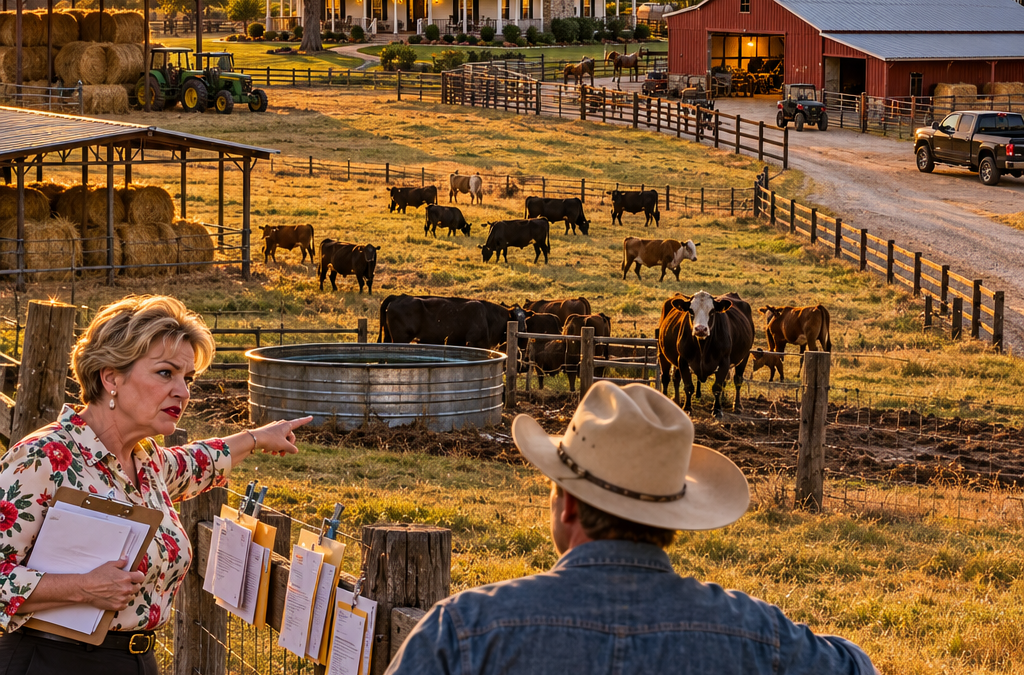
My family has owned Hargrove Ranch for three generations.
One hundred fourteen acres.
Not enormous by western standards, but large enough that there is always something broken, something growing, something hungry, or something leaning farther than it did the day before.
My grandfather bought the original acreage in 1960.
He built the main house the following year with help from two brothers, a cousin, and a retired carpenter who accepted beef in place of part of his fee.
The house still stands.
White siding.
Deep porch.
Stone chimney.
Nothing fancy.
My father added the east barn in 1987 after the old equipment shed collapsed under a wet spring snow.
When I took over full operation of the ranch twelve years ago, I added a guest cabin near the cottonwoods, replaced the second pasture fence, improved the well system, and finally put down a proper gravel drive so every delivery truck that came through didn’t sink axle-deep after a hard rain.
That’s how the place grew.
Not through grand plans.
Through need.
One generation repaired what the previous generation had built.
Then added something the next generation could use.
I knew every fence line.
Every gate.
Every low spot that held water after a storm.
Every tree that leaned toward the west pasture.
I knew which cow would come running if she heard the grain bin open and which one would make you cross half an acre pretending she couldn’t hear you.
Out there, I was Caleb.
That was enough.
Most people around me knew I worked at the county courthouse, but people in rural communities have a way of separating jobs from people.
The ranch supply clerk wasn’t “the county judge.”
The man at the diner wasn’t “Your Honor.”
I was the guy who fixed his own fence posts, drank coffee too strong, and once spent half an afternoon helping a neighbor pull a tractor out of mud.
That was exactly how I liked it.
I had served as a county judge for nine years.
Before taking the bench, I practiced property law for eleven.
Land use.
Boundary disputes.
Easements.
Title problems.
Subdivision litigation.
Annexation applications.
The kinds of disputes where people could live twenty feet apart for thirty years without speaking because one believed a fence had been built eighteen inches in the wrong direction.
I had seen grown adults spend more money fighting over access to a twelve-foot strip of gravel than the strip itself was worth.
Property law taught me something early.
Facts are quiet.
People are not.
A person can shout that land belongs to him.
A deed doesn’t care.
A board can insist that it has authority.
A recorded instrument doesn’t care.
A neighbor can tell the same story for twenty years until everyone believes it.
The filing history doesn’t care.
That lesson would eventually matter more than anything Derinda Feifer said about my ranch.
But when she first moved into Avalon Ridge, I had no reason to think about her at all.
Avalon Ridge had been built west of my property about six years earlier.
The subdivision didn’t touch the ranch directly at first.
There was an undeveloped buffer tract between their easternmost homes and my western fence.
The houses were large.
Stone facades.
Three-car garages.
Small manicured yards.
Decorative streetlights.
The kind of development where every mailbox matched and people paid extra for trees that had been planted already mature enough to look as though they’d grown there for decades.
I had no problem with it.
The developer owned the land.
People bought homes.
That was their business.
The HOA occasionally sent questions about drainage or fence lines through their management company.
We handled them professionally.
No drama.
Then Avalon Ridge absorbed a smaller adjoining subdivision.
That brought the association boundary closer to my western property line.
And it brought Derinda Feifer.
She moved into one of the newer houses with a second-story kitchen window that looked east.
Straight toward my pastures.
I later learned she’d lived there less than three months before running for HOA president.
She won by four votes.
Four.
The first time I heard her name was from my neighbor, Earl Simmons.
We were replacing a broken brace near my north pasture when Earl looked toward Avalon Ridge and said, “You’ve got trouble coming.”
I tightened a bolt.
“What kind?”
“HOA kind.”
“Worse than weather?”
“Depends on the weather.”
I laughed.
He didn’t.
“New president over there. Feifer.”
“Don’t know her.”
“She knows you.”
That made me stop.
“What does that mean?”
“Says your fence is too high.”
I looked at the split-rail fence beside us.
It had stood in roughly the same place since my father installed it.
“According to who?”
“Her.”
“That fence isn’t in Avalon Ridge.”
Earl shrugged.
“Apparently nobody told her.”
I went back to work.
That should have been the end of it.
Three days later, the first complaint arrived.
It wasn’t even sent to me directly.
The county code office forwarded it because my parcel number appeared on the filing.
COMPLAINT: FENCE HEIGHT / VISUAL OBSTRUCTION.
The allegation stated that a portion of my split-rail fence exceeded the preferred sightline standard for properties adjacent to Avalon Ridge.
Preferred sightline standard.
I called the county code officer who handled rural parcels.
His name was Mike.
He’d been there almost as long as I had worked at the courthouse.
“Mike.”
He sighed before I finished introducing myself.
“You got the fence complaint.”
“I did.”
“You can throw it away.”
“Not actionable?”
“Not even close.”
“My land isn’t in the HOA.”
“I know.”
“It’s not in the subdivision.”
“I know.”
“The fence predates half those houses.”
“I know, Caleb.”
I leaned back in my chair.
“Then why send it?”
“Procedure. If someone files against a parcel, we document and forward.”
“Who filed it?”
He already knew I knew.
“Derinda Feifer.”
I thanked him and put the paper in a desk drawer.
Complaint number one.
I didn’t answer Derinda.
That was deliberate.
If there had been an actual concern—loose livestock, drainage crossing a property line, fence damage—I would have walked over, knocked on a door, and talked.
But arguing about an HOA sightline rule that had no jurisdiction over my ranch seemed like a waste of everyone’s time.
Apparently my silence encouraged her.
The second complaint came eleven days later.
BARN COLOR / EXCESSIVE VISUAL IMPACT.
That one actually made me laugh.
My east barn is red.
Not bright candy red.
Barn red.
The sort of color barns have been painted since somebody realized iron oxide helped preserve wood.
According to Derinda, the barn presented what she called a “visually aggressive contrast” against Avalon Ridge’s architectural palette.
I read that phrase twice.
Visually aggressive.
The barn had been red since 1987.
Avalon Ridge hadn’t existed then.
Derinda probably hadn’t even been thinking about moving to the county when my father painted it.
I put the complaint behind the first one.
Then came the third.
Livestock visibility.
The fourth.
Agricultural odor.
The fifth.
Dust generated from my gravel driveway.
The sixth.
Exterior lighting.
I had one yard light outside the equipment building.
It turned off automatically at ten.
Derinda’s complaint claimed illumination after nine p.m. disrupted residential enjoyment.
The seventh concerned cattle noise.
Apparently one of my cows had committed the grave offense of making cow sounds.
By complaint number eight, I bought a folder.
Plain brown accordion folder.
Nothing dramatic.
I wrote FEIFER / AVALON RIDGE across the tab.
Every new complaint went inside.
Stamped.
Dated.
Filed.
I still didn’t call Derinda.
Then she began showing up at county code meetings.
Not court.
Administrative meetings.
She brought photographs.
Maps.
Printed HOA guidelines.
She argued that my ranch was negatively affecting surrounding property values.
The county staff explained repeatedly that my property was zoned agricultural and sat outside Avalon Ridge jurisdiction.
Three hundred feet outside it at the closest point.
That fact did not seem to interest her.
Complaint number twelve concerned the appearance of my cattle feeders.
Number thirteen alleged excessive equipment visibility.
Fourteen involved a utility trailer parked near the barn.
At number fifteen, I called my attorney.
That probably sounds strange.
A property lawyer hiring a property lawyer.
A judge hiring one sounds stranger.
But anyone who understands the system knows why.
The fastest way to make a bad situation worse is to represent yourself when you have a personal stake.
My attorney was Rachel Donnelly.
She had practiced land-use law for nearly twenty years.
Sharp.
Patient.
Almost impossible to provoke.
I brought her the folder.
She flipped through the complaints slowly.
“Fifteen?”
“So far.”
“How many actionable?”
“Zero.”
She looked up.
“Why is she doing this?”
“You’d have to ask her.”
“Have you?”
“No.”
Rachel tapped the folder.
“Good.”
“Good?”
“You’re a sitting judge. The less direct conflict, the better.”
“I know.”
“Does she know what you do?”
“I have no idea.”
“You haven’t told her?”
“No reason to.”
Rachel smiled faintly.
“Let’s keep it that way.”
Not because we were setting some trap.
Because my position was irrelevant to whether Derinda’s complaints had merit.
My ranch either violated the law or it didn’t.
My job shouldn’t change that answer.
Rachel sent a short letter to the county code office requesting copies of all filings involving my parcel and asking that future notices go through her office.
She also confirmed in writing that Hargrove Ranch was outside Avalon Ridge’s recorded jurisdiction.
That was all.
No threat.
No accusation.
No mention of harassment.
Yet.
The complaints continued.
Number sixteen alleged a manure pile was visible from a community walking path.
It was compost.
Number seventeen complained about temporary hay storage.
Number eighteen alleged runoff from my north pasture entered association land.
County engineering checked.
It didn’t.
Number nineteen concerned the “industrial appearance” of my stock trailer.
Number twenty alleged commercial operations inconsistent with surrounding residential character.
It was a ranch.
Of course it was inconsistent with surrounding residential character.
The ranch had been there first.
By the third month, I started to recognize Derinda’s writing style before seeing her signature.
“Negative visual impact.”
“Community harmony.”
“Residential compatibility.”
“Corridor standards.”
“Enhanced neighborhood character.”
She wrote as if enough decorative language could turn preference into law.
One Friday afternoon, Rachel called me.
“You’re at twenty-three.”
“I know.”
“She’s escalating.”
“What’s twenty-three?”
“Hay shed.”
I closed my eyes.
“What about it?”
“Shadow.”
I thought I had misheard.
“Shadow?”
“She alleges the western side of your hay shed casts a shadow across a section of the bike path around dusk.”
I stared out my office window.
“Is sunlight now governed by Avalon Ridge?”
“Not yet.”
I laughed.
Rachel didn’t.
“Caleb, this isn’t funny anymore.”
I knew.
That was the problem.
Taken individually, every complaint looked ridiculous.
Together, they created a paper trail.
And paper trails matter.
Even false ones.
Maybe especially false ones, because someone reading a file quickly might see thirty complaints before noticing that all thirty resulted in no enforcement.
“She’s trying to create a record,” Rachel said.
“That’s my assumption.”
“For what?”
“I don’t know yet.”
We found out two weeks later.
The letter was hand-delivered to my mailbox on a Tuesday.
Cream paper.
Embossed Avalon Ridge logo.
Signed by Derinda Feifer in blue ink.
It informed adjoining landowners that the Avalon Ridge Homeowners Association intended to pursue formal annexation of three adjacent parcels north and west of the existing development.
One of those parcels shared a fence line with my northern pasture.
The expansion would bring, in Derinda’s words, “enhanced community standards and coordinated development oversight to the entire corridor.”
I stood beside my mailbox reading that sentence.
Then I looked across the pasture.
My cattle were grazing near the far fence.
The east barn sat behind them.
The same barn Derinda had called visually aggressive.
Suddenly the complaints made sense.
She wasn’t merely annoyed by the ranch.
She was preparing for expansion.
Avalon Ridge wanted to grow.
To annex adjoining residential parcels, the association needed local approval.
Part of that process required review of adjacent land-use conflicts.
And Derinda had spent four months manufacturing what she apparently believed would look like a record of trouble originating from my property.
Thirty complaints.
Thirty attempts to frame me as the problem next door.
I folded the letter carefully.
Put it on top of the folder.
Then drove to the courthouse.
Because that was where I worked.
The annexation application wasn’t on my desk yet.
It would be.
Our county’s land-use structure is unusual.
Major residential expansion and certain annexation petitions pass through a judicially supervised review process before final administrative approval.
The reviewing judge verifies legal descriptions, notice requirements, adjacent property conflicts, recorded easements, and procedural history before the matter proceeds to the full permit board.
For nine years, that docket had been part of my assignment.
Not every permit.
Not every shed.
Not every building project.
But major subdivision expansion?
Yes.
HOA annexation affecting adjoining parcels?
Absolutely.
When I saw Derinda’s letter, I understood immediately what would happen once Avalon Ridge filed.
And I understood something else.
I could not review it.
The moment an application involving my own adjacent land appeared, I would have a direct personal interest.
Ethically, legally, professionally, recusal wasn’t optional.
I told my clerk that afternoon.
“If Avalon Ridge files annexation papers, flag them immediately.”
She looked at me.
“Because of the ranch?”
“Yes.”
“Need reassignment?”
“Eventually. First I need to disclose.”
That was the proper process.
Nothing secret.
Nothing clever.
No revenge.
I had spent my career watching people destroy otherwise legitimate cases by trying to manipulate procedure.
I wasn’t going to become one of them because an HOA president annoyed me.
Still, I was human.
And when complaint number twenty-four arrived two days later, I admit I looked at the folder differently.
Derinda thought she was building leverage.
She didn’t understand that every complaint became part of the same official record her own annexation application would eventually rely on.
By the end of month four, there were thirty.
Thirty filings.
Not thirty letters to me.
Thirty formal complaints submitted to county offices.
Every one tied to my parcel number.
Every one naming Hargrove Ranch.
Every one reviewed.
Every one found non-actionable or unsupported.
Rachel created a chart.
Date.
Complaint.
County response.
Disposition.
- Fence height. No jurisdictional violation.
- Barn color. No county violation.
- Livestock visibility. Lawful agricultural use.
- Odor. No actionable code breach.
- Gravel dust. No violation.
And on.
Thirty lines.
Zero sustained findings.
Rachel slid the chart across her desk.
“This is becoming useful.”
“I know.”
“Do you?”
I looked at her.
She tapped the final column.
“She thinks this shows thirty problems.”
“It shows thirty rejected allegations.”
“More than that.”
“What?”
“It shows persistence after notice.”
That mattered.
After the first few complaints, Derinda could plausibly say she misunderstood the boundary.
After ten, she had been told.
After fifteen, she had received correspondence through counsel.
After twenty, county staff had explained repeatedly that the cited HOA standards didn’t control my parcel.
Yet she continued.
At some point, mistake becomes pattern.
Six weeks after the annexation notice, Avalon Ridge formally filed.
I didn’t touch the application.
My clerk received it, logged it, and notified me.
The HOA’s attorney was Fletcher Grouse.
I knew the name, but not personally.
He practiced municipal and association law in the next county.
Professional reputation.
Competent.
Two days after filing, Fletcher called the courthouse asking for status.
My clerk answered.
She later told me exactly how the conversation went.
“I’m calling regarding the Avalon Ridge annexation petition.”
“Yes, sir. It’s been received.”
“Has a reviewing judge been assigned?”
She looked at the docket.
At that stage, technically yes.
My name was still attached until formal recusal occurred at the review session.
“Judge Hargrove is the assigned land-use judge.”
Long pause.
“Hargrove?”
“Yes.”
“Caleb Hargrove?”
“Yes, sir.”
Another pause.
Then Fletcher said, “Thank you.”
He hung up.
The next morning, he called back.
This time he asked for me.
My clerk came into chambers.
“Fletcher Grouse wants to speak with you.”
“About Avalon Ridge?”
“Yes.”
I considered refusing.
Then decided a short procedural call was appropriate.
I picked up.
“Judge Hargrove.”
“Your Honor, Fletcher Grouse.”
“Good morning.”
“I represent Avalon Ridge Homeowners Association.”
“I understand.”
There was a hesitation.
He had figured it out.
“You own the Hargrove property adjacent to the proposed annexation area.”
“I do.”
“I wasn’t aware of that when the application was filed.”
“All ownership records are public.”
“Of course.”
Silence.
He was choosing words carefully.
“So how will the application be handled?”
“According to normal procedure.”
“Will you be reviewing it?”
“I will address any required disclosure and recusal on the record.”
Another silence.
“Understood.”
I continued.
“All relevant filed materials will remain part of the public administrative record, including complaint history involving adjacent parcels.”
That sentence landed exactly where I expected.
Not as a threat.
As notice.
Fletcher said, “The complaint history.”
“Yes.”
“I believe some of those matters may have been informal.”
“If they were formally filed, they’ll appear as formally filed. If they weren’t, they won’t.”
“I see.”
“Anything else?”
“No, Your Honor.”
“Have a good day, Mr. Grouse.”
“You too.”
He did not sound like a man having a good day.
Later that afternoon, Rachel called.
“I just got an email from Fletcher.”
“About?”
“He wants to know whether your office intends to characterize Derinda’s complaints as evidence against the HOA.”
“My office won’t characterize anything.”
“I know.”
“Did you tell him that?”
“Yes.”
“What did he say?”
“Nothing yet.”
I leaned back.
“He’s nervous.”
“He should be.”
Three weeks later, the public review session was scheduled.
Those sessions are formal but not theatrical.
Long conference room.
Raised dais at one end.
Applicant tables facing the panel.
County staff along one wall.
Interested landowners and residents seated behind.
Applications are presented.
Legal descriptions verified.
Questions asked.
Comments entered.
Nothing like television court.
Usually boring.
That morning, I arrived early.
My disclosure statement was already prepared.
Judge Anita Fell had agreed to take the case after my recusal.
Anita had served on the bench eleven years.
Exacting.
Fair.
Not easily impressed.
Most importantly, she had no connection to me beyond being a colleague.
I told her only what ethics rules required.
“I own the adjacent parcel identified in the application. There is an existing complaint history between the HOA president and my property.”
She nodded.
“Records in the file?”
“Yes.”
“You’ve reached no conclusions?”
“None.”
“Good.”
That was it.
At nine, the room filled.
I was reviewing another file when I heard voices near the entrance.
Then silence.
Not total silence.
A shift.
I looked up.
Derinda Feifer had walked in carrying a thick binder.
Color-coded tabs protruded from the top.
Fletcher walked beside her.
Two HOA board members followed.
Derinda saw me.
She stopped.
I’ve seen many expressions in courtrooms.
Anger.
Fear.
Shock.
Grief.
Arrogance.
False confidence.
The look on Derinda’s face was a combination of disbelief and sudden calculation.
Her eyes moved from me to the nameplate in front of my seat.
HON. CALEB HARGROVE.
Then back to me.
The binder in her hands lowered slowly.
Fletcher leaned toward her and whispered.
I couldn’t hear him.
Whatever he said drained more color from her face.
For four months, Derinda had treated me as a rancher who didn’t understand procedure.
A man with cattle.
An old barn.
A gravel driveway.
A split-rail fence.
Apparently she had never once typed my name into a search bar.
Never asked a county employee who I was.
Never asked Fletcher.
Never asked anyone.
She had been so certain she understood the person she was targeting that curiosity seemed unnecessary.
I called the session to order.
Standard introduction.
Case number.
Applicant.
Nature of request.
Then I addressed the issue immediately.
“Before this matter proceeds, I need to disclose a direct personal interest.”
Derinda stared at me.
“I am the owner of Hargrove Ranch, the parcel identified in the application materials as an adjacent landholding along the proposed annexation corridor.”
Murmurs moved through the room.
I continued.
“Because the application may materially affect property adjacent to land I own, and because filings concerning that property appear in the administrative record, I cannot participate in substantive review.”
Derinda’s shoulders shifted.
Relief.
I saw it.
Probably she thought recusal meant the problem disappeared.
“I therefore recuse myself from this application in full.”
I signed the order.
“Judge Anita Fell will preside.”
Anita moved to the center seat.
I gathered my papers.
Before leaving, I added:
“All documents properly filed prior to reassignment remain part of the public record and will be considered or disregarded according to their relevance under normal procedure.”
Then I walked out.
That’s it.
No speech.
No look at Derinda.
No dramatic warning.
I spent the next two hours in chambers working unrelated cases.
I did not watch the review.
I did not call Anita.
I did not ask staff for updates.
Judicial recusal means something.
It is not ceremonial.
You don’t step away publicly and then influence the process privately.
Around noon, Rachel texted me.
One sentence.
You should see the public record when you’re allowed.
I didn’t respond.
Later, after the session concluded and the clerk confirmed the record was public, I reviewed what had happened like any member of the public could.
Avalon Ridge presented its annexation plan.
Infrastructure.
Tax impact.
Maintenance.
Community services.
Property-owner consent from the three parcels involved.
Then came the adjacent conflict section.
Derinda’s binder apparently included several of her own complaints against my ranch.
That decision turned out to be disastrous.
Fletcher had likely realized the danger by then, because the transcript showed he tried to characterize the complaints as evidence of ongoing land-use incompatibility requiring coordinated standards.
Judge Fell asked a simple question.
“How many of these complaints resulted in a finding of violation?”
Fletcher answered.
“None.”
“Any enforcement order?”
“No.”
“Any citation sustained against Hargrove Ranch?”
“No.”
“Any county finding that the ranch is operating outside its zoning?”
“No.”
Then Anita asked:
“Why are thirty unsupported complaints being offered as evidence of wrongdoing by the adjacent landowner?”
According to the transcript, Fletcher requested a moment to confer with his client.
Derinda eventually spoke.
She argued that the volume of complaints demonstrated persistent neighborhood concerns.
Anita asked who had filed them.
Derinda admitted she had filed the majority personally in her capacity as HOA president.
“How many?”
“Thirty.”
“All thirty?”
“Yes.”
“Over what period?”
“Approximately four months.”
“And after the county advised you that the ranch was outside HOA jurisdiction?”
Derinda hesitated.
“I believed broader community impact remained relevant.”
Anita asked whether any county officer had told her the ranch violated law.
“No.”
Whether any agricultural-use citation had been issued.
“No.”
Whether Hargrove Ranch had a complaint history before Avalon Ridge’s recent expansion.
County staff answered.
No material history.
That was the moment the record changed character.
Derinda had tried to create evidence that I was a problematic adjacent owner.
Instead, she had documented herself filing thirty unsuccessful complaints against a property that had no meaningful prior code history.
The board members sitting beside her apparently began distancing themselves.
One testified that he had not known Derinda filed all thirty.
Another said the full board had never voted to authorize most of them.
That mattered even more.
The annexation application was not denied that same hour.
Government rarely works that dramatically.
The review panel requested additional materials.
HOA meeting minutes.
Complaint authorization records.
Correspondence with county departments.
Evidence supporting claims of adjacent conflict.
Fletcher was given time to supplement.
For the next two weeks, more documents came in.
They didn’t help.
Several complaints had been filed under Derinda’s presidential authority without recorded board discussion.
County responses repeatedly told her my ranch was lawful agricultural property.
In one email, a code officer wrote explicitly:
Avalon Ridge private aesthetic standards do not govern Hargrove Ranch.
That email had been sent after complaint number nine.
Derinda filed twenty-one more after receiving it.
Another email warned that further repetitive complaints without new evidence could be treated as duplicative.
She kept filing.
The pattern was no longer subtle.
Rachel called me one evening.
“You know the worst part?”
“What?”
“She didn’t need any of this.”
“What do you mean?”
“The annexation parcels themselves might have had a viable application.”
I knew that.
“She could have filed a clean application and addressed the ranch honestly.”
“Exactly.”
“Instead she tried to manufacture conflict.”
“And documented herself doing it.”
Paperwork cuts both ways.
That’s something I used to tell young lawyers.
A document does not belong emotionally to the person who creates it.
Once filed, it becomes evidence.
It can support you.
Or destroy your theory.
Three weeks after the review session, Judge Fell and the panel issued the written decision.
I did not see a draft.
I had no role.
The application was denied.
Not because I owned the ranch.
Not because I was a judge.
Not because Derinda had insulted my barn.
The decision cited unresolved adjacent-landowner conflict, deficiencies in the applicant’s presentation of that conflict, and a complaint history raising substantial concerns about whether the HOA’s stated land-use concerns were supported by objective violations or reflected a pattern of targeted administrative filings.
The order also noted inconsistencies between the board’s recorded authorizations and the complaints filed under the association’s name.
It was careful.
Measured.
Exactly how such an order should be.
No accusation of malice.
No dramatic language.
Just facts.
Avalon Ridge could reapply later after addressing deficiencies.
But the expansion Derinda had promised residents was dead for the foreseeable future.
I read the decision once.
Then closed the file.
I expected satisfaction.
There was some.
I’d be lying if I said otherwise.
For four months, that woman had tried to turn my family’s ranch into evidence against itself.
She had called cattle an eyesore.
My father’s barn visually aggressive.
My driveway a nuisance.
My hay shed’s shadow a community impact.
Thirty times she had tried to make preference look like law.
Now the same filings sat in a public order explaining why the HOA’s credibility had collapsed.
But underneath the satisfaction was something else.
Relief.
Because the system had worked without me twisting it.
I had done the one thing Derinda probably never expected.
I stepped out of the way.
That mattered to me more than winning.
Eleven days later, Derinda resigned as HOA president.
I heard about it from Earl.
He drove into the ranch one Saturday while I was repairing a water trough.
He climbed out of his truck smiling.
“You hear?”
“What?”
“Your friend quit.”
I kept tightening the fitting.
“Who?”
“Don’t do that.”
“Do what?”
“Act like you don’t know.”
I looked up.
“Derinda?”
“Resigned last night.”
I went back to the wrench.
“Good for her.”
Earl laughed.
“That’s all you’ve got?”
“What do you want?”
“Maybe fireworks.”
“I’ve got cattle.”
“Same smell.”
I threw a rag at him.
Later, Rachel sent me the public notice.
Derinda’s resignation cited personal obligations and the need for “fresh leadership.”
No mention of the annexation denial.
No mention of the complaints.
No mention of me.
Again, I didn’t need one.
Avalon Ridge residents began asking questions.
How much had the failed annexation cost?
Who authorized legal expenses?
Why had Derinda filed complaints under the HOA’s name without full board votes?
Why did nobody investigate whether the ranch was actually governed by community standards before spending months attacking it?
Three board members called for an internal review.
Fletcher advised them to preserve records.
The association did not collapse.
I didn’t want it to.
Most HOAs aren’t villains.
They are organizations.
Good or bad depending largely on who runs them and whether homeowners pay attention.
Avalon Ridge elected a new president named Robert Kim.
He called Rachel before contacting me.
Smart man.
He requested a meeting at the ranch.
Rachel came too.
Robert arrived without a binder.
That was the first promising sign.
We sat on my porch.
He looked across the pasture for a while.
Then said, “It’s quieter than I expected.”
I smiled.
“What were you expecting?”
“I don’t know.”
“Visually aggressive cows?”
His face went red.
Then he laughed.
“Fair.”
He apologized on behalf of the association.
Not for every resident.
Not for things he hadn’t done.
For the organization’s conduct.
That distinction impressed me.
“We’re withdrawing any remaining HOA-originated complaints,” he said.
“County already closed them.”
“I know. We also adopted a policy requiring board approval before complaints are filed in the association’s name against property outside our boundaries.”
“That seems sensible.”
“It should have been obvious.”
“Most good rules are.”
He looked toward the east barn.
“Is that the aggressive one?”
“That’s her.”
He laughed again.
The red barn stood exactly where it had stood since 1987.
Nothing about it had changed.
Only the person looking at it.
Robert and I eventually developed a decent working relationship.
Avalon Ridge maintained its side of the boundary.
I maintained mine.
When drainage work near the bike path required temporary access, they asked.
I agreed.
When one of my cattle got through a damaged section of fence and wandered near the subdivision trail, Robert called me rather than filing something.
I drove over.
We got her back.
Handshake.
Honesty.
Problem solved.
The way neighbors had solved things around there for generations.
Derinda remained in Avalon Ridge for four more months.
I saw her once during that time.
I was picking up supplies at a hardware store.
She stood in the garden section comparing bags of soil.
We noticed each other at roughly the same moment.
For a second, I considered walking away.
Instead, I nodded.
“Mrs. Feifer.”
“Judge Hargrove.”
That was the first time she’d called me that.
I didn’t like it.
“Caleb is fine.”
She looked surprised.
Then her expression tightened.
“I suppose you’re pleased.”
“About what?”
“The annexation.”
“No.”
She gave me a look that said she didn’t believe me.
“You expect me to believe that?”
“I didn’t want your HOA expanded toward my ranch.”
“Exactly.”
“That isn’t the same as wanting you humiliated.”
Her eyes hardened.
“You made me look like a criminal.”
“No.”
“You sat there knowing what those complaints would do.”
“I recused myself.”
“You knew.”
“I knew they were in the file.”
“And you let them stay.”
That almost made me angry.
Almost.
“They were your complaints.”
She said nothing.
“You filed them.”
“I filed legitimate concerns.”
“Thirty.”
“Your ranch impacts nearby residents.”
“Then one complaint with evidence would have been enough.”
She folded her arms.
“You don’t understand what it’s like to protect property values.”
I stared at her.
“I practiced property law for eleven years.”
That silenced her.
Then I said:
“Derinda, you keep talking like the paperwork betrayed you.”
Her face shifted.
“It didn’t.”
I pointed gently toward her.
“You created it.”
She looked away.
For a few seconds, neither of us spoke.
Customers moved around us.
Cart wheels rattled across concrete.
Somebody loaded mulch nearby.
Finally she said:
“I didn’t know you were the judge.”
There it was.
Not an apology.
But the truth beneath everything.
I considered my answer carefully.
“It shouldn’t have mattered.”
She looked back at me.
“What?”
“Whether I was a judge.”
“You know that’s not what I meant.”
“I think it is.”
I stepped closer, lowering my voice.
“If I had been only a rancher, would thirty baseless complaints have been okay?”
She didn’t answer.
“If I had fixed fences for a living?”
Silence.
“If I drove a school bus?”
Nothing.
“If I was seventy-five and didn’t know how to hire a lawyer?”
Her face changed.
That was the question.
Because authority should not depend on accidentally targeting someone who knows how to resist.
People sometimes tell stories like mine as though the satisfying part is hidden power.
The HOA woman thought she was bullying a rancher.
Surprise—he’s a judge.
But I don’t see it that way.
The disturbing part is what might have happened if I hadn’t understood the system.
Maybe another landowner would have spent thousands defending routine agricultural activity.
Maybe someone would have gotten scared by official envelopes.
Maybe he would have changed legal operations simply to stop the complaints.
Maybe a retiree would have looked at thirty filings and assumed where there was smoke there had to be fire.
That’s what bothered me.
I looked at Derinda.
“My job didn’t make your complaints wrong.”
She swallowed.
“They were wrong already.”
For the first time since I’d known her name, she had no answer.
I picked up the box of fence hardware I’d come for.
“Take care, Derinda.”
She gave a small nod.
“You too.”
Four months later, her house went on the market.
I heard she moved to a newer development across the county.
No agricultural land bordering it.
No barns.
No cattle.
No split-rail fences.
I genuinely hope she found what she wanted.
Not because I’m generous enough to forget everything.
Because life gets easier when people choose places that fit them instead of trying to remake everything already there.
The ranch remained unchanged.
That was the part I valued most.
The cattle kept grazing.
The east barn stayed red.
My gravel driveway remained gravel.
The hay shed still cast a shadow across part of the bike path at sunset during certain months.
The sun never received a violation notice.
My folder stayed in the bottom drawer of my desk at home.
Thirty complaints.
Rachel asked once why I kept them.
“Case file?”
“No.”
“Evidence?”
“Not anymore.”
“Then why?”
I thought about it.
“Reminder.”
“Of her?”
“No.”
“Of what?”
“Paperwork.”
Rachel smiled.
“Very judicial.”
But that wasn’t exactly what I meant.
For years, I had watched people treat documents as weapons.
Threat letters.
Complaints.
Notices.
Filings.
They believed that creating more paper made their version of events stronger.
Sometimes it did.
But documentation has a stubborn quality.
It preserves details the author later wishes everyone would forget.
Dates.
Frequency.
Language.
Contradictions.
Notice.
Knowledge.
By complaint number one, Derinda could say she didn’t understand my property’s status.
By complaint number nine, she had been told in writing.
By complaint number thirty, the record showed she understood and continued anyway.
She didn’t need an enemy to expose that.
She documented it herself.
That lesson followed me back into court.
Not because I compared every litigant to Derinda.
Because the experience reminded me how it feels to be on the other side of official paperwork.
Judges see files.
People live them.
A complaint may be six pages to me.
To the person receiving it, it may mean a sleepless night.
A citation may be routine on a docket.
At someone’s kitchen table, it can feel like an accusation against everything he has built.
That changed the way I read certain cases.
I became more careful about volume.
Thirty complaints are not automatically more truthful than one.
Ten accusations do not outweigh one clean record simply because ten takes longer to read.
Patterns matter.
But so does who created them.
My grandfather would have found the whole situation ridiculous.
He distrusted paperwork.
Not law.
Paperwork.
When I was a kid, I once watched him argue with an insurance company because they had misspelled Hargrove.
“They’ve got your money,” my father told him. “Why do you care about one letter?”
Grandpa said, “Because if they can’t get my name right, I don’t trust what comes after it.”
That was him.
He built the house without architectural committees.
He repaired his own equipment.
He believed most problems could be solved face-to-face.
Sometimes I wonder what he would have done if someone told him his barn was visually aggressive.
Probably laugh.
Then ask if they wanted to help paint it.
My father would have been less patient.
He spent forty years protecting that ranch from drought, debt, bad markets, and one wildfire that came within half a mile of the north pasture.
The idea that an HOA formed decades later could decide his barn offended its visual character would have made him furious.
I was glad neither man had to deal with it.
That responsibility landed with me.
And maybe that’s what inheritance really is.
Not land.
Not buildings.
Not cattle.
Problems.
Each generation receives a place along with whatever threatens it at the time.
Grandpa’s challenge was paying for it.
Dad’s was keeping it profitable.
Mine, apparently, was explaining to a homeowners association that their aesthetic preferences ended at my fence.
A year after the annexation denial, Avalon Ridge invited adjacent landowners to an open meeting about a revised long-term development plan.
Robert sent me a formal invitation.
I went.
Not because I needed to.
Because I wanted to see whether anything had changed.
It had.
The presentation included a large boundary map.
Hargrove Ranch appeared clearly outside the association.
Different color.
Different zoning.
A bold line marking the separation.
One slide addressed adjacent agricultural uses.
Existing agricultural operations will be respected as lawful neighboring land uses.
I almost smiled.
During public comment, a younger resident raised his hand.
“What about smell?”
Robert looked toward me.
I shrugged.
He answered.
“We live next to a ranch.”
People laughed.
The resident looked embarrassed.
Robert added:
“If livestock operations comply with county regulations, that’s part of the area we chose to live in.”
Simple.
Honest.
No thirty-page strategy.
No complaints.
No attempt to turn cows into an HOA violation.
After the meeting, Robert caught me near the door.
“Was that acceptable?”
“What?”
“The map.”
“It’s accurate.”
“I’ll take that as praise.”
“You should.”
He grinned.
Outside, I stood for a moment looking toward the dark outline of my land beyond the subdivision lights.
Avalon Ridge wasn’t evil.
That realization mattered.
It had simply given one person too much room to confuse personal preference with institutional authority.
Then everyone else had been too busy to stop her.
Until the process forced them to look.
That’s why I don’t tell this story as revenge.
Revenge would have been me staying on the case.
Using the bench.
Making things difficult because I could.
That would have made me no better than Derinda.
The moment I saw my interest, I stepped aside.
What happened after that belonged to the record.
And the record was enough.
Years later, the folder is still in my desk.
The first complaint is slightly faded.
FENCE HEIGHT / VISUAL OBSTRUCTION.
I sometimes pull it out and look at the date.
Then complaint number thirty.
Four months apart.
Thirty attempts to establish control over land that was never hers to regulate.
That folder could make me bitter.
It doesn’t.
Mostly, it makes me cautious.
Whenever someone arrives in my courtroom with a stack of allegations, I don’t count pages.
I ask what survived scrutiny.
Whenever an attorney says there is a “long history of violations,” I ask how many resulted in findings.
Whenever one party has filed complaint after complaint against the same person, I ask when they were told their theory was wrong.
Facts.
Sequence.
Notice.
Context.
Not volume.
The ranch taught me that again.
One evening not long ago, I was fixing a section of fence near the western pasture.
The sun was low.
Avalon Ridge’s roofs caught the light beyond the trees.
A few residents were walking on the bike path.
One couple waved.
I waved back.
My cattle were gathered near the water tank.
The east barn stood behind me.
Red.
Aggressive as ever.
The hay shed cast a long shadow toward the trail.
I looked at it and laughed.
Earl, who had come over to help, asked what was funny.
“Nothing.”
“You’re staring at the shed.”
“I was thinking about complaint twenty-three.”
“Which one was that?”
“The shadow.”
He stopped working.
“No.”
“Yes.”
“She complained about a shadow?”
“Officially.”
Earl leaned against the fence post and stared toward the shed.
“Think we should shorten it?”
“The shed?”
“The shadow.”
I laughed hard enough that I had to put the drill down.
We worked until dark.
Then sat on the tailgate of my truck drinking water.
Earl looked toward Avalon Ridge.
“Quiet now.”
“Mostly.”
“You miss her?”
“No.”
“Had to ask.”
After he left, I stayed a little longer.
Coyotes started calling far to the south.
The yard light came on near the barn.
The same one Derinda had once complained remained visible after nine.
I checked my watch.
8:47.
For a second, I imagined the old version of myself seeing another county envelope in the mailbox.
Another allegation.
Another demand to defend something my family had done legally for decades.
Then the feeling passed.
The ranch was still there.
Not because I had power.
Because we had title.
History.
Lawful use.
And records.
Derinda’s authority had lasted less than a year.
My grandfather’s fence posts had lasted longer.
There is a lesson in that.
Titles sound impressive.
President.
Judge.
Attorney.
Chairman.
Director.
But titles do not change property lines.
They don’t make false complaints true.
They don’t make preferences enforceable.
And they don’t give someone the right to manufacture a record just because they expect nobody to read closely.
Derinda thought thirty complaints would bury me.
Instead, they created a timeline.
She thought the county would see a troublesome ranch.
Instead, the county saw thirty unsupported allegations filed by the same person after she had repeatedly been told she lacked jurisdiction.
She thought paperwork was pressure.
She forgot paperwork was evidence.
And when the truth finally reached the right desk, I didn’t need to sign anything against her.
I only needed to move my hands away and let someone else read what she had written.








