𝗙𝗨𝗟𝗟 𝗦𝗧𝗢𝗥𝗬 The HOA President Dumped 10,000 Fish Into My Private Pond and Claimed the Water Had Always Been Hers
𝗙𝗨𝗟𝗟 𝗦𝗧𝗢𝗥𝗬 ”
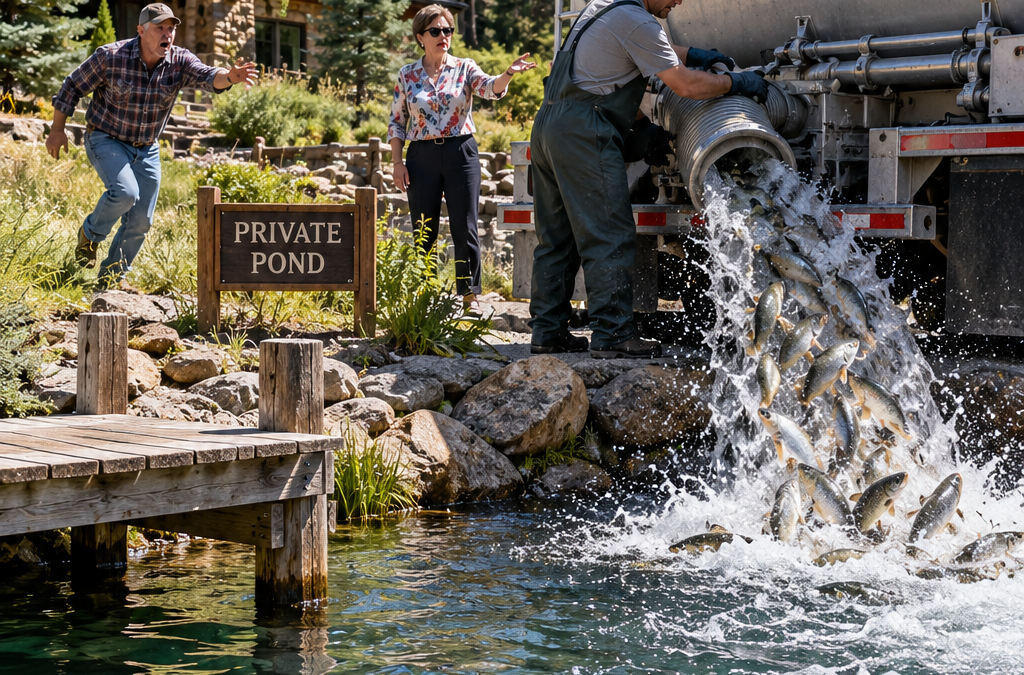
Before I reached him, he connected the hose.
Then the valve opened.
Water rushed.
Then fish.
Thousands of them.
Silver flashes poured into my pond.
The sheer quantity stunned me.
One moment the shoreline was normal.
The next it looked alive.
Fish slapped against water.
The hose jumped.
The surface churned.
I stared.
“Stop.”
The driver looked at me.
“Sir, I have to unload.”
“This is private water.”
He pointed at the clipboard again.
“Talk to whoever signed it.”
“Who signed it?”
He turned the page so I could see.
Linda Draper.
I knew the name.
Everybody in Pinerest Ridge knew Linda Draper.
She had been president of the HOA for three years.
If Pinerest Ridge had a center of gravity, Linda considered herself it.
She was polished.
Organized.
Confident.
The kind of woman who could turn a suggestion into a policy simply by speaking as if the vote had already happened.
She chaired meetings with a calm smile.
She wrote newsletters in language that made ordinary landscaping decisions sound like civic duty.
She often used the phrase community stewardship.
What it usually meant was Linda wanted something done her way.
I had kept my distance from her.
My property sat along the edge of Pinerest Ridge but was not part of the HOA’s common holdings.
My deed predated most of the development.
The pond was specifically included in my parcel.
There had never been any confusion about that.
At least not until a tanker truck arrived.
The hose continued emptying.
I watched thousands of unfamiliar fish disappear into my water.
“How many are in there?”
The driver checked something.
“About ten thousand.”
I stared at him.
“Ten thousand?”
“Approximately.”
“Who stocks ten thousand fish in a neighborhood pond?”
He shrugged again.
Apparently shrugging was his main defense.
Twenty minutes later, Linda Draper’s white SUV came down the road.
That was fast enough to tell me she already knew what was happening.
She stepped out wearing a pale jacket and trousers, dressed as though she were on her way to a luncheon.
Not a muddy shoreline.
Not a confrontation.
Linda always looked prepared for photographs.
She walked toward us.
“Daniel.”
No apology.
No confusion.
Just my name.
“Linda.”
She smiled.
“I understand there’s some concern.”
“Some concern?”
I pointed toward the hose.
“You dumped ten thousand fish into my pond.”
“Our pond.”
I stared at her.
“Excuse me?”
“Pinerest Ridge common water.”
“No.”
She gave the little patient smile I had seen at board meetings.
“Daniel, the pond has always functioned as part of the community’s environmental system.”
“That’s not the same as ownership.”
“The HOA maintains habitat obligations.”
“Not here.”
She looked toward the water.
“We have every right to stock it.”
I went inside.
Linda followed me as far as the porch.
I returned holding a copy of my deed.
I kept one in the house because of previous access questions involving shoreline maintenance.
I opened it.
Pointed.
“This pond has been titled to my property since 1994.”
Linda looked.
Her smile remained.
Her eyes didn’t.
They moved quickly.
Parcel number.
Boundary description.
Water feature.
For less than a second, I saw something.
Recognition.
Not confusion.
She knew.
That was the first moment I stopped believing the stocking was a mistake.
“We’ll let the board sort out the paperwork,” she said.
“No.”
She looked up.
“No?”
“You don’t get to trespass, change my water, then tell me a committee will decide whether I own it.”
Her tone cooled.
“This project has already been approved.”
“By who?”
“The association.”
“The association can’t approve work on land it doesn’t own.”
“Daniel, let’s not make this more complicated than necessary.”
I looked at the thousands of fish settling into my pond.
“I didn’t make it complicated.”
She turned toward her SUV.
“Someone from the board will contact you.”
“Linda.”
She stopped.
“What species are those?”
That was the first question that made her hesitate.
Barely.
“I don’t know. Appropriate stock.”
“Appropriate for what?”
“Habitat.”
“Which habitat?”
She opened the car door.
“You’ll receive information.”
Then she left.
The tanker followed twenty minutes later.
I stood beside the pond alone.
Fish moved near the shallows.
The sunlight caught their sides.
They didn’t look like bluegill.
Not bass.
Not anything I’d ever put there.
They were narrow-bodied.
Patterned.
Some had faint coloring near the throat.
And there were far too many.
Ten thousand fish is not casual stocking.
It’s a program.
A project.
An expenditure.
I knew enough from my ranger years to understand that.
Fish cost money.
Transport costs money.
Hatchery production takes planning.
Permits.
Water-quality decisions.
Species selection.
Nobody accidentally sends an entire truckload because Linda Draper checks the wrong box.
I spent the rest of the afternoon walking the shoreline.
The fish seemed healthy.
Some were disoriented.
Most began spreading.
That should have reassured me.
It didn’t.
By dinner, I couldn’t stop thinking about the number.
Ten thousand.
Where had they come from?
Why my pond?
Why had Linda already been ready with the phrase common water?
And why had she looked nervous when I asked about species?
I called Renee Callahan.
Renee and I had worked together years earlier during my ranger days.
She had stayed in conservation work longer than I had and now worked for the State Department of Natural Resources.
She knew fish.
More importantly, she knew programs.
“Daniel?”
“Renee.”
“How long has it been?”
“Long enough that I’m about to ask a strange favor.”
“Those are usually the only reason old rangers call.”
“I had ten thousand fish dumped into my pond today.”
Silence.
Then:
“You what?”
“HOA tanker.”
“Your pond?”
“Private.”
“What species?”
“No idea.”
“Send photos.”
I did.
Close-ups from the shallows.
Fish moving over gravel.
One I managed to capture briefly in a net before releasing it.
Renee called back within five minutes.
Her voice had changed.
“Daniel.”
“Yeah?”
“Don’t touch that water.”
“I wasn’t planning to.”
“No fishing.”
“Okay.”
“No moving fish.”
“Okay.”
“No treatment.”
“Renee.”
“I’m serious.”
“I can tell.”
“If those photos are what I think they are, I need to be there tomorrow.”
“What do you think they are?”
She hesitated.
“Bonaville cutthroat.”
I sat down.
“Protected?”
“Potentially.”
“Potentially how?”
“Daniel, leave them alone.”
That night, I barely slept.
I had spent years around conservation enforcement.
Protected wildlife on private property can create responsibilities depending on species, origin, permits, and how the animals arrived.
I knew enough to know I did not want to guess.
At six the next morning, I was sitting beside the pond drinking coffee when Renee’s state truck came down the road.
She climbed out wearing waders.
Nets.
Sample containers.
Clipboard.
No wasted conversation.
“Show me.”
We went to the north shallows.
She moved carefully through the water.
Caught one fish.
Lifted it.
Examined the markings.
Then became very still.
“Renee?”
She didn’t answer immediately.
She checked another.
Then a third.
Finally she turned.
“Daniel, these aren’t random hatchery fish.”
“What are they?”
“Bonaville cutthroat.”
She held one where I could see it.
“This strain is protected.”
I looked at the pond.
At flashes moving everywhere.
“All of them?”
“If the load came from where I think it came from, yes.”
“Where?”
She released the fish.
Climbed out.
“State breeding program.”
That made even less sense.
Renee removed her gloves.
“The department has been working for six years to establish a wild breeding population.”
“Where?”
“River system about forty miles from here.”
“Then why are they here?”
“That’s a very good question.”
“How expensive is a program like that?”
She looked at me.
“This one?”
“Yes.”
“Roughly six hundred thousand dollars in grant funding.”
I actually laughed.
Not because anything was funny.
“You’re telling me somebody dumped six hundred thousand dollars of conservation work into my backyard?”
“Not all of the grant is fish.”
“Obviously.”
“But this looks like the full hatchery output scheduled for release.”
I stared at the pond.
The quiet place I’d known for eleven years had suddenly become evidence.
Renee asked:
“Who ordered the delivery?”
“Linda Draper.”
She wrote the name.
“HOA president?”
“Yes.”
“Why would an HOA president have authority over a state hatchery release?”
“I was hoping you’d tell me.”
She looked toward the development.
“Has Pinerest Ridge ever received state habitat money?”
That question opened something in my memory.
Two years earlier.
An HOA meeting.
Linda standing beside a projected slide.
WELLNESS LAKE INITIATIVE.
I had nearly forgotten it.
Pinerest Ridge had proposed building a recreational pond on HOA common property.
Walking path.
Benches.
Native habitat.
Education signage.
Some kind of state partnership tied to restoration.
I remembered voting against the HOA portion of the project.
Not because I hated ponds.
Because the projected maintenance numbers looked optimistic.
The proposal passed anyway.
Then nothing happened.
No construction.
No excavators.
No wellness lake.
I assumed the project had been abandoned.
“Renee.”
“What?”
“Two years ago, Linda got approval for a wellness lake.”
Renee stopped writing.
“What kind?”
“Man-made recreation pond. Habitat component.”
“State funded?”
“Partly.”
“How much?”
“I don’t know.”
“Was it built?”
“No.”
“You’re certain?”
“I live here.”
She stared at me.
“No pond?”
“No.”
“Any restored wetland? Basin? New habitat?”
“Nothing.”
Her face tightened.
“I need the project name.”
I gave it to her.
She called the office.
While she waited, I walked the shoreline.
Thousands of protected fish moved through the water.
What had started as trespass was becoming something much darker.
Renee finished the call.
“Daniel.”
“What?”
“The grant existed.”
My stomach tightened.
“Amount?”
“Six hundred thousand.”
I looked at her.
“Same number.”
“Yes.”
“Project status?”
She didn’t answer immediately.
“Completed.”
I stared.
“Completed where?”
“That’s what we’re going to find out.”
According to the state database, the Pinerest Ridge Wellness Lake Habitat Partnership had been funded.
Construction approved.
Habitat work scheduled.
Project later certified as complete.
But there was no lake.
No new habitat.
No construction.
Renee looked back at my pond.
“The fish were the audit trigger.”
“What does that mean?”
“The grant required proof that breeding stock was released into approved habitat by the deadline.”
“When?”
“This month.”
I felt cold.
“If the fish aren’t released?”
“Compliance failure.”
“And if they’re released somewhere?”
“Paperwork can be submitted showing completion.”
“Even here?”
“Not legitimately.”
“But if nobody knows this pond is mine?”
Renee looked at me.
“Or if someone tells the inspector it’s part of the project.”
Everything clicked at once.
Linda hadn’t sent fish here by mistake.
She needed water.
Real water.
Healthy habitat.
Close to Pinerest Ridge.
My pond was deep.
Cold.
Established.
The only body of water around the development that could plausibly look like the finished version of a habitat project without anybody building anything.
“She’s using my pond.”
Renee nodded slowly.
“That’s what it looks like.”
“To fake the project.”
“Potentially.”
“Why now?”
“Inspection deadline.”
I looked toward the road Linda had driven away on.
The arrogance of it made my hands shake.
She had trespassed onto my property.
Released protected state fish.
Then immediately claimed my pond belonged to the HOA.
Not because she misunderstood the deed.
Because she needed that statement to become true.
Or at least believable.
The next morning, an HOA notice appeared taped to my front gate.
I read it standing in the road.
UNAUTHORIZED INTERFERENCE WITH HOA WILDLIFE INFRASTRUCTURE.
The phrase was so absurd I read it twice.
The notice demanded I refrain from disturbing the stocked population.
Fine.
I had no intention of disturbing them.
Then the next paragraph.
Pinerest Ridge staff required unrestricted access to the pond for inspection, maintenance, environmental monitoring, and compliance purposes.
Indefinitely.
I almost admired it.
Linda had dumped the fish into my pond.
Then used their presence to create an argument that HOA personnel needed permanent access to my land.
She wasn’t merely covering a grant problem.
She was attempting to transform her unauthorized act into an ongoing claim over the water.
I laughed.
Bitterly.
Then I called Paul Ostrander.
Paul had been a friend since my ranger days.
He was county sheriff now.
We didn’t call each other often.
That made the conversation simple.
“Paul.”
“Daniel.”
“I need you to look at something before somebody turns it into paperwork.”
“That sentence usually ruins my morning.”
“It might ruin somebody else’s.”
He arrived within an hour.
Renee returned too.
This time she carried printed records.
The three of us stood beside my pond.
Paul read the HOA notice.
Then my deed.
Then the state grant summary.
He looked at Renee.
“The project is listed as complete?”
“Yes.”
“Where’s the lake?”
Renee pointed at my pond.
“That’s the problem.”
Paul stared at the water.
“So somebody filed completion paperwork for a lake that doesn’t exist.”
“Correct.”
“And now ten thousand protected fish connected to that grant are sitting in Daniel’s private pond.”
“Correct.”
Paul looked at me.
“You ever authorize anything?”
“No.”
“Lease?”
“No.”
“Easement?”
“No.”
“HOA maintenance rights?”
“No.”
He folded the notice.
“This is ambitious.”
Renee had also pulled the project completion certificate.
The signature belonged to Gary Holt.
HOA treasurer.
I knew Gary only slightly.
Quiet man.
Accountant by profession, I thought.
He rarely spoke at meetings.
“Linda didn’t sign it,” I said.
“No,” Renee said.
“Then maybe Gary ran the project.”
Paul shook his head.
“Follow the money before you follow titles.”
Renee had already started.
Grant deposits moved into HOA-controlled accounts.
Then another account appeared.
An account Linda personally controlled.
That was enough for Paul to request a deeper review through proper channels.
By the next morning, records began showing what had happened.
More than $410,000 of the $600,000 grant had been transferred to a private LLC.
Registered address:
Linda Draper’s home.
I remember staring at the printout.
“Same address?”
Renee nodded.
“Same.”
The remaining money?
Consulting fees.
Paid to Linda’s brother-in-law.
According to the state records Renee pulled, he had no fisheries license.
No habitat restoration license.
No construction credentials connected to the project.
Paul leaned back in the chair at my kitchen table.
“This isn’t a stocking mistake.”
“No.”
“This isn’t even creative accounting.”
Renee said nothing.
Paul tapped the transfer record.
“This is grand theft from a state agency if these records are what they appear to be.”
Then he pointed toward the pond.
“And she used your land to try to bury it.”
The state compliance inspection was scheduled for Friday.
Three days away.
That deadline explained the panic.
For nearly two years, the wellness lake had existed on paper.
Grant awarded.
Project marked complete.
Money dispersed.
No pond.
No habitat.
No public questions large enough to trigger investigation.
Then the state needed proof the fish had been released.
Linda needed living fish in living water before the inspector arrived.
My pond solved everything.
If the inspector came Friday and saw thousands of healthy protected fish swimming in a cold pond beside Pinerest Ridge, what reason would there be to ask whether the pond had actually been constructed with grant money?
If Linda controlled the presentation, she could point at my water and say:
Here it is.
Project complete.
Fish thriving.
Grant successful.
By the time anybody examined property records, perhaps the audit would be closed.
Maybe she believed nobody ever would.
“How do we prove the rest before Friday?” I asked.
Renee looked at Paul.
“We don’t need to finish the entire investigation.”
Paul nodded.
“We need enough probable cause and enough preserved evidence to keep anyone from cleaning this up.”
Renee began collecting satellite imagery.
Historical views.
No construction activity on any HOA parcel during the period the lake was supposedly built.
No excavation footprint.
No new basin.
No access roads.
No dam.
Nothing.
Bank transfer logs tied the money to Linda’s LLC.
Grant files showed consulting payments.
Invoices lacked credible supporting work.
Paul began arranging the appropriate investigative contacts.
I stayed out of that part.
I had been a ranger long enough to know the difference between providing evidence and trying to run somebody else’s case.
My job was simple.
Protect my property.
Do not touch the fish.
Keep every document.
Let the state see exactly what was there.
That evening, Linda came to my gate.
Alone.
No board members.
No clipboard.
No formal notice.
She parked the SUV.
Got out.
And smiled.
Warmly.
Too warmly.
“Daniel.”
“Linda.”
“I think this has gotten unnecessarily adversarial.”
I almost laughed.
“You put ten thousand protected fish into my pond.”
“A misunderstanding.”
“You told me the pond belonged to the HOA.”
“There’s some ambiguity.”
“No, there isn’t.”
She sighed.
“Can we speak like adults?”
“We’ve been doing that.”
She stepped closer.
“I can have the board withdraw the violation notice.”
“The notice saying I’m interfering with wildlife you dumped onto my property?”
“Exactly.”
“How generous.”
Her smile disappeared.
“There’s an inspection Friday.”
“I know.”
That surprised her.
Barely.
“You know?”
“Yes.”
She recovered.
“Then you understand how important it is.”
“Very.”
“The fish are healthy.”
“So far.”
“The state simply needs to verify the habitat.”
“My habitat.”
She looked toward the pond.
“Daniel, we’re all part of the same community.”
“No.”
Her eyes narrowed.
“No?”
“You don’t get to use the word community when what you mean is my property.”
She changed tone.
Softer.
“Let’s be reasonable.”
“I am.”
“I need your cooperation.”
“How exactly?”
That was the question.
She hesitated.
Only for a second.
It was enough.
“Friday, let the inspector see the fish.”
“I plan to.”
“And don’t complicate things.”
“Define complicate.”
“Don’t get into unnecessary history.”
“What history?”
She looked irritated.
“Daniel.”
“I’m asking.”
She lowered her voice.
“Just don’t mention where the fish came from.”
There it was.
No more ambiguity.
“Why?”
“Because the state knows where they came from.”
“Then why can’t I say it?”
“You’re being difficult.”
“No. I’m giving you a chance to explain yourself.”
She looked toward the house.
Then the pond.
“Let the inspector see a healthy population and sign off.”
“And the grant?”
“It’s not your concern.”
“You put the grant in my pond.”
“No one gets hurt if you cooperate.”
That sentence made me angry in a way nothing else had.
No one gets hurt.
As though using my property to conceal hundreds of thousands of dollars was harmless.
As though Gary’s false certificate was harmless.
As though protected fish being moved into unauthorized habitat without review was harmless.
As though the state didn’t care where its money went.
As though my deed mattered only until Linda needed it not to.
I stepped closer to the gate.
“You dumped a state conservation program into my private water without permission.”
She said nothing.
“Then you fined me for interfering with it.”
Silence.
“And now you’re asking me to lie to a state inspector.”
“I’m asking you not to create a problem that doesn’t need to exist.”
“The problem exists.”
“You don’t understand what’s at stake.”
“I understand enough.”
She folded her arms.
“What are you going to do?”
“I’m going to let the inspector see everything.”
Her face hardened.
“Everything?”
“The fish.”
I paused.
“The deed.”
Her jaw tightened.
“The grant paperwork.”
She stopped breathing for a second.
“And everything Renee has already found.”
That did it.
The polished version of Linda Draper disappeared.
“You have no idea what you’re doing.”
“Maybe.”
“You could destroy the HOA.”
“I didn’t move the money.”
“You’re making assumptions.”
“Then the records will clear you.”
She stared at me.
I had spent years as a ranger dealing with people who became loud when evidence stopped cooperating.
Linda was no different.
She turned.
Walked to her SUV.
Before getting in, she said:
“You are going to regret turning this into something bigger.”
I looked at the pond.
“Linda, you brought ten thousand fish.”
She slammed the door.
Friday morning came cold and clear.
I was awake before sunrise.
The pond was almost perfectly still.
Steam hovered above the water.
Fish occasionally broke the surface.
Ten thousand pieces of evidence.
That was what they had become.
At nine, the state compliance vehicle arrived.
Renee was already there.
She had brought a second official.
Attorney General’s office.
That detail changed the atmosphere immediately.
Paul stood near the shoreline but away from the driveway.
No uniformed spectacle.
No dramatic roadblock.
Just waiting.
Linda arrived minutes later.
She looked flawless.
Dark blazer.
Folder.
Professional smile.
If you didn’t know anything, you would have thought she was there to accept an award for successful conservation work.
“Good morning,” she said.
The state inspector introduced himself.
Linda began immediately.
“We’re extremely proud of the habitat partnership.”
I almost admired her nerve.
She described community conservation.
Long-term ecological planning.
Native species restoration.
Resident education.
The inspector walked to the water.
Renee helped net several fish.
Healthy.
Active.
Good condition.
On paper, the biological result looked excellent.
Thousands of protected native trout thriving.
Linda watched the inspector.
I watched Linda.
She believed the fish would save her.
Then Renee stepped forward.
“I need to address the habitat authorization.”
Linda turned.
“We’ve already submitted that.”
Renee opened a folder.
“The approved project location does not match this parcel.”
Linda’s smile tightened.
“There were amendments.”
“No recorded amendment changes ownership of this pond.”
“Daniel has been confused about boundary documentation.”
I handed the inspector my deed.
He read.
Checked parcel data.
Asked:
“Mr. Cross, did you authorize stocking?”
“No.”
“Any agreement with Pinerest Ridge?”
“No.”
“Any state habitat agreement?”
“No.”
Linda interrupted.
“The HOA has historically treated—”
The inspector raised one hand.
“Ms. Draper, I’ll come back to you.”
Renee laid out satellite imagery.
No wellness lake.
No construction.
Then the completion certificate.
Signed by Gary Holt.
Then grant payment records.
Then the transfers.
More than $410,000.
Private LLC.
Linda’s address.
Consulting fees.
Brother-in-law.
No relevant licenses.
The inspector’s expression changed slowly.
Not shock.
Government investigators learn not to look shocked.
Attention.
That’s worse.
He turned toward Linda.
“Can you identify the constructed wellness lake funded under this grant?”
Linda pointed toward my pond.
“This habitat serves the project.”
“Was it constructed with grant funds?”
She paused.
“It was integrated.”
“That’s not what I asked.”
“We adapted the program.”
“Where is the construction documentation?”
“The HOA office maintains files.”
“Where are the excavation invoices?”
“Consultants managed that.”
“Which consultant?”
Linda looked toward Renee.
Then the inspector.
Then me.
The story was running out of places to hide.
Paul stepped forward.
“Linda Draper.”
She turned.
His voice was calm.
“You’re being detained pending investigation related to grant fraud and falsification of public records.”
Her face went blank.
“Excuse me?”
“I need you to come with me.”
“This is absurd.”
No one answered.
“I’m the HOA president.”
Again, that sentence.
As if titles created immunity.
Paul remained calm.
“Please don’t make this harder.”
Linda looked at me.
Her expression contained something I couldn’t name.
Anger.
Disbelief.
Maybe betrayal.
That almost made me laugh.
She had used my pond without permission and somehow looked at me as though I had broken an agreement.
I said nothing.
I didn’t need to.
The pond said enough.
The fish she believed would prove compliance had become the physical evidence that the project had not happened where she claimed.
Within a week, the investigation expanded.
Financial subpoenas.
HOA records.
Grant correspondence.
Bank records.
Vendor files.
Gary Holt cooperated.
He admitted he had signed the false completion certificate under pressure from Linda.
In exchange, his HOA dues had been waived.
That detail made me strangely sad.
Not because Gary was innocent.
He wasn’t.
Because corruption often looks pathetic when you finally see the price.
A man risked his name over waived dues.
Linda faced formal charges involving theft of public funds, falsification of government records, and unauthorized environmental disposal.
Her seat on the HOA board was vacated immediately.
The association hired outside counsel.
Emergency elections were scheduled.
Residents demanded financial reviews going back several years.
For the first few days, people avoided me.
Then the opposite started happening.
Neighbors came to my gate.
Some apologized.
One man said:
“I thought that pond was common property.”
“Why?”
“Linda always said it was.”
That was the whole problem.
Another resident, Helen Morris, stood beside the mailbox holding one of the old HOA newsletters.
“I’ve lived here eight years.”
She looked embarrassed.
“I never checked.”
“Most people wouldn’t.”
“We just assumed.”
“Yeah.”
“Did she really put those fish in without asking you?”
I looked toward the pond.
“You can see them.”
Helen shook her head.
“I don’t know how you stayed calm.”
Neither did I.
Not completely.
But anger would not have improved a deed.
Or bank record.
Or fish.
The investigation did something else I hadn’t expected.
The state became interested in the pond itself.
Renee returned about two weeks later.
This time, she was smiling.
That made me nervous.
“What?”
“I have something for you.”
“Another tanker?”
She laughed.
“No.”
“Good.”
“The fish are doing very well.”
“So you keep telling me.”
“Better than expected.”
“Meaning?”
“The temperature profile is good. Water quality is excellent. Spawning substrate isn’t bad either.”
I looked at her.
“Are you about to tell me I’m stuck with ten thousand protected trout?”
“Sort of.”
I sighed.
“Renee.”
“Listen.”
She handed me a proposal.
Because the protected trout had already been released and the pond had unexpectedly proven suitable, the state wanted to designate the property as a protected conservation habitat.
Voluntary.
With me as steward.
I read the first page.
Then the second.
“What does this mean legally?”
“Your ownership stays yours.”
“HOA?”
“No control.”
“Public access?”
“Not required.”
“Fishing?”
“Managed under the conservation terms.”
“State access?”
“Scheduled biological monitoring.”
“And what’s this?”
I pointed to a payment section.
“Annual stewardship stipend.”
I laughed.
“You’re paying me to take care of the fish Linda dumped here?”
“Technically, the state is compensating the landowner for habitat stewardship.”
“That’s a very government way to say yes.”
Renee smiled.
“Yes.”
Then she pointed to another section.
The conservation designation would be recorded in a way that provided additional legal protection against future claims that the HOA could control the water.
I read that twice.
“So the thing she used to try to take control of my pond—”
“May permanently strengthen your rights against HOA interference.”
I sat down.
For the first time since the tanker arrived, I laughed without anger.
Not because Linda was in trouble.
Not because of the irony.
Because the pond was safe.
That was all I had wanted from the beginning.
My water.
My land.
Left alone.
The state approved the designation.
I signed as steward.
Pinerest Ridge’s new board formally recognized the pond as private protected habitat.
Their apology arrived on HOA letterhead.
No legal evasions.
No “misunderstanding.”
It stated plainly that the prior administration had acted without authority on my property.
I appreciated that.
The new board president came to see me personally.
Her name was Elaine Porter.
She stopped at the gate instead of driving in.
That alone made a good first impression.
“Mr. Cross?”
“Daniel.”
“Elaine Porter.”
“I know.”
She held an envelope.
“Formal board apology.”
“I received the copy.”
“I wanted to bring the original.”
I took it.
She looked toward the pond.
“May I ask something?”
“Sure.”
“Are residents allowed to see the trout?”
I almost said no.
Not because I wanted to punish anyone.
Because after weeks of officials, investigators, neighbors, cameras, and paperwork, I wanted quiet.
Then I thought about the people who had nothing to do with Linda.
Children.
Families.
Neighbors who simply believed their board president.
“From the road overlook,” I said.
“No entry to the shoreline.”
“Of course.”
“No feeding.”
“Absolutely.”
“No HOA signs.”
She smiled.
“Understood.”
That was how things began becoming normal again.
People stopped occasionally at the overlook.
Parents lifted children so they could see fish moving in the clear water.
Renee helped create a small educational board placed outside my property boundary.
It explained the protected population.
No address.
No inflated tourism language.
No claim that Pinerest Ridge had created it.
Just facts.
I liked that.
Sheriff Ostrander came back one Saturday.
No uniform.
Fishing rod.
I met him at the dock.
“You know you can’t just fish protected stock without following the management rules.”
“I called Renee.”
“Of course you did.”
“She said there are other fish.”
“There are.”
“So I’m innocent.”
“Debatable.”
We sat for a while.
Paul cast.
I drank coffee.
After twenty minutes, he said:
“Funny how this worked.”
“Which part?”
“The fish.”
“What about them?”
“They almost buried you.”
I looked over.
“How?”
“If Linda had convinced everyone the pond was HOA property and got that inspection signed, you’d have inherited the mess.”
I knew that.
Protected fish.
False habitat certification.
Questions about unauthorized stocking.
Potential responsibility for maintenance.
Access claims.
Maybe investigations aimed first at the landowner.
Paul continued.
“Instead, they’re what exposed her.”
I watched the water.
“The thing she needed most became the thing she couldn’t explain.”
“Pretty much.”
A fish rose.
Paul cast toward it.
Missed.
“You’re terrible at this.”
“I’m sheriff.”
“Not relevant.”
“It usually works when I say it.”
“That sounds like Linda.”
He glared at me.
Then laughed.
Three months later, Linda’s case moved toward trial.
Restitution demands centered heavily on the more than $410,000 transferred into her LLC, along with additional financial issues tied to the grant.
Possible prison time became part of the conversation.
I did not attend every hearing.
I gave statements when required.
Produced records.
Confirmed dates.
Then went home.
I had no desire to build my life around watching Linda fall apart.
That’s not why I fought.
I fought because she tried to turn my pond into evidence for a project that didn’t exist.
That distinction mattered.
For a while, the neighborhood wanted villains and heroes.
Linda was the villain.
I was supposedly the hero.
I rejected both simplifications.
I wasn’t brave when the tanker came.
I was confused.
I wasn’t brilliant when I called Renee.
I called somebody who knew fish.
Paul did his job.
Renee did hers.
State investigators followed money.
Records existed.
Gary talked.
The fraud collapsed because too many pieces contradicted one another.
Not because I made some dramatic speech.
People underestimate how powerful contradictions are.
A six-hundred-thousand-dollar lake exists on paper.
But not on the ground.
Fish scheduled for a river appear in a private pond.
A private pond is suddenly described as HOA infrastructure.
More than $410,000 leaves the project account.
An LLC shares an address with the HOA president.
Consulting money goes to a relative without the qualifications.
A treasurer signs a completion certificate for construction nobody can locate.
Any one fact can be explained.
Together, they become a structure.
That was what destroyed Linda’s story.
Not outrage.
Pattern.
The pond changed after the designation.
Not physically, at least not dramatically.
The fish adapted.
Renee’s team monitored water quality.
State biologists visited occasionally.
I learned more about trout habitat than I ever expected to know.
I also became more protective of the shoreline.
Certain areas stayed untouched.
No fertilizer near runoff.
No unnecessary clearing.
No chemicals.
The stewardship stipend paid for some of that work.
Irony has a sense of humor.
Linda used state money to create a fake habitat project.
Her fraud accidentally created a real one.
The difference was my pond already existed.
Nature had done the construction for free.
One morning, nearly a year later, I stood on the dock before sunrise.
The water was smooth.
Cold air.
Fog.
A trout moved beneath the surface.
Then another.
For eleven years, I had come there because nothing important happened.
That was the gift of the pond.
Stillness.
Then one tanker truck turned it into the center of a criminal investigation.
For months, I hated that.
I hated the attention.
The state vehicles.
Neighbors.
Reporters who occasionally tried to call.
HOA lawyers.
People asking whether they could photograph fish.
I wanted my quiet back.
Eventually, it returned.
Not exactly the same.
But close.
Peace after conflict is different from peace before it.
Before, you take it for granted.
Afterward, you recognize it.
A truck on the road makes you look up.
An HOA envelope makes your stomach tighten for half a second.
A strange vehicle near the pond gets your attention.
Then months pass.
Nothing happens.
The nervous system learns again.
Elaine Porter, the new HOA president, never claimed the pond.
She never asked for keys.
Never demanded access.
If state officials needed to coordinate road use through Pinerest Ridge, she asked.
That word alone mattered.
Asked.
One afternoon, she stopped at the gate.
“Daniel?”
“Yeah?”
“We’re updating the community map.”
“Okay.”
“Would you mind reviewing the pond boundary before we publish it?”
I looked at her.
“Why me?”
“It’s your property.”
Simple.
That was all Linda had needed to understand.
I reviewed it.
They marked the boundary correctly.
PRIVATE CONSERVATION HABITAT — NO HOA ACCESS.
I approved it.
No argument.
No lawyers.
Five minutes.
That is how ordinary governance is supposed to work.
Sometimes I think Linda’s biggest problem wasn’t greed.
The money was serious.
The fraud was real.
But underneath it was something more basic.
She believed the HOA was whatever she said it was.
If the board needed a lake, then my pond could become their lake.
If the state needed fish, then my pond could become the release site.
If paperwork needed access, then she could invent an HOA right of entry.
If I objected, she could fine me.
Every problem was solved by expanding her authority in her own mind.
That is dangerous.
Especially in small institutions.
People think corruption requires sophisticated schemes.
Offshore accounts.
Fake corporations.
Complex contracts.
Sometimes it begins with someone learning that nobody questions the sentence:
“We have the authority.”
Linda said it confidently.
For years, people apparently accepted it.
Then she used that confidence on the wrong piece of property.
Not because I was special.
Because my deed was clear.
Because I knew the difference between community interest and ownership.
Because I called someone before touching the fish.
That’s another part I think about.
What if I had panicked?
What if I’d tried to net them out?
What if I’d treated the water?
What if I’d opened a drain or moved fish somewhere else?
Linda might have claimed I destroyed protected stock.
The state could have arrived to find evidence gone.
I might have become the first person investigators looked at.
Renee’s first instruction saved me:
Leave the water alone.
That was harder than it sounds.
Something illegal happens on your property and every instinct says fix it.
Undo it.
Remove it.
But sometimes evidence needs to remain ugly for a while.
The fish had to stay.
The paperwork had to stay.
Linda’s notice had to stay.
Her words had to stay.
People destroy their own defense by cleaning up too soon.
My ranger years taught me that.
A disturbed scene tells less truth than an untouched one.
So I waited.
Documented.
Photographed.
Called professionals.
Let them decide.
That became the story’s quiet center.
Not the arrest.
Not the money.
Restraint.
At one point during the investigation, a neighbor named Marcus Doyle came by.
He had supported Linda in two previous HOA elections.
He stood awkwardly outside the gate.
“I owe you an apology.”
“For what?”
“I voted for her.”
“So did plenty of people.”
“I defended her after the fish thing started.”
“I didn’t know that.”
“Online.”
“I stopped reading the neighborhood group years ago.”
He smiled weakly.
“Smart.”
He looked at the pond.
“She told us you were trying to claim HOA assets.”
“She dumped fish into my water.”
“I know.”
“That’s a strange asset claim.”
“Yeah.”
He looked embarrassed.
Then said:
“I trusted the title.”
“What title?”
“President.”
That stayed with me.
Trusted the title.
Titles are shortcuts.
Sheriff.
Ranger.
President.
Treasurer.
Inspector.
People assume the person holding one has earned the right to be believed.
Sometimes that’s necessary.
Society cannot function if every interaction begins with a full forensic audit.
But titles are not evidence.
Paul had a badge.
He still checked documents.
Renee worked for the state.
She still sampled fish.
The inspector had authority.
He still compared parcel maps.
Linda had a title.
She expected the title to replace all of that.
It didn’t.
Months after the state designation, Renee asked if I regretted allowing the trout to remain.
I had to think.
“No.”
“Really?”
“I regretted the way they got here.”
“Different question.”
“Exactly.”
We stood near the north bank.
Young fish had begun using shallower sections.
“Think they’ll establish?”
She smiled.
“That’s the hope.”
“A wild population.”
“Potentially.”
“So the conservation project might actually work.”
“Just not where it was funded to happen.”
“Government irony.”
“Nature doesn’t read grants.”
That line made me laugh.
No.
Nature doesn’t read grants.
Fish don’t know Linda stole money.
They don’t know Gary signed paperwork.
They don’t know the HOA claimed my pond.
They survive if the water works.
In a strange way, that was comforting.
Human systems can become corrupt.
Ecosystems remain brutally honest.
Temperature.
Oxygen.
Food.
Spawning conditions.
Either they support life or they don’t.
You cannot smile at a trout and persuade it that a fake lake exists.
Eventually, Pinerest Ridge held an annual meeting to formally close out the old administration’s issues.
I attended for the first time in years.
Not because I enjoyed HOA meetings.
Because the pond appeared on the agenda.
Elaine stood at the front.
No gavel.
No theatrical authority.
She reviewed updated financial controls.
Independent approval for grant applications.
Mandatory disclosure of related-party vendors.
No single officer could control project accounts.
Quarterly financial reporting.
External review for government funds.
Then she displayed the updated property map.
My pond clearly outside HOA ownership.
A resident raised his hand.
“Will the HOA ever have access?”
Elaine looked toward me.
I appreciated that.
She didn’t answer for my property.
I stood.
“The state may occasionally coordinate monitoring access. That’s between me and the state.”
The man nodded.
“What about residents viewing the trout?”
“Road overlook.”
“Fishing?”
“No.”
A little laughter.
“Fair enough.”
I sat.
Nobody argued.
Afterward, several people thanked me.
That made me uncomfortable.
“I didn’t recover the money.”
“No, but you called the right people.”
“I called an old colleague because I didn’t recognize fish.”
Sometimes history turns on very ordinary decisions.
That was one.
Send me photos.
Leave the water alone.
Six words from Renee.
Without them, maybe everything changes.
Linda’s case eventually became something handled mostly by lawyers.
Restitution.
Charges.
Hearings.
I followed only what concerned my property.
There is a temptation, when someone harms you, to consume yourself with their punishment.
I didn’t want that.
My pond had already taken enough of my attention away from peace.
So I returned to mornings.
Coffee.
Dock.
Fog.
I learned the trout.
They were beautiful.
I hated admitting that at first.
It felt like appreciating the evidence of trespass.
But the fish hadn’t done anything wrong.
They had been moved.
Used.
Just like my pond.
Eventually, I stopped looking at them as Linda’s fish.
They weren’t.
They belonged to the state program.
Then to the habitat.
Then, in the way wild animals belong anywhere, to themselves.
That felt better.
One late-summer morning, Paul came back with his fishing rod.
“Again?”
“I have the permit.”
He waved it.
“Renee said you’re allowed to fish designated nonprotected species.”
“I know the rules.”
“You used to arrest people for bothering fishermen.”
“I was a ranger.”
“Exactly.”
He sat at the dock edge.
After a while, he said:
“Do you realize none of this would’ve happened if Linda had just built the lake?”
“Yes.”
“Six hundred thousand dollars.”
“Apparently not enough.”
“Greed’s weird.”
I looked at him.
“It’s rarely about needing the money.”
“Control?”
“Maybe.”
“Status?”
“Maybe.”
Paul cast.
“Or people get away with one thing.”
“Then another.”
“Then eventually dumping ten thousand fish into somebody else’s pond seems reasonable.”
I laughed.
“That’s an excellent investigative summary.”
“Thank you.”
He didn’t catch anything.
I never let him forget that.
The conservation designation changed one more thing.
The pond became harder to threaten than before.
That irony still makes me smile.
Linda’s HOA notice had attempted to create a future right of entry based on “wildlife infrastructure.”
Instead, the state designation explicitly preserved my ownership and limited access under a formal stewardship agreement.
No HOA board could later claim the fish made the pond common water.
The fraud had permanently closed the argument Linda was trying to create.
The tool she used to take control had become the legal mechanism protecting me from it.
Renee called that poetic.
Paul called it funny.
I called it expensive paperwork.
But I slept better.
The old HOA notice remains in my files.
UNAUTHORIZED INTERFERENCE WITH HOA WILDLIFE INFRASTRUCTURE.
Sometimes I read that phrase and wonder how Linda believed it would survive scrutiny.
Then I remember something.
Maybe she didn’t think scrutiny would happen.
That’s often the whole strategy.
Make the language official.
Put it on letterhead.
Set a deadline.
Most people comply before anyone checks whether the authority exists.
I had seen the same tactic as a ranger.
Signs.
Claims.
Warnings.
People obey because the cost of questioning feels higher than the cost of surrender.
Linda counted on that.
She underestimated how attached I was to the pond.
More importantly, she underestimated how well I knew what legitimate conservation paperwork looks like.
State projects leave trails.
Permits.
Species plans.
Habitat approvals.
Release sites.
Monitoring.
You don’t move ten thousand protected fish into random private water and call it a Tuesday.
The scale itself exposed her.
That’s another lesson.
Fraud gets unstable as it grows.
One lie can fit inside a conversation.
A six-hundred-thousand-dollar lie needs invoices.
Accounts.
Certifications.
Fish.
Inspection sites.
Partners.
Signatures.
Relatives.
Every new piece becomes another place the story can contradict itself.
Linda eventually had too many moving parts.
The pond was simply where they collided.
I was standing there when the tanker arrived.
Wrong person.
Wrong deed.
Wrong water.
A year after everything, the state placed a small marker near my gate.
Not on the pond.
At the boundary.
PROTECTED HABITAT
PRIVATE PROPERTY
AUTHORIZED ACCESS ONLY
I stood looking at it longer than necessary.
Eleven years earlier, when I bought the place, I had worried that nearby development would eventually make privacy impossible.
Then Linda nearly did exactly that.
Now an official state marker reinforced the boundary.
I ran my hand over the post.
Not because I love signs.
Because this one told the truth.
Elaine drove by later.
Stopped.
“Looks official.”
“It is.”
“No HOA logo.”
“That’s my favorite part.”
She laughed.
Relations with the neighborhood became normal.
Not friendly with everyone.
Normal is underrated.
People waved.
I waved.
Nobody claimed the pond.
Nobody sent staff.
Nobody issued notices.
When the state monitoring team arrived, they called first.
When they needed shoreline access, they scheduled it.
Permission.
A concept Linda had skipped entirely.
Sometimes I imagine the alternate version of the story.
Linda’s plan works.
The fish arrive.
I assume the HOA has some obscure right.
I grumble but do nothing.
Friday comes.
Inspector sees healthy protected fish.
Linda produces paperwork.
The project closes.
Grant audit passes.
Money remains gone.
My pond slowly becomes treated as community habitat.
HOA staff enter.
Signs appear.
Residents assume access.
Years later, I try to sell.
Title questions arise.
Who controls the protected habitat?
Who has maintenance rights?
What agreement did Daniel sign?
Maybe someone finds the old notice and treats my silence as consent.
One act of trespass becomes an institutional fact because nobody challenged it while it was happening.
That possibility bothered me more than the money.
Land rights erode through stories as much as documents.
People repeat something until nobody remembers the first person who said it.
Common water.
HOA wildlife infrastructure.
Community habitat.
None had been true.
They could have become socially true before they became legally challenged.
That’s why I pulled out the deed on day one.
That’s why Linda’s eyes flickered.
She knew the story had met paper.
Paper is difficult that way.
I don’t worship documents.
I’ve seen bad records.
Wrong maps.
Clerical mistakes.
But a recorded deed has one advantage over confidence.
It can be checked.
Linda’s authority depended on people not checking.
The pond depended on me doing exactly that.
Three years after the tanker, the trout population remained healthy.
Some of the original fish were gone, as nature works.
Others reproduced.
The state adjusted its stewardship plan.
Renee joked that my pond had become the conservation success nobody was allowed to design.
I liked that description.
Unplanned.
Legitimate after the fact.
Protected.
One fall evening, I stood at the shoreline watching the sun disappear behind the ridge.
The water turned dark.
A trout rose near the reeds.
For a moment, I remembered Linda standing in her pale jacket saying:
This pond is HOA common water.
I had been furious.
Now the memory felt almost distant.
The pond had outlasted her presidency.
The fish had outlasted the scheme.
The records had outlasted the lies.
That is the strange advantage truth sometimes has.
It can be slower.
Much slower.
But it doesn’t have to remember what it said last time.
Linda had to keep adjusting.
First the pond was common water.
Then habitat infrastructure.
Then a misunderstanding.
Then something I shouldn’t complicate.
Then a project I was supposed to help an inspector approve.
Every explanation required the previous one to disappear.
The deed never changed.
My answer never changed.
It’s my pond.
You didn’t have permission.
Where did the money go?
Those questions were enough.
I never needed a better speech.
Pinerest Ridge eventually stopped being known for the scandal.
Communities survive embarrassing leaders.
New residents moved in who had never met Linda.
Kids grew older.
Houses sold.
Elaine eventually stepped down.
Another board took over.
Before leaving, she gave the new president a binder.
One tab was labeled:
CROSS POND — PRIVATE.
I laughed when she told me.
“Really?”
“Really.”
“How thick?”
“Three pages.”
“What are they?”
“Boundary map, state habitat agreement summary, instruction not to touch it.”
“Best HOA policy I’ve ever heard.”
She smiled.
“Sometimes governance improves through trauma.”
“That’s depressing.”
“Still true.”
When I look back, the part that stays with me isn’t Linda being detained.
It isn’t the $410,000 transfer.
It isn’t the false certificate.
It isn’t even the ten thousand fish.
It’s the moment I showed her my deed.
“This pond has been titled to my property since 1994.”
She looked at it.
And her eyes changed.
She knew.
Everything that followed came from her deciding the truth was inconvenient enough to ignore.
That’s the real beginning.
Not the tanker.
Not the grant.
The decision.
Facts versus need.
Linda needed my pond to belong to the HOA.
Therefore, she behaved as though it did.
She needed the wellness lake to exist.
Therefore, paperwork said it existed.
She needed grant money to disappear without consequence.
Therefore, transfers were disguised.
She needed fish in approved habitat.
Therefore, my habitat became approved in her mind.
She needed me quiet.
Therefore, she fined me.
Every step replaced reality with necessity.
That works until somebody refuses the replacement.
I refused.
Not dramatically.
I called Renee.
Then Paul.
Then I waited.
Sometimes that is what standing your ground looks like.
No shouting.
No gate confrontation.
No revenge.
Just refusing to sign the lie.
The state stewardship agreement sits in my safe now beside the deed.
The annual stipend isn’t enormous.
Enough for shoreline maintenance.
Water testing.
Habitat work.
I use every dollar for the pond.
I keep receipts.
Renee once laughed at how organized the file is.
“I’ve learned things.”
“From Linda?”
“Mostly what not to do.”
“Still learning.”
Fair.
I don’t know whether Linda ever understood the irony.
The pond she tried to seize became more legally protected against her HOA than it had ever been before.
The fish she used as camouflage became evidence.
The grant inspection she hoped would close the books opened them.
The $600,000 project that existed only on paper ultimately created a real habitat where no one had intended one.
And the homeowner she expected to silence became the steward responsible for protecting it.
None of that was revenge.
That’s why I can live with it.
Revenge keeps you connected to the person who wronged you.
Protection lets you move on.
Linda’s case became a matter for courts and attorneys.
My life returned to water.
Trees.
Coffee.
Morning fog.
The occasional state biologist.
Paul failing to catch fish.
Renee sending me messages that begin with, “Don’t panic, but…”
Normal enough.
One evening, a young boy from the neighborhood stood at the road overlook with his father.
I happened to be checking the gate.
The boy pointed toward the water.
“Are those the special fish?”
His father looked embarrassed.
“Sorry, Daniel.”
“It’s fine.”
I nodded.
“Yeah. They’re the special fish.”
“Can I go down?”
“No.”
He looked disappointed.
“Why?”
“Because they need space.”
He thought.
“Do they belong to you?”
Interesting question.
“The pond does.”
“What about the fish?”
I looked toward the water.
“They belong where they are.”
He seemed satisfied.
I was too.
Because after everything, that was the only answer that really mattered.
The water was still mine.
The fish were still wild.
And nobody had the right to turn either one into a lie again.
Eleven years of quiet had been interrupted by the strangest month of my life.
A tanker.
Ten thousand protected trout.
A fake lake.
A stolen grant.
An HOA notice.
A sheriff.
An inspector.
An arrest.
Then silence returned.
Not the same silence.
Better.
Earned.
I stood at the water’s edge one evening after the final board apology arrived.
The sunset reflected orange across the surface.
Fish moved below it.
My land.
My pond.
Protected now in ways Linda never intended.
I thought about what Paul had said.
The fish that almost buried you ended up saving you.
He was only half right.
The fish didn’t save me.
Evidence did.
The deed did.
The state records did.
The bank transfers did.
The false certificate did.
The fact that I refused to cooperate with a lie did.
The fish simply made the lie visible.
And sometimes that is all truth needs.
Something impossible to explain away.








