𝗙𝗨𝗟𝗟 𝗦𝗧𝗢𝗥𝗬 The HOA President Drained My Private Reservoir Overnight—Then 400 Families Woke Up Without Water
𝗙𝗨𝗟𝗟 𝗦𝗧𝗢𝗥𝗬
She opened a leather folder.
“The HOA’s long-term improvement plan includes landscape integration, shoreline redevelopment, and visual consistency. We’ve identified your reservoir as a problem.”
“You’ve identified my private property as a problem?”
“Don’t be dramatic.”
She spoke with the practiced impatience of someone accustomed to having the final word.
“We simply expect neighboring property owners to cooperate with community standards.”
I folded my arms.
“Your standards end at your property line.”
Her expression tightened.
“Everything you do here affects our residents.”
“And everything your residents do affects my ranch. That doesn’t give me permission to tell them how to live.”
Linda stared at me for several seconds.
Then she smiled again.
It wasn’t a friendly smile.
“You’re making a mistake, Daniel.”
“How?”
“By assuming the HOA doesn’t have influence outside its immediate boundaries.”
Tom stepped forward.
“Ma’am, you’re on private ranch property. If you’re finished—”
Linda raised one finger.
“I wasn’t speaking to you.”
I saw Tom’s jaw tighten.
He had worked on my ranch for seventeen years. He was a good man, patient with animals, dependable during emergencies, and far more tolerant of difficult people than I had ever managed to be.
Linda had known him less than five minutes and was already treating him like dirt.
“Tom speaks for this ranch when I’m not here,” I said. “You’ll treat him with respect.”
Her eyes flashed.
“You really don’t understand who you’re dealing with.”
I pointed toward her SUV.
“I understand you’re trespassing.”
That ended our first conversation.
But not the problem.
Over the following weeks, Linda began sending letters.
The first claimed the reservoir violated Brookstone Heights’ visual development standards.
The second demanded an environmental appearance review.
The third suggested the HOA should have administrative access to the reservoir’s control equipment because the water supply affected community residents.
I sent each letter back with the same response.
The reservoir was private property. Any legitimate water-system question belonged with the appropriate utility officials and existing legal agreements, not an HOA board.
Linda didn’t accept that.
One afternoon, she arrived with two board members and a photographer.
I found them standing just inside my northern gate.
The photographer was taking pictures of the valve station.
Linda was pointing toward the reservoir embankment.
When she saw my truck approaching, she barely acknowledged me.
“Get a wide shot,” she instructed the photographer. “I want the equipment and surrounding erosion in the same frame.”
I climbed out.
“What are you doing?”
“Documenting community concerns.”
“On my land?”
She turned slowly.
“Daniel, the reservoir is connected to infrastructure serving Brookstone Heights. That creates a community interest.”
“A community interest doesn’t give you ownership.”
“Ownership isn’t the only form of authority.”
“No. But it does matter when you’re trespassing.”
One of the board members looked uncomfortable.
“Linda, maybe we should have scheduled this.”
She shot him a furious look.
“Don’t undermine me in front of him.”
The man fell silent.
I remember that moment clearly.
It told me more about how she ran the HOA than any rumor I’d heard.
Even her own board members were afraid to disagree with her.
I ordered them off the property.
Linda walked past me, close enough that I caught the scent of expensive perfume.
“You can keep playing stubborn rancher,” she whispered, “but you won’t enjoy what happens when the whole neighborhood turns against you.”
I stood still as she returned to her SUV.
“Try bringing them the truth,” I said. “They might surprise you.”
She slammed her door.
Three days later, the complaints began.
Residents called my ranch office asking why I was supposedly withholding water from Brookstone Heights.
Someone had circulated a letter claiming I controlled the neighborhood’s water supply and refused to cooperate with essential improvements.
A woman confronted Tom at the feed store.
She accused us of deliberately keeping water for our cattle while families were being forced to conserve.
That accusation infuriated him.
The reservoir served multiple purposes under established agreements, and nobody was withholding water.
The town’s authorized distribution system was operating normally.
But Linda had discovered something powerful.
Most people didn’t understand how the reservoir worked.
They knew it existed.
They knew their neighborhood received water through infrastructure connected to it.
They didn’t know where private ownership ended and public distribution responsibilities began.
Linda took that confusion and turned it into a weapon.
At a community meeting, she reportedly stood before nearly a hundred homeowners and declared that the Carter ranch was obstructing progress.
A neighbor named Mrs. Alvarez called me afterward.
Her voice trembled.
“Daniel, I don’t believe what she’s saying, but people are getting scared.”
“Scared of what?”
“She says if you don’t surrender control of the reservoir, the neighborhood could lose access to water.”
I closed my eyes.
“That’s not how the agreement works.”
“I know. But she’s telling everyone you’re refusing to cooperate.”
I thanked her and hung up.
Then I called the town utilities department to confirm nothing had changed.
It hadn’t.
The reservoir was operating normally.
The distribution arrangement remained in effect.
The town’s engineering staff had no outstanding request requiring HOA intervention.
I asked for written confirmation.
They provided it.
I sent Linda a copy and demanded that she stop spreading false claims.
Her reply arrived the next morning.
It contained one sentence.
The HOA will take whatever measures are necessary to protect its residents.
I read that line three times.
At first, it struck me as more bullying.
Then I began wondering what she meant by “whatever measures.”
I called my attorney, Sarah Mitchell, who had handled ranch property matters for years.
Sarah was methodical, cautious, and difficult to impress.
She reviewed Linda’s correspondence, the water agreements, and the property survey.
“She’s bluffing,” Sarah told me. “The HOA doesn’t have the authority she’s claiming.”
“Then why does she keep pushing?”
“Because she’s used to people backing down.”
I leaned against my office desk.
“What happens if she doesn’t?”
Sarah hesitated.
“Document everything. Especially any attempts to access the equipment.”
I glanced through the office window toward the reservoir.
“Do you think she’d actually touch it?”
“I think she’s demonstrated poor judgment. That’s enough reason to be careful.”
That conversation stayed with me.
I checked our locks.
I reviewed the camera coverage.
The main control station sat beside a concrete service platform near the western bank, accessible by a gravel road crossing the ranch.
Authorized personnel needed to reach the controls for inspection, maintenance, and emergency operation.
The station had mechanical security measures, but the main outlet equipment remained serviceable by hand using its operating mechanism.
Its purpose was to regulate the release of stored water into the downstream system.
Handled correctly, the equipment was reliable.
Handled carelessly, it could cause enormous damage.
Tom and I knew that.
The town’s engineers knew that.
Apparently, Linda believed she knew better than all of us.
A month before the disaster, she confronted me outside a county administration building.
I had just finished a meeting about a routine ranch permit when I saw her waiting beside the steps.
The familiar red lace dress stood out against the gray concrete.
She approached with her phone in one hand and an oversized designer handbag on her shoulder.
“We need to settle this,” she said.
“I agree. Stop entering my property.”
Her smile vanished.
“You think you’re funny.”
“No. I think you’re trespassing.”
She moved closer.
“Do you have any idea how many people are asking questions about that reservoir?”
“Because you’re misleading them.”
“Because they’re concerned.”
“Then tell them the truth.”
She laughed.
“Truth doesn’t matter if people don’t trust you.”
I stared at her.
She seemed entirely comfortable saying it.
“What do you actually want, Linda?”
She tilted her head.
“Control.”
At least that part was honest.
“Administrative control,” she clarified. “The HOA needs authority to direct maintenance priorities, shoreline improvements, and operational decisions affecting our community.”
“You want authority over a privately owned reservoir.”
“I want you to recognize that your little ranch isn’t the center of the universe.”
“And I want you to read a property map.”
Her cheeks flushed.
“You arrogant son of a—”
She stopped when a county employee walked past.
Within a heartbeat, the pleasant smile returned.
“Daniel,” she said loudly, “I really hope we can resolve this peacefully.”
Then she leaned closer and lowered her voice.
“Because when people lose patience with you, I won’t be able to protect you from the consequences.”
I felt a sharp surge of anger.
For a moment, I wanted to tell her exactly what I thought of her threats.
Instead, I took out my phone.
“Would you repeat that?”
She looked at the screen.
“Are you recording me?”
“I’m documenting our conversation.”
Her face hardened.
“You’ll regret humiliating me.”
She turned and walked away.
I watched her heels strike the concrete.
Something about that exchange unsettled me more than the letters.
Linda no longer seemed interested in negotiating.
She wanted me punished for refusing her.
And people who confuse punishment with leadership are capable of extraordinary stupidity.
The day before the reservoir emptied was ordinary.
That is one of the details I still think about.
Nothing in the afternoon suggested that our lives were about to change.
The temperature was mild. The cattle were calm. A light breeze carried the smell of dry grass across the pasture.
Tom checked the western fence before making his usual round past the reservoir.
At approximately four-thirty, he returned to the ranch office.
“Water’s right where it should be,” he told me.
“Any trouble?”
“Nothing. Outlet looks normal.”
I was sorting invoices at my desk.
“Good. We can tackle that south pasture gate tomorrow.”
He nodded.
Then he mentioned seeing a white SUV on the county road near the reservoir entrance.
I looked up.
“Linda?”
“Couldn’t tell. It drove off before I got close.”
I remember frowning.
But I had seen so much of Linda’s white SUV over the previous months that I didn’t give it the attention I should have.
That evening, I ate dinner alone at the ranch house.
My wife had died four years earlier, and the quiet still caught me off guard sometimes.
She had loved the reservoir at sunset.
When our children were young, we’d take them fishing along its eastern bank. In summer, she’d pack sandwiches and insist we spend at least one evening away from work.
She used to say the water made the entire ranch feel alive.
After she died, I found myself walking down there more often.
Sometimes I went to check equipment.
Sometimes I went because the silence felt less empty beside the water.
That reservoir wasn’t merely infrastructure to me.
It was part of my family’s history.
My grandfather had helped build it.
My father had maintained it.
I had repaired its embankments, upgraded its controls, and carried forward the responsibility of keeping it safe.
Linda saw a bargaining chip.
I saw three generations of work.
That night, I went to bed shortly after ten.
Sometime after midnight, my security camera recorded a white SUV entering the reservoir access road.
I didn’t know it then.
I was asleep while Linda Whitmore drove onto my property.
The footage would later show her stopping beside the control station.
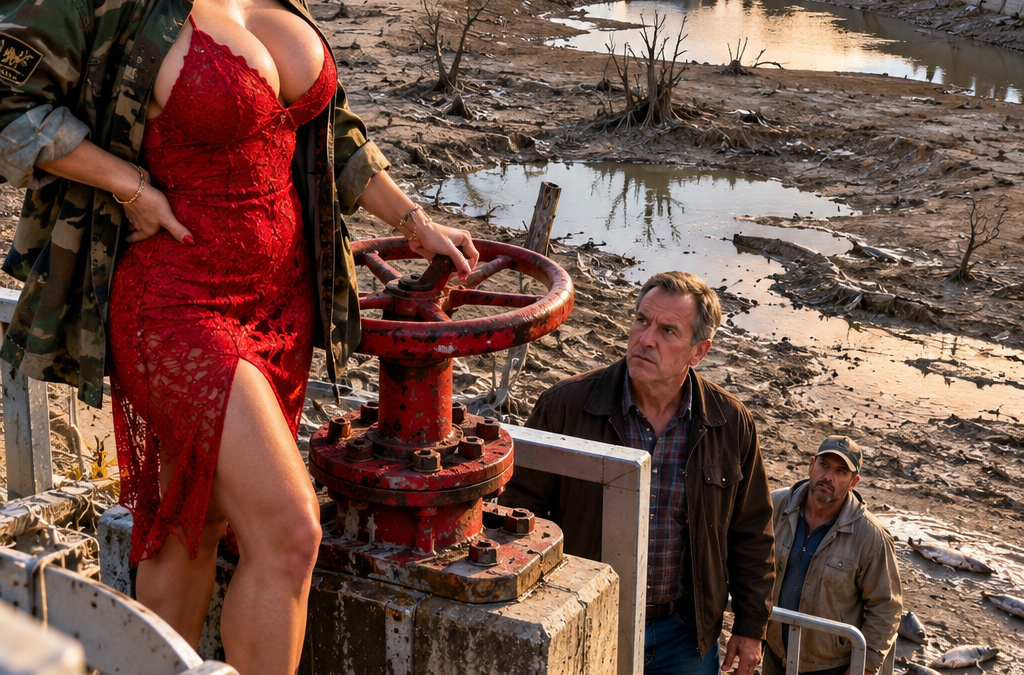
She stepped out wearing the same red lace dress, now partially covered by a light jacket. Her blonde hair moved in the wind as she walked directly toward the equipment.
There was no hesitation.
No confusion.
She wasn’t lost.
She hadn’t stopped to ask directions.
She approached the main outlet controls with purpose.
The camera captured her standing beneath the service light, examining the mechanism before operating it.
Then she returned to her SUV.
And drove away.
Behind her, the water began leaving the reservoir.
I woke before sunrise to a sound I couldn’t immediately identify.
At first, I thought it was wind rattling the loose panel near the barn.
Then I realized what was missing.
Usually, even from the ranch house, I could hear faint water movement near the lower channel during quiet mornings.
That morning, the air felt strangely still.
I pulled on my jeans, boots, and jacket and stepped outside.
The sky was dark blue above the eastern ridge.
A thin line of orange marked the horizon.
I drove toward the reservoir with a mug of coffee balanced in the truck’s cup holder.
Halfway down the road, I noticed the exposed shoreline.
At first, my mind refused to understand it.
The water should have stretched toward the cottonwoods.
Instead, there was a broad band of pale mud.
I accelerated.
When I reached the western bank, I slammed on the brakes.
For several seconds, I didn’t move.
The reservoir was nearly empty.
Not a little low.
Not down a few feet.
Almost completely drained.
The water that had once covered the basin was reduced to scattered pools and a narrow, muddy channel.
The normal waterline stood high above the remaining water.
An old tree stump I hadn’t seen in years protruded from the exposed bottom.
My coffee sat untouched as I climbed out.
“No,” I whispered.
I walked toward the edge.
The ground sucked at my boots.
Fish moved weakly in shrinking puddles.
The smell of disturbed sediment was overwhelming.
I looked toward the outlet station.
Even from that distance, something was wrong.
Then I heard an engine.
Tom’s pickup came bouncing down the ranch road.
He jumped out before it had fully stopped.
“Daniel!”
He ran toward me.
“I saw it from the north pasture. What the hell happened?”
“I don’t know.”
He stared at the basin.
“I checked it yesterday afternoon. It was full.”
“I know.”
“This isn’t possible.”
We stood beside each other, looking at the exposed reservoir bed.
A slow leak might have lowered the water level over weeks.
Evaporation might have reduced it during extreme heat.
But this?
This was the result of a massive, uncontrolled release.
Tom turned toward the valve station.
“Somebody opened it.”
I followed his gaze.
Neither of us said Linda’s name.
Not yet.
We approached the control station carefully.
The main outlet had been left in an abnormal operating position.
Water had been flowing into the downstream release system for hours.
Tom swore under his breath.
“Whoever did this knew which control to use.”
I pulled out my phone and called the utility emergency number.
Then I called the sheriff’s office.
We avoided interfering with the equipment while the emergency response was being organized.
The last thing I wanted was to disturb evidence or worsen an already dangerous situation.
Then I remembered the camera.
“Tom. The west security feed.”
We hurried back to the ranch office.
I opened the recording software with hands that felt clumsy and cold.
Tom stood behind my chair.
We scrolled through the overnight footage.
For a few moments, there was nothing but the empty access road.
Then, shortly after midnight, headlights appeared.
A white luxury SUV rolled into view.
My stomach tightened.
“No,” Tom muttered.
The vehicle stopped beside the control station.
The driver’s door opened.
A blonde woman stepped out.
Even before she turned toward the camera, I knew who it was.
Linda Whitmore.
She walked directly to the equipment.
The timestamp continued advancing.
We watched her operate the control mechanism.
Then we watched her drive away.
I replayed it.
Once.
Twice.
A third time.
Tom slammed his palm against the desk.
“She did it.”
I couldn’t speak.
For months, Linda had threatened my property, attacked my reputation, and demanded control over a water system she didn’t own.
But there was a distance between issuing arrogant letters and physically sabotaging critical equipment.
I hadn’t believed she’d cross it.
“Save that footage,” Tom said.
I exported the original recording and made a separate copy.
Then I called Deputy Hayes at the sheriff’s office and told him what we’d found.
His tone changed immediately.
“Do not confront her alone, Mr. Carter. We’re sending someone.”
I looked toward the window.
Beyond the pasture, the empty reservoir sat beneath the morning sky.
“She’s already taken the water,” I said quietly.
That was when the first homeowners began arriving.
Two vehicles came down the road, followed by three more.
People parked near the ranch entrance and walked toward the basin.
Some carried phones.
Others brought empty water containers.
A young father wearing a work jacket approached me.
“Are you Daniel Carter?”
“Yes.”
“What happened to the water?”
“We’re investigating an unauthorized release.”
He looked past me toward the reservoir.
“Unauthorized?”
“Someone opened the outlet overnight.”
His face drained.
“Our faucets stopped working an hour ago.”
Before I could answer, a woman shouted from behind him.
“Mine too!”
Another man raised his phone.
“The neighborhood group says there’s no water pressure on the east side.”
Within minutes, people were talking over one another.
Some thought a pipe had burst.
Others believed the town had intentionally shut off service.
A few had already read Linda’s earlier warnings about the reservoir and assumed I was responsible.
One man pointed at me.
“Didn’t the HOA say you were refusing to cooperate with the neighborhood?”
Tom stepped forward.
“Careful what you’re accusing him of.”
The man raised his hands.
“I’m asking a question!”
“And I’m answering it,” I said.
I forced myself to stay calm.
“The town has a legal water distribution agreement. Nobody here has been withholding water. Someone entered my property last night and opened the outlet.”
A woman holding a plastic jug stared at me.
“Why would anyone do that?”
I looked toward the control station.
“That’s what we’re going to establish.”
By seven o’clock, the emergency crews had arrived.
The town utilities department sent two trucks, followed by a county service vehicle.
Workers moved toward the outlet station while other personnel checked the downstream distribution system.
I watched them confer near the controls.
One engineer called the town office.
Another photographed the exposed reservoir bed.
The situation was becoming more serious by the minute.
Under normal conditions, the reservoir maintained a substantial volume of stored water feeding the town’s distribution infrastructure through a regulated system.
That storage helped maintain reliable service.
By opening the main outlet, Linda had released water far faster than the authorized distribution arrangement was designed to handle.
The water hadn’t simply been transferred into household taps.
It had escaped into downstream drainage channels and traveled well beyond the community.
And now the system lacked the stored volume needed to maintain normal supply conditions.
The town began issuing emergency notices.
Residents were told to conserve any water available.
Schools and businesses received warnings.
Crews investigated pressure losses, isolated vulnerable sections, and assessed whether any reserve capacity could be used safely.
Within hours, officials estimated that nearly four hundred homes had lost their normal water supply.
I watched the news spread across people’s faces.
Confusion became fear.
Fear became anger.
An elderly man sat on the tailgate of his truck, staring at an empty water jug.
A mother stood beside her minivan trying to reach the school district.
Another homeowner told me his small restaurant couldn’t operate without dependable water service.
These weren’t people arguing about property values or landscaping standards anymore.
They were families facing an emergency they hadn’t caused.
And I knew exactly who the security camera showed at the valve.
Then Linda arrived.
Her white SUV came down the ranch road at a speed that sent gravel scattering toward the shoulder.
She parked in front of my truck.
The driver’s door swung open.
Out stepped Linda Whitmore, wearing her unmistakable red lace dress, high heels, and a cream-colored jacket draped loosely over her shoulders.
Her makeup was immaculate.
Her expression was triumphant.
She took one look at the dry reservoir and smiled.
“Well,” she announced, loudly enough for the gathered homeowners to hear, “it seems Daniel has finally learned that he can’t ignore the community forever.”
For a moment, I couldn’t believe what I was hearing.
People were standing around us wondering how they would get water for their children.
Emergency crews were trying to understand the damage.
And Linda was celebrating.
Tom moved toward her.
“You’re out of your damn mind.”
Linda lifted her chin.
“Excuse me?”
“You heard me.”
“I don’t take insults from hired help.”
I grabbed Tom’s arm before the argument could go any further.
Then I stepped directly in front of her.
“Linda.”
She smiled.
“Daniel. I hope you’re prepared to discuss reasonable terms now.”
“Did you open the main outlet valve last night?”
The smile didn’t disappear.
If anything, it widened.
“I took the initiative you were too selfish to take.”
A few homeowners stopped talking.
I stared at her.
“Did you open it?”
“Yes, Daniel. I did.”
The words landed like stones.
Someone behind us gasped.
Linda continued with complete confidence.
“Your reservoir has been sitting here wasting water while our neighborhood needs it. You’ve refused every reasonable request. I decided it was time to force a response.”
Tom shook his head.
“You drained the whole thing.”
Linda waved him off.
“Water is a renewable resource.”
“Not at the rate you released it,” I said.
She crossed her arms.
“Don’t lecture me about community infrastructure.”
“Do you have any idea where that water went?”
“Into the water system, obviously.”
“No.”
She frowned.
“What?”
“It didn’t go into your kitchen faucet, Linda.”
Her smile faltered.
I stepped closer.
“You opened a major outlet without understanding where it discharged. You emptied a storage reservoir in the middle of the night. And now hundreds of homes have no water.”
She laughed sharply.
“That’s absurd. If the supply failed, then the town needs to fix its infrastructure.”
“You created the emergency.”
“I exposed the emergency.”
“No. You caused it.”
Her expression hardened.
“Watch your tone.”
For a second, I thought I’d misheard her.
There we stood beside an almost empty reservoir, surrounded by frightened residents and emergency vehicles, and she was still trying to control the conversation.
“Watch my tone?” I repeated.
“I am the president of Brookstone Heights. I represent nearly four hundred households.”
“Then you should have thought about those households before you opened a valve you didn’t understand.”
Her cheeks turned red.
“You’ve been hoarding community resources for years!”
“This is privately owned infrastructure.”
“It affects our neighborhood!”
“That doesn’t make it yours!”
The force of my voice surprised even me.
The gathering crowd fell quiet.
Linda looked around, suddenly aware of the attention.
Then she raised her voice.
“Everyone needs to understand that this man has refused to cooperate with the HOA for months. I have repeatedly warned him that his reservoir was a threat to our community.”
A homeowner called out.
“Did you really open it?”
Linda turned toward him.
“I took action to protect your interests.”
“My house doesn’t have water!”
“That’s a municipal failure.”
Another woman stepped forward.
“My children couldn’t shower this morning. We have no idea when service is coming back.”
Linda forced a sympathetic expression.
“Which is precisely why we must demand accountability.”
I stared at her.
“From you.”
She snapped her head toward me.
“Don’t you dare.”
“You opened the valve.”
“Under emergency authority.”
“What emergency authority?”
“The homeowners association’s authority to protect the community.”
I shook my head.
“You’re not even inside the HOA boundary.”
That finally made her pause.
I turned toward Tom.
“Bring me the old steel cabinet key.”
He nodded and headed toward the ranch office.
Linda watched him leave.
“What’s that supposed to mean?”
“It means you’re about to see the documents you’ve spent six months pretending don’t exist.”
She smirked.
“Your little collection of antique papers won’t change what’s necessary for public safety.”
I said nothing.
Because by then, I was beginning to understand something.
Linda wasn’t simply ignorant of the boundary.
She was depending on everyone else being ignorant too.
As long as the dispute remained a shouting match, she could claim authority, invoke community interests, and intimidate anyone who questioned her.
But a recorded survey was different.
An original property document didn’t care how expensive her SUV was.
A pipeline diagram couldn’t be bullied into agreement.
And an official investigation wouldn’t become legitimate just because Linda declared herself in charge.
I left her standing beside the reservoir and walked toward my office.
The old steel filing cabinet sat against the back wall beneath a framed photograph of my grandfather.
He was standing beside the reservoir during its original construction, wearing muddy boots and holding a surveying rod.
My father used to tell me how carefully Granddad kept those records.
“Land lasts longer than arguments,” he’d say. “Make sure you can prove what’s yours.”
I opened the cabinet.
Inside were decades of deeds, surveys, permits, inspection reports, and water-system documentation.
I found the original survey in a thick protective folder.
The paper had yellowed at the edges, but the markings were clear.
The reservoir boundary.
The access road.
The control station.
The privately owned pipeline segments.
The distribution connection.
And several hundred yards away, the line beyond which the HOA’s development had eventually been constructed.
I spread the survey across my desk.
Every important feature was there.
Linda had been demanding control over infrastructure her association had never owned.
I added the reservoir documents and distribution agreements to the folder.
Then I looked once more at my grandfather’s photograph.
I wondered what he’d think of a woman in a red lace dress deciding that his life’s work belonged to her neighborhood.
Probably nothing polite.
When I returned outside, the crowd had grown.
Deputy Hayes had arrived.
So had a senior water engineer named Richard Cole.
Richard was in his late fifties, with graying hair, weathered hands, and the exhausted expression of a man who had already spent his morning dealing with emergencies.
He didn’t waste time.
“Mr. Carter, I understand the reservoir was full yesterday?”
“Tom checked it around four-thirty.”
Richard turned to Tom.
“You’re certain?”
“Absolutely.”
“Any maintenance scheduled overnight?”
“None.”
Richard looked toward the outlet station.
“Then I need to inspect the discharge controls and downstream line.”
I nodded.
“You have my permission.”
Linda stepped between us.
“I should be included in this inspection.”
Richard glanced at her.
“And you are?”
“Linda Whitmore. President of Brookstone Heights.”
He waited.
She seemed offended by his silence.
“Our neighborhood depends on this system, and I’ve been leading the effort to improve its management.”
Richard looked at me.
“Does she have operating authority?”
“No.”
Linda interrupted.
“That’s disputed.”
“No,” I said. “It isn’t.”
She turned to Richard.
“The HOA has emergency authority where community resources are concerned.”
Richard’s expression barely changed.
“Ma’am, are you a licensed operator for this water system?”
Linda blinked.
“That’s not relevant.”
“Are you?”
“No, but—”
“Then please remain outside the work area.”
Her mouth fell open.
“Do you know who I am?”
“I know you just told me.”
Tom turned away, hiding a grim smile.
Linda wasn’t accustomed to people answering her so plainly.
She followed anyway, remaining close enough to hear as Richard and the utility crew examined the system.
I walked beside them.
The open outlet mechanism stood exactly as we’d found it.
Richard studied the position indicators and the surrounding equipment.
He asked one of his technicians to document the condition.
Then he examined the pipeline plans and compared them with the control layout.
His face grew increasingly serious.
After several minutes, he turned toward us.
“Who opened this?”
Nobody answered immediately.
I looked at Linda.
She folded her arms.
Richard repeated the question.
“Who operated the main outlet?”
Linda lifted her chin.
“I did.”
Richard stared at her.
“You?”
“Yes.”
“Who authorized you?”
“The HOA.”
Richard remained silent.
Linda mistook that silence for uncertainty.
“Our residents have been dealing with an unacceptable situation for months. The reservoir was being mismanaged, and the town needed to take the matter seriously.”
Richard slowly removed his glasses.
“Ma’am, what exactly did you believe would happen when you opened this outlet?”
Linda looked irritated.
“I believed the water would be released into the community system. That was the entire point.”
Richard stared at her for several seconds.
Then he looked at the pipeline diagram.
“That’s not where this outlet discharges.”
The words hung in the air.
Linda frowned.
“Of course it is.”
“No.”
“Then why is it connected to the reservoir?”
“Because reservoirs have more than one operational function.”
She waved a hand.
“You’re making this unnecessarily complicated.”
Richard’s voice grew harder.
“No, ma’am. The system is complicated. That’s why unauthorized people aren’t allowed to operate it.”
Linda stepped back.
He pointed toward the control station.
“This outlet releases stored water into the downstream drainage system. At the position you left it, an enormous amount of water was discharged overnight.”
Linda looked toward the empty basin.
“But the water has to go somewhere.”
“It did.”
“Then where is it?”
Richard turned toward the western hills.
“Downstream. Beyond the distribution intake and far beyond your neighborhood.”
She blinked.
“That doesn’t make sense.”
“It makes perfect sense when you understand the equipment.”
I watched her face change.
For the first time that morning, she appeared genuinely uncertain.
Richard continued.
“You’ve removed a substantial volume of stored water from the system. That storage cannot be restored overnight. The town is now dealing with a serious supply emergency.”
Linda looked toward the homeowners.
Then back at Richard.
“You’re saying the water didn’t go to our homes?”
“That’s exactly what I’m saying.”
“But I was trying to make the town act.”
“You did.”
His voice was cold.
“You forced an emergency response.”
Several people in the crowd began murmuring.
Linda straightened her shoulders.
“Then the town should have responded sooner to my concerns.”
Richard looked at her as though he couldn’t decide whether she was deliberately avoiding reality or simply didn’t understand it.
“Your concerns did not authorize you to operate this equipment.”
She pointed at me.
“He refused to cooperate!”
Richard didn’t even look in my direction.
“That has nothing to do with what you did last night.”
Her face twisted.
“You don’t understand the pressure I’ve been under. Hundreds of people expect me to protect their property values and their quality of life.”
Richard gestured toward the dry reservoir.
“And now those people don’t have dependable water.”
That was the moment the crowd’s mood changed completely.
For months, Linda had framed herself as a defender of the neighborhood.
She had told residents the reservoir was dangerous, poorly managed, and controlled by a selfish rancher.
Now the town’s senior engineer was standing in front of them, explaining that she had personally emptied the storage their water service depended upon.
A man near the fence spoke first.
“So you did this?”
Linda turned toward him.
“I acted in the community’s best interests.”
The man shook his head.
“My wife runs a daycare from our house. She had to send six children home this morning because we don’t have water.”
“That’s unfortunate,” Linda said.
“Unfortunate?”
He took a step forward.
“My family is losing income because you decided to play engineer in the middle of the night!”
Linda recoiled.
“Don’t speak to me like that.”
A woman behind him shouted.
“You don’t get to tell us how to speak!”
Another homeowner raised his voice.
“You told us Daniel was the problem!”
Linda’s eyes moved rapidly across the crowd.
“Everyone needs to calm down.”
Nobody did.
For the first time since I’d known her, Linda was surrounded by people she couldn’t silence with HOA fines.
They weren’t board members.
They weren’t homeowners afraid of another inspection notice.
They were parents, workers, retirees, and business owners who wanted water.
And they were finally asking the right questions.
Linda turned toward the control station.
“Well, then close the outlet and refill the reservoir.”
Richard stared at her.
“Refill it with what?”
She hesitated.
“With water.”
Tom made a sound of disbelief.
Linda glared at him.
Richard answered before anyone else could speak.
“The reservoir collects and receives water under conditions that take time. We can secure the outlet immediately, assess the remaining volume, and coordinate recovery measures. We cannot manufacture an entire reservoir’s worth of stored water on demand.”
Her voice rose.
“There must be pumps!”
“Pumps require a water source.”
“Then bring in trucks!”
“For a reservoir this size?”
She threw up her hands.
“You’re the engineer. Figure it out!”
Richard’s face hardened.
“We are figuring it out, ma’am. We’re also documenting why we’re in this situation.”
Linda took a step toward the equipment.
“Then I’ll help you close it.”
She reached toward the station.
Deputy Hayes moved between her and the controls.
“Ma’am, step back.”
Linda looked up at him in outrage.
“Excuse me?”
“You’re not touching any more equipment.”
“I am the HOA president!”
“Step away from the valve.”
She pointed a manicured finger at his chest.
“You have no idea how much influence I have in this county.”
Hayes didn’t move.
“I’ve asked you politely. Don’t make me ask again.”
Linda’s expression shifted from outrage to disbelief.
Around us, people had gone quiet.
She glanced from the deputy to the engineer, waiting for someone to support her.
Nobody did.
Finally, she lowered her hand.
“This is ridiculous.”
Hayes maintained his position.
“Please remain with me while we establish what happened.”
Linda looked toward her SUV.
“I have an emergency board meeting to attend.”
“That can wait.”
She stiffened.
“Are you detaining me?”
“I’m asking you to remain available while we sort out an incident involving critical water infrastructure.”
Her voice grew sharper.
“I know attorneys.”
“Then you may want to call one.”
She took a breath.
I watched her carefully.
It was the first time she’d encountered a problem she couldn’t solve by threatening an HOA violation.
But she still wasn’t finished trying.
As the utility crew began securing the outlet, Linda moved toward the homeowners and raised her voice.
“Everyone, listen to me. The engineer has confirmed that this reservoir’s operating system is dangerously inadequate. That is exactly what I’ve been warning about.”
I almost couldn’t believe it.
She was rewriting the conversation while we were still standing there.
Richard turned.
“That’s not what I said.”
Linda ignored him.
“The town needs to take over this reservoir immediately. We cannot leave our water supply in the hands of someone who refuses reasonable oversight.”
My fists tightened.
She was attempting to blame me for the consequences of her own actions.
Again.
A few homeowners looked confused.
One asked whether the reservoir had failed mechanically.
Linda seized on the question.
“Clearly, a safe system wouldn’t allow a single valve operation to cause this kind of emergency.”
Richard spoke firmly.
“Ma’am, stop misrepresenting my findings.”
Linda rounded on him.
“I’m entitled to my opinion.”
“You’re entitled to an opinion. You’re not entitled to claim I made a technical finding I haven’t made.”
She looked toward the deputy.
“Are you going to let this man harass me?”
Hayes didn’t answer.
That seemed to make her angrier.
She pointed at me.
“This is all his fault! He could have worked with the HOA months ago. He could have given us access. He could have let the community manage the property responsibly!”
I felt something inside me settle.
Until that moment, my anger had been hot and restless.
Watching Linda blame everyone else while families stood without water changed it into something colder.
I walked to my truck.
Opened the bed cover.
And pulled out the survey folder.
“Linda,” I called.
She turned.
“What now?”
“You keep saying the HOA had the right to operate my reservoir.”
“Because we did.”
“Then show everyone where that right begins.”
I spread the original survey across the hood of my truck.
The paper unfolded in broad sections.
Tom placed two clean tools near the corners to keep the breeze from lifting it.
Richard and Deputy Hayes walked over.
Several homeowners gathered behind them.
I pointed to the northern boundary.
“This is my ranch.”
Then I traced the marked reservoir perimeter.
“This is the reservoir.”
I moved my finger toward the control station.
“This is the main outlet.”
Then toward the service road.
“This is the access road Linda used last night.”
Finally, I pointed to the development boundary.
“And this is where Brookstone Heights begins.”
The line was unmistakable.
Several hundred yards separated the HOA-controlled development from the privately owned reservoir equipment.
Linda leaned over the document.
“That’s an old survey.”
“Yes.”
“Development changes boundaries.”
“Not without a lawful transfer or recorded change.”
She straightened.
“You can’t expect me to accept some decades-old drawing as the final word.”
I opened the next document.
“Here’s the updated county survey.”
Then another.
“Here’s the recorded water agreement.”
And another.
“Here’s the later infrastructure amendment identifying the equipment responsibilities.”
Richard examined the documents.
He compared them with the information his department already held.
Then he nodded.
“These appear consistent with the system records.”
Linda’s jaw tightened.
“Appear?”
Richard looked at her.
“The reservoir, control station, and main outlet are identified as private infrastructure. The town has defined operational and distribution rights. I see nothing giving the HOA authority to operate this equipment.”
I watched Linda’s fingers curl around the strap of her handbag.
She looked down at the map again.
For a second, she seemed to be searching for some hidden line that would rescue her.
There wasn’t one.
She pointed toward the distribution connection.
“That pipeline serves our neighborhood.”
“Under the town’s agreement,” Richard replied.
“So the HOA has a direct interest.”
“A direct interest is not operational authority.”
She lifted her chin.
“That’s a legal interpretation.”
Deputy Hayes spoke.
“Then we’ll let the attorneys address it.”
Linda turned sharply.
“I intend to.”
“Good,” Hayes said.
Something about his calmness seemed to enrage her more than an argument would have.
She was accustomed to controlling people through volume and intimidation.
Hayes wasn’t giving her anything to fight.
Neither was Richard.
I folded my arms.
“You crossed onto private property after midnight,” I said. “You operated infrastructure you didn’t own, released water without authorization, and left hundreds of families without their normal supply.”
Linda glared at me.
“You can’t prove my intentions.”
“I don’t need to guess what you intended. You already told us why you did it.”
Her eyes widened slightly.
I continued.
“You said you wanted to force the town to respond.”
“Because nobody was listening!”
“Then you call the town. You file a complaint. You request an inspection. You go to court if you believe you have a legal claim.”
I stepped closer.
“You don’t sneak onto somebody’s ranch at midnight and open a reservoir outlet.”
For once, Linda had no immediate answer.
Then she looked at the homeowners behind us.
“You people have no idea how hard I’ve worked for this neighborhood.”
Nobody applauded.
Nobody thanked her.
The silence was devastating.
She turned back to me.
“This isn’t over.”
I held her gaze.
“No. It isn’t.”
By noon, the emergency had grown beyond anything our small community had experienced in years.
Water department trucks moved between affected streets.
Town officials established a temporary response plan.
Businesses received updated advisories.
Schools began making contingency arrangements.
Residents shared bottled water and helped elderly neighbors.
The town’s emergency personnel coordinated with the utility department to determine what could be restored, what needed to be isolated, and what temporary supply measures were available.
Every update carried the same painful reality.
The lost storage volume couldn’t be replaced immediately.
I spent most of the afternoon moving between the reservoir and the ranch office.
Reporters began calling.
I declined to speculate.
I told them the equipment had been operated without authorization and that the proper authorities had the evidence.
One reporter asked whether I held the HOA responsible.
I answered carefully.
“The HOA’s president was recorded at my control station. She has acknowledged opening the outlet. The investigators and attorneys will determine responsibility.”
I didn’t want an emotional statement to become a distraction.
The facts were strong enough.
Still, maintaining that discipline wasn’t easy.
At two o’clock, a woman arrived at the ranch gate carrying an empty five-gallon container.
She was in her seventies, with gray hair pulled into a loose bun.
She introduced herself as Margaret Ellis.
She had lived in Brookstone Heights since its first phase was completed.
“I’m sorry to bother you,” she said.
“You’re not bothering me.”
She looked toward the reservoir.
“I just wanted to see it for myself.”
I opened the gate and walked with her to a safe viewing area.
When she saw the exposed basin, she covered her mouth.
“Oh, my goodness.”
We stood quietly.
After a while, she said, “Linda told us you were dangerous.”
I didn’t answer.
“She said you were holding our water hostage. That you didn’t care whether old people like me had enough.”
I felt my chest tighten.
“I’m sorry she told you that.”
Margaret shook her head.
“I believed her.”
She looked ashamed.
“Not all of it. But enough.”
“You had no reason to know the details.”
“That’s not an excuse.”
She watched a utility vehicle move across the far bank.
“My husband used to say that people who constantly announce how much power they have are usually the ones you should be most careful around.”
I smiled faintly.
“He sounds like a wise man.”
“He was.”
She turned toward me.
“Can I ask you something?”
“Of course.”
“Are you going to stop letting us use the water because of what she did?”
The question hit harder than I expected.
Here was an elderly woman standing beside an empty reservoir, afraid that one person’s cruelty might convince me to punish an entire neighborhood.
“No, ma’am,” I said.
Her eyes filled with tears.
“The town’s agreements remain in place. I’m going to cooperate with the engineers to restore the system.”
She reached for my hand.
“Thank you.”
I squeezed her fingers gently.
After she left, I stood at the gate for a long time.
I realized Linda had made the conflict personal for months.
She had attacked me.
Threatened my ranch.
Tried to humiliate me publicly.
And now her actions had harmed people who’d never done anything to me.
I could have let resentment take over.
I could have looked at Brookstone Heights and seen nothing but the neighborhood whose president had tormented me.
But Margaret reminded me of something my father had taught me.
A man doesn’t prove he’s right by making innocent people suffer for someone else’s mistakes.
That evening, the town attorney arrived.
His name was Michael Reeves, and he looked like he had already lived through three exhausting days in the space of twelve hours.
He came with a county official and a folder containing emergency documentation.
We met beside my truck.
The reservoir lay behind us, an ugly scar beneath the fading light.
“Mr. Carter,” Reeves said, “the town needs immediate access to secure the water infrastructure and conduct the necessary recovery work.”
“You have it.”
He looked relieved.
“We also need to clarify the scope of the existing agreements so there are no operational disputes during the emergency.”
I handed him my documentation folder.
“Everything’s here.”
He opened it and reviewed the survey.
Then he examined the recorded water agreements.
“Good.”
I pointed toward the control station.
“I want that equipment secured. But I also want the evidence preserved.”
“That’s appropriate.”
“Because this wasn’t an accident.”
Reeves looked up.
“What do you have?”
I took out my phone.
“Security footage.”
His expression changed.
“Of the incident?”
“Of Linda Whitmore arriving after midnight and opening the outlet.”
For a moment, he said nothing.
Then he asked to see it.
I played the recording.
The white SUV appeared.
Linda stepped out.
She walked to the control station.
She operated the valve.
Then she left.
Reeves watched without interrupting.
When the video ended, he asked me to play it again.
I did.
He leaned back against the truck.
“Have you provided this to law enforcement?”
“Deputy Hayes has been notified, and I preserved the original file.”
“We’ll need to ensure the town receives a proper copy and that the evidence is handled correctly.”
I nodded.
“Whatever you need.”
He looked toward the empty reservoir.
“She did this because of an HOA dispute?”
“She said she wanted to force the town to respond.”
Reeves closed his eyes briefly.
Then he exhaled.
“That is going to be a very significant statement.”
As we talked, Linda’s SUV returned.
I heard it before I saw it.
She drove down the access road and stopped several yards from the gathered officials.
For a moment, she remained inside.
Then she stepped out.
Even now, with the entire community facing emergency restrictions, she wore the same red lace dress.
Her expression was rigid.
She walked toward us with a phone pressed against her ear.
“Yes,” she said loudly. “I’m here with the town representatives now.”
She ended the call.
“Michael,” she announced, “I’m glad you’ve finally arrived.”
Reeves turned.
“Mrs. Whitmore.”
“I’ve been trying to get someone from the town attorney’s office to address this reservoir problem for months.”
He waited.
She gestured toward the dry basin.
“As you can see, Daniel Carter’s irresponsible management has created a serious public concern.”
I felt my jaw tighten.
Reeves glanced at me, then back at Linda.
“Mrs. Whitmore, we’ve been reviewing the circumstances.”
“Excellent. Then you understand why the HOA had to intervene.”
“Who authorized you to operate the outlet?”
She lifted her chin.
“The homeowners association acted under emergency community authority.”
Reeves remained expressionless.
“Did you seek authorization from the town utilities department?”
“No.”
“From the property owner?”
“He refused to cooperate.”
“From any licensed operator responsible for the system?”
Linda shifted her weight.
“The situation required decisive leadership.”
Reeves studied her for a moment.
“Decisive leadership doesn’t create legal authority.”
Her smile disappeared.
“I beg your pardon?”
“You were not authorized to operate that valve.”
“That is your opinion.”
“It’s based on the agreements and records we’ve reviewed.”
She pointed at the reservoir.
“Then explain why hundreds of homeowners were depending on a privately controlled system in the first place.”
Reeves answered calmly.
“Because the existing agreements establish an arrangement for private infrastructure and town water distribution. The town is investigating the emergency. Ownership and operational rights are documented.”
Linda shook her head.
“I’ve been warning people this arrangement was unacceptable.”
Reeves held her gaze.
“Warnings don’t authorize interference.”
She looked toward me.
“You’ve been feeding him your version of events.”
I opened my phone.
“No, Linda. I’ve been showing him what happened.”
Her eyes fixed on the screen.
I pressed play.
The recording began.
She watched her SUV appear on the access road.
Then herself walking toward the valve.
For the first time all day, the color seemed to drain from her face.
She stared at the screen as the recorded image of her own hand moved over the controls.
Then she looked up.
“Where did you get that?”
I almost laughed.
“From the camera watching my equipment.”
Her lips parted.
“You’ve been recording me?”
“I’ve been recording my private property.”
She stepped forward.
“That footage needs context.”
Reeves spoke.
“Then provide the context.”
She looked from him to me.
“I was trying to expose a dangerous situation.”
“By opening the outlet?” he asked.
“I believed the water would reach the neighborhood.”
Richard, who had joined us, shook his head.
“That belief was incorrect.”
Linda turned toward him.
“You’re determined to make me look incompetent.”
“No, ma’am,” Richard said. “I’m describing what the system does.”
She looked trapped.
Then anger returned to her face.
“This is a setup.”
I stared at her.
“A setup?”
“You’ve been waiting for an excuse to destroy my reputation!”
“You came here after midnight.”
“You’ve been provoking me for months!”
“You opened the valve.”
“You could have prevented all of this if you’d agreed to cooperate!”
I took a step toward her.
“And that’s what this was really about, wasn’t it?”
She fell silent.
I pointed toward the reservoir.
“Not water conservation. Not public safety. Not protecting your neighbors.”
Her eyes narrowed.
“You have no right to question my motives.”
“You couldn’t stand the fact that I owned something you couldn’t control.”
She looked away.
I continued.
“Every time I told you no, you threatened me. Every time the documents proved you wrong, you invented another excuse. You told homeowners I was selfish because I refused to give you authority you never had.”
Linda’s face reddened.
“Enough.”
“Then last night you came onto my property and tried to prove you could control my reservoir anyway.”
“Enough!”
Her voice cracked across the access road.
I stopped speaking.
She was breathing hard.
For several seconds, nobody moved.
Then Reeves closed his folder.
“Mrs. Whitmore, the town is securing the infrastructure and preparing legal action concerning the unauthorized interference and resulting emergency.”
Linda stared at him.
“Legal action?”
“Yes.”
“Against Daniel?”
Reeves shook his head.
“The evidence does not support blaming Mr. Carter for operating the outlet.”
Her expression changed.
Astonishment.
Then fear.
Then fury.
“You can’t be serious.”
“I am.”
She looked toward the deputy.
“Tell him he can’t do that.”
Hayes didn’t respond.
Linda turned back to Reeves.
“I’m the president of Brookstone Heights. The HOA represents hundreds of households. You can’t simply treat us like some insignificant organization.”
“The size of the organization doesn’t excuse unauthorized conduct.”
Her voice dropped.
“You are making a very dangerous political mistake.”
Reeves’ expression hardened.
“This is not a political negotiation.”
She stood rigidly.
The evening wind lifted the edge of her jacket.
For months, she’d used the HOA presidency as a shield.
Now the shield was failing.
And everyone standing beside that empty reservoir could see it.
The next several days were some of the longest I could remember.
The reservoir wasn’t magically restored because Linda’s authority had been exposed.
The damage remained.
Water had to be managed carefully.
Crews secured the outlet, inspected the infrastructure, monitored the remaining stored volume, and developed a recovery plan.
The town worked on temporary measures for affected residents.
Some homes regained limited service sooner than others.
Water advisories and conservation instructions changed as technicians assessed the system.
Businesses adjusted their operations.
Schools coordinated emergency arrangements.
Neighbors began organizing deliveries for elderly residents and families with small children.
The emergency did something Linda had never accomplished during her months of speeches and threats.
It brought the community together.
Not behind her.
Against the damage she’d caused.
At first, I tried to spend every hour near the control station.
I checked on the crews, answered questions, and coordinated access.
But by the third day, exhaustion was catching up with me.
My shoulders ached.
My eyes burned from lack of sleep.
Every time I looked at the empty reservoir, I felt the same mixture of anger and grief.
Tom noticed.
He found me standing beside the western bank shortly before sunset.
“You need to go home,” he said.
“I’m home.”
“You know what I mean.”
I looked at the exposed mud.
“Granddad would be sick if he saw this.”
Tom stood beside me.
“He’d be angry.”
I nodded.
“But he wouldn’t blame you.”
I didn’t answer.
Tom waited.
Then he said, “You didn’t open that valve, Daniel.”
“I know.”
“Do you?”
I looked at him.
He continued.
“Because you’ve been walking around like you should have predicted it.”
I swallowed.
“We knew she was angry.”
“Angry people are everywhere. Most of them don’t sneak onto a ranch and empty a reservoir.”
“I should’ve upgraded the security sooner.”
“We had locks. We had cameras. We had documented access restrictions. She chose to cross the line.”
I stared at the water.
“What if the supply doesn’t recover properly?”
“It will take work.”
“What if people blame us anyway?”
“Then we’ll keep showing them the truth.”
I looked toward the hills.
For a while, neither of us spoke.
Then Tom put a hand on my shoulder.
“Your grandfather built this thing because people needed water. You kept it operating because people still need water. Don’t let one entitled woman convince you that all that work means nothing.”
I felt a knot tighten in my throat.
“Thanks, Tom.”
He nodded.
“Now eat something before you fall over.”
I managed a small laugh.
It was the first time I’d laughed since the disaster.
But the worst confrontation was still ahead.
Several days after the emergency began, an HOA board meeting was called.
At first, Linda insisted that the meeting would address the town’s failure to maintain reliable water infrastructure.
By then, however, residents had seen the survey, heard the engineer’s explanation, and learned that security footage existed.
Her story was collapsing.
The board members wanted answers.
The homeowners wanted accountability.
And the town was preparing its formal civil claim.
I wasn’t planning to attend the HOA meeting.
My ranch wasn’t part of their association.
But one of the board members, a man named Robert Daniels, called me that afternoon.
He sounded exhausted.
“Daniel, I owe you an apology.”
“For what?”
“For allowing Linda to speak for all of us without questioning her.”
I leaned back in my chair.
“You don’t owe me an apology for something she did.”
“I disagree.”
His voice grew quieter.
“Some of us knew she was escalating the dispute. We let it continue because confronting her was unpleasant.”
I said nothing.
He continued.
“Now people are without water, and the association may be facing a serious claim.”
“That’s between the HOA, the town, and your attorneys.”
“I understand. But I wanted you to know that not everyone supported her.”
I appreciated the call.
Still, I told him the same thing I’d told Margaret.
“I don’t blame your neighborhood for what Linda did.”
Robert was quiet for a moment.
Then he said, “I wish we’d stopped her before it came to this.”
So did I.
The town’s civil claim was filed soon afterward.
It named Linda Whitmore and the Brookstone Heights HOA in connection with the unauthorized interference with the water system and the resulting emergency.
The allegations focused on the conduct, its consequences, and the costs associated with responding to the damage.
I didn’t pretend to understand every legal detail.
Sarah explained that the town would need to establish the relevant responsibilities, damages, and grounds for relief.
Liability would be determined through the legal process.
But the central evidence was no longer a matter of rumor.
There was footage.
There were property records.
There were technical findings.
And Linda had admitted opening the outlet in front of witnesses.
When the filing became public, the reaction in Brookstone Heights was immediate.
Homeowners who had previously defended Linda demanded explanations.
Others questioned why the association had allowed the dispute to continue.
Several residents asked whether board members had known about her plan.
According to Robert, most had not.
Linda had acted alone.
That didn’t erase the HOA’s legal exposure, but it made the internal conflict even worse.
For the first time, the board was forced to confront the possibility that the woman they’d allowed to rule through intimidation had exposed the organization to consequences far beyond a landscaping disagreement.
Linda responded exactly as I’d expected.
She blamed everyone else.
She claimed the town was exaggerating the damage.
She accused the engineer of misunderstanding her intentions.
She insisted the surveillance footage didn’t explain the pressure she’d faced.
And she continued blaming me for refusing her demands.
Then, one afternoon, she came back to my ranch.
I was in the office reviewing a fencing invoice when I heard an engine outside.
Tom looked through the window.
His expression darkened.
“You’re not going to believe this.”
I stood.
Linda’s white SUV was parked beside the office.
She climbed out slowly.
The red lace dress was still there, but the woman wearing it looked different.
Her hair was perfectly arranged.
Her makeup was carefully applied.
Yet her shoulders were tense, and her smile appeared forced.
I stepped onto the porch.
“You’re not supposed to be here.”
She lifted both hands.
“I just want to talk.”
“Then call my attorney.”
“Daniel, please.”
The word surprised me.
I had never heard Linda say please without turning it into an insult.
Tom stood in the doorway behind me.
Linda glanced at him.
“Privately.”
“No,” I said.
Her jaw tightened.
Then she sighed.
“Fine.”
She approached the bottom step.
“I need you to understand that I never intended for anyone to lose water.”
I looked at her.
“You intentionally opened the outlet.”
“Because I thought it would help.”
“You thought draining the reservoir would help?”
“I thought it would force the town to recognize the problem.”
“What problem?”
She hesitated.
“The management dispute.”
“There was no legitimate management dispute. You wanted control you didn’t have.”
Her face hardened.
“I was trying to protect the community.”
I shook my head.
“You’re still saying the same thing.”
“Because it’s true!”
“No, Linda. You wanted to win.”
She stared at me.
I continued.
“You wanted me to beg you to stop. You wanted everyone to see that the HOA president could make a rancher surrender his own property.”
“That’s not fair.”
“You came here after midnight.”
“Must you keep repeating that?”
“Yes. Because you keep avoiding it.”
Her eyes flashed.
“You have no idea what this situation is doing to me.”
I almost laughed.
Nearly four hundred households had been affected.
Crews were still working to restore the system.
The town was spending resources addressing an emergency.
And Linda wanted me to worry about her reputation.
“What do you want?” I asked.
She looked down at her handbag.
Then back at me.
“If you spoke publicly about how difficult the reservoir situation had become, it might help everyone understand why I acted.”
I held still.
“What exactly are you asking me to say?”
“That the infrastructure arrangement was confusing. That you had resisted cooperation. That the town failed to provide clear guidance.”
“The agreement wasn’t confusing.”
“Daniel—”
“And the town’s guidance wasn’t the problem.”
She stepped closer.
“Please be reasonable.”
I stared at her.
There it was.
The same word she’d used for months.
Reasonable.
To Linda, it meant agreeing with her.
It meant accepting her version of events even when the evidence said otherwise.
I shook my head.
“I’ll tell the truth. That’s all.”
Her expression went cold.
“Then you’re choosing to destroy me.”
“No.”
I looked toward the reservoir.
“You made your choice when you opened that valve.”
For a moment, she stood absolutely still.
Then she whispered, “You could make this easier.”
“I’ve spent the last several days trying to make things easier for the families affected by what you did.”
She swallowed.
“You’re enjoying this.”
That accusation hurt more than I expected.
I looked at her for a long time.
“Do you think I enjoy looking at my grandfather’s reservoir sitting empty? Do you think I enjoy hearing from families who can’t use their own kitchens? Do you think I enjoy watching people I care about work themselves sick trying to repair damage you caused?”
She looked away.
I stepped down from the porch.
“You turned a personal grudge into a public emergency. And even now, all you can talk about is what happens to you.”
Her voice trembled with anger.
“You’ve always looked down on me.”
“No, Linda. I told you no.”
She looked back at me.
“That’s what you never forgave.”
For the first time, she had no clever insult ready.
No threat of a fine.
No warning about HOA influence.
No legal-sounding phrase she could use to make her demands appear legitimate.
Only silence.
Finally, she turned toward her SUV.
At the driver’s door, she stopped.
“You haven’t heard the last of this.”
I nodded.
“I’m sure my attorney hasn’t.”
She slammed the door and drove away.
I watched the dust settle behind her.
Tom stepped onto the porch.
“Think she’ll ever admit she was wrong?”
I looked toward the road.
“Not while she can still find someone else to blame.”
The recovery continued.
Week by week, the situation improved.
The engineers monitored the reservoir closely.
The outlet remained secured.
Operational access was reviewed.
The town coordinated the restoration of normal distribution conditions as sufficient water became available.
Rainfall and managed inflows slowly contributed to the reservoir’s recovery.
The muddy shoreline began disappearing beneath returning water.
The exposed tree stump vanished again.
Birds returned to the eastern bank.
Fish habitat gradually improved as the water level rose.
None of it happened quickly.
That was the hardest lesson Linda’s actions taught the community.
One reckless decision can destroy in hours what requires weeks or months to restore.
I visited the reservoir every morning.
At first, I measured the recovery almost obsessively.
A few inches.
Then another small increase.
Some days the level barely changed.
Other days brought more encouraging progress.
I kept a notebook on my desk recording the engineer’s updates and our observations.
It wasn’t because I doubted the professionals.
I needed to see the numbers.
After waking up to an empty reservoir, I found it difficult to trust that the water was truly returning unless I could measure it.
One morning, Tom joined me beside the control station.
He looked at the water.
“Better.”
I nodded.
“Better.”
“Not where we want it.”
“No.”
“But better.”
He smiled.
I did too.
A month earlier, I wouldn’t have thought those few inches of water could mean so much.
Now they felt like evidence that the damage wasn’t permanent.
During that period, the town’s civil case continued.
The filings described the unauthorized operation of the outlet and the emergency response that followed.
The security recording formed part of the evidence.
The original survey and infrastructure documentation established the relevant property boundaries and responsibilities.
The engineering assessment explained the technical consequences of releasing the stored water.
Linda and the HOA faced the legal process and the financial exposure associated with the claim.
I wasn’t going to pretend that filing a lawsuit automatically settled every question.
It didn’t.
Court proceedings take time.
Claims have to be proved.
Defendants have opportunities to respond.
But one thing had changed decisively.
Linda could no longer turn the dispute into a private contest of intimidation.
Her conduct was now documented in an official case.
And the town was seeking accountability through a process she couldn’t control by shouting.
The HOA’s internal situation deteriorated as well.
Robert called me again several weeks later.
Linda was no longer running meetings with the same unquestioned authority.
Board members had begun insisting on formal votes, written records, and legal advice before taking action.
Homeowners were demanding financial transparency.
Some wanted Linda removed from the presidency.
Others wanted to know how the board would prevent a similar abuse of authority.
I listened without satisfaction.
There was a part of me that wanted to hear she’d been publicly humiliated.
After everything she’d done, that reaction was human.
But each time I felt it, I remembered the families who had struggled through the outage.
They were the ones who deserved relief.
Not another spectacle.
I told Robert I hoped the association would learn to operate responsibly.
He laughed bitterly.
“That would be a first.”
“Then it’s overdue.”
He grew quiet.
“Daniel, I want you to know something.”
“What’s that?”
“People used to be afraid of contradicting Linda. Now they ask for evidence every time she makes a claim.”
I looked toward the reservoir through my office window.
“That’s a good habit.”
“Yeah,” he said. “We should’ve developed it sooner.”
By the time several more weeks had passed, the water level was visibly higher.
The reservoir wasn’t completely back to its previous condition, but it was recovering under the engineers’ management.
The town’s system had moved through its emergency response and restoration work, and normal service was returning as technical conditions allowed.
I began sleeping through the night again.
Not every night.
Sometimes I still woke around midnight and checked the camera feed.
Sometimes a passing set of headlights made my stomach tighten.
But the worst of the immediate danger had passed.
And then came the day I finally installed the new sign.
It was a clear morning.
The sky was bright.
The air smelled of damp earth and grass.
Tom and I carried the sign down to the control station in the back of my truck.
I had chosen something simple.
No threats.
No insults.
No mention of Linda.
Just a clear statement of ownership and access restrictions.
The sign read:
PRIVATE RESERVOIR
AUTHORIZED PERSONNEL ONLY
We mounted it beside the control station, where anyone approaching the equipment would see it immediately.
Tom stepped back to inspect our work.
“Looks good.”
I nodded.
“It’s simple.”
“Sometimes simple is enough.”
I looked toward the reservoir.
The water had risen substantially since the morning I’d found it empty.
Sunlight moved across the surface.
A pair of ducks landed near the southern bank.
Beyond the fence, the neighborhood rooftops were barely visible against the hills.
For months, Linda had insisted that my ranch was standing in the way of progress.
She’d acted as though private property became community property whenever she declared it necessary.
She had threatened, manipulated, and intimidated people because she believed authority meant never being told no.
Then she crossed the property line in the middle of the night.
She opened a valve she didn’t understand.
And she discovered that water doesn’t care about titles.
It doesn’t recognize an HOA president.
It doesn’t respond to threats.
It simply follows the physical system in front of it.
The reservoir’s water had followed the downstream drainage route, leaving the community without the stored supply it needed.
The consequences followed just as surely.
Emergency crews.
Disrupted businesses.
Frightened families.
An official investigation.
A civil claim.
And an entire neighborhood forced to confront what happened when one person confused personal power with lawful authority.
Tom leaned against the truck.
“Do you think she’ll ever come back?”
I looked at the new sign.
“If she does, she’ll know where she’s standing.”
He chuckled.
Then he climbed into the driver’s seat and headed toward the barn.
I stayed behind.
For a while, I watched the returning water.
I thought about my grandfather working beside the original excavation.
I thought about my father teaching me how to read the gauges.
I thought about my wife sitting with our children near the shoreline on warm summer evenings.
And I thought about Margaret Ellis, holding her empty water container and asking whether I would punish the neighborhood for what Linda had done.
I was glad I’d told her no.
Because a reservoir isn’t valuable simply because someone owns it.
It’s valuable because of what it makes possible.
Healthy cattle.
Working farms.
Families.
Homes.
Schools.
Businesses.
An entire community going about its ordinary life without having to think about where the water comes from.
Linda never seemed to understand that responsibility.
She saw ownership as an obstacle.
She saw neighbors as an audience.
She saw power as something to seize.
I had spent most of my life learning the opposite.
Real responsibility means understanding that your choices can affect people you may never meet.
It means respecting boundaries even when they’re inconvenient.
And it means admitting when something is outside your authority.
The town’s legal case would continue toward its resolution through the courts. Linda and the HOA would have to answer the claims against them, and the emergency would remain part of Brookstone Heights’ history.
But the reservoir was secure.
The recovery was underway.
The property records had settled the boundary question.
And no one could credibly claim that Linda had been authorized to open the outlet.
Most importantly, the families affected by her decision were getting their water service restored, and the community now understood what had actually happened.
As I turned to leave, a vehicle slowed on the county road beyond the fence.
It wasn’t Linda’s SUV.
It was an older pickup driven by a man I’d seen among the homeowners on the morning of the disaster.
He stopped, rolled down his window, and called across the distance.
“Hey, Daniel!”
I raised a hand.
“Morning.”
He pointed toward the rising reservoir.
“Looking better!”
“Getting there.”
He nodded.
Then he said something I didn’t expect.
“Thanks for sticking with us.”
Before I could reply, he waved and drove on.
I stood beside the new sign, watching the dust settle behind his truck.
For the first time in weeks, the tightness in my chest eased.
I hadn’t won anything from Linda that I wanted.
I hadn’t asked for a feud.
I hadn’t wanted a public confrontation.
All I’d wanted was to maintain the property my family had worked for generations to protect.
But when she tried to turn that responsibility into a weapon against me, she exposed the difference between someone who holds an office and someone who understands what that office is supposed to serve.
Nearly four hundred households had paid a price for her arrogance.
They would remember the night their water disappeared.
I would remember the morning I stood beside the empty reservoir and wondered whether decades of careful work could ever be recovered.
And I would remember the day the water began covering the mud again.
Because that was the day I finally felt that my grandfather’s reservoir was coming back.
Linda Whitmore had crossed my property line believing she could force me to surrender.
Instead, she left behind evidence that would follow her far beyond an HOA meeting.
I looked one last time at the clear water moving gently along the shoreline.
Then I locked the control station, checked the new sign, and drove home.
The reservoir was still mine.
The water was returning.
And this time, everyone knew exactly where the boundary stood.








