𝗙𝗨𝗟𝗟 𝗦𝗧𝗢𝗥𝗬 The HOA President Demanded the Keys to My Family’s Mountain House and Threatened to Call the Police When I Refused to Let Him Inside
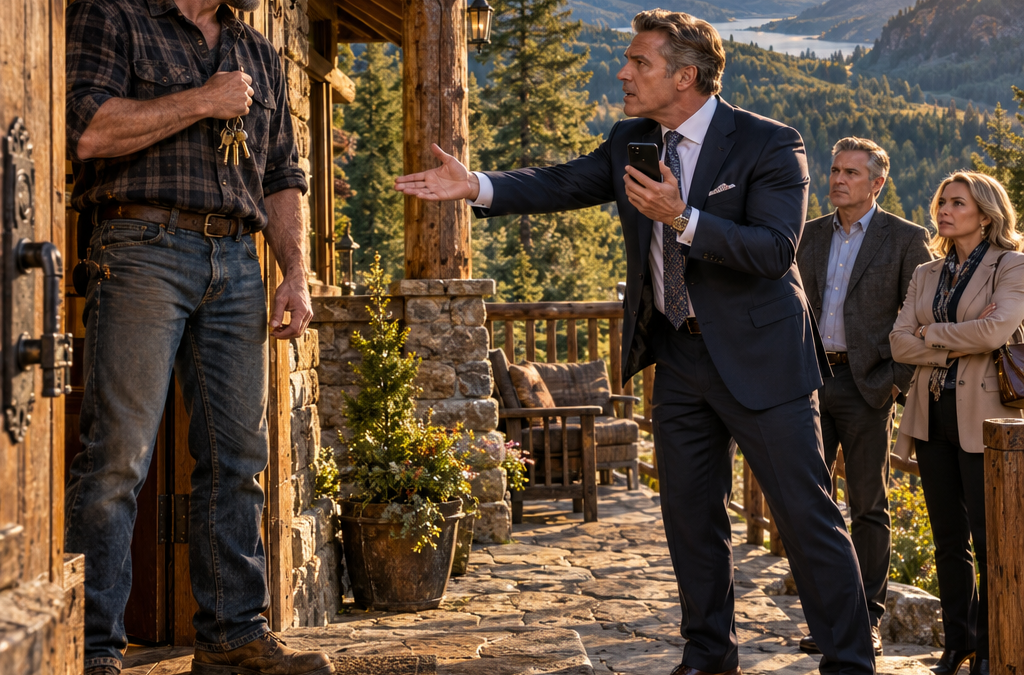
𝗙𝗨𝗟𝗟 𝗦𝗧𝗢𝗥𝗬
I knew all of this because my father had kept the records.
He wasn’t a lawyer.
He was simply careful.
He believed that people should understand what they owned and what obligations came with it.
When the first developers purchased land below the ridge, he reviewed the subdivision plans.
He checked the boundary descriptions.
He asked questions about road access.
And he made sure our property remained separate.
I still had the folder he assembled.
It contained the deed, recorded surveys, county maps, and correspondence establishing the house’s independent status.
For years, that folder sat quietly in the cabinet beside the fireplace.
I never imagined I’d need to spread its contents across a police vehicle to prove that a neighboring association couldn’t demand my front-door keys.
The trouble began on a Thursday afternoon in early fall.
I’d driven up to the mountain the previous evening.
The weather was beautiful.
The air was cool enough for a light jacket, and the first autumn colors were beginning to appear among the aspens along the lower road.
I spent the morning cleaning the gutters and checking the windows before winter.
By lunchtime, I’d finished the work I planned to do.
I made coffee, carried it onto the porch, and sat in the wooden chair beside the front door.
From there, I could see the mountain road winding toward the house.
A little after two, I heard an engine.
Then another.
I looked toward the bend below the property.
Two vehicles appeared through the trees.
The first was a black luxury SUV.
The second was a silver sedan.
Both climbed slowly toward the house.
I set my coffee down.
Nobody had told me they were coming.
The black SUV stopped near the front steps.
A man climbed out wearing a dark blue suit and an expensive-looking coat.
His silver-black hair was combed neatly away from his forehead. He had a closely trimmed beard, a gold watch, and polished shoes completely unsuited to the gravel driveway.
He looked like a man arriving for a corporate negotiation.
Not someone visiting a remote mountain house.
Two other people emerged from the sedan.
One carried a clipboard.
The other held a folder.
The man in the suit glanced around with a critical expression.
Then he walked toward my porch.
“Good afternoon.”
I stood.
“Afternoon.”
“I’m Karen Brooks, president of the Silver Pine Estates Homeowners Association.”
I nodded.
“I know the neighborhood.”
He gave me a practiced smile.
“Excellent. Then you understand why we’re here.”
I looked at the two representatives behind him.
“Actually, I don’t.”
His smile tightened slightly.
“We’re conducting a property access and safety review.”
“Of what property?”
He looked toward the house.
“This one.”
I stared at him.
“Why?”
“Because the association has responsibilities concerning structures that affect the surrounding community.”
I leaned against the porch railing.
“My house isn’t in your HOA.”
Karen adjusted his cuff.
“That isn’t the only consideration.”
“It seems like a pretty important one.”
He gave a short, dismissive laugh.
“You’re taking an unnecessarily narrow view of community responsibility.”
I studied him.
There was something familiar about the way he spoke.
He used phrases that sounded official without answering the question.
Community responsibility.
Safety review.
Surrounding impact.
He said them as though the words themselves established authority.
“What exactly do you want to inspect?” I asked.
“The interior, exterior access points, and security arrangements.”
I stared at him.
“The interior?”
“Yes.”
“You want to go inside my house?”
“That’s generally what an inspection involves.”
I glanced at the two representatives.
Neither looked particularly comfortable.
The woman with the clipboard avoided my eyes.
I turned back toward Karen.
“Who authorized that?”
“The HOA.”
“Who in the HOA?”
“The board.”
“And what gives your board authority over my house?”
Karen’s expression hardened.
“Our governing rules.”
I took a slow breath.
“Karen, those rules apply to properties legally subject to your association.”
“This residence affects the community below.”
“That doesn’t make it community property.”
He straightened his jacket.
“Nobody is claiming the house is community property.”
“Then why do you need to enter it?”
“To fulfill our inspection responsibilities.”
“Show me the document creating those responsibilities.”
For the first time, he hesitated.
Only for a moment.
Then he turned toward the representative carrying the folder.
“Do you have the compliance materials?”
The man handed him several pages.
Karen flipped through them and selected one.
He held it toward me.
“This is the association’s inspection policy.”
I examined it.
The document listed routine safety and maintenance procedures for properties inside Silver Pine Estates.
It discussed exterior inspections, community standards, and access requirements for certain shared facilities.
Nothing identified my mountain parcel.
Nothing mentioned my house.
Nothing granted the HOA a right to enter neighboring private residences.
I handed it back.
“This doesn’t apply to me.”
Karen’s jaw tightened.
“It reflects our established procedures.”
“For your members.”
“Our responsibilities extend to protecting neighborhood interests.”
“Then protect them from your own property.”
His face changed.
The polished smile disappeared.
“That attitude is exactly why this inspection is necessary.”
I stared at him.
“What attitude?”
“Your refusal to cooperate with reasonable oversight.”
I looked toward the woman with the clipboard.
“Did somebody report a problem with this house?”
She glanced toward Karen.
He answered before she could speak.
“We’ve received concerns.”
“What concerns?”
“Security.”
“Has someone broken into the house?”
“Not that I’m aware of.”
“Has there been a fire?”
“No.”
“Is the building unsafe?”
“That is what we intend to determine.”
I folded my arms.
“So you don’t have a specific problem. You just want to come inside.”
Karen stepped closer.
“You’re making this much more difficult than necessary.”
I felt my patience thinning.
“Then explain why you believe you can enter without my permission.”
He looked at the front door.
Then he held out his hand.
“Give me the keys.”
I stared at him.
For a moment, I genuinely thought I’d misunderstood.
“What?”
“The keys to the property.”
I looked down at the brass key ring resting on the porch table.
Then back at him.
“Why would I do that?”
“The association needs reliable access for inspection purposes.”
“Reliable access?”
“Correct.”
“You want to keep a set of keys?”
“That would be the most efficient arrangement.”
I felt something cold settle in my chest.
He wasn’t asking me to open the door for a specific inspection.
He wanted control over access.
Permanent access.
A means of entering the house whenever the HOA decided it was necessary.
“No.”
His eyebrows rose.
“Excuse me?”
“No, Karen. You’re not getting my keys.”
His expression hardened.
“This is a standard compliance procedure.”
“Not for my property.”
“You seem determined to resist every reasonable request.”
“You’re asking me to hand over the keys to my family’s house.”
“To the association.”
“That doesn’t make it better.”
Karen looked at the two representatives behind him.
Then back at me.
He seemed almost embarrassed that I’d refused in front of witnesses.
“Let me make this clear,” he said. “Silver Pine Estates has an obligation to maintain security throughout the mountain community.”
“Your community is down the road.”
“This property overlooks the neighborhood.”
“Yes.”
“And its condition affects us.”
“Then tell me what condition concerns you.”
His eyes narrowed.
“We don’t need your permission to fulfill our responsibilities.”
I picked up the keys.
The brass felt cool against my palm.
“My father carried these keys for decades,” I said. “Before that, they belonged to my grandfather.”
Karen’s expression barely changed.
“Sentiment doesn’t supersede policy.”
I looked at him.
“Neither does policy supersede ownership.”
He stepped closer.
“You’re being unreasonable.”
“No. I’m refusing to give a stranger permanent access to my house.”
His face reddened.
“I’m not a stranger. I’m the president of the homeowners association.”
“An association I don’t belong to.”
The silence became uncomfortable.
One of the representatives shifted his weight.
I could hear the wind moving through the pines below the porch.
Karen stared at the keys.
Then he extended his hand again.
“Give them to me.”
I closed my fingers around the ring.
“These stay with me.”
That was when he reached for his phone.
He looked almost relieved.
As if he’d been waiting for an excuse to escalate the confrontation.
“Fine,” he said. “I’ll call the police.”
I nodded.
“Go ahead.”
His expression flickered.
I don’t think he expected that answer.
He probably expected me to panic.
Or apologize.
Or surrender the keys before he finished dialing.
Instead, I stepped back beside the porch railing.
Karen turned away and made the call.
I heard him describe an access dispute involving a property that supposedly fell within the HOA’s security responsibilities.
He said I was refusing authorized inspection access.
He emphasized that the association needed assistance resolving the situation.
Every few seconds, he glanced toward me.
I said nothing.
I knew what he was trying to do.
He wanted the presence of law enforcement to change the balance of power.
He believed the police would hear his title, see his documents, and assume his request was legitimate.
Then I’d be pressured into handing over the keys.
The thought made me angry.
But I wasn’t going to give him the confrontation he wanted.
When he finished the call, he slipped the phone back into his jacket.
“They’re sending someone.”
“All right.”
“You still have time to resolve this voluntarily.”
I looked at him.
“By giving you my keys?”
“By cooperating with the association.”
“No.”
His jaw tightened.
“Then the consequences are your responsibility.”
I looked toward the road.
For the first time that afternoon, I felt genuinely uneasy.
Not because I’d done something wrong.
Because I understood how much damage could happen when someone with an official-sounding title made false assumptions sound like facts.
I had the deed.
I had the survey.
I knew the house belonged to me.
But I still had to stand on my own porch and wait for police officers because Karen refused to accept the boundary.
I went inside to retrieve the property folder.
Karen immediately called after me.
“Where are you going?”
“To get the documents you should’ve read before coming here.”
He looked irritated.
I stepped inside.
The familiar smell of cedar and fireplace ash greeted me.
The living room was quiet.
My father’s old armchair sat near the window.
A framed photograph of my grandparents hung above the mantel.
For a moment, I stopped beneath it.
Grandpa stood beside the front door, smiling with one hand on the porch railing.
My grandmother stood next to him holding a basket of flowers.
They looked proud.
Happy.
Completely unaware that decades later, someone from a neighborhood that didn’t yet exist would demand the keys to their house.
I felt grief tighten my throat.
Then I went to the cabinet beside the fireplace.
The property folder was exactly where I’d left it.
I removed the deed, recorded survey, and county map.
The paperwork wasn’t glamorous.
There were no colorful diagrams or impressive logos.
Just descriptions, signatures, recording information, and boundary lines.
But those pages represented something Karen’s polished presentation couldn’t replace.
Legal ownership.
I carried the folder outside.
Karen was still speaking to his representatives.
When he saw the documents, he gave a dismissive smile.
“More historical paperwork?”
“Property records.”
“Those don’t necessarily override current community obligations.”
I looked at him.
“Then show me the current document that applies to this house.”
He said nothing.
I placed the folder on the porch table.
Then I waited.
It took a little while for the police vehicle to arrive.
The mountain road wasn’t easy to navigate.
It climbed through several sharp turns, crossed a narrow bridge, and passed an exposed section where the wind could make driving uncomfortable.
Eventually, I heard an engine approaching.
A marked police SUV came around the bend and stopped near the driveway.
Two officers stepped out.
The older officer was a broad-shouldered man with gray at his temples.
The younger officer carried a notebook.
Karen immediately hurried down the steps.
“Officers, thank goodness.”
The older officer looked at him.
“Sir, are you the caller?”
“Yes. Karen Brooks, president of Silver Pine Estates.”
“All right. I’m Officer Harris. This is Officer Collins.”
Karen gestured toward the house.
“We have an ongoing refusal of HOA inspection access.”
Harris glanced at the building.
“Inspection access?”
“Correct. The owner is refusing to surrender the keys required for association security responsibilities.”
I felt my jaw tighten.
Required.
That was the word Karen kept using.
As if saying something was required made it so.
Harris looked toward me.
“Are you the property owner?”
“Yes.”
“Can you come down here, please?”
I picked up the folder and walked down the steps.
Karen stepped aside, wearing a satisfied expression.
He seemed convinced the officers were about to take over.
Harris looked at me.
“What’s going on?”
I kept my voice calm.
“This is my family’s mountain house. It’s private property, outside the HOA. Karen came here demanding that I give him the keys so the association can enter whenever it wants.”
Karen immediately interrupted.
“That’s a distortion.”
Harris raised one hand.
“Sir, let him finish.”
Karen stopped.
I continued.
“I asked for the legal document giving the HOA access. He showed me community inspection rules, but nothing establishing that those rules apply to this property.”
Harris nodded.
“Do you have proof of ownership?”
I opened the folder.
“Yes.”
He took the deed.
Officer Collins moved beside him.
They examined the property description and recording information.
Harris looked at the survey.
Then at the county map.
“How long has your family owned this house?”
“For decades. My grandfather owned it before the subdivision existed.”
“And it’s currently titled in your name?”
“Yes.”
He checked the documents again.
Then he looked toward Karen.
“Does the HOA have a recorded agreement granting access to this specific property?”
Karen opened his folder.
“Our inspection policies establish the association’s responsibilities.”
Harris held out his hand.
“May I see them?”
Karen handed over the papers.
The officer read them.
His expression remained neutral.
Then he asked, “Is this house listed as part of your association?”
Karen hesitated.
“It’s located above our community.”
“That isn’t what I asked.”
Karen adjusted his tie.
“The property has a direct impact on neighborhood security.”
Harris looked at him.
“Is the owner a member of the HOA?”
“No, but—”
“Is there a recorded covenant or access easement granting your association the right to enter this house?”
Karen looked toward the folder.
“We have board-approved procedures.”
Harris paused.
“That doesn’t answer the question.”
The wind lifted the corner of the survey.
I pressed it down with one hand.
Karen’s face became redder.
“Our board is responsible for maintaining standards.”
“On property legally subject to those standards,” Harris said.
Karen looked offended.
“Officer, you don’t understand the importance of our inspection program.”
Harris remained calm.
“I understand that you’re requesting access to a private residence.”
“Yes.”
“And the owner is refusing.”
“Correct.”
“So I need to know what legal authority gives you the right to enter.”
Karen looked toward the two HOA representatives.
Neither spoke.
He turned back.
“The association believes the property falls within our wider security responsibility.”
Harris nodded slowly.
“Belief isn’t documentation.”
The words hung in the air.
I felt some of the tension leave my shoulders.
Not because the officer had declared the entire dispute resolved.
But because he was asking the same question I’d been asking from the beginning.
Where was the legal authority?
Karen tried another approach.
“This mountain house sits above our residential streets. If something happened here, it could affect hundreds of homeowners.”
I looked at him.
“What exactly do you think is going to happen?”
He ignored me.
Harris asked, “Is there an emergency here right now?”
Karen hesitated.
“No immediate emergency.”
“Is anyone inside who needs assistance?”
“No.”
“Has the owner threatened anyone?”
“Not directly.”
“Has the county issued an order requiring inspection of this residence?”
“Not that I’m aware of.”
Harris looked at the house.
Then back at Karen.
“Then this appears to be a civil disagreement about access.”
Karen’s expression hardened.
“Are you refusing to assist the association?”
“I’m explaining that police cannot compel someone to surrender the keys to his private home just because an HOA requests them.”
Karen stared at him.
“But we’re responsible for security.”
“That responsibility doesn’t automatically authorize entry.”
I looked down at the keys in my hand.
They suddenly felt heavier.
Harris turned toward me.
“Sir, if the association believes it has a lawful right of access, that claim may need to be resolved through the appropriate civil process.”
I nodded.
“That’s fine.”
“Do you understand that a valid court order or other legal authority could change the situation?”
“Of course.”
He nodded.
“But based on what I’ve been shown here, I don’t have grounds to require you to hand over the keys.”
I exhaled slowly.
“Thank you.”
Karen stepped forward.
“Officer, this is unacceptable.”
Harris looked at him.
“I’m not ruling on every possible legal issue. I’m telling you there is no basis for us to force entry or seize the keys today.”
“The HOA has responsibilities.”
“Then have your attorney establish the right you’re claiming.”
Karen’s jaw tightened.
He looked at me.
“This isn’t finished.”
I met his eyes.
“Then bring the proper documents.”
For a moment, I thought he might shout.
Instead, he closed his folder sharply.
Officer Harris looked at both of us.
“I expect everyone to keep this peaceful.”
I nodded.
Karen said nothing.
Collins handed my deed back.
“Keep these records available.”
“I will.”
The officers returned toward their SUV.
Karen remained near the steps, watching them.
Before leaving, Harris looked at him one final time.
“Mr. Brooks, don’t attempt to enter this residence without permission or other lawful authority.”
Karen’s face tightened.
Then he gave a stiff nod.
The police vehicle turned around and started down the mountain road.
I stood on the porch watching it disappear.
For several seconds, nobody spoke.
Then Karen turned toward me.
“You seem pleased with yourself.”
I looked at him.
“I’m relieved the officers checked the documents.”
He gave a short, bitter laugh.
“You’re confusing a police officer’s unwillingness to intervene with a final legal determination.”
I nodded.
“You’re right about one thing. If you believe the HOA has an enforceable right, you can take it through the proper process.”
His expression hardened.
“But until then, you’re not getting my keys.”
He stared at the key ring in my hand.
Then he glanced toward the front door.
I could almost see the calculation happening.
He had expected a simple result.
He would arrive with HOA representatives.
Demand the keys.
Call the police if necessary.
And leave with permanent access to my mountain house.
Instead, the officers had refused to force anything.
And now he was standing on my porch with no more authority than when he’d arrived.
I walked toward the door.
Karen followed me with his eyes.
“What are you doing?”
“Going inside.”
“You can’t simply dismiss an ongoing compliance concern.”
I inserted the old brass key into the lock.
The familiar mechanism turned with a heavy click.
I opened the door.
Then I looked back.
“Karen, this is my house.”
He stared at me.
“And I’m going inside.”
I stepped through the doorway.
Closed the heavy wooden door.
And locked it behind me.
For a few seconds, I stood with my hand resting on the lock.
Outside, I heard Karen speaking sharply to the two representatives.
Then footsteps crossed the porch.
A vehicle door slammed.
An engine started.
A second followed.
Eventually, the sounds faded down the mountain.
The house was quiet again.
But the peace didn’t return immediately.
I walked into the living room and sat beside the fireplace.
My hands were still trembling slightly.
That surprised me.
I’d handled the confrontation calmly.
I’d shown the documents.
I’d answered the officers’ questions.
Nobody had entered the house.
Nobody had taken the keys.
Yet I felt as though something important had been threatened.
For most of my life, the mountain house had been the one place I could return to without explaining myself.
I didn’t need permission to sit on the porch.
I didn’t need approval to open a window.
I didn’t need a committee to decide whether the house deserved to remain private.
Now a man who lived miles below the ridge was insisting that his title entitled him to walk through my front door.
I looked toward the windows.
The valley was turning gold beneath the afternoon sun.
Far below, Silver Pine Estates looked peaceful.
Small houses.
Curving streets.
Perfectly arranged rooftops.
From this distance, nothing suggested the neighborhood had produced a man willing to call the police because I refused to surrender my family’s keys.
I sat there until the light began to fade.
Then I went outside to check the gate.
Karen was gone.
The vehicles were gone.
The driveway was empty.
But I found myself looking toward the road more often than usual.
That evening, I locked the front door earlier than I normally would.
I checked the windows.
Checked the side entrance.
Walked through the lower storage room.
Then returned to the living room.
I knew Karen hadn’t gained access.
I knew the officers had told him he couldn’t simply enter.
But I couldn’t stop thinking about how comfortable he’d been demanding the keys.
He hadn’t asked whether I would allow a scheduled inspection.
He hadn’t identified a specific emergency.
He hadn’t presented a warrant, easement, agreement, or court order.
He’d simply extended his hand.
As if the keys already belonged to him.
That was what disturbed me most.
His certainty.
I thought about the old brass key ring.
For decades, it had been a symbol of trust within my family.
Grandpa gave the keys to Dad.
Dad gave them to me.
The right to enter the house had always been tied to ownership, permission, and family.
Karen wanted to replace all of that with a board policy.
I didn’t want another argument over who physically held a key.
I wanted a security system that reflected the legal reality of the property.
Only people I authorized would have access.
Nobody else.
Late that night, I sat at the kitchen table with my phone and began researching modern residential locks.
I looked at electronic deadbolts.
Keypad systems.
Remote-access locks.
Camera-equipped models.
Eventually, I found a facial-recognition smart lock designed for residential use.
It had a built-in camera.
Encrypted user credentials.
Remote access management.
And a system that allowed me to register authorized users individually.
The feature that interested me most was the access list.
I could see exactly who had permission to unlock the door.
No guessing about copied keys.
No confusion about whether somebody had been given access years earlier.
No HOA president claiming he should have a spare simply because his board considered it convenient.
I studied the specifications.
Read the installation requirements.
Checked whether the hardware would fit the existing door.
Then I looked toward the old lock.
The house had a heavy wooden entrance door, built long before smart security systems existed.
I didn’t want to damage it.
My grandfather had made that door.
Every scratch and weathered mark was part of the house’s history.
So I checked the dimensions carefully.
I found a compatible model that could be installed without replacing the entire door.
The next morning, I placed the order.
It felt almost ridiculous.
A fifty-year-old HOA president had driven up the mountain demanding brass keys, and my response was to install technology that would make those keys unnecessary.
But the longer I thought about it, the more sensible the decision seemed.
I wasn’t trying to punish Karen.
I wasn’t trying to embarrass him.
I simply wanted clearer control over my own front door.
The lock arrived two days later.
By then, the weather had changed.
Low clouds moved across the mountain in the morning, and a cold wind swept along the exposed ridge.
I carried the package inside and placed it on the kitchen table.
The box was surprisingly compact.
Inside were the lock assembly, mounting hardware, installation instructions, and electronic components.
I read the instructions twice.
Then I gathered my tools.
Before removing the old lock, I photographed the door and existing hardware.
I measured everything again.
The old brass mechanism had served the family for decades.
It had survived winter storms, summer heat, and years of daily use.
Removing it felt stranger than I’d expected.
I loosened the screws carefully.
Pulled the interior plate free.
Then removed the old locking cylinder.
For a moment, I held it in my hand.
It was heavy.
Solid.
Worn.
I remembered watching my grandfather use that same lock when I was little.
He would turn the key slowly, push the door open, and announce that the mountain was officially ours for the weekend.
The memory brought a smile to my face.
I placed the old hardware on a clean cloth.
Then I installed the new lock.
The process required patience.
I aligned the mounting plate.
Checked the mechanism.
Secured the electronic assembly.
Then tested the bolt several times before connecting the system.
I didn’t rush.
If the lock failed during a winter storm, convenience wouldn’t matter.
I wanted it installed correctly.
When the physical installation was finished, I opened the companion app on my phone.
The setup process guided me through connecting the lock and configuring the owner account.
Within minutes, the system recognized the device.
I checked the status.
Door locked.
Battery level.
Access settings.
Authorized users.
Everything appeared on the screen.
Then came the final step.
Facial recognition.
I stood in front of the camera.
The display instructed me to position my face within the frame.
I followed the prompts.
Turn slightly left.
Turn right.
Look forward.
The camera completed the registration.
A message appeared confirming that my face had been enrolled as an authorized user.
I stood there for a moment, staring at the little screen.
It seemed almost too simple.
No brass key.
No physical handoff.
No argument about who should possess a spare.
Just an access system controlled by the property owner.
I stepped away from the door.
Waited a few seconds.
Then approached again.
The camera activated.
A small light blinked.
The mechanism clicked.
The door unlocked.
I laughed.
I couldn’t help it.
After everything that had happened, the sound was surprisingly satisfying.
I tested it again.
Then once more.
Each time, the lock recognized my face and released the door.
When I checked the app, my name was the only authorized user.
Nobody from Silver Pine Estates.
No committee members.
No security personnel.
No HOA president.
Just me.
I stood on the porch and looked out across the valley.
The clouds had lifted slightly.
Sunlight broke through above the distant hills.
For the first time since Karen’s visit, I felt some of the old peace returning.
The front door was secure.
The property records were in the cabinet.
And I no longer needed to carry the old keys everywhere.
I placed them in a small wooden box on the living room shelf.
I didn’t throw them away.
I never would.
They belonged to the history of the house.
But they no longer controlled the new lock.
That afternoon, I spent several hours checking the exterior shutters and stacking firewood near the covered porch.
I was halfway through the final stack when I heard an engine on the mountain road.
I stopped.
A black SUV appeared below the bend.
I recognized it immediately.
Karen.
I felt the muscles in my shoulders tighten.
He had returned.
Alone this time.
His vehicle climbed toward the house and stopped near the same place he’d parked during the first confrontation.
He stepped out wearing a dark wool coat over a perfectly tailored suit.
His hair was immaculate.
His shoes were polished.
And the expression on his face told me he hadn’t come to apologize.
He walked toward the porch.
His eyes moved immediately to the new lock.
He stopped.
“What is that?”
I set down the piece of firewood I was holding.
“A new lock.”
He stared at it.
“Why?”
“Security.”
His expression hardened.
“Who authorized you to install it?”
I looked at him.
“Who authorized me to put a lock on my own front door?”
“Don’t play games, Michael.”
I folded my arms.
“Then ask a reasonable question.”
He stepped onto the first porch step.
“That device interferes with the association’s ability to conduct required inspections.”
I stared at him.
“We already went through this.”
“The police did not resolve the underlying compliance issue.”
“They told you not to enter without permission or lawful authority.”
Karen’s jaw tightened.
“And I told you our board has responsibilities connected to this property.”
“Then show me the document.”
He looked irritated.
“We are still reviewing the relevant provisions.”
I nodded.
“So you still don’t have one.”
His face reddened.
“That is not what I said.”
“It’s what your answer means.”
He pointed toward the lock.
“Remove it.”
“No.”
His eyes narrowed.
“You cannot simply install a security system that prevents lawful association access.”
“Nobody has established that the association has a right to enter.”
“That’s your interpretation.”
“It’s what the deed says.”
Karen took another step closer.
He was now standing near the top of the porch.
His expensive coat moved in the wind.
I could smell his cologne.
He looked directly at the camera mounted on the lock.
“Does this thing record visitors?”
“It has a camera.”
“Then the association will need access to those records.”
I stared at him.
“What?”
“Security monitoring data may be relevant to our community responsibilities.”
I felt a sudden surge of anger.
First the keys.
Then the house.
Now he wanted access to the lock’s records.
“Karen, stop.”
He looked offended.
“Excuse me?”
“You don’t have authority over my house, my door, or my private security system.”
His expression hardened.
“You’re becoming increasingly hostile.”
“No. I’m setting a boundary.”
He glanced toward the valley.
“Silver Pine Estates is a highly regulated community.”
“Then regulate your community.”
“Our responsibilities don’t end simply because someone insists his property is separate.”
I took a slow breath.
“Your property rights end where mine begin.”
He gave me a cold smile.
“That’s a convenient slogan.”
“It’s also why the survey matters.”
Karen stared at the lock again.
“How does it open?”
I paused.
“Why do you need to know?”
“Because if the association requires access, we need to understand the mechanism.”
“It recognizes authorized users.”
“Who are the authorized users?”
“People I authorize.”
His expression tightened.
“And the HOA?”
“No.”
He looked genuinely shocked.
“You’re deliberately excluding the association.”
I met his eyes.
“Yes.”
The word hung between us.
Karen’s face became rigid.
He seemed unable to accept that I could say it without apologizing.
“You’re admitting that you’ve installed a system designed to deny us access.”
“I’m admitting that I installed a lock designed to keep unauthorized people out.”
He stepped back.
Then he reached for his phone.
I almost sighed.
“Karen, you’re going to call the police again?”
“If that’s what it takes.”
“The officers already reviewed the deed.”
“They haven’t reviewed this new obstruction.”
I looked toward the lock.
“It’s a front-door lock.”
“It’s an interference with association responsibilities.”
I shook my head.
“Then make your call.”
He stared at me for a moment.
Then dialed.
This time, he spoke more sharply.
He told the dispatcher there was an ongoing HOA access dispute.
He said I had installed a technological barrier preventing community inspection.
He claimed the new device created security concerns because the association no longer possessed any means of entry.
I listened without interrupting.
That last statement almost made me laugh.
The association had never possessed an authorized means of entry.
Karen was describing the loss of something he had never been entitled to.
When he ended the call, he looked satisfied.
“An officer is coming.”
I nodded.
“Then we’ll show him the same documents.”
Karen glanced at the lock.
“And the new system.”
“Of course.”
He seemed surprised by my calmness.
I wasn’t as calm as I looked.
Inside, I was furious.
I had come to the mountain to escape noise, conflict, and unnecessary demands.
Now I was dealing with a man who considered every refusal a personal insult.
The first time I denied him the keys, he called the police.
When the police refused to force entry, I improved my security.
Now he was calling them again because the new lock made his lack of access unmistakable.
Every reasonable step I took seemed to make him more determined to control the house.
I wondered how far he would go.
Would he keep returning?
Would he start sending letters?
Would he try to convince the county that the house was unsafe?
Would he encourage other HOA officials to pressure me?
I didn’t know.
And that uncertainty was beginning to wear me down.
Karen stood beside his SUV while we waited.
He checked his watch repeatedly.
At one point, he walked toward the side of the house.
I called out.
“Stay on the driveway.”
He stopped.
“I’m inspecting the exterior.”
“No, you’re not.”
His face hardened.
“You cannot prevent visual inspection.”
“You’re free to look at what you can lawfully see from a place you’re allowed to be. You’re not walking around my house without permission.”
He stared at me.
Then returned toward the SUV.
I could tell he wanted to argue.
But perhaps he remembered the officer’s warning from the first visit.
Less than an hour later, a police vehicle climbed the mountain road.
The same older officer stepped out.
Officer Harris.
He looked toward the house.
Then at Karen.
Then at me.
For a moment, his expression suggested he’d already guessed why he was there.
“Good afternoon.”
I nodded.
“Officer.”
Karen immediately approached.
“I’m glad you’re here. We have a new development.”
Harris looked at the front door.
“The lock?”
“Exactly.”
The officer glanced toward me.
“Michael, is that a new security system?”
“Yes.”
Harris nodded.
“All right. Tell me what’s going on.”
Karen began speaking before I could answer.
“The property owner has installed facial-recognition technology that prevents the association from carrying out its access responsibilities.”
Harris looked at him.
“Has the association established a lawful right to enter this house since our last visit?”
Karen hesitated.
“The matter is under review.”
“Do you have a court order?”
“No.”
“A recorded access agreement?”
“Not with me.”
“An emergency requiring immediate entry?”
Karen’s expression tightened.
“No.”
Harris nodded slowly.
“Then what’s changed?”
Karen pointed toward the door.
“The new lock.”
Harris walked closer.
He studied the device without touching it.
“Michael, does this lock secure your private residence?”
“Yes.”
“Is it installed on your front door?”
“Yes.”
“Does it affect any shared entrance, public access route, or neighboring property?”
“No.”
He looked toward the survey folder I’d placed on the porch table.
“Same ownership documents?”
“Same deed. Same boundaries. Nothing has changed except the lock.”
Harris nodded.
Then he turned toward Karen.
“A smart lock doesn’t change property ownership.”
Karen’s face reddened.
“That’s not the issue.”
“Then what is?”
“It prevents the HOA from entering.”
Harris looked at him.
“Did the HOA have an authorized key before?”
Karen hesitated.
“No.”
“Did the owner previously consent to entry?”
“No.”
“Then what access right did the new lock take away?”
Karen opened his mouth.
Nothing came out.
For several seconds, the only sound was the wind.
Then he said, “The association requires practical access to perform its responsibilities.”
Harris remained calm.
“Mr. Brooks, needing access and having a legal right to access are different things.”
Karen adjusted his coat.
“This property affects hundreds of residents below.”
“That doesn’t automatically give your association the right to enter it.”
I looked down at the wooden porch.
I could feel my pulse beginning to settle.
Harris turned toward me.
“Can you explain how the lock works?”
“Of course.”
I opened the app on my phone.
The screen displayed the lock’s status.
I showed him the authorized user list.
“My account controls access. I can add users if I choose to.”
He looked at the screen.
“And who’s currently authorized?”
“Only me.”
Harris nodded.
“So it’s a normal residential access-control system.”
“Yes.”
Karen stepped forward.
“Officer, he’s deliberately withholding access from the HOA.”
I looked directly at him.
“That’s intentional.”
Karen turned sharply.
I continued.
“Only people I personally authorize can enter my home. That’s how I want it.”
Harris looked at Karen.
“That is generally a property owner’s decision unless some separate lawful obligation requires access.”
Karen stared at him.
“The association has inspection policies.”
“Then those policies need to apply lawfully to this particular property.”
“They should.”
“Should isn’t the same as do.”
The words landed hard.
Karen’s face tightened.
I could see the old frustration returning.
The same frustration he’d shown when I refused the brass keys.
But something was different now.
The first time, he’d believed the police would force me to cooperate.
This time, the officer already knew the property records.
Karen couldn’t pretend the ownership question was unresolved.
He had to explain why an HOA that didn’t control the house should nevertheless receive access to its front door.
And he couldn’t.
Harris looked at the lock again.
“Michael, can you demonstrate that it functions as a private door lock?”
I nodded.
I stepped away from the entrance.
Waited for the device to return to standby.
Then walked toward it.
The camera activated.
A small indicator light appeared.
The mechanism clicked.
I opened the door.
Then I closed it and secured the lock again.
Harris watched.
“Seems straightforward.”
“It is.”
Karen looked deeply irritated.
“The fact that it works doesn’t make it appropriate.”
Harris turned toward him.
“Mr. Brooks, I’m not seeing a criminal violation here.”
Karen opened his folder.
“But the HOA—”
“Has not established authority to demand access.”
Karen’s jaw tightened.
The officer continued.
“If the association believes it has a legal right, you need to address that through the proper process. You cannot use police assistance to force someone to surrender access simply because your board would prefer it.”
Karen looked toward the valley.
His hands tightened around the folder.
For a moment, I thought he would launch into another speech about neighborhood standards.
Instead, he asked, “So you’re refusing to do anything?”
Harris answered carefully.
“I’m documenting the complaint. I’m explaining the limits of what law enforcement can do. And I’m making it clear that you should not attempt unauthorized entry.”
Karen lowered his eyes.
The officer looked at me.
“Michael, continue keeping your documents available. If there is a legitimate emergency or court order in the future, different rules may apply. But no one has established grounds for us to require you to remove this lock today.”
I nodded.
“Understood.”
Harris turned toward Karen.
“Do you understand?”
Karen remained silent for a moment.
Then he gave a stiff nod.
“Yes.”
For the first time since I’d met him, he didn’t argue.
He didn’t smile.
He didn’t insist that everyone misunderstood the importance of his position.
He simply gathered his papers.
The officer made a few notes.
Then he returned to his vehicle.
Karen walked toward his SUV without looking at me.
At the driver’s door, he stopped.
I was still standing on the porch.
He turned.
“I hope you understand the position you’ve put the association in.”
I looked at him.
“Karen, I haven’t put the HOA in any position.”
He frowned.
“I’ve kept my house private. That’s all.”
He looked toward the lock.
Then back at me.
His expression was exhausted, angry, and strangely uncertain.
Finally, he climbed into the SUV.
The engine started.
And he drove away.
I watched the black vehicle disappear around the curve.
Then I turned toward the front door.
The smart lock recognized my face.
The mechanism clicked.
I walked inside.
And for the first time in several days, I felt that the house was truly quiet again.
I didn’t sleep immediately that night.
Not because I was afraid of the lock failing.
It worked perfectly.
But I kept thinking about how the confrontation had escalated.
Karen had arrived wanting keys.
When I refused, he called the police.
The police checked the deed and refused to force access.
I installed a better lock.
Karen returned demanding that I remove it.
Then he called the police again.
Each time I tried to establish a reasonable boundary, he treated that boundary as an attack on his authority.
I sat beside the fireplace with a cup of coffee and looked at the small wooden box containing the old keys.
There was something sad about the whole situation.
For generations, those keys had represented home.
Safety.
Continuity.
Family.
Now they had become the object of a dispute with a man who didn’t understand why I refused to surrender them.
He saw metal.
I saw memories.
But even if they had been ordinary keys bought at a hardware store, the principle wouldn’t have changed.
Nobody should have to surrender access to a private residence simply because a neighboring committee wants it.
I looked toward the windows.
Far below, the subdivision lights glowed among the trees.
I wondered whether Karen genuinely believed he was protecting people.
Maybe he did.
Maybe somewhere inside his carefully maintained image of authority, he had convinced himself that controlling every nearby property was necessary for the neighborhood’s safety.
But good intentions couldn’t erase boundaries.
And wanting control wasn’t the same as having the right to exercise it.
Over the next several days, I began settling back into my routine.
I checked the gutters.
Stacked more firewood.
Cleaned the windows.
Replaced a worn weather seal on the back door.
And tested the new lock each morning.
It recognized me consistently.
The app showed no additional authorized users.
Everything worked as intended.
I stopped carrying the old keys in my pocket.
That felt strange at first.
For years, I’d checked for them automatically whenever I left the house.
Phone.
Wallet.
Keys.
Now I could walk toward the front door and hear the lock release when it recognized me.
The change was convenient.
But convenience wasn’t the only benefit.
The system made the authorization question unmistakable.
Access wasn’t something Karen could claim because he held a position.
It wasn’t something an HOA representative could assume because the house overlooked the neighborhood.
It was a decision I controlled, subject to whatever lawful obligations might actually apply.
And no one had demonstrated that Silver Pine Estates possessed such an obligation.
A week later, another envelope arrived.
I found it in the mailbox near the lower entrance.
The Silver Pine Estates logo was printed in the upper corner.
My stomach tightened immediately.
I stood beside the mailbox for a moment, staring at it.
Part of me wanted to throw it into the truck and ignore it until evening.
Another demand.
Another threat.
Another attempt to make me justify living in my own house.
But I opened it.
The language surprised me.
There was no immediate compliance deadline.
No order to surrender keys.
No threat of police intervention.
Instead, the letter requested a formal meeting to clarify access expectations concerning my mountain property.
It acknowledged that the house was privately owned and outside the HOA’s recorded boundaries.
And it proposed that the association and I discuss a procedure for future access requests involving legitimate concerns.
I read the letter twice.
Then a third time.
The tone was completely different.
For the first time, the HOA was asking.
Not demanding.
I wasn’t sure whether Karen had changed his mind or the board had finally questioned his approach.
But I recognized an opportunity.
I didn’t want to spend the next several years fighting over the same issue.
I wanted a practical understanding that everyone could follow.
So I agreed to meet.
I requested that the discussion be documented and that any proposed access procedure be put in writing.
I also said I would bring the property records.
The HOA confirmed the meeting.
It was scheduled for the following week at the neighborhood’s administrative office.
When the day arrived, I drove down the mountain carrying the same folder I’d shown the police.
The road curved through the pines.
As I descended, the trees grew taller and the air became warmer.
The first houses of Silver Pine Estates appeared behind decorative stone walls.
I passed landscaped medians, carefully trimmed hedges, and identical streetlights.
Everything looked orderly.
Controlled.
Predictable.
I parked outside the administrative building and sat for a moment before getting out.
The building had stone columns and large windows.
A sign beside the entrance carried the HOA name.
Inside, the lobby smelled faintly of expensive cleaning products and fresh coffee.
A receptionist directed me to a conference room.
Karen was already there.
He sat at the head of a long polished table.
Today he wore a charcoal suit and a dark tie.
His silver-black hair was perfectly styled.
A leather folder lay in front of him.
Two board representatives sat nearby.
They were the same people who had accompanied him to my house during the first confrontation.
A third board member had joined them.
She introduced herself as Margaret Ellis, the association’s secretary.
Karen stood when I entered.
“Michael.”
“Karen.”
His tone was noticeably more restrained.
He gestured toward a chair.
“Please sit.”
I placed my folder on the table.
“Thank you.”
For a moment, the room was quiet.
Then Margaret spoke.
“We appreciate you coming.”
I nodded.
“I’d rather settle this clearly than keep having police vehicles drive up the mountain.”
One of the representatives looked uncomfortable.
Karen’s jaw tightened slightly.
Margaret continued.
“That’s why we’ve asked for this meeting.”
She opened a folder.
“We’ve reviewed the property records and the circumstances of the recent complaints.”
I waited.
“The board recognizes that your mountain house is a separate private parcel outside the recorded HOA boundaries.”
I felt some tension leave my shoulders.
“Good.”
She continued.
“We also recognize that our existing inspection policy does not, by itself, grant unrestricted access to that residence.”
Karen looked down at the table.
It was the first time I’d heard anyone from the association state the distinction so clearly.
I opened my own folder.
“That’s what I’ve been trying to explain.”
Margaret nodded.
“We understand.”
Karen leaned forward.
“However, the board still has responsibilities concerning safety issues that may affect the broader community.”
I looked at him.
“I’m willing to discuss legitimate concerns.”
He seemed relieved.
“Good.”
“But discussing concerns doesn’t mean surrendering the keys or giving the HOA permanent access.”
His expression tightened.
Margaret raised a hand.
“We’re not asking for that.”
I looked toward her.
“Then we’re making progress.”
She gave a small smile.
The next hour was the most productive conversation I’d had with anyone from Silver Pine Estates.
We reviewed the recorded property boundaries.
I showed them the deed.
The county survey.
The parcel description.
And the documents my father had preserved when the subdivision was first developed.
The board members compared those records with the HOA map.
The distinction was clear.
My house stood on an independent parcel above the tree line.
The HOA’s boundaries ended below it.
The fact that the neighborhood could see my house didn’t create a right to enter it.
Karen listened.
Occasionally, he tried to redirect the discussion toward broad security responsibilities.
But this time, the other board members kept returning to specific documents and practical procedures.
Margaret asked whether I’d be willing to consider inspection requests if there were a concrete concern involving a potential hazard affecting neighboring property.
I nodded.
“Of course.”
Karen immediately leaned forward.
“Then we agree that inspections may be necessary.”
I looked at him.
“Requests may be necessary. Authorization is a separate question.”
His expression tightened.
I continued.
“If the HOA identifies a genuine concern, send me the details. Explain what the issue is, why access is needed, and what authority you’re relying on.”
Margaret nodded.
“That seems reasonable.”
“If there’s an actual emergency, contact the appropriate emergency services. I won’t obstruct lawful emergency response.”
Karen folded his arms.
“And routine inspections?”
I looked directly at him.
“My house isn’t subject to your routine HOA inspections.”
He stared at me.
I continued.
“If I choose to invite someone to inspect a particular concern, that permission will be specific. It won’t create a permanent right of access.”
Margaret wrote something down.
“Understood.”
One of the other representatives asked about the new smart lock.
I explained that it was a standard residential security system.
I controlled the authorized user list.
I could grant access to individuals when appropriate.
And I could revoke that access when the authorized purpose ended.
Karen looked toward me.
“So the association could receive temporary access?”
“If I agree to a legitimate request, I can arrange access in a secure way.”
He nodded.
“That would help.”
“But I’m not adding the HOA as a permanent authorized user.”
His expression hardened slightly.
Margaret intervened.
“There’s no need for permanent access in the procedure we’re discussing.”
I looked at her.
“Exactly.”
The atmosphere changed.
Not dramatically.
There was no sudden friendship.
Karen didn’t apologize for demanding my keys.
He didn’t admit that calling the police twice had been unnecessary.
But the board was finally treating the question as a matter of legal authority and consent rather than personal obedience.
That was enough to begin resolving it.
We spent the remainder of the meeting working through a simple written understanding.
The association could submit a request when it had a legitimate reason to seek access.
The request had to identify the specific concern.
I would review it.
If I agreed, we would arrange an appropriate time and method of entry.
Any permission would be limited to the agreed purpose.
The HOA would not retain keys or permanent credentials.
And the agreement would not change the property’s independent status or create new rights of entry.
Existing lawful emergency powers and any future court orders would remain unaffected.
The language was straightforward.
No unnecessary threats.
No vague claims about extended community jurisdiction.
No provision allowing Karen to decide that access was mandatory simply because he wanted it.
When the draft was finished, Margaret read it aloud.
I listened carefully.
Then I asked for one final clarification.
“This doesn’t give the HOA continuing access if I authorize a single visit?”
“No,” she answered.
“And it doesn’t place my property under the community’s general inspection rules?”
“No.”
“And nobody gets a permanent key or smart-lock account?”
“Correct.”
I nodded.
“Then I can agree to that.”
Karen sat silently.
Margaret looked toward him.
“Karen?”
He adjusted his tie.
For several seconds, he said nothing.
Then he nodded.
“Yes.”
It was a small word.
But after two police calls, multiple confrontations, and days of unnecessary anxiety, it felt significant.
We finalized the written understanding.
Everyone received a copy.
I placed mine in the property folder beside the deed.
Then I stood.
Margaret extended her hand.
“Thank you for working with us.”
I shook it.
“I appreciate the board being willing to review the records.”
She nodded.
“We should have done that before the first visit.”
I looked toward Karen.
He didn’t respond.
I didn’t demand an apology.
The meeting had accomplished what I needed.
The HOA had formally recognized the limits of its authority.
The future access procedure was clear.
And my house remained private.
As I turned to leave, Karen spoke.
“Michael.”
I stopped.
He stood beside the conference table.
His expression was serious.
“I hope we won’t have any further misunderstandings.”
I looked at him.
“Neither do I.”
He glanced toward the folder in my hand.
“You’ve been very firm about the property.”
I nodded.
“It’s my family’s home.”
His eyes shifted toward the window.
For a moment, he seemed to be searching for something to say.
Then he asked, “Was all of this really necessary?”
I studied him.
The expensive suit.
The perfect hair.
The carefully controlled expression.
The same man who had stood on my porch demanding that I surrender the keys.
I could have reminded him of every insult.
Every threat.
Every time he accused me of refusing community responsibility.
But I was tired of fighting.
So I answered plainly.
“Karen, you could have asked for a meeting before you demanded my keys.”
He looked down.
“You could have checked the deed before calling the police.”
His jaw tightened.
“And you could have respected my refusal without coming back and demanding that I remove my lock.”
He didn’t answer.
I paused.
“All I wanted was to keep my home private.”
For once, Karen had nothing to say.
I walked out of the conference room.
The drive back up the mountain felt different.
The road was the same.
The trees were the same.
The sharp turns still required attention.
But the constant tension I’d felt over the previous weeks was beginning to fade.
As I climbed above the lower forest, the houses of Silver Pine Estates disappeared behind the trees.
The pavement ended.
The gravel road narrowed.
The air cooled.
And the mountain house appeared ahead.
Its stone chimney rose above the roof.
The broad windows reflected the afternoon sky.
The porch looked exactly as it had when my grandfather was alive.
I parked beside the shed and climbed out.
For a moment, I stood in the driveway looking at the house.
Then I walked toward the front door.
The camera activated.
The lock recognized me.
A soft click sounded.
The door opened.
I smiled.
It still felt slightly strange not reaching for the old brass keys.
But I liked it.
I liked knowing that access was clear.
That permission was deliberate.
That nobody could simply insist he deserved a copy because he held an HOA title.
Inside, I placed the property folder back in the cabinet.
The written agreement went beside the deed and survey.
For the first time, that folder contained not only proof of ownership but also a practical understanding with the neighboring association.
The conflict had been exhausting.
But at least it had produced clarity.
Over the following weeks, the house returned to its familiar rhythm.
I came up on weekends.
Sometimes I stayed several days.
I worked on ordinary maintenance projects.
Checked the water system.
Cleaned the fireplace.
Repaired a loose porch board.
And watched the weather move across the valleys.
The smart lock became part of my routine.
I’d approach the door.
The camera would recognize me.
The mechanism would release.
And I’d walk inside.
No searching for keys.
No argument about who should hold them.
No confusion about whether an HOA representative had been authorized to enter.
The system worked.
More importantly, the written agreement worked.
The association stopped sending demands for keys.
Nobody arrived unexpectedly to inspect the interior.
Karen stopped calling the police.
The board understood that any future access request had to be specific, lawful, and handled through the agreed process.
The silence that followed was one of the most welcome things I’d experienced in years.
About a month after the meeting, I spent a Saturday afternoon cleaning the small storage cabinet beside the fireplace.
It had accumulated decades of family odds and ends.
Old photographs.
A flashlight that no longer worked.
A pocketknife with a damaged handle.
A collection of postcards.
And several small wooden boxes.
One box sat near the back.
I recognized it immediately.
It was the one where I’d placed the original brass keys after installing the smart lock.
I carried it to the kitchen table.
The wood was dark and smooth.
My grandfather had made it years earlier from a piece of leftover walnut.
There was a tiny scratch along one corner.
I opened the lid.
Inside lay the old key ring.
The brass had lost most of its shine.
The faded red tape was still wrapped around one key.
I picked them up.
They felt familiar.
Heavier than I’d remembered.
I thought about the day Karen first arrived.
How confidently he’d held out his hand.
How he’d expected me to surrender those keys as though they were ordinary HOA property.
I remembered the police vehicle climbing the mountain.
The questions about ownership.
The second confrontation after I installed the smart lock.
And the final meeting where the association finally acknowledged that requesting access wasn’t the same as possessing a right to enter.
All of that had begun with a handful of old keys.
I smiled faintly.
My grandfather would have found the whole situation ridiculous.
He had never liked people who confused titles with character.
When I was young, he used to say that a man could own an expensive suit and still have no idea where his responsibilities ended.
I could almost hear him laughing at the thought of an HOA president driving four miles up a mountain to demand his front-door keys.
But I also knew he would have taken the dispute seriously.
He understood property boundaries.
He understood privacy.
And he believed that a home should be a place where the owner didn’t need to justify ordinary decisions to strangers.
I turned the old keys in my hand.
Then I looked toward the front door.
The new lock was barely visible from inside.
Modern.
Quiet.
Efficient.
The old keys no longer opened it.
But they still belonged in the house.
They connected me to the people who built and cared for the place before I did.
I returned them to the wooden box.
Then I placed the box on the shelf beside the fireplace.
Not because I expected to need the keys again.
Because I wanted to keep the memory.
The next morning, I woke before sunrise.
A cold wind moved across the ridge.
The windows were dark, and the first faint line of light had appeared above the eastern mountains.
I made coffee and carried it onto the porch.
The air smelled of pine and damp stone.
Far below, a few lights still glowed in Silver Pine Estates.
The neighborhood looked peaceful from that distance.
I thought about Karen.
He was still president of the HOA.
The association still existed.
Its residents still had their rules, meetings, and inspections.
Nothing about my victory required the neighborhood to disappear.
I hadn’t tried to take power away from them over property they actually controlled.
I’d simply insisted that their authority stop where my rights began.
That distinction mattered.
A community could have legitimate concerns about fire hazards, road safety, drainage, and emergencies.
Those concerns deserved to be taken seriously.
But concern alone didn’t create ownership.
And a responsibility to protect one group of homeowners didn’t give its president unrestricted access to somebody else’s home.
Karen had treated my refusal like an act of rebellion.
He believed that because he was responsible for the neighborhood below, he should be able to direct what happened above it.
He couldn’t understand why a man would refuse a seemingly simple request for keys.
But to me, the request had never been simple.
It was about whether a stranger could turn a neighboring HOA policy into control over my front door.
Whether family ownership meant anything when someone with a more impressive title demanded obedience.
And whether I could protect my privacy without being forced into a confrontation every time I said no.
The answer had taken longer than it should have.
Two police visits.
A new security system.
A formal meeting.
And a written agreement.
But it was finally clear.
The house was mine.
The boundaries were documented.
The HOA could ask when it had a legitimate reason.
I could decide whether to authorize access, subject to any actual legal obligation.
And nobody was entitled to permanent keys simply because they wanted them.
I took a sip of coffee.
The first sunlight reached the opposite ridge.
For a few minutes, the mountains glowed a deep orange.
Then the light moved slowly down the slopes.
The valley began to wake.
A bird called from the pines.
Somewhere below, a truck moved along the distant highway.
But up here, everything remained quiet.
I looked toward the front door.
The new lock was secure.
Inside, the original brass keys rested in their small wooden box.
I liked knowing they were still there.
Not as a means of entry.
As a reminder.
My grandfather had built this house because he wanted somewhere his family could gather without the pressures of the world below.
My father had preserved it because he understood how much it meant to us.
And I’d kept it because there were some things that deserved to survive longer than the people who first created them.
Karen had seen the house as another property that should fall within his sphere of control.
I saw the place where my grandfather taught me to build a fire.
Where my grandmother served breakfast beside the big window.
Where my father sat quietly after losing his parents.
Where generations of our family came when the world became too loud.
I would never apologize for protecting that.
When the coffee was finished, I stood and walked toward the door.
The lock recognized my face.
The mechanism clicked.
I stepped inside and closed the door behind me.
No HOA representatives waited on the porch.
No police vehicle climbed the road.
No one demanded that I hand over access to a home they didn’t own.
The mountain house had returned to what it had always been.
A quiet refuge above the tree line.
A place where I could hear the wind against the roof and watch storms gather beyond the valley.
A place where family history lived in the walls, the furniture, the worn floorboards, and the old wooden box beside the fireplace.
Karen had demanded my keys because he believed his HOA title gave him authority over my private home.
The police had checked the ownership documents.
The new lock had made access control unmistakable.
And the final written agreement had established what should have been understood from the beginning.
The HOA could request permission.
It could not simply take it.
I looked once more toward the wooden box.
Then I turned toward the fireplace and began preparing the house for another peaceful morning.
For the first time since Karen appeared on my porch, I wasn’t thinking about who might come knocking.
I was thinking about breakfast, the weather, and whether the western trail would be clear enough for a walk.
The old keys were safe.
The new lock was secure.
And the mountain house was still mine.
Exactly as it had been for generations.








