𝗙𝗨𝗟𝗟 𝗦𝗧𝗢𝗥𝗬 The HOA President Demanded I Destroy the Greenhouse I Spent Years Building—All Because It Blocked Her Million-Dollar Lake View.
𝗙𝗨𝗟𝗟 𝗦𝗧𝗢𝗥𝗬
Then I prepared the construction documents and submitted them through the required approval process.
I wasn’t careless about any of it.
I’d seen enough neighborhood disputes to understand that property rules mattered.
So I made sure the proposed structure complied with the applicable requirements.
The greenhouse would stand within the designated rear portion of my property.
Its foundation would remain inside the legal boundaries.
Its height and dimensions would comply with the approved design.
And the construction would be inspected as required.
I received the necessary permits and approvals before work began.
That paperwork mattered to me.
I kept every document.
Every drawing.
Every approval.
Every inspection record.
Not because I expected trouble.
Because I liked knowing things had been done correctly.
Construction took time.
I worked on the surrounding garden during weekends.
Saved for improvements.
Installed shelves.
Planned the watering system.
Adjusted ventilation.
Arranged the interior so the plants received appropriate light.
Eventually, the greenhouse became a beautiful space.
Clear glass walls rose above a sturdy foundation.
A central walkway separated rows of planting benches.
Hanging orchids formed colorful clusters overhead.
Ferns filled shaded corners.
Climbing vines softened the structural lines.
The air inside carried the scent of damp soil and flowering plants.
On cold mornings, the greenhouse felt like a little pocket of spring hidden inside winter.
During summer, sunlight moved slowly across the glass and leaves.
I had a wooden chair near the rear wall.
I’d sit there after difficult days with a cup of coffee, listening to the ventilation system and the quiet rustle of leaves.
Sometimes I read.
Sometimes I worked.
Sometimes I simply sat.
It wasn’t just a building.
It was the place where I could stop thinking about everything that demanded my attention.
My grandfather had once told me that a garden didn’t have to be impressive to matter.
It only had to be yours.
I thought about that often.
And for years, my greenhouse caused no trouble.
Neighbors occasionally asked to see it.
A few complimented the design.
Some wanted advice about growing orchids or keeping plants healthy through winter.
I enjoyed those conversations.
I never tried to impose the greenhouse on anyone.
I didn’t ask neighbors to help maintain it.
I didn’t interfere with their yards.
I didn’t cross their property lines.
I simply cared for the little world I’d built.
Then Karen became obsessed with her lake view.
Her house sat on a nearby lot positioned to overlook the water.
It was larger than mine, with an expensive rear deck, oversized windows, and professionally maintained landscaping.
She frequently described the lake view as one of her property’s most valuable features.
I understood why.
The lake was beautiful.
In the morning, sunlight stretched across the surface.
In the evening, the water reflected the colors of the sky.
But Karen seemed to believe that buying a house with a lake view gave her authority over anything that might ever appear between her windows and the water.
Trees.
Fences.
Garden structures.
Anything.
And eventually, she decided my greenhouse was an offense against her investment.
The first complaint came during an ordinary afternoon.
I was inside adjusting an orchid support when I heard someone calling my name.
I stepped outside.
Karen stood near the garden gate.
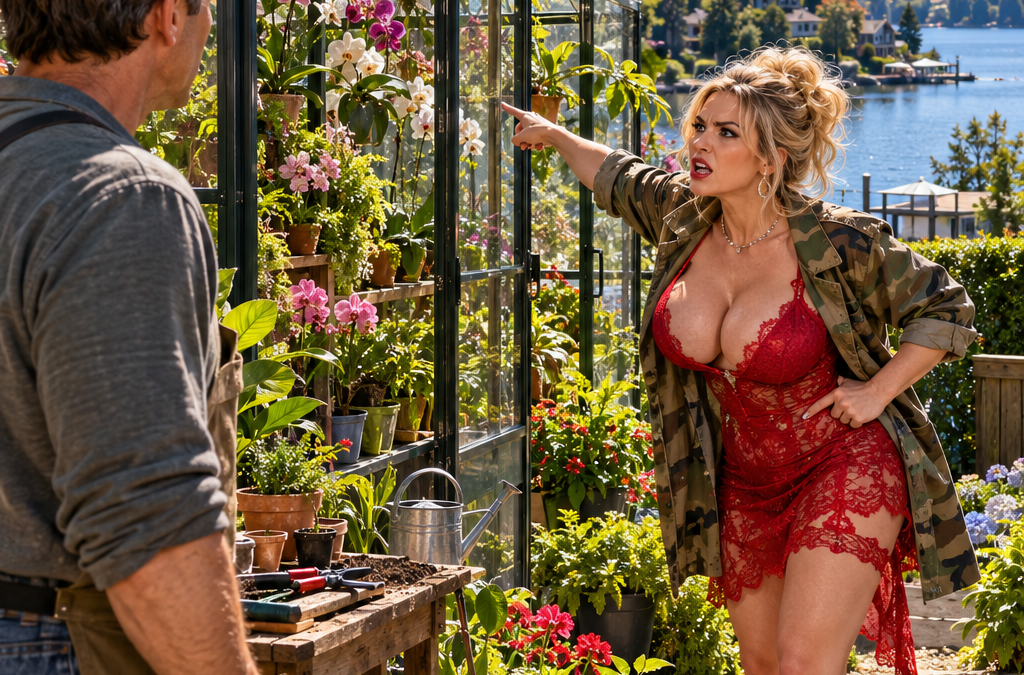
She wore her red lace dress and carried a leather folder tucked under one arm.
“Finally,” she said.
I frowned.
“Finally what?”
“I’ve been calling you.”
“I was working.”
She looked past me at the greenhouse.
“That monstrosity is becoming a serious problem.”
I stared at her.
“Monstrosity?”
She pointed.
“The greenhouse.”
“What about it?”
“It’s blocking my view.”
I glanced toward the lake.
Then back at her.
“The greenhouse has been here for years.”
“And it’s bothered me for years.”
“Then why are you bringing it up now?”
She lifted her chin.
“Because I’ve decided it’s time for the neighborhood to enforce its standards.”
I studied her.
“Which standard does it violate?”
“The appearance provisions.”
“Which section?”
Her eyes narrowed.
“Don’t start with that.”
“I’m asking for the actual rule.”
She stepped closer.
“Look, I know you’ve become attached to this ridiculous glass box, but some of us own valuable property.”
I felt my face grow hot.
“My property is valuable too.”
She laughed.
“Not in the same way.”
For a moment, I couldn’t believe what she’d said.
Then she continued.
“My lake-facing windows were designed around an unobstructed view. Your greenhouse interferes with that.”
I looked at her.
“Then you should have purchased the land between your house and the lake.”
Her smile vanished.
“Excuse me?”
“You don’t own my yard.”
She stared at me.
“You’re going to regret being disrespectful.”
I folded my arms.
“Karen, the greenhouse is legal. It’s on my property. I’m not removing it because you dislike looking at it.”
Her face hardened.
“We’ll see about that.”
Two days later, the official notice arrived.
It came in a thick white envelope bearing the HOA’s name.
I opened it at the kitchen table.
The heading read:
NOTICE OF ARCHITECTURAL NONCOMPLIANCE.
According to the association, my greenhouse violated neighborhood appearance standards.
The notice described the structure as oversized, visually inconsistent with the surrounding properties, and detrimental to the character of the community.
It demanded corrective action.
The implication was unmistakable.
Karen wanted the greenhouse removed.
I read the letter twice.
Then I looked through the window toward the garden.
The glass walls caught the afternoon light.
Inside, the orchids were blooming.
I thought about all the weekends I’d spent building that space.
All the plans.
All the money.
All the inspections.
And now a woman who disliked the view was trying to turn years of legal work into a violation.
That night, I brought every relevant document to the dining room table.
The original deed.
Property survey.
Recorded plat.
Construction drawings.
Building permits.
Inspection approvals.
HOA modification paperwork.
Applicable property restrictions.
I checked everything.
Then checked it again.
The greenhouse was entirely inside my property.
The approved dimensions matched the completed structure.
The required construction approvals were in place.
There was no apparent boundary encroachment.
And nothing in the documents supported Karen’s claim that her personal lake view gave her the right to demand demolition.
I sat back in my chair.
The evidence was straightforward.
I thought that would resolve the matter.
I wrote a professional response to the HOA.
I attached copies of the relevant documents.
I explained that the greenhouse was lawfully constructed and located within the recorded boundaries.
Then I asked the board to identify the specific enforceable restriction it believed had been violated.
I sent the letter.
And waited.
Karen didn’t respond with evidence.
She responded by coming back.
This time, she brought two HOA representatives.
They arrived while I was working near the greenhouse entrance.
I heard voices by the gate.
When I turned, Karen was already marching toward me.
Her red lace dress stood out against the green plants.
She carried a clipboard.
Behind her were two board representatives, both looking uncomfortable.
“Good afternoon,” Karen announced.
Her tone made it clear that she didn’t mean it.
I set down my tools.
“Karen.”
“We’re here for an official inspection.”
I looked at the two representatives.
“Was this scheduled?”
Karen ignored the question.
“We need to discuss immediate removal of the structure.”
I stared at her.
“I sent you the permits.”
“I received your paperwork.”
“Then you know it was approved.”
She smiled coldly.
“Approval doesn’t make an eyesore acceptable forever.”
I felt my jaw tighten.
“That’s not how property rights work.”
She turned toward the representatives.
“Do you see what I’ve been dealing with?”
Neither answered.
Karen pointed at the greenhouse.
“This structure is completely out of proportion with the neighborhood.”
I looked at her.
“It’s the same size as the approved plans.”
“The association has broad authority to protect aesthetic consistency.”
“Then identify the rule.”
Her face hardened.
“You are not going to interrogate me.”
“I’m asking why you’re demanding demolition.”
She stepped closer.
“Because I’m telling you the structure violates community standards.”
“That’s your opinion.”
Her eyes flashed.
“I am the HOA president.”
“And I’m the property owner.”
For a moment, the two of us stared at each other.
Then Karen turned toward the representatives.
“Record that he is refusing to cooperate.”
One of the men cleared his throat.
“Karen, perhaps we should review the documents first.”
She spun toward him.
“The board has already discussed this.”
“But the homeowner says he has permits.”
She glared at him.
“I am aware of what he claims.”
Then she faced me again.
“You have a choice. Remove the greenhouse voluntarily or force the association to pursue enforcement.”
I looked past her at the plants.
There were orchids I’d been growing for years.
Rare ferns I’d patiently nursed through difficult seasons.
Cuttings from plants my grandfather had once kept.
The greenhouse held memories that couldn’t be replaced by a construction invoice.
I turned back toward Karen.
“I’m not demolishing it.”
Her expression became vicious.
“Then you’ll pay for your stubbornness.”
I took a slow breath.
“You’re threatening me over your view.”
She leaned forward.
“I’m promising you that I will not allow one selfish homeowner to lower the value of my property.”
Then she turned and walked away.
The two representatives followed.
One of them glanced back at me.
For a moment, he looked almost apologetic.
But he said nothing.
I stood beside the greenhouse door feeling a mixture of anger and disbelief.
Karen had brought witnesses to my property.
She’d demanded demolition.
She’d threatened enforcement.
And she hadn’t identified one actual legal defect.
That evening, I sat in my wooden chair inside the greenhouse.
Rain tapped softly against the glass.
The orchids hung above me.
The air smelled of soil and greenery.
I tried to imagine tearing the structure down.
Breaking apart the glass.
Removing the benches.
Dismantling the ventilation system.
Carrying the plants into boxes with nowhere suitable to put them.
All because Karen preferred a different view from her deck.
I felt a tightness in my throat.
It wasn’t just anger.
It was the realization that someone was trying to take away the one place on my property where I felt completely at peace.
And she seemed to enjoy doing it.
The next step came quickly.
The HOA scheduled an official meeting concerning the greenhouse.
Karen’s notice described the issue as an urgent architectural compliance matter affecting neighborhood values.
The language was dramatic.
Deliberately so.
She wanted residents to believe the greenhouse threatened the appearance of the entire development.
I knew what she was doing.
If she could convince the board that my private garden was a community problem, she could justify increasingly aggressive enforcement.
And if the neighbors became angry enough, perhaps I’d surrender simply to avoid becoming the person everyone disliked.
I refused to let that happen.
Before the meeting, I prepared a binder.
The original deed.
The survey.
Approved construction drawings.
Permits.
Inspection records.
Photographs showing the greenhouse within the property.
Copies of the HOA notices.
My written responses.
Everything arranged chronologically.
Then I attended the meeting.
The clubhouse was nearly full.
Karen sat at the front table wearing a fitted jacket over her favorite red lace dress.
Her blonde hair was styled perfectly.
She smiled broadly as residents arrived.
When she saw me, her smile tightened.
“How nice that you decided to participate.”
I took a seat.
“I wouldn’t miss a meeting about my own property.”
She looked away.
When the meeting began, Karen presented photographs of the greenhouse.
The images had been taken from angles that made the structure appear large against the surrounding landscape.
She displayed one photograph showing the greenhouse from the direction of her house.
Then another.
Then a photograph of the lake.
“Residents,” she announced, “we have an ongoing issue involving a structure that substantially interferes with the visual quality of our community.”
I watched quietly.
Karen continued.
“Our neighborhood has always maintained strict architectural standards. Those standards protect property values, particularly premium lake-facing properties.”
She gestured toward the photograph.
“As you can see, this structure is simply unacceptable.”
I raised my hand.
She ignored me.
“Allowing this kind of construction to remain would establish a dangerous precedent.”
I raised my hand again.
Karen sighed.
“Yes?”
“May I show the approved plans?”
She smiled coldly.
“In a moment.”
I waited.
She continued speaking for several more minutes.
She described the greenhouse as oversized.
Unattractive.
Disruptive.
Inconsistent with the community’s appearance.
At one point, she called it a “glass warehouse.”
A few residents looked toward me.
I remained calm.
Finally, Karen announced that I could respond.
I stood.
Carried my binder to the table.
And opened it.
“This is my original deed,” I said.
Karen leaned back.
I placed the property survey beside it.
“This shows the legal boundaries of my lot.”
Then I opened the construction documents.
“These are the drawings approved before the greenhouse was built.”
A board member leaned forward.
“Those were approved?”
“Yes.”
I placed the permits on the table.
“And these are the required construction permits and inspection records.”
The board member began reading.
Another representative moved closer.
I watched their expressions change.
The evidence wasn’t complicated.
The structure was where the plans said it would be.
The dimensions matched the approvals.
The property boundaries were clear.
Karen’s photographs showed that she disliked the greenhouse.
They didn’t establish that it violated an enforceable restriction.
One resident raised his hand.
“Was this greenhouse approved before construction?”
I nodded.
“Yes.”
He looked toward Karen.
“Then why are we demanding its removal now?”
Karen’s face reddened.
“Because the negative impact became more apparent after completion.”
I stared at her.
“The greenhouse has been standing for years.”
She snapped.
“That doesn’t mean it belongs here.”
I looked around the room.
“Then what does approval mean?”
The question hung in the air.
Karen’s eyes narrowed.
I continued.
“If someone submits plans, receives the required permits, builds according to those plans, and passes inspections, what exactly are they supposed to rely on?”
One board member looked uncomfortable.
Another studied the deed again.
Karen struck the table with her hand.
“This discussion is becoming unnecessarily argumentative.”
I kept my voice even.
“I’m asking why my property rights are being treated as optional.”
She pointed toward the photograph of the lake.
“Because your greenhouse obstructs a valuable view.”
I looked at her.
“Does your deed give you ownership of my backyard?”
Her face hardened.
“Don’t be ridiculous.”
“Then show the recorded restriction that gives you control over structures on my land.”
She stared at me.
For several seconds, nobody spoke.
Then a woman near the back said quietly, “That seems like a fair question.”
Karen turned sharply.
“This meeting is not an opportunity to attack the board.”
The woman looked surprised.
“I wasn’t attacking anyone.”
Karen struck the table again.
“We will review the matter and issue our decision.”
The meeting ended without a clear explanation.
But something had changed.
Several residents had seen my documents.
They’d heard Karen’s argument.
And they were beginning to recognize that the dispute wasn’t really about community safety or building standards.
It was about one woman’s view.
After the meeting, I walked toward the parking lot.
Karen followed.
“That was a disgusting performance.”
I turned.
“Showing the board my permits?”
“Trying to embarrass me.”
“I answered the accusations you made.”
She stepped closer.
“You made me look foolish.”
I looked at her.
“Then perhaps you should stop making claims you can’t support.”
Her eyes flashed.
“You think those papers make you untouchable?”
“No.”
“Good. Because I can make your life miserable.”
I took a slow breath.
“Karen, leave my greenhouse alone.”
She smiled.
“Not a chance.”
Then she turned and walked away.
I watched her go.
For the first time, I understood that she wasn’t interested in finding a reasonable solution.
She wanted submission.
She wanted me to admit that her preferences mattered more than my deed.
And she intended to punish me until I did.
I decided to remove any remaining doubt about the boundary.
I hired a professional surveyor.
The surveyor arrived with his equipment and reviewed the recorded property documents.
He measured the relevant lines from multiple established points.
He checked the greenhouse’s position.
Verified the surrounding markers.
And prepared an independent report.
I watched him work.
The measurements took several hours.
When he finished, he stood beside the greenhouse with his notes.
“The structure is where your documents show it.”
I felt relief.
“Completely inside the property?”
“Yes.”
“Any encroachment?”
“None.”
I looked toward Karen’s house.
“And the distance from the boundary?”
He explained the verified position and showed me the measurements.
The greenhouse didn’t cross the HOA boundary.
Not by a foot.
Not by an inch.
Not by any measurable amount.
It was entirely on my land.
I asked for the completed professional survey in writing.
He provided it.
I sent a copy to the HOA.
I expected Karen to reconsider.
Instead, she arrived the following afternoon.
She stood at the edge of the garden, holding the survey as though it offended her.
“This doesn’t change anything.”
I stared at her.
“It proves the greenhouse is on my property.”
“We already knew where it was.”
“Then why are you claiming the association can order it removed?”
She rolled her eyes.
“Because property boundaries aren’t the only issue.”
“What’s the issue, then?”
“My view.”
I waited.
She seemed irritated that I wasn’t responding.
“My valuable lake view,” she repeated.
I looked at her.
“Karen, you keep saying that as if it gives you ownership of my yard.”
She stepped toward me.
“Don’t be smug.”
“I’m not.”
“You think you’re clever because you hired a surveyor.”
“I hired a surveyor because you threatened to destroy a permitted structure.”
Her face reddened.
“The HOA is prepared to go to court.”
I felt my heartbeat quicken.
“Then go to court.”
She blinked.
“What?”
“I’m prepared to defend my property.”
For the first time, she looked genuinely surprised.
Then her expression hardened.
“You have no idea what litigation costs.”
“I know it isn’t cheap.”
“Our attorneys will bury you in paperwork.”
I held her gaze.
“Then I suppose I’ll be bringing a very large binder.”
She stared at me with open hatred.
“You are going to regret this.”
I looked toward the greenhouse.
The sunlight was filtering through the glass.
Plants moved gently in the ventilation breeze.
Then I turned back to her.
“Karen, I regret that you turned a greenhouse into a war. But I’m not tearing it down.”
She spun around and marched away.
The court papers arrived a few weeks later.
The HOA had filed its case.
Seeing the association’s name on official court documents made the situation feel more serious than any threatening letter had.
Karen had spent weeks boasting about the power of the board.
Now she was trying to use the legal system to force me to remove something I’d built lawfully.
I sat at the kitchen table reading the filing.
The accusations were framed in formal language.
Architectural incompatibility.
Visual interference.
Adverse impact on premium lake views.
Violation of association appearance requirements.
The filing asked the court to grant relief that would require removal or alteration of the greenhouse.
I looked through the window.
The glass walls were glowing in the afternoon light.
Inside were years of work.
And now a court might be asked to order that work dismantled.
I felt sick.
Not because I believed Karen was right.
But because even an unjustified lawsuit could be expensive.
It could consume time.
Drain savings.
Create stress.
And force me to defend the same facts over and over.
I hired an attorney experienced in property and HOA disputes.
At our first meeting, I placed the binder on his desk.
He opened it.
Reviewed the deed.
Then the survey.
Then the permits and approved construction drawings.
He examined the association’s filing.
And began making notes.
After a while, he looked up.
“You’ve kept excellent records.”
“I didn’t expect to need them.”
“Most people don’t.”
He turned back to the deed.
“Tell me about this portion of the property.”
I explained that the rear garden area was one of the reasons I’d bought the house.
He studied the property description.
Then asked whether I had copies of all recorded agreements affecting the lot.
“I have the main closing packet.”
“Do you have the older property agreements?”
I frowned.
“Older than the deed?”
“Agreements recorded against the parcel can continue affecting property rights after ownership changes.”
I leaned forward.
“What are you looking for?”
“Specific provisions addressing permissible structures and the designated garden area.”
He made several notes.
Then looked at me.
“I want to review the complete recorded history.”
I nodded.
“All right.”
He tapped the deed.
“Because there may be protections here that go beyond the ordinary boundary question.”
For the first time, I realized the case might become much bigger than Karen’s demand to remove a greenhouse.
I had thought I was defending a building.
My attorney was examining the legal framework that protected how my land could be used.
And the more he studied it, the more interested he became.
Over the following days, he reviewed the recorded instruments connected to my parcel.
The original development documents.
Subsequent property agreements.
Recorded restrictions.
Relevant amendments.
And the provisions that governed the designated rear portion of my property.
He also analyzed the HOA’s claimed authority.
Then he called.
“I found something important.”
I sat down.
“What?”
“An older recorded agreement attached to the property.”
My pulse quickened.
“What does it say?”
“It specifically addresses the owner’s right to maintain lawful structures within the designated area.”
I stared at the wall.
“Structures like my greenhouse?”
“That’s what we need to establish through the exact language and its relationship to the other property documents. But it provides an important additional protection.”
I closed my eyes.
For weeks, Karen had behaved as though her dislike of my greenhouse gave the HOA absolute power.
Now there was another recorded document supporting my rights.
Not just the deed.
Not just the survey.
An older agreement that expressly protected the maintenance of structures in the designated area.
My attorney continued.
“The association cannot simply ignore recorded property rights because one resident dislikes a view.”
I felt some of the tension leave my shoulders.
“Then why would they file this lawsuit?”
He paused.
“Sometimes people assume litigation pressure will produce the result they want, regardless of the strength of the underlying claim.”
I thought about Karen.
Her threats.
Her confidence.
The way she enjoyed telling me how expensive court would be.
That explanation sounded painfully familiar.
My attorney advised me not to discuss the newly located agreement with Karen directly.
We would handle the document through the litigation process.
I agreed.
I wasn’t interested in another shouting match at my garden gate.
I wanted the court to examine the evidence.
And I wanted the greenhouse protected.
Still, the weeks before the hearing were difficult.
Karen didn’t stop talking about the dispute.
She described me as an unreasonable homeowner who refused to respect community standards.
She repeatedly claimed I was damaging property values.
She complained that her expensive lake view had been compromised.
She made the greenhouse sound like a dangerous industrial structure rather than a carefully maintained private garden.
At one point, a neighbor approached me near the mailbox.
“Is it true the HOA wants you to tear the whole thing down?”
I nodded.
“That’s what they’re asking for.”
He looked surprised.
“Over the view?”
“Apparently.”
He glanced toward my backyard.
“I’ve seen the greenhouse. It looks nice.”
I smiled faintly.
“Thanks.”
He shook his head.
“Karen makes it sound like you’ve built a warehouse.”
I looked toward her house.
“Karen has a very specific view of what she wants.”
He chuckled.
Then his expression became serious.
“She’s been telling people the lawsuit could cost the association a lot of money.”
I nodded.
“Litigation usually does.”
“She says it’s your fault.”
I felt my jaw tighten.
“I didn’t file the case.”
He studied me.
Then nodded slowly.
“Fair point.”
Conversations like that helped.
But they didn’t erase the anxiety.
Every official letter reminded me that my favorite place on the property was being challenged.
Every court deadline meant more preparation.
Every attorney meeting meant time and expense.
I found myself spending less time in the greenhouse.
Not because I loved it less.
Because being inside sometimes made the uncertainty harder.
I’d look at a shelf and imagine having to dismantle it.
I’d see a blooming orchid and wonder how I’d protect it if the structure were removed.
I’d touch the workbench and remember installing it years earlier.
Karen had succeeded in taking something from me before the case was even decided.
Peace.
The greenhouse had once been the place where I escaped stress.
Now it had become the center of it.
One evening, I stood inside while rain tapped against the roof.
The lights cast a warm glow across the plants.
I looked at the wooden chair near the rear wall.
Then at the orchids.
Some had taken years to mature.
Others had been propagated from older plants I’d kept through moves and difficult seasons.
They weren’t just decorations.
They were living reminders of patience and continuity.
I sat down.
For the first time since Karen began her campaign, I wondered whether the fight was worth it.
Not because I believed I should surrender.
But because I was tired.
Tired of documents.
Tired of meetings.
Tired of threats.
Tired of having to prove that a lawful structure on my own land deserved to remain there.
Then I remembered my grandfather.
I imagined him standing beside me with dirt on his hands, telling me that some things grew slowly because they were meant to last.
I looked around the greenhouse.
I had spent years creating this place.
Karen wanted it gone because she preferred a different view from her window.
I wasn’t going to let exhaustion accomplish what her arguments couldn’t.
The hearing arrived.
I woke early.
Checked the documents one more time.
Then drove to the courthouse.
My attorney met me near the entrance.
He carried the organized file and the relevant recorded agreements.
“Ready?” he asked.
“As ready as I can be.”
He nodded.
“Remember, the documents establish the foundation. We don’t need to turn this into a personal argument.”
I looked toward the courtroom doors.
“That’s easier said than done when Karen is involved.”
He smiled faintly.
“Then let her be the emotional one.”
We entered.
Karen was already there.
She sat beside the HOA’s attorney wearing a fitted jacket over her familiar red lace dress.
Her blonde hair was perfectly styled.
Her makeup was immaculate.
And she looked completely confident.
When she saw me, she smiled.
The same smile she’d worn while threatening to destroy the greenhouse.
The same smile she’d used when she told me the HOA would bury me in legal expenses.
She leaned toward her attorney and whispered something.
Then looked back at me.
I didn’t respond.
I sat beside my attorney and waited.
The hearing began.
The HOA presented its position first.
Its attorney discussed architectural restrictions, community aesthetics, and the association’s asserted interest in preserving lake views.
Karen’s photographs were introduced.
The greenhouse appeared from several angles.
Some showed its glass walls reflecting sunlight.
Others emphasized its position between nearby homes and the lake.
Karen’s attorney argued that the structure interfered with the visual character of the neighborhood.
He emphasized the value of lake-facing properties.
Then Karen was given an opportunity to explain her concerns.
She stood.
Straightened her jacket.
And addressed the court with the polished confidence she’d practiced at board meetings.
“The greenhouse has significantly diminished the enjoyment of my property.”
I watched her.
She continued.
“I purchased my home for its exceptional lake view. That view is part of what makes the property valuable.”
The judge listened.
Karen gestured toward the photographs.
“The structure is intrusive. It damages the visual harmony of the neighborhood, and the HOA has a responsibility to preserve community standards.”
She looked toward me.
“Some homeowners simply refuse to consider how their choices affect others.”
I felt my face grow hot.
My attorney placed a hand lightly on the table.
A reminder to remain calm.
Karen continued.
“I tried to resolve this privately. I gave him every opportunity to cooperate. Unfortunately, he refused.”
I stared at her.
She had marched onto my property and demanded demolition.
Threatened financial ruin.
Rejected the permits.
Dismissed the survey.
And now she was telling the court she’d been patient and reasonable.
The judge asked whether she claimed the greenhouse was physically encroaching onto association property.
Karen hesitated.
Then shook her head.
“That’s not the primary issue.”
“What is the primary issue?”
“My view.”
The courtroom became quiet.
The judge looked down at the documents.
Then back at Karen.
“We’ll examine the legal basis for the relief you’re seeking.”
She nodded confidently.
“I’m certain the law supports protecting valuable views.”
I looked at my attorney.
He remained composed.
Then it was our turn.
My attorney began with the original deed.
He placed it before the court and identified the relevant property description.
Then he introduced the official survey.
The legal boundaries were clearly marked.
The greenhouse stood entirely within my lot.
There was no encroachment.
No overlap.
No portion crossing into HOA property.
The judge examined the documents carefully.
My attorney presented the independent survey as additional confirmation.
The measurements matched.
The legal boundary remained unchanged.
Then he introduced the approved construction documents.
Permits.
Plans.
Inspection records.
Everything demonstrated that the greenhouse had been built in accordance with the documented approvals.
Karen shifted in her chair.
Her attorney reviewed the papers.
My attorney continued.
“The association’s argument concerns a neighboring owner’s preferred view, but the structure itself is located on private property and was built under the relevant approvals.”
The judge examined another page.
Then looked toward the HOA’s counsel.
“Does the association dispute the boundary shown on the survey?”
The attorney answered carefully.
He acknowledged the survey evidence but returned to the asserted architectural restrictions.
The judge asked whether the HOA owned any part of the land occupied by the greenhouse.
The answer was no.
I watched Karen.
Her confidence began to fade.
She leaned toward her attorney.
He whispered something.
She shook her head.
Then she raised her hand as though she were attending another board meeting.
The judge allowed her to clarify her position.
Karen stood.
“This isn’t simply about where the property line is.”
The judge looked at her.
“Then explain the legal right you believe allows removal.”
She gestured toward the photographs.
“My home has a premium lake view.”
The judge waited.
“That view is valuable. The HOA has an obligation to protect that value.”
The judge asked a direct question.
“Do you own any portion of the defendant’s property?”
Karen blinked.
“No, but—”
“Do you have a recorded easement or enforceable agreement granting you the right to prevent this structure?”
Her expression tightened.
“The association has architectural authority.”
“Please identify the specific provision that authorizes the requested removal despite the recorded property rights and construction approvals.”
Karen looked toward her attorney.
For the first time, she didn’t have an immediate answer.
I sat still.
My heartbeat was pounding.
The same woman who had spent weeks telling me she could force demolition was now being asked to identify the legal basis for her claim.
And she couldn’t simply strike a gavel and declare the discussion over.
My attorney stood again.
“Your Honor, there is one additional recorded document the court should examine.”
He opened the final section of the file.
Karen looked toward him.
Her expression changed slightly.
My attorney placed the older agreement before the judge.
He identified its recording information.
Explained how it related to the property.
Then directed the court to the provision protecting the owner’s right to maintain structures within the designated area.
The courtroom became silent.
I watched the judge read.
Then read again.
The agreement was older than the present dispute.
It hadn’t been created because Karen disliked my greenhouse.
It was part of the property’s recorded legal history.
And it specifically supported the right to maintain lawful structures in the relevant portion of my lot.
My attorney explained how the greenhouse fell within that designated area.
He connected the agreement to the deed.
Then to the survey.
Then to the approved construction documents.
The evidence formed a clear chain.
The land belonged to me.
The greenhouse was inside the protected area.
The structure had been approved and lawfully built.
And the HOA had not established a superior right to demand its removal simply because Karen’s view was affected.
Karen stared at the document.
Her face lost color.
She leaned toward her attorney.
“What is that?”
He answered quietly.
She looked at him in disbelief.
Then at the judge.
Then back at the paper.
For weeks, she’d acted as though the only relevant consideration was whether the greenhouse inconvenienced her.
Now the court was examining recorded property rights she hadn’t bothered to consider.
Karen stood abruptly.
“Your Honor, this is unfair.”
The judge looked up.
“Please allow counsel to proceed.”
She remained standing.
“That agreement is ancient.”
My attorney paused.
The judge addressed her calmly.
“The age of a recorded agreement does not, by itself, invalidate it.”
Karen’s lips tightened.
“But it shouldn’t allow him to ruin my property value.”
I felt anger rise.
She was still doing it.
Still describing my lawful greenhouse as an attack on her property.
Still treating her preferred view as more important than the rights attached to my land.
The judge asked her to sit.
This time, she did.
My attorney completed his presentation.
The judge reviewed the documents again.
The deed.
The official survey.
The permits.
The older recorded agreement.
The HOA’s claimed restrictions.
The photographs of the lake view.
Everything.
Then he addressed the central issue.
The association could not simply demand removal of a lawfully constructed structure from private property without establishing a valid legal basis for doing so.
A homeowner’s preference for an unobstructed view did not automatically create ownership or control over neighboring land.
The recorded property rights and approved construction documents were decisive.
I felt my hands trembling beneath the table.
Karen stared straight ahead.
Her attorney remained quiet.
The judge continued explaining the ruling.
The greenhouse could remain.
The HOA had not established authority to force its removal under the evidence presented.
The association’s claim failed.
For several seconds, I didn’t move.
I had imagined that moment repeatedly.
Sometimes I pictured myself celebrating.
Sometimes I imagined confronting Karen outside the courthouse.
Sometimes I dreamed of hearing the judge tell her exactly how unreasonable she’d been.
But when the ruling finally came, I felt something much quieter.
Relief.
The greenhouse was staying.
The plants were safe.
The years I’d spent building the structure hadn’t been erased by one woman’s obsession.
I looked toward Karen.
She appeared stunned.
Her lips were pressed together.
Her hands were clenched.
The confidence she’d displayed when entering the courthouse was gone.
She had spent weeks telling me that the HOA would win.
That its attorneys would destroy my case.
That the court would protect her expensive lake view.
Now the court had recognized my right to keep the greenhouse.
But the dispute wasn’t finished.
Because Karen had treated the lawsuit as though legal expenses were a weapon only the HOA could use.
She hadn’t considered the consequences of forcing an unjustified dispute against documented private property rights.
My attorney had done more than defend the greenhouse.
He had also documented the financial harm associated with the association’s actions.
The costs of responding to its demands.
The legal expenses.
The documented effects of the enforcement campaign.
The additional losses and related claims supported by the evidence.
He had preserved those issues while preparing the defense.
And the court reviewed them through the relevant proceedings.
Karen had expected the lawsuit to frighten me into tearing down the greenhouse.
Instead, her campaign had created a financial dispute of a scale she apparently never imagined.
The record was extensive.
Correspondence showing repeated demands for removal despite the permits.
Documents establishing that I’d provided the association with the property records.
The independent survey.
Proof that Karen had been told the structure was within my boundary.
Evidence of the HOA’s continued pursuit of removal despite those documents.
The financial records supporting the associated damages and legal claims.
My attorney presented the evidence methodically.
Karen’s counsel challenged the amounts.
The court considered the legal basis and documentation.
I watched the proceedings with a strange sense of disbelief.
Months earlier, all I’d wanted was to be left alone with my plants.
Now the association’s actions were being examined not just as an unsuccessful property claim but as conduct that had caused substantial financial harm.
The final amount determined through the court’s review and related claims reached $1.8 million.
One million eight hundred thousand dollars.
I stared at my attorney when I heard it.
For a moment, the number didn’t seem real.
Karen looked as though she couldn’t breathe.
Her eyes widened.
Then she turned sharply toward her lawyer.
“What?”
He leaned toward her.
She shook her head.
“No.”
Her voice rose.
“That is absolutely ridiculous.”
The judge maintained control of the proceedings.
Karen’s face turned red.
She had wanted my greenhouse removed because it interfered with the view from her expensive home.
She’d threatened me with the HOA’s legal resources.
She’d made it clear she believed she could force me into financial submission.
And now the financial consequences of the dispute had become enormous.
I didn’t smile.
I didn’t stand and celebrate.
I simply sat there looking at the documents that had started everything.
A deed.
A survey.
Construction approvals.
An older recorded agreement.
Paperwork Karen had treated as irrelevant because it didn’t give her the answer she wanted.
The greenhouse would remain.
The HOA had failed to establish the authority it claimed.
And its campaign against my property had become staggeringly expensive.
When the proceedings ended, I remained seated for a moment.
My attorney leaned toward me.
“You okay?”
I nodded.
“I think so.”
He smiled faintly.
“The greenhouse is protected.”
I looked at him.
“That’s what matters.”
He gathered the documents.
I took a slow breath.
For the first time in weeks, I felt as though the weight pressing against my chest had begun to lift.
Outside the courthouse, several people were waiting.
Some were homeowners from the neighborhood.
Others were curious about the result.
A few had heard about the greenhouse dispute and wanted to know what the judge decided.
One man approached me.
“What happened?”
I adjusted the binder beneath my arm.
“The court settled the property dispute.”
He looked toward Karen.
“Is the greenhouse coming down?”
“No.”
Another homeowner stepped closer.
“So it can stay?”
“Yes.”
“What about the HOA?”
I glanced toward the courthouse doors.
“The association’s claim failed.”
Someone asked about the financial consequences.
I kept my answer brief.
“The court reviewed the evidence and the related claims.”
I wasn’t interested in turning the courthouse steps into another performance.
Karen had already made the dispute public enough.
I wanted to go home.
Then she appeared.
She walked out with her attorney, her red lace dress visible beneath her jacket.
Her blonde hair was still perfectly styled.
But her expression was very different from the one she’d worn when she arrived.
There was no confident smile.
No flirtatious charm.
No clipboard held like a badge of authority.
She looked furious.
And exhausted.
Several residents turned toward her.
One asked whether she’d comment on the ruling.
Karen didn’t answer.
Another asked why the HOA had pursued the case despite the property records.
She kept walking.
Then she saw me.
For a moment, our eyes met.
I remembered the first day she came into my garden.
Her pointing at the greenhouse.
Her contemptuous laughter.
Her promise that she’d make the dispute expensive.
I could almost hear her voice again.
Enjoy your little jungle while it lasts.
Now the greenhouse was legally protected.
And the financial consequences had reached $1.8 million.
Karen opened her mouth.
I waited.
Then she closed it.
She walked past without saying a word.
I watched her leave.
For months, she’d had an answer for everything.
A threat.
An insult.
A lecture about property values.
A reminder that she was HOA president.
But now, for the first time, she had nothing useful left to say.
I drove home slowly.
The familiar streets looked different.
Not because anything physical had changed.
The houses were still there.
The trees still lined the road.
The lake still glittered beyond the neighborhood.
But I no longer felt as though I was driving back into a conflict I couldn’t escape.
I was driving home to my greenhouse.
And it was staying exactly where I’d built it.
I parked in the driveway.
Turned off the engine.
Then sat for a moment with my hands resting on the steering wheel.
I thought about the months of tension.
The notices.
The meetings.
The surveyor.
The attorneys.
The sleepless nights.
The fear of losing something that had taken years to create.
I thought about Karen telling me my property wasn’t valuable in the same way hers was.
About her dismissing the permits.
About her threatening to bury me in legal expenses.
Then I looked toward the backyard.
The greenhouse roof was visible above the garden.
Sunlight reflected off the glass.
I got out of the car.
Walked around the house.
And went straight to the greenhouse.
The door opened with its familiar quiet sound.
Warm air greeted me.
The scent of damp soil and leaves filled the space.
Everything was exactly where I’d left it.
The orchids hung from their supports.
The ferns filled their shaded corners.
The vines climbed toward the light.
The wooden chair stood near the rear wall.
For a moment, I simply stood there.
Then I walked to the central bench and touched one of the plants.
A small orchid was beginning to bloom.
I’d been watching its development for weeks.
The first flower had opened while I was consumed by legal documents and court preparations.
I hadn’t taken the time to appreciate it.
Now I leaned closer.
The petals were delicate.
Perfectly formed.
Completely unconcerned with Karen’s lawsuits, her lake view, or the enormous financial judgment that had followed.
I smiled.
Then I sat in my old wooden chair.
For the first time in weeks, I wasn’t thinking about how to defend the greenhouse.
I was thinking about the plants.
Which ones needed repotting.
Which orchids were ready for fertilizer.
Whether the ventilation settings should be adjusted as the season changed.
Ordinary things.
Beautifully ordinary things.
I stayed there until the light began fading.
I didn’t check my phone.
Didn’t open another email.
Didn’t think about what Karen might say at the next HOA meeting.
I simply enjoyed the place I’d built.
And for the first time since the dispute began, it felt peaceful again.
In the weeks that followed, the neighborhood gradually learned the full significance of the ruling.
Karen’s personal dislike of the greenhouse had never been enough to override my property rights.
The deed had established ownership.
The survey had established the location.
The approved construction documents had established that the structure was built lawfully.
And the older recorded agreement had reinforced my right to maintain structures in that designated area.
The HOA had tried to make a private property dispute about one resident’s preferred view.
The court had examined the actual legal rights.
The difference was enormous.
Some neighbors approached me afterward.
A few apologized for assuming Karen must have been right.
Others admitted they’d never read the recorded restrictions affecting their own homes.
One man said, “I guess I always thought the HOA could decide almost anything.”
I shook my head.
“Not anything.”
He smiled faintly.
“Apparently not.”
Another neighbor asked whether I regretted fighting.
I thought about the question.
The legal costs.
The anxiety.
The time I’d lost.
The stress of wondering whether someone could force me to destroy years of work.
Then I looked toward the greenhouse.
“No,” I said.
“I regret that it was necessary.”
That was the truth.
I hadn’t wanted to fight Karen.
I hadn’t wanted the neighborhood divided over my garden.
I hadn’t wanted an expensive lawsuit.
I certainly hadn’t wanted to spend months explaining why a permitted greenhouse on private property should be allowed to exist.
I’d wanted to grow plants.
That was all.
But Karen couldn’t tolerate the fact that my property didn’t belong to her.
She saw a glass building interrupting her expensive lake view and decided the person who owned it should surrender.
When I refused, she escalated.
First a complaint.
Then an HOA notice.
Then a demand for removal.
Then a public meeting.
Then the threat of court.
Then an actual lawsuit.
At every stage, she had an opportunity to stop.
She could have read the documents.
She could have accepted the survey.
She could have acknowledged that her view didn’t give her ownership of my yard.
But she chose confrontation.
And when the evidence contradicted her wishes, she treated the evidence as another insult.
That was what made the outcome so satisfying.
Not the money by itself.
Not seeing her walk out of court in silence.
Not watching the neighborhood discover that she wasn’t as powerful as she claimed.
It was knowing that the greenhouse was still standing.
The plants were safe.
The years of work had been protected.
And Karen’s personal preferences hadn’t become the law simply because she shouted them loudly enough.
I began spending more time in the greenhouse again.
On Saturday mornings, I’d open the door early and check the plants before breakfast.
Sometimes I brought coffee.
Sometimes a book.
Sometimes I worked for hours without realizing how much time had passed.
The greenhouse gradually returned to its original purpose.
A place for patience.
Growth.
Quiet.
And the pleasure of caring for something that didn’t demand an argument.
One morning, I found an old photograph tucked into a gardening notebook.
It showed the greenhouse during its early construction.
Only part of the frame was complete.
Tools lay scattered across the ground.
The area was muddy.
There were no shelves.
No orchids.
No beautiful walls filled with greenery.
Just an unfinished project and a lot of work ahead.
I studied the photograph.
Then looked around the completed greenhouse.
I remembered the weekends.
The measuring.
The adjustments.
The frustration when something didn’t fit correctly.
The satisfaction when the first glass panels went into place.
The excitement of carrying the first plants inside.
None of it had happened overnight.
The greenhouse represented years of effort.
Karen had looked at that effort and seen nothing except an obstacle to her view.
That was perhaps the saddest part.
She couldn’t imagine that something important to another person might deserve respect even when it didn’t benefit her.
She had confused inconvenience with injustice.
And authority with ownership.
In the end, the court had been forced to explain the difference.
I placed the photograph back into the notebook.
Then walked toward the rear glass wall.
From there, I could see the garden outside.
Beyond the trees, a little of the lake was visible in the distance.
The same lake Karen had spent months arguing about.
It was still beautiful.
The water still reflected the morning sky.
The birds still moved across its surface.
Karen still had the neighborhood setting she’d purchased.
She simply didn’t have the right to control everything in front of her windows.
I thought about how differently the entire situation might have unfolded if she’d approached me with ordinary courtesy.
She could have said the greenhouse affected part of her view.
We could have talked.
I might have listened.
Perhaps we could have discussed landscaping.
Or small aesthetic adjustments that didn’t compromise the greenhouse.
But she hadn’t wanted a conversation.
She wanted an order.
And when I refused, she decided to make me suffer.
That decision had cost far more than she imagined.
Not just financially.
It had damaged trust.
Exposed the limits of her leadership.
And forced the community to examine whether the HOA was being used to protect legitimate shared interests or satisfy one person’s demands.
I wasn’t interested in becoming HOA president.
I didn’t suddenly develop a passion for committee meetings.
I still preferred my greenhouse to a room full of people arguing about property values.
But I became more careful about the association’s decisions.
I read notices.
Reviewed proposals that affected property rights.
And paid attention whenever someone claimed the HOA could do something simply because the board had decided it should.
The lawsuit had taught me that official-looking paperwork wasn’t automatically proof of authority.
Sometimes the most important documents were the ones recorded years before a dispute began.
The ones people forgot existed.
The ones Karen had ignored because they didn’t fit the story she wanted to tell.
My deed hadn’t changed.
The survey hadn’t changed.
The older agreement hadn’t changed.
Only the HOA’s willingness to acknowledge those documents had changed.
And it had taken a court ruling to make that happen.
One evening, as the sun began setting, I walked through the garden carrying a small tray of seedlings.
The greenhouse glowed warmly ahead of me.
The glass reflected the orange sky.
I unlocked the door and stepped inside.
The air felt familiar.
Comforting.
I placed the seedlings on a bench.
Adjusted their position.
Then watered a row of young plants.
Outside, the neighborhood was quiet.
Somewhere beyond the trees, I could hear distant voices near the lake.
I thought about Karen.
I hadn’t spoken to her since the courthouse.
She still lived in the neighborhood.
She still had the same lake view she’d complained about.
And my greenhouse still stood exactly where it had always stood.
The difference was that she could no longer pretend her dissatisfaction gave her the right to demand its destruction.
The recorded property rights had been upheld.
The HOA’s case had failed.
And the financial consequences of the association’s campaign had reached $1.8 million.
I looked around the greenhouse.
The plants were thriving.
The glass walls were clean.
The wooden chair waited near the rear wall.
Everything that had mattered to me before Karen began her campaign was still there.
I sat down and listened to the soft hum of the ventilation system.
For a long time, I did nothing.
Then I smiled.
My grandfather had been right.
Some things couldn’t be rushed.
They needed patience.
Care.
And the determination to protect them when necessary.
I’d spent years building this greenhouse.
Karen had spent months trying to destroy it.
But in the end, her anger hadn’t moved the property line.
Her title hadn’t erased the deed.
Her expensive lake view hadn’t given her ownership of my garden.
And her threats hadn’t changed the recorded agreement that protected my right to maintain the structure.
The greenhouse wasn’t simply a building anymore.
It was a reminder that private property rights still mattered, even when someone with authority found them inconvenient.
Karen had wanted my greenhouse gone because it changed what she saw from her window.
Instead, the court made the association face the consequences of trying to control land it didn’t own.
I leaned back in my chair.
Sunlight moved slowly across the glass.
A bright orchid flower opened beside the walkway.
And for the first time in months, I wasn’t wondering whether the greenhouse would still be standing tomorrow.
I knew it would.
That was enough.
I picked up my coffee, looked out across the garden, and enjoyed the view from the property that had been mine all along.








