𝗙𝗨𝗟𝗟 𝗦𝗧𝗢𝗥𝗬 The HOA President Demanded Control of My Grandfather’s Ranch Road and Threatened to Take It Whether I Agreed or Not
𝗙𝗨𝗟𝗟 𝗦𝗧𝗢𝗥𝗬
That last task wasn’t new to me.
I had been interested in the property’s history for years.
My grandfather kept his records in a steel filing cabinet inside the office beside the kitchen.
The cabinet contained old deeds, boundary surveys, receipts from fence contractors, county correspondence, and detailed notes about access routes.
There were maps dating back decades.
Some had handwritten annotations.
Others carried surveyors’ signatures and official recording references.
Together, they told the story of how the ranch had grown.
I was particularly interested in the eastern boundary.
That was where the land approached Cedar Ridge Estates, a luxury residential development that had appeared during the last several years of my grandfather’s life.
The contrast between the two properties was startling.
On our side stood weathered barns, wire fences, wide pastures, and winding gravel roads.
On the other side were enormous modern houses with stone facades, manicured lawns, ornamental trees, and driveways that looked as though someone washed them every morning.
The development had private security signs, decorative streetlights, and an imposing entrance monument.
Its residents drove expensive SUVs and luxury sedans.
My grandfather once described the neighborhood as “a whole lot of money looking for something to complain about.”
I laughed when he said it.
He hadn’t.
“They’ll be wanting the road next,” he muttered.
At the time, I thought he was exaggerating.
I learned otherwise on a cold Thursday morning.
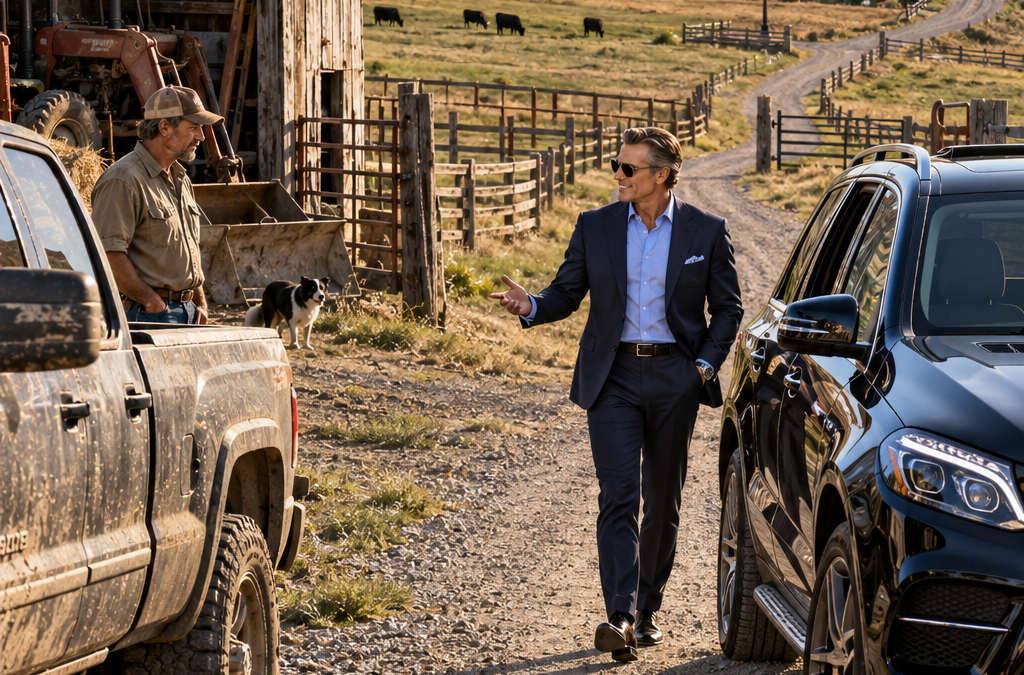
I was replacing a damaged latch on the equipment barn when a black Mercedes SUV turned off the county road and came through the ranch entrance.
The vehicle moved slowly along the gravel driveway before stopping beside my truck.
A man stepped out.
He looked about fifty, tall and carefully groomed, with dark hair slicked neatly away from his forehead and silver beginning to show near his temples.
His navy blazer fit like it had been tailored that morning.
He wore a pale blue shirt, pressed trousers, polished leather shoes, and a watch that probably cost more than my grandfather’s first tractor.
Even his smile looked rehearsed.
“Jake?” he called.
I set down my wrench.
“That’s me.”
He approached with one hand extended.
“Linden Harper. President of the Cedar Ridge Estates Homeowners Association.”
His handshake was firm, but he held it a little too long.
“I’m sorry about your grandfather,” he said. “He was quite a character.”
I studied his face.
“Did you know him?”
“We had several conversations.”
Something in his tone told me those conversations hadn’t been pleasant.
“What can I do for you?”
He glanced around the barnyard.
“Actually, I’m here to discuss what you’re going to do for the community.”
I raised an eyebrow.
He chuckled as though he’d made a clever joke.
“Now that you’ve inherited the property, there are some longstanding access arrangements we need to clarify.”
“What arrangements?”
“Road access. Maintenance expectations. Boundary cooperation. The usual matters that arise when an established property changes hands.”
I wiped my hands on a rag.
“Nothing’s changed hands except the name on the deed.”
“Of course.”
His smile remained fixed.
“But your grandfather was rather traditional. He wasn’t always cooperative with modern community management.”
I looked at him.
“What exactly are you asking?”
He reached into a leather portfolio and withdrew a printed sheet.
“Our association has authority over several shared access areas along the eastern ranch boundary. We expect those routes to remain available to residents and authorized HOA contractors.”
I took the paper.
It was a community access diagram.
A colored line ran from Cedar Ridge Estates across a portion of the ranch before reconnecting near the county road.
I recognized the route immediately.
It was the old eastern service road.
My grandfather had used it for ranch equipment and seasonal pasture access.
It crossed our property before approaching the HOA boundary.
“What is this supposed to show?” I asked.
“Established community access.”
“According to whom?”
“The association’s records.”
“Where did the association get authority over that road?”
He smiled.
“That arrangement predates your ownership.”
“My grandfather owned this place before your subdivision existed.”
His smile thinned.
“Jake, I think you’re misunderstanding the relationship between the properties.”
“Then explain it.”
“The road has been used by residents for years. It’s effectively part of our access system.”
“Use doesn’t automatically make it yours.”
He sighed.
“That’s a rather narrow interpretation.”
“It’s a property boundary.”
He looked toward the distant ranch fence.
“Let me be direct. Cedar Ridge is an expensive community. People paid a substantial premium for the convenience and accessibility promised to them. We cannot have private landowners disrupting those expectations.”
I felt my grip tighten around the paper.
“Private landowners?”
“Yes.”
“You’re standing on private land right now.”
He looked briefly amused.
“Obviously.”
“Then you understand why I’d like to know what legal authority you think you have.”
His expression changed.
Not much.
Just enough to reveal irritation beneath the polished exterior.
“Everything is documented.”
“Good. Show me.”
He glanced at the barn.
“Here?”
“Right here.”
I led him into the ranch office.
The room was small and cluttered.
My grandfather’s desk stood beneath the window, covered with labeled folders.
I opened the steel cabinet and removed the original property survey.
The paper was large enough that I had to clear space across the desk.
I unfolded it carefully.
Linden stood opposite me, watching with a restrained smile.
“This is the eastern boundary,” I said, pointing to the survey.
He leaned forward.
“And?”
“This is the service road.”
I traced the line.
“It enters from the county road, crosses the ranch, and reaches the area where your development begins.”
“Precisely.”
I looked up.
“Precisely what?”
“That’s the established access.”
“No. That’s the location of my road.”
I pointed again.
“The ranch boundary runs here. The road remains inside my property for this entire section.”
He stared at the survey.
I watched him examine the legal description, then the boundary markers.
His confidence weakened for perhaps half a second.
Then his smile returned.
“These older surveys don’t necessarily reflect current use rights.”
“Do you have an easement?”
“The association has extensive documentation.”
“Then show me the recorded easement.”
He straightened.
“That isn’t something I carry around.”
“Then send it to me.”
His jaw tightened.
“Jake, I didn’t come here to debate technicalities.”
“Whether you have a legal right to cross my land isn’t a technicality.”
He placed his hands on the desk.
“I’m trying to establish a cooperative relationship.”
“So am I.”
“Then don’t start by questioning the authority of my board.”
I stared at him.
“You came onto my ranch and told me what I was required to do.”
“Because certain obligations already exist.”
“Then prove them.”
For several seconds, he said nothing.
Finally, he picked up his portfolio.
“I’ll have our office provide the relevant information.”
“Good.”
He moved toward the door.
Then stopped.
“One more thing.”
I looked at him.
“The association will continue using that road while this is being clarified.”
“No. Not without an established right or my permission.”
His eyes narrowed.
“You may want to reconsider that position.”
“Why?”
“Because Cedar Ridge has considerable resources, and I’m not accustomed to having routine community operations obstructed by someone who doesn’t understand how these things work.”
I took a step closer.
“My grandfather maintained that road for forty years. I have the deeds, surveys, and maintenance records. If somebody doesn’t understand how it works, I don’t think it’s me.”
The silence between us sharpened.
Then Linden smiled again.
“Let’s try to keep this professional.”
He walked out before I could answer.
I watched his Mercedes disappear down the driveway.
Then I returned to the office and examined the survey once more.
The boundary was clear.
But so was something else.
Linden Harper hadn’t come to ask permission.
He had come to tell me that permission was unnecessary.
That distinction bothered me more than anything he had said.
Three days later, I understood why.
I was driving toward the eastern pasture when a white SUV approached from the opposite direction along the ranch service road.
It carried a Cedar Ridge security emblem.
I slowed.
The driver slowed too.
We stopped beside each other.
I rolled down my window.
“Morning. Can I help you?”
The driver looked uncomfortable.
“Just checking the access route.”
“Who authorized you to use it?”
“The HOA office.”
“Did they tell you this is private ranch property?”
He glanced toward the fence.
“They said the road is shared.”
“It’s not listed as HOA property.”
He shifted in his seat.
“I’m just doing my job.”
I understood that.
I wasn’t interested in arguing with a security guard.
“Please let your supervisor know the ownership and access rights are disputed.”
He nodded.
I moved aside and let him turn around.
I thought that would be the end of it.
It wasn’t.
Over the next week, I saw more vehicles.
A landscaping pickup.
Two SUVs.
A maintenance van.
Then a luxury sedan traveling fast enough to throw gravel into the roadside grass.
The service road had never been intended as a neighborhood shortcut.
It was narrow, uneven, and built for ranch operations.
There were sections where two vehicles couldn’t pass without one pulling into the grass.
Heavy rain occasionally washed sediment across the low crossing near the eastern drainage channel.
My grandfather had maintained the road for equipment and livestock access, not continuous residential traffic.
Now strangers were using it as though it were part of the subdivision.
I called the HOA office.
A receptionist transferred me to Linden.
“Mr. Harper, your vehicles are still crossing my ranch.”
He sounded distracted.
“Yes, Jake. That’s the established route.”
“We haven’t established that you have permission.”
“We’ve already discussed this.”
“And I asked you for a recorded easement.”
“Our records department is reviewing the matter.”
“Until then, you need to stop directing traffic onto the ranch.”
He exhaled sharply.
“Do you expect ninety-six homeowners to change their routines because you’re confused about a boundary?”
“Your development has its own entrance from the public road.”
“That doesn’t make this route any less important.”
“Important doesn’t mean legally yours.”
His voice hardened.
“I won’t allow one ranch owner to dictate community transportation policy.”
I stared at the phone.
“You don’t have authority over my ranch.”
“We’ll see about that.”
He hung up.
I stood in the equipment barn listening to the disconnected line.
The conversation left me furious.
But anger wasn’t evidence.
My grandfather had taught me that much.
The next morning, I installed private property signs along the eastern boundary.
I placed them where they could be seen clearly from the road.
They identified the ranch as privately owned and warned that access required authorization.
I didn’t block an established public highway.
I didn’t destroy any road surface.
I simply marked the property that my deeds and surveys showed belonged to me.
For about twenty-four hours, traffic decreased.
Then Linden called.
“Remove those signs.”
No greeting.
No explanation.
Just an order.
I was standing beside the water trough in the south pasture.
“Good morning to you too.”
“I’m not interested in jokes.”
“Then don’t start the conversation with a demand.”
“Your signs are interfering with community access.”
“They’re on my property.”
“They create the impression that residents are trespassing.”
“They may be, unless you can establish a right to use the road.”
He lowered his voice.
“Jake, I have been extremely patient.”
“I’ve been waiting for your documents.”
“You are creating hostility between the ranch and Cedar Ridge.”
“No. I’m asking you to respect the boundary.”
“The board will not tolerate intimidation.”
I looked at the cattle standing near the fence.
They had more interest in the conversation than Linden had in the deed.
“Send me the easement,” I said.
He disconnected again.
The following afternoon, I discovered that one of my signs had been pulled loose.
It leaned against a fence post.
I had no proof who moved it.
I photographed the location and reinstalled it.
Then I started keeping a more detailed record.
Every vehicle I could safely document.
Every date.
Every time.
Every visible company marking.
Every damaged section of road.
I photographed the boundary monuments and recorded their positions.
I copied the relevant deeds and surveys into a separate folder.
I also requested the publicly available road and subdivision records from the county.
I wasn’t interested in catching some resident making a wrong turn.
I wanted to know why the HOA was sending vehicles across a working ranch while refusing to produce proof of access rights.
The more I documented, the more concerned I became.
Several HOA maintenance trucks were using the eastern route.
One had heavy equipment secured to a trailer.
Another carried drainage materials.
I couldn’t tell exactly where the vehicles had been working.
But I noticed fresh tire tracks near the low stretch of road.
I also noticed places where the roadside soil looked recently disturbed.
At first, I assumed ordinary maintenance.
Still, I photographed everything.
A few days later, I visited the county recorder’s office.
The clerk helped me locate the relevant filings.
The ranch’s recorded deeds and maps remained consistent with my grandfather’s records.
There was no recorded conveyance transferring the disputed road to Cedar Ridge.
We also did not locate an easement granting the HOA the broad access authority Linden was claiming.
I understood that the absence of a record didn’t automatically resolve every possible legal argument.
But it made his certainty increasingly difficult to explain.
I returned home and laid the documents across the kitchen table.
The old survey and modern parcel map matched.
The road sat on the ranch.
The HOA boundary began farther east.
Nothing in the records I had found gave Linden Harper the right to treat that road as his private transportation corridor.
Yet he was acting as though my refusal to accept his authority was the real problem.
I decided to hire an independent surveyor.
His name was Michael Reed.
He came highly recommended by a neighboring rancher who had used him to resolve a complicated boundary dispute.
When I called, I explained the situation.
Michael listened without interrupting.
Then he asked, “Do you have the original legal descriptions?”
“Yes.”
“Recorded surveys?”
“Several.”
“Any known boundary monuments?”
“Most of them are still there.”
“Good. I’ll need access to the relevant points.”
He paused.
“One more question. Is somebody moving markers?”
“Not that I can prove.”
“Then let’s verify the line before this gets any uglier.”
He arrived at seven the following Tuesday morning.
His pickup carried a collection of surveying equipment, including a robotic total station, a survey-grade satellite receiver, tripods, and measuring tools.
Michael was in his late forties, with sun-darkened skin and a quiet way of speaking.
He didn’t seem impressed by the size of the ranch or the money represented by the houses beyond the fence.
He wanted the records.
I showed him everything.
My grandfather’s original survey.
The deed descriptions.
The modern county parcel map.
The location of the access road.
The areas where Linden claimed HOA authority.
Michael studied the documents at the kitchen table.
Then he tapped a point near the eastern boundary.
“This is where I want to start.”
We spent the entire morning walking the property.
The air was cool at first, but the sun warmed the open pastures quickly.
Michael located old monuments, checked control points, and compared field measurements with the legal descriptions.
At several places, we had to move through thick grass and low brush.
He worked methodically.
Measure.
Record.
Compare.
Move to the next point.
By noon, he had enough information to confirm that the old boundary references were consistent.
After lunch, we focused on the service road.
Michael set up his equipment near the southern edge.
He worked along the route, checking its alignment against the ranch boundary.
The result was exactly what my grandfather’s survey had shown.
The disputed section of road ran inside the ranch.
It did not become HOA property simply because it approached the development.
Near the low drainage crossing, Michael stopped and looked at the ground.
“Has this section always been rough?”
I glanced toward the ditch.
“It’s always needed attention after heavy rain.”
He crouched and examined the roadside.
“Looks like somebody worked along this shoulder.”
“I’ve seen maintenance trucks.”
“Recently?”
“Within the last couple of weeks.”
He stood.
“Do you know what they were doing?”
“No.”
He looked toward the road.
“Keep an eye on this section. The drainage looks different from what I’d expect based on the old contour records.”
“What do you mean?”
“I’m not making a geotechnical diagnosis. I’m saying this low ground deserves a closer look, especially if somebody has changed the drainage.”
I photographed the area again.
By late afternoon, Michael had completed the critical boundary measurements.
We returned to the ranch office.
He reviewed the data and explained his findings.
The new survey agreed with the family records.
The ranch boundary was where my grandfather had documented it.
The road section Linden wanted to control was inside my property.
When Michael delivered the finalized survey, I felt the first real relief since the dispute began.
I now had an independent professional confirming what the original documents showed.
I called Linden.
“Michael Reed completed the survey.”
“Congratulations,” Linden said dryly.
“It confirms the road is inside my ranch.”
“That’s your interpretation.”
“It’s the surveyor’s professional conclusion.”
“I have no idea who this man is.”
“He’s licensed. You can review his work.”
Linden sighed.
“Jake, hiring someone to tell you what you want to hear doesn’t change the HOA’s authority.”
I stared at the phone.
“You haven’t even seen the report.”
“And I don’t intend to accept a private survey as the final word.”
“Then obtain your own professional review.”
His voice sharpened.
“The board will decide how we respond.”
“The board doesn’t get to vote my property into its ownership.”
He went quiet.
Then he said, “You’re making a serious mistake.”
“By verifying the boundaries?”
“By challenging people who have much more experience handling land development than you do.”
I gripped the phone.
“Then they should understand the importance of a recorded legal description.”
He hung up.
I sent the survey to the HOA office anyway, along with a written request for the documents supporting their claimed access rights.
No satisfactory proof followed.
Instead, three days later, I received a formal notice from the HOA.
It accused me of interfering with established community access.
It demanded that I remove the private property signs.
It warned that the association might pursue legal remedies if I continued obstructing its operations.
I read the letter twice.
Then I placed it beside the survey.
My grandfather’s words returned to me.
Keep your papers straight.
So I made copies.
Every page.
Every notice.
Every photograph.
Every survey.
If Linden wanted a formal dispute, he was going to have to explain his claims against actual records.
The emergency HOA board meeting took place the following Thursday evening.
A resident who had heard about the controversy told me when and where it would be held.
I contacted the association and asked to attend the portion concerning the ranch road.
The board agreed.
I arrived carrying a binder thick enough to make my shoulder ache.
The meeting was held in the Cedar Ridge clubhouse.
The building looked more like a luxury hotel than a neighborhood meeting space.
Polished stone covered the entrance.
Recessed lighting illuminated framed architectural photographs.
The chairs were upholstered in cream-colored fabric.
A large window overlooked a carefully landscaped courtyard.
I felt out of place in my clean work jeans and dark jacket.
Then I reminded myself that I wasn’t there to impress anyone.
I was there to protect my property.
Linden stood near the front of the room.
He wore a charcoal suit, black dress shoes, and a silk tie.
His hair was glossy under the lights.
He was speaking quietly with several board members when he noticed me.
His expression hardened.
“Jake. How good of you to join us.”
“I was told this meeting concerns my property.”
He smiled without warmth.
“It concerns community access.”
“Then we’re talking about the same thing.”
Several board members exchanged glances.
Linden gestured toward an empty chair.
“Please sit down. We have a process.”
I sat.
The meeting began with Linden explaining the dispute.
He described the road as a longstanding access route.
He claimed the ranch had historically permitted community use.
He said the private property signs had caused unnecessary confusion.
Then he looked directly at me.
“Unfortunately, the new ranch owner has taken an unusually confrontational position.”
I felt my jaw tighten.
But I remained silent.
A board member named Thomas asked whether the HOA held an easement.
Linden waved one hand.
“The access rights are reflected in the development’s records.”
“Have we confirmed the recorded instrument?” Thomas asked.
Linden’s expression tightened.
“Our legal review is ongoing.”
I opened my binder.
Another board member spoke.
“Mr. Harper says residents have been using that road for years. Doesn’t that establish something?”
I waited for Linden to answer.
He nodded confidently.
“Exactly. The route is part of our community’s established transportation pattern.”
I raised my hand.
Linden stared at me.
“Yes, Jake?”
“May I show the board the survey?”
He sighed.
“We’re aware you obtained one.”
“Then you should be interested in the findings.”
He glanced toward the other members.
“Go ahead.”
I stood and unfolded Michael’s survey across the table.
The board leaned forward.
I pointed to the eastern boundary.
“This is the ranch property line.”
Then I traced the disputed road.
“This entire section sits inside the ranch. My grandfather maintained it. The current survey matches the original legal descriptions.”
Thomas examined the page.
“Where does the HOA boundary begin?”
I showed him.
He frowned.
“That’s farther east than I thought.”
“It is.”
Linden immediately interrupted.
“That doesn’t eliminate historic access rights.”
“No,” I agreed. “A valid easement or other established right would have to be examined separately. But nobody has produced one.”
A woman near the end of the table looked at Linden.
“Do we have a recorded easement?”
He adjusted his tie.
“Our counsel is reviewing the matter.”
I could see impatience spreading across his face.
He wasn’t accustomed to questions that couldn’t be dismissed with a confident answer.
I placed copies of the original survey, recorded deed references, and Michael’s findings on the table.
“These documents establish the boundary. If the association believes it has a right to use the road, I want to see the document supporting that claim.”
Linden leaned back.
“Jake, we have ninety-six households to consider.”
“And I have a ranch to operate.”
“Surely you understand that closing a road affects more than yourself.”
“Then why did you start using it without establishing permission?”
His face reddened.
“We did not start using it. The access was already established.”
“By whom?”
“The developer and prior community management.”
“Based on what?”
He stared at me.
“You’re repeating yourself.”
“Because nobody is answering.”
The room went silent.
Then Thomas asked the question again.
“Do we have the easement document?”
Linden closed his folder.
“We are not going to let this meeting become an interrogation.”
I sat back.
Several members looked uncomfortable.
One eventually said, “Until the legal review is complete, perhaps we should continue using the route as we have been.”
Another agreed.
Linden nodded immediately.
“That is the practical approach.”
I looked around the table.
“You understand the road is on my land?”
Thomas sighed.
“We understand there’s a dispute.”
“There is evidence establishing the boundary.”
“And we have to consider the community’s needs,” another member said.
I closed my binder.
For a moment, I wanted to argue until every person in that room admitted the obvious.
But I could see how the decision was going to go.
Linden had framed the situation as a choice between protecting the neighborhood and respecting my property.
The board was more comfortable siding with the man in the expensive suit than confronting the uncertainty in the documents.
So I stood.
“The property records will speak for themselves.”
Linden smiled.
“We’ll take that under advisement.”
I looked directly at him.
“One more thing. I’ve noticed recent work near the low section of the road. If the association has authorized construction there, I need the records and the contractor information.”
His expression changed.
“What work?”
“Roadside excavation or drainage work.”
“Our maintenance contractors perform routine upkeep.”
“On my property?”
“On an established access route.”
“That isn’t an answer.”
He straightened.
“This discussion is finished.”
I gathered my documents.
As I walked toward the door, he called after me.
“Jake, I’d strongly advise you not to interfere with our maintenance operations.”
I turned.
“I’d strongly advise you not to perform work on land you haven’t proved you have a right to use.”
His smile disappeared.
I left.
That night, I couldn’t sleep.
I kept thinking about the board meeting.
About the way Linden had spoken.
About the fact that several people were willing to continue using the road without seeing the document that supposedly gave them permission.
I also thought about Michael’s warning.
The drainage looks different.
I pulled up the photographs I had taken near the low crossing.
Fresh gravel.
Tire impressions.
Uneven soil near the shoulder.
The images didn’t prove anything by themselves.
But something about them bothered me.
I went to bed after midnight.
At six the following morning, I was already driving toward the eastern road.
The sun had barely cleared the hills.
The grass was wet with dew.
A thin mist hung above the drainage channel.
I slowed as I approached the low stretch.
Something was wrong.
At first, I couldn’t identify it.
Then I noticed the fence.
Three posts along the roadside leaned at angles that hadn’t been there before.
The soil around their bases looked loose.
I stopped the truck.
I remembered the photographs.
Those posts had been upright two days earlier.
I stepped out.
The ground near the road was uneven.
There was a shallow depression along the edge, perhaps several feet across.
Fresh cracks ran through the packed surface.
I crouched at a safe distance.
The soil appeared darker in places.
Almost as though it had recently been disturbed from below.
I stood.
A faint sound reached me.
Not loud.
Not dramatic.
A dull grinding noise.
I turned toward the center of the road.
For several seconds, nothing happened.
Then a small patch of gravel shifted.
I thought I was imagining it.
I took one step closer.
The ground moved again.
This time I saw it clearly.
A narrow crack widened.
A small section of soil settled downward.
Loose stones rolled into the depression.
I froze.
My grandfather had warned me about washouts.
He had shown me places where water undermined culverts and where saturated soil could give way without warning.
But I had never watched a road surface move while standing beside it.
Another faint grinding sound came from beneath the gravel.
Then the edge of the depression dropped slightly.
I stepped back immediately.
My heart hammered.
I looked up the road.
If an SUV came through that crossing at speed, the driver might not recognize the danger until the surface gave way beneath the wheels.
A ranch truck could suffer the same fate.
Worse, someone might stop and walk directly onto the unstable section.
I hurried back to my vehicle and moved it to firm ground well away from the depression.
Then I called the sheriff’s office.
“This is Jake,” I told the dispatcher. “I’m on the eastern service road near the Cedar Ridge boundary. The ground is actively settling.”
“Is anyone injured?”
“No.”
“Are vehicles using the road?”
“Yes. HOA vehicles have been crossing it regularly.”
“Can you tell whether the road is safe?”
“No. I can see the surface moving.”
Her voice sharpened.
“Stay clear of the affected area. We’ll send deputies.”
I ended the call and immediately contacted the ranch hands.
I told them not to use the eastern route.
Then I placed temporary warning barriers and visible markers on stable ground at both approaches, keeping myself away from the moving section.
I made certain the nearest employees knew the road was closed.
I didn’t care about the HOA argument anymore.
This was no longer about convenience.
Someone could be seriously hurt.
I was checking the western warning point when I heard an engine approaching.
A silver SUV came down the road from the Cedar Ridge side.
I moved to a safe position where the driver could see me.
I raised both arms.
The vehicle slowed.
It was one of the HOA maintenance supervisors.
“Road’s closed,” I called.
He lowered his window.
“Why?”
“Ground movement ahead. Sheriff is on the way.”
He looked past me.
“I need to get through.”
“You can’t.”
“We’ve got equipment scheduled.”
“Then turn around.”
He frowned.
“Mr. Harper told us this route stays open.”
I felt anger flash through me.
“Mr. Harper isn’t standing beside a collapsing road.”
The driver looked toward the depression.
As he watched, a small amount of gravel slid into the crack.
His face changed.
“Jesus.”
“Turn around carefully. Stay on the stable section.”
He nodded.
The SUV backed away.
I watched until it disappeared.
Then I heard another engine.
A black Mercedes.
I knew who it was before it stopped.
Linden Harper stepped out wearing a perfectly fitted dark coat over his suit.
His shoes were polished.
His hair was immaculate.
He looked as though he had come to supervise a corporate meeting rather than inspect a ranch road that was failing beneath his community’s access route.
He slammed the door.
“What the hell are you doing?”
I stood beside the warning barrier.
“Closing an unsafe road.”
“Who authorized this?”
“I did.”
His face hardened.
“You cannot unilaterally close community access.”
“The ground is moving.”
He barely glanced toward the road.
“Jake, this is exactly the sort of interference I warned you about.”
“Look at the surface.”
“I don’t have time for another performance.”
I felt my temper rise.
“This isn’t a performance.”
He stepped closer.
“You attended an HOA meeting last night, failed to get the result you wanted, and now you’ve decided to block the road.”
“There’s a depression forming near the drainage crossing.”
“Roads develop ruts.”
“Ruts don’t move while you’re looking at them.”
He laughed sharply.
“Do you expect me to believe the earth suddenly started collapsing the morning after the board rejected your position?”
I stared at him.
For several seconds, I couldn’t find words.
He genuinely believed I was inventing a safety emergency to win an argument.
“Come look,” I said.
He pointed toward the barrier.
“Remove that.”
“No.”
“Jake, I’m giving you one opportunity to avoid serious consequences.”
“Stay back from the damaged section.”
He turned toward his vehicle.
“I’ll have the HOA’s contractor remove it.”
I stepped into his line of sight, keeping distance between us.
“Nobody is moving those barriers until the authorities assess the road.”
His eyes narrowed.
“You have no idea who you’re dealing with.”
I looked at him.
“And you have no idea what you’re standing beside.”
A low cracking sound interrupted us.
Both of us turned.
A patch of gravel near the depression slipped downward.
Fine dirt poured into the new gap.
One of the nearby fence posts tilted another inch.
Linden stopped moving.
For the first time since I’d met him, the confidence drained from his face so completely that he looked like a different man.
“What was that?”
“The ground settling.”
He stared at the road.
Another few stones fell.
The crack widened.
He took an involuntary step backward.
I grabbed the sleeve of his coat and pulled him farther away from the unsafe area.
“Stay here.”
He looked down at the place where I’d touched his jacket.
Ordinarily, I suspected he would have objected.
This time, he didn’t.
He looked back toward the depression.
“How long has it been doing that?”
“I found it this morning.”
His mouth opened.
Then closed.
He stared at the road as though refusing to believe what his own eyes were showing him.
“Is somebody coming?”
“The sheriff.”
He looked toward the HOA entrance.
Several homes were visible beyond the trees.
For the first time, I saw genuine fear replace his anger.
Not concern over a legal argument.
Not embarrassment.
Fear of something he couldn’t order to stop.
“How bad is it?” he asked.
“I don’t know.”
“Could the road collapse?”
“That’s why nobody’s going across it.”
A distant siren sounded.
I looked toward the county road.
Linden remained silent.
Sheriff Daniel Brooks arrived with two deputies shortly afterward.
Daniel was a broad-shouldered man in his fifties who had known my grandfather for years.
He climbed out of his patrol vehicle and approached carefully.
“Jake. Dispatch said the road’s moving.”
“It is.”
I pointed out the affected section from a safe position.
Daniel examined the depression.
One deputy photographed the visible cracks.
Another moved farther back to help secure the approach.
Daniel watched the loose gravel shift near the opening.
“Nobody goes through here,” he said.
Linden stepped forward.
“Sheriff, I’m Linden Harper, president of Cedar Ridge Estates.”
Daniel looked at him.
“All right.”
“This road provides an important community connection. We need to keep it available if possible.”
Daniel pointed toward the damaged ground.
“Does that look available to you?”
Linden swallowed.
“We have contractors who could inspect it.”
“That’s fine. They can coordinate with the appropriate county officials. Until it’s been assessed, nobody is driving through.”
“Could we use one lane?”
“No.”
“Even for light vehicles?”
“No.”
Linden’s face tightened.
“With respect, Sheriff, the association has—”
Daniel interrupted.
“Mr. Harper, I don’t care what association you represent. That ground is moving. We are not putting people on it.”
I looked away to hide the bitter satisfaction rising in my chest.
For weeks, Linden had acted as though his title gave him control over everything within sight.
Now he was standing beside a sheriff who couldn’t care less about the HOA’s preferences.
Daniel turned toward me.
“Who owns this road?”
“The ranch does. I have the survey.”
Linden immediately said, “That’s disputed.”
Daniel raised one hand.
“I’m not settling a property case on the roadside. Right now, we’re handling a dangerous condition.”
He instructed the deputies to secure both approaches.
The county road department was contacted to coordinate the closure and assessment.
Within an hour, the crossing was officially closed to traffic pending professional evaluation.
I watched the barriers go into place.
For the first time in weeks, nobody was driving across my ranch road.
But I couldn’t enjoy it.
The road was failing.
And I had no idea how far the damage extended.
Several HOA vehicles arrived from the development.
A landscaping truck.
A maintenance van.
Two residents in SUVs.
The deputies stopped them before they reached the unstable section.
One driver argued that the HOA had authorized the route.
The deputy pointed toward the closed road.
“Not today.”
Another resident rolled down her window.
“What’s happening?”
“Ground settlement. The road is unsafe.”
Her expression changed immediately.
She turned around without another word.
I watched the vehicles retreat.
Then I looked toward the depression.
A fresh crack had appeared along the edge.
This was worse than I’d first realized.
Daniel approached me.
“You said you hired a surveyor recently?”
“Michael Reed.”
“Can he come back?”
“I’ll call him.”
“We’ll also need the people who handle drainage and ground stability.”
I nodded.
Linden stood several yards away, speaking urgently into his phone.
His expensive shoes were coated with pale road dust.
I doubted he had noticed.
Michael arrived later that afternoon.
He stepped out of his truck, looked toward the barriers, and immediately slowed.
“Well,” he said quietly. “That doesn’t look good.”
I met him near the safe approach.
“I found it moving this morning.”
“Any injuries?”
“No.”
“Good.”
He reviewed the photographs I’d taken before the closure.
Then he began measuring the affected area from safe locations with his equipment.
The county arranged for technical personnel to examine the drainage and determine what additional investigation would be needed.
Michael’s role was to establish accurate positions, elevations, and the extent of visible movement.
He didn’t pretend a survey alone could explain the soil mechanics.
That mattered to me.
Linden had spent weeks pretending certainty was the same as expertise.
Michael had no problem saying what he knew and what he didn’t.
As the measurements developed, one thing became clear.
The movement extended beyond the small depression I’d noticed.
The road surface had settled unevenly across a wider section.
The fence line showed displacement.
The shoulder contained cracks that weren’t obvious from the center of the road.
And the ground toward the drainage channel had changed elevation.
Michael studied his measurements.
“This isn’t just one little pothole.”
I looked at the affected section.
“How much ground are we talking about?”
“Enough that nobody should be trying to repair it with a truckload of gravel and a roller.”
He showed the county personnel his elevation readings.
The concern was no longer confined to the visible crack.
The underlying ground conditions needed proper investigation.
I looked toward Linden.
He was standing beside his Mercedes, watching the work.
His arms were crossed.
The carefully controlled expression had returned to his face.
But he wasn’t giving orders anymore.
Not to Michael.
Not to the sheriff.
Not to the county personnel.
He was simply watching.
As evening approached, Daniel came over.
“County wants this route kept closed until the assessment and repair plan are complete.”
“Understood.”
“Can your ranch operate without it?”
“Yes. We have established routes on the north and west sides.”
“Good. Use those.”
I nodded.
Daniel glanced toward the HOA entrance.
“What about the neighborhood?”
“They have their own entrance to the public road.”
“Then they can use it.”
He looked back at the damaged section.
“Nobody is risking a vehicle going down in that.”
When he left, I remained beside the barrier.
The road had become the center of a property dispute.
Now it was the center of a safety investigation.
And something told me the two issues were connected.
That night, I sat at my grandfather’s kitchen table with the old maps spread in front of me.
I found the earliest drainage drawing I could locate.
It showed the natural contours of the eastern slope.
Water flowed from higher ground toward the low channel that passed beneath the service road.
My grandfather had made handwritten notes about repairs to the crossing.
There were references to a buried drainage structure.
Several entries documented heavy rainfall and maintenance work.
One note caught my attention.
Keep the outlet clear. Don’t redirect water into the roadbed.
I stared at it.
Then I looked at the photographs from the previous weeks.
The fresh gravel.
The disturbed shoulder.
The unusual soil.
The HOA maintenance trucks.
I didn’t know what it meant yet.
But my grandfather’s warning made the hair rise on my arms.
I called Michael the next morning.
“I found an old drainage drawing.”
“Does it show the crossing?”
“Yes.”
“Bring it.”
By noon, we were reviewing it with the county’s technical team.
The old records showed that water had historically passed beneath the road through a drainage feature tied to the natural channel.
Over the years, repairs and changes had altered parts of the crossing.
The investigators began comparing those records with current conditions.
I watched them work from behind the safety barrier.
They examined visible drainage outlets.
They compared elevations.
They studied available plans.
They reviewed photographs taken before the ground movement.
Then they requested information about any recent excavation or construction near the road.
That question changed everything.
Because the HOA had recently authorized work around the access route.
I had seen the trucks.
I had photographed the disturbed soil.
And now county investigators wanted to know exactly what those contractors had done.
Linden arrived during the afternoon.
He stepped from his Mercedes wearing a light gray suit and sunglasses.
His face was composed again.
But there was something stiff about the way he walked.
He approached Daniel.
“Sheriff, I’ve been informed that the county is requesting our maintenance records.”
Daniel nodded.
“That’s correct.”
“Is that really necessary?”
“The technical team needs to know what work has been performed around the road.”
Linden glanced toward me.
“I assume this is coming from Jake.”
Daniel’s face hardened.
“This is coming from the investigation.”
Linden removed his sunglasses.
“Our association conducts routine maintenance. I don’t see why that should be treated as suspicious.”
“Then providing the records shouldn’t be difficult.”
He looked away.
I could see his jaw working.
“Everything was done through our normal procedures.”
Daniel nodded.
“Then the paperwork should explain it.”
Linden didn’t answer.
Over the next several days, the investigation grew more detailed.
Michael continued documenting the boundary and affected ground elevations.
The county examined the drainage history.
Contractor records were requested.
The HOA board was contacted.
Questions began circulating about who had authorized work near the crossing and whether the necessary permissions had been obtained.
The first major finding concerned the old drainage path.
The assessment showed that the drainage conditions beneath and around the road had been altered from the original pattern.
Parts of the buried system were no longer functioning as the old plans indicated.
Water and soil had not been moving through the area as they were supposed to.
The unstable ground wasn’t simply a random hole that appeared overnight.
It was associated with an area where the drainage pattern had been disturbed.
Years of changes had affected the crossing, and recent activity required closer examination.
I stood with Michael as he explained the findings.
“So the water was supposed to pass through the original channel?”
“That’s what the historical records indicate.”
“And now?”
“The present conditions are different. The drainage specialists are identifying how the changes affected the ground supporting the road.”
I looked toward the depression.
“Could that explain the settlement?”
“It’s consistent with why the area became unstable. The technical assessment will determine the specific mechanisms and repair requirements.”
I rubbed my forehead.
“Grandpa warned me about this.”
Michael looked at me.
“What?”
“He wrote down not to redirect water into the roadbed.”
Michael studied the note.
“Your grandfather knew this property.”
I nodded.
“He knew every inch.”
For a moment, I felt an ache so sharp that I had to look away.
I wished he were standing beside me.
Not because I needed him to fight the HOA.
Because he would have understood the road immediately.
He would have recognized the drainage.
He would have known where the original crossing sat.
And he would have been furious that someone had interfered with it without checking the property records.
The county continued examining the work history.
Then the HOA maintenance documents arrived.
I learned about them when Daniel called and asked me to meet him at the county offices.
Michael was there.
So was a county representative working with the technical investigation.
On the table lay copies of maintenance records and contractor documents.
Daniel looked at me.
“We’ve confirmed the HOA ordered work near the disputed access route.”
I sat down.
“What kind of work?”
“Roadside and drainage-related maintenance.”
“On my ranch?”
“The location shown in the records falls within the boundary established by the surveys.”
I looked at Michael.
He nodded.
“The work area is inside the ranch parcel.”
I felt my throat tighten.
“Did anyone ask for my permission?”
Daniel glanced at the papers.
“We haven’t found an authorization from you.”
“What about my grandfather?”
“The work we’re discussing occurred after his death.”
I stared at the document.
The contractor had been hired through the HOA.
The location corresponded to the disputed road.
The work had been described as improving access conditions.
I remembered the trucks.
The fresh gravel.
The disturbed shoulder.
The tracks leading toward the drainage channel.
I looked up.
“Why would they authorize construction on a road they couldn’t prove they had rights over?”
Daniel didn’t answer immediately.
Then he said, “That’s one of the questions we’re asking.”
The HOA board members were contacted individually.
Their explanations did not fully agree.
One member believed the work had been ordinary shoulder maintenance.
Another understood that drainage improvements had been approved.
A third said the board had authorized general access-route upkeep but had not specifically discussed construction inside the ranch boundary.
Linden maintained that he had acted under the HOA’s established authority.
But when investigators asked for the documents granting that authority over my land, the same problem returned.
The ranch boundary had never changed.
The disputed road had never been conveyed to the HOA.
No document produced by the association established the broad access and construction rights Linden had repeatedly claimed.
And the recent work had been undertaken without my permission.
I sat at the kitchen table that evening, looking at the copied records.
For weeks, Linden had accused me of interfering with community operations.
He had demanded that I remove private property signs.
He had ordered vehicles onto the road.
He had dismissed a professional survey.
He had convinced board members to continue using the route.
And while I was trying to prove the boundary, HOA-directed contractors had been working near an old drainage system on my property.
I felt a slow, sick anger build inside me.
This was no longer just a disagreement over where a line appeared on a map.
His insistence on treating the road as his had allowed unauthorized work to take place near an already vulnerable crossing.
I didn’t need to claim that every inch of the settlement had been caused by one recent project.
The technical assessment would address that.
What mattered immediately was that the HOA had exercised control it had never established and that the road was now dangerous.
I called Linden.
He answered on the fourth ring.
“Jake.”
He sounded exhausted.
“We need to talk.”
“I’m quite busy.”
“Then make time.”
A pause.
“What is this about?”
“The maintenance records.”
His voice changed.
“I assume you’ve been speaking with the sheriff.”
“I have.”
“Then you know the association was conducting routine work.”
“On my ranch.”
He sighed.
“Here we go again.”
“No. We’re not doing this again.”
Silence.
I took a breath.
“For weeks, you claimed authority over the road. You refused to provide proof. You ordered vehicles across it. You dismissed the survey. Then you had contractors working near the drainage crossing without my permission.”
“You’re making allegations you cannot support.”
“The records support the work order. The survey supports the location.”
He said nothing.
“The county is investigating why the ground failed. But regardless of the exact cause, you had no business authorizing construction there without verifying your rights.”
His voice hardened.
“Do you have any idea what it takes to manage a community of this size?”
I closed my eyes.
Even now.
Even after the road had started moving.
Even after the sheriff closed it.
He still wanted the conversation to be about his authority.
“Do you know what it takes to maintain a ranch for generations?” I asked.
He scoffed.
“That’s hardly comparable.”
“It means understanding every road, every drainage channel, every low spot, and every place where water can destroy what somebody built.”
“Jake—”
“My grandfather knew that road better than you know the inside of your own office.”
His breathing grew louder.
“Watch your tone.”
“No. You listen.”
My voice shook.
Not because I was frightened.
Because I had spent weeks swallowing my anger while he treated my property rights like an inconvenience.
“You walked onto my ranch and told me your HOA had authority over land you couldn’t prove it controlled. You threatened me when I asked for documents. You ignored the survey. Then your organization authorized work on my property.”
He said nothing.
“And now that road is closed because the ground isn’t stable.”
“That doesn’t prove our work caused the problem.”
“I’m not claiming the investigators have finished determining that.”
“Then stop blaming me.”
“I’m holding you responsible for what the records already show.”
The silence stretched.
Finally, he spoke.
“We’ll address this through the appropriate channels.”
I almost laughed.
“That’s what I asked you to do from the beginning.”
I ended the call.
For a long time, I stood beside the kitchen window.
The eastern pasture lay beyond the fence.
Cattle moved slowly through the grass.
The hills looked exactly as they had when my grandfather was alive.
And yet everything felt different.
I had inherited the ranch believing my greatest challenge would be keeping it running.
I hadn’t expected to spend my first months defending it from a neighborhood president who believed money and confidence could replace property law.
But the investigation was changing that.
For the first time, Linden had to answer questions instead of simply issuing demands.
The following week, the HOA board convened another meeting.
This time, county findings and property documents were at the center of the discussion.
I attended with Michael’s finalized survey and the relevant deed records.
Linden sat at the front of the room.
He looked as polished as ever.
But the expression beneath the carefully maintained appearance had changed.
His jaw was tight.
His eyes moved constantly toward the other board members.
He no longer seemed certain that they would automatically support him.
Thomas opened the meeting.
“We need to address the access-road situation and the county investigation.”
Linden straightened.
“I’ve already explained that the association believed it was acting within established access rights.”
Thomas looked down at his papers.
“Believed.”
Linden frowned.
“Yes.”
“But we don’t have a recorded document establishing the authority you claimed.”
“We relied on the developer’s representations.”
Another board member spoke.
“Then why didn’t we verify them when Jake requested it?”
Linden’s face reddened.
“We were dealing with an uncooperative landowner.”
I felt my hands tighten beneath the table.
Thomas turned toward me.
“Jake, would you summarize what your survey establishes?”
I stood.
I opened the map.
“The ranch boundary runs along this line. The disputed road crosses ranch property before reaching the HOA boundary.”
I showed them the legal description.
“The current measurements agree with the older recorded surveys.”
Then I placed the maintenance records beside the map.
“The HOA-directed work was performed in this area, near the drainage crossing. I never authorized it.”
One board member leaned forward.
“Wasn’t that part of the original development access?”
“Not according to the ownership documents I’ve reviewed. If someone believes there is a valid access right, they need to produce the instrument and establish its scope.”
Thomas nodded slowly.
He turned toward Linden.
“Do we have anything showing the ranch owner authorized maintenance work there?”
Linden looked at his folder.
“No written authorization from Jake.”
The room went quiet.
A woman near the end of the table asked, “Then who approved it?”
Linden’s jaw tightened.
“The work was ordered through the association’s established maintenance procedures.”
“That wasn’t my question,” she said.
I watched him.
For weeks, Linden had used that exact kind of deflection against me.
Now the board was refusing to accept it.
Thomas spoke again.
“Were the contractors told to verify the property boundary?”
“I assumed the route was within our authority.”
“You assumed?”
Linden leaned forward.
“Let’s not turn a good-faith maintenance decision into some kind of scandal.”
I finally spoke.
“Someone could have been hurt.”
Every face turned toward me.
I continued.
“I watched that road move. I watched gravel fall into a crack that wasn’t there the day before. HOA vehicles were using the route regularly. Ranch equipment could have crossed it. Any driver could have reached that section without realizing what was happening underneath.”
Linden looked at me.
“Nobody was injured.”
“Because the road was closed before someone tried to cross it.”
He opened his mouth.
I continued.
“The fact that nobody got hurt isn’t proof that your decisions were harmless.”
The room fell silent.
For the first time, I wasn’t interested in making Linden admit that I was right.
I wanted the board to understand the difference between inconvenience and danger.
“You keep talking about access,” I said. “But access means nothing if the road isn’t safe. And authority means nothing if you never had the right to exercise it.”
Thomas looked down at the survey again.
One of the other members spoke quietly.
“We should never have ignored these records.”
Linden turned toward him.
“You’re taking his side?”
“I’m taking the side of the documents.”
The words hung in the room.
I almost smiled.
Because that was all I had been asking anyone to do.
The board agreed that the association would no longer assert general control over the ranch road without establishing a lawful right.
Further unauthorized access and maintenance activity would stop.
The county’s closure would remain in place while the drainage and ground-stability issues were addressed.
Any future work affecting the ranch would require proper authority and coordination.
It wasn’t a dramatic courtroom victory.
Nobody slammed a gavel.
Nobody was dragged away.
But the practical result was clear.
The HOA could no longer pretend the property line was merely a suggestion.
After the meeting, Linden approached me near the clubhouse entrance.
For a moment, I thought he might offer an apology.
He didn’t.
He stood beside me with his shoulders squared.
“You’ve made this very difficult.”
I looked at him.
“You made it difficult when you decided the boundary didn’t matter.”
His eyes narrowed.
“I was protecting the community.”
“Then you should have protected it by checking the records.”
He looked toward the parking lot.
Several residents were walking to their cars.
His voice dropped.
“You’ve embarrassed me in front of my board.”
I stared at him.
“Nobody made you ignore the survey.”
His jaw tightened.
I continued.
“Nobody made you threaten me. Nobody made you authorize work without permission. Those were decisions.”
He looked back at me.
For the first time, there was no confident smile waiting behind his anger.
Only a man confronting the limits of the authority he had assumed was limitless.
“I suppose you’re satisfied,” he said.
I shook my head.
“The road is damaged. The county is investigating. People could have been hurt. I’m not satisfied.”
He stared at me.
“Then what do you want?”
I looked toward the distant ranch hills.
“I want the boundary respected. I want the unsafe road repaired properly. And I want your association to stop treating my family’s land like something it can claim whenever it’s convenient.”
He didn’t answer.
I walked away.
The investigation continued after that.
The county maintained the closure while the technical findings were reviewed and repair planning proceeded.
The drainage assessment identified the disturbed historical water path as a critical issue.
The work records established that the HOA had recently directed activity near the crossing without authorization from the ranch owner.
The investigators and responsible professionals continued working through the precise causes and the steps required to stabilize the site.
I didn’t interfere.
I provided the documents I had.
Photographs.
Surveys.
The old drainage drawing.
My grandfather’s maintenance notes.
Copies of the HOA notices.
Every piece of evidence that might help explain what had happened.
The ranch continued operating through its other established routes.
We adjusted a few schedules.
Moved equipment along the northern access road.
Changed how we approached the eastern pasture.
It was inconvenient.
But inconvenience was better than putting someone onto unstable ground.
The HOA residents returned to using their own established entrance.
Some complained about the longer drive.
Others were relieved that the danger had been discovered before anyone was hurt.
Over time, the angry calls stopped.
The boundary survey was incorporated into the formal property documentation, providing a clear reference for the disputed area.
The HOA board acknowledged that the ranch boundary had not changed.
The road had not magically become association property because residents had used it.
And the association’s earlier assumption of control did not establish a right to authorize construction.
Those facts were now documented.
Linden remained visible around Cedar Ridge, but his manner had changed.
Whenever I saw him near the entrance, he no longer waved me down to issue instructions.
He no longer stopped by the ranch house with papers explaining what I was supposedly required to do.
He didn’t tell me where I could place signs.
He didn’t order contractors onto the road.
And he certainly didn’t threaten to bring the HOA board against me again.
One afternoon, several weeks after the board meeting, I drove past the Cedar Ridge entrance on my way to inspect the northern pasture.
Linden stood beside his Mercedes, speaking with two men wearing county-issued identification badges.
They were looking toward the closed road.
A set of barriers remained visible in the distance.
Linden held a folder.
For a moment, he looked up and saw me.
Our eyes met.
He didn’t smile.
He didn’t wave.
He simply looked away and returned his attention to the officials.
I kept driving.
It occurred to me that this was probably the first time he’d ever been forced to deal with the ranch as something outside his control.
Not an empty tract waiting to be incorporated into his neighborhood.
Not a convenient shortcut.
Not land he could regulate through an HOA meeting.
But private property owned by someone who had the records to prove it.
That evening, I walked out behind the equipment barn.
The sun was setting.
Long shadows stretched across the pasture.
The cattle moved lazily through the grass, and a cool breeze came down from the wooded hills.
I followed the fence line toward the eastern boundary.
Every post reminded me of work my grandfather had done.
I remembered him replacing wire during a summer thunderstorm.
I remembered carrying fence staples in an old coffee can while he taught me to set braces properly.
I remembered him kneeling beside a boundary marker and explaining that property lines weren’t imaginary simply because you couldn’t see them from a distance.
As a boy, I thought he was talking about surveying.
Now I understood he was talking about responsibility.
A boundary wasn’t merely a restriction.
It was an agreement about where one person’s authority ended and another person’s began.
Respecting that line made it possible for neighbors to live beside each other without turning every disagreement into a battle.
Linden had refused to accept that.
He looked at a ranch road and saw convenience.
He looked at a property boundary and saw an obstacle.
He looked at my grandfather’s records and saw paperwork he could dismiss.
And when I challenged him, he treated the disagreement as a contest of power.
But the ground itself had no interest in his title.
It didn’t care that he wore expensive suits.
It didn’t care how much the houses in Cedar Ridge cost.
It didn’t care what the HOA board had voted.
When the drainage system beneath that old crossing could no longer support the ground as it should, the road began to settle.
And suddenly, the property records Linden had dismissed became essential to determining who owned the land, who had authorized the work, and who had the right to decide what happened next.
I reached the high point above the eastern pasture.
From there, I could see the ranch stretching toward the horizon.
Thousands of acres.
Fields.
Barns.
Tree lines.
Cattle ponds.
Old roads winding through the grass.
My grandfather had spent his life caring for that place.
He had never believed ownership meant doing whatever you wanted without regard for the land or the people around you.
He believed it meant understanding what you were responsible for.
Keeping fences repaired.
Maintaining drainage.
Respecting neighbors.
And never letting someone else’s confidence replace the truth.
I stood there until the sun touched the ridge.
Then I pulled the folded copy of the old survey from my jacket.
I had carried it with me so often during the dispute that the creases were beginning to soften.
I unfolded it carefully.
The eastern boundary ran across the page.
The service road followed its familiar course.
The old drainage crossing was marked in the same place where the ground had failed.
My grandfather had known the line.
Michael had confirmed it.
The county had documented it.
And now the HOA had finally been forced to respect it.
The road remained closed pending the proper repairs.
No one had been injured.
The ranch was operating safely through its other established routes.
The HOA’s unauthorized work and access claims had been exposed.
And the land was still mine.
I looked across the fields and remembered my grandfather sitting beside me in his old Ford pickup.
Don’t fight the wheel. Feel where the road wants to take you.
I smiled.
He had taught me to drive on that ranch long before I understood what it would mean to defend it.
Now I knew.
Sometimes protecting something doesn’t require anger or force.
Sometimes it means keeping the records.
Measuring the boundaries.
Standing firm when someone tries to intimidate you.
And refusing to allow another person’s convenience to become your obligation.
I folded the survey and slipped it back into my jacket.
Then I turned toward the ranch house.
Behind me, the sun disappeared beyond the hills.
The fences were where they belonged.
The pastures were quiet.
And for the first time since inheriting the property, I felt certain that my grandfather’s ranch was safe from the man who had tried to claim authority over it.
Linden Harper had believed that running a wealthy neighborhood gave him the power to decide where his community ended and my ranch began.
But that decision had been made long before Cedar Ridge existed.
It was written in the deeds, fixed by the surveys, and marked across the land by people who understood that ownership came with responsibilities.
All I had done was refuse to let him erase it.
And when the ground beneath the disputed road finally gave way, it exposed something more important than damaged gravel or disturbed drainage.
It revealed exactly how dangerous it could become when a man with authority convinced himself that his wishes mattered more than the boundaries he was supposed to respect.
My grandfather’s ranch had survived generations of storms, droughts, changing markets, and difficult years.
It would survive Linden Harper, too.
Because the land had never belonged to the HOA.
And no amount of polished arrogance could change where my grandfather had drawn the line.








