𝗙𝗨𝗟𝗟 𝗦𝗧𝗢𝗥𝗬 The HOA President Demanded a Key to My Cabin and Called the Police When I Refused to Give Her One
𝗙𝗨𝗟𝗟 𝗦𝗧𝗢𝗥𝗬
She gave me a look.
“Everybody says that.”
I laughed.
“I mean it.”
“So do I.”
I attended one association meeting during my first year.
I went because a neighbor told me there would be a discussion about wildfire clearing along shared tree lines.
That sounded relevant.
I sat in a folding chair in a clubhouse with about forty people while grown adults argued for twenty minutes about whether fences facing internal roads should be four feet or four and a half.
Then someone spent another fifteen minutes complaining that a resident stored a fishing boat in his own driveway.
I left before they got to the fire issue.
I never went back.
I never paid dues.
Never signed a membership agreement.
Never accepted a board position.
Never used association facilities.
I simply lived on my land.
For almost two years, that worked.
Then Deline Stor became interested in me.
She was fifty-eight.
President of something called the Cedarwood Ridge Community Council.
That was their preferred terminology by then.
Community Council sounded softer than HOA.
Friendlier.
Less legal.
In practice, it behaved like an HOA whenever doing so gave Deline more authority.
The first time she came to my property was on a Tuesday morning.
I remember the day because I had been planning to replace two rotted boards near the south end of the porch.
I heard a small electric motor coming up my driveway.
Then a golf cart appeared through the trees.
White roof.
Tan seats.
Little Cedarwood Ridge emblem on the front.
Deline was driving.
She parked beside my truck and stepped out wearing khaki pants, a pale green polo shirt, white sneakers, and a laminated badge hanging on a blue lanyard.
The badge said:
COMMUNITY COMPLIANCE OFFICER.
Large red letters.
She carried a clipboard.
Of course she did.
“Mr. Reeves?”
I kept the drill in my hand.
“Yes.”
“I’m Deline Stor.”
“I know who you are.”
That seemed to surprise her.
“We met at a council meeting.”
“I remember.”
“You left early.”
“I did.”
Her smile became slightly thinner.
“I wanted to speak with you about the cabin.”
“What about it?”
She glanced toward the porch.
“We’ve received several concerns.”
“From whom?”
“I can’t disclose individual residents.”
“Concerns about what?”
“The condition of the structure.”
I looked at the cabin.
Freshly painted siding.
New gutters.
Recently repaired porch railing.
There was a stack of firewood beside the wall, but otherwise the place looked better than it had when I bought it.
“What condition?”
“It doesn’t fully conform to community appearance standards.”
“What community?”
“Cedarwood Ridge.”
“I’m not in Cedarwood Ridge.”
“You fall within the expanded community influence area.”
That phrase was new.
“Expanded what?”
“Community influence area.”
“That’s not something attached to my deed.”
“We’ve adopted standards for bordering properties.”
“You’ve adopted them.”
“Yes.”
“Did I?”
She paused.
“I’m not sure I understand.”
“I didn’t sign your standards.”
“Participation isn’t always dependent on individual signatures.”
“It is when you’re trying to regulate privately owned property outside your subdivision.”
She adjusted the clipboard.
“Mr. Reeves, I’m not here to argue.”
“Good.”
“I’m simply making you aware that your cabin has several potential compliance issues.”
“Potential under what legal authority?”
She flipped through papers.
“Section Eleven of the community standards.”
“That doesn’t answer my question.”
She looked at me.
I continued.
“Show me the deed restriction. Recorded covenant. Easement. Contract. Anything binding my property to your council.”
“Our attorney has reviewed our authority.”
“Then this should be easy.”
Her expression hardened slightly.
“I can provide the documentation.”
“Please do.”
She glanced at my door.
Then she said something I honestly thought I had misunderstood.
“We’ll also need a key.”
I stared at her.
“A key to what?”
“The cabin.”
“My cabin?”
“Yes.”
I almost laughed.
“Why?”
“The council maintains emergency access to certain properties for interior wellness checks.”
“Interior what?”
“Wellness checks on structures that are periodically unoccupied.”
I lowered the drill.
“You want me to give you a key to my house?”
“Cabin.”
“It’s still my house.”
“Technically, your primary residence appears to be elsewhere.”
“That doesn’t make this building yours.”
“No one said it did.”
“Then why would you have a key?”
She gave me the patient smile people use when they believe resistance comes from ignorance.
“It’s standard procedure.”
“For your members?”
“For properties subject to community oversight.”
“I’m not subject to community oversight.”
“We’ve already discussed that.”
“No. You’ve made a claim. You haven’t shown authority.”
Her jaw tightened.
“Failure to provide emergency access may result in enforcement.”
I leaned against the porch post.
“What kind of enforcement?”
“Community enforcement.”
“Against a person who isn’t part of your community organization?”
“I’ll send the relevant language.”
“Please do.”
Then I pointed toward her cart.
“And don’t come onto my property again unless you need to deliver that document.”
She stared at me.
“You’re being unnecessarily difficult.”
“I’m being extremely clear.”
She turned around.
The golf cart made almost no sound as she drove away.
That somehow made the whole interaction more irritating.
Three days later, I got the letter.
It came in a large white envelope.
Official-looking logo.
Cedarwood Ridge Community Council.
Compliance Division.
There were ordinance numbers.
Bold headings.
A deadline.
Fourteen days.
The letter demanded that I provide a duplicate cabin key to the council for “emergency access, structural welfare verification, and unoccupied-property monitoring.”
Failure to comply would subject the property to:
COMMUNITY ENFORCEMENT ACTION.
I read that phrase three times.
Community enforcement action.
The letter cited three codes.
One looked like a county ordinance.
One looked like an internal Cedarwood Ridge provision.
The third was some kind of fire-safety reference.
I pulled out my phone and called Priya.
She answered with, “Tell me you didn’t sign anything.”
“Hello to you too.”
“What happened?”
“The neighborhood council wants a key to my cabin.”
Silence.
Then:
“Why?”
“For wellness checks.”
Another silence.
“Callum.”
“Yes.”
“Please tell me that’s exactly what the letter says.”
“I’ll send it.”
“I want the whole thing.”
I scanned every page.
Twenty minutes later she called back.
Her voice had changed.
“Do not give them a key.”
“I wasn’t going to.”
“Do not sign anything either.”
“I wasn’t going to.”
“And don’t respond directly yet.”
“That one I was considering.”
“Don’t.”
“Why?”
“Because two of these citations are nonsense.”
“And the third?”
“The county ordinance exists, but it doesn’t say what they’re claiming.”
I leaned against the kitchen counter.
“So we’re done?”
“No.”
That answer bothered me.
“What do you mean?”
“I’m pulling the full Cedarwood records.”
“Why?”
“Because I want to know why they care this much about a cabin outside their association.”
That was the first time I became suspicious.
Until then, I’d assumed Deline was simply controlling.
Some people obtain small amounts of power and immediately become addicted to using it.
Maybe she wanted every property in sight to conform to her standards.
Maybe my cabin offended her sense of order.
Maybe she simply disliked hearing no.
Priya thought there might be more.
She pulled everything.
My deed.
The seller’s deed.
Earlier deeds.
Recorded plats.
Cedarwood’s original declarations.
Later amendments.
Bylaws.
County filings.
Community maps.
Meeting documents available through public records.
Two days later, she asked me to come to her office.
That was unusual.
Priya normally handled small matters by phone.
When I arrived, she had documents spread across the conference table.
“You’re definitely outside the HOA.”
“I knew that.”
“I know you knew it. I’m confirming it.”
She pointed to a map.
“Here’s Cedarwood’s mandatory boundary.”
My property sat east of it.
“Nothing changed?”
“Not legally.”
“Then what does Deline think she’s doing?”
Priya pulled another document forward.
“That.”
It was an amendment dated 2019.
“Cedarwood amended its internal bylaws to create procedures concerning nearby unoccupied structures.”
I read the paragraph.
The language was dense.
The kind of language designed to sound more authoritative than it was.
“What does this actually do?”
“Internally? It tells the council what process they want to follow.”
“Externally?”
“That’s where things get interesting.”
She highlighted a clause.
It described structures located within half a mile of the community boundary that were not under “active community supervision.”
If such a structure was considered unoccupied and insufficiently maintained, the council could initiate what it called an abandoned-property referral.
I looked up.
“Referral to who?”
“County offices.”
“And then?”
“That’s not automatic. Cedarwood can’t simply declare your land abandoned.”
“Obviously.”
“But local procedures do exist for certain genuinely abandoned properties. Tax delinquency, unsafe structures, unclear ownership, things like that.”
“My taxes are current.”
“Yes.”
“My deed is clean.”
“Yes.”
“The cabin isn’t unsafe.”
“Correct.”
“So this goes nowhere.”
“Normally.”
I didn’t like the word.
“Normally?”
Priya pulled another file.
“Who owns the parcel east of you?”
“I don’t know.”
“Martin Stor.”
I looked at her.
“Stor.”
“Deline’s brother-in-law.”
The room went quiet.
Priya leaned back.
“His lot is small.”
“How small?”
“Just under four acres.”
“And?”
“He tried to buy the eastern portion of your land from the previous owner.”
That got my attention.
“When?”
“About five years ago.”
“How do you know?”
“Found correspondence referenced in a prior survey dispute. He wanted access to the creek and additional frontage.”
“The seller said no?”
“Apparently.”
I looked back at the 2019 amendment.
Then at the map.
Then at my parcel.
Twelve acres.
Martin’s property directly east.
Cedarwood to the west.
I felt the pieces moving together.
“The key.”
Priya didn’t answer.
“If I give them a key, what happens?”
“Depends on what they do with it.”
“They claim access.”
“They could certainly claim you acknowledged some kind of oversight relationship.”
“Membership?”
“Not necessarily. But jurisdictional arguments are built from facts.”
“And if they conduct these so-called wellness checks?”
“They generate records.”
“Inspection reports.”
“Yes.”
“Statements that the property is unoccupied.”
“Possibly.”
“And then they begin calling it abandoned.”
Priya folded her arms.
“That’s what concerns me.”
I stood up and walked toward the window.
Deline wasn’t after a key.
A key was evidence.
Not strong evidence by itself.
But fraud and land grabs don’t always start with strong evidence.
They start with paper trails.
A duplicated key logged as “emergency access.”
A council report.
An inspection notation.
A statement that the structure is routinely unoccupied.
Another report six months later.
Maybe photographs taken when I wasn’t there.
Then complaints.
Then an abandoned-property petition.
Maybe it would fail.
Probably it should fail.
But legal processes cost time and money.
And if someone believed the owner was disengaged enough, they might hope he never challenged the first steps.
I turned around.
“She thinks the place is empty most of the time.”
“It is empty much of the time.”
“She thinks that helps.”
“I think Deline wants a documented connection between your property and the council.”
“To eventually support her brother-in-law.”
“I can’t prove that yet.”
“I don’t need proof to understand what I’m looking at.”
Priya watched me for a few seconds.
Then she said something I still remember.
“Don’t just defend yourself.”
I raised an eyebrow.
“What?”
“Make them regret starting this.”
I laughed.
“That sounds less lawyerly than usual.”
“I’m allowed one sentence like that per quarter.”
“So what’s step one?”
She smiled.
“Now you sound like a client I can work with.”
We filed a formal challenge with the county recorder’s office and relevant county authorities regarding the 2019 amendment.
The argument was straightforward.
Cedarwood had attempted to use internal association language to create external consequences for landowners who had never joined the association.
The amendment had not been properly disclosed through the deed-transfer process for adjacent parcels.
More importantly, Cedarwood’s language could not create property jurisdiction simply because the board voted for it.
Priya drafted everything.
We filed on Wednesday.
Then I changed my routine.
I began staying at the cabin much more frequently.
Not full-time.
I still had a primary residence elsewhere.
But I spent enough nights there that any claim the structure was abandoned became ridiculous.
I moved clothing in.
Food.
Tools.
Books.
Mail.
I updated several records showing active use.
I took photographs.
I documented utilities.
Then I upgraded the door lock.
If Deline wanted to make access part of the dispute, I was going to make access measurable.
The locksmith installed a commercial-grade electronic deadbolt.
Keypad.
Biometric backup.
Tamper alarm.
Remote notification.
And most importantly, an access log.
Every keypad attempt.
Every failed fingerprint scan.
Every mechanical bypass attempt.
Date.
Time.
Duration.
I also mounted a security camera beneath the porch roof.
Wide enough to capture the front door, porch, steps, and driveway approach.
The installer asked whether I expected trouble.
“I expect documentation.”
He laughed.
“That’s usually trouble.”
The lock went live on Monday afternoon.
Tuesday morning at 6:47, Deline came back.
I wasn’t at the cabin.
I was at a diner in town having breakfast.
My phone vibrated.
FRONT PORCH MOTION.
I opened the camera feed.
There she was.
Same golf cart.
Different polo shirt.
Clipboard.
No appointment.
No invitation.
She walked directly to my front door.
At first, I assumed she was leaving another letter.
Then she reached into her bag.
Pulled something out.
And inserted it into my lock.
I stopped chewing.
She had a key.
Not mine.
I had never given her one.
The new lock still had a mechanical override for emergencies, but it had been rekeyed during installation.
Whatever she possessed belonged to an earlier lock configuration.
She turned it.
Nothing.
She pulled the key out.
Looked at it.
Tried again.
The camera caught her expression changing.
Third attempt.
Fourth.
Then she pressed her hand against the door as though force might persuade the lock to reconsider.
My phone received another notification.
TAMPER EVENT.
I watched the recording three times while sitting in that diner.
Then three more.
I wasn’t laughing yet.
I wanted to know where the key came from.
The previous owner?
A contractor?
Had somebody duplicated an old key?
Had Cedarwood somehow obtained one before I bought the place?
I still don’t have a complete answer.
But Deline possessed a physical key she believed would open my privately owned cabin.
That fact changed everything.
I called Priya.
“She tried to get in.”
“What?”
“Security footage. Six forty-seven this morning.”
“Send it.”
“I will.”
“Did she damage anything?”
“No.”
“Did she leave anything?”
“Not that I can see.”
“What did she use?”
“A key.”
Silence.
“A key?”
“Four attempts.”
“Callum, do not contact her.”
“I know.”
“Download the footage.”
“Already doing it.”
“Export the access logs.”
“Done.”
“Back everything up somewhere else.”
“Doing that too.”
Twenty minutes later, Deline called the police.
Not me.
The police.
I was driving back from town when my phone rang.
The caller ID showed the county sheriff’s office.
I answered.
“Callum Reeves?”
“Speaking.”
“This is Deputy Harlon Frost with the county sheriff’s office.”
“Morning.”
His tone was careful.
“Mr. Reeves, I’m calling regarding a complaint made this morning concerning property access.”
I almost smiled.
“What kind of complaint?”
“A representative from Cedarwood Ridge Community Council states that you’ve changed locks on a structure subject to community jurisdiction and are unlawfully restricting authorized access.”
I looked through my windshield at the road.
“Did she tell you who owns the structure?”
There was a short pause.
“She stated the council has oversight rights.”
“That wasn’t my question.”
“No, sir.”
“I own it.”
“I understand.”
“Outright.”
“All right.”
“And no Cedarwood entity has legal access.”
His voice changed slightly.
“That’s part of what I’m trying to determine.”
“Come to the cabin.”
“Sir?”
“Come on over. I’ll meet you there.”
“I am required to make contact.”
“I know. I’m inviting you.”
Another pause.
“You have documentation?”
“I have exactly what you need.”
I reached the cabin about fifteen minutes before Deputy Frost.
For the first time since Deline had appeared with that ridiculous badge, I felt calm.
Not because I thought everything was over.
Because she had finally done what Priya and I needed.
She had brought neutral law enforcement into the dispute.
And I had evidence waiting.
I printed three things.
My deed.
Priya’s county filing challenging the 2019 amendment.
The electronic access log from 6:47 that morning.
Then I opened the security footage on my laptop.
I set everything on the kitchen table.
Deputy Frost arrived in a marked SUV.
He was probably in his forties.
Tall.
Quiet.
The kind of deputy who looked like he preferred facts to excitement.
I met him on the porch.
“Mr. Reeves?”
“Callum is fine.”
“Harlon Frost.”
We shook hands.
“I appreciate you meeting with me.”
“No problem.”
He glanced toward the lock.
“That’s the lock in question?”
“That’s the lock Deline tried to enter this morning.”
He looked at me.
“She attempted entry?”
“Four times.”
“Do you have video?”
“Come inside.”
We sat at the table.
I handed him the deed first.
“This parcel is mine. Twelve acres. Not part of Cedarwood Ridge.”
He read.
Not skimmed.
Read.
Then I gave him Priya’s filing.
“What’s this?”
“Cedarwood adopted an internal amendment attempting to create an abandoned-property process for nearby land. My attorney is challenging it.”
He read several pages.
Then I gave him the access log.
The failed attempts were listed clearly.
06:47:12.
Mechanical override attempt.
Failed.
06:47:20.
Failed.
06:47:31.
Failed.
06:47:45.
Failed.
Tamper alert.
Deputy Frost stared at the page.
“Who was at the door?”
I turned the laptop.
The video played.
Deline came up the steps.
Pulled out the key.
Tried the lock.
Again.
Again.
Again.
The deputy watched the full clip.
Then he asked, “Has this woman ever had legal access to this property?”
“No.”
“You ever give her a key?”
“No.”
“Give Cedarwood a key?”
“No.”
“Previous owner tell you Cedarwood had a key?”
“No.”
“Any written agreement allowing inspections?”
“No.”
“Fire access agreement?”
“No.”
“Property management agreement?”
“No.”
He leaned back.
“Is this your primary residence?”
“No.”
“Do you use it?”
“Regularly.”
“Utilities active?”
“Yes.”
“Taxes current?”
“Yes.”
“Any foreclosure?”
“No.”
“Any abandonment proceeding?”
“No.”
He looked again at the deed.
Then at the screen.
“Why does she believe she has access?”
I answered carefully.
“That’s what my attorney and I are trying to establish.”
“She says it’s for wellness checks.”
“Does the county conduct secret six-forty-seven-in-the-morning wellness checks using an unauthorized key?”
He almost smiled.
Almost.
“No, sir.”
I pointed to the 2019 amendment.
“My concern is that Cedarwood has been trying to create a paper trail suggesting jurisdiction over the cabin.”
“For what purpose?”
“Adjacent acquisition.”
His eyebrows moved slightly.
I explained Martin Stor’s property.
The earlier attempt to purchase acreage.
The amendment.
The abandoned-property language.
I didn’t accuse Deline of a crime I couldn’t prove.
I simply showed him what existed.
When I finished, Deputy Frost gathered the copies.
“Based on what I’m seeing, you’ve done nothing illegal by changing your lock.”
“I know.”
He gave me a brief look.
“I have to say it.”
“Fair.”
“You have the right to secure your property.”
“Agreed.”
“And if Ms. Stor has no access right, she can’t force you to provide a key by calling us.”
“That’s also my understanding.”
He stood.
Then he paused.
“I’m going to make a phone call.”
He stepped outside.
I stayed at the kitchen table.
Ten minutes later he returned.
“I spoke with my supervisor.”
“Okay.”
“We’re documenting the attempted entry.”
“Good.”
“Ms. Stor will be contacted separately.”
“Good.”
“I’d also recommend you preserve the original video file.”
“Already backed up.”
“The lock logs too.”
“Three copies.”
This time he did smile.
“You were expecting this.”
“I was expecting something.”
He handed my deed back.
“Well, whatever happens with their community rules, this isn’t a police enforcement issue against you.”
“That’s all I needed.”
He left.
I stood on the porch watching the cruiser disappear through the trees.
Then I called Priya.
“What happened?”
“He watched the video.”
“And?”
“I’m not under arrest for protecting my own cabin.”
“Always a strong outcome.”
“He’s going to see Deline.”
Priya laughed.
Not loudly.
That satisfied little laugh lawyers sometimes produce when the opposition has just created new evidence.
“What?”
“Nothing.”
“You’re enjoying this.”
“Professionally.”
“Sure.”
“Callum, don’t engage with her.”
“I won’t.”
“And don’t celebrate yet.”
“I wasn’t planning to.”
But something had changed.
Deline had spent weeks speaking as though authority belonged to whoever claimed it most confidently.
Now someone outside Cedarwood had looked at the documents.
A deputy.
A neutral person.
And the authority disappeared.
That afternoon, Deline did not come back.
The next day, she didn’t either.
No letter.
No golf cart.
No clipboard.
For the first time since the conflict began, Cedarwood went silent.
Priya said that was probably because their attorney had finally become involved.
Six days later, we received a formal response to our county challenge.
Cedarwood defended the 2019 amendment.
They argued that the community had legitimate safety concerns regarding unoccupied structures bordering residential areas.
They denied that the amendment created ownership rights.
They denied targeting me specifically.
They described the key requirement as a “voluntary emergency-access protocol.”
Priya nearly spit out her coffee reading that.
“Voluntary.”
“That’s not what Deline said.”
“I know.”
“Her letter says required.”
“I know.”
“And she called the sheriff when I refused.”
“I know.”
“And she tried an actual key.”
Priya looked at me.
“That’s why paper matters.”
We submitted Deline’s compliance letter.
The camera footage.
The lock records.
The deputy’s incident documentation.
Then Priya produced one of the strongest pieces of evidence.
An earlier Cedarwood meeting summary contained discussion of “inactive adjacent parcels.”
My parcel number appeared.
So did a reference to “future boundary continuity.”
That phrase might have meant nothing in isolation.
Next to Martin Stor’s property, it meant much more.
Then came emails.
Not enough for some dramatic criminal conspiracy.
Enough to show that Deline had discussed my property as a potential expansion opportunity.
One message referred to my cabin as:
rarely occupied and strategically located.
Strategically located.
My home had become a strategy.
Another email mentioned Martin’s longstanding interest in “consolidating eastern frontage.”
Priya read the wording twice.
“Still think she only wanted a wellness key?”
“No.”
“Neither do I.”
The county review took six weeks.
Those six weeks were strangely peaceful.
I stayed at the cabin often.
Not because I needed to legally establish occupancy anymore.
Because I realized Deline had almost changed how I felt about the place.
I had bought the cabin to escape people.
Then suddenly every trip there came with cameras, legal papers, lock notifications, and the expectation that a golf cart might appear.
I hated that.
So I forced myself to reclaim the routine.
Morning coffee on the porch.
Wood stove at night.
Walking the eastern property line.
Clearing fallen branches.
Fixing the railing.
Reading.
Doing absolutely nothing.
I wasn’t going to let Deline turn my retreat into a command post permanently.
One evening, I walked to the boundary beside Martin Stor’s lot.
There was a simple line of survey markers and old fencing.
His land sat beyond the trees.
For the first time, I really understood why he wanted mine.
My acreage widened toward the creek.
His didn’t.
Acquiring even a portion would improve access and possibly increase development potential.
Twelve acres can look very different depending on who is looking.
To me, trees.
Quiet.
Privacy.
To Martin, frontage.
To Deline, jurisdiction.
To Cedarwood, expansion.
That was the arrogance underneath the whole dispute.
They believed unused by them meant unused.
They saw land that wasn’t being maximized in the way they valued and began imagining alternate ownership.
That mindset bothered me more than the key.
A key is metal.
Entitlement is harder to remove.
The county decision arrived on a Thursday.
Priya called before nine.
“Are you at the cabin?”
“Yes.”
“Good.”
“Why?”
“They struck it.”
I sat up.
“The amendment?”
“The relevant filing and enforcement basis. Improperly filed and not effective against outside parcels.”
I didn’t answer immediately.
“Callum?”
“I’m here.”
“Cedarwood cannot use that 2019 language to assert jurisdiction over you.”
“What about the abandoned-property process?”
“Not through them.”
“And Martin?”
“If he wants your land, he has the same options everyone else has.”
“Buy it?”
“If you’re willing.”
“I’m not.”
“Then that’s a short conversation.”
I stood and walked toward the porch.
The morning was cool.
Sunlight came through the trees in narrow strips.
“So that’s it?”
“For this issue, mostly.”
“Mostly.”
“Lawyers don’t say completely unless someone is dead or the statute of limitations expired twenty years ago.”
I laughed.
“What happens to Deline?”
“That isn’t our decision.”
It turned out Cedarwood made that decision for her.
Or she made it for herself.
Two weeks later, Deline Stor resigned as president of the Cedarwood Ridge Community Council.
No public explanation.
No long farewell letter.
No defense of her years of service.
No statement about spending more time with family.
Nothing.
Her name simply disappeared from the board roster.
Someone else became interim president.
I learned about it from a neighbor.
“You hear about Deline?”
“No.”
“She quit.”
“When?”
“Last night.”
“Why?”
“They didn’t say.”
I looked toward the road.
“Imagine that.”
Martin never contacted me.
Not once.
That was probably smart.
Priya told me the best outcome was often the one where the opposing side finally stopped creating problems.
I agreed.
The police never returned.
Deline never drove up my driveway again.
Cedarwood stopped sending me compliance letters.
The cabin stayed mine.
Twelve acres.
Same deed.
Same porch.
Same wood stove.
Different lock.
Several months later, I received an invitation to a Cedarwood community meeting.
I almost threw it away.
Then I noticed the wording.
Nearby landowners welcome.
No assertion that I was a member.
No compliance language.
No jurisdiction.
Just an invitation.
I didn’t go.
Progress has limits.
I did meet the new council president eventually.
His name was Harold Greene.
He came to the property in a pickup.
No golf cart.
No badge.
No clipboard.
He stopped at the bottom of the porch steps.
“Mr. Reeves?”
“Callum.”
“Harold Greene.”
“I know.”
“I wanted to introduce myself.”
“All right.”
“And apologize.”
That surprised me.
“You didn’t do anything.”
“I’m representing the organization that did.”
I respected that answer.
He didn’t climb the steps without being invited.
That mattered too.
I nodded toward a chair.
He sat.
“The council has reviewed its policies,” he said.
“Good.”
“We’re eliminating any language suggesting authority over nonmember properties.”
“Better.”
“And there will be no requests for private keys.”
“Best decision you’ve made.”
He smiled.
“I thought you’d like that one.”
We sat quietly for a moment.
Then he asked, “Can I ask you something?”
“Depends.”
“Did you really install that lock before Deline called the sheriff?”
“Yes.”
“You had access logs?”
“Yes.”
“And video?”
“Yes.”
He shook his head slowly.
“She had no idea.”
“No.”
“Why did you expect her to try something?”
“I didn’t know exactly what she’d do.”
“But you prepared.”
“There’s a difference between paranoia and documenting someone who’s already threatened enforcement.”
He nodded.
“Fair.”
Before leaving, he looked at the cabin.
“I understand why you like it out here.”
“That’s why I bought it.”
He stood.
“For what it’s worth, most Cedarwood residents didn’t know any of this was happening.”
“I believe you.”
That was important.
I never considered Cedarwood my enemy.
Organizations make it easy to pretend everybody inside them shares responsibility for whatever leadership does.
Usually they don’t.
Most people at Cedarwood were probably worried about their own mortgages, kids, health, jobs, lawns, and dinner.
They weren’t sitting around plotting to take twelve acres from Callum Reeves.
Deline was.
Maybe Martin was.
Maybe a few others knew.
But communities are not their worst board members.
That distinction kept me from becoming bitter.
Deline had tried to weaponize community.
I refused to let her succeed at that either.
About a year after everything ended, I replaced the porch boards she’d seen me working on the first morning she arrived.
I had delayed the job through all the legal nonsense.
When I pulled up the last rotted plank, something metal fell into the dirt beneath it.
An old cabin key.
Not one of mine.
Probably decades old.
Rust around the edges.
I picked it up and laughed.
Of all things.
I cleaned it and put it in a small wooden box inside the cabin.
Not because it had anything to do with Deline.
It didn’t.
But keys had become symbolic whether I liked it or not.
That’s the funny thing about ownership.
People often think a deed is the important part.
Legally, it usually is.
Emotionally, ownership is made up of smaller things.
Knowing which floorboard creaks.
Knowing where the roof leaks first during a hard rain.
Knowing which window sticks in July.
Knowing exactly how long the stove takes to warm the back room.
Knowing where the deer cross the creek.
Knowing which key belongs to which door.
Deline saw my cabin as a legal opening.
I saw it as a place.
That’s why she never understood my refusal.
To her, handing over a key was administrative.
Minor.
Reasonable.
A tiny concession.
But concessions create precedents.
Especially when the person asking already believes your boundaries are negotiable.
The original letter still sits in a drawer.
I read it once in a while.
Provide a duplicate key within fourteen days.
Community enforcement action.
The wording seems almost ridiculous now.
At the time, it wasn’t.
Authority doesn’t have to be real to frighten people.
It only has to look official.
Letterhead.
Codes.
Deadlines.
Badges.
Confident voices.
Most of us are trained from childhood to obey documents that look formal.
Deline understood that.
She probably sent plenty of letters that worked.
People complied.
Not because she was legally right.
Because arguing seemed harder.
Give them a gate code.
Move the trailer.
Change the fence.
Trim the tree.
Pay the fine.
Hand over the key.
What does it hurt?
Sometimes nothing.
Sometimes everything starts with that first small surrender.
Priya once told me during the case:
“People think property gets stolen with forged deeds. Sometimes it gets stolen through exhaustion.”
I understood exactly what she meant.
Make someone answer letters.
Hire attorneys.
Take time off.
Attend hearings.
File objections.
Pay fees.
Correct records.
Eventually, the victim may decide surrendering something is cheaper than continuing to defend it.
Deline’s plan didn’t require her to break down my door.
She only needed me to get tired.
I didn’t.
The strangest part is that I’m not naturally confrontational.
People who hear the story imagine I must be some hardheaded man who spends weekends studying property law and waiting for neighbors to cross a line.
Nothing could be further from the truth.
I bought the cabin because I wanted less conflict.
I don’t care what color somebody paints his mailbox.
I don’t care whether someone’s fence is six inches too tall.
I don’t care if a neighbor parks a fishing boat beside his garage.
If it’s his property and he’s not hurting anyone, I have better things to think about.
Maybe that’s why Deline misread me.
She mistook disinterest in control for inability to defend myself.
Those are very different things.
A man who doesn’t want power over you may still care deeply about preventing you from taking power over him.
The camera is still above the porch.
The lock is still on the door.
I don’t watch the footage much anymore.
Months can pass without an alert except for me, delivery drivers, or the occasional raccoon walking across the porch railing.
I like that.
The access log is boring now.
That’s exactly what a security log should be.
Every once in a while, usually early in the morning, I think about Deline standing at that door at 6:47.
Trying the key.
Once.
Twice.
Three times.
Four.
I wonder what she thought each time it failed.
Maybe she thought I had inconvenienced her.
Maybe she thought replacing the lock proved I was interfering with Cedarwood.
Maybe she genuinely believed she had a right to enter.
That’s the danger of entitlement.
Eventually, people stop recognizing the line between authority and habit.
If nobody stops them, they start assuming whatever they’ve been allowed to do is something they were always entitled to do.
The new lock stopped more than a key.
It stopped the assumption.
A few months after Harold’s visit, I was sitting on the porch when a Cedarwood resident named Ellen walked past the bottom of my driveway with her dog.
She waved.
I waved back.
Then she hesitated.
“You’re the cabin guy, right?”
I laughed.
“Apparently.”
“Can I ask you something?”
“Sure.”
“Did Deline really call the sheriff because you changed your locks?”
“She did.”
Ellen shook her head.
“That’s insane.”
“I thought so.”
“We had no idea she was doing that stuff.”
“I figured.”
She looked toward Cedarwood.
“A lot of people are embarrassed.”
“You don’t need to be.”
“She represented us.”
“She represented the board. That’s not always the same thing.”
Ellen considered that.
“You’re nicer about this than I’d be.”
“Being angry at two hundred strangers sounds exhausting.”
She laughed.
Then she walked on.
That conversation helped me understand the ending better.
At first, I thought winning meant Deline losing.
Her amendment struck.
Her plan gone.
Her resignation.
My land protected.
Those things mattered.
But that wasn’t the most important part.
The real victory was returning everything to the scale it should have been from the beginning.
My cabin.
My land.
Their neighborhood.
Clear boundaries.
Neighbors instead of rulers and subjects.
An invitation instead of a demand.
A conversation instead of an enforcement letter.
That’s all I’d ever wanted.
One evening the following fall, Priya drove out to see the property.
She had handled the purchase but had never actually visited.
She stood on the porch and looked toward the trees.
“This is what all the trouble was over?”
“Twelve acres.”
“I expected something dramatic.”
“There’s a creek.”
“Oh. Well, that changes everything.”
I handed her coffee.
We sat on the porch.
After a while she said, “You know, you got lucky.”
“With what?”
“Evidence.”
“The camera?”
“Camera. Lock logs. The timing. Deline trying that key after we filed.”
“I thought lawyers didn’t believe in luck.”
“We believe in evidence. Evidence often involves luck.”
“Fair.”
She looked at the door.
“You really watched the footage eleven times?”
“Who told you that?”
“You did.”
“I shouldn’t tell attorneys anything.”
“Too late.”
I smiled.
Then I asked the question that had bothered me from the beginning.
“Do you think she would have gotten the land?”
Priya took a moment.
“Honestly?”
“Yes.”
“Probably not.”
That surprised me.
“Not legally, if you stayed engaged.”
“Then why all of it?”
“Because she didn’t need a perfect legal case. She needed leverage.”
I said nothing.
“Maybe she hoped you would sell after enough pressure. Maybe she believed an abandonment process would create negotiating leverage. Maybe Martin believed you wouldn’t spend money fighting. People don’t always need a winning claim to hurt someone.”
“Just an expensive one.”
“Exactly.”
I looked toward the eastern woods.
“So the key wasn’t enough.”
“No.”
“But it was useful.”
“Yes.”
“As evidence that I’d accepted their authority.”
“Potentially.”
“That’s what I thought.”
Priya nodded.
“You did the right thing.”
I laughed.
“What?”
“That may be the first time you’ve said that without adding a legal qualification.”
“Don’t get used to it.”
We sat until the sun went down.
The cabin became what I wanted again after that.
Quiet.
No strategy.
No evidence gathering.
No law enforcement.
No county filings.
Just a place.
I repaired the porch.
Added a small shed.
Cleared a trail to the creek.
Replaced the old stove pipe.
Nothing ambitious.
I could probably sell the acreage now for considerably more than I paid.
Development keeps moving outward.
Cedarwood has grown too.
People ask sometimes whether I worry that another board will try something later.
Not really.
My deed hasn’t changed.
Neither has my understanding of it.
And Cedarwood’s new governing documents are considerably clearer about where their authority ends.
If another person shows up wearing a laminated compliance badge, I’ll deal with that person then.
But I don’t spend my life expecting conflict.
That would give Deline something she didn’t deserve.
Permanent space in my head.
The only permanent thing she left behind is the lock.
I like the lock.
It works.
The final time I saw Deline was almost a year after she resigned.
I was buying paint at a hardware store in town.
She came around the end of an aisle pushing a cart.
We saw each other at the same time.
For a second, neither of us spoke.
She looked older.
Not dramatically.
Just tired.
I expected her to turn around.
She didn’t.
“Callum.”
“Deline.”
She glanced at the paint in my cart.
“Working on the cabin?”
“Always.”
She nodded.
Then she said, “I suppose you’re pleased with how everything turned out.”
It wasn’t an apology.
It wasn’t an accusation either.
“Yes.”
Her mouth tightened.
“You made me look like a criminal.”
I thought carefully before answering.
“I showed what you did.”
“That isn’t the same thing.”
“It usually is.”
She looked away.
“We were trying to protect the community.”
“By entering my house?”
“I didn’t enter.”
“You tried.”
“I believed the council had authority.”
“Your own attorney should have told you otherwise.”
She became quiet.
Then she said, “Martin really did believe the property was being neglected.”
There it was.
The first time she openly mentioned him to me.
“Martin doesn’t own it.”
“No.”
“I do.”
“I understand that now.”
I looked at her.
“You should have understood it before you came to my door asking for a key.”
For once, Deline had no response.
She pushed the cart past me.
I watched her walk away.
No triumph.
No anger.
Just finality.
I bought my paint and went back to the cabin.
That evening, I sat on the porch while the first coat dried inside.
The woods were loud with insects.
Somewhere down by the creek, a frog kept making the same three-note call.
I thought about all the official words Deline had used.
Compliance.
Jurisdiction.
Wellness.
Oversight.
Enforcement.
Abandonment.
Acquisition.
Words can be useful.
They can also hide simple truths.
So I reduced the entire story to the simplest version.
A woman asked for the key to my house.
She had no right to it.
I said no.
Everything that happened afterward came from her refusal to accept that answer.
That’s what boundaries really are.
Not lines on surveys.
Not locks.
Not fences.
A boundary is where another person’s authority stops.
Healthy people understand that without being forced.
Unhealthy systems don’t.
They keep pushing until someone makes the line impossible to ignore.
I didn’t win because I was smarter than Deline.
I didn’t win because I had a sophisticated plan from the beginning.
I won because I kept asking the same basic question.
Where did I agree to this?
She never had an answer.
The key demand?
No agreement.
The interior checks?
No agreement.
The community standards?
No agreement.
The abandoned-property jurisdiction?
No valid authority over my land.
Once you stripped away the badge, the letterhead, and the official vocabulary, the whole scheme depended on one thing:
Me behaving as though Deline had power she did not actually possess.
I refused.
That’s all.
The county did the rest.
The police did their job.
Priya did hers.
The documents told the truth.
The camera preserved it.
The lock recorded it.
And eventually Cedarwood understood that their boundary ended exactly where my deed said it ended.
The cabin is still mine.
Twelve acres.
Two rooms.
Wood stove.
Creek.
Trees.
Wraparound porch.
Commercial-grade deadbolt.
I keep one emergency key in a safe place.
One.
Mine.
No council has a copy.
No board president has a copy.
No community compliance officer has a copy.
And no one has asked again.
Sometimes the most important thing you can say to another person is not a complicated legal argument.
Not a threat.
Not a speech.
Just one word.
No.
No, you cannot have the key.
No, you cannot enter.
No, your rules do not become mine because you printed them.
No, my absence does not make my property abandoned.
No, your brother-in-law’s interest does not create a right.
No, confidence is not jurisdiction.
No.
Deline never understood the power of that word until she called the police to force me to surrender something that had never belonged to her.
By the time the deputy left my porch, she finally did.
She thought the key would open a door to my land.
Instead, the lock closed one on her.
𝗧𝗛𝗘 𝗘𝗡𝗗
The HOA President Demanded a Key to My Cabin and Called the Police When I Refused to Give Her One
Deline Stor called the sheriff because I refused to hand her a key to a cabin she did not own, on twelve acres her organization had never controlled, and by the time the deputy reached my porch, I had already placed the evidence he needed on my kitchen table.
What she believed would finally force me under her authority became the moment the entire scheme behind her “community rules” began to collapse.
My name is Callum Reeves.
Three years before Deline Stor called the police on me, I bought twelve acres on the outer edge of a planned community in rural Tennessee.
The place wasn’t impressive.
That was one of the reasons I wanted it.
The cabin had two rooms, a small bathroom, a wood stove, an old metal roof, and a porch that wrapped around three sides of the building.
The boards creaked when temperatures changed.
The kitchen cabinets had probably been installed sometime in the late eighties.
There was no granite countertop.
No smart thermostat.
No decorative stone fireplace.
No driveway gate with my initials welded into it.
Just a gravel road, a cabin, twelve acres of trees, and enough distance from the nearest house that I could sit outside at night without hearing someone else’s television through an open window.
That was exactly what I wanted.
I had spent most of my adult life around people.
Too many people, if I’m being truthful.
I worked in commercial equipment sales for years, which meant airports, highways, trade shows, hotel conference rooms, client dinners, and endless phone calls with people who believed every silence needed to be filled.
By the time I was in my fifties, quiet had become expensive to me.
Not financially.
Personally.
I wanted somewhere I could disappear for a few days without actually disappearing.
A place where a ringing phone could remain unanswered.
Where nobody cared whether the porch needed staining.
Where I could split firewood, cook something simple, sit beside the stove, and hear the wind instead of traffic.
When I first walked the property with the real estate agent, I knew within ten minutes.
“This is it.”
She laughed.
“You haven’t seen the whole thing.”
“I don’t need to.”
“You haven’t seen the back acreage.”
“I can see trees.”
“There could be problems back there.”
“Are they expensive problems?”
She smiled.
“Probably not.”
“Then I’ll meet them later.”
The land had clean title.
The cabin was legal.
There were no mortgages attached to it.
The property taxes were manageable.
Most importantly, according to every recorded document associated with the sale, the parcel was not subject to the mandatory homeowners association governing Cedarwood Ridge.
That mattered because Cedarwood Ridge sat just west of me.
It was a planned community built in several phases over what had once been farmland and timber acreage.
Large homes.
Paved walking paths.
Decorative entrance pillars.
A pond.
A clubhouse.
A collection of internal roads with names like Whispering Pine Lane and Heritage View Court.
My property had existed before the development.
Cedarwood Ridge had grown toward it.
Not the other way around.
During the purchase, the seller disclosed that there was a local community association.
Voluntary.
That exact word appeared in the information I received.
Voluntary.
Membership available to nearby residents who wanted access to certain events and community programs.
No mandatory dues for my parcel.
No recorded covenant binding my land to the association.
No deed restriction requiring membership.
No declaration incorporating my property into Cedarwood Ridge.
My attorney at closing, Priya Nandanda, reviewed everything.
“You are adjacent,” she told me.
“You’re not part of them.”
“That’s what I want.”
“Then don’t sign anything later without calling me.”
“I wasn’t planning to.”
She gave me a look.
“Everybody says that.”
I laughed.
“I mean it.”
“So do I.”
I attended one association meeting during my first year.
I went because a neighbor told me there would be a discussion about wildfire clearing along shared tree lines.
That sounded relevant.
I sat in a folding chair in a clubhouse with about forty people while grown adults argued for twenty minutes about whether fences facing internal roads should be four feet or four and a half.
Then someone spent another fifteen minutes complaining that a resident stored a fishing boat in his own driveway.
I left before they got to the fire issue.
I never went back.
I never paid dues.
Never signed a membership agreement.
Never accepted a board position.
Never used association facilities.
I simply lived on my land.
For almost two years, that worked.
Then Deline Stor became interested in me.
She was fifty-eight.
President of something called the Cedarwood Ridge Community Council.
That was their preferred terminology by then.
Community Council sounded softer than HOA.
Friendlier.
Less legal.
In practice, it behaved like an HOA whenever doing so gave Deline more authority.
The first time she came to my property was on a Tuesday morning.
I remember the day because I had been planning to replace two rotted boards near the south end of the porch.
I heard a small electric motor coming up my driveway.
Then a golf cart appeared through the trees.
White roof.
Tan seats.
Little Cedarwood Ridge emblem on the front.
Deline was driving.
She parked beside my truck and stepped out wearing khaki pants, a pale green polo shirt, white sneakers, and a laminated badge hanging on a blue lanyard.
The badge said:
COMMUNITY COMPLIANCE OFFICER.
Large red letters.
She carried a clipboard.
Of course she did.
“Mr. Reeves?”
I kept the drill in my hand.
“Yes.”
“I’m Deline Stor.”
“I know who you are.”
That seemed to surprise her.
“We met at a council meeting.”
“I remember.”
“You left early.”
“I did.”
Her smile became slightly thinner.
“I wanted to speak with you about the cabin.”
“What about it?”
She glanced toward the porch.
“We’ve received several concerns.”
“From whom?”
“I can’t disclose individual residents.”
“Concerns about what?”
“The condition of the structure.”
I looked at the cabin.
Freshly painted siding.
New gutters.
Recently repaired porch railing.
There was a stack of firewood beside the wall, but otherwise the place looked better than it had when I bought it.
“What condition?”
“It doesn’t fully conform to community appearance standards.”
“What community?”
“Cedarwood Ridge.”
“I’m not in Cedarwood Ridge.”
“You fall within the expanded community influence area.”
That phrase was new.
“Expanded what?”
“Community influence area.”
“That’s not something attached to my deed.”
“We’ve adopted standards for bordering properties.”
“You’ve adopted them.”
“Yes.”
“Did I?”
She paused.
“I’m not sure I understand.”
“I didn’t sign your standards.”
“Participation isn’t always dependent on individual signatures.”
“It is when you’re trying to regulate privately owned property outside your subdivision.”
She adjusted the clipboard.
“Mr. Reeves, I’m not here to argue.”
“Good.”
“I’m simply making you aware that your cabin has several potential compliance issues.”
“Potential under what legal authority?”
She flipped through papers.
“Section Eleven of the community standards.”
“That doesn’t answer my question.”
She looked at me.
I continued.
“Show me the deed restriction. Recorded covenant. Easement. Contract. Anything binding my property to your council.”
“Our attorney has reviewed our authority.”
“Then this should be easy.”
Her expression hardened slightly.
“I can provide the documentation.”
“Please do.”
She glanced at my door.
Then she said something I honestly thought I had misunderstood.
“We’ll also need a key.”
I stared at her.
“A key to what?”
“The cabin.”
“My cabin?”
“Yes.”
I almost laughed.
“Why?”
“The council maintains emergency access to certain properties for interior wellness checks.”
“Interior what?”
“Wellness checks on structures that are periodically unoccupied.”
I lowered the drill.
“You want me to give you a key to my house?”
“Cabin.”
“It’s still my house.”
“Technically, your primary residence appears to be elsewhere.”
“That doesn’t make this building yours.”
“No one said it did.”
“Then why would you have a key?”
She gave me the patient smile people use when they believe resistance comes from ignorance.
“It’s standard procedure.”
“For your members?”
“For properties subject to community oversight.”
“I’m not subject to community oversight.”
“We’ve already discussed that.”
“No. You’ve made a claim. You haven’t shown authority.”
Her jaw tightened.
“Failure to provide emergency access may result in enforcement.”
I leaned against the porch post.
“What kind of enforcement?”
“Community enforcement.”
“Against a person who isn’t part of your community organization?”
“I’ll send the relevant language.”
“Please do.”
Then I pointed toward her cart.
“And don’t come onto my property again unless you need to deliver that document.”
She stared at me.
“You’re being unnecessarily difficult.”
“I’m being extremely clear.”
She turned around.
The golf cart made almost no sound as she drove away.
That somehow made the whole interaction more irritating.
Three days later, I got the letter.
It came in a large white envelope.
Official-looking logo.
Cedarwood Ridge Community Council.
Compliance Division.
There were ordinance numbers.
Bold headings.
A deadline.
Fourteen days.
The letter demanded that I provide a duplicate cabin key to the council for “emergency access, structural welfare verification, and unoccupied-property monitoring.”
Failure to comply would subject the property to:
COMMUNITY ENFORCEMENT ACTION.
I read that phrase three times.
Community enforcement action.
The letter cited three codes.
One looked like a county ordinance.
One looked like an internal Cedarwood Ridge provision.
The third was some kind of fire-safety reference.
I pulled out my phone and called Priya.
She answered with, “Tell me you didn’t sign anything.”
“Hello to you too.”
“What happened?”
“The neighborhood council wants a key to my cabin.”
Silence.
Then:
“Why?”
“For wellness checks.”
Another silence.
“Callum.”
“Yes.”
“Please tell me that’s exactly what the letter says.”
“I’ll send it.”
“I want the whole thing.”
I scanned every page.
Twenty minutes later she called back.
Her voice had changed.
“Do not give them a key.”
“I wasn’t going to.”
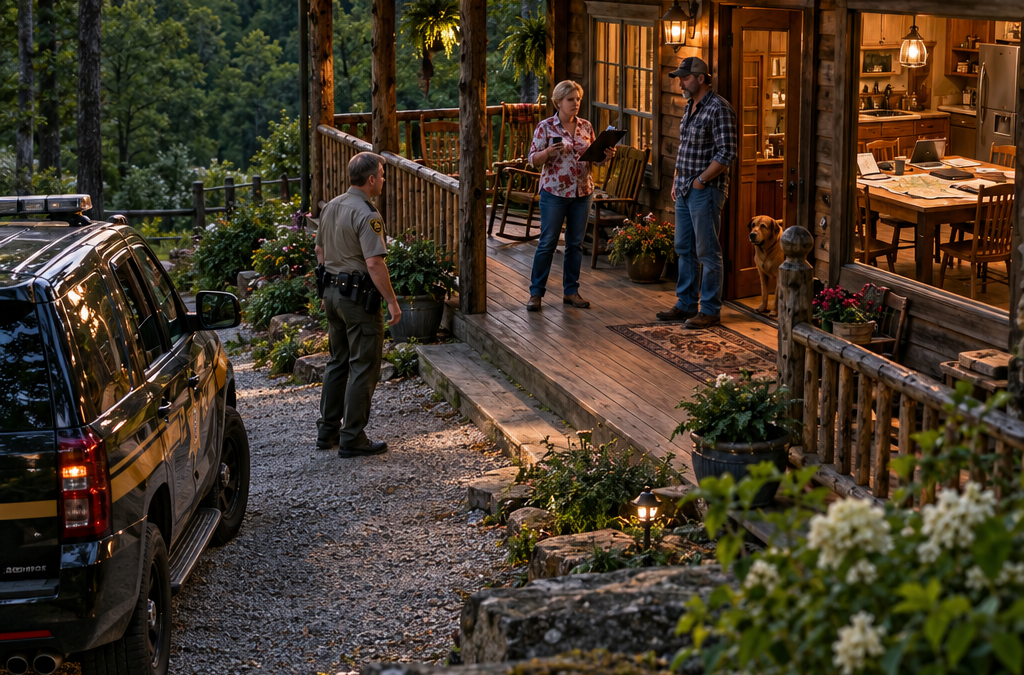
“Do not sign anything either.”
“I wasn’t going to.”
“And don’t respond directly yet.”
“That one I was considering.”
“Don’t.”
“Why?”
“Because two of these citations are nonsense.”
“And the third?”
“The county ordinance exists, but it doesn’t say what they’re claiming.”
I leaned against the kitchen counter.
“So we’re done?”
“No.”
That answer bothered me.
“What do you mean?”
“I’m pulling the full Cedarwood records.”
“Why?”
“Because I want to know why they care this much about a cabin outside their association.”
That was the first time I became suspicious.
Until then, I’d assumed Deline was simply controlling.
Some people obtain small amounts of power and immediately become addicted to using it.
Maybe she wanted every property in sight to conform to her standards.
Maybe my cabin offended her sense of order.
Maybe she simply disliked hearing no.
Priya thought there might be more.
She pulled everything.
My deed.
The seller’s deed.
Earlier deeds.
Recorded plats.
Cedarwood’s original declarations.
Later amendments.
Bylaws.
County filings.
Community maps.
Meeting documents available through public records.
Two days later, she asked me to come to her office.
That was unusual.
Priya normally handled small matters by phone.
When I arrived, she had documents spread across the conference table.
“You’re definitely outside the HOA.”
“I knew that.”
“I know you knew it. I’m confirming it.”
She pointed to a map.
“Here’s Cedarwood’s mandatory boundary.”
My property sat east of it.
“Nothing changed?”
“Not legally.”
“Then what does Deline think she’s doing?”
Priya pulled another document forward.
“That.”
It was an amendment dated 2019.
“Cedarwood amended its internal bylaws to create procedures concerning nearby unoccupied structures.”
I read the paragraph.
The language was dense.
The kind of language designed to sound more authoritative than it was.
“What does this actually do?”
“Internally? It tells the council what process they want to follow.”
“Externally?”
“That’s where things get interesting.”
She highlighted a clause.
It described structures located within half a mile of the community boundary that were not under “active community supervision.”
If such a structure was considered unoccupied and insufficiently maintained, the council could initiate what it called an abandoned-property referral.
I looked up.
“Referral to who?”
“County offices.”
“And then?”
“That’s not automatic. Cedarwood can’t simply declare your land abandoned.”
“Obviously.”
“But local procedures do exist for certain genuinely abandoned properties. Tax delinquency, unsafe structures, unclear ownership, things like that.”
“My taxes are current.”
“Yes.”
“My deed is clean.”
“Yes.”
“The cabin isn’t unsafe.”
“Correct.”
“So this goes nowhere.”
“Normally.”
I didn’t like the word.
“Normally?”
Priya pulled another file.
“Who owns the parcel east of you?”
“I don’t know.”
“Martin Stor.”
I looked at her.
“Stor.”
“Deline’s brother-in-law.”
The room went quiet.
Priya leaned back.
“His lot is small.”
“How small?”
“Just under four acres.”
“And?”
“He tried to buy the eastern portion of your land from the previous owner.”
That got my attention.
“When?”
“About five years ago.”
“How do you know?”
“Found correspondence referenced in a prior survey dispute. He wanted access to the creek and additional frontage.”
“The seller said no?”
“Apparently.”
I looked back at the 2019 amendment.
Then at the map.
Then at my parcel.
Twelve acres.
Martin’s property directly east.
Cedarwood to the west.
I felt the pieces moving together.
“The key.”
Priya didn’t answer.
“If I give them a key, what happens?”
“Depends on what they do with it.”
“They claim access.”
“They could certainly claim you acknowledged some kind of oversight relationship.”
“Membership?”
“Not necessarily. But jurisdictional arguments are built from facts.”
“And if they conduct these so-called wellness checks?”
“They generate records.”
“Inspection reports.”
“Yes.”
“Statements that the property is unoccupied.”
“Possibly.”
“And then they begin calling it abandoned.”
Priya folded her arms.
“That’s what concerns me.”
I stood up and walked toward the window.
Deline wasn’t after a key.
A key was evidence.
Not strong evidence by itself.
But fraud and land grabs don’t always start with strong evidence.
They start with paper trails.
A duplicated key logged as “emergency access.”
A council report.
An inspection notation.
A statement that the structure is routinely unoccupied.
Another report six months later.
Maybe photographs taken when I wasn’t there.
Then complaints.
Then an abandoned-property petition.
Maybe it would fail.
Probably it should fail.
But legal processes cost time and money.
And if someone believed the owner was disengaged enough, they might hope he never challenged the first steps.
I turned around.
“She thinks the place is empty most of the time.”
“It is empty much of the time.”
“She thinks that helps.”
“I think Deline wants a documented connection between your property and the council.”
“To eventually support her brother-in-law.”
“I can’t prove that yet.”
“I don’t need proof to understand what I’m looking at.”
Priya watched me for a few seconds.
Then she said something I still remember.
“Don’t just defend yourself.”
I raised an eyebrow.
“What?”
“Make them regret starting this.”
I laughed.
“That sounds less lawyerly than usual.”
“I’m allowed one sentence like that per quarter.”
“So what’s step one?”
She smiled.
“Now you sound like a client I can work with.”
We filed a formal challenge with the county recorder’s office and relevant county authorities regarding the 2019 amendment.
The argument was straightforward.
Cedarwood had attempted to use internal association language to create external consequences for landowners who had never joined the association.
The amendment had not been properly disclosed through the deed-transfer process for adjacent parcels.
More importantly, Cedarwood’s language could not create property jurisdiction simply because the board voted for it.
Priya drafted everything.
We filed on Wednesday.
Then I changed my routine.
I began staying at the cabin much more frequently.
Not full-time.
I still had a primary residence elsewhere.
But I spent enough nights there that any claim the structure was abandoned became ridiculous.
I moved clothing in.
Food.
Tools.
Books.
Mail.
I updated several records showing active use.
I took photographs.
I documented utilities.
Then I upgraded the door lock.
If Deline wanted to make access part of the dispute, I was going to make access measurable.
The locksmith installed a commercial-grade electronic deadbolt.
Keypad.
Biometric backup.
Tamper alarm.
Remote notification.
And most importantly, an access log.
Every keypad attempt.
Every failed fingerprint scan.
Every mechanical bypass attempt.
Date.
Time.
Duration.
I also mounted a security camera beneath the porch roof.
Wide enough to capture the front door, porch, steps, and driveway approach.
The installer asked whether I expected trouble.
“I expect documentation.”
He laughed.
“That’s usually trouble.”
The lock went live on Monday afternoon.
Tuesday morning at 6:47, Deline came back.
I wasn’t at the cabin.
I was at a diner in town having breakfast.
My phone vibrated.
FRONT PORCH MOTION.
I opened the camera feed.
There she was.
Same golf cart.
Different polo shirt.
Clipboard.
No appointment.
No invitation.
She walked directly to my front door.
At first, I assumed she was leaving another letter.
Then she reached into her bag.
Pulled something out.
And inserted it into my lock.
I stopped chewing.
She had a key.
Not mine.
I had never given her one.
The new lock still had a mechanical override for emergencies, but it had been rekeyed during installation.
Whatever she possessed belonged to an earlier lock configuration.
She turned it.
Nothing.
She pulled the key out.
Looked at it.
Tried again.
The camera caught her expression changing.
Third attempt.
Fourth.
Then she pressed her hand against the door as though force might persuade the lock to reconsider.
My phone received another notification.
TAMPER EVENT.
I watched the recording three times while sitting in that diner.
Then three more.
I wasn’t laughing yet.
I wanted to know where the key came from.
The previous owner?
A contractor?
Had somebody duplicated an old key?
Had Cedarwood somehow obtained one before I bought the place?
I still don’t have a complete answer.
But Deline possessed a physical key she believed would open my privately owned cabin.
That fact changed everything.
I called Priya.
“She tried to get in.”
“What?”
“Security footage. Six forty-seven this morning.”
“Send it.”
“I will.”
“Did she damage anything?”
“No.”
“Did she leave anything?”
“Not that I can see.”
“What did she use?”
“A key.”
Silence.
“A key?”
“Four attempts.”
“Callum, do not contact her.”
“I know.”
“Download the footage.”
“Already doing it.”
“Export the access logs.”
“Done.”
“Back everything up somewhere else.”
“Doing that too.”
Twenty minutes later, Deline called the police.
Not me.
The police.
I was driving back from town when my phone rang.
The caller ID showed the county sheriff’s office.
I answered.
“Callum Reeves?”
“Speaking.”
“This is Deputy Harlon Frost with the county sheriff’s office.”
“Morning.”
His tone was careful.
“Mr. Reeves, I’m calling regarding a complaint made this morning concerning property access.”
I almost smiled.
“What kind of complaint?”
“A representative from Cedarwood Ridge Community Council states that you’ve changed locks on a structure subject to community jurisdiction and are unlawfully restricting authorized access.”
I looked through my windshield at the road.
“Did she tell you who owns the structure?”
There was a short pause.
“She stated the council has oversight rights.”
“That wasn’t my question.”
“No, sir.”
“I own it.”
“I understand.”
“Outright.”
“All right.”
“And no Cedarwood entity has legal access.”
His voice changed slightly.
“That’s part of what I’m trying to determine.”
“Come to the cabin.”
“Sir?”
“Come on over. I’ll meet you there.”
“I am required to make contact.”
“I know. I’m inviting you.”
Another pause.
“You have documentation?”
“I have exactly what you need.”
I reached the cabin about fifteen minutes before Deputy Frost.
For the first time since Deline had appeared with that ridiculous badge, I felt calm.
Not because I thought everything was over.
Because she had finally done what Priya and I needed.
She had brought neutral law enforcement into the dispute.
And I had evidence waiting.
I printed three things.
My deed.
Priya’s county filing challenging the 2019 amendment.
The electronic access log from 6:47 that morning.
Then I opened the security footage on my laptop.
I set everything on the kitchen table.
Deputy Frost arrived in a marked SUV.
He was probably in his forties.
Tall.
Quiet.
The kind of deputy who looked like he preferred facts to excitement.
I met him on the porch.
“Mr. Reeves?”
“Callum is fine.”
“Harlon Frost.”
We shook hands.
“I appreciate you meeting with me.”
“No problem.”
He glanced toward the lock.
“That’s the lock in question?”
“That’s the lock Deline tried to enter this morning.”
He looked at me.
“She attempted entry?”
“Four times.”
“Do you have video?”
“Come inside.”
We sat at the table.
I handed him the deed first.
“This parcel is mine. Twelve acres. Not part of Cedarwood Ridge.”
He read.
Not skimmed.
Read.
Then I gave him Priya’s filing.
“What’s this?”
“Cedarwood adopted an internal amendment attempting to create an abandoned-property process for nearby land. My attorney is challenging it.”
He read several pages.
Then I gave him the access log.
The failed attempts were listed clearly.
06:47:12.
Mechanical override attempt.
Failed.
06:47:20.
Failed.
06:47:31.
Failed.
06:47:45.
Failed.
Tamper alert.
Deputy Frost stared at the page.
“Who was at the door?”
I turned the laptop.
The video played.
Deline came up the steps.
Pulled out the key.
Tried the lock.
Again.
Again.
Again.
The deputy watched the full clip.
Then he asked, “Has this woman ever had legal access to this property?”
“No.”
“You ever give her a key?”
“No.”
“Give Cedarwood a key?”
“No.”
“Previous owner tell you Cedarwood had a key?”
“No.”
“Any written agreement allowing inspections?”
“No.”
“Fire access agreement?”
“No.”
“Property management agreement?”
“No.”
He leaned back.
“Is this your primary residence?”
“No.”
“Do you use it?”
“Regularly.”
“Utilities active?”
“Yes.”
“Taxes current?”
“Yes.”
“Any foreclosure?”
“No.”
“Any abandonment proceeding?”
“No.”
He looked again at the deed.
Then at the screen.
“Why does she believe she has access?”
I answered carefully.
“That’s what my attorney and I are trying to establish.”
“She says it’s for wellness checks.”
“Does the county conduct secret six-forty-seven-in-the-morning wellness checks using an unauthorized key?”
He almost smiled.
Almost.
“No, sir.”
I pointed to the 2019 amendment.
“My concern is that Cedarwood has been trying to create a paper trail suggesting jurisdiction over the cabin.”
“For what purpose?”
“Adjacent acquisition.”
His eyebrows moved slightly.
I explained Martin Stor’s property.
The earlier attempt to purchase acreage.
The amendment.
The abandoned-property language.
I didn’t accuse Deline of a crime I couldn’t prove.
I simply showed him what existed.
When I finished, Deputy Frost gathered the copies.
“Based on what I’m seeing, you’ve done nothing illegal by changing your lock.”
“I know.”
He gave me a brief look.
“I have to say it.”
“Fair.”
“You have the right to secure your property.”
“Agreed.”
“And if Ms. Stor has no access right, she can’t force you to provide a key by calling us.”
“That’s also my understanding.”
He stood.
Then he paused.
“I’m going to make a phone call.”
He stepped outside.
I stayed at the kitchen table.
Ten minutes later he returned.
“I spoke with my supervisor.”
“Okay.”
“We’re documenting the attempted entry.”
“Good.”
“Ms. Stor will be contacted separately.”
“Good.”
“I’d also recommend you preserve the original video file.”
“Already backed up.”
“The lock logs too.”
“Three copies.”
This time he did smile.
“You were expecting this.”
“I was expecting something.”
He handed my deed back.
“Well, whatever happens with their community rules, this isn’t a police enforcement issue against you.”
“That’s all I needed.”
He left.
I stood on the porch watching the cruiser disappear through the trees.
Then I called Priya.
“What happened?”
“He watched the video.”
“And?”
“I’m not under arrest for protecting my own cabin.”
“Always a strong outcome.”
“He’s going to see Deline.”
Priya laughed.
Not loudly.
That satisfied little laugh lawyers sometimes produce when the opposition has just created new evidence.
“What?”
“Nothing.”
“You’re enjoying this.”
“Professionally.”
“Sure.”
“Callum, don’t engage with her.”
“I won’t.”
“And don’t celebrate yet.”
“I wasn’t planning to.”
But something had changed.
Deline had spent weeks speaking as though authority belonged to whoever claimed it most confidently.
Now someone outside Cedarwood had looked at the documents.
A deputy.
A neutral person.
And the authority disappeared.
That afternoon, Deline did not come back.
The next day, she didn’t either.
No letter.
No golf cart.
No clipboard.
For the first time since the conflict began, Cedarwood went silent.
Priya said that was probably because their attorney had finally become involved.
Six days later, we received a formal response to our county challenge.
Cedarwood defended the 2019 amendment.
They argued that the community had legitimate safety concerns regarding unoccupied structures bordering residential areas.
They denied that the amendment created ownership rights.
They denied targeting me specifically.
They described the key requirement as a “voluntary emergency-access protocol.”
Priya nearly spit out her coffee reading that.
“Voluntary.”
“That’s not what Deline said.”
“I know.”
“Her letter says required.”
“I know.”
“And she called the sheriff when I refused.”
“I know.”
“And she tried an actual key.”
Priya looked at me.
“That’s why paper matters.”
We submitted Deline’s compliance letter.
The camera footage.
The lock records.
The deputy’s incident documentation.
Then Priya produced one of the strongest pieces of evidence.
An earlier Cedarwood meeting summary contained discussion of “inactive adjacent parcels.”
My parcel number appeared.
So did a reference to “future boundary continuity.”
That phrase might have meant nothing in isolation.
Next to Martin Stor’s property, it meant much more.
Then came emails.
Not enough for some dramatic criminal conspiracy.
Enough to show that Deline had discussed my property as a potential expansion opportunity.
One message referred to my cabin as:
rarely occupied and strategically located.
Strategically located.
My home had become a strategy.
Another email mentioned Martin’s longstanding interest in “consolidating eastern frontage.”
Priya read the wording twice.
“Still think she only wanted a wellness key?”
“No.”
“Neither do I.”
The county review took six weeks.
Those six weeks were strangely peaceful.
I stayed at the cabin often.
Not because I needed to legally establish occupancy anymore.
Because I realized Deline had almost changed how I felt about the place.
I had bought the cabin to escape people.
Then suddenly every trip there came with cameras, legal papers, lock notifications, and the expectation that a golf cart might appear.
I hated that.
So I forced myself to reclaim the routine.
Morning coffee on the porch.
Wood stove at night.
Walking the eastern property line.
Clearing fallen branches.
Fixing the railing.
Reading.
Doing absolutely nothing.
I wasn’t going to let Deline turn my retreat into a command post permanently.
One evening, I walked to the boundary beside Martin Stor’s lot.
There was a simple line of survey markers and old fencing.
His land sat beyond the trees.
For the first time, I really understood why he wanted mine.
My acreage widened toward the creek.
His didn’t.
Acquiring even a portion would improve access and possibly increase development potential.
Twelve acres can look very different depending on who is looking.
To me, trees.
Quiet.
Privacy.
To Martin, frontage.
To Deline, jurisdiction.
To Cedarwood, expansion.
That was the arrogance underneath the whole dispute.
They believed unused by them meant unused.
They saw land that wasn’t being maximized in the way they valued and began imagining alternate ownership.
That mindset bothered me more than the key.
A key is metal.
Entitlement is harder to remove.
The county decision arrived on a Thursday.
Priya called before nine.
“Are you at the cabin?”
“Yes.”
“Good.”
“Why?”
“They struck it.”
I sat up.
“The amendment?”
“The relevant filing and enforcement basis. Improperly filed and not effective against outside parcels.”
I didn’t answer immediately.
“Callum?”
“I’m here.”
“Cedarwood cannot use that 2019 language to assert jurisdiction over you.”
“What about the abandoned-property process?”
“Not through them.”
“And Martin?”
“If he wants your land, he has the same options everyone else has.”
“Buy it?”
“If you’re willing.”
“I’m not.”
“Then that’s a short conversation.”
I stood and walked toward the porch.
The morning was cool.
Sunlight came through the trees in narrow strips.
“So that’s it?”
“For this issue, mostly.”
“Mostly.”
“Lawyers don’t say completely unless someone is dead or the statute of limitations expired twenty years ago.”
I laughed.
“What happens to Deline?”
“That isn’t our decision.”
It turned out Cedarwood made that decision for her.
Or she made it for herself.
Two weeks later, Deline Stor resigned as president of the Cedarwood Ridge Community Council.
No public explanation.
No long farewell letter.
No defense of her years of service.
No statement about spending more time with family.
Nothing.
Her name simply disappeared from the board roster.
Someone else became interim president.
I learned about it from a neighbor.
“You hear about Deline?”
“No.”
“She quit.”
“When?”
“Last night.”
“Why?”
“They didn’t say.”
I looked toward the road.
“Imagine that.”
Martin never contacted me.
Not once.
That was probably smart.
Priya told me the best outcome was often the one where the opposing side finally stopped creating problems.
I agreed.
The police never returned.
Deline never drove up my driveway again.
Cedarwood stopped sending me compliance letters.
The cabin stayed mine.
Twelve acres.
Same deed.
Same porch.
Same wood stove.
Different lock.
Several months later, I received an invitation to a Cedarwood community meeting.
I almost threw it away.
Then I noticed the wording.
Nearby landowners welcome.
No assertion that I was a member.
No compliance language.
No jurisdiction.
Just an invitation.
I didn’t go.
Progress has limits.
I did meet the new council president eventually.
His name was Harold Greene.
He came to the property in a pickup.
No golf cart.
No badge.
No clipboard.
He stopped at the bottom of the porch steps.
“Mr. Reeves?”
“Callum.”
“Harold Greene.”
“I know.”
“I wanted to introduce myself.”
“All right.”
“And apologize.”
That surprised me.
“You didn’t do anything.”
“I’m representing the organization that did.”
I respected that answer.
He didn’t climb the steps without being invited.
That mattered too.
I nodded toward a chair.
He sat.
“The council has reviewed its policies,” he said.
“Good.”
“We’re eliminating any language suggesting authority over nonmember properties.”
“Better.”
“And there will be no requests for private keys.”
“Best decision you’ve made.”
He smiled.
“I thought you’d like that one.”
We sat quietly for a moment.
Then he asked, “Can I ask you something?”
“Depends.”
“Did you really install that lock before Deline called the sheriff?”
“Yes.”
“You had access logs?”
“Yes.”
“And video?”
“Yes.”
He shook his head slowly.
“She had no idea.”
“No.”
“Why did you expect her to try something?”
“I didn’t know exactly what she’d do.”
“But you prepared.”
“There’s a difference between paranoia and documenting someone who’s already threatened enforcement.”
He nodded.
“Fair.”
Before leaving, he looked at the cabin.
“I understand why you like it out here.”
“That’s why I bought it.”
He stood.
“For what it’s worth, most Cedarwood residents didn’t know any of this was happening.”
“I believe you.”
That was important.
I never considered Cedarwood my enemy.
Organizations make it easy to pretend everybody inside them shares responsibility for whatever leadership does.
Usually they don’t.
Most people at Cedarwood were probably worried about their own mortgages, kids, health, jobs, lawns, and dinner.
They weren’t sitting around plotting to take twelve acres from Callum Reeves.
Deline was.
Maybe Martin was.
Maybe a few others knew.
But communities are not their worst board members.
That distinction kept me from becoming bitter.
Deline had tried to weaponize community.
I refused to let her succeed at that either.
About a year after everything ended, I replaced the porch boards she’d seen me working on the first morning she arrived.
I had delayed the job through all the legal nonsense.
When I pulled up the last rotted plank, something metal fell into the dirt beneath it.
An old cabin key.
Not one of mine.
Probably decades old.
Rust around the edges.
I picked it up and laughed.
Of all things.
I cleaned it and put it in a small wooden box inside the cabin.
Not because it had anything to do with Deline.
It didn’t.
But keys had become symbolic whether I liked it or not.
That’s the funny thing about ownership.
People often think a deed is the important part.
Legally, it usually is.
Emotionally, ownership is made up of smaller things.
Knowing which floorboard creaks.
Knowing where the roof leaks first during a hard rain.
Knowing which window sticks in July.
Knowing exactly how long the stove takes to warm the back room.
Knowing where the deer cross the creek.
Knowing which key belongs to which door.
Deline saw my cabin as a legal opening.
I saw it as a place.
That’s why she never understood my refusal.
To her, handing over a key was administrative.
Minor.
Reasonable.
A tiny concession.
But concessions create precedents.
Especially when the person asking already believes your boundaries are negotiable.
The original letter still sits in a drawer.
I read it once in a while.
Provide a duplicate key within fourteen days.
Community enforcement action.
The wording seems almost ridiculous now.
At the time, it wasn’t.
Authority doesn’t have to be real to frighten people.
It only has to look official.
Letterhead.
Codes.
Deadlines.
Badges.
Confident voices.
Most of us are trained from childhood to obey documents that look formal.
Deline understood that.
She probably sent plenty of letters that worked.
People complied.
Not because she was legally right.
Because arguing seemed harder.
Give them a gate code.
Move the trailer.
Change the fence.
Trim the tree.
Pay the fine.
Hand over the key.
What does it hurt?
Sometimes nothing.
Sometimes everything starts with that first small surrender.
Priya once told me during the case:
“People think property gets stolen with forged deeds. Sometimes it gets stolen through exhaustion.”
I understood exactly what she meant.
Make someone answer letters.
Hire attorneys.
Take time off.
Attend hearings.
File objections.
Pay fees.
Correct records.
Eventually, the victim may decide surrendering something is cheaper than continuing to defend it.
Deline’s plan didn’t require her to break down my door.
She only needed me to get tired.
I didn’t.
The strangest part is that I’m not naturally confrontational.
People who hear the story imagine I must be some hardheaded man who spends weekends studying property law and waiting for neighbors to cross a line.
Nothing could be further from the truth.
I bought the cabin because I wanted less conflict.
I don’t care what color somebody paints his mailbox.
I don’t care whether someone’s fence is six inches too tall.
I don’t care if a neighbor parks a fishing boat beside his garage.
If it’s his property and he’s not hurting anyone, I have better things to think about.
Maybe that’s why Deline misread me.
She mistook disinterest in control for inability to defend myself.
Those are very different things.
A man who doesn’t want power over you may still care deeply about preventing you from taking power over him.
The camera is still above the porch.
The lock is still on the door.
I don’t watch the footage much anymore.
Months can pass without an alert except for me, delivery drivers, or the occasional raccoon walking across the porch railing.
I like that.
The access log is boring now.
That’s exactly what a security log should be.
Every once in a while, usually early in the morning, I think about Deline standing at that door at 6:47.
Trying the key.
Once.
Twice.
Three times.
Four.
I wonder what she thought each time it failed.
Maybe she thought I had inconvenienced her.
Maybe she thought replacing the lock proved I was interfering with Cedarwood.
Maybe she genuinely believed she had a right to enter.
That’s the danger of entitlement.
Eventually, people stop recognizing the line between authority and habit.
If nobody stops them, they start assuming whatever they’ve been allowed to do is something they were always entitled to do.
The new lock stopped more than a key.
It stopped the assumption.
A few months after Harold’s visit, I was sitting on the porch when a Cedarwood resident named Ellen walked past the bottom of my driveway with her dog.
She waved.
I waved back.
Then she hesitated.
“You’re the cabin guy, right?”
I laughed.
“Apparently.”
“Can I ask you something?”
“Sure.”
“Did Deline really call the sheriff because you changed your locks?”
“She did.”
Ellen shook her head.
“That’s insane.”
“I thought so.”
“We had no idea she was doing that stuff.”
“I figured.”
She looked toward Cedarwood.
“A lot of people are embarrassed.”
“You don’t need to be.”
“She represented us.”
“She represented the board. That’s not always the same thing.”
Ellen considered that.
“You’re nicer about this than I’d be.”
“Being angry at two hundred strangers sounds exhausting.”
She laughed.
Then she walked on.
That conversation helped me understand the ending better.
At first, I thought winning meant Deline losing.
Her amendment struck.
Her plan gone.
Her resignation.
My land protected.
Those things mattered.
But that wasn’t the most important part.
The real victory was returning everything to the scale it should have been from the beginning.
My cabin.
My land.
Their neighborhood.
Clear boundaries.
Neighbors instead of rulers and subjects.
An invitation instead of a demand.
A conversation instead of an enforcement letter.
That’s all I’d ever wanted.
One evening the following fall, Priya drove out to see the property.
She had handled the purchase but had never actually visited.
She stood on the porch and looked toward the trees.
“This is what all the trouble was over?”
“Twelve acres.”
“I expected something dramatic.”
“There’s a creek.”
“Oh. Well, that changes everything.”
I handed her coffee.
We sat on the porch.
After a while she said, “You know, you got lucky.”
“With what?”
“Evidence.”
“The camera?”
“Camera. Lock logs. The timing. Deline trying that key after we filed.”
“I thought lawyers didn’t believe in luck.”
“We believe in evidence. Evidence often involves luck.”
“Fair.”
She looked at the door.
“You really watched the footage eleven times?”
“Who told you that?”
“You did.”
“I shouldn’t tell attorneys anything.”
“Too late.”
I smiled.
Then I asked the question that had bothered me from the beginning.
“Do you think she would have gotten the land?”
Priya took a moment.
“Honestly?”
“Yes.”
“Probably not.”
That surprised me.
“Not legally, if you stayed engaged.”
“Then why all of it?”
“Because she didn’t need a perfect legal case. She needed leverage.”
I said nothing.
“Maybe she hoped you would sell after enough pressure. Maybe she believed an abandonment process would create negotiating leverage. Maybe Martin believed you wouldn’t spend money fighting. People don’t always need a winning claim to hurt someone.”
“Just an expensive one.”
“Exactly.”
I looked toward the eastern woods.
“So the key wasn’t enough.”
“No.”
“But it was useful.”
“Yes.”
“As evidence that I’d accepted their authority.”
“Potentially.”
“That’s what I thought.”
Priya nodded.
“You did the right thing.”
I laughed.
“What?”
“That may be the first time you’ve said that without adding a legal qualification.”
“Don’t get used to it.”
We sat until the sun went down.
The cabin became what I wanted again after that.
Quiet.
No strategy.
No evidence gathering.
No law enforcement.
No county filings.
Just a place.
I repaired the porch.
Added a small shed.
Cleared a trail to the creek.
Replaced the old stove pipe.
Nothing ambitious.
I could probably sell the acreage now for considerably more than I paid.
Development keeps moving outward.
Cedarwood has grown too.
People ask sometimes whether I worry that another board will try something later.
Not really.
My deed hasn’t changed.
Neither has my understanding of it.
And Cedarwood’s new governing documents are considerably clearer about where their authority ends.
If another person shows up wearing a laminated compliance badge, I’ll deal with that person then.
But I don’t spend my life expecting conflict.
That would give Deline something she didn’t deserve.
Permanent space in my head.
The only permanent thing she left behind is the lock.
I like the lock.
It works.
The final time I saw Deline was almost a year after she resigned.
I was buying paint at a hardware store in town.
She came around the end of an aisle pushing a cart.
We saw each other at the same time.
For a second, neither of us spoke.
She looked older.
Not dramatically.
Just tired.
I expected her to turn around.
She didn’t.
“Callum.”
“Deline.”
She glanced at the paint in my cart.
“Working on the cabin?”
“Always.”
She nodded.
Then she said, “I suppose you’re pleased with how everything turned out.”
It wasn’t an apology.
It wasn’t an accusation either.
“Yes.”
Her mouth tightened.
“You made me look like a criminal.”
I thought carefully before answering.
“I showed what you did.”
“That isn’t the same thing.”
“It usually is.”
She looked away.
“We were trying to protect the community.”
“By entering my house?”
“I didn’t enter.”
“You tried.”
“I believed the council had authority.”
“Your own attorney should have told you otherwise.”
She became quiet.
Then she said, “Martin really did believe the property was being neglected.”
There it was.
The first time she openly mentioned him to me.
“Martin doesn’t own it.”
“No.”
“I do.”
“I understand that now.”
I looked at her.
“You should have understood it before you came to my door asking for a key.”
For once, Deline had no response.
She pushed the cart past me.
I watched her walk away.
No triumph.
No anger.
Just finality.
I bought my paint and went back to the cabin.
That evening, I sat on the porch while the first coat dried inside.
The woods were loud with insects.
Somewhere down by the creek, a frog kept making the same three-note call.
I thought about all the official words Deline had used.
Compliance.
Jurisdiction.
Wellness.
Oversight.
Enforcement.
Abandonment.
Acquisition.
Words can be useful.
They can also hide simple truths.
So I reduced the entire story to the simplest version.
A woman asked for the key to my house.
She had no right to it.
I said no.
Everything that happened afterward came from her refusal to accept that answer.
That’s what boundaries really are.
Not lines on surveys.
Not locks.
Not fences.
A boundary is where another person’s authority stops.
Healthy people understand that without being forced.
Unhealthy systems don’t.
They keep pushing until someone makes the line impossible to ignore.
I didn’t win because I was smarter than Deline.
I didn’t win because I had a sophisticated plan from the beginning.
I won because I kept asking the same basic question.
Where did I agree to this?
She never had an answer.
The key demand?
No agreement.
The interior checks?
No agreement.
The community standards?
No agreement.
The abandoned-property jurisdiction?
No valid authority over my land.
Once you stripped away the badge, the letterhead, and the official vocabulary, the whole scheme depended on one thing:
Me behaving as though Deline had power she did not actually possess.
I refused.
That’s all.
The county did the rest.
The police did their job.
Priya did hers.
The documents told the truth.
The camera preserved it.
The lock recorded it.
And eventually Cedarwood understood that their boundary ended exactly where my deed said it ended.
The cabin is still mine.
Twelve acres.
Two rooms.
Wood stove.
Creek.
Trees.
Wraparound porch.
Commercial-grade deadbolt.
I keep one emergency key in a safe place.
One.
Mine.
No council has a copy.
No board president has a copy.
No community compliance officer has a copy.
And no one has asked again.
Sometimes the most important thing you can say to another person is not a complicated legal argument.
Not a threat.
Not a speech.
Just one word.
No.
No, you cannot have the key.
No, you cannot enter.
No, your rules do not become mine because you printed them.
No, my absence does not make my property abandoned.
No, your brother-in-law’s interest does not create a right.
No, confidence is not jurisdiction.
No.
Deline never understood the power of that word until she called the police to force me to surrender something that had never belonged to her.
By the time the deputy left my porch, she finally did.
She thought the key would open a door to my land.
Instead, the lock closed one on her.








