𝗙𝗨𝗟𝗟 𝗦𝗧𝗢𝗥𝗬 The HOA President Cut My Father’s Boat Loose for His Luxury Photo Shoot While Fishing Boats Were Heading Toward the Harbor Channel
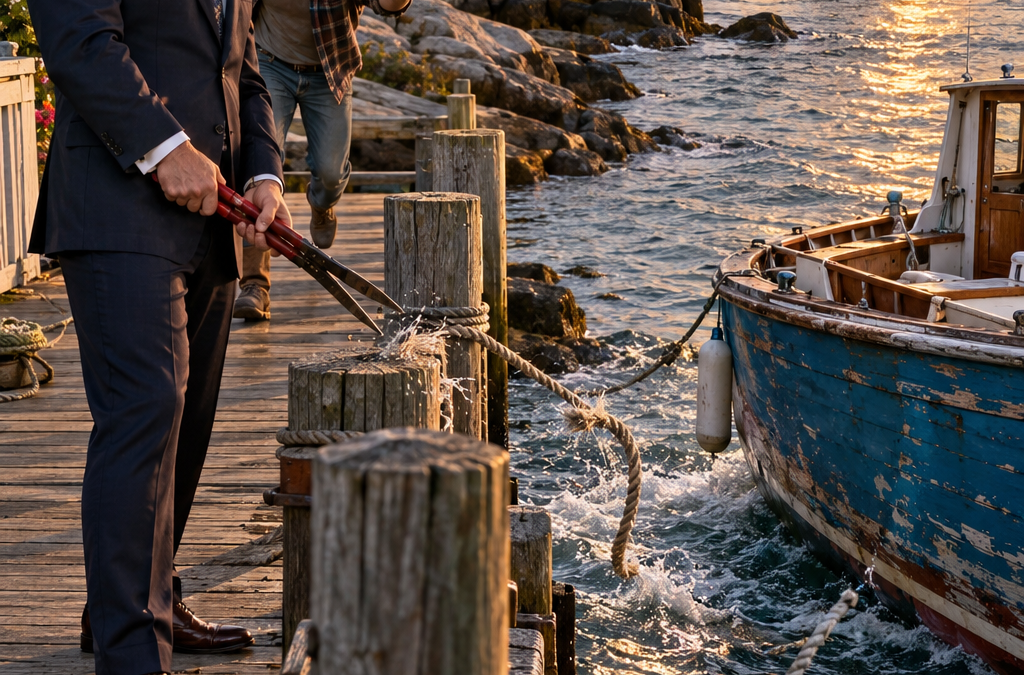
𝗙𝗨𝗟𝗟 𝗦𝗧𝗢𝗥𝗬
There was a difference.
My father, Walter Callahan, had built her by hand over two winters in a rented barn.
He was a shipwright who trusted good wood more than expensive advertising and believed a person should understand how a thing worked before claiming to love it.
I was seventeen when he first let me help shape a replacement frame.
I remember standing beside him with my hands covered in sawdust while he ran his fingers along a curved piece of oak.
“Feel that?” he asked.
I nodded, although I wasn’t sure what he meant.
“Don’t force the wood against what it wants to do. Learn its grain first.”
That was how he taught almost everything.
Patience before force.
Understanding before judgment.
Work before boasting.
When he finished the Anmarie, my mother stood beside the launch ramp with tears in her eyes.
He had named the boat after her without telling her.
For thirty-four years, that name had remained on the stern.
My father was gone now.
So was my mother.
But when I stepped aboard the Anmarie, there were moments when I could almost hear his boots against the deck.
I could still picture him leaning over the engine box, telling me to listen carefully because a good mechanic could often hear a problem before he saw it.
Keeping that boat in the water wasn’t a hobby.
It was a promise.
And during those four days of leave, I’d planned to honor that promise in the simplest way possible.
Take Martha out across the bay.
Visit the small island she loved.
Return before dark.
Cook dinner.
And wake up the following morning with nothing urgent waiting for me.
The first morning began exactly as I had hoped.
Fog rested low over the cove.
The water was almost motionless.
I pulled on an old red flannel shirt, made coffee, and walked down to check the boat while Martha slept.
The shared pier was damp beneath my boots.
I could smell salt, seaweed, and the faint trace of diesel drifting from the working harbor beyond the point.
The Anmarie floated comfortably in her slip.
I checked the bow line.
Then the stern line.
Then the spring line that kept her from surging against the float when the wind and tide shifted.
Each was properly secured.
The chafe guards were in place.
The cleats were tight.
I had tied the same familiar hitches I’d been using since my father first taught them to me.
I ran my hand over the rail.
“Morning, girl.”
Then I heard car doors slamming from the neighboring property.
Across the narrow stretch of lawn, a large glass-and-cedar rental house stood on the next point.
It belonged to Philip Granger, a wealthy businessman who rented the estate to vacationers and commercial clients.
That week, three white vans had pulled into the driveway.
Men and women were unloading light stands, rolling equipment cases, folding tables, clothing racks, and large black cables.
One man carried a generator toward the side entrance.
Another struggled with a metal frame taller than he was.
I stood watching.
I’d seen film crews along the coast before.
Maine’s rocky shoreline attracted advertising companies, wedding photographers, and people who wanted the ocean to look like it belonged exclusively to them.
Most worked without bothering anybody.
I assumed this crew would be the same.
Then Karen Whitmore appeared.
He was fifty years old, with slick black hair combed backward so precisely that the sea breeze barely seemed able to disturb it.
His beard was trimmed into a sharp, carefully maintained line.
He wore a fitted cream-colored jacket, designer trousers, polished leather loafers, and a heavy gold wristwatch that flashed whenever he moved his hands.
Even at the waterfront, surrounded by wet boards and coils of rope, he looked as though he’d stepped out of a luxury real-estate advertisement.
He carried a tablet beneath one arm.
A pair of expensive sunglasses hung from his shirt collar.
His entire appearance communicated a message before he spoke.
He expected to be taken seriously.
He walked toward the shared pier with two assistants behind him.
“Good morning!” he called.
His smile was broad and professionally rehearsed.
I nodded.
“Morning.”
“Hoa Karen Whitmore. Whitmore Events and Photography.”
He extended his hand.
I shook it.
“Ethan Callahan.”
He glanced toward the cabin.
“You’re the owner next door?”
“My family’s owned the cabin for decades.”
“Wonderful.”
His smile brightened.
“I’m also president of the Seaward Point Homeowners Association. We’re responsible for maintaining the character and quality of this stretch of shoreline.”
I looked toward the private houses farther up the coast.
“I know the development.”
“Excellent.”
He adjusted his cuffs.
“We’ve rented the Granger estate for a major luxury advertising production. High-end campaign. Important people. Very demanding client.”
“Sounds busy.”
“Extremely.”
He seemed pleased that I’d recognized the importance of his work.
Then he turned toward the water.
He raised both hands and formed a rectangle with his fingers, framing the view beyond the pier.
The mountains of the distant coast were barely visible through the fog.
The water reflected the pale morning sky.
Gulls circled above the channel.
It was a beautiful scene.
Then Karen’s imaginary frame settled on the Anmarie.
His smile vanished.
“Oh, no.”
I looked at him.
“What?”
He pointed toward the boat.
“Please tell me that isn’t yours.”
“It is.”
He sighed as though I’d delivered terrible news.
“Seriously?”
“Yes.”
He looked over the hull from bow to stern.
“That is unfortunate.”
I waited.
He walked closer.
“It’s so old.”
“She’s thirty-four.”
“Thirty-four years?”
“Yes.”
His expression suggested I’d confessed to keeping a dead animal in the water.
“Look at that rust.”
I glanced toward the fittings.
A few orange stains marked the weathered metal.
“She’s maintained.”
Karen shook his head.
“That thing makes the entire cove look cheap.”
I felt the first flicker of irritation.
“She’s a boat, Mr. Whitmore. Not a decoration.”
He turned toward me.
“Of course. But I’m shooting a luxury campaign here. The client is paying an extraordinary amount of money for an untouched, exclusive coastal setting.”
I looked toward the fishing channel.
“Well, this is a working harbor.”
His smile tightened.
“Which is exactly the problem.”
He pointed toward the Anmarie.
“I need that boat moved.”
I stared at him.
“Where?”
“Anywhere outside the camera frame.”
“For how long?”
“The duration of the shoot.”
I glanced toward the crew unloading equipment.
“And how long is that?”
“Several days.”
I shook my head.
“No.”
Karen blinked.
“Excuse me?”
“The boat stays in her slip.”
He gave a soft laugh.
“Come on. I’m being reasonable.”
“So am I.”
He looked toward the cove.
“Would five hundred dollars change your mind?”
“No.”
“A thousand?”
“No.”
He studied me.
“Everybody has a price, Ethan.”
I looked him directly in the eye.
“Not everything is for sale.”
His expression cooled.
“You’re making this needlessly difficult.”
“I’m standing beside my own boat.”
“And your boat is interfering with a professional production.”
“Then move your camera.”
His jaw tightened.
I gestured toward the open water.
“Turn it a few degrees. There’s an entire bay out there.”
Karen stared at me.
“Do you have any idea what this campaign is worth?”
“No.”
“Tens of thousands of dollars. The client is flying in from New York. We’ve arranged equipment, talent, transportation, catering, and a very specific visual environment.”
“Then I hope everything goes well.”
He stepped closer.
“You’re not listening.”
“I am. You want my boat moved because it doesn’t look expensive enough for your advertisement. I said no.”
His smile disappeared completely.
“You need to understand that I have relationships with important property owners along this coast.”
I nodded.
“Good for you.”
“And the homeowners association has standards concerning the appearance of waterfront areas.”
“My family’s slip is privately established and legally permitted.”
Karen looked offended.
“That doesn’t mean you can ignore community concerns.”
I took a breath.
“Mr. Whitmore, this isn’t an HOA common area, and your association doesn’t own my boat.”
His face reddened.
“You’ve got a remarkably confrontational attitude.”
“Then stop confronting me.”
For a moment, I thought he might shout.
Instead, he stepped back and straightened his jacket.
“People who sabotage expensive commercial operations tend to regret it.”
I looked at him.
“Is that a threat?”
“It’s business.”
“No. Business would be asking permission and accepting the answer.”
His eyes narrowed.
“You’re going to make this difficult for yourself.”
Before I could respond, Martha came down the lawn carrying two cups of coffee.
She wore an old blue sweater, comfortable sneakers, and the expression of a woman who had already recognized trouble from fifty feet away.
“Ethan?”
I turned.
“Morning, sweetheart.”
She handed me a mug.
Then she looked at Karen.
“Everything all right?”
Karen gave her a quick glance.
His eyes moved over her sweater and old shoes with the unmistakable disdain of a man accustomed to judging people’s worth by their appearance.
“Your husband is refusing a reasonable accommodation.”
Martha looked at me.
“What accommodation?”
“He wants me to move the Anmarie.”
She glanced toward the boat.
“Why?”
Karen spread his hands.
“Because we’re creating a luxury visual experience, and that vessel destroys the entire atmosphere.”
Martha stared at him for a moment.
Then she looked toward the sea.
“Seems to me the atmosphere is doing just fine.”
I nearly smiled.
Karen did not.
He looked at her as though she had committed an act of deliberate disrespect.
Martha touched my arm.
“Ethan, we came here to rest.”
“I know.”
She lowered her voice.
“Don’t let him take the whole morning.”
Karen had already turned away.
He walked up the pier toward the rental estate, speaking sharply into his phone.
I watched him go.
Martha stood beside me.
“He’s not going to let this go, is he?”
I looked toward the Anmarie.
“I don’t think so.”
She followed my gaze.
“Should we be worried?”
I considered lying.
Then I shook my head.
“I don’t know yet.”
We went out on the bay anyway.
I started the old inboard engine, and the Anmarie settled into the familiar vibration I’d known since childhood.
Martha sat beside me in the cabin.
The fog lifted as we passed the outer ledges.
For a few hours, the ocean did what it always did.
It made everything else seem smaller.
We visited the island Martha loved, ate sandwiches on the sheltered side of the beach, and watched seabirds circle above the rocks.
We talked about ordinary things.
The cabin roof.
Her sister’s upcoming birthday.
Whether I should finally replace the porch steps.
Not once did I mention Karen.
But when we returned that afternoon, Jack Riley was waiting at the head of the pier.
And the expression on his face told me the trouble had followed us home.
Jack was thirty-nine and had run the marina since his father retired.
He was practical, hardworking, and normally allergic to confrontation.
He had known my family since childhood.
His father and mine had repaired docks together, helped one another through storms, and shared enough bad coffee to establish a friendship that survived almost anything.
Jack stood with his hands inside his canvas jacket.
“Ethan, got a minute?”
I tied off the Anmarie.
“What’s wrong?”
He glanced toward the rental house.
“That photographer.”
“Karen?”
“Yeah.”
I looked at him.
“What did he do?”
Jack rubbed the back of his neck.
“He came to my office last night, before you two even met.”
I stopped adjusting the stern line.
“Last night?”
“He wanted to know who controlled the slips in front of the Granger property.”
I stared at him.
“Why?”
“Asked whether the marina could move boats for events. Wanted to know who had authority over the shared floats.”
I looked toward Karen’s equipment vans.
“So he already knew about the Anmarie.”
Jack nodded.
“He knew exactly which boat he wanted moved.”
The realization bothered me.
Karen hadn’t discovered the boat that morning.
He’d investigated how to remove it before introducing himself.
Jack continued.
“He came back again after you went out.”
“What did he want?”
“He demanded I order you to move the boat.”
I waited.
“I told him I couldn’t. Your slip rights are recorded, your permits are current, and the marina maintains the pier. We don’t own your boat or have authority to evict it from a lawful berth.”
I nodded.
“Thank you.”
Jack didn’t smile.
“That’s when he started making threats.”
I felt my shoulders tighten.
“What kind?”
“He said he works with Philip Granger. Said his clients rent a dozen houses along this coast every season. Then he mentioned Granger’s maintenance and fuel contract.”
I knew that contract.
Granger’s coastal properties generated substantial business for the marina.
Jack depended on that income to keep the operation stable through the winter.
“How much is that contract worth to you?” I asked.
Jack looked away.
“Almost a third of our annual revenue.”
I felt a hard knot form in my stomach.
Karen wasn’t merely threatening me now.
He was threatening a man whose family had helped maintain this waterfront for decades.
Jack continued.
“He said it would be unfortunate if Granger decided to reconsider working with a marina that wasn’t cooperative.”
“What did you tell him?”
“That I’d be happy to explain the legal situation to Granger personally.”
I looked at him.
“That took some nerve.”
Jack gave a tired smile.
“My father would haunt me if I let somebody bully a slip holder because he didn’t like the color of a boat.”
Then his expression turned serious again.
“Karen also started talking about environmental violations. Said your boat might be leaking rust into the water, that it could be blocking the walkway, and that he wasn’t sure it was properly registered.”
I shook my head.
“He hasn’t checked any of that.”
“I know.”
“What did he say when you told him the papers were good?”
Jack hesitated.
“He said if nobody else would handle the problem, he’d handle it himself.”
I looked toward the rental house.
The crew was still moving equipment across the lawn.
A man carried a large coil of black cable toward the pier.
Another rolled a case of lighting equipment across the grass.
I could see Karen standing near the patio with his tablet.
He looked completely at ease.
Jack followed my gaze.
“Ethan, I’m sorry.”
“Don’t be.”
“I don’t want my business dragged into this.”
“I understand.”
He looked toward the boat.
“Just be careful.”
I nodded.
“I will.”
That evening, I did something I hadn’t expected to do during my vacation.
I opened the old oak filing cabinet in the cabin’s back room.
It had belonged to my father.
Inside were folders labeled in his careful handwriting.
BOAT REGISTRATION.
SLIP RIGHTS.
HARBOR PERMITS.
MAINTENANCE.
I carried the records to the kitchen table.
Everything was current.
The Anmarie was properly registered.
The slip was lawfully established.
The harbor allocation was documented.
The marina’s maintenance responsibilities were clear.
Nothing gave Karen, his photography business, or the homeowners association authority to order the boat removed.
I also went down to the pier with a tape measure.
The Anmarie sat within her permitted berth.
At the widest point, her beam remained eight inches inside the relevant boundary.
She wasn’t blocking the walkway.
She wasn’t extending into another slip.
Her lines were sound.
I photographed the bow and stern cleats.
The spring line.
The chafe guards.
The fittings.
The boundary markers.
I recorded the date and time of every photograph.
Then I wrote the details in a notebook.
Martha watched me from the porch.
“You’re taking him seriously.”
I looked up.
“He threatened Jack’s business.”
“And your boat.”
“Yes.”
She stepped closer.
“Ethan, please don’t turn our vacation into another investigation.”
I set down the tape measure.
“I don’t want to.”
“Then what are you doing?”
I looked toward the Anmarie.
“Making sure that if something happens, nobody gets to pretend the facts were different.”
She was quiet.
Then she nodded.
“I’ll make dinner.”
I considered reporting Karen’s threats immediately.
I considered calling the harbor master and explaining that a commercial producer was attempting to pressure a lawful slip holder into moving his boat.
But I didn’t.
I hoped Karen would discover that his threats weren’t working and find another camera angle.
I wanted to believe a successful businessman had enough sense to stop before doing something genuinely dangerous.
That was my second mistake.
At dusk, I walked down to the pier one final time.
The tide was beginning to ebb.
The water moved gently beneath the planks.
I checked the Anmarie’s mooring lines with a flashlight.
All three were secured.
Then I heard footsteps.
Karen approached along the pier.
He had changed into a dark tailored jacket and cream-colored trousers.
His hair remained perfectly styled.
The gold watch gleamed beneath the dock light.
He stopped several feet behind me.
“Nervous?”
I stood.
“What?”
He looked at my flashlight.
“Checking the ropes. Measuring everything. Taking photographs.”
“Routine maintenance.”
He gave a small laugh.
“Of course.”
I held his gaze.
“Is there something you need?”
He stepped closer.
“Tomorrow, that boat is going to be gone.”
My stomach tightened.
“Don’t touch it.”
His smile widened.
“You don’t get to decide everything, Ethan.”
“It’s my boat.”
“And this is a commercial production worth more than your little floating antique.”
I took a slow breath.
“You have no authority to move it.”
He tilted his head.
“We’ll see about authority.”
Then he walked away.
I stood on the pier watching him disappear into the growing darkness.
A few minutes later, headlights swept across the cove.
A flatbed truck was backing toward the rental house.
Several men began unloading large covered equipment cases, cable reels, two portable generators, and a flat platform supported by foam pontoons.
The platform looked like a small floating stage.
I watched the crew carry it toward the shoreline.
A young dock technician named Lucas Reed walked over from the marina.
Lucas was thirty-four, thin, quiet, and exceptionally careful.
He had worked around boats long enough to notice things most people ignored.
I heard him ask the foreman what they were building.
“Lighting platform,” the man answered.
“For where?”
“Out there.”
He pointed into the cove.
“About forty feet beyond the pier.”
I looked toward the marked channel.
Forty feet.
That was too close for comfort.
The channel carried working fishing boats returning to the harbor.
At dusk, especially during the ebb tide, those boats needed clear visibility and enough maneuvering room to avoid obstacles.
A floating platform with lights, cables, and generators could become a serious hazard if it wasn’t properly positioned and marked.
Martha came to stand beside me.
She watched the men unloading equipment.
Then she looked toward the Anmarie.
“Ethan.”
“Yeah?”
“He’s not just trying to make a photograph.”
I turned toward her.
She looked worried.
“He wants that boat gone because it’s in the way of something.”
I looked back toward the floating platform.
I had reached the same conclusion.
Karen had paid a fortune to transform a working waterfront into the image of a private, untouched coastline.
My father’s boat didn’t belong in that image.
Neither did fishing boats.
Neither did channel markers.
And neither did a Coast Guard commander who knew exactly what unsafe equipment near a navigation channel looked like.
I didn’t yet understand how far Karen was willing to go.
But the following morning, I found out.
I was standing at the kitchen stove when I heard the first snap.
At first, I thought somebody had dropped a piece of metal equipment on the pier.
Then I heard the sound again in my memory.
Rope.
A loaded line being severed.
I turned toward the window.
Martha was already looking outside.
Her face had changed.
“Ethan.”
I stepped closer.
She pointed toward the float.
“Karen’s down there. He’s touching the boat.”
I saw him standing beside the Anmarie’s bow with heavy shears in one hand.
A loose length of rope lay on the planks near his shoes.
I didn’t remember turning off the stove.
I only remembered the screen door slamming behind me.
I ran down the lawn as fast as my knees would carry me.
The pier seemed twice as long as it had the previous evening.
A young man with a small camera on a stabilizing handle stood near the grass, filming the cove.
He barely looked up as I passed.
I reached the float and saw the Anmarie’s bow swinging away from the pier.
Karen stood beside the severed bow line.
He looked entirely untroubled.
“What are you doing?” I demanded.
He turned.
“Clearing the view.”
I stared at the shears.
“You cut my mooring line.”
“It’s an old rope.”
“That line was holding a twenty-four-foot boat.”
Karen shrugged.
“Then perhaps you should have moved the boat when I asked.”
I stepped toward the bow cleat.
The current was pulling against the hull.
The stern line had taken much of the load, and the spring line was beginning to stretch.
I knew immediately what could happen if either failed.
“Put those shears down,” I said.
Karen looked offended.
“Don’t give me orders.”
“Step away from the boat.”
He glanced toward the photography crew.
Several people were watching.
A few held equipment cases.
Others stood beside the lighting platform.
Karen seemed suddenly aware of his audience.
His posture straightened.
“Someone had to deal with this obstruction. I’ll pay for the rope.”
“This isn’t about the cost of rope.”
He sighed.
“Ethan, you’re being dramatic.”
I turned toward the remaining lines.
“Don’t touch anything else.”
Then I heard another snap.
I spun around.
Karen had cut the stern line.
He lowered the shears with deliberate calm.
“Untie that rusty boat from my view,” he said.
Then he smiled.
“Now it won’t ruin my photographs.”
The Anmarie swung outward.
The spring line tightened.
I watched the fibers stretch beneath the load.
A gust caught the cabin.
The current pushed against the hull.
And in that moment, I saw the situation with the terrible clarity that comes from years of understanding how quickly water can turn an ordinary mistake into an emergency.
The spring line wasn’t designed to hold the boat alone under those conditions.
“Karen, get back!”
He looked startled by my tone.
Then the line parted.
The sound cracked across the cove like a rifle shot.
The Anmarie lurched away from the pier.
For one suspended second, she drifted sideways with her bow pointed toward open water.
Then the tide caught her.
I watched my father’s boat begin moving toward the channel.
Everything else disappeared.
Karen.
The cameras.
The crew.
The arguments.
None of it mattered.
There was an unmanned boat drifting toward working traffic.
And I had to reach her before she became a danger to someone else.
I ran to the dock locker, pulled out a life vest, and fastened it.
Then I grabbed a coil of spare line and jumped into the twelve-foot skiff tied at the end of the float.
Martha was already calling Jack.
“Ethan!”
I looked back.
“Call the marina! Tell them we’ve got a loose boat heading toward the channel!”
She nodded.
“Be careful!”
I started the skiff’s outboard.
The engine caught on the first pull.
I opened the throttle.
The Anmarie was already sixty feet away.
Her bow swung slowly with the current.
Beyond her, the green channel marker rose and fell against the gray water.
I approached from the windward side.
Closing on a drifting vessel requires patience, even when every instinct tells you to hurry.
You can’t simply charge alongside.
One bad approach can damage both boats, knock someone into the water, or leave you trapped between moving hulls.
I matched her movement.
Brought the skiff alongside.
Secured a temporary line.
Then climbed aboard.
For a moment, my boots landed on the same worn deck where I’d stood beside my father as a teenager.
I felt a sharp ache in my chest.
Not now, Dad.
Please.
Not now.
I reached the engine controls.
The old inboard coughed twice.
Then it started.
The deck vibrated beneath my feet.
I almost laughed with relief.
“Good girl.”
I turned the wheel.
The bow began swinging away from the channel.
Then I heard a deep engine note beyond the outer ledge.
A fishing boat appeared around the point.
She was moving steadily toward the harbor, riding low with a day’s catch.
Ray Dunham was at the helm.
I’d known Ray for years.
He was a weathered lobsterman with hands like rope and a face shaped by decades of sun, wind, and salt spray.
He saw the Anmarie.
Then he saw my position.
His hand moved to the throttle.
The fishing boat slowed sharply.
The horn sounded across the water.
I brought the Anmarie farther around.
Ray swung wide.
For several seconds, I watched the distance between our hulls with my heart hammering against my ribs.
The boats passed with only a few lengths to spare.
Ray looked through his windshield.
I raised one hand.
He nodded once.
Then he continued toward the harbor.
No collision.
No injuries.
But that near miss had been real.
I could still hear the horn long after it stopped sounding.
I brought the Anmarie into the inner cove, well clear of the channel, and picked up a heavy guest mooring.
I secured the pennant.
Doubled the line.
Checked the connection.
Then checked it again.
Only when I was satisfied did I sit on the engine box.
My hands were shaking.
The old boat moved gently beneath me.
I looked down at the familiar deck boards.
A few moments earlier, I had watched her drift toward a collision because somebody disliked the way she looked.
I rested one hand against the rail.
My father had built this boat to carry his family safely across the bay.
Karen had treated her like a movable piece of scenery.
I stayed there until my breathing steadied.
Then I climbed back into the skiff and returned to the pier.
Karen was waiting.
He stood with his arms folded, the shears no longer visible, his assistant beside him.
His expression suggested that I had inconvenienced him.
“Are you finished?” he asked.
I stepped onto the planks.
I was still breathing hard.
“Finished?”
“Making a spectacle.”
I stared at him.
“You cut a boat loose in an active harbor.”
He waved one hand.
“It drifted a little.”
“It nearly collided with a fishing vessel.”
“Because you overreacted.”
I felt anger rise so sharply that for a moment my vision seemed to narrow.
Karen continued.
“Honestly, Ethan, your behavior is embarrassing. You’re making everybody uncomfortable over an old boat.”
I looked at him.
I could have shouted.
I could have demanded that he explain himself in front of every member of his crew.
Instead, I said, “From this moment forward, every action involving that boat will be documented.”
Karen laughed.
A bright, dismissive laugh.
“Do whatever makes you feel important.”
Then he turned away.
As he walked toward the rental house, I noticed the young man with the camera still standing near the lawn.
He was holding the equipment against his chest.
His face was pale.
I didn’t know his name yet.
But I would remember that expression.
Jack arrived minutes later.
Lucas followed him down the pier.
Martha stood at the head of the float, visibly shaken.
I wanted to go to her.
I wanted to take her back inside and tell her the danger had passed.
But Lucas had already knelt beside the spring-line cleat.
He was studying the frayed rope.
“Ethan.”
Something in his voice made me stop.
“What?”
He held up the severed end.
“Look at this.”
I crouched beside him.
The spring line had parted under tension, but the fibers weren’t damaged uniformly.
Several strands had been cut cleanly in a shallow, straight line.
A foot away from the splice.
Exactly where yesterday’s chafe guard had been.
I looked closer.
The guard was missing.
Lucas pointed toward the cleat.
Two of the four mounting bolts had been loosened.
Not torn out.
Loosened.
I felt something cold settle in my stomach.
“Are you sure?”
Lucas nodded.
“These weren’t pulled free by the boat. Somebody backed them out.”
I looked toward Karen’s crew.
Then back at the line.
Lucas continued examining the remaining hitch.
After a moment, he frowned.
“That’s not your knot.”
I stared at him.
“What?”
“The final turn. You always finish this hitch with the tail lying toward the inside of the cleat.”
I leaned closer.
He was right.
My father had taught me that habit.
I’d tied thousands of knots the same way.
This one had been retied differently.
Lucas touched the flattened fibers.
“Somebody took it apart and put it back together.”
I looked at the damaged rope.
The missing chafe guard.
The loosened cleat bolts.
Then toward the cove.
The meaning was difficult to accept.
Karen had cut two lines in broad daylight.
But somebody had already weakened the remaining mooring arrangements.
This wasn’t simply an arrogant man making a reckless decision with a pair of shears.
Someone had prepared the boat to break free.
The thought made my hands go cold.
If I hadn’t heard the ropes part, the Anmarie might have drifted into the channel while nobody was watching.
If the current had been stronger, I might not have reached her.
If Ray had been approaching a few seconds earlier, the outcome might have been very different.
I looked toward the rental house again.
For the first time, I was afraid of what Karen might do next.
Not because I thought he was more powerful than I was.
Because he had demonstrated that he didn’t understand—or didn’t care—how dangerous his actions had become.
I pulled out my notebook.
Wrote down the time.
The wind direction.
The tide.
The position of the boat.
The approximate route she had taken.
Then I photographed the cleat, the loose bolts, the damaged fibers, and the missing chafe guard.
Jack watched me.
“Should we call somebody?”
“Yes,” I said. “But first, let’s preserve what we have.”
I collected the severed line ends.
Placed them in a clean, dry bag.
Sealed it.
Marked the time.
Then I asked Lucas to document exactly what he’d observed before the damaged hardware was disturbed further.
Martha came down the pier.
“Ethan.”
I turned.
Her face was pale.
“Are you hurt?”
“No.”
She looked toward the guest mooring.
“The boat?”
“She’s safe.”
Martha closed her eyes.
For a moment, she said nothing.
Then she took my hand.
“I saw her moving away.”
“I know.”
“I thought—”
Her voice broke.
I squeezed her hand.
“It’s all right.”
She shook her head.
“No. It isn’t.”
I couldn’t disagree.
Two hours later, Karen began telling his own version of the story.
He appeared at the head of the pier with his assistant, a producer, and one of the catering staff.
Several crew members were close enough to hear.
Karen spoke loudly, as though delivering a statement to the press.
“I witnessed an extremely dangerous situation this morning.”
I stood beside Jack.
Karen continued.
“Mr. Callahan’s deteriorating boat broke loose because of rotten mooring equipment. It drifted toward the navigation channel and nearly caused an accident.”
I stared at him.
He didn’t look away.
“This is precisely why private shoreline standards matter,” he announced. “Neglected equipment creates hazards for everyone.”
The young server looked toward the water.
Jack stiffened beside me.
Karen continued.
“If necessary, I’ll report the incident to the appropriate authorities. Someone could have been seriously injured.”
For a moment, I couldn’t believe what I was hearing.
He had cut the lines.
He had stood there holding the shears.
And now he was describing himself as a responsible witness to a dangerous accident caused by my negligence.
I felt every muscle in my shoulders tighten.
Karen turned toward me.
“I assume you’ll be replacing that rotten equipment immediately.”
I looked him directly in the eye.
“I’ll make sure the incident is fully documented.”
His smile widened.
“Excellent.”
Then he walked away.
Jack swore quietly.
I looked at him.
“Don’t.”
He stared at me.
“He’s blaming you.”
“I know.”
“He cut the lines.”
“I know.”
“Then why aren’t you saying it?”
I looked toward the crew.
“Because he wants an argument. He wants everyone to remember me shouting while he calmly explains that my old boat was dangerous.”
Jack stared at me.
“That’s exactly what he’s doing.”
I nodded.
“Then we give them something better than an argument.”
I asked Jack for the marina’s dock log.
We sat in his cramped office with the ledger between us.
The marina kept records of visitors, maintenance work, fuel deliveries, unusual activity, and requests concerning the shared pier.
Jack turned the pages slowly.
Then stopped.
“Look at this.”
He pointed to an entry from two days earlier.
Karen’s assistant, Brian, had visited the office asking about the cabin.
I frowned.
“About what?”
Jack read the note.
Whether Mr. Callahan generally takes his boat out during the evenings.
I stared at the page.
Jack turned another.
A second visit.
This time Brian had asked whether the cabin was normally occupied on Friday nights.
Then a third.
He wanted to know whether Martha and I were expected to be home during the production.
I looked up.
“Why would they care when we’re home?”
Jack shook his head.
Then he remembered something.
“Ethan, you told Lucas you might visit Martha’s sister on Friday.”
I felt my stomach tighten.
“Yes.”
“Lucas mentioned it to me. Brian was standing here when we talked about it.”
I looked at the ledger again.
Martha had entered the office behind us.
She heard the last part.
For several seconds, she remained silent.
Then she said, “He wasn’t asking when we’d be home because he wanted to be considerate.”
I turned toward her.
She looked frightened.
“He wanted to know when we wouldn’t be here.”
The room fell quiet.
I pictured the camera platform.
The generators.
The cables.
The channel.
Then the Anmarie drifting away.
Karen wanted the boat out of the picture.
But he also wanted me absent while his crew worked on the water.
I knew boats.
I knew what safe harbor equipment looked like.
I knew which channel markers couldn’t be ignored and why a floating platform needed proper placement.
If I wasn’t there, nobody would be standing on that pier asking difficult questions.
And if my boat disappeared because of a supposedly rotten mooring, Karen would have a convenient explanation for why it was gone.
I looked toward Jack.
“What permits did they submit for this production?”
He opened another folder.
The rental estate’s event application described a private shoreline photography session.
No meaningful impact on navigable water.
No floating commercial structures.
No interference with harbor traffic.
Nothing about fuel cans and generators on the shared pier.
Nothing about a lighting platform anchored close to the channel.
The document was signed by Karen.
I read it twice.
Then I looked toward Martha.
“We’re not going to your sister’s tomorrow.”
She nodded.
“I already know.”
“I’m sorry.”
She reached across the desk and took my hand.
“Don’t apologize. I would rather miss a visit than discover someone got hurt because we weren’t here.”
That night, I barely slept.
Every time I closed my eyes, I saw the Anmarie drifting toward Ray’s fishing boat.
I heard the horn.
I remembered the final rope snapping.
Then I imagined the same thing happening at night.
A vessel coming around the ledge.
A brightly lit platform floating near the channel.
An unmarked service boat crossing in front of working traffic.
I got out of bed before dawn.
Martha found me sitting at the kitchen table with my notebook.
“You’re working,” she said quietly.
I looked up.
“Trying to make sense of it.”
She pulled out a chair.
“Have you?”
I looked toward the window.
“Not completely.”
She studied my face.
“Then promise me something.”
“What?”
“Whatever happens next, don’t let that man make you forget who you are.”
I took her hand.
“I won’t.”
But on Friday evening, when Karen’s crew began operating its floating lighting platform beside the channel, keeping that promise became harder than I’d expected.
The equipment had been assembled throughout the afternoon.
The raft floated beyond the pier, crowded with light stands, sandbags, electrical cables, and metal supports.
Two portable generators hummed on the dock.
Fuel cans stood nearby.
Heavy cables snaked across the walking surface toward the platform.
The anchoring arrangement extended dangerously close to the marked navigation channel.
I walked down with Jack and studied the setup.
The farther I looked, the more concerns I saw.
“That’s too close,” I said.
Jack followed my gaze.
“The platform?”
“The anchor line. And they’re going to blind incoming boats if they aim those lights across the channel.”
A large man wearing a work vest approached.
He introduced himself as Mike Sullivan, the production foreman.
I spoke calmly.
“Mike, I’m Ethan Callahan. I own the cabin next door.”
He nodded.
“I know.”
“I’m not trying to interfere with your work. But you’ve got fuel close to the water, cables across the shared walking route, and a platform positioned inside a very narrow safety margin.”
Mike looked tired.
“We’ve got a schedule.”
“I understand.”
“The equipment’s already in place.”
“Then let’s adjust it before dark.”
He glanced toward the rental estate.
I continued.
“Move the fuel farther back. Secure the cables so nobody trips. Mark the platform properly. And pull the whole setup away from the channel.”
Mike rubbed his forehead.
“We’ve been told everything’s approved.”
“By whom?”
He didn’t answer.
Then a young lighting technician spoke from beside the platform.
Her name was Danielle Pierce.
She was in her mid-twenties, with a headlamp pushed above her forehead and a tape measure clipped to her belt.
She had been checking the anchor line.
“Mike,” she said quietly, “he’s right about the distance.”
The foreman looked toward her.
She pointed at the water.
“The permit sheet said we’d keep a wider margin. We’re inside the marker.”
I nodded.
“Exactly.”
Then Karen appeared.
He came down the pier wearing a white linen jacket, expensive trousers, and the same immaculate expression he’d worn while threatening me.
His tablet was tucked beneath one arm.
“Is there a problem?”
Mike hesitated.
Danielle looked toward him.
I answered.
“Several safety concerns.”
Karen sighed.
“Of course.”
He looked at the crew.
“Mr. Callahan has been trying to obstruct this production since the moment we arrived.”
I held his gaze.
“I’m asking you to move equipment away from an active navigation channel.”
Karen turned toward Danielle.
“What were you saying?”
She swallowed.
“The anchor line is closer than the permit allows.”
Karen stared at her.
For several seconds, he said nothing.
Then he stepped close enough that she had to tilt her head upward to meet his eyes.
“You do what you’re told.”
Her face reddened.
“Sir, I’m only—”
“Or you go home tonight and never work for another serious production company in this region again.”
The words were quiet.
But everyone nearby heard them.
Danielle lowered her eyes.
She unclipped the tape measure.
Then put it away.
I felt anger rise through my chest.
I’d seen supervisors misuse authority before.
I’d seen employees remain silent because speaking up might cost them a paycheck.
But watching Karen threaten a young technician for pointing out a safety problem made the situation painfully clear.
He wasn’t interested in whether the platform was safe.
He was interested in whether anybody had the courage to contradict him.
Dusk settled quickly.
The sky turned pink above the outer ledges.
The water darkened.
Then the platform lights came on.
A burst of brilliant white reflected across the cove.
I instinctively raised one hand against the glare.
The lights were aimed low, creating a bright surface across the water.
From the camera’s position, it probably looked beautiful.
From the channel, it was dangerous.
I could barely see the marker beyond the platform.
Then I heard an engine.
A small inflatable service boat was crossing the cove.
Brian, Karen’s assistant, sat at the tiller.
A large equipment case rested near the bow.
The boat had no visible running lights.
He was heading toward the platform.
Directly across the edge of the working channel.
And beyond him, two fishing boats were approaching from the outer harbor.
I saw their navigation lights moving through the glare.
My chest tightened.
“Brian!” I shouted.
He didn’t hear me.
The generators were too loud.
I turned toward the marina service locker.
Ran.
Grabbed the heavy dock flashlight and compressed-air horn.
Then returned to the pier.
I aimed the light across the water, directing long, clear sweeps away from the approaching vessels’ eyes and toward Brian’s position.
“BRIAN! SLOW DOWN!”
He turned slightly.
I sounded the horn.
Once.
Twice.
Then again.
The first fishing boat began reducing speed.
I could hear the change in its engine note.
The inflatable continued toward the platform.
I shouted again.
“GET YOUR LIGHTS ON! TURN AWAY FROM THE CHANNEL!”
Karen grabbed my arm.
“What the hell are you doing?”
I pulled free.
“Keeping that boat out of traffic!”
“You’re ruining the shot!”
I looked at him.
For a moment, I couldn’t believe he had said it.
There were vessels approaching.
A small unlit boat was crossing their route.
The platform lights were affecting visibility.
And Karen was worried about a photograph.
I turned back toward the water.
Sounded the horn again.
Brian finally slowed.
The inflatable began turning away from the channel.
The first fishing boat reduced speed and passed with a narrow but safe margin.
The second followed behind it.
I continued signaling until all three vessels were clear.
Then I lowered the flashlight.
My heart was pounding.
The air horn felt heavy in my hand.
For several seconds, I stood listening to the engines recede.
Another near miss.
Another dangerous situation created because Karen wanted control of what the camera could see.
When I turned around, he was standing directly behind me.
His face was red with fury.
“You’ve gone too far.”
I stared at him.
“What?”
“You just disrupted an expensive production in front of my client.”
I took a breath.
“Your service boat was crossing the channel without lights.”
“You had no right to interfere.”
“Two fishing vessels were approaching.”
“I saw them.”
“Then why didn’t you stop the boat?”
His expression twisted.
“You are a bitter old man who can’t accept that this coastline is changing.”
A dozen crew members were watching.
Mike stood near the generators.
Danielle remained beside the platform.
Brian was bringing the inflatable back toward the dock.
Karen stepped closer.
“You’ve spent days trying to sabotage my work because you don’t like being told what to do.”
I looked at him.
Something in me changed.
For days, I’d avoided discussing my professional position.
I’d come here on leave.
I didn’t want my rank entering a private dispute over my father’s boat.
But this was no longer only about my boat.
There were real hazards on the water.
People could be injured.
And Karen was treating every safety warning as a personal insult.
I spoke quietly.
“Mr. Whitmore, I’m a commander in the United States Coast Guard.”
The crew fell silent.
Karen stopped moving.
For three seconds, he said nothing.
I continued.
“When I see a hazard to navigation, I have a responsibility to recognize it. That doesn’t disappear because I’m on vacation.”
His face changed.
I could almost see him calculating what the words meant.
I gestured toward the water.
“An improperly marked floating platform, fuel and electrical equipment near the water, bright lights affecting visibility, and an unlit service boat crossing a working channel at dusk. Those are real safety concerns.”
Karen looked toward Mike.
Then toward Danielle.
Then back at me.
For one brief moment, I thought he might finally understand.
Instead, his expression hardened.
He turned toward the crew.
“There it is.”
I frowned.
“What?”
He raised his voice.
“Now we know what this is really about.”
I stared at him.
Karen pointed directly at me.
“He’s using his federal rank to intimidate a private business because we disagreed about his boat.”
I felt my stomach tighten.
“That’s not what I’m doing.”
He continued.
“He couldn’t get his way as a homeowner, so now he’s threatening us with government authority.”
I shook my head.
“I haven’t issued an order.”
“You’re abusing your position!”
Several crew members looked uncomfortable.
Danielle stared at the pier.
Mike lowered his eyes.
Karen kept talking.
“I’m going to make sure the proper people hear about this.”
I knew exactly what he was attempting.
He had cut my boat loose.
Then claimed its moorings were defective.
Now he had ignored serious safety concerns and was accusing me of using federal authority for personal revenge.
He was trying to reverse the entire story.
Again.
I looked at him.
“I’m not invoking enforcement authority here. I’m identifying a hazard.”
He laughed bitterly.
“Convenient distinction.”
I didn’t argue.
Instead, I walked toward Jack, who had arrived with a flashlight and a notebook.
“Jack, I need you to document what happened.”
He nodded.
“What exactly?”
“The time. The equipment locations. The service boat. The approaching fishing vessels. The warning signals. Everything you observed.”
Jack began writing.
Karen watched from the pier.
For the first time, he seemed less certain about what would happen next.
But the most damaging evidence against him had already been recorded.
And he didn’t know it still existed.
I was walking back toward the cabin when Danielle appeared behind me.
She stood near the edge of the lawn, away from the production lights, with her arms folded tightly across her chest.
“Mr. Callahan?”
I stopped.
“Yes?”
She glanced toward the pier.
“Can I tell you something?”
“Of course.”
Her voice dropped.
“Karen ordered us to delete the video.”
I felt my stomach tighten.
“What video?”
“The footage from when he cut your boat loose.”
For a moment, I couldn’t speak.
She continued quickly.
“The camera was running that morning. He knew it. He told me and another crew member to erase the clip.”
“Did you?”
She lowered her eyes.
“Yes.”
I stared toward the rental house.
Danielle swallowed.
“He stood over me until I deleted it. He watched the screen.”
I felt something cold spread through my chest.
The young man with the camera.
The one I’d passed while running toward the pier.
He had recorded everything.
And Karen had ordered the footage destroyed.
Danielle looked frightened.
“I’m sorry.”
I took a breath.
“You don’t owe me an explanation tonight.”
“He said I’d never work again if I refused.”
I looked at her.
“I heard what he said to you about the anchor line.”
Her eyes filled.
“I need this job.”
“I understand.”
She looked toward the lights again.
“I just thought you should know.”
Then she hurried back toward the crew.
I stood in the darkness listening to the generators.
The evidence existed.
Or it had existed.
And Karen had deliberately tried to erase it.
I didn’t sleep much that night.
At first light, I sat at the kitchen table organizing everything we had collected.
The photographs.
The tide records.
My notes.
The damaged rope.
Lucas’s observations.
Jack’s dock log.
The production application.
The reported near misses.
I had enough to establish serious concerns even without the video.
But I knew how easily Karen could challenge individual witnesses.
He could claim Lucas was protecting the marina.
That Jack was angry about the contract threat.
That I was using my position to retaliate.
He had already begun telling those stories.
The knock came at eight.
Martha opened the door.
A young man stood on the porch holding a laptop against his chest.
He looked exhausted.
“Is Mr. Callahan here?”
I stepped forward.
“I’m Ethan.”
He swallowed.
“My name’s Tyler Brooks. I’m the digital imaging technician for the production.”
I recognized him immediately.
The young man with the camera.
“Come in.”
He shook his head.
“Could we talk outside?”
I nodded.
We sat on the porch steps.
Tyler stared at the water.
Then he said, “I know Karen told Danielle to delete the footage.”
I waited.
“He thinks it’s gone.”
My pulse quickened.
“Is it?”
Tyler looked at the laptop.
“No.”
For several seconds, neither of us spoke.
He explained that the production cameras automatically transferred recorded files to a storage system in the equipment van.
Karen had ordered the camera’s local copy deleted.
But the original recording had already been backed up.
“He doesn’t know the system works that way,” Tyler said.
I looked at him.
“And you still have it?”
He nodded.
His hands trembled slightly.
“I’ve been sitting on it for almost two days.”
“Why?”
He stared at the laptop.
“Because I know what it shows.”
He swallowed.
“And I’m scared.”
I understood.
Karen had threatened Jack’s business.
He had threatened Danielle’s career.
Tyler was twenty-three.
He was just beginning to establish himself in an industry where reputation and personal connections mattered.
If he challenged Karen, the consequences could follow him far beyond this production.
I looked at him.
“Tyler, I’m not going to pressure you.”
He raised his eyes.
“You aren’t?”
“No.”
“But you need the footage.”
“I need the truth. That doesn’t give me the right to force you into anything.”
He looked down.
I continued.
“You should decide what to do because you believe it’s right, not because I’m a Coast Guard commander or because you’re afraid of disappointing me.”
For a long moment, he said nothing.
Then he opened the laptop.
“I think you need to see this.”
The first video showed the cove late Thursday morning.
The Anmarie rested quietly in her slip.
The water was gray.
The camera angle captured the shared pier and part of the rental house lawn.
Karen entered the frame.
He carried the heavy shears.
I watched him walk toward the bow cleat.
He bent down.
Positioned the blades.
And cut the line.
There was no hesitation.
No confusion.
He wasn’t trying to rescue a damaged boat.
He wasn’t removing dangerous equipment.
He was deliberately severing a properly secured mooring line.
Then he moved toward the stern.
The second cut was just as clear.
My own voice came from the recording a moment later.
The camera captured Karen looking at me with that faint, satisfied smile.
Then I heard his words again.
“Now it won’t ruin my photographs.”
I sat motionless.
Seeing the incident was different from remembering it.
In my memory, everything had happened too quickly.
The snapping rope.
The drifting hull.
The danger near the channel.
On the screen, Karen’s actions were deliberate.
Controlled.
Almost casual.
Tyler paused the footage.
“There’s something else.”
He opened another file.
“This was recorded the evening before.”
The second clip showed the production crew rigging the floating platform.
Mike Sullivan stood beside Karen, discussing the placement of the anchor line.
Mike pointed toward the channel marker.
The audio was clear.
He warned Karen that the equipment was too close to the navigation route.
Karen barely looked at the marker.
“I don’t care about that buoy. Nobody’s going to see it in the photograph.”
Mike tried again.
“The fishing boats—”
Karen interrupted.
“My client is paying for a private shoreline. I’m going to give them a private shoreline.”
Then he looked toward the Anmarie.
“And that boat has to go. Otherwise the whole picture says public harbor.”
Tyler stopped the recording.
Neither of us spoke.
Outside, the tide moved gently beneath the pier.
The reason for everything finally became clear.
Karen hadn’t been furious about the Anmarie because she was rusty.
He was furious because she revealed what the location actually was.
A working harbor.
A place with legally established boat slips, fishing traffic, channel markers, and ordinary people whose rights didn’t disappear when a luxury company rented a nearby estate.
Karen’s client wanted photographs suggesting exclusive possession of an untouched coastline.
Karen had promised to produce that illusion.
My father’s boat made the illusion harder to sell.
And rather than adjust the camera or explain the location honestly, he had decided to remove the evidence that contradicted his promise.
I looked at Tyler.
“Thank you for showing me.”
His face was pale.
“What happens now?”
“I’ll document what you’ve told me. What you do with the recordings is your decision.”
He nodded slowly.
“I want the harbor master to have them.”
I studied him.
“Are you sure?”
“No.”
He gave a nervous laugh.
“I’m terrified.”
Then his expression steadied.
“But I know what happened. And I don’t want someone getting hurt because everybody was too scared to say anything.”
I placed a hand on his shoulder.
“That’s a decision you can be proud of.”
After Tyler left, I called Jack.
He had already been speaking with the harbor authorities about the unmarked platform and the close calls in the channel.
Through those legitimate safety concerns, Commander Sarah Mitchell became involved.
Sarah had served in the Coast Guard for as long as I had.
She was precise, calm, and utterly uninterested in giving friends special treatment.
When she called me, her first words were direct.
“Ethan, I’m speaking to you because Jack reported a navigational safety issue. Not because we’re friends.”
“Understood.”
She reviewed the circumstances with me.
A moored vessel had been deliberately released.
A floating production platform had been positioned near an active channel.
Unlit equipment traffic had crossed the area at dusk.
And the lighting arrangement had interfered with safe visibility.
“Those are matters for the appropriate harbor and marine authorities,” she said.
“I know.”
“Then submit your evidence through the proper channels.”
“I intend to.”
Her voice became firmer.
“You’re a witness and a property owner in this dispute. Don’t use your rank to settle it.”
I looked toward the Anmarie.
“I haven’t.”
“Good. Keep it that way.”
After the call, I sat quietly for a long time.
I knew what came next.
The evidence needed to be submitted.
But I also knew the consequences might reach people who had done nothing wrong.
Mike had expressed concerns.
Danielle had tried to warn Karen.
Tyler had chosen to preserve the truth.
There were servers, lighting assistants, drivers, and technicians who depended on being paid for the production.
I didn’t want them punished because Karen had made reckless decisions.
Still, saying nothing would leave the danger unaddressed.
So I organized the documentation carefully.
Jack prepared his marina records.
Lucas wrote a detailed statement describing the damaged spring line, missing chafe guard, loosened cleat bolts, and altered hitch.
I prepared the photographs and timeline.
Tyler independently provided copies of both recordings to the harbor master.
Danielle submitted a statement explaining how Karen had ordered the first recording deleted.
By Sunday morning, everything was ready for review.
Harbor Master Dale Whitcomb called a meeting at Jack’s marina office.
Dale was a stocky man with a weathered face, gray hair, and the steady manner of someone who preferred documents to arguments.
He had been responsible for harbor operations long enough to recognize the difference between an honest mistake and a problem that somebody had tried to conceal.
I arrived carrying my folder.
Jack was already there.
Lucas stood beside the window.
Tyler and Danielle sat near the back of the room.
Philip Granger, owner of the rental estate, had also come.
Beside him sat Victoria Hail, the brand director representing the luxury company that had hired Karen.
Victoria was in her forties, dressed in a dark blazer, with a leather notebook resting on her lap.
Her expression was composed.
But she seemed deeply concerned.
Karen arrived last.
He wore a perfectly fitted navy jacket, expensive trousers, and polished shoes.
His hair was immaculate.
His leather folder looked brand-new.
He walked into the office with the confident smile I’d seen on our first morning together.
“Well,” he announced, “I’m glad we’re finally going to clear this up.”
Nobody answered.
Karen sat down.
Then, before Dale could begin, he launched into his explanation.
He claimed the Anmarie had been in poor condition.
He said the mooring had failed because of neglected maintenance.
He described the near collision as evidence that I had endangered the harbor.
Then he accused me of abusing my Coast Guard position to interfere with a legitimate commercial production.
His voice was controlled.
His sentences were polished.
If I hadn’t witnessed the incident myself, I might have wondered whether his version deserved consideration.
That was what made him dangerous.
He could make an accusation sound reasonable merely by delivering it with enough confidence.
Dale waited until Karen finished.
Then he opened my folder.
“Let’s begin with the vessel.”
He reviewed the registration.
The permit.
The recorded slip rights.
Then the photographs.
“The Anmarie was lawfully moored within her assigned berth.”
Karen shifted.
Dale continued.
“The photographs document the condition of the mooring equipment before the incident.”
Jack explained that nobody at the marina had authority to order me to vacate the slip for a commercial photograph.
He also described Karen’s earlier threats concerning the marina’s maintenance contract.
Karen immediately objected.
“That’s being taken out of context.”
Dale made a note.
Then Lucas spoke.
His voice was quiet, but steady.
He described the loose cleat bolts.
The missing chafe guard.
The nicks in the spring line.
The altered hitch.
Karen folded his arms.
“He’s a marina employee. Of course he’s going to defend the marina.”
Lucas looked at him.
“I’m describing what I found.”
Karen gave a dismissive laugh.
“Nobody actually saw me sabotage anything.”
Dale looked toward Tyler.
“Mr. Brooks?”
Tyler opened his laptop.
The room fell silent.
The video began.
We watched Karen walk toward the Anmarie.
We watched him cut the bow line.
Then the stern line.
We watched the hull move away from the pier.
And we heard him speak about removing the boat from his photographs.
Nobody moved.
When the recording ended, Karen sat rigidly.
His face had lost its color.
Then Tyler played the second clip.
Karen’s own voice filled the office.
He dismissed the channel marker.
He ignored the warning about fishing traffic.
And he made it clear that he wanted the Anmarie gone because a working boat made the location look like a public harbor.
Victoria slowly lowered her pen.
She looked at Karen.
He stared at the laptop.
Then Danielle stood.
She explained how Karen had ordered her to delete the first recording and threatened her career if she resisted.
Her voice trembled.
But she finished.
For several seconds, the office remained completely silent.
Karen finally looked up.
“Those recordings are out of context.”
Nobody spoke.
He continued.
“I was joking about the boat.”
Dale looked at him.
“Which part was the joke?”
Karen opened his mouth.
Then closed it.
“The situation was stressful. People misunderstood what I meant.”
Victoria placed her notebook on the desk.
“I’ve heard enough.”
Her voice wasn’t loud.
But everyone turned toward her.
She looked directly at Karen.
“We hired your company to create a photograph.”
Karen straightened.
“Victoria, I can explain—”
“No.”
The word stopped him.
She continued.
“We did not hire you to damage a stranger’s property. We did not authorize you to interfere with working harbor traffic. And we certainly did not authorize you to create safety hazards in order to make a public shoreline appear private.”
Karen’s face tightened.
“The production was almost finished.”
Victoria shook her head.
“That doesn’t matter.”
He leaned forward.
“You understand the financial consequences of canceling now?”
“Yes,” she replied. “I do.”
She looked at the documents.
“And I understand the consequences of continuing after learning what you’ve done.”
Karen’s expression changed.
For the first time, I saw genuine fear.
Victoria continued.
“The shoot is terminated. Effective immediately.”
Karen stared at her.
“You can’t be serious.”
“I am.”
“Our contract—”
“Our legal department will review the costs and your company’s obligations.”
He looked toward Philip Granger.
“Philip, surely you understand—”
Granger raised one hand.
“Karen, you threatened my marina operator over a boat you had no authority to move.”
Karen went silent.
Granger continued.
“You put equipment in the water without properly disclosing the scope of the operation. And now I’ve watched footage of you deliberately cutting someone’s mooring lines.”
He paused.
“You will not be renting any of my properties again.”
Karen looked around the room.
His polished confidence had disappeared.
He tried once more.
“This is being exaggerated.”
Dale closed the folder.
“No, Mr. Whitmore. The evidence is quite specific.”
The harbor master documented the equipment and navigation violations, including the improperly marked platform and hazards near the channel.
He also referred the evidence concerning the deliberate cutting of mooring lines to the county marine unit for further review.
Nobody was arrested in that office.
There was no dramatic struggle.
No shouting match.
No handcuffs.
Karen simply sat in his expensive suit while the people around him withdrew the authority, trust, and business relationships he had assumed would protect him.
Victoria stood.
Before leaving, she turned to Mike, Danielle, and Tyler.
“Our company will ensure the crew is paid for the contracted week.”
Danielle’s shoulders dropped.
Tyler lowered his head.
Mike exhaled.
For the first time that morning, I felt genuine relief.
The people who had tried to do their jobs honestly weren’t being abandoned.
Karen remained seated.
The largest contract of his year was gone.
His relationship with Granger was finished.
His client’s trust had collapsed.
And the evidence of what he’d done would remain in an official record.
He looked at me.
For a moment, I expected another accusation.
Another threat.
Another claim that I had used my rank against him.
Instead, he looked away.
That was the last time I spoke to him.
The consequences continued after the meeting.
The relevant marine authorities reviewed the incident.
Karen was held responsible for the documented costs of repairing and replacing my damaged mooring equipment, including the severed lines, compromised hardware, and Lucas’s inspection work.
His insurer was notified.
The unauthorized or hazardous production setup was removed from the waterfront.
The marina revised its event procedures to make requirements for temporary equipment, shared-pier access, and navigation safety clearer.
Through Jack, I later heard that other clients had begun questioning Karen’s judgment.
Some withdrew their business.
Others simply stopped calling.
For a man who had built his career on selling luxury and exclusivity, the damage to his reputation was far more serious than the cost of replacing a few ropes.
But I didn’t feel triumphant.
What I felt was tired.
Martha and I had lost most of our vacation to fear, documentation, and a fight neither of us had wanted.
My father’s boat had nearly been destroyed.
Working fishermen had been placed at risk.
Young employees had been frightened into silence.
And all of it had begun because one arrogant man believed he had the right to remove anything that spoiled his preferred image.
A few weeks later, I returned to the cabin with replacement hardware.
Lucas met me at the pier.
We removed the compromised cleat and installed heavier fittings with proper backing plates.
We replaced the damaged lines.
Added fresh chafe guards.
Checked every attachment point.
Then inspected the Anmarie from bow to stern.
I sanded the rusted fittings back to clean metal.
Treated them.
Repainted the affected areas.
Martha spent an afternoon cleaning the cabin and oiling the old teak until the wood glowed beneath her hands.
When we finished, the Anmarie still looked old.
Her blue paint remained softly faded.
Her rails still carried thirty-four years of scratches.
But she was sound.
And she was ours.
One evening, Martha stood beside me on the pier.
She ran her fingers along the rail.
“Still think she looks rusty?”
I smiled.
“A little.”
“Planning to replace her?”
I looked toward the open bay.
“No.”
Martha nodded.
“Good.”
I rested my hand against the wood.
My father had built that boat for our family.
He hadn’t built it to impress strangers.
He hadn’t built it to appear in advertisements.
He’d built it because he loved the water and wanted something strong enough to carry the people he loved.
That had never changed.
Later, Jack sent me a copy of the completed marina incident file.
I placed it in my father’s old filing cabinet beside the Anmarie’s registration and harbor permits.
Sarah eventually called to ask how everything had ended.
I told her the safety concerns had been documented, the evidence reviewed, and the damaged equipment repaired.
She was quiet for a moment.
“Did you stay out of the enforcement decisions?”
“Yes.”
“Good.”
I smiled.
“You sound surprised.”
“No,” she said. “Just pleased.”
After we hung up, I stood beside the cabinet thinking about how close I’d come to losing my temper.
Karen had wanted a confrontation.
He had wanted me angry enough to make mistakes.
He had wanted my rank to become part of the argument so he could portray himself as the victim of government intimidation.
But the people responsible for reviewing the incident hadn’t needed my rank to recognize what happened.
They had the documents.
The photographs.
The witness statements.
The recorded footage.
And the physical evidence left behind on the pier.
The truth had survived without my having to force it on anyone.
On our final visit that autumn, Martha and I took the Anmarie out before sunrise.
The cove was nearly still.
A thin layer of fog floated above the water.
The first pink light of morning appeared behind the outer ledges.
I started the engine.
It coughed once.
Then settled into the familiar rhythm I’d known since I was seventeen.
Martha sat beside me.
I eased the boat away from the pier.
As we passed the neighboring point, I glanced toward Philip Granger’s rental house.
The lawn was empty.
No white vans.
No generators.
No lighting platform.
No man in polished shoes telling everyone what was allowed to exist in his view.
Just a quiet house beside a working harbor.
I looked toward the channel.
A fishing boat was returning from an early run.
Farther out, gulls circled above the water.
The green marker stood exactly where it had always stood.
Nothing about that coastline needed to pretend it was something else.
The working boats belonged there.
The fishermen belonged there.
The marina belonged there.
And my father’s weathered wooden launch belonged there too.
Martha touched my arm.
“You’re smiling.”
I looked at her.
“Am I?”
“Yes.”
I glanced back toward the cove.
For the first time since Karen had cut the lines, I felt no anger when I looked at that stretch of shore.
Only relief.
I had kept my promise to my father.
The Anmarie was still afloat.
My family could still take its quiet trips across the bay.
And the people who had watched the incident knew exactly what had happened.
I hadn’t needed to use my rank to defeat Karen.
I hadn’t needed to humiliate him.
I hadn’t even needed an apology.
I had only needed to protect what was mine, preserve the evidence, and allow the people with proper authority to examine the truth.
I looked toward the bow.
The faded blue paint caught the morning light.
My father’s boat moved steadily through the water, leaving a white wake behind her.
And as I guided her toward the open bay, I realized something that would stay with me long after the incident itself faded.
Karen had looked at the Anmarie and seen an ugly object standing between him and an expensive photograph.
I had looked at the same boat and seen thirty-four years of family history, patience, craftsmanship, and love.
He had mistaken his wealth and influence for the right to decide which of those things mattered.
But no amount of money could give him ownership of somebody else’s memories.
And no expensive photograph could make a lie more valuable than the truth.
I rested one hand against the old wooden wheel.
The engine hummed beneath my feet.
Martha leaned comfortably against the cabin seat.
Ahead of us, the bay opened wide beneath the morning sky.
For the first time in weeks, there was nothing urgent waiting.
No threats.
No equipment to inspect.
No paperwork to prepare.
Just the boat my father had built, the woman I loved, and the quiet water carrying us home to ourselves.








