𝗙𝗨𝗟𝗟 𝗦𝗧𝗢𝗥𝗬 The HOA President Cut a Trench Across My Dairy Road—Then the Milk Tanker Arrived and Exposed What She Had Ignored
𝗙𝗨𝗟𝗟 𝗦𝗧𝗢𝗥𝗬
My name is Caleb Turner.
My family has run Turner Dairy on the edge of Willow Creek for three generations.
Before the subdivision existed, before the HOA clubhouse existed, before Karen Whitfield ever moved into her stucco house with white shutters and started measuring everyone’s lawn with a clipboard, this was pastureland.
My grandfather milked thirty cows here.
My father expanded the barns and paved the main farm road when milk collection became more tightly regulated and tanker access had to be reliable year-round.
By the time I took over, we were running a modern dairy operation.
Automated milking systems.
Cold storage.
Feed scheduling.
Regular veterinary checks.
State inspections.
Transportation windows coordinated down to the hour.
Nothing about dairy is casual.
The cows do not care about HOA meetings.
The milk does not wait because a board president wants a pipe installed across the wrong road.
Milk has to be cooled.
Stored.
Collected.
Transported.
Documented.
If a tanker misses its window, the entire operation starts tightening like a rope around your neck.
Storage capacity becomes an issue.
Milking schedules shift.
Staffing gets rearranged.
Quality-control timelines change.
Every delay costs money.
Every mistake risks waste.
Karen knew none of that.
Worse, she didn’t want to know.
To her, my farm was an old inconvenience sitting beside the neighborhood she believed she had perfected. The barns looked too rural. The feed trucks made too much noise. The cows smelled like cows. And the road, the road my family had built and maintained, happened to cross a strip of land she wanted to use for the HOA’s new water main project.
The project had been sold to residents as an upgrade.
A large water line.
Improved pressure.
Future development support.
Better fire response.
On paper, it sounded reasonable.
I wasn’t opposed to infrastructure.
I was opposed to Karen treating my farm access like a blank space on her map.
Two months earlier, she had sent a notice claiming the HOA would need “temporary construction access” across the dairy road.
I replied asking for the exact route, schedule, easement document, traffic-control plan, and confirmation that dairy transportation access would remain open.
She responded with one sentence.
The board expects all adjacent property owners to cooperate with approved community infrastructure.
I asked again.
No answer.
Then survey flags appeared along the shoulder of my road.
I pulled them and called the contractor.
He told me he was acting under HOA authorization.
I called Karen.
She sounded pleased.
“Caleb, the flags are preliminary.”
“They cross my access road.”
“Your access road crosses our improvement corridor.”
“Show me the recorded corridor.”
“You keep demanding paperwork as if that changes the practical reality.”
“Paperwork is the practical reality when you’re digging across a farm road.”
She laughed softly.
“You farmers are always so dramatic about land.”
I remember going quiet.
Not because I had no response.
Because I had too many.
“You need to understand something,” I said. “This isn’t a decorative driveway. This road supports daily milk pickup.”
“Then the farm should adapt.”
“To what?”
“Progress.”
That was Karen’s favorite word when she wanted to make destruction sound noble.
Progress.
Community benefit.
Modernization.
Improvement.
She used beautiful language to hide the fact that she had not done the basic work.
No operational plan.
No farm-access study.
No coordination with the dairy hauler.
No contingency route.
No serious conversation with me.
Just confidence, a project map, and the assumption that if she moved fast enough, I would be forced to deal with the consequences.
By noon on the day construction began, she had turned that assumption into a trench.
I called my hauler immediately.
“Tom, where’s the tanker?”
“About two hours out.”
My stomach tightened.
“Road’s cut.”
“What?”
“The HOA construction crew opened the main dairy road.”
Silence.
Then:
“Can we access from the south lane?”
“Not safely. It’s gravel, narrow, and the grade near the creek is soft from rain.”
“Caleb, I can’t take a loaded tanker through soft ground.”
“I know.”
“How bad is the cut?”
“Across most of the road.”
He swore.
“Storage?”
“We have room for this pickup. Not for indefinite delays.”
“I’ll keep rolling toward you unless you tell me otherwise.”
“Keep coming. I’m working on it.”
I hung up and turned back toward the construction site.
By then, the trench had widened.
The crew had cut through nearly the full width of the pavement. Orange cones lined the edges. A massive blue pipe sat on a flatbed trailer nearby, waiting to be lowered into place.
Karen stood beside it, talking to Martin, the crew supervisor, like she was directing a military campaign.
I walked up.
“Martin, did anyone give you the dairy pickup schedule?”
He blinked.
“No.”
“Did anyone tell you milk tankers use this road daily?”
He looked toward Karen.
She spoke before he could answer.
“The crew was informed this is a farm access route.”
“That is not the same thing.”
Martin opened his folder.
“We were told the road could be closed during the installation window.”
My jaw tightened.
“By whom?”
Karen said, “By the project authority.”
“Meaning you.”
“Meaning the HOA.”
“Karen, did you tell them milk tankers had to reach the barn this afternoon?”
She gave me a bored look.
“I am not your dispatcher.”
Martin looked increasingly uncomfortable.
“Mr. Turner, we weren’t given a required access window.”
“That’s because she didn’t ask.”
Karen snapped, “Do not misrepresent me.”
I turned to her.
“What did you think was going to happen when you cut the road?”
“I assumed you had alternative access.”
“You assumed.”
“A commercial operation should.”
“We do for tractors and small trucks. Not loaded milk tankers.”
“That seems like a planning failure on your part.”
Something in me almost broke then.
Not because she was ignorant.
Ignorance can be fixed.
Because she was enjoying it.
She liked standing there while I explained the risk. She liked making it sound as though the problem she created was proof I had failed to prepare.
Luis came over, wiping his hands on his jeans.
“Boss, feed truck’s asking if he should wait.”
“Tell him to hold.”
Karen looked at him.
“All contractors need to stay clear of the construction zone.”
Luis stared at her.
“He’s not a contractor. He’s feed delivery.”
“Same thing for site purposes.”
I stepped between them.
“Do not give orders to my employees.”
Karen smiled.
“Then manage them properly.”
Luis muttered something in Spanish and walked away.
Martin studied the plans again.
“Mrs. Whitfield, the road closure should have been coordinated with the farm schedule.”
Karen’s eyes hardened.
“The work was scheduled in accordance with the approved plan.”
“The approved plan doesn’t show active dairy logistics.”
“That isn’t our problem.”
Martin hesitated.
“It might be if we block a regulated pickup.”
She turned slowly.
“Are you questioning the HOA’s authority to proceed?”
“I’m questioning whether we have enough information to proceed safely.”
“You were hired to install a water main, not run a farm.”
He closed his folder.
“We were hired to perform work without creating unnecessary hazards.”
The first real crack had appeared.
Karen noticed.
Her voice dropped.
“Martin, I would be careful about delaying this project. The association expects performance.”
I saw what she was doing.
Threatening his contract.
Threatening payment.
Threatening reputation.
The same way she threatened homeowners with fines and liens.
Karen didn’t persuade.
She pressured.
And when pressure failed, she punished.
The crew lowered the first section of blue pipe toward the trench despite Martin’s hesitation. Workers guided it with straps. The excavator repositioned. The open road looked less like a construction site and more like a wound across the artery feeding my farm.
Inside the barns, work continued because cows don’t pause for disputes.
Milking cycles.
Feed mixing.
Cleaning.
Health checks.
Every routine still had to happen.
My employees kept moving, but everyone understood the problem now.
The road was blocked.
The tanker was coming.
Karen kept glancing toward the far bend as if watching for trouble she didn’t want to admit existed.
At 2:37 p.m., we heard the truck before we saw it.
Low diesel rumble.
Air brakes.
Then the silver tanker appeared beyond the tree line, turning carefully onto the farm approach road.
For the first time that day, Karen’s confidence faltered.
Only slightly.
But I saw it.
Her eyes moved from the tanker to the trench.
Then to the massive pipe suspended above it.
Then back to the tanker.
The truck rolled closer.
The driver slowed.
Then stopped fifty yards short of the construction zone.
Tom climbed down from the cab and removed his sunglasses.
He looked at the trench.
Then at me.
Then at Karen.
“What the hell is this?”
Karen lifted her chin.
“Scheduled infrastructure work.”
Tom walked toward the trench.
“No, ma’am. That’s a blocked dairy access route.”
“This is temporary.”
“Temporary doesn’t help me move forty thousand pounds of truck through an open trench.”
Karen smiled tightly.
“Surely professional drivers handle detours.”
Tom stared at her.
“Not through a construction cut with no reinforced crossing.”
I walked up beside him.
“Storage has the volume for this pickup, but we need collection today.”
Tom nodded.
“I have two more farms after you.”
Karen folded her arms.
“Then use another road.”
Tom pointed toward the tanker.
“That truck needs grade, width, turning clearance, load support, and safe backing radius. You don’t improvise that because someone dropped cones across asphalt.”
Karen’s lips pressed together.
“I find it hard to believe a modern farm depends on one road.”
“Believe whatever you want,” I said. “But the tanker is here.”
Martin joined us with the plans in his hand.
He looked at the tanker, then the trench.
“Mrs. Whitfield, we need to establish temporary access.”
“No.”
The word came fast.
Flat.
Commanding.
Everyone looked at her.
She realized she’d said it too sharply and adjusted her tone.
“We cannot compromise the work area.”
Martin said, “We also can’t block essential agricultural transport.”
“The HOA is not responsible for Mr. Turner’s business scheduling.”
Tom laughed in disbelief.
“This isn’t a salon appointment.”
Karen turned on him.
“And who are you?”
“The milk hauler.”
“Then wait.”
“I can’t wait indefinitely.”
“You’ll wait until the site is safe.”
“The site became unsafe when you opened the road without a crossing.”
Karen’s face reddened.
“You people keep acting as though the association did something unreasonable. This is a water main installation. It benefits the entire community.”
“Not if you destroy my operation to do it,” I said.
She pointed at me.
“Don’t exaggerate.”
I stepped closer.
“You cut off a dairy farm.”
“For several days.”
“That is cutting off the farm.”
“If your business can’t tolerate routine construction, that’s not the HOA’s fault.”
Tom shook his head.
“Lady, routine construction includes an access plan.”
Martin nodded.
“He’s right.”
Karen’s head snapped toward him.
Martin kept going.
“We should have been given this schedule. We should have staged plates or built a temporary crossing before opening the full cut.”
“Then why didn’t you?”
“Because the project documents didn’t identify the road as a critical milk pickup route.”
“They identified it as a farm road.”
“Not the same thing.”
She glared at him.
For a second, I thought she might fire the entire crew on the spot.
Then a gust of wind lifted dust across the trench, and the suspended blue pipe swayed slightly in its straps.
Martin turned to his workers.
“Set the pipe down. Safely. Hold installation.”
Karen stepped forward.
“I did not authorize a shutdown.”
Martin didn’t look at her.
“Site control is mine.”
That landed harder than anything I had said all day.
Karen had been treated like the final authority since morning.
Now the person actually responsible for construction safety had taken control away from her.
The pipe was lowered to the ground.
Workers began repositioning equipment.
Martin gathered the crew near the trench.
“We need a reinforced temporary crossing away from the deepest section.”
He looked at me.
“Where’s the firmest shoulder?”
I pointed.
“West side, near the old drainage culvert. My tractors use that turn, but not tankers.”
“Base?”
“Packed gravel under grass. It held loaded feed trucks in dry conditions, but we had rain two nights ago.”
“We’ll need matting and steel plates.”
Tom said, “And turning room. I can’t cut too tight with this trailer.”
Martin nodded.
“We’ll widen the marked path.”
Karen looked outraged.
“You are redesigning the site for one truck?”
Martin finally turned to her.
“For the first truck we should have planned for.”
She went quiet.
Not because she agreed.
Because several workers were watching her now, and the tanker sat in full view like a silver monument to her negligence.
The crew moved fast.
They brought in mats from the trailer, repositioned barriers, tamped soft areas, and laid steel plates near the edge of the trench. Martin inspected the grade himself. Tom walked the path and judged the turning angle.
I watched every step.
So did Karen.
Her arms remained folded, but the smug satisfaction had disappeared from her face.
This was no longer her performance.
It was logistics.
Real work.
Real risk.
Real people solving the problem she had created by refusing to ask one practical question before digging.
Can the milk truck still reach the barn?
That’s all she needed to ask.
She hadn’t.
Because to Karen, my road wasn’t a farm artery.
It was an obstacle to her schedule.
After forty minutes, Martin called us over.
“Temporary crossing is ready for a controlled pass. Empty or loaded?”
Tom answered, “Arriving empty. Leaving loaded.”
Martin looked at me.
“Once he’s loaded, we may need to reinforce again before exit.”
“Do it.”
Karen interrupted.
“Who is paying for this extra work?”
I turned slowly.
“You are asking that right now?”
She didn’t blink.
“The HOA should not absorb costs caused by Mr. Turner’s failure to disclose operations.”
I laughed once.
Hard.
“You mean the dairy farm?”
Her eyes narrowed.
“I mean specific tanker timing.”
“There are milk trucks on this road every day.”
“Not in the project file.”
“Because you didn’t put them there.”
Martin said carefully, “Mrs. Whitfield, the farm made clear this road served dairy operations.”
Karen snapped, “Stay in your lane.”
Martin’s face changed.
“My lane currently includes preventing your construction site from blocking a regulated pickup.”
Tom muttered, “Amen.”
Karen glared at him.
But she didn’t stop the crew.
She couldn’t.
Not anymore.
The temporary route was marked with cones and workers stationed at each side. Martin walked beside the tanker as Tom eased forward. The truck moved slowly, tires rolling over mats and plates, suspension shifting under its size.
Everyone watched.
No one spoke.
The tanker cleared the first section.
Then the second.
The rear wheels passed the marked turn with inches to spare.
Tom straightened and continued toward the barns.
Luis raised both fists from near the loading area.
For the first time all day, I breathed fully.
The pickup happened.
Hoses connected.
Samples taken.
Volumes recorded.
Milk transferred.
The ordinary routine of the dairy resumed around us, but nothing felt ordinary about it anymore.
It felt like we’d dragged the farm through a preventable disaster by force of will, steel plates, and basic competence.
Karen stayed near the trench while the tanker loaded.
She avoided looking at me.
When the truck returned, now loaded and far heavier, Martin had the crew reinforce the path again. He inspected every plate, checked every barrier, and assigned two spotters.
Tom drove out slowly.
The tanker crossed.
The plates held.
The truck reached the paved road beyond the construction zone.
Then it stopped briefly.
Tom leaned from the cab.
“Caleb.”
I walked over.
“You good?”
“Yeah.”
He looked toward Karen.
“Next time someone decides to cut your road, make them call me first.”
“I will.”
He gave Karen one last look.
“Ma’am, farms aren’t decorative.”
Then he drove away.
That sentence stayed in the air after the tanker disappeared.
Farms aren’t decorative.
Karen had treated mine like background scenery behind her subdivision.
Something rustic enough to advertise in community brochures, but inconvenient the moment it required respect.
She liked telling residents they lived near “heritage farmland.”
She did not like the reality of trucks, schedules, manure, feed, livestock, refrigeration, and access roads that couldn’t be cut because a pipe crew had arrived.
Martin called a site meeting before restarting work.
This time, Karen wasn’t the one leading.
He laid the plans across the hood of a truck.
“We’re revising the sequence.”
Karen’s eyes narrowed.
“Under whose authority?”
“Mine for site safety. Yours if you want to shut the project down and rebid it.”
She said nothing.
He continued.
“Farm access remains open at all times. No full-width cut without bridging. Work zones shift in sections. Tanker windows are protected. Feed and veterinary access coordinated daily.”
I added, “And emergency access stays open.”
“Agreed.”
Karen’s jaw tightened.
“We can’t let one farm dictate the project.”
I looked at her.
“One farm?”
She turned.
“You know what I mean.”
“No. Say it.”
She didn’t.
So I said it for her.
“You mean my farm is in your way.”
“I mean the HOA has responsibilities to the entire community.”
“And I have responsibilities to living animals and a regulated food product.”
“Don’t use the cows as a shield.”
The workers went still.
I stepped toward her.
“You really don’t know when to stop.”
She lifted her chin.
“I know manipulation when I hear it.”
“Manipulation?”
“You want sympathy because you know the legal easement allows the project.”
“Then show it.”
She froze.
There it was.
Again.
The missing document.
The supposed authority behind everything.
For months, Karen had waved around project maps and board approvals, but she had never produced the recorded easement giving the HOA the right to cut across my farm road in the manner she claimed.
Martin looked from her to me.
“You don’t have the easement on site?”
Karen snapped, “The HOA attorney has reviewed all necessary documents.”
“Then someone should send me the access conditions,” Martin said. “Because they matter.”
I almost smiled.
Karen had lost the room.
Not to me.
To reality.
Construction continued that day, but under a completely different plan.
Access first.
Excavation second.
Milk schedule posted.
Feed deliveries coordinated.
Temporary crossing maintained.
No open trench left impassable without bridging.
The crew became careful because they now understood what Karen had ignored.
A dairy farm is a system.
Cut the access route, and you don’t inconvenience one homeowner.
You threaten the whole operation.
That evening, after the milk pickup was complete and the cows were fed, I stood near the barns watching the crew secure the construction site.
Karen approached.
I knew she would.
People like her can’t leave a defeat alone.
They need one final word to convince themselves they haven’t lost.
“Today was unnecessary,” she said.
I looked at the trench.
“Yes. It was.”
“If you had provided the schedule earlier—”
I turned.
“I told you repeatedly this road served daily dairy traffic.”
“General statements are not schedules.”
“You didn’t ask for one.”
“You should have anticipated the need.”
“I should have anticipated that you’d cut my road without an access plan?”
She folded her arms.
“You are determined to make me the villain.”
“No, Karen. You keep applying for the position.”
Her eyes flashed.
“I could have the board assess delay costs.”
“Try.”
“You think I won’t?”
“I think if you do, we’ll finally have a formal hearing about why you authorized a full-width trench across an active dairy road without verifying access.”
Her mouth tightened.
“I acted within HOA authority.”
“Then produce the authority.”
“You keep saying that.”
“Because you keep avoiding it.”
For a moment, neither of us spoke.
The cows shifted inside the barn.
A pump hummed.
Workers secured fencing around the trench.
The farm was still running.
That was the thing Karen couldn’t destroy that day.
She had tried to turn my road into proof of her power.
Instead, the road proved how little she understood about anything beyond her own control.
She stepped closer.
“You enjoy humiliating me in front of contractors.”
I stared at her.
“Karen, you humiliated yourself when you treated a dairy operation like a cul-de-sac paving job.”
Her face hardened.
“You’ll regret making an enemy of me.”
I almost laughed.
“You brought an excavator to my road before breakfast.”
She didn’t answer.
“You made yourself my enemy.”
The following morning, the HOA board received a written report from Martin.
I knew because one of the board members, Denise, called me.
She sounded shaken.
“Caleb, I didn’t know the road was your main dairy access.”
“I told Karen.”
“She told us it was an underused farm lane.”
I closed my eyes.
Of course she did.
“Underused?”
“She said there were alternative routes.”
“Not for tankers.”
“I know that now.”
“Did she mention the milk pickup schedule?”
“No.”
“Did she mention I requested access coordination?”
“No.”
“Did she mention the missing easement conditions?”
Denise hesitated.
“No.”
I looked through the office window toward the barns.
“Then the board approved a project without understanding what it was cutting through.”
Denise was quiet.
Finally, she said, “I’m sorry.”
I believed her.
But sorry didn’t put asphalt back.
The board called an emergency review.
This time, Karen had to sit while Martin explained the issue.
Farm road.
Critical access.
Milk tanker schedule.
Insufficient coordination.
Temporary crossing required.
Project staging revised.
Potential liability if access failed.
I attended with photographs, emails, tanker pickup records, and the road-use schedule.
Karen tried to interrupt three times.
The HOA attorney told her to let Martin finish.
That was new.
When it was my turn, I didn’t shout.
I didn’t need to.
I placed one photograph on the table.
The excavator bucket tearing through the center of my road.
Then another.
The milk tanker stopped in front of the trench.
Then another.
Workers building the temporary crossing under pressure because nobody had planned for the truck.
“This was avoidable,” I said.
No one argued.
Karen looked furious.
But for once, fury wasn’t enough.
The board ordered that all remaining construction follow a written farm-access plan. The contractor would coordinate daily with me. No full closure without my written acknowledgment and an approved crossing. Emergency farm access had to remain open. Milk pickup windows were protected.
Karen objected.
“The board is allowing one property owner to control a community project.”
Denise looked at her.
“No, Karen. We’re preventing another failure.”
Karen’s face went pale with rage.
But she lost the vote.
Work continued over the next several days.
Slowly.
Carefully.
Annoyingly, yes.
But safely.
The crew installed the water main in sections, maintaining access as they went. Temporary plates were repositioned. Barriers were adjusted. Every morning Martin checked the schedule with me.
Feed trucks got through.
The vet got through.
Milk tankers got through.
The farm kept running.
Karen visited the site less after that.
When she did appear, she stayed back from the trench.
No more speeches about progress.
No more public orders.
No more smug smiles while equipment tore through pavement.
She had learned, at least temporarily, that a farm road was not an ordinary street and a dairy schedule was not a personal inconvenience she could dismiss.
Weeks later, the water main was complete.
The trench was filled.
The road was patched.
Not perfectly.
I made them redo one section because the slope affected drainage. Karen called that “excessive.” Martin quietly agreed with me and fixed it.
The first morning after the final patch cured, I stood near the barns before sunrise.
Mist hung low over the pasture.
The cows were already shifting inside.
Luis waved from the feed area.
In the distance, I heard the familiar rumble of a milk tanker turning onto the road.
It rolled over the repaired section smoothly.
No cones.
No trench.
No Karen.
Just the truck doing what trucks had done on that road for years.
The driver pulled into the loading area and climbed down.
“Road’s better.”
“Good.”
“No drama today?”
“Not yet.”
He grinned.
“Early.”
I laughed.
The pickup went exactly as it should.
Quiet.
Efficient.
Boring.
Boring is underrated when you’ve watched your road disappear under an excavator bucket.
Later that afternoon, I walked the length of the repaired pavement.
I could still see where the cut had been.
New asphalt never quite matches old asphalt.
That scar across the road would remain visible for years.
Part of me hated that.
Part of me was glad.
It reminded me what happens when someone with authority refuses to understand the system they’re interrupting.
Karen saw pavement.
I saw the route that kept animals fed, milk moving, workers employed, and a family farm alive.
She saw a line on a project map.
I saw generations of daily work.
She saw an obstacle.
I saw an artery.
That’s the difference between people who manage from paper and people who live with consequences.
The HOA did get its water main.
The neighborhood got its infrastructure upgrade.
Nobody stopped progress.
But progress had to learn where the cows were.
It had to learn when the tanker came.
It had to learn that the farm wasn’t decoration on the edge of a subdivision.
It was alive.
It had schedules, needs, risks, and rights.
And Karen, for one furious afternoon, had to stand in front of an open trench and watch a milk tanker expose everything she had ignored.
She wanted to prove the road belonged to her project.
Instead, she proved it belonged to the farm.
Not by title alone.
Not by shouting.
By use.
By necessity.
By the simple fact that when she cut it, the entire operation felt the wound.
The milk was collected.
The cows were cared for.
The farm kept running.
And from that day forward, nobody from the HOA ever called my dairy road an ordinary street again.
𝗧𝗛𝗘 𝗘𝗡𝗗
The HOA President Cut a Trench Across My Dairy Road—Then the Milk Tanker Arrived and Exposed What She Had Ignored
The excavator bucket broke through my farm road at 11:18 in the morning, and Karen Whitfield stood beside the trench smiling like she had just conquered enemy territory.
Chunks of asphalt cracked loose and dropped into the dirt below.
The sound hit me somewhere deep in the chest.
Not because it was just a road.
It was never just a road.
That strip of pavement had carried my dairy operation for years. Feed trucks used it before sunrise. Veterinary trucks used it during emergencies. Equipment trailers used it during harvest. And every morning, every single morning, milk tankers drove that road to reach the loading area behind the barns.
I knew every dip in it.
Every patched crack.
Every low spot where rainwater gathered after a storm.
Every section my father and I had repaired by hand before I could afford proper resurfacing.
And now Karen Whitfield had ordered a construction crew to slice it open without so much as asking how the farm behind it was supposed to keep running.
I walked toward the trench as the excavator lifted another jagged slab of asphalt.
“Shut it down.”
The operator glanced toward me.
Before he could respond, Karen raised one hand.
“Keep working.”
The bucket dropped again.
The road split wider.
I turned toward her.
“Karen, stop this right now.”
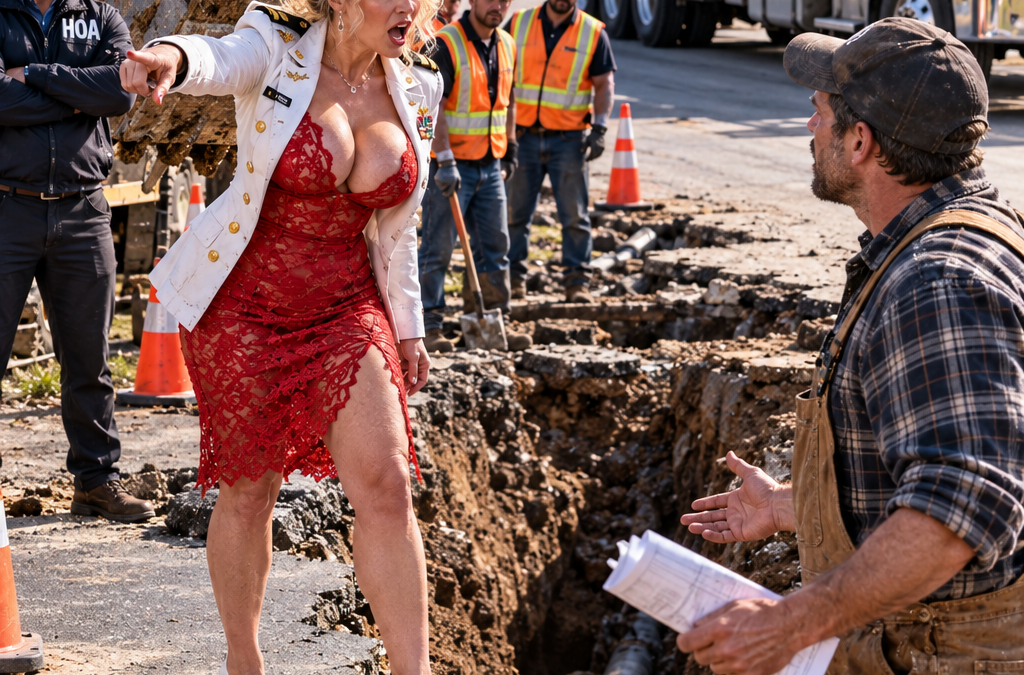
She stood there in wedge heels and a fitted red lace dress under a cream blazer, sunglasses perched on top of her blonde hair, looking wildly out of place among diesel fumes, mud, safety cones, and broken pavement.
But that was Karen.
Forty years old, polished, beautiful, and mean enough to make grown men study their shoes at HOA meetings.
She had been president of the Willow Creek Homeowners Association for nine years, and somewhere along the way she’d stopped believing she represented the neighborhood.
She believed she owned it.
Every curb.
Every mailbox.
Every drainage ditch.
Every tree.
And apparently, as of that morning, every road serving my dairy farm.
She looked at me like I was interrupting her ceremony.
“Caleb, construction has already been approved.”
“My farm road has not.”
Her smile sharpened.
“The board has easement authority.”
“Over a road my family built?”
“Over infrastructure crossing the community utility corridor.”
“This road is not your utility corridor.”
“It is today.”
I stared at her.
Behind me, one of my employees, Luis, stepped out of the feed shed and froze when he saw the trench. A delivery driver waiting near the grain bins rolled down his window. Two construction workers pretended not to listen.
Karen loved that.
An audience.
She always wanted people nearby when she exerted control. It was never enough for her to send a notice. She wanted the homeowner standing there, humiliated, while everybody watched her win.
I pointed toward the barns in the distance.
“That road is the main access route to an operating dairy.”
“I am aware you have animals.”
“They’re not pets, Karen. This is a commercial farm.”
She gave a small laugh.
“Then perhaps a commercial farm should be better prepared for community improvements.”
My hands tightened.
“You cut the only paved access route to the milk loading area.”
“Temporarily.”
“For how long?”
She turned toward the crew supervisor.
“Martin?”
The supervisor looked uncomfortable.
“Several days, depending on soil conditions and pipe placement.”
“Several days,” I repeated.
Karen folded her arms.
“That is a standard construction inconvenience.”
“No. A closed driveway is an inconvenience. Blocking milk pickup is a financial and animal-care emergency.”
She rolled her eyes.
“Please don’t dramatize this.”
“Milk tankers run on strict schedules.”
“Then reschedule.”
“That’s not how dairy collection works.”
“Everything can be rescheduled if people cooperate.”
There it was again.
Cooperate.
When Karen said cooperate, she meant obey.
She stepped closer and lowered her voice, though not enough to keep the workers from hearing.
“You have fought this project from the beginning because you don’t like the HOA having authority near your land.”
“I fought this project because you never produced the recorded easement.”
“The board reviewed it.”
“Show me.”
“We are not relitigating approved infrastructure because you don’t understand community planning.”
“Karen, the tanker comes this afternoon.”
“Then I suggest you figure something out.”
The excavator bucket hit the pavement again.
Another section of my road collapsed into the trench.
I had to force myself not to grab the keys from the machine.
My name is Caleb Turner.
My family has run Turner Dairy on the edge of Willow Creek for three generations.
Before the subdivision existed, before the HOA clubhouse existed, before Karen Whitfield ever moved into her stucco house with white shutters and started measuring everyone’s lawn with a clipboard, this was pastureland.
My grandfather milked thirty cows here.
My father expanded the barns and paved the main farm road when milk collection became more tightly regulated and tanker access had to be reliable year-round.
By the time I took over, we were running a modern dairy operation.
Automated milking systems.
Cold storage.
Feed scheduling.
Regular veterinary checks.
State inspections.
Transportation windows coordinated down to the hour.
Nothing about dairy is casual.
The cows do not care about HOA meetings.
The milk does not wait because a board president wants a pipe installed across the wrong road.
Milk has to be cooled.
Stored.
Collected.
Transported.
Documented.
If a tanker misses its window, the entire operation starts tightening like a rope around your neck.
Storage capacity becomes an issue.
Milking schedules shift.
Staffing gets rearranged.
Quality-control timelines change.
Every delay costs money.
Every mistake risks waste.
Karen knew none of that.
Worse, she didn’t want to know.
To her, my farm was an old inconvenience sitting beside the neighborhood she believed she had perfected. The barns looked too rural. The feed trucks made too much noise. The cows smelled like cows. And the road, the road my family had built and maintained, happened to cross a strip of land she wanted to use for the HOA’s new water main project.
The project had been sold to residents as an upgrade.
A large water line.
Improved pressure.
Future development support.
Better fire response.
On paper, it sounded reasonable.
I wasn’t opposed to infrastructure.
I was opposed to Karen treating my farm access like a blank space on her map.
Two months earlier, she had sent a notice claiming the HOA would need “temporary construction access” across the dairy road.
I replied asking for the exact route, schedule, easement document, traffic-control plan, and confirmation that dairy transportation access would remain open.
She responded with one sentence.
The board expects all adjacent property owners to cooperate with approved community infrastructure.
I asked again.
No answer.
Then survey flags appeared along the shoulder of my road.
I pulled them and called the contractor.
He told me he was acting under HOA authorization.
I called Karen.
She sounded pleased.
“Caleb, the flags are preliminary.”
“They cross my access road.”
“Your access road crosses our improvement corridor.”
“Show me the recorded corridor.”
“You keep demanding paperwork as if that changes the practical reality.”
“Paperwork is the practical reality when you’re digging across a farm road.”
She laughed softly.
“You farmers are always so dramatic about land.”
I remember going quiet.
Not because I had no response.
Because I had too many.
“You need to understand something,” I said. “This isn’t a decorative driveway. This road supports daily milk pickup.”
“Then the farm should adapt.”
“To what?”
“Progress.”
That was Karen’s favorite word when she wanted to make destruction sound noble.
Progress.
Community benefit.
Modernization.
Improvement.
She used beautiful language to hide the fact that she had not done the basic work.
No operational plan.
No farm-access study.
No coordination with the dairy hauler.
No contingency route.
No serious conversation with me.
Just confidence, a project map, and the assumption that if she moved fast enough, I would be forced to deal with the consequences.
By noon on the day construction began, she had turned that assumption into a trench.
I called my hauler immediately.
“Tom, where’s the tanker?”
“About two hours out.”
My stomach tightened.
“Road’s cut.”
“What?”
“The HOA construction crew opened the main dairy road.”
Silence.
Then:
“Can we access from the south lane?”
“Not safely. It’s gravel, narrow, and the grade near the creek is soft from rain.”
“Caleb, I can’t take a loaded tanker through soft ground.”
“I know.”
“How bad is the cut?”
“Across most of the road.”
He swore.
“Storage?”
“We have room for this pickup. Not for indefinite delays.”
“I’ll keep rolling toward you unless you tell me otherwise.”
“Keep coming. I’m working on it.”
I hung up and turned back toward the construction site.
By then, the trench had widened.
The crew had cut through nearly the full width of the pavement. Orange cones lined the edges. A massive blue pipe sat on a flatbed trailer nearby, waiting to be lowered into place.
Karen stood beside it, talking to Martin, the crew supervisor, like she was directing a military campaign.
I walked up.
“Martin, did anyone give you the dairy pickup schedule?”
He blinked.
“No.”
“Did anyone tell you milk tankers use this road daily?”
He looked toward Karen.
She spoke before he could answer.
“The crew was informed this is a farm access route.”
“That is not the same thing.”
Martin opened his folder.
“We were told the road could be closed during the installation window.”
My jaw tightened.
“By whom?”
Karen said, “By the project authority.”
“Meaning you.”
“Meaning the HOA.”
“Karen, did you tell them milk tankers had to reach the barn this afternoon?”
She gave me a bored look.
“I am not your dispatcher.”
Martin looked increasingly uncomfortable.
“Mr. Turner, we weren’t given a required access window.”
“That’s because she didn’t ask.”
Karen snapped, “Do not misrepresent me.”
I turned to her.
“What did you think was going to happen when you cut the road?”
“I assumed you had alternative access.”
“You assumed.”
“A commercial operation should.”
“We do for tractors and small trucks. Not loaded milk tankers.”
“That seems like a planning failure on your part.”
Something in me almost broke then.
Not because she was ignorant.
Ignorance can be fixed.
Because she was enjoying it.
She liked standing there while I explained the risk. She liked making it sound as though the problem she created was proof I had failed to prepare.
Luis came over, wiping his hands on his jeans.
“Boss, feed truck’s asking if he should wait.”
“Tell him to hold.”
Karen looked at him.
“All contractors need to stay clear of the construction zone.”
Luis stared at her.
“He’s not a contractor. He’s feed delivery.”
“Same thing for site purposes.”
I stepped between them.
“Do not give orders to my employees.”
Karen smiled.
“Then manage them properly.”
Luis muttered something in Spanish and walked away.
Martin studied the plans again.
“Mrs. Whitfield, the road closure should have been coordinated with the farm schedule.”
Karen’s eyes hardened.
“The work was scheduled in accordance with the approved plan.”
“The approved plan doesn’t show active dairy logistics.”
“That isn’t our problem.”
Martin hesitated.
“It might be if we block a regulated pickup.”
She turned slowly.
“Are you questioning the HOA’s authority to proceed?”
“I’m questioning whether we have enough information to proceed safely.”
“You were hired to install a water main, not run a farm.”
He closed his folder.
“We were hired to perform work without creating unnecessary hazards.”
The first real crack had appeared.
Karen noticed.
Her voice dropped.
“Martin, I would be careful about delaying this project. The association expects performance.”
I saw what she was doing.
Threatening his contract.
Threatening payment.
Threatening reputation.
The same way she threatened homeowners with fines and liens.
Karen didn’t persuade.
She pressured.
And when pressure failed, she punished.
The crew lowered the first section of blue pipe toward the trench despite Martin’s hesitation. Workers guided it with straps. The excavator repositioned. The open road looked less like a construction site and more like a wound across the artery feeding my farm.
Inside the barns, work continued because cows don’t pause for disputes.
Milking cycles.
Feed mixing.
Cleaning.
Health checks.
Every routine still had to happen.
My employees kept moving, but everyone understood the problem now.
The road was blocked.
The tanker was coming.
Karen kept glancing toward the far bend as if watching for trouble she didn’t want to admit existed.
At 2:37 p.m., we heard the truck before we saw it.
Low diesel rumble.
Air brakes.
Then the silver tanker appeared beyond the tree line, turning carefully onto the farm approach road.
For the first time that day, Karen’s confidence faltered.
Only slightly.
But I saw it.
Her eyes moved from the tanker to the trench.
Then to the massive pipe suspended above it.
Then back to the tanker.
The truck rolled closer.
The driver slowed.
Then stopped fifty yards short of the construction zone.
Tom climbed down from the cab and removed his sunglasses.
He looked at the trench.
Then at me.
Then at Karen.
“What the hell is this?”
Karen lifted her chin.
“Scheduled infrastructure work.”
Tom walked toward the trench.
“No, ma’am. That’s a blocked dairy access route.”
“This is temporary.”
“Temporary doesn’t help me move forty thousand pounds of truck through an open trench.”
Karen smiled tightly.
“Surely professional drivers handle detours.”
Tom stared at her.
“Not through a construction cut with no reinforced crossing.”
I walked up beside him.
“Storage has the volume for this pickup, but we need collection today.”
Tom nodded.
“I have two more farms after you.”
Karen folded her arms.
“Then use another road.”
Tom pointed toward the tanker.
“That truck needs grade, width, turning clearance, load support, and safe backing radius. You don’t improvise that because someone dropped cones across asphalt.”
Karen’s lips pressed together.
“I find it hard to believe a modern farm depends on one road.”
“Believe whatever you want,” I said. “But the tanker is here.”
Martin joined us with the plans in his hand.
He looked at the tanker, then the trench.
“Mrs. Whitfield, we need to establish temporary access.”
“No.”
The word came fast.
Flat.
Commanding.
Everyone looked at her.
She realized she’d said it too sharply and adjusted her tone.
“We cannot compromise the work area.”
Martin said, “We also can’t block essential agricultural transport.”
“The HOA is not responsible for Mr. Turner’s business scheduling.”
Tom laughed in disbelief.
“This isn’t a salon appointment.”
Karen turned on him.
“And who are you?”
“The milk hauler.”
“Then wait.”
“I can’t wait indefinitely.”
“You’ll wait until the site is safe.”
“The site became unsafe when you opened the road without a crossing.”
Karen’s face reddened.
“You people keep acting as though the association did something unreasonable. This is a water main installation. It benefits the entire community.”
“Not if you destroy my operation to do it,” I said.
She pointed at me.
“Don’t exaggerate.”
I stepped closer.
“You cut off a dairy farm.”
“For several days.”
“That is cutting off the farm.”
“If your business can’t tolerate routine construction, that’s not the HOA’s fault.”
Tom shook his head.
“Lady, routine construction includes an access plan.”
Martin nodded.
“He’s right.”
Karen’s head snapped toward him.
Martin kept going.
“We should have been given this schedule. We should have staged plates or built a temporary crossing before opening the full cut.”
“Then why didn’t you?”
“Because the project documents didn’t identify the road as a critical milk pickup route.”
“They identified it as a farm road.”
“Not the same thing.”
She glared at him.
For a second, I thought she might fire the entire crew on the spot.
Then a gust of wind lifted dust across the trench, and the suspended blue pipe swayed slightly in its straps.
Martin turned to his workers.
“Set the pipe down. Safely. Hold installation.”
Karen stepped forward.
“I did not authorize a shutdown.”
Martin didn’t look at her.
“Site control is mine.”
That landed harder than anything I had said all day.
Karen had been treated like the final authority since morning.
Now the person actually responsible for construction safety had taken control away from her.
The pipe was lowered to the ground.
Workers began repositioning equipment.
Martin gathered the crew near the trench.
“We need a reinforced temporary crossing away from the deepest section.”
He looked at me.
“Where’s the firmest shoulder?”
I pointed.
“West side, near the old drainage culvert. My tractors use that turn, but not tankers.”
“Base?”
“Packed gravel under grass. It held loaded feed trucks in dry conditions, but we had rain two nights ago.”
“We’ll need matting and steel plates.”
Tom said, “And turning room. I can’t cut too tight with this trailer.”
Martin nodded.
“We’ll widen the marked path.”
Karen looked outraged.
“You are redesigning the site for one truck?”
Martin finally turned to her.
“For the first truck we should have planned for.”
She went quiet.
Not because she agreed.
Because several workers were watching her now, and the tanker sat in full view like a silver monument to her negligence.
The crew moved fast.
They brought in mats from the trailer, repositioned barriers, tamped soft areas, and laid steel plates near the edge of the trench. Martin inspected the grade himself. Tom walked the path and judged the turning angle.
I watched every step.
So did Karen.
Her arms remained folded, but the smug satisfaction had disappeared from her face.
This was no longer her performance.
It was logistics.
Real work.
Real risk.
Real people solving the problem she had created by refusing to ask one practical question before digging.
Can the milk truck still reach the barn?
That’s all she needed to ask.
She hadn’t.
Because to Karen, my road wasn’t a farm artery.
It was an obstacle to her schedule.
After forty minutes, Martin called us over.
“Temporary crossing is ready for a controlled pass. Empty or loaded?”
Tom answered, “Arriving empty. Leaving loaded.”
Martin looked at me.
“Once he’s loaded, we may need to reinforce again before exit.”
“Do it.”
Karen interrupted.
“Who is paying for this extra work?”
I turned slowly.
“You are asking that right now?”
She didn’t blink.
“The HOA should not absorb costs caused by Mr. Turner’s failure to disclose operations.”
I laughed once.
Hard.
“You mean the dairy farm?”
Her eyes narrowed.
“I mean specific tanker timing.”
“There are milk trucks on this road every day.”
“Not in the project file.”
“Because you didn’t put them there.”
Martin said carefully, “Mrs. Whitfield, the farm made clear this road served dairy operations.”
Karen snapped, “Stay in your lane.”
Martin’s face changed.
“My lane currently includes preventing your construction site from blocking a regulated pickup.”
Tom muttered, “Amen.”
Karen glared at him.
But she didn’t stop the crew.
She couldn’t.
Not anymore.
The temporary route was marked with cones and workers stationed at each side. Martin walked beside the tanker as Tom eased forward. The truck moved slowly, tires rolling over mats and plates, suspension shifting under its size.
Everyone watched.
No one spoke.
The tanker cleared the first section.
Then the second.
The rear wheels passed the marked turn with inches to spare.
Tom straightened and continued toward the barns.
Luis raised both fists from near the loading area.
For the first time all day, I breathed fully.
The pickup happened.
Hoses connected.
Samples taken.
Volumes recorded.
Milk transferred.
The ordinary routine of the dairy resumed around us, but nothing felt ordinary about it anymore.
It felt like we’d dragged the farm through a preventable disaster by force of will, steel plates, and basic competence.
Karen stayed near the trench while the tanker loaded.
She avoided looking at me.
When the truck returned, now loaded and far heavier, Martin had the crew reinforce the path again. He inspected every plate, checked every barrier, and assigned two spotters.
Tom drove out slowly.
The tanker crossed.
The plates held.
The truck reached the paved road beyond the construction zone.
Then it stopped briefly.
Tom leaned from the cab.
“Caleb.”
I walked over.
“You good?”
“Yeah.”
He looked toward Karen.
“Next time someone decides to cut your road, make them call me first.”
“I will.”
He gave Karen one last look.
“Ma’am, farms aren’t decorative.”
Then he drove away.
That sentence stayed in the air after the tanker disappeared.
Farms aren’t decorative.
Karen had treated mine like background scenery behind her subdivision.
Something rustic enough to advertise in community brochures, but inconvenient the moment it required respect.
She liked telling residents they lived near “heritage farmland.”
She did not like the reality of trucks, schedules, manure, feed, livestock, refrigeration, and access roads that couldn’t be cut because a pipe crew had arrived.
Martin called a site meeting before restarting work.
This time, Karen wasn’t the one leading.
He laid the plans across the hood of a truck.
“We’re revising the sequence.”
Karen’s eyes narrowed.
“Under whose authority?”
“Mine for site safety. Yours if you want to shut the project down and rebid it.”
She said nothing.
He continued.
“Farm access remains open at all times. No full-width cut without bridging. Work zones shift in sections. Tanker windows are protected. Feed and veterinary access coordinated daily.”
I added, “And emergency access stays open.”
“Agreed.”
Karen’s jaw tightened.
“We can’t let one farm dictate the project.”
I looked at her.
“One farm?”
She turned.
“You know what I mean.”
“No. Say it.”
She didn’t.
So I said it for her.
“You mean my farm is in your way.”
“I mean the HOA has responsibilities to the entire community.”
“And I have responsibilities to living animals and a regulated food product.”
“Don’t use the cows as a shield.”
The workers went still.
I stepped toward her.
“You really don’t know when to stop.”
She lifted her chin.
“I know manipulation when I hear it.”
“Manipulation?”
“You want sympathy because you know the legal easement allows the project.”
“Then show it.”
She froze.
There it was.
Again.
The missing document.
The supposed authority behind everything.
For months, Karen had waved around project maps and board approvals, but she had never produced the recorded easement giving the HOA the right to cut across my farm road in the manner she claimed.
Martin looked from her to me.
“You don’t have the easement on site?”
Karen snapped, “The HOA attorney has reviewed all necessary documents.”
“Then someone should send me the access conditions,” Martin said. “Because they matter.”
I almost smiled.
Karen had lost the room.
Not to me.
To reality.
Construction continued that day, but under a completely different plan.
Access first.
Excavation second.
Milk schedule posted.
Feed deliveries coordinated.
Temporary crossing maintained.
No open trench left impassable without bridging.
The crew became careful because they now understood what Karen had ignored.
A dairy farm is a system.
Cut the access route, and you don’t inconvenience one homeowner.
You threaten the whole operation.
That evening, after the milk pickup was complete and the cows were fed, I stood near the barns watching the crew secure the construction site.
Karen approached.
I knew she would.
People like her can’t leave a defeat alone.
They need one final word to convince themselves they haven’t lost.
“Today was unnecessary,” she said.
I looked at the trench.
“Yes. It was.”
“If you had provided the schedule earlier—”
I turned.
“I told you repeatedly this road served daily dairy traffic.”
“General statements are not schedules.”
“You didn’t ask for one.”
“You should have anticipated the need.”
“I should have anticipated that you’d cut my road without an access plan?”
She folded her arms.
“You are determined to make me the villain.”
“No, Karen. You keep applying for the position.”
Her eyes flashed.
“I could have the board assess delay costs.”
“Try.”
“You think I won’t?”
“I think if you do, we’ll finally have a formal hearing about why you authorized a full-width trench across an active dairy road without verifying access.”
Her mouth tightened.
“I acted within HOA authority.”
“Then produce the authority.”
“You keep saying that.”
“Because you keep avoiding it.”
For a moment, neither of us spoke.
The cows shifted inside the barn.
A pump hummed.
Workers secured fencing around the trench.
The farm was still running.
That was the thing Karen couldn’t destroy that day.
She had tried to turn my road into proof of her power.
Instead, the road proved how little she understood about anything beyond her own control.
She stepped closer.
“You enjoy humiliating me in front of contractors.”
I stared at her.
“Karen, you humiliated yourself when you treated a dairy operation like a cul-de-sac paving job.”
Her face hardened.
“You’ll regret making an enemy of me.”
I almost laughed.
“You brought an excavator to my road before breakfast.”
She didn’t answer.
“You made yourself my enemy.”
The following morning, the HOA board received a written report from Martin.
I knew because one of the board members, Denise, called me.
She sounded shaken.
“Caleb, I didn’t know the road was your main dairy access.”
“I told Karen.”
“She told us it was an underused farm lane.”
I closed my eyes.
Of course she did.
“Underused?”
“She said there were alternative routes.”
“Not for tankers.”
“I know that now.”
“Did she mention the milk pickup schedule?”
“No.”
“Did she mention I requested access coordination?”
“No.”
“Did she mention the missing easement conditions?”
Denise hesitated.
“No.”
I looked through the office window toward the barns.
“Then the board approved a project without understanding what it was cutting through.”
Denise was quiet.
Finally, she said, “I’m sorry.”
I believed her.
But sorry didn’t put asphalt back.
The board called an emergency review.
This time, Karen had to sit while Martin explained the issue.
Farm road.
Critical access.
Milk tanker schedule.
Insufficient coordination.
Temporary crossing required.
Project staging revised.
Potential liability if access failed.
I attended with photographs, emails, tanker pickup records, and the road-use schedule.
Karen tried to interrupt three times.
The HOA attorney told her to let Martin finish.
That was new.
When it was my turn, I didn’t shout.
I didn’t need to.
I placed one photograph on the table.
The excavator bucket tearing through the center of my road.
Then another.
The milk tanker stopped in front of the trench.
Then another.
Workers building the temporary crossing under pressure because nobody had planned for the truck.
“This was avoidable,” I said.
No one argued.
Karen looked furious.
But for once, fury wasn’t enough.
The board ordered that all remaining construction follow a written farm-access plan. The contractor would coordinate daily with me. No full closure without my written acknowledgment and an approved crossing. Emergency farm access had to remain open. Milk pickup windows were protected.
Karen objected.
“The board is allowing one property owner to control a community project.”
Denise looked at her.
“No, Karen. We’re preventing another failure.”
Karen’s face went pale with rage.
But she lost the vote.
Work continued over the next several days.
Slowly.
Carefully.
Annoyingly, yes.
But safely.
The crew installed the water main in sections, maintaining access as they went. Temporary plates were repositioned. Barriers were adjusted. Every morning Martin checked the schedule with me.
Feed trucks got through.
The vet got through.
Milk tankers got through.
The farm kept running.
Karen visited the site less after that.
When she did appear, she stayed back from the trench.
No more speeches about progress.
No more public orders.
No more smug smiles while equipment tore through pavement.
She had learned, at least temporarily, that a farm road was not an ordinary street and a dairy schedule was not a personal inconvenience she could dismiss.
Weeks later, the water main was complete.
The trench was filled.
The road was patched.
Not perfectly.
I made them redo one section because the slope affected drainage. Karen called that “excessive.” Martin quietly agreed with me and fixed it.
The first morning after the final patch cured, I stood near the barns before sunrise.
Mist hung low over the pasture.
The cows were already shifting inside.
Luis waved from the feed area.
In the distance, I heard the familiar rumble of a milk tanker turning onto the road.
It rolled over the repaired section smoothly.
No cones.
No trench.
No Karen.
Just the truck doing what trucks had done on that road for years.
The driver pulled into the loading area and climbed down.
“Road’s better.”
“Good.”
“No drama today?”
“Not yet.”
He grinned.
“Early.”
I laughed.
The pickup went exactly as it should.
Quiet.
Efficient.
Boring.
Boring is underrated when you’ve watched your road disappear under an excavator bucket.
Later that afternoon, I walked the length of the repaired pavement.
I could still see where the cut had been.
New asphalt never quite matches old asphalt.
That scar across the road would remain visible for years.
Part of me hated that.
Part of me was glad.
It reminded me what happens when someone with authority refuses to understand the system they’re interrupting.
Karen saw pavement.
I saw the route that kept animals fed, milk moving, workers employed, and a family farm alive.
She saw a line on a project map.
I saw generations of daily work.
She saw an obstacle.
I saw an artery.
That’s the difference between people who manage from paper and people who live with consequences.
The HOA did get its water main.
The neighborhood got its infrastructure upgrade.
Nobody stopped progress.
But progress had to learn where the cows were.
It had to learn when the tanker came.
It had to learn that the farm wasn’t decoration on the edge of a subdivision.
It was alive.
It had schedules, needs, risks, and rights.
And Karen, for one furious afternoon, had to stand in front of an open trench and watch a milk tanker expose everything she had ignored.
She wanted to prove the road belonged to her project.
Instead, she proved it belonged to the farm.
Not by title alone.
Not by shouting.
By use.
By necessity.
By the simple fact that when she cut it, the entire operation felt the wound.
The milk was collected.
The cows were cared for.
The farm kept running.
And from that day forward, nobody from the HOA ever called my dairy road an ordinary street again.








