𝗙𝗨𝗟𝗟 𝗦𝗧𝗢𝗥𝗬 The HOA President Climbed Into My Hot Tub at Midnight—Then Called 911 and Told Police I Was the Trespasser
𝗙𝗨𝗟𝗟 𝗦𝗧𝗢𝗥𝗬
I looked at her.
“Betty?”
“Betty Sutton. HOA president.”
“Oh.”
“She keeps files.”
I laughed.
Carol didn’t.
“Files on what?”
“People.”
I waited for the punchline.
There wasn’t one.
“You’re serious.”
“Eleven years she’s been running that board.”
“Nobody else wants the job?”
“Nobody wants what comes with challenging her.”
I leaned against the mailbox.
“How bad can HOA politics really get?”
Carol looked toward a large brick house near the end of the street.
A black SUV sat in the driveway.
“That’s what people always ask before they learn.”
Nine days after I moved in, I learned.
The violation notice was taped to my front door.
UNAUTHORIZED EXTERIOR STRUCTURE.
I read it twice.
The alleged structure was the five-foot-two privacy screen beside the hot tub.
The same privacy screen that had been there when I purchased the house.
I called the HOA number printed at the bottom.
Betty answered personally.
“Maple Ridge Homeowners Association. Betty speaking.”
“Hi. Daniel Reyes. I just moved into number eighteen.”
“Oh, Daniel.”
Her voice softened immediately.
“I’ve been meaning to introduce myself.”
“I got a violation notice.”
“The privacy screen.”
“Yeah. It was already here when I bought the place.”
“Ownership transfer doesn’t automatically grandfather unauthorized structures.”
I walked to my office and pulled out the HOA booklet.
“I’m looking at the bylaws right now. It says privacy screens under six feet don’t require architectural approval.”
There was a pause.
Then she laughed lightly.
“Rules protect property values, sugar. You’ll thank me later.”
I frowned.
“That doesn’t answer what I said.”
“You’ll need to bring the screen into compliance.”
“Compliance with what?”
“The community standard.”
“Where is that standard written?”
Another pause.
Then her voice cooled.
“Daniel, you’re very new here. I would strongly recommend that you start by cooperating rather than looking for technicalities.”
I stared at the phone.
“It’s not a technicality if the rule doesn’t exist.”
“Have a lovely afternoon.”
She hung up.
That night, I read every page of the bylaws.
There was no prohibition.
I emailed Betty the relevant clause.
I was polite.
I attached a photograph with measurements.
I explained that the privacy screen was five feet, two inches high and therefore fell below the threshold requiring architectural review.
No response.
One day passed.
Then two.
On the fourth day, another notice appeared.
Different rule.
This one accused the privacy screen of violating “aesthetic consistency with established community standards.”
There was no measurement.
No definition.
No photograph.
No actual standard.
Just vague language broad enough to mean whatever Betty wanted it to mean.
I stood on my porch holding the notice and realized Carol had been right.
Betty didn’t enforce rules.
She invented interpretations until people got tired of arguing.
I went inside and started a folder.
First notice.
Second notice.
My email.
The bylaw page.
Photographs.
Dates.
Times.
I labeled everything.
At the time, I thought I was protecting myself against a stupid fine.
I had no idea that folder would eventually help destroy Betty’s eleven-year reign over Maple Ridge.
Two weeks later, she appeared at my fence while I was grilling dinner.
I heard her before I saw her.
“Daniel.”
I turned.
Betty stood on the sidewalk beyond the wooden fence, arms folded.
She was wearing the red lace dress.
It hugged her figure tightly, plunging low at the neckline beneath a cream blazer. Blonde hair fell over one shoulder. Expensive perfume drifted faintly across the yard.
If you didn’t know her, she looked like someone arriving for drinks.
If you did know her, the clipboard under her arm told you everything.
“Evening, Betty.”
She looked past me toward the hot tub.
“That thing runs loud.”
“The grill?”
“The tub.”
“It’s off.”
“I’m talking generally.”
I flipped a burger.
“Okay.”
“Neighbors have complained.”
That got my attention.
“Which neighbors?”
“I can’t disclose confidential complaints.”
“How many?”
“Several.”
I looked at the houses on either side.
“Interesting.”
Her eyes narrowed.
“Why is that interesting?”
“Because I asked the Marshalls yesterday if the jets were bothering them.”
The Marshalls lived behind me.
Betty shifted her weight.
“And?”
“They said the jets cover highway noise.”
“People aren’t always comfortable confronting neighbors directly.”
“So they complained to you.”
“Yes.”
I nodded.
“Send me the complaints.”
“I’m not required to identify residents.”
“Redact the names.”
Her mouth tightened.
“Don’t become difficult, Daniel.”
I looked at her over the grill.
“I’m not being difficult. You say people complained. I’m asking you to show me the complaints.”
She gave me that same syrupy smile.
“You’ll learn how things work here.”
Then she walked away.
The next morning, I spoke to every immediate neighbor who could reasonably hear the hot tub.
Nobody had complained.
Not one person.
The Marshalls laughed when I asked again.
Carol rolled her eyes.
“Betty complains on behalf of imaginary people all the time.”
That was the first moment I understood that Betty wasn’t simply interpreting rules aggressively.
She was manufacturing consensus.
So I documented that too.
I bought an inexpensive decibel meter.
Ran the tub.
Recorded readings at the fence line.
Photographed distances.
Saved timestamps.
At work, I dealt with structures where half an inch mattered and undocumented assumptions could get people hurt.
Documentation was already part of how my brain worked.
Betty had picked the wrong profession to antagonize.
The first monetary fine arrived in March.
Two hundred dollars.
EXCESSIVE WATER USAGE.
I actually laughed.
The hot tub operated on a closed filtration loop.
The water circulated.
It wasn’t continuously draining into the street.
I appealed.
The appeal hearing lasted less than ten minutes.
Betty sat at the center of the table.
On one side was a man named Frank Coleman.
On the other was Richard Hayes.
Betty smiled.
“Daniel, we’re here to consider your appeal.”
I looked around.
“You’re chairing it?”
“I’m board president.”
“You’re also the person who issued the violation.”
Her smile sharpened.
“The appeals committee operates independently.”
“Who are these gentlemen?”
Betty answered.
“Community representatives.”
I learned later that both did business with Betty’s husband, Frank Sutton, a local contractor.
One provided equipment rentals.
The other subcontracted masonry work.
The independent appeals committee wasn’t independent.
It was Betty judging an accusation Betty had made, assisted by men financially connected to her family.
I explained the closed-loop filtration system.
Showed manufacturer’s documentation.
Presented water-use records.
Betty glanced at them.
Then denied the appeal.
“Community resource conservation is important.”
“That isn’t evidence.”
“The decision is final.”
I looked at her.
“How could it be final when you didn’t consider anything I brought?”
She leaned forward.
“Daniel, you seem determined to create conflict.”
“No. I seem determined to ask what rule I broke.”
Her voice dropped.
“People who live happily in Maple Ridge understand cooperation.”
I left the meeting feeling something close to claustrophobia.
Like the walls of the whole neighborhood had moved inward.
For the first time, moving crossed my mind.
Sell the house.
Take the loss.
Find somewhere without an HOA.
But the thought made me angry.
I’d spent years building enough equity and credit to buy something after my divorce.
Why should I leave because a woman with a clipboard enjoyed control?
I called an attorney.
Her name was Priya Shah.
She specialized in real estate disputes and HOA governance.
I brought the folder.
Priya listened while I explained everything.
When I finished, she flipped through the notices.
“The good news,” she said, “is that she isn’t nearly as untouchable as she thinks she is.”
“What does that mean?”
“It means Karens like her make the same mistake eventually.”
I raised an eyebrow.
“Karens?”
Priya smiled slightly.
“Occupational term.”
Despite myself, I laughed.
Then she became serious.
“They start confusing the rulebook with personal authority. Once that happens, they stop worrying about procedure.”
“She’s already there.”
“Exactly.”
Priya tapped my folder.
“And people who stop caring about procedure eventually leave evidence.”
Her first recommendation surprised me.
“Request the HOA’s financial disclosures.”
“Financial?”
“Yes.”
“I’m fighting a hot tub violation.”
“Maybe.”
She leaned back.
“But people who manipulate rules for control sometimes manipulate other things too. If she’s been president eleven years and nobody challenges her, I want to see where the money goes.”
I filed the request.
Betty stalled.
One week.
Then two.
Then three.
Meanwhile, the violations multiplied.
Mailbox color.
My post was supposedly “cream-white” instead of “architectural white.”
A garden gnome left by the previous owner became “prohibited decorative clutter.”
She even cited two outdoor burrs from a flowering shrub as landscaping debris.
Each letter went into the folder.
Then came the one that stopped being funny.
NOTICE OF STRUCTURAL SAFETY ORDER.
I stood at my kitchen counter reading the sentence twice.
The HOA ordered me to drain and permanently remove the hot tub within thirty days.
According to Betty, the installation represented a structural safety hazard.
I immediately checked my cameras.
No inspector had visited.
Nobody had entered the backyard.
Nobody had examined the tub.
I called Priya.
“She says it’s structurally unsafe.”
“Based on what?”
“Exactly.”
“Any report attached?”
“No.”
“Board vote?”
“No.”
“Engineering review?”
“I’m literally a structural engineer, Priya. Nobody has inspected anything.”
She laughed once, without humor.
“Send a certified demand for the report.”
I did.
Betty never produced one.
Instead, she sent another letter.
Failure to comply could result in a five-thousand-dollar lien against my home.
That changed something.
It wasn’t about losing a hot tub anymore.
It was about losing financial control over the first home I’d bought after my marriage ended.
I stopped sleeping.
I’d lie awake listening to the hum of the HVAC system, imagining legal bills.
Property records.
Collection notices.
A lien sitting against my title.
My ex-wife had once told me that I had a tendency to turn problems into equations because equations made me feel safer.
She wasn’t wrong.
But there was no clean equation for someone like Betty.
Rules could be researched.
Numbers could be audited.
A person willing to invent reality was harder.
Carol saw the exhaustion on my face one morning.
She came over with coffee.
“She’s getting to you.”
“I’ve had better months.”
Carol sat at the patio table.
Then she looked toward Betty’s house.
“She did this to another family.”
I stopped.
“What?”
“Years ago. Two streets over.”
“What happened?”
“They fought her over modifications. Betty kept escalating. Fines. Threats. Legal letters.”
“And?”
“They sold.”
“Because of Betty?”
“At a loss.”
I felt sick.
“Why didn’t anyone stop her?”
Carol stared into her coffee.
“Because once Betty picked someone, everybody else was just relieved it wasn’t them.”
That sentence stayed with me.
I decided I wasn’t selling.
Not because I wanted to become a crusader.
Because I refused to be driven out of a home I’d earned by somebody who couldn’t even produce the inspection report she claimed justified threatening it.
On day twenty-nine after Priya’s formal financial-record demand, a manila envelope appeared.
The disclosures were incomplete.
Pages missing.
Entire sections blacked out.
Totals that didn’t reconcile.
Priya spread the papers across her conference table.
“This is garbage.”
“Legal garbage?”
“Suspicious garbage.”
Then she pointed at a line item.
LANDSCAPING CONSULTING — SUTTON FIELDS LLC.
The payment appeared again three months later.
And again.
And again.
“Sutton,” I said.
“Betty’s married name.”
“Her husband is Frank Sutton.”
Priya looked at me.
“Exactly.”
We checked public records.
Sutton Fields LLC belonged to Frank.
The HOA was paying a company owned by the president’s husband.
That wasn’t automatically illegal.
But the lack of transparency, missing invoices, and repeated payments raised obvious questions.
For the first time, I felt something besides fear.
Hope.
Betty might be hurting herself every time she tried to hide something.
At the next HOA meeting, she attacked first.
“I’d like to address recent hostility from certain homeowners.”
I knew immediately she meant me.
Betty stood beneath fluorescent lights in a fitted red lace dress with a black blazer over it, clipboard in one hand.
Her eyes moved directly toward my chair.
“Some residents have chosen confrontation instead of cooperation.”
People glanced at me.
She continued.
“Maple Ridge cannot function if every reasonable safety measure becomes a legal threat.”
I stood.
“Betty.”
She paused.
“Yes, Daniel?”
“Can you show the board the inspection report declaring my hot tub structurally unsafe?”
The room went quiet.
Betty’s expression froze for perhaps half a second.
Then she recovered.
“That matter is under review.”
“You issued a removal order based on the report.”
“I said it’s under review.”
“Then how did you determine it was unsafe?”
She gripped the clipboard.
“This is not the appropriate forum.”
“It’s an HOA meeting.”
Several people shifted in their chairs.
Betty looked uncomfortable.
For the first time, everybody could see the gap between her certainty and her evidence.
After the meeting, a board member named Harold caught me near the parking lot.
He was seventy, thin, soft-spoken, and looked terrified even whispering.
“I never voted for the lien.”
I stared at him.
“What?”
“The five-thousand-dollar threat.”
He looked toward the clubhouse door.
“Betty said it was unanimously approved.”
“It wasn’t?”
“No.”
“Did anybody vote?”
Harold shook his head.
“Not that I know of.”
My pulse quickened.
“Would you say that publicly?”
His face tightened.
“I don’t know.”
“Harold, she’s threatening my house using approval that doesn’t exist.”
“I know.”
“Then why stay quiet?”
He looked down.
“You don’t know what she’s like when she decides you’re against her.”
I almost laughed.
“I do now.”
Harold said nothing.
But before walking away, he whispered, “I’ve kept my own meeting notes for years.”
That was another crack.
A week later, the lien notice arrived.
Official-looking.
Heavy paper.
Aggressive language.
Betty wanted me to believe my house was now at risk because I refused to destroy a perfectly legal hot tub.
Priya reviewed the notice.
“If Harold’s telling the truth, the authorization behind this is likely defective.”
We sent a cease-and-desist demand.
We cited the nonexistent inspection.
Fabricated complaints.
Improper appeal structure.
Missing board authorization.
Betty responded that every action had been unanimously approved.
That was a lie we could prove.
I started sleeping slightly better.
Not because Betty had stopped.
Because she had finally moved from vague bullying into documented falsehoods.
Then she began walking her dog past my house every night.
Slowly.
Always looking toward the backyard.
At first, I thought paranoia was getting to me.
Then Carol noticed too.
“She’s scouting.”
“Scouting what?”
Carol sighed.
“That’s what Betty does before she escalates.”
I already had cameras.
One covered the gate.
Another covered the patio.
I’d installed them after the lien threat.
Three nights later, at 11:31 p.m., my phone vibrated.
MOTION DETECTED.
I opened the feed.
Betty stood beside my fence.
I watched her look toward my house.
Then she put one foot on the lower rail.
Pulled herself up.
Swung one leg over.
Dropped into my yard.
My whole body went cold.
She moved toward the hot tub like she’d done it before.
Lifted the cover.
Dipped her hand into the water.
Then, unbelievably, she started getting in.
I watched through the camera feed.
She removed her cardigan.
Placed her wine glass on the ledge.
Climbed into my hot tub.
I put on a jacket.
Walked downstairs.
Kept my phone recording.
At 11:47, I stepped outside.
And that’s where this story began.
“What exactly are you doing in my hot tub?”
“Testing the water pressure.”
“At midnight?”
“Compliance inspections happen when necessary.”
“You climbed my fence.”
She waved me off.
“I’m authorized.”
“No, you’re not.”
Her smile sharpened.
“Daniel, don’t make this ugly.”
I stared at her.
“You’re sitting in my hot tub after illegally entering my yard, and you’re telling me not to make it ugly?”
She lifted the wine.
“You’re emotional.”
“Get out.”
Then she called 911.
I listened while she told the dispatcher that I was threatening an HOA officer.
I felt something inside me settle.
Strangely, I wasn’t angry anymore.
I was calm.
“Good,” I said.
Betty covered the phone.
“What?”
“Good. Let’s let the sheriff decide.”
Twelve minutes later, red and blue light spilled across my fence.
Deputy Ramos entered through the gate.
His flashlight moved across the patio.
Then stopped on Betty.
For perhaps three full seconds, nobody spoke.
Finally, he asked, “Ma’am, is this your residence?”
Betty straightened.
“I’m the HOA president.”
“That wasn’t my question.”
She looked annoyed.
“I’m performing a compliance inspection.”
Ramos looked at the hot tub.
Then at me.
“Sir, your property?”
“Yes.”
“Your fence?”
“Yes.”
“Hot tub?”
“Yes.”
Betty interrupted.
“Officer, I have association authority—”
Ramos held up one hand.
“Ma’am, please let me finish.”
She stopped.
I handed him my phone.
“Camera caught her entering.”
He watched.
Betty climbing the fence.
Dropping into my backyard.
Walking toward the tub.
No knock.
No permission.
No emergency.
Nothing remotely resembling lawful consent.
Ramos looked at her.
“You climbed the fence.”
Betty’s face changed.
“I had reason to inspect.”
“Did you have the homeowner’s consent?”
“HOA authority doesn’t require—”
“That’s not how property law works.”
Her mouth opened.
Ramos continued.
“Please step out of the water.”
Betty climbed out.
Suddenly, she looked smaller.
Her mascara had begun running.
Her wet hair clung to the side of her face.
Without the board table between us, without the clipboard, without neighbors too frightened to contradict her, she looked less like the queen of Maple Ridge and more like a wet trespasser trying to explain an absurd decision.
Ramos reviewed the footage again.
“This appears to support a criminal-trespass complaint.”
Betty’s voice cracked.
“This is a misunderstanding.”
“You called us on the homeowner.”
“I was threatened.”
“What threat?”
She pointed toward me.
“He came outside aggressively.”
“I asked you to leave my property,” I said.
Ramos looked at me.
“Any physical contact?”
“No.”
“Threats?”
“No.”
Then he turned back to her.
“Ma’am, being HOA president doesn’t give you authority to enter fenced private property without permission.”
For one second, Betty looked at me.
And I saw fear.
Real fear.
Not anger.
Not irritation.
Fear.
Ramos did not arrest her that night.
He documented everything, issued the appropriate report information, and instructed us about next steps.
Before leaving, he handed me a case number.
“Keep everything.”
“I have a lawyer.”
“Good.”
He looked at the cameras.
“And keep the footage.”
I texted Priya.
She trespassed. Cops came. Everything is on video.
The reply came almost immediately.
This changes everything. Send me the footage tonight.
I didn’t sleep.
But for once, fear wasn’t keeping me awake.
Momentum was.
By morning, half of Maple Ridge knew.
Carol sent me a message.
Betty got caught in your hot tub. This neighborhood will never recover.
I laughed.
Then I remembered who we were dealing with.
Betty wasn’t finished.
Two days later, another HOA notice appeared.
HARASSMENT AND INTIMIDATION OF BOARD OFFICER.
I read it twice.
Then laughed so hard I had to sit down.
The woman who climbed my fence at midnight was accusing me of harassing her.
Then she emailed the entire neighborhood.
According to Betty, I had “created a hostile environment,” lured her onto the property under false pretenses, and intentionally humiliated her during legitimate HOA business.
Some people believed her.
That hurt more than I expected.
Neighbors I’d waved to for months suddenly avoided eye contact.
One man across the street asked whether I’d “set her up.”
I felt that old panic returning.
What if confidence mattered more than truth?
What if she said the lie enough times that people simply accepted it?
Priya stopped me.
“The footage is objective.”
“I know.”
“So stop arguing with the rumor.”
“She’s poisoning everybody against me.”
“Then we force the issue into a room where evidence matters.”
We petitioned for a full HOA meeting.
Betty tried to deny it.
State requirements and association procedures gave homeowners a mechanism to demand one with enough signatures.
We needed fourteen.
We collected fourteen in two days.
Harold signed.
Carol signed.
The Marshalls signed.
People were beginning to move.
Meanwhile, Priya dug deeper into Sutton Fields LLC.
The company had been created approximately six months after Betty became president.
Frank Sutton was the sole owner.
Over eleven years, Maple Ridge had paid Sutton Fields nearly one hundred forty thousand dollars.
Landscaping consulting.
Grounds evaluation.
Seasonal maintenance advisement.
Vague descriptions.
No detailed invoices.
No competing bids for contracts that should have triggered bidding requirements.
No clear records showing meaningful work.
I stared at the total.
“One hundred forty thousand dollars?”
“Approximately.”
“For consulting?”
“That’s what they called it.”
“Did Frank even do landscaping?”
“His construction business occasionally subcontracted outdoor work.”
“That isn’t an answer.”
“No.”
Priya leaned back.
“We now have three separate categories of concern. Improper enforcement. Fabricated board authorization. Financial self-dealing.”
“And trespass.”
“Four.”
The night before the meeting, Betty messaged me directly.
Drop this and I’ll drop the harassment complaint.
I stared at the screen.
Then deleted the draft reply.
Some offers don’t deserve an answer.
Carol invited several neighbors over that evening.
“She’s going to perform tomorrow,” she warned.
“Betty always performs when she’s cornered.”
I nodded.
“Let her.”
“She’s good at it.”
“So are documents.”
Carol smiled.
“Look at you.”
“What?”
“Six months ago you thought HOAs were about lawn height.”
“I was younger then.”
She laughed.
I barely slept.
By morning, the anger had faded.
What remained was concentration.
The clubhouse was packed.
People lined the walls.
Betty sat at the head table.
Red lace dress.
Cream blazer.
Clipboard.
Perfect makeup.
For a moment, looking at her, I understood why she’d lasted eleven years.
She looked like authority.
Calm.
Polished.
Certain.
She opened with a speech.
“Maple Ridge has always been built on harmony.”
I almost admired the nerve.
“Unfortunately, recent events have brought outside hostility into our community.”
Outside hostility.
I lived there.
“This board will not be intimidated by individuals who weaponize lawyers, social media, and selective recordings.”
A few people nodded.
My stomach tightened.
She was good.
Then petitioners were recognized.
Priya stood beside me as I walked toward the front.
My hands were shaking.
I placed the folder on the podium.
“My name is Daniel Reyes.”
Betty rolled her eyes.
“I’d like to show the homeowners footage from October fourteenth.”
I connected my laptop.
The video began.
Betty appeared on screen.
Climbing my fence.
Dropping into my yard.
Walking toward the hot tub.
The room changed.
Whispers.
Gasps.
Someone muttered, “Oh my God.”
Then the footage showed Betty getting into the water.
Calling 911.
Claiming I threatened her.
I stopped the video.
Betty leaned toward her microphone.
“That is completely out of context.”
I looked at her.
“Then give us the context.”
She blinked.
“You said you were performing a safety inspection.”
“I was.”
“At midnight?”
“I work unusual hours.”
“In pajamas?”
Several people laughed.
Betty’s face reddened.
“That’s irrelevant.”
“Without written notice?”
Silence.
“Without a board order?”
Silence.
“After climbing my fence?”
The silence became brutal.
Then Harold stood.
“I never approved that inspection.”
Betty’s head snapped toward him.
“Harold, sit down.”
“No.”
People turned.
He looked terrified.
But he stayed standing.
“I never voted for the hot-tub removal order.”
Betty’s face went pale.
“And I never voted for Daniel’s lien.”
“Harold—”
“And I never voted to renew Sutton Fields.”
A murmur moved through the room.
Betty slammed her palm on the table.
“You signed the minutes.”
Harold pulled papers from a folder.
“No, Betty.”
He held them up.
“These are my meeting notes.”
Her expression changed.
“You forged the approval page.”
The room erupted.
People started talking all at once.
Betty shouted for order.
Nobody listened.
Then one woman stood.
“You did the same thing to us.”
Another homeowner raised his voice.
“We got fines for siding you’d already approved.”
Another.
“You threatened a lien over a shed that existed before we bought.”
Years of fear were breaking open all at once.
Betty stood.
“This is a coordinated smear campaign.”
Priya stepped forward.
“Then perhaps you can answer one financial question.”
Betty stared at her.
“Who are you?”
“Daniel’s attorney.”
A flicker of fear.
Priya continued.
“Can you explain approximately one hundred forty thousand dollars in HOA payments to Sutton Fields LLC?”
Betty froze.
The room went quiet again.
“That’s a legitimate vendor.”
“Owned by Frank Sutton.”
“Frank provides excellent services.”
“Frank is your husband.”
Her face drained.
Priya held up copies of the disclosures.
“We found no competing bids.”
Betty opened her mouth.
“No itemized invoices.”
Silence.
“No documented scope for many of the payments.”
“You’re not an accountant.”
“No. But the forensic accountant reviewing these records is.”
That landed.
A man near the front stood.
“That’s our reserve money.”
Betty looked toward him.
“Sit down.”
He didn’t.
“We’ve been told for three years we can’t afford the clubhouse roof.”
Another homeowner shouted, “You paid your husband instead?”
Voices rose.
The part-time security attendant stepped closer to the board table.
Betty looked around.
For perhaps the first time in eleven years, the room wasn’t afraid of her.
It was angry.
She tried one final time.
“I don’t have to sit here and be abused by people who don’t understand HOA governance.”
Then an elderly founding resident stood.
Her voice wasn’t loud.
It didn’t need to be.
“Sit down, Betty.”
Betty stared.
“We built this community before you ever chaired that board.”
The vice president cleared his throat.
His face was pale.
“I move for an emergency vote to remove Betty Sutton as president pending a full financial investigation.”
Betty spun toward him.
“You can’t do that.”
“We can.”
“You need cause.”
He looked at the screen still showing a frozen image of Betty climbing my fence.
Then at Priya’s financial documents.
“We have cause.”
Hands went up.
One.
Then another.
Then almost every voting hand in the room.
Betty’s remained down.
Her fingers trembled.
The motion passed.
After eleven years, Betty Sutton was no longer president of Maple Ridge Estates.
She stood absolutely still.
For a second, I expected an explosion.
Instead, she gathered her clipboard.
Closed the folder.
Walked toward the exit.
Her heels clicked against the tile.
The sound echoed through the silent clubhouse.
Then the door shut behind her.
And the whole room exhaled.
I thought that was the ending.
It wasn’t.
It was only the moment Betty lost control of the story.
Within days, a local reporter contacted me.
Carol had mentioned the case to someone she knew.
I was hesitant.
Priya wasn’t.
“Sunlight,” she said, “is one of the best enforcement mechanisms.”
The resulting article focused on the midnight trespass, the disputed fines, and the financial questions surrounding Sutton Fields.
The security footage spread quickly in local community groups.
People couldn’t believe it.
An HOA president had climbed into a homeowner’s hot tub, called police on him, and then accused him of harassment.
But the absurdity pulled attention toward the more serious issue.
The money.
The interim board requested a formal audit.
Investigators started examining years of financial records.
What they found was worse than we knew.
Backdated invoices.
Payments lacking documented work.
Accounts connected to entities with questionable registration histories.
Transfers that ultimately reached personal accounts.
Sutton Fields hadn’t performed anything close to the volume of work reflected in the HOA’s payments.
According to the later findings, approximately $138,400 had been improperly taken from association funds.
Betty was formally charged with financial offenses connected to the misappropriation.
Frank faced separate allegations related to the business arrangements and filings.
The trespass case continued separately.
Months later, I sat in court watching Betty stand before a judge.
She wasn’t wearing the red lace dress.
She wore a conservative dark suit.
No clipboard.
No microphone.
No row of frightened homeowners.
Her attorney described eleven years of community service.
I felt Carol shift beside me.
The prosecutor responded with the amount.
One hundred thirty-eight thousand four hundred dollars.
Money taken from neighbors.
Money that should have funded maintenance.
Reserves.
Repairs.
The judge imposed restitution obligations, eighteen months of probation, and a permanent prohibition against serving on an HOA board.
She did not receive prison time.
I’ll admit something.
Part of me wanted more.
Not because I wanted revenge.
Because I knew what she’d done to people.
How many nights people had spent frightened.
How many families had paid fines they couldn’t afford.
How many residents had stayed silent because they’d watched what happened to anyone who challenged her.
But when the judge banned her permanently from HOA leadership, something inside me loosened.
Control had been Betty’s real addiction.
More than money.
More than status.
She needed the clipboard.
The chair at the front of the room.
The ability to say I decide.
And now that was gone.
The trespass citation brought a separate penalty and permanent record.
After the hearing, Betty passed me in the hallway.
She stopped.
For one second, I thought she might apologize.
Instead, she gave me a bitter look.
No remorse.
No acknowledgment.
Nothing.
Then she walked away.
I realized she would probably never say she was sorry.
People like Betty don’t always apologize.
Sometimes they just run out of places to hide.
Maple Ridge held new elections within a month.
Real elections.
Harold became interim president.
Every significant fine required documented approval.
Vendor contracts required recorded votes and transparent bidding.
Financial statements were distributed quarterly.
Reserve-fund spending required actual documentation.
Everything became boring.
And boring was beautiful.
The hot tub went back to being a hot tub.
No inspection notices.
No fictional neighbors complaining.
No midnight visitors.
That spring, Carol hosted a neighborhood gathering.
She called it a barbecue.
Everybody knew it was therapy with hamburgers.
People told stories.
Some funny.
Some painful.
Three families who had sold their homes under Betty’s pressure contacted attorneys after seeing what happened.
The man who’d shouted about the reserve fund at the meeting introduced himself properly.
His name was Ed.
Retired firefighter.
Eighteen years in Maple Ridge.
He shook my hand.
“Thank you.”
I felt uncomfortable.
“I didn’t do this alone.”
“No.”
He looked toward Carol.
“None of us did much of anything until you started asking questions.”
“I just didn’t want to lose my house.”
“Sometimes that’s enough.”
Priya eventually sent her final bill.
I opened the envelope reluctantly.
Legal fees had cost me thousands.
Money I wouldn’t fully recover.
But beneath the invoice was a handwritten note.
You handled this better than most clients with twice your experience. Proud of you.
I framed it.
Strangely, I hung it beside the original privacy-screen violation.
The beginning and the end.
Betty sold her house by summer.
At a significant loss.
I couldn’t ignore the irony.
The woman who had spent years using financial pressure against other homeowners ultimately left Maple Ridge under a cloud of scandal that destroyed much of the value she’d built around her own reputation.
Frank’s construction business collapsed not long afterward.
Nobody wanted to hire a contractor whose name had appeared throughout the financial scandal.
Months later, Carol called me.
“You won’t believe this.”
“What now?”
“Betty tried joining another HOA board.”
I sat upright.
“You’re kidding.”
“Two towns over. Used her maiden name.”
“Did she get on?”
“No.”
The board ran a background check.
They rejected her before she got near a ballot.
I laughed.
Not cruelly.
Mostly with relief.
Some patterns become much harder to repeat once people know what to look for.
I won’t pretend the experience left me untouched.
It didn’t.
I lost money.
Sleep.
Trust.
Before Maple Ridge, I believed rules were generally there to protect people who followed them.
After Betty, I understood that rules can become weapons when one person controls how they are interpreted and nobody demands evidence.
I became suspicious of vague language.
Suspicious of unchecked discretion.
Suspicious whenever someone answered a reasonable question with a threat.
But I gained something too.
A community.
A real one.
Not the fake harmony Betty used to demand.
People actually talked now.
Ed brought tomatoes from his garden every August.
Carol still texted me whenever she heard some ridiculous Betty rumor.
The Marshalls invited me over for football.
Harold became a different man once he stopped looking over his shoulder before speaking.
And the hot tub?
It still runs almost every night around eight.
Jets humming.
Steam rising.
Mine.
People sometimes ask whether I regret pushing so hard.
The lawyer.
The records.
The meeting.
The public fight.
I tell them the truth.
The moment I found Betty sitting in my water, I already knew there was no version of the story where I backed down.
Some fights choose you.
You don’t get to decide how big they become.
You only decide whether you keep showing up.
Betty had eleven years of momentum.
Eleven years of homeowners learning that resistance cost more than obedience.
She thought time had made her untouchable.
What she forgot was that momentum means nothing if the foundation underneath it is rotten.
Every fine she fabricated, I filed.
Every threat she sent, I dated.
Every shifting explanation, I saved.
Every lie eventually collided with a document, witness, financial record, or piece of footage.
Patience wasn’t weakness.
Documentation wasn’t drama.
It was how reality defended itself against someone who believed she could rewrite it.
I think about Harold sometimes.
He was a decent man.
But fear kept him quiet for years.
I understand why.
When the person across the table can issue fines, threaten liens, control appeals, shape meeting minutes, and make herself appear legally untouchable, fear is rational.
Most people have jobs.
Mortgages.
Children.
Medical bills.
They don’t want a second career fighting a volunteer board president.
Betty understood that.
She depended on it.
Her power wasn’t built entirely from the bylaws.
It was built from exhaustion.
People gave up because fighting cost too much.
That was the structure beneath everything.
And all I did, really, was ask one question Betty had spent eleven years avoiding.
Show me the actual rule.
Then another.
Show me the inspection.
Then another.
Show me the vote.
Then another.
Show me where the money went.
She never had good answers.
Once enough people noticed, the kingdom collapsed faster than any of us expected.
I still keep the original folder.
It’s in a cabinet in my garage.
The first violation notice sits at the front.
Unauthorized exterior structure.
Five-foot-two privacy screen.
Such a ridiculous beginning for everything that followed.
Sometimes, when a new resident gets a suspicious letter, they knock on my door.
I’ve reluctantly become the neighborhood’s unofficial first stop for HOA questions.
I always tell them the same thing.
“Read the bylaws.”
Then:
“Document everything.”
I don’t tell them every board member is corrupt.
They aren’t.
Harold isn’t.
Most of the new board consists of ordinary people trying to keep the landscaping maintained and make sure the pool insurance gets paid.
That’s what an HOA should be.
Boring administration.
Not personal rule.
Carol occasionally says I should run for president.
I laugh every time.
“Absolutely not.”
“You’d be good.”
“That’s what scares me.”
I’ve had enough board meetings for several lifetimes.
I’d rather sit in my hot tub.
Months after the case ended, Deputy Ramos stopped by while off duty.
I was watering some plants.
He recognized me.
“Mr. Reyes.”
“Deputy.”
He smiled.
“Heard how everything turned out.”
“Yeah.”
“Most HOA disputes don’t end like yours.”
“I’d prefer if none ended like mine.”
He laughed.
“Fair.”
Then he nodded toward the backyard.
“You really had the receipts.”
“Literally.”
That was the first time I genuinely laughed about the whole thing.
Not bitterly.
Not nervously.
Just laughed.
Because sometimes justice doesn’t arrive dramatically.
Sometimes it’s a boring audit.
A recorded vote.
A case number.
A dated photograph.
And sometimes it arrives at midnight with police lights reflecting off a fence while the person who called 911 slowly realizes she’s the one officers are questioning.
Betty Sutton now lives two counties away.
Mostly forgotten.
Her name still comes up occasionally.
Usually someone shakes their head and says:
“Remember when she climbed into Daniel’s hot tub?”
I don’t need her punished forever.
I don’t need to spend the rest of my life angry.
Watching her lose the one thing she valued most was enough.
Control.
That was Betty’s real identity.
Without the board, without the rulebook, without the frightened audience, she was simply a woman who climbed someone else’s fence and sat in water that wasn’t hers.
That’s the part I think mattered most.
Bigger than the money.
Bigger than the forged approval pages.
Bigger than the fake complaints.
Bigger even than the midnight trespass.
Underneath the laminated rules and the red lace dress and the syrupy smile, there had never really been principle.
There had been power.
Unchecked power.
The moment somebody started checking it, everything fell apart.
I printed one still frame from the security footage.
Betty halfway over the fence.
One leg across the top rail.
Confidence all over her face.
I keep it near the old folder.
Not because I enjoy humiliating her.
Because it reminds me of something.
Bullies are constantly conducting experiments.
They push a little.
Then watch.
If nobody stops them, they push farther.
A warning.
A fine.
A threat.
A lien.
A fake vote.
A hidden payment.
A fence climbed at midnight.
They keep moving until someone finally tells them where the boundary actually is.
Betty’s problem was that for eleven years, Maple Ridge never forced her to find that boundary.
Then she climbed into my backyard.
And called the police on me.
That was where she finally found it.
Maple Ridge feels different now.
Lighter.
New families move in and hear the story within days.
It’s become half warning, half neighborhood legend.
I’m fine with that.
Legends are useful when they teach the next person what to watch for.
Maybe the next Betty Sutton never gets eleven years.
Maybe someone sees the first fabricated violation and asks for the rule immediately.
Maybe someone checks a vendor’s ownership.
Maybe a frightened board member speaks earlier.
Maybe a homeowner realizes that authority should survive questions if it’s legitimate.
My divorce still happened.
My sixty-hour weeks didn’t disappear.
The house didn’t magically solve the loneliness that made me buy it.
But something changed here.
When I first moved in, the hot tub was a place where I went to escape.
Now it feels different.
I sit there some nights with the jets running and steam rising into the dark Carolina sky.
No clipboard.
No camera alerts.
No lawyer calling.
No certified letter waiting at the front door.
Just water.
Quiet.
My home.
Sometimes I think about that first night after closing, when I sat in the same spot believing I had finally found somewhere peaceful.
I was wrong then.
Peace isn’t the absence of conflict.
Sometimes peace is what exists after you’ve defended the boundary people kept crossing.
I learned that the hard way.
And Betty learned something too.
She thought eleven years of control made Maple Ridge hers.
In the end, all it took to prove otherwise was one locked fence, one camera, one folder, and one homeowner who finally refused to move.
Justice didn’t arrive quickly.
It didn’t arrive cleanly.
And it certainly didn’t arrive cheaply.
But eventually it came.
Late.
Documented.
And dripping wet in somebody else’s hot tub.
𝗧𝗛𝗘 𝗘𝗡𝗗
The HOA President Climbed Into My Hot Tub at Midnight—Then Called 911 and Told Police I Was the Trespasser
At 11:47 on a Tuesday night, I found the president of my homeowners association sitting in my hot tub.
Not standing beside it.
Not inspecting it from the fence.
Not knocking on my back door with some ridiculous violation notice in her hand.
Sitting in it.
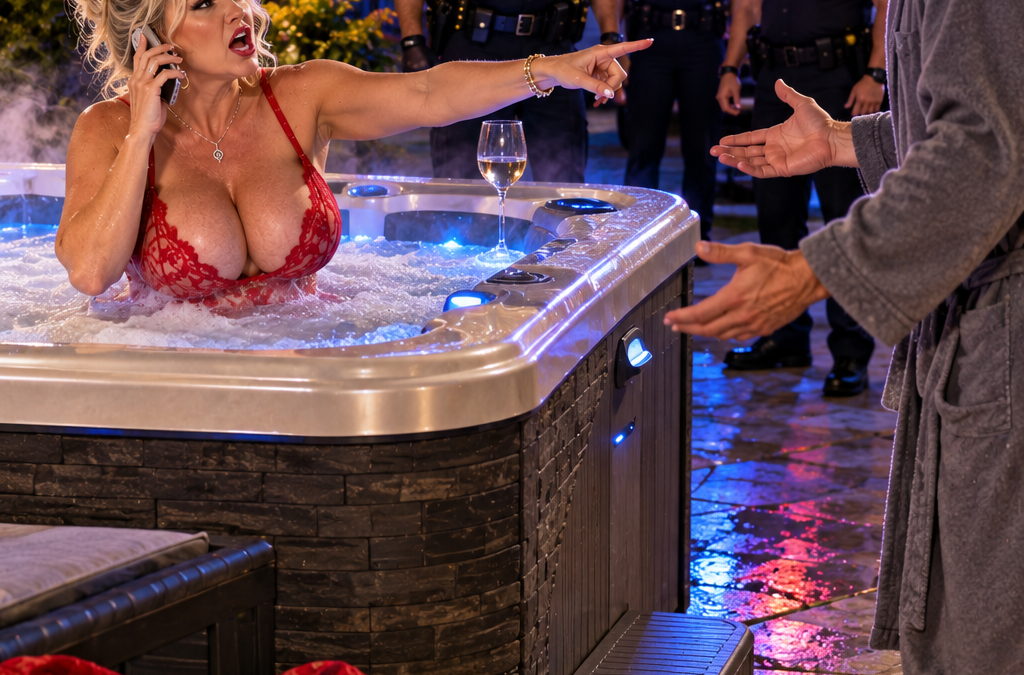
Betty Sutton was chest-deep in steaming water behind my house, a wine glass balanced on the stone ledge, looking completely at home on property she had climbed a fence to enter.
For several seconds, I honestly wondered whether exhaustion had finally broken something in my brain.
I had worked almost twelve hours that day.
I was recently divorced.
I had been living on coffee, frozen dinners, and four or five hours of sleep for weeks.
Maybe this was some stress hallucination.
Then Betty looked directly at me and smiled.
That familiar syrupy smile.
The one she used right before telling somebody their mailbox was the wrong shade of beige.
“Daniel,” she said. “You’re up late.”
I stared at her.
Steam drifted around her shoulders.
Her blonde hair was pinned loosely behind her head. She had discarded the cardigan she’d apparently been wearing when she climbed into my yard. Her makeup was still perfect except for the mascara beginning to darken beneath one eye.
And there, beside the hot tub, lay the red lace dress she wore so often to HOA functions that half the neighborhood privately joked it was her official uniform.
Betty Sutton was forty, beautiful in a way she had clearly learned to weaponize, curvy, flirtatious when she wanted something, and always dressed as though an HOA board meeting might somehow turn into a cocktail party.
But there was nothing charming about her sitting in my water at midnight.
“What exactly are you doing?” I asked.
She lifted the wine glass.
“Testing.”
“Testing what?”
“The water pressure.”
I looked at the wine.
Then at her.
“At eleven forty-seven at night?”
Her smile widened.
“Code compliance doesn’t keep office hours, sugar.”
That was Betty.
Eleven years as president of the Maple Ridge Estates Homeowners Association had taught her that if she said something confidently enough, most people would stop asking whether it made sense.
Unfortunately for her, I had stopped doing that months earlier.
I took another step onto the patio.
“You climbed my fence.”
She waved one hand dismissively.
“I accessed the property.”
“You climbed my locked fence.”
“Don’t be dramatic.”
“This is trespassing.”
Her eyes narrowed slightly.
“I’m the HOA president.”
“You’re still trespassing.”
The smile disappeared.
For half a second, we simply stared at one another.
Then Betty did something so absurd that even after everything she’d put me through, I wasn’t prepared for it.
She reached toward her phone.
Unlocked it.
And dialed 911.
I almost laughed.
“Seriously?”
She turned slightly away from me.
“Yes, hello? I need police assistance. A homeowner is threatening an HOA officer while she’s performing an authorized inspection.”
I stopped breathing for a second.
She was calling the police.
On me.
From my hot tub.
Inside my fenced backyard.
After climbing onto my property without permission.
That was the moment everything between Betty Sutton and me finally broke open.
But to understand how a suburban HOA president ended up dripping wet in my backyard while accusing me of trespassing on my own land, you have to understand what Maple Ridge had become under her control.
And for that, we have to go back six months.
My name is Daniel Reyes.
I’m a structural engineer.
At the time, I was forty-two years old, recently divorced, exhausted, and trying very hard to convince myself that buying a house alone counted as moving forward instead of starting over.
The divorce hadn’t been explosive.
No affair.
No dramatic courtroom battle.
Just two people who spent too many years becoming strangers while pretending everything was fine.
When it ended, my ex-wife kept the house we’d bought together.
I didn’t fight her for it.
I wanted somewhere new.
Somewhere without old arguments baked into the walls.
Maple Ridge Estates sat outside Charlotte, North Carolina, in one of those carefully landscaped suburban developments designed to look peaceful from every angle.
Curving streets.
Young trees.
Matching mailboxes.
Wide lawns.
Families walking dogs after dinner.
The listing called it a “close-knit community with strong property values.”
What sold me was the backyard.
Specifically, the built-in hot tub.
It sat beneath a cedar pergola against a stone patio, partially screened from neighboring houses by a wooden privacy wall.
After sixty-hour work weeks inspecting steel structures and arguing with contractors about load calculations, the idea of coming home, turning on the jets, and sitting in silence sounded almost medicinal.
The first evening after I moved in, I opened a beer, climbed into that tub, and watched steam rise into the Carolina night.
For the first time in months, I felt still.
I remember thinking, Maybe I can actually be okay here.
Then Carol warned me about Betty.
Carol lived next door.
She was sixty-eight, widowed, observant, and possessed the useful neighborhood talent of knowing everything without making it obvious that she was paying attention.
She caught me near the mailbox during my first week.
“Settling in?”
“Trying.”
She smiled.
“House is good?”
“Best feature’s in the backyard.”
She laughed.
“The hot tub.”
“Exactly.”
Her expression shifted.
“Watch yourself with Betty.”
I looked at her.
“Betty?”
“Betty Sutton. HOA president.”
“Oh.”
“She keeps files.”
I laughed.
Carol didn’t.
“Files on what?”
“People.”
I waited for the punchline.
There wasn’t one.
“You’re serious.”
“Eleven years she’s been running that board.”
“Nobody else wants the job?”
“Nobody wants what comes with challenging her.”
I leaned against the mailbox.
“How bad can HOA politics really get?”
Carol looked toward a large brick house near the end of the street.
A black SUV sat in the driveway.
“That’s what people always ask before they learn.”
Nine days after I moved in, I learned.
The violation notice was taped to my front door.
UNAUTHORIZED EXTERIOR STRUCTURE.
I read it twice.
The alleged structure was the five-foot-two privacy screen beside the hot tub.
The same privacy screen that had been there when I purchased the house.
I called the HOA number printed at the bottom.
Betty answered personally.
“Maple Ridge Homeowners Association. Betty speaking.”
“Hi. Daniel Reyes. I just moved into number eighteen.”
“Oh, Daniel.”
Her voice softened immediately.
“I’ve been meaning to introduce myself.”
“I got a violation notice.”
“The privacy screen.”
“Yeah. It was already here when I bought the place.”
“Ownership transfer doesn’t automatically grandfather unauthorized structures.”
I walked to my office and pulled out the HOA booklet.
“I’m looking at the bylaws right now. It says privacy screens under six feet don’t require architectural approval.”
There was a pause.
Then she laughed lightly.
“Rules protect property values, sugar. You’ll thank me later.”
I frowned.
“That doesn’t answer what I said.”
“You’ll need to bring the screen into compliance.”
“Compliance with what?”
“The community standard.”
“Where is that standard written?”
Another pause.
Then her voice cooled.
“Daniel, you’re very new here. I would strongly recommend that you start by cooperating rather than looking for technicalities.”
I stared at the phone.
“It’s not a technicality if the rule doesn’t exist.”
“Have a lovely afternoon.”
She hung up.
That night, I read every page of the bylaws.
There was no prohibition.
I emailed Betty the relevant clause.
I was polite.
I attached a photograph with measurements.
I explained that the privacy screen was five feet, two inches high and therefore fell below the threshold requiring architectural review.
No response.
One day passed.
Then two.
On the fourth day, another notice appeared.
Different rule.
This one accused the privacy screen of violating “aesthetic consistency with established community standards.”
There was no measurement.
No definition.
No photograph.
No actual standard.
Just vague language broad enough to mean whatever Betty wanted it to mean.
I stood on my porch holding the notice and realized Carol had been right.
Betty didn’t enforce rules.
She invented interpretations until people got tired of arguing.
I went inside and started a folder.
First notice.
Second notice.
My email.
The bylaw page.
Photographs.
Dates.
Times.
I labeled everything.
At the time, I thought I was protecting myself against a stupid fine.
I had no idea that folder would eventually help destroy Betty’s eleven-year reign over Maple Ridge.
Two weeks later, she appeared at my fence while I was grilling dinner.
I heard her before I saw her.
“Daniel.”
I turned.
Betty stood on the sidewalk beyond the wooden fence, arms folded.
She was wearing the red lace dress.
It hugged her figure tightly, plunging low at the neckline beneath a cream blazer. Blonde hair fell over one shoulder. Expensive perfume drifted faintly across the yard.
If you didn’t know her, she looked like someone arriving for drinks.
If you did know her, the clipboard under her arm told you everything.
“Evening, Betty.”
She looked past me toward the hot tub.
“That thing runs loud.”
“The grill?”
“The tub.”
“It’s off.”
“I’m talking generally.”
I flipped a burger.
“Okay.”
“Neighbors have complained.”
That got my attention.
“Which neighbors?”
“I can’t disclose confidential complaints.”
“How many?”
“Several.”
I looked at the houses on either side.
“Interesting.”
Her eyes narrowed.
“Why is that interesting?”
“Because I asked the Marshalls yesterday if the jets were bothering them.”
The Marshalls lived behind me.
Betty shifted her weight.
“And?”
“They said the jets cover highway noise.”
“People aren’t always comfortable confronting neighbors directly.”
“So they complained to you.”
“Yes.”
I nodded.
“Send me the complaints.”
“I’m not required to identify residents.”
“Redact the names.”
Her mouth tightened.
“Don’t become difficult, Daniel.”
I looked at her over the grill.
“I’m not being difficult. You say people complained. I’m asking you to show me the complaints.”
She gave me that same syrupy smile.
“You’ll learn how things work here.”
Then she walked away.
The next morning, I spoke to every immediate neighbor who could reasonably hear the hot tub.
Nobody had complained.
Not one person.
The Marshalls laughed when I asked again.
Carol rolled her eyes.
“Betty complains on behalf of imaginary people all the time.”
That was the first moment I understood that Betty wasn’t simply interpreting rules aggressively.
She was manufacturing consensus.
So I documented that too.
I bought an inexpensive decibel meter.
Ran the tub.
Recorded readings at the fence line.
Photographed distances.
Saved timestamps.
At work, I dealt with structures where half an inch mattered and undocumented assumptions could get people hurt.
Documentation was already part of how my brain worked.
Betty had picked the wrong profession to antagonize.
The first monetary fine arrived in March.
Two hundred dollars.
EXCESSIVE WATER USAGE.
I actually laughed.
The hot tub operated on a closed filtration loop.
The water circulated.
It wasn’t continuously draining into the street.
I appealed.
The appeal hearing lasted less than ten minutes.
Betty sat at the center of the table.
On one side was a man named Frank Coleman.
On the other was Richard Hayes.
Betty smiled.
“Daniel, we’re here to consider your appeal.”
I looked around.
“You’re chairing it?”
“I’m board president.”
“You’re also the person who issued the violation.”
Her smile sharpened.
“The appeals committee operates independently.”
“Who are these gentlemen?”
Betty answered.
“Community representatives.”
I learned later that both did business with Betty’s husband, Frank Sutton, a local contractor.
One provided equipment rentals.
The other subcontracted masonry work.
The independent appeals committee wasn’t independent.
It was Betty judging an accusation Betty had made, assisted by men financially connected to her family.
I explained the closed-loop filtration system.
Showed manufacturer’s documentation.
Presented water-use records.
Betty glanced at them.
Then denied the appeal.
“Community resource conservation is important.”
“That isn’t evidence.”
“The decision is final.”
I looked at her.
“How could it be final when you didn’t consider anything I brought?”
She leaned forward.
“Daniel, you seem determined to create conflict.”
“No. I seem determined to ask what rule I broke.”
Her voice dropped.
“People who live happily in Maple Ridge understand cooperation.”
I left the meeting feeling something close to claustrophobia.
Like the walls of the whole neighborhood had moved inward.
For the first time, moving crossed my mind.
Sell the house.
Take the loss.
Find somewhere without an HOA.
But the thought made me angry.
I’d spent years building enough equity and credit to buy something after my divorce.
Why should I leave because a woman with a clipboard enjoyed control?
I called an attorney.
Her name was Priya Shah.
She specialized in real estate disputes and HOA governance.
I brought the folder.
Priya listened while I explained everything.
When I finished, she flipped through the notices.
“The good news,” she said, “is that she isn’t nearly as untouchable as she thinks she is.”
“What does that mean?”
“It means Karens like her make the same mistake eventually.”
I raised an eyebrow.
“Karens?”
Priya smiled slightly.
“Occupational term.”
Despite myself, I laughed.
Then she became serious.
“They start confusing the rulebook with personal authority. Once that happens, they stop worrying about procedure.”
“She’s already there.”
“Exactly.”
Priya tapped my folder.
“And people who stop caring about procedure eventually leave evidence.”
Her first recommendation surprised me.
“Request the HOA’s financial disclosures.”
“Financial?”
“Yes.”
“I’m fighting a hot tub violation.”
“Maybe.”
She leaned back.
“But people who manipulate rules for control sometimes manipulate other things too. If she’s been president eleven years and nobody challenges her, I want to see where the money goes.”
I filed the request.
Betty stalled.
One week.
Then two.
Then three.
Meanwhile, the violations multiplied.
Mailbox color.
My post was supposedly “cream-white” instead of “architectural white.”
A garden gnome left by the previous owner became “prohibited decorative clutter.”
She even cited two outdoor burrs from a flowering shrub as landscaping debris.
Each letter went into the folder.
Then came the one that stopped being funny.
NOTICE OF STRUCTURAL SAFETY ORDER.
I stood at my kitchen counter reading the sentence twice.
The HOA ordered me to drain and permanently remove the hot tub within thirty days.
According to Betty, the installation represented a structural safety hazard.
I immediately checked my cameras.
No inspector had visited.
Nobody had entered the backyard.
Nobody had examined the tub.
I called Priya.
“She says it’s structurally unsafe.”
“Based on what?”
“Exactly.”
“Any report attached?”
“No.”
“Board vote?”
“No.”
“Engineering review?”
“I’m literally a structural engineer, Priya. Nobody has inspected anything.”
She laughed once, without humor.
“Send a certified demand for the report.”
I did.
Betty never produced one.
Instead, she sent another letter.
Failure to comply could result in a five-thousand-dollar lien against my home.
That changed something.
It wasn’t about losing a hot tub anymore.
It was about losing financial control over the first home I’d bought after my marriage ended.
I stopped sleeping.
I’d lie awake listening to the hum of the HVAC system, imagining legal bills.
Property records.
Collection notices.
A lien sitting against my title.
My ex-wife had once told me that I had a tendency to turn problems into equations because equations made me feel safer.
She wasn’t wrong.
But there was no clean equation for someone like Betty.
Rules could be researched.
Numbers could be audited.
A person willing to invent reality was harder.
Carol saw the exhaustion on my face one morning.
She came over with coffee.
“She’s getting to you.”
“I’ve had better months.”
Carol sat at the patio table.
Then she looked toward Betty’s house.
“She did this to another family.”
I stopped.
“What?”
“Years ago. Two streets over.”
“What happened?”
“They fought her over modifications. Betty kept escalating. Fines. Threats. Legal letters.”
“And?”
“They sold.”
“Because of Betty?”
“At a loss.”
I felt sick.
“Why didn’t anyone stop her?”
Carol stared into her coffee.
“Because once Betty picked someone, everybody else was just relieved it wasn’t them.”
That sentence stayed with me.
I decided I wasn’t selling.
Not because I wanted to become a crusader.
Because I refused to be driven out of a home I’d earned by somebody who couldn’t even produce the inspection report she claimed justified threatening it.
On day twenty-nine after Priya’s formal financial-record demand, a manila envelope appeared.
The disclosures were incomplete.
Pages missing.
Entire sections blacked out.
Totals that didn’t reconcile.
Priya spread the papers across her conference table.
“This is garbage.”
“Legal garbage?”
“Suspicious garbage.”
Then she pointed at a line item.
LANDSCAPING CONSULTING — SUTTON FIELDS LLC.
The payment appeared again three months later.
And again.
And again.
“Sutton,” I said.
“Betty’s married name.”
“Her husband is Frank Sutton.”
Priya looked at me.
“Exactly.”
We checked public records.
Sutton Fields LLC belonged to Frank.
The HOA was paying a company owned by the president’s husband.
That wasn’t automatically illegal.
But the lack of transparency, missing invoices, and repeated payments raised obvious questions.
For the first time, I felt something besides fear.
Hope.
Betty might be hurting herself every time she tried to hide something.
At the next HOA meeting, she attacked first.
“I’d like to address recent hostility from certain homeowners.”
I knew immediately she meant me.
Betty stood beneath fluorescent lights in a fitted red lace dress with a black blazer over it, clipboard in one hand.
Her eyes moved directly toward my chair.
“Some residents have chosen confrontation instead of cooperation.”
People glanced at me.
She continued.
“Maple Ridge cannot function if every reasonable safety measure becomes a legal threat.”
I stood.
“Betty.”
She paused.
“Yes, Daniel?”
“Can you show the board the inspection report declaring my hot tub structurally unsafe?”
The room went quiet.
Betty’s expression froze for perhaps half a second.
Then she recovered.
“That matter is under review.”
“You issued a removal order based on the report.”
“I said it’s under review.”
“Then how did you determine it was unsafe?”
She gripped the clipboard.
“This is not the appropriate forum.”
“It’s an HOA meeting.”
Several people shifted in their chairs.
Betty looked uncomfortable.
For the first time, everybody could see the gap between her certainty and her evidence.
After the meeting, a board member named Harold caught me near the parking lot.
He was seventy, thin, soft-spoken, and looked terrified even whispering.
“I never voted for the lien.”
I stared at him.
“What?”
“The five-thousand-dollar threat.”
He looked toward the clubhouse door.
“Betty said it was unanimously approved.”
“It wasn’t?”
“No.”
“Did anybody vote?”
Harold shook his head.
“Not that I know of.”
My pulse quickened.
“Would you say that publicly?”
His face tightened.
“I don’t know.”
“Harold, she’s threatening my house using approval that doesn’t exist.”
“I know.”
“Then why stay quiet?”
He looked down.
“You don’t know what she’s like when she decides you’re against her.”
I almost laughed.
“I do now.”
Harold said nothing.
But before walking away, he whispered, “I’ve kept my own meeting notes for years.”
That was another crack.
A week later, the lien notice arrived.
Official-looking.
Heavy paper.
Aggressive language.
Betty wanted me to believe my house was now at risk because I refused to destroy a perfectly legal hot tub.
Priya reviewed the notice.
“If Harold’s telling the truth, the authorization behind this is likely defective.”
We sent a cease-and-desist demand.
We cited the nonexistent inspection.
Fabricated complaints.
Improper appeal structure.
Missing board authorization.
Betty responded that every action had been unanimously approved.
That was a lie we could prove.
I started sleeping slightly better.
Not because Betty had stopped.
Because she had finally moved from vague bullying into documented falsehoods.
Then she began walking her dog past my house every night.
Slowly.
Always looking toward the backyard.
At first, I thought paranoia was getting to me.
Then Carol noticed too.
“She’s scouting.”
“Scouting what?”
Carol sighed.
“That’s what Betty does before she escalates.”
I already had cameras.
One covered the gate.
Another covered the patio.
I’d installed them after the lien threat.
Three nights later, at 11:31 p.m., my phone vibrated.
MOTION DETECTED.
I opened the feed.
Betty stood beside my fence.
I watched her look toward my house.
Then she put one foot on the lower rail.
Pulled herself up.
Swung one leg over.
Dropped into my yard.
My whole body went cold.
She moved toward the hot tub like she’d done it before.
Lifted the cover.
Dipped her hand into the water.
Then, unbelievably, she started getting in.
I watched through the camera feed.
She removed her cardigan.
Placed her wine glass on the ledge.
Climbed into my hot tub.
I put on a jacket.
Walked downstairs.
Kept my phone recording.
At 11:47, I stepped outside.
And that’s where this story began.
“What exactly are you doing in my hot tub?”
“Testing the water pressure.”
“At midnight?”
“Compliance inspections happen when necessary.”
“You climbed my fence.”
She waved me off.
“I’m authorized.”
“No, you’re not.”
Her smile sharpened.
“Daniel, don’t make this ugly.”
I stared at her.
“You’re sitting in my hot tub after illegally entering my yard, and you’re telling me not to make it ugly?”
She lifted the wine.
“You’re emotional.”
“Get out.”
Then she called 911.
I listened while she told the dispatcher that I was threatening an HOA officer.
I felt something inside me settle.
Strangely, I wasn’t angry anymore.
I was calm.
“Good,” I said.
Betty covered the phone.
“What?”
“Good. Let’s let the sheriff decide.”
Twelve minutes later, red and blue light spilled across my fence.
Deputy Ramos entered through the gate.
His flashlight moved across the patio.
Then stopped on Betty.
For perhaps three full seconds, nobody spoke.
Finally, he asked, “Ma’am, is this your residence?”
Betty straightened.
“I’m the HOA president.”
“That wasn’t my question.”
She looked annoyed.
“I’m performing a compliance inspection.”
Ramos looked at the hot tub.
Then at me.
“Sir, your property?”
“Yes.”
“Your fence?”
“Yes.”
“Hot tub?”
“Yes.”
Betty interrupted.
“Officer, I have association authority—”
Ramos held up one hand.
“Ma’am, please let me finish.”
She stopped.
I handed him my phone.
“Camera caught her entering.”
He watched.
Betty climbing the fence.
Dropping into my backyard.
Walking toward the tub.
No knock.
No permission.
No emergency.
Nothing remotely resembling lawful consent.
Ramos looked at her.
“You climbed the fence.”
Betty’s face changed.
“I had reason to inspect.”
“Did you have the homeowner’s consent?”
“HOA authority doesn’t require—”
“That’s not how property law works.”
Her mouth opened.
Ramos continued.
“Please step out of the water.”
Betty climbed out.
Suddenly, she looked smaller.
Her mascara had begun running.
Her wet hair clung to the side of her face.
Without the board table between us, without the clipboard, without neighbors too frightened to contradict her, she looked less like the queen of Maple Ridge and more like a wet trespasser trying to explain an absurd decision.
Ramos reviewed the footage again.
“This appears to support a criminal-trespass complaint.”
Betty’s voice cracked.
“This is a misunderstanding.”
“You called us on the homeowner.”
“I was threatened.”
“What threat?”
She pointed toward me.
“He came outside aggressively.”
“I asked you to leave my property,” I said.
Ramos looked at me.
“Any physical contact?”
“No.”
“Threats?”
“No.”
Then he turned back to her.
“Ma’am, being HOA president doesn’t give you authority to enter fenced private property without permission.”
For one second, Betty looked at me.
And I saw fear.
Real fear.
Not anger.
Not irritation.
Fear.
Ramos did not arrest her that night.
He documented everything, issued the appropriate report information, and instructed us about next steps.
Before leaving, he handed me a case number.
“Keep everything.”
“I have a lawyer.”
“Good.”
He looked at the cameras.
“And keep the footage.”
I texted Priya.
She trespassed. Cops came. Everything is on video.
The reply came almost immediately.
This changes everything. Send me the footage tonight.
I didn’t sleep.
But for once, fear wasn’t keeping me awake.
Momentum was.
By morning, half of Maple Ridge knew.
Carol sent me a message.
Betty got caught in your hot tub. This neighborhood will never recover.
I laughed.
Then I remembered who we were dealing with.
Betty wasn’t finished.
Two days later, another HOA notice appeared.
HARASSMENT AND INTIMIDATION OF BOARD OFFICER.
I read it twice.
Then laughed so hard I had to sit down.
The woman who climbed my fence at midnight was accusing me of harassing her.
Then she emailed the entire neighborhood.
According to Betty, I had “created a hostile environment,” lured her onto the property under false pretenses, and intentionally humiliated her during legitimate HOA business.
Some people believed her.
That hurt more than I expected.
Neighbors I’d waved to for months suddenly avoided eye contact.
One man across the street asked whether I’d “set her up.”
I felt that old panic returning.
What if confidence mattered more than truth?
What if she said the lie enough times that people simply accepted it?
Priya stopped me.
“The footage is objective.”
“I know.”
“So stop arguing with the rumor.”
“She’s poisoning everybody against me.”
“Then we force the issue into a room where evidence matters.”
We petitioned for a full HOA meeting.
Betty tried to deny it.
State requirements and association procedures gave homeowners a mechanism to demand one with enough signatures.
We needed fourteen.
We collected fourteen in two days.
Harold signed.
Carol signed.
The Marshalls signed.
People were beginning to move.
Meanwhile, Priya dug deeper into Sutton Fields LLC.
The company had been created approximately six months after Betty became president.
Frank Sutton was the sole owner.
Over eleven years, Maple Ridge had paid Sutton Fields nearly one hundred forty thousand dollars.
Landscaping consulting.
Grounds evaluation.
Seasonal maintenance advisement.
Vague descriptions.
No detailed invoices.
No competing bids for contracts that should have triggered bidding requirements.
No clear records showing meaningful work.
I stared at the total.
“One hundred forty thousand dollars?”
“Approximately.”
“For consulting?”
“That’s what they called it.”
“Did Frank even do landscaping?”
“His construction business occasionally subcontracted outdoor work.”
“That isn’t an answer.”
“No.”
Priya leaned back.
“We now have three separate categories of concern. Improper enforcement. Fabricated board authorization. Financial self-dealing.”
“And trespass.”
“Four.”
The night before the meeting, Betty messaged me directly.
Drop this and I’ll drop the harassment complaint.
I stared at the screen.
Then deleted the draft reply.
Some offers don’t deserve an answer.
Carol invited several neighbors over that evening.
“She’s going to perform tomorrow,” she warned.
“Betty always performs when she’s cornered.”
I nodded.
“Let her.”
“She’s good at it.”
“So are documents.”
Carol smiled.
“Look at you.”
“What?”
“Six months ago you thought HOAs were about lawn height.”
“I was younger then.”
She laughed.
I barely slept.
By morning, the anger had faded.
What remained was concentration.
The clubhouse was packed.
People lined the walls.
Betty sat at the head table.
Red lace dress.
Cream blazer.
Clipboard.
Perfect makeup.
For a moment, looking at her, I understood why she’d lasted eleven years.
She looked like authority.
Calm.
Polished.
Certain.
She opened with a speech.
“Maple Ridge has always been built on harmony.”
I almost admired the nerve.
“Unfortunately, recent events have brought outside hostility into our community.”
Outside hostility.
I lived there.
“This board will not be intimidated by individuals who weaponize lawyers, social media, and selective recordings.”
A few people nodded.
My stomach tightened.
She was good.
Then petitioners were recognized.
Priya stood beside me as I walked toward the front.
My hands were shaking.
I placed the folder on the podium.
“My name is Daniel Reyes.”
Betty rolled her eyes.
“I’d like to show the homeowners footage from October fourteenth.”
I connected my laptop.
The video began.
Betty appeared on screen.
Climbing my fence.
Dropping into my yard.
Walking toward the hot tub.
The room changed.
Whispers.
Gasps.
Someone muttered, “Oh my God.”
Then the footage showed Betty getting into the water.
Calling 911.
Claiming I threatened her.
I stopped the video.
Betty leaned toward her microphone.
“That is completely out of context.”
I looked at her.
“Then give us the context.”
She blinked.
“You said you were performing a safety inspection.”
“I was.”
“At midnight?”
“I work unusual hours.”
“In pajamas?”
Several people laughed.
Betty’s face reddened.
“That’s irrelevant.”
“Without written notice?”
Silence.
“Without a board order?”
Silence.
“After climbing my fence?”
The silence became brutal.
Then Harold stood.
“I never approved that inspection.”
Betty’s head snapped toward him.
“Harold, sit down.”
“No.”
People turned.
He looked terrified.
But he stayed standing.
“I never voted for the hot-tub removal order.”
Betty’s face went pale.
“And I never voted for Daniel’s lien.”
“Harold—”
“And I never voted to renew Sutton Fields.”
A murmur moved through the room.
Betty slammed her palm on the table.
“You signed the minutes.”
Harold pulled papers from a folder.
“No, Betty.”
He held them up.
“These are my meeting notes.”
Her expression changed.
“You forged the approval page.”
The room erupted.
People started talking all at once.
Betty shouted for order.
Nobody listened.
Then one woman stood.
“You did the same thing to us.”
Another homeowner raised his voice.
“We got fines for siding you’d already approved.”
Another.
“You threatened a lien over a shed that existed before we bought.”
Years of fear were breaking open all at once.
Betty stood.
“This is a coordinated smear campaign.”
Priya stepped forward.
“Then perhaps you can answer one financial question.”
Betty stared at her.
“Who are you?”
“Daniel’s attorney.”
A flicker of fear.
Priya continued.
“Can you explain approximately one hundred forty thousand dollars in HOA payments to Sutton Fields LLC?”
Betty froze.
The room went quiet again.
“That’s a legitimate vendor.”
“Owned by Frank Sutton.”
“Frank provides excellent services.”
“Frank is your husband.”
Her face drained.
Priya held up copies of the disclosures.
“We found no competing bids.”
Betty opened her mouth.
“No itemized invoices.”
Silence.
“No documented scope for many of the payments.”
“You’re not an accountant.”
“No. But the forensic accountant reviewing these records is.”
That landed.
A man near the front stood.
“That’s our reserve money.”
Betty looked toward him.
“Sit down.”
He didn’t.
“We’ve been told for three years we can’t afford the clubhouse roof.”
Another homeowner shouted, “You paid your husband instead?”
Voices rose.
The part-time security attendant stepped closer to the board table.
Betty looked around.
For perhaps the first time in eleven years, the room wasn’t afraid of her.
It was angry.
She tried one final time.
“I don’t have to sit here and be abused by people who don’t understand HOA governance.”
Then an elderly founding resident stood.
Her voice wasn’t loud.
It didn’t need to be.
“Sit down, Betty.”
Betty stared.
“We built this community before you ever chaired that board.”
The vice president cleared his throat.
His face was pale.
“I move for an emergency vote to remove Betty Sutton as president pending a full financial investigation.”
Betty spun toward him.
“You can’t do that.”
“We can.”
“You need cause.”
He looked at the screen still showing a frozen image of Betty climbing my fence.
Then at Priya’s financial documents.
“We have cause.”
Hands went up.
One.
Then another.
Then almost every voting hand in the room.
Betty’s remained down.
Her fingers trembled.
The motion passed.
After eleven years, Betty Sutton was no longer president of Maple Ridge Estates.
She stood absolutely still.
For a second, I expected an explosion.
Instead, she gathered her clipboard.
Closed the folder.
Walked toward the exit.
Her heels clicked against the tile.
The sound echoed through the silent clubhouse.
Then the door shut behind her.
And the whole room exhaled.
I thought that was the ending.
It wasn’t.
It was only the moment Betty lost control of the story.
Within days, a local reporter contacted me.
Carol had mentioned the case to someone she knew.
I was hesitant.
Priya wasn’t.
“Sunlight,” she said, “is one of the best enforcement mechanisms.”
The resulting article focused on the midnight trespass, the disputed fines, and the financial questions surrounding Sutton Fields.
The security footage spread quickly in local community groups.
People couldn’t believe it.
An HOA president had climbed into a homeowner’s hot tub, called police on him, and then accused him of harassment.
But the absurdity pulled attention toward the more serious issue.
The money.
The interim board requested a formal audit.
Investigators started examining years of financial records.
What they found was worse than we knew.
Backdated invoices.
Payments lacking documented work.
Accounts connected to entities with questionable registration histories.
Transfers that ultimately reached personal accounts.
Sutton Fields hadn’t performed anything close to the volume of work reflected in the HOA’s payments.
According to the later findings, approximately $138,400 had been improperly taken from association funds.
Betty was formally charged with financial offenses connected to the misappropriation.
Frank faced separate allegations related to the business arrangements and filings.
The trespass case continued separately.
Months later, I sat in court watching Betty stand before a judge.
She wasn’t wearing the red lace dress.
She wore a conservative dark suit.
No clipboard.
No microphone.
No row of frightened homeowners.
Her attorney described eleven years of community service.
I felt Carol shift beside me.
The prosecutor responded with the amount.
One hundred thirty-eight thousand four hundred dollars.
Money taken from neighbors.
Money that should have funded maintenance.
Reserves.
Repairs.
The judge imposed restitution obligations, eighteen months of probation, and a permanent prohibition against serving on an HOA board.
She did not receive prison time.
I’ll admit something.
Part of me wanted more.
Not because I wanted revenge.
Because I knew what she’d done to people.
How many nights people had spent frightened.
How many families had paid fines they couldn’t afford.
How many residents had stayed silent because they’d watched what happened to anyone who challenged her.
But when the judge banned her permanently from HOA leadership, something inside me loosened.
Control had been Betty’s real addiction.
More than money.
More than status.
She needed the clipboard.
The chair at the front of the room.
The ability to say I decide.
And now that was gone.
The trespass citation brought a separate penalty and permanent record.
After the hearing, Betty passed me in the hallway.
She stopped.
For one second, I thought she might apologize.
Instead, she gave me a bitter look.
No remorse.
No acknowledgment.
Nothing.
Then she walked away.
I realized she would probably never say she was sorry.
People like Betty don’t always apologize.
Sometimes they just run out of places to hide.
Maple Ridge held new elections within a month.
Real elections.
Harold became interim president.
Every significant fine required documented approval.
Vendor contracts required recorded votes and transparent bidding.
Financial statements were distributed quarterly.
Reserve-fund spending required actual documentation.
Everything became boring.
And boring was beautiful.
The hot tub went back to being a hot tub.
No inspection notices.
No fictional neighbors complaining.
No midnight visitors.
That spring, Carol hosted a neighborhood gathering.
She called it a barbecue.
Everybody knew it was therapy with hamburgers.
People told stories.
Some funny.
Some painful.
Three families who had sold their homes under Betty’s pressure contacted attorneys after seeing what happened.
The man who’d shouted about the reserve fund at the meeting introduced himself properly.
His name was Ed.
Retired firefighter.
Eighteen years in Maple Ridge.
He shook my hand.
“Thank you.”
I felt uncomfortable.
“I didn’t do this alone.”
“No.”
He looked toward Carol.
“None of us did much of anything until you started asking questions.”
“I just didn’t want to lose my house.”
“Sometimes that’s enough.”
Priya eventually sent her final bill.
I opened the envelope reluctantly.
Legal fees had cost me thousands.
Money I wouldn’t fully recover.
But beneath the invoice was a handwritten note.
You handled this better than most clients with twice your experience. Proud of you.
I framed it.
Strangely, I hung it beside the original privacy-screen violation.
The beginning and the end.
Betty sold her house by summer.
At a significant loss.
I couldn’t ignore the irony.
The woman who had spent years using financial pressure against other homeowners ultimately left Maple Ridge under a cloud of scandal that destroyed much of the value she’d built around her own reputation.
Frank’s construction business collapsed not long afterward.
Nobody wanted to hire a contractor whose name had appeared throughout the financial scandal.
Months later, Carol called me.
“You won’t believe this.”
“What now?”
“Betty tried joining another HOA board.”
I sat upright.
“You’re kidding.”
“Two towns over. Used her maiden name.”
“Did she get on?”
“No.”
The board ran a background check.
They rejected her before she got near a ballot.
I laughed.
Not cruelly.
Mostly with relief.
Some patterns become much harder to repeat once people know what to look for.
I won’t pretend the experience left me untouched.
It didn’t.
I lost money.
Sleep.
Trust.
Before Maple Ridge, I believed rules were generally there to protect people who followed them.
After Betty, I understood that rules can become weapons when one person controls how they are interpreted and nobody demands evidence.
I became suspicious of vague language.
Suspicious of unchecked discretion.
Suspicious whenever someone answered a reasonable question with a threat.
But I gained something too.
A community.
A real one.
Not the fake harmony Betty used to demand.
People actually talked now.
Ed brought tomatoes from his garden every August.
Carol still texted me whenever she heard some ridiculous Betty rumor.
The Marshalls invited me over for football.
Harold became a different man once he stopped looking over his shoulder before speaking.
And the hot tub?
It still runs almost every night around eight.
Jets humming.
Steam rising.
Mine.
People sometimes ask whether I regret pushing so hard.
The lawyer.
The records.
The meeting.
The public fight.
I tell them the truth.
The moment I found Betty sitting in my water, I already knew there was no version of the story where I backed down.
Some fights choose you.
You don’t get to decide how big they become.
You only decide whether you keep showing up.
Betty had eleven years of momentum.
Eleven years of homeowners learning that resistance cost more than obedience.
She thought time had made her untouchable.
What she forgot was that momentum means nothing if the foundation underneath it is rotten.
Every fine she fabricated, I filed.
Every threat she sent, I dated.
Every shifting explanation, I saved.
Every lie eventually collided with a document, witness, financial record, or piece of footage.
Patience wasn’t weakness.
Documentation wasn’t drama.
It was how reality defended itself against someone who believed she could rewrite it.
I think about Harold sometimes.
He was a decent man.
But fear kept him quiet for years.
I understand why.
When the person across the table can issue fines, threaten liens, control appeals, shape meeting minutes, and make herself appear legally untouchable, fear is rational.
Most people have jobs.
Mortgages.
Children.
Medical bills.
They don’t want a second career fighting a volunteer board president.
Betty understood that.
She depended on it.
Her power wasn’t built entirely from the bylaws.
It was built from exhaustion.
People gave up because fighting cost too much.
That was the structure beneath everything.
And all I did, really, was ask one question Betty had spent eleven years avoiding.
Show me the actual rule.
Then another.
Show me the inspection.
Then another.
Show me the vote.
Then another.
Show me where the money went.
She never had good answers.
Once enough people noticed, the kingdom collapsed faster than any of us expected.
I still keep the original folder.
It’s in a cabinet in my garage.
The first violation notice sits at the front.
Unauthorized exterior structure.
Five-foot-two privacy screen.
Such a ridiculous beginning for everything that followed.
Sometimes, when a new resident gets a suspicious letter, they knock on my door.
I’ve reluctantly become the neighborhood’s unofficial first stop for HOA questions.
I always tell them the same thing.
“Read the bylaws.”
Then:
“Document everything.”
I don’t tell them every board member is corrupt.
They aren’t.
Harold isn’t.
Most of the new board consists of ordinary people trying to keep the landscaping maintained and make sure the pool insurance gets paid.
That’s what an HOA should be.
Boring administration.
Not personal rule.
Carol occasionally says I should run for president.
I laugh every time.
“Absolutely not.”
“You’d be good.”
“That’s what scares me.”
I’ve had enough board meetings for several lifetimes.
I’d rather sit in my hot tub.
Months after the case ended, Deputy Ramos stopped by while off duty.
I was watering some plants.
He recognized me.
“Mr. Reyes.”
“Deputy.”
He smiled.
“Heard how everything turned out.”
“Yeah.”
“Most HOA disputes don’t end like yours.”
“I’d prefer if none ended like mine.”
He laughed.
“Fair.”
Then he nodded toward the backyard.
“You really had the receipts.”
“Literally.”
That was the first time I genuinely laughed about the whole thing.
Not bitterly.
Not nervously.
Just laughed.
Because sometimes justice doesn’t arrive dramatically.
Sometimes it’s a boring audit.
A recorded vote.
A case number.
A dated photograph.
And sometimes it arrives at midnight with police lights reflecting off a fence while the person who called 911 slowly realizes she’s the one officers are questioning.
Betty Sutton now lives two counties away.
Mostly forgotten.
Her name still comes up occasionally.
Usually someone shakes their head and says:
“Remember when she climbed into Daniel’s hot tub?”
I don’t need her punished forever.
I don’t need to spend the rest of my life angry.
Watching her lose the one thing she valued most was enough.
Control.
That was Betty’s real identity.
Without the board, without the rulebook, without the frightened audience, she was simply a woman who climbed someone else’s fence and sat in water that wasn’t hers.
That’s the part I think mattered most.
Bigger than the money.
Bigger than the forged approval pages.
Bigger than the fake complaints.
Bigger even than the midnight trespass.
Underneath the laminated rules and the red lace dress and the syrupy smile, there had never really been principle.
There had been power.
Unchecked power.
The moment somebody started checking it, everything fell apart.
I printed one still frame from the security footage.
Betty halfway over the fence.
One leg across the top rail.
Confidence all over her face.
I keep it near the old folder.
Not because I enjoy humiliating her.
Because it reminds me of something.
Bullies are constantly conducting experiments.
They push a little.
Then watch.
If nobody stops them, they push farther.
A warning.
A fine.
A threat.
A lien.
A fake vote.
A hidden payment.
A fence climbed at midnight.
They keep moving until someone finally tells them where the boundary actually is.
Betty’s problem was that for eleven years, Maple Ridge never forced her to find that boundary.
Then she climbed into my backyard.
And called the police on me.
That was where she finally found it.
Maple Ridge feels different now.
Lighter.
New families move in and hear the story within days.
It’s become half warning, half neighborhood legend.
I’m fine with that.
Legends are useful when they teach the next person what to watch for.
Maybe the next Betty Sutton never gets eleven years.
Maybe someone sees the first fabricated violation and asks for the rule immediately.
Maybe someone checks a vendor’s ownership.
Maybe a frightened board member speaks earlier.
Maybe a homeowner realizes that authority should survive questions if it’s legitimate.
My divorce still happened.
My sixty-hour weeks didn’t disappear.
The house didn’t magically solve the loneliness that made me buy it.
But something changed here.
When I first moved in, the hot tub was a place where I went to escape.
Now it feels different.
I sit there some nights with the jets running and steam rising into the dark Carolina sky.
No clipboard.
No camera alerts.
No lawyer calling.
No certified letter waiting at the front door.
Just water.
Quiet.
My home.
Sometimes I think about that first night after closing, when I sat in the same spot believing I had finally found somewhere peaceful.
I was wrong then.
Peace isn’t the absence of conflict.
Sometimes peace is what exists after you’ve defended the boundary people kept crossing.
I learned that the hard way.
And Betty learned something too.
She thought eleven years of control made Maple Ridge hers.
In the end, all it took to prove otherwise was one locked fence, one camera, one folder, and one homeowner who finally refused to move.
Justice didn’t arrive quickly.
It didn’t arrive cleanly.
And it certainly didn’t arrive cheaply.
But eventually it came.
Late.
Documented.
And dripping wet in somebody else’s hot tub.








