𝗙𝗨𝗟𝗟 𝗦𝗧𝗢𝗥𝗬 The HOA President Claimed My Family’s 750-Acre Farm and Threatened to Arrest Me When I Discovered He Had Sold Pieces of It to Strangers
𝗙𝗨𝗟𝗟 𝗦𝗧𝗢𝗥𝗬
Its black lens pointed down toward the road.
I looked beyond it at the new neighborhood.
A woman was pushing a stroller along the sidewalk.
A man in running clothes jogged past a newly planted maple.
Two children rode bicycles in circles near a cul-de-sac.
Those people looked perfectly ordinary.
They had no reason to know what had happened.
They probably believed they had purchased homes in a legitimate subdivision.
But beneath those houses was a question nobody had bothered to answer.
Who actually owned the ground?
My phone vibrated in my pocket.
It was a text from the farmhand who helped me maintain the northern pastures.
You still coming to check the water line?
I stared at the message.
The water line could wait.
For the first time in my life, I wasn’t sure how much of my own farm someone might try to stop me from entering.
I got back into my truck and drove toward the development entrance.
I wasn’t going there to make trouble.
I wanted an explanation.
I wanted to know who had approved the construction, who had represented the land as available for sale, and what document supposedly gave them the authority to do any of it.
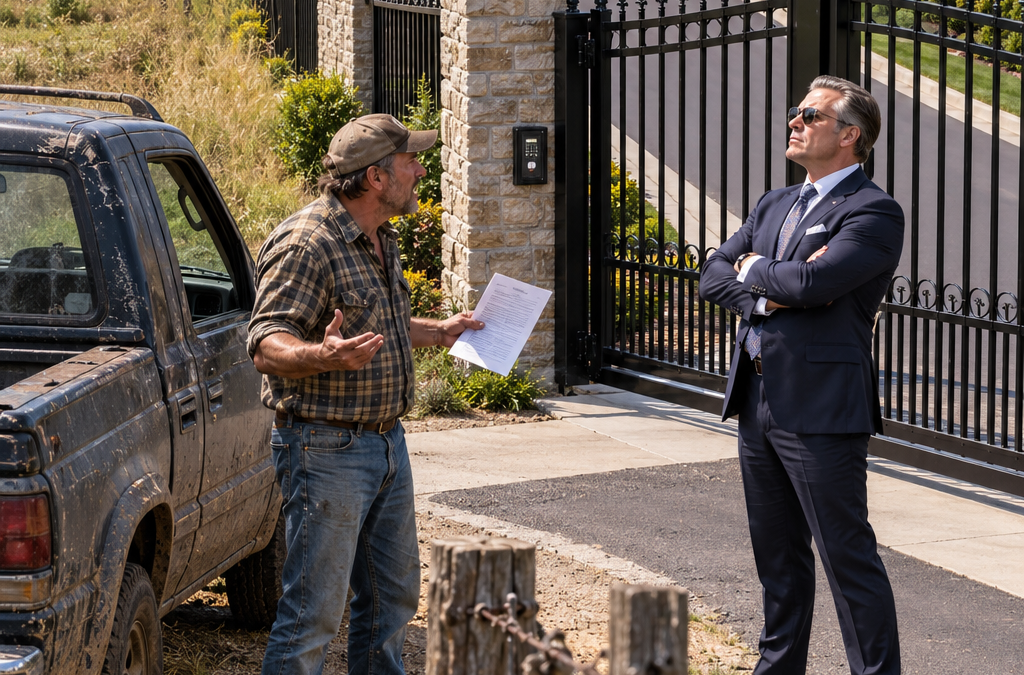
I had just parked beside the entrance when a black luxury SUV rolled toward me.
It was an enormous vehicle, polished to a mirror finish, with dark tinted windows and expensive wheels that looked too clean for a rural road.
The driver pulled into a space beside my truck.
The door opened.
A man stepped out.
He appeared to be around fifty, tall and broad through the shoulders, with silver beginning to show in his carefully styled dark hair.
He wore a tailored charcoal suit, a white dress shirt, and a burgundy silk tie.
A silver watch flashed beneath his cuff.
His shoes were so polished they reflected the pale morning sky.
He looked like a man who considered appearances a form of authority.
When he saw me, he smiled.
It was the kind of smile that never quite reached the eyes.
“Good morning,” he said. “Can I help you?”
“I certainly hope so.”
He approached with one hand extended.
“Preston Vale. President of the Cedar Ridge Homeowners Association.”
I shook his hand.
His grip was firm and deliberately prolonged.
“I own the farm west of this development,” I said.
His expression changed immediately.
Not surprise.
Recognition.
“Oh,” he said. “You’re the agricultural property owner.”
“I am.”
He glanced at my pickup.
Then back at me.
“I believe our office recently sent you some information.”
“You sent me a letter claiming my farm belongs to your development.”
He smoothed his tie.
“That’s a simplified way of putting it.”
“Then give me the complicated version.”
Vale chuckled.
“Property development can be difficult to understand without familiarity with the planning process.”
“I’ve owned this land for decades.”
“Of course.”
“And my family owned it before me.”
“Historical ownership is one factor,” he replied. “But land use evolves. Communities expand. Development plans are approved.”
I looked at him.
“Are you telling me a development plan transferred my farm to your HOA?”
He tilted his head.
“I’m telling you the property was included in the overall development structure.”
“By whom?”
“By the development company and the relevant planning authorities.”
“Who sold them the land?”
His smile weakened.
“Excuse me?”
“Who sold them my land?”
He glanced toward the houses.
“The property was incorporated through the appropriate development process.”
“That isn’t an answer.”
His eyes narrowed slightly.
“Mr. Vale,” I said, “I’m standing here looking at houses built on acreage that belongs to my family. Your association has sent me a letter claiming ownership of my farm. I’m asking you one simple question.”
I stepped closer.
“Who signed the deed?”
For the first time, he stopped smiling.
Then he reached inside his suit jacket.
“I anticipated that you might have questions.”
He removed a folded document.
“Fortunately, we have the necessary paperwork.”
He handed it to me.
Across the top were the words:
LAND TRANSFER AND DEVELOPMENT INCLUSION AGREEMENT.
Beneath the heading were several paragraphs describing Cedar Ridge Estates, the surrounding property, and the incorporation of adjacent agricultural land into the development’s master plan.
There were parcel references.
Survey exhibits.
A date.
And several signatures near the bottom.
At first glance, it looked official.
That was what troubled me.
I had spent enough years dealing with farm loans, easements, land surveys, and county records to recognize when a document was designed to create an impression.
And this one was clearly designed to look like proof of something.
I read the first page carefully.
Then the second.
The language referred to development inclusion, planning consent, and association control.
But the more I examined it, the less sense it made.
The parcel description didn’t match the original property records.
The acreage references were inconsistent.
A survey exhibit appeared to combine portions of neighboring tracts without identifying a proper conveyance from the actual owner.
And nowhere could I find a valid deed showing that I had transferred my farm to anybody.
I looked up.
“Where did you get this?”
Vale seemed offended.
“From the development’s legal documentation.”
“Who prepared it?”
“The developer’s representatives.”
“Did you verify it against the original deed?”
“Of course.”
“Then why doesn’t the legal description match?”
He blinked.
“What?”
I pointed to the page.
“This parcel reference is incomplete. The acreage description doesn’t correspond to the recorded boundary. And this section refers to an inclusion agreement, not a deed conveying title.”
Vale glanced at the document.
Then he shrugged.
“You’re focusing on technicalities.”
I stared at him.
“Technicalities?”
“These things are handled by professionals. The board doesn’t personally examine every surveying detail.”
“You’re claiming ownership of 750 acres, and you think the legal description is a minor detail?”
His smile disappeared.
“I don’t appreciate your tone.”
“And I don’t appreciate strangers selling my family’s land.”
He stepped closer.
“Let me be perfectly clear. Cedar Ridge Estates has already completed sales to numerous homeowners. Those transactions have closed. The homes are occupied. Whatever objections you believe you have should have been raised during development.”
“Before development?”
“Yes.”
“How was I supposed to object to a land transfer I never authorized?”
Vale’s jaw tightened.
“You’re making accusations.”
“I’m asking questions.”
“You’re implying that legitimate property transactions were improper.”
“I’m saying this document does not prove you own my farm.”
He gave a short, sharp laugh.
“That’s irrelevant at this point.”
My stomach turned.
“Explain that.”
“The houses have been sold.”
“So?”
“The buyers are now the legal owners.”
“Of land nobody had the authority to sell?”
He lifted his chin.
“You’re welcome to challenge the process if you want to spend the money. But these transactions are finished.”
For several seconds, I couldn’t speak.
I looked past him at the new houses.
Fresh siding.
Clean windows.
Flags hanging from porches.
A delivery truck stopped in front of one driveway.
All of it had been built on the assumption that whoever sold the land had the right to sell it.
And here stood the man responsible for enforcing the neighborhood’s rules, telling me that completed sales mattered more than the original ownership.
I folded the document.
“I’m not accepting this as proof.”
Vale’s face hardened.
“You’re free to have an opinion.”
“Ownership isn’t an opinion.”
“No,” he said coldly. “It’s a legal matter. And our attorneys are considerably more familiar with the process than you are.”
I looked him directly in the eyes.
“Then tell them to find the deed.”
His expression turned ugly.
“You need to understand something. This association is not going to let one disgruntled farmer disrupt an entire residential community.”
“Disgruntled farmer?”
“Someone who refuses to accept development because he’s emotionally attached to old land.”
For a moment, I saw my father’s hands.
Cracked knuckles.
Dirt beneath the nails.
The deep scars along his fingers from repairing equipment through winters when we barely had enough money to replace worn tires.
My father had worked that land until his body could no longer keep up.
And this polished stranger was reducing generations of ownership to emotional attachment.
I forced myself to stay calm.
“Mr. Vale, my family doesn’t own that land because we’re sentimental. We own it because the deed says we do.”
He pointed toward the entrance.
“This conversation is over.”
“No, it isn’t.”
“Yes, it is. You’ve received the association’s documentation. If you disagree, take it up with our legal department.”
I looked toward the houses one last time.
Then I walked back to my truck.
Behind me, Vale called out.
“And stay out of the residential construction areas. Those properties have been sold.”
I stopped.
Without turning around, I answered, “You can’t sell something you don’t own.”
Then I drove home.
The whole way back, my hands gripped the steering wheel so tightly that my fingers began to ache.
I wasn’t afraid of Vale.
Not yet.
I was afraid of what the situation meant.
Forty-six houses.
Dozens of families.
Mortgages.
Insurance policies.
Construction loans.
Real estate contracts.
All attached to land that appeared in my family’s property records.
This wasn’t a fence dispute.
It wasn’t a disagreement over a few feet of pasture.
It was a property problem large enough to threaten my farm and an entire neighborhood at the same time.
When I reached the house, I went straight to the study.
My father’s filing cabinet stood against the wall.
It was old, green, and dented along one side.
He had bought it secondhand when I was a boy.
Inside were decades of records arranged in thick folders.
Deeds.
Surveys.
Tax statements.
Boundary maps.
Farm improvement permits.
Old photographs showing fences and roads that had disappeared long before Cedar Ridge existed.
I took out the main property file and laid everything across the dining room table.
The original deed was first.
Then the records showing the transfer through my family.
Then the updated county survey.
Then the tax parcel descriptions.
I spread the documents out until I could barely see the table beneath them.
My father had kept those papers with almost religious care.
He used to tell me that a man could lose money, equipment, and even a season’s harvest and still recover.
But if he became careless about the ground beneath his feet, he could lose something his children might never get back.
I had heard those words countless times.
That afternoon, they no longer sounded like an old man’s caution.
They sounded like a warning.
I began comparing Vale’s development document with the original records.
The first problem was obvious.
The HOA paperwork described the farm as though it had been absorbed into a development tract.
But there was no corresponding conveyance in my family’s records.
The second problem was the survey.
Cedar Ridge’s map showed development boundaries extending westward across the old eastern pasture.
My survey showed that land inside the original farm boundary.
The third problem was the description of the supposed transfer.
It referred to development inclusion and association authority, but it didn’t establish a valid transfer of my ownership.
I sat back in my chair.
The more closely I examined it, the worse it looked.
Somebody had treated the development plan like a substitute for a deed.
But planning documents could not magically transform another person’s farm into subdivision property.
I looked at the clock.
The county recorder’s office was still open.
I called.
After explaining the situation, I was directed to the appropriate land records staff.
I provided the parcel identification, my name, and the references from the disputed paperwork.
The woman on the phone listened carefully.
Then she asked me to repeat one of the document numbers.
I did.
There was a pause.
Keyboard sounds.
Then she said, “Sir, I’m not seeing a recorded conveyance matching the transfer you’re describing.”
My pulse quickened.
“You’re certain?”
“I’m telling you what appears in the records available to me. You’ll need a formal title examination to resolve any competing claims, but the ownership history I’m seeing doesn’t match the HOA’s description.”
I closed my eyes.
It was the first clear confirmation that I wasn’t imagining the problem.
“What should I do?”
“Request certified copies of the relevant records and speak with a qualified real estate attorney. Given the number of properties involved, I would not advise handling this informally.”
I thanked her.
Then I sat at the table, staring at the documents.
Outside, the farm was quiet.
The afternoon wind moved through the trees beyond the kitchen window.
I could hear a tractor somewhere near the northern fields.
Everything sounded normal.
But nothing felt normal anymore.
The next morning, I drove to the county office and obtained certified copies of the ownership records and surveys.
I also requested the available subdivision plat and recorded documents associated with Cedar Ridge.
By the time I returned home, the evidence filled a second folder.
I spent hours arranging it.
Original ownership.
Recorded conveyances.
Tax history.
Boundary surveys.
Subdivision documents.
The HOA’s claimed transfer.
Every paper had a place.
Every inconsistency received a note.
I wasn’t preparing for a shouting match.
I was preparing for something much more serious.
The county records showed that the farm’s original 750-acre boundary remained identifiable in the recorded history.
The disputed development documents did not establish the transfer Vale had described.
That didn’t mean every legal issue was automatically resolved.
But it meant the HOA could not simply point to its master plan and declare the farm gone.
I wanted to believe that once Vale saw the certified records, he would stop.
I was wrong.
Two days later, I drove along the public road east of my farm.
Three more SOLD signs had appeared.
Construction workers were unloading materials at another house.
A landscaping crew was planting trees.
And a large advertising banner near the subdivision entrance announced that additional homesites were available.
They were still selling.
Even after I had challenged their ownership claim.
I pulled over and watched a young couple walk through a model home with a real estate agent.
The woman held a brochure.
The man carried a little girl on his shoulders.
They were smiling.
I imagined them choosing a kitchen.
Discussing where the child’s bedroom would be.
Trying to decide whether the monthly payment was manageable.
They probably had no idea that the property beneath that beautiful house was disputed.
My first instinct was to march into the sales office and tell them everything.
But I stopped myself.
If I started making accusations in front of buyers without a formal legal process in place, Vale could use that against me.
He had already made it clear that he viewed me as a threat to the development.
I needed to be careful.
The consequences were no longer limited to my land.
Innocent people were involved.
That evening, another envelope arrived.
This one was delivered by courier.
The heading read:
CEASE AND DESIST NOTICE.
According to the association, I was prohibited from entering property designated as Cedar Ridge common or residential land.
The notice accused me of interfering with development operations.
It warned that further unauthorized entry could result in legal action and referral to law enforcement.
One paragraph claimed that my continued insistence on ownership created uncertainty for homeowners and potential buyers.
I read that sentence three times.
My insistence on ownership.
As though the problem wasn’t the unauthorized claim over my family’s land.
As though the deed itself had become inconvenient.
I set the letter down and stared out the window.
The eastern pasture had been part of my life since I was old enough to ride beside my father in an old farm truck.
I remembered moving cattle through that field during dry summers.
I remembered repairing storm-damaged wire with frozen fingers.
I remembered walking the boundary with Dad while he showed me where the old survey markers sat.
And now Preston Vale was demanding that I stop entering it.
He was treating the actual owner like an intruder.
That was the first night I had trouble sleeping.
I lay awake listening to the house settle.
Every creak sounded louder than usual.
I kept imagining survey stakes appearing farther west.
Fences moving.
More houses.
More signs.
More letters claiming that land I had never sold belonged to someone else.
By morning, I knew the dispute had become too serious to handle alone.
I called a property attorney.
Her name was Evelyn Mercer.
She had spent more than twenty years handling land ownership disputes, title defects, boundary litigation, and agricultural property cases.
When I described the situation, she didn’t interrupt.
She simply listened.
Then she asked one question.
“How many acres are involved?”
“Seven hundred and fifty.”
There was a pause.
“And how many homes have already been built on the disputed portion?”
“Dozens. I counted at least forty occupied or nearly completed houses.”
Her voice changed.
“I need to see every document you have.”
We met the following morning.
Evelyn’s office was modest compared with the expensive development buildings I had seen near Cedar Ridge.
No marble floors.
No enormous glass conference room.
Just shelves of legal books, a large wooden desk, and a conference table covered with files.
I placed my folders in front of her.
She began with the original deed.
Then the later ownership records.
Then the surveys.
Then the HOA’s document.
She read silently for nearly twenty minutes.
Finally, she looked up.
“Who gave you this transfer agreement?”
“The HOA president.”
“And he says this gives the association ownership?”
“Yes.”
She looked back at the document.
“That’s a serious claim.”
“I know.”
“No,” she said quietly. “I don’t think you understand how serious.”
I felt my stomach tighten.
She turned the paper toward me.
“These documents appear to confuse development planning with actual conveyance of title. There may be other records we haven’t seen, so I’m not going to make a final conclusion today. But nothing here establishes that you knowingly transferred your entire farm.”
“I didn’t.”
“I believe you. Now we need to prove exactly what happened.”
She spread the surveys across the table.
“Here’s the old farm boundary.”
I nodded.
“And here is the new subdivision plat.”
She placed a transparent overlay over the documents.
The difference was unmistakable.
The development extended across the eastern portion of the original farm.
Streets.
Lots.
Drainage areas.
Several common spaces.
All drawn over land identified in my family’s recorded ownership history.
Evelyn traced the overlap.
“This isn’t a small surveying error.”
“I know.”
“Somebody prepared a development plan that incorporated land without adequately establishing the chain of title.”
I stared at the map.
“How could houses have been sold?”
She leaned back.
“That’s one of the questions we’re going to ask. There may have been incorrect assumptions, deficient title examinations, improper documentation, or representations that weren’t supported by the records. We need to identify each transaction and the parties responsible.”
“Can they keep selling while we do that?”
“That’s exactly what concerns me.”
She folded her hands.
“If more homes close, more buyers become involved. More lenders. More title insurers. More people relying on documents that may be defective.”
I looked down at the map.
“What happens to the families already living there?”
Her expression softened slightly.
“That depends on the outcome and the available remedies.”
“They didn’t do anything wrong.”
“Most likely, they relied on what they were told.”
“I don’t want to throw anyone out of their house.”
“I understand.”
“But I’m not giving away my farm because somebody built on it.”
“And you shouldn’t be forced to choose between those two things without understanding your legal rights.”
I sat silently.
For the first time since the dispute began, someone was speaking about the problem without trying to intimidate me or dismiss my ownership.
But the facts were becoming more frightening.
The original farm boundary wasn’t just being challenged.
It had been used as the foundation for an entire chain of transactions.
If those transactions were defective, untangling them would be complicated.
If I ignored them, the problem could grow until my property rights became harder to protect.
Evelyn looked at me.
“Are you prepared for this to become public?”
I hesitated.
“How public?”
“Potentially court filings, homeowners receiving notices, lenders asking questions, and a lot of pressure from people who don’t understand how this happened.”
I thought about the young couple at the model home.
The little girl on her father’s shoulders.
Then I thought about my grandfather.
My father.
The land.
“Do what we need to do,” I said.
Evelyn nodded.
“Then we do it carefully.”
Over the next several days, she began assembling the legal record.
A professional surveyor was asked to compare the original farm boundaries with the development plat.
Certified documents were obtained.
The title history was examined.
Letters were prepared demanding that the relevant parties preserve records and explain the claimed transfer.
Evelyn also notified the developer and association that ownership was disputed and that continuing sales could deepen the harm.
I hoped the formal notice would make Vale reconsider.
Instead, he escalated.
The following Monday, I found two unfamiliar vehicles parked near my eastern service road.
Three men were standing beside the old fence.
One held a measuring device.
Another carried a clipboard.
The third was placing small orange flags in the ground.
I stopped my truck and stepped out.
“Morning.”
The man with the clipboard looked up.
“Morning.”
“What are you doing?”
“Marking the next phase boundary.”
I stared at him.
“Next phase?”
“Development expansion.”
I looked at the flags.
They extended westward.
Toward my active hayfield.
“Who told you to mark this area?”
“The development office.”
“This is my farm.”
The man glanced toward the fence.
“We were told the property had already been incorporated.”
“By whom?”
He checked his clipboard.
“Cedar Ridge development management.”
I felt heat rising in my face.
“Did they tell you the ownership is disputed?”
He hesitated.
“No, sir.”
I took out my phone and photographed the flags.
Then I asked the men to stop work until the ownership issue could be verified.
The man with the clipboard looked uncomfortable.
“We’re just doing the survey work.”
“I understand. My dispute isn’t with you. But you’re marking construction boundaries across land that belongs to me.”
He nodded slowly.
“We’ll call the office.”
I thanked him.
Then I called Evelyn.
Her voice became sharp when I described the flags.
“Don’t move them. Photograph everything.”
“I already have.”
“Don’t argue with the workers. I’ll contact the developer’s counsel immediately.”
I looked toward the orange markers stretching across the grass.
“How far are they planning to go?”
“I don’t know yet.”
That answer frightened me more than anything Vale had said.
Because I suddenly realized that the development might not be finished.
The houses already built were bad enough.
But if another phase moved westward, the damage could spread into the hayfields we still depended on.
The ground beneath my feet felt less secure than it had the day before.
The next morning, Vale called me himself.
I recognized his voice immediately.
“What exactly do you think you’re doing?”
I stood beside my kitchen window.
“Good morning to you, too.”
“Don’t play games.”
“What do you want, Mr. Vale?”
“You interfered with authorized survey personnel.”
“I informed them that the land they were marking is subject to a documented ownership dispute.”
“They were conducting association-approved development work.”
“Your association doesn’t own my farm.”
He laughed bitterly.
“You’re still repeating that?”
“Until you show me a valid conveyance, yes.”
His voice hardened.
“Let me explain something. People have invested millions of dollars in Cedar Ridge. Families have moved in. Contractors have obligations. Lenders have funded construction. You are not going to hold an entire development hostage because you refuse to accept reality.”
I gripped the phone.
“Reality is the original deed.”
“Your documents are being reviewed.”
“Then why are you planning another phase?”
“Because the development has legal authority.”
“Prove it.”
He went silent.
Then he said something that made my blood run cold.
“You should think carefully about whether you want to be responsible for ruining forty-six families.”
I closed my eyes.
There it was.
The pressure point.
He knew I didn’t want innocent homeowners harmed.
And he was trying to turn that concern into a weapon.
“Those families trusted the people selling them homes,” I said.
“And now you’re threatening their property.”
“No. I’m challenging the people who sold land without proving they owned it.”
“Courts don’t look kindly on people who try to destroy communities.”
“Neither do they ignore deeds.”
His voice rose.
“You arrogant son of a—”
He stopped himself.
For several seconds, I could hear him breathing.
Then he spoke more quietly.
“You have one opportunity to stop this.”
I waited.
“Withdraw your objections. Let the development proceed. Our attorneys can discuss some accommodation regarding your remaining agricultural use.”
I stared through the window at the fields beyond my house.
“My remaining agricultural use?”
“Yes.”
“Of what?”
“Of the portions that haven’t been developed.”
I almost couldn’t believe what I was hearing.
He was offering to let me use my own farm.
As though it were a favor.
“Mr. Vale,” I said, “you are speaking about land my family has owned for generations.”
“History doesn’t stop progress.”
“No. But progress doesn’t erase ownership.”
His voice turned icy.
“Then we’ll let the authorities settle it.”
The call ended.
I stood motionless for a long time.
That was the moment I understood how far Vale was prepared to go.
He wasn’t simply defending a mistaken document.
He was defending a development already built on the assumption that I would eventually surrender.
And every time I refused, he increased the pressure.
First the notice.
Then the claim that the sales were final.
Then the cease-and-desist letter.
Then the expansion flags.
Now he was using innocent homeowners as leverage.
I called Evelyn and told her everything.
She listened without interrupting.
Then she said, “We’re past informal negotiation.”
“What happens now?”
“We move to preserve the property and establish the facts through formal legal channels.”
She paused.
“And you need to be prepared. They’re going to try to make you look like the person causing the damage.”
I looked down at my father’s deed lying open on the table.
“They can try.”
The sheriff became involved a few days later.
I hadn’t called him expecting an arrest.
Evelyn had already explained that the ownership dispute belonged primarily in the civil process, although any evidence of knowingly false records could raise separate questions.
The sheriff’s office had received reports about the disagreement and was trying to prevent the situation from becoming a confrontation between property owners, contractors, and residents.
A deputy sheriff came to the farm first.
He was a broad-shouldered man with graying hair and a calm, deliberate manner.
He introduced himself as Deputy Collins.
We sat at my kitchen table.
I gave him the complete property folder.
He spent nearly an hour reviewing the documents.
He asked where the original boundaries ran.
How long my family had owned the farm.
Whether I had ever signed a transfer.
Whether anyone had approached me about selling the eastern tract.
I answered every question.
“No,” I told him when he asked about a sale. “I’ve never sold any part of that eastern pasture to Cedar Ridge.”
He examined the certified deed.
Then the subdivision plat.
Then the disputed transfer agreement.
He looked up.
“These descriptions don’t appear to line up.”
“No, sir.”
“Has your attorney reviewed them?”
“Yes.”
“Good.”
He turned another page.
“The association has supplied documents claiming development authority. We’re going to compare those with the available records. But I want to be clear: my office isn’t a court, and I’m not going to make a final title determination here at your kitchen table.”
“I understand.”
He nodded.
“What concerns me is that you’ve got multiple parties making competing claims over land where people are living.”
“That concerns me, too.”
“Have you threatened any homeowners?”
“No.”
“Have you attempted to remove anybody?”
“Absolutely not.”
“Good.”
He studied me for a moment.
“Because whatever happened here, those families need to stay out of the middle of a physical confrontation.”
I nodded.
“That’s exactly what I want.”
He closed the folder.
“I’ll be speaking with the HOA and the development company.”
I hesitated.
“Deputy, can I ask you something?”
“Of course.”
“Have you ever seen anything like this?”
He looked toward the window.
“Land disputes? Yes. People arguing over boundaries? Plenty.”
He paused.
“But forty-six homes sitting inside a disputed agricultural tract?”
He shook his head.
“That’s not something I see every day.”
The following afternoon, Deputy Collins contacted Vale.
I wasn’t present for their entire conversation, but Evelyn later informed me that the association had been asked to produce its supporting ownership records.
A meeting was arranged so the competing documents could be reviewed.
When I arrived, Vale was already there.
He stood beside his black SUV, dressed in another immaculate suit.
His hair was perfectly arranged.
His watch gleamed beneath his cuff.
But his face looked different.
Tighter.
Less relaxed.
He saw Evelyn walking beside me and narrowed his eyes.
“So you’ve brought an attorney.”
Evelyn answered before I could.
“Mr. Vale, I’m Evelyn Mercer. I represent the farm owner.”
Vale gave a stiff smile.
“I assumed as much.”
We entered the meeting room.
Deputy Collins was there with another official assisting with the review.
Vale placed his documents on the table.
I placed mine beside them.
For the first time, his paperwork was being compared directly with certified records by people who were not members of his association.
Collins examined the HOA’s transfer agreement.
Then he looked at the original deed.
Then the subdivision plat.
Vale leaned forward.
“As you can see, the development was properly approved.”
Collins pointed to one paragraph.
“This refers to inclusion in the development plan.”
“Correct.”
“Where is the recorded deed conveying this property from its owner?”
Vale hesitated.
“The relevant transfer is reflected in the development records.”
“Which recorded instrument?”
Vale opened another folder.
He shuffled through several pages.
Then he placed a document on the table.
“This.”
Evelyn leaned forward.
She examined it carefully.
Then she spoke.
“That is a planning exhibit.”
Vale’s expression hardened.
“It’s part of the approved development package.”
“Yes,” Evelyn said. “But a planning exhibit does not, by itself, convey ownership from my client.”
Vale looked toward Collins.
“Surely you understand that developments involve complex land arrangements.”
Collins kept his voice neutral.
“I understand that we’re trying to establish what authority existed to include this parcel.”
Vale tapped the paper.
“The planning department approved the subdivision.”
Evelyn answered quietly.
“Planning approval does not cure a defective chain of title.”
Vale stared at her.
His face flushed.
“You attorneys love making simple things complicated.”
She didn’t react.
“This became complicated when dozens of homes were sold on land whose ownership had not been adequately established.”
The room went silent.
Vale looked down at the documents.
For the first time since I had met him, he appeared genuinely nervous.
Not angry.
Not insulted.
Nervous.
Because the conversation was no longer happening at the entrance to his development, where his title and expensive appearance carried weight.
It was happening across a table covered with official records.
And every question required an answer.
Collins continued reviewing the papers.
The differences were significant.
The farm’s original boundaries were documented.
The development map overlapped those boundaries.
The claimed transfer did not match the ownership history.
And the association could not produce the straightforward conveyance Vale had repeatedly insisted existed.
The deputy made notes.
Then he looked at Vale.
“Until the proper legal process resolves this, I strongly recommend that nobody attempt to remove or exclude the parties involved based solely on these disputed documents.”
Vale’s jaw tightened.
“Are you saying our residents can’t use their properties?”
“I’m saying your association shouldn’t treat a disputed title claim as settled fact.”
Evelyn nodded.
“That’s precisely our position.”
Vale turned toward me.
“This is what you wanted?”
I looked back at him.
“I wanted you to show me the deed.”
He said nothing.
And for once, he had no prepared speech.
The official review continued.
Over the next several weeks, the county records, survey evidence, and subdivision documents were examined in greater detail.
Evelyn pursued the civil claims necessary to protect my ownership interests and challenge the disputed transactions.
The relevant parties were notified.
The developer was required to address the questions raised about its land records.
Title companies and other parties involved in the sales began reviewing their files.
And the HOA could no longer pretend the disagreement was just one stubborn farmer refusing neighborhood rules.
It involved forty-six families.
Forty-six home purchases.
Forty-six sets of expectations built on documents that now needed serious scrutiny.
The surveyor’s report was particularly difficult to read.
Not because it was unclear.
Because it was painfully clear.
The original farm boundary had not vanished.
The subdivision plat had simply extended into it.
The professional comparison identified the overlap, including the eastern tract where houses had been built and the additional land marked for future development.
Seeing that information on a certified survey was different from seeing the houses through a fence.
A person could stand in front of a new subdivision and still hope there had been some harmless misunderstanding.
But a survey stripped away that comfort.
It showed lines.
Measurements.
References.
Boundaries.
It showed where the original farm ended.
And where the development had crossed into it.
Evelyn called me after receiving the report.
“We have the boundary evidence.”
I was standing in the barn.
The smell of hay and old wood surrounded me.
“What does it say?”
“It supports the original recorded farm boundary. The development’s disputed portion overlaps your property.”
I leaned against a stall door.
For several seconds, I couldn’t speak.
Then I asked, “What happens to the houses?”
Her voice softened.
“That’s the next problem we have to solve.”
The legal filings challenged the claimed ownership and sought to prevent the disputed land from being treated as freely available for additional development while the case proceeded.
The process was not quick.
And it was not painless.
Construction slowed.
Planned transactions were questioned.
Homeowners began receiving notices explaining that the land records affecting their properties were under review.
People who had bought houses believing everything was properly documented suddenly faced uncertainty.
Some were frightened.
Some were furious.
Some didn’t know whom to believe.
And Vale took advantage of that fear.
One evening, I found a handwritten note attached to my gate.
It said:
Stop trying to take our homes.
There was no name.
I stood there holding the paper for a long time.
The words hurt more than Vale’s threats.
Because whoever wrote them probably believed I was the danger.
I imagined a family sitting at their kitchen table, reading a notice from a title company.
A husband wondering whether his mortgage was secure.
A wife asking what would happen if the land beneath their house belonged to someone else.
Parents trying to reassure children while having no answers themselves.
I understood their fear.
But it didn’t change what had happened.
I hadn’t sold them the land.
I hadn’t prepared the defective development documents.
I hadn’t represented disputed property as belonging to the association.
And I hadn’t collected money from the home sales.
Still, I was the visible obstacle.
The man with the old farm.
The man with the deed.
The man refusing to step aside.
That was exactly how Vale wanted the story told.
At the next association meeting, he made sure it was.
I attended with Evelyn.
The clubhouse was crowded.
Nearly every chair was occupied.
People stood along the walls.
Some held documents.
Others had printed emails from the developer or their title companies.
The atmosphere was tense enough that I could feel it before the meeting began.
Vale stood at the front.
Perfectly dressed.
Perfectly groomed.
But his smile was strained.
He opened the meeting by describing the dispute as an attack on the community’s stability.
He talked about property values.
Families.
Investment.
The future of Cedar Ridge.
Then he looked directly toward me.
“Unfortunately,” he said, “one neighboring landowner has chosen to challenge the foundation of this community.”
A murmur spread through the room.
I felt Evelyn shift beside me.
Vale continued.
“We have attempted to resolve the matter professionally. But certain individuals seem determined to disrupt legitimate homeownership.”
A man near the front stood.
“Are our houses safe?”
Vale lifted both hands.
“The board is doing everything possible to protect your interests.”
“That’s not what I asked.”
Another homeowner spoke.
“My mortgage company sent me a letter. They’re reviewing the title. Why?”
Vale looked irritated.
“These are technical legal issues.”
A woman stood near the middle of the room.
“Technical? We put our life savings into that house.”
The room quieted.
She was perhaps in her thirties, wearing jeans and a faded blue sweater.
Her hands trembled around a folded paper.
“We moved here six months ago,” she said. “My husband and I saved for eleven years. We have two children. Now I’m being told there may be a problem with the land under our home.”
She looked at Vale.
“You told us everything was properly documented.”
Vale adjusted his tie.
“And that remains our position.”
“Then why is there a lawsuit?”
He opened his mouth.
But she continued.
“Who owned the land before you sold it?”
The question landed like a hammer.
Vale looked toward me.
Then back at her.
“The development was approved through the appropriate channels.”
She shook her head.
“That isn’t what I asked.”
I recognized those words.
I had said them myself at the subdivision entrance.
Vale’s expression hardened.
“Please allow us to follow the agenda.”
“No,” the woman said.
Her voice cracked.
“No more agendas. I want to know whether somebody sold us land they didn’t own.”
The room erupted.
People began speaking over one another.
Questions came from every direction.
Why hadn’t the association checked?
Who prepared the transfer document?
What did the county records show?
Why were more houses being sold after the dispute began?
Vale raised his voice.
“Order!”
Nobody stopped.
He struck the table with his palm.
“I said order!”
The room fell silent.
His face was flushed.
For a moment, the polished man from the luxury SUV disappeared.
What remained was someone furious that people had stopped obeying him.
He pointed toward me.
“You want answers? Ask the man who’s trying to undermine your homes.”
Every face turned.
I felt the weight of the room settle on my shoulders.
Evelyn leaned closer.
“You don’t have to respond to that accusation.”
I looked at the frightened woman holding her paper.
Then at the people around her.
I stood.
“I’ll answer.”
Vale folded his arms.
“By all means.”
I walked toward the front.
My boots sounded heavy against the polished floor.
I had spent my life working fields and repairing fences.
I wasn’t comfortable standing before a room full of angry strangers.
But I knew what it felt like to have your home threatened.
And these people deserved to hear the truth.
I turned toward the audience.
“My family owned that farm long before Cedar Ridge existed.”
Nobody interrupted.
“My grandfather worked it. My father worked it. I’ve worked it for most of my life.”
I paused.
“The original property records identify 750 acres. Those boundaries are supported by the recorded documents and professional survey evidence.”
A man raised his hand.
“Then why are our houses there?”
I looked at him.
“That’s the question I’ve been asking since the day I discovered the development.”
Vale shook his head.
“Here we go.”
I ignored him.
“I never signed a deed selling that land to the association. I never authorized the developer to include my eastern pasture in the subdivision. And when I asked Mr. Vale to show me proof of the transfer, he handed me paperwork that did not establish what he claimed.”
A woman near the back spoke.
“So you want our houses torn down?”
“No.”
The word came out immediately.
I looked directly at her.
“I don’t want your houses torn down. I don’t want your families displaced. I don’t want your children frightened.”
The room grew quieter.
“But I also won’t pretend that my family gave away hundreds of acres because someone drew a development boundary across our farm.”
The woman in the blue sweater stepped forward.
“What are we supposed to do?”
Her voice was barely above a whisper.
I looked at her.
“I don’t know every answer yet.”
She lowered her eyes.
“But I know who should be answering your questions.”
I turned toward Vale.
“The people who represented this property as available for sale. The people who prepared the documents. The people who collected money from transactions without adequately verifying the ownership.”
Vale stood abruptly.
“That’s an outrageous accusation.”
I faced him.
“Then show everyone the valid deed.”
He glared at me.
“The matter is under legal review.”
“Then stop telling these families that I’m responsible for the uncertainty.”
“You filed the challenge.”
“Because the land is mine.”
“These people have homes!”
“And they deserve clear title to those homes.”
For a moment, we stood facing one another.
The room was completely silent.
Vale’s expensive watch flashed beneath the overhead lights.
His hands rested against the table.
His expression was hard with anger.
I could hear my own heartbeat.
Then I said something I had wanted to tell him since our first meeting.
“You keep talking about protecting this community, but you won’t answer the question that matters most.”
His jaw tightened.
“Which is?”
“Who had the right to sell the land?”
He said nothing.
I continued.
“You built your authority around rules, maps, and approvals. You sent me letters ordering me off my own farm. You threatened legal action when I asked for proof.”
I stepped closer.
“And when the records contradicted you, you tried to frighten the homeowners into blaming me.”
Vale’s face turned red.
“Enough.”
“No.”
The word came out harder than I intended.
But I didn’t stop.
“These families trusted someone. They signed contracts. They paid deposits. They took out mortgages. They moved their children into those houses because they believed the people selling them property had the legal right to do it.”
I looked around the room.
“They deserve better than being used as a shield against the truth.”
The woman in the blue sweater was crying quietly now.
Her husband stood beside her with one arm around her shoulders.
I swallowed.
“I am not your enemy.”
I looked at the homeowners.
“Your homes matter. My farm matters. And the law should protect both as fairly as possible.”
No one spoke.
Then an older man near the front stood.
He held a copy of the subdivision plat.
“I have one question for the president.”
Vale looked at him.
“What is it?”
“Before the first house was sold, did you personally verify that the developer had acquired the land?”
Vale glanced toward another board member.
The man repeated the question.
“Did you?”
Vale took a breath.
“The association relied on the documentation supplied by the development company.”
“Did you verify it?”
“We relied on professional representations.”
“So no?”
Vale’s silence filled the room.
The older man slowly sat down.
Then the woman in the blue sweater spoke again.
“Mr. Vale, you told us our homes were safe.”
Vale looked at her.
“That was based on the information available.”
She shook her head.
“But you kept selling houses after you knew there was a dispute.”
That question changed the atmosphere.
Several heads turned toward the front.
Another homeowner stood.
“Is that true?”
Vale’s eyes darted toward the board.
A man near the aisle lifted a folder.
“My closing was after the first notice went out.”
Someone else spoke.
“So was mine.”
The room began buzzing again.
Evelyn stood.
“Those transactions are among the matters being reviewed. It’s important that no one draw conclusions before the evidence is complete.”
Her calm voice cut through the tension.
Then she added, “But every homeowner should have access to independent legal advice and accurate information about the status of their title.”
A board member finally spoke.
“We need an independent review of what happened.”
Vale turned sharply.
“That is not necessary.”
The board member looked at him.
“Yes, Preston. It is.”
Vale stared.
I watched the realization spread across his face.
He was losing control.
Not because I had shouted louder.
Not because I had threatened him.
But because the people he claimed to represent were beginning to ask questions he could no longer dismiss.
The meeting ended without the comforting reassurances Vale had promised.
Residents gathered in small groups, comparing documents and discussing what they had learned.
Several approached me.
A few apologized.
Others asked questions I couldn’t yet answer.
I told them the same thing.
The records needed to be corrected.
The responsible parties needed to be identified.
And the families who had purchased homes in good faith deserved a fair resolution.
That night, when I returned to the farm, I was exhausted.
I sat alone at the kitchen table.
The house was dark except for the light above the stove.
My father’s old photograph stood on the shelf near the window.
He was standing beside a tractor, one hand resting on the steering wheel, smiling into the sunlight.
I stared at the picture for a long time.
Then I whispered, “I don’t know how this ends, Dad.”
The refrigerator hummed.
The clock ticked.
I thought about the woman crying at the meeting.
The children.
The houses.
The old fence line.
For the first time, I wondered whether protecting the farm would require me to accept a solution that wasn’t exactly what I had imagined.
I wanted the land back.
Every acre.
Every pasture.
Every road.
But I couldn’t ignore what stood on the eastern tract now.
Forty-six families had made homes there.
They had trusted a system that was supposed to protect them.
If the law recognized my ownership, the next question would be what justice looked like for everyone caught in the damage.
And that answer would be harder than any argument with Vale.
The official findings arrived after the records and survey evidence had been examined.
Evelyn called me into her office.
I recognized the seriousness in her voice before she said a word.
When I arrived, the conference table was covered with documents.
The updated survey.
Certified deed records.
Subdivision plats.
Title history reports.
And a written summary of the findings.
Evelyn motioned for me to sit.
“The original farm boundary has been confirmed.”
I looked at her.
“Confirmed?”
“Yes.”
She opened the report.
“The records establish the original 750-acre tract. The development documents do not demonstrate a valid conveyance of the disputed land in the manner the association claimed.”
I stared at the page.
For several seconds, I felt nothing.
Then my hands began trembling.
I looked down.
The words were there.
The original boundaries.
The recorded ownership.
The overlap.
The lack of a valid transfer supporting the HOA’s broad ownership claim.
Everything I had known in my bones since childhood was finally reflected in the official review.
I pressed my palms against the table.
“So the farm wasn’t theirs.”
“Correct. They cannot simply claim your entire property through development documents.”
I exhaled slowly.
It felt as though I had been holding that breath for weeks.
Then I asked the question that mattered almost as much.
“What about the homeowners?”
Evelyn’s expression became serious.
“That’s where the case becomes more complicated.”
She turned to another page.
“The homes on the disputed tract create substantial title issues. Those transactions need to be reviewed individually. The recorded ownership needs to be corrected, and the parties responsible for the development will have to participate in a remedy.”
“Can the families keep their homes?”
“That is the outcome we’re working toward.”
I looked at her.
“And my farm?”
“Your ownership interests are being formally protected. Any lawful transfer or other arrangement involving your land will require a proper legal basis, not an HOA announcement.”
She paused.
“This is the point where we have leverage to insist on a fair resolution.”
The findings changed everything.
The association’s position was no longer merely being questioned.
It had been contradicted by the verified records.
The original farm boundaries had not been legally erased.
The land had not simply become Cedar Ridge property because the developer included it on a plan.
And Vale could no longer treat the entire 750-acre farm as an extension of his neighborhood.
The civil proceedings moved forward.
The disputed sales and title chains were reviewed.
The development company and other responsible parties were required to address the defects.
The HOA’s unsupported ownership claims were challenged directly.
The legal process was still complex, but the direction had changed.
I was no longer fighting merely to be heard.
The official record supported the central fact I had been trying to establish from the beginning.
My family owned the farm.
The next confrontation with Vale happened during a formal meeting involving the relevant parties and their legal representatives.
It was nothing like our first encounter.
There was no luxury SUV dominating the entrance.
No smiling lecture about how development worked.
No threat to remove me from my own property.
Vale sat across the conference table in a dark suit.
His hair was still perfectly styled.
His shoes were still polished.
But his face had lost its easy confidence.
Several documents lay in front of him.
He had been asked to explain the association’s role in the development records and the representations made about ownership.
He looked toward the attorneys.
“The board acted based on information provided by the developer.”
Evelyn glanced at her notes.
“When did the association first become aware that the original farm owner disputed the transfer?”
Vale hesitated.
“After receiving correspondence.”
“Did you continue asserting ownership after that?”
“We maintained our understanding of the development documents.”
“Did you send my client a notice demanding that he stop entering portions of his farm?”
Vale shifted.
“That notice was intended to prevent interference.”
“With property whose ownership had not been verified?”
His jaw tightened.
“We believed we had authority.”
Evelyn placed the certified records on the table.
“Belief is not a conveyance.”
Vale looked at the papers.
For a moment, I thought he might argue.
He didn’t.
Then one of the other representatives asked whether the board had reviewed the original ownership history before adopting its position.
Vale stared at the table.
“No,” he said finally. “Not in the detail that has since occurred.”
It was a small answer.
But it mattered.
Because it was the first time he had acknowledged the gap between what he believed and what the records proved.
Evelyn continued.
“The issue now is correcting the records, addressing the defective transactions, and establishing lawful arrangements for the affected properties.”
Vale looked toward me.
“You understand that families are living in those houses.”
I met his eyes.
“I’ve understood that from the beginning.”
“Then surely you can appreciate the difficulty.”
I felt something harden inside me.
“Mr. Vale, I spent weeks trying to get you to acknowledge the difficulty.”
He looked away.
“You told me the sales were finished. You said my ownership was irrelevant. You threatened me with enforcement notices and treated me like a criminal for entering my own land.”
The room was silent.
I continued.
“Now that the records have been examined, you’re finally talking about the families.”
Vale said nothing.
I leaned forward.
“I want those people protected. I want the records corrected. And I want the parties who created this problem to take responsibility for fixing it.”
His expression tightened.
“You make it sound simple.”
“It isn’t simple.”
I looked at the documents.
“That’s why you should have checked before building houses.”
For several seconds, Vale stared at me.
Then he lowered his eyes.
He had no answer.
The resolution took further negotiations, legal review, and careful work involving the affected transactions.
There was no magical moment when forty-six defective title situations vanished because one document had been discovered.
The problem had been created through a chain of decisions.
It had to be corrected through a lawful process.
The original 750-acre farm boundary was formally recognized in the ownership history.
The association’s claim that it had acquired the entire property through development inclusion was rejected.
The disputed subdivision records were corrected to reflect the actual chain of title.
The parties responsible for the development had to address the affected lot transactions instead of shifting the burden onto unsuspecting homeowners.
For the occupied lots, the legal representatives worked toward documented arrangements that would protect the families who had purchased in good faith.
Those arrangements required proper surveys, lawful transfers of the necessary interests, financial responsibility from the development side, and the correction of title records.
I agreed to cooperate with that process.
Not because Vale had frightened me.
Not because I believed the HOA was entitled to take what it wanted.
But because I knew those families had not created the problem.
Any interest in my land that needed to be conveyed for a fair settlement had to be handled openly, with my consent, proper compensation, and recorded documents.
Nothing would be transferred by assumption.
Nothing would be taken because a board president declared it community property.
The original 750-acre tract was the starting point the law recognized.
Any legitimate changes after that had to be real transactions, accurately surveyed and properly documented.
And the remaining farm stayed under my ownership, free from the HOA’s unsupported claim.
The developer and other responsible parties faced the financial and legal consequences of correcting the sales.
The association had to stop representing my property as land it controlled.
Residents received updated information about the process.
The title issues affecting their homes were addressed through the appropriate channels.
And the planned expansion into my remaining agricultural land was stopped.
That last point mattered more than almost anything.
The orange flags disappeared.
The threatened second phase did not move across my hayfield.
No more houses appeared beyond the corrected limits.
No more association notices told me to stop working my own land.
The eastern boundary was finally treated as a legal boundary rather than an inconvenience.
One afternoon, Evelyn called.
“The court has approved the resolution of the remaining ownership claims under the settlement.”
I was standing beside the barn.
A breeze moved through the tall grass near the western pasture.
I closed my eyes.
“Does that mean it’s over?”
“The central dispute is resolved. The agreed corrections and transactions have been documented, and the remaining implementation is being handled.”
I leaned against the barn wall.
For a moment, I couldn’t speak.
Then I asked, “The homeowners?”
“The affected families have been included in the resolution process, with their title issues addressed through the appropriate arrangements. The remaining corrections are being completed without treating them as trespassers.”
I looked toward the trees.
“And the farm?”
“Your ownership has been established. The HOA cannot claim the rest of your property.”
I swallowed.
“Thank you, Evelyn.”
She paused.
“You did something important.”
“I just wanted the truth.”
“You also made sure the people who had been misled weren’t treated as disposable.”
I looked down at my boots.
They were covered in dust.
My hands were rough.
I smelled faintly of hay and diesel.
I didn’t feel like someone who had accomplished anything grand.
I felt like a tired farmer who had spent months defending a fact that should never have been questioned.
But for the first time in a long while, the ground beneath my feet felt steady again.
The community changed after that.
Not overnight.
Trust doesn’t return as quickly as paperwork can be corrected.
Some residents were still angry.
Others were embarrassed.
A few avoided talking about the dispute at all.
But people gradually began separating the farm owner from the mistakes made by the development and association.
The woman in the blue sweater approached me one afternoon near the public road.
I recognized her immediately.
She was standing beside her car with a small boy holding her hand.
When she saw my truck, she raised one arm.
I pulled over.
She walked toward me.
“I’ve been wanting to talk to you.”
I stepped out.
“How are you doing?”
She smiled nervously.
“Better.”
Her son stood close beside her.
She looked toward the neighborhood.
“We finally got clear information about our property. Our attorney explained what was corrected and how the settlement protects us.”
“I’m glad.”
She nodded.
Then her eyes filled with tears.
“I was terrified.”
I didn’t know what to say.
She continued.
“When the notices first came, I thought we were going to lose everything. My husband had just changed jobs. We had used almost all our savings for the down payment.”
I listened.
“I thought you were trying to take our house.”
Her voice broke.
“I’m sorry.”
I shook my head.
“You were frightened.”
“That doesn’t excuse how we treated you.”
I looked toward the little boy.
He was tracing circles in the dirt with the toe of his shoe.
I thought about what it would have meant to be his age and hear my parents whispering about losing our home.
“Your family didn’t sell my land,” I said. “You bought a house believing everything had been done properly.”
She wiped her eyes.
“Still. You could have made this much worse for us.”
“I wanted the people responsible to fix it.”
She nodded.
Then she smiled.
“My son likes watching the cows from our backyard.”
I looked at the boy.
He glanced up shyly.
“Do you?”
He nodded.
“There’s a brown one.”
I laughed softly.
“That would probably be Daisy.”
His face brightened.
“She has a white spot.”
“Right on her forehead.”
He smiled.
For the first time in months, something about the eastern side of the farm felt ordinary again.
Not a courtroom.
Not a dispute.
Not a map covered in overlapping lines.
Just a child who liked watching a cow.
His mother thanked me again.
Then they returned to their car.
I watched them drive away.
And I realized that the ending I had feared most had not happened.
I had protected the farm.
The affected families had a path to secure, properly documented ownership.
And the people who had mishandled the land records were no longer allowed to hide behind those families.
Preston Vale’s reputation never fully recovered.
People remembered his confident speeches.
His enforcement letters.
His insistence that the association controlled the property.
They remembered him standing before homeowners and blaming me for the uncertainty while the ownership records told a different story.
After the legal review, his authority was questioned openly.
The association was forced to address how its governing board had accepted and repeated ownership claims without proper verification.
Residents demanded greater transparency.
They wanted records examined before rules were imposed.
They wanted decisions documented.
They wanted to know exactly what the HOA owned and what it did not.
Vale could no longer rely on his polished appearance or commanding voice to settle every disagreement.
For a man who had built his authority on being unquestioned, that was a serious consequence.
I saw him once more.
It was several weeks after the central legal dispute had been resolved.
I was driving past the development entrance when his black SUV pulled out of the parking area near the clubhouse.
We stopped beside the road.
He lowered his window.
I did the same.
For a moment, neither of us spoke.
Then he looked toward the farm.
“Looks like things have settled down.”
“They have.”
He nodded.
His hair was still immaculate.
His tie was perfectly centered.
But he looked older than he had during our first confrontation.
“I suppose the legal process clarified matters.”
“It did.”
He glanced at me.
“The situation was more complicated than anyone expected.”
I thought about the original deed.
The subdivision plat.
The orange stakes in my hayfield.
The woman crying at the association meeting.
Then I looked him in the eye.
“It became complicated because the ownership wasn’t verified before the land was sold.”
Vale’s jaw tightened.
For an instant, I saw the old anger return.
Then he looked away.
“Well,” he said, “what’s done is done.”
I shook my head.
“No, Mr. Vale.”
He turned back.
“What’s done had consequences. People had to spend money, lose sleep, hire attorneys, and worry about their homes because somebody treated a development plan like proof of ownership.”
He said nothing.
I continued.
“My father taught me to check a fence line before moving it. You should have checked the deed before selling the ground behind it.”
Vale stared at me.
Then he nodded once.
Not warmly.
Not graciously.
But he nodded.
“Good day,” he said.
He raised his window and drove away.
I watched the SUV disappear around the bend.
And for the first time, I felt no urge to say anything more.
There was nothing left to prove to him.
The records had already done that.
The following spring, I repaired the old fence near the eastern pasture.
Not the ornamental steel around Cedar Ridge.
My fence.
The one that separated the active farmland from the development’s corrected boundary.
I spent two days replacing worn posts and tightening wire.
The work was slow.
My shoulders ached.
My hands developed fresh blisters.
But I enjoyed every minute.
There was something satisfying about rebuilding a fence when everyone finally understood where it belonged.
One afternoon, I stood beside a newly set post and looked across the fields.
The barn rose against the western sky.
The hayfield stretched toward the creek.
Cattle grazed near the northern slope.
The old dirt road curved between two stands of oak trees.
There were places where the land had changed.
I couldn’t pretend otherwise.
The eastern tract now included houses and streets where there had once been open pasture.
But those changes had finally been addressed through the proper process.
The history of the original 750 acres had been established.
The boundaries and subsequent lawful transactions had been documented.
My remaining farm was protected.
And no HOA president could simply point across my fence and announce that everything beyond it belonged to his association.
I rested my hands on the top rail.
The wind smelled of grass and freshly turned soil.
Somewhere behind me, a cow called from the lower field.
I smiled.
For months, I had lived with a constant fear that someone would take the farm piece by piece while I struggled to make the truth matter.
I had imagined losing the barn.
The fields.
The roads.
The places where my father had worked until his boots wore through.
There had been nights when I sat alone at the kitchen table wondering whether the paperwork would be enough.
Whether money and influence could overwhelm something as simple as a family deed.
Whether I would become the man who lost the land his grandfather had trusted his descendants to protect.
But the records had survived.
My grandfather had kept them.
My father had preserved them.
And when the time came, I had carried them into the offices and proceedings where they needed to be examined.
Those papers didn’t solve every problem by themselves.
The legal process had been exhausting.
The negotiations had required difficult decisions.
The innocent homeowners had needed protection.
And the harm caused by the development could not be undone with one dramatic speech.
But the documents gave us the truth.
And the truth gave us a place to begin putting things right.
That evening, I walked back toward the house.
The sun was setting behind the barn.
Golden light spread across the pasture.
The fence posts cast long shadows over the grass.
I stopped at the old oak near the driveway.
My grandfather had planted it when he was a young man.
Its trunk was thick now, its branches reaching over the road.
My father used to stand beneath it after a long day’s work.
Sometimes he said nothing.
He just looked across the farm, as though checking that everything was still where it belonged.
I found myself doing the same thing.
The fields were there.
The barn was there.
The dirt road was there.
And the land my family had spent generations protecting was no longer being treated as disposable property for an HOA’s expansion plans.
I thought about Preston Vale.
His confidence.
His threats.
His expensive SUV.
The way he had stood at the entrance to Cedar Ridge and told me the sales were finished, as though that single sentence could erase decades of recorded ownership.
He had believed the scale of the development made his claim untouchable.
Dozens of houses.
Millions of dollars.
An entire association standing behind him.
He had assumed no farmer would have the resources or determination to challenge something that large.
But he had misunderstood what he was facing.
I wasn’t fighting because I wanted to stop progress.
I wasn’t fighting because I hated the homeowners.
And I wasn’t fighting because I believed the past should never change.
I was fighting because ownership means something.
Because a deed isn’t a suggestion.
Because the people who buy homes deserve truthful records.
And because no one should be able to sell another person’s land and then use the innocent buyers as a reason the real owner must stay silent.
The farm had never needed revenge.
It needed the truth to be recognized.
I looked across the pasture one last time.
Then I opened the old gate and walked toward the house.
For the first time in months, I didn’t feel as though I needed to look over my shoulder.
There were no new survey flags in the field.
No threats waiting in the mailbox.
No notices declaring that my farm had somehow become association property.
The HOA could manage its legitimate community affairs.
The homeowners could continue building their lives on titles corrected through lawful arrangements.
And I could return to the work my family had done for generations.
The grass needed cutting.
The fences needed checking.
The cattle needed feeding.
The farm needed its owner.
As I reached the porch, I looked back toward the fading sunlight.
My father had spent his life teaching me that a man’s responsibility wasn’t merely to inherit land.
It was to protect it carefully enough that the next generation would know what had been entrusted to them.
That responsibility had nearly been taken away by people who believed paperwork was something they could manufacture to suit their plans.
But the original records had told a different story.
One that began long before Cedar Ridge Estates existed.
One that Preston Vale had never bothered to read.
And one that no polished sign, expensive suit, or confident declaration could erase.
I stepped inside, placed the property folder back in my father’s old filing cabinet, and closed the drawer.
The farm was quiet again.
And this time, the quiet belonged to us.








