𝗙𝗨𝗟𝗟 𝗦𝗧𝗢𝗥𝗬 The HOA President Claimed My Driveway as Community Property, Then Threatened to Take My House When I Refused.
𝗙𝗨𝗟𝗟 𝗦𝗧𝗢𝗥𝗬
That red dress became almost a uniform.
She wore expensive perfume that announced her arrival before she spoke. Her smile was practiced, her manner flirtatious whenever she wanted something, and her voice could turn from sweet to cutting in the space of a single sentence.
She had a particular way of leaning toward people, touching an arm, and making them feel that agreeing with her was the easiest choice in the world.
And when that didn’t work, she stopped smiling.
Diane had been president of the Maple Ridge Homeowners Association for six years.
According to my neighbors, she’d gradually turned every routine decision into something requiring her personal approval.
Landscaping requests.
Fence colors.
Parking permissions.
Even the placement of decorative flowerpots.
People joked about her obsession with control, but they did it quietly.
Nobody wanted to become her next project.
I didn’t know any of that when I moved in.
I met Diane on my second Saturday in the house.
I was unloading tools from my truck when a white Lexus SUV rolled slowly into the cul-de-sac and stopped near my mailbox.
Diane stepped out wearing that red lace dress, oversized sunglasses, and heels that clicked sharply against the concrete.
“You must be Wayne,” she said, approaching with a wide smile.
“That’s me.”
“Diane Whitfield. HOA president.”
She offered her hand.
I shook it.
“Nice to meet you.”
Her eyes moved past me toward the garage, then across the driveway and the strip of lawn separating my property from the neighboring lot.
For a moment, her smile became strangely fixed.
“So you’re the one who bought this place.”
“Looks that way.”
“Interesting.”
I wasn’t sure what she meant.
She looked at the driveway again.
“Did the previous owner explain all the neighborhood arrangements?”
“He gave me the HOA documents.”
“Everything?”
“As far as I know.”
She smiled again, but it didn’t reach her eyes.
“Well, you’ll find that Maple Ridge is a very cooperative community. We value people who understand that their property is part of something larger.”
I thought it was a strange thing to say during a welcome visit.
But I nodded.
“Sure. I don’t plan on causing trouble.”
Her smile widened.
“Good. Because I don’t tolerate trouble.”
She said it lightly, almost playfully, then climbed back into her Lexus and drove away.
I remember standing in my driveway afterward, wondering whether I’d just been welcomed or warned.
At the time, I decided I was reading too much into it.
That was my first mistake.
The first violation notice arrived eleven days later.
I came home from a service call, pulled a white envelope from my mailbox, and found an official-looking letter bearing the HOA logo.
According to the notice, my mailbox was improperly positioned.
Specifically, it was half an inch below the minimum approved height.
Half an inch.
I stood there reading it twice.
The letter instructed me to correct the violation within seven days or face a fine.
At the bottom was Diane’s familiar looping signature.
I laughed.
Not because it was funny, exactly, but because I couldn’t believe someone had spent time measuring my mailbox closely enough to complain about half an inch.
I got my tape measure.
Diane was technically correct.
The mailbox was a fraction too low compared with the measurement listed in the HOA guidelines.
I adjusted the mounting bracket, tightened two bolts, took a picture, and emailed the association.
Problem solved.
Or so I thought.
The following week, I received another notice.
This time, my garbage containers had remained visible from the street beyond the approved collection window.
The letter specified the violation time.
Eleven minutes.
I’d been delayed at a customer’s house because a replacement capacitor hadn’t fixed the underlying problem, and I refused to leave an elderly couple without cooling during a heat advisory.
By the time I drove home, the trash truck had already come through.
My containers were still beside the curb.
Apparently, Diane had been watching.
The fine was fifty dollars.
I called the HOA office number.
Diane answered.
“Maple Ridge Association. Diane speaking.”
“Hey, Diane. It’s Wayne from the end of the court.”
“Oh, Wayne. What can I do for you?”
“I got this fine about the garbage cans.”
“Yes?”
“It says they were out eleven minutes too long.”
“That’s correct.”
“Eleven minutes?”
“The regulations are very clear.”
I leaned against my kitchen counter.
“Look, I was working. I got home as soon as I could.”
“And that’s unfortunate.”
“Could you just waive it? First time, honest mistake.”
There was a pause.
Then her voice cooled.
“If I waive your fine, Wayne, I would have to waive everyone’s.”
“I’m not asking you to change the rules. I’m asking for a little common sense.”
“Common sense would be arranging for your containers to be brought in on time.”
I stared at the phone.
“I live alone. I was working.”
“Then perhaps you need to make better arrangements.”
The way she said it bothered me more than the fine.
Not angry.
Not apologetic.
Just dismissive, like my time and circumstances were things she didn’t consider worth understanding.
I could have argued.
Instead, I paid the fifty dollars.
I figured it was cheaper than wasting another hour fighting over garbage cans.
For the next few days, everything seemed normal.
Then the notices started arriving more frequently.
My lawn needed edging.
A garden hose was visible from the street.
My work pickup was allegedly parked at an improper angle.
One notice claimed my truck obstructed a sightline near the end of the cul-de-sac.
That one made me stop.
My truck was parked entirely within my own driveway.
It wasn’t hanging over the sidewalk.
It wasn’t blocking the street.
It wasn’t even close.
I walked outside with the letter and stood beside the truck.
There was enough space for a delivery van to turn around without coming near my property.
I took photographs from three angles and emailed Diane.
She responded seventeen minutes later.
The association has determined that the vehicle placement creates a potential community access concern.
No measurement.
No cited regulation.
No explanation.
Just a declaration.
I replied asking which specific rule I’d violated.
She didn’t answer the question.
Instead, I received a new warning the following Monday.
That was when I started getting angry.
Not the explosive kind of anger that makes you slam doors.
The quieter kind.
The kind that follows you to work, sits beside you at red lights, and makes you reread every letter wondering why someone has decided you deserve to be punished.
I began keeping copies of everything.
At first, it was just a folder on my kitchen table.
Then the folder got too thick.
I bought a three-ring binder and separated the notices by date.
Every letter.
Every email.
Every fine.
Every photograph.
As an HVAC technician, I already documented service work carefully. When a customer disputes a repair, notes and photographs matter.
I applied the same habit to Diane.
I didn’t realize then how important those records would become.
The first person to tell me what was really happening was my neighbor, Carla.
Carla lived two houses down.
She was in her early sixties, recently retired, and had the kind of direct, no-nonsense personality that made people either love her or avoid her.
She’d brought me homemade banana bread the week I moved in.
Every few days, I’d see her tending her flowerbeds or sitting on her porch with a book.
One evening, she caught me measuring the distance between my truck and the sidewalk for the third time.
“Wayne.”
I looked over.
“Evening, Carla.”
She pointed at the tape measure.
“Let me guess. Another letter?”
I gave a tired laugh.
“Apparently my truck is a public safety hazard.”
She didn’t laugh.
Her expression tightened.
“She’s still doing it.”
I straightened.
“Still doing what?”
Carla glanced toward the street before stepping closer.
“Targeting you.”
The word landed harder than I expected.
“What?”
“Diane. She’s targeting you.”
“I figured she just enjoys making everybody miserable.”
“Oh, she does. But this is different.”
I folded the tape measure.
“Why?”
Carla hesitated.
For the first time since I’d met her, she looked uncomfortable.
“Because you bought the lot she wanted for her sister.”
I stared at her.
“What lot?”
“Yours.”
I glanced back at my house.
“She wanted my house?”
“The property. The driveway. The location. Her sister was interested before you bought it.”
Carla lowered her voice.
“Diane thought she could arrange the sale privately. But the owner put it on the market, and you made an offer before her sister did.”
“That’s ridiculous. I didn’t even know her.”
“Doesn’t matter. Diane doesn’t like losing.”
I shook my head.
“So she’s fining me because I bought a house?”
“She’s making it uncomfortable for you to stay.”
There was something about hearing those words aloud that made my stomach tighten.
I thought about Diane’s first visit.
The way she’d examined my driveway.
The strange emphasis she’d placed on cooperation.
Her remark about not tolerating trouble.
Suddenly, it made more sense than I wanted it to.
“Why didn’t somebody tell me?”
Carla gave me a sad look.
“Because people around here have learned that getting involved usually means becoming her next target.”
I looked toward Diane’s house at the far end of the street.
Her Lexus was parked outside.
“Well,” I said, trying to sound casual, “she picked the wrong guy.”
Carla didn’t smile.
“Be careful, Wayne. She doesn’t just get angry. She gets even.”
That night, I sat at my kitchen table with my binder open and my mortgage statement beside it.
I’d spent years saving for that house.
Years working overtime.
Years taking emergency calls when other technicians wanted to go home.
I’d replaced air-conditioning systems in August heat so thick it felt like breathing through a wet towel. I’d worked weekends, skipped vacations, and driven an aging truck because buying something newer would have delayed my down payment.
That house wasn’t a trophy.
It was proof that the work had been worth it.
I wasn’t about to let a woman with a clipboard make me feel like a trespasser on my own property.
So I made a decision.
No more paying fines without checking them.
No more assuming Diane acted in good faith.
From then on, everything would be in writing.
The next violation came on a Thursday.
Diane claimed that my truck had been parked in a manner that interfered with neighborhood circulation.
I took photographs showing it entirely within the driveway.
I included measurements.
I quoted the parking regulations.
Then I formally disputed the notice.
Her reply arrived the following morning.
Your continued resistance to association enforcement is concerning. Failure to cooperate may result in escalated corrective action.
There was no answer to my actual question.
I sent a second email.
“Please identify the exact provision authorizing this fine.”
Nothing.
Three days later, I received a certified letter.
And when I opened it, I realized Diane wasn’t interested in my mailbox, my trash cans, or how I parked my truck.
She wanted my driveway.
The letter announced that the HOA had determined my driveway constituted a shared community access easement.
I read the sentence four times.
Then I read it aloud.
“Shared community access easement?”
The letter claimed residents had a right to use the driveway for neighborhood access and temporary vehicle positioning.
It demanded that I stop interfering with those rights.
And if I refused, the association threatened further fines, legal action, and the possibility of recording a lien against my property.
I looked through my kitchen window.
My driveway sat empty in the afternoon sunlight.
The same driveway I’d been using since the day I moved in.
The same driveway shown on my property survey.
The same strip of concrete included in the home I’d paid for with my own money.
Diane was now telling me it belonged to everyone.
I called her immediately.
She answered after two rings.
“Wayne,” she said pleasantly. “I assume you received the correspondence.”
“I did. What the hell is this?”
“Watch your language.”
“What is this easement business?”
“It’s clearly explained in the letter.”
“No, it isn’t. You’re claiming people can park in my driveway.”
“They have established access rights.”
“Established by who?”
“The association.”
“You can’t just decide my property belongs to the neighborhood.”
Her tone hardened.
“You’re misunderstanding the distinction between ownership and community use.”
“Then explain it.”
“Your driveway serves a broader community function.”
“It serves my garage.”
“Wayne.”
“Diane.”
There was silence.
Then she said, very slowly, “You need to understand that individual ownership doesn’t exempt you from association obligations.”
“And you need to understand that the HOA doesn’t own my driveway.”
“That is your interpretation.”
“It’s on my deed.”
“Deeds are not the only documents governing land use.”
I knew enough about property ownership to understand that easements could exist.
Utility companies had them.
Neighboring parcels sometimes shared access roads.
But nothing I’d received when purchasing my house indicated that my driveway was one of them.
“Send me the recorded easement,” I said.
“You’ll receive whatever documentation the association determines is appropriate.”
“I want the actual document.”
“Wayne, you’re making this unnecessarily difficult.”
“No. I’m asking you to prove what you’re claiming.”
Her voice became almost intimate.
“You’re a hardworking man. You have a nice home. It would be a shame to put all that at risk over something as small as a driveway.”
I felt something cold move through my chest.
“Are you threatening me?”
“I’m reminding you that noncompliance has consequences.”
“The letter says you might put a lien on my house.”
“That’s one enforcement mechanism available to an association.”
“Over my driveway?”
“Over your refusal to cooperate.”
I gripped the phone.
For a second, I wanted to tell her exactly what I thought of her authority.
Instead, I remembered Carla’s warning.
Be careful.
I forced myself to speak calmly.
“Put everything in writing, Diane.”
“Excuse me?”
“Every claim. Every demand. Every document.”
She laughed softly.
“You’re welcome to hire an attorney if you think that will help.”
Then she hung up.
I stood there holding my phone, listening to the dead line.
It was the first time I genuinely felt afraid.
Not because I believed Diane owned the driveway.
Because she’d shown me she was willing to threaten my home to make me surrender it.
A house can be your biggest achievement and your greatest vulnerability at the same time.
You spend years making payments, improving things, fixing what breaks, telling yourself the property is finally yours.
Then someone starts using words like lien and legal action, and suddenly you remember how much of your life is tied to a few pages of paperwork.
I pulled my closing documents from the cabinet that night.
The deed was there.
So was the survey.
I spread both across the kitchen table.
According to the county records provided when I purchased the home, the driveway was part of my private parcel. The relevant boundaries had been recorded years before I moved in.
The property’s documented history went back to 1998.
Nothing in those documents described a neighborhood access easement across my driveway.
I traced the lot lines with my finger.
The driveway sat completely inside them.
No shared lane.
No marked access corridor.
No notation about public parking.
I checked every page again.
Then I opened my laptop and began looking up the county property records.
By midnight, I had downloaded copies of the information I could access online.
By one in the morning, I had a headache.
By two, I was certain of one thing.
If Diane had a legitimate easement, she was going to have to show it to me.
The following morning, I called the county assessor’s office.
A patient county employee listened while I explained the situation.
“Your HOA says what?”
“They’re claiming my private driveway is a shared community easement.”
“Is there a recorded easement?”
“Not in the documents I have.”
“Do you have the parcel number?”
I gave it to her.
She looked up the property while I waited.
I could hear a keyboard clicking.
Then she read back the parcel description.
“You’re showing a privately owned residential lot,” she said.
“Right.”
“The driveway is within your parcel boundaries.”
“Exactly.”
“Do you have reason to believe a separate access agreement was recorded?”
“Only because my HOA president says there is one.”
The woman paused.
“An HOA president can’t simply reclassify private property by issuing a letter.”
I closed my eyes.
Hearing someone outside Maple Ridge say it felt like finally breathing after being underwater.
“So she has no authority to declare it community property?”
“Not by herself, no. You should verify the recorded instruments with the recorder’s office, and if there’s an actual dispute, you may need legal advice. But a board declaration doesn’t change ownership.”
I thanked her.
Then I called the county recorder.
The existing property records didn’t show the historic shared driveway easement Diane claimed.
I requested copies of the relevant recorded instruments.
And that afternoon, I sent Diane a formal written request for the easement documentation the HOA supposedly possessed.
I included the parcel number, the recorded deed information, and the date of her letter.
I also asked for the specific governing provision authorizing the HOA to enforce public or community use of my private driveway.
My email was polite.
Painfully polite.
I wanted it to be something a judge could read without wondering whether I’d contributed to the conflict.
Diane responded with four words.
We will address this.
Two days passed.
Then five.
Then a week.
I followed up.
No answer.
Meanwhile, another violation notice arrived, alleging that I’d interfered with community vehicle access.
I hadn’t changed anything.
Nobody had ever asked to use my driveway before Diane brought it up.
I replied with another written objection.
Diane ignored it.
The next board meeting was scheduled for Thursday evening.
I decided to attend.
Maple Ridge held its meetings in a small community room near the entrance to the development.
Folding chairs.
Fluorescent lights.
A coffee station nobody cleaned properly.
A long table at the front where the board members sat with matching folders.
I arrived ten minutes early carrying my binder.
Carla was already there.
She saw the folder and raised an eyebrow.
“You’re prepared.”
“I asked for records. I intend to get them.”
“She won’t like that.”
“She doesn’t seem to like much about me.”
Carla gave me a brief smile.
Then Diane walked in.
The red lace dress.
The heels.
The perfume.
She entered as though she were stepping into a reception held in her honor rather than a homeowners association meeting.
Her eyes found me immediately.
Her smile disappeared.
She crossed the room and stopped beside my chair.
“Wayne. I wasn’t expecting you.”
“It’s a board meeting.”
“Yes, but we generally prefer members to submit concerns in advance.”
“I did.”
She glanced at the binder on my lap.
“There’s really no need to turn this into a production.”
“I’m here for the easement records.”
Her expression tightened.
“Those are being reviewed.”
“By whom?”
“Appropriate parties.”
“When will the review be finished?”
“Wayne, please don’t be confrontational.”
“I’m asking a question.”
She leaned slightly closer, her voice low enough that the other homeowners wouldn’t hear.
“You are developing a reputation for being difficult.”
I met her eyes.
“Then show me the paperwork and put an end to it.”
For a moment, I thought she might lose her temper.
Instead, she straightened, smiled at the room, and walked to her seat.
The meeting started.
Diane handled routine business with remarkable efficiency.
Landscaping costs.
A damaged streetlight.
A discussion about snow removal.
She smiled, complimented people, and moved through the agenda.
When it came time for homeowner concerns, I raised my hand.
“Diane, I’d like the board to address the claimed easement across my driveway.”
Her expression didn’t change.
“That matter is under administrative review.”
“I requested the documents two weeks ago.”
“Yes, and we’ve acknowledged your request.”
“When will I receive them?”
She looked toward the other board members.
“We don’t have sufficient information to discuss that issue tonight.”
“Then why did you threaten to place a lien on my house?”
The room went quiet.
One of the board members looked up sharply.
Diane’s smile thinned.
“That is an inappropriate characterization of a standard enforcement notice.”
I opened the binder.
“I brought the letter.”
She held up a hand.
“This is not the forum for a legal dispute.”
“You sent me a legal threat as HOA president. I’m asking the HOA board what it’s based on.”
“Wayne, you’re disrupting the meeting.”
“I’m asking for the document you say gives the community access to my driveway.”
Her eyes flashed.
“I am not going to debate this with you in front of everyone.”
“Then give me a date when you’ll provide it.”
She stared at me.
Then she closed her folder.
“We’re postponing further discussion of this matter.”
“Until when?”
“The board will notify you.”
She moved immediately to adjourn.
People began gathering their belongings.
I sat there feeling the same frustration I’d felt on the phone.
She hadn’t answered a single question.
But she’d made me look like the problem for asking.
As I headed toward the door, Carla caught up with me.
“You did fine.”
“Didn’t get anything.”
“You made the others hear it.”
I glanced toward the board table.
Two members were speaking quietly to Diane.
She noticed me watching and turned away.
Carla touched my elbow.
“She’s stalling because she doesn’t have what you asked for.”
“Then why keep pushing?”
Carla’s face grew serious.
“Because if she backs down now, she has to admit she was wrong.”
That stayed with me.
I wasn’t dealing with someone trying to settle a disagreement.
I was dealing with someone who considered admitting a mistake worse than hurting another person.
The HOA postponed the matter again the following week.
Then Diane notified me that the relevant records were being retrieved from association archives.
I asked which archives.
She didn’t say.
Another week passed.
During that time, she issued a new warning accusing me of obstructing a shared-access area.
The violation notice included a photograph of my pickup truck sitting in my driveway.
Completely inside the property lines.
I sent back my survey.
She replied that the survey didn’t supersede existing easement rights.
I asked to see those rights.
She didn’t respond.
I began to dread opening my mailbox.
It was an ugly feeling.
I’d come home from difficult service calls before, exhausted and covered in dust, and still felt relief when I turned onto Maple Ridge Court.
Now my stomach tightened whenever I saw a white envelope.
I caught myself checking Diane’s Lexus as I drove past her house.
Was it there?
Was she watching?
Had she measured something else?
I hated that I was thinking about her at all.
I hated even more that she seemed to know exactly how to occupy space in my head.
Finally, almost a month after my first request, Diane emailed that the historic easement agreement would be presented at a special board meeting.
I printed the message.
Added it to the binder.
And went.
This time, fewer people attended.
Carla sat beside me.
Diane arrived carrying a slim black folder.
She looked pleased with herself.
That alone made me suspicious.
“Thank you for your patience,” she announced once the meeting began. “We’ve located the original documentation governing the shared-access area on Wayne’s parcel.”
I felt Carla shift beside me.
Diane opened the folder and removed a single document.
“This establishes the community’s longstanding right to access that portion of the property.”
She slid a copy down the table.
I stood and took it.
The document had an official-looking title.
Historic Community Access Easement Agreement.
It contained legal descriptions, references to the development, and language supposedly granting shared use of the driveway.
At first glance, it looked convincing.
But as I read, something bothered me.
The document was dated years earlier, yet the copy looked remarkably clean.
Modern typeface.
Precise digital formatting.
No sign that it had been reproduced from an older original.
That alone proved nothing.
Old documents could be reprinted or digitally reconstructed.
But the date was also strange.
The accompanying document-control information indicated a preparation or processing date roughly two weeks after I’d first demanded proof.
I looked up.
“Diane, where did this come from?”
“Association records.”
“Which records?”
“Our archives.”
“Do you have the original?”
“This is the official copy.”
“Is there a recorded instrument number?”
She glanced at the page.
“The document is valid, Wayne.”
“That wasn’t my question.”
Her cheeks reddened.
“The association has had this agreement for years.”
“Then why couldn’t you find it until now?”
“Because association administration involves more than satisfying your personal demands.”
I kept looking at the paper.
“Can I have a copy?”
She smiled.
“Of course.”
I folded it carefully and placed it in my binder.
Diane seemed to mistake my silence for surrender.
“I’m glad we can finally move forward,” she said.
I looked at her.
“That depends on whether this is real.”
The room froze.
Her smile vanished.
“Excuse me?”
“I said I need to verify it.”
“Are you accusing me of something?”
“I’m saying this document needs verification.”
She leaned forward.
“Be very careful about making defamatory statements in a public meeting.”
I felt the other homeowners watching.
Carla put her hand lightly on my forearm.
I kept my voice even.
“I haven’t accused anyone of anything. I’m asking for proof.”
Diane’s expression became dangerously calm.
“You have been provided with proof. Your continued refusal to accept it may require the association to take additional enforcement steps.”
“What steps?”
“Whatever becomes necessary.”
She said it with the same little smile she’d worn when we first met.
For the first time, I understood how much she enjoyed making people feel cornered.
I left the meeting with the document in my binder and a sinking feeling in my stomach.
I knew the paper was suspicious.
I didn’t know how to prove it.
And suspicion wasn’t enough to stop someone willing to threaten my home.
That evening, I called a man named Pete.
Pete was a forensic document examiner I’d met through an air-conditioning job.
A year earlier, his central AC had died during a brutal July heat wave. He’d been facing an expensive replacement, but I’d found a failed electrical component that another contractor had missed.
I fixed it.
When he tried to pay me for the repair, I told him to keep the money.
He was helping care for his elderly father at the time, and I could see how exhausted he was.
Pete hadn’t forgotten.
He’d told me, “If you ever need something checked, give me a call.”
At the time, I figured he meant a signature on a contract or some paperwork dispute.
I never expected to need forensic help defending my driveway.
I explained the situation over the phone.
Pete listened without interrupting.
When I finished, he asked, “Do you have the document?”
“Right here.”
“Can you send me a scan?”
“Tonight.”
“Do that. And Wayne?”
“Yeah?”
“Don’t tell anyone what you suspect yet.”
“Why?”
“Because if someone fabricated it, you don’t want to give them time to explain away the evidence before you’ve established what the evidence actually shows.”
I stared at the paper.
“Can you tell if it’s fake?”
“I can examine inconsistencies and prepare a report. But I won’t give you an answer until I’ve looked at it.”
That was exactly what I needed to hear.
Someone who wasn’t interested in winning an argument.
Someone interested in finding the truth.
I sent him the file.
Two days later, he called me.
“Wayne, can you come by my office?”
My pulse quickened.
“Did you find something?”
“Yes.”
“What?”
“I’d rather walk you through it.”
I finished my last service appointment early and drove to Pete’s office.
He had two copies of the alleged easement laid out across his desk.
One was the version Diane had supplied.
The other contained his annotations.
Pete pointed to the formatting and identifying details.
“Look at this.”
I leaned closer.
He explained that the document contained features consistent with a much newer document-generation process than the year printed on its face.
He’d checked the software-specific formatting, compared known templates, and examined characteristics that shouldn’t have appeared in a document supposedly created when Diane claimed.
“Could someone have retyped the old agreement?” I asked.
“Absolutely. That’s why appearance alone isn’t enough.”
He turned another page.
“But the problem is that this document presents itself as the historic instrument, not a modern transcription. And there’s no authenticated earlier original supporting it.”
“So what are you saying?”
Pete looked directly at me.
“I’m saying the evidence strongly indicates this document was created long after its claimed date.”
I sat back.
For a moment, neither of us spoke.
All those letters.
All those threats.
All those nights I’d spent wondering whether I’d misunderstood my own property rights.
And now I was sitting across from a professional telling me the document Diane relied on didn’t match its supposed history.
Pete continued.
“Someone used document-generation software that wasn’t available when this agreement supposedly originated.”
I let out a breath.
“You’re sure?”
“I’m confident in the findings I’ve documented. A court or investigator would still need to establish who created it and why.”
“Can you put everything in a formal report?”
He pushed a folder toward me.
“Already did.”
I looked at the cover.
Inside were the observations, comparisons, reference materials, and his signed professional conclusions.
I ran my thumb along the edge of the folder.
Pete watched me.
“Wayne, this isn’t just a neighborhood argument anymore.”
“I know.”
“No. I want you to understand. A questionable private document is one thing. If someone knowingly uses a fabricated instrument to claim property rights or files it as an official record, the consequences can become serious.”
I looked down at the report.
“She threatened to put a lien on my house.”
Pete nodded.
“Then you need to protect yourself. Keep every original communication. Don’t alter anything. And don’t confront her alone.”
I thanked him.
He waved it away.
“You helped me when my dad needed the house cool. Consider this returning the favor.”
Driving home, I felt something I hadn’t experienced in weeks.
Hope.
Not triumph.
Not satisfaction.
Just the relief of knowing I wasn’t crazy.
Someone else had looked at Diane’s evidence and seen what I’d seen.
But that relief lasted less than twenty-four hours.
Because the following morning, Diane parked her Lexus in my driveway.
And this time, she wasn’t hiding behind letters.
She was waiting for me.
I opened my front door at six-fifteen, coffee in one hand and keys in the other.
My work truck was parked near the garage.
Diane’s white Lexus sat diagonally across the lower part of the driveway, blocking my exit.
She stood beside it wearing the red lace dress and sunglasses, even though the sun had barely cleared the rooftops.
I stopped on the porch.
“What are you doing?”
She looked up from her phone.
“Good morning, Wayne.”
“Move your car.”
She smiled.
“I’m exercising the community access rights we’ve already discussed.”
“You’re blocking my driveway.”
“I’m demonstrating that the easement is active.”
I walked down the steps.
“Diane, I have a service call in forty minutes.”
“Then I suggest you make arrangements.”
I stared at her.
“You cannot seriously think this is reasonable.”
She tilted her head.
“Reasonable would be accepting the board’s determination instead of wasting everyone’s time.”
“Get your Lexus out of my driveway.”
Her smile disappeared.
“Do not speak to me like that.”
“Then stop parking on my property.”
She folded her arms.
“Your ownership is subject to the recorded rights of the community.”
“Show me a county recording that says so.”
“I’ve already supplied the easement.”
“No. You’ve supplied a piece of paper.”
Her eyes narrowed.
“Are you suggesting it isn’t valid?”
I remembered Pete’s warning.
Don’t confront her with your suspicions.
“I’m saying you need to move your vehicle.”
She stepped closer.
“Wayne, you’re making a very expensive mistake.”
The words came quietly.
That made them worse.
“What does that mean?”
“It means the association can pursue enforcement until you comply.”
“You’ve already threatened my house.”
“And you’ve continued to refuse cooperation.”
For a moment, I considered walking over to her Lexus and trying to push it out of the way.
I didn’t.
I knew exactly how that would look if she called the police.
Instead, I took out my phone and photographed the vehicle.
Front plate.
Rear plate.
Position.
Time.
Diane gave a theatrical sigh.
“Really?”
“Really.”
Then I turned toward the doorbell camera mounted beside my front entrance.
Its light was on.
Recording.
I pointed toward it.
“You’re on camera, too.”
Her eyes flicked up.
For one small moment, her expression changed.
Then she waved at the camera.
A smug little flutter of her fingers.
“Wonderful,” she said. “Now you have a record of authorized community use.”
I looked at her.
“You have a record of yourself blocking my driveway.”
She shrugged.
I stood there trying to decide what to do.
I needed to get to work.
A family on the other side of town had a failed system, and I’d promised to be there before the afternoon temperature climbed.
Diane knew I used the truck for my livelihood.
She knew blocking me would cost money.
That was why she’d chosen the morning.
“Move it,” I said one last time.
She slipped into the driver’s seat.
For several seconds, she sat there adjusting her mirror.
Then she started the engine.
“I hope you’re ready to be more cooperative tomorrow.”
She backed out slowly.
Painfully slowly.
I watched until the Lexus disappeared around the corner.
Then I climbed into my truck and gripped the steering wheel so hard my knuckles hurt.
I was twenty-three minutes late for my first appointment.
The customer was understanding.
I still felt terrible.
That evening, I downloaded the doorbell footage, labeled the file, and backed it up.
I added the photographs to my growing record.
And I sent Diane an email.
Your vehicle blocked my private driveway this morning. You do not have my permission to park there. Please do not repeat this conduct.
She responded just before midnight.
Community easement use does not require your individual permission.
I stared at those words for a long time.
Then I saved the email.
The next morning, she did it again.
Same Lexus.
Same position.
Same red dress.
This time she was sitting inside, drinking coffee.
When I stepped outside, she lowered the window.
“Morning, Wayne.”
I looked at the blocked driveway.
“You’ve got to be kidding me.”
She took a sip.
“Beautiful weather.”
“Move.”
She gave me an exaggerated look of disappointment.
“Is that any way to speak to your HOA president?”
“Is this what you’re going to do now? Park here every morning?”
“As long as necessary to establish the association’s rights.”
I felt my temper rise.
“You don’t establish property rights by parking a car.”
She smiled.
“We’ll see.”
That was the pattern for the next several days.
Sometimes she stayed ten minutes.
Sometimes thirty.
Once she remained there long enough that I had to move equipment around in the back of the truck while I waited, trying not to explode in front of the neighbors.
Another morning, she arrived before sunrise.
I looked outside and saw her Lexus sitting in the driveway with its headlights off.
For a second, the sight frightened me.
Not because I thought Diane would physically attack me.
Because I realized she was willing to wake up early, drive over, and sit outside my home just to remind me she could interfere with my day whenever she wanted.
I started checking the camera before getting dressed.
Checking the driveway before making breakfast.
Checking the street before going to bed.
My home had begun to feel less like a refuge and more like a place under observation.
And every time I thought about calling the police, I remembered that Diane had a supposed easement document she would wave around.
I didn’t want an officer arriving, hearing two competing claims about property rights, and telling us to settle it in civil court.
I wanted the record clear enough that nobody could mistake what was happening.
So I kept documenting.
One afternoon, I was standing outside reviewing camera footage on my phone when Carla walked over.
“She’s outdone herself,” she said.
I gave a humorless laugh.
“Which time?”
Carla nodded toward the driveway.
“At this point, she should just pay you rent.”
I laughed.
I couldn’t help it.
For a few seconds, the situation seemed absurd instead of frightening.
Then Carla saw the exhaustion on my face.
“You’re not sleeping.”
“Not much.”
“She’s getting to you.”
“That’s the idea.”
Carla was quiet.
Then she said, “You know why she keeps doing this, don’t you?”
I looked toward Diane’s house.
“Because I won’t back down.”
“Because you’re the first person in a long time who hasn’t.”
I shoved my phone into my pocket.
“Doesn’t make me brave. Just makes me stubborn.”
“Sometimes that’s the same thing.”
I looked at her.
“What if she really can tie my house up in court? What if I spend thousands proving something I already know?”
Carla’s expression softened.
“I don’t know, Wayne.”
That was what made the conversation hurt.
She couldn’t promise me everything would work out.
Nobody could.
I had a mortgage.
A truck payment.
Business expenses.
Tools that needed replacing.
I wasn’t sitting on a pile of money reserved for legal warfare with an HOA president who seemed to have unlimited time to make my life miserable.
Diane could issue letters, claim authority, and use association procedures as weapons.
I had to work.
Every hour I spent defending my driveway was an hour I wasn’t earning money.
Every morning she blocked my truck made the calculation worse.
One evening, I sat at my kitchen table with a stack of overdue administrative work in front of me.
Invoices needed sending.
Parts needed ordering.
A customer had left two messages about a scheduled maintenance visit.
I stared at the screen without moving.
All I could think about was whether Diane would be parked outside again at six.
For the first time, I understood why people sometimes gave in to unreasonable demands.
It wasn’t because they believed the bully was right.
It was because being right could become exhausting.
I opened my mortgage statement.
Then I looked at the deed.
The thought came quietly, unwelcome and humiliating.
Maybe I should just let her use the driveway.
Maybe I could give her access during certain hours.
Maybe she’d stop.
Maybe protecting my peace mattered more than proving a point.
But then I remembered the mailbox.
The trash cans.
The truck photographs.
The certified letter.
The threat against my home.
Every time I’d conceded something, Diane had taken it as permission to demand more.
If I surrendered the driveway, what would she take next?
I closed the mortgage statement.
And I opened the binder.
I wasn’t going to hand her another inch.
What I didn’t know was that Diane had already made a decision that would move our fight far beyond HOA meetings and angry emails.
She wasn’t content to pretend her document was valid inside Maple Ridge.
She wanted the county to recognize it.
And she was about to put the very thing that could expose her into an official government record.
I found out on a Tuesday afternoon.
I’d just finished replacing a blower motor in an older house outside town when my phone buzzed.
It was an email notification from the county recorder’s online system.
I’d signed up for property-record alerts after speaking with the assessor’s office. At the time, it seemed like another precaution that might never matter.
Now the subject line made my stomach drop.
New Instrument Recorded Against Parcel.
I stood beside my truck with the afternoon sun beating against the back of my neck.
I opened the notification.
And there it was.
Diane had filed the supposed historic community access easement with the county recorder’s office.
Against my property.
My address.
My parcel number.
The same document Pete had examined.
For several seconds, I could only stare at the screen.
Then I opened the attached record.
There was a recording date.
An instrument number.
An official county stamp.
Everything Diane had previously lacked was now sitting on a government website.
I called the recorder’s office immediately.
A clerk confirmed that the document had been submitted and accepted for recording.
“Does that mean the county agrees it’s valid?” I asked.
“No, sir. Recording a document doesn’t necessarily establish that the claims inside it are legally enforceable.”
“Then why is it there?”
“Because the recording process isn’t a trial of the underlying property rights. If an instrument meets the applicable submission requirements, it may be accepted. Validity can still be challenged.”
I leaned against my truck.
“So somebody can record a document claiming rights over my property, and then I have to fight it?”
“If you’re disputing the instrument, you should seek legal assistance and provide any evidence of fraud to the appropriate authorities.”
I thanked her and ended the call.
Then I stood there staring at the parking lot.
Until that moment, Diane’s campaign had consisted of fines, threats, and a suspicious document she’d presented at an HOA meeting.
Now there was a recorded claim attached to the public history of my property.
Even if the easement was fraudulent, I could no longer treat it as something that existed only in Diane’s imagination.
Anyone reviewing the parcel might see the claim.
A lender.
A buyer.
A title company.
A lawyer.
I’d spent years building something stable, and Diane had found a way to make that stability feel uncertain with a single filing.
I drove home without turning on the radio.
My mind kept returning to one question.
How far would she go before somebody stopped her?
When I pulled into Maple Ridge Court, Diane’s Lexus was parked outside her own house.
For once, my driveway was empty.
I parked, went inside, and printed the recorder’s filing.
Then I placed it beside Pete’s report.
The contrast was almost unbearable.
On one side of my kitchen table was a professional examination raising serious concerns about the document’s authenticity.
On the other was the same document bearing a county recording stamp.
Diane had taken a claim she couldn’t substantiate and given it the appearance of official recognition.
I called Pete.
“She filed it,” I said when he answered.
“Filed what?”
“The easement. With the county.”
Silence.
Then Pete asked, “The same document I examined?”
“Same one.”
“Do you have a certified copy?”
“Not yet.”
“Get one.”
I swallowed.
“Pete, what does this mean?”
“It means you need to take everything to the authorities. Not just the HOA. The actual authorities.”
“Do you think they’ll care?”
“If the evidence supports knowing falsification, they should. But let them determine that.”
I looked down at the recording stamp.
“What if she gets away with it?”
Pete took a moment before answering.
“Wayne, you can’t control whether she tries something dishonest. You can control whether the people responsible for investigating it receive the evidence.”
After we hung up, I sat alone at the kitchen table.
For weeks, I’d wanted to walk directly to Diane’s house and confront her.
Now I had the strongest reason yet.
I wanted to knock on her door, hold up the county filing, and ask her what kind of person would risk somebody else’s home because she couldn’t stand losing a property sale.
But I didn’t.
Because for the first time, my anger wasn’t the most important thing in the room.
The evidence was.
The next morning, I went to the recorder’s office and obtained a certified copy of the newly filed instrument.
I also collected the available deed records and the documents showing the driveway within my property boundaries.
I organized everything chronologically.
My original deed.
The recorded property history dating back to 1998.
The HOA violation letters.
Diane’s first demand for community access.
The certified letter threatening enforcement and a possible lien.
My written requests for easement documentation.
Her delayed responses.
The suspicious historic agreement.
Pete’s signed forensic report.
The county recording.
Photographs and timestamps of her Lexus blocking my driveway.
The doorbell footage showing her waving at the camera while asserting a right to park there.
By the time I finished, the binder was thick enough to make me nervous just looking at it.
It held three months of my life.
Three months of frustration.
Lost time.
Anger.
Sleepless nights.
And the slow realization that a woman I’d barely known had decided to use her position to make me surrender property I legally owned.
I drove to the county prosecutor’s office.
Walking through those doors was harder than I expected.
I’d never imagined myself bringing a criminal complaint against a neighbor, much less the president of my homeowners association.
I stood at the entrance for a moment holding that binder against my chest.
Part of me still wanted someone to tell me I was overreacting.
That the whole situation could be settled with an apology.
That Diane would eventually admit the driveway was mine and leave me alone.
But she’d already been given every opportunity to stop.
Instead, she’d escalated from petty fines to threatening my house, then to obstructing my work, and finally to recording a questionable instrument against my property.
I couldn’t pretend anymore.
I went inside.
After an initial conversation with staff and a review of the materials, I was directed to someone who could evaluate the complaint.
I explained the dispute from the beginning.
I didn’t start with Diane’s personality.
I didn’t talk about her red dress, her arrogance, or the neighborhood gossip.
I started with the deed.
Then the easement claim.
Then the timeline.
The prosecutor reviewing the materials was calm and methodical.
He asked when I’d purchased the property.
Whether the driveway was included in my deed.
When Diane first claimed community access.
Whether I’d ever consented to that access.
Whether the HOA had provided an original historic agreement.
Then he reached Pete’s report.
His expression changed.
He read one section twice.
“Who prepared this?”
“A forensic document examiner named Pete. His credentials and contact information are included.”
“And this is the document the association president filed?”
“Yes.”
He placed the county recording beside the report.
“Same text?”
“Same claimed agreement. Same material Pete examined.”
He studied the dates.
Then he looked at the emails documenting my requests.
“She produced this after you challenged the easement?”
“Almost a month after I first asked for proof.”
“And the document contains characteristics inconsistent with the historical date it claims?”
“That’s what the examiner found.”
The prosecutor leaned back.
“Did she personally submit the recording?”
“The filing identifies the submitting party. I included that information.”
He nodded and continued reviewing.
I watched him without speaking.
For weeks, every conversation about the driveway had ended with Diane dismissing me.
Every time I brought evidence, she changed the subject.
Every time I asked for authority, she claimed more authority.
Now someone was examining the details without treating me like an inconvenience.
Finally, the prosecutor looked up.
“This appears to be more than an ordinary disagreement over HOA rules.”
I felt my chest tighten.
“You think it’s fraud?”
“We have evidence that warrants investigation. Recording an instrument known to be false can carry criminal consequences. We need to verify the findings, the submission, and the knowledge and intent behind it.”
I nodded.
I didn’t need him to promise an arrest.
I needed him to recognize what was happening.
“Can you establish who created the document?” he asked.
“Not personally. But I can show when Diane produced it, what she claimed about it, and how she used it.”
“That’s useful.”
He continued through the photographs.
At one point, he stopped at an image of Diane’s Lexus parked diagonally across my driveway.
“She’s been doing this repeatedly?”
“Almost every morning.”
“After you told her to stop?”
“Repeatedly.”
“Do you have video?”
“Yes.”
I showed him a clip.
There was Diane, smiling at my doorbell camera.
Waving.
Declaring that she was exercising community access rights.
The prosecutor watched without comment.
When the clip ended, he asked for a copy.
I provided it.
He made notes, then closed the folder.
“We’ll review these materials and determine the appropriate next steps. Preserve everything. If there are further incidents, document them and report them accurately.”
I hesitated.
“Can I ask you something?”
“Go ahead.”
“What am I supposed to do if she parks in my driveway again?”
“Don’t damage her vehicle. Don’t threaten her. Contact law enforcement if she’s obstructing your property, and explain that you’ve disputed the claimed easement and submitted evidence concerning the recording.”
I looked down at the binder.
“So I just keep being careful.”
“That’s exactly what I’d recommend.”
Outside the building, I sat in my pickup for several minutes.
I felt relieved.
I also felt strangely empty.
For so long, the conflict had consumed my thoughts, and now I’d finally placed the evidence in someone else’s hands.
But the threat hadn’t disappeared.
The recorded easement still existed.
Diane still controlled the HOA.
And she still believed she could make me surrender.
That evening, I received another email from her.
The association has now formally recorded the historic access rights affecting your property. Any further obstruction of community use will be treated as deliberate noncompliance.
I read it twice.
Then another message arrived.
You have been given numerous opportunities to resolve this cooperatively. Failure to do so may result in additional enforcement, including financial remedies against your property.
I felt the familiar surge of anger.
She’d created a bigger problem and was still presenting herself as the victim.
For a moment, I considered replying with everything I knew.
Pete’s report.
The prosecutor.
The investigation.
I could have written one sentence that would have wiped that smug smile off her face.
Diane, the county prosecutor has your fake easement.
I even typed the beginning of a reply.
Then I deleted it.
There was nothing to gain by warning her.
Instead, I saved both emails and added them to the evidence folder.
The following day was quiet.
No Lexus.
No violation letter.
No knock on the door.
I almost convinced myself Diane had finally decided to stop.
But on the second morning after my visit to the prosecutor, I opened the curtains and saw the familiar white SUV sitting across the bottom of my driveway.
I stood absolutely still.
For a moment, I felt the old panic.
The exhaustion.
The anger.
The urge to walk outside and start yelling.
Then I saw Diane behind the wheel.
She was looking toward my house.
Waiting.
I knew exactly what she wanted.
She wanted me to storm outside and lose control.
She wanted another argument.
Maybe another recording she could use against me.
Maybe proof that I was the unreasonable homeowner she’d spent months describing.
I looked at the clock.
6:42 a.m.
I had a service appointment scheduled for eight.
My truck was blocked.
Again.
I picked up my phone and opened the doorbell camera feed.
The footage clearly showed her arriving, turning into my driveway, and positioning her Lexus across the exit.
I saved the clip.
Then I walked outside.
Diane lowered her window before I reached the vehicle.
“Good morning, Wayne.”
She looked almost cheerful.
The same red lace dress hugged her figure. Her blonde hair was carefully arranged, and her perfume drifted through the open window.
“You’re blocking me,” I said.
She smiled.
“You’re still confused about that, I see.”
“You don’t have permission to park here.”
“The easement is now officially recorded.”
“A recording doesn’t automatically make a false claim true.”
Her smile tightened.
“Careful.”
“Move your car.”
“Not until you acknowledge the association’s rights.”
I looked at her for several seconds.
“So you’re refusing to leave?”
“I’m exercising lawful community access.”
“That’s not what I asked.”
She leaned back in her seat.
“Wayne, I have been extraordinarily patient with you.”
I almost laughed.
Patient.
The woman had spent months inventing violations, threatening my house, and interfering with my livelihood.
And she believed she was the patient one.
“You’ve had plenty of chances to stop this,” I said.
She gave me a hard look.
“Stop what? Enforcing the rules?”
“Blocking my driveway.”
She pointed toward the front of my property.
“This driveway is subject to shared use. You need to accept that.”
“No.”
Her eyes narrowed.
“Excuse me?”
“No, Diane.”
She stared at me.
I could see her struggling to decide whether I’d misunderstood her authority or was deliberately challenging it.
“You’re being incredibly foolish,” she said.
“Maybe.”
I stepped back and took a photograph of her Lexus.
Then another.
She rolled her eyes.
“More pictures? Seriously?”
“Yes.”
“You’re embarrassing yourself.”
I looked at her through the open window.
“Last chance. Are you moving the car?”
“No.”
The word came out sharp and absolute.
She folded her arms.
“I’m not going anywhere until you stop this ridiculous campaign against the association.”
I nodded.
“Okay.”
Then I turned and walked back toward my porch.
Behind me, she called out, “Where are you going?”
I didn’t answer.
“Wayne!”
I went inside, closed the door, and called the nonemergency police number.
I gave my name and address.
I explained that an unauthorized vehicle was blocking my private driveway and preventing me from leaving.
I told the dispatcher that the driver had refused to move after being asked.
I also explained the ongoing property dispute and the evidence I’d recently submitted concerning the recorded easement.
I didn’t exaggerate.
I didn’t claim Diane had threatened to kill me.
I didn’t invent an emergency.
I simply described what was happening.
The dispatcher took the information.
An officer was sent.
I waited inside.
Through the doorbell camera, I watched Diane sitting in her Lexus, scrolling through her phone.
At one point, she checked her makeup in the mirror.
Then she stepped out and leaned against the vehicle, apparently pleased with herself.
She believed this was another morning when I’d eventually give in because I needed to work.
What she didn’t know was that I was finished negotiating with someone who treated negotiation as surrender.
The first patrol car arrived less than twenty minutes later.
A second officer joined shortly afterward.
I walked outside carrying my property binder.
Diane straightened immediately.
“Oh, wonderful,” she said brightly. “Officers, I’m glad you’re here.”
One of them looked between us.
“Who called?”
“I did,” I said.
Diane laughed.
“Of course he did.”
The officer turned toward me.
“What’s the problem?”
“This vehicle is parked across my private driveway. I’ve asked the owner to move it. She refuses.”
Diane stepped forward.
“That’s a deliberate misrepresentation.”
The officer raised a hand.
“Ma’am, I’ll speak with you in a moment.”
Her expression flickered.
I explained the property boundaries and showed the officer my deed and survey.
I pointed out the driveway’s location.
Then I showed him photographs documenting Diane’s repeated parking.
The other officer checked the Lexus registration and identified the driver.
Diane waited approximately thirty seconds before interrupting.
“I am the president of the Maple Ridge Homeowners Association.”
The officer looked at her.
“Okay.”
“This driveway is a recorded community easement.”
“Do you have documentation?”
“Of course.”
She reached into her Lexus and produced a folder.
The same black folder I’d seen at the board meeting.
She handed over the recorded easement.
“There,” she said triumphantly. “Official county records.”
The officer examined it.
Then he looked at my paperwork.
I could feel my pulse pounding.
This was the moment I’d worried about for weeks.
What if the officer saw the recording stamp and decided Diane’s version must be correct?
What if he told me to take it to court?
What if Diane got exactly what she wanted, an apparent official endorsement of her right to block my driveway?
The officer turned toward me.
“Sir, do you dispute this easement?”
“Yes. Completely.”
“On what basis?”
I opened the binder to Pete’s report.
“There’s evidence the historic document was created long after its stated date. I submitted the forensic findings and the recorder’s filing to the county prosecutor’s office.”
Diane made a sharp, disbelieving sound.
“What?”
I didn’t look at her.
The officer examined the report.
Then he asked for the relevant dates.
I showed him the timeline.
My deed.
Diane’s initial demand.
The delayed production of the purported historic agreement.
The forensic findings.
The subsequent county filing.
The officer consulted the other officer.
They checked the available property information and discussed what they could establish at the scene.
A recording stamp alone did not settle the disputed validity of Diane’s easement.
But one fact was beyond dispute.
Her Lexus was physically blocking access to my garage, and I had explicitly withdrawn any permission for her to park there.
The officer turned toward Diane.
“Ma’am, is that your vehicle?”
“Obviously.”
“Did the homeowner ask you to move it?”
“He has no right to restrict community access.”
“That’s not what I asked.”
She stiffened.
“Yes, he asked.”
“And you refused?”
“Because the easement—”
“Ma’am. Did you refuse?”
Diane’s face reddened.
“I refused to surrender rights that the community legally possesses.”
The officer took a breath.
“Regardless of the underlying civil dispute, you cannot use your vehicle to obstruct someone’s access while that dispute is being resolved. I’m directing you to move it now.”
Diane looked at him as if he’d spoken another language.
“I’m sorry?”
“Move the Lexus out of the driveway.”
Her voice rose.
“You clearly don’t understand the situation.”
“Ma’am.”
“I am the HOA president. The association has already made a determination.”
The officer’s expression didn’t change.
“Your position with the homeowners association doesn’t override police instructions.”
Diane took a step back.
I saw the exact moment her pride became more important than her judgment.
She could still have moved the car.
She could have accepted the warning, driven home, and complained about me to the board later.
But too many people were watching.
Carla had come onto her porch.
A couple from across the street stood near their mailbox.
Another neighbor was looking out from behind a front window.
Diane couldn’t bear the idea of being told what to do in public.
“This is outrageous,” she snapped.
The officer remained calm.
“Ma’am, I’m giving you an opportunity to move the vehicle voluntarily.”
“No.”
The word rang across the driveway.
Then she pointed at me.
“He’s the one violating the agreement! He should be fined. He should be cited. He’s interfering with community property.”
The officer glanced at the Lexus.
“Are you refusing my direction to move the vehicle?”
Diane folded her arms.
“I am refusing to participate in this harassment.”
I felt the whole morning change.
There had been a dozen moments over the previous three months when Diane could have chosen a reasonable way out.
She’d ignored every one.
Now she was refusing a direct instruction from an officer, standing beside the car she’d deliberately used to block my driveway.
The officer stepped away to confer with his colleague.
They checked the circumstances and the applicable towing procedure.
Then he returned.
“Ma’am, because the vehicle is obstructing private access and you’ve declined to remove it, we’re arranging for it to be towed.”
Diane stared at him.
For one second, I thought she hadn’t heard.
Then her voice exploded.
“You are absolutely not towing my Lexus!”
The officer held his ground.
“You were given an opportunity to move it.”
“You have no authority!”
“Ma’am, lower your voice.”
“Do you know how much that vehicle costs?”
I looked at the Lexus.
Then at her.
Three months earlier, I’d paid fifty dollars because my trash cans were out eleven minutes too long.
Diane had treated that as an unforgivable violation of community order.
Now she was furious that there were consequences for repeatedly blocking somebody else’s driveway.
The irony would have been funny if I hadn’t been so exhausted.
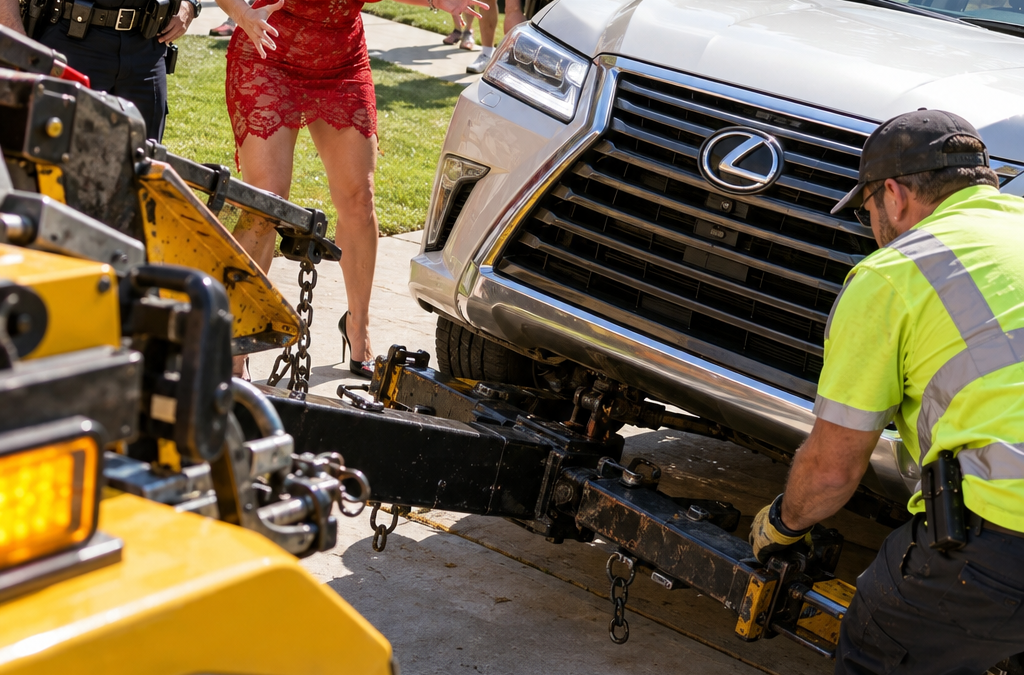
The tow truck arrived a short time later.
Its amber lights flashed against the brick houses as it rounded the cul-de-sac.
I heard Carla say something from across the street.
A garage door opened.
Another neighbor stepped onto his porch.
Within minutes, the quiet court looked like the scene of some small suburban emergency.
Diane stood beside her Lexus as the tow truck driver got out.
“What do you think you’re doing?” she demanded.
The driver looked toward the officer.
The officer explained the tow authorization.
Diane stepped in front of her vehicle.
“No. Absolutely not. I will sue every single person involved.”
“Ma’am,” the officer said, “please move out of the operator’s way.”
She didn’t.
Instead, she turned toward the gathering neighbors.
“Are you all seeing this? Your HOA president is being harassed for protecting community property!”
Nobody came to her defense.
Carla stood with her arms folded.
One neighbor had his phone raised.
Another shook his head.
The silence seemed to enrage Diane more than any argument could have.
“All of you benefit from these rules!” she shouted. “All of you!”
I stood beside my truck holding the binder.
For weeks, I’d pictured confronting her.
I’d imagined delivering some devastating speech that would finally make her understand what she’d done.
But now, with two officers present and the tow truck waiting, I couldn’t find any satisfaction in humiliating her.
I was simply tired.
Tired of her letters.
Tired of her threats.
Tired of waking up wondering whether my own driveway would be usable.
Diane turned toward me.
“Wayne, tell them to stop.”
Her voice had changed.
There was still anger in it, but underneath was something new.
Uncertainty.
I looked at her.
“You had your chance to move it.”
“This is private association business.”
“You made it my business when you started blocking my truck.”
Her jaw tightened.
“You don’t understand what you’re doing.”
I almost smiled.
“I understand exactly what I’m doing.”
She came closer.
“Withdraw the complaint.”
“No.”
“Wayne.”
“No, Diane.”
Her face flushed.
“You think this makes you powerful? You think embarrassing me in front of everyone will change the easement?”
“This isn’t about embarrassing you.”
“Then what is it about?”
I looked at the driveway.
At my truck.
At the house behind me.
At the door I’d spent years working to call my own.
“It’s about being able to come home without wondering what you’re going to take from me next.”
She stared at me.
For one brief moment, I thought she might actually hear it.
Then her expression hardened.
“You should have sold the property when you had the chance.”
The words hit harder than I expected.
Because she hadn’t merely hinted at her motive.
She’d said it aloud.
I kept my voice low.
“This was never about community access, was it?”
She looked away.
I continued.
“Your sister wanted this lot. I bought it. And you’ve been trying to punish me ever since.”
“That’s ridiculous.”
“Then why did you start targeting me?”
“I enforce the rules.”
“You made up a right to my driveway.”
“I did no such thing.”
“You threatened my house.”
“You refused to cooperate.”
“You blocked my work truck.”
She gave a bitter laugh.
“You’re being dramatic.”
I looked her directly in the eyes.
“No. Dramatic is waking up early every morning to park in somebody else’s driveway because you can’t stand being told no.”
For the first time, Diane had no immediate answer.
Behind her, the tow truck operator began positioning the equipment.
Metal scraped against concrete.
Diane spun around.
“Stop!”
The officer stepped forward.
“Ma’am, you need to stand clear.”
She pointed at him.
“This is an abuse of authority!”
“Move back, please.”
Then the driver began securing the Lexus.
And Diane’s face changed.
I watched the color drain from it.
She looked at the tow truck.
Then at the police.
Then at the neighbors recording everything.
Finally, she looked back at me.
“You did this,” she whispered.
I thought about the three months we’d just lived through.
The first violation.
The fifty-dollar fine.
The binder filling with letters.
Carla’s warning.
The forged-looking document.
The sleepless nights.
The fear of losing my home.
“No, Diane,” I said. “You did.”
She opened her mouth.
Nothing came out.
The tow truck operator finished securing the vehicle.
When the flatbed began lifting, Diane stepped backward as though the sight physically hurt.
Her Lexus rose slowly from the driveway.
The vehicle she’d used like a weapon against me was no longer under her control.
She turned toward the officers again.
“I want your badge numbers.”
They provided the information.
“I’ll file complaints.”
The officers remained professional.
“I’ll sue the county.”
Nobody argued.
“I’ll have all of you removed.”
But her threats had lost their power.
For six years, people in Maple Ridge had treated Diane’s anger like something that had to be feared.
Now it was simply noise.
The tow truck driver checked the straps.
The officers completed their work.
And the Lexus left my driveway.
The space it had occupied was suddenly empty.
Just concrete.
Gray, ordinary concrete.
I had never been so relieved to see something so unremarkable.
Carla crossed the street once the officers had finished speaking with me.
She looked down the road where the tow truck had disappeared.
Then she looked at my driveway.
“Well,” she said, “I guess she’s not paying rent after all.”
I laughed.
A real laugh.
The kind that comes out unexpectedly when your body finally releases something it’s been carrying too long.
But the morning wasn’t quite the victory it looked like.
Diane’s vehicle had been removed.
The police incident had been documented.
I’d finally made it clear that she couldn’t occupy my driveway whenever she pleased.
Yet the fraudulent easement was still sitting in the county records.
The potential lien threat hadn’t disappeared.
And Diane was still HOA president.
I knew better than to mistake one satisfying moment for the end of the fight.
That afternoon, I sent the police incident information and the newest video footage to the prosecutor’s office.
Then I went back to work.
I was late for my first appointment, but this time I didn’t have to explain that a neighbor had trapped my truck in the driveway.
I simply told the customer I’d been dealing with a police matter involving unauthorized parking.
The customer was understanding.
I repaired the system.
Collected my tools.
Drove home.
For the first time in weeks, I turned into Maple Ridge Court without seeing Diane’s Lexus waiting near my house.
I parked in my driveway.
Walked inside.
And slept through the night.
The investigation continued.
I answered questions when investigators contacted me.
I supplied original emails, unedited video files, and additional copies of the records.
Pete was contacted regarding his findings.
The recorder’s submission became an important part of the investigation because it provided a specific act, date, and document that could be examined independently of the neighborhood argument.
Meanwhile, word of the towing incident spread throughout Maple Ridge.
I didn’t post about it online.
I didn’t organize some neighborhood campaign against Diane.
I didn’t have to.
Too many people had watched it happen.
The neighbors who’d spent years quietly accepting Diane’s decisions began asking questions of their own.
According to Carla, several homeowners requested information about the association’s enforcement practices.
People wanted to know what authority Diane actually possessed.
They wanted to understand why she had claimed community rights over a private driveway without producing reliable documentation.
They wanted to know whether the board had authorized what she’d done.
Most of all, they wanted to know whether the same thing could happen to them.
That was the question Diane couldn’t answer with her usual smile.
A week after the towing, Carla knocked on my front door.
I invited her inside.
She declined coffee and sat at the kitchen table with an expression that told me she had news.
“The board is in trouble,” she said.
I sat across from her.
“How much trouble?”
“They’re trying to figure out who approved the easement.”
I looked at her.
“And?”
“And apparently nobody wants to admit they did.”
I felt a strange mixture of anger and relief.
“Funny how that works.”
Carla nodded.
“They’re realizing this isn’t something they can just call a misunderstanding.”
She glanced at the binder sitting on the counter.
“You kept everything.”
“Every last piece.”
“Good.”
She hesitated.
“Wayne, I need to tell you something.”
“What?”
“Some of the neighbors feel terrible about how they treated you.”
I frowned.
“They didn’t do anything.”
“Exactly.”
I didn’t answer.
Carla looked down at her hands.
“We watched her go after you. We knew it wasn’t right. But nobody wanted to get involved.”
I thought about the times I’d stood in my driveway while Diane blocked my truck.
The curtains moving.
The neighbors pretending not to see.
The uncomfortable greetings afterward.
I had been angry about that, too.
Not as angry as I was with Diane.
But enough to feel alone.
Carla continued.
“People were afraid she’d start doing the same thing to them.”
I nodded slowly.
“I know.”
“That doesn’t make it okay.”
“No.”
She looked up.
“I’m sorry.”
I didn’t know what to say.
Finally, I shrugged.
“You warned me when nobody else would.”
“I should’ve done more.”
“Maybe. But you did something.”
For a while, we sat quietly.
Then she smiled.
“I still think you should’ve charged her parking fees.”
I laughed again.
It felt good.
A few weeks after the tow, the investigation reached the point where formal action was taken.
Diane Whitfield was charged in connection with recording the fraudulent instrument.
The allegation was serious.
It wasn’t a parking dispute.
It wasn’t a disagreement about trash cans or mailbox height.
It concerned a document submitted to an official county recording system that investigators believed had been falsely represented as a historic grant of property rights.
I understood that being charged wasn’t the same as being convicted.
The criminal process still had to run its course.
But the fact that authorities had reached that point meant the matter was no longer something Diane could bury under an HOA agenda.
Her authority as president couldn’t make the investigation disappear.
Neither could her red dress, her rehearsed smile, or the confident way she’d been ordering people around for years.
The association’s remaining board members held an emergency meeting.
I attended.
So did Carla.
This time, the community room was crowded.
Neighbors stood along the walls because the folding chairs were full.
There was no casual conversation when Diane arrived.
She was wearing the same fitted red lace dress.
Her hair was styled as perfectly as ever.
Her makeup was immaculate.
But the confidence that had once filled the room ahead of her seemed forced now.
She walked to the front table.
For a moment, I wondered whether she’d simply take her usual seat and attempt to run the meeting.
She didn’t get the chance.
One of the other board members opened the proceedings and explained that the board would address Diane’s conduct and leadership position.
Diane objected immediately.
“This meeting is procedurally improper.”
The board member continued.
“The association has received information concerning the recorded easement instrument and the resulting criminal charge.”
“An allegation,” Diane snapped.
“Yes,” he replied. “And we will distinguish allegations from findings. But we also have association records and documented conduct to address.”
She looked around the room.
“This is a coordinated attack against me.”
Nobody responded.
Then the board reviewed what had happened.
The property dispute.
The threats of enforcement.
The document Diane had presented as historic.
The later county recording.
The questions about whether she’d acted with proper board authorization.
I sat quietly through it.
At one point, Diane stood and pointed toward me.
“He has been hostile since the day he moved here!”
Every head in the room turned.
I felt heat creep into my face.
The board member asked her to sit down.
She ignored him.
“He has challenged every reasonable regulation. He has undermined this association. He had my vehicle towed!”
I rose slowly.
I hadn’t intended to speak.
But after three months of being described as the problem, I couldn’t sit there and let her rewrite everything again.
“Diane.”
She turned.
“You bought the property my sister wanted,” she snapped.
The room went still.
She seemed to realize what she’d said.
Then she tried to recover.
“That has nothing to do with this.”
I looked at her.
“It has everything to do with why you started.”
She shook her head.
“You’re twisting my words.”
“No. I’m finally asking you to listen to them.”
I took a breath.
“I fixed the mailbox. I paid the trash fine. I answered your letters. I followed the rules even when you made them ridiculous.”
She opened her mouth.
I continued.
“When you claimed my driveway belonged to the community, I asked for documentation. You threatened my home. When I challenged the document, you blocked my truck. When I kept asking questions, a document appeared in the county records.”
Diane’s expression grew harder with every sentence.
I looked around the room.
“I’m not asking this association to give me special treatment. I’m asking it to recognize that my house belongs to me, and I shouldn’t have to fight the HOA president for the right to use my own driveway.”
Nobody moved.
Then I looked directly at Diane.
“You could have stopped after the first letter.”
Her jaw tightened.
“You could have stopped after I showed you the deed. You could have stopped before you threatened a lien. You could have stopped before you parked that Lexus across my driveway.”
She looked away.
“But every time you had a choice, you decided that being in charge mattered more than being right.”
I sat down.
My hands were shaking beneath the table.
I hadn’t realized how much anger I’d been holding until I heard my own voice.
The board continued.
Diane attempted to challenge the process, criticized the other members, and insisted she was being punished for enforcing community standards.
But the questions kept returning to the same facts.
What authority had she relied on?
Who had approved the easement claim?
Where was the authenticated historic document?
Why had enforcement continued despite the unanswered questions?
She didn’t provide satisfactory answers.
When the board voted on removing her from the presidency and her board position, every other member voted against her.
Unanimously.
Diane sat absolutely still.
For several seconds, she looked as though she couldn’t believe what had happened.
Then she gathered her folder.
“This association is going to regret this,” she said.
Nobody answered.
She left the room.
Her heels clicked against the floor, the sound growing fainter as she moved down the hallway.
The door closed behind her.
And for the first time since I’d moved into Maple Ridge, a board meeting continued without Diane Whitfield controlling every word.
I didn’t celebrate.
I didn’t clap.
I didn’t feel like shouting.
I just sat there looking at the empty chair.
It was strange how ordinary it looked.
For six years, that chair had apparently been the center of so much fear and resentment.
Now it was furniture.
Nothing more.
The remaining board members began reviewing the HOA’s enforcement procedures.
They also addressed the actions taken against my property.
A few days later, I received a formal written apology from the association.
The letter acknowledged that the dispute had been mishandled and that I had been subjected to improper actions concerning my driveway.
It confirmed that the association would not continue asserting the disputed easement rights against me and would address the unsupported enforcement notices connected to the matter.
I read the apology at my kitchen table.
Then I read it again.
For three months, I’d received letters telling me I was wrong.
Letters demanding compliance.
Letters threatening punishment.
This was the first letter from Maple Ridge admitting that the problem hadn’t been me.
I placed it in the binder.
Not because I intended to keep fighting.
Because I wanted to remember that the written record could finally reflect the truth.
The property-record issue required additional attention.
A fraudulent instrument doesn’t simply evaporate because the person who filed it loses an HOA position.
The county and appropriate legal authorities had to address the disputed recording through the proper process.
Eventually, the false easement was nullified, and the resulting title records confirmed that the claimed community access right did not burden my driveway.
My private property rights were intact.
The recorded claim Diane had used to frighten me was no longer hanging over my home.
When I received the documentation confirming that outcome, I stood in the kitchen holding it for a long time.
I’d expected to feel victorious.
Instead, I felt exhausted.
Then relieved.
Then, unexpectedly, sad.
Not for Diane.
For the time I’d lost.
For the mornings when I’d opened the curtains with a knot in my stomach.
For the evenings when I’d been too distracted to finish work properly.
For the way I’d started listening for tires on concrete outside my window.
For the fact that someone with a volunteer title and a personal grudge had managed to make me feel unsafe in the house I’d spent most of my adult life trying to own.
I sat down.
Looked at the clean title documentation.
And let myself breathe.
The criminal case against Diane remained a separate matter.
I didn’t control that process, and I wasn’t interested in pretending I did.
She had been charged, and the authorities would determine the legal consequences according to the evidence and the law.
What mattered to me was that her position no longer insulated her from accountability.
She couldn’t silence questions by adjourning a meeting.
She couldn’t manufacture authority by signing another notice.
And she couldn’t use my driveway to demonstrate control over a neighborhood that had finally stopped treating her word as law.
Carla came by not long after the property records were corrected.
She found me outside washing my truck.
“How’s the kingdom?” she asked.
I looked up.
“What kingdom?”
She waved toward the driveway.
“Your magnificent empire of concrete.”
I laughed.
“Still standing.”
“No royal decrees this morning?”
“Not a one.”
She walked closer and glanced at the open garage.
“You look better.”
“Sleeping helps.”
She nodded.
“I heard the title issue’s resolved.”
“Finally.”
“Good.”
We stood together for a moment, watching two kids ride bicycles around the cul-de-sac.
Everything looked ordinary.
The lawns were still green.
The mailboxes stood in their usual places.
Somebody was trimming hedges.
A delivery truck rolled past and disappeared around the bend.
It was the same neighborhood I’d moved into.
But something had changed.
People weren’t whispering about Diane anymore.
They were discussing board elections, maintenance budgets, and whether certain fines had ever been necessary.
For years, Maple Ridge had confused keeping the peace with keeping quiet.
Now the neighbors were beginning to understand the difference.
Carla looked at me.
“You ever think about moving?”
I considered the question.
There had been nights when I’d seriously thought about it.
I’d imagined putting the house on the market, packing my tools, and finding somewhere without an HOA.
Somewhere I could park a truck and leave a trash can by the curb without wondering whether somebody was timing me.
But then I looked at the garage I’d organized myself.
The porch I’d repaired.
The small maple tree I’d planted near the front lawn.
The driveway I’d spent months defending.
“No,” I said.
Carla smiled.
“Good.”
“I bought this place because I wanted to stay.”
“And?”
I looked toward the house.
“And I’m staying.”
She gave me a satisfied nod.
“That’s what I wanted to hear.”
After she went home, I finished washing the truck.
I coiled the hose.
Put everything away.
Then I stood for a moment at the end of the driveway.
I could see the spot where Diane used to park her Lexus.
There was nothing special about it.
No sign.
No barrier.
No warning painted on the concrete.
Just a driveway leading from the street to my garage.
The same driveway shown on my deed.
The same driveway I’d paid for.
The same driveway someone had tried to turn into a tool for taking control of my home.
I thought back to that first morning when Diane had blocked me.
How she’d lowered the window and smiled.
How she’d told me I was making an expensive mistake.
How she’d expected me to get tired enough to surrender.
And I realized something.
She hadn’t misunderstood my property rights.
She’d counted on me being too intimidated, too busy, or too financially vulnerable to defend them.
When the mailbox letter came, she expected compliance.
When the garbage fine arrived, she expected payment.
When the easement claim appeared, she expected surrender.
Every time I tried to resolve the problem peacefully, she raised the cost of resisting.
She’d mistaken my willingness to cooperate for weakness.
And when cooperation stopped working, she tried coercion.
That was her real mistake.
Because I might not know much about running an HOA, but I know how to solve a problem.
You identify what’s wrong.
You collect evidence.
You check the assumptions.
And when somebody tells you something is true, you don’t accept it merely because they say it confidently.
You verify it.
That’s how I fix air conditioners.
As it turned out, it was also how I protected my home.
I still live on Maple Ridge Court.
I still wake up early, drink coffee that’s usually too strong, and drive a pickup full of tools to houses where somebody’s air conditioner has stopped working.
I still deal with broken compressors, clogged drain lines, and customers who are convinced their thermostat is haunted.
My life didn’t become glamorous because an HOA president got herself in trouble.
I didn’t get rich.
I didn’t become famous.
I didn’t suddenly turn into the kind of man who enjoys fighting with neighbors.
If anything, the experience taught me how much I value ordinary days when nothing happens.
A quiet breakfast.
A truck that starts on the first turn of the key.
A customer happy to have cold air again.
A front door I can walk through without feeling threatened.
Those things might sound small.
They aren’t.
Not when you’ve spent months wondering whether somebody with enough determination and a title can take them away.
There’s still an HOA in Maple Ridge.
There are still rules.
And I still follow the reasonable ones.
I keep my lawn trimmed.
I bring in my trash cans.
My mailbox is still the correct height.
But nobody sends me threatening letters because my work truck is parked on my own driveway.
Nobody claims the concrete in front of my garage belongs to the neighborhood.
And nobody wakes up before dawn to trap me inside my property.
I keep the binder in a cabinet beside my closing documents.
Every now and then, when I’m looking for a warranty or an old receipt, I’ll see its thick spine and remember how much effort it took to make someone acknowledge something that should never have been disputed.
I’ve thought about throwing it away.
I probably never will.
It’s a reminder of what happens when you stop asking questions because someone in authority tells you to.
It’s also a reminder that standing up for yourself doesn’t always feel heroic.
Sometimes it feels miserable.
Sometimes it’s sitting alone at a kitchen table, wondering whether you can afford another week of conflict.
Sometimes it’s going to work angry and tired while the person causing the trouble seems perfectly comfortable.
Sometimes it’s resisting the temptation to do something foolish because you know that losing your temper would hand your opponent exactly what she wants.
And sometimes, after all that, justice looks surprisingly simple.
A certified document.
A police report.
A board vote.
An apology.
A clean title.
An empty driveway.
One morning, several weeks after everything had settled, I stepped outside just after sunrise.
The air was cool.
The street was quiet.
A light breeze moved through the maple trees along the cul-de-sac.
I carried my travel mug down the porch steps and walked toward my truck.
Halfway there, I stopped.
Not because anything was wrong.
Because nothing was.
There was no white Lexus.
No angry woman in a red lace dress.
No argument waiting beside my garage.
No one demanding access to something that belonged to me.
Just the soft morning light stretching across the concrete.
I stood there for a few seconds, taking it in.
Then I climbed into my truck.
Started the engine.
Backed down my driveway.
And drove to work.
I didn’t check my rearview mirror to see whether Diane was coming.
I didn’t worry about whether I’d be able to return home.
I didn’t think about the HOA at all.
And after everything she’d put me through, that was the ending I wanted most.
Not revenge.
Not applause.
Just the freedom to live in my own home without asking permission from someone who had never owned it.








