𝗙𝗨𝗟𝗟 𝗦𝗧𝗢𝗥𝗬 The HOA President Chained Me Out of My Own Farmhouse—Then the County Map Exposed the One Thing She Never Expected Me to Check
𝗙𝗨𝗟𝗟 𝗦𝗧𝗢𝗥𝗬
Boundary compliance.
That phrase should have bothered me more than it did.
At the time, I simply thanked her and hung up.
The following afternoon, Karen appeared at my property.
Not alone.
She brought two HOA security guards with her.
I watched them turn into my driveway from the front porch.
Karen arrived first in a white SUV.
A dark utility vehicle followed with the Cedar Ridge logo printed on both doors.
Two men in gray uniforms climbed out.
Neither was a police officer.
But judging from the belts, radios, dark glasses, and expressions, Karen clearly wanted them to look official.
Then she stepped out.
She was about forty and undeniably beautiful, with long blonde hair, carefully styled makeup, bright eyes, and the kind of exaggerated self-confidence that made it obvious she expected people to notice her.
She wore a fitted red lace dress.
Low neckline.
High heels.
Gold bracelet.
The dress emphasized her dramatic curves and very full chest, and she carried herself with the flirtatious confidence of someone who had learned long ago that charm could open doors before intimidation finished the job.
One guard stepped forward to open her passenger door.
Karen thanked him with a smile and brushed two fingers across his arm.
Then she looked at me.
The warmth disappeared.
“You must be our new homeowner.”
I stayed on the porch.
“No.”
She blinked.
“No?”
“I’m the new owner of this property. I’m not an HOA homeowner.”
She gave a soft laugh.
“Oh, honey.”
That single word told me almost everything I needed to know about her.
“I think you’ve misunderstood your purchase documents.”
“I don’t think I have.”
Karen came closer.
The guards followed.
I stood.
“What exactly are they doing here?”
Karen glanced behind her as if she’d forgotten they existed.
“Security.”
“For what?”
“Sometimes new residents become emotional when we’re explaining compliance.”
I stared at her.
“You brought security guards because I said I wasn’t part of your HOA?”
Her smile widened.
“I brought witnesses.”
One of the guards shifted slightly.
I couldn’t tell whether he was embarrassed or bored.
Karen held a folder against her waist.
“Your property is within the Cedar Ridge community area.”
“Show me.”
“Excuse me?”
“Show me the recorded document requiring membership.”
She tilted her head.
“The neighborhood map is very clear.”
“That’s not what I asked.”
“It’s sufficient.”
“No.”
For the first time, her expression hardened.
I went inside, retrieved my closing folder, and came back with a copy of the recorded deed.
“This is sufficient.”
I opened it.
“Legal description. Parcel number. Recorded boundaries.”
Karen barely looked.
I pointed.
“Where is the HOA covenant?”
“You think every obligation has to be printed directly on your deed?”
“I think if you’re claiming mandatory membership, you should be able to identify the recorded restriction that creates it.”
One of the guards looked toward Karen.
She noticed.
Her tone sharpened.
“Your driveway connects to a road serving Cedar Ridge.”
“So?”
“So you benefit from our infrastructure.”
“That doesn’t make me a member.”
“It gives us jurisdiction.”
“Show me the document.”
Karen stepped closer.
Her perfume reached me before she did.
Expensive.
Floral.
Overpowering.
She lowered her voice.
“I don’t think you understand how things work here.”
“Then explain it.”
“Cedar Ridge has maintained standards in this area for years. We don’t allow people to buy on the perimeter and suddenly decide they’re independent.”
“I didn’t decide anything. My recorded deed did.”
Her smile became cold.
“You’re being combative.”
“I’m asking for proof.”
“You’re questioning the association president on your first week here.”
“Yes.”
She blinked.
Apparently that answer hadn’t occurred to her.
I continued.
“If my property is legally obligated to join your HOA, provide the recorded instrument. If it isn’t, stop contacting me.”
One guard cleared his throat.
Karen glanced at him.
Then back at me.
Her voice dropped.
“You should think carefully before creating problems with the people around you.”
I felt something tighten in my stomach.
“Is that a threat?”
“It’s advice.”
“You brought two guards onto my driveway.”
“For my safety.”
“Nobody invited you onto my property.”
Karen’s jaw tightened.
“You’re going to discover that this neighborhood can become very uncomfortable for people who refuse to cooperate.”
There it was.
Direct enough that nobody could pretend later.
I looked at the guards.
“Did both of you hear that?”
One stared at the ground.
The other looked away.
Karen’s cheeks flushed.
“We’re done here.”
I nodded.
“Good.”
She turned.
Then stopped halfway to the SUV.
“One last thing.”
I waited.
“You have forty-eight hours to acknowledge HOA authority before formal enforcement begins.”
I laughed.
I couldn’t help it.
Karen turned slowly.
“You think this is funny?”
“I think you haven’t shown me a single legal document.”
“Keep laughing.”
She got into her SUV.
The guards followed.
I watched them drive away.
For the first time since I’d bought the farmhouse, the silence after they left didn’t feel peaceful.
It felt like the pause before something.
I spent that evening going through my closing documents again.
The deed.
Title report.
Survey materials.
Property tax information.
I looked for Cedar Ridge.
Nothing.
No covenant.
No mandatory dues.
No HOA declaration.
No membership obligation.
No recorded restriction incorporating my parcel into the association.
I slept badly.
Not because I thought Karen was right.
Because she had seemed so certain.
People like Karen use certainty like a weapon.
They don’t need evidence if they can make you afraid that you’re the only person who doesn’t understand the rules.
I started wondering whether I had missed something.
Maybe there was an old easement.
Maybe a supplemental declaration hadn’t been included.
Maybe the title office had overlooked something.
By midnight, I had reread the same paragraph six times.
Finally, I forced myself to stop.
“I own the property,” I said aloud.
The empty kitchen didn’t answer.
The next morning, I learned exactly how far Karen was willing to go.
I was heading out just after seven.
I had a stack of errands to run and still needed basic supplies for the farmhouse.
I drove down the gravel lane toward my gate.
Then I stopped.
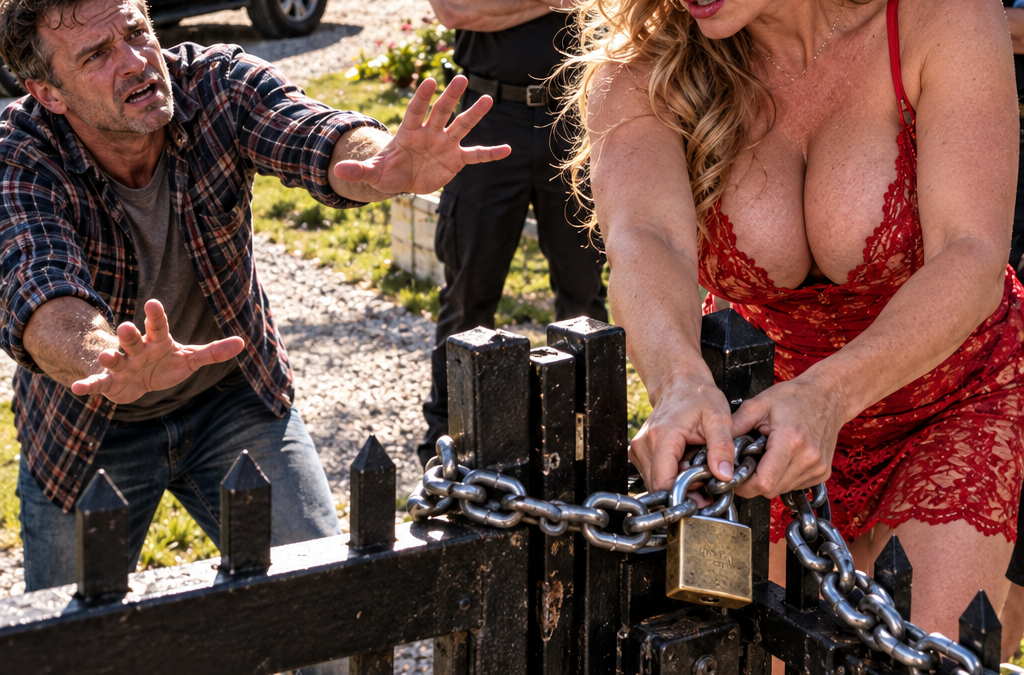
A heavy steel chain had been wrapped around it.
A new padlock connected the two sides.
For several seconds, my brain refused to process what I was seeing.
I got out.
Walked closer.
Touched the chain.
It wasn’t mine.
Someone had physically locked me inside my own property.
I felt heat climb up my neck.
Then tires crunched on the road.
Karen’s white SUV appeared.
The HOA security vehicle followed.
She had timed it.
There was no other explanation.
She knew I’d find the gate.
She wanted to be there when I did.
Karen stepped out wearing the same red lace dress, sunglasses pushed into her hair.
The two guards positioned themselves near the gate.
She smiled.
“Good morning.”
I held up the chain.
“Take this off.”
“You don’t have authorization to use the access point.”
I stared at her.
“My driveway?”
“HOA-controlled access.”
“This gate is on my property.”
“That’s disputed.”
“No. You decided to dispute it.”
She folded her arms.
“Until you acknowledge Cedar Ridge authority, access is suspended.”
One of the guards shifted his weight.
I looked at him.
“Did you put this chain here?”
He glanced toward Karen.
She answered for him.
“The association did.”
I turned back to her.
“Remove it.”
“No.”
My pulse thudded in my ears.
“You have locked me inside my own land.”
Karen smiled.
“You are currently occupying property subject to Cedar Ridge access control.”
“Occupying?”
“You haven’t completed membership authorization.”
“I don’t need membership authorization to enter my own house.”
She stepped closer to the gate.
“Technically, if you continue using association-controlled property after being told not to, you’re trespassing.”
I actually laughed.
Once.
Short.
Disbelieving.
“You’re accusing me of trespassing at my own gate.”
“The gate falls within our control corridor.”
“Show me the easement.”
She held up her clipboard.
“This is not a courtroom.”
“No. Which means you don’t get to invent ownership because you brought two guys in uniforms.”
One guard stiffened.
Karen’s eyes narrowed.
“You are making a serious mistake.”
“And you’re chaining private property without documentation.”
“I’ve tried being polite with you.”
I stared at her.
“This is polite?”
“I gave you an opportunity to cooperate.”
“By threatening me.”
“By educating you.”
“No.”
Her smile vanished completely.
“Let me make something very clear.”
She moved closer until the chain separated us.
“This association has lawyers. We have enforcement procedures. We have financial reserves. You are one property owner who arrived here less than a week ago.”
There was pure contempt in her voice.
“You can make this simple, or you can make it expensive.”
I felt fear.
Real fear.
Not because Karen had proven anything.
Because she was telling me exactly how she intended to win.
Not with law.
With attrition.
Money.
Time.
Stress.
She wanted me to surrender because defending myself would become more painful than joining.
For a moment, I imagined the next six months.
Attorney bills.
Letters.
Hearings.
Fines.
Maybe liens.
I had just spent nearly everything buying the property.
Karen knew new homeowners were financially exposed.
Maybe that was why she’d moved so quickly.
I took my phone out.
Karen smirked.
“Calling your lawyer?”
“No.”
I stepped away from the gate.
“I’m calling the county.”
Her smile faltered slightly.
“For what?”
“To find out exactly where my property begins.”
“Your county paperwork doesn’t override Cedar Ridge governance.”
“We’ll see.”
I didn’t argue with the guards.
I didn’t touch the chain.
I didn’t give Karen the confrontation she clearly wanted.
I called the county property records office.
It took several transfers before I reached someone who could pull the parcel map.
I gave the parcel number.
Waited.
Then the woman on the phone asked me to confirm the road name.
I did.
More typing.
Finally, she said, “Your tract is separate from the Cedar Ridge subdivision.”
I looked toward Karen.
She was talking quietly with one of the guards.
“Separate how?”
“Different recorded parcel. The subdivision boundary appears to stop before the beginning of your driveway.”
My heart started beating faster.
“Can you send me the official parcel map?”
“Yes.”
“Does the HOA boundary include my gate?”
“Based on the county map I’m viewing, no.”
I closed my eyes.
For the first time since Karen arrived, I felt the ground beneath me again.
Independent documentation.
Not my opinion.
Not her map.
The county record.
I wrote down everything.
Then asked where I could obtain certified copies.
Karen watched me finish the call.
“Well?”
I put the phone away.
“The county says your neighborhood ends before my driveway begins.”
She laughed immediately.
“County clerks don’t interpret HOA jurisdiction.”
“They interpret county parcel maps.”
“Those maps are often outdated.”
“Then why don’t you show me the current recorded document?”
Her face tightened.
“You’re wasting everyone’s time.”
I pointed at the chain.
“You’re the one who locked a gate that the county says is inside my parcel.”
Karen shrugged.
“We’ll let the lawyers sort it out.”
“Take the chain off.”
“No.”
She walked back toward her SUV.
I called after her.
“Karen.”
She stopped.
“If the county map confirms this gate is mine, you’ve crossed a line.”
She looked over her shoulder.
“Then prove it.”
That sentence became my entire strategy.
I did.
I drove to the county office using another access route across the rear portion of the property that connected with an older farm lane.
It took longer.
I almost got stuck in mud.
But I made it.
I obtained copies of the official parcel map.
The lines were unmistakable.
Cedar Ridge ended before my driveway.
My parcel was a separate tract.
My gate sat inside it.
I returned to the property that afternoon.
Karen wasn’t there.
The chain remained.
I photographed it from every angle.
Then I emailed the county documents to the HOA.
Karen responded within twenty-three minutes.
County mapping does not determine private association jurisdiction.
I almost admired the audacity.
Almost.
I called her.
She answered immediately.
“Did you get the parcel map?”
“Yes.”
“And?”
“It’s irrelevant.”
“How?”
“Your property connects to a road tied to Cedar Ridge.”
“Using a road isn’t the same as owning my gate.”
“We maintain infrastructure benefiting your tract.”
“Which infrastructure?”
“The access road.”
“Who owns it?”
A pause.
“The association maintains it.”
“That wasn’t my question.”
Karen’s voice became sharp.
“You’re becoming exhausting.”
I laughed.
“Karen, you chained my gate.”
“Because you continue refusing legitimate authority.”
“Show me the easement.”
“You keep repeating yourself.”
“Because you keep avoiding the answer.”
She lowered her voice.
“You don’t understand what you’re doing.”
“I understand exactly what I’m doing. I’m asking for recorded documents.”
“And when we send them?”
“I’ll read them.”
“And if they prove you’re wrong?”
“I’ll deal with that.”
Karen gave a small laugh.
“No. You’ll pay every dollar we’ve spent dealing with this nonsense.”
There it was.
Another threat.
“Send the documents.”
She hung up.
I called the title company next.
The title specialist who handled the closing agreed to review everything again.
I sent her the HOA letter.
The county parcel map.
Photographs of the chained gate.
She was quiet when she called back.
“I’ve reviewed the deed and title records again.”
“And?”
“I don’t see a recorded declaration placing your parcel inside Cedar Ridge.”
“What about an easement?”
“There are road-use documents in the general area, but I don’t see anything conveying ownership of your private gate to the HOA.”
I sat down.
“Could they have authority just because my driveway connects to a road they maintain?”
“Road use and property ownership are different issues.”
That sentence mattered.
Road use.
Property ownership.
Karen had deliberately blurred the two.
She was taking whatever access rights might exist around the road and stretching them until they became imaginary control over my land.
“Can you put your findings in writing?”
“Yes.”
The written title review arrived the next day.
No HOA ownership of the gate.
No recorded mandatory membership obligation found against my parcel.
No document transferring my property into Cedar Ridge.
I printed three copies.
Then I hired a licensed surveyor.
By then, I wasn’t taking chances.
Karen had demonstrated that every time one piece of evidence contradicted her, she’d simply invent a different explanation.
First, the neighborhood map.
Then community service area.
Then road access.
I wanted pins in the ground.
Measurements.
Professional verification.
The surveyor arrived early Monday morning.
Karen’s chain was still on the gate.
He stood beside it for several seconds.
“Who installed this?”
“The HOA.”
“Why?”
“They say the gate is under their control.”
He looked at the chain.
Then at me.
“Do they have a survey?”
“Not one they’ve shown me.”
He nodded slowly.
“All right.”
He spent hours measuring.
Recorded monuments.
Property corners.
Distances.
Reference points.
I followed for part of it, then forced myself to stop hovering.
By early afternoon, he called me over.
He pointed toward the gate.
“My measurements put this entirely within your parcel.”
“Entirely?”
“Yes.”
“What about the HOA boundary?”
“Ends before this point according to the recorded documents I’ve reviewed.”
I stared at the gate.
The chain looked different after that.
Not intimidating.
Ridiculous.
Karen had used a physical object to create the illusion of ownership.
The steel hadn’t changed.
The law hadn’t changed.
Only my confidence had.
“Can you certify that?”
“That’s what I’m here for.”
The survey report gave me what Karen had never provided.
Professional measurements tied directly to recorded property descriptions.
I sent it to the HOA.
For an entire day, no answer came.
Then an official notice arrived by certified mail.
It accused me of refusing to comply with community regulations and interfering with association access.
The language was aggressive.
Legalistic.
Full of references to governing documents.
At first glance, it looked frightening.
Then I did something Karen probably didn’t expect.
I checked every citation.
Several referenced Cedar Ridge declarations.
My parcel wasn’t listed.
Another referenced an access provision concerning association-owned infrastructure.
My gate wasn’t association-owned.
A third cited a community map.
The county map contradicted it.
The more carefully I read, the weaker the notice became.
It was written to intimidate someone who would never check.
I checked.
I started a binder.
Deed.
County map.
Title review.
Survey.
Closing documents.
HOA letters.
Photographs.
Emails.
A timeline.
I noted every time Karen changed her explanation.
First claim: neighborhood map.
Second claim: service area.
Third claim: road connection.
Fourth claim: HOA-controlled access.
Each new theory appeared after the previous one failed.
I also documented the threats.
The neighborhood can become very uncomfortable.
You can make this simple or expensive.
The more evidence I collected, the clearer the pattern became.
Karen didn’t have one strong legal argument.
She had a series of increasingly desperate assertions designed to keep me off balance.
Then she escalated again.
I was inside the farmhouse one afternoon when I heard an engine.
Karen’s SUV.
The security vehicle.
Again.
I walked outside.
Karen stepped onto the driveway without invitation.
The red lace dress was brighter in the afternoon sunlight.
One guard stayed near the gate.
The other followed her halfway toward the house.
“What now?”
Karen smiled.
“We’ve received reports of unauthorized activity.”
“From whom?”
“Community sources.”
“I don’t live in your community.”
“You continue using an association-adjacent access corridor.”
“My deed, county map, title specialist, and licensed surveyor all disagree with you.”
Karen waved one manicured hand.
“You’ve hired people to tell you what you want to hear.”
“The county?”
“County records are not infallible.”
“The surveyor?”
“Surveyors interpret documents.”
“The title company?”
“They protect transactions.”
“So everyone except you is wrong?”
Her expression hardened.
“Don’t be cute.”
“I’m not.”
I held up the binder.
“I’m giving you one more chance. Show me the recorded document.”
Karen looked toward the guard beside her.
Then back at me.
“The board will issue a final determination.”
“No.”
Her eyebrows rose.
“No?”
“The board doesn’t determine property ownership.”
“You really think you can lecture me on jurisdiction?”
“Yes.”
Karen stepped closer.
“You’re a new owner.”
“So?”
“You don’t know this area.”
“I know where my boundary is.”
“I’ve run this association for seven years.”
“That doesn’t move my property line.”
Her jaw tightened.
“People like you always come in thinking ownership means you can ignore community expectations.”
“People like me?”
“Outsiders.”
There it was.
Not law.
Territory.
Karen saw Cedar Ridge as hers.
My farmhouse existed beside her neighborhood, therefore she believed it should answer to her.
“This property existed before half your subdivision.”
“Which is exactly why it’s become a problem.”
I stared at her.
“What does that mean?”
Karen caught herself.
“Nothing.”
“No. Say it again.”
“I said your property creates inconsistencies.”
“Inconsistencies?”
“Different standards. Different appearance. Different expectations.”
“So you want control because my property doesn’t look like the subdivision.”
“I want uniformity.”
“Then buy a painting.”
One of the guards covered a cough that sounded suspiciously like a laugh.
Karen heard it.
Her face flushed.
She turned toward him.
“If this isn’t serious to you, you can leave.”
The guard immediately straightened.
Karen looked back at me.
“Enjoy your little performance.”
She began walking away.
I called after her.
“The chain comes off.”
She stopped.
“No.”
“I have a certified survey now.”
“The board hasn’t reviewed it.”
“I don’t need your board’s permission to enter my property.”
Karen turned.
“If you cut that chain, we will treat it as destruction of HOA property.”
“You put it on my gate.”
“The chain belongs to the association.”
“Then remove your property from mine.”
Her eyes narrowed.
“Clever.”
“No. Simple.”
Karen got into the SUV.
As they drove away, I realized something that made the situation even more disturbing.
She hadn’t denied the survey.
She’d stopped arguing about where the boundary actually was.
Now she was relying entirely on her authority as president.
The facts were moving against her, so she was trying to make the fight about obedience.
That night, I barely slept.
I kept thinking about the chain.
I could cut it.
Legally, I felt certain I had the right.
But I didn’t want to give Karen anything she could twist into another allegation.
So I documented.
Photographs.
Video.
A written demand that the HOA remove its chain from my gate.
I gave them a deadline.
The board finally agreed to meet.
The email came from the board secretary, not Karen.
That mattered.
Special boundary review meeting.
Karen responded separately.
I trust you will attend with an appropriate willingness to resolve your violations.
I read the sentence aloud.
Then laughed.
She still thought the meeting was about whether I would submit.
I prepared differently.
I made copies for every board member.
Deed.
County parcel map.
Title review.
Certified survey.
The HOA notice.
A photograph of the chain.
A written timeline.
I highlighted the boundary references.
Marked every recorded instrument number.
Made it impossible for anyone to claim confusion.
The meeting took place in the Cedar Ridge clubhouse.
I arrived early.
Karen was already there.
Red lace dress.
Perfect hair.
Perfect makeup.
A legal pad in front of her.
The two security guards stood near the rear doors.
Completely unnecessary.
Completely theatrical.
Karen smiled when I walked in.
“Glad you came.”
“I wouldn’t miss it.”
She glanced at my binder.
“You’ve certainly been busy.”
“So have you.”
Her smile tightened.
Board members began arriving.
Five besides Karen.
Most looked uncomfortable.
I realized then that some might never have seen the actual evidence.
Karen controlled communication.
Karen issued notices.
Karen interpreted documents.
Karen probably told the board I was a belligerent outsider refusing obvious obligations.
The meeting opened.
Karen spoke first.
Of course.
She described the matter as a “routine compliance dispute complicated by an uncooperative property owner.”
I sat silently.
She continued.
“The property benefits from Cedar Ridge infrastructure and has historically been understood as part of our community service zone.”
Historically understood.
Another phrase with no document behind it.
Karen looked at me.
“We’ve offered numerous opportunities for voluntary compliance.”
One board member asked, “Is the property listed in the declaration?”
Karen paused.
“We have broader authority through connected access.”
The member frowned.
“So is it listed?”
Karen’s tone sharpened.
“The issue is more complicated than a single list.”
I almost smiled.
The board member looked toward me.
“Do you have documents?”
“Yes.”
I stood.
Karen interrupted.
“Before we turn this into a courtroom, I’d like to remind everyone—”
The secretary cut in.
“Karen, let her present.”
That silence that followed was tiny.
But important.
Karen sat back.
I placed the deed on the table.
“This is my recorded deed.”
I handed out copies.
“Here is the legal description.”
Then the county parcel map.
“This is the county’s official map. Cedar Ridge ends before my driveway.”
Karen scoffed.
“Again, county maps don’t determine—”
Another board member held up a hand.
“Let her finish.”
Karen stared at him.
I continued.
“This is the title review. No recorded HOA declaration requiring membership against my parcel. No document granting Cedar Ridge ownership of my private gate.”
Then the survey.
“This is a licensed surveyor’s certified boundary determination.”
The room became quieter.
The secretary connected the survey file to the projector.
The map filled the screen.
Colored boundary lines.
Parcel numbers.
Measurements.
Road.
Driveway.
Gate.
Farmhouse.
Cedar Ridge subdivision.
Separate.
Clear.
Nobody needed legal training to see it.
My property wasn’t inside the HOA boundary.
The subdivision ended before my driveway began.
My gate sat inside my parcel.
One board member leaned toward the screen.
“Karen.”
She didn’t answer.
He pointed.
“That’s not inside Cedar Ridge.”
Karen crossed her arms.
“The road creates association jurisdiction.”
The board member looked at me.
“Do you have the road documents?”
I handed him the title specialist’s review.
“Any road-use interest is separate from ownership of my gate and parcel.”
He read.
Then passed it to the next member.
Karen’s voice rose.
“This homeowner is deliberately cherry-picking documents.”
I looked at her.
“Then show yours.”
She froze.
“I have.”
“No.”
I pointed toward the table.
“You’ve shown letters your office wrote. You’ve shown an internal neighborhood map. You have not shown a recorded deed restriction, declaration, covenant, annexation document, or easement giving your HOA ownership or control over my gate.”
Karen stood.
“This is becoming hostile.”
I almost laughed.
For weeks, every time evidence cornered her, she called the situation hostile.
I stayed calm.
“You chained me inside my own property.”
“Because you refused access compliance.”
“Based on what recorded authority?”
She slammed her palm on the table.
“Because your driveway connects to our road!”
The room went silent.
Finally.
The actual argument.
Not a declaration.
Not membership.
A road.
I looked at the projected map.
Then at Karen.
“Using a road doesn’t make the association owner of every property that touches it.”
“You’re not an attorney.”
“Neither are you.”
Her cheeks flushed.
One of the board members shifted uncomfortably.
I continued.
“If the HOA has an easement, produce it. If it owns the gate, produce the deed. If my property was annexed into Cedar Ridge, produce the recorded annexation document.”
Karen opened her mouth.
Nothing came out.
For the first time since I met her, Karen Doyle had no new explanation ready.
The board secretary looked at the survey again.
Then at Karen.
“Why was the gate chained?”
Karen snapped, “For enforcement.”
“Of what?”
“Community access rules.”
“But if the gate is inside his parcel—”
“He benefits from Cedar Ridge.”
“That’s not the same thing.”
Karen turned on her.
“I know that.”
The secretary blinked.
“Then why did we claim control?”
Karen’s eyes flicked across the table.
The balance of the room had changed.
She could feel it.
So could I.
She reached for the one weapon she still trusted.
Intimidation.
“This discussion is reckless. If we undermine enforcement every time a property owner throws documents on the table, we will lose control of the perimeter.”
There.
Control.
Not law.
Not ownership.
Control.
A board member near the end spoke carefully.
“Karen, are there other perimeter properties we’re enforcing against that aren’t actually inside the association?”
Her face went still.
Nobody had asked that before.
“I am not discussing unrelated properties.”
“It doesn’t sound unrelated.”
“It is.”
He leaned back.
“I disagree.”
Karen’s voice sharpened.
“Then perhaps you need to remember why you were appointed.”
The words came out before she could stop them.
The board member stared at her.
“Excuse me?”
Karen realized the mistake.
“I mean elected.”
“No.”
He shook his head.
“You said appointed.”
The secretary looked down at her notes.
The room felt suddenly smaller.
Karen picked up her pen.
“This is getting off topic.”
I almost couldn’t believe what I was watching.
A month earlier, Karen had arrived at my farmhouse with two guards and acted as though her authority was absolute.
Now her own board was questioning not only the boundary dispute but the way she treated them.
I kept the focus where it belonged.
“I am asking for one thing.”
Everyone looked at me.
“Remove the chain.”
Karen laughed bitterly.
“You think that’s all this is about?”
“For me, yes.”
I pointed toward the projected survey.
“My gate. My driveway. My farmhouse.”
Then I looked at her.
“You decided proximity gave you ownership.”
“I decided Cedar Ridge needed consistency.”
“You decided you were entitled to property you don’t own.”
Her eyes flashed.
“Watch yourself.”
“No.”
I leaned forward slightly.
“You’ve been telling me to watch myself since the day you came to my house with security guards.”
One guard at the back looked down.
“You told me the neighborhood could make my life uncomfortable.”
Karen glanced around the room.
“I never said that.”
I took out my phone.
Her expression changed.
I had started recording our interactions after the chained-gate incident.
The first driveway conversation hadn’t been recorded.
But her later statements had.
I didn’t need to play them.
The possibility was enough.
Karen sat.
The board chair for that meeting cleared his throat.
“I think we need executive review.”
I shook my head.
“No.”
Karen immediately said, “Agreed.”
I looked at the board.
“My property rights have already been discussed without me. I’m asking that any decision about whether your association claims my land be made on the record.”
Several members exchanged looks.
Karen glared.
The secretary spoke.
“I agree.”
One.
Then another.
“So do I.”
Karen looked at each of them as though personally betrayed.
The chair finally nodded.
“All right.”
He reviewed the documents again.
There was a long silence.
Then he said the sentence I’d been waiting weeks to hear.
“Based on the material presented, I don’t see evidence this parcel is within Cedar Ridge.”
Karen sat completely still.
The secretary added, “Neither do I.”
Another member nodded.
Then another.
One by one, the authority Karen had pretended was unanimous dissolved in front of her.
She stood abruptly.
“This is insane.”
Nobody answered.
“You are going to let one outsider undermine years of community governance?”
I looked at her.
“I’m not undermining anything.”
I tapped the deed.
“I’m showing you where your authority ends.”
Karen turned toward the board.
“If we concede this, every owner near the perimeter will start challenging us.”
The chair looked tired.
“If we’re wrong about other properties, they should.”
Karen stared at him.
“You don’t mean that.”
“I do.”
Her face hardened into something ugly.
All the flirtation.
The charm.
The polished HOA-president persona.
Gone.
“You people have no idea what it takes to keep a community under control.”
There was that word again.
Control.
The secretary slowly closed her folder.
“I think that’s the problem.”
Karen looked around the room.
Nobody defended her.
She pointed at me.
“This is your fault.”
I almost felt sorry for her.
Almost.
“No.”
My voice stayed quiet.
“I asked you for a document.”
She laughed harshly.
“And you turned it into a war.”
“You chained my gate.”
“You refused to cooperate.”
“I asked you to prove authority.”
“You humiliated me in front of my board.”
“You did that yourself.”
Her eyes narrowed.
For a second, I thought she might come around the table.
One of the guards stepped slightly forward.
Not toward me.
Toward Karen.
That told me even they understood how far she’d gone.
The chairman spoke.
“The association will remove the chain immediately.”
Karen spun toward him.
“You cannot make that decision without presidential approval.”
The secretary stared at her.
“The board can absolutely direct removal of association property from land we have no evidence we control.”
Karen’s mouth opened.
Closed.
The chairman continued.
“All enforcement notices against this parcel are suspended pending formal legal review.”
I spoke.
“No.”
He looked at me.
“Excuse me?”
“Not suspended.”
I pointed at the survey.
“Withdrawn.”
Karen laughed.
“Now he’s dictating terms.”
I looked at the chair.
“I never joined your HOA. You don’t get to keep fictional enforcement actions pending indefinitely.”
Silence.
Then the chair nodded slowly.
“Fair.”
Karen whispered, “Unbelievable.”
The board voted.
The enforcement notice was withdrawn.
The chain was ordered removed.
The association would cease claiming membership or gate authority unless it produced a recorded instrument establishing those rights.
It couldn’t.
Because none existed.
Karen left before the meeting ended.
Her heels struck the clubhouse floor with sharp, furious clicks.
At the door, she turned.
Her face was red.
“You all think this is over?”
The chairman sighed.
“Karen.”
“No.”
She pointed directly at me.
“You think because you found some lines on a map you’ve won?”
I stood.
“No.”
I looked at the deed in front of me.
“I think I bought property that was never yours.”
She stared at me for several seconds.
Then walked out.
The next morning, the chain was gone.
I drove down my gravel driveway and stopped at the gate.
For a moment, I just sat there.
Same gate.
Same road.
Same property.
But everything felt different.
I got out.
Ran my hand over the place where the chain had rubbed against the metal.
There were fresh scratches.
I could have painted over them.
I never did.
I wanted to remember.
Not Karen.
The lesson.
The difference between confidence and authority.
The difference between paperwork someone creates and paperwork recorded against land.
The difference between an organization saying something belongs to it and actually proving ownership.
I drove through the gate.
No guards.
No Karen.
No clipboard.
I almost laughed.
Over the next several days, the board sent me a written notice confirming that my parcel was not being treated as part of Cedar Ridge and that the prior enforcement communication had been withdrawn.
The letter was careful.
No apology.
No admission of wrongdoing.
Lawyers probably touched every sentence.
I didn’t care.
I had what mattered.
My property remained separate.
My gate was mine.
My farmhouse was mine.
No mandatory HOA membership appeared against my deed.
For weeks afterward, I kept expecting Karen to return.
Every white SUV made me look toward the road.
Every unexpected envelope tightened my stomach.
That’s what sustained intimidation does.
Even after the threat disappears, your body keeps waiting for it.
But nothing came.
No security guards.
No violation notices.
No chain.
The farmhouse slowly became what I’d bought it to be.
Home.
I unpacked the remaining boxes.
Fixed the porch railing.
Painted the barn doors.
Replaced a leaking faucet.
Bought an old workbench for the garage.
Some evenings, I’d sit outside with a drink and look toward the entrance to Cedar Ridge.
Rows of identical roofs beyond the trees.
Perfectly trimmed lawns.
Beautiful houses.
And somewhere inside that neighborhood, Karen Doyle was probably still furious that lines on a county map mattered more than her title.
I didn’t need revenge.
I didn’t need to embarrass her publicly.
I didn’t need to prove that I was tougher.
I had never wanted a fight.
All I wanted was the peace I’d paid for.
But I learned something from Karen.
People who depend on intimidation rarely begin with their strongest move.
They begin by testing whether you’ll accept their version of reality.
A welcome letter.
A confident statement.
A neighborhood map.
Two guards.
A chain.
Each step is designed to make the next step feel more legitimate.
If I’d accepted that first letter, maybe I’d have started paying dues I didn’t owe.
If I’d accepted the map, maybe I’d have followed restrictions that weren’t attached to my land.
If I’d accepted the road argument, maybe Karen would have controlled my gate permanently.
That’s how authority expands when nobody demands proof.
Not all at once.
One unchallenged assumption at a time.
A few months later, one of the board members stopped by.
Not Karen.
The older man who had questioned whether my parcel appeared in the HOA declaration.
He parked outside the gate and waited for me to walk down.
“I wanted to apologize.”
I studied him.
“For what?”
“We should have looked at the documents before Karen sent enforcement.”
“Yes.”
He nodded.
“We relied on her.”
“I noticed.”
He looked embarrassed.
“She’d been president a long time.”
“That doesn’t make her a surveyor.”
A small smile.
“No.”
“Or the county recorder.”
“No.”
“Or the owner of my property.”
He looked toward the farmhouse.
“No.”
For a moment, neither of us spoke.
Then he said, “The board is reviewing several perimeter parcels.”
I wasn’t surprised.
“Good.”
His eyebrows lifted.
“Good?”
“If you’re claiming authority over people’s land, you should know whether you actually have it.”
He nodded slowly.
“Fair enough.”
As he turned to leave, I called after him.
“One suggestion.”
He stopped.
“Next time somebody asks Karen to show the document?”
“Yes?”
“Ask to see it before you send security.”
He gave me a tired smile.
“Point taken.”
I walked back toward the farmhouse.
That conversation gave me more satisfaction than I expected.
Not because the board member apologized.
Because the problem had finally become larger than me in the right way.
Karen had treated the edges of Cedar Ridge as though proximity created ownership.
Maybe I was the first person stubborn enough to demand the exact recorded authority.
I doubted I was the first person she’d pressured.
That thought stayed with me.
One evening, I opened the binder I’d created.
The first HOA welcome letter sat at the front.
Friendly language.
Elegant logo.
Welcome to the community.
I laughed.
Then came Karen’s warnings.
The official notice.
The county map.
The title review.
The survey.
The meeting documents.
And finally, the board’s withdrawal.
I considered throwing it all away.
Instead, I put the binder in a cabinet beside my closing papers.
Not because I expected another fight.
Because someday, if I ever sold the property, the next owner would have everything.
No uncertainty.
No intimidation.
No Karen showing up with a neighborhood map and pretending the farmhouse had somehow wandered into her jurisdiction.
The proof would already be there.
A year after I bought the property, I replaced the old gate.
The original was rusted and slightly crooked.
I installed a heavier one with a simple black finish.
No HOA-approved shade.
No committee application.
No architectural review.
Just a gate I liked.
Before the contractor left, he asked whether I wanted a lock.
I looked at the latch.
Then smiled.
“Yes.”
He installed one.
I kept the only keys.
That mattered more than it should have.
Sometimes the smallest things become symbols after somebody tries to take control of them.
A gate.
A driveway.
A piece of paper with your name on it.
The right to decide who enters.
Karen had stood outside that gate and told me I needed her authorization to reach my own home.
She had said it calmly.
Confidently.
As though confidence could rewrite a deed.
It couldn’t.
That’s the part I remember most clearly.
Not the board meeting.
Not the guards.
Not even the chain.
Karen’s certainty.
The way she looked at me and said I was trespassing on HOA-controlled property.
She expected me to panic.
Argue.
Maybe surrender.
Instead, I called the county.
That one decision changed everything.
Not because county employees were magical.
Because I stopped arguing about opinions and started verifying records.
Parcel map.
Deed.
Title report.
Survey.
Documents that existed before Karen’s threats and would exist after her presidency ended.
By the time the board finally saw everything projected on that clubhouse wall, Karen’s authority looked exactly as strong as it actually was.
Not strong at all.
She had a title.
I had the deed.
And in the end, only one of those told the truth about who owned the land.
The farmhouse is quiet now.
Exactly what I wanted.
Some mornings I stand on the porch before sunrise.
The gravel driveway curves between the maples.
The new gate sits closed at the road.
Beyond it, Cedar Ridge begins where the county records say it begins.
And my property begins where my deed says mine does.
A few inches on a survey map became the difference between living under someone else’s rules and living on my own land.
Karen thought the neighborhood map was enough.
Then she thought her title was enough.
Then she thought two guards were enough.
Then she thought a chain was enough.
She was wrong every time.
Because no matter how loudly someone claims authority, ownership still comes down to something far less dramatic.
The record.
The boundary.
The deed.
And my name was the one written on it.
𝗧𝗛𝗘 𝗘𝗡𝗗
The HOA President Chained Me Out of My Own Farmhouse—Then the County Map Exposed the One Thing She Never Expected Me to Check
I thought buying the farmhouse would finally give me peace.
Not excitement.
Not status.
Not a fight.
Peace.
The closing papers were signed on a Friday afternoon. The deed had my name on it. The title work was finished. The keys were mine.
I remember sitting alone in my truck outside the title office with the envelope of closing documents beside me and just looking at my signature on the deed.
I had spent years saving for that place.
The house wasn’t impressive by suburban standards. It sat on several acres beyond the newer development, with faded white siding, a detached workshop, two old maple trees near the porch, and a long gravel driveway that disappeared behind a slight bend before reaching the road.
The front fence leaned a little.
The barn needed paint.
The kitchen cabinets had been installed sometime during an era when everyone apparently loved dark oak.
I didn’t care.
It was mine.
I could wake up in the morning without hearing an upstairs neighbor.
I could drink coffee on my porch.
I could work in the garage at midnight if I wanted.
I could look across my own property and know that nobody had the right to tell me what color my mailbox needed to be.
At least, that was what I believed.
Before I signed the final papers, I asked the closing agent one question.
It was the same question I had asked during the purchase process.
“Is this property part of the homeowners association next door?”
The answer mattered.
The newer subdivision began less than half a mile away, and its entrance road eventually connected with the county road near my driveway. The houses were large, polished, and aggressively identical.
Stone mailboxes.
Matching lamps.
Perfect lawns.
The sort of place where even the shrubs looked like they had signed behavioral agreements.
I had nothing against HOAs in principle.
I just didn’t want to belong to one.
The closing agent reviewed the title paperwork.
“No mandatory HOA membership is listed against this parcel.”
“Nothing?”
“Nothing in the documents we’ve reviewed.”
I pointed at the property description.
“So my parcel is separate?”
“That’s what the recorded documents show.”
That was enough for me.
I signed.
Two days later, I started moving boxes into the farmhouse.
The first three nights were exactly what I had hoped for.
Quiet.
No traffic.
No neighbors staring over a shared fence.
At night, I could hear wind moving through the trees and the occasional sound of something small running through the grass.
I slept better than I had in years.
Then the first HOA letter arrived.
I hadn’t even unpacked all my kitchen dishes.
The envelope was heavy, cream-colored, and printed with an elaborate logo.
CEDAR RIDGE HOMEOWNERS ASSOCIATION
I almost threw it away without opening it.
Then I noticed my name.
Inside was a welcome letter.
It congratulated me on joining the community and reminded me that all owners were expected to comply with architectural, landscaping, parking, maintenance, access, and appearance standards.
A glossy packet listed dozens of rules.
Approved exterior colors.
Fence restrictions.
Vehicle limitations.
Mailbox standards.
Lawn-height requirements.
Temporary structure prohibitions.
Even holiday decoration deadlines.
I stood in my half-unpacked kitchen reading the pages in disbelief.
I hadn’t joined Cedar Ridge.
I had specifically checked that.
I called the number at the bottom of the letter.
A woman answered.
“Cedar Ridge HOA office.”
“Hi. I received a welcome packet, but I think there’s been a mistake.”
“Property address?”
I gave it.
There was typing.
Then a pause.
“No mistake. You’re in our neighborhood service area.”
“I don’t think I am.”
“You’re adjacent to Cedar Ridge.”
“Adjacent isn’t the same as being a member.”
Another pause.
Then the woman’s tone cooled.
“I’ll have President Karen contact you.”
“I really don’t think that’s necessary. I just need the record corrected.”
“President Karen handles boundary compliance.”
Boundary compliance.
That phrase should have bothered me more than it did.
At the time, I simply thanked her and hung up.
The following afternoon, Karen appeared at my property.
Not alone.
She brought two HOA security guards with her.
I watched them turn into my driveway from the front porch.
Karen arrived first in a white SUV.
A dark utility vehicle followed with the Cedar Ridge logo printed on both doors.
Two men in gray uniforms climbed out.
Neither was a police officer.
But judging from the belts, radios, dark glasses, and expressions, Karen clearly wanted them to look official.
Then she stepped out.
She was about forty and undeniably beautiful, with long blonde hair, carefully styled makeup, bright eyes, and the kind of exaggerated self-confidence that made it obvious she expected people to notice her.
She wore a fitted red lace dress.
Low neckline.
High heels.
Gold bracelet.
The dress emphasized her dramatic curves and very full chest, and she carried herself with the flirtatious confidence of someone who had learned long ago that charm could open doors before intimidation finished the job.
One guard stepped forward to open her passenger door.
Karen thanked him with a smile and brushed two fingers across his arm.
Then she looked at me.
The warmth disappeared.
“You must be our new homeowner.”
I stayed on the porch.
“No.”
She blinked.
“No?”
“I’m the new owner of this property. I’m not an HOA homeowner.”
She gave a soft laugh.
“Oh, honey.”
That single word told me almost everything I needed to know about her.
“I think you’ve misunderstood your purchase documents.”
“I don’t think I have.”
Karen came closer.
The guards followed.
I stood.
“What exactly are they doing here?”
Karen glanced behind her as if she’d forgotten they existed.
“Security.”
“For what?”
“Sometimes new residents become emotional when we’re explaining compliance.”
I stared at her.
“You brought security guards because I said I wasn’t part of your HOA?”
Her smile widened.
“I brought witnesses.”
One of the guards shifted slightly.
I couldn’t tell whether he was embarrassed or bored.
Karen held a folder against her waist.
“Your property is within the Cedar Ridge community area.”
“Show me.”
“Excuse me?”
“Show me the recorded document requiring membership.”
She tilted her head.
“The neighborhood map is very clear.”
“That’s not what I asked.”
“It’s sufficient.”
“No.”
For the first time, her expression hardened.
I went inside, retrieved my closing folder, and came back with a copy of the recorded deed.
“This is sufficient.”
I opened it.
“Legal description. Parcel number. Recorded boundaries.”
Karen barely looked.
I pointed.
“Where is the HOA covenant?”
“You think every obligation has to be printed directly on your deed?”
“I think if you’re claiming mandatory membership, you should be able to identify the recorded restriction that creates it.”
One of the guards looked toward Karen.
She noticed.
Her tone sharpened.
“Your driveway connects to a road serving Cedar Ridge.”
“So?”
“So you benefit from our infrastructure.”
“That doesn’t make me a member.”
“It gives us jurisdiction.”
“Show me the document.”
Karen stepped closer.
Her perfume reached me before she did.
Expensive.
Floral.
Overpowering.
She lowered her voice.
“I don’t think you understand how things work here.”
“Then explain it.”
“Cedar Ridge has maintained standards in this area for years. We don’t allow people to buy on the perimeter and suddenly decide they’re independent.”
“I didn’t decide anything. My recorded deed did.”
Her smile became cold.
“You’re being combative.”
“I’m asking for proof.”
“You’re questioning the association president on your first week here.”
“Yes.”
She blinked.
Apparently that answer hadn’t occurred to her.
I continued.
“If my property is legally obligated to join your HOA, provide the recorded instrument. If it isn’t, stop contacting me.”
One guard cleared his throat.
Karen glanced at him.
Then back at me.
Her voice dropped.
“You should think carefully before creating problems with the people around you.”
I felt something tighten in my stomach.
“Is that a threat?”
“It’s advice.”
“You brought two guards onto my driveway.”
“For my safety.”
“Nobody invited you onto my property.”
Karen’s jaw tightened.
“You’re going to discover that this neighborhood can become very uncomfortable for people who refuse to cooperate.”
There it was.
Direct enough that nobody could pretend later.
I looked at the guards.
“Did both of you hear that?”
One stared at the ground.
The other looked away.
Karen’s cheeks flushed.
“We’re done here.”
I nodded.
“Good.”
She turned.
Then stopped halfway to the SUV.
“One last thing.”
I waited.
“You have forty-eight hours to acknowledge HOA authority before formal enforcement begins.”
I laughed.
I couldn’t help it.
Karen turned slowly.
“You think this is funny?”
“I think you haven’t shown me a single legal document.”
“Keep laughing.”
She got into her SUV.
The guards followed.
I watched them drive away.
For the first time since I’d bought the farmhouse, the silence after they left didn’t feel peaceful.
It felt like the pause before something.
I spent that evening going through my closing documents again.
The deed.
Title report.
Survey materials.
Property tax information.
I looked for Cedar Ridge.
Nothing.
No covenant.
No mandatory dues.
No HOA declaration.
No membership obligation.
No recorded restriction incorporating my parcel into the association.
I slept badly.
Not because I thought Karen was right.
Because she had seemed so certain.
People like Karen use certainty like a weapon.
They don’t need evidence if they can make you afraid that you’re the only person who doesn’t understand the rules.
I started wondering whether I had missed something.
Maybe there was an old easement.
Maybe a supplemental declaration hadn’t been included.
Maybe the title office had overlooked something.
By midnight, I had reread the same paragraph six times.
Finally, I forced myself to stop.
“I own the property,” I said aloud.
The empty kitchen didn’t answer.
The next morning, I learned exactly how far Karen was willing to go.
I was heading out just after seven.
I had a stack of errands to run and still needed basic supplies for the farmhouse.
I drove down the gravel lane toward my gate.
Then I stopped.
A heavy steel chain had been wrapped around it.
A new padlock connected the two sides.
For several seconds, my brain refused to process what I was seeing.
I got out.
Walked closer.
Touched the chain.
It wasn’t mine.
Someone had physically locked me inside my own property.
I felt heat climb up my neck.
Then tires crunched on the road.
Karen’s white SUV appeared.
The HOA security vehicle followed.
She had timed it.
There was no other explanation.
She knew I’d find the gate.
She wanted to be there when I did.
Karen stepped out wearing the same red lace dress, sunglasses pushed into her hair.
The two guards positioned themselves near the gate.
She smiled.
“Good morning.”
I held up the chain.
“Take this off.”
“You don’t have authorization to use the access point.”
I stared at her.
“My driveway?”
“HOA-controlled access.”
“This gate is on my property.”
“That’s disputed.”
“No. You decided to dispute it.”
She folded her arms.
“Until you acknowledge Cedar Ridge authority, access is suspended.”
One of the guards shifted his weight.
I looked at him.
“Did you put this chain here?”
He glanced toward Karen.
She answered for him.
“The association did.”
I turned back to her.
“Remove it.”
“No.”
My pulse thudded in my ears.
“You have locked me inside my own land.”
Karen smiled.
“You are currently occupying property subject to Cedar Ridge access control.”
“Occupying?”
“You haven’t completed membership authorization.”
“I don’t need membership authorization to enter my own house.”
She stepped closer to the gate.
“Technically, if you continue using association-controlled property after being told not to, you’re trespassing.”
I actually laughed.
Once.
Short.
Disbelieving.
“You’re accusing me of trespassing at my own gate.”
“The gate falls within our control corridor.”
“Show me the easement.”
She held up her clipboard.
“This is not a courtroom.”
“No. Which means you don’t get to invent ownership because you brought two guys in uniforms.”
One guard stiffened.
Karen’s eyes narrowed.
“You are making a serious mistake.”
“And you’re chaining private property without documentation.”
“I’ve tried being polite with you.”
I stared at her.
“This is polite?”
“I gave you an opportunity to cooperate.”
“By threatening me.”
“By educating you.”
“No.”
Her smile vanished completely.
“Let me make something very clear.”
She moved closer until the chain separated us.
“This association has lawyers. We have enforcement procedures. We have financial reserves. You are one property owner who arrived here less than a week ago.”
There was pure contempt in her voice.
“You can make this simple, or you can make it expensive.”
I felt fear.
Real fear.
Not because Karen had proven anything.
Because she was telling me exactly how she intended to win.
Not with law.
With attrition.
Money.
Time.
Stress.
She wanted me to surrender because defending myself would become more painful than joining.
For a moment, I imagined the next six months.
Attorney bills.
Letters.
Hearings.
Fines.
Maybe liens.
I had just spent nearly everything buying the property.
Karen knew new homeowners were financially exposed.
Maybe that was why she’d moved so quickly.
I took my phone out.
Karen smirked.
“Calling your lawyer?”
“No.”
I stepped away from the gate.
“I’m calling the county.”
Her smile faltered slightly.
“For what?”
“To find out exactly where my property begins.”
“Your county paperwork doesn’t override Cedar Ridge governance.”
“We’ll see.”
I didn’t argue with the guards.
I didn’t touch the chain.
I didn’t give Karen the confrontation she clearly wanted.
I called the county property records office.
It took several transfers before I reached someone who could pull the parcel map.
I gave the parcel number.
Waited.
Then the woman on the phone asked me to confirm the road name.
I did.
More typing.
Finally, she said, “Your tract is separate from the Cedar Ridge subdivision.”
I looked toward Karen.
She was talking quietly with one of the guards.
“Separate how?”
“Different recorded parcel. The subdivision boundary appears to stop before the beginning of your driveway.”
My heart started beating faster.
“Can you send me the official parcel map?”
“Yes.”
“Does the HOA boundary include my gate?”
“Based on the county map I’m viewing, no.”
I closed my eyes.
For the first time since Karen arrived, I felt the ground beneath me again.
Independent documentation.
Not my opinion.
Not her map.
The county record.
I wrote down everything.
Then asked where I could obtain certified copies.
Karen watched me finish the call.
“Well?”
I put the phone away.
“The county says your neighborhood ends before my driveway begins.”
She laughed immediately.
“County clerks don’t interpret HOA jurisdiction.”
“They interpret county parcel maps.”
“Those maps are often outdated.”
“Then why don’t you show me the current recorded document?”
Her face tightened.
“You’re wasting everyone’s time.”
I pointed at the chain.
“You’re the one who locked a gate that the county says is inside my parcel.”
Karen shrugged.
“We’ll let the lawyers sort it out.”
“Take the chain off.”
“No.”
She walked back toward her SUV.
I called after her.
“Karen.”
She stopped.
“If the county map confirms this gate is mine, you’ve crossed a line.”
She looked over her shoulder.
“Then prove it.”
That sentence became my entire strategy.
I did.
I drove to the county office using another access route across the rear portion of the property that connected with an older farm lane.
It took longer.
I almost got stuck in mud.
But I made it.
I obtained copies of the official parcel map.
The lines were unmistakable.
Cedar Ridge ended before my driveway.
My parcel was a separate tract.
My gate sat inside it.
I returned to the property that afternoon.
Karen wasn’t there.
The chain remained.
I photographed it from every angle.
Then I emailed the county documents to the HOA.
Karen responded within twenty-three minutes.
County mapping does not determine private association jurisdiction.
I almost admired the audacity.
Almost.
I called her.
She answered immediately.
“Did you get the parcel map?”
“Yes.”
“And?”
“It’s irrelevant.”
“How?”
“Your property connects to a road tied to Cedar Ridge.”
“Using a road isn’t the same as owning my gate.”
“We maintain infrastructure benefiting your tract.”
“Which infrastructure?”
“The access road.”
“Who owns it?”
A pause.
“The association maintains it.”
“That wasn’t my question.”
Karen’s voice became sharp.
“You’re becoming exhausting.”
I laughed.
“Karen, you chained my gate.”
“Because you continue refusing legitimate authority.”
“Show me the easement.”
“You keep repeating yourself.”
“Because you keep avoiding the answer.”
She lowered her voice.
“You don’t understand what you’re doing.”
“I understand exactly what I’m doing. I’m asking for recorded documents.”
“And when we send them?”
“I’ll read them.”
“And if they prove you’re wrong?”
“I’ll deal with that.”
Karen gave a small laugh.
“No. You’ll pay every dollar we’ve spent dealing with this nonsense.”
There it was.
Another threat.
“Send the documents.”
She hung up.
I called the title company next.
The title specialist who handled the closing agreed to review everything again.
I sent her the HOA letter.
The county parcel map.
Photographs of the chained gate.
She was quiet when she called back.
“I’ve reviewed the deed and title records again.”
“And?”
“I don’t see a recorded declaration placing your parcel inside Cedar Ridge.”
“What about an easement?”
“There are road-use documents in the general area, but I don’t see anything conveying ownership of your private gate to the HOA.”
I sat down.
“Could they have authority just because my driveway connects to a road they maintain?”
“Road use and property ownership are different issues.”
That sentence mattered.
Road use.
Property ownership.
Karen had deliberately blurred the two.
She was taking whatever access rights might exist around the road and stretching them until they became imaginary control over my land.
“Can you put your findings in writing?”
“Yes.”
The written title review arrived the next day.
No HOA ownership of the gate.
No recorded mandatory membership obligation found against my parcel.
No document transferring my property into Cedar Ridge.
I printed three copies.
Then I hired a licensed surveyor.
By then, I wasn’t taking chances.
Karen had demonstrated that every time one piece of evidence contradicted her, she’d simply invent a different explanation.
First, the neighborhood map.
Then community service area.
Then road access.
I wanted pins in the ground.
Measurements.
Professional verification.
The surveyor arrived early Monday morning.
Karen’s chain was still on the gate.
He stood beside it for several seconds.
“Who installed this?”
“The HOA.”
“Why?”
“They say the gate is under their control.”
He looked at the chain.
Then at me.
“Do they have a survey?”
“Not one they’ve shown me.”
He nodded slowly.
“All right.”
He spent hours measuring.
Recorded monuments.
Property corners.
Distances.
Reference points.
I followed for part of it, then forced myself to stop hovering.
By early afternoon, he called me over.
He pointed toward the gate.
“My measurements put this entirely within your parcel.”
“Entirely?”
“Yes.”
“What about the HOA boundary?”
“Ends before this point according to the recorded documents I’ve reviewed.”
I stared at the gate.
The chain looked different after that.
Not intimidating.
Ridiculous.
Karen had used a physical object to create the illusion of ownership.
The steel hadn’t changed.
The law hadn’t changed.
Only my confidence had.
“Can you certify that?”
“That’s what I’m here for.”
The survey report gave me what Karen had never provided.
Professional measurements tied directly to recorded property descriptions.
I sent it to the HOA.
For an entire day, no answer came.
Then an official notice arrived by certified mail.
It accused me of refusing to comply with community regulations and interfering with association access.
The language was aggressive.
Legalistic.
Full of references to governing documents.
At first glance, it looked frightening.
Then I did something Karen probably didn’t expect.
I checked every citation.
Several referenced Cedar Ridge declarations.
My parcel wasn’t listed.
Another referenced an access provision concerning association-owned infrastructure.
My gate wasn’t association-owned.
A third cited a community map.
The county map contradicted it.
The more carefully I read, the weaker the notice became.
It was written to intimidate someone who would never check.
I checked.
I started a binder.
Deed.
County map.
Title review.
Survey.
Closing documents.
HOA letters.
Photographs.
Emails.
A timeline.
I noted every time Karen changed her explanation.
First claim: neighborhood map.
Second claim: service area.
Third claim: road connection.
Fourth claim: HOA-controlled access.
Each new theory appeared after the previous one failed.
I also documented the threats.
The neighborhood can become very uncomfortable.
You can make this simple or expensive.
The more evidence I collected, the clearer the pattern became.
Karen didn’t have one strong legal argument.
She had a series of increasingly desperate assertions designed to keep me off balance.
Then she escalated again.
I was inside the farmhouse one afternoon when I heard an engine.
Karen’s SUV.
The security vehicle.
Again.
I walked outside.
Karen stepped onto the driveway without invitation.
The red lace dress was brighter in the afternoon sunlight.
One guard stayed near the gate.
The other followed her halfway toward the house.
“What now?”
Karen smiled.
“We’ve received reports of unauthorized activity.”
“From whom?”
“Community sources.”
“I don’t live in your community.”
“You continue using an association-adjacent access corridor.”
“My deed, county map, title specialist, and licensed surveyor all disagree with you.”
Karen waved one manicured hand.
“You’ve hired people to tell you what you want to hear.”
“The county?”
“County records are not infallible.”
“The surveyor?”
“Surveyors interpret documents.”
“The title company?”
“They protect transactions.”
“So everyone except you is wrong?”
Her expression hardened.
“Don’t be cute.”
“I’m not.”
I held up the binder.
“I’m giving you one more chance. Show me the recorded document.”
Karen looked toward the guard beside her.
Then back at me.
“The board will issue a final determination.”
“No.”
Her eyebrows rose.
“No?”
“The board doesn’t determine property ownership.”
“You really think you can lecture me on jurisdiction?”
“Yes.”
Karen stepped closer.
“You’re a new owner.”
“So?”
“You don’t know this area.”
“I know where my boundary is.”
“I’ve run this association for seven years.”
“That doesn’t move my property line.”
Her jaw tightened.
“People like you always come in thinking ownership means you can ignore community expectations.”
“People like me?”
“Outsiders.”
There it was.
Not law.
Territory.
Karen saw Cedar Ridge as hers.
My farmhouse existed beside her neighborhood, therefore she believed it should answer to her.
“This property existed before half your subdivision.”
“Which is exactly why it’s become a problem.”
I stared at her.
“What does that mean?”
Karen caught herself.
“Nothing.”
“No. Say it again.”
“I said your property creates inconsistencies.”
“Inconsistencies?”
“Different standards. Different appearance. Different expectations.”
“So you want control because my property doesn’t look like the subdivision.”
“I want uniformity.”
“Then buy a painting.”
One of the guards covered a cough that sounded suspiciously like a laugh.
Karen heard it.
Her face flushed.
She turned toward him.
“If this isn’t serious to you, you can leave.”
The guard immediately straightened.
Karen looked back at me.
“Enjoy your little performance.”
She began walking away.
I called after her.
“The chain comes off.”
She stopped.
“No.”
“I have a certified survey now.”
“The board hasn’t reviewed it.”
“I don’t need your board’s permission to enter my property.”
Karen turned.
“If you cut that chain, we will treat it as destruction of HOA property.”
“You put it on my gate.”
“The chain belongs to the association.”
“Then remove your property from mine.”
Her eyes narrowed.
“Clever.”
“No. Simple.”
Karen got into the SUV.
As they drove away, I realized something that made the situation even more disturbing.
She hadn’t denied the survey.
She’d stopped arguing about where the boundary actually was.
Now she was relying entirely on her authority as president.
The facts were moving against her, so she was trying to make the fight about obedience.
That night, I barely slept.
I kept thinking about the chain.
I could cut it.
Legally, I felt certain I had the right.
But I didn’t want to give Karen anything she could twist into another allegation.
So I documented.
Photographs.
Video.
A written demand that the HOA remove its chain from my gate.
I gave them a deadline.
The board finally agreed to meet.
The email came from the board secretary, not Karen.
That mattered.
Special boundary review meeting.
Karen responded separately.
I trust you will attend with an appropriate willingness to resolve your violations.
I read the sentence aloud.
Then laughed.
She still thought the meeting was about whether I would submit.
I prepared differently.
I made copies for every board member.
Deed.
County parcel map.
Title review.
Certified survey.
The HOA notice.
A photograph of the chain.
A written timeline.
I highlighted the boundary references.
Marked every recorded instrument number.
Made it impossible for anyone to claim confusion.
The meeting took place in the Cedar Ridge clubhouse.
I arrived early.
Karen was already there.
Red lace dress.
Perfect hair.
Perfect makeup.
A legal pad in front of her.
The two security guards stood near the rear doors.
Completely unnecessary.
Completely theatrical.
Karen smiled when I walked in.
“Glad you came.”
“I wouldn’t miss it.”
She glanced at my binder.
“You’ve certainly been busy.”
“So have you.”
Her smile tightened.
Board members began arriving.
Five besides Karen.
Most looked uncomfortable.
I realized then that some might never have seen the actual evidence.
Karen controlled communication.
Karen issued notices.
Karen interpreted documents.
Karen probably told the board I was a belligerent outsider refusing obvious obligations.
The meeting opened.
Karen spoke first.
Of course.
She described the matter as a “routine compliance dispute complicated by an uncooperative property owner.”
I sat silently.
She continued.
“The property benefits from Cedar Ridge infrastructure and has historically been understood as part of our community service zone.”
Historically understood.
Another phrase with no document behind it.
Karen looked at me.
“We’ve offered numerous opportunities for voluntary compliance.”
One board member asked, “Is the property listed in the declaration?”
Karen paused.
“We have broader authority through connected access.”
The member frowned.
“So is it listed?”
Karen’s tone sharpened.
“The issue is more complicated than a single list.”
I almost smiled.
The board member looked toward me.
“Do you have documents?”
“Yes.”
I stood.
Karen interrupted.
“Before we turn this into a courtroom, I’d like to remind everyone—”
The secretary cut in.
“Karen, let her present.”
That silence that followed was tiny.
But important.
Karen sat back.
I placed the deed on the table.
“This is my recorded deed.”
I handed out copies.
“Here is the legal description.”
Then the county parcel map.
“This is the county’s official map. Cedar Ridge ends before my driveway.”
Karen scoffed.
“Again, county maps don’t determine—”
Another board member held up a hand.
“Let her finish.”
Karen stared at him.
I continued.
“This is the title review. No recorded HOA declaration requiring membership against my parcel. No document granting Cedar Ridge ownership of my private gate.”
Then the survey.
“This is a licensed surveyor’s certified boundary determination.”
The room became quieter.
The secretary connected the survey file to the projector.
The map filled the screen.
Colored boundary lines.
Parcel numbers.
Measurements.
Road.
Driveway.
Gate.
Farmhouse.
Cedar Ridge subdivision.
Separate.
Clear.
Nobody needed legal training to see it.
My property wasn’t inside the HOA boundary.
The subdivision ended before my driveway began.
My gate sat inside my parcel.
One board member leaned toward the screen.
“Karen.”
She didn’t answer.
He pointed.
“That’s not inside Cedar Ridge.”
Karen crossed her arms.
“The road creates association jurisdiction.”
The board member looked at me.
“Do you have the road documents?”
I handed him the title specialist’s review.
“Any road-use interest is separate from ownership of my gate and parcel.”
He read.
Then passed it to the next member.
Karen’s voice rose.
“This homeowner is deliberately cherry-picking documents.”
I looked at her.
“Then show yours.”
She froze.
“I have.”
“No.”
I pointed toward the table.
“You’ve shown letters your office wrote. You’ve shown an internal neighborhood map. You have not shown a recorded deed restriction, declaration, covenant, annexation document, or easement giving your HOA ownership or control over my gate.”
Karen stood.
“This is becoming hostile.”
I almost laughed.
For weeks, every time evidence cornered her, she called the situation hostile.
I stayed calm.
“You chained me inside my own property.”
“Because you refused access compliance.”
“Based on what recorded authority?”
She slammed her palm on the table.
“Because your driveway connects to our road!”
The room went silent.
Finally.
The actual argument.
Not a declaration.
Not membership.
A road.
I looked at the projected map.
Then at Karen.
“Using a road doesn’t make the association owner of every property that touches it.”
“You’re not an attorney.”
“Neither are you.”
Her cheeks flushed.
One of the board members shifted uncomfortably.
I continued.
“If the HOA has an easement, produce it. If it owns the gate, produce the deed. If my property was annexed into Cedar Ridge, produce the recorded annexation document.”
Karen opened her mouth.
Nothing came out.
For the first time since I met her, Karen Doyle had no new explanation ready.
The board secretary looked at the survey again.
Then at Karen.
“Why was the gate chained?”
Karen snapped, “For enforcement.”
“Of what?”
“Community access rules.”
“But if the gate is inside his parcel—”
“He benefits from Cedar Ridge.”
“That’s not the same thing.”
Karen turned on her.
“I know that.”
The secretary blinked.
“Then why did we claim control?”
Karen’s eyes flicked across the table.
The balance of the room had changed.
She could feel it.
So could I.
She reached for the one weapon she still trusted.
Intimidation.
“This discussion is reckless. If we undermine enforcement every time a property owner throws documents on the table, we will lose control of the perimeter.”
There.
Control.
Not law.
Not ownership.
Control.
A board member near the end spoke carefully.
“Karen, are there other perimeter properties we’re enforcing against that aren’t actually inside the association?”
Her face went still.
Nobody had asked that before.
“I am not discussing unrelated properties.”
“It doesn’t sound unrelated.”
“It is.”
He leaned back.
“I disagree.”
Karen’s voice sharpened.
“Then perhaps you need to remember why you were appointed.”
The words came out before she could stop them.
The board member stared at her.
“Excuse me?”
Karen realized the mistake.
“I mean elected.”
“No.”
He shook his head.
“You said appointed.”
The secretary looked down at her notes.
The room felt suddenly smaller.
Karen picked up her pen.
“This is getting off topic.”
I almost couldn’t believe what I was watching.
A month earlier, Karen had arrived at my farmhouse with two guards and acted as though her authority was absolute.
Now her own board was questioning not only the boundary dispute but the way she treated them.
I kept the focus where it belonged.
“I am asking for one thing.”
Everyone looked at me.
“Remove the chain.”
Karen laughed bitterly.
“You think that’s all this is about?”
“For me, yes.”
I pointed toward the projected survey.
“My gate. My driveway. My farmhouse.”
Then I looked at her.
“You decided proximity gave you ownership.”
“I decided Cedar Ridge needed consistency.”
“You decided you were entitled to property you don’t own.”
Her eyes flashed.
“Watch yourself.”
“No.”
I leaned forward slightly.
“You’ve been telling me to watch myself since the day you came to my house with security guards.”
One guard at the back looked down.
“You told me the neighborhood could make my life uncomfortable.”
Karen glanced around the room.
“I never said that.”
I took out my phone.
Her expression changed.
I had started recording our interactions after the chained-gate incident.
The first driveway conversation hadn’t been recorded.
But her later statements had.
I didn’t need to play them.
The possibility was enough.
Karen sat.
The board chair for that meeting cleared his throat.
“I think we need executive review.”
I shook my head.
“No.”
Karen immediately said, “Agreed.”
I looked at the board.
“My property rights have already been discussed without me. I’m asking that any decision about whether your association claims my land be made on the record.”
Several members exchanged looks.
Karen glared.
The secretary spoke.
“I agree.”
One.
Then another.
“So do I.”
Karen looked at each of them as though personally betrayed.
The chair finally nodded.
“All right.”
He reviewed the documents again.
There was a long silence.
Then he said the sentence I’d been waiting weeks to hear.
“Based on the material presented, I don’t see evidence this parcel is within Cedar Ridge.”
Karen sat completely still.
The secretary added, “Neither do I.”
Another member nodded.
Then another.
One by one, the authority Karen had pretended was unanimous dissolved in front of her.
She stood abruptly.
“This is insane.”
Nobody answered.
“You are going to let one outsider undermine years of community governance?”
I looked at her.
“I’m not undermining anything.”
I tapped the deed.
“I’m showing you where your authority ends.”
Karen turned toward the board.
“If we concede this, every owner near the perimeter will start challenging us.”
The chair looked tired.
“If we’re wrong about other properties, they should.”
Karen stared at him.
“You don’t mean that.”
“I do.”
Her face hardened into something ugly.
All the flirtation.
The charm.
The polished HOA-president persona.
Gone.
“You people have no idea what it takes to keep a community under control.”
There was that word again.
Control.
The secretary slowly closed her folder.
“I think that’s the problem.”
Karen looked around the room.
Nobody defended her.
She pointed at me.
“This is your fault.”
I almost felt sorry for her.
Almost.
“No.”
My voice stayed quiet.
“I asked you for a document.”
She laughed harshly.
“And you turned it into a war.”
“You chained my gate.”
“You refused to cooperate.”
“I asked you to prove authority.”
“You humiliated me in front of my board.”
“You did that yourself.”
Her eyes narrowed.
For a second, I thought she might come around the table.
One of the guards stepped slightly forward.
Not toward me.
Toward Karen.
That told me even they understood how far she’d gone.
The chairman spoke.
“The association will remove the chain immediately.”
Karen spun toward him.
“You cannot make that decision without presidential approval.”
The secretary stared at her.
“The board can absolutely direct removal of association property from land we have no evidence we control.”
Karen’s mouth opened.
Closed.
The chairman continued.
“All enforcement notices against this parcel are suspended pending formal legal review.”
I spoke.
“No.”
He looked at me.
“Excuse me?”
“Not suspended.”
I pointed at the survey.
“Withdrawn.”
Karen laughed.
“Now he’s dictating terms.”
I looked at the chair.
“I never joined your HOA. You don’t get to keep fictional enforcement actions pending indefinitely.”
Silence.
Then the chair nodded slowly.
“Fair.”
Karen whispered, “Unbelievable.”
The board voted.
The enforcement notice was withdrawn.
The chain was ordered removed.
The association would cease claiming membership or gate authority unless it produced a recorded instrument establishing those rights.
It couldn’t.
Because none existed.
Karen left before the meeting ended.
Her heels struck the clubhouse floor with sharp, furious clicks.
At the door, she turned.
Her face was red.
“You all think this is over?”
The chairman sighed.
“Karen.”
“No.”
She pointed directly at me.
“You think because you found some lines on a map you’ve won?”
I stood.
“No.”
I looked at the deed in front of me.
“I think I bought property that was never yours.”
She stared at me for several seconds.
Then walked out.
The next morning, the chain was gone.
I drove down my gravel driveway and stopped at the gate.
For a moment, I just sat there.
Same gate.
Same road.
Same property.
But everything felt different.
I got out.
Ran my hand over the place where the chain had rubbed against the metal.
There were fresh scratches.
I could have painted over them.
I never did.
I wanted to remember.
Not Karen.
The lesson.
The difference between confidence and authority.
The difference between paperwork someone creates and paperwork recorded against land.
The difference between an organization saying something belongs to it and actually proving ownership.
I drove through the gate.
No guards.
No Karen.
No clipboard.
I almost laughed.
Over the next several days, the board sent me a written notice confirming that my parcel was not being treated as part of Cedar Ridge and that the prior enforcement communication had been withdrawn.
The letter was careful.
No apology.
No admission of wrongdoing.
Lawyers probably touched every sentence.
I didn’t care.
I had what mattered.
My property remained separate.
My gate was mine.
My farmhouse was mine.
No mandatory HOA membership appeared against my deed.
For weeks afterward, I kept expecting Karen to return.
Every white SUV made me look toward the road.
Every unexpected envelope tightened my stomach.
That’s what sustained intimidation does.
Even after the threat disappears, your body keeps waiting for it.
But nothing came.
No security guards.
No violation notices.
No chain.
The farmhouse slowly became what I’d bought it to be.
Home.
I unpacked the remaining boxes.
Fixed the porch railing.
Painted the barn doors.
Replaced a leaking faucet.
Bought an old workbench for the garage.
Some evenings, I’d sit outside with a drink and look toward the entrance to Cedar Ridge.
Rows of identical roofs beyond the trees.
Perfectly trimmed lawns.
Beautiful houses.
And somewhere inside that neighborhood, Karen Doyle was probably still furious that lines on a county map mattered more than her title.
I didn’t need revenge.
I didn’t need to embarrass her publicly.
I didn’t need to prove that I was tougher.
I had never wanted a fight.
All I wanted was the peace I’d paid for.
But I learned something from Karen.
People who depend on intimidation rarely begin with their strongest move.
They begin by testing whether you’ll accept their version of reality.
A welcome letter.
A confident statement.
A neighborhood map.
Two guards.
A chain.
Each step is designed to make the next step feel more legitimate.
If I’d accepted that first letter, maybe I’d have started paying dues I didn’t owe.
If I’d accepted the map, maybe I’d have followed restrictions that weren’t attached to my land.
If I’d accepted the road argument, maybe Karen would have controlled my gate permanently.
That’s how authority expands when nobody demands proof.
Not all at once.
One unchallenged assumption at a time.
A few months later, one of the board members stopped by.
Not Karen.
The older man who had questioned whether my parcel appeared in the HOA declaration.
He parked outside the gate and waited for me to walk down.
“I wanted to apologize.”
I studied him.
“For what?”
“We should have looked at the documents before Karen sent enforcement.”
“Yes.”
He nodded.
“We relied on her.”
“I noticed.”
He looked embarrassed.
“She’d been president a long time.”
“That doesn’t make her a surveyor.”
A small smile.
“No.”
“Or the county recorder.”
“No.”
“Or the owner of my property.”
He looked toward the farmhouse.
“No.”
For a moment, neither of us spoke.
Then he said, “The board is reviewing several perimeter parcels.”
I wasn’t surprised.
“Good.”
His eyebrows lifted.
“Good?”
“If you’re claiming authority over people’s land, you should know whether you actually have it.”
He nodded slowly.
“Fair enough.”
As he turned to leave, I called after him.
“One suggestion.”
He stopped.
“Next time somebody asks Karen to show the document?”
“Yes?”
“Ask to see it before you send security.”
He gave me a tired smile.
“Point taken.”
I walked back toward the farmhouse.
That conversation gave me more satisfaction than I expected.
Not because the board member apologized.
Because the problem had finally become larger than me in the right way.
Karen had treated the edges of Cedar Ridge as though proximity created ownership.
Maybe I was the first person stubborn enough to demand the exact recorded authority.
I doubted I was the first person she’d pressured.
That thought stayed with me.
One evening, I opened the binder I’d created.
The first HOA welcome letter sat at the front.
Friendly language.
Elegant logo.
Welcome to the community.
I laughed.
Then came Karen’s warnings.
The official notice.
The county map.
The title review.
The survey.
The meeting documents.
And finally, the board’s withdrawal.
I considered throwing it all away.
Instead, I put the binder in a cabinet beside my closing papers.
Not because I expected another fight.
Because someday, if I ever sold the property, the next owner would have everything.
No uncertainty.
No intimidation.
No Karen showing up with a neighborhood map and pretending the farmhouse had somehow wandered into her jurisdiction.
The proof would already be there.
A year after I bought the property, I replaced the old gate.
The original was rusted and slightly crooked.
I installed a heavier one with a simple black finish.
No HOA-approved shade.
No committee application.
No architectural review.
Just a gate I liked.
Before the contractor left, he asked whether I wanted a lock.
I looked at the latch.
Then smiled.
“Yes.”
He installed one.
I kept the only keys.
That mattered more than it should have.
Sometimes the smallest things become symbols after somebody tries to take control of them.
A gate.
A driveway.
A piece of paper with your name on it.
The right to decide who enters.
Karen had stood outside that gate and told me I needed her authorization to reach my own home.
She had said it calmly.
Confidently.
As though confidence could rewrite a deed.
It couldn’t.
That’s the part I remember most clearly.
Not the board meeting.
Not the guards.
Not even the chain.
Karen’s certainty.
The way she looked at me and said I was trespassing on HOA-controlled property.
She expected me to panic.
Argue.
Maybe surrender.
Instead, I called the county.
That one decision changed everything.
Not because county employees were magical.
Because I stopped arguing about opinions and started verifying records.
Parcel map.
Deed.
Title report.
Survey.
Documents that existed before Karen’s threats and would exist after her presidency ended.
By the time the board finally saw everything projected on that clubhouse wall, Karen’s authority looked exactly as strong as it actually was.
Not strong at all.
She had a title.
I had the deed.
And in the end, only one of those told the truth about who owned the land.
The farmhouse is quiet now.
Exactly what I wanted.
Some mornings I stand on the porch before sunrise.
The gravel driveway curves between the maples.
The new gate sits closed at the road.
Beyond it, Cedar Ridge begins where the county records say it begins.
And my property begins where my deed says mine does.
A few inches on a survey map became the difference between living under someone else’s rules and living on my own land.
Karen thought the neighborhood map was enough.
Then she thought her title was enough.
Then she thought two guards were enough.
Then she thought a chain was enough.
She was wrong every time.
Because no matter how loudly someone claims authority, ownership still comes down to something far less dramatic.
The record.
The boundary.
The deed.
And my name was the one written on it.








