𝗙𝗨𝗟𝗟 𝗦𝗧𝗢𝗥𝗬 The HOA President Came to Evict Me From My Cabin Without Realizing What Her Community Had Been Using for Years
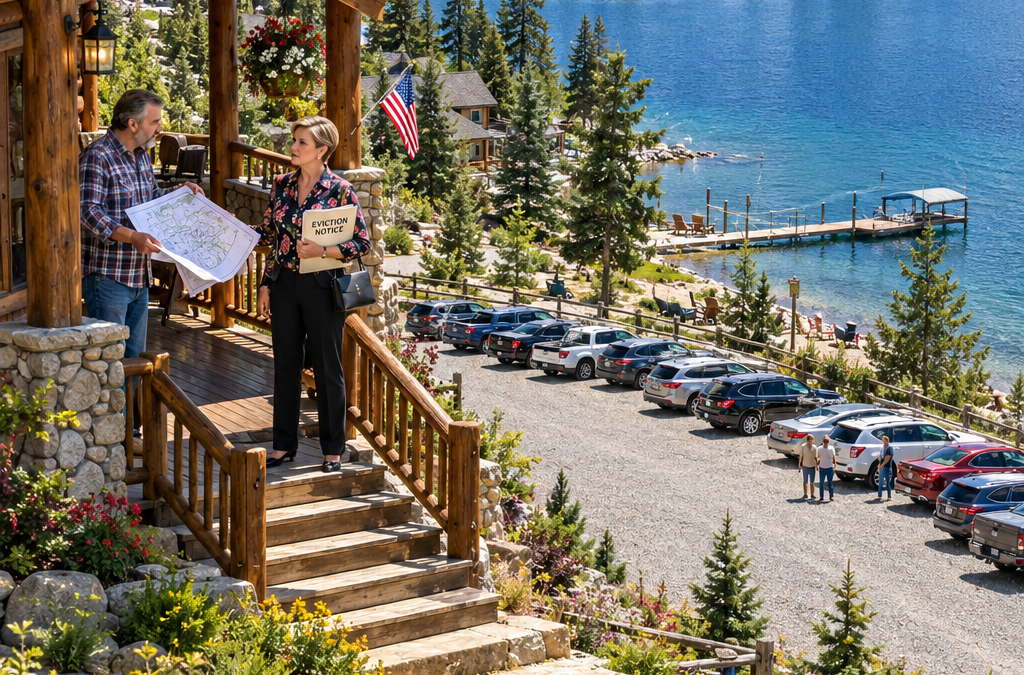
𝗙𝗨𝗟𝗟 𝗦𝗧𝗢𝗥𝗬
Then Karen Whitmore became HOA president.
I first heard her name from a man named Dennis who lived in Mountain Laurel and occasionally stopped by my dock.
He was retired military.
Quiet.
The kind of neighbor who asked before entering property even if he had been invited ten times before.
One afternoon, we were sitting near the water when he mentioned a board election.
“New president,” he said.
“Good one?”
He made a face.
“Motivated.”
“That’s not an answer.”
“It’s the safest answer.”
I laughed.
“What’s her name?”
“Karen Whitmore.”
“Know her?”
“Everybody does now.”
Apparently Karen had won on a platform of restoring standards and clarifying community control.
Within a few months, new notices went out.
Storage rules.
Exterior maintenance.
Parking enforcement.
Guest policies.
Use of shared spaces.
Again, not my concern.
Until I received a letter.
It came in an HOA envelope addressed simply to:
Occupant
Lakeside Cabin
No name.
That irritated me before I even opened it.
Inside was a notice regarding “unauthorized private improvements adjacent to Mountain Laurel common property.”
I read it twice.
Then looked outside at my porch.
Private improvements?
The letter referenced my dock.
A small woodshed.
A section of fencing.
It claimed HOA approval was required.
I assumed they had the wrong parcel.
So I called the number.
A woman answered.
“Mountain Laurel Estates management.”
I gave the notice number.
“That concerns the lakeside tract,” she said.
“Yes.”
“Board enforcement.”
“I’m not in Mountain Laurel.”
There was a pause.
“Are you the cabin owner?”
“Yes.”
“Then you’ll need to speak with the board.”
“Why?”
“The president reviewed the property.”
“Did she review the deed?”
“I can’t answer that.”
That should have told me where things were heading.
Still, I wasn’t interested in a fight.
I mailed a short response.
My property is privately owned and is not subject to Mountain Laurel Estates HOA covenants. Please correct your records.
I attached the first page of the deed.
Nothing else.
Two weeks passed.
Then another letter came.
This one addressed to me by name.
Mr. Ethan Cole.
They had done at least some research.
The second notice claimed Mountain Laurel had “historical jurisdiction” over the lakeside area and requested that I cease unapproved maintenance activity until the board completed a boundary review.
I called again.
This time, I spoke directly with Karen.
Her voice was calm.
Professional.
Confident.
“Mr. Cole, I’m glad you called.”
“I’m trying to understand why your HOA keeps sending me notices.”
“We’re clarifying several long-standing property issues.”
“My property isn’t one of your issues.”
“That’s what we’re evaluating.”
“No. That’s what my deed already evaluates.”
She paused.
“You have to understand that the lake has functioned as part of the Mountain Laurel community for decades.”
“Functioned how?”
“Residents use the area.”
“The residents use the parking area.”
“Exactly.”
“That doesn’t make it HOA property.”
“Usage history matters.”
“Sometimes. Ownership matters more.”
Her tone cooled.
“Mr. Cole, I don’t think arguing by phone helps.”
“I agree.”
“Then allow the board to complete its review.”
“You’re reviewing land you don’t own.”
“We’ll determine that.”
That sentence bothered me.
Not because she disagreed.
Because she spoke as though the board had authority to determine whether my deed existed.
I almost said more.
Then stopped.
“Karen, if you believe Mountain Laurel owns any part of my parcel, send me the recorded document.”
“We’ll be in touch.”
She hung up.
After that, I pulled every property record I had.
Not because I doubted myself.
Because confidence is not proof, even when the confident person is you.
The original deed.
Updated survey.
Tax map.
Boundary monuments.
Title paperwork.
I read all of it.
The cabin was mine.
The land was mine.
The lake was inside my parcel.
And there, on the eastern side of the survey, was the gravel parking area.
Mine.
I had always known it.
But seeing it highlighted after Karen’s calls changed the way I understood the conflict.
Mountain Laurel had spent years treating something as common space without ever asking who owned it.
That was not unusual.
Communities grow.
Maps get simplified.
People repeat assumptions.
The person who lived there before me had allowed parking.
I had allowed parking.
Nothing had forced anyone to examine the underlying title.
Permission had slowly become invisible.
Invisible permission often turns into imagined ownership.
I still hoped Karen would simply review the survey and let the matter go.
She did the opposite.
One Tuesday afternoon, I was repairing a loose board on the dock when I heard a vehicle on the gravel.
White SUV.
HOA logo on the door.
Karen stepped out.
She carried a thick folder.
No greeting.
No handshake.
She walked toward the cabin as though she were serving a warrant.
“Ethan Cole?”
“Yes.”
She held out a document.
“You need to vacate the property.”
For a second, I thought she was joking.
“What?”
“This structure is within Mountain Laurel community boundaries.”
I looked at the paper.
NOTICE TO VACATE AND CEASE UNAUTHORIZED OCCUPANCY.
There were references to community property.
Common-area protection.
Board authority.
Several legal-sounding phrases.
None changed reality.
I looked back at her.
“You’re evicting me?”
“We’re directing you to vacate until ownership can be resolved.”
“Ownership is resolved.”
“Not according to our records.”
“Your records don’t own my house.”
Karen’s jaw tightened.
“This cabin is located inside the Mountain Laurel lakeside tract.”
“No.”
“It is.”
“No.”
She opened the folder.
Pulled out a map.
It was a simplified HOA community map.
Colored zones.
Roads.
Lots.
The lake was shaded blue.
A green band ran along part of the shore.
The cabin wasn’t clearly marked.
“See?”
I looked at her.
“This is not a recorded survey.”
“It’s the association’s official map.”
“That’s not the same thing.”
“It has been used for years.”
“So has a restaurant menu. It doesn’t transfer land either.”
Her face hardened.
“I don’t appreciate being mocked.”
“I’m not mocking you.”
I handed the paper back.
“I’m telling you that you’re standing on private land asking the owner to leave because your HOA drawing uses the wrong color.”
“This isn’t just a drawing.”
“Then show me the deed.”
She stared.
“The community owns the lake.”
That was the moment I almost laughed.
Not because it was funny.
Because I realized how far she had gone without checking.
“The community owns the lake?”
“Yes.”
“Karen.”
“What?”
“I own the lake.”
Her expression barely changed.
Then:
“No, you don’t.”
“Yes.”
“That’s community water.”
“According to what?”
“Historical use.”
“That’s not ownership.”
“Residents have accessed it for decades.”
“That doesn’t answer the question.”
I walked inside.
For a moment, I wondered whether she would follow me.
She didn’t.
I returned carrying the survey tube and a copy of my deed.
I unfolded the survey across the porch table.
Old habit made me put two coffee mugs on the corners to stop the wind lifting it.
Karen stood opposite me.
I pointed.
“Cabin.”
She looked.
“Property line.”
I traced it.
“Shoreline.”
Then around the water.
“Lake.”
The survey clearly contained the entire lake inside my legal description.
Karen leaned closer.
She said nothing.
I pointed east.
“And here’s something else.”
My finger moved to the rectangular gravel area beside the access road.
“What’s that?” she asked.
“The parking lot.”
Her eyes shifted.
She looked toward the road.
Then back at the map.
“No.”
“Yes.”
“That parking area is Mountain Laurel property.”
“Show me.”
She looked again.
The boundary line was unmistakable.
The lot sat on my parcel.
Not close.
Not ambiguous.
Inside.
I watched the confidence leave her face a little at a time.
Then return in another form.
Defensiveness.
“This survey could be outdated.”
“It’s the current recorded survey.”
“Maps conflict.”
“Your map conflicts.”
“We’ve maintained that lot.”
“Sometimes.”
“We’ve resurfaced it.”
“Once, as far as I know.”
“That demonstrates control.”
“It demonstrates maintenance.”
“Residents have used it continuously.”
“With permission.”
“Whose permission?”
“Mine.”
She stared.
“I’ve never seen an agreement.”
“There wasn’t a formal one.”
She seized on that.
“Exactly.”
“No, Karen. That doesn’t help you.”
She frowned.
“I allowed people to park there. The owner before me did too. Nobody charged anyone. Nobody locked it.”
“So it became community parking.”
“It became parking the community used.”
“Same thing.”
“No.”
That was the entire conflict in one word.
No.
Use and ownership were not the same.
Permission and title were not the same.
Habit and law were not the same.
Karen refused to accept that distinction.
She closed the folder.
“I think we need law enforcement here.”
“Why?”
“You are refusing a lawful directive.”
I looked around at my porch.
“My lawful directive is that you leave my property.”
Her face flushed.
“I’m calling the sheriff.”
“Go ahead.”
I meant it.
At that point, I wanted somebody neutral.
Karen stepped into the yard and made the call.
I could hear pieces.
Disputed property.
Unauthorized occupant.
HOA common area.
Refusal to leave.
I stayed on the porch.
Not because I was especially calm.
Because I had learned over the years that anger rarely improves paperwork.
About twenty minutes later, a sheriff’s vehicle came up the road.
Deputy Samuel Hayes stepped out.
Mid-forties.
Neutral expression.
He looked at Karen.
Then me.
Then the lake.
“Afternoon.”
Karen moved first.
“Officer, I’m Karen Whitmore, president of Mountain Laurel Estates.”
“Deputy.”
“I’m sorry?”
“Deputy Hayes.”
She nodded.
“Of course.”
She began immediately.
“This man is occupying community property without authorization.”
Hayes looked at me.
“You own the cabin?”
“Yes.”
Karen interrupted.
“He claims he does.”
Hayes held up one hand.
“I’ll hear both.”
That was the first useful sentence anyone had said in twenty minutes.
Karen handed him her folder.
Board map.
Vacate notice.
Community documents.
He read.
Asked questions.
“Do you have a recorded deed identifying the HOA as owner of this parcel?”
Karen paused.
“We have governance documents.”
“Do they convey this land?”
“They establish the lakeside area as community property.”
“Are they recorded against this parcel?”
“I’d have to ask counsel.”
He nodded.
Then turned to me.
“Your documents?”
I handed him the deed and survey.
He unfolded the survey across the hood of his vehicle.
For several long seconds, nobody spoke.
Hayes traced the description.
Parcel number.
Monuments.
Boundary.
Cabin.
Lake.
Then the eastern lot.
He looked at me.
“You’re saying this entire water body is inside your deed?”
“Yes.”
He checked.
Then looked at Karen.
“Ma’am, do you have something different?”
Karen crossed her arms.
“The HOA has always controlled the lake.”
“That’s not what I asked.”
Her expression changed.
Hayes continued.
“Do you have a deed showing HOA ownership?”
“Not with me.”
“Recorded easement?”
“The residents have used it for decades.”
“That’s not the same question.”
I almost smiled.
He had reached the same wall I had.
Karen turned toward me.
“This proves nothing about community rights.”
I answered:
“It proves ownership.”
Hayes pointed toward the parking lot.
“What’s this area?”
“Community parking,” Karen said immediately.
“My land,” I said.
Hayes looked at the survey again.
“Looks like it’s within this boundary.”
Karen stepped closer.
“That cannot be correct.”
“Why?”
“Because Mountain Laurel has maintained it.”
“Do you have a separate parcel record?”
“No.”
“Easement?”
“I’d need to check.”
“License?”
“No.”
“Lease?”
“No.”
Hayes straightened.
“I’m not deciding complex civil property rights on the side of the road. That’s not my role.”
Karen seemed relieved.
Then he added:
“But based on what you’ve handed me, I have no basis to remove Mr. Cole from this cabin.”
Her relief disappeared.
“He is occupying community land.”
“Your documents don’t establish that.”
“They do.”
“Not ownership.”
She looked furious.
Hayes continued.
“And I’m certainly not evicting someone from a residence based on an HOA notice.”
Karen tried another approach.
“What about the parking lot?”
“Same answer. If there’s a title dispute, attorneys and the recorder’s office can resolve it.”
I said:
“I have the older records too.”
I went inside.
Returned with the original acquisition documents.
Historical parcel description.
Older survey.
No change in boundaries.
Hayes compared them.
Karen watched.
The documents told the same story over decades.
Cabin.
Land.
Lake.
Eastern gravel area.
No HOA ownership.
No conveyance.
No transfer.
Nothing.
Hayes folded the documents carefully.
“Ms. Whitmore, it looks like you need your board and counsel to review this.”
Karen’s voice became quieter.
“So you’re taking his side.”
“No.”
“That’s exactly what you’re doing.”
“No. I’m looking at the documents both of you brought.”
She pointed toward the community.
“Two hundred families rely on that parking area.”
I looked at her.
There it was.
Not the cabin.
Not the lake.
The thing that actually mattered.
The parking lot.
Mountain Laurel depended on it far more than I had ever realized.
During summer weekends, residents filled it.
Guests.
Boats.
Kayaks.
Walkers.
Events.
The internal streets near the lake could not accommodate that volume.
Without the gravel lot, parking became a mess.
Hayes looked toward me.
“What are you planning to do with it?”
“Nothing.”
Karen interrupted.
“For now.”
I looked at her.
“I haven’t threatened to close it.”
“You just said it’s yours.”
“It is.”
“Then you could.”
“That’s true.”
Her face hardened again.
“And that’s exactly why the HOA has to protect the community.”
“From what?”
“From one individual controlling access.”
I stared at her.
“Karen, I have controlled access this entire time.”
She stopped.
“You just didn’t know it.”
That was the first thing that truly silenced her.
For years, the neighborhood had been safe not because the HOA owned the lot.
Because I had chosen not to interfere with its use.
Nothing changed the day Karen saw the survey except her understanding.
The risk had existed all along.
The assumption merely concealed it.
Hayes suggested the board review everything that evening.
Karen called an emergency HOA meeting.
I received a formal invitation three hours later.
At first, I didn’t want to go.
I had spent the afternoon defending ownership of my own home.
The last thing I wanted was a room full of angry homeowners hearing that their parking lot sat on my land.
Then Dennis called.
“Come.”
“I don’t need another argument.”
“People need to see the map.”
“Karen has it.”
“That’s why you need to come.”
Fair.
The Mountain Laurel clubhouse was packed.
More people than I had ever seen there.
Chairs filled.
Residents stood along the walls.
Some looked angry.
Some worried.
Some curious.
Karen sat at the front with four board members.
The thick folder was beside her.
No eviction notice in sight.
Their attorney joined by speakerphone.
Karen opened the meeting.
“We’re here to address a significant property discrepancy concerning the lakeside area.”
Discrepancy.
That was softer than unauthorized occupant.
She continued.
“Mr. Cole has presented documents that conflict with long-standing community records.”
I raised my hand.
“Can we clarify something?”
Karen looked irritated.
“This isn’t public comment yet.”
One board member, a man named Howard Lane, said:
“Let him.”
Karen looked at him.
He shrugged.
“He’s the property owner in question.”
I stood.
“My documents don’t conflict with the county records. The HOA map conflicts with them.”
Murmurs.
Karen said:
“That’s your interpretation.”
I held up the survey.
“Then let’s put it on the screen.”
Howard agreed.
Someone connected a laptop.
We displayed a scanned copy.
The room changed immediately.
People understand maps differently when they see them enlarged.
The cabin sat clearly inside my parcel.
The lake.
The shoreline.
The gravel lot.
One woman near the front said:
“Wait.”
She stood.
“The parking area?”
I nodded.
“It’s inside the recorded boundary.”
A man behind her asked:
“How long have you owned it?”
“Years.”
“You knew?”
“Yes.”
“Why did you let us park there?”
The question wasn’t hostile.
Genuinely confused.
“Because it wasn’t hurting anything.”
Another resident:
“Do we have an easement?”
I looked toward Karen.
She looked at the board attorney’s speakerphone.
Howard answered.
“We haven’t located one.”
The room erupted in conversation.
Someone said:
“We’ve been parking there for twenty years.”
Another:
“Doesn’t that make it ours?”
The attorney’s voice came through.
“Continuous use may create legal questions depending on circumstances, but usage alone does not automatically establish ownership.”
People quieted.
I appreciated the precision.
A resident named Lisa stood.
“So who owns the lake?”
I answered:
“I do.”
More murmurs.
Karen finally spoke.
“The HOA has always treated the lake as part of the community.”
A man in the back said:
“That’s not what she asked.”
Karen’s expression tightened.
Lisa looked at me.
“Have you ever stopped residents from using it?”
“The lake itself? People haven’t had unrestricted use. The parking lot, no. I haven’t stopped parking.”
“Are you going to?”
I looked around the room.
That was the fear underneath everything.
Not who had been rude.
Not whether Karen was embarrassed.
Would I retaliate?
I understood why they were worried.
One day earlier, they thought the HOA controlled an essential parking area.
Now they were learning one individual did.
“I don’t want to close it.”
Relief moved through the room.
Then I continued.
“But I don’t want this happening again.”
Karen crossed her arms.
“This?”
“Someone coming to my cabin with an eviction notice because nobody checked the deed.”
She looked down.
I continued.
“I don’t want notices about my dock. My cabin. My woodshed. My lake. I don’t want the HOA treating permission as ownership.”
Howard leaned forward.
“What would you propose?”
That was the first time anyone had asked.
Not demanded.
Asked.
“I want a written access agreement.”
The room became quiet again.
“For the parking lot?” Howard asked.
“Yes.”
“What kind?”
“Simple.”
I explained.
Residents could continue using the gravel lot.
The agreement would define the exact area.
No expansion without consent.
No claim of ownership.
No HOA enforcement authority over my cabin, lake, shoreline, or remaining land.
Residents would have authorized parking access under clear terms.
The HOA would acknowledge the boundary.
In exchange, I would not close the lot arbitrarily.
We could define maintenance responsibilities.
Insurance.
Trash.
Snow removal.
Basic things.
The attorney came through the speaker.
“That would be considerably cleaner than the current arrangement.”
Karen looked at the phone.
“What current arrangement?”
“The current arrangement appears to be informal permission.”
She didn’t like hearing that.
“That could create liability for the association.”
“Correct.”
Howard looked at me.
“Would you consider recording it?”
“Yes.”
“Permanent?”
“I’d consider a long-term recorded agreement as long as the boundaries are respected.”
A woman near the side wall raised her hand.
“What about lake access?”
“There is no general community lake access.”
Karen interrupted.
“We’ve always—”
“No, Karen.”
My tone was sharper than I intended.
The room went silent.
I lowered it.
“The parking lot and lake are two different things. People parking on my land doesn’t mean they own my water.”
The attorney supported that distinction.
We went through the map slowly.
The more we did, the less emotional the meeting became.
Facts are useful that way.
There was my boundary.
There was theirs.
There was the parking area.
There was the lake.
There was the road.
There were no mysterious overlapping rights hiding in the margins.
The conflict had grown because Karen treated assumptions as documents.
Once actual documents were on the screen, much of the drama evaporated.
Then Howard asked Karen:
“Did you personally review the original deed before issuing the vacate notice?”
Nobody moved.
Karen looked at the table.
“I reviewed association records.”
“That wasn’t my question.”
She exhaled.
“No.”
“Did you review the county survey?”
“No.”
“Did counsel?”
Karen looked toward the phone.
The attorney answered.
“Our office was not asked to review ownership before today’s meeting.”
That landed hard.
Karen’s face changed.
Not humiliation exactly.
Realization.
She had marched to my cabin, ordered me out, called the sheriff, and threatened a conflict involving the whole community without ever checking the one document that mattered.
The deed.
She looked toward me.
For the first time, she seemed less like an HOA president and more like a person who knew she’d made a serious mistake.
“I assumed the lakeside tract was community property.”
There it was.
Assumed.
A woman near the back said:
“Based on what?”
Karen looked around.
“Historical use. Maps. Board records.”
“Not the deed?”
“No.”
Nobody shouted.
That almost made it worse.
The room simply absorbed it.
Dennis caught my eye from the third row.
He gave the smallest possible nod.
I sat down.
I didn’t feel victorious.
I had spent the afternoon imagining some dramatic satisfaction if Karen was forced to admit she was wrong.
The reality felt different.
Mostly I was relieved.
The residents were not my enemies.
They had parked on my land because everybody told them they could.
Karen had made a bad assumption and then wrapped authority around it.
There was no reason to turn that mistake into a war.
The board voted to suspend all enforcement notices against my property immediately.
They authorized their attorney to draft an access agreement with mine.
I didn’t actually have an attorney involved yet.
So the next morning, I hired one.
Her name was Rebecca Sloan.
She specialized in real estate and easements.
When I showed her the documents, she laughed once.
“Your HOA president tried to evict you?”
“Not my HOA president.”
“Even better.”
She read the survey.
Then looked at the parking lot through satellite imagery.
“How long have they used this?”
“Years.”
“Any written agreement?”
“No.”
“Fees?”
“No.”
“Maintenance?”
“Mixed.”
“Any signs calling it HOA property?”
“I don’t think so.”
She nodded.
“This is exactly the kind of arrangement people leave informal until somebody makes everyone nervous.”
“Karen made everyone nervous.”
“Apparently.”
We drafted carefully.
Mountain Laurel residents and authorized guests could use the defined gravel parking area.
No ownership transferred.
No access rights extended to the cabin, dock, lake, or other portions of my parcel.
The HOA would contribute to gravel maintenance and trash removal.
No permanent structure.
No expansion.
No signs claiming HOA ownership.
No use outside designated hours for organized events without permission.
The agreement acknowledged my property boundaries.
Simple.
Clear.
Rebecca insisted on another clause.
“Permission isn’t jurisdiction.”
I looked at her.
“Meaning?”
“Use of the parking lot does not subject the rest of your property to HOA rules.”
“Put that in bold.”
“We don’t generally bold deed language.”
“Shame.”
The final agreement was only several pages.
Nothing dramatic.
No revenge fee.
No toll booth.
No impossible restrictions.
That surprised some people.
Dennis came by the cabin while negotiations were happening.
“You know you could charge them.”
“I know.”
“Probably a lot.”
“I know.”
“You’re not going to?”
“No.”
He sat on the porch rail.
“Why?”
I looked at the lake.
“Because I didn’t let them park there all these years so I could someday surprise them with a bill.”
“Karen surprised you with an eviction notice.”
“Karen isn’t two hundred families.”
Dennis smiled.
“That’s annoyingly reasonable.”
“I’ve been called worse.”
The board approved the agreement unanimously.
Karen read every page.
Slowly.
She asked questions about the boundary clause.
About maintenance.
About liability.
At one point she asked:
“What if the community needs emergency access to the lake?”
Rebecca answered:
“Emergency services already have the authority they need in an actual emergency. That doesn’t create HOA ownership.”
Karen nodded.
No argument.
That was new.
We signed.
Then we recorded the agreement.
For the first time, the neighborhood’s use of my parking area became documented properly.
Nobody had to rely on memory.
Nobody had to assume.
Nobody had to hope the next owner would be as relaxed as I had been.
The arrangement finally had what it should have had years earlier.
Paper.
The next morning, a sign company installed a new marker at the parking lot entrance.
PRIVATE PROPERTY
AUTHORIZED MOUNTAIN LAUREL PARKING BY AGREEMENT
Nothing hostile.
No KEEP OUT.
No TRESPASSERS WILL BE PROSECUTED.
Just accurate information.
I added a smaller sign near the path leading toward my shoreline.
PRIVATE LAKE AND CABIN PROPERTY
NO COMMUNITY ACCESS BEYOND THIS POINT
I stood looking at it.
Part of me disliked signs.
The lake had been prettier without them.
But clarity had a beauty of its own.
For the first time in weeks, nothing felt uncertain.
Around seven that morning, residents began parking.
A man got out of his SUV.
Looked at the new sign.
Then saw me.
“Morning.”
“Morning.”
“We still okay here?”
“If you’re a Mountain Laurel resident.”
He smiled.
“Twenty-two years.”
“Then you’re fine.”
“Thanks.”
That was it.
No argument.
No board meeting.
No sheriff.
Thirty seconds.
I went back to the dock.
The lake was completely still.
Mountains reflected in the surface.
For the first time since Karen’s first letter, I could enjoy it without imagining paperwork.
A few days later, her white SUV came down the road again.
I saw it through the cabin window.
I felt my stomach tighten automatically.
That’s what conflict does.
Even after it ends, your body remembers first.
Karen got out.
No folder.
No notice.
She stopped at the edge of the porch.
“Can we talk?”
“Sure.”
I didn’t invite her inside.
We sat in two chairs facing the water.
For a while, neither of us spoke.
Then she said:
“I handled this badly.”
That was not the opening I expected.
I looked at her.
She continued.
“I should have checked the original records.”
“Yes.”
“I relied on HOA maps.”
“Yes.”
“And historical use.”
“Yes.”
She almost smiled.
“You’re not going to make this easy, are you?”
“I’m agreeing with you.”
She looked toward the lake.
“I genuinely believed it belonged to the community.”
“I know.”
“You don’t sound angry.”
“I was.”
“Were?”
“Mostly.”
She nodded.
“I would have been.”
I waited.
Then she said:
“I shouldn’t have come here with a vacate notice.”
“No.”
“Or called the sheriff.”
“Probably not.”
She rubbed her hands together.
“I thought you were refusing to cooperate.”
“I thought you were trying to remove me from my own home.”
“I was.”
That honesty surprised me.
Karen looked embarrassed.
“When I say it now, it sounds insane.”
“Documents help.”
She laughed quietly.
Then became serious.
“I’ve spent years dealing with residents who say things like ‘that’s my property’ when the covenants say otherwise.”
“I understand.”
“I started assuming every disagreement was another version of that.”
“And mine wasn’t.”
“No.”
She looked toward the parking lot.
“I also didn’t know that was yours.”
“I figured.”
“I should have.”
“Yes.”
She nodded again.
“What happens if you ever sell?”
“The agreement runs according to its recorded terms.”
“So residents are protected.”
“That’s the point.”
She looked genuinely relieved.
That mattered to me.
Because for all the conflict, I did not want two hundred families wondering whether they might lose access because of one stupid afternoon.
Karen stood.
Before leaving, she looked back.
“Why didn’t you close the parking lot?”
“When?”
“After I tried to evict you.”
I considered the question.
“Because it would’ve hurt people who didn’t do anything.”
She looked at me.
“Even after everyone believed the HOA owned it?”
“Believing the wrong thing isn’t the same as trying to steal it.”
She took that in.
Then nodded.
“I appreciate that.”
“Just make sure the next board knows the difference.”
“We will.”
She drove away.
No drama.
No final confrontation.
No victory speech.
I liked that ending better.
For several months, Mountain Laurel adjusted.
The new agreement appeared in resident packets.
The community map was corrected.
My parcel was clearly marked.
The lake stopped appearing as common HOA water.
The parking area was labeled:
AUTHORIZED ACCESS AREA — PRIVATE LAND.
Karen’s name remained on meeting agendas.
She did not disappear.
She wasn’t removed.
Nobody destroyed her life.
She had made a serious mistake.
Then she admitted it.
I can work with that.
Some people wanted a more dramatic conclusion when they heard what happened.
Dennis once told the story to his brother and apparently made me sound like I’d defeated an invading army.
His brother came by and asked:
“So you owned their whole lake?”
“No.”
“They said—”
“I owned my lake.”
“And their parking lot.”
“I owned the land they used for parking.”
“Could’ve shut them down.”
“Could’ve.”
“Should’ve.”
“No.”
He seemed disappointed.
People like revenge because it’s simple.
Someone hurts you.
You hurt them harder.
Balance restored.
Real life is usually more complicated.
The residents had not ordered me off my land.
Karen had.
The board had relied on bad records.
The residents had relied on the board.
Closing the lot would have punished everybody for one person’s arrogance.
That isn’t justice.
It’s just a larger version of the original mistake.
Instead, the conflict produced something useful.
The neighborhood knew where its rights ended.
I knew their access was documented.
Future boards would not need to guess.
Future owners of my property could not pretend the parking arrangement never existed.
Everybody gained certainty.
That matters more than pride.
I eventually asked Rebecca something that had been bothering me.
“What would’ve happened if I’d just ignored Karen?”
She leaned back.
“In what sense?”
“If I never showed the survey. Never went to the meeting. Just kept letting people use the parking lot.”
She thought.
“Probably nothing immediately.”
“And long term?”
“Hard to say.”
“Could historical use become a problem?”
“Potentially, depending on how things developed and what claims were made.”
“So the conflict helped.”
“In a strange way.”
I laughed.
“Karen will love that.”
“Don’t tell her.”
But Rebecca was right.
The confrontation forced everyone to do what nobody had done for years.
Check.
Survey.
Record.
Clarify.
The parking lot had existed in a legal grayness created not by defective ownership but by undocumented permission.
That was dangerous for everyone.
My generosity depended on memory.
The residents’ expectations depended on habit.
Neither was enough.
The written agreement fixed that.
Grandparents sometimes leave sayings.
My father had one.
“Friendly arrangements survive until somebody forgets why they started.”
He used it about tools.
Loans.
Fences.
Anything.
I thought of it often after the Mountain Laurel dispute.
Nobody had been dishonest originally.
The community needed parking.
The old owner allowed it.
Then I allowed it.
Years passed.
People moved.
Boards changed.
The origin disappeared.
By the time Karen arrived, all she saw was an HOA neighborhood using a parking lot.
Of course she assumed it was theirs.
The failure wasn’t the first assumption.
The failure was refusing to check when challenged.
That is where ordinary mistakes become abuse.
Karen could have said:
Show me the deed.
Instead, she said:
Leave.
That was the line.
Confidence becomes dangerous when it treats questions as disobedience.
I saw the same pattern elsewhere after that.
Neighbors arguing over fences.
Roads.
Drainage.
Tree lines.
A person sees something used one way for years and assumes it must legally be that way.
Sometimes they’re right.
Sometimes a survey destroys twenty years of certainty in ten minutes.
The answer isn’t to avoid the survey.
The answer is to respect it.
One winter morning, I woke before sunrise.
Snow had fallen overnight.
The lake was dark.
The parking lot hadn’t been plowed yet.
Around eight, I heard machinery.
Mountain Laurel’s contractor came in.
He stopped before entering.
The driver got out.
Walked to my cabin.
Knocked.
“Mr. Cole?”
“Yes.”
“HOA sent me to clear the authorized parking area.”
“Okay.”
“Just confirming I can cross here.”
That question.
It made me smile.
“Yes.”
“Boundary still marked by the orange stakes?”
“Yes.”
“Anything else I need to avoid?”
“Don’t pile snow against the shoreline gate.”
“Got it.”
He went back to work.
Five minutes.
No conflict.
Same HOA.
Same land.
Different approach.
Permission.
Clarity.
Respect.
People underestimate how much conflict comes from skipping those three.
The lake remained mine.
The residents stopped calling it “our lake.”
Not because I demanded language policing.
Because the corrected maps changed how people understood it.
Some called it Cole Lake.
I hated that.
The older historical name eventually returned.
Silver Pine Lake.
Much better.
I kept the dock private.
Occasionally, Dennis asked to fish.
He always called first.
I almost always said yes.
One afternoon we sat there with rods and he asked:
“You ever regret being so reasonable?”
“Constantly.”
He laughed.
“I’m serious.”
“So am I.”
He looked toward the parking area.
“If you had charged the HOA even fifty dollars a space every month, you’d be making a fortune.”
“Then I’d have to manage parking.”
“Good point.”
“Also, I like sleeping.”
He nodded.
“Karen’s different now.”
“How?”
“Checks things.”
I laughed.
“Radical leadership strategy.”
“No kidding.”
Apparently, after the incident, she required the board to attach source documents to any property claim before enforcement.
Not just HOA maps.
Recorded covenants.
Surveys.
County records where appropriate.
She also changed the language in violation notices so residents could identify the actual rule being enforced.
That pleased me.
Not because I wanted credit.
Because mistakes should improve systems.
Otherwise they are just pain with paperwork.
A year after the eviction-notice incident, Mountain Laurel held a lakeside cleanup day.
Technically, most of it happened on their side.
Dennis asked whether volunteers could collect trash along the edge of the parking area too.
I said yes.
Karen was there.
We worked for two hours without discussing property law once.
That might have been our greatest achievement.
At lunch, she stood beside me looking at the lake.
“I still can’t believe we thought this was ours.”
I glanced at her.
“You didn’t think.”
She gave me a look.
“I deserved that.”
“Probably.”
She laughed.
Then said:
“We printed the old map for almost fifteen years.”
“That’s how assumptions get respectable.”
She nodded.
“What do you mean?”
“Put an error on letterhead long enough and people stop asking where it came from.”
She became quiet.
“That’s uncomfortable.”
“It’s true.”
She looked toward the residents eating at picnic tables.
“I used to think leadership meant sounding certain.”
“Sometimes it means saying you need to check.”
She nodded.
“I know that now.”
That was probably the closest thing we ever had to a philosophical conversation.
I went home afterward.
Sat on the porch.
Watched evening move across the water.
I thought about the afternoon she’d arrived with the folder.
The words:
You need to leave.
At the time, I had felt invaded.
Not just physically.
Personally.
A home is not only real estate.
It is the place where you stop performing ownership for anyone else.
You close the door.
Take off your shoes.
Leave coffee cups where you want.
Repair the porch when you choose.
Wake to a view you’ve seen a thousand times.
For someone to arrive and tell you that home isn’t yours destabilizes something basic.
Even when you know they’re wrong.
For a few seconds, I had felt the ground beneath my life become argumentative.
Then I remembered the deed.
That’s the quiet power of documentation.
It doesn’t make you louder.
It means you don’t have to be.
Karen had the folder.
HOA logo.
Official language.
Board title.
Eviction notice.
I had a recorded deed.
Those things were not equal.
The title on the paper mattered more than the confidence of the person holding it.
That afternoon changed the way I stored my records.
I scanned everything.
Cloud copy.
Fireproof box.
Original survey protected.
Recorded access agreement in both my file and Rebecca’s.
Maybe that sounds excessive.
It doesn’t to me.
Land outlives people.
Memories don’t.
Future disagreements should not depend on someone remembering what Ethan Cole said at a clubhouse meeting.
They should be able to open the record.
There it is.
Lake.
Cabin.
Parking.
Agreement.
Done.
Years later, new residents moved into Mountain Laurel who had no idea the dispute had ever happened.
One summer, I heard two young parents talking near the parking lot.
Their children were carrying inflatable kayaks.
One parent said:
“We can’t launch there. That’s private.”
The other answered:
“Oh, right.”
That was it.
No resentment.
No confusion.
They walked toward the community access point farther down.
I stood on my porch and smiled.
The system worked.
Nobody had to know the history.
That is the mark of a good agreement.
It solves the problem even after everyone who argued about it has gone home.
Karen eventually finished her term as HOA president.
She did not run again.
Not because of me, as far as I know.
She told people she wanted more time to travel.
At her last meeting, Dennis said she gave a short speech about institutional memory and accurate records.
He called me afterward.
“She sounded like you.”
“That’s unfortunate.”
“She even said assumptions aren’t documentation.”
I laughed.
“Did she credit me?”
“No.”
“Typical.”
I didn’t care.
The idea mattered more than attribution.
By then, Karen and I had reached something close to neighborly neutrality.
We waved.
Occasionally talked.
Never became friends.
That was fine.
Not every conflict needs to end in friendship.
Respect is enough.
One autumn evening, she walked down to the cabin.
No HOA vehicle anymore.
Just hiking clothes.
She stopped by the property sign.
“Still hate that sign?”
I had told her once that I disliked needing it.
“Less than I used to.”
“It helped.”
“It did.”
She looked across the lake.
“It’s beautiful.”
“Yeah.”
“Do you ever get tired of waking up to it?”
“No.”
She smiled.
“I wouldn’t either.”
Then she continued down the road.
That was the last long conversation we ever had.
Sometimes I think about what would have happened if I had reacted differently the day she arrived.
If I had yelled.
If I had blocked the parking lot immediately.
If I had chained the entrance and put up NO HOA ACCESS signs before the sheriff arrived.
I would still have owned the land.
But the story would have changed.
Residents would have experienced me first as the man who took away parking.
Karen’s claim might have looked more believable.
The meeting would have begun with fear instead of documents.
Instead, I let the survey speak before I changed anything.
That choice mattered.
Property rights are strongest when you don’t need to perform them dramatically.
I never had to prove ownership by hurting someone.
I proved it by opening the map.
The parking lot remains open today under the agreement.
The lake remains private.
The cabin remains my home.
No HOA notices.
No eviction letters.
No confused sheriff.
Just boundaries everyone understands.
And the funny thing is, once the boundaries were clear, people became friendlier.
The uncertainty had created more tension than the line itself.
A clear no is easier to live with than an assumed maybe.
Residents knew where they could park.
Knew where they could walk.
Knew where my property began.
I knew they had written permission where appropriate.
Nobody had to guess.
That’s peace.
Not the absence of boundaries.
The absence of arguments about where they are.
One morning, years after the dispute, I woke before dawn.
The mountains were dark blue.
The lake had almost no movement.
I made coffee.
Walked to the dock.
Sat.
A car entered the gravel parking area.
Door closed softly.
Footsteps headed toward the community trail.
Nothing unusual.
Nobody looked toward the cabin.
Nobody asked permission because the permission was already written.
That struck me.
Before Karen, the parking lot had operated on unspoken generosity.
After Karen, it operated on documented respect.
The second arrangement was better.
More durable.
Safer.
Maybe conflict isn’t always evidence that something is broken beyond repair.
Sometimes it exposes a weak place everyone had been lucky enough to ignore.
Our weak place was assumption.
Karen’s mistake forced us to replace it.
I wouldn’t thank her for the eviction notice.
But I can admit the final arrangement was stronger because she made the underlying problem impossible to ignore.
The lesson I took from all of it was not “never trust an HOA.”
That’s too easy.
Most institutions are only as careful as the people running them.
The real lesson was simpler.
Know what you own.
Know what you don’t.
If you give someone permission, write it down when the permission matters.
If somebody claims authority over your property, ask for the document.
Not the map they made themselves.
Not the rule book that governs someone else.
Not the sentence beginning with “we’ve always.”
The document.
Tradition can explain behavior.
It cannot rewrite a deed.
Karen learned that on my porch.
The neighborhood learned it in the clubhouse.
I learned something too.
Owning property is not only about defending what belongs to you.
Sometimes it means deciding how generously you can share it without surrendering the truth.
I owned the parking lot.
I chose to keep it available.
Those facts could coexist.
I owned the lake.
I chose to keep it private.
Those facts could coexist too.
Ownership gave me the right to choose.
The agreement made the choices clear.
That was all I had ever wanted.
I never wanted to fight Mountain Laurel.
I never wanted to embarrass Karen.
I never wanted two hundred families worrying about where their guests would park.
I wanted to wake up in the cabin I owned and look across the lake I owned without someone arriving with a folder telling me I needed permission to exist there.
Now I can.
On certain evenings, when the sun drops behind the mountains, the water turns orange for a few minutes.
The cabin windows catch the reflection.
The parking area grows quiet.
The community lights appear one by one beyond the trees.
I sit on the porch and think about how absurd the whole conflict was.
Karen arrived convinced I was occupying HOA land.
By the end of that day, she had discovered her HOA had been using mine.
Not because I outmaneuvered her.
Not because I bought anything secretly.
Not because of some legal trick.
The line had been there the entire time.
On the same survey.
In the same county records.
Through every board election.
Every parking weekend.
Every resident map.
Every assumption.
Nobody had looked.
That is what made the conflict possible.
And that is why I keep the survey close now.
Not as a weapon.
As a reminder.
Facts don’t become less true because people forget them.
But forgetting can make truth expensive.
We were lucky.
The mistake cost us arguments, embarrassment, a sheriff’s visit, and a rushed HOA meeting.
It could have cost much more.
Instead, we corrected it.
Karen stopped claiming my property.
Residents kept their parking.
The lake stayed quiet.
The cabin stayed mine.
No one had to lose for the facts to win.
That was the ending I preferred.
And every morning when I step outside and see the mountains reflected in the water, I remember the afternoon someone tried to remove me from the only place I had ever wanted to stay.
Then I remember the map spread across my porch.
The boundary line.
Karen’s silence.
The sheriff looking from the survey to the parking lot.
And the simple truth underneath all of it.
I knew what I owned.
Once everyone else finally looked at the documents, they did too.
𝗧𝗛𝗘 𝗘𝗡𝗗
The HOA President Came to Evict Me From My Cabin Without Realizing What Her Community Had Been Using for Years
Karen stood on my porch with an eviction notice in one hand and told me the cabin, the shoreline, and the lake outside my window were all under her HOA’s authority.
I let her finish before I brought out the survey, because there was one part of that map she had never bothered to check—and nearly every family in her community depended on it.
I had lived in that cabin long enough to know what the lake sounded like before I opened my eyes.
On calm mornings, the water barely touched the dock.
There was just a slow wooden creak beneath the planks, followed by the faint movement of water against the pilings.
On windy mornings, the sound was different.
Short waves.
Pine branches brushing the roof.
Loose leaves sliding across the porch.
And on winter mornings, when the mountains were white and the lake edge froze hard enough to hold a skin of ice, the whole place became so quiet that I could hear the wood stove settling in the next room.
That cabin was not impressive.
Two bedrooms.
Small kitchen.
Stone fireplace.
Wraparound porch.
Dock extending into the lake.
The roof had been replaced twice since I bought it.
The kitchen floor tilted slightly toward the back wall.
One porch post carried a scar where I had backed a utility trailer into it years earlier.
I loved every imperfect inch.
More importantly, I owned every imperfect inch.
The cabin.
The surrounding land.
The shoreline.
The lake.
People hear that last part and usually ask the same question.
You own the lake?
Yes.
Not a giant public lake.
Not a reservoir.
It was a private mountain lake, completely contained inside the parcel described in my deed.
The property had been assembled decades earlier, long before the residential development on the eastern side was built.
The original deed described the water body, the surrounding acreage, the access strip, and a broad level area near the eastern shore that had eventually become useful to the neighboring community.
That level area mattered more than anyone realized.
But for years, it had never been a problem.
Neither had the lake.
The development next to me was called Mountain Laurel Estates.
It started with about two dozen homes and eventually grew larger.
Nice houses.
Well-kept roads.
Walking trails.
Clubhouse.
An HOA.
Nothing about that bothered me.
I had no philosophical objection to homeowners associations.
If people voluntarily bought homes under a common set of rules and wanted matching fences or regulated paint colors, that was their business.
My property wasn’t part of it.
The boundaries were clear.
My cabin had existed before most of their homes.
The deed was recorded.
The survey had been updated.
Nobody had ever seriously disputed any of it.
Residents occasionally used the lake view.
Some walked near the shoreline where the community trail approached my boundary.
Most were respectful.
They waved.
I waved.
Occasionally, someone asked whether they could launch a kayak from my side.
If I knew them, I sometimes said yes.
If I didn’t, I said no.
Nobody acted offended.
There was also a gravel parking area near the eastern edge of my property.
That part was more complicated.
It had started as a staging area years earlier when logging work was done on the parcel.
Later, when Mountain Laurel Estates expanded, residents began using it.
First occasionally.
Then regularly.
It was convenient.
The development had narrow internal roads and limited guest parking close to the lake.
My gravel lot sat in the perfect place.
People could park there and walk toward the community trail.
Over time, everybody simply treated it as neighborhood parking.
I never charged.
Never put up a gate.
Never made an issue of it.
I knew it was mine.
The residents probably assumed it was theirs.
For years, that difference did not matter.
Then Karen Whitmore became HOA president.
I first heard her name from a man named Dennis who lived in Mountain Laurel and occasionally stopped by my dock.
He was retired military.
Quiet.
The kind of neighbor who asked before entering property even if he had been invited ten times before.
One afternoon, we were sitting near the water when he mentioned a board election.
“New president,” he said.
“Good one?”
He made a face.
“Motivated.”
“That’s not an answer.”
“It’s the safest answer.”
I laughed.
“What’s her name?”
“Karen Whitmore.”
“Know her?”
“Everybody does now.”
Apparently Karen had won on a platform of restoring standards and clarifying community control.
Within a few months, new notices went out.
Storage rules.
Exterior maintenance.
Parking enforcement.
Guest policies.
Use of shared spaces.
Again, not my concern.
Until I received a letter.
It came in an HOA envelope addressed simply to:
Occupant
Lakeside Cabin
No name.
That irritated me before I even opened it.
Inside was a notice regarding “unauthorized private improvements adjacent to Mountain Laurel common property.”
I read it twice.
Then looked outside at my porch.
Private improvements?
The letter referenced my dock.
A small woodshed.
A section of fencing.
It claimed HOA approval was required.
I assumed they had the wrong parcel.
So I called the number.
A woman answered.
“Mountain Laurel Estates management.”
I gave the notice number.
“That concerns the lakeside tract,” she said.
“Yes.”
“Board enforcement.”
“I’m not in Mountain Laurel.”
There was a pause.
“Are you the cabin owner?”
“Yes.”
“Then you’ll need to speak with the board.”
“Why?”
“The president reviewed the property.”
“Did she review the deed?”
“I can’t answer that.”
That should have told me where things were heading.
Still, I wasn’t interested in a fight.
I mailed a short response.
My property is privately owned and is not subject to Mountain Laurel Estates HOA covenants. Please correct your records.
I attached the first page of the deed.
Nothing else.
Two weeks passed.
Then another letter came.
This one addressed to me by name.
Mr. Ethan Cole.
They had done at least some research.
The second notice claimed Mountain Laurel had “historical jurisdiction” over the lakeside area and requested that I cease unapproved maintenance activity until the board completed a boundary review.
I called again.
This time, I spoke directly with Karen.
Her voice was calm.
Professional.
Confident.
“Mr. Cole, I’m glad you called.”
“I’m trying to understand why your HOA keeps sending me notices.”
“We’re clarifying several long-standing property issues.”
“My property isn’t one of your issues.”
“That’s what we’re evaluating.”
“No. That’s what my deed already evaluates.”
She paused.
“You have to understand that the lake has functioned as part of the Mountain Laurel community for decades.”
“Functioned how?”
“Residents use the area.”
“The residents use the parking area.”
“Exactly.”
“That doesn’t make it HOA property.”
“Usage history matters.”
“Sometimes. Ownership matters more.”
Her tone cooled.
“Mr. Cole, I don’t think arguing by phone helps.”
“I agree.”
“Then allow the board to complete its review.”
“You’re reviewing land you don’t own.”
“We’ll determine that.”
That sentence bothered me.
Not because she disagreed.
Because she spoke as though the board had authority to determine whether my deed existed.
I almost said more.
Then stopped.
“Karen, if you believe Mountain Laurel owns any part of my parcel, send me the recorded document.”
“We’ll be in touch.”
She hung up.
After that, I pulled every property record I had.
Not because I doubted myself.
Because confidence is not proof, even when the confident person is you.
The original deed.
Updated survey.
Tax map.
Boundary monuments.
Title paperwork.
I read all of it.
The cabin was mine.
The land was mine.
The lake was inside my parcel.
And there, on the eastern side of the survey, was the gravel parking area.
Mine.
I had always known it.
But seeing it highlighted after Karen’s calls changed the way I understood the conflict.
Mountain Laurel had spent years treating something as common space without ever asking who owned it.
That was not unusual.
Communities grow.
Maps get simplified.
People repeat assumptions.
The person who lived there before me had allowed parking.
I had allowed parking.
Nothing had forced anyone to examine the underlying title.
Permission had slowly become invisible.
Invisible permission often turns into imagined ownership.
I still hoped Karen would simply review the survey and let the matter go.
She did the opposite.
One Tuesday afternoon, I was repairing a loose board on the dock when I heard a vehicle on the gravel.
White SUV.
HOA logo on the door.
Karen stepped out.
She carried a thick folder.
No greeting.
No handshake.
She walked toward the cabin as though she were serving a warrant.
“Ethan Cole?”
“Yes.”
She held out a document.
“You need to vacate the property.”
For a second, I thought she was joking.
“What?”
“This structure is within Mountain Laurel community boundaries.”
I looked at the paper.
NOTICE TO VACATE AND CEASE UNAUTHORIZED OCCUPANCY.
There were references to community property.
Common-area protection.
Board authority.
Several legal-sounding phrases.
None changed reality.
I looked back at her.
“You’re evicting me?”
“We’re directing you to vacate until ownership can be resolved.”
“Ownership is resolved.”
“Not according to our records.”
“Your records don’t own my house.”
Karen’s jaw tightened.
“This cabin is located inside the Mountain Laurel lakeside tract.”
“No.”
“It is.”
“No.”
She opened the folder.
Pulled out a map.
It was a simplified HOA community map.
Colored zones.
Roads.
Lots.
The lake was shaded blue.
A green band ran along part of the shore.
The cabin wasn’t clearly marked.
“See?”
I looked at her.
“This is not a recorded survey.”
“It’s the association’s official map.”
“That’s not the same thing.”
“It has been used for years.”
“So has a restaurant menu. It doesn’t transfer land either.”
Her face hardened.
“I don’t appreciate being mocked.”
“I’m not mocking you.”
I handed the paper back.
“I’m telling you that you’re standing on private land asking the owner to leave because your HOA drawing uses the wrong color.”
“This isn’t just a drawing.”
“Then show me the deed.”
She stared.
“The community owns the lake.”
That was the moment I almost laughed.
Not because it was funny.
Because I realized how far she had gone without checking.
“The community owns the lake?”
“Yes.”
“Karen.”
“What?”
“I own the lake.”
Her expression barely changed.
Then:
“No, you don’t.”
“Yes.”
“That’s community water.”
“According to what?”
“Historical use.”
“That’s not ownership.”
“Residents have accessed it for decades.”
“That doesn’t answer the question.”
I walked inside.
For a moment, I wondered whether she would follow me.
She didn’t.
I returned carrying the survey tube and a copy of my deed.
I unfolded the survey across the porch table.
Old habit made me put two coffee mugs on the corners to stop the wind lifting it.
Karen stood opposite me.
I pointed.
“Cabin.”
She looked.
“Property line.”
I traced it.
“Shoreline.”
Then around the water.
“Lake.”
The survey clearly contained the entire lake inside my legal description.
Karen leaned closer.
She said nothing.
I pointed east.
“And here’s something else.”
My finger moved to the rectangular gravel area beside the access road.
“What’s that?” she asked.
“The parking lot.”
Her eyes shifted.
She looked toward the road.
Then back at the map.
“No.”
“Yes.”
“That parking area is Mountain Laurel property.”
“Show me.”
She looked again.
The boundary line was unmistakable.
The lot sat on my parcel.
Not close.
Not ambiguous.
Inside.
I watched the confidence leave her face a little at a time.
Then return in another form.
Defensiveness.
“This survey could be outdated.”
“It’s the current recorded survey.”
“Maps conflict.”
“Your map conflicts.”
“We’ve maintained that lot.”
“Sometimes.”
“We’ve resurfaced it.”
“Once, as far as I know.”
“That demonstrates control.”
“It demonstrates maintenance.”
“Residents have used it continuously.”
“With permission.”
“Whose permission?”
“Mine.”
She stared.
“I’ve never seen an agreement.”
“There wasn’t a formal one.”
She seized on that.
“Exactly.”
“No, Karen. That doesn’t help you.”
She frowned.
“I allowed people to park there. The owner before me did too. Nobody charged anyone. Nobody locked it.”
“So it became community parking.”
“It became parking the community used.”
“Same thing.”
“No.”
That was the entire conflict in one word.
No.
Use and ownership were not the same.
Permission and title were not the same.
Habit and law were not the same.
Karen refused to accept that distinction.
She closed the folder.
“I think we need law enforcement here.”
“Why?”
“You are refusing a lawful directive.”
I looked around at my porch.
“My lawful directive is that you leave my property.”
Her face flushed.
“I’m calling the sheriff.”
“Go ahead.”
I meant it.
At that point, I wanted somebody neutral.
Karen stepped into the yard and made the call.
I could hear pieces.
Disputed property.
Unauthorized occupant.
HOA common area.
Refusal to leave.
I stayed on the porch.
Not because I was especially calm.
Because I had learned over the years that anger rarely improves paperwork.
About twenty minutes later, a sheriff’s vehicle came up the road.
Deputy Samuel Hayes stepped out.
Mid-forties.
Neutral expression.
He looked at Karen.
Then me.
Then the lake.
“Afternoon.”
Karen moved first.
“Officer, I’m Karen Whitmore, president of Mountain Laurel Estates.”
“Deputy.”
“I’m sorry?”
“Deputy Hayes.”
She nodded.
“Of course.”
She began immediately.
“This man is occupying community property without authorization.”
Hayes looked at me.
“You own the cabin?”
“Yes.”
Karen interrupted.
“He claims he does.”
Hayes held up one hand.
“I’ll hear both.”
That was the first useful sentence anyone had said in twenty minutes.
Karen handed him her folder.
Board map.
Vacate notice.
Community documents.
He read.
Asked questions.
“Do you have a recorded deed identifying the HOA as owner of this parcel?”
Karen paused.
“We have governance documents.”
“Do they convey this land?”
“They establish the lakeside area as community property.”
“Are they recorded against this parcel?”
“I’d have to ask counsel.”
He nodded.
Then turned to me.
“Your documents?”
I handed him the deed and survey.
He unfolded the survey across the hood of his vehicle.
For several long seconds, nobody spoke.
Hayes traced the description.
Parcel number.
Monuments.
Boundary.
Cabin.
Lake.
Then the eastern lot.
He looked at me.
“You’re saying this entire water body is inside your deed?”
“Yes.”
He checked.
Then looked at Karen.
“Ma’am, do you have something different?”
Karen crossed her arms.
“The HOA has always controlled the lake.”
“That’s not what I asked.”
Her expression changed.
Hayes continued.
“Do you have a deed showing HOA ownership?”
“Not with me.”
“Recorded easement?”
“The residents have used it for decades.”
“That’s not the same question.”
I almost smiled.
He had reached the same wall I had.
Karen turned toward me.
“This proves nothing about community rights.”
I answered:
“It proves ownership.”
Hayes pointed toward the parking lot.
“What’s this area?”
“Community parking,” Karen said immediately.
“My land,” I said.
Hayes looked at the survey again.
“Looks like it’s within this boundary.”
Karen stepped closer.
“That cannot be correct.”
“Why?”
“Because Mountain Laurel has maintained it.”
“Do you have a separate parcel record?”
“No.”
“Easement?”
“I’d need to check.”
“License?”
“No.”
“Lease?”
“No.”
Hayes straightened.
“I’m not deciding complex civil property rights on the side of the road. That’s not my role.”
Karen seemed relieved.
Then he added:
“But based on what you’ve handed me, I have no basis to remove Mr. Cole from this cabin.”
Her relief disappeared.
“He is occupying community land.”
“Your documents don’t establish that.”
“They do.”
“Not ownership.”
She looked furious.
Hayes continued.
“And I’m certainly not evicting someone from a residence based on an HOA notice.”
Karen tried another approach.
“What about the parking lot?”
“Same answer. If there’s a title dispute, attorneys and the recorder’s office can resolve it.”
I said:
“I have the older records too.”
I went inside.
Returned with the original acquisition documents.
Historical parcel description.
Older survey.
No change in boundaries.
Hayes compared them.
Karen watched.
The documents told the same story over decades.
Cabin.
Land.
Lake.
Eastern gravel area.
No HOA ownership.
No conveyance.
No transfer.
Nothing.
Hayes folded the documents carefully.
“Ms. Whitmore, it looks like you need your board and counsel to review this.”
Karen’s voice became quieter.
“So you’re taking his side.”
“No.”
“That’s exactly what you’re doing.”
“No. I’m looking at the documents both of you brought.”
She pointed toward the community.
“Two hundred families rely on that parking area.”
I looked at her.
There it was.
Not the cabin.
Not the lake.
The thing that actually mattered.
The parking lot.
Mountain Laurel depended on it far more than I had ever realized.
During summer weekends, residents filled it.
Guests.
Boats.
Kayaks.
Walkers.
Events.
The internal streets near the lake could not accommodate that volume.
Without the gravel lot, parking became a mess.
Hayes looked toward me.
“What are you planning to do with it?”
“Nothing.”
Karen interrupted.
“For now.”
I looked at her.
“I haven’t threatened to close it.”
“You just said it’s yours.”
“It is.”
“Then you could.”
“That’s true.”
Her face hardened again.
“And that’s exactly why the HOA has to protect the community.”
“From what?”
“From one individual controlling access.”
I stared at her.
“Karen, I have controlled access this entire time.”
She stopped.
“You just didn’t know it.”
That was the first thing that truly silenced her.
For years, the neighborhood had been safe not because the HOA owned the lot.
Because I had chosen not to interfere with its use.
Nothing changed the day Karen saw the survey except her understanding.
The risk had existed all along.
The assumption merely concealed it.
Hayes suggested the board review everything that evening.
Karen called an emergency HOA meeting.
I received a formal invitation three hours later.
At first, I didn’t want to go.
I had spent the afternoon defending ownership of my own home.
The last thing I wanted was a room full of angry homeowners hearing that their parking lot sat on my land.
Then Dennis called.
“Come.”
“I don’t need another argument.”
“People need to see the map.”
“Karen has it.”
“That’s why you need to come.”
Fair.
The Mountain Laurel clubhouse was packed.
More people than I had ever seen there.
Chairs filled.
Residents stood along the walls.
Some looked angry.
Some worried.
Some curious.
Karen sat at the front with four board members.
The thick folder was beside her.
No eviction notice in sight.
Their attorney joined by speakerphone.
Karen opened the meeting.
“We’re here to address a significant property discrepancy concerning the lakeside area.”
Discrepancy.
That was softer than unauthorized occupant.
She continued.
“Mr. Cole has presented documents that conflict with long-standing community records.”
I raised my hand.
“Can we clarify something?”
Karen looked irritated.
“This isn’t public comment yet.”
One board member, a man named Howard Lane, said:
“Let him.”
Karen looked at him.
He shrugged.
“He’s the property owner in question.”
I stood.
“My documents don’t conflict with the county records. The HOA map conflicts with them.”
Murmurs.
Karen said:
“That’s your interpretation.”
I held up the survey.
“Then let’s put it on the screen.”
Howard agreed.
Someone connected a laptop.
We displayed a scanned copy.
The room changed immediately.
People understand maps differently when they see them enlarged.
The cabin sat clearly inside my parcel.
The lake.
The shoreline.
The gravel lot.
One woman near the front said:
“Wait.”
She stood.
“The parking area?”
I nodded.
“It’s inside the recorded boundary.”
A man behind her asked:
“How long have you owned it?”
“Years.”
“You knew?”
“Yes.”
“Why did you let us park there?”
The question wasn’t hostile.
Genuinely confused.
“Because it wasn’t hurting anything.”
Another resident:
“Do we have an easement?”
I looked toward Karen.
She looked at the board attorney’s speakerphone.
Howard answered.
“We haven’t located one.”
The room erupted in conversation.
Someone said:
“We’ve been parking there for twenty years.”
Another:
“Doesn’t that make it ours?”
The attorney’s voice came through.
“Continuous use may create legal questions depending on circumstances, but usage alone does not automatically establish ownership.”
People quieted.
I appreciated the precision.
A resident named Lisa stood.
“So who owns the lake?”
I answered:
“I do.”
More murmurs.
Karen finally spoke.
“The HOA has always treated the lake as part of the community.”
A man in the back said:
“That’s not what she asked.”
Karen’s expression tightened.
Lisa looked at me.
“Have you ever stopped residents from using it?”
“The lake itself? People haven’t had unrestricted use. The parking lot, no. I haven’t stopped parking.”
“Are you going to?”
I looked around the room.
That was the fear underneath everything.
Not who had been rude.
Not whether Karen was embarrassed.
Would I retaliate?
I understood why they were worried.
One day earlier, they thought the HOA controlled an essential parking area.
Now they were learning one individual did.
“I don’t want to close it.”
Relief moved through the room.
Then I continued.
“But I don’t want this happening again.”
Karen crossed her arms.
“This?”
“Someone coming to my cabin with an eviction notice because nobody checked the deed.”
She looked down.
I continued.
“I don’t want notices about my dock. My cabin. My woodshed. My lake. I don’t want the HOA treating permission as ownership.”
Howard leaned forward.
“What would you propose?”
That was the first time anyone had asked.
Not demanded.
Asked.
“I want a written access agreement.”
The room became quiet again.
“For the parking lot?” Howard asked.
“Yes.”
“What kind?”
“Simple.”
I explained.
Residents could continue using the gravel lot.
The agreement would define the exact area.
No expansion without consent.
No claim of ownership.
No HOA enforcement authority over my cabin, lake, shoreline, or remaining land.
Residents would have authorized parking access under clear terms.
The HOA would acknowledge the boundary.
In exchange, I would not close the lot arbitrarily.
We could define maintenance responsibilities.
Insurance.
Trash.
Snow removal.
Basic things.
The attorney came through the speaker.
“That would be considerably cleaner than the current arrangement.”
Karen looked at the phone.
“What current arrangement?”
“The current arrangement appears to be informal permission.”
She didn’t like hearing that.
“That could create liability for the association.”
“Correct.”
Howard looked at me.
“Would you consider recording it?”
“Yes.”
“Permanent?”
“I’d consider a long-term recorded agreement as long as the boundaries are respected.”
A woman near the side wall raised her hand.
“What about lake access?”
“There is no general community lake access.”
Karen interrupted.
“We’ve always—”
“No, Karen.”
My tone was sharper than I intended.
The room went silent.
I lowered it.
“The parking lot and lake are two different things. People parking on my land doesn’t mean they own my water.”
The attorney supported that distinction.
We went through the map slowly.
The more we did, the less emotional the meeting became.
Facts are useful that way.
There was my boundary.
There was theirs.
There was the parking area.
There was the lake.
There was the road.
There were no mysterious overlapping rights hiding in the margins.
The conflict had grown because Karen treated assumptions as documents.
Once actual documents were on the screen, much of the drama evaporated.
Then Howard asked Karen:
“Did you personally review the original deed before issuing the vacate notice?”
Nobody moved.
Karen looked at the table.
“I reviewed association records.”
“That wasn’t my question.”
She exhaled.
“No.”
“Did you review the county survey?”
“No.”
“Did counsel?”
Karen looked toward the phone.
The attorney answered.
“Our office was not asked to review ownership before today’s meeting.”
That landed hard.
Karen’s face changed.
Not humiliation exactly.
Realization.
She had marched to my cabin, ordered me out, called the sheriff, and threatened a conflict involving the whole community without ever checking the one document that mattered.
The deed.
She looked toward me.
For the first time, she seemed less like an HOA president and more like a person who knew she’d made a serious mistake.
“I assumed the lakeside tract was community property.”
There it was.
Assumed.
A woman near the back said:
“Based on what?”
Karen looked around.
“Historical use. Maps. Board records.”
“Not the deed?”
“No.”
Nobody shouted.
That almost made it worse.
The room simply absorbed it.
Dennis caught my eye from the third row.
He gave the smallest possible nod.
I sat down.
I didn’t feel victorious.
I had spent the afternoon imagining some dramatic satisfaction if Karen was forced to admit she was wrong.
The reality felt different.
Mostly I was relieved.
The residents were not my enemies.
They had parked on my land because everybody told them they could.
Karen had made a bad assumption and then wrapped authority around it.
There was no reason to turn that mistake into a war.
The board voted to suspend all enforcement notices against my property immediately.
They authorized their attorney to draft an access agreement with mine.
I didn’t actually have an attorney involved yet.
So the next morning, I hired one.
Her name was Rebecca Sloan.
She specialized in real estate and easements.
When I showed her the documents, she laughed once.
“Your HOA president tried to evict you?”
“Not my HOA president.”
“Even better.”
She read the survey.
Then looked at the parking lot through satellite imagery.
“How long have they used this?”
“Years.”
“Any written agreement?”
“No.”
“Fees?”
“No.”
“Maintenance?”
“Mixed.”
“Any signs calling it HOA property?”
“I don’t think so.”
She nodded.
“This is exactly the kind of arrangement people leave informal until somebody makes everyone nervous.”
“Karen made everyone nervous.”
“Apparently.”
We drafted carefully.
Mountain Laurel residents and authorized guests could use the defined gravel parking area.
No ownership transferred.
No access rights extended to the cabin, dock, lake, or other portions of my parcel.
The HOA would contribute to gravel maintenance and trash removal.
No permanent structure.
No expansion.
No signs claiming HOA ownership.
No use outside designated hours for organized events without permission.
The agreement acknowledged my property boundaries.
Simple.
Clear.
Rebecca insisted on another clause.
“Permission isn’t jurisdiction.”
I looked at her.
“Meaning?”
“Use of the parking lot does not subject the rest of your property to HOA rules.”
“Put that in bold.”
“We don’t generally bold deed language.”
“Shame.”
The final agreement was only several pages.
Nothing dramatic.
No revenge fee.
No toll booth.
No impossible restrictions.
That surprised some people.
Dennis came by the cabin while negotiations were happening.
“You know you could charge them.”
“I know.”
“Probably a lot.”
“I know.”
“You’re not going to?”
“No.”
He sat on the porch rail.
“Why?”
I looked at the lake.
“Because I didn’t let them park there all these years so I could someday surprise them with a bill.”
“Karen surprised you with an eviction notice.”
“Karen isn’t two hundred families.”
Dennis smiled.
“That’s annoyingly reasonable.”
“I’ve been called worse.”
The board approved the agreement unanimously.
Karen read every page.
Slowly.
She asked questions about the boundary clause.
About maintenance.
About liability.
At one point she asked:
“What if the community needs emergency access to the lake?”
Rebecca answered:
“Emergency services already have the authority they need in an actual emergency. That doesn’t create HOA ownership.”
Karen nodded.
No argument.
That was new.
We signed.
Then we recorded the agreement.
For the first time, the neighborhood’s use of my parking area became documented properly.
Nobody had to rely on memory.
Nobody had to assume.
Nobody had to hope the next owner would be as relaxed as I had been.
The arrangement finally had what it should have had years earlier.
Paper.
The next morning, a sign company installed a new marker at the parking lot entrance.
PRIVATE PROPERTY
AUTHORIZED MOUNTAIN LAUREL PARKING BY AGREEMENT
Nothing hostile.
No KEEP OUT.
No TRESPASSERS WILL BE PROSECUTED.
Just accurate information.
I added a smaller sign near the path leading toward my shoreline.
PRIVATE LAKE AND CABIN PROPERTY
NO COMMUNITY ACCESS BEYOND THIS POINT
I stood looking at it.
Part of me disliked signs.
The lake had been prettier without them.
But clarity had a beauty of its own.
For the first time in weeks, nothing felt uncertain.
Around seven that morning, residents began parking.
A man got out of his SUV.
Looked at the new sign.
Then saw me.
“Morning.”
“Morning.”
“We still okay here?”
“If you’re a Mountain Laurel resident.”
He smiled.
“Twenty-two years.”
“Then you’re fine.”
“Thanks.”
That was it.
No argument.
No board meeting.
No sheriff.
Thirty seconds.
I went back to the dock.
The lake was completely still.
Mountains reflected in the surface.
For the first time since Karen’s first letter, I could enjoy it without imagining paperwork.
A few days later, her white SUV came down the road again.
I saw it through the cabin window.
I felt my stomach tighten automatically.
That’s what conflict does.
Even after it ends, your body remembers first.
Karen got out.
No folder.
No notice.
She stopped at the edge of the porch.
“Can we talk?”
“Sure.”
I didn’t invite her inside.
We sat in two chairs facing the water.
For a while, neither of us spoke.
Then she said:
“I handled this badly.”
That was not the opening I expected.
I looked at her.
She continued.
“I should have checked the original records.”
“Yes.”
“I relied on HOA maps.”
“Yes.”
“And historical use.”
“Yes.”
She almost smiled.
“You’re not going to make this easy, are you?”
“I’m agreeing with you.”
She looked toward the lake.
“I genuinely believed it belonged to the community.”
“I know.”
“You don’t sound angry.”
“I was.”
“Were?”
“Mostly.”
She nodded.
“I would have been.”
I waited.
Then she said:
“I shouldn’t have come here with a vacate notice.”
“No.”
“Or called the sheriff.”
“Probably not.”
She rubbed her hands together.
“I thought you were refusing to cooperate.”
“I thought you were trying to remove me from my own home.”
“I was.”
That honesty surprised me.
Karen looked embarrassed.
“When I say it now, it sounds insane.”
“Documents help.”
She laughed quietly.
Then became serious.
“I’ve spent years dealing with residents who say things like ‘that’s my property’ when the covenants say otherwise.”
“I understand.”
“I started assuming every disagreement was another version of that.”
“And mine wasn’t.”
“No.”
She looked toward the parking lot.
“I also didn’t know that was yours.”
“I figured.”
“I should have.”
“Yes.”
She nodded again.
“What happens if you ever sell?”
“The agreement runs according to its recorded terms.”
“So residents are protected.”
“That’s the point.”
She looked genuinely relieved.
That mattered to me.
Because for all the conflict, I did not want two hundred families wondering whether they might lose access because of one stupid afternoon.
Karen stood.
Before leaving, she looked back.
“Why didn’t you close the parking lot?”
“When?”
“After I tried to evict you.”
I considered the question.
“Because it would’ve hurt people who didn’t do anything.”
She looked at me.
“Even after everyone believed the HOA owned it?”
“Believing the wrong thing isn’t the same as trying to steal it.”
She took that in.
Then nodded.
“I appreciate that.”
“Just make sure the next board knows the difference.”
“We will.”
She drove away.
No drama.
No final confrontation.
No victory speech.
I liked that ending better.
For several months, Mountain Laurel adjusted.
The new agreement appeared in resident packets.
The community map was corrected.
My parcel was clearly marked.
The lake stopped appearing as common HOA water.
The parking area was labeled:
AUTHORIZED ACCESS AREA — PRIVATE LAND.
Karen’s name remained on meeting agendas.
She did not disappear.
She wasn’t removed.
Nobody destroyed her life.
She had made a serious mistake.
Then she admitted it.
I can work with that.
Some people wanted a more dramatic conclusion when they heard what happened.
Dennis once told the story to his brother and apparently made me sound like I’d defeated an invading army.
His brother came by and asked:
“So you owned their whole lake?”
“No.”
“They said—”
“I owned my lake.”
“And their parking lot.”
“I owned the land they used for parking.”
“Could’ve shut them down.”
“Could’ve.”
“Should’ve.”
“No.”
He seemed disappointed.
People like revenge because it’s simple.
Someone hurts you.
You hurt them harder.
Balance restored.
Real life is usually more complicated.
The residents had not ordered me off my land.
Karen had.
The board had relied on bad records.
The residents had relied on the board.
Closing the lot would have punished everybody for one person’s arrogance.
That isn’t justice.
It’s just a larger version of the original mistake.
Instead, the conflict produced something useful.
The neighborhood knew where its rights ended.
I knew their access was documented.
Future boards would not need to guess.
Future owners of my property could not pretend the parking arrangement never existed.
Everybody gained certainty.
That matters more than pride.
I eventually asked Rebecca something that had been bothering me.
“What would’ve happened if I’d just ignored Karen?”
She leaned back.
“In what sense?”
“If I never showed the survey. Never went to the meeting. Just kept letting people use the parking lot.”
She thought.
“Probably nothing immediately.”
“And long term?”
“Hard to say.”
“Could historical use become a problem?”
“Potentially, depending on how things developed and what claims were made.”
“So the conflict helped.”
“In a strange way.”
I laughed.
“Karen will love that.”
“Don’t tell her.”
But Rebecca was right.
The confrontation forced everyone to do what nobody had done for years.
Check.
Survey.
Record.
Clarify.
The parking lot had existed in a legal grayness created not by defective ownership but by undocumented permission.
That was dangerous for everyone.
My generosity depended on memory.
The residents’ expectations depended on habit.
Neither was enough.
The written agreement fixed that.
Grandparents sometimes leave sayings.
My father had one.
“Friendly arrangements survive until somebody forgets why they started.”
He used it about tools.
Loans.
Fences.
Anything.
I thought of it often after the Mountain Laurel dispute.
Nobody had been dishonest originally.
The community needed parking.
The old owner allowed it.
Then I allowed it.
Years passed.
People moved.
Boards changed.
The origin disappeared.
By the time Karen arrived, all she saw was an HOA neighborhood using a parking lot.
Of course she assumed it was theirs.
The failure wasn’t the first assumption.
The failure was refusing to check when challenged.
That is where ordinary mistakes become abuse.
Karen could have said:
Show me the deed.
Instead, she said:
Leave.
That was the line.
Confidence becomes dangerous when it treats questions as disobedience.
I saw the same pattern elsewhere after that.
Neighbors arguing over fences.
Roads.
Drainage.
Tree lines.
A person sees something used one way for years and assumes it must legally be that way.
Sometimes they’re right.
Sometimes a survey destroys twenty years of certainty in ten minutes.
The answer isn’t to avoid the survey.
The answer is to respect it.
One winter morning, I woke before sunrise.
Snow had fallen overnight.
The lake was dark.
The parking lot hadn’t been plowed yet.
Around eight, I heard machinery.
Mountain Laurel’s contractor came in.
He stopped before entering.
The driver got out.
Walked to my cabin.
Knocked.
“Mr. Cole?”
“Yes.”
“HOA sent me to clear the authorized parking area.”
“Okay.”
“Just confirming I can cross here.”
That question.
It made me smile.
“Yes.”
“Boundary still marked by the orange stakes?”
“Yes.”
“Anything else I need to avoid?”
“Don’t pile snow against the shoreline gate.”
“Got it.”
He went back to work.
Five minutes.
No conflict.
Same HOA.
Same land.
Different approach.
Permission.
Clarity.
Respect.
People underestimate how much conflict comes from skipping those three.
The lake remained mine.
The residents stopped calling it “our lake.”
Not because I demanded language policing.
Because the corrected maps changed how people understood it.
Some called it Cole Lake.
I hated that.
The older historical name eventually returned.
Silver Pine Lake.
Much better.
I kept the dock private.
Occasionally, Dennis asked to fish.
He always called first.
I almost always said yes.
One afternoon we sat there with rods and he asked:
“You ever regret being so reasonable?”
“Constantly.”
He laughed.
“I’m serious.”
“So am I.”
He looked toward the parking area.
“If you had charged the HOA even fifty dollars a space every month, you’d be making a fortune.”
“Then I’d have to manage parking.”
“Good point.”
“Also, I like sleeping.”
He nodded.
“Karen’s different now.”
“How?”
“Checks things.”
I laughed.
“Radical leadership strategy.”
“No kidding.”
Apparently, after the incident, she required the board to attach source documents to any property claim before enforcement.
Not just HOA maps.
Recorded covenants.
Surveys.
County records where appropriate.
She also changed the language in violation notices so residents could identify the actual rule being enforced.
That pleased me.
Not because I wanted credit.
Because mistakes should improve systems.
Otherwise they are just pain with paperwork.
A year after the eviction-notice incident, Mountain Laurel held a lakeside cleanup day.
Technically, most of it happened on their side.
Dennis asked whether volunteers could collect trash along the edge of the parking area too.
I said yes.
Karen was there.
We worked for two hours without discussing property law once.
That might have been our greatest achievement.
At lunch, she stood beside me looking at the lake.
“I still can’t believe we thought this was ours.”
I glanced at her.
“You didn’t think.”
She gave me a look.
“I deserved that.”
“Probably.”
She laughed.
Then said:
“We printed the old map for almost fifteen years.”
“That’s how assumptions get respectable.”
She nodded.
“What do you mean?”
“Put an error on letterhead long enough and people stop asking where it came from.”
She became quiet.
“That’s uncomfortable.”
“It’s true.”
She looked toward the residents eating at picnic tables.
“I used to think leadership meant sounding certain.”
“Sometimes it means saying you need to check.”
She nodded.
“I know that now.”
That was probably the closest thing we ever had to a philosophical conversation.
I went home afterward.
Sat on the porch.
Watched evening move across the water.
I thought about the afternoon she’d arrived with the folder.
The words:
You need to leave.
At the time, I had felt invaded.
Not just physically.
Personally.
A home is not only real estate.
It is the place where you stop performing ownership for anyone else.
You close the door.
Take off your shoes.
Leave coffee cups where you want.
Repair the porch when you choose.
Wake to a view you’ve seen a thousand times.
For someone to arrive and tell you that home isn’t yours destabilizes something basic.
Even when you know they’re wrong.
For a few seconds, I had felt the ground beneath my life become argumentative.
Then I remembered the deed.
That’s the quiet power of documentation.
It doesn’t make you louder.
It means you don’t have to be.
Karen had the folder.
HOA logo.
Official language.
Board title.
Eviction notice.
I had a recorded deed.
Those things were not equal.
The title on the paper mattered more than the confidence of the person holding it.
That afternoon changed the way I stored my records.
I scanned everything.
Cloud copy.
Fireproof box.
Original survey protected.
Recorded access agreement in both my file and Rebecca’s.
Maybe that sounds excessive.
It doesn’t to me.
Land outlives people.
Memories don’t.
Future disagreements should not depend on someone remembering what Ethan Cole said at a clubhouse meeting.
They should be able to open the record.
There it is.
Lake.
Cabin.
Parking.
Agreement.
Done.
Years later, new residents moved into Mountain Laurel who had no idea the dispute had ever happened.
One summer, I heard two young parents talking near the parking lot.
Their children were carrying inflatable kayaks.
One parent said:
“We can’t launch there. That’s private.”
The other answered:
“Oh, right.”
That was it.
No resentment.
No confusion.
They walked toward the community access point farther down.
I stood on my porch and smiled.
The system worked.
Nobody had to know the history.
That is the mark of a good agreement.
It solves the problem even after everyone who argued about it has gone home.
Karen eventually finished her term as HOA president.
She did not run again.
Not because of me, as far as I know.
She told people she wanted more time to travel.
At her last meeting, Dennis said she gave a short speech about institutional memory and accurate records.
He called me afterward.
“She sounded like you.”
“That’s unfortunate.”
“She even said assumptions aren’t documentation.”
I laughed.
“Did she credit me?”
“No.”
“Typical.”
I didn’t care.
The idea mattered more than attribution.
By then, Karen and I had reached something close to neighborly neutrality.
We waved.
Occasionally talked.
Never became friends.
That was fine.
Not every conflict needs to end in friendship.
Respect is enough.
One autumn evening, she walked down to the cabin.
No HOA vehicle anymore.
Just hiking clothes.
She stopped by the property sign.
“Still hate that sign?”
I had told her once that I disliked needing it.
“Less than I used to.”
“It helped.”
“It did.”
She looked across the lake.
“It’s beautiful.”
“Yeah.”
“Do you ever get tired of waking up to it?”
“No.”
She smiled.
“I wouldn’t either.”
Then she continued down the road.
That was the last long conversation we ever had.
Sometimes I think about what would have happened if I had reacted differently the day she arrived.
If I had yelled.
If I had blocked the parking lot immediately.
If I had chained the entrance and put up NO HOA ACCESS signs before the sheriff arrived.
I would still have owned the land.
But the story would have changed.
Residents would have experienced me first as the man who took away parking.
Karen’s claim might have looked more believable.
The meeting would have begun with fear instead of documents.
Instead, I let the survey speak before I changed anything.
That choice mattered.
Property rights are strongest when you don’t need to perform them dramatically.
I never had to prove ownership by hurting someone.
I proved it by opening the map.
The parking lot remains open today under the agreement.
The lake remains private.
The cabin remains my home.
No HOA notices.
No eviction letters.
No confused sheriff.
Just boundaries everyone understands.
And the funny thing is, once the boundaries were clear, people became friendlier.
The uncertainty had created more tension than the line itself.
A clear no is easier to live with than an assumed maybe.
Residents knew where they could park.
Knew where they could walk.
Knew where my property began.
I knew they had written permission where appropriate.
Nobody had to guess.
That’s peace.
Not the absence of boundaries.
The absence of arguments about where they are.
One morning, years after the dispute, I woke before dawn.
The mountains were dark blue.
The lake had almost no movement.
I made coffee.
Walked to the dock.
Sat.
A car entered the gravel parking area.
Door closed softly.
Footsteps headed toward the community trail.
Nothing unusual.
Nobody looked toward the cabin.
Nobody asked permission because the permission was already written.
That struck me.
Before Karen, the parking lot had operated on unspoken generosity.
After Karen, it operated on documented respect.
The second arrangement was better.
More durable.
Safer.
Maybe conflict isn’t always evidence that something is broken beyond repair.
Sometimes it exposes a weak place everyone had been lucky enough to ignore.
Our weak place was assumption.
Karen’s mistake forced us to replace it.
I wouldn’t thank her for the eviction notice.
But I can admit the final arrangement was stronger because she made the underlying problem impossible to ignore.
The lesson I took from all of it was not “never trust an HOA.”
That’s too easy.
Most institutions are only as careful as the people running them.
The real lesson was simpler.
Know what you own.
Know what you don’t.
If you give someone permission, write it down when the permission matters.
If somebody claims authority over your property, ask for the document.
Not the map they made themselves.
Not the rule book that governs someone else.
Not the sentence beginning with “we’ve always.”
The document.
Tradition can explain behavior.
It cannot rewrite a deed.
Karen learned that on my porch.
The neighborhood learned it in the clubhouse.
I learned something too.
Owning property is not only about defending what belongs to you.
Sometimes it means deciding how generously you can share it without surrendering the truth.
I owned the parking lot.
I chose to keep it available.
Those facts could coexist.
I owned the lake.
I chose to keep it private.
Those facts could coexist too.
Ownership gave me the right to choose.
The agreement made the choices clear.
That was all I had ever wanted.
I never wanted to fight Mountain Laurel.
I never wanted to embarrass Karen.
I never wanted two hundred families worrying about where their guests would park.
I wanted to wake up in the cabin I owned and look across the lake I owned without someone arriving with a folder telling me I needed permission to exist there.
Now I can.
On certain evenings, when the sun drops behind the mountains, the water turns orange for a few minutes.
The cabin windows catch the reflection.
The parking area grows quiet.
The community lights appear one by one beyond the trees.
I sit on the porch and think about how absurd the whole conflict was.
Karen arrived convinced I was occupying HOA land.
By the end of that day, she had discovered her HOA had been using mine.
Not because I outmaneuvered her.
Not because I bought anything secretly.
Not because of some legal trick.
The line had been there the entire time.
On the same survey.
In the same county records.
Through every board election.
Every parking weekend.
Every resident map.
Every assumption.
Nobody had looked.
That is what made the conflict possible.
And that is why I keep the survey close now.
Not as a weapon.
As a reminder.
Facts don’t become less true because people forget them.
But forgetting can make truth expensive.
We were lucky.
The mistake cost us arguments, embarrassment, a sheriff’s visit, and a rushed HOA meeting.
It could have cost much more.
Instead, we corrected it.
Karen stopped claiming my property.
Residents kept their parking.
The lake stayed quiet.
The cabin stayed mine.
No one had to lose for the facts to win.
That was the ending I preferred.
And every morning when I step outside and see the mountains reflected in the water, I remember the afternoon someone tried to remove me from the only place I had ever wanted to stay.
Then I remember the map spread across my porch.
The boundary line.
Karen’s silence.
The sheriff looking from the survey to the parking lot.
And the simple truth underneath all of it.
I knew what I owned.
Once everyone else finally looked at the documents, they did too.








