𝗙𝗨𝗟𝗟 𝗦𝗧𝗢𝗥𝗬 The HOA President Called the Sheriff to Throw Me Off My Family’s Ranch Before I Could Even Unlock My Barn
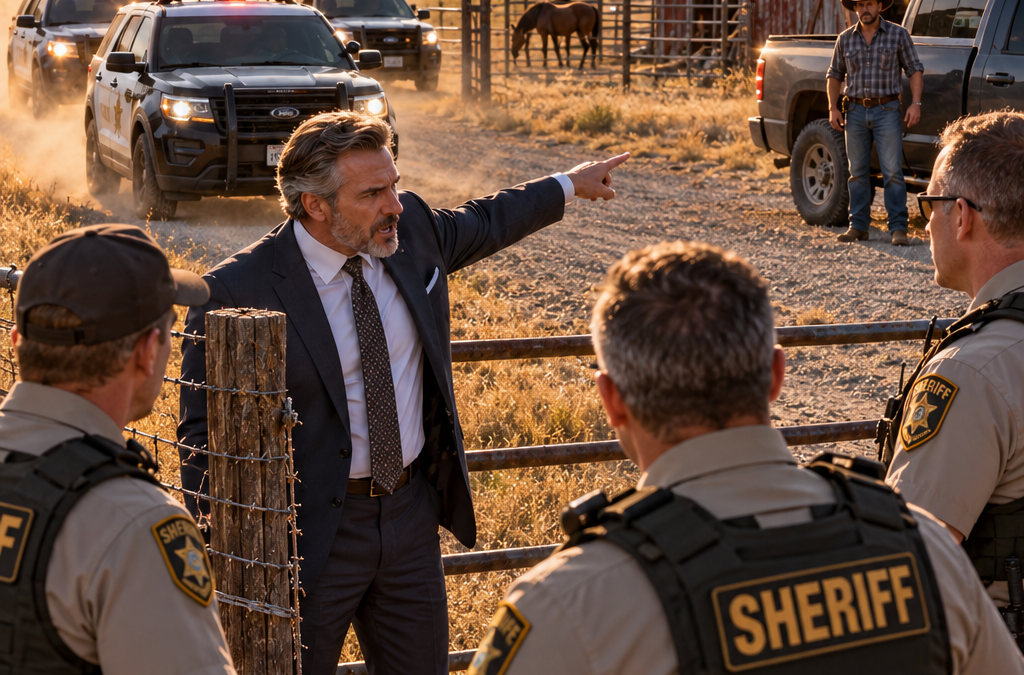
𝗙𝗨𝗟𝗟 𝗦𝗧𝗢𝗥𝗬
“I asked where you’ve been. This property has been sitting unattended for weeks.”
“It hasn’t been unattended.”
“I’ve been monitoring it.”
That got my attention.
“Monitoring my ranch?”
“Someone has to take responsibility.”
I closed my truck door.
“Karen, my neighbor has been checking the animals, and everything here is under control.”
He waved that away.
“That’s not the point.”
“Then what is?”
He stepped closer to the fence.
“The point is that you cannot simply disappear for several weeks and then return as though none of the community’s regulations apply to you.”
I stared at him.
For a moment, I thought I’d misunderstood.
“Come again?”
Karen folded his arms.
“The board has been reviewing the status of this property.”
“Your board?”
“Yes.”
“Reviewing what?”
“Compliance.”
I glanced toward the barn, then back at him.
“Compliance with what?”
“Our governing regulations.”
I almost laughed.
But Karen wasn’t smiling.
He looked irritated that I hadn’t immediately recognized his authority.
“Jake, I’ve tried being reasonable with you.”
“Have you?”
“We’ve sent notices. We’ve explained the standards. We’ve given you ample opportunities to cooperate.”
I walked toward the fence.
“Karen, we’ve had this conversation before. My ranch isn’t in Ridgecrest.”
He lifted his chin.
“That is precisely the attitude that has made this situation so difficult.”
“What situation?”
“Your refusal to acknowledge that this land exists within our community’s boundaries.”
“No,” I said. “It exists next to your community.”
“That distinction is not yours to make.”
I stopped walking.
The sentence hung between us.
“Actually,” I said, “when we’re talking about my property, that distinction is very much mine to make.”
A flush rose along his collar.
He adjusted his cuff.
“You’re going to regret taking that position.”
I studied him.
“Is that a threat?”
“It’s a warning.”
“About what?”
He reached into his jacket and pulled out his phone.
“About what happens when a property owner refuses to comply with lawful authority.”
I looked at the phone.
“Karen, put that away. You’re embarrassing yourself.”
His eyes hardened.
That was my mistake.
I should have known a man like Karen could tolerate almost anything except being told he wasn’t important.
He turned away, dialed, and began speaking before I had even reached my barn door.
“Yes, I’d like to report a serious property compliance issue at Ridgecrest Estates.”
I stopped.
He continued.
“We have an individual on a parcel under our community’s jurisdiction who is refusing to acknowledge enforcement instructions.”
I walked back toward the fence.
“Karen.”
He held up one finger.
“Yes, he’s currently on the property. He’s been warned repeatedly.”
“Karen, don’t do this.”
He looked directly at me.
“I believe officer assistance is necessary to resolve the situation before it escalates.”
Something cold settled in my stomach.
Not because I was afraid of talking to the police.
I had lived in the county my entire life. I knew several deputies by name. I had never been arrested, never been charged with anything, and had nothing to hide.
But I understood what Karen was doing.
He wasn’t calling because somebody was hurt.
He wasn’t reporting a break-in, a fire, or a threat.
He was trying to turn a property disagreement into a police matter because he believed an officer’s badge would accomplish what his letters couldn’t.
He wanted me removed.
From my own home.
Karen ended the call and slipped his phone back into his jacket.
“There,” he said.
I looked at him.
“What exactly did you tell them?”
“The truth.”
“Which is?”
“That you are occupying property subject to HOA regulation and refusing to follow lawful instructions.”
I shook my head.
“You understand that’s not the same as trespassing.”
“That will be for the sheriff to determine.”
“The sheriff doesn’t determine who owns land because the neighborhood president dislikes somebody’s barn.”
Karen gave me a thin smile.
“We’ll see.”
I stood there watching him return to his Escalade.
He leaned against the front fender, crossed his arms, and waited.
Like a man waiting for a tow truck to remove a car from his reserved parking space.
For a moment, anger surged through me so sharply that I wanted to walk down to the gate and tell him exactly what I thought of him.
But then I remembered something Dad used to say.
Never get so angry that you forget where you put the proof.
I turned and walked toward the house.
Inside, everything smelled exactly as it had when I left.
Wood polish.
Old coffee.
Leather.
The faint dusty sweetness of the cedar cabinets my mother had insisted on installing thirty years earlier.
I passed the kitchen table and went directly to the narrow office beside the living room.
The old filing cabinet stood against the wall.
Dad had kept it locked when he was alive.
Not because there was anything valuable inside in the usual sense.
No cash.
No jewelry.
No weapons.
Just paper.
Property deeds.
Tax records.
Survey maps.
Water rights.
Receipts.
Old correspondence from the county.
The boring documents that had allowed our family to keep the ranch through droughts, disputes, and changing neighbors.
I unlocked the top drawer.
Inside was a thick brown folder with my grandfather’s name written across the front.
I lifted it carefully.
The paper smelled old.
On the first page was the original recorded deed establishing the family ranch.
Behind it were later boundary confirmations, county maps, and a detailed survey that my father had commissioned when development first began spreading east.
I’d read those documents dozens of times.
Most people never think about property lines until someone questions them.
My father thought about them constantly.
And now I understood why.
Outside, the distant growl of an approaching engine carried through the open window.
Then another.
And another.
I looked up.
Three sheriff’s vehicles turned off the county road.
Their tires kicked dust into the afternoon light as they passed through the open gate.
I closed the folder.
Karen was already walking toward them.
He was smiling.
Not a friendly smile.
The satisfied expression of a man who believed he had finally arranged the world exactly the way he wanted it.
I picked up my father’s records and walked outside.
The lead vehicle stopped near my truck.
Sheriff Daniel Mercer climbed out.
He was in his late fifties, broad-shouldered, with weathered features and the steady movements of someone who had spent decades dealing with people at their worst.
Two deputies emerged from the other vehicles.
One stayed near the driveway.
The other approached with the sheriff.
Karen hurried forward.
“Sheriff, thank goodness. I appreciate you responding so quickly.”
Mercer looked past him toward me.
“Jake.”
“Sheriff.”
“You doing all right?”
“I was until about fifteen minutes ago.”
Karen cleared his throat loudly.
“Sheriff, this is the individual I told you about.”
Mercer turned toward him.
“The individual?”
“The noncompliant property occupant.”
I felt my jaw tighten.
Mercer glanced at me again.
“Jake, what’s going on?”
I held up the folder.
“Apparently, the president of the HOA next door believes he owns my ranch.”
Karen’s face stiffened.
“That’s a deliberate misrepresentation.”
I looked at him.
“Then explain it correctly.”
He stepped toward the sheriff.
“This parcel falls within the greater Ridgecrest community area. Mr. Jake has repeatedly refused to comply with the rules established to protect our property values and neighborhood standards.”
Mercer listened without interrupting.
When Karen finished, the sheriff asked one question.
“Does he own this ranch?”
Karen blinked.
“That’s not the relevant issue.”
“It is to me.”
“Ownership doesn’t exempt someone from applicable community regulations.”
“Maybe not, if the property is legally subject to them,” Mercer said. “I’m asking whether Jake owns this land.”
Karen hesitated.
“He’s the recorded owner, yes.”
“All right.”
Mercer turned toward me.
“Jake, is there a court order restricting you from entering your property?”
“No.”
“Any active eviction order?”
“No.”
“Any other legal reason you can’t be here?”
“None that I’m aware of.”
Karen interrupted.
“Sheriff, you’re missing the larger issue.”
Mercer faced him.
“Then help me understand it.”
Karen opened a black leather binder he had carried from his SUV.
Inside were plastic sleeves filled with printed regulations, maps, highlighted paragraphs, and neatly organized tabs.
He held it with the pride of a man unveiling evidence at a murder trial.
“Article Four, Section Seven,” he announced. “Exterior maintenance and neighborhood appearance.”
Mercer examined the page.
“All right.”
“And Article Six, Section Two. Activities affecting community welfare.”
“Go on.”
“Mr. Jake has failed to maintain this parcel according to Ridgecrest standards. There are agricultural vehicles in plain view, unapproved structures, and activities inconsistent with the residential character of the community.”
I looked toward my tractor.
It was parked beside the barn, exactly where it had been for twenty years.
“Unapproved structures?” I repeated.
Karen pointed at the barn.
“That building, for one.”
I nearly dropped the folder.
“My grandfather rebuilt that barn before your subdivision existed.”
“Age does not confer exemption,” Karen snapped.
Mercer raised a hand.
“Hold on.”
Karen stopped.
The sheriff tapped the binder.
“These are HOA rules.”
“Correct.”
“Where is the document showing Jake’s property is subject to this HOA?”
Karen looked confused.
“The governing documents are right there.”
“Those tell me what your rules are. I’m asking what gives your association the legal authority to enforce them on his parcel.”
Karen glanced at me.
I said nothing.
“Ridgecrest surrounds the eastern and southern boundaries of this property,” Karen answered.
Mercer waited.
Karen continued.
“The ranch is effectively inside the larger community footprint.”
“That’s geography,” the sheriff said. “I’m asking about legal authority.”
Karen’s smile disappeared.
“I don’t understand the distinction.”
“Just because a property sits beside an HOA doesn’t mean the HOA governs it.”
“That is an overly simplistic interpretation.”
“Maybe. But it’s the starting point.”
Karen adjusted his tie.
“Our board has recognized this land as part of the greater Ridgecrest development area.”
“Did Jake sign an agreement?”
“No.”
“Did his father?”
“Not to my knowledge.”
“Is there a recorded declaration legally binding this particular property to the association?”
Karen’s eyes moved toward his binder.
“There are maps.”
Mercer nodded slowly.
“Then let’s see them.”
That was the first moment I saw uncertainty in Karen’s face.
It wasn’t fear yet.
It was the expression of a man who had spent years confusing other people’s reluctance to argue with proof that he was right.
I stepped forward.
“Sheriff, I have the original ranch records.”
Karen turned sharply.
“Those are outdated.”
I looked at him.
“You haven’t even seen them.”
“They predate the development.”
“Exactly.”
Mercer held out his hand.
“Let’s have a look.”
I opened the folder.
And the conversation changed.
Sheriff Mercer took the oldest deed first.
He unfolded it on the hood of his patrol vehicle, using both hands to keep the brittle edges from catching the wind.
The deputies moved closer.
Karen stood opposite me, watching with the rigid impatience of a man forced to sit through an explanation he believed should have been unnecessary.
Mercer studied the document.
“How long has your family owned this property, Jake?”
“My grandfather purchased the original tract in 1948. My father took it over later, and the property passed to me after he died.”
“And it’s been continuously used as a ranch?”
“Yes, sir.”
“Any part of it ever sold to the development company?”
“No.”
“Any annexation agreement?”
“None.”
He examined the recording information at the top of the deed.
Then he looked at the survey beneath it.
“This was prepared when?”
“Originally in the fifties. The county confirmed the boundaries again in 1998. Dad commissioned another survey when the developers started buying land around us.”
Mercer nodded.
“Do you have that later survey?”
I reached into the folder and pulled out a larger sheet.
The paper was newer but worn along the folds.
Dad had marked several points in pencil.
The eastern fence.
The old creek crossing.
The northern access road.
The original stone marker near the cottonwood grove.
I touched one of those pencil marks.
“That’s where Dad made me help dig out the old corner post when I was seventeen.”
Mercer glanced at me.
“Still there?”
“Last time I checked.”
He laid the survey beside the deed.
Karen made an impatient noise.
“Sheriff, surely you aren’t suggesting that a decades-old ranch map takes precedence over our current development documents.”
Mercer didn’t look up.
“I’m suggesting we establish what land we’re talking about before anybody claims authority over it.”
“Our subdivision has been legally operating for years.”
“That may be true.”
“Then this shouldn’t be complicated.”
“It wouldn’t be,” Mercer said, “if your association had brought something showing Jake agreed to be part of it.”
Karen’s jaw tightened.
He opened his binder again.
“Here.”
He extracted a large color map.
It was an impressive document.
Bright green sections marked parks and recreational spaces.
Blue lines identified drainage corridors.
Residential streets curved around neatly shaded lots.
Near the center was a broad area outlined in yellow.
My ranch.
Except it wasn’t labeled as my ranch.
It was labeled Ridgecrest Community Agricultural Reserve.
I stared at the words.
For several seconds, I couldn’t speak.
“What is that?”
Karen looked almost relieved.
“That is the community master plan.”
“I can see that. Why does it have my ranch listed as a community reserve?”
“Because the property lies within the broader development boundary.”
I looked at him.
“Who gave you permission to put that on a map?”
“The planning committee approved the designation.”
“Your planning committee?”
“Yes.”
“Karen, that’s my pasture.”
He spread his hands.
“The map reflects the community’s long-term land-use intentions.”
I could feel my pulse beating in my throat.
“Intentions?”
Mercer lifted the map closer to his face.
“Karen, was this property actually transferred to the association?”
“The designation was approved internally.”
“That’s not what I asked.”
“The board voted.”
“Did the landowner agree?”
Karen glanced at me.
“Mr. Jake has consistently refused to cooperate.”
I let out a breath.
“So you held a meeting, voted to call my ranch something else, and decided that made it yours?”
“Don’t be childish.”
That did it.
I stepped toward him.
“Childish?”
Karen straightened.
“Yes. You’re allowing sentimentality to interfere with responsible regional management.”
For a second, I saw my father standing beside the eastern fence, leaning on a shovel with sweat running down his face.
He had spent his entire life protecting this place.
And now a man who had never repaired a fence post here was telling me the land belonged to his committee because they had colored it yellow on a map.
I pointed at the document.
“My father buried his father on this land.”
Karen’s expression barely changed.
“That doesn’t alter the zoning.”
“My family worked these fields before your neighborhood existed.”
“And times change.”
“Not ownership.”
His eyes narrowed.
“Ownership comes with responsibilities, Jake.”
“So does making accusations.”
Mercer stepped between us.
“Enough.”
His voice wasn’t loud.
It didn’t need to be.
“Both of you take a step back.”
I did.
Karen hesitated before obeying.
Mercer turned the HOA map sideways and placed it over the older survey.
He asked Deputy Ruiz to hold the corners.
Then he studied the boundaries.
At first, nothing happened.
He followed one line with his finger.
Then another.
His expression changed.
“Ruiz.”
“Sir?”
“Look at the eastern boundary here.”
The deputy leaned closer.
Mercer tapped a shaded section.
“What’s this parcel number?”
Ruiz read it aloud.
Then Mercer pointed to the old survey.
“And what’s this one?”
The deputy looked between them.
“Same parent tract reference.”
Mercer nodded slowly.
“That’s what I thought.”
Karen moved forward.
“Is there a problem?”
The sheriff ignored him for another moment.
He traced the line marking my eastern pasture.
Then he traced the line on Karen’s map.
The two boundaries did not match.
Not by a few inches.
Not by the width of a fence post.
By a substantial strip of land running along the eastern side of my ranch.
“Jake,” Mercer said, “have you ever seen this HOA map?”
“Never.”
“Did anyone tell you the association was claiming this section?”
“No.”
Karen lifted his chin.
“The land was included in our master planning documents.”
Mercer pointed to the map.
“This appears to overlap Jake’s recorded property.”
“That’s a mapping issue.”
“How big an issue?”
“Minor.”
Deputy Ruiz shook his head.
“Sheriff, this isn’t minor.”
He pointed to a second boundary marker.
“Look at the north corner. The HOA line crosses the old ranch tract, then runs down toward the creek.”
Mercer examined it.
“You’re right.”
I leaned in.
The more I looked, the worse it became.
The HOA hadn’t merely placed its boundary near mine.
Its map appeared to absorb a long section of pasture and identify part of it as community-controlled land.
That was why Karen kept talking about compliance.
That was why he’d grown bolder.
He wasn’t simply trying to make me repaint my barn.
He had convinced himself that his association possessed some kind of authority over the ranch itself.
“Karen,” Mercer said, “where did this boundary information come from?”
“The developer’s original planning materials.”
“Who prepared them?”
“Our development consultants.”
“Do you have a recorded deed conveying this overlapping land to the HOA?”
Karen’s face tightened.
“I have the approved map.”
“A map isn’t a deed.”
“It was professionally prepared.”
“That doesn’t answer the question.”
Karen looked from the sheriff to the deputies.
Then he looked at me.
His expression hardened.
“Jake has been deliberately obstructive for years. You cannot allow a single property owner to undermine an entire residential community.”
Mercer folded his arms.
“I’m not letting anybody undermine anything. I’m trying to figure out whether your association has been claiming property it doesn’t own.”
The words landed like a hammer.
Karen stopped moving.
For the first time since the police arrived, he had nothing immediate to say.
I looked down at the map.
Something bothered me.
The outline of the ranch was wrong.
The label was wrong.
But there was another detail.
A narrow strip along the northeastern corner was marked as a common-access corridor.
I followed it with my finger.
“What’s this?”
Karen glanced over.
“A designated community access area.”
“That’s my north pasture.”
“It provides important connectivity for the development.”
“Connectivity to what?”
“The future recreational area.”
I stared at him.
“There’s no recreational area.”
“Not yet.”
The deputy looked at Karen.
“You’re saying the HOA planned future access across land Jake owns?”
Karen hesitated.
“The property was identified during the development process.”
“Identified by whom?” I asked.
“The board.”
“For what?”
“Community purposes.”
I laughed once.
It wasn’t because anything was funny.
It was the sound a man makes when the situation has become so unreasonable that anger doesn’t know where to go.
“You were planning trails through my pasture.”
Karen’s eyes flashed.
“Public amenities improve the entire area.”
“Not when you put them on private land without permission.”
“You’re being selfish.”
I turned toward him.
“Selfish?”
“Yes.”
He gestured toward the distant rooftops.
“Hundreds of residents have invested their savings in this community. They expect attractive surroundings, responsible land use, and access to the amenities they’ve been promised.”
“So you promised them something you didn’t own.”
“That’s not what I said.”
“It’s exactly what you said.”
Mercer raised his hand again.
“All right. We’re not resolving this by shouting.”
He took a photograph of the two maps.
Then he turned toward his vehicle.
“I’m calling the county records office.”
Karen immediately stepped after him.
“Sheriff, I really don’t believe that is necessary.”
Mercer stopped.
“Why not?”
“Because these are private community governance matters.”
“You requested law enforcement assistance.”
“To address noncompliance.”
“And now we’re checking the basis for your complaint.”
Karen’s lips pressed together.
“It seems excessive.”
Mercer looked directly at him.
“You called three patrol units to remove a man from his own ranch because he wouldn’t follow your association’s rules. I’d say checking whether those rules apply is the least we can do.”
Karen’s face reddened.
I looked away.
Not because I felt sorry for him.
Because I was trying very hard not to smile.
The sheriff climbed into his vehicle and made the call.
I remained near the hood with Deputy Ruiz.
Karen stood several feet away, scrolling through his phone with sharp, irritated movements.
After a minute, Ruiz looked at me.
“You really just got back today?”
“About ten minutes before he called.”
He glanced toward the house.
“That’s one heck of a welcome.”
“Tell me about it.”
“How’s the ranch doing otherwise?”
I looked toward the pasture.
“Ask me after I see what three weeks away did to the water pump.”
He smiled faintly.
Then his expression grew serious.
“Jake, I’m not a land surveyor, and I’m not going to pretend I know what the county will find. But keep those originals safe.”
I looked down at the folder.
“I plan to.”
“Make copies.”
“Already have.”
He nodded approvingly.
“My father used to tell me paperwork was the difference between owning something and proving you owned it.”
I looked at him.
“My father said almost exactly the same thing.”
We stood quietly for a moment.
Then Karen approached again.
He was holding his phone.
“I’ve spoken with the board.”
I didn’t respond.
“They’re extremely concerned about the sheriff’s interpretation of this matter.”
Ruiz looked at him.
“The sheriff is checking the records.”
“And in the meantime, our governing documents remain in force.”
“Over your members’ property, to the extent they’re legally enforceable,” Ruiz said.
Karen ignored him.
“Jake, the board is prepared to offer you one final opportunity to cooperate.”
I stared at him.
“You’re doing this now?”
“Yes.”
“While the sheriff is checking whether you have any authority over my ranch?”
Karen’s smile returned.
It was uglier than the first one.
“The board can suspend enforcement of certain penalties if you agree to acknowledge the association’s jurisdiction.”
I looked at his phone.
“What penalties?”
“Outstanding compliance assessments.”
“How much?”
“That information can be discussed privately.”
“How much, Karen?”
He hesitated.
“Approximately twelve thousand dollars.”
For a moment, I honestly thought I’d misheard.
“Twelve thousand?”
“Accumulated violations.”
“For what?”
“Maintenance deficiencies. Unauthorized agricultural equipment. Architectural noncompliance. Failure to respond to official notices.”
I stared at him.
Then I looked at Ruiz.
“Deputy, did you hear that?”
Ruiz’s expression had become very still.
“I did.”
Karen hurried to explain.
“These assessments have been properly reviewed by our compliance committee.”
“Karen,” I said quietly, “you’ve been fining me for living on my own ranch?”
“Your refusal to participate in the process doesn’t invalidate the process.”
“Show me where I agreed to it.”
“The community’s boundaries—”
“No.”
My voice came out sharper than I intended.
“No more boundaries. No more community standards. No more pretending a board meeting gives you the right to take what belongs to somebody else.”
Karen’s smile vanished.
“Careful, Jake.”
I stepped closer.
“You’ve called the police. You’ve accused me of violating rules I never agreed to. You’ve drawn my land into your development maps. And now you’re telling me I owe you twelve thousand dollars.”
“You’d be wise not to make this personal.”
I looked at him for a long moment.
“My father spent fifty years keeping this ranch alive.”
My voice lowered.
“He worked when he was sick. He worked when he was exhausted. He worked after my mother died because he said the animals still needed feeding and the fences still needed fixing.”
Karen said nothing.
“When he got too old to climb onto the tractor, I climbed onto it for him. When he couldn’t walk to the far pasture, I drove him there so he could see the cattle. And when he died, I promised him I’d take care of this place.”
I pointed toward the barn.
“So don’t stand here in your polished shoes and tell me not to make it personal.”
For the first time, Karen looked away.
But only for a second.
Then he straightened.
“Emotional arguments won’t protect you from legal consequences.”
“No,” I said. “That’s what my documents are for.”
Behind us, Sheriff Mercer opened his patrol vehicle’s door.
He stepped out with his phone still in his hand.
His expression had changed.
Karen noticed immediately.
“Sheriff?”
Mercer looked at me first.
“Jake, the county has located the original ranch records.”
I nodded.
“And?”
“The recording dates match what you brought.”
Karen started to speak.
Mercer held up a hand.
“There’s more.”
The sheriff glanced toward the HOA map.
“The county’s preliminary index shows that Ridgecrest was formed decades after this property was established. Your ranch was listed as a separate tract when the development began.”
I felt some of the tension leave my shoulders.
Karen immediately objected.
“That doesn’t mean subsequent development agreements weren’t executed.”
“Correct,” Mercer said.
Karen seized on that.
“Exactly.”
“But so far, the county hasn’t found a recorded annexation agreement signed by Jake or his father.”
Karen went pale beneath his carefully maintained tan.
Mercer continued.
“And there’s a discrepancy involving the land used to define the HOA’s original boundaries.”
The wind moved across the driveway.
Nobody spoke.
Then Karen asked, very quietly, “What kind of discrepancy?”
Mercer looked at him.
“The kind that needs more than a patrol officer and a binder full of community rules.”
He turned toward Deputy Ruiz.
“Get the county land-records division on the line again. Ask them to send someone with the certified documents.”
Ruiz nodded and stepped away.
Karen opened his mouth.
Closed it.
Then asked, “Is there some misunderstanding?”
Mercer watched him.
“That’s what we’re trying to determine.”
I looked toward the house.
The familiar porch.
The old water trough.
The windmill turning slowly beyond the barn.
I’d come home expecting to repair fences.
Instead, a county investigation was beginning in my driveway.
And the man who had started it was beginning to understand that he might not be able to stop it.
Karen walked back toward his Escalade.
He stood beside the driver’s door, speaking urgently into his phone.
I couldn’t hear everything.
But I heard enough.
“They’re questioning the master declaration.”
A pause.
“No, I don’t think you understand.”
Another pause.
Then, louder:
“I need every board member here. Immediately.”
He ended the call and looked toward me.
The arrogance was still there.
But something else had appeared beneath it.
Fear.
Not fear of me.
Fear of a process he no longer controlled.
Twenty minutes later, the first HOA board member arrived.
Then another.
Then a third.
Within half an hour, three expensive vehicles were parked near my ranch gate, and their occupants were walking toward the sheriff with the strained expressions of people who had been told there was a serious problem but not what it was.
Karen greeted them halfway down the driveway.
I recognized Laurel Price, the HOA treasurer, and Frank Bennett, the board secretary. The third was a younger man named Andrew Cole, who handled the association’s architectural committee.
Laurel had always seemed reasonably polite.
Frank was quiet.
Andrew had once sent me a letter complaining that my barn roof was visually inconsistent with Ridgecrest’s architectural character.
I remembered because Dad had laughed about it for nearly a week.
Now none of them were smiling.
Karen began speaking before they reached the sheriff.
“There’s been an unfortunate misunderstanding involving historical property documentation.”
Laurel frowned.
“What misunderstanding?”
“Certain old records are being interpreted as conflicting with the association’s boundaries.”
Frank looked at me.
“Jake?”
“Afternoon.”
“What happened?”
I gestured toward Karen.
“Your president called the sheriff because I came home.”
Frank blinked.
“He did what?”
Karen snapped, “That’s a gross oversimplification.”
I shrugged.
“Ask him.”
Laurel turned toward Karen.
“You called law enforcement?”
“Yes, because Jake has repeatedly refused to acknowledge HOA jurisdiction.”
“Over the ranch?”
“Over the property included within the development’s planning area.”
Frank stared at him.
“I thought we were still trying to establish whether the ranch was included.”
Karen looked irritated.
“That issue was settled.”
“When?”
“At the last compliance review.”
Frank shook his head.
“We reviewed the map. We didn’t review the deed.”
The sentence caught everyone’s attention.
Karen turned sharply.
“Frank.”
“What?”
“Be careful what you’re saying.”
Frank looked at the deputies.
Then he looked at me.
“I’m not saying anything that isn’t true.”
Laurel crossed her arms.
“Karen, what exactly did you tell the sheriff?”
“The association’s position.”
“Did the board authorize you to request Jake’s removal?”
Karen hesitated.
“I acted within my responsibilities as president.”
“That wasn’t my question.”
Mercer approached.
“Good afternoon. I’m Sheriff Mercer.”
The board members introduced themselves.
Mercer explained the situation without embellishment.
He showed them the historical survey, the HOA map, and the sections where the boundaries appeared to overlap.
Laurel studied the documents.
Her expression changed immediately.
“Wait.”
She moved closer.
“That’s the eastern reserve.”
Karen nodded quickly.
“Yes.”
Laurel looked at him.
“Karen, that reserve is listed as an association asset.”
I turned toward her.
“What?”
She looked uncomfortable.
“Our annual financial statements identify it as part of the common-property inventory.”
My mouth went dry.
“Your HOA has been listing my pasture as an asset?”
Laurel didn’t answer immediately.
Karen intervened.
“That’s an accounting classification.”
“An accounting classification?” I repeated.
He gestured impatiently.
“Part of the broader planning structure.”
Laurel looked at him.
“Karen, we used that land designation when presenting the recreational expansion proposal.”
Frank slowly lowered his head.
Andrew opened his mouth.
Then closed it again.
I looked at the sheriff.
“Sheriff, are you hearing this?”
Mercer nodded.
“I am.”
For the first time, I understood that the problem might go far beyond one angry HOA president.
My land wasn’t merely appearing on a map.
It was appearing in the association’s records.
The HOA had apparently been presenting portions of my ranch as though they belonged to the neighborhood.
And those representations were being used to justify decisions involving residents’ money.
Karen turned toward Laurel.
“This discussion is inappropriate.”
She looked at him.
“Why?”
“Because we’re speaking in front of an outside property owner.”
I stared at him.
“An outside property owner?”
“Yes.”
“You’ve spent the last hour claiming I’m inside your jurisdiction.”
Karen’s face tightened.
Frank glanced down.
A muscle moved in his jaw.
Mercer looked directly at Karen.
“You asked law enforcement to intervene in this dispute. You don’t get to decide that the relevant evidence is suddenly private because it raises questions about your claims.”
Karen stiffened.
“I am not accustomed to being spoken to this way.”
Mercer didn’t move.
“Then I suggest you get accustomed to answering questions.”
The silence that followed was almost painful.
Laurel looked at the HOA map again.
“Where did this boundary come from?”
Karen answered immediately.
“The developer.”
“Did we ever verify the underlying deed?”
“That wasn’t necessary.”
“Why not?”
“Because the development plan was approved.”
Frank shook his head.
“Approved for planning purposes. That doesn’t mean every property shown on it was transferred.”
Karen turned on him.
“You’ve been secretary for six years, Frank. Don’t suddenly pretend you have concerns about procedures you approved.”
Frank met his eyes.
“I approved minutes and board notices. I never approved taking Jake’s ranch.”
The words left Karen standing alone in the center of my driveway.
And the strangest thing was that he still seemed unable to accept what was happening.
He had expected everyone to rally behind him.
He had expected uniforms, titles, and committee positions to settle the argument.
Instead, each new person who examined the documents started asking the same question.
Where was the proof?
The county vehicle arrived shortly afterward.
A white SUV with the county seal on its doors rolled up the driveway and stopped behind the sheriff’s patrol car.
A woman in her early sixties stepped out carrying a reinforced document case.
She introduced herself as Martha Ellis, senior records examiner for the county land-records office.
I’d met her once before, years earlier, when Dad had needed a certified copy of a water-rights record.
She remembered me.
“Jake.”
“Ms. Ellis.”
“I’m sorry we’re meeting under these circumstances.”
I managed a tired smile.
“Me too.”
She looked toward the cluster of people gathered around the patrol vehicle.
“Apparently, we’ve got some maps to straighten out.”
Karen immediately stepped forward.
“Mrs. Ellis, I’m Karen, president of Ridgecrest Estates.”
“I know who you are.”
He extended his hand.
She shook it briefly.
“Our association has been operating under a county-recognized development structure for years,” he began. “I trust this is a routine verification.”
Martha looked at him.
“I wouldn’t call it routine.”
Karen’s hand dropped to his side.
She placed her case on the hood of the county SUV and opened it.
Inside were certified copies of recorded deeds, plats, historical surveys, and several documents from the subdivision’s original development file.
She arranged them carefully.
Then she looked at the sheriff.
“Before I explain anything, I want to be clear. I’m here to establish what the county’s recorded documents show. I’m not a judge, and I cannot settle every private property dispute standing beside a truck.”
Mercer nodded.
“Understood.”
“But these records are enough to identify whether the association has a documented basis for its claim.”
She opened the first folder.
“This is the recorded deed for the original ranch parcel.”
I recognized my grandfather’s name.
My throat tightened unexpectedly.
Martha continued.
“The ranch was established as an independent property decades before Ridgecrest Estates was proposed. The county’s later boundary confirmations preserve that separate tract.”
Karen leaned forward.
“That much is already understood.”
Martha glanced at him.
“Then let me finish.”
He stepped back.
She opened a second document.
“This is the original development plat submitted for Ridgecrest.”
The board members gathered closer.
“The developer purchased several neighboring parcels. Those parcels were later combined and subdivided into residential lots and common areas.”
She pointed to the outer boundary.
“This is the development’s recorded property line.”
Then she placed my father’s survey beside it.
The boundaries matched.
Not the newer HOA promotional map.
The actual recorded development plat.
And there, running along the western edge of Ridgecrest, was the line separating the subdivision from my ranch.
Clear.
Unmistakable.
Martha placed one finger on the line.
“This is where Ridgecrest ends.”
Then she moved her finger across the paper.
“And this is where Jake’s property begins.”
For several seconds, nobody moved.
I stared at the boundary.
It was such a simple thing.
A line on paper.
My father had spent years explaining why that line mattered.
Now, surrounded by deputies, county officials, and HOA board members, I could almost hear him again.
They can build right up to the fence, son. They just can’t move the fence by voting on it.
Karen finally spoke.
“But that doesn’t account for the later community master plan.”
Martha nodded.
“That’s the problem.”
She produced another document.
“The master plan your association has been using includes land that was not conveyed to the developer or the HOA.”
Karen’s face hardened.
“That is a matter of interpretation.”
“No,” Martha said. “The parcel identifiers are recorded. The ownership history is documented. The problem is that the map your association has relied upon is inconsistent with those records.”
She turned to Laurel.
“Are you the treasurer?”
“Yes.”
“Has the association represented the disputed land as community property?”
Laurel hesitated.
Karen immediately said, “Our internal financial documents are not relevant.”
Martha looked at him.
“I asked the treasurer.”
Laurel swallowed.
“Yes. Portions of it appear in our common-area inventory.”
“On what basis?”
Laurel looked at Karen.
Then at the map.
“The master declaration.”
Martha opened a third folder.
“That’s what I was afraid of.”
The words made my stomach drop.
Karen visibly stiffened.
Martha removed a certified copy of the HOA’s founding declaration.
“This document was filed during the original organization of Ridgecrest Estates.”
Karen nodded.
“Exactly.”
“But there is a problem with its property description.”
She turned several pages.
“The declaration incorporates a larger land schedule than the developer’s recorded deeds support. That larger schedule includes part of Jake’s ranch.”
Karen lifted his hands.
“Then the description can be corrected.”
“Possibly, if it were merely a harmless mapping mistake. But there’s another issue.”
She turned to an attachment.
“This is the proposed common-property schedule supporting the association’s original formation.”
Laurel leaned closer.
I saw the color drain from her face.
Martha continued.
“The founding documents identified this disputed land as part of the common-property framework. They treated a future transfer of the tract as though it had already been completed.”
Karen spoke quickly.
“The developer assured the board that all necessary transfers were handled.”
Martha looked at him.
“Do you have the recorded transfer?”
“The developer’s attorney prepared the documents.”
“Do you have the recorded instrument?”
Karen stared at her.
Martha waited.
He finally said, “Not with me.”
She nodded.
“The county has searched the relevant grantor and grantee records. We have found no completed conveyance of this ranch land to the developer or the association.”
Frank slowly sat on the edge of a nearby concrete trough.
Laurel covered her mouth.
Andrew looked toward the road.
I watched Karen.
He was no longer polished and commanding.
Sweat had gathered along his hairline.
His expensive jacket looked strangely out of place against the dust rising from the driveway.
Martha continued.
“More importantly, the association’s formation file contains a conditional approval that required the supporting property schedule to be corrected and the necessary owner consents to be recorded.”
She held up a letter bearing an old county stamp.
“That correction was never filed.”
Karen blinked.
“What?”
“The county requested additional documentation before the declaration could be treated as complete.”
He shook his head.
“That’s impossible.”
“The request is right here.”
“No. We’ve been operating for years.”
“That doesn’t make the missing documents appear.”
Karen took a step closer.
“Are you suggesting Ridgecrest doesn’t exist?”
“The neighborhood exists,” Martha said. “The homes exist. The owners’ individual deeds exist. But the association’s claimed enforcement authority has a serious defect in its founding records.”
Laurel’s voice was barely audible.
“How serious?”
Martha looked at her.
“Serious enough that county counsel has been asked to review whether the declaration was ever validly established.”
Nobody spoke.
Not even Karen.
For several seconds, the only sounds were the windmill beyond the barn and the distant clatter of a loose gate chain.
I looked at the documents.
Then at the man who had called the police.
He had spent the entire afternoon demanding that I prove my right to stand on land my family owned.
And now the official records were raising the same question about his organization.
What right did it have to control anything?
Karen finally found his voice.
“This is an administrative technicality.”
Martha closed one folder.
“It may be an administrative failure with legal consequences.”
“You’re talking about destroying an association that represents hundreds of homeowners.”
“I’m talking about verifying whether its governing declaration was properly established.”
“The residents depend on us.”
“That doesn’t change the documents.”
Karen looked around desperately.
He turned to the sheriff.
“Surely you can see what is happening here.”
Mercer folded his arms.
“What do you think is happening?”
“Jake has orchestrated this.”
I stared at him.
For a second, I couldn’t believe what I’d heard.
“Orchestrated what?”
“This entire challenge. These old documents. The sudden questioning of our authority.”
I looked at him.
“Karen, you called the police.”
His mouth tightened.
“You knew those records would create confusion.”
“I didn’t even know you had put my ranch in your HOA’s paperwork.”
“You’ve been hostile to this association from the beginning.”
“Because you keep telling me my property belongs to you.”
Karen pointed at me.
“There. That’s exactly the attitude.”
Mercer stepped forward.
“Lower your hand.”
Karen turned toward him.
“Sheriff—”
“Lower it.”
Karen obeyed.
Mercer looked at him for a long moment.
“You contacted my office alleging Jake was unlawfully occupying property under your jurisdiction. We responded. Jake produced evidence of ownership. Your own documents raised questions about your authority. The county is now reviewing those questions.”
Karen’s chest rose and fell.
“If you’d rather we hadn’t checked,” Mercer continued, “you shouldn’t have asked us to remove a man from his home.”
Karen looked as though the sheriff had struck him.
Martha carefully collected the documents.
“This matter is being referred for formal review.”
Laurel spoke.
“What happens in the meantime?”
“The association should suspend enforcement actions based on the disputed declaration. County counsel will advise on the next steps.”
Karen immediately objected.
“You cannot expect us to stop governing the community.”
Martha met his eyes.
“I’m not giving you a personal preference, Mr. Karen. I’m telling you that continuing to issue demands under a declaration whose validity is being formally challenged could create additional legal exposure.”
He stared at her.
Then he turned toward the other board members.
“We need to discuss this privately.”
Frank stood.
“No.”
Karen blinked.
“What?”
“No more private discussions where everyone agrees with you and nobody sees the underlying records.”
Laurel nodded slowly.
“We need independent legal advice.”
Karen looked furious.
“I am the president of this association.”
“And I’m the treasurer,” Laurel said. “Which means I’m responsible for what happens to the money.”
She pointed toward the map.
“If we’ve been claiming assets we don’t own, I need to know.”
Frank added, “And if our founding declaration was never completed, every enforcement action we’ve taken needs review.”
Karen stared at them.
“You are undermining your own organization.”
Laurel looked at him.
“No, Karen. We’re trying to find out whether we had the authority to do what you’ve been telling us to do.”
The confrontation should have ended there.
I thought it might.
The sheriff had made his position clear.
The county had confirmed my ownership.
The board members were asking questions.
There was no reason for anyone to keep arguing beside my barn.
But Karen wasn’t finished.
He looked directly at me.
“Jake, you understand what this could do to the neighborhood?”
I said nothing.
“Homeowners could face uncertainty. Property transactions could become complicated. People could lose confidence in the community.”
I watched him.
“And whose fault would that be?”
His expression hardened.
“You’re the one insisting on this confrontation.”
I slowly shook my head.
“No.”
I stepped closer.
“You could have let me come home.”
Karen didn’t answer.
“You could have asked about the deed. You could have called the county yourself. You could have looked at the original development records before sending threatening letters.”
My voice tightened.
“But you didn’t.”
I pointed toward the patrol vehicles.
“You called the sheriff because you wanted somebody with a badge to frighten me off my family’s land.”
Karen looked away.
“And when that didn’t work,” I continued, “you tried to convince everyone here that my ownership was somehow less important than your plans.”
For the first time, I raised my voice.
“I didn’t ask for this, Karen. You brought it to my front door.”
He stared at me.
Then he said something that made the anger inside me turn cold.
“You should have sold this place years ago.”
The silence was immediate.
Even the deputies looked toward him.
Karen adjusted his jacket.
“The neighborhood would have been better off. The land would have been developed properly. Everyone could have benefited.”
I felt my hands curl into fists.
My father had heard those same arguments for years.
Sell.
Move.
Get out of the way.
Let somebody with more money decide what the land ought to become.
But this was the first time I’d heard a man say it with such naked contempt while standing on my driveway.
I took one breath.
Then another.
“Karen,” I said, “the only reason you can stand there and see a ranch instead of another row of houses is because my father refused to sell it.”
He watched me.
“And he was right.”
I stepped back.
There was nothing else worth saying.
Martha turned toward the sheriff.
“We have enough to refer this for legal review. I’ll send the certified records to county counsel today.”
Mercer nodded.
Then he looked at me.
“Jake, based on what we’ve established, there’s no basis for us to remove you from this property.”
I felt my chest loosen.
“I appreciate that.”
“If anyone attempts to prevent you from accessing your ranch without proper legal authority, contact my office.”
I glanced toward Karen.
“Understood.”
Mercer looked at the HOA president.
“That includes anyone trying to use law enforcement to enforce a private association claim without supporting legal documents.”
Karen said nothing.
The sheriff turned back toward me.
“Keep your records available. County counsel may need additional copies.”
“They can have whatever they need.”
Mercer extended his hand.
I shook it.
Then I watched as the deputies gathered their materials and returned toward the vehicles.
For a moment, I thought about walking back to the barn.
The afternoon was slipping away.
The cattle still needed checking.
The water pump still needed attention.
Real work was waiting.
But I couldn’t make myself move.
Because I knew the county review wasn’t going to be simple.
And I knew Karen wasn’t the kind of man who accepted defeat simply because the evidence contradicted him.
The following morning proved me right.
At 8:17, I found another letter tucked inside the mailbox beside my gate.
It wasn’t delivered by the post office.
Someone had placed it there personally.
The envelope carried the Ridgecrest Estates logo.
Inside was a notice titled Emergency Compliance Determination.
It stated that the association continued to recognize its jurisdiction over the ranch pending further review.
It instructed me to cease any activity that might alter the “community agricultural reserve.”
It also warned that additional assessments could accrue if I failed to cooperate.
I read it twice.
Then I called the sheriff’s office.
Deputy Ruiz answered.
“Jake?”
“Morning, Deputy.”
“What can I do for you?”
“Apparently, Karen didn’t hear a word anybody said yesterday.”
I explained the letter.
Ruiz was quiet for a moment.
“Can you send me a copy?”
“Already taking a picture.”
“Good. Send the original notice to county counsel too.”
I looked out the kitchen window.
Karen’s black Escalade was parked on the road beyond my fence.
He wasn’t standing outside.
He didn’t need to be.
The message was clear.
He intended to keep applying pressure.
I sent the documents.
Then I went to work.
There was a fence post near the north pasture that needed replacing. I’d noticed it before leaving for the temporary job, and three weeks away hadn’t improved it.
I carried the tools out to the truck.
For the next two hours, I worked under the morning sun.
I dug out the old post.
Cleaned the hole.
Set the new one.
Packed the earth.
There was something almost comforting about the physical effort.
A broken fence was honest.
You could see the damage.
You knew what caused it.
You knew what needed to be done.
People like Karen were different.
They could create a problem out of nothing, cover it in official-looking paper, and make you spend weeks proving that your own life belonged to you.
When I stopped for water, I noticed the Escalade was gone.
For a moment, I felt relieved.
Then my phone rang.
It was Martha Ellis.
“Jake, county counsel has reviewed the documents we collected yesterday.”
I set the water bottle down.
“All right.”
“They’ve confirmed the defect in the original association filing is substantial.”
“Does that mean the HOA has no authority over my ranch?”
“Your ranch is not included in any valid recorded annexation we could locate.”
I closed my eyes.
Hearing those words mattered more than I’d expected.
Not because I had ever doubted my ownership.
Because after a day of listening to someone challenge it, certainty felt like something I needed to hear aloud.
Martha continued.
“But there’s a larger issue.”
I opened my eyes.
“What issue?”
“The original master declaration appears to have been accepted into the records without satisfying the conditions attached to the development approval. The missing owner consent and the defective property schedule were never corrected.”
I leaned against the truck.
“What does that mean for Ridgecrest?”
“It means the declaration’s validity is under formal challenge. County counsel is preparing the necessary action, and the association will be given an opportunity to present its records.”
I looked toward the pasture.
“Is Karen going to be able to keep sending notices?”
“His association has been advised not to issue further enforcement demands based on the disputed instrument. We have a copy of the notice you received this morning.”
I sighed.
“Of course you do.”
“Jake, I want you to understand something.”
I waited.
“This is no longer just a disagreement about your property line.”
I looked at the old barn.
“I figured that out yesterday.”
“If the founding declaration was invalid, the association’s enforcement structure may not have a lawful foundation. That doesn’t automatically erase everyone’s individual property rights, and it doesn’t mean the county can dissolve a private corporation with a phone call. But the board will have to account for how it has been operating.”
I rubbed my forehead.
“How long?”
“Long enough to provide due process. Faster than anyone on that board probably expected.”
I thanked her and ended the call.
Then I stood beside the fence for a long time.
I wasn’t celebrating.
I was thinking about the families in Ridgecrest.
Most of them had done nothing to me.
They had bought homes, paid their dues, planted gardens, and gone about their lives.
Some probably believed every word Karen told them.
Others might have questioned him privately but never challenged him.
And now all of them were facing a problem created by documents most had probably never read.
I didn’t want to hurt those people.
But I couldn’t surrender my land to protect them from the consequences of their president’s decisions.
That afternoon, Laurel Price called me.
Her voice sounded exhausted.
“Jake, I hope I’m not disturbing you.”
“You’re fine.”
“I wanted to apologize for yesterday.”
I said nothing.
She continued.
“I honestly didn’t know the ranch was listed that way in our founding documents.”
“I believe you.”
“We’ve hired independent counsel.”
“Good.”
“They’re reviewing everything.”
I leaned back against the kitchen counter.
“Everything?”
“The declaration. The original development agreement. The common-area inventory. The enforcement assessments.”
I thought about the twelve-thousand-dollar figure Karen had thrown at me.
“That’s probably a good idea.”
Laurel hesitated.
“Karen is furious.”
“That doesn’t surprise me.”
“He’s telling people you want to destroy the neighborhood.”
I looked through the window.
“Do you believe that?”
“No.”
Her answer came quickly.
Then she added, “But some residents are frightened.”
I understood.
People didn’t like uncertainty, especially when their homes were involved.
“Laurel, I don’t want anything that belongs to your homeowners. I don’t want their houses, their roads, or their money.”
“I know.”
“I want my ranch left alone.”
She was quiet for several seconds.
Then she said, “I’m beginning to think that’s all you ever wanted.”
“That’s right.”
We ended the call.
For the next several days, the county review continued.
Certified records were examined.
The development’s original approvals were compared with recorded deeds.
The association’s governing documents were reviewed by independent attorneys.
What emerged was worse than the board had expected.
The original declaration had relied on a common-property arrangement that was never completed.
The developer had submitted a proposed land schedule including portions of the ranch, but the necessary conveyance had never occurred.
The county had requested corrections.
Those corrections had never been recorded.
Instead, later HOA documents had treated the proposed arrangement as final.
That error had been carried forward through years of board decisions, community maps, financial statements, and enforcement notices.
Karen had not created every defect himself.
Some had existed long before he became president.
But he had relied on those defects to claim powers that the records did not establish, and he had continued making demands after officials warned him there was a serious problem.
That distinction mattered.
The foundation had been defective.
Karen had built his authority on top of it.
And when someone questioned him, he tried to use the sheriff’s office to force obedience.
A week after my return, the county legal review reached its decisive stage.
A formal hearing had been scheduled to determine the effect of the defective declaration and the association’s continued operations.
The HOA’s attorneys submitted arguments.
The county presented the recorded documents.
The independent homeowners were given notice.
Jake’s ranch, the property Karen insisted had to be controlled for the good of the neighborhood, became the clearest evidence of what had gone wrong.
I attended the hearing.
Not because I wanted to watch Karen lose.
Because I wanted to be certain nobody would ever stand at my gate again and claim I needed permission from Ridgecrest to walk into my own barn.
The hearing room was smaller than I’d expected.
Wood-paneled walls.
Fluorescent lighting.
Rows of hard chairs.
A county seal behind the judge’s bench.
There were no television cameras or dramatic speeches.
Just attorneys, board members, homeowners, and stacks of documents.
Somehow, that made it feel more serious.
Karen sat at the front beside the association’s attorney.
He wore a charcoal suit, a silk tie, and the same expensive watch I’d seen on the day he called the police.
His hair was immaculate.
But his expression was drawn.
He looked as though he hadn’t slept properly in days.
Laurel and Frank sat a few seats away.
Neither spoke to him.
I took a seat near the back.
My father’s folder rested on my lap.
When the hearing began, the county’s attorney explained the problem.
The defect wasn’t merely that the HOA had mistakenly drawn its boundary across my ranch.
That would have been serious enough.
The deeper problem was that the association’s original master declaration had never satisfied the recorded conditions required to establish the claimed common-property and covenant structure.
The document had been repeatedly treated as enforceable despite the missing conveyances and owner consents.
The association had collected assessments and issued penalties under a governing framework whose legal foundation was now being challenged.
The HOA’s attorney argued that the organization had operated in good faith for years.
He emphasized the number of homeowners involved.
He warned against unnecessary disruption.
He pointed out that residents had relied on the association to maintain common spaces and administer neighborhood services.
The judge listened.
Then she asked a question.
“Can you identify a properly recorded, legally effective declaration establishing the association’s claimed enforcement authority over the properties at issue?”
The attorney turned a page.
He referred to the founding declaration.
The judge looked down at it.
“That is the instrument whose validity is being challenged.”
“Yes, Your Honor.”
“And the missing conditions?”
The attorney paused.
“We have not located evidence that they were satisfied.”
The room became very quiet.
The judge asked another question.
“Do you contend that Mr. Jake’s ranch was ever validly conveyed or annexed to this association?”
The attorney glanced at his notes.
“No, Your Honor.”
I felt my hands tighten around the folder.
The judge continued.
“Then why was the ranch included in the association’s claimed jurisdiction?”
There was a long pause.
Finally, the attorney answered.
“The association relied upon the development mapping and subsequent administrative practice.”
The judge looked at him.
“Administrative practice does not transfer title.”
Nobody moved.
Karen stared straight ahead.
The county attorney then presented the chain of title showing that my family’s ranch remained independent.
The recorded surveys were admitted.
The original development documents were compared with the later HOA map.
Martha Ellis explained the missing property transfer and the unfulfilled conditions.
Every step was careful.
Every conclusion rested on a document.
There was no dramatic revelation hidden in a final envelope.
No secret recording.
No surprise witness.
Just the same records my father had spent his life preserving.
At one point, Karen’s attorney requested permission for him to address the court.
The judge allowed it.
Karen stood.
He straightened his jacket.
For a brief moment, I recognized the man from my driveway.
The self-appointed ruler of Ridgecrest.
The man who believed that speaking with enough confidence made his opinion a fact.
“Your Honor,” he began, “I’ve dedicated years of my life to protecting this community.”
The judge watched him.
“I’ve worked tirelessly to preserve property values, maintain standards, and provide stability for our residents.”
He gestured toward the homeowners seated behind him.
“They depend on us.”
The judge waited.
Karen continued.
“We have rules because without rules there is disorder. People buy into a community with expectations. Those expectations deserve protection.”
I looked down at my hands.
I could feel where the skin had split from repairing the fence earlier that week.
Karen’s hands were resting on the edge of the table.
Clean.
Perfectly manicured.
He continued.
“The ranch represents a unique challenge because it sits within the larger geographic character of the development. Its agricultural activity affects the visual environment and future planning opportunities.”
The judge interrupted.
“Mr. Karen.”
He stopped.
“Yes, Your Honor?”
“Are you arguing that proximity to the community gives your association authority over property it does not own and has not validly annexed?”
He hesitated.
“I’m arguing that the broader interests of the community must be considered.”
“They have been.”
“The homeowners invested substantial sums—”
“The homeowners’ interests do not give the association the right to enforce covenants against a nonmember’s independent property.”
Karen’s mouth tightened.
The judge looked directly at him.
“Did you request that law enforcement remove Mr. Jake from his ranch?”
He glanced toward me.
“Yes.”
“Did you possess a court order establishing that he had no right to be there?”
“No.”
“Did you possess a recorded conveyance showing the ranch belonged to the association?”
“No.”
“Then what legal basis did you believe justified removing him?”
Karen looked toward his attorney.
The attorney remained silent.
Finally, Karen said, “He refused to comply with our instructions.”
The judge held his gaze.
“Instructions are not authority, Mr. Karen.”
The words seemed to empty the air from the room.
Karen sat down.
He didn’t speak again.
The hearing continued with testimony concerning the association’s formation and possible dissolution.
The board’s independent counsel confirmed that Ridgecrest’s officers could not identify a valid replacement declaration or the required owner consents.
The members had been notified of the defect.
After reviewing their options, the board had voted to accept a court-supervised dissolution rather than continue asserting authority under invalid documents.
Karen had opposed the vote.
The other directors had supported it.
The association’s remaining lawful obligations would be handled through the dissolution process, including accounting for funds, reviewing disputed assessments, and arranging any necessary transition of services that residents had previously relied upon.
The homeowners would keep their houses.
Their individual deeds would remain intact.
Public roads would remain public.
Existing lawful property rights would not simply disappear.
But the organization that Karen had treated as an unquestionable source of power would no longer be allowed to govern under the defective declaration.
When the judge delivered the ruling, she did so calmly.
She found the founding declaration legally ineffective because the required conditions had not been satisfied.
She confirmed that my ranch was independent from the association and had never been validly brought under its jurisdiction.
She approved the dissolution of the Ridgecrest Estates Homeowners Association under the documented findings and the board’s formal action.
And she ordered that the dissolution be recorded and administered according to law.
Karen did not move.
Laurel closed her eyes.
Frank lowered his head.
I sat perfectly still.
For a long time, I had imagined what it would feel like to hear a judge say the ranch belonged to me and nobody else had the right to claim control over it.
I expected relief.
Maybe satisfaction.
Maybe the fierce, triumphant happiness people feel when they finally prove someone wrong.
But the feeling that came over me was quieter.
It was grief.
Not because I’d lost anything.
Because I wished my father had been sitting beside me.
He would have listened to every word.
He would have folded his arms, nodded once, and said something plain and practical, like, Well, I guess that settles it.
Then he would have asked whether I’d fixed the water pump.
I swallowed hard.
The judge finished explaining the consequences of the ruling.
The association’s disputed enforcement assessments were to be reviewed and corrected.
No penalty could be maintained against me under Ridgecrest’s invalid claim of jurisdiction.
The association would cease operating as an enforcement body and complete the necessary dissolution procedures.
The board would have to account for its records and obligations.
Karen’s presidency was over.
Not because I had run against him.
Not because I had persuaded the homeowners to remove him.
Not because I had threatened him.
Because the authority he claimed had never rested on the legal foundation he insisted it did.
I looked across the hearing room.
Karen was staring at the table.
His expensive suit couldn’t protect him.
His polished shoes couldn’t carry him out of the facts.
And his title no longer meant what he wanted it to mean.
When the judge dismissed the hearing, people began standing.
The board members gathered their folders.
Several homeowners approached their attorneys.
Laurel spoke quietly to Frank.
I remained seated for another moment, holding my father’s documents.
Then I stood.
I was halfway toward the door when Karen stepped into the aisle.
“Jake.”
I stopped.
He looked older than he had a week earlier.
His hair was still perfect, but his face had lost the confident sharpness that always accompanied his demands.
“What?”
He glanced around.
Then he lowered his voice.
“Are you satisfied?”
I looked at him.
“With what?”
“With what’s happened.”
I studied his face.
There was resentment there.
Humiliation.
But not much understanding.
“Karen, I didn’t come home looking for a fight.”
He looked away.
“You knew this would damage the association.”
“I knew my ranch wasn’t yours.”
He shook his head.
“You don’t understand the position I was in.”
“What position?”
“The board expected results. Residents complained about the ranch. The developer’s plans had always included that land. Somebody had to take responsibility for maintaining standards.”
I stared at him.
“People complained because they didn’t like seeing cattle?”
“That was part of it.”
“And you decided their complaints mattered more than my deed?”
He said nothing.
I stepped closer.
“Here’s what you never understood, Karen.”
He looked up.
“Your job wasn’t to control everything you could see. Your job was to operate within the authority you actually had.”
His jaw tightened.
“You make it sound simple.”
“It was.”
I held up the folder.
“All you had to do was look at the records and respect the boundary.”
For a moment, I thought he might apologize.
His mouth opened slightly.
Then he glanced toward the homeowners standing near the door.
Pride returned to his expression.
“I did what I believed was necessary.”
I nodded.
“That’s the problem.”
I walked past him.
He didn’t follow.
Outside, the late-afternoon sunlight was bright enough to make me squint.
I stood on the courthouse steps and breathed slowly.
Cars passed along the street.
Someone laughed near the parking lot.
A woman hurried past carrying groceries.
The ordinary world continued.
For everyone else, it was just another afternoon.
For me, something that had been tightening around my home for years had finally been released.
The next morning, Martha Ellis called with confirmation that the court’s ruling had been entered and the dissolution order recorded.
A certified copy would be available for my records.
I thanked her.
Then I called the sheriff’s office.
Mercer answered personally.
“Heard about the ruling,” he said.
“Yes, sir.”
“Looks like your father kept some mighty useful paperwork.”
I smiled.
“He certainly did.”
There was a pause.
Then Mercer said, “Jake, I want you to know something. You handled that day at the ranch the right way.”
I looked toward the window.
“Didn’t feel like it.”
“Doing the right thing doesn’t always feel good while you’re doing it.”
I thought about Karen’s threats.
The deputies in my driveway.
The maps.
The financial assessments.
The hearing.
“I just didn’t want to lose my temper.”
“That probably made my job easier.”
I laughed softly.
“Glad one of us benefited.”
He chuckled.
Then his tone grew serious.
“You’ve got no reason to expect further enforcement from Ridgecrest. If someone shows up making threats or trying to interfere with your access, call us.”
“I will.”
“And Jake?”
“Yes?”
“Go enjoy your ranch.”
I looked out toward the pasture.
“That’s exactly what I intend to do.”
By the end of the week, the last formal notices had been distributed to Ridgecrest homeowners.
The association’s dissolution was no longer a rumor spreading through neighborhood conversations.
It was documented.
The board’s enforcement authority had ended.
The officers’ positions were terminated through the winding-up process.
Residents were informed about the transition arrangements and the review of money collected under the defective governing structure.
The community itself remained.
People still lived in their homes.
Children still rode bicycles along the streets.
Dogs still barked behind backyard fences.
The flower beds still needed watering.
The sidewalks still needed sweeping.
The world hadn’t collapsed because the HOA could no longer tell people what color their mailboxes ought to be.
I later heard that Laurel and Frank had spent days helping homeowners sort through the paperwork.
They had questions to answer.
Records to preserve.
Financial accounts to reconcile.
It wasn’t glamorous work.
But it was necessary.
Karen, meanwhile, disappeared from public view for a while.
His Escalade stopped appearing near my fence.
The notices stopped.
Nobody came to complain about my barn.
Nobody threatened me over hay bales.
Nobody demanded architectural approval before I repaired my tractor.
The silence was almost difficult to believe.
For years, every envelope bearing the Ridgecrest logo had meant another argument.
Another invented obligation.
Another reminder that somebody wanted to interfere with a life they hadn’t built.
Now the mailbox held ordinary things again.
Bills.
Advertisements.
A postcard from my sister.
A reminder about an equipment service appointment.
I had never been so happy to receive a water bill.
One Saturday, nearly two weeks after the ruling, I drove toward the north pasture with a new length of fence wire in the truck bed.
The sky was clear.
The cattle were grazing near the creek.
A hawk circled high above the western ridge.
I stopped beside the old stone boundary marker.
Dad had shown me that marker when I was a boy.
I could still remember him kneeling in the grass, brushing away dirt with the back of his hand.
“This is one of the reasons we never have to guess where we stand,” he told me.
I was maybe ten years old.
I hadn’t understood why a rock mattered so much.
He pointed toward the fence line.
“Everything on this side is ours to care for. Everything on that side belongs to somebody else. Remember both parts.”
Back then, I’d thought he was teaching me about property lines.
Now I understood he had been teaching me about respect.
Respect for what belonged to us.
And respect for what didn’t.
Karen had never understood that second part.
He viewed a boundary as an inconvenience if it stood between him and something he wanted.
He viewed disagreement as rebellion.
He viewed authority as a possession, something he could accumulate until nobody dared question him.
And when I refused to obey, he tried to borrow the sheriff’s authority to make up for the authority he didn’t have.
But a badge couldn’t change a deed.
A board vote couldn’t move an old boundary.
And a man’s confidence couldn’t turn a piece of paper into lawful ownership.
I walked along the fence, checking each post.
At the northeastern corner, I stopped and looked toward Ridgecrest.
From there, I could see the subdivision rooftops rising beyond the trees.
Neat houses.
Clean sidewalks.
Decorative landscaping.
There was nothing wrong with those homes.
Nothing wrong with the people who wanted to live there.
Nothing wrong with neighbors working together to maintain shared property when they had properly established the right to do so.
The problem had never been community.
It had been control.
And now the boundary between the two was clear.
I replaced the damaged wire.
Tightened the staples.
Checked the gate.
Then I climbed back into the truck.
As I drove toward the barn, I noticed a black Escalade moving slowly along the paved road outside the eastern fence.
For a moment, my stomach tightened from habit.
Karen.
He stopped near the entrance.
I pulled my truck to a halt.
He lowered his window.
For several seconds, neither of us spoke.
He wasn’t wearing a suit.
Just a dark polo shirt and sunglasses.
But his hair was still perfectly combed.
His expression was guarded.
“Jake.”
“Karen.”
His eyes moved toward the ranch.
“The place looks the same.”
I glanced around.
“That’s generally the idea.”
He didn’t smile.
Instead, he studied the barn.
Then the pasture.
Then the fence that separated his neighborhood from my land.
“I suppose you’ll be making changes now.”
“What kind of changes?”
“To the property.”
I leaned an elbow on the open truck window.
“I’ll repair what needs repairing.”
“And the barn?”
“Needs some paint.”
He looked at the faded red boards.
“What color?”
I considered him for a moment.
“Red.”
Karen looked away.
For the first time since I’d met him, he seemed to understand that the conversation did not require his approval.
He rested one hand on the steering wheel.
“People are still upset.”
“I know.”
“Some of them blame me.”
I didn’t answer.
He turned back.
“Do you?”
I looked at him.
“You called the sheriff to have me removed from my own ranch.”
His face tightened.
“I thought—”
“I know what you thought.”
I paused.
“You thought if you brought enough authority with you, nobody would question yours.”
He looked down.
For a moment, I could see the man beneath the expensive clothes and carefully maintained appearance.
A man who had spent so long demanding control that he seemed almost lost without it.
I didn’t hate him.
That surprised me.
I’d been angry with him.
Furious, at times.
But standing there beside the fence, I realized hatred would simply keep him involved in my life long after the dispute had ended.
I didn’t want that.
I wanted my mornings back.
My work.
My land.
My peace.
“Karen,” I said, “the ranch was here before Ridgecrest. It’ll be here after both of us are gone.”
He looked toward the pasture.
“I know.”
I waited.
Then he said quietly, “I didn’t think it would end this way.”
“Neither did I.”
He nodded once.
He didn’t apologize.
I didn’t ask him to.
There were some things an apology couldn’t undo, and I had no interest in standing beside the road teaching a fifty-year-old man how to take responsibility.
After another moment, he raised his window.
The Escalade rolled forward.
I watched it disappear beyond the curve.
Then I drove home.
That evening, I climbed the small hill west of the barn.
It was a place my father used to visit when the day’s work was finished.
From there, I could see nearly the entire ranch.
The old house sat beneath the cottonwoods.
The barn cast a long shadow across the yard.
The cattle moved slowly through the grass.
Farther out, the creek reflected the last orange light of the sunset.
I sat on the tailgate of my truck and opened the brown folder.
Inside were the certified records I’d collected after the ruling.
The original deed.
The boundary survey.
The court’s findings.
The recorded dissolution order.
I spread them across my lap.
My grandfather’s name appeared on one page.
My father’s on another.
Mine on the newer records.
Three generations.
Three names.
One piece of land.
I thought about the day Karen called the police.
How confident he had looked.
How quickly he had expected the sheriff to solve his problem.
How he had walked into my driveway believing the uniformed officers would make me surrender something he had never legally possessed.
I remembered standing beside the patrol vehicle while the sheriff studied the maps.
I remembered the moment the first boundary discrepancy appeared.
And I remembered how Karen’s expression changed when the questions stopped being about my alleged violations and started being about his association’s authority.
The first serious cracks appeared within minutes of the deputies arriving.
The investigation that followed exposed the foundation of the HOA’s entire enforcement structure.
And the official ruling had finally brought that structure to an end.
I looked at the old barn.
The wood was weathered.
The roof still needed work.
The northern fence would probably need another repair before winter.
There were bills waiting on the kitchen table.
The tractor still made an ugly grinding noise when I shifted into reverse.
Nothing about ranch life had suddenly become easy.
But the problems waiting for me were mine.
Honest problems.
Work I understood.
Responsibilities I had chosen.
I carefully returned the documents to their folder.
Then I looked across the fields.
For years, I’d sometimes caught myself wondering what Dad would think if he could see the developments spreading around the property.
Would he worry about the rising taxes?
The new roads?
The houses pressing closer to the fence?
Would he wonder whether I could hold on to the place the way he had?
I thought about the promises I’d made him during his final months.
How I’d sat beside his bed when he could no longer walk to the barn.
How I’d told him the cattle were healthy.
How I’d promised the fences were good.
How I’d assured him the ranch wasn’t going anywhere.
He’d squeezed my hand.
“Don’t let anybody make you feel like a stranger on your own land, Jake.”
At the time, I thought he was talking about the future.
Now I understood he had been preparing me for it.
The sun slipped behind the hills.
The light softened.
Somewhere near the creek, a cow called to her calf.
I closed my eyes for a moment.
Then I spoke quietly into the evening.
“We’re still here, Dad.”
The wind moved through the grass.
I sat for another few minutes before climbing down from the tailgate.
There was feed to put out.
A gate to close.
And tomorrow morning, before sunrise, there would be another day’s work waiting.
I drove toward the house as the first stars appeared.
The barn stood exactly where it had stood when I was a child.
The fields stretched away beneath the darkening sky.
The old gravel road led home.
No security guards waited at the entrance.
No HOA president stood at the fence.
No sheriff’s vehicles blocked the driveway.
There was no argument left to win.
The association had been dissolved.
My ownership had been officially confirmed.
The property records were back in the filing cabinet where they belonged.
And the land was quiet again.
I parked beside the barn, switched off the engine, and stepped out into the cool evening air.
For the first time since coming home, I didn’t look toward the road to see who might be watching.
I simply walked across the yard, slid open the barn door, and returned to the life my family had spent generations building.
The ranch had never needed Karen’s permission to exist.
And neither did I.








