𝗙𝗨𝗟𝗟 𝗦𝗧𝗢𝗥𝗬 The HOA President Called the Police on My Wheelchair—But She Had No Idea I’d Been Recording Her for Months
𝗙𝗨𝗟𝗟 𝗦𝗧𝗢𝗥𝗬
The next warning involved my charging cable.
She claimed it created an “unsightly visual hazard” when visible on my front porch.
I moved it.
Then came a warning about the rubber threshold protector at my front door.
Then one about the position of a small package shelf mounted at wheelchair height.
Each violation targeted something connected to accessibility.
Never directly enough that she had to admit what she was doing.
Always close enough that I understood.
My neighbor Rosa understood too.
She lived across from me and had been in Maple Hollow almost fifteen years.
One afternoon she leaned against my fence while I checked the mail.
“Be careful with Deborah.”
“I’m beginning to notice.”
“No. I mean careful.”
I looked at her.
Rosa lowered her voice.
“She did this to the Andersons.”
“Did what?”
“Found one thing. Then another. Then another. Fines every week. Complaints. Inspections. Letters.”
“What happened?”
“They moved.”
“Because of HOA fines?”
“Because she made them miserable.”
Rosa glanced toward Deborah’s house.
“Cross her and she finds a way to make you disappear.”
I wanted to dismiss it as neighborhood gossip.
Then the wheelchair-speed letter arrived.
FORMAL NOTICE OF MOTORIZED VEHICLE VIOLATION.
According to Deborah, my electric wheelchair exceeded Maple Hollow’s permitted sidewalk vehicle regulations.
I read the letter three times.
Then I checked my chair manual.
Maximum speed: four miles per hour.
I emailed the board.
I explained that the device was an electric wheelchair, not a recreational vehicle.
Deborah answered personally.
Mr. Kowalski,
All motorized vehicles are subject to community safety standards regardless of how the operator chooses to classify them.
Operator.
Chooses to classify.
I rolled to her house that afternoon.
She was watering flowers in heels.
“Deborah.”
She looked up.
Her expression immediately cooled.
“You received my response.”
“My wheelchair is medical equipment.”
“That’s your opinion.”
“No. That’s what it is.”
She turned off the hose.
“Steven, you’re new here, so I’ll give you some advice.”
She walked closer.
“I have run this community for over a decade. People who cooperate have very easy lives.”
“And people who don’t?”
She smiled.
“Why would you want to find out?”
I remember the silence after that.
She had threatened me without technically threatening me.
Then her eyes moved down toward my chair.
“You know, some people exaggerate disabilities because they think it gives them special privileges.”
I actually thought I had misheard.
“What did you say?”
She shrugged.
“I’ve seen people stand up from wheelchairs the second they think nobody’s watching.”
“My spine was broken in three places.”
“Documentation can be forged.”
My hands went cold.
I had endured pity.
Curiosity.
Awkward questions.
People talking to whoever stood beside me instead of speaking directly to me.
But nobody had ever looked me in the face and suggested I might be pretending.
I turned my chair around.
Deborah called after me.
“Four miles per hour is still too fast if people feel unsafe!”
I went home.
Then I called my sister.
She worked as a paralegal.
I read her every notice.
Every email.
Every strange sentence Deborah had written.
When I finished, my sister was silent.
“Steven.”
“Yeah?”
“Stop paying without documenting.”
“I have the letters.”
“Not enough. Record everything.”
“Everything?”
“Audio. Video. Dates. Times. Witnesses.”
She paused.
“She’s building a file against you.”
I looked through my front window toward Deborah’s house.
“What do I do?”
“Build a better one.”
Two days later, I mounted a discreet camera beneath my wheelchair armrest.
That camera changed my life.
The first major recording happened less than a week later.
I woke at seven in the morning and opened my front door.
Three orange traffic cones blocked my ramp.
A printed sign had been taped to one.
TEMPORARILY CLOSED FOR SAFETY INSPECTION.
I called the HOA office.
Nobody knew about an inspection.
I emailed Deborah.
No response.
The cones remained all day.
Then overnight.
Then another day.
Six days.
For six days, I could not use the only accessible entrance to my own home.
The rear door had steps.
To leave the house, I had to transfer from my wheelchair while Rosa and another neighbor carried the chair down separately.
The humiliation was difficult to describe.
People assumed losing mobility meant losing dignity automatically.
It didn’t.
What hurt my dignity was being forced to depend on neighbors for something I had already been capable of doing independently because one woman wanted to remind me who controlled the neighborhood.
On the fourth morning, Rosa helped steady me at the back steps.
“This is insane.”
“I know.”
“This is illegal.”
“I know.”
“Then why aren’t you screaming?”
Because Deborah was watching.
I could see movement behind her curtains.
I looked directly toward her window.
“Because I want her to keep doing it.”
Rosa stared at me.
“What?”
“I want everything documented.”
I pointed toward the camera on my chair.
“Every day those cones stay there, the case gets stronger.”
The next violation notice accused me of creating excessive noise with my wheelchair motor.
Fine: $200.
I almost admired the cruelty of it.
The motor sounded quieter than my refrigerator.
I paid under written protest.
Saved the receipt.
Photographed the notice.
Logged the date.
At night, my dining table disappeared beneath binders.
Then Deborah got careless.
She posted in the neighborhood Facebook group.
Some residents seem to believe ADA laws give them permission to disregard rules and make everyone else uncomfortable.
She didn’t name me.
She didn’t need to.
Within minutes, people were arguing.
Some residents defended me.
Others repeated Deborah’s language almost word for word.
If he gets exceptions, where does it stop?
Rules should apply equally.
Medical equipment still needs regulation.
I screenshotted everything.
My sister called it a gift.
“She just connected the enforcement directly to your disability.”
“Publicly.”
“Exactly.”
For the first time, I stopped feeling helpless.
I contacted a disability-rights attorney.
I sent her the Facebook screenshots, the fines, photographs of the cones, and copies of the wheelchair-speed letters.
She called me the same day.
“Do not confront her yet.”
“That’s your advice?”
“My advice is let her keep writing.”
“You want her to keep harassing me?”
“I want her to put discriminatory intent on paper.”
Deborah did better than that.
She tried to turn discrimination into official HOA policy.
A board member quietly forwarded me draft language Deborah had circulated.
The proposed rule prohibited “motorized personal transportation devices” from Maple Hollow’s common walkways.
No exception for wheelchairs.
No exception for mobility scooters.
Nothing.
My attorney laughed when she read it.
“She’s writing our complaint for us.”
“You think they’ll pass it?”
“If she does, don’t stop her.”
The night of the vote, Deborah stood behind the clubhouse podium in another red lace dress, surrounded by board members who had spent years learning not to challenge her.
She smiled at the room.
“For the protection of pedestrians and the preservation of community safety, we are modernizing our transportation standards.”
I sat in the front row.
My camera was running.
Deborah looked directly at me.
“Motorized devices will no longer be permitted on common pedestrian walkways.”
Rosa stood.
“This targets Steven.”
Deborah banged the gavel.
“You are out of order.”
“It bans his wheelchair.”
“It bans vehicles.”
“It’s a wheelchair!”
“Sit down.”
“No.”
Deborah leaned toward the microphone.
“Sit down, Rosa, or I will have you removed.”
The room became quiet.
The vote passed six to one.
Rosa was the only no vote.
Afterward, Deborah walked directly toward me with the printed rule.
Her perfume reached me before she did.
She lowered the paper into my lap.
“There you go.”
I looked up.
“What?”
“Now nobody can claim the rules are unclear.”
She smiled.
“Just following policy, Steven.”
I looked at the document.
Then at her.
“Thank you.”
Her smile faltered.
“What?”
“Thank you.”
I folded the paper and placed it in my bag.
Deborah’s eyes narrowed.
She had expected anger.
She would have known how to fight anger.
She had no idea what to do with gratitude.
That night my attorney filed the Fair Housing complaint.
We included the bylaw.
The Facebook post.
The fines.
The blocked ramp.
The emails.
Six months of targeted enforcement.
Two weeks later, a certified letter arrived at the HOA office during a public meeting.
Deborah opened it at the front table.
I watched the blood leave her face.
“Fair Housing Act investigation,” she read aloud before realizing she shouldn’t have.
The room fell silent.
Then she said the most revealing thing possible.
“This is clearly a misunderstanding.”
Nobody had accused her of anything yet.
Rosa leaned toward me.
“You patient bastard.”
I almost laughed.
Deborah deleted the new vehicle rule from the HOA website that night.
My attorney had already archived it.
Every version.
Every timestamp.
Every edit.
The following week, Deborah suddenly became friendly.
“Steven, you look wonderful today.”
“You’re so resilient.”
“If you ever need anything, you know this board supports you.”
I smiled back.
She thought she was repairing the record.
She was actually making it stranger.
Behind the fake friendliness, she hired someone to investigate me.
A private investigator parked in a gray sedan outside my house for three days.
Rosa’s husband recognized what he was doing.
The goal was obvious.
Catch me standing.
Catch me walking.
Catch me doing anything Deborah could use to suggest I was lying about my disability.
There was only one problem.
I wasn’t lying.
The investigator recorded hours of absolutely nothing useful.
Then, at six one morning, his camera captured something neither of us expected.
Deborah.
She walked from her house carrying orange traffic cones.
The same cones.
She crossed the street.
Looked around.
Then placed them directly across my ramp.
One by one.
She stood there for a moment admiring her work.
Then walked home.
The private investigator later fought with Deborah over an unpaid invoice.
He sent me the footage.
I watched it three times.
My attorney watched it once.
Then she laughed.
“She hired a witness against herself.”
We saved the video.
We did not release it.
Not yet.
Deborah escalated again.
The accessible parking space beside the community pool was suddenly repainted VISITOR PARKING ONLY.
It was the nearest accessible space to the pool entrance.
I asked the maintenance contractor who ordered the change.
He showed me the email.
Deborah Voss.
I filed a county ADA complaint.
An inspector arrived.
Measured the parking area.
Reviewed the markings.
Issued the HOA a violation.
Deborah blamed the maintenance company.
Then my sister found the email chain.
Deborah had copied herself on the repainting order.
She had literally created a written record proving her own lie.
At the next board meeting, another director requested an independent review of Deborah’s enforcement practices.
Deborah’s reaction was instant.
“No.”
“Deborah, considering the investigation—”
“We do not need outsiders interfering in private association matters.”
“We’re already under investigation.”
She slammed her palm onto the table.
“I said no.”
The room froze.
She pointed at the board member.
“If you cannot support this board, perhaps you shouldn’t be sitting on it.”
There it was.
Not governance.
Obedience.
A few weeks later, Deborah called police on me for the first time.
I was parked in my own driveway waiting for a delivery.
Two officers arrived because someone had reported a suspicious vehicle blocking the roadway.
They found me six feet from the curb.
One officer looked at my wheelchair.
Then at my garage.
Then at the street.
“This is the vehicle?”
“Apparently.”
He actually rubbed his forehead.
The call lasted two minutes.
No citation.
No warning.
But now there was a police record.
Complainant: Deborah Voss.
My attorney requested it the next morning.
“Good.”
“Good?”
“She has escalated from HOA paperwork to government resources.”
Deborah didn’t stop.
She circulated a petition demanding that I relocate my wheelchair charging station away from an outlet near the clubhouse.
Eleven people signed.
Later, several admitted Deborah had pressured them.
One woman apologized to me privately.
“She told me if I didn’t sign, the board might review my fence.”
That was how Deborah ruled.
Not through respect.
Through examples.
Punish one person publicly and everyone else learned to cooperate.
I requested a formal accommodation meeting.
The HOA’s insurance carrier sent a representative.
Deborah assumed he was there to protect her.
For twenty straight minutes she complained about “entitled residents.”
“People think disability means unlimited exceptions.”
“Some homeowners weaponize federal law.”
“You cannot run a community if one person gets special treatment.”
The insurance representative took notes.
He barely spoke.
Afterward, he pulled me aside.
“Off the record?”
“Sure.”
“You have an extremely strong case.”
That was the first time I knew Deborah’s protection was disappearing.
Then she tried to exclude me from the annual holiday parade.
Her proposed policy banned “non-standard mobility devices.”
Even her allies hesitated.
Janet, a longtime board member, texted me privately.
This has gone too far. I’ll testify.
Deborah sensed the rebellion.
Her behavior became erratic.
She sent mass emails demanding “loyalty to proper HOA governance.”
She accused residents of conspiring against her.
She began interrupting meetings.
Threatening fines.
Reminding people how long she had been president.
Then the county deadline arrived for restoring the accessible parking space.
Deborah ignored it.
She told residents the county had no authority over private HOA property.
The association was fined $5,000.
Five thousand dollars of homeowner money.
At the next meeting, more than forty residents showed up furious.
Deborah blamed me.
“This community is losing money because one litigious resident refuses to cooperate!”
People turned toward me.
I raised my hand.
She reluctantly recognized me.
I spoke calmly.
“Deborah, do you deny personally placing traffic cones across my ramp at six in the morning?”
Silence.
Her face changed.
“What?”
“Do you deny it?”
“I have no idea what you’re talking about.”
“Okay.”
That was all I said.
I rolled out.
Behind me, the room exploded into whispers.
She knew.
She finally understood that I had something.
She just didn’t know what.
That weekend, my attorney completed the full complaint.
Disability discrimination.
Harassment.
Defamation.
Retaliation.
False police reporting.
Fourteen exhibits.
Six witnesses.
One video of Deborah blocking my ramp with her own hands.
We planned to file Monday.
Sunday morning, Deborah made the biggest mistake of her life.
I left my house to collect a package.
She saw me.
Before I even reached the mailbox, she called police.
“A dangerous unregistered vehicle.”
“Threatening pedestrians.”
“Operating aggressively.”
Two patrol cars arrived.
Red and blue lights splashed across my garage.
Deborah stood proudly on her porch.
“This is him!”
The younger officer looked at my wheelchair.
“Ma’am, this is a motorized wheelchair.”
“He terrorizes people with it.”
“Who?”
“Everyone!”
The officer looked at the empty street.
“Where are the pedestrians he threatened?”
Deborah’s voice rose.
“They were here!”
“Who?”
“I don’t have their names!”
“Then what exactly happened?”
“He drives too fast.”
I looked down at my chair.
Then I laughed.
Deborah pointed at me.
“See? Look at him! He has no respect for authority!”
The senior officer stepped forward.
“Ma’am, calm down.”
“Don’t tell me to calm down. I am the president of this community.”
“That doesn’t change what I’m asking.”
“He violates our vehicle rules constantly.”
“This is medical equipment.”
“Our HOA classified it as a motorized vehicle.”
The officer stared at her.
“You classified his wheelchair as a vehicle?”
“Yes.”
Rosa was already standing on her porch with her phone out.
Other doors opened.
Neighbors emerged.
Deborah looked around at the gathering crowd.
“Everyone needs to go back inside.”
Nobody moved.
“I said go back inside! This does not concern you.”
More phones appeared.
I reached into the bag on my wheelchair and handed the senior officer a folder.
“What’s this?”
“The report from the last time she called police on me.”
His expression changed.
I handed him my attorney’s card.
Then I opened a video on my phone.
“Before you leave, I think you should watch this.”
The footage showed Deborah walking across the street at dawn.
Carrying traffic cones.
Blocking my ramp.
The officer watched silently.
Deborah saw the screen.
Her face went white.
“Where did you get that?”
The officer looked at her.
“Ma’am, did you obstruct his wheelchair access?”
“That video is illegally obtained.”
“That isn’t what I asked.”
“She’s twisting everything.”
“Did you place those cones?”
“I was conducting an HOA safety inspection.”
“At six in the morning?”
She looked at me.
Not angry anymore.
Afraid.
“You’ve been spying on me.”
I shook my head.
“No, Deborah.”
The crowd was completely silent.
“You hired someone to spy on me.”
Her eyes widened.
That was the moment she understood.
The investigator.
Her investigator.
Her own decision had created the video.
The senior officer checked the previous call report.
Then looked at her.
“You called about this same resident before.”
“He is dangerous.”
“What specifically did he do today?”
“He drove his wheelchair.”
“Where?”
“The sidewalk!”
“At what speed?”
Deborah stopped.
“Fast.”
“How fast?”
“I don’t know.”
“Did he strike anyone?”
“No.”
“Did he threaten anyone?”
“He intimidates people.”
“How?”
Silence.
The officer closed his notebook.
“Ma’am, filing a knowingly false emergency report is an offense.”
Deborah laughed sharply.
“You can’t cite me.”
“I can.”
“I am president of Maple Hollow.”
The officer’s voice stayed flat.
“State law does not contain an HOA-president exception.”
Rosa covered her mouth, trying not to laugh.
The officer wrote the citation.
Deborah stared at the paper as though she had been handed a death sentence.
“You can’t do this.”
He handed it to her.
“I just did.”
She turned on the crowd.
“This is harassment! Every one of you standing here recording me is participating in harassment.”
Nobody moved.
For years Deborah had ordered people back into their homes.
That morning, for the first time, they simply ignored her.
I rolled forward.
“Deborah.”
She looked at me.
“I have eighteen months of documentation.”
Her expression shifted.
“I have every fine.”
“What are you talking about?”
“Every email.”
She took a step back.
“Every meeting recording.”
Another step.
“The illegal wheelchair bylaw.”
She stared at me.
“The parking-space order.”
Her lips parted.
“The private-investigator footage.”
Then I said the words I had waited months to say.
“And the Fair Housing complaint.”
Her face emptied.
“What complaint?”
“Federal disability discrimination.”
“You’re lying.”
“It was filed three weeks ago.”
The crowd murmured.
Deborah’s voice dropped.
“You’ve been planning this.”
“I’ve been surviving you.”
She stared at me.
I kept my voice low.
“You just gave me enough evidence to stop surviving and start fighting.”
Someone behind Rosa applauded.
One person.
Then another.
Then five.
Deborah looked around.
The neighborhood she had ruled through fear was watching her lose control.
She turned and marched home.
Her red dress disappeared through the doorway.
The door slammed hard enough to shake the porch light.
That night, Maple Hollow’s Facebook group exploded.
The Andersons, who had moved years earlier, commented.
They confirmed Rosa’s story.
Other residents posted fine notices.
Emails.
Threats.
Warnings.
People who had stayed silent for years finally compared notes.
One week later, the HOA called an emergency board meeting.
Deborah did not attend.
For the first time in more than a decade, her chair was empty.
Janet stood before the residents holding a prepared statement.
“We failed this community by allowing one person’s personal hostility to operate unchecked under the authority of the board.”
Nobody interrupted.
A motion was made.
Immediate suspension of Deborah Voss pending state and federal investigations.
Seven votes.
Seven yeses.
Zero noes.
The same board that had once approved almost anything Deborah demanded removed her unanimously.
Two days later, my attorney publicly filed the full Fair Housing complaint.
The video was attached.
Local television picked up the story.
HOA PRESIDENT CITED AFTER POLICE CALLED ON DISABLED RESIDENT USING WHEELCHAIR.
Deborah’s face appeared on the six o’clock news.
Her attorney called the coverage one-sided.
He did not deny the recordings.
He could not.
The Fair Housing investigation moved fast after officials saw everything together.
The bylaw.
The targeted fines.
The Facebook comments.
The parking-space order.
The ramp obstruction.
The police reports.
The private investigator footage.
It was no longer possible to explain each incident away separately.
Together, they formed exactly what Sarah—my sister—had predicted months earlier.
A pattern.
Investigators determined that the conduct amounted to deliberate disability discrimination.
The HOA was ordered to pay damages.
The wheelchair rule was rescinded permanently.
The board underwent mandatory fair-housing training.
Deborah was personally named.
The false-report citation also escalated after prosecutors reviewed both police calls.
One bad call could be explained as confusion.
Two nearly identical fabricated calls against the same disabled resident were harder to excuse.
Her attorney asked for leniency.
Decades of community service, he argued.
The judge watched the video of Deborah carrying cones across the street at dawn.
Then he looked over his glasses.
“Community service does not include intentionally obstructing a disabled resident’s access to his own home.”
Deborah was fined.
Ordered to perform community service.
Formally removed from HOA leadership.
Maple Hollow’s board then voted to permanently bar her from holding office in the association again.
Her kingdom ended with paperwork.
Exactly the thing she had used for years to frighten everyone else.
Neighbors began apologizing to me.
Not dramatic apologies.
Quiet ones.
At the mailbox.
Beside driveways.
One woman lowered her eyes and said, “We should have helped sooner.”
“Why didn’t you?”
She looked toward Deborah’s house.
“We were afraid.”
I understood.
Fear had been Deborah’s real enforcement mechanism.
Not bylaws.
Not fines.
Fear of becoming next.
Rosa hugged me when the ruling became official.
“You did it.”
“We did it.”
“No. You were the insane patient one.”
I laughed.
“You carried my chair down the back steps for six mornings.”
“And complained every second.”
“That counts.”
The HOA eventually held a public apology meeting.
Janet acknowledged that the board had failed to protect a resident from discriminatory enforcement.
My accessible parking space was restored.
The illegal rule disappeared permanently.
New board members started asking disabled residents what accommodations they actually needed instead of deciding for them.
Then Deborah listed her house for sale.
Three weeks later, a moving truck arrived.
I watched from my porch.
She came outside wearing black instead of red.
No clipboard.
No heels.
No audience.
For a moment I wondered whether she would look toward me.
She didn’t.
Maybe she hated me.
Maybe she blamed me.
Maybe she still believed she had done nothing wrong.
It didn’t matter anymore.
She got into her car and drove away.
I expected victory to feel louder.
Instead, the neighborhood became quiet.
That was better.
No curtains moving every time I checked the mail.
No car idling outside my house.
No orange cones.
No letters waiting like threats.
No woman questioning whether my broken spine was authentic enough for her approval.
My attorney eventually called with the civil settlement.
The money covered legal expenses, damages and some measure of the peace I had lost.
It could not return eighteen months.
Nothing could.
I used part of the settlement to create small accessibility grants for residents who needed ramps and home modifications.
It felt right.
Deborah had tried to make accessibility a punishment.
I wanted something good to come from the same fight.
The board reviewed three years of older violations.
They found more selective enforcement.
Elderly homeowners.
New residents.
People Deborah disliked.
Some fines were refunded.
Others were formally withdrawn.
Nobody received a personal apology from Deborah.
Neither did I.
I stopped wanting one.
An apology from somebody who believed she was entitled to hurt people would have meant less than the public record proving she had done it.
These days, people occasionally joke about what happened.
“Remember when Deborah called the cops on Steven’s wheelchair?”
Someone will say it at a barbecue.
People laugh.
I laugh too.
Not because what happened was funny.
Because now it sounds ridiculous.
At the time, it didn’t.
At the time, a woman with a clipboard managed to make me wonder whether I could remain in the house I had chosen specifically because it gave me independence.
That was the part nobody saw.
The fines were annoying.
The letters were infuriating.
The police calls were humiliating.
But the real damage happened quietly.
Every time I opened my front door and wondered what she had changed.
Every time I approached the mailbox expecting another envelope.
Every time a strange car slowed near my house.
Every time I saw Deborah watching from her window.
She turned ordinary life into something I had to defend.
That is what bullies like Deborah understand instinctively.
You don’t always need to destroy someone.
Sometimes you just make every day difficult enough that they eventually destroy their own attachment to the place.
Move away.
Stop attending meetings.
Stop asking questions.
Stop fighting.
The Andersons had.
Others had.
I almost did.
The only reason the story ended differently for me was because somebody told me to document everything before I reached the breaking point.
The folder mattered.
The recordings mattered.
Rosa mattered.
Janet mattered.
My attorney mattered.
The investigator Deborah hired mattered more than he probably expected.
But what mattered most was refusing to let every incident remain isolated.
A $75 ramp fine sounded petty.
A wheelchair-speed warning sounded absurd.
Orange cones could be dismissed as a misunderstanding.
An inaccessible parking space could be blamed on maintenance.
One police call could be described as concern.
But put them together.
Add dates.
Add emails.
Add video.
Add witnesses.
Add Deborah’s own words.
Suddenly the story changed.
It stopped being a disagreement between an HOA president and a difficult resident.
It became what it always had been.
A campaign.
Sometimes I still see a gray sedan that resembles the investigator’s car and feel my stomach tighten automatically.
Then I remember something.
Nobody is watching me anymore.
I roll to my mailbox every morning at exactly the same speed.
Four miles per hour at most.
Nobody measures it.
Nobody writes it down.
Nobody calls police.
Nobody asks whether my disability is real.
Nobody blocks my ramp.
There is something almost beautiful about how boring those mornings are.
I leave my house.
Roll down the ramp.
Cross the driveway.
Open the mailbox.
Return home.
That’s it.
An ordinary morning.
For eighteen months, that ordinary independence was the thing Deborah Voss tried hardest to take from me.
In the end, it became the thing she could not touch.
She lost her presidency.
Her authority.
Her reputation in Maple Hollow.
Eventually, even her home there.
I lost eighteen months of peace.
I will never pretend otherwise.
But I kept the one thing she wanted me to surrender.
My right to exist in my own neighborhood without asking Deborah Voss for permission.
And every morning when I roll down that ramp without an orange cone in sight, that feels like enough.
𝗧𝗛𝗘 𝗘𝗡𝗗
The HOA President Called the Police on My Wheelchair—But She Had No Idea I’d Been Recording Her for Months
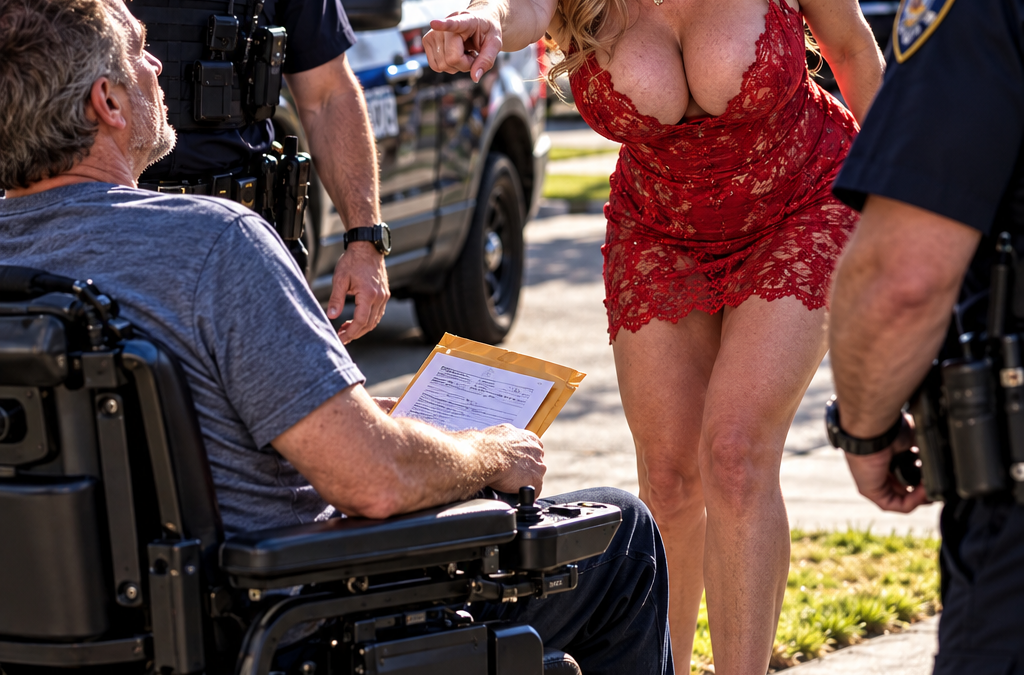
The red and blue lights hit my garage door before I heard the sirens.
Two patrol cars rolled into Maple Hollow Estates at 9:14 on a Sunday morning and stopped directly in front of my house.
I was ten feet from my mailbox.
Ten feet.
I had one hand on the controls of my electric wheelchair and a padded envelope resting in my lap when the first officer stepped out.
His right hand hovered near his belt.
The second officer came around the passenger side, looking from me to the empty sidewalk as though he were searching for the emergency he had been promised.
Then I saw Deborah Voss.
She stood across the street in front of her house with her arms folded beneath her chest, looking almost triumphant.
Deborah was around forty, attractive in a way she used like another weapon. She had long dark hair, carefully styled makeup, and a habit of dressing as though every HOA meeting were a private cocktail party. That morning she wore one of her favorite red lace dresses, low-cut and tight enough that nobody could mistake her desire to be noticed.
She loved attention.
More than that, she loved authority.
And at Maple Hollow, she had spent years confusing the two.
“That’s him,” she shouted.
She pointed at me.
Not at a car.
Not at a motorcycle.
At me.
“He’s been driving that thing recklessly through the common areas. He nearly hit pedestrians.”
I looked behind me.
The sidewalk was empty.
The street was empty.
A sprinkler clicked lazily three houses down.
The younger officer glanced at my chair.
Then at Deborah.
Then back at me.
“Sir,” he said carefully, “we received a report of a dangerous unregistered motorized vehicle operating aggressively around pedestrians.”
I stared at him.
Then I looked down at my wheelchair.
Four wheels.
Armrests.
Seat cushion.
Medical equipment.
Top speed: four miles per hour if the battery was feeling ambitious.
And after eighteen months of fines, threats, blocked access, public humiliation, surveillance and accusations that I was faking the disability that had permanently changed my life, something inside me finally broke.
I laughed.
Not because it was funny.
Because there was nothing left to do except laugh.
Deborah’s expression sharpened immediately.
“You think this is funny?”
I kept laughing.
She marched off her porch.
“You think endangering this community is a joke?”
The senior officer held up a hand.
“Ma’am, stay where you are.”
Her mouth fell open slightly.
People didn’t tell Deborah Voss where to stand.
Not in Maple Hollow.
She was used to doing the telling.
What she didn’t know was that the tiny camera attached beneath the armrest of my wheelchair was recording everything.
It had been recording her for months.
And the police call she thought would finally humiliate me in front of my neighbors was about to become the last piece of evidence in a case she never realized I had been building.
My name is Steven Kowalski.
Six months before that morning, I was still stupid enough to believe an HOA president could only make my life annoying.
I hadn’t understood yet that Deborah wanted to make my life impossible.
I moved into Maple Hollow Estates two years after the car accident that shattered three vertebrae and left me using a wheelchair full-time.
The house mattered to me in a way I had trouble explaining to people who had never lost independence.
Before the accident, I never thought about door widths.
Ramp angles.
Curb cuts.
Bathroom clearance.
Whether a sidewalk had a crack big enough to catch a front caster.
Afterward, every building became a series of questions.
Can I enter?
Can I turn?
Can I reach?
Can I leave without asking for help?
Maple Hollow seemed perfect.
The neighborhood sat beneath mature trees on mostly level land. The sidewalks were wide. My house already had a reinforced front ramp installed by the previous owner. The mailbox was close enough for me to reach without assistance.
For the first time since the accident, I felt like I had found a place where I could simply live.
Then Deborah knocked on my door.
It was less than a week after closing.
I opened it and found her standing at the bottom of my ramp wearing a red lace dress, sunglasses pushed onto her hair and a clipboard pressed against her hip.
She smiled.
Not warmly.
Possessively.
“You’re the new owner.”
“Steven.”
“I know.”
That should have bothered me more than it did.
She looked past me at the ramp.
“Just so you understand, exterior modifications require board approval.”
“The ramp was already here when I bought the house.”
Her smile tightened.
“That doesn’t mean it was properly authorized.”
“It’s an accessibility feature.”
“I can see that.”
Something in the way she said it made my shoulders tense.
“Then you know disability accommodations aren’t the same thing as decorative modifications.”
She tilted her head.
“I know what the bylaws say.”
“I’m talking about federal law.”
That got her attention.
For half a second the friendly mask slipped.
Then she smiled again and wrote something on her clipboard.
“Well. We’ll see.”
She walked away.
Two weeks later, I received a violation notice.
RAMP COLOR INCONSISTENT WITH APPROVED COMMUNITY EXTERIOR PALETTE.
Fine: $75.
I stared at it for a long time.
The ramp was gray.
The porch was gray.
The house trim was gray.
I paid it anyway.
At the time, fighting seemed exhausting.
I already spent more energy than most people understood just navigating ordinary life.
Transferring into bed.
Loading the chair.
Physical therapy.
Appointments.
Pain.
I didn’t want to spend what little energy I had left arguing over paint with a woman carrying a clipboard.
So I paid.
That was exactly what Deborah wanted.
The next warning involved my charging cable.
She claimed it created an “unsightly visual hazard” when visible on my front porch.
I moved it.
Then came a warning about the rubber threshold protector at my front door.
Then one about the position of a small package shelf mounted at wheelchair height.
Each violation targeted something connected to accessibility.
Never directly enough that she had to admit what she was doing.
Always close enough that I understood.
My neighbor Rosa understood too.
She lived across from me and had been in Maple Hollow almost fifteen years.
One afternoon she leaned against my fence while I checked the mail.
“Be careful with Deborah.”
“I’m beginning to notice.”
“No. I mean careful.”
I looked at her.
Rosa lowered her voice.
“She did this to the Andersons.”
“Did what?”
“Found one thing. Then another. Then another. Fines every week. Complaints. Inspections. Letters.”
“What happened?”
“They moved.”
“Because of HOA fines?”
“Because she made them miserable.”
Rosa glanced toward Deborah’s house.
“Cross her and she finds a way to make you disappear.”
I wanted to dismiss it as neighborhood gossip.
Then the wheelchair-speed letter arrived.
FORMAL NOTICE OF MOTORIZED VEHICLE VIOLATION.
According to Deborah, my electric wheelchair exceeded Maple Hollow’s permitted sidewalk vehicle regulations.
I read the letter three times.
Then I checked my chair manual.
Maximum speed: four miles per hour.
I emailed the board.
I explained that the device was an electric wheelchair, not a recreational vehicle.
Deborah answered personally.
Mr. Kowalski,
All motorized vehicles are subject to community safety standards regardless of how the operator chooses to classify them.
Operator.
Chooses to classify.
I rolled to her house that afternoon.
She was watering flowers in heels.
“Deborah.”
She looked up.
Her expression immediately cooled.
“You received my response.”
“My wheelchair is medical equipment.”
“That’s your opinion.”
“No. That’s what it is.”
She turned off the hose.
“Steven, you’re new here, so I’ll give you some advice.”
She walked closer.
“I have run this community for over a decade. People who cooperate have very easy lives.”
“And people who don’t?”
She smiled.
“Why would you want to find out?”
I remember the silence after that.
She had threatened me without technically threatening me.
Then her eyes moved down toward my chair.
“You know, some people exaggerate disabilities because they think it gives them special privileges.”
I actually thought I had misheard.
“What did you say?”
She shrugged.
“I’ve seen people stand up from wheelchairs the second they think nobody’s watching.”
“My spine was broken in three places.”
“Documentation can be forged.”
My hands went cold.
I had endured pity.
Curiosity.
Awkward questions.
People talking to whoever stood beside me instead of speaking directly to me.
But nobody had ever looked me in the face and suggested I might be pretending.
I turned my chair around.
Deborah called after me.
“Four miles per hour is still too fast if people feel unsafe!”
I went home.
Then I called my sister.
She worked as a paralegal.
I read her every notice.
Every email.
Every strange sentence Deborah had written.
When I finished, my sister was silent.
“Steven.”
“Yeah?”
“Stop paying without documenting.”
“I have the letters.”
“Not enough. Record everything.”
“Everything?”
“Audio. Video. Dates. Times. Witnesses.”
She paused.
“She’s building a file against you.”
I looked through my front window toward Deborah’s house.
“What do I do?”
“Build a better one.”
Two days later, I mounted a discreet camera beneath my wheelchair armrest.
That camera changed my life.
The first major recording happened less than a week later.
I woke at seven in the morning and opened my front door.
Three orange traffic cones blocked my ramp.
A printed sign had been taped to one.
TEMPORARILY CLOSED FOR SAFETY INSPECTION.
I called the HOA office.
Nobody knew about an inspection.
I emailed Deborah.
No response.
The cones remained all day.
Then overnight.
Then another day.
Six days.
For six days, I could not use the only accessible entrance to my own home.
The rear door had steps.
To leave the house, I had to transfer from my wheelchair while Rosa and another neighbor carried the chair down separately.
The humiliation was difficult to describe.
People assumed losing mobility meant losing dignity automatically.
It didn’t.
What hurt my dignity was being forced to depend on neighbors for something I had already been capable of doing independently because one woman wanted to remind me who controlled the neighborhood.
On the fourth morning, Rosa helped steady me at the back steps.
“This is insane.”
“I know.”
“This is illegal.”
“I know.”
“Then why aren’t you screaming?”
Because Deborah was watching.
I could see movement behind her curtains.
I looked directly toward her window.
“Because I want her to keep doing it.”
Rosa stared at me.
“What?”
“I want everything documented.”
I pointed toward the camera on my chair.
“Every day those cones stay there, the case gets stronger.”
The next violation notice accused me of creating excessive noise with my wheelchair motor.
Fine: $200.
I almost admired the cruelty of it.
The motor sounded quieter than my refrigerator.
I paid under written protest.
Saved the receipt.
Photographed the notice.
Logged the date.
At night, my dining table disappeared beneath binders.
Then Deborah got careless.
She posted in the neighborhood Facebook group.
Some residents seem to believe ADA laws give them permission to disregard rules and make everyone else uncomfortable.
She didn’t name me.
She didn’t need to.
Within minutes, people were arguing.
Some residents defended me.
Others repeated Deborah’s language almost word for word.
If he gets exceptions, where does it stop?
Rules should apply equally.
Medical equipment still needs regulation.
I screenshotted everything.
My sister called it a gift.
“She just connected the enforcement directly to your disability.”
“Publicly.”
“Exactly.”
For the first time, I stopped feeling helpless.
I contacted a disability-rights attorney.
I sent her the Facebook screenshots, the fines, photographs of the cones, and copies of the wheelchair-speed letters.
She called me the same day.
“Do not confront her yet.”
“That’s your advice?”
“My advice is let her keep writing.”
“You want her to keep harassing me?”
“I want her to put discriminatory intent on paper.”
Deborah did better than that.
She tried to turn discrimination into official HOA policy.
A board member quietly forwarded me draft language Deborah had circulated.
The proposed rule prohibited “motorized personal transportation devices” from Maple Hollow’s common walkways.
No exception for wheelchairs.
No exception for mobility scooters.
Nothing.
My attorney laughed when she read it.
“She’s writing our complaint for us.”
“You think they’ll pass it?”
“If she does, don’t stop her.”
The night of the vote, Deborah stood behind the clubhouse podium in another red lace dress, surrounded by board members who had spent years learning not to challenge her.
She smiled at the room.
“For the protection of pedestrians and the preservation of community safety, we are modernizing our transportation standards.”
I sat in the front row.
My camera was running.
Deborah looked directly at me.
“Motorized devices will no longer be permitted on common pedestrian walkways.”
Rosa stood.
“This targets Steven.”
Deborah banged the gavel.
“You are out of order.”
“It bans his wheelchair.”
“It bans vehicles.”
“It’s a wheelchair!”
“Sit down.”
“No.”
Deborah leaned toward the microphone.
“Sit down, Rosa, or I will have you removed.”
The room became quiet.
The vote passed six to one.
Rosa was the only no vote.
Afterward, Deborah walked directly toward me with the printed rule.
Her perfume reached me before she did.
She lowered the paper into my lap.
“There you go.”
I looked up.
“What?”
“Now nobody can claim the rules are unclear.”
She smiled.
“Just following policy, Steven.”
I looked at the document.
Then at her.
“Thank you.”
Her smile faltered.
“What?”
“Thank you.”
I folded the paper and placed it in my bag.
Deborah’s eyes narrowed.
She had expected anger.
She would have known how to fight anger.
She had no idea what to do with gratitude.
That night my attorney filed the Fair Housing complaint.
We included the bylaw.
The Facebook post.
The fines.
The blocked ramp.
The emails.
Six months of targeted enforcement.
Two weeks later, a certified letter arrived at the HOA office during a public meeting.
Deborah opened it at the front table.
I watched the blood leave her face.
“Fair Housing Act investigation,” she read aloud before realizing she shouldn’t have.
The room fell silent.
Then she said the most revealing thing possible.
“This is clearly a misunderstanding.”
Nobody had accused her of anything yet.
Rosa leaned toward me.
“You patient bastard.”
I almost laughed.
Deborah deleted the new vehicle rule from the HOA website that night.
My attorney had already archived it.
Every version.
Every timestamp.
Every edit.
The following week, Deborah suddenly became friendly.
“Steven, you look wonderful today.”
“You’re so resilient.”
“If you ever need anything, you know this board supports you.”
I smiled back.
She thought she was repairing the record.
She was actually making it stranger.
Behind the fake friendliness, she hired someone to investigate me.
A private investigator parked in a gray sedan outside my house for three days.
Rosa’s husband recognized what he was doing.
The goal was obvious.
Catch me standing.
Catch me walking.
Catch me doing anything Deborah could use to suggest I was lying about my disability.
There was only one problem.
I wasn’t lying.
The investigator recorded hours of absolutely nothing useful.
Then, at six one morning, his camera captured something neither of us expected.
Deborah.
She walked from her house carrying orange traffic cones.
The same cones.
She crossed the street.
Looked around.
Then placed them directly across my ramp.
One by one.
She stood there for a moment admiring her work.
Then walked home.
The private investigator later fought with Deborah over an unpaid invoice.
He sent me the footage.
I watched it three times.
My attorney watched it once.
Then she laughed.
“She hired a witness against herself.”
We saved the video.
We did not release it.
Not yet.
Deborah escalated again.
The accessible parking space beside the community pool was suddenly repainted VISITOR PARKING ONLY.
It was the nearest accessible space to the pool entrance.
I asked the maintenance contractor who ordered the change.
He showed me the email.
Deborah Voss.
I filed a county ADA complaint.
An inspector arrived.
Measured the parking area.
Reviewed the markings.
Issued the HOA a violation.
Deborah blamed the maintenance company.
Then my sister found the email chain.
Deborah had copied herself on the repainting order.
She had literally created a written record proving her own lie.
At the next board meeting, another director requested an independent review of Deborah’s enforcement practices.
Deborah’s reaction was instant.
“No.”
“Deborah, considering the investigation—”
“We do not need outsiders interfering in private association matters.”
“We’re already under investigation.”
She slammed her palm onto the table.
“I said no.”
The room froze.
She pointed at the board member.
“If you cannot support this board, perhaps you shouldn’t be sitting on it.”
There it was.
Not governance.
Obedience.
A few weeks later, Deborah called police on me for the first time.
I was parked in my own driveway waiting for a delivery.
Two officers arrived because someone had reported a suspicious vehicle blocking the roadway.
They found me six feet from the curb.
One officer looked at my wheelchair.
Then at my garage.
Then at the street.
“This is the vehicle?”
“Apparently.”
He actually rubbed his forehead.
The call lasted two minutes.
No citation.
No warning.
But now there was a police record.
Complainant: Deborah Voss.
My attorney requested it the next morning.
“Good.”
“Good?”
“She has escalated from HOA paperwork to government resources.”
Deborah didn’t stop.
She circulated a petition demanding that I relocate my wheelchair charging station away from an outlet near the clubhouse.
Eleven people signed.
Later, several admitted Deborah had pressured them.
One woman apologized to me privately.
“She told me if I didn’t sign, the board might review my fence.”
That was how Deborah ruled.
Not through respect.
Through examples.
Punish one person publicly and everyone else learned to cooperate.
I requested a formal accommodation meeting.
The HOA’s insurance carrier sent a representative.
Deborah assumed he was there to protect her.
For twenty straight minutes she complained about “entitled residents.”
“People think disability means unlimited exceptions.”
“Some homeowners weaponize federal law.”
“You cannot run a community if one person gets special treatment.”
The insurance representative took notes.
He barely spoke.
Afterward, he pulled me aside.
“Off the record?”
“Sure.”
“You have an extremely strong case.”
That was the first time I knew Deborah’s protection was disappearing.
Then she tried to exclude me from the annual holiday parade.
Her proposed policy banned “non-standard mobility devices.”
Even her allies hesitated.
Janet, a longtime board member, texted me privately.
This has gone too far. I’ll testify.
Deborah sensed the rebellion.
Her behavior became erratic.
She sent mass emails demanding “loyalty to proper HOA governance.”
She accused residents of conspiring against her.
She began interrupting meetings.
Threatening fines.
Reminding people how long she had been president.
Then the county deadline arrived for restoring the accessible parking space.
Deborah ignored it.
She told residents the county had no authority over private HOA property.
The association was fined $5,000.
Five thousand dollars of homeowner money.
At the next meeting, more than forty residents showed up furious.
Deborah blamed me.
“This community is losing money because one litigious resident refuses to cooperate!”
People turned toward me.
I raised my hand.
She reluctantly recognized me.
I spoke calmly.
“Deborah, do you deny personally placing traffic cones across my ramp at six in the morning?”
Silence.
Her face changed.
“What?”
“Do you deny it?”
“I have no idea what you’re talking about.”
“Okay.”
That was all I said.
I rolled out.
Behind me, the room exploded into whispers.
She knew.
She finally understood that I had something.
She just didn’t know what.
That weekend, my attorney completed the full complaint.
Disability discrimination.
Harassment.
Defamation.
Retaliation.
False police reporting.
Fourteen exhibits.
Six witnesses.
One video of Deborah blocking my ramp with her own hands.
We planned to file Monday.
Sunday morning, Deborah made the biggest mistake of her life.
I left my house to collect a package.
She saw me.
Before I even reached the mailbox, she called police.
“A dangerous unregistered vehicle.”
“Threatening pedestrians.”
“Operating aggressively.”
Two patrol cars arrived.
Red and blue lights splashed across my garage.
Deborah stood proudly on her porch.
“This is him!”
The younger officer looked at my wheelchair.
“Ma’am, this is a motorized wheelchair.”
“He terrorizes people with it.”
“Who?”
“Everyone!”
The officer looked at the empty street.
“Where are the pedestrians he threatened?”
Deborah’s voice rose.
“They were here!”
“Who?”
“I don’t have their names!”
“Then what exactly happened?”
“He drives too fast.”
I looked down at my chair.
Then I laughed.
Deborah pointed at me.
“See? Look at him! He has no respect for authority!”
The senior officer stepped forward.
“Ma’am, calm down.”
“Don’t tell me to calm down. I am the president of this community.”
“That doesn’t change what I’m asking.”
“He violates our vehicle rules constantly.”
“This is medical equipment.”
“Our HOA classified it as a motorized vehicle.”
The officer stared at her.
“You classified his wheelchair as a vehicle?”
“Yes.”
Rosa was already standing on her porch with her phone out.
Other doors opened.
Neighbors emerged.
Deborah looked around at the gathering crowd.
“Everyone needs to go back inside.”
Nobody moved.
“I said go back inside! This does not concern you.”
More phones appeared.
I reached into the bag on my wheelchair and handed the senior officer a folder.
“What’s this?”
“The report from the last time she called police on me.”
His expression changed.
I handed him my attorney’s card.
Then I opened a video on my phone.
“Before you leave, I think you should watch this.”
The footage showed Deborah walking across the street at dawn.
Carrying traffic cones.
Blocking my ramp.
The officer watched silently.
Deborah saw the screen.
Her face went white.
“Where did you get that?”
The officer looked at her.
“Ma’am, did you obstruct his wheelchair access?”
“That video is illegally obtained.”
“That isn’t what I asked.”
“She’s twisting everything.”
“Did you place those cones?”
“I was conducting an HOA safety inspection.”
“At six in the morning?”
She looked at me.
Not angry anymore.
Afraid.
“You’ve been spying on me.”
I shook my head.
“No, Deborah.”
The crowd was completely silent.
“You hired someone to spy on me.”
Her eyes widened.
That was the moment she understood.
The investigator.
Her investigator.
Her own decision had created the video.
The senior officer checked the previous call report.
Then looked at her.
“You called about this same resident before.”
“He is dangerous.”
“What specifically did he do today?”
“He drove his wheelchair.”
“Where?”
“The sidewalk!”
“At what speed?”
Deborah stopped.
“Fast.”
“How fast?”
“I don’t know.”
“Did he strike anyone?”
“No.”
“Did he threaten anyone?”
“He intimidates people.”
“How?”
Silence.
The officer closed his notebook.
“Ma’am, filing a knowingly false emergency report is an offense.”
Deborah laughed sharply.
“You can’t cite me.”
“I can.”
“I am president of Maple Hollow.”
The officer’s voice stayed flat.
“State law does not contain an HOA-president exception.”
Rosa covered her mouth, trying not to laugh.
The officer wrote the citation.
Deborah stared at the paper as though she had been handed a death sentence.
“You can’t do this.”
He handed it to her.
“I just did.”
She turned on the crowd.
“This is harassment! Every one of you standing here recording me is participating in harassment.”
Nobody moved.
For years Deborah had ordered people back into their homes.
That morning, for the first time, they simply ignored her.
I rolled forward.
“Deborah.”
She looked at me.
“I have eighteen months of documentation.”
Her expression shifted.
“I have every fine.”
“What are you talking about?”
“Every email.”
She took a step back.
“Every meeting recording.”
Another step.
“The illegal wheelchair bylaw.”
She stared at me.
“The parking-space order.”
Her lips parted.
“The private-investigator footage.”
Then I said the words I had waited months to say.
“And the Fair Housing complaint.”
Her face emptied.
“What complaint?”
“Federal disability discrimination.”
“You’re lying.”
“It was filed three weeks ago.”
The crowd murmured.
Deborah’s voice dropped.
“You’ve been planning this.”
“I’ve been surviving you.”
She stared at me.
I kept my voice low.
“You just gave me enough evidence to stop surviving and start fighting.”
Someone behind Rosa applauded.
One person.
Then another.
Then five.
Deborah looked around.
The neighborhood she had ruled through fear was watching her lose control.
She turned and marched home.
Her red dress disappeared through the doorway.
The door slammed hard enough to shake the porch light.
That night, Maple Hollow’s Facebook group exploded.
The Andersons, who had moved years earlier, commented.
They confirmed Rosa’s story.
Other residents posted fine notices.
Emails.
Threats.
Warnings.
People who had stayed silent for years finally compared notes.
One week later, the HOA called an emergency board meeting.
Deborah did not attend.
For the first time in more than a decade, her chair was empty.
Janet stood before the residents holding a prepared statement.
“We failed this community by allowing one person’s personal hostility to operate unchecked under the authority of the board.”
Nobody interrupted.
A motion was made.
Immediate suspension of Deborah Voss pending state and federal investigations.
Seven votes.
Seven yeses.
Zero noes.
The same board that had once approved almost anything Deborah demanded removed her unanimously.
Two days later, my attorney publicly filed the full Fair Housing complaint.
The video was attached.
Local television picked up the story.
HOA PRESIDENT CITED AFTER POLICE CALLED ON DISABLED RESIDENT USING WHEELCHAIR.
Deborah’s face appeared on the six o’clock news.
Her attorney called the coverage one-sided.
He did not deny the recordings.
He could not.
The Fair Housing investigation moved fast after officials saw everything together.
The bylaw.
The targeted fines.
The Facebook comments.
The parking-space order.
The ramp obstruction.
The police reports.
The private investigator footage.
It was no longer possible to explain each incident away separately.
Together, they formed exactly what Sarah—my sister—had predicted months earlier.
A pattern.
Investigators determined that the conduct amounted to deliberate disability discrimination.
The HOA was ordered to pay damages.
The wheelchair rule was rescinded permanently.
The board underwent mandatory fair-housing training.
Deborah was personally named.
The false-report citation also escalated after prosecutors reviewed both police calls.
One bad call could be explained as confusion.
Two nearly identical fabricated calls against the same disabled resident were harder to excuse.
Her attorney asked for leniency.
Decades of community service, he argued.
The judge watched the video of Deborah carrying cones across the street at dawn.
Then he looked over his glasses.
“Community service does not include intentionally obstructing a disabled resident’s access to his own home.”
Deborah was fined.
Ordered to perform community service.
Formally removed from HOA leadership.
Maple Hollow’s board then voted to permanently bar her from holding office in the association again.
Her kingdom ended with paperwork.
Exactly the thing she had used for years to frighten everyone else.
Neighbors began apologizing to me.
Not dramatic apologies.
Quiet ones.
At the mailbox.
Beside driveways.
One woman lowered her eyes and said, “We should have helped sooner.”
“Why didn’t you?”
She looked toward Deborah’s house.
“We were afraid.”
I understood.
Fear had been Deborah’s real enforcement mechanism.
Not bylaws.
Not fines.
Fear of becoming next.
Rosa hugged me when the ruling became official.
“You did it.”
“We did it.”
“No. You were the insane patient one.”
I laughed.
“You carried my chair down the back steps for six mornings.”
“And complained every second.”
“That counts.”
The HOA eventually held a public apology meeting.
Janet acknowledged that the board had failed to protect a resident from discriminatory enforcement.
My accessible parking space was restored.
The illegal rule disappeared permanently.
New board members started asking disabled residents what accommodations they actually needed instead of deciding for them.
Then Deborah listed her house for sale.
Three weeks later, a moving truck arrived.
I watched from my porch.
She came outside wearing black instead of red.
No clipboard.
No heels.
No audience.
For a moment I wondered whether she would look toward me.
She didn’t.
Maybe she hated me.
Maybe she blamed me.
Maybe she still believed she had done nothing wrong.
It didn’t matter anymore.
She got into her car and drove away.
I expected victory to feel louder.
Instead, the neighborhood became quiet.
That was better.
No curtains moving every time I checked the mail.
No car idling outside my house.
No orange cones.
No letters waiting like threats.
No woman questioning whether my broken spine was authentic enough for her approval.
My attorney eventually called with the civil settlement.
The money covered legal expenses, damages and some measure of the peace I had lost.
It could not return eighteen months.
Nothing could.
I used part of the settlement to create small accessibility grants for residents who needed ramps and home modifications.
It felt right.
Deborah had tried to make accessibility a punishment.
I wanted something good to come from the same fight.
The board reviewed three years of older violations.
They found more selective enforcement.
Elderly homeowners.
New residents.
People Deborah disliked.
Some fines were refunded.
Others were formally withdrawn.
Nobody received a personal apology from Deborah.
Neither did I.
I stopped wanting one.
An apology from somebody who believed she was entitled to hurt people would have meant less than the public record proving she had done it.
These days, people occasionally joke about what happened.
“Remember when Deborah called the cops on Steven’s wheelchair?”
Someone will say it at a barbecue.
People laugh.
I laugh too.
Not because what happened was funny.
Because now it sounds ridiculous.
At the time, it didn’t.
At the time, a woman with a clipboard managed to make me wonder whether I could remain in the house I had chosen specifically because it gave me independence.
That was the part nobody saw.
The fines were annoying.
The letters were infuriating.
The police calls were humiliating.
But the real damage happened quietly.
Every time I opened my front door and wondered what she had changed.
Every time I approached the mailbox expecting another envelope.
Every time a strange car slowed near my house.
Every time I saw Deborah watching from her window.
She turned ordinary life into something I had to defend.
That is what bullies like Deborah understand instinctively.
You don’t always need to destroy someone.
Sometimes you just make every day difficult enough that they eventually destroy their own attachment to the place.
Move away.
Stop attending meetings.
Stop asking questions.
Stop fighting.
The Andersons had.
Others had.
I almost did.
The only reason the story ended differently for me was because somebody told me to document everything before I reached the breaking point.
The folder mattered.
The recordings mattered.
Rosa mattered.
Janet mattered.
My attorney mattered.
The investigator Deborah hired mattered more than he probably expected.
But what mattered most was refusing to let every incident remain isolated.
A $75 ramp fine sounded petty.
A wheelchair-speed warning sounded absurd.
Orange cones could be dismissed as a misunderstanding.
An inaccessible parking space could be blamed on maintenance.
One police call could be described as concern.
But put them together.
Add dates.
Add emails.
Add video.
Add witnesses.
Add Deborah’s own words.
Suddenly the story changed.
It stopped being a disagreement between an HOA president and a difficult resident.
It became what it always had been.
A campaign.
Sometimes I still see a gray sedan that resembles the investigator’s car and feel my stomach tighten automatically.
Then I remember something.
Nobody is watching me anymore.
I roll to my mailbox every morning at exactly the same speed.
Four miles per hour at most.
Nobody measures it.
Nobody writes it down.
Nobody calls police.
Nobody asks whether my disability is real.
Nobody blocks my ramp.
There is something almost beautiful about how boring those mornings are.
I leave my house.
Roll down the ramp.
Cross the driveway.
Open the mailbox.
Return home.
That’s it.
An ordinary morning.
For eighteen months, that ordinary independence was the thing Deborah Voss tried hardest to take from me.
In the end, it became the thing she could not touch.
She lost her presidency.
Her authority.
Her reputation in Maple Hollow.
Eventually, even her home there.
I lost eighteen months of peace.
I will never pretend otherwise.
But I kept the one thing she wanted me to surrender.
My right to exist in my own neighborhood without asking Deborah Voss for permission.
And every morning when I roll down that ramp without an orange cone in sight, that feels like enough.








