𝗙𝗨𝗟𝗟 𝗦𝗧𝗢𝗥𝗬 The HOA President Called the Police on My Family at My Own Marina—Then the Officers Asked Her for the Deed
𝗙𝗨𝗟𝗟 𝗦𝗧𝗢𝗥𝗬
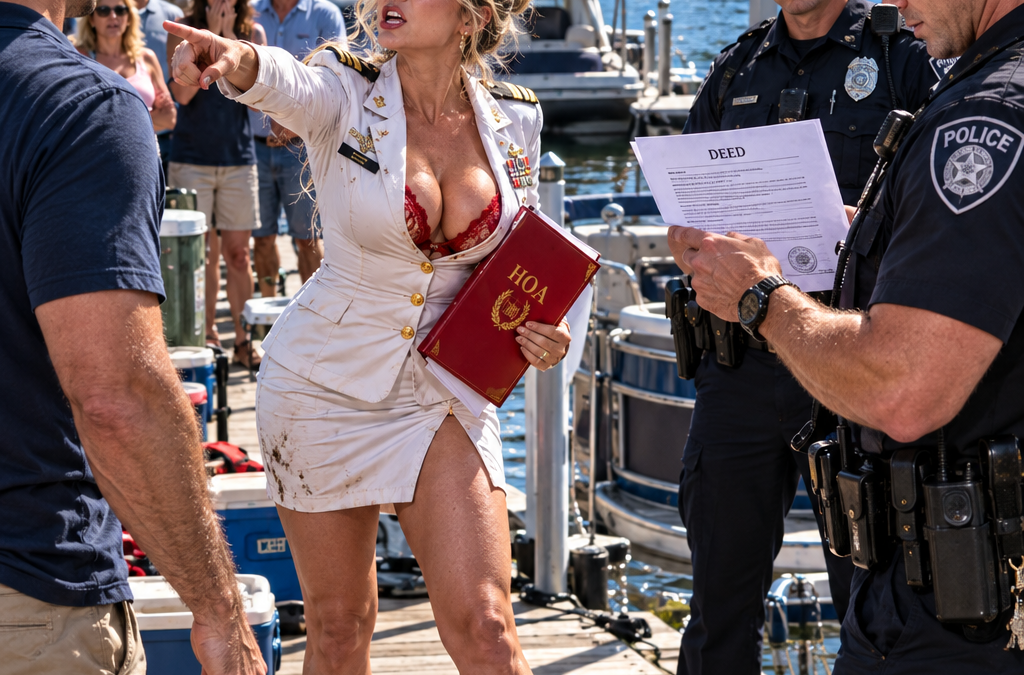
She opened the red folder and pulled out a glossy map.
Not a deed.
Not a survey.
A map.
The kind printed for welcome packets.
Willow Ridge was highlighted in pale green. The lake sat inside the shaded neighborhood outline, bright blue and pretty enough for a brochure.
She held it up like evidence in a trial.
“There.”
My uncle muttered, “That looks like something from a sales office.”
Karen heard him.
“Sir, you are trespassing. I suggest you stop commenting.”
I held out my hand.
She reluctantly gave me the map.
I looked at it.
Then handed it back.
“This isn’t a deed.”
“It’s the official community map.”
“It’s a marketing map.”
“It shows the lake inside Willow Ridge.”
“It shows a drawing.”
“It shows the community boundary.”
“That boundary is not a property title.”
She leaned closer.
Her perfume hit me before her words did.
“You are not going to stand here and lecture me in front of your guests.”
“Then stop pretending you own something you don’t.”
Her smile vanished.
“There it is.”
“What?”
“The arrogance.”
I almost laughed.
“Arrogance?”
“You think because your grandfather had some old paperwork, you get to turn community property into your private playground.”
“My grandfather had recorded title.”
“From decades ago.”
“Correct.”
“Before the HOA.”
“Exactly.”
She blinked, then recovered.
“That makes it outdated.”
“No, Karen. That makes it senior.”
The board member behind her, Paul, shifted uncomfortably.
Karen whipped around.
“Do you have something to say?”
Paul shook his head.
“Didn’t think so.”
She turned back to me.
“Your guests need to leave.”
“No.”
“You’re refusing a direct HOA order?”
“I’m refusing a trespass accusation with no legal basis.”
She raised the folder.
“This handbook is the legal basis.”
“No. It isn’t.”
“The handbook is binding on Willow Ridge residents.”
“Even if it were, my mother doesn’t live here.”
“Exactly.”
“She doesn’t need to. I invited her onto my property.”
“This is not your property.”
I pulled the deed from the waterproof folder I kept in the marina office.
I’d brought it down that morning because I had suspected Karen might try something.
She stared at it with immediate irritation, like the paper itself had insulted her.
I opened it to the recorded parcel description.
“Here.”
She didn’t take it.
“That document is obsolete.”
“You haven’t read it.”
“I don’t need to.”
That sentence landed hard.
Not just with me.
With everyone.
My sister looked at me.
My uncle folded his arms.
Even one of Karen’s board members looked embarrassed.
“You don’t need to read the deed before claiming the land?” I asked.
“I have reviewed HOA records.”
“What records?”
“Our community documents.”
“Show me the transfer.”
“What transfer?”
“The transfer from my family to the HOA.”
Her lips pressed together.
“That isn’t necessary.”
“It’s the only thing that matters.”
Her voice rose.
“Do not misrepresent the law to me.”
“I’m not.”
“I have run this association for eight years.”
“And you’ve owned this lake for zero.”
Her face went red.
That was the moment I knew she was done pretending this was about rules.
It was about being contradicted.
In public.
By someone who wouldn’t move.
Karen pulled out her phone.
My mother whispered, “Mark, what is she doing?”
Karen pressed three digits.
I sighed.
“Of course.”
She turned away slightly, but not enough to keep us from hearing.
“Yes, I need police at Willow Ridge Marina. We have a trespassing situation. A homeowner has brought unauthorized strangers onto HOA property, and they are refusing to leave.”
My sister’s eyes widened.
“Is she serious?”
“Unfortunately.”
My cousin stepped toward me.
“Are we actually going to get arrested?”
“No.”
I hoped I sounded more certain than I felt.
Karen continued into the phone.
“No, I do not feel safe confronting them alone. There are multiple people here, and they are becoming aggressive.”
I looked around.
My uncle was holding a sandwich.
My mother was clutching iced tea.
Two children were standing barefoot on the dock.
Aggressive.
That was Karen’s favorite word whenever someone refused to obey.
She hung up and faced us.
“The police are on their way.”
“Good.”
That caught her off guard.
“Good?”
“Yes. Bring in someone neutral.”
She smiled again, but I could see the tension in her jaw.
“You may regret that confidence.”
“No, Karen.”
I held up the deed.
“You may regret never reading this.”
We waited.
The afternoon changed while we stood there.
The music stopped.
Nobody opened another drink.
My nephews sat quietly on the dock steps.
The boat remained tied.
People who had been laughing ten minutes earlier now stood awkwardly under the weight of Karen’s accusation.
That was another part of her cruelty.
She didn’t just challenge me.
She humiliated my guests.
She wanted my mother, my relatives, and my friends to feel like criminals for accepting an invitation.
Karen stood at the head of the dock, arms folded, visibly pleased with the discomfort she’d created.
“Everyone should remain where they are,” she announced.
My uncle looked at me.
“Does she think she’s deputized?”
Karen snapped, “Sir, I warned you.”
I stepped between them.
“You don’t get to order my family around.”
“I absolutely do when they are on HOA property.”
“They’re not.”
“We’ll see what the officers say.”
“Yes, we will.”
The police arrived in two cars about ten minutes later.
Two officers stepped out near the marina entrance.
The lead officer was a tall man with a calm expression and the patient posture of someone accustomed to walking into arguments where everybody claimed to be right.
Karen rushed toward him before he reached the dock.
“Officer, thank goodness. I’m Karen Whitfield, president of the Willow Ridge Homeowners Association.”
Of course that was the first sentence.
Not her name.
Not the situation.
Her title.
The officer nodded.
“I’m Officer Daniels. This is Officer Ruiz. What’s going on?”
Karen pointed toward us.
“These nonresidents are trespassing on HOA lake property. I instructed them to leave. They refused.”
Officer Daniels looked toward the marina.
“Who owns the property?”
“The HOA does,” Karen said immediately.
I said, “I do.”
Karen shot me a look.
Daniels raised one hand.
“One at a time.”
Karen stepped closer.
“Officer, this is a resident who has repeatedly tried to privatize community amenities.”
“That’s false.”
Daniels looked at me.
“Sir, your name?”
“Mark Bennett.”
“Can you explain your position?”
“Yes.”
I handed him the deed and recorded property map.
“This lake parcel, the marina strip, and the dock access are privately owned. My family recorded the property decades before the HOA existed.”
Karen laughed sharply.
“That’s his interpretation.”
Daniels didn’t respond to her.
He studied the deed.
Then the parcel map.
“Do you have identification?”
I gave it to him.
He compared the name.
Then looked toward the lake.
“This parcel includes the marina?”
“Yes.”
“And the water rights described here?”
“Yes.”
Karen interrupted.
“The HOA rules restrict lake usage to residents.”
Daniels looked at her.
“Do you have a deed showing the HOA owns the lake?”
She opened the red folder with unnecessary force.
“I have the community map.”
She handed it to him.
Daniels looked at it.
Then looked at the deed in his other hand.
“This appears to be a neighborhood map.”
“It’s the official Willow Ridge map.”
“Does it have a recorded document number?”
Karen hesitated.
“It is distributed by the HOA.”
“That wasn’t my question.”
Her expression tightened.
Officer Ruiz looked at the map.
“This doesn’t show a transfer of title.”
Karen’s voice sharpened.
“It shows the lake inside the community.”
“That may show location,” Daniels said. “It doesn’t prove ownership.”
“With respect, officer, you may not understand HOA governance.”
That was a mistake.
Officer Daniels didn’t react emotionally.
He simply looked at her.
“Ma’am, I understand the difference between a trespass complaint and a neighborhood rule dispute.”
Karen’s face darkened.
“The rule is clear.”
“Do you have an easement, deed, lease, access agreement, or other legal authorization showing HOA control over this marina?”
Karen opened her mouth.
No answer came out.
For the first time that afternoon, she was silent.
My cousin whispered, “So we’re not being arrested?”
Officer Ruiz heard him.
“No one is being arrested. We’re determining whether there’s a legal basis for the trespass complaint.”
Karen immediately stepped forward.
“There is a basis. I am telling you there is.”
Daniels remained calm.
“I need evidence, not conclusions.”
“I am the HOA president.”
“That’s a title, not evidence.”
My uncle coughed to hide a laugh.
Karen glared.
Daniels turned to me.
“Can you show where the property boundary runs?”
I unfolded the recorded survey across the marina table.
The paper had been copied so many times that I kept a laminated version for exactly this reason.
My grandfather’s parcel was outlined.
The marina sat inside it.
The shoreline curve matched.
The access point matched.
The lake description matched the deed.
Daniels studied it.
Ruiz leaned over.
Karen stood rigidly beside them.
“This line,” I said, pointing, “runs from the old oak marker near the north bank, around the marina, and follows the shoreline to this inlet.”
Daniels nodded.
“And this is the marina location?”
“Yes.”
Karen finally spoke.
“The lake has always been treated as community property.”
I looked at her.
“By whom?”
“The neighborhood.”
“Who transferred it to the neighborhood?”
She turned away from me.
“The HOA has always managed access.”
“No, it hasn’t.”
“Yes, it has.”
“My family maintained the marina.”
“We included it in community materials.”
“That doesn’t make it yours.”
She pulled out her phone again.
“I’m calling Paul.”
One of the board members flinched.
“I’m right here.”
“Not you,” she snapped. “David.”
She dialed another HOA board member and put him on speaker.
“David, I’m with the police at the marina. I need the lake ownership file.”
A pause.
Then a man’s voice.
“The what?”
“The ownership file proving HOA control of the lake.”
Another pause.
“Karen, I thought that was in the community packet.”
Officer Daniels looked at Ruiz.
Karen’s grip tightened around the phone.
“No, David. I need the transfer document.”
“The transfer from who?”
I watched Karen’s face.
She closed her eyes for half a second.
“From the Bennett parcel.”
“I don’t think I’ve ever seen that.”
The speakerphone made the sentence impossible to hide.
Several people heard it.
My mother lowered herself back into the chair.
Karen took the phone off speaker.
“Find it.”
She ended the call.
Daniels waited.
“Do you have anything else you want to provide?”
Karen forced a smile.
“The board member I spoke to is not the custodian of records.”
“Who is?”
“I am.”
“Then do you have the document?”
Her smile vanished again.
“I don’t carry every HOA file with me.”
“You carried a map.”
“Because the map is sufficient.”
“It isn’t.”
Her voice rose.
“Officer, this is absurd. These people are strangers. They are drinking, boating, using amenities maintained by dues-paying residents.”
“My guests are not using HOA amenities,” I said.
Karen pointed toward the dock.
“That dock is an amenity.”
“That dock is mine.”
“Prove it.”
I tapped the survey.
“I did.”
Daniels asked, “Who maintains the dock?”
“I do.”
“Who pays taxes on the parcel?”
“I do.”
“Any HOA maintenance records for the marina?”
Karen jumped in.
“We include lake access in community planning.”
“That’s not maintenance.”
“We clean the shoreline.”
“You organize volunteer trash pickup twice a year on the public road side,” I said. “Not my marina.”
Karen turned on me.
“Do not minimize community stewardship.”
“Do not inflate trash pickup into ownership.”
Officer Ruiz asked her, “Ma’am, is your position that the HOA owns the lake, or that residents have access rights?”
Karen paused.
That was the first time someone forced her to separate the two.
“They’re functionally the same.”
Daniels shook his head.
“They’re not.”
“The HOA rules grant access.”
“Rules can govern members,” Daniels said. “They don’t automatically create ownership over private land.”
Karen stared at him.
“You are taking his side.”
“No, ma’am. I’m asking for documentation.”
“You haven’t asked him for anything.”
“He provided a recorded deed and survey.”
“Those are old.”
“Recorded documents don’t become irrelevant because they’re old.”
She stepped back as if the statement physically struck her.
I could see her losing control of the scene.
That was what frightened her most.
Not being wrong.
Being wrong in public.
Neighbors had started gathering near the path above the marina.
Some were watching from decks.
People heard enough.
Saw enough.
Karen’s authority was evaporating in front of the entire lakeside.
She raised her voice.
“I demand that all nonresidents leave immediately pending review.”
Officer Daniels turned toward her.
“That is not your decision to make.”
Her mouth opened.
Nothing.
Daniels continued.
“At this time, based on what has been shown, I don’t have a legal basis to remove these people from the marina.”
Karen looked stunned.
“They are violating HOA rules.”
“Even if that were true, HOA rules are not the same as criminal trespass.”
“They are guests of a resident.”
“On property the resident appears to own.”
“They are not residents.”
“Again, that doesn’t establish trespass.”
Karen pointed at the handbook.
“It says resident-only.”
Daniels looked at it.
“Where does this handbook state the HOA owns Mr. Bennett’s parcel?”
“It doesn’t have to.”
“Then it’s not enough.”
She laughed in disbelief.
“This is unbelievable.”
I said nothing.
That was important.
Karen wanted me to gloat.
She wanted me to say something sharp so she could pivot toward behavior.
I simply stood there with the deed in my hand.
Daniels looked toward me.
“Do you have the county recording information?”
“Yes.”
I showed him the recorded document number.
He stepped away and used his radio.
Karen watched him like she could intimidate the signal.
The wait lasted only minutes, but it felt longer.
My guests stood quietly.
My sister squeezed my mother’s shoulder.
My uncle stared at Karen with open disgust.
The nephews whispered to each other on the dock.
When Daniels returned, his expression was unchanged.
“County records confirm the parcel information matches Mr. Bennett’s documents.”
Karen’s face drained slightly.
“That can’t be complete.”
“It’s what was verified.”
“The HOA has rights.”
“Not shown here.”
“There may be documents not immediately available.”
“Then you can produce them through civil channels.”
“This is a police matter.”
“Not without evidence of trespass.”
Her voice cracked.
“You are letting him steal community property in front of everyone.”
That was the old Karen surfacing.
When charm failed, she used outrage.
When outrage failed, she used accusation.
Officer Daniels remained professional.
“No one is stealing anything.”
“He is excluding residents.”
I said, “I’ve never prevented residents from using the public access road or other HOA property. But the marina is private.”
Karen snapped, “Because you decided that.”
“No. Because the deed says it.”
“Enough with the deed.”
Everyone heard that.
Enough with the deed.
That sentence was more revealing than anything else she said.
She didn’t want proof.
She wanted hierarchy.
Her title above my document.
Her rulebook above my grandfather’s recording.
Her voice above the county records.
Daniels looked at her.
“Ma’am, the deed is the issue.”
Karen’s hands trembled.
“You people don’t understand what it’s like trying to maintain standards.”
Officer Ruiz said, “We’re not here about standards.”
“That lake is part of Willow Ridge identity.”
“Identity isn’t title.”
A few neighbors murmured.
Karen heard them.
Her eyes swept the gathering crowd.
For the first time all afternoon, she looked less angry than exposed.
The officers spoke with me briefly off to the side.
Daniels handed my documents back.
“Keep copies available.”
“I always do.”
“Lake access rights can be complicated. Ownership, easements, riparian rights, HOA covenants, local rules—those can all matter depending on the documents. If she produces something legitimate, it may need civil review.”
“I understand.”
“But based on what we have today, I’m not removing your guests.”
“Thank you.”
He nodded.
“Everyone should stay calm.”
Then he walked back toward Karen.
“We’re clearing the call unless there’s another issue.”
Karen stared at him.
“This isn’t over.”
“I’m sure it may not be. But today, this is not a trespass enforcement matter.”
She looked toward my family.
Then toward the gathered neighbors.
Her face burned red.
For once, she had no order to give that anyone was required to obey.
The officers left.
Karen remained.
No one moved for several seconds.
Then my uncle said, loud enough for everyone to hear:
“So… sandwiches?”
My mother burst out laughing.
The tension cracked.
People slowly returned to the afternoon.
My nephews untied the pontoon.
My sister turned the music back on, still low.
Coolers opened.
Some of the guests were shaken, but once they realized nobody was being dragged away in handcuffs, the day began to breathe again.
Karen stood at the head of the marina watching it happen.
Watching her performance fail.
Watching my invited guests continue using my dock with my permission.
Watching neighbors whisper.
She stepped toward me.
“This was a mistake.”
“Calling the police?”
“Humiliating me.”
I looked at her.
“You did that yourself.”
Her eyes narrowed.
“Enjoy this moment, Mark.”
“I plan to.”
“You think a deputy’s roadside opinion settles ownership?”
“No.”
I held up the deed.
“This does.”
She turned and walked away.
The emergency HOA meeting happened that evening.
Of course it did.
Karen sent the announcement to the entire neighborhood.
SUBJECT: URGENT LAKE ACCESS MATTER.
She wrote that the police had “misunderstood the scope of HOA recreational authority.”
She wrote that I had “exploited outdated documents to disrupt community access.”
She wrote that the board would “review appropriate enforcement options.”
By then, the story had already spread.
A few neighbors who had watched from the path started messaging me privately.
Did the cops really say she had no deed?
Is the marina actually yours?
Karen told us HOA dues paid for the lake.
That last message made my stomach tighten.
Karen hadn’t merely assumed ownership.
She had apparently let residents believe they were paying for access rights the HOA didn’t own.
The next morning, the board reviewed old property records.
Not the glossy welcome map.
Not the handbook.
The actual files.
They found no deed transferring the lake parcel to the HOA.
No easement over the marina.
No recorded agreement giving Karen authority to exclude my guests.
The lake had never been transferred into the association’s name.
Paul called me first.
He sounded exhausted.
“Mark, I owe you an apology.”
“Does the board?”
“Yes.”
“Put it in writing.”
He sighed.
“We will.”
“Good.”
He paused.
“Karen is… upset.”
“I’m sure.”
“She believes there may still be historical usage rights.”
“Then she can produce them.”
“She hasn’t.”
“Then my guests continue using the marina with my permission.”
“I understand.”
“Does she?”
Another pause.
“Not yet.”
The written apology arrived two days later.
It was careful.
Lawyerly.
“The board regrets confusion.”
“The board acknowledges that current HOA records do not establish ownership of the lake parcel or marina.”
“The board will refrain from representing privately held lake property as association-owned.”
I read that sentence three times.
Then saved the letter with the deed.
Karen didn’t sign it.
That told me enough.
At the next HOA meeting, she tried again.
Not to win the legal point.
That was slipping beyond her control.
She tried to save face.
“There has been misinformation about the lake.”
I attended.
So did half the neighborhood.
Karen stood at the front in her red lace dress and blazer, smiling too brightly.
“The board is conducting a comprehensive historical review.”
Paul looked at the table.
I raised my hand.
She ignored me.
I kept it raised.
Finally, she said:
“Mr. Bennett.”
“Will the HOA stop describing my lake parcel as a resident-exclusive amenity?”
Her smile twitched.
“We are reviewing language.”
“Yes or no.”
“This isn’t a courtroom.”
“No. It’s where you created the problem.”
A few people murmured.
Karen’s eyes flashed.
“You have enjoyed making this divisive.”
“Divisive?”
“You brought police into a community matter.”
The room shifted.
I stared at her.
“You called the police.”
“Because of your refusal to cooperate.”
“There it is again.”
“What?”
“Cooperate. You use that word when you mean obey.”
Someone in the back whispered, “That’s true.”
Karen heard it.
Her voice sharpened.
“The chair will not tolerate disorder.”
I stepped forward.
“My grandfather recorded that deed before this HOA existed. My family maintained that marina. You called my mother and relatives trespassers because you couldn’t produce a document.”
Her face tightened.
“I acted based on information available.”
“No. You acted based on a map you liked better than a deed you didn’t.”
Paul finally spoke.
“The board has confirmed we do not currently have ownership records for the marina.”
Karen turned toward him.
“Paul.”
He didn’t back down.
“Residents deserve clarity.”
“Residents deserve unity.”
“They deserve accurate records.”
That mattered.
Not because Paul said something dramatic.
Because he said it while sitting beside her.
Karen looked around and realized the room wasn’t entirely hers anymore.
People had questions.
How long had the HOA described the lake as community property?
Were dues used for lake-related expenses?
What parts of the shoreline were actually HOA-owned?
Could residents use the water?
What about boats?
What about the marina?
What had Karen known?
For years, she had thrived in vagueness.
That meeting forced specifics.
And specifics were not her friend.
The board agreed to commission an independent review of lake-related property documents and revise all community materials.
Karen opposed wording that sounded like accountability.
She lost the vote.
Barely.
But she lost.
Afterward, Mrs. Hanley, an older resident who had lived there since the first phase of Willow Ridge, stopped me near the door.
“Your grandfather used to let my boys fish off that dock.”
I smiled.
“He did?”
“Yes. But they always asked him first.”
That was the difference.
The lake had never been sealed away.
My family had often allowed neighbors to enjoy it respectfully.
Fishing.
Small gatherings.
Occasional access.
But permission is not ownership.
Kindness is not a transfer of title.
Karen had mistaken generosity for surrender.
Or maybe she hadn’t mistaken anything.
Maybe she had simply seen something the HOA wanted and decided that saying “community” enough times would eventually make it true.
In the weeks that followed, the association changed its materials.
“Willow Ridge Lake” became “lake adjacent to Willow Ridge and privately owned in part.”
It was ugly wording.
But accurate.
The handbook was amended.
The marina was removed from the list of resident amenities.
The board sent notice to homeowners explaining that private lake access required permission from the owner and that any general lake-use questions depended on recorded property rights, easements, and applicable law.
Karen hated that notice.
I knew because she appeared at my mailbox the afternoon it went out.
“Congratulations.”
I turned.
She stood there with sunglasses on, red folder in hand.
“For what?”
“You’ve confused the entire neighborhood.”
“No. The deed clarified it.”
“You’ve made people feel unwelcome.”
“You called my family trespassers.”
“You could have handled this privately.”
I stared at her.
“You called the police.”
Her jaw tightened.
“You keep saying that.”
“Because it happened.”
“I was protecting residents.”
“You were protecting your authority.”
She smiled coldly.
“You’re enjoying this.”
“No.”
“Don’t lie.”
“I’m not enjoying anything.”
I looked toward the lake.
“I would’ve preferred a quiet afternoon with my family.”
For a moment, something flickered across her face.
Not regret.
Something smaller.
Irritation that regret might be expected.
“You don’t understand what it takes to manage a neighborhood,” she said.
“I understand what it doesn’t take.”
“And what’s that?”
“Calling police on someone’s mother because you didn’t check a deed.”
She had no answer.
So she walked away.
That should have been the end.
But stories like this never end cleanly with people like Karen.
She remained president for a while.
Her power weakened.
Not dramatically at first.
But noticeably.
Homeowners began asking for documents.
At meetings, someone would say:
“Can we see the recorded easement?”
Or:
“Is that in the covenants?”
Or:
“Is that HOA property or just on the map?”
Those questions had always been available.
People had simply forgotten they were allowed to ask them.
Karen still tried to control the room.
But every time she invoked authority, someone asked what supported it.
That was enough.
Her kingdom didn’t collapse overnight.
It developed cracks.
The lake incident became a neighborhood reference point.
Whenever Karen overreached, someone would say:
“Is this another marina situation?”
She hated that.
Frankly, I loved it.
A month after the police call, I hosted another family gathering.
Same marina.
Same dock.
Same lake.
My mother came again.
So did my sister and nephews.
This time, a few neighbors waved from the walking path.
No one called police.
No one demanded documents.
No one shouted “residents only” across the dock.
We took the pontoon out just before sunset.
The water turned orange near the far bank.
My youngest nephew sat beside me at the helm.
“Uncle Mark?”
“Yeah?”
“Was that lady trying to take the lake?”
I considered giving him a softer answer.
Then decided he deserved the simple truth.
“She thought saying something belonged to her was enough.”
“That’s dumb.”
I smiled.
“Yes.”
“Did the police tell her it was yours?”
“They checked the records.”
He nodded seriously.
“Good.”
I looked toward the shoreline.
He was right.
Good.
Not dramatic.
Not complicated.
Just good.
That’s what should happen when someone claims ownership.
Check the records.
Not the loudest voice.
Not the most official-looking folder.
Not the prettiest map.
The records.
Karen had called the police because she believed her title could overpower my deed.
She thought confidence would do what evidence could not.
She thought if she used words like community and residents and HOA property, everyone would forget that ownership has to come from somewhere real.
A transfer.
A deed.
An easement.
A recorded right.
She never checked.
Or worse, she checked and didn’t like the answer.
Either way, the result was the same.
Two officers stood on my dock, looked past her performance, and asked for proof.
She didn’t have it.
That moment changed Willow Ridge.
It changed me too.
I used to keep the deed in a filing cabinet.
Now I keep a copy in the marina office, another in the house, and a digital version backed up in three places.
Not because I expect police every weekend.
Because my grandfather was right about paperwork.
Land doesn’t defend itself.
Neither does water.
People do that.
With records.
With patience.
With the discipline not to shout when the other side is desperate for you to look unreasonable.
I think Karen expected me to explode that day.
She wanted me angry.
She wanted my uncle arguing.
She wanted my family afraid and loud.
She wanted police arriving to chaos.
Instead, they arrived to sandwiches, confused children, one HOA president making accusations, and one recorded deed.
Facts don’t need theatrics.
Karen learned that on my dock.
The officers didn’t decide the issue by volume.
They didn’t care that she was president.
They didn’t care that she had a highlighted map.
They didn’t care how long the HOA had repeated the same assumption.
They asked the only question that mattered.
Who owns it?
And when Karen couldn’t answer with anything stronger than a handbook, the entire performance collapsed.
My family still uses the lake.
My guests still come with my permission.
Neighbors still enjoy the water when arrangements are respectful and clear.
Nothing about the community was destroyed by telling the truth.
What was destroyed was Karen’s ability to pretend the truth didn’t matter.
And if you ask me, that made the lake more peaceful than it had been in years.
𝗧𝗛𝗘 𝗘𝗡𝗗
The HOA President Called the Police on My Family at My Own Marina—Then the Officers Asked Her for the Deed
Karen Whitfield came storming down the marina dock like she was leading a raid.
I saw her before she saw me.
Or maybe that wasn’t true.
Maybe she had been watching us the whole time from the clubhouse balcony, waiting for enough people to gather before she made her entrance.
That was always Karen’s way.
She never wanted a quiet correction.
She wanted witnesses.
She wanted people uncomfortable, embarrassed, frozen in place while she stood in front of them with that glossy red folder in one hand and her phone in the other, pretending her personal outrage was the same thing as legal authority.
It was a bright Saturday afternoon in July, the kind of day the lake looked almost unreal under the sun.
Blue water.
White dock posts.
Kids laughing.
Coolers open.
Fishing rods leaning against the railing.
My sister had brought sandwiches. My cousin had a speaker playing low enough not to bother anyone. Two of my nephews were helping my uncle untie the pontoon line while my mother sat beneath the marina shade canopy with iced tea in her hand, smiling like she finally had one peaceful day after a long year.
That was all it was supposed to be.
A family weekend.
Twelve people.
My people.
At my marina.
On my lake.
Then Karen arrived.
She was forty, strikingly beautiful, and dressed in the same dramatic way she appeared at every HOA meeting: a fitted red lace dress under a white blazer, oversized sunglasses pushed into her blonde hair, makeup perfect despite the summer heat. She looked like she belonged at a private cocktail party, not marching across dock planks in wedge heels with fury in her face.
Behind her came two HOA board members, both looking like they wished they had stayed home.
Karen stopped at the entrance to the marina and clapped once.
Hard.
The sound cracked across the dock.
“Everyone stop what you’re doing.”
My nephew froze with a rope in his hand.
My sister turned.
My uncle slowly straightened.
I looked up from the small equipment locker where I had been checking life jackets.
“Karen.”
She pointed one manicured finger toward my guests.
“These people need to leave immediately.”
Nobody spoke.
For a second, all you could hear was water tapping against the hulls.
I closed the locker.
“Good afternoon to you too.”
“This is not a joke, Mr. Bennett.”
Her voice was loud enough to carry to every porch overlooking the lake.
That was deliberate.
Karen Whitfield had spent eight years as president of the Willow Ridge Homeowners Association, and in those eight years she’d perfected the art of turning an audience into a weapon.
If she could make people watch, she thought she could make people believe.
“My family is here with my permission,” I said.
“Your permission is irrelevant.”
That made my cousin laugh once under his breath.
Karen’s head snapped toward him.
“Do not laugh at me.”
He held up both hands.
I stepped forward.
“Karen, lower your voice.”
Her eyes widened in mock disbelief.
“Lower my voice?”
“Yes.”
“You bring a crowd of unauthorized outsiders onto HOA lake property, and you think you get to tell me how to speak?”
“My family is not a crowd of outsiders.”
“They are not residents.”
“They don’t need to be.”
“This lake is for Willow Ridge residents only.”
I looked past her at the two board members.
Neither of them met my eyes.
That told me everything.
Karen had dragged them down here without giving them the full story, or they knew the full story and were too afraid to contradict her.
Both possibilities were familiar.
Karen pointed toward the boats.
“You will remove these people from the marina. You will remove those coolers. You will cancel whatever event you’re attempting to host. And you will do it now before this becomes much more serious.”
My mother slowly stood behind me.
“Mark?”
“It’s fine, Mom.”
It wasn’t fine.
My name is Mark Bennett.
And the lake behind my property had belonged to my family long before Willow Ridge existed.
My grandfather bought the parcel in the late 1960s when that whole area was still pine, scrub, and rough access roads. The developer who later built Willow Ridge purchased land around it, not through it. My grandfather kept the water rights, the marina strip, and a curved section of shoreline that had been recorded with almost obsessive precision.
He had been that kind of man.
Careful.
Suspicious of paperwork that wasn’t his own.
He saved deeds, surveys, tax receipts, maps, easement descriptions, letters from the county, and even handwritten notes from the original closing.
When I inherited the property from my father, the lake parcel came with the house, the dock, and the marina.
Everyone in the neighborhood knew it.
At least, everyone who cared about facts.
Karen cared about control.
The trouble began when she started calling the lake “Willow Ridge Lake” in HOA newsletters.
At first, I ignored it.
People in the neighborhood used the name casually. I wasn’t petty enough to correct every picnic announcement or Fourth of July flyer.
Then the newsletter language changed.
“Community lake.”
Then:
“HOA-managed lake.”
Then:
“Resident-exclusive lake amenities.”
That last phrase got my attention.
I emailed Karen and asked her to correct it.
She replied within six minutes.
The lake serves the Willow Ridge community and is therefore appropriately described as a community amenity.
I wrote back:
The lake parcel, marina, and access rights are privately owned. Please do not represent them as HOA property.
No response.
A week later, the HOA handbook was updated.
One new sentence appeared under recreational rules:
Lake and marina use is restricted to Willow Ridge residents and their household guests.
That sounded harmless unless you knew what Karen was doing.
She was trying to write herself into authority one sentence at a time.
I objected.
She ignored me.
Then came a warning letter claiming I had allowed “nonresident recreational use” of a community amenity.
I sent her a copy of the deed.
She responded:
The board does not recognize outdated private claims that interfere with modern community expectations.
Outdated private claims.
That was what she called recorded ownership.
I should have gone to an attorney immediately.
Instead, I did what I had always done with Willow Ridge nonsense.
I documented it.
Every email.
Every notice.
Every newsletter.
Every version of the handbook.
Every time Karen changed language to make the lake sound more like hers.
I wasn’t planning a fight.
I just knew Karen well enough to understand that if she ever escalated, I would need paper.
That Saturday, she escalated.
I walked toward her slowly, keeping my voice even.
“Karen, I’m going to ask you one time. Show me the document giving the HOA ownership of this lake.”
She smiled.
Not pleasantly.
Triumphantly.
As though she’d been waiting for the question.
“That’s not how community property works.”
“It is exactly how property works.”
She opened the red folder and pulled out a glossy map.
Not a deed.
Not a survey.
A map.
The kind printed for welcome packets.
Willow Ridge was highlighted in pale green. The lake sat inside the shaded neighborhood outline, bright blue and pretty enough for a brochure.
She held it up like evidence in a trial.
“There.”
My uncle muttered, “That looks like something from a sales office.”
Karen heard him.
“Sir, you are trespassing. I suggest you stop commenting.”
I held out my hand.
She reluctantly gave me the map.
I looked at it.
Then handed it back.
“This isn’t a deed.”
“It’s the official community map.”
“It’s a marketing map.”
“It shows the lake inside Willow Ridge.”
“It shows a drawing.”
“It shows the community boundary.”
“That boundary is not a property title.”
She leaned closer.
Her perfume hit me before her words did.
“You are not going to stand here and lecture me in front of your guests.”
“Then stop pretending you own something you don’t.”
Her smile vanished.
“There it is.”
“What?”
“The arrogance.”
I almost laughed.
“Arrogance?”
“You think because your grandfather had some old paperwork, you get to turn community property into your private playground.”
“My grandfather had recorded title.”
“From decades ago.”
“Correct.”
“Before the HOA.”
“Exactly.”
She blinked, then recovered.
“That makes it outdated.”
“No, Karen. That makes it senior.”
The board member behind her, Paul, shifted uncomfortably.
Karen whipped around.
“Do you have something to say?”
Paul shook his head.
“Didn’t think so.”
She turned back to me.
“Your guests need to leave.”
“No.”
“You’re refusing a direct HOA order?”
“I’m refusing a trespass accusation with no legal basis.”
She raised the folder.
“This handbook is the legal basis.”
“No. It isn’t.”
“The handbook is binding on Willow Ridge residents.”
“Even if it were, my mother doesn’t live here.”
“Exactly.”
“She doesn’t need to. I invited her onto my property.”
“This is not your property.”
I pulled the deed from the waterproof folder I kept in the marina office.
I’d brought it down that morning because I had suspected Karen might try something.
She stared at it with immediate irritation, like the paper itself had insulted her.
I opened it to the recorded parcel description.
“Here.”
She didn’t take it.
“That document is obsolete.”
“You haven’t read it.”
“I don’t need to.”
That sentence landed hard.
Not just with me.
With everyone.
My sister looked at me.
My uncle folded his arms.
Even one of Karen’s board members looked embarrassed.
“You don’t need to read the deed before claiming the land?” I asked.
“I have reviewed HOA records.”
“What records?”
“Our community documents.”
“Show me the transfer.”
“What transfer?”
“The transfer from my family to the HOA.”
Her lips pressed together.
“That isn’t necessary.”
“It’s the only thing that matters.”
Her voice rose.
“Do not misrepresent the law to me.”
“I’m not.”
“I have run this association for eight years.”
“And you’ve owned this lake for zero.”
Her face went red.
That was the moment I knew she was done pretending this was about rules.
It was about being contradicted.
In public.
By someone who wouldn’t move.
Karen pulled out her phone.
My mother whispered, “Mark, what is she doing?”
Karen pressed three digits.
I sighed.
“Of course.”
She turned away slightly, but not enough to keep us from hearing.
“Yes, I need police at Willow Ridge Marina. We have a trespassing situation. A homeowner has brought unauthorized strangers onto HOA property, and they are refusing to leave.”
My sister’s eyes widened.
“Is she serious?”
“Unfortunately.”
My cousin stepped toward me.
“Are we actually going to get arrested?”
“No.”
I hoped I sounded more certain than I felt.
Karen continued into the phone.
“No, I do not feel safe confronting them alone. There are multiple people here, and they are becoming aggressive.”
I looked around.
My uncle was holding a sandwich.
My mother was clutching iced tea.
Two children were standing barefoot on the dock.
Aggressive.
That was Karen’s favorite word whenever someone refused to obey.
She hung up and faced us.
“The police are on their way.”
“Good.”
That caught her off guard.
“Good?”
“Yes. Bring in someone neutral.”
She smiled again, but I could see the tension in her jaw.
“You may regret that confidence.”
“No, Karen.”
I held up the deed.
“You may regret never reading this.”
We waited.
The afternoon changed while we stood there.
The music stopped.
Nobody opened another drink.
My nephews sat quietly on the dock steps.
The boat remained tied.
People who had been laughing ten minutes earlier now stood awkwardly under the weight of Karen’s accusation.
That was another part of her cruelty.
She didn’t just challenge me.
She humiliated my guests.
She wanted my mother, my relatives, and my friends to feel like criminals for accepting an invitation.
Karen stood at the head of the dock, arms folded, visibly pleased with the discomfort she’d created.
“Everyone should remain where they are,” she announced.
My uncle looked at me.
“Does she think she’s deputized?”
Karen snapped, “Sir, I warned you.”
I stepped between them.
“You don’t get to order my family around.”
“I absolutely do when they are on HOA property.”
“They’re not.”
“We’ll see what the officers say.”
“Yes, we will.”
The police arrived in two cars about ten minutes later.
Two officers stepped out near the marina entrance.
The lead officer was a tall man with a calm expression and the patient posture of someone accustomed to walking into arguments where everybody claimed to be right.
Karen rushed toward him before he reached the dock.
“Officer, thank goodness. I’m Karen Whitfield, president of the Willow Ridge Homeowners Association.”
Of course that was the first sentence.
Not her name.
Not the situation.
Her title.
The officer nodded.
“I’m Officer Daniels. This is Officer Ruiz. What’s going on?”
Karen pointed toward us.
“These nonresidents are trespassing on HOA lake property. I instructed them to leave. They refused.”
Officer Daniels looked toward the marina.
“Who owns the property?”
“The HOA does,” Karen said immediately.
I said, “I do.”
Karen shot me a look.
Daniels raised one hand.
“One at a time.”
Karen stepped closer.
“Officer, this is a resident who has repeatedly tried to privatize community amenities.”
“That’s false.”
Daniels looked at me.
“Sir, your name?”
“Mark Bennett.”
“Can you explain your position?”
“Yes.”
I handed him the deed and recorded property map.
“This lake parcel, the marina strip, and the dock access are privately owned. My family recorded the property decades before the HOA existed.”
Karen laughed sharply.
“That’s his interpretation.”
Daniels didn’t respond to her.
He studied the deed.
Then the parcel map.
“Do you have identification?”
I gave it to him.
He compared the name.
Then looked toward the lake.
“This parcel includes the marina?”
“Yes.”
“And the water rights described here?”
“Yes.”
Karen interrupted.
“The HOA rules restrict lake usage to residents.”
Daniels looked at her.
“Do you have a deed showing the HOA owns the lake?”
She opened the red folder with unnecessary force.
“I have the community map.”
She handed it to him.
Daniels looked at it.
Then looked at the deed in his other hand.
“This appears to be a neighborhood map.”
“It’s the official Willow Ridge map.”
“Does it have a recorded document number?”
Karen hesitated.
“It is distributed by the HOA.”
“That wasn’t my question.”
Her expression tightened.
Officer Ruiz looked at the map.
“This doesn’t show a transfer of title.”
Karen’s voice sharpened.
“It shows the lake inside the community.”
“That may show location,” Daniels said. “It doesn’t prove ownership.”
“With respect, officer, you may not understand HOA governance.”
That was a mistake.
Officer Daniels didn’t react emotionally.
He simply looked at her.
“Ma’am, I understand the difference between a trespass complaint and a neighborhood rule dispute.”
Karen’s face darkened.
“The rule is clear.”
“Do you have an easement, deed, lease, access agreement, or other legal authorization showing HOA control over this marina?”
Karen opened her mouth.
No answer came out.
For the first time that afternoon, she was silent.
My cousin whispered, “So we’re not being arrested?”
Officer Ruiz heard him.
“No one is being arrested. We’re determining whether there’s a legal basis for the trespass complaint.”
Karen immediately stepped forward.
“There is a basis. I am telling you there is.”
Daniels remained calm.
“I need evidence, not conclusions.”
“I am the HOA president.”
“That’s a title, not evidence.”
My uncle coughed to hide a laugh.
Karen glared.
Daniels turned to me.
“Can you show where the property boundary runs?”
I unfolded the recorded survey across the marina table.
The paper had been copied so many times that I kept a laminated version for exactly this reason.
My grandfather’s parcel was outlined.
The marina sat inside it.
The shoreline curve matched.
The access point matched.
The lake description matched the deed.
Daniels studied it.
Ruiz leaned over.
Karen stood rigidly beside them.
“This line,” I said, pointing, “runs from the old oak marker near the north bank, around the marina, and follows the shoreline to this inlet.”
Daniels nodded.
“And this is the marina location?”
“Yes.”
Karen finally spoke.
“The lake has always been treated as community property.”
I looked at her.
“By whom?”
“The neighborhood.”
“Who transferred it to the neighborhood?”
She turned away from me.
“The HOA has always managed access.”
“No, it hasn’t.”
“Yes, it has.”
“My family maintained the marina.”
“We included it in community materials.”
“That doesn’t make it yours.”
She pulled out her phone again.
“I’m calling Paul.”
One of the board members flinched.
“I’m right here.”
“Not you,” she snapped. “David.”
She dialed another HOA board member and put him on speaker.
“David, I’m with the police at the marina. I need the lake ownership file.”
A pause.
Then a man’s voice.
“The what?”
“The ownership file proving HOA control of the lake.”
Another pause.
“Karen, I thought that was in the community packet.”
Officer Daniels looked at Ruiz.
Karen’s grip tightened around the phone.
“No, David. I need the transfer document.”
“The transfer from who?”
I watched Karen’s face.
She closed her eyes for half a second.
“From the Bennett parcel.”
“I don’t think I’ve ever seen that.”
The speakerphone made the sentence impossible to hide.
Several people heard it.
My mother lowered herself back into the chair.
Karen took the phone off speaker.
“Find it.”
She ended the call.
Daniels waited.
“Do you have anything else you want to provide?”
Karen forced a smile.
“The board member I spoke to is not the custodian of records.”
“Who is?”
“I am.”
“Then do you have the document?”
Her smile vanished again.
“I don’t carry every HOA file with me.”
“You carried a map.”
“Because the map is sufficient.”
“It isn’t.”
Her voice rose.
“Officer, this is absurd. These people are strangers. They are drinking, boating, using amenities maintained by dues-paying residents.”
“My guests are not using HOA amenities,” I said.
Karen pointed toward the dock.
“That dock is an amenity.”
“That dock is mine.”
“Prove it.”
I tapped the survey.
“I did.”
Daniels asked, “Who maintains the dock?”
“I do.”
“Who pays taxes on the parcel?”
“I do.”
“Any HOA maintenance records for the marina?”
Karen jumped in.
“We include lake access in community planning.”
“That’s not maintenance.”
“We clean the shoreline.”
“You organize volunteer trash pickup twice a year on the public road side,” I said. “Not my marina.”
Karen turned on me.
“Do not minimize community stewardship.”
“Do not inflate trash pickup into ownership.”
Officer Ruiz asked her, “Ma’am, is your position that the HOA owns the lake, or that residents have access rights?”
Karen paused.
That was the first time someone forced her to separate the two.
“They’re functionally the same.”
Daniels shook his head.
“They’re not.”
“The HOA rules grant access.”
“Rules can govern members,” Daniels said. “They don’t automatically create ownership over private land.”
Karen stared at him.
“You are taking his side.”
“No, ma’am. I’m asking for documentation.”
“You haven’t asked him for anything.”
“He provided a recorded deed and survey.”
“Those are old.”
“Recorded documents don’t become irrelevant because they’re old.”
She stepped back as if the statement physically struck her.
I could see her losing control of the scene.
That was what frightened her most.
Not being wrong.
Being wrong in public.
Neighbors had started gathering near the path above the marina.
Some were watching from decks.
People heard enough.
Saw enough.
Karen’s authority was evaporating in front of the entire lakeside.
She raised her voice.
“I demand that all nonresidents leave immediately pending review.”
Officer Daniels turned toward her.
“That is not your decision to make.”
Her mouth opened.
Nothing.
Daniels continued.
“At this time, based on what has been shown, I don’t have a legal basis to remove these people from the marina.”
Karen looked stunned.
“They are violating HOA rules.”
“Even if that were true, HOA rules are not the same as criminal trespass.”
“They are guests of a resident.”
“On property the resident appears to own.”
“They are not residents.”
“Again, that doesn’t establish trespass.”
Karen pointed at the handbook.
“It says resident-only.”
Daniels looked at it.
“Where does this handbook state the HOA owns Mr. Bennett’s parcel?”
“It doesn’t have to.”
“Then it’s not enough.”
She laughed in disbelief.
“This is unbelievable.”
I said nothing.
That was important.
Karen wanted me to gloat.
She wanted me to say something sharp so she could pivot toward behavior.
I simply stood there with the deed in my hand.
Daniels looked toward me.
“Do you have the county recording information?”
“Yes.”
I showed him the recorded document number.
He stepped away and used his radio.
Karen watched him like she could intimidate the signal.
The wait lasted only minutes, but it felt longer.
My guests stood quietly.
My sister squeezed my mother’s shoulder.
My uncle stared at Karen with open disgust.
The nephews whispered to each other on the dock.
When Daniels returned, his expression was unchanged.
“County records confirm the parcel information matches Mr. Bennett’s documents.”
Karen’s face drained slightly.
“That can’t be complete.”
“It’s what was verified.”
“The HOA has rights.”
“Not shown here.”
“There may be documents not immediately available.”
“Then you can produce them through civil channels.”
“This is a police matter.”
“Not without evidence of trespass.”
Her voice cracked.
“You are letting him steal community property in front of everyone.”
That was the old Karen surfacing.
When charm failed, she used outrage.
When outrage failed, she used accusation.
Officer Daniels remained professional.
“No one is stealing anything.”
“He is excluding residents.”
I said, “I’ve never prevented residents from using the public access road or other HOA property. But the marina is private.”
Karen snapped, “Because you decided that.”
“No. Because the deed says it.”
“Enough with the deed.”
Everyone heard that.
Enough with the deed.
That sentence was more revealing than anything else she said.
She didn’t want proof.
She wanted hierarchy.
Her title above my document.
Her rulebook above my grandfather’s recording.
Her voice above the county records.
Daniels looked at her.
“Ma’am, the deed is the issue.”
Karen’s hands trembled.
“You people don’t understand what it’s like trying to maintain standards.”
Officer Ruiz said, “We’re not here about standards.”
“That lake is part of Willow Ridge identity.”
“Identity isn’t title.”
A few neighbors murmured.
Karen heard them.
Her eyes swept the gathering crowd.
For the first time all afternoon, she looked less angry than exposed.
The officers spoke with me briefly off to the side.
Daniels handed my documents back.
“Keep copies available.”
“I always do.”
“Lake access rights can be complicated. Ownership, easements, riparian rights, HOA covenants, local rules—those can all matter depending on the documents. If she produces something legitimate, it may need civil review.”
“I understand.”
“But based on what we have today, I’m not removing your guests.”
“Thank you.”
He nodded.
“Everyone should stay calm.”
Then he walked back toward Karen.
“We’re clearing the call unless there’s another issue.”
Karen stared at him.
“This isn’t over.”
“I’m sure it may not be. But today, this is not a trespass enforcement matter.”
She looked toward my family.
Then toward the gathered neighbors.
Her face burned red.
For once, she had no order to give that anyone was required to obey.
The officers left.
Karen remained.
No one moved for several seconds.
Then my uncle said, loud enough for everyone to hear:
“So… sandwiches?”
My mother burst out laughing.
The tension cracked.
People slowly returned to the afternoon.
My nephews untied the pontoon.
My sister turned the music back on, still low.
Coolers opened.
Some of the guests were shaken, but once they realized nobody was being dragged away in handcuffs, the day began to breathe again.
Karen stood at the head of the marina watching it happen.
Watching her performance fail.
Watching my invited guests continue using my dock with my permission.
Watching neighbors whisper.
She stepped toward me.
“This was a mistake.”
“Calling the police?”
“Humiliating me.”
I looked at her.
“You did that yourself.”
Her eyes narrowed.
“Enjoy this moment, Mark.”
“I plan to.”
“You think a deputy’s roadside opinion settles ownership?”
“No.”
I held up the deed.
“This does.”
She turned and walked away.
The emergency HOA meeting happened that evening.
Of course it did.
Karen sent the announcement to the entire neighborhood.
SUBJECT: URGENT LAKE ACCESS MATTER.
She wrote that the police had “misunderstood the scope of HOA recreational authority.”
She wrote that I had “exploited outdated documents to disrupt community access.”
She wrote that the board would “review appropriate enforcement options.”
By then, the story had already spread.
A few neighbors who had watched from the path started messaging me privately.
Did the cops really say she had no deed?
Is the marina actually yours?
Karen told us HOA dues paid for the lake.
That last message made my stomach tighten.
Karen hadn’t merely assumed ownership.
She had apparently let residents believe they were paying for access rights the HOA didn’t own.
The next morning, the board reviewed old property records.
Not the glossy welcome map.
Not the handbook.
The actual files.
They found no deed transferring the lake parcel to the HOA.
No easement over the marina.
No recorded agreement giving Karen authority to exclude my guests.
The lake had never been transferred into the association’s name.
Paul called me first.
He sounded exhausted.
“Mark, I owe you an apology.”
“Does the board?”
“Yes.”
“Put it in writing.”
He sighed.
“We will.”
“Good.”
He paused.
“Karen is… upset.”
“I’m sure.”
“She believes there may still be historical usage rights.”
“Then she can produce them.”
“She hasn’t.”
“Then my guests continue using the marina with my permission.”
“I understand.”
“Does she?”
Another pause.
“Not yet.”
The written apology arrived two days later.
It was careful.
Lawyerly.
“The board regrets confusion.”
“The board acknowledges that current HOA records do not establish ownership of the lake parcel or marina.”
“The board will refrain from representing privately held lake property as association-owned.”
I read that sentence three times.
Then saved the letter with the deed.
Karen didn’t sign it.
That told me enough.
At the next HOA meeting, she tried again.
Not to win the legal point.
That was slipping beyond her control.
She tried to save face.
“There has been misinformation about the lake.”
I attended.
So did half the neighborhood.
Karen stood at the front in her red lace dress and blazer, smiling too brightly.
“The board is conducting a comprehensive historical review.”
Paul looked at the table.
I raised my hand.
She ignored me.
I kept it raised.
Finally, she said:
“Mr. Bennett.”
“Will the HOA stop describing my lake parcel as a resident-exclusive amenity?”
Her smile twitched.
“We are reviewing language.”
“Yes or no.”
“This isn’t a courtroom.”
“No. It’s where you created the problem.”
A few people murmured.
Karen’s eyes flashed.
“You have enjoyed making this divisive.”
“Divisive?”
“You brought police into a community matter.”
The room shifted.
I stared at her.
“You called the police.”
“Because of your refusal to cooperate.”
“There it is again.”
“What?”
“Cooperate. You use that word when you mean obey.”
Someone in the back whispered, “That’s true.”
Karen heard it.
Her voice sharpened.
“The chair will not tolerate disorder.”
I stepped forward.
“My grandfather recorded that deed before this HOA existed. My family maintained that marina. You called my mother and relatives trespassers because you couldn’t produce a document.”
Her face tightened.
“I acted based on information available.”
“No. You acted based on a map you liked better than a deed you didn’t.”
Paul finally spoke.
“The board has confirmed we do not currently have ownership records for the marina.”
Karen turned toward him.
“Paul.”
He didn’t back down.
“Residents deserve clarity.”
“Residents deserve unity.”
“They deserve accurate records.”
That mattered.
Not because Paul said something dramatic.
Because he said it while sitting beside her.
Karen looked around and realized the room wasn’t entirely hers anymore.
People had questions.
How long had the HOA described the lake as community property?
Were dues used for lake-related expenses?
What parts of the shoreline were actually HOA-owned?
Could residents use the water?
What about boats?
What about the marina?
What had Karen known?
For years, she had thrived in vagueness.
That meeting forced specifics.
And specifics were not her friend.
The board agreed to commission an independent review of lake-related property documents and revise all community materials.
Karen opposed wording that sounded like accountability.
She lost the vote.
Barely.
But she lost.
Afterward, Mrs. Hanley, an older resident who had lived there since the first phase of Willow Ridge, stopped me near the door.
“Your grandfather used to let my boys fish off that dock.”
I smiled.
“He did?”
“Yes. But they always asked him first.”
That was the difference.
The lake had never been sealed away.
My family had often allowed neighbors to enjoy it respectfully.
Fishing.
Small gatherings.
Occasional access.
But permission is not ownership.
Kindness is not a transfer of title.
Karen had mistaken generosity for surrender.
Or maybe she hadn’t mistaken anything.
Maybe she had simply seen something the HOA wanted and decided that saying “community” enough times would eventually make it true.
In the weeks that followed, the association changed its materials.
“Willow Ridge Lake” became “lake adjacent to Willow Ridge and privately owned in part.”
It was ugly wording.
But accurate.
The handbook was amended.
The marina was removed from the list of resident amenities.
The board sent notice to homeowners explaining that private lake access required permission from the owner and that any general lake-use questions depended on recorded property rights, easements, and applicable law.
Karen hated that notice.
I knew because she appeared at my mailbox the afternoon it went out.
“Congratulations.”
I turned.
She stood there with sunglasses on, red folder in hand.
“For what?”
“You’ve confused the entire neighborhood.”
“No. The deed clarified it.”
“You’ve made people feel unwelcome.”
“You called my family trespassers.”
“You could have handled this privately.”
I stared at her.
“You called the police.”
Her jaw tightened.
“You keep saying that.”
“Because it happened.”
“I was protecting residents.”
“You were protecting your authority.”
She smiled coldly.
“You’re enjoying this.”
“No.”
“Don’t lie.”
“I’m not enjoying anything.”
I looked toward the lake.
“I would’ve preferred a quiet afternoon with my family.”
For a moment, something flickered across her face.
Not regret.
Something smaller.
Irritation that regret might be expected.
“You don’t understand what it takes to manage a neighborhood,” she said.
“I understand what it doesn’t take.”
“And what’s that?”
“Calling police on someone’s mother because you didn’t check a deed.”
She had no answer.
So she walked away.
That should have been the end.
But stories like this never end cleanly with people like Karen.
She remained president for a while.
Her power weakened.
Not dramatically at first.
But noticeably.
Homeowners began asking for documents.
At meetings, someone would say:
“Can we see the recorded easement?”
Or:
“Is that in the covenants?”
Or:
“Is that HOA property or just on the map?”
Those questions had always been available.
People had simply forgotten they were allowed to ask them.
Karen still tried to control the room.
But every time she invoked authority, someone asked what supported it.
That was enough.
Her kingdom didn’t collapse overnight.
It developed cracks.
The lake incident became a neighborhood reference point.
Whenever Karen overreached, someone would say:
“Is this another marina situation?”
She hated that.
Frankly, I loved it.
A month after the police call, I hosted another family gathering.
Same marina.
Same dock.
Same lake.
My mother came again.
So did my sister and nephews.
This time, a few neighbors waved from the walking path.
No one called police.
No one demanded documents.
No one shouted “residents only” across the dock.
We took the pontoon out just before sunset.
The water turned orange near the far bank.
My youngest nephew sat beside me at the helm.
“Uncle Mark?”
“Yeah?”
“Was that lady trying to take the lake?”
I considered giving him a softer answer.
Then decided he deserved the simple truth.
“She thought saying something belonged to her was enough.”
“That’s dumb.”
I smiled.
“Yes.”
“Did the police tell her it was yours?”
“They checked the records.”
He nodded seriously.
“Good.”
I looked toward the shoreline.
He was right.
Good.
Not dramatic.
Not complicated.
Just good.
That’s what should happen when someone claims ownership.
Check the records.
Not the loudest voice.
Not the most official-looking folder.
Not the prettiest map.
The records.
Karen had called the police because she believed her title could overpower my deed.
She thought confidence would do what evidence could not.
She thought if she used words like community and residents and HOA property, everyone would forget that ownership has to come from somewhere real.
A transfer.
A deed.
An easement.
A recorded right.
She never checked.
Or worse, she checked and didn’t like the answer.
Either way, the result was the same.
Two officers stood on my dock, looked past her performance, and asked for proof.
She didn’t have it.
That moment changed Willow Ridge.
It changed me too.
I used to keep the deed in a filing cabinet.
Now I keep a copy in the marina office, another in the house, and a digital version backed up in three places.
Not because I expect police every weekend.
Because my grandfather was right about paperwork.
Land doesn’t defend itself.
Neither does water.
People do that.
With records.
With patience.
With the discipline not to shout when the other side is desperate for you to look unreasonable.
I think Karen expected me to explode that day.
She wanted me angry.
She wanted my uncle arguing.
She wanted my family afraid and loud.
She wanted police arriving to chaos.
Instead, they arrived to sandwiches, confused children, one HOA president making accusations, and one recorded deed.
Facts don’t need theatrics.
Karen learned that on my dock.
The officers didn’t decide the issue by volume.
They didn’t care that she was president.
They didn’t care that she had a highlighted map.
They didn’t care how long the HOA had repeated the same assumption.
They asked the only question that mattered.
Who owns it?
And when Karen couldn’t answer with anything stronger than a handbook, the entire performance collapsed.
My family still uses the lake.
My guests still come with my permission.
Neighbors still enjoy the water when arrangements are respectful and clear.
Nothing about the community was destroyed by telling the truth.
What was destroyed was Karen’s ability to pretend the truth didn’t matter.
And if you ask me, that made the lake more peaceful than it had been in years.








