𝗙𝗨𝗟𝗟 𝗦𝗧𝗢𝗥𝗬 The HOA President Called the Police on My Disabled Father Without Knowing Why the Officer Froze When He Saw Him
𝗙𝗨𝗟𝗟 𝗦𝗧𝗢𝗥𝗬
He looked at me.
“Don’t start talking for me, Ethan.”
“I won’t.”
“If I can’t answer someday, that’s different. Until then, I can still speak.”
“I understand.”
He nodded once.
That conversation stayed with me.
Because my father’s greatest fear wasn’t physical pain.
It wasn’t even losing mobility.
It was disappearing while he was still alive.
So we built routines that allowed him to keep as much independence as possible.
The front porch became the center of one of those routines.
Every morning, unless the weather was terrible, I helped him get dressed and moved him outside.
He had an old navy-blue ceramic mug he’d owned for longer than I could remember.
The handle had been repaired twice.
I offered to replace it.
He refused.
“Coffee tastes better in this one.”
“That’s not how mugs work.”
“Then explain why I’m right.”
I’d bring him coffee, set his small radio on the table beside him, check his oxygen line if he needed it, and leave the front door cracked.
He would sit beneath the porch roof and watch Brierstone Lane wake up.
He knew the school bus schedule.
He knew which neighbor walked their dog before breakfast.
He knew when the mail carrier usually arrived.
He knew which kids rode bicycles too fast around the corner.
Sometimes people stopped to talk.
Sometimes they waved.
Sometimes he simply sat there with his eyes closed while sunlight touched his face.
That mattered more than most people understood.
My father’s world had become smaller.
He couldn’t drive anymore.
He couldn’t walk around the block.
He couldn’t go into the garage and spend six hours repairing something nobody had asked him to repair.
The porch gave him something that still felt normal.
Outside air.
Passing cars.
Birdsong.
Neighbors.
Weather.
Life.
For almost seven years, nobody complained.
Then Melissa Granger became president of the Brierstone Ridge Homeowners Association.
Melissa had lived in the neighborhood for maybe five years.
She was in her early fifties, always perfectly dressed, always perfectly arranged, always carrying herself like somebody was about to take her photograph.
Her lawn looked professionally measured.
Her white SUV never had dust on it.
She chaired landscaping committees nobody knew existed and used phrases like “protecting neighborhood character” with the seriousness of a city planner discussing earthquake codes.
At first, I didn’t think much about her.
People like Melissa had always drifted through HOA boards.
They enjoyed rules.
They enjoyed meetings.
They enjoyed deciding whether someone’s mailbox leaned two degrees too far to the left.
Most residents learned to tolerate them.
Melissa was different.
She didn’t merely enforce rules.
She seemed to enjoy finding people who could be made uncomfortable by them.
The first time I realized my father had become one of those people was on a Thursday morning in April.
I was standing in the kitchen washing a coffee cup when I noticed Melissa walking down the sidewalk.
She wore white slacks, sunglasses, and a pale green blouse.
A clipboard was tucked beneath one arm.
My father sat on the porch beneath his blanket.
His oxygen tank stood beside him.
Melissa reached our driveway and slowed down.
Then stopped.
Not for long.
Maybe five seconds.
But I saw her eyes move.
Wheelchair.
Blanket.
Oxygen tank.
Ramp.
Father.
Then back to the oxygen tank.
My father noticed her.
He raised his hand.
“Morning.”
She gave him a tight smile.
“Good morning, Robert.”
Then she continued walking.
I remember thinking there was something strange about the way she’d looked at him.
Two days later, a letter arrived.
The envelope had the HOA logo in the corner.
I almost tossed it onto the counter unopened.
Most HOA mail was garbage.
Landscaping reminders.
Pool schedules.
Meeting notices.
I opened it while eating lunch.
The first paragraph was written in the kind of formal language designed to make nonsense sound official.
Then I reached the sentence that mattered.
“Visible medical equipment must not be stored in public-facing areas where it negatively affects the visual continuity of the neighborhood.”
I read it again.
Then a third time.
My first reaction was confusion.
We didn’t store medical equipment outside.
The oxygen tank remained indoors unless my father was using it.
Then I understood.
They meant the oxygen tank beside his wheelchair.
I called the HOA office.
A woman named Denise answered.
I read the notice number.
There was a pause.
“Oh.”
The way she said it immediately irritated me.
“What does ‘oh’ mean?”
“I’m just pulling up the file.”
Another pause.
“Yes. This relates to visible medical equipment on the front porch.”
“It’s an oxygen tank.”
“Yes.”
“My father uses it.”
“I understand.”
“No, I don’t think you do. The notice says it’s being stored there. It isn’t stored there. It is connected to my father while he is sitting outside.”
Denise lowered her voice.
“Mr. Caldwell, the complaint came directly from President Granger.”
That should have told me where this was going.
Instead, I tried to be reasonable.
“Then please tell President Granger the tank is medically necessary.”
“I can make a note.”
“Do that.”
I followed up in writing.
I explained my father’s disability.
I attached a doctor’s letter.
I included photographs showing the porch was clean and unobstructed.
I cited the fact that the ramp had been installed years earlier without objection.
I expected that would end it.
Three days passed.
Then the second letter arrived.
This one concerned the ramp itself.
The HOA claimed the ramp “failed to conform with current exterior design standards.”
I actually laughed when I read it.
Then I stopped laughing.
That ramp had been there seven years.
It wasn’t improvised plywood.
It had been professionally built, stained to match the porch, fitted with proper rails, and inspected.
No one had objected.
Not once.
Melissa suddenly had.
That afternoon, I saw her near our driveway.
She was standing on the sidewalk looking directly at the ramp.
I stepped outside.
“Melissa.”
She turned.
“Ethan.”
She smiled as if we were about to discuss roses.
“I received another violation notice.”
“I assumed you would.”
“The ramp has been here seven years.”
“I’m aware.”
“Then why is it suddenly a problem?”
She glanced at it.
“The board has been reviewing exterior compliance across the neighborhood.”
“It’s a wheelchair ramp.”
“I understand.”
“My father can’t enter his house without it.”
Her expression didn’t change.
“I understand that too.”
“Then what exactly are you suggesting?”
She shifted the clipboard against her hip.
“There are ways to make accessibility features less visually prominent.”
For a second, I thought I’d misunderstood her.
“Less visually prominent.”
“Yes.”
“You mean less visible.”
“I’m saying accommodations can often be integrated into the property’s design more discreetly.”
I stared at her.
“My father needs the ramp to get in and out of his house.”
“No one is questioning his need.”
“Then what are you questioning?”
“The presentation.”
The word landed harder than it should have.
Then I noticed my father behind me.
He was sitting on the porch.
He had heard everything.
Melissa saw him too.
For the first time, her confidence wavered.
Only slightly.
My father looked at her.
Then at the ramp.
Then down at his own wheelchair.
He said nothing.
Melissa gave him that careful smile again.
“Robert, I hope you understand this isn’t personal.”
My father lifted his eyes.
“You ever been unable to walk?”
Melissa blinked.
“No.”
“Then I don’t think you understand much of anything about it.”
She left without answering.
That evening, my father barely touched dinner.
I found him later in the living room staring at the television with the sound off.
“You want me to change the channel?”
“No.”
“You okay?”
He rubbed his right hand across his knee.
“Don’t fight with them over me.”
I sat down.
“What?”
“The HOA.”
“Dad—”
“Don’t make trouble.”
“They’re the ones making trouble.”
He shook his head.
“It’s just a ramp.”
“No. It isn’t.”
“Ethan.”
“They’re telling you your wheelchair needs to be less visible.”
He stared at the floor.
After a moment, he said, “Maybe I sit outside too much.”
That sentence made something inside me go cold.
“You sit outside exactly as much as you want.”
“People don’t want to look at sick old men.”
“Then they can look somewhere else.”
He gave me a tired smile.
“You always were stubborn.”
“I learned from somebody.”
He didn’t laugh.
Then he said quietly, “I don’t want to be the reason you spend your life fighting.”
That was when I understood what Melissa was actually doing.
She wasn’t just sending notices.
She was making my father question whether he had the right to be seen.
And my father had already lost too much.
I wasn’t going to let her take that from him too.
The letters continued.
A warning regarding the oxygen tank.
A second warning regarding the ramp.
Then a notice about what the HOA called “excessive use of front-facing residential space.”
That one took me several minutes to interpret.
They were complaining about how often my father sat on his porch.
I called Denise again.
“Are you telling me there’s a limit on how long residents can sit outside?”
“I don’t believe the rule says that specifically.”
“Then what does it say?”
She hesitated.
“It references activities that may affect neighborhood aesthetics or quiet enjoyment.”
“My father drinks coffee.”
“I understand.”
“He listens to the radio at low volume.”
“I understand.”
“He waves at people.”
“Ethan—”
“Is waving now a violation?”
She sighed.
“These directives are coming from Melissa.”
“Then tell Melissa to put her name on the next one.”
The next one did have her name.
It accused my father of “resident behavior creating concern among surrounding homeowners.”
That was different.
It was no longer about objects.
It was about him.
I started documenting everything.
Dates.
Letters.
Emails.
Conversations.
I bought a security camera and mounted it beneath the porch roof.
It covered our front walk, ramp, steps, and a narrow section of our yard.
It recorded audio.
I wasn’t hiding it.
Anyone walking past could see it.
My father disliked the idea.
“Now I really look like a criminal.”
“You look like someone whose HOA president keeps making things up.”
He frowned at the camera.
“Make sure it doesn’t record Mrs. Patterson’s house.”
“It doesn’t.”
“Good. She watches television in her bathrobe.”
“Dad.”
“I’m protecting the woman’s dignity.”
Despite everything, he could still make me laugh.
A week later, the camera recorded Melissa standing at the edge of our yard taking photographs.
At first, I assumed she was photographing the ramp.
Then I looked carefully.
Her phone wasn’t pointed at the ramp.
It was pointed directly at my father.
He was asleep in his wheelchair.
Morning sun fell across his face.
His coffee sat beside him.
His blanket covered his legs.
Melissa took one picture.
Then another.
Then a third.
Something about it made me angrier than any fine.
She was treating him like evidence.
I confronted her that evening.
She was checking landscaping near the neighborhood entrance.
“You’ve been photographing my father.”
She didn’t deny it.
“As HOA president, I’m required to document potential violations.”
“What violation?”
“That’s determined by the board.”
“He was sleeping.”
“That’s not the point.”
“Then explain the point.”
She sighed like I was being difficult.
“Ethan, no one is trying to harm your father.”
“You’ve sent four notices about his disability.”
“They are property notices.”
“You photographed him.”
“He was located in the area relevant to the documentation.”
I stepped closer.
“He’s a person, Melissa.”
Her face hardened.
“I never said he wasn’t.”
“Then stop treating him like a defective piece of landscaping.”
She looked directly at me.
“The board interprets the rules, not you.”
That was when I stopped thinking this was ordinary HOA nonsense.
She had decided my father was the problem.
And once someone begins with that conclusion, every ordinary thing becomes evidence.
His ramp.
His oxygen.
His chair.
His presence.
His voice.
Two weeks later, I went to the pharmacy to pick up prescriptions.
I was gone maybe forty minutes.
When I turned onto Brierstone Lane, I saw the police cruiser.
It was parked directly in front of our house.
My stomach dropped so suddenly I almost missed the driveway.
My father had heart problems.
For half a second, I thought something medical had happened.
Then I saw Melissa.
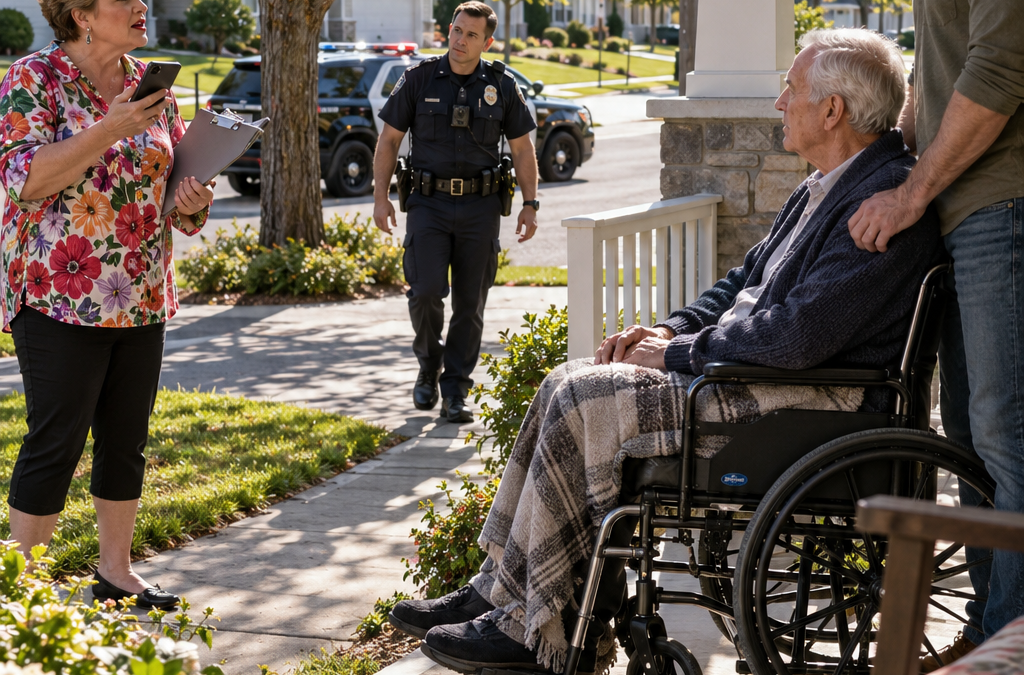
She stood at the bottom of the porch steps with her arms crossed.
A police officer stood beside her.
My father was on the porch.
Alive.
But unnaturally still.
I parked crooked and got out.
“What’s going on?”
Melissa turned.
She had the same composed expression she wore during HOA meetings.
“Your father’s behavior has escalated.”
I looked at her.
“What behavior?”
She gestured toward the officer.
“I had no choice but to contact law enforcement.”
I almost laughed.
“You had no choice?”
The officer stepped slightly between us.
“Sir, I’m Officer Daniel Reeves.”
His tone was calm.
He looked to be around forty.
Tall.
Broad shoulders.
Dark hair beginning to gray near his temples.
I forced myself to look at him instead of Melissa.
“What exactly was reported?”
He checked the notes on his phone.
“Complaint states an elderly male resident has been verbally aggressive toward pedestrians and has yelled at residents from this porch.”
I looked at my father.
He held his radio in his right hand.
His face looked gray.
Not frightened exactly.
Humiliated.
“My father can barely project his voice across the yard.”
Melissa cut in.
“He shouted at me last Thursday.”
My father lifted his head.
“No.”
Melissa looked at him.
“Robert, you did.”
He tightened his fingers around the radio.
“I said good morning.”
“Your tone was aggressive.”
I stared at her.
“His tone.”
Officer Reeves raised one hand.
“Let’s keep everybody calm.”
I pointed toward the camera above the porch.
“That records.”
Officer Reeves followed my hand.
“Audio too?”
“Yes.”
Melissa’s expression changed.
Only for a fraction of a second.
But I saw it.
Officer Reeves saw it too.
“Do you know the date of the alleged incident?”
Melissa answered.
“Thursday morning.”
I pulled out my phone.
The security app stored footage by time.
“Approximately what time?”
“Around nine.”
I found the clip.
There was Melissa walking down the sidewalk.
My father sat on the porch.
As she passed, he raised his hand.
The microphone clearly captured his voice.
“Good morning, Melissa.”
She didn’t respond.
She kept walking.
That was all.
Officer Reeves watched the video.
Then he watched it again.
He looked at Melissa.
“Was there another interaction?”
She crossed her arms.
“There have been multiple incidents.”
“Was that the one from Thursday?”
“Yes, but video doesn’t always capture tone.”
I stared at her.
“He said good morning.”
“I’m not going to debate this with you, Ethan.”
Officer Reeves looked back at me.
“How far back does the camera footage go?”
“Several weeks.”
“Any reason you installed it?”
I looked at Melissa.
“Yes.”
Then I told him.
The oxygen notice.
The ramp.
The complaints about how long my father sat outside.
The photographs.
Melissa interrupted twice.
Officer Reeves asked her to let me finish.
That alone made her angry.
Then he walked toward the porch.
My father looked up.
Officer Reeves slowed.
His expression changed.
At first, I thought he had noticed the oxygen line.
Then he stared at my father’s face.
“Sir?”
My father waited.
Officer Reeves took another step.
“Is your name Robert Caldwell?”
My father nodded.
“Yes.”
The officer’s eyes narrowed slightly.
“Did you drive a tow truck years ago?”
My father gave him a puzzled look.
“I drove one almost thirty years.”
“A blue one?”
My father’s expression changed.
“Tow truck was blue for a while.”
“Route 19 area?”
“Mostly.”
Officer Reeves went completely still.
Then he said, “You pulled my mother out of a wreck.”
Nobody spoke.
Melissa looked from the officer to my father.
I didn’t understand yet.
My father frowned, searching his memory.
Officer Reeves stepped closer to the porch.
“It was 2009. Route 19 near the old feed store. A pickup ran the light and hit our car.”
My father blinked slowly.
“I remember a lot of wrecks.”
“I was seventeen.”
The officer’s voice had changed.
The professional distance was gone.
“My mom was driving. I was in the passenger seat. The truck hit her side.”
My father kept staring at him.
Then something flickered in his eyes.
“A red sedan?”
Officer Reeves nodded.
“Yes.”
“Engine caught?”
“Yes.”
My father’s face tightened.
“Your mother was pinned.”
Officer Reeves swallowed.
“She was.”
The whole street seemed to become quiet.
Officer Reeves continued.
“People stopped. Nobody knew what to do. There was smoke coming from under the hood.”
My father looked down at his hands.
“You came running from your tow truck,” Reeves said. “You had a crowbar. You broke the rear passenger window first. Then you got the driver’s door open enough to pull her out.”
My father whispered, “There was fuel on the road.”
“Yes.”
“You were bleeding.”
Officer Reeves touched his forehead automatically.
“I needed six stitches.”
My father looked up.
“Did she make it?”
That question broke something in the officer’s face.
He smiled.
“She’s alive.”
My father closed his eyes.
Officer Reeves nodded.
“She’s seventy-two now. She has three grandchildren.”
My father’s mouth trembled.
“Good.”
“She remembers you.”
“I just did what anyone should’ve done.”
Officer Reeves shook his head.
“Nobody else did.”
My father looked away.
I could see tears gathering in his eyes.
I’d heard stories about my father helping stranded motorists.
I’d heard about accidents.
But he had never told me about this one.
To him, apparently, it hadn’t been a story worth telling.
Just something that needed doing.
Then Officer Reeves turned toward Melissa.
His voice became controlled again.
Not loud.
Controlled.
“You called police because this man sits on his porch?”
Melissa straightened.
“That isn’t what happened.”
“You reported aggressive behavior.”
“There have been ongoing concerns.”
“From whom?”
“Residents.”
“Names?”
“Complaints to an HOA can be confidential.”
“This isn’t an HOA investigation. You requested police response.”
Her face flushed.
“He has made people uncomfortable.”
Officer Reeves glanced at my father.
He was seventy-four.
Half-paralyzed.
Holding a small radio.
An oxygen tube ran beneath his nose.
“What specifically has he done?”
Melissa hesitated.
“He watches people.”
I actually thought I had misheard.
“He watches people?”
“From the porch.”
Officer Reeves stared at her.
“People walk down the street.”
“He makes some residents uncomfortable.”
My father finally spoke.
“I sit here because I can’t walk.”
Melissa didn’t look at him.
Officer Reeves did.
My father continued.
“I used to walk this neighborhood every morning. Can’t anymore.”
His voice was quiet.
“If looking down the street bothers somebody, I don’t know where else I’m supposed to look.”
I saw Officer Reeves clench his jaw.
Then he turned to me.
“You said there were HOA notices?”
“I have all of them.”
“May I see them?”
I went inside.
The folder had grown thick over the previous weeks.
When I returned, Reeves opened it on the hood of his cruiser.
Ramp violation.
Oxygen violation.
Front porch use.
Behavior notice.
Photography complaint.
Emails.
My written responses.
Doctor’s documentation.
He read carefully.
Melissa became increasingly restless.
“Officer, I don’t believe going through private association correspondence is relevant.”
Reeves did not look up.
“You called me here.”
“This is still largely an HOA matter.”
“It became my matter when you made a police report.”
He kept reading.
Two neighbors had stepped outside.
Then another.
Brierstone Lane had the kind of residents who could detect a police cruiser through three closed curtains and a running dishwasher.
Mrs. Alvarez appeared near her mailbox.
Mr. Benton stood across the street.
Melissa noticed them watching.
Officer Reeves finished the last notice.
Then he closed the folder.
“This appears to show a pattern.”
Melissa’s chin lifted.
“A pattern of enforcing community standards.”
“A pattern of complaints connected to a resident’s disability.”
“That’s an unfair characterization.”
“Is the oxygen tank medically necessary?”
She didn’t answer.
“Is the ramp medically necessary?”
“It still has to comply—”
“Was it there before you became HOA president?”
“That’s irrelevant.”
Officer Reeves looked at me.
“How long?”
“Seven years.”
He looked back at Melissa.
“Any complaints before recently?”
“Standards evolve.”
My father laughed once.
It was dry and tired.
“Funny. My legs didn’t.”
Melissa flushed.
Officer Reeves closed the folder.
“Mr. Caldwell isn’t committing a crime.”
“I never said he was.”
“You reported aggressive behavior.”
“I reported a concern.”
“You described him as yelling at pedestrians.”
“There were complaints.”
“Yet the only specific incident you’ve identified is him saying good morning.”
Melissa’s composure cracked.
“This family has been difficult throughout the enforcement process.”
Several people heard that.
Mrs. Alvarez spoke from the sidewalk.
“No, they haven’t.”
Melissa turned.
“This doesn’t involve you.”
Mrs. Alvarez folded her arms.
“It involves all of us when you’re calling police on people for sitting outside.”
More neighbors began watching.
Officer Reeves handed the folder back to me.
“Mr. Caldwell,” he said to my father, “you have every right to be on your porch.”
My father nodded slowly.
“Thank you.”
Reeves turned to me.
“If this continues, I’d recommend documenting every communication and speaking with an attorney familiar with housing and disability issues.”
Melissa gave a short laugh.
“An attorney? Over violation letters?”
Officer Reeves looked at her.
“Over a pattern.”
That word changed everything.
Pattern.
Up until then, I had thought my father was the target because Melissa disliked the way his wheelchair and oxygen tank looked.
I wasn’t wrong.
I simply wasn’t seeing enough.
That evening, Mrs. Alvarez knocked on our door.
She was sixty-eight and lived at the corner.
She used a walker after hip surgery.
She brought one of her own HOA notices.
Melissa had cited her because the walker was occasionally visible beside the garage.
“I thought it was just me,” she said.
Twenty minutes later, Mr. Benton came over.
His wife had Parkinson’s disease.
A home health nurse visited three times a week.
The HOA had warned them that “repeated commercial vehicles” in their driveway affected neighborhood appearance.
The commercial vehicle was the nurse’s hatchback with a small agency logo on the door.
Then Elaine Porter called.
Her husband had died six months earlier.
He had used a wheelchair during the final year of his life.
Melissa had personally suggested that Elaine remove the ramp quickly because it made the home “look institutional.”
Elaine’s voice shook while she told me.
“His funeral was twelve days before she said it.”
I sat at my kitchen table afterward surrounded by papers.
My father wheeled himself slowly into the room.
“What’s all that?”
“Other complaints.”
He looked at the notices.
“So it’s not just me.”
“No.”
For some reason, that seemed to hurt him more.
He stared at the table.
“People like being cruel to sick folks now?”
“I don’t think people do.”
“She does.”
“Yes.”
He was quiet.
Then he said, “Your mother would’ve hated her.”
I laughed.
“Mom would’ve run for HOA president just to remove her.”
That made him smile.
“Your mother would’ve burned the rulebook in the parking lot.”
For the first time in weeks, some of the shame seemed to leave his face.
I contacted the HOA board the next morning.
Not Melissa.
Every board member individually.
I sent the letters.
Video clips.
Statements from neighbors.
Officer Reeves’s incident information.
Photographs.
A timeline.
I wrote that I believed the association was selectively targeting residents because of disability-related accommodations.
For three days, there was silence.
Then an email arrived announcing an emergency HOA meeting.
Melissa’s name was still listed as president.
The meeting was scheduled for Thursday at seven.
My father wanted to attend.
I told him he didn’t have to.
“I know.”
“It could be ugly.”
“I know.”
“You sure?”
He looked at me.
“They’ve been talking about me for two months.”
Then he nodded toward his wheelchair.
“I ought to be in the room when they do it.”
Thursday night, nearly fifty residents showed up.
Normal HOA meetings attracted ten people on a busy night.
The community room was packed.
Folding chairs had to be brought from storage.
Melissa sat at the front table wearing a navy blazer.
Her hair was perfect.
Her hands were folded.
Her expression suggested she believed the meeting was merely an administrative inconvenience.
I pushed my father into the first row.
When Melissa saw him, her smile disappeared for half a second.
Then it returned.
The board secretary began reading the agenda.
She barely finished the second sentence before Mr. Benton stood.
“I want to know why disabled residents are being fined for existing.”
The room erupted.
Melissa struck the gavel.
“This meeting will remain orderly.”
Mrs. Alvarez stood.
“You fined me for my walker.”
“Mrs. Alvarez, individual enforcement matters are not—”
“You wrote the letter.”
Another voice called from the back.
“You told me my mother’s portable ramp had to be removed after each use.”
Melissa hit the gavel again.
“One person at a time.”
Elaine stood.
Her voice was quiet enough that the room settled itself.
“Two weeks after my husband’s funeral, you told me I should remove his wheelchair ramp because it made my house look institutional.”
Melissa’s face tightened.
“I expressed sympathy and discussed exterior modifications.”
“No.”
Elaine shook her head.
“You said I should be relieved I could finally make the house look normal again.”
Nobody moved.
Melissa stared at her.
“That is not an accurate quotation.”
“It is exactly what you said.”
Someone behind me whispered, “Jesus.”
More residents spoke.
An elderly man cited for a portable handrail.
A woman warned because a medical transport van regularly stopped outside her home.
Another family told the board they had been pressured to move a mobility scooter out of view even though their grandfather used it every day.
The pattern was no longer theoretical.
It had names.
Faces.
Homes.
Families.
Melissa tried to frame everything as neutral enforcement.
“Standards apply equally to all homeowners.”
Finally, I stood.
I carried the folder to the front.
“My father has lived on Brierstone Lane for thirty-two years.”
The room became quiet.
“He bought his home before most of these HOA policies existed. He raised me there. He maintained that property himself until two strokes took away most of his ability to walk.”
Melissa shifted in her chair.
I continued.
“For seven years, his wheelchair ramp caused no problem.”
I held up the first notice.
“Then Melissa Granger became president.”
Another notice.
“Suddenly his oxygen tank became an aesthetic violation.”
Another.
“His ramp became an aesthetic violation.”
Another.
“The amount of time he spent sitting on his porch became an issue.”
Another.
“Then his behavior became an issue.”
Melissa interrupted.
“That is a gross misrepresentation.”
I looked at her.
“You called police.”
“For reported behavior.”
“You reported the behavior.”
“Residents expressed concerns.”
“Name one.”
She didn’t.
I turned toward the room.
“My father was accused of yelling aggressively at pedestrians.”
Then I looked back at Melissa.
“We have the video.”
Her face changed.
I connected my laptop to the monitor.
The first clip played.
My father sat on the porch.
Melissa approached.
He lifted his hand.
“Good morning, Melissa.”
She continued walking.
Nothing else happened.
The room stayed silent.
I played another clip.
Melissa stood near our property taking pictures of my father as he slept.
Then another.
A conversation from the porch.
Her voice came clearly through the speakers.
“There are ways to make accessibility features less visually prominent.”
That was the moment the room turned.
Not loudly.
Not dramatically.
It was something deeper.
People simply stopped giving Melissa the benefit of the doubt.
Harold Finch, one of the board members, removed his glasses.
“Melissa.”
She looked at him.
“Did you say that?”
She straightened.
“It was a discussion regarding property presentation.”
Harold frowned.
“You said accessibility should be less visible.”
“I said accessibility features could be integrated aesthetically.”
Elaine spoke from the back.
“No. You were talking about people.”
Applause broke out.
Melissa struck the gavel.
“Enough.”
No one listened.
Then the rear door opened.
Officer Daniel Reeves entered.
He wasn’t wearing a uniform.
Jeans.
Gray button-down shirt.
No badge visible except the one clipped at his belt.
The room recognized him anyway.
Melissa stared.
“What is he doing here?”
Reeves walked toward the microphone.
“I was invited to provide information about the police response.”
Melissa leaned toward the board attorney.
“I object to this.”
Harold shook his head.
“This isn’t a courtroom.”
Reeves reached the microphone.
“My name is Daniel Reeves. I responded to a call at the Caldwell residence concerning an allegedly aggressive elderly male.”
He glanced toward my father.
“Upon arrival, I reviewed available video evidence.”
Melissa folded her arms.
Reeves continued.
“The specific incident identified by the complainant did not match the allegation made to police.”
The room was completely silent.
“The resident was not yelling. He was not threatening anyone. He was not acting aggressively.”
Melissa muttered, “That is your interpretation.”
Reeves turned toward her.
“It’s the evidence.”
She said nothing.
He looked back toward the board.
“I also reviewed correspondence provided by Mr. Caldwell’s family regarding prior complaints concerning his wheelchair ramp, oxygen equipment, and use of his porch.”
He paused.
“I cannot make a legal determination regarding HOA policy. But I can say the call I responded to did not appear to involve a public safety issue.”
Then he looked directly at Melissa.
“It appeared to involve an attempt to use law enforcement against a disabled resident over a neighborhood dispute.”
Melissa’s face went pale.
“This is outrageous.”
No one defended her.
The board called a recess.
Then they moved into a closed session.
Twenty minutes passed.
My father sat beside me.
“You all right?” I asked.
“Tired.”
“You want to go home?”
“No.”
He looked toward Melissa.
“Not yet.”
Twenty-seven minutes after entering closed session, the board returned.
Harold Finch spoke.
“Effective immediately, Melissa Granger has been removed from the office of president pending a full review of enforcement practices under her tenure.”
The room erupted.
My father didn’t celebrate.
He simply closed his eyes.
I put my hand on his shoulder.
Melissa gathered her papers.
For the first time since I’d met her, she looked ordinary.
Not powerful.
Not polished.
Not in control.
Just a woman standing in a room where people had finally stopped being afraid of making her uncomfortable.
Within a week, every violation against my father was withdrawn.
Every fine was canceled.
Two weeks later, the HOA issued a written apology to him and several other residents.
A month after that, new association policies were adopted.
Medical equipment being actively used could not be cited as an aesthetic violation.
Accessibility modifications were exempted from ordinary appearance enforcement when reasonably necessary.
Complaints involving disabled residents required board review instead of unilateral enforcement by one officer.
It didn’t erase what had happened.
But it made it harder for it to happen again.
Melissa still lived three streets away.
She stopped walking past our house.
My father noticed.
“Think she changed her route?”
“Probably.”
“Shame.”
“Why?”
He smiled.
“I was going to say good morning.”
The first morning after the formal apology arrived, I helped him onto the porch.
Nothing about the ritual had changed.
Wheelchair.
Blanket.
Navy-blue mug.
Radio.
Oxygen nearby.
But the porch felt different.
Mrs. Alvarez came over carrying blueberry muffins.
Mr. Benton stopped to tighten a loose screw he’d noticed on the ramp.
Three kids riding bicycles waved at my father.
He waved back.
Then around noon, a car pulled up.
Officer Reeves stepped out.
He walked around to the passenger side and opened the door.
An older woman climbed out slowly.
She had silver hair and used a cane.
The moment my father saw her, he stopped moving.
Officer Reeves helped her up the walkway.
“This is my mom,” he said.
The woman looked at my father for several seconds.
Then she smiled.
“Robert Caldwell.”
My father swallowed.
“Ma’am.”
She stepped onto the ramp.
“Daniel told me he’d found you.”
My father’s eyes filled.
“I’m glad you’re all right.”
She laughed softly.
“All right is generous at my age.”
Then she reached him.
She took his right hand in both of hers.
“I’ve wanted to say this to you for seventeen years.”
My father looked down at their hands.
She said, “Thank you for giving me more time.”
My father broke.
Not dramatically.
He simply lowered his head, and tears fell onto the blanket across his knees.
“I didn’t know,” he whispered.
“Didn’t know what?”
“That you lived.”
She tightened her hands around his.
“I lived.”
He covered his mouth.
Officer Reeves turned away for a moment.
So did I.
His mother continued.
“I saw my son graduate high school.”
My father’s shoulders shook.
“I saw him become a police officer.”
She smiled toward Daniel.
“I saw him get married.”
My father wiped his eyes.
“I held every one of my grandchildren.”
Then she leaned slightly closer.
“And all those years came after the day you pulled me out of that car.”
My father couldn’t answer.
So she squeezed his hand.
“I thought you should know what you saved.”
I had spent months watching Melissa reduce my father to objects.
A wheelchair.
A ramp.
An oxygen tank.
An aesthetic problem.
Something that should be hidden.
Something that didn’t fit.
And there, on that porch, sat proof of how small that view of a human being really was.
My father could no longer walk.
That was true.
He needed help standing.
That was true too.
Some mornings, getting him dressed took twenty minutes.
Some afternoons, he needed oxygen after transferring from one chair to another.
He wasn’t the physically powerful man I’d known as a child.
But weakness wasn’t the right word for what had happened to him.
His body had changed.
His value hadn’t.
Years before, on a highway filled with smoke and broken glass, he had seen another human being in danger and run toward her.
He had not asked whether saving her would improve anyone’s property value.
He had not wondered whether her injuries were attractive.
He had not waited for someone more qualified to become brave.
He saw a person who needed help.
And he helped.
Now, decades later, when he was the one who needed accommodations, Melissa Granger had looked at him and seen inconvenience.
That difference told me everything about both of them.
After Officer Reeves and his mother left, my father stayed outside.
The sun had moved across the porch.
I adjusted the blanket over his knees.
“You ready to go in?”
He shook his head.
“Not yet.”
“Tired?”
“A little.”
I sat in the chair beside him.
For a while, neither of us said anything.
A delivery truck rolled past.
Somewhere down the street, a dog barked.
The maple leaves moved in the wind.
My father took a sip of coffee that had long since gone cold.
Then he looked at me.
“You know what bothered me most?”
“What?”
“I started believing her.”
I knew immediately who he meant.
He looked down at his wheelchair.
“When she kept sending those letters, I started wondering if maybe people really didn’t want to see me.”
“Dad.”
“I know.”
His voice was steady.
“But you lose enough pieces of your old life, you start wondering whether everybody else can see how much you’ve lost.”
I didn’t interrupt.
“I couldn’t work anymore. Couldn’t drive. Couldn’t fix things. Couldn’t even get onto my own porch without a ramp.”
He looked down the street.
“Then somebody starts writing letters saying the chair looks bad. The oxygen looks bad. The ramp looks bad.”
He paused.
“After a while, what you hear is that you look bad.”
That hurt more than anything Melissa had said directly to me.
I leaned forward.
“You want to know what I see?”
He gave me a suspicious look.
“If you’re about to give me some emotional speech—”
“I’m serious.”
He sighed.
“Fine.”
“I see the guy who raised a thirteen-year-old kid by himself after his wife died.”
He looked away.
“I see the guy who worked two jobs and still made every baseball game.”
“Ethan—”
“I see the guy who pulled a woman out of a burning car and never bothered telling his son because apparently saving somebody from a fire wasn’t worth mentioning.”
“It wasn’t on fire yet.”
I stared at him.
“That’s your objection?”
“Accuracy matters.”
I laughed despite myself.
Then I continued.
“I see my father.”
His eyes filled again.
“And if somebody looks at you and only sees that chair, they’re not seeing enough.”
He was quiet for a long moment.
Then he nodded toward the street.
“Help me move forward a little.”
I unlocked the wheels and pushed him closer to the porch railing.
The sun fell fully across his face.
He closed his eyes.
There was no embarrassment in that moment.
No apology.
No attempt to become less visible.
He simply sat there.
Exactly where he belonged.
In the months that followed, Brierstone Lane changed in ways I hadn’t expected.
Some of the changes were administrative.
The HOA reviewed previous violations involving medical accommodations.
Several fines were refunded.
The board created an accessibility committee, though my father complained that the name sounded too official.
“Committee means meetings.”
“Probably.”
“Meetings mean coffee.”
“Usually.”
“Then I might volunteer.”
He did.
Not because he suddenly loved HOAs.
He absolutely did not.
But because he didn’t want another person receiving the kind of letter he’d received.
At the first committee meeting, a younger resident asked whether my father thought ramps should still follow basic safety and construction standards.
My father looked at him.
“Of course.”
The man seemed relieved.
Then Dad added, “But there’s a difference between making sure a ramp is safe and wishing the person using it were invisible.”
Nobody argued.
Mrs. Alvarez joined too.
So did Elaine.
People who had once quietly accepted warnings because they didn’t want conflict began asking questions.
Why was this rule being enforced?
Who had complained?
Was the complaint based on safety or appearance?
Was an accommodation available?
Could the same goal be accomplished without humiliating someone?
The neighborhood didn’t become perfect.
No neighborhood does.
People still argued over fences.
Someone complained about trash cans.
Two men spent three meetings fighting about whether a basketball hoop violated setback rules.
But something fundamental had shifted.
The HOA stopped feeling like one person’s private authority.
My father became something of a fixture at meetings.
Not because he talked constantly.
He rarely did.
He would sit near the back with his navy mug and listen.
But when accessibility came up, people turned toward him.
At first, he hated that.
“I don’t want to be their wheelchair expert.”
“Then tell them that.”
“I did.”
“What happened?”
“They made me vice chair.”
I laughed so hard I nearly spilled my coffee.
Officer Reeves visited occasionally.
Sometimes in uniform.
Sometimes not.
The first time his mother came back, she brought photographs.
One showed Daniel graduating from the police academy.
Another showed him standing beside his wife.
The last showed three children sitting around a birthday cake.
She handed that one to my father.
“Those are the three grandkids I told you about.”
My father stared at the photograph for a long time.
Then he asked if he could keep it.
“It’s why I brought it.”
He placed the picture on the small table beside his chair.
For weeks afterward, I noticed him looking at it.
One evening, I asked him why.
He rubbed his thumb across the edge of the frame.
“Most things you do in your life, you don’t get to know what came after.”
“What do you mean?”
“You help somebody. Fix something. Say something. Then life keeps moving.”
He looked at the photograph.
“Sometimes you never know whether it mattered.”
I sat beside him.
“That one mattered.”
He nodded.
“So did what you did.”
“What did I do?”
“You wouldn’t let me hide.”
The words caught me off guard.
He looked toward the porch.
“When Melissa started all that, I would’ve stayed inside.”
“I know.”
“I would’ve told myself it was easier.”
“I know.”
He smiled faintly.
“You didn’t let me.”
“No.”
“Annoying trait.”
“You taught me.”
“Unfortunately.”
We sat quietly after that.
My father died two years later.
Not suddenly.
Not dramatically.
His health declined the way doctors had warned us it eventually would.
Another small stroke.
More weakness.
Longer hospital visits.
Harder mornings.
Near the end, there were days when he no longer wanted to go outside.
But on good mornings, he still asked.
“Porch?”
And I knew exactly what he meant.
I would help him into his wheelchair.
Pull the blanket over his knees.
Bring the navy-blue mug.
Turn on the radio.
Sometimes he slept.
Sometimes he talked.
Sometimes we just watched the street.
A few weeks before he died, I found him looking toward the ramp.
“You remember when that woman wanted this thing hidden?”
I smiled.
“Hard to forget.”
“What’s her name?”
“Melissa.”
He nodded.
“Right.”
Then he smiled.
“Hope she’s doing well.”
That surprised me.
“You do?”
“Sure.”
“Why?”
He shrugged as much as his weakened left side allowed.
“Being angry takes energy.”
Then he added, “And I’m old.”
That was my father.
He never became sentimental about what happened.
He didn’t need Melissa punished forever.
He only needed to know she couldn’t do it to somebody else.
After his funeral, I sat alone on the porch.
His wheelchair was gone.
The oxygen tank was gone.
For the first time in years, the space beside the railing was empty.
I almost removed the ramp.
For a few days, I couldn’t stand looking at it.
Then Mrs. Alvarez came over.
She stood beside me with her walker.
“You taking that out?”
“I was thinking about it.”
She stared at the ramp.
“Robert would yell at you.”
I laughed.
“He probably would.”
“Leave it.”
“Why?”
She looked at me like the answer was obvious.
“Because someday somebody else might need it.”
So I left it.
It’s still there.
The finish has been redone twice.
A few boards were replaced.
The railing my father once complained wasn’t level has been adjusted.
Sometimes delivery drivers use it when they’re carrying heavy packages.
Sometimes Mrs. Alvarez uses it when she visits.
Sometimes nobody uses it for weeks.
And that’s fine.
A ramp doesn’t make a house ugly.
A wheelchair doesn’t make a person lesser.
An oxygen tank doesn’t ruin a neighborhood.
But cruelty can.
Humiliation can.
The quiet belief that some people should make themselves smaller because their bodies have changed can.
Melissa Granger once believed she could protect the image of Brierstone Lane by making my father less visible.
Instead, she forced the entire neighborhood to look at him.
And when they finally did, they didn’t see the wheelchair.
They saw Robert Caldwell.
The widower who raised his son.
The neighbor who shoveled other people’s snow.
The man who fixed porch steps without charging anyone.
The tow-truck driver who stopped beside a wreck in 2009 when everyone else was afraid of the smoke.
The stranger who broke a window, reached into twisted metal, and pulled a mother toward another seventeen years of birthdays, graduations, weddings, and grandchildren.
The old man who sat beneath a blanket with a navy-blue mug in his hand because the porch was one of the last places where the world still came to him.
For months, Melissa tried to convince him that being seen was something he should apologize for.
She failed.
And in the end, the thing I remember most isn’t the HOA meeting.
It isn’t the video.
It isn’t even the moment the board removed her.
It’s one ordinary morning after all of it was over.
My father was sitting on the porch.
Sunlight rested across his face.
His eyes were closed.
His coffee was beside him.
A group of kids rode past on bicycles.
One of them shouted, “Morning, Mr. Caldwell!”
My father opened his eyes.
He lifted his hand.
“Morning.”
The kids kept riding.
Nothing dramatic happened.
No one stopped.
No one applauded.
There were no police cars.
No cameras.
No violation letters.
My father simply sat on his own porch, in his own wheelchair, in front of his own home.
Visible.
Unashamed.
And exactly where he belonged.








