𝗙𝗨𝗟𝗟 𝗦𝗧𝗢𝗥𝗬 The HOA President Called the Police on Me for Swimming in My Own Pool
𝗙𝗨𝗟𝗟 𝗦𝗧𝗢𝗥𝗬
I remember standing in the shallow end, watching the sunset turn the water copper.
“Yes, we did.”
For almost a year, the pool was our little sanctuary.
Morning swims before work.
Quiet evenings after dinner.
Elena reading on the lounge chair while I skimmed leaves.
Friends over on Saturdays.
Nothing dramatic.
Nothing anyone else needed to care about.
Then Karen Whitfield decided our backyard was somehow his business.
Karen had been president of the Maple Ridge HOA for six years.
In that time, he had turned a volunteer board position into something that felt less like neighborhood service and more like a personal throne.
He moved through Maple Ridge with a clipboard in one hand and an expression that suggested he was constantly disappointed in the rest of us.
He liked words like “harmony,” “uniformity,” “standards,” and “community integrity.”
He spoke in that polished, condescending tone some people use when they want to sound reasonable while threatening you.
Our first offense, according to Karen, was the color of our shutters.
A letter arrived on a Thursday.
Exterior Color Nonconformity — Shutters Not Consistent With Community Harmony. Fine: $100.
I stood on the porch and stared at our shutters.
Blue.
The exact approved blue from the HOA binder.
I still had the paint chip.
The one Karen himself had handed us at the architectural review meeting.
I called the HOA office.
Karen answered.
“Daniel.”
“Karen, I got a fine for my shutters.”
“Yes.”
“They’re painted with the approved color.”
“They appear slightly brighter in natural light.”
“They’re the approved paint.”
“Paint can vary by batch.”
“I used the exact code from your binder.”
“The board determined the effect is inconsistent.”
I looked toward the house across the street.
Its shutters were a faded green that I was almost certain had never appeared in any approved palette.
“Can I appeal?”
“You can submit a written appeal.”
“Will the board review it?”
“Of course.”
Something in the way he said it made me doubt the board would see anything he didn’t want it to see.
Still, I paid the fine.
Elena thought that was a mistake.
“It’s not about the hundred dollars,” she said.
“I know.”
“Then why pay?”
“Because I don’t want to spend three weeks arguing about blue shutters.”
She looked at me over her coffee mug.
“That is exactly how people like him win.”
She was right.
I hated that.
A week later, a second fine arrived.
Unauthorized Landscaping Alteration — Rose Bush Height Below Approved Minimum. Fine: $150.
This one made me stare at the paper for a long time.
I had trimmed the rose bushes along the front walkway because one branch was scratching Elena’s car when she pulled into the garage.
Apparently, I had trimmed them two inches shorter than the bylaws allowed.
Two inches.
I looked at the shrubs.
They looked better than before.
I paid that fine too.
Then I started a folder.
Elena watched me label it from the kitchen table.
“HOA nonsense?” she asked.
“Evidence.”
“Evidence for what?”
“I don’t know yet.”
She smiled faintly.
“You’re being paranoid.”
“Maybe.”
But I took photos anyway.
Mailbox.
Lawn.
Driveway.
Pool fence.
Front shrubs.
Side gate.
Shutters.
Every photo had a timestamp.
Every letter went into the folder.
Every payment confirmation was saved.
I had spent years managing facilities. When something went wrong, the person with records usually survived the meeting.
That instinct turned out to be the smartest thing I did.
The fines kept coming faster.
A garden gnome near the front steps violated uniformity standards.
That one belonged to Elena. It was a little ceramic figure holding a book. Her students had given it to her as an end-of-year gift.
I moved it to the backyard.
Then came a parking citation.
Our own car, in our own driveway, allegedly remained outside past an overnight parking curfew.
The curfew did not exist in the rules I had.
I checked three times.
Still, the fine came.
Then came the certified letter.
The envelope was thick.
The tone was serious.
Notice of Intent to File Lien — Outstanding Balance: $400.
Four hundred dollars.
Some of it involved fines I had already disputed in writing.
Some involved late charges added before my appeal window had even expired.
The letter warned that unpaid assessments could lead to collection actions against our property.
A lien against our house.
Over shutters, roses, a gnome, and a fake parking curfew.
I sat at the dining table while Elena read the notice.
Her face went pale.
“Can they do that?”
“They can try.”
“Daniel.”
“I know.”
“This is our home.”
“I know.”
That night, after Elena went to bed, I read the letter line by line.
The fine print cited several sections of the HOA bylaws, including Section 14B.
I opened my copy of the recorded covenants.
There was no Section 14B.
The document went from 14A to 15.
At first, I assumed I had an outdated packet.
The next morning, I drove to the county recorder’s office and requested the recorded HOA documents.
The clerk brought me copies.
Original declaration.
Amendments.
Current recorded covenants.
There was still no Section 14B.
It didn’t exist.
Karen had cited a phantom section.
That was when irritation became something else.
I sat in my truck outside the recorder’s office, flipping through the documents.
The recorded covenants capped fines at $50 per incident unless approved under a specific amendment procedure.
Karen had been charging $100, $150, sometimes more.
Triple.
Quadruple.
Amounts that appeared nowhere in the documents available to homeowners or recorded with the county.
I drove home with copies on the passenger seat and a cold focus settling in my chest.
Karen wasn’t simply strict.
He was inventing authority.
At the next HOA meeting, I brought the documents.
The meeting was held in the clubhouse, a beige building with a kitchenette, folding chairs, and framed photographs from community events.
Eleven homeowners attended.
Karen stood at the front table, dressed in a pale gray polo and tan slacks, looking like he had stepped out of a golf magazine.
After routine announcements, he opened the floor.
I stood.
“My name is Daniel Ortega. I’d like clarification on a lien notice I received.”
Karen’s expression barely shifted.
“Yes, Daniel.”
I held up the letter.
“This notice cites Section 14B as authority for several fines. I pulled the recorded covenants from the county. There is no Section 14B.”
A few heads turned.
Karen smiled.
The smile was smooth, practiced, and deeply irritating.
“The documents you have are outdated.”
I placed copies on the table.
“These are the current recorded documents from the county.”
“The board has adopted internal policy updates.”
“Where are they recorded?”
“Internal policies don’t always require recording.”
“Do they allow you to exceed the fine cap in the covenants?”
His smile tightened.
“You’re misunderstanding the relationship between administrative policies and governing documents.”
“I’m asking a simple question. Where is Section 14B?”
The room went quiet.
Karen lifted his chin.
“Daniel, I suggest you consult the updated enforcement schedule before making accusations in public.”
“Can you provide it?”
“It has been made available.”
“To whom?”
“To homeowners.”
“I’m a homeowner.”
The silence became uncomfortable.
A woman two rows behind me leaned forward and whispered, “I paid over two thousand dollars last year.”
I turned slightly.
She was an elderly widow named Mrs. Larkin. I had seen her walking a small white dog in the mornings.
Her voice shook.
“I never questioned it.”
Karen’s eyes moved to her.
She immediately looked down.
That small motion told me everything.
People were afraid of him.
Not annoyed.
Not inconvenienced.
Afraid.
Karen tapped the table.
“This board will not entertain inflammatory claims based on incomplete information.”
I kept my voice calm.
“Then produce the complete information.”
He stared at me for a long second.
“We’ll move on.”
I sat down.
My pulse was pounding.
But I had what I needed.
The question was on record.
So was his refusal.
That night, I started calling neighbors.
Quietly.
One by one.
Mrs. Larkin was first.
She showed me fines for hedge height, porch decorations, window treatments, and a mailbox decal her late husband had placed there years earlier.
She had paid nearly $2,300 in twelve months.
A family on Creekside Court had paid $900 after Karen threatened them over a basketball hoop that appeared to comply with the rules.
The Parkers had received a foreclosure warning over less than $500.
The Nguyens had fines citing Section 14B too.
Six households had similar stories.
Invented sections.
Inflated fines.
Threats of liens or foreclosure over small amounts.
Always signed by Karen.
Always delivered in the same clipped, superior tone.
The more I heard, the less this felt like a neighborhood dispute.
It felt like a system.
Karen found people who didn’t know the documents, didn’t have time to fight, or didn’t want public conflict.
Then he leaned on them until they paid.
The twist nobody expected came from the financial records.
Karen always claimed fines went into the HOA landscaping reserve.
He said it at meetings.
He wrote it in newsletters.
He used it to make people feel as if paying inflated fines somehow benefited the community.
So I requested the financial disclosures.
Every homeowner had that right.
Karen stalled.
First, he said the accountant was preparing the reports.
Then he said the board needed to review them.
Then he said there were formatting issues.
Three weeks passed.
Meanwhile, the HOA account statements available in prior annual packets showed something strange.
The landscaping reserve had not grown in two years.
Not meaningfully.
Not by the amount Karen’s fines should have produced.
If six households alone had paid thousands, where was the money?
Before I could get an answer, Karen escalated.
He filed a lien notice against my house with the county recorder’s office.
I found out through a mailed copy.
I stood in the driveway holding the notice while Elena read over my shoulder.
For a few seconds, neither of us spoke.
The debt wasn’t valid.
The bylaw section didn’t exist.
The fine amounts exceeded the recorded limits.
But there it was.
Attached to our property.
Our home now had Karen’s false paperwork clouding it.
Elena’s voice shook.
“He really did it.”
I folded the notice carefully.
“Yes.”
“What do we do?”
“We stop treating him like a nuisance.”
Two days later, the police came to my pool.
That morning was supposed to be ordinary.
I swam before work whenever the weather allowed. Twenty laps, sometimes thirty if my back wasn’t bothering me. It helped clear my head.
Elena was inside packing lunch.
I was on lap eighteen when I heard tires on the driveway.
At first, I thought it was a delivery truck.
Then I saw red and blue lights flickering against the water.
I climbed out of the pool.
Two officers walked toward the gate.
The younger one looked uncertain.
The older one looked like he had been doing this long enough to know when a call already smelled bad.
“Sir,” the younger officer said, opening his notepad, “we got a call about a trespasser using a private pool without authorization.”
That was when I laughed.
“This pool is mine.”
The older officer looked toward the water.
“This address is yours?”
“Yes.”
“Do you have ID?”
“I’ll get it.”
Elena came outside before I reached the back door.
“What’s happening?”
“Someone called the police on me for swimming.”
She stared.
“In our pool?”
“Yes.”
The older officer’s expression changed slightly.
He pulled out a tablet.
“Let’s check the property map.”
While he searched, Karen appeared at the fence line.
Of course he did.
He stood just beyond the side gate, phone raised, recording.
“Officers,” he called, “this pool has been represented as an association amenity in the past.”
I turned slowly.
“No, it hasn’t.”
Karen smiled.
“The association has records indicating shared recreational access questions.”
“Karen, this pool is fifteen feet inside my property line.”
The older officer looked at the tablet.
Then at me.
Then at Karen.
“Sir, this pool appears to be entirely on Mr. Ortega’s private lot.”
Karen’s smile faltered.
“There may be an easement.”
The officer looked back at the tablet.
“I’m not seeing one.”
“I’m the HOA president.”
“That doesn’t change the property line.”
Elena crossed her arms.
Karen lowered his phone slightly.
The older officer walked toward the fence.
“Sir, are you the caller?”
Karen lifted his chin.
“I reported a potential unauthorized use issue.”
“Of his own pool?”
“I had reason to believe—”
The officer interrupted.
“Do not make another report like this unless you have actual evidence of a crime.”
Karen’s jaw tightened.
“This is a community standards matter.”
“Then it’s not a police matter.”
The younger officer looked away, probably to hide a smile.
Then the best moment of that horrible morning happened.
Karen stepped backward while launching into another lecture about HOA jurisdiction and community harmony.
His heel caught on one of Elena’s decorative garden gnomes near the fence.
A small ceramic mermaid gnome.
He flailed.
His clipboard flew open.
For one glorious second, the president of Maple Ridge Estates windmilled his arms like a man trying to fight gravity through superior bylaws.
He did not fully fall.
Almost.
But he stumbled hard into the side fence, sending his sunglasses crooked.
The younger officer turned his whole body away.
His shoulders shook once.
Elena covered her mouth.
I bit the inside of my cheek so hard it hurt.
After weeks of stress, watching Karen lose a fight to a garden gnome felt like the universe cashing a check.
Karen recovered quickly.
His face was red.
He pointed at me.
“He threatened me at the last HOA meeting.”
The laughter vanished.
I stared at him.
“What?”
Karen looked at the officers.
“He has been aggressive, hostile, and threatening during board proceedings.”
The younger officer turned back.
“Sir, is that true?”
“No.”
Karen said, “It’s documented.”
I said, “Yes. It is.”
Karen’s eyes flicked toward me.
I walked inside, grabbed my phone, and opened the recording folder.
I had recorded every HOA meeting for two months, openly, from my seat.
I handed the phone to the older officer.
“Here’s the meeting he’s talking about.”
The officer watched thirty seconds.
There I was on video, standing in the clubhouse, calmly asking where Section 14B appeared in the recorded covenants.
There was Karen, smiling, dodging, and citing internal policies.
No threat.
No raised voice.
No aggressive conduct.
Just a man asking questions.
The officer watched a little more.
Then he handed the phone back.
“Mr. Whitfield, that does not show a threat.”
Karen’s face hardened.
“This is being taken out of context.”
The officer sighed.
“I’ve heard enough for today.”
He turned to me.
“You may want to file a formal complaint with the county’s HOA oversight division if you believe the association is acting improperly.”
I blinked.
“There’s an HOA oversight division?”
He pulled a card from his pocket.
“Yes. Start here.”
Then he looked at Karen.
“And you need to leave Mr. Ortega’s property line.”
Karen opened his mouth.
The officer added, “Now.”
Karen left.
Not gracefully.
Not with his usual smooth control.
He gathered his fallen papers, avoided the gnome, and walked back toward the street.
When the officers left, the older one actually apologized.
“Sorry for the interruption, sir.”
I looked at the pool.
Then at the card in my hand.
“No. This helped.”
And it did.
Because Karen’s false police call had done something he didn’t intend.
It introduced me to the exact office that could investigate him.
I filed the complaint the following Monday.
I attached everything.
Photos.
Recordings.
The phantom Section 14B citation.
The county covenants.
The inflated fine notices.
Six neighbor statements.
The lien notice.
The pool incident police report.
Evidence that the pool was fully inside my lot.
Proof that Karen had made false claims about community access.
I expected silence.
Instead, the county opened an investigation within a week.
That was when the third twist landed.
Karen had not only inflated fines.
He had been skimming them.
Forensic accountants reviewed two years of HOA records.
They found nearly $30,000 in landscaping fund withdrawals that traced to Karen’s personal credit card payments and a family vacation.
Some fine payments entered HOA accounts and were then moved through vague maintenance entries.
Some were deposited into an account Karen controlled before being partially transferred elsewhere.
Not every detail was explained to us immediately, but the broad pattern was clear.
Homeowners paid fines they often did not legally owe.
Karen claimed the money supported landscaping.
The landscaping fund did not reflect the deposits.
And thousands flowed toward his personal expenses.
The HOA board, suddenly cooperative and terrified of being associated with him, voted him out within forty-eight hours of receiving preliminary findings.
The official minutes used the phrase gross financial misconduct.
I printed a copy.
I put it in my folder.
Right beside the first shutter fine.
Karen losing his title was satisfying.
But it was not enough.
Not for Mrs. Larkin, who had paid money she needed for medicine.
Not for the Parkers, who nearly refinanced to cover a false foreclosure threat.
Not for Elena, who had spent two nights crying over the lien on our house.
Not for me, standing in my own pool while police officers asked if I was trespassing.
The county filed embezzlement charges.
Separately, I filed a civil suit for wrongful lien, harassment, fraudulent fines, and damages tied to the false reporting and improper collection efforts.
Karen hired a lawyer.
His defense began with clerical error.
Then misunderstanding.
Then internal policy confusion.
But recordings of him citing nonexistent bylaw sections in public meetings made “confusion” a hard sell.
Especially when the same fake section appeared across multiple households’ fines.
The lien on my house was voided by court order within two weeks.
The document arrived stamped, notarized, and official.
I held it in both hands at the kitchen table.
Elena sat across from me.
“It’s gone?” she asked.
“It’s gone.”
She covered her face.
For weeks, that lien had sat over our home like a shadow.
Now a judge had erased it.
The county clerk’s office sent a letter acknowledging that the filing had been voided following the court order.
It wasn’t personal.
It wasn’t emotional.
But I read it three times because it meant our title was clear.
Karen’s paperwork no longer touched our home.
Word spread through Maple Ridge quickly.
At the next HOA meeting, the clubhouse was packed.
People who had never spoken before stood one by one.
Mrs. Larkin described the fines she paid after her husband died because she was afraid of losing the home they bought together.
The Parkers described the foreclosure letter they received over $375.
A young father from Creekside Court talked about taking overtime shifts to pay penalties for a basketball hoop his kids barely used.
The Nguyens brought copies of citations with Section 14B printed in bold.
Every story sounded different.
Every pattern was the same.
Karen sat in the back row.
No clipboard.
No sunglasses.
No authority.
Just a man watching six years of fear turn into testimony.
When my turn came, I stood.
I did not give a speech.
I simply held up the pool police report.
“This is what happens when an HOA president forgets where his authority ends.”
Then I placed it on the table.
Nobody clapped.
They didn’t need to.
The silence was enough.
Three months later, Karen pleaded guilty to embezzlement-related charges.
He faced restitution and probation.
The state real estate board reviewed the case and revoked his license, ending the career he had used to make himself seem untouchable.
I heard the news from Priya Shah, the attorney who handled my civil case.
She called me on a Thursday afternoon.
“It’s done,” she said.
“What part?”
“Most of it. Plea entered. Restitution ordered. Real estate license revoked.”
I stood in the backyard, looking at the pool.
“And our civil case?”
“Settlement is finalized. Fraudulent fines reimbursed. Legal costs addressed. Wrongful lien damages included.”
I looked toward the water.
It was calm, blue, ordinary.
For a moment, I couldn’t speak.
Priya waited.
Finally, I said, “Thank you.”
“You did the important part.”
“What was that?”
“You checked the math.”
I laughed quietly.
That was exactly what started the collapse.
Not rage.
Not revenge.
Math.
A missing bylaw section.
A fine cap.
A community account that didn’t grow.
Numbers that refused to support Karen’s story.
I still swim every morning.
The first few times after the police incident, I felt strange stepping into the water.
I would glance toward the driveway, expecting lights.
Expecting Karen.
Expecting someone to tell me the thing I owned was not really mine.
That feeling faded slowly.
Now the pool is mine again.
Ours.
No sirens.
No officers.
No fences to explain.
No HOA president filming from the side yard.
Just quiet water.
The morning sun hits it at an angle that turns the surface silver. I swim my laps before work while Elena drinks coffee at the patio table and reads whatever novel she’s currently using to avoid grading papers.
Sometimes the mermaid gnome still sits by the fence.
Elena refuses to move it.
“Historic landmark,” she says.
I told her we should put up a plaque.
Here Karen Whitfield was defeated by decorative ceramics.
She said that might violate community harmony.
We laughed for five minutes.
Maple Ridge is different now.
The new board revised enforcement procedures.
No fine can be issued without a specific citation to a recorded rule.
Fine amounts must match the covenants.
Lien threats require board approval, attorney review, and notice to the homeowner with a clear appeal process.
Financial statements are posted quarterly.
Fine revenue is tracked separately.
And no single president controls both enforcement and accounting.
It should have been that way all along.
But neighborhoods often discover the need for safeguards only after someone abuses the absence of them.
Mrs. Larkin got her money back.
So did the Parkers.
So did several other families.
Not all of the damage could be undone.
Some people had carried anxiety for years.
Some had paid money they needed for groceries, medicine, school clothes, car repairs.
Some had been too ashamed to tell anyone how scared they were.
Karen had counted on that.
He had counted on silence.
He had counted on people assuming official paper meant lawful authority.
He had counted on homeowners paying $150 because fighting felt harder.
And for a long time, he was right.
Until he called the police on a man swimming in his own pool.
That mistake exposed the absurdity of his power more clearly than any spreadsheet could have done alone.
The police came expecting a trespasser.
They found a homeowner.
They found a false report.
They found a president who didn’t understand that his title did not redraw property lines.
And they gave me a card that led to the office that finally pulled the whole thing apart.
I keep that card in my HOA folder.
The folder is thick now.
Photos.
Recordings.
Covenants.
County maps.
Lien release.
Settlement papers.
Court orders.
A copy of the meeting minutes removing Karen for gross financial misconduct.
I don’t open it often.
But I keep it.
Not because I want to relive the fight.
Because I want to remember the lesson.
Peace is not the absence of conflict.
Sometimes peace is what you get after you refuse to let someone keep abusing the rules.
One Saturday morning, months after the case ended, I finished my swim and climbed out of the pool.
Elena handed me a towel.
“You’re smiling,” she said.
“Am I?”
“Yes.”
“I was thinking.”
“That’s usually dangerous.”
I looked toward the driveway.
No police lights.
No Karen.
No clipboard.
Just our house.
Our pool.
Our quiet little piece of Maple Ridge.
“I was thinking this is what we paid for.”
She looked at the water.
“Worth it?”
I thought about the fines.
The lien.
The meetings.
The neighbors.
The court order.
The false police call.
The morning I stood dripping wet while two officers asked whether I belonged in my own backyard.
Then I looked at Elena.
“Yes,” I said. “Now it is.”
She smiled.
I stepped back into the pool.
The water closed around me, cool and clean.
For the first time in months, I didn’t swim to burn off anger.
I swam because the morning was quiet.
Because the house was safe.
Because the lien was gone.
Because Karen Whitfield was no longer president of anything that mattered to me.
And because the only person authorized to use that pool was exactly where he belonged.
𝗧𝗛𝗘 𝗘𝗡𝗗
The HOA President Called the Police on Me for Swimming in My Own Pool
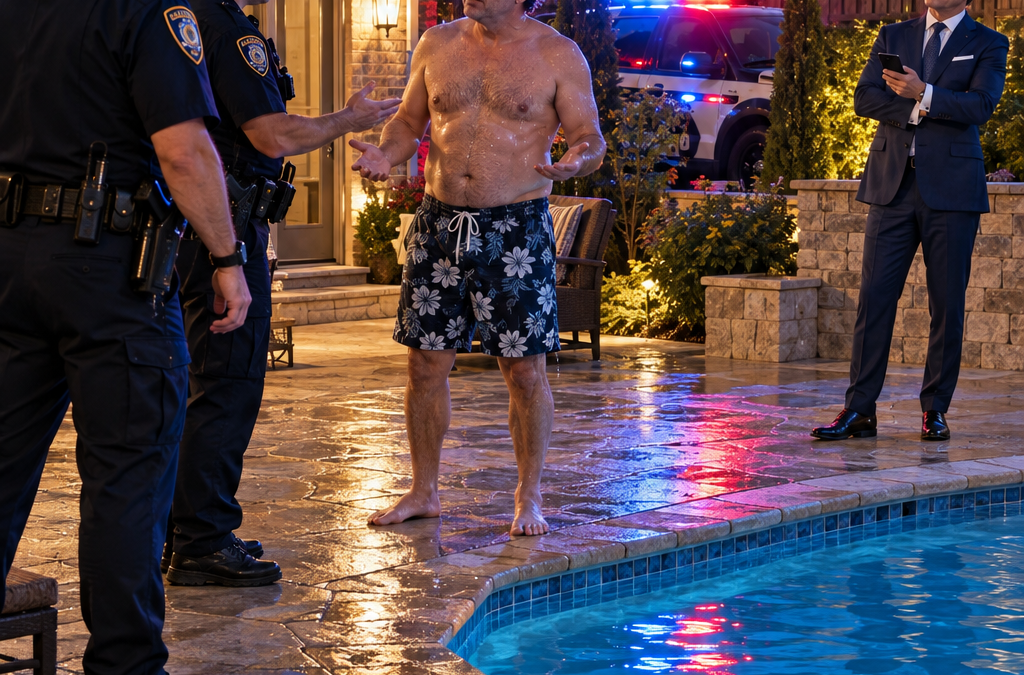
Red and blue lights bounced across my pool water at nine on a Tuesday morning, flashing against the ripples like something out of a bad crime show. I stood there in my swim trunks, dripping wet, while two officers walked up my driveway to ask why I was trespassing in a pool my wife and I had paid for ourselves.
The younger officer flipped open his notepad.
“Sir, we got a call about an unauthorized person using a private pool.”
For half a second, I thought I had misunderstood him.
Then I looked over my shoulder at the blue water behind me, the stamped concrete patio, the filter system humming beside the fence, the little table where Elena and I drank coffee every Saturday morning.
Every tile, every pipe, every dollar of that pool belonged to us.
So I laughed.
Not because it was funny.
Because if I didn’t laugh, I was going to say something that might make the officers’ morning harder than it already was.
The older officer raised one eyebrow.
“Is something amusing?”
I wiped water from my face.
“That pool is mine.”
The younger officer looked from me to the pool.
Then back to his notepad.
“The caller said this was a community amenity.”
I almost laughed again.
“Then the caller lied.”
That caller stood near the fence line less than thirty seconds later, holding his phone like a courtroom camera.
Karen Whitfield.
Fifty years old, HOA president, white polo shirt tucked into pressed khakis, expensive sunglasses, and a clipboard tucked under one arm like a sheriff’s badge.
He looked calm.
That was the thing about Karen.
He always looked calm when he was trying to ruin someone’s life.
Three weeks earlier, I had thought he was just another power-hungry HOA president with too much free time and a laminated rulebook.
By that morning, with police officers standing in my driveway and my wife watching from the kitchen window, I knew he was something worse.
My name is Daniel Ortega.
My wife, Elena, and I bought our house in Maple Ridge Estates because we wanted quiet.
Not luxury.
Not prestige.
Quiet.
I was forty-six, a facilities supervisor for a regional hospital network, which meant my workdays were filled with broken systems, delayed contractors, budget arguments, and machines people only noticed when they failed. Elena taught third grade, which meant her workdays were filled with children, parents, lesson plans, and a level of patience I still considered supernatural.
We had spent most of our marriage saving for one thing.
A home with enough space to breathe.
When we found the house on Maple Ridge Lane, it felt almost too good to be true.
Brick front.
Three bedrooms.
A small study for Elena.
A two-car garage.
A backyard wide enough for the pool we had dreamed about for fifteen years.
The subdivision itself looked like every real estate brochure’s idea of suburban success. Manicured lawns. Matching mailboxes. Flower beds near the entrance sign. Cul-de-sacs where children rode bikes in circles while parents pretended not to worry.
There was an HOA, of course.
Maple Ridge Estates had one of those thick homeowner packets with architectural standards, landscaping rules, parking restrictions, and language about preserving community character.
I read the documents before we closed.
Elena teased me for marking pages with sticky notes.
“You know most people just sign these and hope for the best,” she said.
“Most people also discover problems after closing.”
“You’re turning into your father.”
“My father read appliance manuals before plugging things in.”
“And lived a long life.”
“Exactly.”
The rules seemed manageable.
No commercial vehicles overnight.
No unapproved sheds.
No exterior paint changes without approval.
No neglected lawns.
Fine.
We weren’t planning to turn the house into a junkyard.
The pool was the biggest project, and we did everything correctly.
Permits.
HOA architectural application.
County inspections.
Survey.
Contractor drawings.
Drainage plan.
Fence compliance.
It took almost a year and more money than I liked thinking about, but eleven months before the police came to my driveway, the pool was finished and paid off.
No loans.
No outstanding contractor bills.
No shared ownership.
Just ours.
Elena cried the first evening we swam in it.
Not loud crying.
Just tears on her cheeks while she floated on her back and looked at the sky.
“We actually did it,” she said.
I remember standing in the shallow end, watching the sunset turn the water copper.
“Yes, we did.”
For almost a year, the pool was our little sanctuary.
Morning swims before work.
Quiet evenings after dinner.
Elena reading on the lounge chair while I skimmed leaves.
Friends over on Saturdays.
Nothing dramatic.
Nothing anyone else needed to care about.
Then Karen Whitfield decided our backyard was somehow his business.
Karen had been president of the Maple Ridge HOA for six years.
In that time, he had turned a volunteer board position into something that felt less like neighborhood service and more like a personal throne.
He moved through Maple Ridge with a clipboard in one hand and an expression that suggested he was constantly disappointed in the rest of us.
He liked words like “harmony,” “uniformity,” “standards,” and “community integrity.”
He spoke in that polished, condescending tone some people use when they want to sound reasonable while threatening you.
Our first offense, according to Karen, was the color of our shutters.
A letter arrived on a Thursday.
Exterior Color Nonconformity — Shutters Not Consistent With Community Harmony. Fine: $100.
I stood on the porch and stared at our shutters.
Blue.
The exact approved blue from the HOA binder.
I still had the paint chip.
The one Karen himself had handed us at the architectural review meeting.
I called the HOA office.
Karen answered.
“Daniel.”
“Karen, I got a fine for my shutters.”
“Yes.”
“They’re painted with the approved color.”
“They appear slightly brighter in natural light.”
“They’re the approved paint.”
“Paint can vary by batch.”
“I used the exact code from your binder.”
“The board determined the effect is inconsistent.”
I looked toward the house across the street.
Its shutters were a faded green that I was almost certain had never appeared in any approved palette.
“Can I appeal?”
“You can submit a written appeal.”
“Will the board review it?”
“Of course.”
Something in the way he said it made me doubt the board would see anything he didn’t want it to see.
Still, I paid the fine.
Elena thought that was a mistake.
“It’s not about the hundred dollars,” she said.
“I know.”
“Then why pay?”
“Because I don’t want to spend three weeks arguing about blue shutters.”
She looked at me over her coffee mug.
“That is exactly how people like him win.”
She was right.
I hated that.
A week later, a second fine arrived.
Unauthorized Landscaping Alteration — Rose Bush Height Below Approved Minimum. Fine: $150.
This one made me stare at the paper for a long time.
I had trimmed the rose bushes along the front walkway because one branch was scratching Elena’s car when she pulled into the garage.
Apparently, I had trimmed them two inches shorter than the bylaws allowed.
Two inches.
I looked at the shrubs.
They looked better than before.
I paid that fine too.
Then I started a folder.
Elena watched me label it from the kitchen table.
“HOA nonsense?” she asked.
“Evidence.”
“Evidence for what?”
“I don’t know yet.”
She smiled faintly.
“You’re being paranoid.”
“Maybe.”
But I took photos anyway.
Mailbox.
Lawn.
Driveway.
Pool fence.
Front shrubs.
Side gate.
Shutters.
Every photo had a timestamp.
Every letter went into the folder.
Every payment confirmation was saved.
I had spent years managing facilities. When something went wrong, the person with records usually survived the meeting.
That instinct turned out to be the smartest thing I did.
The fines kept coming faster.
A garden gnome near the front steps violated uniformity standards.
That one belonged to Elena. It was a little ceramic figure holding a book. Her students had given it to her as an end-of-year gift.
I moved it to the backyard.
Then came a parking citation.
Our own car, in our own driveway, allegedly remained outside past an overnight parking curfew.
The curfew did not exist in the rules I had.
I checked three times.
Still, the fine came.
Then came the certified letter.
The envelope was thick.
The tone was serious.
Notice of Intent to File Lien — Outstanding Balance: $400.
Four hundred dollars.
Some of it involved fines I had already disputed in writing.
Some involved late charges added before my appeal window had even expired.
The letter warned that unpaid assessments could lead to collection actions against our property.
A lien against our house.
Over shutters, roses, a gnome, and a fake parking curfew.
I sat at the dining table while Elena read the notice.
Her face went pale.
“Can they do that?”
“They can try.”
“Daniel.”
“I know.”
“This is our home.”
“I know.”
That night, after Elena went to bed, I read the letter line by line.
The fine print cited several sections of the HOA bylaws, including Section 14B.
I opened my copy of the recorded covenants.
There was no Section 14B.
The document went from 14A to 15.
At first, I assumed I had an outdated packet.
The next morning, I drove to the county recorder’s office and requested the recorded HOA documents.
The clerk brought me copies.
Original declaration.
Amendments.
Current recorded covenants.
There was still no Section 14B.
It didn’t exist.
Karen had cited a phantom section.
That was when irritation became something else.
I sat in my truck outside the recorder’s office, flipping through the documents.
The recorded covenants capped fines at $50 per incident unless approved under a specific amendment procedure.
Karen had been charging $100, $150, sometimes more.
Triple.
Quadruple.
Amounts that appeared nowhere in the documents available to homeowners or recorded with the county.
I drove home with copies on the passenger seat and a cold focus settling in my chest.
Karen wasn’t simply strict.
He was inventing authority.
At the next HOA meeting, I brought the documents.
The meeting was held in the clubhouse, a beige building with a kitchenette, folding chairs, and framed photographs from community events.
Eleven homeowners attended.
Karen stood at the front table, dressed in a pale gray polo and tan slacks, looking like he had stepped out of a golf magazine.
After routine announcements, he opened the floor.
I stood.
“My name is Daniel Ortega. I’d like clarification on a lien notice I received.”
Karen’s expression barely shifted.
“Yes, Daniel.”
I held up the letter.
“This notice cites Section 14B as authority for several fines. I pulled the recorded covenants from the county. There is no Section 14B.”
A few heads turned.
Karen smiled.
The smile was smooth, practiced, and deeply irritating.
“The documents you have are outdated.”
I placed copies on the table.
“These are the current recorded documents from the county.”
“The board has adopted internal policy updates.”
“Where are they recorded?”
“Internal policies don’t always require recording.”
“Do they allow you to exceed the fine cap in the covenants?”
His smile tightened.
“You’re misunderstanding the relationship between administrative policies and governing documents.”
“I’m asking a simple question. Where is Section 14B?”
The room went quiet.
Karen lifted his chin.
“Daniel, I suggest you consult the updated enforcement schedule before making accusations in public.”
“Can you provide it?”
“It has been made available.”
“To whom?”
“To homeowners.”
“I’m a homeowner.”
The silence became uncomfortable.
A woman two rows behind me leaned forward and whispered, “I paid over two thousand dollars last year.”
I turned slightly.
She was an elderly widow named Mrs. Larkin. I had seen her walking a small white dog in the mornings.
Her voice shook.
“I never questioned it.”
Karen’s eyes moved to her.
She immediately looked down.
That small motion told me everything.
People were afraid of him.
Not annoyed.
Not inconvenienced.
Afraid.
Karen tapped the table.
“This board will not entertain inflammatory claims based on incomplete information.”
I kept my voice calm.
“Then produce the complete information.”
He stared at me for a long second.
“We’ll move on.”
I sat down.
My pulse was pounding.
But I had what I needed.
The question was on record.
So was his refusal.
That night, I started calling neighbors.
Quietly.
One by one.
Mrs. Larkin was first.
She showed me fines for hedge height, porch decorations, window treatments, and a mailbox decal her late husband had placed there years earlier.
She had paid nearly $2,300 in twelve months.
A family on Creekside Court had paid $900 after Karen threatened them over a basketball hoop that appeared to comply with the rules.
The Parkers had received a foreclosure warning over less than $500.
The Nguyens had fines citing Section 14B too.
Six households had similar stories.
Invented sections.
Inflated fines.
Threats of liens or foreclosure over small amounts.
Always signed by Karen.
Always delivered in the same clipped, superior tone.
The more I heard, the less this felt like a neighborhood dispute.
It felt like a system.
Karen found people who didn’t know the documents, didn’t have time to fight, or didn’t want public conflict.
Then he leaned on them until they paid.
The twist nobody expected came from the financial records.
Karen always claimed fines went into the HOA landscaping reserve.
He said it at meetings.
He wrote it in newsletters.
He used it to make people feel as if paying inflated fines somehow benefited the community.
So I requested the financial disclosures.
Every homeowner had that right.
Karen stalled.
First, he said the accountant was preparing the reports.
Then he said the board needed to review them.
Then he said there were formatting issues.
Three weeks passed.
Meanwhile, the HOA account statements available in prior annual packets showed something strange.
The landscaping reserve had not grown in two years.
Not meaningfully.
Not by the amount Karen’s fines should have produced.
If six households alone had paid thousands, where was the money?
Before I could get an answer, Karen escalated.
He filed a lien notice against my house with the county recorder’s office.
I found out through a mailed copy.
I stood in the driveway holding the notice while Elena read over my shoulder.
For a few seconds, neither of us spoke.
The debt wasn’t valid.
The bylaw section didn’t exist.
The fine amounts exceeded the recorded limits.
But there it was.
Attached to our property.
Our home now had Karen’s false paperwork clouding it.
Elena’s voice shook.
“He really did it.”
I folded the notice carefully.
“Yes.”
“What do we do?”
“We stop treating him like a nuisance.”
Two days later, the police came to my pool.
That morning was supposed to be ordinary.
I swam before work whenever the weather allowed. Twenty laps, sometimes thirty if my back wasn’t bothering me. It helped clear my head.
Elena was inside packing lunch.
I was on lap eighteen when I heard tires on the driveway.
At first, I thought it was a delivery truck.
Then I saw red and blue lights flickering against the water.
I climbed out of the pool.
Two officers walked toward the gate.
The younger one looked uncertain.
The older one looked like he had been doing this long enough to know when a call already smelled bad.
“Sir,” the younger officer said, opening his notepad, “we got a call about a trespasser using a private pool without authorization.”
That was when I laughed.
“This pool is mine.”
The older officer looked toward the water.
“This address is yours?”
“Yes.”
“Do you have ID?”
“I’ll get it.”
Elena came outside before I reached the back door.
“What’s happening?”
“Someone called the police on me for swimming.”
She stared.
“In our pool?”
“Yes.”
The older officer’s expression changed slightly.
He pulled out a tablet.
“Let’s check the property map.”
While he searched, Karen appeared at the fence line.
Of course he did.
He stood just beyond the side gate, phone raised, recording.
“Officers,” he called, “this pool has been represented as an association amenity in the past.”
I turned slowly.
“No, it hasn’t.”
Karen smiled.
“The association has records indicating shared recreational access questions.”
“Karen, this pool is fifteen feet inside my property line.”
The older officer looked at the tablet.
Then at me.
Then at Karen.
“Sir, this pool appears to be entirely on Mr. Ortega’s private lot.”
Karen’s smile faltered.
“There may be an easement.”
The officer looked back at the tablet.
“I’m not seeing one.”
“I’m the HOA president.”
“That doesn’t change the property line.”
Elena crossed her arms.
Karen lowered his phone slightly.
The older officer walked toward the fence.
“Sir, are you the caller?”
Karen lifted his chin.
“I reported a potential unauthorized use issue.”
“Of his own pool?”
“I had reason to believe—”
The officer interrupted.
“Do not make another report like this unless you have actual evidence of a crime.”
Karen’s jaw tightened.
“This is a community standards matter.”
“Then it’s not a police matter.”
The younger officer looked away, probably to hide a smile.
Then the best moment of that horrible morning happened.
Karen stepped backward while launching into another lecture about HOA jurisdiction and community harmony.
His heel caught on one of Elena’s decorative garden gnomes near the fence.
A small ceramic mermaid gnome.
He flailed.
His clipboard flew open.
For one glorious second, the president of Maple Ridge Estates windmilled his arms like a man trying to fight gravity through superior bylaws.
He did not fully fall.
Almost.
But he stumbled hard into the side fence, sending his sunglasses crooked.
The younger officer turned his whole body away.
His shoulders shook once.
Elena covered her mouth.
I bit the inside of my cheek so hard it hurt.
After weeks of stress, watching Karen lose a fight to a garden gnome felt like the universe cashing a check.
Karen recovered quickly.
His face was red.
He pointed at me.
“He threatened me at the last HOA meeting.”
The laughter vanished.
I stared at him.
“What?”
Karen looked at the officers.
“He has been aggressive, hostile, and threatening during board proceedings.”
The younger officer turned back.
“Sir, is that true?”
“No.”
Karen said, “It’s documented.”
I said, “Yes. It is.”
Karen’s eyes flicked toward me.
I walked inside, grabbed my phone, and opened the recording folder.
I had recorded every HOA meeting for two months, openly, from my seat.
I handed the phone to the older officer.
“Here’s the meeting he’s talking about.”
The officer watched thirty seconds.
There I was on video, standing in the clubhouse, calmly asking where Section 14B appeared in the recorded covenants.
There was Karen, smiling, dodging, and citing internal policies.
No threat.
No raised voice.
No aggressive conduct.
Just a man asking questions.
The officer watched a little more.
Then he handed the phone back.
“Mr. Whitfield, that does not show a threat.”
Karen’s face hardened.
“This is being taken out of context.”
The officer sighed.
“I’ve heard enough for today.”
He turned to me.
“You may want to file a formal complaint with the county’s HOA oversight division if you believe the association is acting improperly.”
I blinked.
“There’s an HOA oversight division?”
He pulled a card from his pocket.
“Yes. Start here.”
Then he looked at Karen.
“And you need to leave Mr. Ortega’s property line.”
Karen opened his mouth.
The officer added, “Now.”
Karen left.
Not gracefully.
Not with his usual smooth control.
He gathered his fallen papers, avoided the gnome, and walked back toward the street.
When the officers left, the older one actually apologized.
“Sorry for the interruption, sir.”
I looked at the pool.
Then at the card in my hand.
“No. This helped.”
And it did.
Because Karen’s false police call had done something he didn’t intend.
It introduced me to the exact office that could investigate him.
I filed the complaint the following Monday.
I attached everything.
Photos.
Recordings.
The phantom Section 14B citation.
The county covenants.
The inflated fine notices.
Six neighbor statements.
The lien notice.
The pool incident police report.
Evidence that the pool was fully inside my lot.
Proof that Karen had made false claims about community access.
I expected silence.
Instead, the county opened an investigation within a week.
That was when the third twist landed.
Karen had not only inflated fines.
He had been skimming them.
Forensic accountants reviewed two years of HOA records.
They found nearly $30,000 in landscaping fund withdrawals that traced to Karen’s personal credit card payments and a family vacation.
Some fine payments entered HOA accounts and were then moved through vague maintenance entries.
Some were deposited into an account Karen controlled before being partially transferred elsewhere.
Not every detail was explained to us immediately, but the broad pattern was clear.
Homeowners paid fines they often did not legally owe.
Karen claimed the money supported landscaping.
The landscaping fund did not reflect the deposits.
And thousands flowed toward his personal expenses.
The HOA board, suddenly cooperative and terrified of being associated with him, voted him out within forty-eight hours of receiving preliminary findings.
The official minutes used the phrase gross financial misconduct.
I printed a copy.
I put it in my folder.
Right beside the first shutter fine.
Karen losing his title was satisfying.
But it was not enough.
Not for Mrs. Larkin, who had paid money she needed for medicine.
Not for the Parkers, who nearly refinanced to cover a false foreclosure threat.
Not for Elena, who had spent two nights crying over the lien on our house.
Not for me, standing in my own pool while police officers asked if I was trespassing.
The county filed embezzlement charges.
Separately, I filed a civil suit for wrongful lien, harassment, fraudulent fines, and damages tied to the false reporting and improper collection efforts.
Karen hired a lawyer.
His defense began with clerical error.
Then misunderstanding.
Then internal policy confusion.
But recordings of him citing nonexistent bylaw sections in public meetings made “confusion” a hard sell.
Especially when the same fake section appeared across multiple households’ fines.
The lien on my house was voided by court order within two weeks.
The document arrived stamped, notarized, and official.
I held it in both hands at the kitchen table.
Elena sat across from me.
“It’s gone?” she asked.
“It’s gone.”
She covered her face.
For weeks, that lien had sat over our home like a shadow.
Now a judge had erased it.
The county clerk’s office sent a letter acknowledging that the filing had been voided following the court order.
It wasn’t personal.
It wasn’t emotional.
But I read it three times because it meant our title was clear.
Karen’s paperwork no longer touched our home.
Word spread through Maple Ridge quickly.
At the next HOA meeting, the clubhouse was packed.
People who had never spoken before stood one by one.
Mrs. Larkin described the fines she paid after her husband died because she was afraid of losing the home they bought together.
The Parkers described the foreclosure letter they received over $375.
A young father from Creekside Court talked about taking overtime shifts to pay penalties for a basketball hoop his kids barely used.
The Nguyens brought copies of citations with Section 14B printed in bold.
Every story sounded different.
Every pattern was the same.
Karen sat in the back row.
No clipboard.
No sunglasses.
No authority.
Just a man watching six years of fear turn into testimony.
When my turn came, I stood.
I did not give a speech.
I simply held up the pool police report.
“This is what happens when an HOA president forgets where his authority ends.”
Then I placed it on the table.
Nobody clapped.
They didn’t need to.
The silence was enough.
Three months later, Karen pleaded guilty to embezzlement-related charges.
He faced restitution and probation.
The state real estate board reviewed the case and revoked his license, ending the career he had used to make himself seem untouchable.
I heard the news from Priya Shah, the attorney who handled my civil case.
She called me on a Thursday afternoon.
“It’s done,” she said.
“What part?”
“Most of it. Plea entered. Restitution ordered. Real estate license revoked.”
I stood in the backyard, looking at the pool.
“And our civil case?”
“Settlement is finalized. Fraudulent fines reimbursed. Legal costs addressed. Wrongful lien damages included.”
I looked toward the water.
It was calm, blue, ordinary.
For a moment, I couldn’t speak.
Priya waited.
Finally, I said, “Thank you.”
“You did the important part.”
“What was that?”
“You checked the math.”
I laughed quietly.
That was exactly what started the collapse.
Not rage.
Not revenge.
Math.
A missing bylaw section.
A fine cap.
A community account that didn’t grow.
Numbers that refused to support Karen’s story.
I still swim every morning.
The first few times after the police incident, I felt strange stepping into the water.
I would glance toward the driveway, expecting lights.
Expecting Karen.
Expecting someone to tell me the thing I owned was not really mine.
That feeling faded slowly.
Now the pool is mine again.
Ours.
No sirens.
No officers.
No fences to explain.
No HOA president filming from the side yard.
Just quiet water.
The morning sun hits it at an angle that turns the surface silver. I swim my laps before work while Elena drinks coffee at the patio table and reads whatever novel she’s currently using to avoid grading papers.
Sometimes the mermaid gnome still sits by the fence.
Elena refuses to move it.
“Historic landmark,” she says.
I told her we should put up a plaque.
Here Karen Whitfield was defeated by decorative ceramics.
She said that might violate community harmony.
We laughed for five minutes.
Maple Ridge is different now.
The new board revised enforcement procedures.
No fine can be issued without a specific citation to a recorded rule.
Fine amounts must match the covenants.
Lien threats require board approval, attorney review, and notice to the homeowner with a clear appeal process.
Financial statements are posted quarterly.
Fine revenue is tracked separately.
And no single president controls both enforcement and accounting.
It should have been that way all along.
But neighborhoods often discover the need for safeguards only after someone abuses the absence of them.
Mrs. Larkin got her money back.
So did the Parkers.
So did several other families.
Not all of the damage could be undone.
Some people had carried anxiety for years.
Some had paid money they needed for groceries, medicine, school clothes, car repairs.
Some had been too ashamed to tell anyone how scared they were.
Karen had counted on that.
He had counted on silence.
He had counted on people assuming official paper meant lawful authority.
He had counted on homeowners paying $150 because fighting felt harder.
And for a long time, he was right.
Until he called the police on a man swimming in his own pool.
That mistake exposed the absurdity of his power more clearly than any spreadsheet could have done alone.
The police came expecting a trespasser.
They found a homeowner.
They found a false report.
They found a president who didn’t understand that his title did not redraw property lines.
And they gave me a card that led to the office that finally pulled the whole thing apart.
I keep that card in my HOA folder.
The folder is thick now.
Photos.
Recordings.
Covenants.
County maps.
Lien release.
Settlement papers.
Court orders.
A copy of the meeting minutes removing Karen for gross financial misconduct.
I don’t open it often.
But I keep it.
Not because I want to relive the fight.
Because I want to remember the lesson.
Peace is not the absence of conflict.
Sometimes peace is what you get after you refuse to let someone keep abusing the rules.
One Saturday morning, months after the case ended, I finished my swim and climbed out of the pool.
Elena handed me a towel.
“You’re smiling,” she said.
“Am I?”
“Yes.”
“I was thinking.”
“That’s usually dangerous.”
I looked toward the driveway.
No police lights.
No Karen.
No clipboard.
Just our house.
Our pool.
Our quiet little piece of Maple Ridge.
“I was thinking this is what we paid for.”
She looked at the water.
“Worth it?”
I thought about the fines.
The lien.
The meetings.
The neighbors.
The court order.
The false police call.
The morning I stood dripping wet while two officers asked whether I belonged in my own backyard.
Then I looked at Elena.
“Yes,” I said. “Now it is.”
She smiled.
I stepped back into the pool.
The water closed around me, cool and clean.
For the first time in months, I didn’t swim to burn off anger.
I swam because the morning was quiet.
Because the house was safe.
Because the lien was gone.
Because Karen Whitfield was no longer president of anything that mattered to me.
And because the only person authorized to use that pool was exactly where he belonged.








