𝗙𝗨𝗟𝗟 𝗦𝗧𝗢𝗥𝗬 The HOA President Called Police to Remove Me From My Own Driveway—Then the Officer Asked One Question She Couldn’t Answer
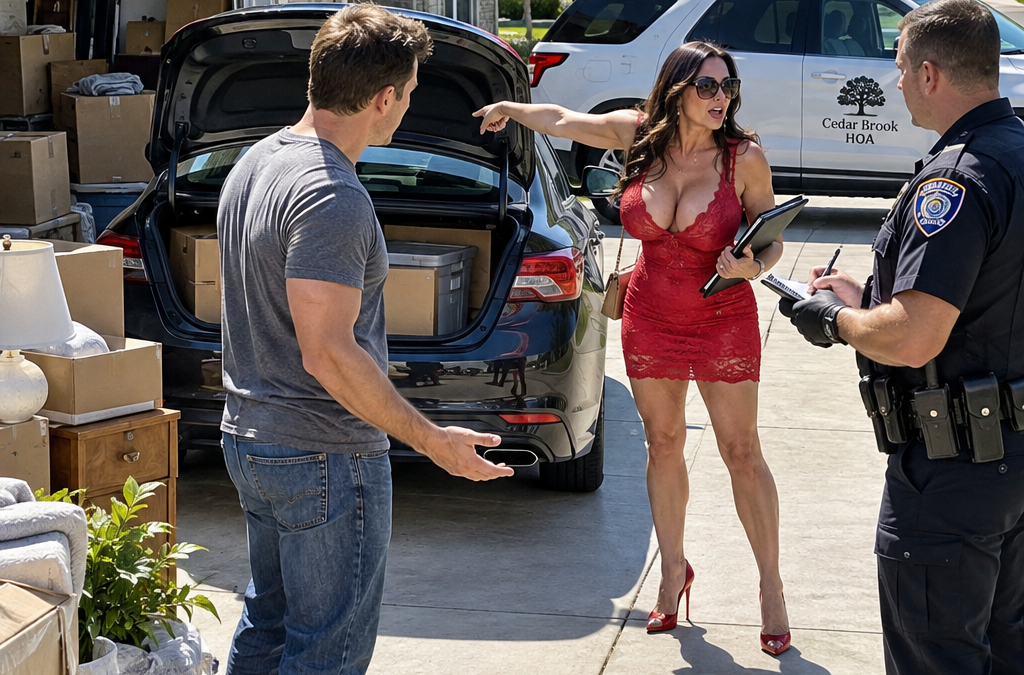
𝗣𝗔𝗥𝗧 𝟮
She smiled.
“They tend to discover how many rules there really are.”
There it was.
The threat wasn’t subtle.
I looked at her for several seconds.
“Are you threatening to target me with violations?”
“I said nothing of the kind.”
“You implied it.”
“You’re already being combative.”
“No. I’m unpacking boxes.”
I picked up the box from beside my feet.
“You drove over here.”
She moved in front of me.
The gesture surprised me.
Not physically aggressive.
But deliberate.
A small attempt to control whether I could walk back toward my own garage.
“Move the vehicle.”
“No.”
Her eyes widened slightly.
“I beg your pardon?”
“I said no.”
“You’re refusing a direct HOA instruction?”
“I’m refusing to move a legally parked vehicle from my private driveway because you haven’t shown me any rule requiring it.”
Karen stared at me.
Then laughed once.
Cold.
“You have absolutely no idea who you’re dealing with.”
That sentence almost made me smile.
Not for the reason she would later assume.
“I could say the same thing.”
She took out her phone.
“Fine.”
“What are you doing?”
“Calling law enforcement.”
I honestly thought she was bluffing.
“Because I parked in my driveway?”
“Because you are obstructing emergency access and refusing lawful community instructions.”
“Karen, if you knowingly give police false information—”
“Don’t threaten me.”
“I’m not threatening you.”
She turned away and dialed.
I stood there holding a box of coffee mugs and watched the president of my new HOA call the police because I refused to move my car from my own driveway.
I considered going inside.
Then decided against it.
If she was going to escalate this, I wanted to hear exactly what she said.
“Yes,” Karen said into the phone. “I’m HOA president at Cedar Brook Estates. We have a resident refusing to clear a designated emergency-access area.”
Resident.
Not homeowner.
Not man standing on his own driveway.
Resident.
“He has been warned.”
I hadn’t.
“He’s refusing HOA instructions.”
That part was technically true.
“No, he will not cooperate.”
I almost raised my hand.
She turned her back to me.
“Yes. I would like an officer here.”
She ended the call.
“Happy?”
I looked at her.
“You called them.”
“You forced me to.”
“No.”
I set the box down again.
“That is exactly the kind of sentence people use when they don’t want responsibility for their own decisions.”
Her face flushed.
“You should move the car before the officer arrives.”
“I’m not moving it.”
“You’re going to make this much worse.”
“If I’m violating a law, the officer can explain it.”
“This isn’t only about law.”
That sentence interested me.
“What else is it about?”
“HOA authority.”
“And you believe police enforce HOA authority?”
She crossed her arms.
“They enforce public safety.”
“Then we’ll ask.”
For the next several minutes, Karen paced near the end of my driveway like a prosecutor waiting for trial.
I went back to unpacking.
That irritated her even more.
“You’re seriously going to keep carrying boxes?”
“What would you prefer?”
“You should be preparing your documents.”
I almost laughed.
“You want documents?”
“You’re the one claiming this is private property.”
I stopped walking.
“I’m claiming my driveway belongs to the house I bought.”
“You’d be surprised what homeowners misunderstand about their own parcels.”
“Would I?”
“Yes.”
She gestured toward the neighborhood.
“This community has easements, maintenance rights, shared-access areas, architectural restrictions and emergency corridors. Purchasing a home does not mean you suddenly control everything inside the curb.”
“That’s true.”
The agreement seemed to confuse her.
“But?”
“But my driveway is still mine.”
She sighed loudly.
“You are going to be exhausting.”
“You’ve known me twenty minutes.”
“And I already know your type.”
“What type is that?”
“The type who thinks knowing a few legal words makes him smarter than everyone else.”
I looked at her.
That one nearly got me.
Instead, I said, “Interesting.”
She misread my silence as retreat.
Karen stepped closer.
“You need to understand how Cedar Brook works. We don’t allow one homeowner to place personal preference above neighborhood safety.”
“My personal preference?”
“Parking wherever you want.”
“On my driveway.”
She rolled her eyes.
“There you go again.”
At 9:27, a police SUV turned onto the street.
Karen’s entire demeanor transformed.
It was impressive.
Her shoulders relaxed.
Her expression softened.
Her voice dropped into something calm and concerned.
Before the officer had even fully stopped, she was walking toward him.
I remained beside my garage.
The officer stepped out.
Mid-forties.
Calm.
Experienced-looking.
Karen reached him first.
“Officer, thank goodness.”
He looked at her.
“You called?”
“Yes. Karen Whitfield. HOA president.”
She pointed directly at me.
“That resident is refusing to comply with an emergency-access requirement.”
The officer looked toward me.
Then at my car.
Then back at Karen.
“What’s being blocked?”
“The access point.”
He looked around.
“Which access point?”
“That driveway.”
He stared at my driveway.
For just a second.
Then longer.
“Is there a fire lane marking?”
“No, but—”
“Emergency signage?”
“The HOA documents designate it.”
I stayed silent.
That was important.
Karen wanted me interrupting.
Angry.
Arguing over her.
Instead, I let her explain the situation exactly the way she wanted.
She continued.
“He was informed that the vehicle needed to be moved. He became argumentative and refused HOA authority.”
The officer looked at me again.
“Sir, can I get your side?”
“Absolutely.”
I walked over slowly.
Karen immediately said, “He’s been confrontational all morning.”
The officer held up one hand.
“Ma’am, let me hear him.”
The look on Karen’s face was subtle.
But I caught it.
She did not like being told when she could speak.
I introduced myself by first name.
“I bought this house four days ago. I’m unpacking. My vehicle is parked entirely inside my driveway. Ms. Whitfield says the driveway is an HOA-controlled emergency access route. I asked her to show me the rule or deed supporting that. She gave me this.”
I held out the notice.
The officer read it.
Karen jumped in.
“That’s the HOA emergency-access policy.”
The officer kept reading.
“It references marked common-area lanes.”
Karen folded her arms.
“That includes this access point.”
“Where does it say that?”
Her expression flickered.
“It’s part of the property-specific enforcement plan.”
I looked toward her.
That was new.
The officer noticed too.
“You have that?”
“Not with me.”
“So this document doesn’t identify the driveway?”
“The HOA has records.”
The officer handed the notice back to me.
“Do you have proof you own the property?”
“Yes.”
I went to the open garage and retrieved the closing folder from a box on the workbench.
I had kept it accessible for exactly the sort of boring administrative reason new homeowners keep closing papers nearby.
I never imagined I would be presenting them to police in my driveway four days after moving in.
I handed over the deed documents and survey.
The officer studied them.
Karen watched impatiently.
“This really shouldn’t require a title review,” she said.
He ignored her for another moment.
Then pointed toward the survey.
“This is the driveway?”
“Yes.”
He checked the parcel outline.
I nodded.
Karen moved closer.
“Officer, ownership does not negate HOA restrictions.”
“That can be true.”
She smiled immediately.
“There.”
The officer continued.
“But I’m trying to determine what police issue exists.”
Her smile disappeared.
“He is blocking emergency access.”
“Emergency access to what?”
“The neighborhood.”
“Through his garage?”
I had to bite the inside of my cheek.
Karen’s face went red.
“No. Obviously not through the garage.”
“Then I need you to show me where the public or HOA-controlled access route is.”
She pointed toward the driveway.
“There.”
The officer looked down the entire length of it.
House at one end.
Public road at the other.
Nothing else.
“No connecting road?”
“The designation is administrative.”
“What does that mean?”
“It means the HOA has reserved rights.”
“In the deed?”
Karen paused.
“In our governing documents.”
“Do you have those rights recorded against this parcel?”
“Again, officer, I don’t carry the entire HOA legal archive in my vehicle.”
He nodded.
“Then I don’t have evidence of an emergency-access violation.”
Karen stared at him.
“There’s an HOA notice.”
“An HOA notice isn’t automatically a police-enforceable order.”
Her voice sharpened.
“So you’re refusing to enforce the rule?”
“I’m saying I don’t see a criminal or immediate public-safety violation.”
“He was warned.”
“That doesn’t change what I’m looking at.”
Karen pointed at me.
“He is refusing a lawful directive.”
The officer turned.
“Sir, are you blocking anyone from entering or leaving?”
“No.”
“Has an emergency vehicle attempted to use this driveway?”
“No.”
“Has the HOA shown you a recorded easement?”
“No.”
Karen snapped.
“He doesn’t get to define what documents are valid.”
The officer looked at her.
“Ma’am, neither do you.”
That was the first moment her confidence visibly cracked.
Not much.
Just enough.
She recovered quickly.
“Fine. Then I want him removed.”
The officer blinked.
“Removed from where?”
“The driveway.”
He looked at me.
Then at the concrete beneath my feet.
“Is he trespassing?”
“He is refusing to leave an HOA-controlled access area.”
“Does he own the house?”
“Yes, but—”
“Does the deed include the driveway?”
Karen’s jaw tightened.
“That isn’t the issue.”
“It’s relevant if you want me to remove him for trespassing.”
She stopped.
The officer waited.
Karen tried again.
“The HOA retains regulatory authority.”
“That’s different from ownership.”
She exhaled in frustration.
“Why are you letting him manipulate this?”
The officer’s expression hardened slightly.
“I’m asking basic questions.”
“I already explained the emergency issue.”
“And I’m not seeing an emergency.”
Karen looked at me as if this were somehow my fault.
Then she said, “You don’t even know who this man is.”
The irony nearly made me laugh.
The officer turned toward me.
“Actually, sir, I should verify identification since I’m here.”
“Of course.”
I reached into my wallet.
My driver’s license was there.
So was my official identification.
I handed him both.
He looked at the driver’s license first.
Then the second identification.
His eyes stopped.
He looked at it again.
Then at me.
Something changed in his posture.
Not fear.
Recognition.
Professional awareness.
“Yes, sir.”
Karen noticed immediately.
Her eyes narrowed.
“What?”
The officer handed the identification back.
I put it into my wallet.
She looked between us.
“What is that?”
Neither of us answered immediately.
Karen’s impatience returned.
“What did he give you?”
The officer turned toward her.
“Ma’am, he’s the newly appointed judge assigned locally.”
Silence.
Actual silence.
Even the distant lawnmower somewhere down the street seemed suddenly too loud.
Karen stared at me.
Her face changed in stages.
Confusion.
Disbelief.
Calculation.
Then something close to panic.
“You’re a judge?”
“Yes.”
“Why didn’t you say that?”
I looked at her.
“You never asked what I did for a living.”
“But you should have told me.”
“Why?”
Her mouth opened.
Nothing came out.
I continued.
“What would it have changed?”
Karen looked toward the officer.
Then back at me.
“You let me call police without telling me you were a judge?”
That was such an extraordinary attempt to rearrange responsibility that I almost admired it.
“You chose to call police.”
“You knew this would embarrass me.”
“No.”
I shook my head.
“I expected you to have legal authority for what you were claiming.”
Her face flushed darker.
“This feels extremely inappropriate.”
“What does?”
“You standing here using your position.”
I had not invoked my position once.
That mattered.
So I made it explicit.
“My profession has nothing to do with ownership of this driveway.”
The officer nodded.
“That’s correct.”
Karen turned toward him.
“I understand that, but clearly this changes things.”
“No,” I said. “It doesn’t.”
She stared at me.
“If I were an accountant, the deed would say the same thing.”
The officer added, “Property questions don’t change based on someone’s occupation.”
Karen’s eyes moved between us.
“I’m being ganged up on.”
Nobody had raised a voice.
Nobody had threatened her.
Nobody had even accused her of a crime.
But Karen understood disagreement as persecution whenever she was no longer controlling the outcome.
She reached into her folder.
“The HOA has authority.”
The officer sighed quietly.
“Ma’am, I’m not saying the HOA has no authority.”
“Then enforce it.”
“I’m saying HOA rules are generally civil matters unless there’s some independent criminal or public-safety issue.”
“This is public safety.”
“You’ve shown me no blocked public roadway, no emergency vehicle unable to pass, and no recorded document establishing this private driveway as an emergency-access lane.”
Karen tapped her notice.
“This.”
“That’s an HOA notice.”
“It is official.”
“Official within the association is not the same thing as a police order.”
She seemed physically offended by the distinction.
“So residents can simply ignore HOA rules now?”
“That’s not what I said.”
“Then what are you saying?”
“If you believe this homeowner is violating a valid covenant, use your association’s proper civil process.”
Karen’s eyes widened.
“I am the proper process.”
“No.”
The word came from the officer before he could soften it.
Karen froze.
He continued.
“The HOA may have procedures. You personally are not a substitute for whatever those procedures require.”
I looked down because I did not want her to see the smile trying to appear.
Her voice dropped.
“You clearly don’t understand how long I’ve managed this community.”
The officer nodded toward my driveway.
“I understand what I’m looking at right now.”
She pointed toward my car.
“That vehicle stays?”
“From a police standpoint, I have no basis to order him to move it.”
“And him?”
“What about him?”
“I want him off the access area.”
The officer looked almost tired now.
“He appears to be standing on property he owns.”
Karen’s voice rose.
“This is unbelievable.”
A few neighbors had started appearing outside.
Nothing attracts suburban attention faster than a police vehicle sitting in someone’s driveway while the HOA president waves paperwork.
Karen noticed the audience.
That made things worse.
She cared deeply about being seen in control.
A woman across the street stood beside her mailbox pretending to check letters she had already collected.
A man farther down walked his dog in an extremely slow circle.
Karen lowered her voice.
“This conversation should be private.”
I looked around.
“You brought the police.”
She shot me a furious look.
The officer handed my closing documents back.
“Sir, I’m not seeing anything requiring action from you.”
“Understood.”
He turned toward Karen.
“If the board believes there’s an enforceable HOA restriction, handle it through your governing process and, if necessary, civil counsel.”
“But he is deliberately refusing.”
“Refusing an HOA demand isn’t automatically a police matter.”
“He was disrespectful.”
The officer paused.
“That’s definitely not a police matter.”
One neighbor coughed suspiciously.
Karen’s head snapped toward the sound.
Then she looked back at me.
Her voice became almost accusatory.
“You knew exactly what you were doing.”
I studied her.
“I was carrying boxes.”
“You kept asking legal questions.”
“You were making legal claims.”
“You made me look ridiculous.”
“No.”
I didn’t say it cruelly.
That somehow made it stronger.
“I asked you to show me the rule.”
Karen said nothing.
The officer returned to his SUV.
Before getting inside, he gave one final explanation.
“Ma’am, an HOA notice by itself does not convert privately deeded property into public or association property. If you have a valid easement or covenant affecting this driveway, that needs to be addressed through the appropriate process.”
Karen stared at him.
“Are you refusing to document his noncompliance?”
“I’ll document the call.”
That was not what she wanted to hear.
The officer looked at me.
“Have a good morning, sir.”
“You too.”
He got into the SUV.
Karen stood in the middle of my driveway entrance, still holding the notice.
The police vehicle pulled away.
Neither of us spoke until it disappeared around the corner.
Then she turned toward me.
Her confidence had not vanished completely.
People like Karen rarely lost it all at once.
But the arrogance had taken a hit.
“You should have disclosed who you were.”
“I told you.”
“You know what I mean.”
“No, Karen. I really don’t.”
“You’re a judge.”
“Yes.”
“And you let an HOA president stand here explaining legal matters to you without mentioning that?”
I almost laughed.
“That was your choice.”
Her face reddened.
“You were testing me.”
“I asked you to show me the rule.”
“You intentionally made me look incompetent.”
“I didn’t write your notice.”
“You could have handled this differently.”
“So could you.”
That stopped her.
I picked up the box I had abandoned nearly an hour earlier.
Karen watched me.
“This is not over.”
I turned back.
“What happens next?”
“The board will review the violation.”
“Good.”
“And there may be fines.”
“Put them in writing.”
She stared at me.
I added, “And include the exact covenant provision you believe I violated.”
Her mouth tightened.
“You really think your position makes you untouchable?”
There it was again.
The attempt to turn my profession into the issue.
I set the box down.
“Listen carefully.”
She folded her arms.
“I have not asked you to treat me differently because I’m a judge.”
“I didn’t say—”
“I’m not finished.”
That surprised her enough that she stopped.
“I’m asking you to treat me exactly like every other homeowner.”
She looked away.
“If this driveway is legally subject to an emergency-access easement, show me.”
Silence.
“If it isn’t, stop claiming it is.”
“This board has managed that property boundary for years.”
“That house had another owner before me.”
“Exactly.”
“And did that owner sign an easement?”
She hesitated.
“We’ll review the file.”
“Good.”
“That doesn’t mean you’re right.”
“No.”
I picked up the box again.
“The documents will determine that.”
Then I walked inside.
My hands started shaking only after I closed the door.
Not fear.
Adrenaline.
People assumed judges were naturally comfortable with confrontation.
We weren’t.
We were trained to manage disputes in controlled environments.
Courtrooms have rules.
One person speaks at a time.
Evidence has procedures.
Arguments have boundaries.
A driveway confrontation with an angry HOA president calling police because she didn’t like the word no was something else entirely.
I stood in my kitchen among unopened boxes and laughed once.
Four days.
I had lived there four days.
I spent the rest of the afternoon unpacking.
The car stayed exactly where it was.
Nobody returned.
No tow truck.
No second officer.
No emergency vehicle desperately trying to drive through my kitchen.
That evening, however, I did what Karen should have done before ever approaching me.
I reviewed the documents.
All of them.
The deed.
Plat.
Title policy.
HOA declaration.
Recorded easements.
Amendments.
Closing disclosures.
I wasn’t reviewing them as a judge.
I was reviewing them as the guy who had just been told an HOA owned rights over his driveway.
The parcel was straightforward.
My property ran to the road boundary shown on the recorded plat.
The driveway was entirely contained inside that parcel.
There was a utility easement along one side.
A drainage easement near the rear.
Nothing granting the HOA general emergency access over the driveway.
Nothing designating it as common area.
Nothing authorizing the HOA to convert it into a fire lane.
I found the language Karen had apparently misunderstood.
Or stretched.
The declaration prohibited homeowners from parking vehicles in a manner that obstructed emergency access to common streets, designated fire routes, and shared facilities.
My vehicle didn’t.
The rule was completely ordinary.
Karen had apparently taken “emergency access” and decided it gave her control over any place a vehicle existed.
I made copies.
Then stopped myself.
I wasn’t going to initiate another fight.
If the board contacted me, I would respond.
Otherwise, I had a house to unpack.
The next afternoon, I received an email.
Not from Karen.
From the HOA management company.
Mr. —,
The board has reviewed yesterday’s incident and the recorded parcel information associated with your property. We have confirmed that your driveway is within your privately owned parcel and is not designated as a common emergency-access lane.
That was the important sentence.
The rest was administrative language.
The original notice had been based on an incorrect interpretation of the property boundary and emergency-access provision.
No enforcement action would be taken.
No fine.
No demand to move the vehicle.
Nothing.
I read it twice.
Then saved it.
About an hour later, I saw Karen’s white HOA SUV drive slowly past the house.
It didn’t stop.
The next morning was completely quiet.
I carried another box from the garage to the kitchen.
My car was parked in exactly the same position.
A delivery truck passed without difficulty.
A landscaping trailer passed after it.
No emergency collapsed.
No neighborhood entrance became inaccessible.
The world somehow continued functioning despite my vehicle remaining in my driveway.
Karen avoided me for several days.
Eventually I saw her near the clubhouse.
She was speaking to another board member.
Red lace dress.
Folder tucked under one arm.
For a second our eyes met.
She looked away first.
I didn’t feel victorious.
That would have made the whole thing seem more important than it was.
The argument had never really been about my profession.
And despite what Karen seemed to believe, it wasn’t about humiliating an HOA president.
It was about a driveway.
Private property.
A written rule.
And the dangerous habit some people develop when nobody asks them to prove the authority they claim.
Karen had probably expected the same reaction she had received from other homeowners.
Move the car.
Pay the fine.
Apologize.
Don’t create trouble.
She had delivered a piece of paper with an HOA logo on it and expected the logo to end the discussion.
When it didn’t, she escalated.
Threat.
Police.
Removal.
Each step required her to make her claim bigger because the original claim couldn’t survive a simple question.
Show me where it says that.
That question did more than arguing ever could.
Not because I was a judge.
Because documents matter.
If I had been a teacher, the deed would have been the same.
If I had been a plumber, the survey would have been the same.
If I had been unemployed, retired, twenty-five years old or seventy-five years old, the boundary line would not have moved.
That was why I refused to use my position as leverage.
I didn’t need it.
In fact, using it would have undermined the entire point.
Karen wasn’t wrong because she unknowingly confronted a judge.
She was wrong because she confronted a homeowner with authority she couldn’t prove.
My profession only made the scene more embarrassing for her because she had chosen to turn a routine property question into a police confrontation before learning anything about the person standing in front of her.
Weeks later, one neighbor finally introduced himself.
His name was Daniel.
He lived two houses down.
“I wanted to say hello sooner,” he told me.
“No problem.”
He looked toward the clubhouse.
“Karen can be… intense.”
“That’s one word.”
He laughed.
“We heard what happened.”
“I figured.”
“Whole neighborhood did.”
“Wonderful.”
He smiled.
“People were shocked when they found out what you do.”
“That wasn’t relevant.”
“I know.”
He paused.
“That’s actually why people are talking about it.”
“What do you mean?”
“She would’ve been wrong no matter who you were.”
I nodded.
“Exactly.”
Daniel looked toward my driveway.
“She tried something similar with the previous owner.”
That caught my attention.
“What?”
“Not police. She kept telling him delivery vehicles couldn’t stop there because of emergency access.”
“Did he challenge it?”
“He mostly ignored her.”
I glanced toward the road.
“So maybe that’s where she got the idea.”
“Probably.”
“Board know?”
“Not until now.”
That explained part of it.
Karen hadn’t invented the claim specifically for me.
She had inherited her own assumption through repetition.
That almost made the situation more instructive.
Bad authority could become tradition if nobody checked the source.
One person said the driveway had special restrictions.
Karen repeated it.
Eventually Karen treated the repetition as proof.
Then a new homeowner asked for the actual document.
Nothing.
That was all it took.
Months later, my house finally looked lived in.
Boxes disappeared.
Pictures went on the walls.
The television bracket eventually lost its argument with me.
My car continued occupying the driveway whenever I wanted it there.
No police returned.
No HOA emergency developed.
Karen and I remained neighbors.
Not friends.
That was fine.
At meetings, she became noticeably more careful whenever describing property rights.
Instead of saying, “The HOA has authority,” she began saying things like, “We’ll verify the governing language.”
That was an improvement.
One evening after work, I pulled into my driveway and sat behind the wheel for a moment.
The sun was setting behind the houses.
Kids were riding bicycles down the sidewalk.
Someone was grilling.
A dog was barking at absolutely nothing.
Normal neighborhood life.
I thought about that first Tuesday.
Karen standing at the bottom of my driveway.
“Move the vehicle.”
“The HOA has authority.”
“You’ll regret refusing.”
Then the police SUV.
The officer reading my deed.
Her demanding that I be removed.
His simple question:
“Is he trespassing?”
That question had exposed the absurdity instantly.
How could I trespass on the driveway attached to the house I had just purchased?
Karen couldn’t answer because she had never stopped long enough to examine her own demand.
She had become so accustomed to people obeying the HOA that refusal itself looked illegal to her.
That was the real problem.
Rules matter.
Associations have legitimate functions.
Covenants can be enforceable.
Shared communities require cooperation.
But authority has boundaries.
And the moment somebody stops distinguishing between “I have authority in some matters” and “I have authority whenever I say I do,” ordinary governance becomes something else.
Karen crossed that line before she ever called police.
The officer merely forced her to look at it.
My official identification didn’t create my property rights.
It only created the moment Karen finally realized she had been lecturing someone about legal authority while refusing to read the document in her own hand.
She asked why nobody had told her I was a judge.
I still think about that question sometimes.
As if the problem was that she had chosen the wrong homeowner to bully.
It wasn’t.
The lesson should never have been:
Be careful because your neighbor might be a judge.
The lesson was simpler.
Be careful because your neighbor has rights.
All of them do.
Even the quiet ones.
Even the new ones.
Even the ones carrying moving boxes in their own driveway.
Especially when the only thing they ask is for you to show them the rule you claim gives you power over their property.
The following Tuesday morning, exactly one week after Karen called the police, I walked outside carrying another box.
My car sat in the driveway.
Same place.
Nothing happened.
No HOA SUV.
No warning.
No officer.
Just a quiet street and a house that finally felt a little more like mine.
I carried the box inside.
And that was the best ending I could have asked for.
Not revenge.
Not humiliation.
Not some dramatic courtroom punishment for Karen.
Just normality.
My house.
My driveway.
My car.
Exactly where they belonged.
𝗧𝗛𝗘 𝗘𝗡𝗗
The HOA President Called Police to Remove Me From My Own Driveway—Then the Officer Asked One Question She Couldn’t Answer
I had been living in the neighborhood for four days when the HOA president called the police and demanded that an officer remove me from my own driveway.
Not my front lawn.
Not a community street.
My driveway.
The concrete strip attached to the house I had just purchased, clearly included in my closing documents, clearly shown on the survey, and currently occupied by the car registered in my name.
Apparently none of that mattered to Karen Whitfield.
At least, not when she first arrived.
That Tuesday morning had started quietly.
I was surrounded by moving boxes, packing paper, and the kind of miscellaneous possessions that make you wonder why you ever decided to own anything.
The house was exactly what I had wanted.
Three bedrooms.
Mature trees.
A wide front porch.
A quiet street.
Enough distance from downtown that I could come home after a long day and actually hear birds instead of traffic.
I had spent months looking.
When I found the place in Cedar Brook Estates, I thought I had finally found somewhere ordinary.
That was important to me.
I had recently accepted a new professional position in the county, and my work already came with enough formality, attention, difficult decisions, and people watching what I said.
Home was supposed to be different.
At home, I wanted to be the man carrying cardboard boxes badly.
The neighbor forgetting which drawer contained the silverware.
The guy arguing with a television bracket.
Nothing more complicated than that.
At around nine that morning, I had my car parked halfway up the driveway with the trunk open.
I was carrying a box marked KITCHEN into the garage when I heard a vehicle stop behind me.
Not passing.
Stopping.
I turned.
A white SUV with the Cedar Brook HOA logo on the door was positioned almost directly across the end of my driveway.
The driver’s door opened.
Karen stepped out.
She was around forty, strikingly attractive and obviously aware of it. Long dark hair, carefully styled makeup, high heels that looked absurdly impractical on a residential sidewalk, and a tight red lace dress under a light jacket.
I would later learn that the red dress was almost a uniform with her.
Board meeting?
Red lace.
Architectural inspection?
Red lace.
Confrontation with a homeowner?
Red lace.
She carried a leather folder in one hand and sunglasses in the other.
She didn’t introduce herself immediately.
Instead, she looked at my car.
Then at me.
Then at the car again.
“That yours?”
I set the box down.
“Yes.”
“You can’t leave it there.”
I assumed she meant because movers might need access.
“Why?”
She walked closer.
“Emergency access.”
I looked behind my car.
The street was wide enough for two trucks to pass without touching.
My vehicle wasn’t even close to the sidewalk.
“What emergency access?”
“That driveway must remain clear.”
I stared at her.
“For what?”
“Neighborhood emergency operations.”
That phrase sounded suspiciously like something invented five minutes earlier.
“My car is parked on my driveway.”
“I can see that.”
“Then what exactly is the problem?”
She finally smiled.
Not warmly.
The smile people use when they have decided they are being patient with someone beneath them.
“You’re new.”
“Four days.”
“That explains it.”
She extended one hand.
“Karen Whitfield. HOA president.”
I shook it once.
“Nice to meet you.”
She didn’t ask my name.
She already had it.
“I’ve been president here for eleven years,” she said. “Cedar Brook operates very smoothly because residents learn the rules early.”
I glanced toward my car.
“I’m still waiting to hear the rule.”
Her expression cooled.
“Vehicles cannot obstruct designated emergency access areas.”
“Okay.”
I pointed toward the road.
“My vehicle isn’t blocking the road.”
“You’re blocking the driveway.”
“My driveway.”
“That particular driveway serves an emergency-access function.”
“How?”
“It provides emergency access.”
“That’s circular.”
She didn’t like that.
Her shoulders stiffened.
“I’m not here to debate wording.”
“I’m not debating wording. I’m asking what emergency service drives through my garage.”
Her smile disappeared completely.
“You’re being unnecessarily difficult.”
I almost laughed.
I had known Karen for approximately ninety seconds.
“I just bought this house.”
“I know.”
“The driveway came with it.”
“That doesn’t exempt you from HOA restrictions.”
“I didn’t say it did. Show me the restriction.”
She opened her leather folder.
For a second, I thought she actually had something.
She removed a printed sheet with the HOA letterhead across the top.
NOTICE REGARDING EMERGENCY ACCESS AND VEHICLE PLACEMENT.
She handed it to me.
I read it.
Then read it again.
The notice addressed vehicles obstructing marked common-area emergency lanes and designated fire access corridors.
It did not mention residential driveways.
It did not identify my property.
It did not designate my driveway as an emergency lane.
It did not say what Karen claimed it said.
I pointed to the paragraph.
“This applies to common-area emergency lanes.”
“Yes.”
“My driveway isn’t a common-area lane.”
“It connects to one.”
“So does every driveway on this street.”
Karen’s eyes narrowed.
“This property has special access requirements.”
“Where?”
“In the governing documents.”
“Which section?”
She hesitated for maybe half a second.
It was the first sign that she hadn’t expected me to read the paper.
“You’ll receive the full compliance packet.”
“I already have the covenants from closing.”
“Then perhaps you should have read them more carefully.”
“I did.”
Her face tightened.
I handed the notice back.
“This doesn’t say what you told me it says.”
She didn’t take it immediately.
Then she snatched it from my hand.
“I’m telling you how the rule is enforced.”
“That’s different.”
“No, it isn’t.”
“Yes, Karen. It is.”
That was when I saw the first real glimpse of who she was.
Her entire posture changed.
The friendly neighborhood president disappeared.
She stepped closer.
“I’m going to give you some advice because you’re new here.”
I waited.
“People who move into Cedar Brook and cooperate generally have a very pleasant experience.”
“And people who ask questions?”
She smiled.
“They tend to discover how many rules there really are.”
There it was.
The threat wasn’t subtle.
I looked at her for several seconds.
“Are you threatening to target me with violations?”
“I said nothing of the kind.”
“You implied it.”
“You’re already being combative.”
“No. I’m unpacking boxes.”
I picked up the box from beside my feet.
“You drove over here.”
She moved in front of me.
The gesture surprised me.
Not physically aggressive.
But deliberate.
A small attempt to control whether I could walk back toward my own garage.
“Move the vehicle.”
“No.”
Her eyes widened slightly.
“I beg your pardon?”
“I said no.”
“You’re refusing a direct HOA instruction?”
“I’m refusing to move a legally parked vehicle from my private driveway because you haven’t shown me any rule requiring it.”
Karen stared at me.
Then laughed once.
Cold.
“You have absolutely no idea who you’re dealing with.”
That sentence almost made me smile.
Not for the reason she would later assume.
“I could say the same thing.”
She took out her phone.
“Fine.”
“What are you doing?”
“Calling law enforcement.”
I honestly thought she was bluffing.
“Because I parked in my driveway?”
“Because you are obstructing emergency access and refusing lawful community instructions.”
“Karen, if you knowingly give police false information—”
“Don’t threaten me.”
“I’m not threatening you.”
She turned away and dialed.
I stood there holding a box of coffee mugs and watched the president of my new HOA call the police because I refused to move my car from my own driveway.
I considered going inside.
Then decided against it.
If she was going to escalate this, I wanted to hear exactly what she said.
“Yes,” Karen said into the phone. “I’m HOA president at Cedar Brook Estates. We have a resident refusing to clear a designated emergency-access area.”
Resident.
Not homeowner.
Not man standing on his own driveway.
Resident.
“He has been warned.”
I hadn’t.
“He’s refusing HOA instructions.”
That part was technically true.
“No, he will not cooperate.”
I almost raised my hand.
She turned her back to me.
“Yes. I would like an officer here.”
She ended the call.
“Happy?”
I looked at her.
“You called them.”
“You forced me to.”
“No.”
I set the box down again.
“That is exactly the kind of sentence people use when they don’t want responsibility for their own decisions.”
Her face flushed.
“You should move the car before the officer arrives.”
“I’m not moving it.”
“You’re going to make this much worse.”
“If I’m violating a law, the officer can explain it.”
“This isn’t only about law.”
That sentence interested me.
“What else is it about?”
“HOA authority.”
“And you believe police enforce HOA authority?”
She crossed her arms.
“They enforce public safety.”
“Then we’ll ask.”
For the next several minutes, Karen paced near the end of my driveway like a prosecutor waiting for trial.
I went back to unpacking.
That irritated her even more.
“You’re seriously going to keep carrying boxes?”
“What would you prefer?”
“You should be preparing your documents.”
I almost laughed.
“You want documents?”
“You’re the one claiming this is private property.”
I stopped walking.
“I’m claiming my driveway belongs to the house I bought.”
“You’d be surprised what homeowners misunderstand about their own parcels.”
“Would I?”
“Yes.”
She gestured toward the neighborhood.
“This community has easements, maintenance rights, shared-access areas, architectural restrictions and emergency corridors. Purchasing a home does not mean you suddenly control everything inside the curb.”
“That’s true.”
The agreement seemed to confuse her.
“But?”
“But my driveway is still mine.”
She sighed loudly.
“You are going to be exhausting.”
“You’ve known me twenty minutes.”
“And I already know your type.”
“What type is that?”
“The type who thinks knowing a few legal words makes him smarter than everyone else.”
I looked at her.
That one nearly got me.
Instead, I said, “Interesting.”
She misread my silence as retreat.
Karen stepped closer.
“You need to understand how Cedar Brook works. We don’t allow one homeowner to place personal preference above neighborhood safety.”
“My personal preference?”
“Parking wherever you want.”
“On my driveway.”
She rolled her eyes.
“There you go again.”
At 9:27, a police SUV turned onto the street.
Karen’s entire demeanor transformed.
It was impressive.
Her shoulders relaxed.
Her expression softened.
Her voice dropped into something calm and concerned.
Before the officer had even fully stopped, she was walking toward him.
I remained beside my garage.
The officer stepped out.
Mid-forties.
Calm.
Experienced-looking.
Karen reached him first.
“Officer, thank goodness.”
He looked at her.
“You called?”
“Yes. Karen Whitfield. HOA president.”
She pointed directly at me.
“That resident is refusing to comply with an emergency-access requirement.”
The officer looked toward me.
Then at my car.
Then back at Karen.
“What’s being blocked?”
“The access point.”
He looked around.
“Which access point?”
“That driveway.”
He stared at my driveway.
For just a second.
Then longer.
“Is there a fire lane marking?”
“No, but—”
“Emergency signage?”
“The HOA documents designate it.”
I stayed silent.
That was important.
Karen wanted me interrupting.
Angry.
Arguing over her.
Instead, I let her explain the situation exactly the way she wanted.
She continued.
“He was informed that the vehicle needed to be moved. He became argumentative and refused HOA authority.”
The officer looked at me again.
“Sir, can I get your side?”
“Absolutely.”
I walked over slowly.
Karen immediately said, “He’s been confrontational all morning.”
The officer held up one hand.
“Ma’am, let me hear him.”
The look on Karen’s face was subtle.
But I caught it.
She did not like being told when she could speak.
I introduced myself by first name.
“I bought this house four days ago. I’m unpacking. My vehicle is parked entirely inside my driveway. Ms. Whitfield says the driveway is an HOA-controlled emergency access route. I asked her to show me the rule or deed supporting that. She gave me this.”
I held out the notice.
The officer read it.
Karen jumped in.
“That’s the HOA emergency-access policy.”
The officer kept reading.
“It references marked common-area lanes.”
Karen folded her arms.
“That includes this access point.”
“Where does it say that?”
Her expression flickered.
“It’s part of the property-specific enforcement plan.”
I looked toward her.
That was new.
The officer noticed too.
“You have that?”
“Not with me.”
“So this document doesn’t identify the driveway?”
“The HOA has records.”
The officer handed the notice back to me.
“Do you have proof you own the property?”
“Yes.”
I went to the open garage and retrieved the closing folder from a box on the workbench.
I had kept it accessible for exactly the sort of boring administrative reason new homeowners keep closing papers nearby.
I never imagined I would be presenting them to police in my driveway four days after moving in.
I handed over the deed documents and survey.
The officer studied them.
Karen watched impatiently.
“This really shouldn’t require a title review,” she said.
He ignored her for another moment.
Then pointed toward the survey.
“This is the driveway?”
“Yes.”
He checked the parcel outline.
I nodded.
Karen moved closer.
“Officer, ownership does not negate HOA restrictions.”
“That can be true.”
She smiled immediately.
“There.”
The officer continued.
“But I’m trying to determine what police issue exists.”
Her smile disappeared.
“He is blocking emergency access.”
“Emergency access to what?”
“The neighborhood.”
“Through his garage?”
I had to bite the inside of my cheek.
Karen’s face went red.
“No. Obviously not through the garage.”
“Then I need you to show me where the public or HOA-controlled access route is.”
She pointed toward the driveway.
“There.”
The officer looked down the entire length of it.
House at one end.
Public road at the other.
Nothing else.
“No connecting road?”
“The designation is administrative.”
“What does that mean?”
“It means the HOA has reserved rights.”
“In the deed?”
Karen paused.
“In our governing documents.”
“Do you have those rights recorded against this parcel?”
“Again, officer, I don’t carry the entire HOA legal archive in my vehicle.”
He nodded.
“Then I don’t have evidence of an emergency-access violation.”
Karen stared at him.
“There’s an HOA notice.”
“An HOA notice isn’t automatically a police-enforceable order.”
Her voice sharpened.
“So you’re refusing to enforce the rule?”
“I’m saying I don’t see a criminal or immediate public-safety violation.”
“He was warned.”
“That doesn’t change what I’m looking at.”
Karen pointed at me.
“He is refusing a lawful directive.”
The officer turned.
“Sir, are you blocking anyone from entering or leaving?”
“No.”
“Has an emergency vehicle attempted to use this driveway?”
“No.”
“Has the HOA shown you a recorded easement?”
“No.”
Karen snapped.
“He doesn’t get to define what documents are valid.”
The officer looked at her.
“Ma’am, neither do you.”
That was the first moment her confidence visibly cracked.
Not much.
Just enough.
She recovered quickly.
“Fine. Then I want him removed.”
The officer blinked.
“Removed from where?”
“The driveway.”
He looked at me.
Then at the concrete beneath my feet.
“Is he trespassing?”
“He is refusing to leave an HOA-controlled access area.”
“Does he own the house?”
“Yes, but—”
“Does the deed include the driveway?”
Karen’s jaw tightened.
“That isn’t the issue.”
“It’s relevant if you want me to remove him for trespassing.”
She stopped.
The officer waited.
Karen tried again.
“The HOA retains regulatory authority.”
“That’s different from ownership.”
She exhaled in frustration.
“Why are you letting him manipulate this?”
The officer’s expression hardened slightly.
“I’m asking basic questions.”
“I already explained the emergency issue.”
“And I’m not seeing an emergency.”
Karen looked at me as if this were somehow my fault.
Then she said, “You don’t even know who this man is.”
The irony nearly made me laugh.
The officer turned toward me.
“Actually, sir, I should verify identification since I’m here.”
“Of course.”
I reached into my wallet.
My driver’s license was there.
So was my official identification.
I handed him both.
He looked at the driver’s license first.
Then the second identification.
His eyes stopped.
He looked at it again.
Then at me.
Something changed in his posture.
Not fear.
Recognition.
Professional awareness.
“Yes, sir.”
Karen noticed immediately.
Her eyes narrowed.
“What?”
The officer handed the identification back.
I put it into my wallet.
She looked between us.
“What is that?”
Neither of us answered immediately.
Karen’s impatience returned.
“What did he give you?”
The officer turned toward her.
“Ma’am, he’s the newly appointed judge assigned locally.”
Silence.
Actual silence.
Even the distant lawnmower somewhere down the street seemed suddenly too loud.
Karen stared at me.
Her face changed in stages.
Confusion.
Disbelief.
Calculation.
Then something close to panic.
“You’re a judge?”
“Yes.”
“Why didn’t you say that?”
I looked at her.
“You never asked what I did for a living.”
“But you should have told me.”
“Why?”
Her mouth opened.
Nothing came out.
I continued.
“What would it have changed?”
Karen looked toward the officer.
Then back at me.
“You let me call police without telling me you were a judge?”
That was such an extraordinary attempt to rearrange responsibility that I almost admired it.
“You chose to call police.”
“You knew this would embarrass me.”
“No.”
I shook my head.
“I expected you to have legal authority for what you were claiming.”
Her face flushed darker.
“This feels extremely inappropriate.”
“What does?”
“You standing here using your position.”
I had not invoked my position once.
That mattered.
So I made it explicit.
“My profession has nothing to do with ownership of this driveway.”
The officer nodded.
“That’s correct.”
Karen turned toward him.
“I understand that, but clearly this changes things.”
“No,” I said. “It doesn’t.”
She stared at me.
“If I were an accountant, the deed would say the same thing.”
The officer added, “Property questions don’t change based on someone’s occupation.”
Karen’s eyes moved between us.
“I’m being ganged up on.”
Nobody had raised a voice.
Nobody had threatened her.
Nobody had even accused her of a crime.
But Karen understood disagreement as persecution whenever she was no longer controlling the outcome.
She reached into her folder.
“The HOA has authority.”
The officer sighed quietly.
“Ma’am, I’m not saying the HOA has no authority.”
“Then enforce it.”
“I’m saying HOA rules are generally civil matters unless there’s some independent criminal or public-safety issue.”
“This is public safety.”
“You’ve shown me no blocked public roadway, no emergency vehicle unable to pass, and no recorded document establishing this private driveway as an emergency-access lane.”
Karen tapped her notice.
“This.”
“That’s an HOA notice.”
“It is official.”
“Official within the association is not the same thing as a police order.”
She seemed physically offended by the distinction.
“So residents can simply ignore HOA rules now?”
“That’s not what I said.”
“Then what are you saying?”
“If you believe this homeowner is violating a valid covenant, use your association’s proper civil process.”
Karen’s eyes widened.
“I am the proper process.”
“No.”
The word came from the officer before he could soften it.
Karen froze.
He continued.
“The HOA may have procedures. You personally are not a substitute for whatever those procedures require.”
I looked down because I did not want her to see the smile trying to appear.
Her voice dropped.
“You clearly don’t understand how long I’ve managed this community.”
The officer nodded toward my driveway.
“I understand what I’m looking at right now.”
She pointed toward my car.
“That vehicle stays?”
“From a police standpoint, I have no basis to order him to move it.”
“And him?”
“What about him?”
“I want him off the access area.”
The officer looked almost tired now.
“He appears to be standing on property he owns.”
Karen’s voice rose.
“This is unbelievable.”
A few neighbors had started appearing outside.
Nothing attracts suburban attention faster than a police vehicle sitting in someone’s driveway while the HOA president waves paperwork.
Karen noticed the audience.
That made things worse.
She cared deeply about being seen in control.
A woman across the street stood beside her mailbox pretending to check letters she had already collected.
A man farther down walked his dog in an extremely slow circle.
Karen lowered her voice.
“This conversation should be private.”
I looked around.
“You brought the police.”
She shot me a furious look.
The officer handed my closing documents back.
“Sir, I’m not seeing anything requiring action from you.”
“Understood.”
He turned toward Karen.
“If the board believes there’s an enforceable HOA restriction, handle it through your governing process and, if necessary, civil counsel.”
“But he is deliberately refusing.”
“Refusing an HOA demand isn’t automatically a police matter.”
“He was disrespectful.”
The officer paused.
“That’s definitely not a police matter.”
One neighbor coughed suspiciously.
Karen’s head snapped toward the sound.
Then she looked back at me.
Her voice became almost accusatory.
“You knew exactly what you were doing.”
I studied her.
“I was carrying boxes.”
“You kept asking legal questions.”
“You were making legal claims.”
“You made me look ridiculous.”
“No.”
I didn’t say it cruelly.
That somehow made it stronger.
“I asked you to show me the rule.”
Karen said nothing.
The officer returned to his SUV.
Before getting inside, he gave one final explanation.
“Ma’am, an HOA notice by itself does not convert privately deeded property into public or association property. If you have a valid easement or covenant affecting this driveway, that needs to be addressed through the appropriate process.”
Karen stared at him.
“Are you refusing to document his noncompliance?”
“I’ll document the call.”
That was not what she wanted to hear.
The officer looked at me.
“Have a good morning, sir.”
“You too.”
He got into the SUV.
Karen stood in the middle of my driveway entrance, still holding the notice.
The police vehicle pulled away.
Neither of us spoke until it disappeared around the corner.
Then she turned toward me.
Her confidence had not vanished completely.
People like Karen rarely lost it all at once.
But the arrogance had taken a hit.
“You should have disclosed who you were.”
“I told you.”
“You know what I mean.”
“No, Karen. I really don’t.”
“You’re a judge.”
“Yes.”
“And you let an HOA president stand here explaining legal matters to you without mentioning that?”
I almost laughed.
“That was your choice.”
Her face reddened.
“You were testing me.”
“I asked you to show me the rule.”
“You intentionally made me look incompetent.”
“I didn’t write your notice.”
“You could have handled this differently.”
“So could you.”
That stopped her.
I picked up the box I had abandoned nearly an hour earlier.
Karen watched me.
“This is not over.”
I turned back.
“What happens next?”
“The board will review the violation.”
“Good.”
“And there may be fines.”
“Put them in writing.”
She stared at me.
I added, “And include the exact covenant provision you believe I violated.”
Her mouth tightened.
“You really think your position makes you untouchable?”
There it was again.
The attempt to turn my profession into the issue.
I set the box down.
“Listen carefully.”
She folded her arms.
“I have not asked you to treat me differently because I’m a judge.”
“I didn’t say—”
“I’m not finished.”
That surprised her enough that she stopped.
“I’m asking you to treat me exactly like every other homeowner.”
She looked away.
“If this driveway is legally subject to an emergency-access easement, show me.”
Silence.
“If it isn’t, stop claiming it is.”
“This board has managed that property boundary for years.”
“That house had another owner before me.”
“Exactly.”
“And did that owner sign an easement?”
She hesitated.
“We’ll review the file.”
“Good.”
“That doesn’t mean you’re right.”
“No.”
I picked up the box again.
“The documents will determine that.”
Then I walked inside.
My hands started shaking only after I closed the door.
Not fear.
Adrenaline.
People assumed judges were naturally comfortable with confrontation.
We weren’t.
We were trained to manage disputes in controlled environments.
Courtrooms have rules.
One person speaks at a time.
Evidence has procedures.
Arguments have boundaries.
A driveway confrontation with an angry HOA president calling police because she didn’t like the word no was something else entirely.
I stood in my kitchen among unopened boxes and laughed once.
Four days.
I had lived there four days.
I spent the rest of the afternoon unpacking.
The car stayed exactly where it was.
Nobody returned.
No tow truck.
No second officer.
No emergency vehicle desperately trying to drive through my kitchen.
That evening, however, I did what Karen should have done before ever approaching me.
I reviewed the documents.
All of them.
The deed.
Plat.
Title policy.
HOA declaration.
Recorded easements.
Amendments.
Closing disclosures.
I wasn’t reviewing them as a judge.
I was reviewing them as the guy who had just been told an HOA owned rights over his driveway.
The parcel was straightforward.
My property ran to the road boundary shown on the recorded plat.
The driveway was entirely contained inside that parcel.
There was a utility easement along one side.
A drainage easement near the rear.
Nothing granting the HOA general emergency access over the driveway.
Nothing designating it as common area.
Nothing authorizing the HOA to convert it into a fire lane.
I found the language Karen had apparently misunderstood.
Or stretched.
The declaration prohibited homeowners from parking vehicles in a manner that obstructed emergency access to common streets, designated fire routes, and shared facilities.
My vehicle didn’t.
The rule was completely ordinary.
Karen had apparently taken “emergency access” and decided it gave her control over any place a vehicle existed.
I made copies.
Then stopped myself.
I wasn’t going to initiate another fight.
If the board contacted me, I would respond.
Otherwise, I had a house to unpack.
The next afternoon, I received an email.
Not from Karen.
From the HOA management company.
Mr. —,
The board has reviewed yesterday’s incident and the recorded parcel information associated with your property. We have confirmed that your driveway is within your privately owned parcel and is not designated as a common emergency-access lane.
That was the important sentence.
The rest was administrative language.
The original notice had been based on an incorrect interpretation of the property boundary and emergency-access provision.
No enforcement action would be taken.
No fine.
No demand to move the vehicle.
Nothing.
I read it twice.
Then saved it.
About an hour later, I saw Karen’s white HOA SUV drive slowly past the house.
It didn’t stop.
The next morning was completely quiet.
I carried another box from the garage to the kitchen.
My car was parked in exactly the same position.
A delivery truck passed without difficulty.
A landscaping trailer passed after it.
No emergency collapsed.
No neighborhood entrance became inaccessible.
The world somehow continued functioning despite my vehicle remaining in my driveway.
Karen avoided me for several days.
Eventually I saw her near the clubhouse.
She was speaking to another board member.
Red lace dress.
Folder tucked under one arm.
For a second our eyes met.
She looked away first.
I didn’t feel victorious.
That would have made the whole thing seem more important than it was.
The argument had never really been about my profession.
And despite what Karen seemed to believe, it wasn’t about humiliating an HOA president.
It was about a driveway.
Private property.
A written rule.
And the dangerous habit some people develop when nobody asks them to prove the authority they claim.
Karen had probably expected the same reaction she had received from other homeowners.
Move the car.
Pay the fine.
Apologize.
Don’t create trouble.
She had delivered a piece of paper with an HOA logo on it and expected the logo to end the discussion.
When it didn’t, she escalated.
Threat.
Police.
Removal.
Each step required her to make her claim bigger because the original claim couldn’t survive a simple question.
Show me where it says that.
That question did more than arguing ever could.
Not because I was a judge.
Because documents matter.
If I had been a teacher, the deed would have been the same.
If I had been a plumber, the survey would have been the same.
If I had been unemployed, retired, twenty-five years old or seventy-five years old, the boundary line would not have moved.
That was why I refused to use my position as leverage.
I didn’t need it.
In fact, using it would have undermined the entire point.
Karen wasn’t wrong because she unknowingly confronted a judge.
She was wrong because she confronted a homeowner with authority she couldn’t prove.
My profession only made the scene more embarrassing for her because she had chosen to turn a routine property question into a police confrontation before learning anything about the person standing in front of her.
Weeks later, one neighbor finally introduced himself.
His name was Daniel.
He lived two houses down.
“I wanted to say hello sooner,” he told me.
“No problem.”
He looked toward the clubhouse.
“Karen can be… intense.”
“That’s one word.”
He laughed.
“We heard what happened.”
“I figured.”
“Whole neighborhood did.”
“Wonderful.”
He smiled.
“People were shocked when they found out what you do.”
“That wasn’t relevant.”
“I know.”
He paused.
“That’s actually why people are talking about it.”
“What do you mean?”
“She would’ve been wrong no matter who you were.”
I nodded.
“Exactly.”
Daniel looked toward my driveway.
“She tried something similar with the previous owner.”
That caught my attention.
“What?”
“Not police. She kept telling him delivery vehicles couldn’t stop there because of emergency access.”
“Did he challenge it?”
“He mostly ignored her.”
I glanced toward the road.
“So maybe that’s where she got the idea.”
“Probably.”
“Board know?”
“Not until now.”
That explained part of it.
Karen hadn’t invented the claim specifically for me.
She had inherited her own assumption through repetition.
That almost made the situation more instructive.
Bad authority could become tradition if nobody checked the source.
One person said the driveway had special restrictions.
Karen repeated it.
Eventually Karen treated the repetition as proof.
Then a new homeowner asked for the actual document.
Nothing.
That was all it took.
Months later, my house finally looked lived in.
Boxes disappeared.
Pictures went on the walls.
The television bracket eventually lost its argument with me.
My car continued occupying the driveway whenever I wanted it there.
No police returned.
No HOA emergency developed.
Karen and I remained neighbors.
Not friends.
That was fine.
At meetings, she became noticeably more careful whenever describing property rights.
Instead of saying, “The HOA has authority,” she began saying things like, “We’ll verify the governing language.”
That was an improvement.
One evening after work, I pulled into my driveway and sat behind the wheel for a moment.
The sun was setting behind the houses.
Kids were riding bicycles down the sidewalk.
Someone was grilling.
A dog was barking at absolutely nothing.
Normal neighborhood life.
I thought about that first Tuesday.
Karen standing at the bottom of my driveway.
“Move the vehicle.”
“The HOA has authority.”
“You’ll regret refusing.”
Then the police SUV.
The officer reading my deed.
Her demanding that I be removed.
His simple question:
“Is he trespassing?”
That question had exposed the absurdity instantly.
How could I trespass on the driveway attached to the house I had just purchased?
Karen couldn’t answer because she had never stopped long enough to examine her own demand.
She had become so accustomed to people obeying the HOA that refusal itself looked illegal to her.
That was the real problem.
Rules matter.
Associations have legitimate functions.
Covenants can be enforceable.
Shared communities require cooperation.
But authority has boundaries.
And the moment somebody stops distinguishing between “I have authority in some matters” and “I have authority whenever I say I do,” ordinary governance becomes something else.
Karen crossed that line before she ever called police.
The officer merely forced her to look at it.
My official identification didn’t create my property rights.
It only created the moment Karen finally realized she had been lecturing someone about legal authority while refusing to read the document in her own hand.
She asked why nobody had told her I was a judge.
I still think about that question sometimes.
As if the problem was that she had chosen the wrong homeowner to bully.
It wasn’t.
The lesson should never have been:
Be careful because your neighbor might be a judge.
The lesson was simpler.
Be careful because your neighbor has rights.
All of them do.
Even the quiet ones.
Even the new ones.
Even the ones carrying moving boxes in their own driveway.
Especially when the only thing they ask is for you to show them the rule you claim gives you power over their property.
The following Tuesday morning, exactly one week after Karen called the police, I walked outside carrying another box.
My car sat in the driveway.
Same place.
Nothing happened.
No HOA SUV.
No warning.
No officer.
Just a quiet street and a house that finally felt a little more like mine.
I carried the box inside.
And that was the best ending I could have asked for.
Not revenge.
Not humiliation.
Not some dramatic courtroom punishment for Karen.
Just normality.
My house.
My driveway.
My car.
Exactly where they belonged.








