𝗙𝗨𝗟𝗟 𝗦𝗧𝗢𝗥𝗬 The HOA President Called Police on My Moving Truck Without Knowing How Many Deeds Around Her Already Carried My Name
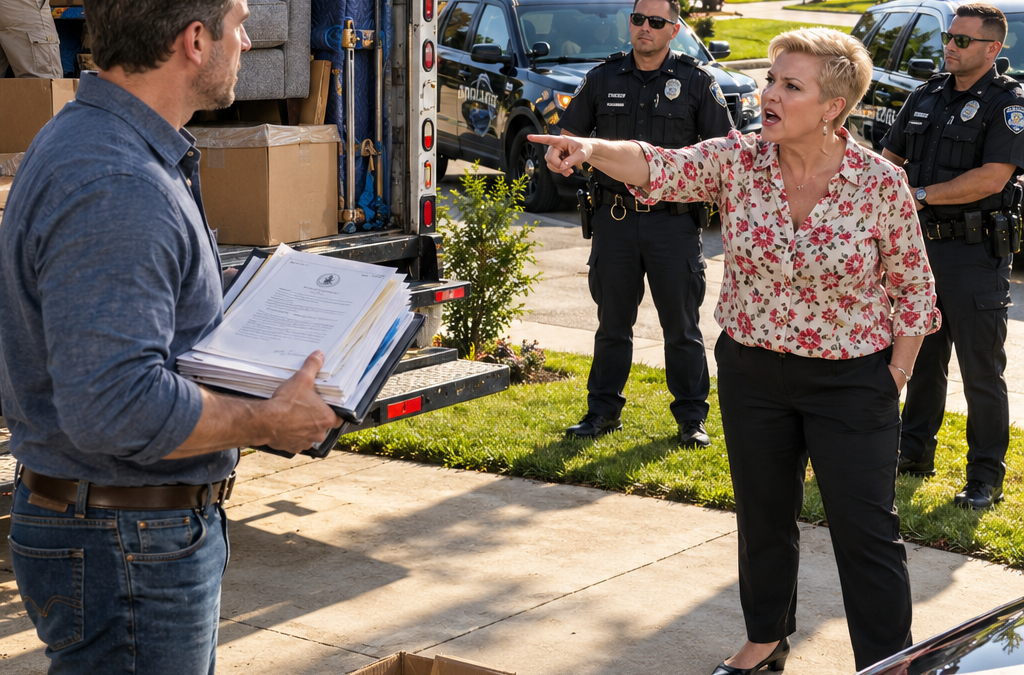
𝗙𝗨𝗟𝗟 𝗦𝗧𝗢𝗥𝗬
That was the version Linda understood.
It wasn’t the whole story.
Moving had given me an idea months earlier.
Not revenge.
I want to be clear about that.
I did not wake up one morning deciding I would buy an entire block because I hated an HOA president.
That would have been ridiculous.
The first purchase happened because opportunity appeared.
The house next door belonged to an older couple named Frank and Elise Morgan.
They had lived there almost eighteen years.
Their children were grown.
Frank’s knees were bad.
They wanted a single-story place closer to their daughter.
One afternoon, Frank mentioned over the fence that they planned to sell.
“Market’s strange,” he said.
“How strange?”
“Realtor says we might do well.”
“You probably will.”
He looked at my house.
“You staying?”
I hesitated.
“Probably not.”
He nodded.
“We’ve had enough too.”
He didn’t need to say of what.
Everyone knew.
Two weeks later, before their property reached the open market, I asked whether they would consider a direct sale.
Frank laughed.
“You buying another house before selling yours?”
“Maybe.”
“What for?”
“I have an idea.”
He studied me.
“Good idea?”
“I don’t know yet.”
That first transaction was straightforward.
Independent appraisal.
Attorney.
Inspection.
Purchase agreement.
Title search.
Closing.
Nothing hidden.
Nothing improper.
I bought the property through a holding company my attorney helped structure for liability and management purposes.
Not to conceal wrongdoing.
There was no wrongdoing to conceal.
I simply didn’t advertise my business plans to the HOA.
The Morgans moved.
I rented their house to a teacher and her husband.
Life continued.
Then another property came up across the street.
The owner had been transferred out of state.
Good price.
Strong rental potential.
I bought that too.
At that point, the idea stopped being hypothetical.
Our block had an unusual layout.
Eight houses around a short loop, separated from the rest of the development by landscaping on one end and a drainage corridor on the other.
The original developer had built the block during an early phase.
Over the next several months, several owners decided to sell for unrelated reasons.
One inherited property.
One divorce.
One job relocation.
One elderly owner moving into assisted living.
None of them sold because I pressured them.
I waited.
If a property became available and the price made sense, I made an offer.
Every deal went through ordinary legal channels.
Title companies.
Lenders where appropriate.
Attorneys.
Recorded deeds.
Taxes.
Inspections.
The kind of boring paperwork real estate depends on.
I never told Linda.
Why would I?
The HOA needed whatever ownership information the governing documents and law required for administration.
Management records were updated when transactions closed.
But I had no obligation to walk into Linda’s office after every private acquisition and explain my long-term strategy.
The funniest part was that she never seemed to notice the pattern.
That told me something about how she saw residents.
She paid attention to violations.
Not ownership.
She knew which porch light she disliked.
Which fence had been painted without approval.
Which resident parked a work truck overnight.
But she never looked carefully enough at county property records to understand that the legal structure beneath her neighborhood was changing.
By the time I began packing my original house, I owned several properties on the block.
The final acquisition was still pending.
That last one mattered.
If it closed, every parcel on the block would be under the same private ownership structure.
Again, that would not magically erase recorded HOA covenants.
I was not buying myself a private country inside the development.
Valid covenants remained valid.
Common-area obligations remained.
Assessments remained where applicable.
What changed was leverage, coordination, and reality.
Linda had spent years acting as though the HOA owned the neighborhood.
It did not.
The association administered defined common interests and restrictions.
The homes still belonged to the people whose names were on the deeds.
By consolidating ownership of the entire block, I was making that distinction impossible to ignore.
But Linda knew none of that on moving day.
To her, I was just leaving.
The truck arrived a little after eight.
Large white box truck.
Professional movers.
Proper insurance.
No blocked fire lane.
No damage to landscaping.
We had positioned it almost entirely inside my driveway, with only enough space near the curb for the loading ramp.
I had spent weeks planning.
Heavy furniture first.
Boxes staged by room.
Utilities scheduled.
Nothing belonged to the HOA.
Nothing belonged to a neighbor.
Nothing was being removed from common property.
We were moving my belongings out of my house.
By nine thirty, the living room was mostly empty.
At ten, I heard a voice outside.
Not one of the movers.
Linda.
I stepped onto the porch.
She stood near the truck with both hands on her hips.
She wore beige slacks, a blue blazer, and sunglasses she didn’t need.
“What’s going on?”
I looked at the moving truck.
Then at her.
“I’m moving.”
“I can see that.”
“Then I’m not sure what part needs explaining.”
“You did not submit a moving request.”
I almost smiled.
“A moving request?”
“Yes.”
“When did that become necessary?”
“The board adopted revised loading and relocation procedures.”
I had seen them.
The rules controlled reasonable things.
Blocking roads.
Damaging common landscaping.
Using elevators in multiunit sections.
Leaving containers overnight.
They did not give Linda personal veto power over whether I could remove my belongings.
“The truck isn’t blocking the road.”
“That’s not the only issue.”
“No common property is being damaged.”
“You failed to provide proper notice.”
“I notified management of my planned move.”
“You didn’t receive board approval.”
“I didn’t request board approval.”
“Exactly.”
The movers had stopped working.
I turned toward them.
“Keep going.”
Linda raised her voice.
“No. Stop.”
One mover looked between us.
I said, “She’s not your client. I am.”
He nodded and picked up another box.
Linda’s face changed.
“You cannot simply disregard HOA procedure.”
“I’m not disregarding anything that lawfully applies.”
“You are.”
“Then send me the citation.”
“I don’t need to debate you on your driveway.”
“That makes two of us.”
She pulled out her phone.
I assumed she was calling management.
Then I heard her say:
“Yes, I need officers at a residence in Willow Crest.”
I stared at her.
She turned away slightly.
“There is an unauthorized moving operation taking place.”
I felt irritation become disbelief.
I walked closer, but stayed several feet away.
“Linda, are you calling the police because I’m moving?”
She covered the phone.
“You were told to stop.”
“No, you told me to stop.”
“The HOA told you.”
“You are not the entire HOA.”
Her eyes narrowed.
Then she resumed the call.
I heard words like unauthorized vehicle, property dispute, noncompliance.
Nothing that sounded like a crime.
The movers looked uncomfortable.
One asked quietly, “You want us to pause?”
I looked at the truck.
Then Linda.
“Yes.”
That decision hurt.
Not because she had authority.
Because I didn’t want the movers dragged into whatever she was creating.
I paid by the hour.
Every minute cost money.
But I was not going to have some employee accused of participating in trespass or obstruction because an HOA president had decided moving required police intervention.
So we waited.
Neighbors began appearing.
First across the street.
Then two houses down.
Curtains moved.
Garage doors opened.
Linda noticed.
I could tell she liked the attention.
That had always been one of her weaknesses.
Private disagreements became performances when an audience appeared.
Ten minutes later, I heard sirens.
I remember thinking:
She actually did it.
Two cruisers turned onto the block.
No urgency once they saw the scene.
They stopped near my driveway.
Two officers stepped out.
One older.
One younger.
Linda walked toward them before I did.
Of course she did.
She began talking immediately.
I stayed near the porch.
One officer raised a hand.
“Ma’am, slow down.”
“He’s conducting an unauthorized move.”
The officer glanced at the truck.
“Unauthorized by who?”
“The homeowners association.”
“Is this his residence?”
“For now.”
That phrase irritated me more than it should have.
The officer looked toward me.
“Sir?”
I walked over.
“I’m the homeowner.”
“You moving out today?”
“Yes.”
“Any dispute over ownership of the items in the truck?”
“No.”
“Court order preventing removal?”
“No.”
“Eviction issue?”
“No.”
“Domestic dispute?”
“No.”
The officer looked at Linda.
She said, “He’s violating HOA rules.”
The older officer asked, “What rule?”
“He did not receive permission to conduct the move.”
The officer looked back at me.
“You have something showing you own the property?”
“Absolutely.”
I had already learned something during my years with Linda.
Keep paperwork accessible.
I went inside and returned with a folder.
Deed.
Closing statement.
Identification.
Moving-company contract.
Management notification.
Nothing dramatic.
The officer reviewed the deed.
Then asked, “These are your belongings?”
“Yes.”
“You’re selling the house?”
“The transaction is being handled separately.”
That was intentionally vague.
The final block purchase had closed only days earlier.
My original home’s disposition was part of a larger property plan.
Linda did not need that explanation on the sidewalk.
I continued:
“The HOA may regulate certain common areas and enforce valid covenants, but there is no rule preventing me from removing my own belongings from my own home.”
The officer nodded.
Linda stepped forward.
“The truck is creating a neighborhood hazard.”
The younger officer walked around it.
He checked the distance to the curb.
The lane.
Fire access.
Then returned.
“It’s in the driveway.”
“Partially.”
“A few feet of loading ramp extend near the curb.”
“Exactly.”
“That isn’t a criminal matter.”
Linda’s face tightened.
“He was ordered to stop.”
“By whom?”
“Me.”
The officer waited.
Linda said, “As HOA president.”
Then came the question that changed the whole tone.
The older officer asked:
“Exactly what law do you believe he’s breaking?”
Silence.
Linda blinked.
“This is an HOA enforcement matter.”
“I understand.”
“He’s violating community policy.”
“That may be a civil association issue.”
“So you’ll make him stop?”
“No.”
Her face changed.
“Excuse me?”
“I don’t see a crime.”
“He’s refusing a lawful directive.”
“An HOA directive is not automatically a police order.”
Several neighbors were close enough to hear that.
A few looked away to hide smiles.
Linda noticed.
Her voice rose.
“This truck is disrupting the neighborhood.”
The younger officer said, “If it blocks the roadway or creates an actual safety problem, call us. Right now, it’s not.”
“What about property rights?”
The older officer looked almost confused.
“He’s the property owner.”
Linda opened her mouth.
Closed it.
I could feel the attention shift.
Ten minutes earlier, Linda had been the person who called police.
That gave her a kind of temporary authority in everyone’s imagination.
Now the officers were looking at her as though they couldn’t understand why they had been called.
She hated that.
I didn’t enjoy it.
I just wanted them gone so I could finish moving.
The officer handed my documents back.
“You can continue.”
“Thank you.”
He looked at Linda.
“This is a civil matter. If the HOA believes rules were violated, use the appropriate civil process.”
Linda crossed her arms.
“So you’re doing nothing.”
“We responded.”
“You’re allowing him to violate our bylaws.”
“We enforce laws, ma’am.”
That ended it.
The officers returned to their cruisers.
No handcuffs.
No citation.
No dramatic speech.
They simply drove away.
The moment the cruisers disappeared, the movers started again.
Linda remained on the sidewalk.
Her phone came out.
More calls.
Management.
Board members.
Maybe the association attorney.
I didn’t care.
I carried boxes.
For another three hours, we worked.
At one point, a neighbor named Denise walked over.
“Are you okay?”
“Fine.”
“I can’t believe she called the police.”
“I can.”
Denise lowered her voice.
“Where are you moving?”
“Not far.”
She looked at the empty house.
“You finally had enough?”
I smiled.
“Something like that.”
That was all I said.
Because the move had never really been the important part.
The important part had happened three days earlier.
The final property purchase had closed.
Every house on our block was now owned by me or by an entity I controlled.
Eight parcels.
Eight recorded transactions.
Different histories.
Different sellers.
One ownership structure.
Linda had no idea.
After the truck left, I drove to the new place where I would actually be living.
Smaller house.
Less HOA involvement.
More land.
Quiet.
Sophia—my sister, who had helped with the financial side of several purchases—called that evening.
“How bad was it?”
“Police.”
She laughed because she assumed I was joking.
Then stopped.
“She actually called police?”
“Two cruisers.”
“For moving?”
“For unauthorized moving.”
“Did they arrest the couch?”
“Coffee table got a warning.”
She laughed again.
Then asked, “Did you tell her?”
“No.”
“About the block?”
“No.”
“Why not?”
“Because I didn’t need to.”
There was a pause.
“When are you going back?”
“Couple days.”
“You enjoy this more than you’re admitting.”
“No.”
“Liar.”
Maybe a little.
But not for the reason she thought.
I didn’t want to humiliate Linda.
What I wanted was to see how she reacted when confronted not with argument but with records.
Linda thrived inside verbal disputes.
She could dominate meetings.
Interrupt people.
Reframe questions.
Call motions.
Cite policies.
But property records are wonderfully indifferent to personality.
A deed does not care who holds the gavel.
Three days later, I returned to Willow Crest.
There were still a few items in the garage.
Tools.
Cleaning supplies.
Documents.
I also had business with several tenants and contractors regarding the newly acquired properties.
Linda saw my truck almost immediately.
She marched across the street.
“You again.”
I smiled.
“Good morning.”
“You moved.”
“Yes.”
“Then why are you here?”
“I have business here.”
“You no longer reside in the neighborhood.”
“That does not mean I have no business here.”
She looked at the house.
“Are you trespassing?”
I laughed before I could stop myself.
“Linda.”
“What?”
“Please don’t call the police again.”
Her face reddened.
“You think that was funny?”
“No.”
“You embarrassed this association.”
“I packed boxes.”
“You violated procedure.”
“We’ve covered this.”
“You need to leave.”
“From where?”
“The neighborhood.”
That sentence was so absurd I almost admired it.
“Linda, you cannot order people off public streets.”
“I’m talking about association property.”
“I’m standing in a private driveway.”
She looked toward the house.
“The new owner hasn’t taken possession.”
I stared at her.
“You’ve been checking?”
“Management monitors transactions.”
“Apparently not very well.”
Her eyes narrowed.
“What does that mean?”
I reached into my truck.
Pulled out a folder.
Not because I needed to prove anything to her on the sidewalk.
Because I had anticipated this exact conversation.
“Check the county records.”
“What?”
“The latest ownership records.”
“I don’t have time for games.”
“Then don’t play.”
I handed her copies.
She read the first deed.
Then another.
Her expression changed slightly.
“What is this?”
“Property record.”
“I can see that.”
“Keep going.”
Second property.
Third.
Fourth.
Her eyes moved faster.
The confidence disappeared gradually.
She looked up.
“You purchased the Morgan property?”
“Yes.”
“And 118 Willow?”
“Yes.”
She flipped.
“The Carson house?”
“Yes.”
“Since when?”
“Months.”
She looked at me as if I had somehow committed an offense by not telling her.
“How many?”
“All of them.”
She stopped.
“What?”
“Every property on this block.”
For once, Linda Whitmore had no immediate response.
She looked around.
Eight houses.
Familiar porches.
Driveways.
Mailboxes.
Properties she had spent years speaking about as though they were pieces on the HOA’s board.
Now one private owner held title to all of them.
Again, that did not dissolve the association.
It did not cancel recorded covenants.
It did not make me mayor.
But it shattered Linda’s assumption that the neighborhood’s legal ownership was somehow synonymous with HOA control.
She looked back at the papers.
“This isn’t possible.”
“They’re recorded.”
“When did this happen?”
“Over several months.”
“Management wasn’t informed.”
“Management received ownership updates where required.”
“I wasn’t informed.”
I smiled.
“That is a different sentence.”
Her face hardened.
“You had an obligation to disclose this.”
“Show me.”
“What?”
“Show me the provision requiring a private owner to personally brief the HOA president on every lawful real estate acquisition.”
She stared.
I had learned from Linda.
Ask for the document.
She hated that.
“You are manipulating the association.”
“No.”
“You’ve secretly purchased an entire block.”
“Privately is not secretly.”
“You deliberately concealed this.”
“I didn’t publish it.”
“Same thing.”
“No, Linda.”
I shook my head.
“It really isn’t.”
By then, two board members had walked over.
Derek Lane, the treasurer, and Ruth Coleman, the secretary.
Linda shoved the papers toward them.
“Look at this.”
Derek adjusted his glasses.
He read.
Then looked toward me.
“Are these certified?”
“Copies of recorded instruments.”
“Every property?”
“Yes.”
Ruth flipped through the pages.
“How?”
“Owners sold. I bought.”
“All cash?”
“Some. Some financed. None of that affects title.”
Linda said, “He did this without notifying the board.”
Ruth looked at her.
“Is notification required?”
Linda opened her mouth.
Derek answered first.
“Not beyond the ownership information sent to management.”
Silence.
That was the beginning of the real shift.
The issue could no longer remain on a sidewalk.
The board called a special meeting.
Officially, the agenda involved property ownership updates, assessment records, voting allocations, and block-level maintenance responsibilities.
Unofficially, everybody wanted to understand what I had done.
The clubhouse was fuller than usual.
Rumors had spread.
Somebody said I had bought half the neighborhood.
Someone else said I was trying to dissolve the HOA.
Neither was true.
I owned one block.
Not the whole development.
And I had no magical ability to erase covenants through acquisition.
I was not interested in pretending otherwise.
That distinction mattered.
Because the point of the story was never that I had found some loophole allowing me to conquer the HOA.
The point was that Linda had spent years confusing governance with ownership.
I had created a situation where she could no longer afford that confusion.
Sophia attended with me.
She whispered before the meeting:
“How angry is Linda?”
“Scale of one to ten?”
“Yeah.”
“Purple blazer.”
Sophia looked toward the front.
Linda was indeed wearing purple.
“Eleven.”
We sat.
The meeting began.
Linda opened with procedural language.
“Recent property transfers have raised significant questions regarding ownership concentration and association governance.”
I almost smiled.
Ownership concentration sounded sinister.
As though eight separate sellers had been hypnotized.
Derek presented county records on the projector.
One parcel at a time.
Morgan property.
My holding company.
Carson property.
My holding company.
Original house.
My ownership structure.
Across the street.
Mine.
End property.
Mine.
Again.
Again.
By the sixth deed, the room had become silent.
Not shocked exactly.
People knew houses had sold.
They just hadn’t realized who was buying them.
The map on the screen told the story visually.
One color.
Every parcel around the loop.
Linda looked toward me.
“Would you like to explain why you concealed these acquisitions?”
I stood.
“I didn’t conceal them.”
“You didn’t disclose them.”
“The deeds are public.”
“That isn’t what I mean.”
“I know.”
Several residents smiled.
I continued.
“Every transaction was conducted through normal contracts, title review, closing, and recording. Management received ownership information as required for HOA administration.”
Linda said, “But the board was never informed of your larger plan.”
“There was no requirement to inform the board of my investment plan.”
“What is your plan?”
“Own and manage the properties.”
“For what purpose?”
“Long-term rental, redevelopment where lawful, and investment.”
“So you intend to alter the character of this community.”
“No.”
“You purchased an entire block.”
“Yes.”
“That changes the community.”
“Ownership changes communities every day.”
Linda leaned forward.
“You clearly did this to undermine the association.”
That accusation irritated me because it was both dramatic and convenient.
“No.”
I looked around the room.
“My first purchase happened because my neighbors were selling.”
I explained the Morgan deal.
Then the second property.
Then the opportunities that followed.
“I did not force anyone to sell. I did not manipulate titles. I did not use a secret legal loophole.”
I pointed toward the projector.
“Those are ordinary deeds.”
Someone in the back asked, “Does this mean the block isn’t part of the HOA anymore?”
“No.”
I answered immediately.
That surprised Linda.
I continued.
“Existing recorded covenants don’t vanish just because one person owns multiple parcels. Assessments don’t disappear. Valid rules don’t disappear.”
The room relaxed slightly.
“But,” I added, “the HOA also does not become owner of private property just because it has enforcement authority over certain covenants.”
I looked at Linda.
“That distinction has been blurred around here for years.”
Her eyes narrowed.
“This meeting is not about personal grievances.”
“You called police on me for moving my own belongings.”
Murmurs.
She said, “Because you failed to follow procedure.”
“The officers asked what law I was breaking.”
“That was irrelevant.”
“No.”
I kept my voice calm.
“It was very relevant.”
Derek shifted in his chair.
Ruth looked down at the papers.
I continued.
“The HOA can enforce legitimate restrictions through legitimate processes. It cannot treat homeowners as tenants of the board.”
One resident clapped once.
Then stopped.
Linda ignored it.
She asked, “Why didn’t you tell us?”
That question came out differently.
Less presidential.
More personal.
I answered honestly.
“Because I didn’t need your permission.”
The room went completely silent.
Not because the sentence was aggressive.
Because it was simple.
Buying private property from willing sellers was not something I needed Linda’s personal approval for.
She had spent years expecting residents to ask.
Fence.
Door color.
Move date.
Landscaping.
Parking.
Now she was facing transactions outside that reflex.
Private sellers.
Private buyer.
Lawyers.
County recorder.
Deeds.
The HOA’s role began where its actual governing authority began.
No earlier.
No later.
Ruth spoke.
“I think we need counsel to review voting allocations and management records.”
“Fine,” I said.
“I agree.”
Linda looked at her.
“We don’t need to treat this as legitimate before reviewing intent.”
Derek frowned.
“Intent doesn’t change the deeds.”
That was the moment Linda lost control of the meeting.
Not her office.
Not yet.
But the room.
For years, board members had followed her because she spoke first and most confidently.
Now the documents were stronger than her certainty.
Residents began asking practical questions.
Would tenants still pay dues through ownership accounts?
Yes.
Would landscaping standards still apply?
Where valid.
Could I change every exterior tomorrow?
No.
Could I block common roads?
Of course not.
Was I planning to evict everyone?
No.
Some properties were vacant.
Others had tenants protected by leases.
I intended to honor them.
One woman asked, “Then what changes?”
I looked at the ownership map.
“Maybe nothing immediately.”
She seemed confused.
“Then why is this important?”
Because that was the heart of it.
I said:
“Because everybody should understand the difference between what the HOA manages and what the HOA owns.”
No one spoke.
“The HOA doesn’t own my house.”
I pointed toward another parcel.
“Or that house.”
Another.
“Or that one.”
Then toward the common clubhouse.
“It owns or administers whatever common property the governing documents say it does.”
I looked back at Linda.
“That line matters.”
She folded her arms.
“So this is a lecture.”
“No.”
“It sounds like one.”
“It is a boundary.”
That word changed the room.
Boundary.
Legal.
Conceptual.
Personal.
For years, Linda had acted as though the line between association authority and personal ownership was flexible whenever enforcement became inconvenient.
Now one owner controlled every private parcel on the block.
If she wanted to deal with landscaping, she dealt with me.
Maintenance notices?
Me.
Access requests?
Me.
Lease administration?
Me.
Any attempt to pretend the board itself owned those homes would immediately collide with the same recorded name eight times.
The concentration of ownership didn’t create my rights.
It made them harder to ignore.
After the meeting, several neighbors approached.
Some were curious.
Some skeptical.
One man asked:
“You trying to turn the block into rentals?”
“Some properties, yes.”
“Short-term?”
“No.”
“Party houses?”
“No.”
He relaxed.
A woman named Teresa asked whether I planned to tear houses down.
“No.”
“Then why buy so many?”
“Because they were good investments.”
She smiled.
“And because Linda drove you crazy.”
I smiled back.
“That didn’t hurt the motivation.”
Sophia laughed.
Linda stood near the board table talking with counsel.
She never approached me.
That was unusual.
Normally, Linda couldn’t resist the last word.
For the next several weeks, the atmosphere changed.
Not dramatically.
There was no revolution.
No dramatic collapse of the HOA.
That’s not how property law works.
The association still existed.
The board still met.
Residents still received notices.
But Linda’s tone changed.
That mattered.
Requests concerning my properties were sent in writing.
Rules were cited specifically.
No more:
The board has decided.
Instead:
Section 8.4 provides…
Good.
That was how it should have worked all along.
When maintenance needed access to inspect a drainage structure behind one property, management asked.
I agreed.
When a landscaping issue existed at a vacant house, they sent a proper notice.
I corrected it.
When Linda attempted to argue during one meeting that a temporary contractor vehicle needed her personal authorization to enter my block, counsel quietly corrected her.
“Association rules address parking duration. They do not require presidential permission for an owner’s invited contractor.”
Linda stopped talking.
I almost felt sorry for her.
Almost.
But the most important change was psychological.
Residents began looking at their own paperwork.
Not because I told them the HOA was evil.
It wasn’t.
An association is a structure.
People decide whether it works responsibly.
Residents started asking simple questions.
Is this common property?
Is this privately owned?
Where is that rule recorded?
Was this amendment adopted correctly?
Who maintains this easement?
Does this assessment apply to my parcel?
Those questions improved meetings.
They also made them longer.
I considered that a good trade.
A few months later, I sold my original house.
That was the part of the move Linda had misunderstood completely.
I wasn’t abandoning the neighborhood.
I was changing my relationship with it.
The house where I had lived was sold.
The other properties remained investments.
I no longer woke up every morning inside Willow Crest.
That gave me distance.
I could deal with the HOA professionally instead of emotionally.
Some residents stayed tenants.
Others eventually moved and new tenants arrived.
I repaired two roofs.
Replaced an HVAC system.
Updated landscaping.
Repainted three interiors.
Owning an entire block turned out to involve far less triumph and far more invoices than Sophia had predicted.
She called one afternoon.
“How’s your empire?”
“Water heater failed at number six.”
“Kingdom in crisis?”
“Plumber wants eighteen hundred dollars.”
“Thoughts and prayers.”
“Thank you.”
I never called it an empire.
Linda probably did.
The block became healthier under consolidated maintenance.
Not because I was brilliant.
Because one owner could coordinate repairs.
Fences matched because I repaired them together.
Drainage problems got addressed across property lines.
Trees were trimmed before branches damaged roofs.
Vacant properties didn’t sit neglected.
Ironically, the block began looking better than it had under Linda’s endless violation letters.
That pleased me more than it should have.
One afternoon, Derek from the board met me near the corner property.
He watched a roofing crew work.
“You spent a lot here.”
“Needs it.”
He nodded.
“Linda said you were buying everything to make the HOA fail.”
I laughed.
“Do these roofs look like sabotage?”
“No.”
He looked toward the houses.
“I think she doesn’t understand why someone would buy this much property unless they wanted control.”
That sentence stayed with me.
Control.
Linda understood ownership only through that lens.
If she had owned the block, she would have wanted control.
So she assumed I did too.
But I wasn’t trying to control residents.
I was trying to own assets.
Maintain them.
Collect rent.
Build equity.
My relationship to property was boring.
That was the difference.
Property ownership is mostly boring when done correctly.
Insurance.
Taxes.
Maintenance.
Contracts.
Records.
Linda made it emotional because power was emotional to her.
Months after the police incident, I ran into Officer James—the older officer who had responded that morning—at a coffee shop.
He recognized me first.
“Moving-truck guy.”
I laughed.
“That’s me.”
“How’d the move go?”
“Eventually.”
“She bother you again?”
“Not with police.”
“Good.”
I hesitated.
“You know what I remember most?”
“What?”
“You asking what law I was breaking.”
He smiled.
“Pretty standard question.”
“It didn’t feel standard.”
He took his coffee.
“HOA disputes are civil until somebody makes them something else.”
I nodded.
“People forget that.”
“People forget lots of things when they’re angry.”
Then he left.
That simple question had punctured the entire performance.
Exactly what law is he breaking?
Linda had titles.
Rules.
Policies.
Complaints.
But when required to identify a crime, she had nothing.
Later, at the special meeting, another simple question did the same thing.
What document required me to announce every lawful real estate purchase to Linda?
Nothing.
That became a pattern I learned to trust.
When authority feels vague, ask for the source.
Not aggressively.
Specifically.
Which rule?
Which deed?
Which statute?
Which recorded covenant?
Which vote?
Which boundary?
People with legitimate authority usually can answer.
People relying on confidence often get irritated by the question.
Linda became more careful after that.
I wouldn’t say she changed completely.
People rarely do.
She still liked control.
Still enjoyed leading meetings.
Still spoke more than necessary.
But she stopped showing up at my properties without notice.
Stopped issuing verbal commands as though they were final.
Stopped threatening immediate enforcement before checking the governing documents.
She never called police on me again.
Eventually, I heard she had told another board member that dealing with me had become “legally complicated.”
I considered that a compliment.
Not because I was litigious.
Because I had become difficult to intimidate.
There is a difference.
A year after my moving day, Willow Crest held its annual meeting.
I attended as an owner.
Not a resident.
The room was calmer than it had been the year before.
Linda was still president.
Barely.
Two new board members had been elected on promises of clearer financial reporting and written enforcement procedures.
Ruth had become vice president.
She handled most rule questions now.
At one point, a homeowner asked about installing a small shed.
Linda began answering from memory.
Ruth interrupted gently.
“Let’s pull the actual provision.”
For a second, Linda looked offended.
Then she stopped.
Ruth found the rule.
Read it.
The homeowner asked a question.
They answered.
No conflict.
No lecture.
No threat.
It was almost painfully normal.
I sat in the back and thought:
This is what I wanted.
Not victory.
Not Linda humiliated.
Procedure.
Real procedure.
A board that remembered it was administering documents, not inventing ownership in real time.
After the meeting, Linda approached me.
I hadn’t expected that.
She stopped a few feet away.
“You still own all eight?”
“Yes.”
“How are the rentals?”
“Fine.”
She nodded.
Then said, “You could have told us what you were doing.”
I looked at her.
“We’ve had this conversation.”
“I know.”
Her tone was different.
Less sharp.
“I suppose what I mean is that I would’ve preferred to know.”
“That I understand.”
She looked toward the empty chairs.
“I thought you were trying to destroy the HOA.”
“I wasn’t.”
“I know that now.”
That was probably the closest Linda would ever come to admitting she had been wrong.
I accepted it.
She glanced toward the door.
“The police call was unnecessary.”
I didn’t respond immediately.
“No argument there.”
Her mouth tightened slightly.
Then, unexpectedly, she smiled.
“Good night.”
“Good night.”
That was it.
No dramatic apology.
No courtroom victory.
No resignation.
Real life gives you smaller endings.
Sometimes better ones.
I left the clubhouse and walked through the block.
My block, legally speaking.
That phrase still sounded strange.
Lights glowed behind curtains.
A tenant in number four was watching television.
Someone had left a bicycle on a porch.
The Morgan house had flowers near the steps.
Ordinary life.
People sometimes imagine owning multiple properties must feel powerful.
Mostly, it feels responsible.
Every roof can leak.
Every tenant can call.
Every insurance premium rises.
Every tax bill arrives.
Ownership does not make the world obey you.
It makes you accountable for what belongs to you.
That is another thing Linda had misunderstood.
She saw ownership and control as almost the same word.
They aren’t.
Ownership comes with rights.
It also comes with obligations.
HOA authority is similar.
It comes with powers.
And limits.
Healthy systems remember both halves.
Trouble begins when people remember only the part that lets them tell others what to do.
The framed county ownership map now hangs in my office.
Not because I need to admire it.
I use it for management.
Each parcel marked.
Insurance renewal date.
Lease status.
Maintenance schedule.
Boring.
Sophia visited one afternoon and stared at it.
“So this is what all the drama became.”
“What?”
“A spreadsheet with roofs.”
“Basically.”
She laughed.
“Linda would be disappointed.”
“She probably expects secret meetings.”
“Do you have secret meetings?”
“With contractors.”
“Scandalous.”
Then she pointed to my original house.
“You miss it?”
Sometimes.
I looked at the map.
“Yes.”
Leaving had been harder than I expected.
That house contained twelve years of my life.
Dinner with friends.
Storms.
Birthdays.
Arguments.
Quiet mornings.
The oak tree had grown wider.
There was a scratch on the kitchen floor from the first couch I dragged inside.
Moving was not purely escape.
It was grief mixed with relief.
Linda’s police stunt had almost erased that emotional part.
For several months, when I remembered leaving, I remembered cruisers.
Neighbors watching.
Her pointing at my truck.
But eventually, the memory changed.
I remembered the empty rooms too.
The last walk through the hallway.
My hand on the kitchen counter.
Closing the front door.
Knowing I had finished one chapter without abandoning everything I had built around it.
I think that’s why buying the surrounding properties mattered to me beyond investment.
It gave me a way to leave without feeling expelled.
Linda believed she was watching me retreat.
I knew I was repositioning.
Not against her.
For myself.
There is a difference.
Had she never called the police, I probably would have told the board about the ownership concentration eventually in an ordinary administrative meeting.
Instead, she turned moving day into a spectacle.
That spectacle made the later revelation feel more dramatic than it needed to be.
But the truth itself was simple.
Eight willing sellers.
Eight legitimate transactions.
Eight recorded deeds.
No secret loophole.
No hidden inheritance.
No forged papers.
I bought property.
The county recorded it.
That was all.
Sometimes the strongest surprise is boring legality.
People expect schemes.
The clever technicality.
The forgotten nineteenth-century clause.
The secret document.
There wasn’t one.
Linda’s mistake was assuming that because she controlled the conversation, she understood the ownership underneath it.
She didn’t.
The county recorder did.
When she finally looked, my name was everywhere.
That visual stayed with me.
Linda at the special meeting.
Projector behind her.
Parcel after parcel.
Same owner.
Her confidence growing quieter with every deed.
I did not enjoy her discomfort as much as I expected.
Mostly, I felt something settle.
For years, she had used the phrase our neighborhood as though it meant ours in the ownership sense.
Of course communities use that phrase emotionally.
Our street.
Our park.
Our town.
Nothing wrong with that.
But legal ownership remains specific.
The HOA was never the landlord of Willow Crest.
Homeowners were not guests.
Linda needed to learn that.
Maybe everyone did.
One of my tenants, a young accountant named Evan, once asked why I had bought so many homes in one place.
I gave him the investment answer.
Efficiency.
Market timing.
Long-term value.
Then he smiled.
“That’s not the whole reason.”
“No?”
“I’ve heard the police story.”
“Neighborhood gossip.”
“Did she really call them because you were moving?”
“Yes.”
He laughed.
“That had to feel good afterward.”
“What?”
“Owning the block.”
I thought about it.
“Not as good as you’d think.”
“Seriously?”
“Seriously.”
“Why?”
“Because if you buy property just to beat somebody, eventually you’re still stuck owning property.”
He laughed.
Then I said:
“The useful part wasn’t that I owned more than she expected.”
“What was it?”
“That she finally understood what she didn’t own.”
That is still the cleanest way I can say it.
The story was never about becoming more powerful than an HOA president.
It was about limits.
Linda’s.
Mine.
The HOA’s.
The homeowners’.
Every relationship works better when those limits are clear.
My ownership didn’t allow me to ignore valid covenants.
Her presidency didn’t allow her to control private transactions.
My moving truck didn’t become illegal because she disliked it.
Her rules didn’t become criminal law because she called police.
The association didn’t own houses simply because it regulated certain exterior standards.
Those lines existed all along.
The drama happened because Linda stopped seeing them.
Today, I still own most of the block.
I sold one property a couple of years later to a tenant who had rented long enough to want a permanent home.
I could have kept it.
The numbers made sense either way.
But he wanted it.
I sold.
The deed changed.
Simple.
That’s how ownership should work.
Linda was still HOA president when that sale happened.
Management received the ownership update.
Two days later, I got an email.
Not from Linda personally.
From the association office.
Thank you. Records updated.
That was all.
No demand to explain.
No suspicion.
No special meeting.
I smiled when I read it.
Progress can be painfully boring.
The new owner called me afterward.
“Anything I need to know about the HOA?”
I laughed.
“How much time do you have?”
“Seriously.”
I told him the truth.
“Read the covenants.”
“Okay.”
“Keep your deed.”
“Obviously.”
“Ask for rules in writing.”
“Anything else?”
“Don’t confuse an HOA with an owner.”
He paused.
“Meaning?”
“You own your house.”
He laughed.
“I know.”
“So did everyone else.”
He didn’t understand yet.
Maybe he never would need to.
I hope not.
The best property lesson is the one you never have to learn through conflict.
I still think about the morning Linda called the police.
The movers standing beside the truck.
Neighbors watching.
My house half empty.
Police lights against the oak tree.
It should have been a sad day.
Maybe a hopeful day.
Instead, she turned it into a confrontation.
But she also unintentionally crystallized something for me.
When the officer asked:
Exactly what law do you believe he is breaking?
Linda had no answer because she had confused disobedience with illegality.
I had not obeyed her.
Therefore, in her mind, I must be doing something wrong.
That is a dangerous way to understand authority.
People who hold legitimate authority need to tolerate hearing no when no is permitted.
Otherwise, every boundary becomes rebellion.
Every question becomes defiance.
Every homeowner becomes a problem.
The police officer didn’t care whether Linda felt disrespected.
He cared whether a law had been broken.
The county recorder didn’t care whether Linda liked my acquisitions.
It cared who signed the deeds.
Those outside systems were useful because they stripped the emotion away.
Facts.
Ownership.
Jurisdiction.
That was enough.
One evening, years later, I drove through Willow Crest after inspecting a roof replacement.
The sun was going down.
Kids rode bicycles around the loop.
Someone was grilling.
A dog barked behind a fence.
Nothing looked like territory.
Nothing looked conquered.
It looked like a neighborhood.
That’s what it had always been.
I stopped near the curb where the police cruisers had parked on moving day.
For a moment, I remembered Linda standing there.
Confident.
Certain.
Telling officers the truck needed to stop.
Then I looked around the block.
Several of the homes were still mine.
One belonged to the tenant who bought it.
Another would probably be sold someday.
Ownership changes.
That’s normal.
What matters is that the records change with it.
Clearly.
Legally.
Without pretending.
I never needed Willow Crest to belong to me in some grand sense.
It never did.
Even when I owned every private parcel on that block, people lived there.
The HOA still maintained common areas.
The streets still served everyone.
Community is larger than title.
But title still matters.
Linda had learned one without respecting the other.
I learned to respect both.
That is why, when people hear the story and say:
“You owned the whole block? You basically owned the HOA.”
I correct them.
“No.”
The HOA was never mine.
The neighborhood was never mine.
The properties were.
That distinction is the entire story.
The day I moved out, Linda believed those distinctions didn’t matter.
She thought policy was ownership.
She thought presidency was permission.
She thought calling police would turn her interpretation into law.
Months of recorded deeds were already proving otherwise.
I didn’t need a speech.
I didn’t need to embarrass her.
I didn’t even need to win an argument.
Eventually, she looked at the same public records anyone could have looked at.
The map had changed.
Not through tricks.
Not through secret votes.
Through ownership.
One lawful closing at a time.
And for the first time since I had known Linda Whitmore, she stopped telling me what the neighborhood belonged to and started checking who actually owned the ground beneath her assumptions.
𝗧𝗛𝗘 𝗘𝗡𝗗
The HOA President Called Police on My Moving Truck Without Knowing How Many Deeds Around Her Already Carried My Name
Linda Whitmore stood at the end of my driveway with two police cruisers behind her, insisting that my moving truck violated HOA rules and that the officers needed to stop me before I could take another box out of my own house.
She thought she was watching one troublesome homeowner leave the neighborhood for good, but she had no idea that for months I had been quietly changing the ownership map around her one recorded deed at a time.
I thought moving day would be the easiest part.
That was almost funny in hindsight.
For three weeks, I had lived among cardboard boxes, packing tape, black markers, furniture blankets, and the strange emotional debris that comes with leaving a house you once believed you might stay in forever.
The kitchen had been reduced to two plates, two coffee mugs, one frying pan, and whatever utensils I could still find without opening a labeled box.
The bookshelves were empty.
Pictures had been taken down.
Little pale rectangles remained on the walls where family photographs had hung for years.
Every room echoed differently once the furniture disappeared.
Even footsteps sounded temporary.
I had been waiting for that day.
Not because I hated the house.
I loved the house.
That was what made leaving complicated.
I had bought it twelve years earlier when the neighborhood was still quiet enough that nobody had strong opinions about whether your trash can remained visible for forty-three minutes too long after collection.
The place had a wide front porch, three bedrooms, an old oak near the driveway, and a backyard that caught the evening sun.
At the time, the HOA barely registered in my thinking.
There were dues.
A few landscaping rules.
Some exterior-paint restrictions.
Nothing unusual.
Then Linda Whitmore became president.
The neighborhood did not change overnight.
It changed the way water temperature changes when you aren’t paying attention.
Slowly enough that you tolerate each degree.
Then one day you realize you’re standing in something entirely different.
Linda began with appearance standards.
Mailbox finishes.
Driveway staining.
Fence colors.
Holiday-decoration dates.
Then parking.
Then contractor hours.
Then restrictions on moving trucks.
Then notices about temporary storage containers.
The board began behaving less like an association responsible for common areas and more like a permit office that expected residents to ask permission before changing anything larger than a flowerpot.
I could have lived with irritating rules.
What I couldn’t tolerate was the attitude beneath them.
Linda spoke about the neighborhood as if ownership belonged collectively to the board and homeowners merely occupied assigned pieces of it.
She liked phrases such as board authority, community discretion, and enforcement rights.
Those phrases were not automatically wrong.
An HOA does have authority where its recorded covenants and governing documents actually give it authority.
But Linda rarely spoke about the other half.
Limits.
Private ownership.
Recorded rights.
Procedures.
She was fascinated by what the HOA could control.
She had almost no interest in where that control ended.
For years, I dealt with her the way most people did.
I paid dues.
Answered notices.
Attended the occasional meeting.
Argued only when something mattered.
Then I stopped wanting to spend my life negotiating ordinary decisions with people who seemed to enjoy making ordinary decisions difficult.
So I decided to move.
I didn’t announce it dramatically.
I didn’t stand at an HOA meeting and tell everyone I was escaping.
I listed the house quietly.
Made plans.
Packed.
Arranged a moving company.
And, at least publicly, prepared to disappear from Linda’s little kingdom.
That was the version Linda understood.
It wasn’t the whole story.
Moving had given me an idea months earlier.
Not revenge.
I want to be clear about that.
I did not wake up one morning deciding I would buy an entire block because I hated an HOA president.
That would have been ridiculous.
The first purchase happened because opportunity appeared.
The house next door belonged to an older couple named Frank and Elise Morgan.
They had lived there almost eighteen years.
Their children were grown.
Frank’s knees were bad.
They wanted a single-story place closer to their daughter.
One afternoon, Frank mentioned over the fence that they planned to sell.
“Market’s strange,” he said.
“How strange?”
“Realtor says we might do well.”
“You probably will.”
He looked at my house.
“You staying?”
I hesitated.
“Probably not.”
He nodded.
“We’ve had enough too.”
He didn’t need to say of what.
Everyone knew.
Two weeks later, before their property reached the open market, I asked whether they would consider a direct sale.
Frank laughed.
“You buying another house before selling yours?”
“Maybe.”
“What for?”
“I have an idea.”
He studied me.
“Good idea?”
“I don’t know yet.”
That first transaction was straightforward.
Independent appraisal.
Attorney.
Inspection.
Purchase agreement.
Title search.
Closing.
Nothing hidden.
Nothing improper.
I bought the property through a holding company my attorney helped structure for liability and management purposes.
Not to conceal wrongdoing.
There was no wrongdoing to conceal.
I simply didn’t advertise my business plans to the HOA.
The Morgans moved.
I rented their house to a teacher and her husband.
Life continued.
Then another property came up across the street.
The owner had been transferred out of state.
Good price.
Strong rental potential.
I bought that too.
At that point, the idea stopped being hypothetical.
Our block had an unusual layout.
Eight houses around a short loop, separated from the rest of the development by landscaping on one end and a drainage corridor on the other.
The original developer had built the block during an early phase.
Over the next several months, several owners decided to sell for unrelated reasons.
One inherited property.
One divorce.
One job relocation.
One elderly owner moving into assisted living.
None of them sold because I pressured them.
I waited.
If a property became available and the price made sense, I made an offer.
Every deal went through ordinary legal channels.
Title companies.
Lenders where appropriate.
Attorneys.
Recorded deeds.
Taxes.
Inspections.
The kind of boring paperwork real estate depends on.
I never told Linda.
Why would I?
The HOA needed whatever ownership information the governing documents and law required for administration.
Management records were updated when transactions closed.
But I had no obligation to walk into Linda’s office after every private acquisition and explain my long-term strategy.
The funniest part was that she never seemed to notice the pattern.
That told me something about how she saw residents.
She paid attention to violations.
Not ownership.
She knew which porch light she disliked.
Which fence had been painted without approval.
Which resident parked a work truck overnight.
But she never looked carefully enough at county property records to understand that the legal structure beneath her neighborhood was changing.
By the time I began packing my original house, I owned several properties on the block.
The final acquisition was still pending.
That last one mattered.
If it closed, every parcel on the block would be under the same private ownership structure.
Again, that would not magically erase recorded HOA covenants.
I was not buying myself a private country inside the development.
Valid covenants remained valid.
Common-area obligations remained.
Assessments remained where applicable.
What changed was leverage, coordination, and reality.
Linda had spent years acting as though the HOA owned the neighborhood.
It did not.
The association administered defined common interests and restrictions.
The homes still belonged to the people whose names were on the deeds.
By consolidating ownership of the entire block, I was making that distinction impossible to ignore.
But Linda knew none of that on moving day.
To her, I was just leaving.
The truck arrived a little after eight.
Large white box truck.
Professional movers.
Proper insurance.
No blocked fire lane.
No damage to landscaping.
We had positioned it almost entirely inside my driveway, with only enough space near the curb for the loading ramp.
I had spent weeks planning.
Heavy furniture first.
Boxes staged by room.
Utilities scheduled.
Nothing belonged to the HOA.
Nothing belonged to a neighbor.
Nothing was being removed from common property.
We were moving my belongings out of my house.
By nine thirty, the living room was mostly empty.
At ten, I heard a voice outside.
Not one of the movers.
Linda.
I stepped onto the porch.
She stood near the truck with both hands on her hips.
She wore beige slacks, a blue blazer, and sunglasses she didn’t need.
“What’s going on?”
I looked at the moving truck.
Then at her.
“I’m moving.”
“I can see that.”
“Then I’m not sure what part needs explaining.”
“You did not submit a moving request.”
I almost smiled.
“A moving request?”
“Yes.”
“When did that become necessary?”
“The board adopted revised loading and relocation procedures.”
I had seen them.
The rules controlled reasonable things.
Blocking roads.
Damaging common landscaping.
Using elevators in multiunit sections.
Leaving containers overnight.
They did not give Linda personal veto power over whether I could remove my belongings.
“The truck isn’t blocking the road.”
“That’s not the only issue.”
“No common property is being damaged.”
“You failed to provide proper notice.”
“I notified management of my planned move.”
“You didn’t receive board approval.”
“I didn’t request board approval.”
“Exactly.”
The movers had stopped working.
I turned toward them.
“Keep going.”
Linda raised her voice.
“No. Stop.”
One mover looked between us.
I said, “She’s not your client. I am.”
He nodded and picked up another box.
Linda’s face changed.
“You cannot simply disregard HOA procedure.”
“I’m not disregarding anything that lawfully applies.”
“You are.”
“Then send me the citation.”
“I don’t need to debate you on your driveway.”
“That makes two of us.”
She pulled out her phone.
I assumed she was calling management.
Then I heard her say:
“Yes, I need officers at a residence in Willow Crest.”
I stared at her.
She turned away slightly.
“There is an unauthorized moving operation taking place.”
I felt irritation become disbelief.
I walked closer, but stayed several feet away.
“Linda, are you calling the police because I’m moving?”
She covered the phone.
“You were told to stop.”
“No, you told me to stop.”
“The HOA told you.”
“You are not the entire HOA.”
Her eyes narrowed.
Then she resumed the call.
I heard words like unauthorized vehicle, property dispute, noncompliance.
Nothing that sounded like a crime.
The movers looked uncomfortable.
One asked quietly, “You want us to pause?”
I looked at the truck.
Then Linda.
“Yes.”
That decision hurt.
Not because she had authority.
Because I didn’t want the movers dragged into whatever she was creating.
I paid by the hour.
Every minute cost money.
But I was not going to have some employee accused of participating in trespass or obstruction because an HOA president had decided moving required police intervention.
So we waited.
Neighbors began appearing.
First across the street.
Then two houses down.
Curtains moved.
Garage doors opened.
Linda noticed.
I could tell she liked the attention.
That had always been one of her weaknesses.
Private disagreements became performances when an audience appeared.
Ten minutes later, I heard sirens.
I remember thinking:
She actually did it.
Two cruisers turned onto the block.
No urgency once they saw the scene.
They stopped near my driveway.
Two officers stepped out.
One older.
One younger.
Linda walked toward them before I did.
Of course she did.
She began talking immediately.
I stayed near the porch.
One officer raised a hand.
“Ma’am, slow down.”
“He’s conducting an unauthorized move.”
The officer glanced at the truck.
“Unauthorized by who?”
“The homeowners association.”
“Is this his residence?”
“For now.”
That phrase irritated me more than it should have.
The officer looked toward me.
“Sir?”
I walked over.
“I’m the homeowner.”
“You moving out today?”
“Yes.”
“Any dispute over ownership of the items in the truck?”
“No.”
“Court order preventing removal?”
“No.”
“Eviction issue?”
“No.”
“Domestic dispute?”
“No.”
The officer looked at Linda.
She said, “He’s violating HOA rules.”
The older officer asked, “What rule?”
“He did not receive permission to conduct the move.”
The officer looked back at me.
“You have something showing you own the property?”
“Absolutely.”
I had already learned something during my years with Linda.
Keep paperwork accessible.
I went inside and returned with a folder.
Deed.
Closing statement.
Identification.
Moving-company contract.
Management notification.
Nothing dramatic.
The officer reviewed the deed.
Then asked, “These are your belongings?”
“Yes.”
“You’re selling the house?”
“The transaction is being handled separately.”
That was intentionally vague.
The final block purchase had closed only days earlier.
My original home’s disposition was part of a larger property plan.
Linda did not need that explanation on the sidewalk.
I continued:
“The HOA may regulate certain common areas and enforce valid covenants, but there is no rule preventing me from removing my own belongings from my own home.”
The officer nodded.
Linda stepped forward.
“The truck is creating a neighborhood hazard.”
The younger officer walked around it.
He checked the distance to the curb.
The lane.
Fire access.
Then returned.
“It’s in the driveway.”
“Partially.”
“A few feet of loading ramp extend near the curb.”
“Exactly.”
“That isn’t a criminal matter.”
Linda’s face tightened.
“He was ordered to stop.”
“By whom?”
“Me.”
The officer waited.
Linda said, “As HOA president.”
Then came the question that changed the whole tone.
The older officer asked:
“Exactly what law do you believe he’s breaking?”
Silence.
Linda blinked.
“This is an HOA enforcement matter.”
“I understand.”
“He’s violating community policy.”
“That may be a civil association issue.”
“So you’ll make him stop?”
“No.”
Her face changed.
“Excuse me?”
“I don’t see a crime.”
“He’s refusing a lawful directive.”
“An HOA directive is not automatically a police order.”
Several neighbors were close enough to hear that.
A few looked away to hide smiles.
Linda noticed.
Her voice rose.
“This truck is disrupting the neighborhood.”
The younger officer said, “If it blocks the roadway or creates an actual safety problem, call us. Right now, it’s not.”
“What about property rights?”
The older officer looked almost confused.
“He’s the property owner.”
Linda opened her mouth.
Closed it.
I could feel the attention shift.
Ten minutes earlier, Linda had been the person who called police.
That gave her a kind of temporary authority in everyone’s imagination.
Now the officers were looking at her as though they couldn’t understand why they had been called.
She hated that.
I didn’t enjoy it.
I just wanted them gone so I could finish moving.
The officer handed my documents back.
“You can continue.”
“Thank you.”
He looked at Linda.
“This is a civil matter. If the HOA believes rules were violated, use the appropriate civil process.”
Linda crossed her arms.
“So you’re doing nothing.”
“We responded.”
“You’re allowing him to violate our bylaws.”
“We enforce laws, ma’am.”
That ended it.
The officers returned to their cruisers.
No handcuffs.
No citation.
No dramatic speech.
They simply drove away.
The moment the cruisers disappeared, the movers started again.
Linda remained on the sidewalk.
Her phone came out.
More calls.
Management.
Board members.
Maybe the association attorney.
I didn’t care.
I carried boxes.
For another three hours, we worked.
At one point, a neighbor named Denise walked over.
“Are you okay?”
“Fine.”
“I can’t believe she called the police.”
“I can.”
Denise lowered her voice.
“Where are you moving?”
“Not far.”
She looked at the empty house.
“You finally had enough?”
I smiled.
“Something like that.”
That was all I said.
Because the move had never really been the important part.
The important part had happened three days earlier.
The final property purchase had closed.
Every house on our block was now owned by me or by an entity I controlled.
Eight parcels.
Eight recorded transactions.
Different histories.
Different sellers.
One ownership structure.
Linda had no idea.
After the truck left, I drove to the new place where I would actually be living.
Smaller house.
Less HOA involvement.
More land.
Quiet.
Sophia—my sister, who had helped with the financial side of several purchases—called that evening.
“How bad was it?”
“Police.”
She laughed because she assumed I was joking.
Then stopped.
“She actually called police?”
“Two cruisers.”
“For moving?”
“For unauthorized moving.”
“Did they arrest the couch?”
“Coffee table got a warning.”
She laughed again.
Then asked, “Did you tell her?”
“No.”
“About the block?”
“No.”
“Why not?”
“Because I didn’t need to.”
There was a pause.
“When are you going back?”
“Couple days.”
“You enjoy this more than you’re admitting.”
“No.”
“Liar.”
Maybe a little.
But not for the reason she thought.
I didn’t want to humiliate Linda.
What I wanted was to see how she reacted when confronted not with argument but with records.
Linda thrived inside verbal disputes.
She could dominate meetings.
Interrupt people.
Reframe questions.
Call motions.
Cite policies.
But property records are wonderfully indifferent to personality.
A deed does not care who holds the gavel.
Three days later, I returned to Willow Crest.
There were still a few items in the garage.
Tools.
Cleaning supplies.
Documents.
I also had business with several tenants and contractors regarding the newly acquired properties.
Linda saw my truck almost immediately.
She marched across the street.
“You again.”
I smiled.
“Good morning.”
“You moved.”
“Yes.”
“Then why are you here?”
“I have business here.”
“You no longer reside in the neighborhood.”
“That does not mean I have no business here.”
She looked at the house.
“Are you trespassing?”
I laughed before I could stop myself.
“Linda.”
“What?”
“Please don’t call the police again.”
Her face reddened.
“You think that was funny?”
“No.”
“You embarrassed this association.”
“I packed boxes.”
“You violated procedure.”
“We’ve covered this.”
“You need to leave.”
“From where?”
“The neighborhood.”
That sentence was so absurd I almost admired it.
“Linda, you cannot order people off public streets.”
“I’m talking about association property.”
“I’m standing in a private driveway.”
She looked toward the house.
“The new owner hasn’t taken possession.”
I stared at her.
“You’ve been checking?”
“Management monitors transactions.”
“Apparently not very well.”
Her eyes narrowed.
“What does that mean?”
I reached into my truck.
Pulled out a folder.
Not because I needed to prove anything to her on the sidewalk.
Because I had anticipated this exact conversation.
“Check the county records.”
“What?”
“The latest ownership records.”
“I don’t have time for games.”
“Then don’t play.”
I handed her copies.
She read the first deed.
Then another.
Her expression changed slightly.
“What is this?”
“Property record.”
“I can see that.”
“Keep going.”
Second property.
Third.
Fourth.
Her eyes moved faster.
The confidence disappeared gradually.
She looked up.
“You purchased the Morgan property?”
“Yes.”
“And 118 Willow?”
“Yes.”
She flipped.
“The Carson house?”
“Yes.”
“Since when?”
“Months.”
She looked at me as if I had somehow committed an offense by not telling her.
“How many?”
“All of them.”
She stopped.
“What?”
“Every property on this block.”
For once, Linda Whitmore had no immediate response.
She looked around.
Eight houses.
Familiar porches.
Driveways.
Mailboxes.
Properties she had spent years speaking about as though they were pieces on the HOA’s board.
Now one private owner held title to all of them.
Again, that did not dissolve the association.
It did not cancel recorded covenants.
It did not make me mayor.
But it shattered Linda’s assumption that the neighborhood’s legal ownership was somehow synonymous with HOA control.
She looked back at the papers.
“This isn’t possible.”
“They’re recorded.”
“When did this happen?”
“Over several months.”
“Management wasn’t informed.”
“Management received ownership updates where required.”
“I wasn’t informed.”
I smiled.
“That is a different sentence.”
Her face hardened.
“You had an obligation to disclose this.”
“Show me.”
“What?”
“Show me the provision requiring a private owner to personally brief the HOA president on every lawful real estate acquisition.”
She stared.
I had learned from Linda.
Ask for the document.
She hated that.
“You are manipulating the association.”
“No.”
“You’ve secretly purchased an entire block.”
“Privately is not secretly.”
“You deliberately concealed this.”
“I didn’t publish it.”
“Same thing.”
“No, Linda.”
I shook my head.
“It really isn’t.”
By then, two board members had walked over.
Derek Lane, the treasurer, and Ruth Coleman, the secretary.
Linda shoved the papers toward them.
“Look at this.”
Derek adjusted his glasses.
He read.
Then looked toward me.
“Are these certified?”
“Copies of recorded instruments.”
“Every property?”
“Yes.”
Ruth flipped through the pages.
“How?”
“Owners sold. I bought.”
“All cash?”
“Some. Some financed. None of that affects title.”
Linda said, “He did this without notifying the board.”
Ruth looked at her.
“Is notification required?”
Linda opened her mouth.
Derek answered first.
“Not beyond the ownership information sent to management.”
Silence.
That was the beginning of the real shift.
The issue could no longer remain on a sidewalk.
The board called a special meeting.
Officially, the agenda involved property ownership updates, assessment records, voting allocations, and block-level maintenance responsibilities.
Unofficially, everybody wanted to understand what I had done.
The clubhouse was fuller than usual.
Rumors had spread.
Somebody said I had bought half the neighborhood.
Someone else said I was trying to dissolve the HOA.
Neither was true.
I owned one block.
Not the whole development.
And I had no magical ability to erase covenants through acquisition.
I was not interested in pretending otherwise.
That distinction mattered.
Because the point of the story was never that I had found some loophole allowing me to conquer the HOA.
The point was that Linda had spent years confusing governance with ownership.
I had created a situation where she could no longer afford that confusion.
Sophia attended with me.
She whispered before the meeting:
“How angry is Linda?”
“Scale of one to ten?”
“Yeah.”
“Purple blazer.”
Sophia looked toward the front.
Linda was indeed wearing purple.
“Eleven.”
We sat.
The meeting began.
Linda opened with procedural language.
“Recent property transfers have raised significant questions regarding ownership concentration and association governance.”
I almost smiled.
Ownership concentration sounded sinister.
As though eight separate sellers had been hypnotized.
Derek presented county records on the projector.
One parcel at a time.
Morgan property.
My holding company.
Carson property.
My holding company.
Original house.
My ownership structure.
Across the street.
Mine.
End property.
Mine.
Again.
Again.
By the sixth deed, the room had become silent.
Not shocked exactly.
People knew houses had sold.
They just hadn’t realized who was buying them.
The map on the screen told the story visually.
One color.
Every parcel around the loop.
Linda looked toward me.
“Would you like to explain why you concealed these acquisitions?”
I stood.
“I didn’t conceal them.”
“You didn’t disclose them.”
“The deeds are public.”
“That isn’t what I mean.”
“I know.”
Several residents smiled.
I continued.
“Every transaction was conducted through normal contracts, title review, closing, and recording. Management received ownership information as required for HOA administration.”
Linda said, “But the board was never informed of your larger plan.”
“There was no requirement to inform the board of my investment plan.”
“What is your plan?”
“Own and manage the properties.”
“For what purpose?”
“Long-term rental, redevelopment where lawful, and investment.”
“So you intend to alter the character of this community.”
“No.”
“You purchased an entire block.”
“Yes.”
“That changes the community.”
“Ownership changes communities every day.”
Linda leaned forward.
“You clearly did this to undermine the association.”
That accusation irritated me because it was both dramatic and convenient.
“No.”
I looked around the room.
“My first purchase happened because my neighbors were selling.”
I explained the Morgan deal.
Then the second property.
Then the opportunities that followed.
“I did not force anyone to sell. I did not manipulate titles. I did not use a secret legal loophole.”
I pointed toward the projector.
“Those are ordinary deeds.”
Someone in the back asked, “Does this mean the block isn’t part of the HOA anymore?”
“No.”
I answered immediately.
That surprised Linda.
I continued.
“Existing recorded covenants don’t vanish just because one person owns multiple parcels. Assessments don’t disappear. Valid rules don’t disappear.”
The room relaxed slightly.
“But,” I added, “the HOA also does not become owner of private property just because it has enforcement authority over certain covenants.”
I looked at Linda.
“That distinction has been blurred around here for years.”
Her eyes narrowed.
“This meeting is not about personal grievances.”
“You called police on me for moving my own belongings.”
Murmurs.
She said, “Because you failed to follow procedure.”
“The officers asked what law I was breaking.”
“That was irrelevant.”
“No.”
I kept my voice calm.
“It was very relevant.”
Derek shifted in his chair.
Ruth looked down at the papers.
I continued.
“The HOA can enforce legitimate restrictions through legitimate processes. It cannot treat homeowners as tenants of the board.”
One resident clapped once.
Then stopped.
Linda ignored it.
She asked, “Why didn’t you tell us?”
That question came out differently.
Less presidential.
More personal.
I answered honestly.
“Because I didn’t need your permission.”
The room went completely silent.
Not because the sentence was aggressive.
Because it was simple.
Buying private property from willing sellers was not something I needed Linda’s personal approval for.
She had spent years expecting residents to ask.
Fence.
Door color.
Move date.
Landscaping.
Parking.
Now she was facing transactions outside that reflex.
Private sellers.
Private buyer.
Lawyers.
County recorder.
Deeds.
The HOA’s role began where its actual governing authority began.
No earlier.
No later.
Ruth spoke.
“I think we need counsel to review voting allocations and management records.”
“Fine,” I said.
“I agree.”
Linda looked at her.
“We don’t need to treat this as legitimate before reviewing intent.”
Derek frowned.
“Intent doesn’t change the deeds.”
That was the moment Linda lost control of the meeting.
Not her office.
Not yet.
But the room.
For years, board members had followed her because she spoke first and most confidently.
Now the documents were stronger than her certainty.
Residents began asking practical questions.
Would tenants still pay dues through ownership accounts?
Yes.
Would landscaping standards still apply?
Where valid.
Could I change every exterior tomorrow?
No.
Could I block common roads?
Of course not.
Was I planning to evict everyone?
No.
Some properties were vacant.
Others had tenants protected by leases.
I intended to honor them.
One woman asked, “Then what changes?”
I looked at the ownership map.
“Maybe nothing immediately.”
She seemed confused.
“Then why is this important?”
Because that was the heart of it.
I said:
“Because everybody should understand the difference between what the HOA manages and what the HOA owns.”
No one spoke.
“The HOA doesn’t own my house.”
I pointed toward another parcel.
“Or that house.”
Another.
“Or that one.”
Then toward the common clubhouse.
“It owns or administers whatever common property the governing documents say it does.”
I looked back at Linda.
“That line matters.”
She folded her arms.
“So this is a lecture.”
“No.”
“It sounds like one.”
“It is a boundary.”
That word changed the room.
Boundary.
Legal.
Conceptual.
Personal.
For years, Linda had acted as though the line between association authority and personal ownership was flexible whenever enforcement became inconvenient.
Now one owner controlled every private parcel on the block.
If she wanted to deal with landscaping, she dealt with me.
Maintenance notices?
Me.
Access requests?
Me.
Lease administration?
Me.
Any attempt to pretend the board itself owned those homes would immediately collide with the same recorded name eight times.
The concentration of ownership didn’t create my rights.
It made them harder to ignore.
After the meeting, several neighbors approached.
Some were curious.
Some skeptical.
One man asked:
“You trying to turn the block into rentals?”
“Some properties, yes.”
“Short-term?”
“No.”
“Party houses?”
“No.”
He relaxed.
A woman named Teresa asked whether I planned to tear houses down.
“No.”
“Then why buy so many?”
“Because they were good investments.”
She smiled.
“And because Linda drove you crazy.”
I smiled back.
“That didn’t hurt the motivation.”
Sophia laughed.
Linda stood near the board table talking with counsel.
She never approached me.
That was unusual.
Normally, Linda couldn’t resist the last word.
For the next several weeks, the atmosphere changed.
Not dramatically.
There was no revolution.
No dramatic collapse of the HOA.
That’s not how property law works.
The association still existed.
The board still met.
Residents still received notices.
But Linda’s tone changed.
That mattered.
Requests concerning my properties were sent in writing.
Rules were cited specifically.
No more:
The board has decided.
Instead:
Section 8.4 provides…
Good.
That was how it should have worked all along.
When maintenance needed access to inspect a drainage structure behind one property, management asked.
I agreed.
When a landscaping issue existed at a vacant house, they sent a proper notice.
I corrected it.
When Linda attempted to argue during one meeting that a temporary contractor vehicle needed her personal authorization to enter my block, counsel quietly corrected her.
“Association rules address parking duration. They do not require presidential permission for an owner’s invited contractor.”
Linda stopped talking.
I almost felt sorry for her.
Almost.
But the most important change was psychological.
Residents began looking at their own paperwork.
Not because I told them the HOA was evil.
It wasn’t.
An association is a structure.
People decide whether it works responsibly.
Residents started asking simple questions.
Is this common property?
Is this privately owned?
Where is that rule recorded?
Was this amendment adopted correctly?
Who maintains this easement?
Does this assessment apply to my parcel?
Those questions improved meetings.
They also made them longer.
I considered that a good trade.
A few months later, I sold my original house.
That was the part of the move Linda had misunderstood completely.
I wasn’t abandoning the neighborhood.
I was changing my relationship with it.
The house where I had lived was sold.
The other properties remained investments.
I no longer woke up every morning inside Willow Crest.
That gave me distance.
I could deal with the HOA professionally instead of emotionally.
Some residents stayed tenants.
Others eventually moved and new tenants arrived.
I repaired two roofs.
Replaced an HVAC system.
Updated landscaping.
Repainted three interiors.
Owning an entire block turned out to involve far less triumph and far more invoices than Sophia had predicted.
She called one afternoon.
“How’s your empire?”
“Water heater failed at number six.”
“Kingdom in crisis?”
“Plumber wants eighteen hundred dollars.”
“Thoughts and prayers.”
“Thank you.”
I never called it an empire.
Linda probably did.
The block became healthier under consolidated maintenance.
Not because I was brilliant.
Because one owner could coordinate repairs.
Fences matched because I repaired them together.
Drainage problems got addressed across property lines.
Trees were trimmed before branches damaged roofs.
Vacant properties didn’t sit neglected.
Ironically, the block began looking better than it had under Linda’s endless violation letters.
That pleased me more than it should have.
One afternoon, Derek from the board met me near the corner property.
He watched a roofing crew work.
“You spent a lot here.”
“Needs it.”
He nodded.
“Linda said you were buying everything to make the HOA fail.”
I laughed.
“Do these roofs look like sabotage?”
“No.”
He looked toward the houses.
“I think she doesn’t understand why someone would buy this much property unless they wanted control.”
That sentence stayed with me.
Control.
Linda understood ownership only through that lens.
If she had owned the block, she would have wanted control.
So she assumed I did too.
But I wasn’t trying to control residents.
I was trying to own assets.
Maintain them.
Collect rent.
Build equity.
My relationship to property was boring.
That was the difference.
Property ownership is mostly boring when done correctly.
Insurance.
Taxes.
Maintenance.
Contracts.
Records.
Linda made it emotional because power was emotional to her.
Months after the police incident, I ran into Officer James—the older officer who had responded that morning—at a coffee shop.
He recognized me first.
“Moving-truck guy.”
I laughed.
“That’s me.”
“How’d the move go?”
“Eventually.”
“She bother you again?”
“Not with police.”
“Good.”
I hesitated.
“You know what I remember most?”
“What?”
“You asking what law I was breaking.”
He smiled.
“Pretty standard question.”
“It didn’t feel standard.”
He took his coffee.
“HOA disputes are civil until somebody makes them something else.”
I nodded.
“People forget that.”
“People forget lots of things when they’re angry.”
Then he left.
That simple question had punctured the entire performance.
Exactly what law is he breaking?
Linda had titles.
Rules.
Policies.
Complaints.
But when required to identify a crime, she had nothing.
Later, at the special meeting, another simple question did the same thing.
What document required me to announce every lawful real estate purchase to Linda?
Nothing.
That became a pattern I learned to trust.
When authority feels vague, ask for the source.
Not aggressively.
Specifically.
Which rule?
Which deed?
Which statute?
Which recorded covenant?
Which vote?
Which boundary?
People with legitimate authority usually can answer.
People relying on confidence often get irritated by the question.
Linda became more careful after that.
I wouldn’t say she changed completely.
People rarely do.
She still liked control.
Still enjoyed leading meetings.
Still spoke more than necessary.
But she stopped showing up at my properties without notice.
Stopped issuing verbal commands as though they were final.
Stopped threatening immediate enforcement before checking the governing documents.
She never called police on me again.
Eventually, I heard she had told another board member that dealing with me had become “legally complicated.”
I considered that a compliment.
Not because I was litigious.
Because I had become difficult to intimidate.
There is a difference.
A year after my moving day, Willow Crest held its annual meeting.
I attended as an owner.
Not a resident.
The room was calmer than it had been the year before.
Linda was still president.
Barely.
Two new board members had been elected on promises of clearer financial reporting and written enforcement procedures.
Ruth had become vice president.
She handled most rule questions now.
At one point, a homeowner asked about installing a small shed.
Linda began answering from memory.
Ruth interrupted gently.
“Let’s pull the actual provision.”
For a second, Linda looked offended.
Then she stopped.
Ruth found the rule.
Read it.
The homeowner asked a question.
They answered.
No conflict.
No lecture.
No threat.
It was almost painfully normal.
I sat in the back and thought:
This is what I wanted.
Not victory.
Not Linda humiliated.
Procedure.
Real procedure.
A board that remembered it was administering documents, not inventing ownership in real time.
After the meeting, Linda approached me.
I hadn’t expected that.
She stopped a few feet away.
“You still own all eight?”
“Yes.”
“How are the rentals?”
“Fine.”
She nodded.
Then said, “You could have told us what you were doing.”
I looked at her.
“We’ve had this conversation.”
“I know.”
Her tone was different.
Less sharp.
“I suppose what I mean is that I would’ve preferred to know.”
“That I understand.”
She looked toward the empty chairs.
“I thought you were trying to destroy the HOA.”
“I wasn’t.”
“I know that now.”
That was probably the closest Linda would ever come to admitting she had been wrong.
I accepted it.
She glanced toward the door.
“The police call was unnecessary.”
I didn’t respond immediately.
“No argument there.”
Her mouth tightened slightly.
Then, unexpectedly, she smiled.
“Good night.”
“Good night.”
That was it.
No dramatic apology.
No courtroom victory.
No resignation.
Real life gives you smaller endings.
Sometimes better ones.
I left the clubhouse and walked through the block.
My block, legally speaking.
That phrase still sounded strange.
Lights glowed behind curtains.
A tenant in number four was watching television.
Someone had left a bicycle on a porch.
The Morgan house had flowers near the steps.
Ordinary life.
People sometimes imagine owning multiple properties must feel powerful.
Mostly, it feels responsible.
Every roof can leak.
Every tenant can call.
Every insurance premium rises.
Every tax bill arrives.
Ownership does not make the world obey you.
It makes you accountable for what belongs to you.
That is another thing Linda had misunderstood.
She saw ownership and control as almost the same word.
They aren’t.
Ownership comes with rights.
It also comes with obligations.
HOA authority is similar.
It comes with powers.
And limits.
Healthy systems remember both halves.
Trouble begins when people remember only the part that lets them tell others what to do.
The framed county ownership map now hangs in my office.
Not because I need to admire it.
I use it for management.
Each parcel marked.
Insurance renewal date.
Lease status.
Maintenance schedule.
Boring.
Sophia visited one afternoon and stared at it.
“So this is what all the drama became.”
“What?”
“A spreadsheet with roofs.”
“Basically.”
She laughed.
“Linda would be disappointed.”
“She probably expects secret meetings.”
“Do you have secret meetings?”
“With contractors.”
“Scandalous.”
Then she pointed to my original house.
“You miss it?”
Sometimes.
I looked at the map.
“Yes.”
Leaving had been harder than I expected.
That house contained twelve years of my life.
Dinner with friends.
Storms.
Birthdays.
Arguments.
Quiet mornings.
The oak tree had grown wider.
There was a scratch on the kitchen floor from the first couch I dragged inside.
Moving was not purely escape.
It was grief mixed with relief.
Linda’s police stunt had almost erased that emotional part.
For several months, when I remembered leaving, I remembered cruisers.
Neighbors watching.
Her pointing at my truck.
But eventually, the memory changed.
I remembered the empty rooms too.
The last walk through the hallway.
My hand on the kitchen counter.
Closing the front door.
Knowing I had finished one chapter without abandoning everything I had built around it.
I think that’s why buying the surrounding properties mattered to me beyond investment.
It gave me a way to leave without feeling expelled.
Linda believed she was watching me retreat.
I knew I was repositioning.
Not against her.
For myself.
There is a difference.
Had she never called the police, I probably would have told the board about the ownership concentration eventually in an ordinary administrative meeting.
Instead, she turned moving day into a spectacle.
That spectacle made the later revelation feel more dramatic than it needed to be.
But the truth itself was simple.
Eight willing sellers.
Eight legitimate transactions.
Eight recorded deeds.
No secret loophole.
No hidden inheritance.
No forged papers.
I bought property.
The county recorded it.
That was all.
Sometimes the strongest surprise is boring legality.
People expect schemes.
The clever technicality.
The forgotten nineteenth-century clause.
The secret document.
There wasn’t one.
Linda’s mistake was assuming that because she controlled the conversation, she understood the ownership underneath it.
She didn’t.
The county recorder did.
When she finally looked, my name was everywhere.
That visual stayed with me.
Linda at the special meeting.
Projector behind her.
Parcel after parcel.
Same owner.
Her confidence growing quieter with every deed.
I did not enjoy her discomfort as much as I expected.
Mostly, I felt something settle.
For years, she had used the phrase our neighborhood as though it meant ours in the ownership sense.
Of course communities use that phrase emotionally.
Our street.
Our park.
Our town.
Nothing wrong with that.
But legal ownership remains specific.
The HOA was never the landlord of Willow Crest.
Homeowners were not guests.
Linda needed to learn that.
Maybe everyone did.
One of my tenants, a young accountant named Evan, once asked why I had bought so many homes in one place.
I gave him the investment answer.
Efficiency.
Market timing.
Long-term value.
Then he smiled.
“That’s not the whole reason.”
“No?”
“I’ve heard the police story.”
“Neighborhood gossip.”
“Did she really call them because you were moving?”
“Yes.”
He laughed.
“That had to feel good afterward.”
“What?”
“Owning the block.”
I thought about it.
“Not as good as you’d think.”
“Seriously?”
“Seriously.”
“Why?”
“Because if you buy property just to beat somebody, eventually you’re still stuck owning property.”
He laughed.
Then I said:
“The useful part wasn’t that I owned more than she expected.”
“What was it?”
“That she finally understood what she didn’t own.”
That is still the cleanest way I can say it.
The story was never about becoming more powerful than an HOA president.
It was about limits.
Linda’s.
Mine.
The HOA’s.
The homeowners’.
Every relationship works better when those limits are clear.
My ownership didn’t allow me to ignore valid covenants.
Her presidency didn’t allow her to control private transactions.
My moving truck didn’t become illegal because she disliked it.
Her rules didn’t become criminal law because she called police.
The association didn’t own houses simply because it regulated certain exterior standards.
Those lines existed all along.
The drama happened because Linda stopped seeing them.
Today, I still own most of the block.
I sold one property a couple of years later to a tenant who had rented long enough to want a permanent home.
I could have kept it.
The numbers made sense either way.
But he wanted it.
I sold.
The deed changed.
Simple.
That’s how ownership should work.
Linda was still HOA president when that sale happened.
Management received the ownership update.
Two days later, I got an email.
Not from Linda personally.
From the association office.
Thank you. Records updated.
That was all.
No demand to explain.
No suspicion.
No special meeting.
I smiled when I read it.
Progress can be painfully boring.
The new owner called me afterward.
“Anything I need to know about the HOA?”
I laughed.
“How much time do you have?”
“Seriously.”
I told him the truth.
“Read the covenants.”
“Okay.”
“Keep your deed.”
“Obviously.”
“Ask for rules in writing.”
“Anything else?”
“Don’t confuse an HOA with an owner.”
He paused.
“Meaning?”
“You own your house.”
He laughed.
“I know.”
“So did everyone else.”
He didn’t understand yet.
Maybe he never would need to.
I hope not.
The best property lesson is the one you never have to learn through conflict.
I still think about the morning Linda called the police.
The movers standing beside the truck.
Neighbors watching.
My house half empty.
Police lights against the oak tree.
It should have been a sad day.
Maybe a hopeful day.
Instead, she turned it into a confrontation.
But she also unintentionally crystallized something for me.
When the officer asked:
Exactly what law do you believe he is breaking?
Linda had no answer because she had confused disobedience with illegality.
I had not obeyed her.
Therefore, in her mind, I must be doing something wrong.
That is a dangerous way to understand authority.
People who hold legitimate authority need to tolerate hearing no when no is permitted.
Otherwise, every boundary becomes rebellion.
Every question becomes defiance.
Every homeowner becomes a problem.
The police officer didn’t care whether Linda felt disrespected.
He cared whether a law had been broken.
The county recorder didn’t care whether Linda liked my acquisitions.
It cared who signed the deeds.
Those outside systems were useful because they stripped the emotion away.
Facts.
Ownership.
Jurisdiction.
That was enough.
One evening, years later, I drove through Willow Crest after inspecting a roof replacement.
The sun was going down.
Kids rode bicycles around the loop.
Someone was grilling.
A dog barked behind a fence.
Nothing looked like territory.
Nothing looked conquered.
It looked like a neighborhood.
That’s what it had always been.
I stopped near the curb where the police cruisers had parked on moving day.
For a moment, I remembered Linda standing there.
Confident.
Certain.
Telling officers the truck needed to stop.
Then I looked around the block.
Several of the homes were still mine.
One belonged to the tenant who bought it.
Another would probably be sold someday.
Ownership changes.
That’s normal.
What matters is that the records change with it.
Clearly.
Legally.
Without pretending.
I never needed Willow Crest to belong to me in some grand sense.
It never did.
Even when I owned every private parcel on that block, people lived there.
The HOA still maintained common areas.
The streets still served everyone.
Community is larger than title.
But title still matters.
Linda had learned one without respecting the other.
I learned to respect both.
That is why, when people hear the story and say:
“You owned the whole block? You basically owned the HOA.”
I correct them.
“No.”
The HOA was never mine.
The neighborhood was never mine.
The properties were.
That distinction is the entire story.
The day I moved out, Linda believed those distinctions didn’t matter.
She thought policy was ownership.
She thought presidency was permission.
She thought calling police would turn her interpretation into law.
Months of recorded deeds were already proving otherwise.
I didn’t need a speech.
I didn’t need to embarrass her.
I didn’t even need to win an argument.
Eventually, she looked at the same public records anyone could have looked at.
The map had changed.
Not through tricks.
Not through secret votes.
Through ownership.
One lawful closing at a time.
And for the first time since I had known Linda Whitmore, she stopped telling me what the neighborhood belonged to and started checking who actually owned the ground beneath her assumptions.








