𝗙𝗨𝗟𝗟 𝗦𝗧𝗢𝗥𝗬 The HOA President Called My 1969 Mustang an Eyesore Before Her Own Spray Can Became the Evidence Against Her
𝗙𝗨𝗟𝗟 𝗦𝗧𝗢𝗥𝗬
Still, for a while, I kept my head down.
I had work.
I had the house.
I had the Mustang.
I did not need a fight with a woman who seemed to enjoy manufacturing them.
Then one evening in February, I came home and found a notice tucked under the Mustang’s windshield wiper.
Vehicle Aesthetic Nonconformity.
I read it twice in the driveway.
The notice claimed my Mustang was an eyesore inconsistent with community aesthetic standards.
I looked from the paper to the car.
Fresh wax.
Clean tires.
No rust.
No damage.
A restored classic sitting in my own driveway.
I laughed because the alternative was taking it seriously, and I did not want to give Sandra that much power.
My first mistake.
Two weeks later, a certified letter arrived.
This one said the Mustang qualified as unauthorized vehicle storage and had to be removed from visible driveway placement within fourteen days or daily fines would begin.
Unauthorized vehicle storage.
My own car.
In my own driveway.
Registered with the DMV, insured, tagged, and running perfectly.
I called Sandra.
She answered on the first ring.
Not the third.
Not after voicemail.
The first.
As if she had been sitting there waiting for me to finally understand the game had begun.
“Briarwood Estates HOA, Sandra Puit speaking.”
“This is Kent Hargrove.”
“Yes, Mr. Hargrove.”
“I received a letter about my Mustang.”
“I assumed you would call.”
“That car is not stored. It’s driven.”
“It remains visible from the street.”
“That’s because it’s in my driveway.”
“Correct.”
“Where exactly do you expect me to put it?”
“That is not really our concern, is it?”
Her voice was sweet as antifreeze.
Clean.
Practiced.
I heard the shape of previous conversations inside that sentence.
She had said it before.
Maybe not about a Mustang.
Maybe about shutters, fences, mailbox posts, flower beds.
But she had said it.
I kept my voice even.
“The bylaws don’t prohibit registered vehicles in driveways.”
“The board has discretion over aesthetic disruptions.”
“Show me the rule.”
“You received the notice.”
“That’s not a rule.”
A pause.
Then she said, “Fourteen days, Mr. Hargrove.”
The line went dead.
I paid the first fine.
One hundred fifty dollars.
I hated myself for doing it, but I told myself it was a way to buy time. I had just come off a long shift. I was tired. My blood pressure was probably doing things my doctor would not appreciate. So I paid, made a note, and decided I would read the governing documents before responding further.
That night, I sat at my kitchen table with all ninety-four pages of HOA bylaws, three cups of coffee, a highlighter, and the kind of stubbornness my father used to call “family fuel.”
By 2:00 a.m., I had my answer.
There was no rule against classic cars in driveways.
No prohibition against restored vehicles.
No authority for Sandra to declare a running, registered car “storage.”
What the bylaws did contain were vague phrases scattered like land mines.
Visual harmony.
Neighborhood character.
Community standards.
Terms that meant very little on their own and everything in the hands of someone who wanted control.
I highlighted every clause she might try to weaponize.
Then I created a folder on my laptop.
Sandra Puit Evidence.
By the end, it would contain 214 files.
The second fine arrived before the original fourteen days even expired.
Three hundred dollars.
Failure to Remediate Aesthetic Disruption.
I stood at the mailbox reading the words while Dave walked over holding a beer, even though it was barely five o’clock.
“She hit you again?” he asked.
“Three hundred this time.”
Dave whistled.
“For the car?”
“For failure to remediate aesthetic disruption.”
He laughed until he saw my face.
Then he leaned closer.
“Listen, Kent. I need to tell you something.”
“What?”
“She fined me two hundred dollars for my shutters last month.”
“Your shutters?”
“Wrong shade of beige.”
I stared at him.
He nodded solemnly.
“Sandstone isn’t desert sand.”
For a second, I laughed because it sounded impossible not to.
Then Dave lowered his voice.
“I paid it. Didn’t want trouble. But when I checked the receipt, the payment routing looked weird.”
“Weird how?”
“It didn’t go to the regular HOA fund.”
I stopped laughing.
Dave glanced toward the street.
“She’s routing fines through a private account.”
I looked toward the entrance of the cul-de-sac, where Sandra’s house sat behind trimmed hedges and a front porch so symmetrical it looked hostile.
“You’re sure?”
“No. Not yet. But something’s off.”
The next morning, I filed a formal financial disclosure request.
Under the bylaws, homeowners had the right to inspect association financial records, including income from fines and fees.
Sandra denied the request within the hour.
In writing.
Her first real legal mistake.
The email was short.
Request denied. Enforcement-related financial materials are internal board records and not subject to homeowner review.
I read it three times.
Then saved it to the folder.
I did not respond.
I did not call.
I did not warn her that the bylaws said the opposite.
I simply documented it.
My father used to say, “Never interrupt a person who is building your case for you.”
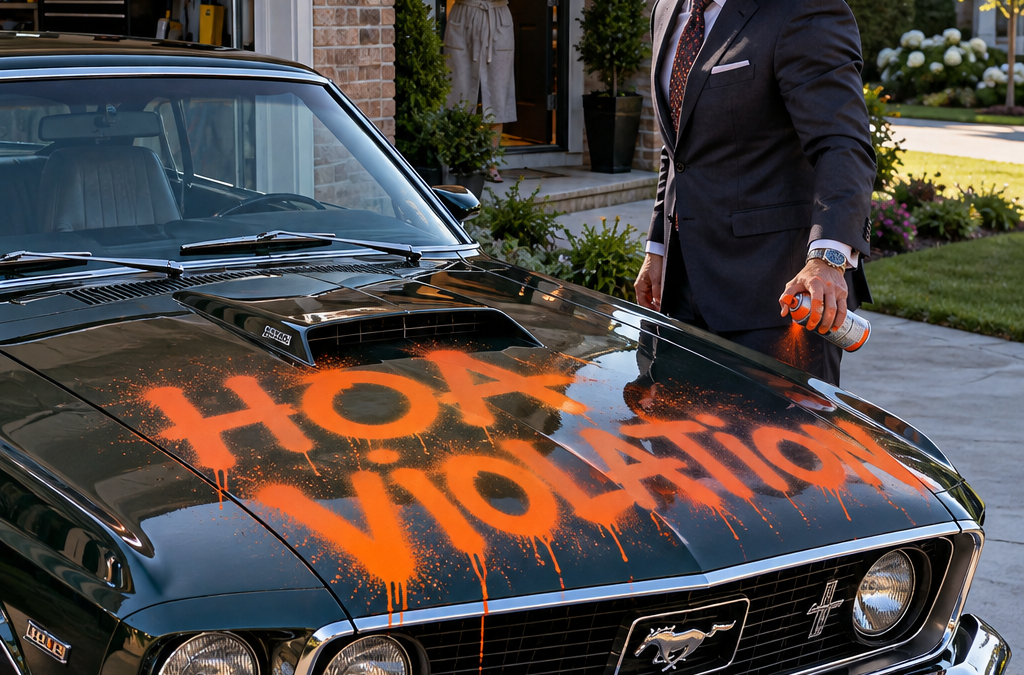
Three days later, I walked outside and found orange spray paint across my Mustang.
The words stretched over the hood in uneven letters.
HOA VIOLATION.
The can had dripped near the edge.
One streak ran toward the front grille.
Another had caught the curve where the hood met the fender.
For several seconds, my mind separated from my body. I saw the paint. I understood it was real. But I could not attach that reality to movement.
Then my hand started shaking.
Not from rage.
From something colder.
Clarity.
I had installed a Ring doorbell years earlier after a package theft. It covered the driveway well enough to see the Mustang.
I went inside, opened the app, and pulled up the footage.
6:47 a.m.
The street was still gray.
Sandra Puit walked into frame wearing a pale cardigan, black pants, and white sneakers. She stopped near the Mustang, looked once toward the street, then shook a spray-paint can.
The sound on the recording was faint but clear.
Rattle. Rattle. Rattle.
Then she leaned over the hood and sprayed.
I watched her write the words.
Slowly.
Deliberately.
Like she was marking territory.
When she finished, she stepped back, looked at the car, and took a photo with her phone.
Then she walked away.
I watched the clip three times without moving.
On the fourth time, I saved it.
Then I called Marcus Webb.
Marcus was an HOA attorney who had already sued two boards in our county and won both times. I had found his name the night before while researching homeowner rights.
His receptionist answered first.
“Webb Property Law.”
“I need to speak with Mr. Webb. It’s urgent.”
“What’s the issue?”
“My HOA president personally spray painted my classic car on camera.”
Silence.
Then, “Please hold.”
Marcus came on the line thirty seconds later.
“This is Marcus Webb.”
“My name is Kent Hargrove. My HOA president is trying to fine me over a 1969 Mustang. This morning she spray painted HOA violation across the hood.”
A pause.
“On camera?”
“Yes.”
“How much is the car worth?”
“About sixty-three thousand.”
Another pause.
Then he said, “Mr. Hargrove, this isn’t a case. This is a gift.”
I met him that afternoon.
His office was small, cluttered, and packed with file boxes. Marcus himself was in his forties, bald, sharp-eyed, with sleeves rolled to his elbows and a tie loosened like he had been fighting paperwork all day.
I showed him everything.
The notices.
The bylaws.
The payment receipt.
The denied financial disclosure request.
Dave’s concern about the private account.
The Ring footage.
Marcus watched the video once.
Then again.
Then he leaned back in his chair and smiled slightly.
“People usually make us work harder than this.”
“She’ll say it was official HOA action.”
“She can say the moon owes her late fees. That doesn’t make it law.”
Three days later, we filed.
Criminal vandalism.
Civil destruction of property.
Harassment.
Breach of fiduciary duty.
Improper enforcement.
Denial of financial inspection rights.
The complaint ran forty-one pages.
Sandra’s response arrived before her lawyer’s did.
Another fine.
Five hundred dollars.
Parking a Damaged Vehicle in Community View.
The paint she had sprayed onto my car had become my violation.
The audacity was almost artistic.
Marcus laughed when I forwarded it to him.
“Please tell me you’re joking.”
“I wish.”
“She fined you for the damage she caused?”
“Correct.”
“Excellent.”
“Excellent?”
“Kent, judges are human. They understand cruelty when it becomes this obvious.”
The first twist landed two weeks later.
Marcus subpoenaed HOA financial records through county court.
What came back was not sloppy bookkeeping.
It was systematic theft.
Sandra had routed fines into Puit Property Management LLC, a company registered seven months before she ran for HOA president.
Seven months.
Not seven years.
Not some old family business that happened to overlap with the HOA.
A fresh entity created before she took power and then used as the landing pad for homeowner penalties.
The timeline was not a coincidence.
Over eighteen months, thirty-four thousand dollars had been collected from neighbors and routed into that company through “processing,” “inspection,” and “compliance management” fees.
Thirty-four thousand dollars from people who had paid because fighting felt too exhausting.
Dave’s beige shutters.
Margaret Chin’s porch planters.
A family on the corner fined for basketball equipment.
A widow cited for leaving trash bins visible after a storm blew her gate open.
Sandra had built her entire scheme on other people’s fatigue.
Marcus filed an emergency motion to freeze HOA-controlled accounts connected to enforcement payments.
The judge granted it in forty-eight hours.
Sandra still showed up to the next board meeting like nothing had happened.
That meeting was the first time I spoke publicly.
The clubhouse was packed, mostly because people had heard rumors but did not yet know what was real. Sandra sat at the front table in a navy blazer, her expression polished flat.
I walked in with printed financials, a still image from the Ring footage, copies of the denied disclosure request, and the calm of a man who had already crossed the line between fear and purpose.
Sandra watched me approach the front.
“This meeting has an agenda, Mr. Hargrove.”
“So does this.”
I turned to the room.
“My name is Kent Hargrove. Most of you know my Mustang. Sandra Puit fined me for it, then spray painted it herself at 6:47 in the morning.”
A murmur moved through the room.
Sandra’s mouth tightened.
“That is a gross mischaracterization.”
I held up the still image.
“This is from my camera.”
Dave stood near the back.
“Let him talk.”
Sandra glared at him.
I placed the financial summary on the table.
“Sandra, you have one opportunity to resign before the criminal referral goes to the DA.”
The room went so quiet I could hear the air conditioner humming overhead.
Sandra laughed.
It was a small, sharp laugh meant to remind everyone she still believed herself above the moment.
“You’re bluffing, Kent.”
She straightened her blazer.
“I have the full confidence of this board.”
That was when Margaret Chin stood.
Margaret was seventy-one and had lived on Willamir Circle for thirty years. She never raised her voice at meetings. Never stirred drama. Never spoke unless she had something worth saying.
She stood from the back row, holding a folder against her chest.
“I resign effective tonight,” she said.
Sandra turned.
“Margaret.”
“And I’ll testify.”
The room shifted.
Sandra looked toward the other board members.
One man stood.
Then another.
“I resign too,” the first said.
“I’ll cooperate with the investigation,” said the second.
Sandra’s composure did not crumble.
It flickered.
Just once.
Like a signal losing its feed.
Then it came back, but not fully.
“You all have no idea what you’re doing,” she said.
Margaret looked at her calmly.
“No, Sandra. We finally do.”
The trial began six weeks later.
By then, the civil case and criminal investigation were feeding each other, though Marcus reminded me often that patience mattered. Sandra had hired an attorney who tried to make everything sound like a misunderstanding between a strict HOA president and a difficult resident.
That worked until Marcus played the Ring footage.
The courtroom watched Sandra Puit walk up my driveway at 6:47 a.m., shake a spray can, and tag my father’s car in the half dark.
No commentary was needed.
No dramatic narration.
Just video.
Orange paint leaving the can.
Her hand moving across the hood.
Her phone coming out for a photo afterward.
Sandra sat very still.
Her attorney argued she had acted in her official capacity to document a violation.
Marcus stood slowly.
“Your Honor, may I ask one clarifying question?”
The judge looked tired already.
“Proceed.”
Marcus turned toward Sandra’s attorney.
“Does the HOA bylaws authorize the president to personally vandalize private property?”
Silence.
“Because I have read all ninety-four pages,” Marcus continued, “and I appear to have missed the spray-paint clause.”
Someone in the back row coughed to hide a laugh.
The judge did not smile, but his pen stopped moving for just a second.
The second twist came from Lewis Pharaoh.
Lewis was a classic car appraiser and restoration expert. He had the slow, careful speech of a man who spent more time with rare vehicles than with impatient people.
Sandra’s team argued the damage was cosmetic.
They claimed the paint could be removed and the hood refinished for about eight thousand dollars.
Lewis disagreed.
He explained that the spray paint had chemically bonded with the original 1969 lacquer and contaminated the finish beyond ordinary correction. Because of the car’s restoration quality and the way the hood tied into surrounding panels, a full panel replacement and restoration process was required.
Not optional.
Required.
“Estimated restoration cost?” Marcus asked.
Lewis adjusted his glasses.
“Forty-seven thousand two hundred dollars.”
Every juror wrote it down.
I watched them.
One woman’s eyebrows lifted.
A man in the front row glanced from Lewis to Sandra.
Sandra stared at the table.
When she took the stand on day three, she looked composed at first.
She spoke about community standards.
Board responsibility.
Aesthetic preservation.
Her duty to prevent “visual decline.”
She described my Mustang as disruptive, nonconforming, and repeatedly unremedied.
Then Marcus asked about Puit Property Management LLC.
Her composure cracked like old plaster.
“That account was administrative overhead,” she said.
Marcus picked up a bank statement.
“Including the four thousand eight hundred dollars at the Westin Savannah in March?”
Sandra blinked.
“I don’t recall that transaction.”
Marcus slid the statement closer.
“The overhead had a very nice ocean view.”
This time, nobody laughed.
The courtroom was too still for laughter.
Because by then everyone understood what he was showing.
The fines were not about standards.
They were revenue.
They were pressure.
They were Sandra’s private business model hiding inside HOA language.
The jury deliberated for under four hours.
Judgment for Kent Hargrove.
Forty-seven thousand two hundred dollars for restoration.
Twenty-two thousand five hundred dollars in legal fees.
Fifteen thousand dollars in punitive damages.
Additional findings supporting referral to the county district attorney for criminal review.
Sandra sat motionless while the judge read the ruling.
Not angry.
Not crying.
Just still.
The way people sit when reality finally reaches them after months of refusal.
Three weeks later, the third twist arrived in a DA letter.
I was formally named as a victim in a criminal fraud case that did not involve only our HOA.
Sandra had run similar schemes through two other associations in the county.
Different neighborhoods.
Different residents.
Same pattern.
Vague standards.
Invented violations.
Fine routing.
Private management entity.
People too tired or afraid to fight.
Dave called that night.
“She did it to three neighborhoods?”
“Looks that way.”
He went quiet.
Then he said, “Okay. But seriously, was the Westin at least nice?”
I laughed for the first time in weeks.
The restoration took eleven weeks.
Lewis Pharaoh supervised it personally.
I visited twice, but mostly I stayed away because seeing the Mustang disassembled hurt more than I expected.
They had to treat the hood, replace affected materials, match the finish, correct surrounding panel impact, and bring the surface back without compromising what Dad and I had built.
When the shop finally called, I left work early.
The Mustang sat under bright shop lights, deep blue paint glowing like water at dusk.
No orange.
No scar.
No trace of Sandra’s hand.
I walked around it once.
Then again.
Lewis stood beside me quietly.
“You did right by the car,” he said.
I nodded, but my throat was too tight to answer.
I opened the driver’s door and sat behind the wheel.
The seat felt exactly the same.
The steering wheel, the dash, the faint smell of leather and old metal and something I can only describe as memory.
I put my hand on the hood through the open window frame, leaned forward, and tapped twice.
Tap tap.
I thought about my dad.
Afternoons in the garage.
Arguments over carburetors.
His hands black with grease.
His laugh when an engine finally turned over.
The way he said rough meant survived.
The car had survived.
So had I.
Sandra Puit eventually pleaded guilty.
Two counts of fiduciary fraud.
One count of criminal mischief.
Probation.
A fifty-thousand-dollar fine.
Restitution.
A lifetime ban from serving on any HOA board in the state.
That last part mattered to me almost as much as the money.
Not because I needed revenge.
Because people like Sandra do not need access to small positions of power. They turn them into kingdoms. They turn neighbors into subjects. They turn fatigue into income.
The car is back in my driveway now.
Exactly where it was before.
Every morning, I walk past it on the way to get the paper.
Sometimes I stop and look at it longer than necessary.
Not because it is perfect, though it is close.
Because I know what it made it through.
Nobody sends notices anymore.
Nobody measures Dave’s grass.
Nobody photographs mailboxes at sunrise.
Nobody argues about sandstone versus desert sand unless they are making fun of what we all survived.
The warden is gone.
Willamir Circle feels like a neighborhood again.
The entrance flowers are a little uneven.
Margaret’s porch planters are back.
Dave’s shutters are whatever shade of beige he wants them to be.
And my Mustang sits in my driveway, registered, restored, and completely visible from the street.
Sometimes, when the late afternoon sun hits the hood just right, I can almost see my father standing beside it.
Arms folded.
Grease on his shirt.
Eyes narrowed, inspecting the finish.
Then I imagine him giving the hood those two little taps.
Tap tap.
Not because nothing bad happened.
Because something good made it through anyway.
𝗧𝗛𝗘 𝗘𝗡𝗗
The HOA President Called My 1969 Mustang an Eyesore Before Her Own Spray Can Became the Evidence Against Her
The orange paint across my hood said HOA VIOLATION, but the camera above my porch told a much clearer story. I had spent six years living quietly on Willamir Circle, until Sandra Puit decided my father’s car was a problem she could punish.
The morning I found my 1969 Mustang vandalized in my driveway, I did not scream.
I did not throw my coffee mug.
I did not pound on anyone’s door or storm down the sidewalk looking for answers.
I simply stood there in the pale morning light, coffee going cold in my hand, staring at two crooked words sprayed across the hood of the car my father and I had spent eleven years restoring together.
HOA VIOLATION.
Orange paint.
Cheap, bright, ugly orange paint.
Across original 1969 lacquer.
Across a hood my father had polished with his own hands the last summer he was strong enough to stand in the garage with me.
For a while, I could not even breathe correctly.
My name is Kent Hargrove, and for six years, 14 Willamir Circle had been the quietest place I had ever lived.
That was the reason I bought the house.
Not because it was big.
It was not.
Not because it was fancy.
It was a modest brick ranch with a two-car garage, a wide driveway, and enough shade from the old maple trees to make July almost bearable.
I bought it because it felt calm.
After twenty years working industrial maintenance, calm meant something to me. I had spent enough nights repairing failed machines under bad lighting while supervisors shouted about production numbers. I wanted a house where the loudest sound on a Saturday morning was a lawn mower three yards over and maybe Dave laughing too hard at his own grill jokes.
For six years, that was exactly what Willamir Circle gave me.
People waved.
Kids rode bikes.
Neighbors borrowed ladders and returned them mostly clean.
Nobody measured anyone’s grass.
Nobody cared if a trash can stayed out an extra hour.
And nobody had ever complained about the Mustang.
That car was not abandoned. It was not rusting. It was not sitting on blocks in the weeds.
It was a 1969 Mustang fastback, fully restored, registered, insured, and running better than half the new cars parked in that neighborhood.
It was worth about sixty-three thousand dollars on paper.
To me, it was worth much more than that.
My father bought the shell when I was twenty-six.
It had no engine, no interior worth saving, and enough rust to make a body shop owner laugh out loud.
Dad loved it instantly.
“She’s rough,” I told him.
He ran one hand along the roofline and grinned.
“Rough means she survived.”
That was how the project started.
One rusted fastback.
Two stubborn men.
Eleven years of weekends, arguments, busted knuckles, parts catalogs, junkyard trips, late-night calls, and coffee so strong it could probably remove paint by itself.
We rebuilt it one section at a time.
Frame repairs first.
Then suspension.
Then the engine.
Then wiring.
Then interior.
Then paint.
Dad cared about the details nobody else saw. He would spend forty minutes adjusting a panel gap most people would never notice. If a trim piece sat wrong by the width of a fingernail, he would tap the hood twice, step back, and say, “Again.”
That hood tap became his signature.
When something finally fit correctly, tap tap.
When the engine turned over clean after months of fighting us, tap tap.
When we lowered the hood after the final polish, tap tap.
He died nine months later.
So when Sandra Puit decided the Mustang was an “aesthetic disruption,” she was not just insulting a car.
She was putting her hands on one of the last things my father and I had finished together.
Sandra became HOA president in January.
Before her, the board existed mostly to pay the landscapers, keep the entrance sign lit, and argue about pool furniture once every few years.
Then Sandra arrived with clipboards, inspection schedules, and the kind of smile that told you she was already disappointed in you.
She was in her late fifties, tall, narrow-faced, with silver-blond hair cut short and sprayed into place. She wore pressed blazers even on humid mornings and had a habit of tilting her head slightly before she corrected people, like she was generously lowering herself to explain civilization.
The first time I really noticed her, she was standing in Dave’s front yard with an actual ruler.
Dave lived two houses down. Retired contractor. Good neighbor. Terrible singer. His lawn looked fine to me, but Sandra had one knee bent, ruler in the grass, phone camera ready.
I walked over with my coffee.
“Morning,” I said.
Sandra looked up.
“Mr. Hargrove.”
We had never been properly introduced, but apparently she already knew my name.
Dave stood on his porch, arms crossed.
“You believe this?” he asked me.
“What’s happening?”
Sandra stood and brushed invisible grass off her slacks.
“Routine compliance inspection.”
“With a ruler?” I asked.
“Standards require measurement.”
Dave snorted.
“The warden’s checking my yard for parole violations.”
Sandra’s eyes narrowed.
“That nickname is inappropriate.”
“So is measuring grass like evidence at a crime scene,” Dave said.
I laughed.
Sandra did not.
That was the beginning.
Neighbors called her the warden behind her back. At first, it was a joke.
Then it became less funny.
Sandra photographed mailboxes at sunrise. She left notices under windshield wipers. She sent emails with subject lines like COMMUNITY INTEGRITY ENFORCEMENT. She began referring to homeowners as “noncompliant parties,” which was a pretty good way to make a cul-de-sac sound like a prison block.
Still, for a while, I kept my head down.
I had work.
I had the house.
I had the Mustang.
I did not need a fight with a woman who seemed to enjoy manufacturing them.
Then one evening in February, I came home and found a notice tucked under the Mustang’s windshield wiper.
Vehicle Aesthetic Nonconformity.
I read it twice in the driveway.
The notice claimed my Mustang was an eyesore inconsistent with community aesthetic standards.
I looked from the paper to the car.
Fresh wax.
Clean tires.
No rust.
No damage.
A restored classic sitting in my own driveway.
I laughed because the alternative was taking it seriously, and I did not want to give Sandra that much power.
My first mistake.
Two weeks later, a certified letter arrived.
This one said the Mustang qualified as unauthorized vehicle storage and had to be removed from visible driveway placement within fourteen days or daily fines would begin.
Unauthorized vehicle storage.
My own car.
In my own driveway.
Registered with the DMV, insured, tagged, and running perfectly.
I called Sandra.
She answered on the first ring.
Not the third.
Not after voicemail.
The first.
As if she had been sitting there waiting for me to finally understand the game had begun.
“Briarwood Estates HOA, Sandra Puit speaking.”
“This is Kent Hargrove.”
“Yes, Mr. Hargrove.”
“I received a letter about my Mustang.”
“I assumed you would call.”
“That car is not stored. It’s driven.”
“It remains visible from the street.”
“That’s because it’s in my driveway.”
“Correct.”
“Where exactly do you expect me to put it?”
“That is not really our concern, is it?”
Her voice was sweet as antifreeze.
Clean.
Practiced.
I heard the shape of previous conversations inside that sentence.
She had said it before.
Maybe not about a Mustang.
Maybe about shutters, fences, mailbox posts, flower beds.
But she had said it.
I kept my voice even.
“The bylaws don’t prohibit registered vehicles in driveways.”
“The board has discretion over aesthetic disruptions.”
“Show me the rule.”
“You received the notice.”
“That’s not a rule.”
A pause.
Then she said, “Fourteen days, Mr. Hargrove.”
The line went dead.
I paid the first fine.
One hundred fifty dollars.
I hated myself for doing it, but I told myself it was a way to buy time. I had just come off a long shift. I was tired. My blood pressure was probably doing things my doctor would not appreciate. So I paid, made a note, and decided I would read the governing documents before responding further.
That night, I sat at my kitchen table with all ninety-four pages of HOA bylaws, three cups of coffee, a highlighter, and the kind of stubbornness my father used to call “family fuel.”
By 2:00 a.m., I had my answer.
There was no rule against classic cars in driveways.
No prohibition against restored vehicles.
No authority for Sandra to declare a running, registered car “storage.”
What the bylaws did contain were vague phrases scattered like land mines.
Visual harmony.
Neighborhood character.
Community standards.
Terms that meant very little on their own and everything in the hands of someone who wanted control.
I highlighted every clause she might try to weaponize.
Then I created a folder on my laptop.
Sandra Puit Evidence.
By the end, it would contain 214 files.
The second fine arrived before the original fourteen days even expired.
Three hundred dollars.
Failure to Remediate Aesthetic Disruption.
I stood at the mailbox reading the words while Dave walked over holding a beer, even though it was barely five o’clock.
“She hit you again?” he asked.
“Three hundred this time.”
Dave whistled.
“For the car?”
“For failure to remediate aesthetic disruption.”
He laughed until he saw my face.
Then he leaned closer.
“Listen, Kent. I need to tell you something.”
“What?”
“She fined me two hundred dollars for my shutters last month.”
“Your shutters?”
“Wrong shade of beige.”
I stared at him.
He nodded solemnly.
“Sandstone isn’t desert sand.”
For a second, I laughed because it sounded impossible not to.
Then Dave lowered his voice.
“I paid it. Didn’t want trouble. But when I checked the receipt, the payment routing looked weird.”
“Weird how?”
“It didn’t go to the regular HOA fund.”
I stopped laughing.
Dave glanced toward the street.
“She’s routing fines through a private account.”
I looked toward the entrance of the cul-de-sac, where Sandra’s house sat behind trimmed hedges and a front porch so symmetrical it looked hostile.
“You’re sure?”
“No. Not yet. But something’s off.”
The next morning, I filed a formal financial disclosure request.
Under the bylaws, homeowners had the right to inspect association financial records, including income from fines and fees.
Sandra denied the request within the hour.
In writing.
Her first real legal mistake.
The email was short.
Request denied. Enforcement-related financial materials are internal board records and not subject to homeowner review.
I read it three times.
Then saved it to the folder.
I did not respond.
I did not call.
I did not warn her that the bylaws said the opposite.
I simply documented it.
My father used to say, “Never interrupt a person who is building your case for you.”
Three days later, I walked outside and found orange spray paint across my Mustang.
The words stretched over the hood in uneven letters.
HOA VIOLATION.
The can had dripped near the edge.
One streak ran toward the front grille.
Another had caught the curve where the hood met the fender.
For several seconds, my mind separated from my body. I saw the paint. I understood it was real. But I could not attach that reality to movement.
Then my hand started shaking.
Not from rage.
From something colder.
Clarity.
I had installed a Ring doorbell years earlier after a package theft. It covered the driveway well enough to see the Mustang.
I went inside, opened the app, and pulled up the footage.
6:47 a.m.
The street was still gray.
Sandra Puit walked into frame wearing a pale cardigan, black pants, and white sneakers. She stopped near the Mustang, looked once toward the street, then shook a spray-paint can.
The sound on the recording was faint but clear.
Rattle. Rattle. Rattle.
Then she leaned over the hood and sprayed.
I watched her write the words.
Slowly.
Deliberately.
Like she was marking territory.
When she finished, she stepped back, looked at the car, and took a photo with her phone.
Then she walked away.
I watched the clip three times without moving.
On the fourth time, I saved it.
Then I called Marcus Webb.
Marcus was an HOA attorney who had already sued two boards in our county and won both times. I had found his name the night before while researching homeowner rights.
His receptionist answered first.
“Webb Property Law.”
“I need to speak with Mr. Webb. It’s urgent.”
“What’s the issue?”
“My HOA president personally spray painted my classic car on camera.”
Silence.
Then, “Please hold.”
Marcus came on the line thirty seconds later.
“This is Marcus Webb.”
“My name is Kent Hargrove. My HOA president is trying to fine me over a 1969 Mustang. This morning she spray painted HOA violation across the hood.”
A pause.
“On camera?”
“Yes.”
“How much is the car worth?”
“About sixty-three thousand.”
Another pause.
Then he said, “Mr. Hargrove, this isn’t a case. This is a gift.”
I met him that afternoon.
His office was small, cluttered, and packed with file boxes. Marcus himself was in his forties, bald, sharp-eyed, with sleeves rolled to his elbows and a tie loosened like he had been fighting paperwork all day.
I showed him everything.
The notices.
The bylaws.
The payment receipt.
The denied financial disclosure request.
Dave’s concern about the private account.
The Ring footage.
Marcus watched the video once.
Then again.
Then he leaned back in his chair and smiled slightly.
“People usually make us work harder than this.”
“She’ll say it was official HOA action.”
“She can say the moon owes her late fees. That doesn’t make it law.”
Three days later, we filed.
Criminal vandalism.
Civil destruction of property.
Harassment.
Breach of fiduciary duty.
Improper enforcement.
Denial of financial inspection rights.
The complaint ran forty-one pages.
Sandra’s response arrived before her lawyer’s did.
Another fine.
Five hundred dollars.
Parking a Damaged Vehicle in Community View.
The paint she had sprayed onto my car had become my violation.
The audacity was almost artistic.
Marcus laughed when I forwarded it to him.
“Please tell me you’re joking.”
“I wish.”
“She fined you for the damage she caused?”
“Correct.”
“Excellent.”
“Excellent?”
“Kent, judges are human. They understand cruelty when it becomes this obvious.”
The first twist landed two weeks later.
Marcus subpoenaed HOA financial records through county court.
What came back was not sloppy bookkeeping.
It was systematic theft.
Sandra had routed fines into Puit Property Management LLC, a company registered seven months before she ran for HOA president.
Seven months.
Not seven years.
Not some old family business that happened to overlap with the HOA.
A fresh entity created before she took power and then used as the landing pad for homeowner penalties.
The timeline was not a coincidence.
Over eighteen months, thirty-four thousand dollars had been collected from neighbors and routed into that company through “processing,” “inspection,” and “compliance management” fees.
Thirty-four thousand dollars from people who had paid because fighting felt too exhausting.
Dave’s beige shutters.
Margaret Chin’s porch planters.
A family on the corner fined for basketball equipment.
A widow cited for leaving trash bins visible after a storm blew her gate open.
Sandra had built her entire scheme on other people’s fatigue.
Marcus filed an emergency motion to freeze HOA-controlled accounts connected to enforcement payments.
The judge granted it in forty-eight hours.
Sandra still showed up to the next board meeting like nothing had happened.
That meeting was the first time I spoke publicly.
The clubhouse was packed, mostly because people had heard rumors but did not yet know what was real. Sandra sat at the front table in a navy blazer, her expression polished flat.
I walked in with printed financials, a still image from the Ring footage, copies of the denied disclosure request, and the calm of a man who had already crossed the line between fear and purpose.
Sandra watched me approach the front.
“This meeting has an agenda, Mr. Hargrove.”
“So does this.”
I turned to the room.
“My name is Kent Hargrove. Most of you know my Mustang. Sandra Puit fined me for it, then spray painted it herself at 6:47 in the morning.”
A murmur moved through the room.
Sandra’s mouth tightened.
“That is a gross mischaracterization.”
I held up the still image.
“This is from my camera.”
Dave stood near the back.
“Let him talk.”
Sandra glared at him.
I placed the financial summary on the table.
“Sandra, you have one opportunity to resign before the criminal referral goes to the DA.”
The room went so quiet I could hear the air conditioner humming overhead.
Sandra laughed.
It was a small, sharp laugh meant to remind everyone she still believed herself above the moment.
“You’re bluffing, Kent.”
She straightened her blazer.
“I have the full confidence of this board.”
That was when Margaret Chin stood.
Margaret was seventy-one and had lived on Willamir Circle for thirty years. She never raised her voice at meetings. Never stirred drama. Never spoke unless she had something worth saying.
She stood from the back row, holding a folder against her chest.
“I resign effective tonight,” she said.
Sandra turned.
“Margaret.”
“And I’ll testify.”
The room shifted.
Sandra looked toward the other board members.
One man stood.
Then another.
“I resign too,” the first said.
“I’ll cooperate with the investigation,” said the second.
Sandra’s composure did not crumble.
It flickered.
Just once.
Like a signal losing its feed.
Then it came back, but not fully.
“You all have no idea what you’re doing,” she said.
Margaret looked at her calmly.
“No, Sandra. We finally do.”
The trial began six weeks later.
By then, the civil case and criminal investigation were feeding each other, though Marcus reminded me often that patience mattered. Sandra had hired an attorney who tried to make everything sound like a misunderstanding between a strict HOA president and a difficult resident.
That worked until Marcus played the Ring footage.
The courtroom watched Sandra Puit walk up my driveway at 6:47 a.m., shake a spray can, and tag my father’s car in the half dark.
No commentary was needed.
No dramatic narration.
Just video.
Orange paint leaving the can.
Her hand moving across the hood.
Her phone coming out for a photo afterward.
Sandra sat very still.
Her attorney argued she had acted in her official capacity to document a violation.
Marcus stood slowly.
“Your Honor, may I ask one clarifying question?”
The judge looked tired already.
“Proceed.”
Marcus turned toward Sandra’s attorney.
“Does the HOA bylaws authorize the president to personally vandalize private property?”
Silence.
“Because I have read all ninety-four pages,” Marcus continued, “and I appear to have missed the spray-paint clause.”
Someone in the back row coughed to hide a laugh.
The judge did not smile, but his pen stopped moving for just a second.
The second twist came from Lewis Pharaoh.
Lewis was a classic car appraiser and restoration expert. He had the slow, careful speech of a man who spent more time with rare vehicles than with impatient people.
Sandra’s team argued the damage was cosmetic.
They claimed the paint could be removed and the hood refinished for about eight thousand dollars.
Lewis disagreed.
He explained that the spray paint had chemically bonded with the original 1969 lacquer and contaminated the finish beyond ordinary correction. Because of the car’s restoration quality and the way the hood tied into surrounding panels, a full panel replacement and restoration process was required.
Not optional.
Required.
“Estimated restoration cost?” Marcus asked.
Lewis adjusted his glasses.
“Forty-seven thousand two hundred dollars.”
Every juror wrote it down.
I watched them.
One woman’s eyebrows lifted.
A man in the front row glanced from Lewis to Sandra.
Sandra stared at the table.
When she took the stand on day three, she looked composed at first.
She spoke about community standards.
Board responsibility.
Aesthetic preservation.
Her duty to prevent “visual decline.”
She described my Mustang as disruptive, nonconforming, and repeatedly unremedied.
Then Marcus asked about Puit Property Management LLC.
Her composure cracked like old plaster.
“That account was administrative overhead,” she said.
Marcus picked up a bank statement.
“Including the four thousand eight hundred dollars at the Westin Savannah in March?”
Sandra blinked.
“I don’t recall that transaction.”
Marcus slid the statement closer.
“The overhead had a very nice ocean view.”
This time, nobody laughed.
The courtroom was too still for laughter.
Because by then everyone understood what he was showing.
The fines were not about standards.
They were revenue.
They were pressure.
They were Sandra’s private business model hiding inside HOA language.
The jury deliberated for under four hours.
Judgment for Kent Hargrove.
Forty-seven thousand two hundred dollars for restoration.
Twenty-two thousand five hundred dollars in legal fees.
Fifteen thousand dollars in punitive damages.
Additional findings supporting referral to the county district attorney for criminal review.
Sandra sat motionless while the judge read the ruling.
Not angry.
Not crying.
Just still.
The way people sit when reality finally reaches them after months of refusal.
Three weeks later, the third twist arrived in a DA letter.
I was formally named as a victim in a criminal fraud case that did not involve only our HOA.
Sandra had run similar schemes through two other associations in the county.
Different neighborhoods.
Different residents.
Same pattern.
Vague standards.
Invented violations.
Fine routing.
Private management entity.
People too tired or afraid to fight.
Dave called that night.
“She did it to three neighborhoods?”
“Looks that way.”
He went quiet.
Then he said, “Okay. But seriously, was the Westin at least nice?”
I laughed for the first time in weeks.
The restoration took eleven weeks.
Lewis Pharaoh supervised it personally.
I visited twice, but mostly I stayed away because seeing the Mustang disassembled hurt more than I expected.
They had to treat the hood, replace affected materials, match the finish, correct surrounding panel impact, and bring the surface back without compromising what Dad and I had built.
When the shop finally called, I left work early.
The Mustang sat under bright shop lights, deep blue paint glowing like water at dusk.
No orange.
No scar.
No trace of Sandra’s hand.
I walked around it once.
Then again.
Lewis stood beside me quietly.
“You did right by the car,” he said.
I nodded, but my throat was too tight to answer.
I opened the driver’s door and sat behind the wheel.
The seat felt exactly the same.
The steering wheel, the dash, the faint smell of leather and old metal and something I can only describe as memory.
I put my hand on the hood through the open window frame, leaned forward, and tapped twice.
Tap tap.
I thought about my dad.
Afternoons in the garage.
Arguments over carburetors.
His hands black with grease.
His laugh when an engine finally turned over.
The way he said rough meant survived.
The car had survived.
So had I.
Sandra Puit eventually pleaded guilty.
Two counts of fiduciary fraud.
One count of criminal mischief.
Probation.
A fifty-thousand-dollar fine.
Restitution.
A lifetime ban from serving on any HOA board in the state.
That last part mattered to me almost as much as the money.
Not because I needed revenge.
Because people like Sandra do not need access to small positions of power. They turn them into kingdoms. They turn neighbors into subjects. They turn fatigue into income.
The car is back in my driveway now.
Exactly where it was before.
Every morning, I walk past it on the way to get the paper.
Sometimes I stop and look at it longer than necessary.
Not because it is perfect, though it is close.
Because I know what it made it through.
Nobody sends notices anymore.
Nobody measures Dave’s grass.
Nobody photographs mailboxes at sunrise.
Nobody argues about sandstone versus desert sand unless they are making fun of what we all survived.
The warden is gone.
Willamir Circle feels like a neighborhood again.
The entrance flowers are a little uneven.
Margaret’s porch planters are back.
Dave’s shutters are whatever shade of beige he wants them to be.
And my Mustang sits in my driveway, registered, restored, and completely visible from the street.
Sometimes, when the late afternoon sun hits the hood just right, I can almost see my father standing beside it.
Arms folded.
Grease on his shirt.
Eyes narrowed, inspecting the finish.
Then I imagine him giving the hood those two little taps.
Tap tap.
Not because nothing bad happened.
Because something good made it through anyway.








