𝗙𝗨𝗟𝗟 𝗦𝗧𝗢𝗥𝗬 The HOA President Called Me a Fraud at the Mountain Gate and Ordered Security to Handcuff Me While a Tow Truck Waited for My Pickup
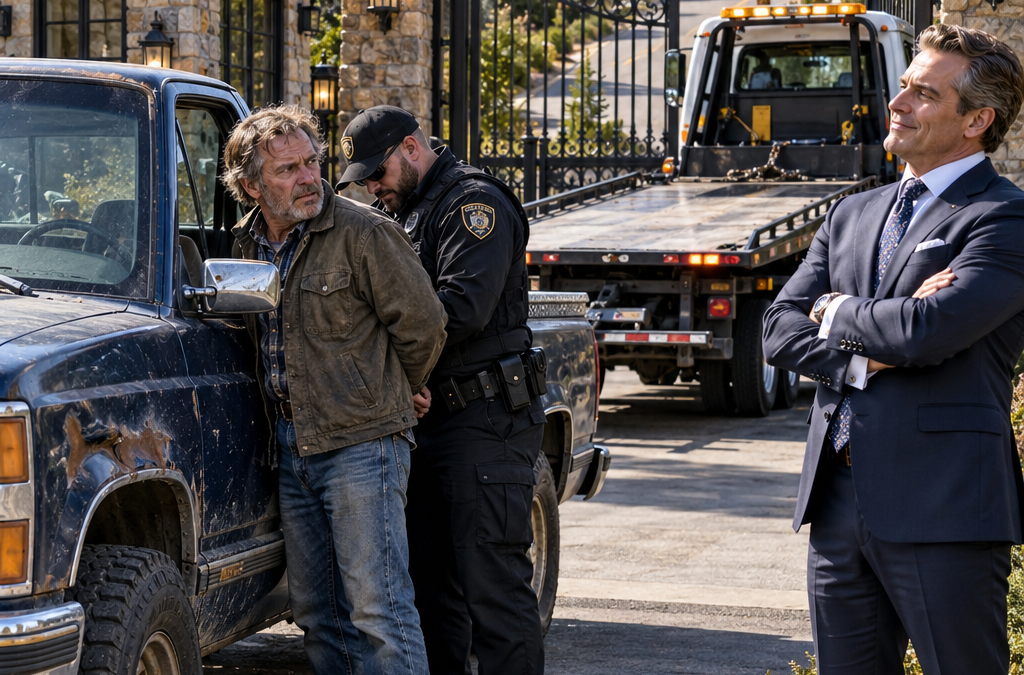
𝗙𝗨𝗟𝗟 𝗦𝗧𝗢𝗥𝗬
The first confrontation happened on a clear Tuesday morning.
I was replacing a loose board on my porch when a black luxury SUV rolled slowly into my driveway.
The vehicle stopped beside my pickup.
Karen stepped out wearing a charcoal-gray jacket, cream-colored shirt, and sunglasses with gold frames.
He stood beside the SUV for several seconds, looking over my property as though evaluating a building he was considering purchasing.
Then he removed his sunglasses.
“Good morning,” he said.
“Morning.”
“Are you the homeowner?”
I looked down at the hammer in my hand.
“Last time I checked.”
He did not smile.
“I’m Hoa Karen, president of the Silver Crest Homeowners Association.”
“I know who you are.”
That seemed to surprise him.
He adjusted one cuff before continuing.
“We’ve received concerns about a vehicle parked on this property.”
I glanced toward the road.
“What vehicle?”
He pointed directly at my Chevrolet.
“That truck.”
I looked at it, then back at him.
“What about it?”
“It’s not consistent with the community’s appearance standards.”
I waited.
He seemed to expect me to react immediately.
When I didn’t, he continued.
“Silver Crest is a private residential community. Commercial vehicles are restricted, particularly those that negatively affect the neighborhood’s visual character.”
“That’s not a commercial vehicle.”
Karen’s expression hardened slightly.
“It certainly appears to be.”
“It’s my pickup.”
“I can see that.”
“Then what’s the problem?”
He slowly replaced his sunglasses in his jacket pocket.
“The problem is that residents are entitled to a certain standard of presentation.”
I put the hammer on the porch railing.
“Mr. Karen, this truck is registered in my name. I use it for personal transportation. There’s no commercial signage, no business equipment, and no business operation taking place here.”
He walked closer to the truck.
His shoes made small crunching sounds on the gravel.
He studied the scratches along the bed.
“Appearance matters,” he said.
“Not as much as facts.”
He turned.
“Excuse me?”
“You said commercial vehicles are restricted. Mine isn’t commercial.”
“That determination belongs to the association.”
“Based on what?”
“Based on our governing documents.”
“Then show me the provision.”
Karen stared at me.
For the first time, his pleasant expression disappeared completely.
“You have a rather confrontational manner.”
“I asked a question.”
“And I answered it.”
“No. You told me you have rules. I asked which rule I’m violating.”
He took a slow breath, looking toward the house as though trying to decide whether I was worth another minute of his attention.
“Most homeowners appreciate the effort we make to protect their investments.”
“I appreciate people respecting my property.”
“Then perhaps you should consider how your property affects everyone else.”
I stepped off the porch.
“That truck has been parked here for years. Nobody complained until you became president.”
His jaw tightened.
“Perhaps previous leadership was too permissive.”
“Or perhaps there wasn’t a problem.”
He gave me a thin smile.
“I suggest you resolve this before it becomes an enforcement matter.”
Then he returned to his SUV and drove away.
I watched his taillights disappear between the trees.
I should have understood something important that morning.
Karen hadn’t come to ask whether my truck violated a rule.
He had come to tell me that he had already decided it did.
And my refusal to accept that decision offended him more than the truck itself.
I went inside, found my registration, and placed it on the kitchen table.
I also pulled out my insurance card and the latest vehicle inspection paperwork.
The documents confirmed exactly what I had told him.
Personal ownership.
Personal registration.
No commercial classification.
I scanned the paperwork and sent a short email to the association’s administrative office.
I explained that the Chevrolet was my personal vehicle and asked that any complaint be evaluated against the actual vehicle restrictions in the governing documents.
I did not insult Karen.
I did not threaten legal action.
I even offered to answer reasonable questions about the truck.
For two days, I heard nothing.
Then, on Friday afternoon, I came home from buying groceries and found a bright yellow notice tucked beneath my windshield wiper.
I knew what it was before I touched it.
The paper displayed the Silver Crest HOA logo.
Underneath, in bold letters, were the words:
VEHICLE VIOLATION NOTICE.
I read it standing in the driveway.
The document alleged that I was maintaining a commercial-type vehicle in a residential area and ordered me to correct the violation.
It also warned that continued noncompliance could lead to enforcement measures, including removal of the offending vehicle.
I read the sentence twice.
Removal.
Not a fine.
Not another conversation.
They were threatening to take my truck off my own property.
I carried the notice inside and placed it beside the registration.
Then I called the association office.
A woman answered.
“Silver Crest administration.”
“This is the homeowner on Ridgeview Lane. I just received a violation notice concerning my pickup.”
“Yes, sir. I see the complaint.”
“I submitted proof that the truck is privately registered.”
“That information was received.”
“Then why did you issue a violation?”
There was a pause.
“The president reviewed the matter.”
“Did he review the registration?”
“I can’t speak to his specific review process.”
“Can you tell me what provision classifies my vehicle as commercial?”
Another pause.
“Mr. Karen has determined that the vehicle falls within the restricted category.”
“That’s not a provision.”
“Sir, I’m only responsible for recording the complaint.”
I heard the strain in her voice.
She sounded like somebody who had already been instructed what she was allowed to say.
I softened my tone.
“I’m not angry with you. I just need someone to show me the rule.”
“I understand.”
“Can you send me the relevant section?”
“I can forward your request.”
“Please do.”
After hanging up, I sat at the kitchen table and studied the notice.
The language bothered me.
It didn’t say the truck was registered commercially.
It said the truck had a commercial appearance.
Those were two different things.
Karen had quietly changed the accusation after I disproved the first one.
That was when I began documenting everything.
I photographed the notice on the windshield.
I saved my email and the office’s acknowledgment.
I wrote down the date and time of my conversation with Karen.
Then I opened a folder on my computer and labeled it VEHICLE DISPUTE.
I hoped the folder would remain small.
It did not.
Three days later, Karen returned.
This time, he wasn’t alone.
A white security SUV followed his vehicle into the driveway.
A uniformed guard stepped out.
He looked to be in his early thirties, broad-shouldered, with a serious face and the cautious posture of someone accustomed to dealing with difficult situations.
Karen approached my porch carrying a leather document folder.
The guard stood several feet behind him.
I opened the front door before they reached the steps.
“Mr. Karen.”
“Good afternoon. We need to discuss your continued noncompliance.”
“I’ve already requested the rule you’re claiming I violated.”
Karen smiled without warmth.
“You seem to believe that asking endless questions excuses you from following community regulations.”
“No. I believe regulations should be applied accurately.”
He opened his folder.
“I have a formal report indicating that you are refusing to cooperate with the association.”
“Who wrote the report?”
“I did.”
“Then you know that’s inaccurate.”
His smile disappeared.
“Be careful.”
The warning was quiet.
I looked at the security guard.
“Have you seen my registration?”
The guard glanced at Karen.
“No, sir.”
“Have you read the rule they’re accusing me of violating?”
“Sir, I’m here to accompany the president.”
“Then you should know I’ve already provided documentation proving this is a personal vehicle.”
Karen snapped his folder shut.
“You’re not going to interrogate my security personnel.”
“He’s standing on my property while you threaten to remove my truck. I think I’m entitled to ask what he knows.”
Karen stepped closer.
“You have mistaken my patience for weakness.”
I felt irritation rising in my chest.
But I kept my voice level.
“Show me the authority to tow a privately registered vehicle from my driveway.”
“The HOA has enforcement procedures.”
“Then show them to me.”
“You will receive whatever documentation is appropriate.”
“Before or after you take my truck?”
His eyes narrowed.
“Do not make this more difficult than necessary.”
“You’ve come to my house twice, issued a notice based on something that isn’t true, and brought security with you. I’m not the person making this difficult.”
The guard shifted his weight.
I noticed him looking at the truck.
There was no commercial equipment to inspect.
No lettering.
No trailer.
Nothing but an old pickup.
Karen turned toward the guard.
“Document the homeowner’s refusal to cooperate.”
The guard hesitated.
“Mr. Karen, he did say he submitted paperwork.”
Karen’s head snapped around.
“I’m not asking for your interpretation.”
The guard straightened.
“Yes, sir.”
“Document his refusal.”
I watched the young man’s face change.
Not because he believed Karen.
Because he understood what disagreeing with Karen might cost him.
I had seen that expression before.
People often imagine that abuse of authority begins with shouting.
Sometimes it begins when one person realizes that telling the truth could threaten his paycheck.
The guard removed a small notebook.
I held up my phone.
“For the record, I’m not refusing to cooperate. I’m requesting written proof of the alleged violation and the HOA’s legal authority to remove my personal vehicle.”
Karen stared at the phone.
“Are you recording me?”
“I’m recording this conversation.”
“Turn that off.”
“I’m standing on my property.”
He moved closer.
“You’re deliberately provoking a confrontation.”
“No. I’m preserving what you’re saying.”
For several seconds, neither of us spoke.
Then Karen looked toward the guard.
“Come on.”
As he walked away, he turned back once.
“The association has ways of handling difficult homeowners.”
I stood on the porch until both vehicles disappeared.
Only then did I realize how tightly I had been gripping my phone.
That evening, I sent another written response.
I attached the registration again.
I requested an immediate suspension of enforcement until the vehicle classification could be verified.
I also specifically objected to any attempt to tow the truck without lawful authority.
The next morning, the association replied with a short message.
The violation remained active.
Further action would be determined by the president.
I read those words while standing in my kitchen.
My coffee had gone cold.
For the first time, I felt something heavier than annoyance.
I felt the beginning of fear.
Not because I thought Karen was legally correct.
Because I was beginning to understand that being legally correct might not prevent him from doing something harmful.
He controlled the security staff.
He influenced the office.
He could authorize contractors, generate violation records, and create the appearance of official misconduct.
And every time I asked him to verify the facts, he treated the request as another act of defiance.
I considered calling an attorney that afternoon.
I even found the number of a local firm.
But I decided to make one final attempt to resolve the matter through the association’s regular process.
I sent the board a formal written request for review.
I included the registration, the violation notice, my previous correspondence, and photographs of the truck.
I asked for a hearing.
I asked that no towing be authorized while the dispute remained unresolved.
Then I went back to work on my garage door.
That was the last ordinary afternoon I had for some time.
The following morning, I left the house shortly after seven.
The sky was pale gray.
Low clouds hung between the mountain ridges, and the temperature had fallen enough to leave frost along the edges of the driveway.
I had an appointment in town.
It involved records connected to my federal commission, something I handled quietly and had never felt the need to discuss with my neighbors.
That commission was part of my professional life.
It was legitimate, formally issued, and recorded through the appropriate federal channels.
It was not a position that gave me authority over the homeowners association.
I had never suggested otherwise.
In fact, I deliberately avoided mentioning it in ordinary situations.
My neighbors knew me as the man with the old truck who repaired his own porch.
That was exactly how I preferred it.
As I drove toward the Silver Crest gate, I noticed two security vehicles parked beside the guardhouse.
That was unusual.
One normally remained near the entrance while the other patrolled the upper roads.
A guard stepped into the lane and raised his hand.
I slowed.
Then I recognized him.
It was the same young man who had accompanied Karen to my house.
I lowered the window.
“Morning.”
“Good morning, sir. I need you to pull into the inspection area.”
“Why?”
“There’s been a complaint.”
“What kind of complaint?”
He looked toward the guardhouse.
“I’m required to hold you here until the matter is reviewed.”
I glanced at the clock.
“I have an appointment.”
“I understand.”
“Then tell me what I’m being held for.”
He swallowed.
“It’s a security matter.”
A second guard approached the passenger side.
I looked between them.
“Is this about my truck?”
The first guard didn’t answer.
That silence told me enough.
I shifted into park and turned off the engine.
“All right. Who authorized this?”
Before he could respond, a black SUV emerged from behind the guardhouse.
Karen stepped out.
He was wearing a dark navy suit beneath an expensive wool overcoat. His shoes were polished, his hair immaculate, and his expression carried the satisfaction of a man arriving at a meeting he had already decided how to control.
He walked toward my window.
“Good morning.”
I looked at him.
“What’s going on?”
“We need to clear up some serious concerns.”
“About my truck?”
“About you.”
Something in his tone made the back of my neck tighten.
“What does that mean?”
Karen folded his hands.
“It means we have reason to question whether you’ve been honest about your status and authority.”
I stared at him.
“What authority?”
“Don’t play games with me.”
“I’m asking you a direct question.”
He turned toward the guards.
“This is exactly the behavior I described.”
The first guard kept his eyes on the pavement.
Karen continued.
“We’ve been dealing with this gentleman’s aggressive refusal to recognize HOA authority. Now we have reason to believe he has been presenting himself as someone with official standing.”
My hands remained on the steering wheel.
“That’s false.”
Karen leaned toward the window.
“Is it?”
“I have never claimed that my professional position gives me any authority over this association.”
“So you admit you’ve been claiming a professional position.”
“I didn’t say that.”
He smiled.
“Interesting.”
I felt my patience thinning.
“Mr. Karen, if somebody has made an accusation against me, tell me exactly what it is.”
He straightened.
“I believe you’ve been pretending to possess official authority you do not have.”
I looked at him for several seconds.
“Based on what?”
“Your conduct.”
“That’s not evidence.”
“Your repeated demands for documentation.”
“Those are ordinary requests from a homeowner.”
“Your suggestion that we don’t have authority over you.”
“I questioned your authority to tow my personal vehicle. I never claimed to be above the law.”
Karen looked at the guards.
“See how he changes his story?”
I felt my stomach tighten.
He wasn’t trying to understand anything.
He was manufacturing a pattern.
Every ordinary statement I made was being converted into evidence of something sinister.
I took a breath.
“Mr. Karen, you have no idea who you’re talking to.”
His expression brightened.
“There it is.”
“What?”
“Another implied threat.”
“It wasn’t a threat.”
“You’re suggesting you have some special status.”
“I’m telling you that accusing someone of fraud without checking the facts is a serious mistake.”
He raised his voice.
“Then prove it.”
I reached toward the inside pocket of my jacket.
Both guards shifted immediately.
“Keep your hands visible,” the younger guard said.
I stopped.
“My identification is in my jacket.”
Karen took a step backward.
“Do not let him reach for anything.”
I looked at the guard.
“I’m telling you exactly where the documents are.”
“Sir, step out of the vehicle.”
“Am I being arrested?”
“No, sir.”
“Then why am I being ordered out?”
“Please, just step out.”
I looked at his face.
He seemed anxious.
But the second guard had already moved closer to the door.
I understood that arguing from inside the vehicle was becoming dangerous.
So I opened the door slowly.
I stepped onto the cold pavement.
The younger guard stood in front of me.
Karen remained behind him.
“Now,” Karen said, “perhaps we can have an honest conversation.”
I kept my hands away from my pockets.
“I want you to contact the appropriate office and verify my credentials before this goes any further.”
Karen laughed.
“Of course you do.”
“There’s a federal commission document in my jacket. You can verify it.”
His smile widened.
“A federal commission?”
“Yes.”
He turned toward the other guard.
“Did you hear that?”
The guard said nothing.
Karen faced me again.
“So now you’re claiming federal authority?”
“I’m stating that I have an official commission. It has nothing to do with the truck.”
“You’re a fraud.”
The words came out loudly enough for both guards to hear.
I felt my face grow hot.
Karen took another step toward me.
“You think you can intimidate this community with fake credentials and some government title?”
“I haven’t shown you anything yet.”
“Because it’s fake.”
“You haven’t checked.”
“I don’t need to check every ridiculous claim made by a noncompliant homeowner.”
I stared at him.
“Then stop accusing me.”
His expression twisted.
“Security, restrain him.”
The younger guard froze.
“Mr. Karen—”
“He’s becoming confrontational.”
“I haven’t moved,” I said.
Karen pointed directly at me.
“He’s refusing to cooperate, making fraudulent claims of federal authority, and threatening association personnel.”
Every word was false.
I looked at the guard.
“Do not put your hands on me without verifying what’s happening.”
Karen snapped, “Do your job.”
The guard moved.
I instinctively shifted one foot backward.
The second guard immediately stepped behind me.
“Sir, hands behind your back.”
I felt a sudden rush of disbelief.
“What?”
“Hands behind your back.”
“I’m not resisting you. But I am asking you to explain the legal basis for detaining me.”
Karen raised his voice.
“He’s resisting.”
“No, I’m not.”
The younger guard reached for my arm.
I could have pulled away.
I was larger than he was, and I knew that physical confrontation would transform an already dangerous situation into something far worse.
So I did the only thing that made sense.
I stopped moving.
I let him take my wrist.
The first handcuff closed with a sharp metallic click.
I heard it more clearly than I heard Karen’s next words.
My pulse hammered against the steel.
The guard moved my other arm behind my back.
The second cuff clicked shut.
For a moment, I simply stood there.
Cold mountain air brushed against my face.
A security vehicle idled near the gate.
Somewhere above us, a truck shifted gears on the steep road.
And I was standing outside my own pickup with my hands restrained behind me because a wealthy man had decided my refusal to obey him was proof that I was a criminal.
Karen looked pleased.
Not relieved.
Not concerned.
Pleased.
“Now,” he said, “we can resolve this properly.”
I turned my head toward him.
“You’re making a mistake.”
He gave me a cold smile.
“You’ve been saying that for weeks.”
“I’ve been asking you to verify the facts for weeks.”
“Save it for the police.”
That caught my attention.
“You called the police?”
“Naturally.”
“For what?”
“Impersonating an official.”
My chest tightened.
“You’re accusing me of a crime because I asked you to check my commission?”
“I’m accusing you because I believe you’re lying.”
“Belief isn’t verification.”
Karen stepped closer.
“People like you always think rules are for someone else.”
I looked directly into his eyes.
“No. People like you think writing a rule gives you permission to ignore every other rule that applies to you.”
His face flushed.
For one second, I thought he might strike me.
Instead, he turned away.
“Document that statement as another threat.”
The younger guard lowered his eyes.
I looked at him.
“Please remember exactly what you’ve heard. Not what he’s telling you to write.”
The guard’s expression changed.
He seemed to want to say something.
But Karen was already issuing more instructions.
“Keep him here until law enforcement arrives. And do not allow that vehicle back through the gate.”
My head turned sharply.
“What?”
Karen looked almost delighted to have another piece of news.
“The vehicle is subject to removal.”
“From where?”
“Your property.”
My stomach dropped.
“You cannot order my truck removed while I’m standing here.”
“The order has already been placed.”
For the first time, fear hit me hard enough to interrupt my thoughts.
He had not merely arranged a confrontation at the gate.
He had coordinated it with an attempt to seize my vehicle.
I stared at him.
“You ordered the tow before this happened?”
He didn’t answer.
“Mr. Karen.”
He adjusted his watch.
“Your repeated noncompliance has consequences.”
I looked toward the security office.
“Is somebody going to my house right now?”
Neither guard answered.
Karen spoke calmly.
“That depends on how efficiently the contractor performs his duties.”
For several seconds, I could not find words.
The pickup was more than transportation.
It was the vehicle I depended on during mountain winters, the only truck I trusted on the narrow icy roads, and the machine I had maintained with my own hands for years.
But the larger issue was what its removal represented.
If Karen could detain me at the gate while sending a contractor onto my property, what would stop him from doing the same thing again?
What would happen the next time I challenged a violation?
Would security arrive at my door?
Would another accusation be created?
Would every disagreement end with somebody putting restraints on me?
I looked at the guard again.
“Please contact whoever dispatched that tow truck. Tell them there’s an active dispute and no verified authority for removal.”
The guard hesitated.
Karen said, “Do not countermand my instructions.”
I took a slow breath.
“Then call the police yourself and tell them everything. Including the tow.”
Karen folded his arms.
“They’re already coming.”
I waited.
The cuffs were tight enough to make my fingers tingle.
My shoulders began to ache.
A few residents drove past the gate.
Most slowed down.
One woman in a white SUV stared directly at me before looking away.
I wondered what she would tell her neighbors.
Maybe she would say security had caught somebody impersonating a federal official.
Maybe she would never know that the entire incident began with a scratched pickup truck.
That was another thing Karen had taken from me.
My reputation was being damaged in real time, and I had no way to correct the story before people began repeating it.
About fifteen minutes later, two police vehicles arrived.
Their tires crunched across the gravel shoulder.
Two officers stepped out.
The older officer approached first, surveying the scene before speaking.
“Who’s in charge here?”
Karen moved forward immediately.
“I am. Hoa Karen, president of the Silver Crest Homeowners Association.”
The officer nodded.
“What’s the situation?”
Karen gestured toward me.
“This individual has repeatedly violated community regulations, threatened association staff, and falsely represented himself as someone holding federal authority.”
I looked at the officer.
“That’s not what happened.”
Karen continued talking.
“We attempted to handle the matter professionally, but he became aggressive.”
“Sir,” the officer said firmly, “I’ll speak with you in a moment.”
Karen stopped.
The officer turned toward me.
“What’s your name?”
I told him.
“Are you injured?”
“My wrists are uncomfortable, but I’m not hurt.”
“Why are you in restraints?”
“Because Mr. Karen told private security to restrain me after I asked them to verify my identification.”
The officer glanced at the guards.
“Did he assault anyone?”
The younger guard shook his head.
“No, sir.”
“Threaten anyone physically?”
“No, sir.”
Karen interrupted.
“He made threatening statements about his authority.”
The officer turned.
“Did he threaten physical harm?”
Karen hesitated.
“He implied consequences.”
“That’s not what I asked.”
Karen’s jaw tightened.
The officer looked back at me.
“What identification were you trying to show?”
“My driver’s license and my federal commission documents. They’re inside my jacket.”
The officer studied my face.
“Can you explain the commission?”
“Yes. It’s a legitimate federal appointment. The commission was formally issued, and its identifying information can be verified through the responsible office.”
Karen laughed.
“There he goes again.”
The officer ignored him.
“Does your commission have anything to do with this homeowners association?”
“No.”
“Are you claiming it exempts you from HOA regulations?”
“Absolutely not.”
“Then why did it come up?”
“Because Mr. Karen accused me of pretending to possess official authority. I offered to prove that the appointment was genuine. He refused to check and ordered security to restrain me.”
The older officer glanced at his partner.
Then he looked at the younger security guard.
“Is that accurate?”
The guard swallowed.
“Yes, sir. He did ask us to verify it.”
Karen stepped forward.
“You’re leaving out the context.”
The officer raised one hand.
“Mr. Karen, please give us a moment.”
I could see Karen struggling with something unfamiliar.
For the first time since I had met him, another person was directing the conversation, and Karen could not force that person to obey.
The officer asked the guard to release one of my hands so my identification could be retrieved safely.
The guard looked toward Karen.
The officer noticed.
“You’re taking instructions from me right now.”
The guard nodded quickly.
“Yes, sir.”
A few moments later, the cuffs came off.
I rubbed my wrists.
The relief was immediate, but my hands continued trembling.
I hated that.
I had remained calm through emergencies that made this incident seem ridiculous by comparison.
Yet standing beside my truck, surrounded by people who had just treated me like a criminal, I could barely keep my fingers steady.
I retrieved my wallet and the official identification from the inside pocket of my jacket.
Then I handed the documents to the officer.
He looked at the identification.
His expression became more focused.
“Do you have the commission paperwork itself?”
“Yes. A certified copy is in the folder behind my passenger seat.”
“Can you retrieve it?”
“With your permission.”
He nodded.
I opened the passenger door, took out the folder, and handed him the document.
Karen leaned closer.
“That could be printed by anybody.”
The officer looked up.
“Mr. Karen.”
“I’m simply pointing out the obvious.”
“The obvious thing is that we need to verify it.”
Karen crossed his arms.
“Fine. Verify it.”
The officer examined the document.
He compared the identifying details with the credentials.
Then he looked at me.
“How can we confirm this?”
“Contact the issuing office. The commission number and verification information are there.”
Karen shook his head.
“This is absurd.”
I turned toward him.
“You accused me of fraud. This is how you determine whether your accusation is true.”
He took a step toward me.
“I will not be lectured by someone who has spent weeks undermining community authority.”
The officer moved slightly between us.
“Mr. Karen, step back.”
Karen stopped.
A small crowd had begun gathering near the guardhouse.
Two residents stood beside a parked SUV.
A maintenance worker watched from farther down the road.
I wanted them all to leave.
I wanted my driveway.
My porch.
My cold coffee.
I wanted to go back to the morning before Karen decided my truck was an offense against his authority.
But I knew that would never happen.
The officer stepped aside to contact the appropriate verification office.
His partner remained near me.
“Have you had problems with this HOA before?” the younger officer asked.
“Only since they started claiming my truck was commercial.”
He glanced toward the Chevrolet.
“That truck?”
“That truck.”
He studied it.
“Looks like a regular pickup.”
“It is.”
“How did this turn into an impersonation complaint?”
I looked toward Karen.
“That’s a question I’ve been trying to get answered.”
The officer said nothing.
Then I heard footsteps approaching from the other side of the gate.
A woman in a navy suit was walking toward the security office.
She carried a slim black leather case and wore a small official identification badge clipped inside her jacket.
I recognized her immediately.
We had arranged to review commission-related records that morning. When I failed to arrive as expected, the disruption at the gate had drawn her attention.
I had hoped to keep our meeting entirely separate from my private dispute.
That possibility was gone.
The woman approached the older police officer.
“Officer, may I speak with you?”
He turned.
“Yes, ma’am.”
She opened her case and presented her credentials.
The officer examined them.
Then he straightened slightly.
“How can I help you?”
She glanced toward me.
Then toward the guards.
Then toward Karen.
Her expression remained composed.
“Before we discuss the commission,” she said, “I need to know who authorized this man’s detention.”
The question changed the atmosphere instantly.
The younger guard looked at Karen.
Karen looked at the police.
Nobody answered.
The federal official waited.
“I asked who authorized the detention.”
Karen stepped forward.
“I did.”
She turned toward him.
“And you are?”
“Hoa Karen. President of the Silver Crest Homeowners Association.”
“Are you a sworn law enforcement officer?”
“No, but—”
“Do you hold any statutory authority to detain this man for allegedly misrepresenting a federal commission?”
Karen’s face tightened.
“I am responsible for security within this community.”
“That wasn’t my question.”
The older officer watched silently.
Karen adjusted his jacket.
“We received a serious complaint.”
“From whom?”
“From the association.”
“Who made the allegation?”
“I did.”
“Based on what verification?”
Karen hesitated.
The woman looked at him directly.
“Did you contact the issuing office?”
“No.”
“Did you examine the commission documents?”
“No, but—”
“Did you ask law enforcement to verify them before directing private security to restrain him?”
Karen’s mouth opened.
Nothing came out.
The woman nodded once.
“Then your accusation was not verified.”
Karen’s face reddened.
“With respect, I don’t think you understand the history here.”
“I’m interested in the facts relevant to this detention.”
“He has been refusing to comply with community regulations.”
“Does that make his federal commission fraudulent?”
“No, but it establishes a pattern.”
“A pattern of what?”
“Disrespect for authority.”
The woman remained silent for a moment.
Then she spoke with the measured precision of someone accustomed to documenting statements that might later matter.
“Mr. Karen, refusing to agree with a homeowners association is not evidence that a federal commission is fraudulent.”
I watched Karen’s shoulders stiffen.
He was accustomed to people backing down when he used his official voice.
This woman did not raise hers.
She simply refused to let him substitute indignation for evidence.
The older officer returned with the commission document.
“We’re in the process of verifying this.”
The woman nodded.
“I can assist with that.”
She examined my identification, the certified document, and the identifying details.
She then compared them with the records available through the proper verification process.
Nobody spoke while she worked.
Karen stood several feet away, his arms folded so tightly that the fabric of his expensive jacket pulled across his shoulders.
The younger security guard looked down at his boots.
I watched the woman’s expression.
Not because I doubted the result.
Because I had suddenly become aware of what was at stake.
My commission was more than a credential.
It represented years of work, scrutiny, appointments, and responsibilities I had taken seriously.
It was not something I displayed to win arguments.
It had never occurred to me that I might one day be forced to defend its authenticity beside a private mountain gate because somebody disliked the vehicle I drove.
The woman finished reviewing the records.
Then she looked at the officers.
“The commission is legitimate.”
Nobody moved.
She continued.
“The identifying information matches the official record. The appointment is valid, and the credentials correspond to the individual standing here.”
The older officer nodded.
“Thank you.”
Karen gave a short, dismissive laugh.
“Well, that doesn’t mean he can ignore our HOA rules.”
The woman turned toward him.
“Nobody has said that he can.”
Karen blinked.
“Then I don’t understand why—”
“The legitimacy of his federal commission is one question. Whether he has complied with a homeowners association vehicle restriction is another. You made a criminal accusation without verifying the first, then used private security to detain him while attempting to enforce the second.”
Her eyes held his.
“Those are serious decisions.”
Karen’s smile had vanished.
For the first time, I saw genuine uncertainty in his face.
Not remorse.
Not yet.
He simply seemed to realize that the conversation had escaped his control.
The older officer turned to me.
“Your credentials check out. We’re going to document the detention and the statements made here.”
I nodded.
“Thank you.”
Then I looked toward Karen.
“Now will you stop calling me a fraud?”
He looked away.
That hurt more than I expected.
I had been accused in front of strangers.
Restrained in front of strangers.
Forced to prove something deeply personal in front of strangers.
And the man responsible could not bring himself to acknowledge the truth in front of those same people.
Instead, he reached for his phone.
“I’m contacting our attorney.”
The federal official nodded.
“That would be appropriate.”
Karen walked several yards away and began speaking urgently.
I couldn’t hear every word, but I caught enough.
“Misunderstanding.”
“Federal paperwork.”
“Security procedure.”
“Need you here immediately.”
Every phrase attempted to make the situation sound smaller than it was.
When he returned, he looked at me.
“Our legal counsel is coming.”
I nodded.
“Good.”
He seemed offended by the answer.
“I hope you understand that the HOA has responsibilities.”
“I understand responsibilities very well.”
“Then you should appreciate why we have to investigate suspicious conduct.”
“Investigation requires checking facts.”
“We were trying to protect the community.”
“From my pickup truck?”
His face tightened.
“Don’t trivialize this.”
I looked at the red marks around my wrists.
“I’m not the one who made it serious.”
A few minutes passed.
The older officer finished taking statements from the guards.
I watched the younger guard answer questions, occasionally looking toward Karen before forcing himself to focus on the officer.
The other guard remained silent.
Then, just as I began thinking the immediate danger had passed, I heard the distant growl of a diesel engine.
A flatbed tow truck emerged around the bend above the gate.
I recognized the company name on the door.
It was the contractor that handled vehicle removals for Silver Crest.
The truck slowed near the security office.
The driver lowered his window.
“Where’s the blue Chevy?”
My entire body went cold.
Karen turned toward him.
“There’s been a delay.”
The driver frowned.
“I was told to pick it up at the residence. Dispatch said the owner would be kept away from the property until the job was finished.”
I stared at Karen.
The older officer looked toward the driver.
“Who gave that instruction?”
The driver pointed at Karen.
“HOA office. I got the dispatch early this morning.”
My heart began pounding again.
I stepped forward.
“You ordered them to hold me at the gate so the truck could be removed?”
Karen raised both hands.
“That is a gross mischaracterization.”
The driver looked confused.
“Sir, that’s what the work order said.”
Karen snapped, “You don’t need to discuss internal contractor instructions.”
The federal official turned toward the police officer.
“Please make sure that statement is documented.”
Karen’s face drained of color.
I walked toward him.
The older officer shifted slightly, ready to intervene if necessary.
I stopped several feet away.
“You planned this.”
Karen looked at me.
“Enforcement actions have to be coordinated.”
“You planned to keep me here while somebody went onto my property and took my vehicle.”
“The truck was in violation.”
“You still haven’t shown me the rule.”
“The board has discretion.”
“Discretion isn’t permission to invent authority.”
His voice rose.
“You have absolutely no respect for this community!”
I felt something inside me finally give way.
Not my self-control.
Something quieter.
The belief that if I stayed reasonable long enough, Karen would eventually recognize reason.
“Respect?” I asked.
He stared at me.
“You came to my home and accused me of violating a rule you couldn’t identify. I gave you my registration. You ignored it. I asked for a review. You sent security. I requested proof. You ordered a tow. Then you had me detained and called me a fraud.”
My voice grew rough.
“Tell me what part of that deserves respect.”
For a moment, Karen said nothing.
Then he looked over my shoulder.
“You’re becoming emotional.”
I almost laughed.
It was such a small, ugly attempt to regain control.
The federal official stepped closer.
“Mr. Karen, the tow authorization needs immediate clarification.”
Karen turned away.
“I’ll handle it.”
“No,” I said.
He stopped.
“I want the police and your attorney to hear exactly what you authorized.”
He turned back.
His face was tight with anger.
“You’re not in charge here.”
I looked directly at him.
“Neither are you, when it comes to determining what the law allows.”
The sound of another vehicle approaching interrupted us.
A dark sedan pulled into the parking area.
A man in his early sixties stepped out carrying a leather briefcase.
He wore a conservative suit and the worried expression of somebody who had been given an incomplete explanation over the telephone.
Karen immediately approached him.
“Thank God you’re here.”
The man barely glanced at him.
“What happened?”
Karen began speaking rapidly.
“We had a security issue involving this homeowner. He claimed federal authority, presented questionable documents, and became uncooperative. Security detained him briefly pending police arrival.”
The attorney looked toward the officers.
“Has his identity been verified?”
Karen hesitated.
“There’s some disagreement about—”
“It has been verified,” the federal official said.
The attorney turned.
She presented her credentials.
His expression changed.
She explained that my federal commission had been reviewed and authenticated.
The attorney listened without interruption.
Then he asked to examine the paperwork.
She handed him the relevant document.
He read it carefully.
I watched him turn one page.
Then another.
He checked the identification details.
He studied the official certification.
His expression gradually became more serious.
Finally, he looked at Karen.
“Why didn’t you mention this commission when you called me?”
Karen blinked.
“I told you he was claiming some federal title.”
“You told me you had caught a homeowner impersonating a federal official.”
“That was our understanding.”
“Whose understanding?”
“Security’s.”
The younger guard spoke quietly.
“Sir, we didn’t verify the documents.”
The attorney turned toward him.
“Who instructed you to detain this man?”
The guard looked at Karen.
“Mr. Karen.”
The attorney closed the folder.
I saw his jaw tighten.
“Mr. Karen, may I speak with you privately?”
Karen straightened.
“Of course.”
They walked several yards away.
I could not hear the beginning of their conversation.
Then the attorney’s voice rose just enough for the words to reach us.
“You’ve crossed a serious line.”
Karen replied sharply.
“He was undermining my authority.”
“That doesn’t give you authority to detain him.”
“He was pretending—”
“The commission is real.”
“Well, I didn’t know that.”
“Because you didn’t check.”
Karen looked away.
The attorney continued.
“Did anyone verify the alleged threat before requesting police intervention?”
Karen did not answer.
“Did anyone review the governing documents before authorizing enforcement?”
“We have vehicle restrictions.”
“That’s not what I asked.”
I felt a grim recognition.
For days, I had been asking Karen the same questions.
He had treated them as insults.
Now his own lawyer was asking them, and Karen had nowhere to hide.
The attorney returned.
“Is there an active towing order?”
“Yes,” I said.
The tow operator raised his hand.
“I’ve got the dispatch right here.”
The attorney walked over.
“Show me.”
The operator handed him the work order.
The attorney read it.
His face became even more troubled.
“Was this authorized by the full board?”
Karen spoke quickly.
“Presidential enforcement authority allows—”
“Was it reviewed by counsel?”
“No.”
“Was the vehicle classification verified?”
Karen hesitated.
“The truck has a commercial appearance.”
The attorney looked toward my Chevrolet.
Then back at Karen.
“Appearance alone does not answer the legal question.”
He turned to the operator.
“Do not proceed with the removal.”
The driver nodded.
“All right.”
“Shut down any equipment and suspend the job immediately.”
The operator climbed into the cab and turned off the engine.
The deep diesel rumble faded.
The sudden silence felt enormous.
I looked at my pickup.
It was sitting exactly where I had parked it.
Faded paint.
Dented fender.
Mud on the tires.
For the first time that morning, I believed I might actually drive it home.
The attorney approached me.
“Sir, I’m counsel for the association. I understand you’ve been requesting an explanation of the vehicle violation.”
“For almost three weeks.”
“I’d like to review the full correspondence.”
“I have copies of everything.”
He nodded.
“Good.”
Then he glanced at my wrists.
“I’m also concerned about the detention.”
“So am I.”
“I need to establish precisely what occurred.”
“Then speak to the guards, the officers, and the tow operator. And preserve the original complaint.”
His eyes narrowed slightly.
“What do you mean?”
“I mean I want the document that started this fraud accusation. Not a summary written afterward.”
He considered that.
“Understood.”
Karen stepped forward.
“This is becoming completely unnecessary.”
The attorney turned toward him.
“No. What’s necessary is preserving the records.”
Karen’s face tightened.
“You work for the association.”
“Yes,” the attorney replied. “And my responsibility is to protect the association from unlawful conduct, including conduct by its officers.”
For the first time since I had met him, Karen had no immediate response.
The attorney looked back at me.
“Can you explain your federal role?”
I took a moment before answering.
I was tired.
Not physically, although my shoulders hurt and the marks around my wrists had begun to darken.
I was tired of having something important to me treated like another weapon in Karen’s dispute.
“My commission is a formal federal appointment,” I said. “It was properly issued, remains valid, and carries responsibilities defined by the office that issued it. It does not make me superior to my neighbors. It does not exempt my property from lawful regulations. And it certainly doesn’t give me a reason to threaten homeowners association employees.”
The attorney nodded.
“Then why did the president believe you were asserting federal authority over the HOA?”
“Because he decided I was trying to intimidate him when I asked him to verify his own authority.”
I looked toward Karen.
“I never brought my commission into the truck dispute. He accused me of fraud, and I offered to prove that accusation false.”
The attorney was quiet.
Then he said, “I understand.”
I shook my head.
“I don’t think you do yet.”
He looked at me.
“I came here to live quietly. I keep my professional records private. I don’t use my appointment to settle neighborhood arguments. Your president dragged it into the open because he couldn’t tolerate somebody asking for documentation.”
My throat tightened.
“And today I stood in handcuffs while people drove past me, wondering what crime I’d committed.”
The attorney lowered his eyes.
“I’m sorry that happened.”
I studied him.
“I appreciate that. But I need more than an apology from the association’s lawyer.”
“What would you like?”
“The truth entered into the record. Every part of it.”
He nodded slowly.
“That’s reasonable.”
The police completed their immediate investigation and documented the statements.
The officers explained that the legitimacy of my commission had been established and that the underlying HOA disagreement would need to be handled separately.
The older officer looked at me before leaving.
“If there are further threats or an unauthorized attempt to remove your property, contact us.”
“I will.”
He glanced toward Karen.
“And any future complaint needs to be based on verified facts.”
Karen stared past him.
I watched the two police vehicles drive away.
The tow operator collected his paperwork.
The security guards returned to the entrance.
The federal official closed her case and prepared to continue our scheduled business elsewhere.
Before leaving, she looked at me.
“Are you all right?”
I considered giving the automatic answer.
I’m fine.
Instead, I looked down at my wrists.
“Not particularly.”
She nodded.
“You handled a difficult situation carefully.”
“I shouldn’t have had to.”
“No,” she said. “You shouldn’t have.”
That simple acknowledgment affected me more than I expected.
For several weeks, every attempt to explain myself had been treated as defiance.
Every request for proof had been interpreted as aggression.
Hearing someone acknowledge that the situation itself was wrong made it easier to recognize how much strain I had been carrying.
When I finally climbed back into my truck, the steering wheel felt strangely unfamiliar beneath my hands.
I sat there for a minute.
Then I started the engine.
The old Chevrolet rattled twice before settling into its familiar idle.
I put it in gear and drove through the gate.
Nobody stopped me.
But I knew the matter was far from over.
That afternoon, the HOA attorney called.
He sounded more serious than he had at the gate.
“I’ve started reviewing the association records.”
“Have you found the original complaint?”
“Yes.”
I sat down at the kitchen table.
“And?”
There was a pause.
“The initial report describes you as a suspected fraud.”
I closed my eyes.
“Before I showed anyone the commission documents?”
“Yes.”
“Before the security detention?”
“Yes.”
“Before anyone attempted to verify my identity?”
Another pause.
“Yes.”
I looked toward the window.
My pickup sat beneath the trees.
Exactly where it belonged.
“Who wrote that complaint?”
The attorney answered quietly.
“Mr. Karen.”
I wasn’t surprised.
But hearing it confirmed still made my stomach sink.
The attorney continued.
“There are additional internal communications concerning the towing authorization and the gate security instructions.”
“What do they say?”
“I can’t discuss every internal document over the telephone, but they establish that the enforcement actions were coordinated before this morning’s confrontation.”
I gripped the phone.
“So the detention wasn’t spontaneous.”
“I’m not prepared to characterize it that way until I’ve completed the review.”
“But the instructions were issued beforehand.”
“Yes.”
I looked down at the red marks around my wrists.
“Then you understand why I want every record preserved.”
“I do.”
He took a breath.
“The board is calling an emergency meeting.”
“When?”
“Tomorrow evening.”
“Will Karen be there?”
“Yes.”
“Will the original reports be presented?”
“They will.”
I sat quietly for a moment.
“Then I want the board to hear my account.”
The attorney hesitated.
“I think that would be appropriate.”
After the call ended, I remained at the table for a long time.
The house was silent.
Normally, that silence comforted me.
Now it made room for thoughts I had been holding back all day.
I remembered the handcuffs.
The sound of metal locking.
The woman in the white SUV staring at me.
Karen smiling.
The tow driver explaining that I was supposed to be kept away from my property.
That detail would not leave me alone.
It revealed how deliberately Karen had approached the dispute.
He had not merely lost his temper.
He had arranged a situation in which I would be unable to stop him from taking my truck.
Then, when I offered proof that contradicted his accusation, he had used my attempt to defend myself as another reason to restrain me.
I stood and walked into the bathroom.
The mirror showed a man who looked older than he had that morning.
I examined the marks on my wrists.
They were not severe.
They would fade.
But I knew the experience would remain long after my skin returned to normal.
I had spent a lifetime believing that composure mattered.
That facts mattered.
That when reasonable people were presented with clear evidence, they would eventually make reasonable decisions.
Karen had shown me something I did not want to learn.
Evidence has no power over someone who is determined never to examine it.
The following evening, I arrived at the HOA administrative building shortly before six.
I drove my Chevrolet.
I considered taking another vehicle, then dismissed the thought.
I had nothing to hide.
The boardroom occupied the second floor of the clubhouse.
Large windows overlooked the valley, and a long polished table stood beneath recessed lighting.
Karen was already there.
He wore a dark suit, a pale-blue tie, and the same immaculate expression I remembered from our first meeting.
But something was different.
He did not approach me.
He did not smile.
He sat at the head of the table with his hands folded in front of him.
Five board members occupied the remaining seats.
The association attorney stood beside a monitor connected to his laptop.
The younger security guard sat near the wall.
When I entered, he looked up.
Our eyes met briefly.
Then he looked away.
I took a seat opposite Karen.
For several seconds, nobody spoke.
Finally, the attorney opened the meeting.
“We’re here to review an enforcement incident involving a resident’s vehicle, a private security detention, an allegation of federal impersonation, and an attempted towing action.”
One board member leaned forward.
“I thought this was a parking complaint.”
The attorney looked at him.
“It began as one.”
He placed the first document on the screen.
A photograph of my Chevrolet.
Below it appeared the original vehicle complaint.
The attorney explained the initial allegation.
Commercial vehicle restriction.
I provided registration proving personal ownership and classification.
The HOA continued enforcement without resolving the discrepancy.
The next slide showed my written response.
Then the violation notice.
Then my second request for verification.
Then the security incident report.
Every document had a date.
Every date formed part of a sequence.
The attorney moved through them carefully.
There was no dramatic music.
No shouting.
No sudden revelation.
Just one document after another, each making Karen’s decisions harder to explain.
A woman on the board raised her hand.
“Did we ever determine that the truck met the definition of a restricted commercial vehicle?”
The attorney shook his head.
“Not before issuing the violation.”
She looked at Karen.
“Why not?”
Karen straightened.
“The governing documents grant the association discretion regarding vehicles that negatively affect the community’s appearance.”
The attorney opened the relevant section.
“That discretion still has to be exercised within the scope of the adopted restrictions.”
Karen folded his arms.
“The vehicle looked commercial.”
I spoke for the first time.
“Then why didn’t you inspect its registration when I sent it?”
Karen turned sharply.
“Because registration isn’t the only relevant factor.”
“Then why didn’t you identify another factor in writing?”
He stared at me.
I continued.
“I asked you repeatedly to show me what rule I had violated. You never answered. You just increased the pressure.”
Karen looked toward the board.
“This is what I’ve been dealing with. He turns every routine enforcement matter into an argument.”
The woman who had spoken earlier frowned.
“Mr. Karen, he’s asking why the documentation was ignored. That’s a fair question.”
Karen’s expression stiffened.
“I have always acted in the best interests of this community.”
“That isn’t an answer,” she replied.
The attorney advanced to the next document.
It was the original security complaint.
I recognized the date immediately.
It had been prepared before the confrontation at the gate.
The attorney highlighted one sentence.
The homeowner is believed to be falsely representing federal authority and may attempt to use fraudulent credentials to avoid association enforcement.
I read the words slowly.
They were worse than I had imagined.
The allegation wasn’t presented as a concern requiring investigation.
It was presented as a conclusion.
One board member looked directly at Karen.
“What evidence supported that statement?”
Karen shifted in his chair.
“He repeatedly challenged the association’s authority.”
The board member frowned.
“That doesn’t establish fraudulent credentials.”
“He made remarks suggesting he had powerful connections.”
I leaned forward.
“I told him to verify the law and the documents before escalating enforcement. I never claimed powerful connections.”
Karen’s face darkened.
“You implied there would be consequences.”
“I told you that acting without authority could have consequences.”
The attorney raised his hand.
“Let’s stay with the documented timeline.”
He displayed another message.
It was Karen’s instruction to security.
The message directed guards to stop me at the community gate and hold me for review if I attempted to leave.
The next entry recorded the towing request.
The attorney enlarged the dispatch instructions.
Coordinate vehicle removal while homeowner is being held at gate.
The room went completely silent.
I stared at the words.
I had heard the tow driver describe those instructions.
Seeing them in writing was different.
For a moment, I was back on the cold pavement with my wrists behind my back.
The guard’s hand on my arm.
Karen watching.
The realization that somebody might already be entering my property.
The female board member spoke quietly.
“Mr. Karen, did you personally authorize this?”
Karen looked down at the table.
“Yes.”
“Without board review?”
“I believed it was within my authority.”
“Without legal review?”
He hesitated.
“Yes.”
The attorney cleared his throat.
“The association’s enforcement authority does not eliminate the requirement to establish a valid violation or to comply with applicable law. The coordination of a private detention with property removal presents significant legal concerns.”
Another board member leaned forward.
“Were we told the homeowner had threatened anyone?”
Karen answered immediately.
“He was verbally aggressive.”
The attorney looked at his notes.
“The security guard’s statement indicates the homeowner remained physically compliant and repeatedly requested verification.”
Karen turned toward the guard.
“You know how he behaved.”
The young man sat very still.
Everyone looked at him.
For several seconds, he seemed unable to speak.
Then he cleared his throat.
“He asked us to verify his documents.”
Karen’s eyes narrowed.
The guard continued.
“He was upset, but he didn’t attack anyone.”
“That’s not the full picture,” Karen said.
The guard looked down at his hands.
“I know, sir.”
“Then explain the full picture.”
The young man raised his head.
“He kept asking what rule he’d broken. He asked whether we had authority to detain him. When we told him to put his hands behind his back, he complied.”
Karen stared at him.
The guard’s voice became steadier.
“I was following instructions, but I didn’t verify the complaint before restraining him.”
Nobody interrupted.
The guard looked toward me.
“I’m sorry.”
I held his gaze.
For a moment, I saw the man from the driveway.
The one who had looked uncomfortable while Karen ordered him to record my refusal to cooperate.
The one who knew something was wrong but had not found the courage to object.
I could have humiliated him.
I could have told him how frightened I had been.
How the cuffs had hurt.
How I had stood there wondering whether the situation would become violent if I made one wrong movement.
Instead, I said, “You should always verify the facts before physically intervening.”
He nodded.
“Yes, sir.”
“Your responsibility doesn’t disappear because someone higher up gives you an order.”
His eyes lowered.
“I understand.”
I believed him.
Not because he apologized.
Because he had finally told the truth while the person who controlled his job was sitting only a few feet away.
The attorney turned back to the board.
“The allegation concerning the federal commission has also been resolved.”
He displayed the verification record.
“The commission is legitimate. Its identifying details were confirmed by a federal official at the scene.”
A board member exhaled slowly.
“So the accusation of impersonation was false.”
“Yes.”
“Was it ever supported by evidence?”
“No verified evidence has been identified.”
The board member turned toward Karen.
“Why did you authorize a criminal complaint before checking?”
Karen’s face had become an unhealthy shade of red.
“I was trying to protect the community.”
“From what?”
“From someone who refused to acknowledge our authority.”
The attorney stepped forward.
“Mr. Karen, a dispute over association authority does not establish criminal fraud.”
Karen slammed his palm against the table.
“How many times do I have to explain myself?”
The sudden noise made several people jump.
I remained still.
Karen looked around the room.
“I have spent months bringing discipline back to this neighborhood. I’ve dealt with people ignoring rules, challenging procedures, and acting as though this association has no right to protect property values.”
His voice grew louder.
“And now I’m being treated like a criminal because I tried to enforce standards.”
The female board member looked at him.
“No. We’re asking why you ordered someone detained without verifying an accusation.”
Karen pointed toward me.
“Because he wouldn’t cooperate!”
I felt heat rise in my chest.
I stood slowly.
The attorney looked toward me, but I raised one hand.
“I need to answer that.”
Karen gave a bitter laugh.
“Of course you do.”
I looked around the table.
Then I looked directly at him.
“I cooperated from the beginning.”
My voice was quiet.
“I answered your questions. I provided my registration. I submitted insurance documentation. I asked for the relevant rule. I requested a review. I asked that enforcement stop until the facts were checked.”
I took a breath.
“Every time I cooperated, you demanded something different.”
Karen opened his mouth.
I continued.
“First, my truck was supposedly commercial. When I proved it wasn’t, you said it looked commercial. When I asked what rule that violated, you said I was being confrontational. When I requested the authority to tow it, you called me difficult. When I questioned your right to detain me, you called me a fraud.”
The room remained silent.
I looked down at my hands.
The red marks had begun fading, but I could still see them.
“Yesterday morning, I stood in handcuffs beside the gate while you smiled.”
Karen’s expression flickered.
I looked back at him.
“You knew security was holding me while a tow operator was being sent toward my property.”
“That was a standard enforcement action.”
“No.”
My voice was sharper now.
“It was a choice.”
I looked toward the board members.
“He made that choice every time he ignored a document. Every time he turned a question into an accusation. Every time he used association personnel to increase pressure instead of checking whether he was right.”
I swallowed.
“I have lived here quietly for years. I’ve paid what I owed, respected my neighbors, maintained my property, and never asked this association for special treatment.”
Then I looked straight at Karen.
“You didn’t want compliance. You wanted submission.”
He stared at me.
I could hear my own breathing.
“You wanted me to remove that truck because you told me to. And when I wouldn’t do it without a legitimate reason, you decided to punish me.”
Karen’s face tightened.
“That’s your interpretation.”
I nodded.
“Then explain the tow order.”
He said nothing.
“Explain the instruction to hold me at the gate.”
Silence.
“Explain why you called my commission fraudulent before you ever looked at it.”
His eyes moved toward the attorney.
There was nowhere else to look.
I sat down.
My legs felt strangely weak.
For several seconds, nobody spoke.
Then the female board member turned toward the attorney.
“What corrective action is required?”
The attorney took a breath.
“First, the vehicle enforcement action should be suspended and reviewed. Second, all related records must be preserved. Third, security procedures need immediate revision. The association should also obtain an independent assessment of the incident and determine what further action is appropriate under its governing documents.”
Another board member spoke.
“And the president?”
The attorney looked at Karen.
“That decision belongs to the board under the association’s governance procedures.”
Karen straightened.
“I will not be removed because of one disagreement over an old truck.”
Nobody answered immediately.
Then the woman at the table said, “This stopped being a disagreement over a truck when you authorized a detention.”
Karen’s jaw tightened.
For the first time, I saw something in his eyes beyond anger.
Fear.
He was beginning to understand that the authority he had used against me was now being examined by the very people who had entrusted it to him.
The board entered a closed discussion to address the consequences and procedural changes.
I waited outside the meeting room.
The younger guard came out several minutes later.
He approached carefully.
“Sir?”
I looked at him.
“Yes?”
“I wanted to apologize again.”
I studied his face.
He looked exhausted.
“I’m sorry I put the cuffs on you.”
I nodded.
“Why did you do it?”
He looked down.
“Mr. Karen said you were a threat.”
“Did I look like one?”
“No.”
“Did I act like one?”
He shook his head.
“No, sir.”
“Then why?”
He took a long breath.
“Because he was the president, and I thought refusing his instructions would get me fired.”
I looked through the glass doors toward the dark mountain road.
“That’s how people like him operate.”
The guard said nothing.
“They make the cost of questioning them feel greater than the cost of obeying them.”
He nodded slowly.
“I’ve never had something like this happen before.”
“I hope you never let it happen again.”
He looked at me.
“I won’t.”
I believed he meant it.
Whether he would have the courage to follow through was something only time could prove.
About forty minutes later, the attorney invited me back into the room.
Karen was seated at the far end of the table.
His jacket lay over the back of his chair.
Without it, he looked less imposing.
Just a middle-aged man in an expensive shirt who had suddenly discovered that a title did not protect him from accountability.
The attorney spoke first.
“The board has agreed to suspend the vehicle enforcement action and withdraw the outstanding violation pending formal closure of the matter.”
I nodded.
“The towing authorization?”
“Canceled.”
“Any future attempt to remove the truck?”
“None will be authorized based on the disputed complaint.”
I looked toward Karen.
He stared at the table.
The attorney continued.
“The board has also directed an immediate review of the security department’s authority, the complaint-verification process, and the approval requirements for vehicle removal.”
A board member added, “Security staff will no longer treat unverified accusations of criminal conduct as established facts.”
Another said, “Requests for police involvement will require proper documentation and review, except in genuine emergencies.”
I listened carefully.
Those changes mattered.
But there was one thing I still wanted.
“What happens to the false fraud allegation?”
The attorney nodded.
“It will be formally corrected in the association’s records, with the verified information attached to the original report.”
“And the security detention?”
“The incident will remain documented, including the circumstances and findings. It won’t be erased or rewritten to conceal what occurred.”
I looked down for a moment.
That answer relieved me more than I expected.
I did not need them to pretend the incident had never happened.
I needed them to stop pretending it had happened for a legitimate reason.
The attorney turned toward Karen.
“Mr. Karen, do you have anything to say to the homeowner?”
Karen sat motionless.
I watched his jaw tighten.
He looked at the other board members.
Nobody spoke.
Finally, he turned toward me.
“I may have acted too quickly.”
I waited.
He swallowed.
“I was concerned about compliance and security.”
The attorney remained silent.
Karen looked down.
Then he raised his eyes again.
“I should have verified the information before making the accusation.”
His voice became quieter.
“And I should not have ordered the situation escalated without confirming the facts.”
I felt the room holding its breath.
Karen’s next words seemed physically difficult for him.
“I’m sorry.”
There was no dramatic breakdown.
No sudden transformation.
He did not become kind.
He did not smile warmly or offer his hand.
He simply sat there, uncomfortable and stripped of the certainty he had carried into every confrontation.
But he admitted he had been wrong.
And for a man who had spent weeks treating every question as an attack, that admission mattered.
I looked at him for several seconds.
Then I nodded.
“Thank you.”
His shoulders relaxed slightly.
But I wasn’t finished.
“I accept that you’ve acknowledged the mistake. That doesn’t make what happened acceptable.”
His expression tightened again.
I continued.
“I don’t want special treatment. I don’t want the association afraid of my commission. I don’t want anyone at this table pretending that federal credentials make my truck more deserving of protection than anyone else’s.”
I glanced toward the board.
“The same procedures should have protected me if I were a retired mechanic, a schoolteacher, or a delivery driver who lived here.”
Nobody interrupted.
“The problem wasn’t that you failed to recognize who I was.”
I looked directly at Karen.
“The problem was that you decided I didn’t deserve to be treated fairly until somebody proved I was important.”
He lowered his eyes.
The female board member nodded slowly.
“That’s something we need to take seriously.”
The meeting ended shortly afterward.
I left the clubhouse without speaking to Karen again.
Outside, the mountain air had grown cold.
A light wind moved through the pines.
The parking lot was nearly empty.
My Chevrolet sat beneath a lamp near the edge of the pavement.
I walked toward it slowly.
For the first time, I noticed how ordinary it looked.
An old pickup.
A little rust.
A scratched tailgate.
Mud along the running boards.
Nothing about it suggested the weeks of conflict it had caused.
Nothing about it explained why a man in an expensive suit had considered its presence intolerable.
I reached into my pocket for the key.
Then I paused.
I looked toward the mountains beyond the clubhouse.
The valley was dark, with scattered lights glowing among the trees.
Somewhere out there, people were finishing dinner, watching television, putting children to bed, and preparing for work the next morning.
Most had no idea what had happened at the gate.
A few probably believed whatever rumors had spread.
But the official record now reflected the truth.
And my truck was still mine.
I climbed into the driver’s seat.
The engine started on the first turn.
I drove home.
The consequences unfolded over the following weeks.
The HOA formally canceled the violation notice.
The towing order was withdrawn from the contractor’s system.
The board retained the original records and completed an internal review of the enforcement process.
Security personnel received revised instructions concerning complaint verification, physical intervention, and requests for law enforcement assistance.
The new procedures emphasized that an HOA complaint did not automatically justify detention and that private guards were not to treat allegations of criminal misconduct as established facts.
Vehicle complaints also had to be tied to specific, documented restrictions rather than a president’s personal interpretation of what looked appropriate.
Those changes were not exciting.
They did not produce the kind of public confrontation that Karen seemed to enjoy.
But they mattered.
A system that requires evidence before punishment is far more important than a system that occasionally apologizes after punishing the wrong person.
The board also reviewed Karen’s conduct and restricted his ability to initiate certain enforcement actions without additional approval.
He remained a resident of Silver Crest, but his decisions no longer carried the same unquestioned weight.
I occasionally saw his black SUV on the mountain road.
The first time we passed each other, he looked straight ahead.
The second time, he turned his face toward the passenger window.
I did not follow him.
I did not confront him.
I had no interest in continuing a personal war.
He had already taken enough of my peace.
My relationship with the younger security guard changed as well.
About a month after the meeting, I approached the gate one morning and found him on duty.
He recognized the truck immediately.
I lowered my window.
“Morning.”
He gave a small smile.
“Good morning, sir.”
“Everything all right?”
“Yes, sir.”
He hesitated.
“Can I ask you something?”
“Sure.”
“After everything that happened, why didn’t you file a complaint against me personally?”
I considered the question.
“Because I understood that you were following orders.”
He looked relieved.
Then I continued.
“But understanding why someone does something doesn’t mean the action was right.”
His expression became serious.
“I know.”
“You were the one who put the cuffs on me.”
He nodded.
“I remember.”
“So next time somebody tells you to restrain a person, you need to know exactly why you’re doing it. Not because the person giving the order has a title. Because the facts justify it and you have lawful authority.”
He looked toward the guardhouse.
Then back at me.
“That’s what they’re training us on now.”
“Good.”
He nodded.
“And for what it’s worth, I never thought your truck looked commercial.”
I laughed for the first time in days.
“Neither did I.”
He smiled.
Then he waved me through.
I drove away feeling something I hadn’t felt at that gate in weeks.
Ordinary.
Not victorious.
Not powerful.
Just ordinary.
That was what I had wanted from the beginning.
At home, I returned to my usual routines.
I repaired the garage door.
I replaced the damaged porch board.
I split firewood and stacked it beneath the workshop overhang.
When the first snow arrived, I put the chains back into the truck and checked the battery.
I also reorganized my records.
The federal commission documents went back into their proper storage place alongside my other official papers.
I made updated copies of the verification materials and kept them secured.
But I did not display my credentials in the house.
I did not mention them to neighbors.
I did not suddenly begin introducing myself by an official title.
Karen’s accusation had forced me to prove something I never should have been required to prove in a neighborhood dispute.
That did not mean I wanted the commission to become part of my personal identity.
I was proud of my work.
I respected the responsibility attached to the appointment.
But I did not believe it made me more valuable than the man repairing the road, the woman cleaning the clubhouse, or the security guard working the morning shift.
I had watched Karen behave as though importance flowed downward from expensive houses, formal titles, and association positions.
I had no desire to imitate him.
Several neighbors eventually learned what had happened.
Some came by to ask questions.
Others simply nodded when they saw me.
An older gentleman who lived farther up the road stopped beside my driveway one afternoon.
He looked at the Chevrolet.
“That the famous truck?”
I sighed.
“Unfortunately.”
He laughed.
“Looks like a perfectly good pickup to me.”
“That’s what I’ve been trying to tell people.”
He leaned against the fence.
“Karen gave me a hard time last year because my grandson’s work van was parked outside for two nights.”
I looked at him.
“Did you challenge it?”
He shook his head.
“Moved the van. Didn’t want the trouble.”
That answer stayed with me.
I wondered how many residents had done the same thing.
How many had accepted unreasonable demands because the alternative seemed exhausting?
How many people had paid questionable fines, changed harmless habits, or swallowed unfair treatment because Karen made resistance feel dangerous?
I had been fortunate.
I had the documentation.
I had the experience to recognize procedural problems.
And when the accusation became serious, I had a legitimate commission that could be independently verified.
But none of those things should have been necessary to secure basic fairness.
A neighbor should not need impressive credentials to ask a homeowners association to identify the rule it claims he violated.
A security guard should not need permission from an arrogant president to verify facts.
And a person standing calmly beside his vehicle should not find himself in handcuffs because someone with a title dislikes being questioned.
Winter settled over the mountains.
Snow collected on the fence rails and covered the lower branches of the pines.
The gravel driveway disappeared beneath a pale sheet of ice.
On cold mornings, I started the Chevrolet early and let the engine warm while I cleared the porch.
The truck continued doing exactly what it had always done.
It carried lumber.
It hauled firewood.
It climbed the steep mountain road without complaint.
Nobody placed another notice beneath its windshield wiper.
Nobody arrived at my porch with a security guard.
No tow truck returned.
The association continued operating, but the atmosphere gradually changed.
Residents still received notices when legitimate issues arose.
Security still monitored the gate.
The board still discussed maintenance budgets, road repairs, and community standards.
But enforcement became more careful.
Complaints were checked.
Documents were reviewed.
Decisions were recorded.
People who questioned a rule were no longer automatically treated as troublemakers.
At least, that was the direction the board worked toward.
I knew no community would ever become perfect.
There would always be disagreements.
There would always be people who preferred easy answers to careful ones.
But the association had finally acknowledged that power required limits.
That was more than I had expected when Karen first stood beside my truck and told me it didn’t belong in the neighborhood.
One evening, near the end of winter, I found myself looking through the photographs stored in my vehicle-dispute folder.
There was the first yellow violation notice.
The registration.
The email correspondence.
The picture of Karen standing beside the security vehicle.
The photograph of the red marks around my wrists.
And the final letter withdrawing the violation.
I opened the letter again.
Its language was formal.
It stated that the enforcement action had been canceled following review.
It confirmed that the vehicle complaint would not support future towing action.
It also acknowledged procedural deficiencies in the handling of the incident.
The letter wasn’t emotional.
It wasn’t dramatic.
But it contained something I had fought for from the beginning.
An accurate record.
I sat at the kitchen table and looked at the photograph of the handcuff marks.
They had disappeared weeks earlier.
Yet I could still remember the cold metal.
I could still hear Karen telling the guard to restrain me.
I could still see the look on the younger man’s face when he realized his employer expected him to act without checking the truth.
For a while, those memories had made me angry.
Then they made me tired.
Eventually, I learned to let them remain what they were.
A reminder.
Not of my importance.
Not of Karen’s humiliation.
But of how quickly ordinary authority can become dangerous when nobody demands accountability.
I closed the folder.
Then I turned off the computer and went outside.
The mountains were dark beneath a clear sky.
Stars filled the spaces between the pine branches.
My truck sat in the driveway with a thin layer of frost collecting on its hood.
I walked over and rested my hand against the metal.
It was cold.
Solid.
Familiar.
I smiled slightly.
“Still here, old friend.”
The truck, naturally, had nothing to say.
Months passed.
Spring came slowly to Silver Crest.
Snow retreated into the shadows beneath the trees. The lower meadow turned green again, and the first wildflowers appeared along the gravel shoulder near my house.
One clear morning, I drove toward town for groceries.
The road was dry.
Sunlight filtered through the forest.
My window was open just enough to let in the smell of pine and damp earth.
As I approached the community gate, I remembered that morning in autumn.
The two security vehicles.
Karen’s black SUV.
The accusation.
The handcuffs.
The police.
The woman in the navy suit.
The attorney reading the commission document.
For a moment, my hands tightened around the steering wheel.
Then I saw the younger guard standing beside the gatehouse.
He recognized my Chevrolet.
He smiled.
And he waved me through.
No inspection.
No accusation.
No demand that I prove who I was.
Just an ordinary morning and a man doing his job.
Karen was nowhere in sight.
I drove past the gate and continued down the mountain.
The engine hummed steadily.
The road curved between the trees.
And gradually, without realizing exactly when it happened, I stopped thinking about the HOA.
I thought about the groceries I needed.
The weather forecast.
The loose hinge on the workshop door.
The ordinary concerns of a man who had come to the mountains because he wanted a quieter life.
That was when I understood what the entire confrontation had really cost me.
Not the hours spent writing emails.
Not the legal records.
Not even the humiliation at the gate.
For weeks, Karen had made me feel that my home was no longer entirely my own.
Every vehicle approaching the driveway had raised my pulse.
Every letter in the mailbox had made me wonder whether another violation notice was coming.
Every trip through the gate had carried the possibility of another confrontation.
He had turned a place of safety into a place of uncertainty.
And for a man who had built his life around the value of quiet, that was no small injury.
But the feeling had finally begun to fade.
The association had corrected its records.
The security staff had changed its procedures.
Karen had been forced to answer for the decisions he made.
And my truck was still parked beside my house.
Exactly where it had always belonged.
I never wanted my federal commission to become a weapon against anyone.
I never wanted a neighbor to fear me because of a title or a government document.
I wanted the same thing I had asked for on the first day.
Show me the rule.
Check the facts.
Treat me fairly.
Karen had believed authority meant getting the final word.
He had believed that expensive clothes, an important position, and a commanding voice entitled him to decide who belonged in his community.
But the morning he ordered security to restrain me, he exposed the weakness beneath all that polished confidence.
He had never learned the difference between possessing authority and being accountable for how he used it.
My commission didn’t settle the vehicle dispute or give me special rights. It established that his accusation of fraud was false. The HOA’s own records then showed how far he had gone without verifying the facts.
That distinction mattered.
Because the outcome was not about an important federal appointee defeating a small-town tyrant.
It was about an ordinary homeowner who refused to surrender his rights merely because someone more powerful demanded obedience.
Karen had every opportunity to resolve the matter peacefully.
He could have examined the registration.
He could have identified the actual restriction.
He could have permitted the board to review the dispute.
He could have asked for clarification instead of making accusations.
At every stage, he chose escalation.
And when the record was finally examined, his own decisions provided the evidence against him.
I still drive that old Chevrolet.
The paint has faded a little more.
The dent above the wheel is still there.
The heater still rattles on cold mornings.
And every time I park it beside my house, I remember the day a man in a perfect suit decided that an imperfect truck was an insult to his authority.
He tried to make me move it.
When that failed, he tried to make me afraid.
When that failed, he tried to make me look like a criminal.
But when the documents were finally opened and the timeline was laid out, there was nothing left for him to hide behind.
In the end, I didn’t need to shout.
I didn’t need to threaten anybody.
I didn’t need to use my title against him.
I simply needed the truth to be examined by people willing to recognize it.
And that was enough for me to drive home, park my old pickup beneath the pines, and close my front door without wondering who might come to take it away.








