𝗙𝗨𝗟𝗟 𝗦𝗧𝗢𝗥𝗬 The HOA President Called Me a Fake Veteran in Front of the Entire Neighborhood, Never Realizing Who Was Sitting Six Feet Away
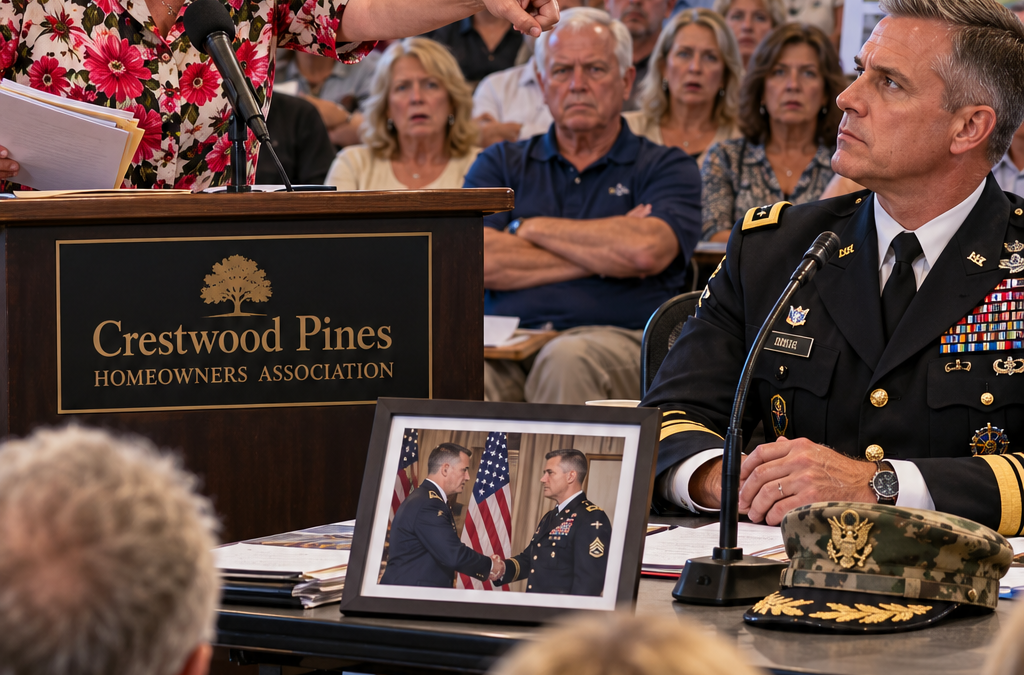
𝗙𝗨𝗟𝗟 𝗦𝗧𝗢𝗥𝗬
Well-maintained lawns.
Too many SUVs.
Children on bicycles.
Dogs dragging owners toward fire hydrants.
People waved from driveways.
Then reported each other to the HOA for things they were too polite to mention face to face.
My neighbor on the left was Thomas Reed.
Everyone called him Tom.
He was fifty-two, divorced, worked in insurance, and possessed the exhausted humor of a man who had attended too many HOA meetings.
The first week I lived there, he leaned over our shared fence while I was trimming a hedge.
“You met Beverly yet?”
“No.”
He made the sign of the cross.
“Enjoy the remaining peace.”
I laughed.
“That bad?”
“Don’t make eye contact until you have to.”
“Who is she?”
“HOA president.”
“Ah.”
“She once sent me a warning because my garage door was open for three hours.”
“Why?”
“Visible storage.”
I looked toward his garage.
It was closed.
“What were you storing?”
“My car.”
I laughed.
He didn’t.
“I’m serious.”
That was my introduction to Beverly Cratch.
I met her formally two weeks later at a neighborhood barbecue.
She was somewhere in her late fifties.
Medium height.
Blond-gray hair cut in a precise bob.
Pearl earrings.
A voice trained to project confidence even when she was discussing garbage cans.
She shook my hand.
“Darren, welcome.”
“Thank you.”
“We like to maintain a very high standard here.”
“So I’ve heard.”
Her eyes moved over my house.
Not obviously.
Just enough.
“You’ve settled in nicely.”
“I’m trying.”
“If you ever have questions regarding exterior modifications, please come to the board before making changes.”
“I will.”
She smiled.
“That saves everyone trouble.”
At the time, I thought she was merely enthusiastic.
Then came the flagpole.
I had wanted one for years.
Not huge.
Not ceremonial.
A simple residential pole in the front yard.
Sixteen feet.
Aluminum.
Proper footing.
Low-profile lighting so the flag could remain displayed respectfully after dark.
American flag at the top.
POW/MIA flag beneath it.
I chose the location carefully.
It didn’t block sight lines.
Didn’t interfere with utilities.
Didn’t extend over anyone’s property.
I even checked the HOA architectural guidelines before installation.
The rules mentioned exterior structures.
Satellite dishes.
Fences.
Sheds.
Nothing specifically prohibiting flagpoles.
There was a general requirement for approval of freestanding structures above a certain height, but I believed a variance would be routine.
The American flag mattered to me.
But the POW/MIA flag mattered differently.
That one carried faces.
Names.
People.
I had been a young captain the first time I stood beside a family while they were told their son was missing.
Years later, another family sat across from me while we explained that recovery efforts were still ongoing.
There are phrases people in uniform learn to say professionally because families need clarity.
Search operations continue.
Recovery efforts remain active.
We have no additional information at this time.
You can say those words calmly and still carry them for years.
Some names stay.
Some moments refuse to age.
The flagpole wasn’t decoration.
It was a memorial I could see from my kitchen window.
The installer finished on a Saturday.
I stood outside that evening while the wind caught both flags.
For the first time since moving in, the house felt fully mine.
Twelve days later, the HOA letter arrived.
NOTICE OF VIOLATION.
UNAPPROVED EXTERIOR STRUCTURE.
FLAGPOLE HEIGHT EXCEEDS PRESUMPTIVE RESIDENTIAL STANDARD.
REMOVE WITHIN TEN DAYS OR DAILY FINE OF $50 MAY APPLY.
I read it twice.
Then checked the guidelines again.
No specific height limitation appeared in the version I had been given.
I called the management office.
A woman named Elaine answered.
“I’d like to discuss violation number 24-1187.”
She pulled it up.
“Flagpole.”
“Correct.”
“Yes, Mr. Ashworth. The board determined the structure requires architectural approval.”
“I understand. I’d like to request a variance.”
“You can submit the form online.”
“Is removal required while the variance is pending?”
She hesitated.
“Typically, enforcement is suspended during review.”
“Typically?”
“The board has discretion.”
“Fine.”
I filed that afternoon.
Photographs.
Measurements.
Installation specifications.
Setback distances.
Lighting details.
A short written statement explaining why I displayed the POW/MIA flag.
I didn’t mention rank.
Didn’t mention command.
Didn’t attach service records.
I didn’t think any of that should matter.
The variance should succeed or fail based on property rules.
Not who I was.
The hearing was scheduled for the following Tuesday.
Tom saw me taking the trash out that morning.
“You going tonight?”
“Apparently.”
“Flagpole?”
“Yep.”
He shook his head.
“I warned you.”
“About making eye contact?”
“Exactly.”
“I’ll try to survive.”
He lowered his voice.
“Beverly hates losing.”
“This isn’t a contest.”
Tom gave me a long look.
“That’s adorable.”
The meeting began at seven.
The clubhouse room held maybe forty-seven residents.
More than usual, according to Tom.
There were complaints about new parking rules, so attendance was high.
I sat near the middle.
Khakis.
Plain blue button-down.
No military pins.
No ribbons.
No indication of rank.
Beverly sat at the center of the board table with a thick binder divided by colored tabs.
Red.
Yellow.
Green.
Blue.
I wondered briefly what offense each color represented.
She moved through the agenda with the confidence of someone who believed procedure itself validated whatever conclusion she preferred.
Landscaping.
Pool access.
Dog waste stations.
Budget update.
Parking.
Then architectural variances.
My name came up third.
“Mr. Darren Ashworth.”
I stood.
Beverly looked over her glasses.
“Please come forward.”
I walked to the microphone.
There was no podium.
Just a standing mic positioned six feet from the board.
Beverly opened a folder.
“You are requesting retroactive approval for a sixteen-foot flagpole.”
“Correct.”
“Installed without prior authorization.”
“Correct.”
“You acknowledge that exterior structures require review.”
“Yes.”
“Then why was it installed first?”
Fair question.
“The version of the architectural guidelines provided to me did not identify residential flagpoles specifically, and I believed it complied with applicable protections and neighborhood setback requirements. Once I received the notice, I submitted the variance.”
Beverly looked at me for a second.
“Applicable protections?”
“Yes.”
“Such as?”
“Federal protections relating to display of the American flag, state law, and the association’s own restrictions.”
I was deliberately careful.
The Freedom to Display the American Flag Act does not mean an HOA can never regulate a flag display.
Reasonable time, place, and manner restrictions can exist.
I knew that.
I wasn’t claiming immunity.
I was saying the variance deserved reasonable consideration.
Beverly tapped her pen.
“And the second flag?”
“POW/MIA.”
“We are aware of what it is.”
“Then yes.”
“Why is that necessary?”
The word bothered me.
Necessary.
I kept my tone level.
“It has personal significance.”
“That doesn’t answer whether it’s necessary.”
“I don’t believe a memorial has to be necessary to be meaningful.”
A couple of heads turned.
Beverly’s smile tightened.
“Mr. Ashworth, we’re discussing neighborhood standards, not sentiment.”
“I understand.”
“Then perhaps you can explain why the board should permit an oversized structure because of your personal attachment.”
“It is sixteen feet.”
“Our preferred standard is twelve.”
“The guidelines I received don’t state twelve.”
“It has been the board’s customary limit.”
“Then I’d appreciate seeing the written standard.”
That was the first moment I saw irritation.
Very slight.
A tightening around her mouth.
She flipped through the folder.
“You also reference military service in your variance request.”
“I referenced the meaning of the POW/MIA flag.”
“Are you a veteran?”
The question itself didn’t bother me.
“Yes.”
She leaned closer to her microphone.
“Actually?”
The room shifted.
I looked at her.
“Yes.”
There was a pause.
Then Beverly smiled.
Not warmly.
“Because anyone can buy a hat.”
I wasn’t wearing a hat.
That made the remark stranger.
I glanced down at myself almost involuntarily.
Blue shirt.
Khakis.
Brown shoes.
Nothing military.
“I’m not wearing a hat.”
A few people laughed quietly.
Beverly didn’t.
“You know what I mean.”
“No, I don’t.”
She sat back.
“We get residents making all sorts of claims when they want exemptions.”
I felt something begin to tighten behind my ribs.
“Are you saying you believe I’m lying about serving?”
“I’m saying the board has a responsibility to verify representations.”
“Then ask for documentation.”
Her eyebrows rose.
“I just did.”
“No.”
I kept my voice calm.
“You suggested I might be falsely claiming service.”
Beverly looked around the room.
“My brother-in-law tells restaurants he’s a veteran for discounts all the time.”
I stared at her.
“Was he a veteran?”
“That’s not the point.”
“It seems relevant.”
A few more people shifted in their seats.
Tom was sitting near the back.
I caught his expression.
He looked like a man watching someone reverse toward a cliff.
Beverly continued.
“People use military claims for sympathy.”
“Some probably do.”
“So we should be careful.”
“Then be careful.”
I paused.
“But be accurate.”
That should have ended it.
It didn’t.
Beverly opened another page in her folder.
“I did look you up.”
That surprised me.
“Did you?”
“There is a photograph attached to one of your online profiles.”
I knew the photograph immediately.
Official promotion ceremony.
Dress uniform.
My daughter standing beside me.
A general pinning colonel’s insignia onto my shoulders.
It had been republished by a regional news station.
Beverly continued.
“And frankly, the uniform in that photograph could have come from Amazon.”
The room went completely silent.
No cough.
No whispered conversation.
Nothing.
I had experienced that kind of silence before.
The silence after somebody says something so inappropriate that everyone present needs a moment to decide whether it actually happened.
I looked at Beverly.
She looked back.
Completely composed.
I could have ended it there.
I could have told her exactly who I was.
Colonel Darren Ashworth.
Thirty-one years active duty.
Base commander of Harwick Installation.
I could have listed deployments.
Assignments.
Commands.
Decorations.
I could have embarrassed her instantly.
For half a second, part of me wanted to.
Then training took over.
Not military training exactly.
Leadership.
If you have the stronger position, don’t lose it by losing control.
I took one breath.
Then another.
“I’ll provide documentation.”
Beverly gave a satisfied nod.
“That would be appropriate.”
“I’ll make sure it’s clear.”
“Thank you.”
“Anything else?”
“We’ll table the variance pending verification.”
I stepped away from the microphone.
As I walked back to my seat, nobody looked at me directly.
Not because they believed Beverly.
I think they were embarrassed.
Maybe for her.
Maybe for themselves.
Tom leaned toward me when I sat down.
“What the hell was that?”
“Apparently I bought thirty-one years of service on Amazon.”
He stared at me.
“Wait.”
I looked at him.
“You really served thirty-one?”
“Yes.”
His face changed.
“You’re still active?”
“Yes.”
“What do you do at Harwick?”
I hesitated.
There was no point hiding it anymore.
“I command it.”
Tom blinked.
“You what?”
“Keep your voice down.”
His mouth opened.
Then closed.
He looked toward Beverly.
Then back at me.
“Oh, man.”
“Tom.”
“Oh, this is bad.”
“Don’t.”
“No, I mean for her.”
“I know what you meant.”
He leaned back in his chair and covered his mouth with one hand.
I stayed until the meeting ended.
Not because I wanted to.
Because leaving angry would have created another story.
Beverly finished the agenda as though nothing unusual had happened.
Parking appeals.
Tree removal.
Community garage sale.
When I got home, the flags were moving gently above the front lawn.
I stood beneath them for a while.
The American flag caught the porch light.
The black POW/MIA flag shifted beneath it.
YOU ARE NOT FORGOTTEN.
I looked at those words.
Then thought about Beverly saying Amazon.
The anger arrived then.
Not because she’d insulted me personally.
I’ve been called worse things by better people.
What bothered me was what she had trivialized.
A uniform is cloth.
Rank is metal.
Awards are ribbons.
None of them matter without what they represent.
Years.
Absences.
Missed birthdays.
Families waiting.
People carrying injuries nobody sees.
People buried beneath government-issued stones.
Beverly hadn’t insulted a costume.
She had decided all of that could be dismissed casually because she wanted leverage in an HOA variance hearing.
I went inside.
The next morning, I called my staff judge advocate—not because I wanted the military involved in a neighborhood dispute, but because I wanted to make sure my response created no ethical problem.
I explained everything.
Major Lawson listened.
Then said, “Sir, with respect, she said your uniform came from Amazon?”
“Yes.”
Silence.
“Major.”
“Sorry, sir.”
“Can I send official verification of current service and position?”
“Yes. Avoid implying the installation is intervening in a private HOA matter.”
“That’s my concern.”
“Provide factual verification only.”
“Good.”
I drafted a one-page letter.
Official military letterhead.
My full name.
Rank.
Current active-duty status.
Position as installation commander.
Dates of service.
A sentence confirming that the photograph referenced during the HOA meeting was taken during an official promotion ceremony.
Nothing emotional.
Nothing threatening.
No request that the variance be approved.
Just facts.
At the bottom:
COLONEL DARREN M. ASHWORTH
COMMANDER, HARWICK INSTALLATION
I signed it.
The base seal appeared in the letterhead.
I attached the public affairs release from my promotion ceremony.
Then I emailed the HOA board.
Subject:
REQUESTED SERVICE VERIFICATION — DARREN ASHWORTH
I copied the management company.
I also copied Lieutenant Priya Sandoval, our public affairs officer, solely to preserve an official record of what had been provided.
I did not call Beverly.
Did not send a separate message.
Did not post anything on the neighborhood app.
The email went out at 7:21 Wednesday morning.
According to the read receipt, Beverly opened it at 7:43.
Her response arrived at 11:38.
Mr. Ashworth,
Documentation received. Your variance remains under board review.
Regards,
Beverly Cratch
President, Crestwood Pines HOA
No acknowledgment.
No correction.
No apology.
Nothing about Amazon.
At 1:12 that afternoon, Tom texted me.
BRO WHAT DID YOU SEND THEM
I replied:
The documentation she requested.
Three dots appeared immediately.
Then:
Beverly hasn’t posted in the neighborhood app all day.
I wrote:
Maybe she’s busy.
His response:
YOU ARE WAY TOO CALM ABOUT THIS
I put the phone down.
The truth was, I wasn’t calm.
I was controlled.
There is a difference.
Beverly had made the accusation publicly.
Correcting the factual record privately was enough for me personally.
But I also knew a public meeting had a public record.
Anybody listening later would hear her accusation.
They would not necessarily see the email.
That bothered me.
Not because I needed validation.
Because false accusations, once recorded, have a way of outliving corrections nobody hears.
The next HOA meeting was two weeks later.
I had planned to attend in civilian clothes.
Then Harwick held a formal retirement ceremony that afternoon for a senior command chief I had served with for years.
The ceremony ran late.
By the time I left the base, I had less than thirty minutes before the HOA meeting.
Going home to change would have made me miss the variance vote.
So I went directly from Harwick.
Dress uniform.
Service ribbons.
Nameplate.
Colonel’s eagles.
Polished shoes.
The whole thing.
I sat in my truck outside the clubhouse for a minute before going in.
I knew how it would look.
Part of me hated that.
It could be interpreted as theater.
A deliberate display designed to embarrass Beverly.
That was not why I was wearing it.
But appearance matters.
I considered skipping the meeting.
Then my phone rang.
Priya Sandoval.
“Sir, are you there?”
“Parking lot.”
“Still okay if I attend?”
Priya had asked earlier that week.
She had seen the letter because I copied public affairs.
She knew the HOA meeting had been recorded.
From a communications standpoint, she wanted to understand whether any public narrative might affect the installation.
I had told her she could attend as my guest provided she remained entirely in a civilian observational role.
“No statements for the base,” I had said.
“Understood.”
“No confrontation.”
“Sir, you know that’s usually your problem, not mine.”
“Lieutenant.”
“Understood.”
She arrived in civilian clothes.
Dark slacks.
Gray jacket.
Notebook.
She looked at my uniform.
“You came directly from the retirement ceremony.”
“Unfortunately.”
She smiled.
“This should be subtle.”
“Don’t enjoy this.”
“I would never.”
“You are enjoying this.”
“Professionally.”
We went inside.
The reaction was immediate.
Conversation faded.
People looked up.
Tom was already seated.
His eyebrows nearly reached his hairline.
He mouthed:
Oh my God.
I ignored him.
Beverly was arranging papers at the board table.
She looked up.
Saw me.
Stopped.
It lasted less than a second.
But I had spent a career reading rooms.
I saw it.
Then her face reset.
“Good evening, Mr. Ashworth.”
“Good evening.”
Not Colonel.
Fine.
I sat in the same seat as before.
Priya sat in the back row and opened her notebook.
The meeting began.
Beverly moved briskly.
Too briskly.
Budget.
Maintenance.
Parking.
Then old business.
Flagpole variance.
She cleared her throat.
“The board has received supplemental documentation regarding Mr. Ashworth’s application.”
Supplemental documentation.
That phrasing almost impressed me.
No mention that the supplemental documentation established that the resident she’d accused of buying a fake uniform online was an active installation commander.
She continued.
“The board’s role remains limited to architectural compliance and should not be influenced by personal background.”
I agreed with that.
Completely.
Then Beverly made the mistake of trying to defend herself before anyone had attacked her.
“I also want it noted that board members have the right and responsibility to verify claims presented during hearings.”
No one spoke.
She looked around the room.
“Questions regarding service history were raised solely because military status was referenced in support of the variance.”
I raised my hand.
Beverly’s eyes settled on me.
“Mr. Ashworth.”
I stood.
“One clarification.”
She nodded stiffly.
“I did not ask the board to approve the flagpole because of my rank.”
“I didn’t say you did.”
“I did not ask for an exemption because I’m the base commander.”
Several people shifted.
There it was.
The words were finally public.
Base commander.
Beverly’s jaw tightened.
I continued.
“I explained why the POW/MIA flag mattered to me. You asked whether I had actually served.”
“Which was a reasonable verification question.”
“Maybe.”
I kept my voice level.
“Then you suggested my uniform was from Amazon.”
Silence.
Beverly leaned toward the microphone.
“I stand by the board’s right to ask questions.”
“That isn’t the same issue.”
“Mr. Ashworth, we’re not going to relitigate tone.”
“I’m not asking you to.”
I paused.
“I’m correcting the record.”
Her expression hardened.
“The record has been corrected by your documentation.”
“Good.”
I sat.
That should have been enough.
But Beverly wasn’t done.
Some people cannot tolerate ending a conversation without reclaiming authority.
She adjusted her microphone.
“For the record, no resident should expect special treatment based on employment, military rank, profession, or social standing.”
Tom muttered something behind me.
I didn’t turn.
I agreed.
“Absolutely.”
Beverly seemed surprised.
I continued from my seat.
“I don’t.”
Her mouth tightened again.
The board voted.
Five to zero.
Variance approved.
The flagpole could remain.
Maximum permitted height for that specific installation: sixteen feet.
Existing lighting approved.
American and POW/MIA flags permitted.
Done.
I felt relief.
Not victory.
I simply wanted the issue finished.
Afterward, Tom caught me near the door.
“Colonel?”
I looked at him.
“Don’t start.”
“You command Harwick?”
“Yes.”
“Like the whole base?”
“Yes, Tom.”
“Thousands of people?”
“Go home.”
He laughed.
“This is unbelievable.”
“What’s unbelievable is that your garage-door violation story might no longer be the dumbest thing I’ve heard.”
“That’s hurtful.”
Priya joined us.
Tom straightened automatically when he realized she was connected to me.
I introduced them.
“Lieutenant Priya Sandoval, public affairs.”
Tom looked at me.
“You brought public affairs?”
“She invited herself.”
Priya smiled.
“Not technically inaccurate.”
“What does that mean?”
“It means I’m here to observe.”
Tom looked toward Beverly.
“She’s going to love that.”
Beverly was across the room speaking with another board member.
She glanced toward us.
Then away.
I went home.
The next morning, Priya called me before seven.
“Sir.”
“What’s wrong?”
“Nothing yet.”
“That’s ominous.”
“Did you know the HOA posts meeting recordings publicly?”
“Yes.”
“Do you know someone sent the previous one to the regional paper?”
I sat up in bed.
“No.”
“They called public affairs.”
I closed my eyes.
“Of course they did.”
“The reporter wants confirmation that you’re the same Darren Ashworth in the recording.”
“What did you tell them?”
“That you are Colonel Darren Ashworth, current commander of Harwick Installation, and that the installation has no position on private HOA matters.”
“Good.”
“They also asked whether the uniform in your promotion photo was authentic.”
I stared at the ceiling.
“You’re joking.”
“No, sir.”
“What did you say?”
“Yes.”
I rubbed my forehead.
“Anything else?”
“They requested comment from you.”
“No.”
“I assumed.”
“Priya.”
“Sir?”
“Keep the base out of it.”
“Already done.”
The story appeared the following afternoon.
It wasn’t front-page national news.
Nothing dramatic.
A regional piece on the paper’s website.
BASE COMMANDER ACCUSED OF FAKING MILITARY SERVICE DURING LOCAL HOA MEETING
The article included Beverly’s quotation from the public meeting recording.
“Anyone can buy a hat.”
“The uniform in your profile photo is probably from Amazon.”
It identified me as Colonel Darren Ashworth, thirty-one-year active-duty officer and Harwick Installation commander.
It linked to the original promotion announcement.
The reporter contacted Beverly.
Her response appeared near the bottom.
“The Crestwood Pines HOA applies consistent verification standards to all residents and does not provide special exemptions based on profession or status.”
Again, no apology.
The comments underneath were brutal.
I stopped reading after twenty.
I had no interest in watching strangers insult her.
That didn’t make anything better.
Tom, unfortunately, considered the comments a public resource.
He texted screenshots.
I told him to stop.
He sent two more.
Then I blocked him for an hour.
At work, I asked my staff not to discuss the story unless necessary.
Naturally, that guaranteed everyone had read it.
My executive officer stepped into my office around ten.
“Sir, one question.”
“No.”
“I haven’t asked it.”
“No.”
“Amazon?”
I stared at him.
He immediately straightened.
“Understood.”
He left.
I heard laughter in the hallway.
It was irritating.
It was also funny.
I eventually laughed too.
The consequences inside Crestwood Pines were less funny.
Two HOA board members resigned within seventy-two hours.
Neither had accused me of anything.
That mattered.
One of them, Janet Wallace, came to my house personally.
I opened the door and found her holding a folder.
“Darren, do you have a minute?”
“Sure.”
She looked uncomfortable.
“I resigned this morning.”
“I heard.”
“I wanted to explain why.”
“You don’t owe me that.”
“I think I do.”
We sat on the porch.
The flags moved above us.
Janet looked toward them.
“I should have stopped Beverly.”
I said nothing.
“At the first meeting.”
“You weren’t the one speaking.”
“No.”
She looked at me.
“But I sat there.”
I knew what she meant.
“I kept thinking she’d correct herself.”
“People usually do.”
“She didn’t.”
“No.”
Janet twisted the folder in her hands.
“Then I told myself it wasn’t my fight.”
That sentence stayed with me.
She continued.
“When the article came out, my daughter asked why nobody on the board said anything.”
I waited.
“I didn’t have an answer I liked.”
I understood that better than she probably realized.
Leadership isn’t always about making the right decision.
Sometimes it’s recognizing too late that silence was also a decision.
“You resigned because of that?”
“Partly.”
She gave a tired smile.
“Also because HOA board service is terrible.”
I laughed.
“Fair.”
She stood.
“I’m sorry.”
“Thank you.”
She looked toward the flagpole again.
“For what it’s worth, I voted for the variance.”
“I know.”
“I should have done more sooner.”
“Probably.”
She blinked, then laughed softly.
“I expected you to say it was okay.”
“I’m not very good at lying.”
“Apparently.”
She left.
The second board member resigned by email.
His message was shorter.
He said the board had failed to maintain civility and fairness.
Within a week, Beverly was presiding over a board that looked visibly fractured.
She released a statement through the HOA portal.
It accused the media of “sensationalizing an ordinary verification process.”
She called the coverage “a targeted attack on community governance.”
She said nothing about the specific Amazon remark.
Nothing about the public accusation.
Nothing about why she had researched my profile photograph before the hearing.
No apology.
Tom showed me the statement while we were standing by my driveway.
“She is physically incapable of saying sorry.”
“Probably.”
“How are you not furious?”
“I was.”
“Past tense?”
“Mostly.”
He stared at me.
“You are weirdly adjusted.”
“No.”
I looked at the flagpole.
“I’m tired.”
That was closer to the truth.
The story had become larger than the thing I cared about.
The flagpole was staying.
The record was corrected.
My service wasn’t actually in doubt among anyone who mattered.
I didn’t need Beverly destroyed.
I didn’t need her humiliated.
I needed her to understand that authority comes with responsibility.
Whether she ever understood that wasn’t something I could control.
A week after the article ran, I opened my mailbox and found a white envelope.
No stamp.
No return address.
Someone had placed it there by hand.
Inside was an index card.
Blue ink.
Only two sentences.
My son is deployed right now.
Thank you for not letting it go.
No name.
No signature.
I stood at the mailbox reading it again.
Then again.
That card affected me more than the newspaper article.
More than the unanimous variance.
More than Beverly’s humiliation.
Because suddenly the issue wasn’t about me.
Someone in that neighborhood had a son somewhere else in the world.
Maybe Europe.
Maybe the Middle East.
Maybe aboard a ship.
Maybe somewhere classified enough that his mother couldn’t say.
And while Beverly thought she was arguing over aesthetics, someone else was looking at that POW/MIA flag and thinking about whether her child would come home.
I put the card in my wallet.
It stayed there.
The paper softened along the fold.
The ink faded slightly.
I still have it.
For the next several weeks, neighborhood life became strange.
People who had barely spoken to me suddenly waved enthusiastically.
One man brought over a six-pack.
A woman I didn’t know thanked me in the grocery store.
I disliked most of that attention.
One Saturday, a man named Greg who lived near the entrance stopped while I was washing my truck.
“Colonel.”
“Darren is fine.”
“Right. Darren.”
He nodded toward the flagpole.
“Looks good.”
“Thanks.”
“My dad was Vietnam.”
I turned off the hose.
“Army?”
“Yeah.”
Greg looked at the POW/MIA flag.
“He used to fly one.”
We talked for twenty minutes.
Not about Beverly.
About his father.
About how he rarely discussed the war.
About how he kept one photograph in a drawer and never explained who the men in it were.
Greg had never asked.
His father died before he thought to.
Conversations like that started happening.
Quietly.
A woman told me her brother had been killed in Afghanistan.
An older resident had served in the Navy during Vietnam.
Another man’s grandfather had been a prisoner of war.
Suddenly the flagpole that Beverly had treated as a visual problem became a place where people told stories.
Not ceremonies.
Not speeches.
Just stories.
That mattered more than winning the variance.
The neighborhood’s annual Memorial Day gathering had historically consisted of hot dogs at the clubhouse and children’s games.
That year, Tom called me.
“Don’t hang up.”
“That’s a bad beginning.”
“The social committee wants you to say a few words.”
“No.”
“I told them you’d say that.”
“Then why call?”
“Because Janet suggested something else.”
“What?”
“Read the names.”
I went quiet.
Tom continued.
“Residents can submit names of family members who died in service. You just read them. No speech.”
I looked through the front window at the flags.
“How many?”
“Twenty-three so far.”
I agreed.
Memorial Day morning was warm.
More than a hundred residents gathered near the clubhouse.
No media.
No cameras except families’ phones.
I wore civilian clothes.
At ten o’clock, I stood beside a small table.
Twenty-nine names by then.
I read each one.
Rank where known.
Branch.
Conflict.
Nothing else.
After the last name, we stood silent.
Beverly did not attend.
I noticed.
I wish I hadn’t.
Because even then, part of me was still measuring her absence.
That was when I realized I needed to let the conflict go.
Not forget.
Let go.
There is a difference.
A few weeks later, I saw Beverly for the first time since the article.
She was walking on the opposite sidewalk.
Normally she would have waved at everyone.
That morning she kept her eyes forward.
I could have ignored her.
Instead, I said, “Morning, Beverly.”
She stopped.
Looked across the street.
“Good morning.”
We stood there awkwardly.
Then she said, “The flag looks fine.”
It was such an absurdly small sentence after everything that I almost laughed.
“Thank you.”
She nodded.
Started walking.
I thought that would be the end.
Then she turned.
“For what it’s worth, I never meant to disrespect people who served.”
I studied her.
Not quite an apology.
But closer.
“What did you mean to do?”
She didn’t answer immediately.
“I thought you were using military service to pressure the board.”
“I wasn’t.”
“I understand that now.”
I crossed the street so we weren’t shouting.
“Beverly, even if I had been a private who served four years thirty years ago, the way you handled it would’ve been wrong.”
She looked at me.
“This isn’t about rank.”
“I know.”
“No.”
I shook my head.
“I don’t think you did.”
Her expression tightened.
I continued.
“You found a photograph. Instead of checking it, you used it as ammunition.”
“I should have researched further.”
“You should have asked before accusing.”
She looked down.
That was the first time I’d ever seen Beverly Cratch look unsure.
“I was angry.”
“About a flagpole?”
“About being challenged.”
There it was.
Honest.
I respected it more than every official statement she’d issued.
She sighed.
“The board had been dealing with residents ignoring approval requirements. You installed something first and asked later. I was already irritated.”
“Fair.”
She looked surprised.
“I should have filed before installation.”
“Yes.”
“I was wrong about that.”
She nodded.
Then I said, “You were wrong about something too.”
“I know.”
We stood in silence.
Finally she said, “I don’t know how to undo it.”
“You don’t.”
Her eyes lifted.
“You learn from it.”
Then I walked home.
Beverly remained president for another two months.
Technically.
In practice, her authority was disappearing.
Two board seats were vacant.
Attendance at meetings doubled.
Residents challenged procedural decisions.
Motions she once passed easily suddenly died for lack of a second.
Tom attended every meeting out of what he called civic responsibility and I called recreational vengeance.
He would text me afterward.
BEVERLY MOTION TO RESTRICT DECORATIVE FLAGS: NO SECOND
BEVERLY MOTION ON CURBSIDE PARKING: DIED IN SILENCE
BEVERLY MOTION TO LIMIT MEETING COMMENTS: ABSOLUTELY NOT
I told him to stop enjoying himself.
He refused.
Then in September, Beverly submitted her resignation.
Official reason:
Personal scheduling conflicts.
The neighborhood app exploded.
People speculated.
Some celebrated.
I didn’t.
Tom came over that evening.
“She’s gone.”
“I heard.”
“Nobody would second her motions anymore.”
“So you said.”
“You’re not even going to smile?”
“I’m grilling.”
He looked at the burgers.
“That’s not an answer.”
I flipped one.
“Want one?”
“Yes.”
We sat on the patio.
Tom opened a beer.
After a while he said, “You know everybody thinks you took her down.”
“I didn’t.”
“The article did.”
“No.”
“Her own mouth did?”
“Closer.”
He laughed.
I looked toward the front yard, though the flagpole wasn’t visible from where we sat.
“Beverly didn’t lose the board because of me.”
“Then why?”
“Because people stopped trusting her judgment.”
“Because of you.”
“Because of what she did in front of them.”
Tom thought about that.
“Difference?”
“Big one.”
I wasn’t trying to be philosophical.
I meant it.
Leadership doesn’t collapse because one person resists.
It collapses when everyone watching realizes the leader’s authority is no longer matched by judgment.
Beverly had used a microphone to make herself stronger.
Instead, she revealed herself.
I happened to be the person standing in front of her when she did it.
The flagpole stayed.
Sixteen feet.
American flag.
POW/MIA beneath it.
Every morning, I saw it before leaving for Harwick.
Some mornings there was no wind, and both flags hung nearly still.
Other mornings the weather pushed them straight out.
I would stand for a second before getting into my truck.
Not every day.
But often.
There were names I thought about.
Mark Ellison.
Victor Hale.
Anthony Ruiz.
Samir Patel.
Men I’d served with.
People I’d briefed.
People I’d lost.
One name belonged to someone whose remains had not been recovered when I first met his family.
Years later, I learned that identification had finally been made.
People think military service makes you accustomed to loss.
It doesn’t.
It gives you rituals.
Fold the flag.
Stand at attention.
Render honors.
Write letters.
Attend memorials.
Say the name.
Ritual does not remove grief.
It gives grief somewhere to stand.
That flagpole became one of those places for me.
Months after Beverly resigned, Harwick held another promotion ceremony.
A young lieutenant colonel named Marcus Bell was promoted to colonel.
I pinned one eagle.
His wife pinned the other.
Afterward, we stood near the stage.
He looked at my shoulders.
“Feels strange.”
“It should.”
“How long until I stop noticing them?”
“The eagles?”
“Yeah.”
“Hopefully never.”
He smiled.
“I thought you’d say a week.”
“No.”
I looked around the room.
Families.
Officers.
Enlisted leaders.
Photographs.
The same kind of scene Beverly had found online.
“Rank should never feel ordinary.”
Marcus nodded.
I thought about how easily a photograph of a ceremony can become just an image to someone outside the experience.
A uniform.
A smile.
Flags.
Maybe that was part of what had happened with Beverly.
She saw symbols without understanding the weight behind them.
Then decided the symbols must be fake because the weight was invisible.
That is an easy mistake to make about people.
Not just veterans.
Anyone.
We see the visible piece.
Wheelchair.
Uniform.
Job title.
House.
Accent.
Clothes.
Car.
Then construct the rest.
Beverly had constructed me as a man trying to manipulate an HOA board.
Once she’d decided that, every fact bent around it.
The POW/MIA flag became performance.
My service became suspicious.
The photograph became costume.
Even documentation became something she was forced to tolerate rather than evidence that her original judgment had been reckless.
I had spent a career warning junior leaders about exactly that kind of thinking.
Don’t fall in love with your first assessment.
New information has to change the picture.
If it doesn’t, you’re not analyzing anymore.
You’re defending ego.
Three months after Beverly resigned, the new HOA president called me.
Her name was Sandra Liu.
“Mr. Ashworth?”
“Darren is fine.”
“Darren. I wanted to let you know the board is revising the architectural policy.”
“Okay.”
“We’re making flagpole standards explicit.”
“That’s probably wise.”
“Maximum residential height will be twenty feet subject to setback and safety requirements.”
“Reasonable.”
“And we’re adding a process requirement that documentation requests be made privately whenever possible.”
I paused.
“Because of me?”
“Because of Beverly.”
“Fair.”
She hesitated.
“Would you review the draft?”
“No.”
She laughed.
“I respect that.”
“I’m serious.”
“So am I.”
“I do enough policy at work.”
“Understood.”
Before hanging up, she said, “For what it’s worth, I’m sorry the association handled your case the way it did.”
“Thank you.”
That was enough.
No spectacle.
No forced confession.
No public punishment.
An institution recognizing failure and changing procedure.
That was what responsible organizations were supposed to do.
A year after the original meeting, I found the anonymous index card while changing wallets.
My son is deployed right now.
Thank you for not letting it go.
The edges were worn.
I stood in my kitchen reading it.
Then walked outside.
The morning was cool.
A steady breeze moved through Crestwood Pines.
The American flag snapped once above me.
The POW/MIA flag turned beneath it.
A school bus stopped at the corner.
Someone started a lawn mower.
Tom’s garage door opened.
Normal life.
I thought about the mother who wrote the card.
I still didn’t know who she was.
Maybe her son had returned.
I hoped so.
Maybe he was still serving.
Maybe she still looked at the flag when she drove past my house.
I would never know.
But she reminded me of something Beverly had accidentally made me forget for a while.
The flagpole was never about me.
That was why being called a fake hurt in a way I hadn’t expected.
Not because I needed people to recognize my career.
But because the accusation contaminated something I had erected for people whose voices were no longer available to defend themselves.
Beverly thought she was challenging one resident’s credibility.
I heard her reducing sacrifice to costume.
That was why I refused to let the record stand.
There are times when ignoring an insult is strength.
I believe that.
There are also times when silence allows a lie to become the version people remember.
That night in the clubhouse, I chose documentation over anger.
Not because I was too disciplined to fight.
Because I knew exactly how to fight.
Facts.
Records.
Patience.
No threats.
No shouting.
No dramatic reveal.
Just the truth placed where everyone could see it.
Beverly did the rest herself.
Years in command taught me that people usually reveal who they are when they believe they hold all the authority in the room.
Some become careful.
Some become generous.
Some become arrogant.
Beverly became careless.
She had a microphone.
A title.
A binder.
A board that rarely challenged her.
And she mistook all of that for immunity from being wrong.
She wasn’t.
Neither am I.
That may be the most important lesson in leadership.
Rank doesn’t make you right.
Votes don’t make you right.
Volume doesn’t make you right.
A microphone definitely doesn’t make you right.
The only thing you can do is build habits that make it easier to discover when you’re wrong before your mistake harms someone else.
Ask.
Verify.
Listen.
Correct.
Apologize when necessary.
Beverly struggled with all five.
Eventually, the neighborhood stopped trusting her with the sixth.
Lead.
I stayed at Harwick another two years.
When retirement finally came, my daughter flew in.
So did people I hadn’t seen in years.
The ceremony was smaller than some expected.
I wanted it that way.
At the end, after speeches I tried unsuccessfully to shorten, I stood in front of the room in uniform one final time.
Thirty-three years by then.
The same daughter who had once laughed at my dream of owning a grill helped remove the command insignia from my uniform.
Afterward, she hugged me.
“So.”
“So?”
“You going home to your grill now?”
“That’s the plan.”
“Colonel Ashworth, defeated by hamburgers.”
“Former Colonel Ashworth.”
She smiled.
“You’re never going to stop correcting people, are you?”
“Probably not.”
When I returned to Crestwood Pines that evening, the flags were still flying.
I changed out of uniform.
Hung it carefully in the closet.
Not in a display case.
Not behind glass.
Just in the closet.
Uniforms are meant to be worn until they aren’t.
Then life continues.
I made coffee.
Walked outside.
Tom was in his driveway.
He looked at me.
“Retired?”
“Officially.”
“So you’re unemployed.”
“Technically.”
He grinned.
“Finally something Beverly would’ve believed.”
I laughed.
“Probably.”
Then he nodded toward the flagpole.
“Keeping that?”
I looked at it.
“Always.”
He nodded once.
“Good.”
Sometimes I think about that first HOA meeting.
The fluorescent lights.
The microphone.
Beverly pointing across the room.
The stunned silence after she said Amazon.
At the time, I thought that silence belonged to me.
Now I understand it belonged to everyone else.
They were being asked to decide what kind of community they wanted to be.
One where a person with authority could publicly humiliate a neighbor without challenge.
Or one where evidence mattered.
Where dignity mattered.
Where leadership had limits.
It took them a little time to choose.
But eventually, they did.
Beverly moved out of Crestwood Pines several years later.
Tom told me.
I never asked why.
I didn’t need to know.
By then, the story belonged to the past.
The clubhouse had new paint.
New board members.
New arguments.
One resident wanted solar panels.
Another hated backyard chickens.
People were still people.
Messy.
Opinionated.
Certain.
The neighborhood never became perfect.
Neither did I.
But the flagpole remained exactly where it had been.
Sixteen feet tall.
American flag above.
POW/MIA flag below.
No daily fines.
No violation notices.
No question about whether the man who installed it had earned the right to explain why it mattered.
One morning after retirement, I stood beneath it while the sun came up.
The neighborhood was quiet.
I could hear the metal clips tapping softly against the pole.
For a moment, I thought about every place I had lived before Crestwood.
Every base.
Every deployment.
Every move.
Every goodbye.
Then I thought about the anonymous mother.
My son is deployed right now.
Thank you for not letting it go.
I looked at the black flag moving beneath the stars and stripes.
YOU ARE NOT FORGOTTEN.
That was the whole point.
Not rank.
Not winning.
Not embarrassing Beverly.
Remembering.
Remembering the people who served.
The ones who returned.
The ones who didn’t.
The ones still waiting to come home.
The families who carry absence quietly while the rest of the world continues arguing about mailboxes, property lines, lawns, and flagpoles.
Beverly had once looked at my uniform and seen a costume.
I couldn’t make her understand what it meant.
That wasn’t mine to control.
But I could refuse to let her lie about it.
I could place the facts on the record.
I could stand beside the people whose names I carried.
And I could keep the flag flying.
So I did.
And every morning after that, when the wind moved through Crestwood Pines and lifted those two flags above my yard, I didn’t think about Beverly Cratch.
I thought about the people the flags were there for.
Exactly as I should have from the beginning.
𝗧𝗛𝗘 𝗘𝗡𝗗
The HOA President Called Me a Fake Veteran in Front of the Entire Neighborhood, Never Realizing Who Was Sitting Six Feet Away
Beverly Cratch pointed at me across a crowded HOA meeting and told forty-seven people, into a live microphone, that I was probably wearing an Amazon uniform and lying about my military service for sympathy.
What she didn’t know was that the photograph she had mocked was from my promotion ceremony, and the man she was accusing of being a fraud was the active-duty colonel commanding the military installation six miles from her front door.
My name is Darren Ashworth.
I spent thirty-one years on active duty in the United States military before I ever found myself sitting beneath fluorescent lights in the Crestwood Pines clubhouse, listening to a woman with a color-coded binder question whether I had actually served.
I had been in harder rooms.
Much harder.
Rooms where decisions carried consequences measured in lives instead of landscaping fines.
I had stood in operations centers at three in the morning while weather closed in over aircraft already in the air.
I had briefed grieving families.
I had walked beside flag-draped cases and learned that silence can be heavier than shouting.
I had sent people into places I would have gone myself if the mission had allowed it.
And I had watched some of them come home different.
Some never came home at all.
So when Beverly called me a fake veteran, anger wasn’t the first thing I felt.
What I felt first was disbelief.
Not because she doubted me.
People are allowed to doubt.
I had spent too much of my career dealing with uncertainty to be offended by questions alone.
What stunned me was the ease with which she tried to humiliate me.
She didn’t ask for documentation quietly.
She didn’t say the board had a policy requiring proof.
She didn’t even ask me what branch I’d served in.
She smiled, leaned toward a microphone, and decided that accusing a stranger of stolen valor was an acceptable way to win an argument about a flagpole.
That distinction mattered.
Crestwood Pines had been supposed to be my quiet place.
I moved there eight months before the meeting.
The installation I commanded sat about six miles east, close enough that on clear mornings you could sometimes hear aircraft in the distance.
I had spent most of my career living near bases.
Government housing.
Rented houses.
Temporary assignments.
Neighborhoods where everyone understood that the family next door might disappear for nine months with little warning.
When I was younger, that life suited me.
I moved where I was told.
Packed what I needed.
Learned a new route to work.
Memorized new names.
Then did it again.
By the time I reached colonel, I had stopped counting addresses.
Crestwood Pines was different.
For once, I wasn’t looking for something temporary.
The house was modest by the standards of some people in the neighborhood.
Two-story brick.
Three bedrooms.
A small office.
Wide front yard.
Back patio large enough for a grill and two chairs.
That was all I wanted.
My daughter joked that after three decades in uniform, I had finally developed extravagant dreams.
“A grill?”
She laughed over the phone.
“That’s the retirement plan?”
“Grill. Coffee. No staff meetings.”
“You’re never retiring.”
“That’s not the point.”
The truth was, I didn’t know when retirement would come.
I was still serving.
Still commanding.
Still getting up before sunrise and driving through the main gate while junior airmen or soldiers or civilian employees—depending on where I was assigned—went about work that rarely made headlines but mattered anyway.
At Harwick Installation, I was the base commander.
That title sounded more dramatic than most days felt.
Most of command was not speeches and ceremonies.
It was infrastructure.
Housing.
Security.
Budgets.
Personnel.
Schools.
Emergency planning.
Maintenance.
Making sure thousands of people had what they needed to do jobs the public would never fully see.
Responsibility accumulated quietly.
I didn’t mind.
What I did mind was carrying rank into every civilian interaction.
So when I moved to Crestwood Pines, I made a decision.
I would just be Darren.
Not Colonel Ashworth.
Not Commander.
Not Sir.
Just Darren.
I didn’t put a military plaque beside the garage.
Didn’t display challenge coins in the front window.
Didn’t introduce myself with a résumé.
When neighbors asked what I did, I usually said, “I work over at Harwick.”
That answer was vague enough.
Most people assumed I was a civilian contractor.
Fine with me.
The older I got, the less interested I became in being recognized.
Respect that depends on insignia disappears when the uniform comes off.
I wanted to know who people were when they thought I was ordinary.
For the first few months, the neighborhood was almost exactly what I expected.
Well-maintained lawns.
Too many SUVs.
Children on bicycles.
Dogs dragging owners toward fire hydrants.
People waved from driveways.
Then reported each other to the HOA for things they were too polite to mention face to face.
My neighbor on the left was Thomas Reed.
Everyone called him Tom.
He was fifty-two, divorced, worked in insurance, and possessed the exhausted humor of a man who had attended too many HOA meetings.
The first week I lived there, he leaned over our shared fence while I was trimming a hedge.
“You met Beverly yet?”
“No.”
He made the sign of the cross.
“Enjoy the remaining peace.”
I laughed.
“That bad?”
“Don’t make eye contact until you have to.”
“Who is she?”
“HOA president.”
“Ah.”
“She once sent me a warning because my garage door was open for three hours.”
“Why?”
“Visible storage.”
I looked toward his garage.
It was closed.
“What were you storing?”
“My car.”
I laughed.
He didn’t.
“I’m serious.”
That was my introduction to Beverly Cratch.
I met her formally two weeks later at a neighborhood barbecue.
She was somewhere in her late fifties.
Medium height.
Blond-gray hair cut in a precise bob.
Pearl earrings.
A voice trained to project confidence even when she was discussing garbage cans.
She shook my hand.
“Darren, welcome.”
“Thank you.”
“We like to maintain a very high standard here.”
“So I’ve heard.”
Her eyes moved over my house.
Not obviously.
Just enough.
“You’ve settled in nicely.”
“I’m trying.”
“If you ever have questions regarding exterior modifications, please come to the board before making changes.”
“I will.”
She smiled.
“That saves everyone trouble.”
At the time, I thought she was merely enthusiastic.
Then came the flagpole.
I had wanted one for years.
Not huge.
Not ceremonial.
A simple residential pole in the front yard.
Sixteen feet.
Aluminum.
Proper footing.
Low-profile lighting so the flag could remain displayed respectfully after dark.
American flag at the top.
POW/MIA flag beneath it.
I chose the location carefully.
It didn’t block sight lines.
Didn’t interfere with utilities.
Didn’t extend over anyone’s property.
I even checked the HOA architectural guidelines before installation.
The rules mentioned exterior structures.
Satellite dishes.
Fences.
Sheds.
Nothing specifically prohibiting flagpoles.
There was a general requirement for approval of freestanding structures above a certain height, but I believed a variance would be routine.
The American flag mattered to me.
But the POW/MIA flag mattered differently.
That one carried faces.
Names.
People.
I had been a young captain the first time I stood beside a family while they were told their son was missing.
Years later, another family sat across from me while we explained that recovery efforts were still ongoing.
There are phrases people in uniform learn to say professionally because families need clarity.
Search operations continue.
Recovery efforts remain active.
We have no additional information at this time.
You can say those words calmly and still carry them for years.
Some names stay.
Some moments refuse to age.
The flagpole wasn’t decoration.
It was a memorial I could see from my kitchen window.
The installer finished on a Saturday.
I stood outside that evening while the wind caught both flags.
For the first time since moving in, the house felt fully mine.
Twelve days later, the HOA letter arrived.
NOTICE OF VIOLATION.
UNAPPROVED EXTERIOR STRUCTURE.
FLAGPOLE HEIGHT EXCEEDS PRESUMPTIVE RESIDENTIAL STANDARD.
REMOVE WITHIN TEN DAYS OR DAILY FINE OF $50 MAY APPLY.
I read it twice.
Then checked the guidelines again.
No specific height limitation appeared in the version I had been given.
I called the management office.
A woman named Elaine answered.
“I’d like to discuss violation number 24-1187.”
She pulled it up.
“Flagpole.”
“Correct.”
“Yes, Mr. Ashworth. The board determined the structure requires architectural approval.”
“I understand. I’d like to request a variance.”
“You can submit the form online.”
“Is removal required while the variance is pending?”
She hesitated.
“Typically, enforcement is suspended during review.”
“Typically?”
“The board has discretion.”
“Fine.”
I filed that afternoon.
Photographs.
Measurements.
Installation specifications.
Setback distances.
Lighting details.
A short written statement explaining why I displayed the POW/MIA flag.
I didn’t mention rank.
Didn’t mention command.
Didn’t attach service records.
I didn’t think any of that should matter.
The variance should succeed or fail based on property rules.
Not who I was.
The hearing was scheduled for the following Tuesday.
Tom saw me taking the trash out that morning.
“You going tonight?”
“Apparently.”
“Flagpole?”
“Yep.”
He shook his head.
“I warned you.”
“About making eye contact?”
“Exactly.”
“I’ll try to survive.”
He lowered his voice.
“Beverly hates losing.”
“This isn’t a contest.”
Tom gave me a long look.
“That’s adorable.”
The meeting began at seven.
The clubhouse room held maybe forty-seven residents.
More than usual, according to Tom.
There were complaints about new parking rules, so attendance was high.
I sat near the middle.
Khakis.
Plain blue button-down.
No military pins.
No ribbons.
No indication of rank.
Beverly sat at the center of the board table with a thick binder divided by colored tabs.
Red.
Yellow.
Green.
Blue.
I wondered briefly what offense each color represented.
She moved through the agenda with the confidence of someone who believed procedure itself validated whatever conclusion she preferred.
Landscaping.
Pool access.
Dog waste stations.
Budget update.
Parking.
Then architectural variances.
My name came up third.
“Mr. Darren Ashworth.”
I stood.
Beverly looked over her glasses.
“Please come forward.”
I walked to the microphone.
There was no podium.
Just a standing mic positioned six feet from the board.
Beverly opened a folder.
“You are requesting retroactive approval for a sixteen-foot flagpole.”
“Correct.”
“Installed without prior authorization.”
“Correct.”
“You acknowledge that exterior structures require review.”
“Yes.”
“Then why was it installed first?”
Fair question.
“The version of the architectural guidelines provided to me did not identify residential flagpoles specifically, and I believed it complied with applicable protections and neighborhood setback requirements. Once I received the notice, I submitted the variance.”
Beverly looked at me for a second.
“Applicable protections?”
“Yes.”
“Such as?”
“Federal protections relating to display of the American flag, state law, and the association’s own restrictions.”
I was deliberately careful.
The Freedom to Display the American Flag Act does not mean an HOA can never regulate a flag display.
Reasonable time, place, and manner restrictions can exist.
I knew that.
I wasn’t claiming immunity.
I was saying the variance deserved reasonable consideration.
Beverly tapped her pen.
“And the second flag?”
“POW/MIA.”
“We are aware of what it is.”
“Then yes.”
“Why is that necessary?”
The word bothered me.
Necessary.
I kept my tone level.
“It has personal significance.”
“That doesn’t answer whether it’s necessary.”
“I don’t believe a memorial has to be necessary to be meaningful.”
A couple of heads turned.
Beverly’s smile tightened.
“Mr. Ashworth, we’re discussing neighborhood standards, not sentiment.”
“I understand.”
“Then perhaps you can explain why the board should permit an oversized structure because of your personal attachment.”
“It is sixteen feet.”
“Our preferred standard is twelve.”
“The guidelines I received don’t state twelve.”
“It has been the board’s customary limit.”
“Then I’d appreciate seeing the written standard.”
That was the first moment I saw irritation.
Very slight.
A tightening around her mouth.
She flipped through the folder.
“You also reference military service in your variance request.”
“I referenced the meaning of the POW/MIA flag.”
“Are you a veteran?”
The question itself didn’t bother me.
“Yes.”
She leaned closer to her microphone.
“Actually?”
The room shifted.
I looked at her.
“Yes.”
There was a pause.
Then Beverly smiled.
Not warmly.
“Because anyone can buy a hat.”
I wasn’t wearing a hat.
That made the remark stranger.
I glanced down at myself almost involuntarily.
Blue shirt.
Khakis.
Brown shoes.
Nothing military.
“I’m not wearing a hat.”
A few people laughed quietly.
Beverly didn’t.
“You know what I mean.”
“No, I don’t.”
She sat back.
“We get residents making all sorts of claims when they want exemptions.”
I felt something begin to tighten behind my ribs.
“Are you saying you believe I’m lying about serving?”
“I’m saying the board has a responsibility to verify representations.”
“Then ask for documentation.”
Her eyebrows rose.
“I just did.”
“No.”
I kept my voice calm.
“You suggested I might be falsely claiming service.”
Beverly looked around the room.
“My brother-in-law tells restaurants he’s a veteran for discounts all the time.”
I stared at her.
“Was he a veteran?”
“That’s not the point.”
“It seems relevant.”
A few more people shifted in their seats.
Tom was sitting near the back.
I caught his expression.
He looked like a man watching someone reverse toward a cliff.
Beverly continued.
“People use military claims for sympathy.”
“Some probably do.”
“So we should be careful.”
“Then be careful.”
I paused.
“But be accurate.”
That should have ended it.
It didn’t.
Beverly opened another page in her folder.
“I did look you up.”
That surprised me.
“Did you?”
“There is a photograph attached to one of your online profiles.”
I knew the photograph immediately.
Official promotion ceremony.
Dress uniform.
My daughter standing beside me.
A general pinning colonel’s insignia onto my shoulders.
It had been republished by a regional news station.
Beverly continued.
“And frankly, the uniform in that photograph could have come from Amazon.”
The room went completely silent.
No cough.
No whispered conversation.
Nothing.
I had experienced that kind of silence before.
The silence after somebody says something so inappropriate that everyone present needs a moment to decide whether it actually happened.
I looked at Beverly.
She looked back.
Completely composed.
I could have ended it there.
I could have told her exactly who I was.
Colonel Darren Ashworth.
Thirty-one years active duty.
Base commander of Harwick Installation.
I could have listed deployments.
Assignments.
Commands.
Decorations.
I could have embarrassed her instantly.
For half a second, part of me wanted to.
Then training took over.
Not military training exactly.
Leadership.
If you have the stronger position, don’t lose it by losing control.
I took one breath.
Then another.
“I’ll provide documentation.”
Beverly gave a satisfied nod.
“That would be appropriate.”
“I’ll make sure it’s clear.”
“Thank you.”
“Anything else?”
“We’ll table the variance pending verification.”
I stepped away from the microphone.
As I walked back to my seat, nobody looked at me directly.
Not because they believed Beverly.
I think they were embarrassed.
Maybe for her.
Maybe for themselves.
Tom leaned toward me when I sat down.
“What the hell was that?”
“Apparently I bought thirty-one years of service on Amazon.”
He stared at me.
“Wait.”
I looked at him.
“You really served thirty-one?”
“Yes.”
His face changed.
“You’re still active?”
“Yes.”
“What do you do at Harwick?”
I hesitated.
There was no point hiding it anymore.
“I command it.”
Tom blinked.
“You what?”
“Keep your voice down.”
His mouth opened.
Then closed.
He looked toward Beverly.
Then back at me.
“Oh, man.”
“Tom.”
“Oh, this is bad.”
“Don’t.”
“No, I mean for her.”
“I know what you meant.”
He leaned back in his chair and covered his mouth with one hand.
I stayed until the meeting ended.
Not because I wanted to.
Because leaving angry would have created another story.
Beverly finished the agenda as though nothing unusual had happened.
Parking appeals.
Tree removal.
Community garage sale.
When I got home, the flags were moving gently above the front lawn.
I stood beneath them for a while.
The American flag caught the porch light.
The black POW/MIA flag shifted beneath it.
YOU ARE NOT FORGOTTEN.
I looked at those words.
Then thought about Beverly saying Amazon.
The anger arrived then.
Not because she’d insulted me personally.
I’ve been called worse things by better people.
What bothered me was what she had trivialized.
A uniform is cloth.
Rank is metal.
Awards are ribbons.
None of them matter without what they represent.
Years.
Absences.
Missed birthdays.
Families waiting.
People carrying injuries nobody sees.
People buried beneath government-issued stones.
Beverly hadn’t insulted a costume.
She had decided all of that could be dismissed casually because she wanted leverage in an HOA variance hearing.
I went inside.
The next morning, I called my staff judge advocate—not because I wanted the military involved in a neighborhood dispute, but because I wanted to make sure my response created no ethical problem.
I explained everything.
Major Lawson listened.
Then said, “Sir, with respect, she said your uniform came from Amazon?”
“Yes.”
Silence.
“Major.”
“Sorry, sir.”
“Can I send official verification of current service and position?”
“Yes. Avoid implying the installation is intervening in a private HOA matter.”
“That’s my concern.”
“Provide factual verification only.”
“Good.”
I drafted a one-page letter.
Official military letterhead.
My full name.
Rank.
Current active-duty status.
Position as installation commander.
Dates of service.
A sentence confirming that the photograph referenced during the HOA meeting was taken during an official promotion ceremony.
Nothing emotional.
Nothing threatening.
No request that the variance be approved.
Just facts.
At the bottom:
COLONEL DARREN M. ASHWORTH
COMMANDER, HARWICK INSTALLATION
I signed it.
The base seal appeared in the letterhead.
I attached the public affairs release from my promotion ceremony.
Then I emailed the HOA board.
Subject:
REQUESTED SERVICE VERIFICATION — DARREN ASHWORTH
I copied the management company.
I also copied Lieutenant Priya Sandoval, our public affairs officer, solely to preserve an official record of what had been provided.
I did not call Beverly.
Did not send a separate message.
Did not post anything on the neighborhood app.
The email went out at 7:21 Wednesday morning.
According to the read receipt, Beverly opened it at 7:43.
Her response arrived at 11:38.
Mr. Ashworth,
Documentation received. Your variance remains under board review.
Regards,
Beverly Cratch
President, Crestwood Pines HOA
No acknowledgment.
No correction.
No apology.
Nothing about Amazon.
At 1:12 that afternoon, Tom texted me.
BRO WHAT DID YOU SEND THEM
I replied:
The documentation she requested.
Three dots appeared immediately.
Then:
Beverly hasn’t posted in the neighborhood app all day.
I wrote:
Maybe she’s busy.
His response:
YOU ARE WAY TOO CALM ABOUT THIS
I put the phone down.
The truth was, I wasn’t calm.
I was controlled.
There is a difference.
Beverly had made the accusation publicly.
Correcting the factual record privately was enough for me personally.
But I also knew a public meeting had a public record.
Anybody listening later would hear her accusation.
They would not necessarily see the email.
That bothered me.
Not because I needed validation.
Because false accusations, once recorded, have a way of outliving corrections nobody hears.
The next HOA meeting was two weeks later.
I had planned to attend in civilian clothes.
Then Harwick held a formal retirement ceremony that afternoon for a senior command chief I had served with for years.
The ceremony ran late.
By the time I left the base, I had less than thirty minutes before the HOA meeting.
Going home to change would have made me miss the variance vote.
So I went directly from Harwick.
Dress uniform.
Service ribbons.
Nameplate.
Colonel’s eagles.
Polished shoes.
The whole thing.
I sat in my truck outside the clubhouse for a minute before going in.
I knew how it would look.
Part of me hated that.
It could be interpreted as theater.
A deliberate display designed to embarrass Beverly.
That was not why I was wearing it.
But appearance matters.
I considered skipping the meeting.
Then my phone rang.
Priya Sandoval.
“Sir, are you there?”
“Parking lot.”
“Still okay if I attend?”
Priya had asked earlier that week.
She had seen the letter because I copied public affairs.
She knew the HOA meeting had been recorded.
From a communications standpoint, she wanted to understand whether any public narrative might affect the installation.
I had told her she could attend as my guest provided she remained entirely in a civilian observational role.
“No statements for the base,” I had said.
“Understood.”
“No confrontation.”
“Sir, you know that’s usually your problem, not mine.”
“Lieutenant.”
“Understood.”
She arrived in civilian clothes.
Dark slacks.
Gray jacket.
Notebook.
She looked at my uniform.
“You came directly from the retirement ceremony.”
“Unfortunately.”
She smiled.
“This should be subtle.”
“Don’t enjoy this.”
“I would never.”
“You are enjoying this.”
“Professionally.”
We went inside.
The reaction was immediate.
Conversation faded.
People looked up.
Tom was already seated.
His eyebrows nearly reached his hairline.
He mouthed:
Oh my God.
I ignored him.
Beverly was arranging papers at the board table.
She looked up.
Saw me.
Stopped.
It lasted less than a second.
But I had spent a career reading rooms.
I saw it.
Then her face reset.
“Good evening, Mr. Ashworth.”
“Good evening.”
Not Colonel.
Fine.
I sat in the same seat as before.
Priya sat in the back row and opened her notebook.
The meeting began.
Beverly moved briskly.
Too briskly.
Budget.
Maintenance.
Parking.
Then old business.
Flagpole variance.
She cleared her throat.
“The board has received supplemental documentation regarding Mr. Ashworth’s application.”
Supplemental documentation.
That phrasing almost impressed me.
No mention that the supplemental documentation established that the resident she’d accused of buying a fake uniform online was an active installation commander.
She continued.
“The board’s role remains limited to architectural compliance and should not be influenced by personal background.”
I agreed with that.
Completely.
Then Beverly made the mistake of trying to defend herself before anyone had attacked her.
“I also want it noted that board members have the right and responsibility to verify claims presented during hearings.”
No one spoke.
She looked around the room.
“Questions regarding service history were raised solely because military status was referenced in support of the variance.”
I raised my hand.
Beverly’s eyes settled on me.
“Mr. Ashworth.”
I stood.
“One clarification.”
She nodded stiffly.
“I did not ask the board to approve the flagpole because of my rank.”
“I didn’t say you did.”
“I did not ask for an exemption because I’m the base commander.”
Several people shifted.
There it was.
The words were finally public.
Base commander.
Beverly’s jaw tightened.
I continued.
“I explained why the POW/MIA flag mattered to me. You asked whether I had actually served.”
“Which was a reasonable verification question.”
“Maybe.”
I kept my voice level.
“Then you suggested my uniform was from Amazon.”
Silence.
Beverly leaned toward the microphone.
“I stand by the board’s right to ask questions.”
“That isn’t the same issue.”
“Mr. Ashworth, we’re not going to relitigate tone.”
“I’m not asking you to.”
I paused.
“I’m correcting the record.”
Her expression hardened.
“The record has been corrected by your documentation.”
“Good.”
I sat.
That should have been enough.
But Beverly wasn’t done.
Some people cannot tolerate ending a conversation without reclaiming authority.
She adjusted her microphone.
“For the record, no resident should expect special treatment based on employment, military rank, profession, or social standing.”
Tom muttered something behind me.
I didn’t turn.
I agreed.
“Absolutely.”
Beverly seemed surprised.
I continued from my seat.
“I don’t.”
Her mouth tightened again.
The board voted.
Five to zero.
Variance approved.
The flagpole could remain.
Maximum permitted height for that specific installation: sixteen feet.
Existing lighting approved.
American and POW/MIA flags permitted.
Done.
I felt relief.
Not victory.
I simply wanted the issue finished.
Afterward, Tom caught me near the door.
“Colonel?”
I looked at him.
“Don’t start.”
“You command Harwick?”
“Yes.”
“Like the whole base?”
“Yes, Tom.”
“Thousands of people?”
“Go home.”
He laughed.
“This is unbelievable.”
“What’s unbelievable is that your garage-door violation story might no longer be the dumbest thing I’ve heard.”
“That’s hurtful.”
Priya joined us.
Tom straightened automatically when he realized she was connected to me.
I introduced them.
“Lieutenant Priya Sandoval, public affairs.”
Tom looked at me.
“You brought public affairs?”
“She invited herself.”
Priya smiled.
“Not technically inaccurate.”
“What does that mean?”
“It means I’m here to observe.”
Tom looked toward Beverly.
“She’s going to love that.”
Beverly was across the room speaking with another board member.
She glanced toward us.
Then away.
I went home.
The next morning, Priya called me before seven.
“Sir.”
“What’s wrong?”
“Nothing yet.”
“That’s ominous.”
“Did you know the HOA posts meeting recordings publicly?”
“Yes.”
“Do you know someone sent the previous one to the regional paper?”
I sat up in bed.
“No.”
“They called public affairs.”
I closed my eyes.
“Of course they did.”
“The reporter wants confirmation that you’re the same Darren Ashworth in the recording.”
“What did you tell them?”
“That you are Colonel Darren Ashworth, current commander of Harwick Installation, and that the installation has no position on private HOA matters.”
“Good.”
“They also asked whether the uniform in your promotion photo was authentic.”
I stared at the ceiling.
“You’re joking.”
“No, sir.”
“What did you say?”
“Yes.”
I rubbed my forehead.
“Anything else?”
“They requested comment from you.”
“No.”
“I assumed.”
“Priya.”
“Sir?”
“Keep the base out of it.”
“Already done.”
The story appeared the following afternoon.
It wasn’t front-page national news.
Nothing dramatic.
A regional piece on the paper’s website.
BASE COMMANDER ACCUSED OF FAKING MILITARY SERVICE DURING LOCAL HOA MEETING
The article included Beverly’s quotation from the public meeting recording.
“Anyone can buy a hat.”
“The uniform in your profile photo is probably from Amazon.”
It identified me as Colonel Darren Ashworth, thirty-one-year active-duty officer and Harwick Installation commander.
It linked to the original promotion announcement.
The reporter contacted Beverly.
Her response appeared near the bottom.
“The Crestwood Pines HOA applies consistent verification standards to all residents and does not provide special exemptions based on profession or status.”
Again, no apology.
The comments underneath were brutal.
I stopped reading after twenty.
I had no interest in watching strangers insult her.
That didn’t make anything better.
Tom, unfortunately, considered the comments a public resource.
He texted screenshots.
I told him to stop.
He sent two more.
Then I blocked him for an hour.
At work, I asked my staff not to discuss the story unless necessary.
Naturally, that guaranteed everyone had read it.
My executive officer stepped into my office around ten.
“Sir, one question.”
“No.”
“I haven’t asked it.”
“No.”
“Amazon?”
I stared at him.
He immediately straightened.
“Understood.”
He left.
I heard laughter in the hallway.
It was irritating.
It was also funny.
I eventually laughed too.
The consequences inside Crestwood Pines were less funny.
Two HOA board members resigned within seventy-two hours.
Neither had accused me of anything.
That mattered.
One of them, Janet Wallace, came to my house personally.
I opened the door and found her holding a folder.
“Darren, do you have a minute?”
“Sure.”
She looked uncomfortable.
“I resigned this morning.”
“I heard.”
“I wanted to explain why.”
“You don’t owe me that.”
“I think I do.”
We sat on the porch.
The flags moved above us.
Janet looked toward them.
“I should have stopped Beverly.”
I said nothing.
“At the first meeting.”
“You weren’t the one speaking.”
“No.”
She looked at me.
“But I sat there.”
I knew what she meant.
“I kept thinking she’d correct herself.”
“People usually do.”
“She didn’t.”
“No.”
Janet twisted the folder in her hands.
“Then I told myself it wasn’t my fight.”
That sentence stayed with me.
She continued.
“When the article came out, my daughter asked why nobody on the board said anything.”
I waited.
“I didn’t have an answer I liked.”
I understood that better than she probably realized.
Leadership isn’t always about making the right decision.
Sometimes it’s recognizing too late that silence was also a decision.
“You resigned because of that?”
“Partly.”
She gave a tired smile.
“Also because HOA board service is terrible.”
I laughed.
“Fair.”
She stood.
“I’m sorry.”
“Thank you.”
She looked toward the flagpole again.
“For what it’s worth, I voted for the variance.”
“I know.”
“I should have done more sooner.”
“Probably.”
She blinked, then laughed softly.
“I expected you to say it was okay.”
“I’m not very good at lying.”
“Apparently.”
She left.
The second board member resigned by email.
His message was shorter.
He said the board had failed to maintain civility and fairness.
Within a week, Beverly was presiding over a board that looked visibly fractured.
She released a statement through the HOA portal.
It accused the media of “sensationalizing an ordinary verification process.”
She called the coverage “a targeted attack on community governance.”
She said nothing about the specific Amazon remark.
Nothing about the public accusation.
Nothing about why she had researched my profile photograph before the hearing.
No apology.
Tom showed me the statement while we were standing by my driveway.
“She is physically incapable of saying sorry.”
“Probably.”
“How are you not furious?”
“I was.”
“Past tense?”
“Mostly.”
He stared at me.
“You are weirdly adjusted.”
“No.”
I looked at the flagpole.
“I’m tired.”
That was closer to the truth.
The story had become larger than the thing I cared about.
The flagpole was staying.
The record was corrected.
My service wasn’t actually in doubt among anyone who mattered.
I didn’t need Beverly destroyed.
I didn’t need her humiliated.
I needed her to understand that authority comes with responsibility.
Whether she ever understood that wasn’t something I could control.
A week after the article ran, I opened my mailbox and found a white envelope.
No stamp.
No return address.
Someone had placed it there by hand.
Inside was an index card.
Blue ink.
Only two sentences.
My son is deployed right now.
Thank you for not letting it go.
No name.
No signature.
I stood at the mailbox reading it again.
Then again.
That card affected me more than the newspaper article.
More than the unanimous variance.
More than Beverly’s humiliation.
Because suddenly the issue wasn’t about me.
Someone in that neighborhood had a son somewhere else in the world.
Maybe Europe.
Maybe the Middle East.
Maybe aboard a ship.
Maybe somewhere classified enough that his mother couldn’t say.
And while Beverly thought she was arguing over aesthetics, someone else was looking at that POW/MIA flag and thinking about whether her child would come home.
I put the card in my wallet.
It stayed there.
The paper softened along the fold.
The ink faded slightly.
I still have it.
For the next several weeks, neighborhood life became strange.
People who had barely spoken to me suddenly waved enthusiastically.
One man brought over a six-pack.
A woman I didn’t know thanked me in the grocery store.
I disliked most of that attention.
One Saturday, a man named Greg who lived near the entrance stopped while I was washing my truck.
“Colonel.”
“Darren is fine.”
“Right. Darren.”
He nodded toward the flagpole.
“Looks good.”
“Thanks.”
“My dad was Vietnam.”
I turned off the hose.
“Army?”
“Yeah.”
Greg looked at the POW/MIA flag.
“He used to fly one.”
We talked for twenty minutes.
Not about Beverly.
About his father.
About how he rarely discussed the war.
About how he kept one photograph in a drawer and never explained who the men in it were.
Greg had never asked.
His father died before he thought to.
Conversations like that started happening.
Quietly.
A woman told me her brother had been killed in Afghanistan.
An older resident had served in the Navy during Vietnam.
Another man’s grandfather had been a prisoner of war.
Suddenly the flagpole that Beverly had treated as a visual problem became a place where people told stories.
Not ceremonies.
Not speeches.
Just stories.
That mattered more than winning the variance.
The neighborhood’s annual Memorial Day gathering had historically consisted of hot dogs at the clubhouse and children’s games.
That year, Tom called me.
“Don’t hang up.”
“That’s a bad beginning.”
“The social committee wants you to say a few words.”
“No.”
“I told them you’d say that.”
“Then why call?”
“Because Janet suggested something else.”
“What?”
“Read the names.”
I went quiet.
Tom continued.
“Residents can submit names of family members who died in service. You just read them. No speech.”
I looked through the front window at the flags.
“How many?”
“Twenty-three so far.”
I agreed.
Memorial Day morning was warm.
More than a hundred residents gathered near the clubhouse.
No media.
No cameras except families’ phones.
I wore civilian clothes.
At ten o’clock, I stood beside a small table.
Twenty-nine names by then.
I read each one.
Rank where known.
Branch.
Conflict.
Nothing else.
After the last name, we stood silent.
Beverly did not attend.
I noticed.
I wish I hadn’t.
Because even then, part of me was still measuring her absence.
That was when I realized I needed to let the conflict go.
Not forget.
Let go.
There is a difference.
A few weeks later, I saw Beverly for the first time since the article.
She was walking on the opposite sidewalk.
Normally she would have waved at everyone.
That morning she kept her eyes forward.
I could have ignored her.
Instead, I said, “Morning, Beverly.”
She stopped.
Looked across the street.
“Good morning.”
We stood there awkwardly.
Then she said, “The flag looks fine.”
It was such an absurdly small sentence after everything that I almost laughed.
“Thank you.”
She nodded.
Started walking.
I thought that would be the end.
Then she turned.
“For what it’s worth, I never meant to disrespect people who served.”
I studied her.
Not quite an apology.
But closer.
“What did you mean to do?”
She didn’t answer immediately.
“I thought you were using military service to pressure the board.”
“I wasn’t.”
“I understand that now.”
I crossed the street so we weren’t shouting.
“Beverly, even if I had been a private who served four years thirty years ago, the way you handled it would’ve been wrong.”
She looked at me.
“This isn’t about rank.”
“I know.”
“No.”
I shook my head.
“I don’t think you did.”
Her expression tightened.
I continued.
“You found a photograph. Instead of checking it, you used it as ammunition.”
“I should have researched further.”
“You should have asked before accusing.”
She looked down.
That was the first time I’d ever seen Beverly Cratch look unsure.
“I was angry.”
“About a flagpole?”
“About being challenged.”
There it was.
Honest.
I respected it more than every official statement she’d issued.
She sighed.
“The board had been dealing with residents ignoring approval requirements. You installed something first and asked later. I was already irritated.”
“Fair.”
She looked surprised.
“I should have filed before installation.”
“Yes.”
“I was wrong about that.”
She nodded.
Then I said, “You were wrong about something too.”
“I know.”
We stood in silence.
Finally she said, “I don’t know how to undo it.”
“You don’t.”
Her eyes lifted.
“You learn from it.”
Then I walked home.
Beverly remained president for another two months.
Technically.
In practice, her authority was disappearing.
Two board seats were vacant.
Attendance at meetings doubled.
Residents challenged procedural decisions.
Motions she once passed easily suddenly died for lack of a second.
Tom attended every meeting out of what he called civic responsibility and I called recreational vengeance.
He would text me afterward.
BEVERLY MOTION TO RESTRICT DECORATIVE FLAGS: NO SECOND
BEVERLY MOTION ON CURBSIDE PARKING: DIED IN SILENCE
BEVERLY MOTION TO LIMIT MEETING COMMENTS: ABSOLUTELY NOT
I told him to stop enjoying himself.
He refused.
Then in September, Beverly submitted her resignation.
Official reason:
Personal scheduling conflicts.
The neighborhood app exploded.
People speculated.
Some celebrated.
I didn’t.
Tom came over that evening.
“She’s gone.”
“I heard.”
“Nobody would second her motions anymore.”
“So you said.”
“You’re not even going to smile?”
“I’m grilling.”
He looked at the burgers.
“That’s not an answer.”
I flipped one.
“Want one?”
“Yes.”
We sat on the patio.
Tom opened a beer.
After a while he said, “You know everybody thinks you took her down.”
“I didn’t.”
“The article did.”
“No.”
“Her own mouth did?”
“Closer.”
He laughed.
I looked toward the front yard, though the flagpole wasn’t visible from where we sat.
“Beverly didn’t lose the board because of me.”
“Then why?”
“Because people stopped trusting her judgment.”
“Because of you.”
“Because of what she did in front of them.”
Tom thought about that.
“Difference?”
“Big one.”
I wasn’t trying to be philosophical.
I meant it.
Leadership doesn’t collapse because one person resists.
It collapses when everyone watching realizes the leader’s authority is no longer matched by judgment.
Beverly had used a microphone to make herself stronger.
Instead, she revealed herself.
I happened to be the person standing in front of her when she did it.
The flagpole stayed.
Sixteen feet.
American flag.
POW/MIA beneath it.
Every morning, I saw it before leaving for Harwick.
Some mornings there was no wind, and both flags hung nearly still.
Other mornings the weather pushed them straight out.
I would stand for a second before getting into my truck.
Not every day.
But often.
There were names I thought about.
Mark Ellison.
Victor Hale.
Anthony Ruiz.
Samir Patel.
Men I’d served with.
People I’d briefed.
People I’d lost.
One name belonged to someone whose remains had not been recovered when I first met his family.
Years later, I learned that identification had finally been made.
People think military service makes you accustomed to loss.
It doesn’t.
It gives you rituals.
Fold the flag.
Stand at attention.
Render honors.
Write letters.
Attend memorials.
Say the name.
Ritual does not remove grief.
It gives grief somewhere to stand.
That flagpole became one of those places for me.
Months after Beverly resigned, Harwick held another promotion ceremony.
A young lieutenant colonel named Marcus Bell was promoted to colonel.
I pinned one eagle.
His wife pinned the other.
Afterward, we stood near the stage.
He looked at my shoulders.
“Feels strange.”
“It should.”
“How long until I stop noticing them?”
“The eagles?”
“Yeah.”
“Hopefully never.”
He smiled.
“I thought you’d say a week.”
“No.”
I looked around the room.
Families.
Officers.
Enlisted leaders.
Photographs.
The same kind of scene Beverly had found online.
“Rank should never feel ordinary.”
Marcus nodded.
I thought about how easily a photograph of a ceremony can become just an image to someone outside the experience.
A uniform.
A smile.
Flags.
Maybe that was part of what had happened with Beverly.
She saw symbols without understanding the weight behind them.
Then decided the symbols must be fake because the weight was invisible.
That is an easy mistake to make about people.
Not just veterans.
Anyone.
We see the visible piece.
Wheelchair.
Uniform.
Job title.
House.
Accent.
Clothes.
Car.
Then construct the rest.
Beverly had constructed me as a man trying to manipulate an HOA board.
Once she’d decided that, every fact bent around it.
The POW/MIA flag became performance.
My service became suspicious.
The photograph became costume.
Even documentation became something she was forced to tolerate rather than evidence that her original judgment had been reckless.
I had spent a career warning junior leaders about exactly that kind of thinking.
Don’t fall in love with your first assessment.
New information has to change the picture.
If it doesn’t, you’re not analyzing anymore.
You’re defending ego.
Three months after Beverly resigned, the new HOA president called me.
Her name was Sandra Liu.
“Mr. Ashworth?”
“Darren is fine.”
“Darren. I wanted to let you know the board is revising the architectural policy.”
“Okay.”
“We’re making flagpole standards explicit.”
“That’s probably wise.”
“Maximum residential height will be twenty feet subject to setback and safety requirements.”
“Reasonable.”
“And we’re adding a process requirement that documentation requests be made privately whenever possible.”
I paused.
“Because of me?”
“Because of Beverly.”
“Fair.”
She hesitated.
“Would you review the draft?”
“No.”
She laughed.
“I respect that.”
“I’m serious.”
“So am I.”
“I do enough policy at work.”
“Understood.”
Before hanging up, she said, “For what it’s worth, I’m sorry the association handled your case the way it did.”
“Thank you.”
That was enough.
No spectacle.
No forced confession.
No public punishment.
An institution recognizing failure and changing procedure.
That was what responsible organizations were supposed to do.
A year after the original meeting, I found the anonymous index card while changing wallets.
My son is deployed right now.
Thank you for not letting it go.
The edges were worn.
I stood in my kitchen reading it.
Then walked outside.
The morning was cool.
A steady breeze moved through Crestwood Pines.
The American flag snapped once above me.
The POW/MIA flag turned beneath it.
A school bus stopped at the corner.
Someone started a lawn mower.
Tom’s garage door opened.
Normal life.
I thought about the mother who wrote the card.
I still didn’t know who she was.
Maybe her son had returned.
I hoped so.
Maybe he was still serving.
Maybe she still looked at the flag when she drove past my house.
I would never know.
But she reminded me of something Beverly had accidentally made me forget for a while.
The flagpole was never about me.
That was why being called a fake hurt in a way I hadn’t expected.
Not because I needed people to recognize my career.
But because the accusation contaminated something I had erected for people whose voices were no longer available to defend themselves.
Beverly thought she was challenging one resident’s credibility.
I heard her reducing sacrifice to costume.
That was why I refused to let the record stand.
There are times when ignoring an insult is strength.
I believe that.
There are also times when silence allows a lie to become the version people remember.
That night in the clubhouse, I chose documentation over anger.
Not because I was too disciplined to fight.
Because I knew exactly how to fight.
Facts.
Records.
Patience.
No threats.
No shouting.
No dramatic reveal.
Just the truth placed where everyone could see it.
Beverly did the rest herself.
Years in command taught me that people usually reveal who they are when they believe they hold all the authority in the room.
Some become careful.
Some become generous.
Some become arrogant.
Beverly became careless.
She had a microphone.
A title.
A binder.
A board that rarely challenged her.
And she mistook all of that for immunity from being wrong.
She wasn’t.
Neither am I.
That may be the most important lesson in leadership.
Rank doesn’t make you right.
Votes don’t make you right.
Volume doesn’t make you right.
A microphone definitely doesn’t make you right.
The only thing you can do is build habits that make it easier to discover when you’re wrong before your mistake harms someone else.
Ask.
Verify.
Listen.
Correct.
Apologize when necessary.
Beverly struggled with all five.
Eventually, the neighborhood stopped trusting her with the sixth.
Lead.
I stayed at Harwick another two years.
When retirement finally came, my daughter flew in.
So did people I hadn’t seen in years.
The ceremony was smaller than some expected.
I wanted it that way.
At the end, after speeches I tried unsuccessfully to shorten, I stood in front of the room in uniform one final time.
Thirty-three years by then.
The same daughter who had once laughed at my dream of owning a grill helped remove the command insignia from my uniform.
Afterward, she hugged me.
“So.”
“So?”
“You going home to your grill now?”
“That’s the plan.”
“Colonel Ashworth, defeated by hamburgers.”
“Former Colonel Ashworth.”
She smiled.
“You’re never going to stop correcting people, are you?”
“Probably not.”
When I returned to Crestwood Pines that evening, the flags were still flying.
I changed out of uniform.
Hung it carefully in the closet.
Not in a display case.
Not behind glass.
Just in the closet.
Uniforms are meant to be worn until they aren’t.
Then life continues.
I made coffee.
Walked outside.
Tom was in his driveway.
He looked at me.
“Retired?”
“Officially.”
“So you’re unemployed.”
“Technically.”
He grinned.
“Finally something Beverly would’ve believed.”
I laughed.
“Probably.”
Then he nodded toward the flagpole.
“Keeping that?”
I looked at it.
“Always.”
He nodded once.
“Good.”
Sometimes I think about that first HOA meeting.
The fluorescent lights.
The microphone.
Beverly pointing across the room.
The stunned silence after she said Amazon.
At the time, I thought that silence belonged to me.
Now I understand it belonged to everyone else.
They were being asked to decide what kind of community they wanted to be.
One where a person with authority could publicly humiliate a neighbor without challenge.
Or one where evidence mattered.
Where dignity mattered.
Where leadership had limits.
It took them a little time to choose.
But eventually, they did.
Beverly moved out of Crestwood Pines several years later.
Tom told me.
I never asked why.
I didn’t need to know.
By then, the story belonged to the past.
The clubhouse had new paint.
New board members.
New arguments.
One resident wanted solar panels.
Another hated backyard chickens.
People were still people.
Messy.
Opinionated.
Certain.
The neighborhood never became perfect.
Neither did I.
But the flagpole remained exactly where it had been.
Sixteen feet tall.
American flag above.
POW/MIA flag below.
No daily fines.
No violation notices.
No question about whether the man who installed it had earned the right to explain why it mattered.
One morning after retirement, I stood beneath it while the sun came up.
The neighborhood was quiet.
I could hear the metal clips tapping softly against the pole.
For a moment, I thought about every place I had lived before Crestwood.
Every base.
Every deployment.
Every move.
Every goodbye.
Then I thought about the anonymous mother.
My son is deployed right now.
Thank you for not letting it go.
I looked at the black flag moving beneath the stars and stripes.
YOU ARE NOT FORGOTTEN.
That was the whole point.
Not rank.
Not winning.
Not embarrassing Beverly.
Remembering.
Remembering the people who served.
The ones who returned.
The ones who didn’t.
The ones still waiting to come home.
The families who carry absence quietly while the rest of the world continues arguing about mailboxes, property lines, lawns, and flagpoles.
Beverly had once looked at my uniform and seen a costume.
I couldn’t make her understand what it meant.
That wasn’t mine to control.
But I could refuse to let her lie about it.
I could place the facts on the record.
I could stand beside the people whose names I carried.
And I could keep the flag flying.
So I did.
And every morning after that, when the wind moved through Crestwood Pines and lifted those two flags above my yard, I didn’t think about Beverly Cratch.
I thought about the people the flags were there for.
Exactly as I should have from the beginning.








