𝗙𝗨𝗟𝗟 𝗦𝗧𝗢𝗥𝗬 The HOA President Called It Compliance Until My Camera Caught Her in My Yard at 2 A.M.
𝗙𝗨𝗟𝗟 𝗦𝗧𝗢𝗥𝗬
The first fine arrived three weeks after Caleb and I moved in.
Fifty dollars.
Trash bin placed at the curb two hours before the permitted time.
I stared at the notice in my kitchen and laughed.
Two hours.
I had rolled the bin out before leaving for work because my shift started early. Apparently, pickup day rules allowed bins at the curb only after six in the evening. I had put mine out at four.
I thought it was ridiculous, but fifty dollars was not worth starting a fight.
So I paid it.
That was my first mistake.
My neighbor Sophia told me that over the back fence two nights later.
Sophia lived directly behind me in a pale yellow ranch house with a wheelchair ramp leading from the driveway to the front porch. Her mother, Mrs. Alvarez, lived with her and used the ramp every day. Sophia had kind eyes, dark hair always tied back in a clip, and the tired patience of someone who had spent too long dealing with unreasonable people.
She saw me repairing a loose sprinkler head and called over the fence.
“You paid Diane’s first fine, didn’t you?”
I looked up.
“How did you know?”
She gave me a look that was half sympathy, half warning.
“Because she always starts with something small.”
“It was fifty dollars.”
“It’s never about the fifty dollars.”
I stood and wiped my hands on a rag.
“Then what is it about?”
Sophia glanced toward the street, even though Diane was nowhere in sight.
“Control.”
I smiled because I thought she was being dramatic.
She didn’t smile back.
“She picks someone new every spring,” Sophia said. “This year it’s you.”
I laughed.
Not because I thought she was funny.
Because I didn’t want to believe her.
“I’m not worth picking.”
“That’s what everyone thinks at first.”
A week later, the second fine arrived.
Grass height violation.
Seventy-five dollars.
According to the notice, my lawn was half an inch over the approved maximum.
Measured with a ruler, Diane wrote in the violation notes.
There was even a photograph attached.
A ruler pressed into my grass near the mailbox.
I stood in the yard holding the letter and looking at the patch she had photographed.
The grass looked like every other lawn on the block.
Maybe a little uneven near the curb because the sprinkler coverage there was weak, but not neglected. I mowed every weekend. Sometimes twice if it rained.
Still, I paid that one too.
I told myself I was buying quiet.
But compliance did not make Diane leave me alone.
It made me look useful.
By the end of the first month, I had five citations in my mailbox.
Trash bin.
Grass height.
Mailbox flag not restored to resting position within twenty-four hours.
Garden hose visible from the street.
Porch light fixture inconsistent with approved bronze finish.
Each notice demanded a check.
Each was vague enough to be hard to disprove and official enough to feel dangerous.
The porch light one made me angry.
It had been installed before I bought the house. I found the original product information in a folder left by the previous owner. The fixture came from the HOA’s own approved exterior catalog.
I was standing on my porch one evening when Diane came down the sidewalk with her clipboard and phone.
She stopped in front of my house.
Raised the phone.
Took a picture of the light.
“Evening, Diane,” I said.
She smiled without lowering the phone.
“Matthew.”
“What’s wrong with the porch light?”
“The finish is inconsistent.”
“It’s from the approved catalog.”
“It may have been approved at one time.”
“Has the catalog changed?”
“The board periodically reviews architectural standards.”
“Can I see the updated standard?”
She took another picture.
“The office can provide relevant materials upon request.”
“I requested them last week.”
“Then I’m sure someone will respond.”
Her voice was sweet enough to rot teeth.
I stepped down from the porch.
“Diane, I’m trying to follow the rules. But you keep citing me for things nobody can explain.”
Her smile tightened.
“You seem to be taking this personally.”
I stared at her.
“You’re standing in front of my house photographing a light you approved.”
“I did not personally approve your light fixture.”
“The HOA did.”
“The HOA approval history of previous owners does not exempt current residents from compliance.”
I almost laughed.
Instead, I looked at the clipboard under her arm.
“Do you have a record showing this fixture is no longer approved?”
Her sunglasses reflected my own porch back at me.
“Matthew, people who choose to live in Sunridge Estates agree to maintain community standards. If that feels burdensome, perhaps this wasn’t the right neighborhood for you.”
There it was.
The threat beneath the politeness.
Maybe you do not belong here.
Maybe you should leave.
She took one final picture and walked away.
That night, after Caleb went to bed, I sat at the kitchen table with every notice spread in front of me.
I remembered what Sophia had said.
She picked someone new every spring.
This year it was me.
I did something I should have done from day one.
I ordered a cheap trail camera online.
Nothing fancy.
Motion activated.
Night vision.
Weatherproof.
When it arrived, I mounted it under the eaves near the garage, angled toward the front yard and porch.
I told Caleb it was for package theft.
That was partly true.
Mostly, it was for Diane.
I started keeping a folder.
Not a physical one at first.
A digital one.
I labeled it simply:
EVIDENCE.
Photos of my lawn.
Photos of my trash cans.
Photos of the porch light.
PDFs of every notice.
Screenshots from the HOA portal.
Dates.
Times.
Payment confirmations.
Emails requesting rules.
Emails receiving no answers.
A spreadsheet tracking each citation.
If Diane liked paper trails, I would build one too.
Two weeks later, the trail camera caught something I never expected.
I had gone to bed early after a long day. Caleb was asleep. The house was quiet.
The camera sent an alert at 2:13 a.m.
I didn’t see it until morning.
At first, I thought it was an animal.
Maybe a raccoon near the bushes.
I opened the clip while standing at the kitchen counter with a cup of coffee.
The black-and-white footage showed the front yard under the soft glow of the streetlight.
A figure entered from the left side of the frame.
I leaned closer.
Sunglasses were absent because it was the middle of the night, but the haircut was unmistakable.
Diane Foster.
She walked across my lawn carrying something small in one hand.
She crouched near the side of my house where the sprinkler control box was mounted.
For nearly two minutes, she worked with the panel.
Then she stood, looked toward the porch, and walked away.
I watched the clip three times.
Then I went outside.
The sprinkler timer had been changed.
My watering schedule had been reduced in two zones, including the narrow strip near the curb where Diane kept photographing brown patches.
She had been sabotaging my lawn herself.
Then fining me for the damage she created.
For several minutes, I could not speak.
I just stood beside the control box with my phone in my hand, feeling the kind of anger that makes your vision narrow.
This was not strict enforcement.
It was fabrication.
And it meant every previous notice had to be questioned.
I saved the clip in three places.
My phone.
My laptop.
The cloud folder.
Then I called Sophia.
She came over immediately.
I showed her the footage at my kitchen table.
She watched without blinking.
When it ended, she whispered, “I knew she was dirty, but I didn’t know she was walking into yards at night.”
“Why me?” I asked.
Sophia looked at me for a long moment.
“You really don’t know?”
“No.”
“You declined to sell.”
I frowned.
“What?”
“Your lot.”
I sat back.
Three weeks after I moved in, a man had called asking whether I would consider selling the property. He said he represented a local landscaping and property services company looking to expand its footprint around Sunridge. I thought it was strange because I had just bought the house, but I told him politely that I wasn’t interested.
I had forgotten about it.
Sophia had not.
“Diane’s husband owns Foster GreenScape,” she said.
The name meant nothing to me.
Sophia continued.
“They do landscaping for the HOA.”
I felt my stomach tighten.
“And they wanted my lot?”
“Your lot sits near the service access road. It connects to three common areas. If they controlled it, they could expand equipment storage and staging without having to lease space outside the neighborhood.”
I stared at her.
“That can’t be legal.”
Sophia gave a bitter laugh.
“A lot of things aren’t legal. People do them anyway until someone proves it.”
That afternoon, I dug through old board minutes at the community office.
The office assistant, a young guy named Mark, looked nervous when I asked to review records.
“Diane usually handles that.”
“Is there a rule saying homeowners can’t inspect minutes?”
“No, but—”
“Then I’d like to inspect them.”
He hesitated.
Then led me to a file cabinet.
The minutes were poorly organized.
Some printed.
Some handwritten.
Some missing attachments.
I spent two hours reading.
And there it was.
My name appeared in a board discussion the same week I declined to sell.
Reyes property: compliance concerns to be monitored.
No specific violation.
No explanation.
Just a note.
A flag.
Three days later, Diane cited me for the trash bin.
The timeline made the fines look different.
I wasn’t a careless homeowner.
I was an obstacle.
Diane’s husband wanted my lot.
I refused.
Suddenly, Diane’s clipboard became a weapon.
When I got home, I added the board minutes to the evidence folder.
Then I searched Foster GreenScape.
Registered owner: Thomas Foster.
Diane’s husband.
Business address: same as Diane’s residence.
HOA vendor contracts: landscaping, irrigation maintenance, seasonal planting, common area service.
The company had made money from Sunridge for years.
Now my lot made sense.
It wasn’t just personal.
It was financial.
The fines were pressure.
Pressure to make the house expensive.
Pressure to make life uncomfortable.
Pressure to make selling look easier than staying.
I thought of the lien notice on my kitchen table.
Three days.
Diane was not trying to correct violations.
She was trying to break me.
I began recording every interaction.
Every phone call went to voicemail unless state law required consent, and if recording was an issue, I documented notes immediately after.
Every sidewalk encounter was followed by a written summary.
Every photograph she took, I took one of my own.
Every email was printed.
Every portal message saved.
The folder grew.
So did the fines.
Then came the mandatory HOA compliance training drill.
Diane loved drills.
That was what Sophia called them.
Every year, residents were ordered to attend a compliance education session in the community gym. Diane would stand at a microphone and recite bylaws like scripture. There would be slides about trash placement, mailbox uniformity, lawn health, fence staining, noise procedures, approved fixtures, and community dignity.
Attendance was mandatory.
Failure to attend triggered an automatic fine.
When the notice arrived, I almost threw it away.
Then Sophia texted me.
She’s planning to make an example of you. Public humiliation. Be ready.
I sat on the edge of my bed holding the phone.
Part of me wanted to stay home and take the fine.
The idea of sitting in a gym while Diane smirked at me in front of the neighborhood made my stomach turn.
Then I looked at the hard drive on my desk.
The sprinkler footage was sitting there.
Untouched by Diane.
Unexplained.
Undeniable.
I texted Sophia back.
I’m going.
She replied almost immediately.
Then we need to talk. Tonight.
I went to her house after dinner.
Mrs. Alvarez was in the living room watching television, a blanket over her knees. Sophia made coffee and pulled out a cardboard file box from the hall closet.
“I wasn’t going to drag you into this,” she said.
“I think I’m already in it.”
She opened the box.
Inside were letters.
Photos.
Copies of emails.
Violation notices.
The first set involved Sophia’s wheelchair ramp.
When her mother moved in, Sophia submitted the proper accessibility modification request. The ramp was modest, clean, and professionally installed. Diane delayed approval for weeks, then claimed the railing finish violated community aesthetic guidelines.
Sophia fought.
Diane fined her for the ramp.
Then for a trash bin.
Then for a hedge.
Then for driveway oil stains.
“The ramp?” I asked.
Sophia’s mouth tightened.
“She told me if I didn’t like the rules, maybe Sunridge wasn’t the right place for my mother’s condition.”
I felt heat rise in my face.
“She said that?”
“Not in writing, of course.”
She pulled another file.
“Then there’s the Parkers. They asked about selling last year. Diane’s husband offered to buy low. They refused. Within two months, they had eighteen citations.”
“What happened?”
“They sold to him.”
I stared at the paper.
She nodded grimly.
“Not directly. Through a holding company. But it traces back.”
Three other families had similar stories.
Fines timed around property inquiries.
Pressure to sell.
Offers from companies tied to Foster GreenScape or its affiliates.
Violations that disappeared once a sale was underway.
A pattern emerged so clearly that we both sat in silence after laying the documents across her dining room table.
Sell to Diane’s husband’s company at a “fair price,” or drown in violations until you did.
That was the scheme.
My house was next.
I hired Priya Anand the following morning.
Priya was a real estate attorney known for handling HOA fraud and property abuse cases. Her office was downtown, tucked into the third floor of an older building with exposed brick walls and glass conference rooms.
She greeted me with a firm handshake and a direct gaze.
“You brought documents?”
“I brought everything.”
She read in silence for nearly an hour.
The fines.
The postmarked notices.
The unanswered rule requests.
The board minutes flagging my name.
The Foster GreenScape records.
Sophia’s ramp file.
The other families.
The sprinkler footage.
When Diane appeared in the video at 2:13 a.m., Priya paused it.
Then played it again.
Then once more.
Finally, she looked up.
“This isn’t a nuisance case.”
I swallowed.
“What is it?”
“This is racketeering.”
The word hit the room like thunder.
Priya clarified immediately.
“We will need to establish the facts and the legal claims carefully. But based on what you’ve shown me, this appears to be a coordinated pattern: fraudulent fines, abuse of HOA authority, pressure to force property sales, financial benefit to an affiliated business, and possible misuse of association funds.”
I sat back.
For months, I had felt like a man being crushed by paperwork.
Priya had just named the machine.
“What do we do?”
“We file a formal complaint with the state HOA oversight board. We request emergency intervention regarding the lien. We preserve evidence. We notify the appropriate authorities about the potential financial misconduct.”
She tapped the sprinkler footage.
“And we do not warn Diane more than the law requires.”
“The training drill is in two days.”
Priya looked at me.
“Good.”
I frowned.
“Good?”
“She plans to humiliate you publicly?”
“That’s what Sophia says.”
Priya closed the folder.
“Then we let her create the audience.”
I did not sleep much before the drill.
The lien deadline sat in my mind like a clock.
Three days had become two.
Then one.
Caleb knew something was wrong, though I tried to shield him from most of it.
The night before the training, he found me at the kitchen table surrounded by papers.
He stood there in sweatpants and an old soccer shirt.
“Dad?”
“Yeah?”
“Are we going to lose the house?”
I froze.
“Who told you that?”
“Nobody. I saw the notice.”
I closed my eyes.
Of course he had.
I had been so careful in some ways and careless in others.
He sat across from me.
“Is it because of the grass?”
“No.”
“Then why?”
I looked at my son.
He had grown taller that year.
His face was changing from boy to teenager, but in that moment he looked small again.
“It’s because someone is using rules the wrong way.”
“Can you stop her?”
I wanted to say yes.
Instead, I said, “I’m trying.”
He looked at the papers.
“Can I help?”
I almost smiled.
“You can keep being you.”
“That’s not very helpful.”
“It helps me.”
He rolled his eyes, but his mouth twitched.
Then he looked serious again.
“Dad?”
“Yeah?”
“Don’t let her take our house.”
I reached across the table and gripped his hand.
“I won’t.”
I said it before I knew whether it was true.
Then I decided it had to be.
The compliance training drill took place in the Sunridge community gym.
By six-thirty, the parking lot was full.
Residents streamed through the doors carrying water bottles, purses, notebooks, and the weary expressions of people attending a mandatory lecture they resented but feared skipping.
Inside, rows of folding chairs filled the basketball court.
Nearly two hundred residents came.
At the front stood a portable stage, a projector screen, a podium, and Diane Foster’s favorite weapon: a microphone.
Diane entered at 6:58 p.m.
She wore a cream blazer, black slacks, and sunglasses pushed up onto her head like a crown. Her clipboard rested under one arm. Behind her stood two private security guards she often hired for “large meetings,” both wearing cheap black jackets with SECURITY printed across the back.
I sat near the middle with Sophia beside me.
Priya stood in the back row, calm and expressionless.
Three rows ahead, a man I didn’t recognize sat quietly in a gray jacket. Priya had pointed him out when we entered.
“State auditor,” she whispered.
I tried not to look again.
Diane had no idea.
She stepped to the microphone.
The room quieted.
“Good evening, residents of Sunridge Estates.”
Her voice filled the gym.
“As many of you know, community dignity does not maintain itself. It requires vigilance, cooperation, and the willingness to hold one another accountable.”
She clicked to the first slide.
A picture of a trash bin appeared.
A few people sighed.
Diane continued for ten minutes.
Trash.
Grass.
Paint.
Lighting.
Mailboxes.
Sprinklers.
Then her tone changed.
“Unfortunately, some residents have mistaken private preference for community entitlement.”
Sophia stiffened beside me.
Diane’s eyes scanned the room.
Then landed on me.
“Rule violators cost this community its dignity.”
People turned.
I felt every eye.
My throat went dry.
Diane smiled.
“There are homeowners who repeatedly refuse correction, ignore notices, and then claim victimhood when enforcement reaches its lawful conclusion.”
She didn’t say my name.
She didn’t need to.
My heart pounded so hard I could hear it.
For one terrible second, I felt myself shrinking under the room’s attention.
Then Priya stood in the back row.
Her voice was calm.
“Before you continue, Ms. Foster, would you like to explain the sprinkler footage?”
The room went silent.
Diane’s smile cracked.
“What?”
Priya walked down the aisle with measured steps.
“The footage showing you on Matthew Reyes’s property at 2:13 a.m., adjusting his sprinkler timer days before fining him for lawn damage.”
Every head turned from me to Diane.
For the first time since I had known her, Diane Foster looked genuinely surprised.
She recovered quickly.
“I have no idea what you’re referring to.”
Priya looked at me.
I stood.
My legs felt unsteady, but I kept moving.
I walked to the projector table with my phone and the adapter Priya had told me to bring.
Diane stepped away from the podium.
“This is not on the agenda.”
Priya replied, “Neither is fraud, but here we are.”
A murmur moved through the gym.
I connected my phone.
The video appeared on the screen.
Black-and-white footage.
My yard.
My sprinkler box.
Diane walking across the lawn at 2:13 a.m.
Diane opening the panel.
Diane changing the timer.
Diane looking toward the porch before leaving.
Gasps spread across the room.
Someone whispered, “Oh my God.”
A coffee cup hit the floor somewhere to my left.
Sophia whispered, “Play it again.”
So I did.
This time the room stayed completely silent.
When it ended, Diane laughed.
It was a sharp, unnatural sound.
“That is doctored.”
I disconnected my phone instinctively as she moved toward me.
She reached for it.
Priya stepped between us.
“Do not touch my client’s property.”
Diane’s private security guards took one uncertain step forward.
Then the man in the gray jacket stood in the third row.
He opened his jacket and displayed identification.
“State HOA oversight audit division.”
The room erupted.
The private security guards froze.
Diane’s face went pale.
The auditor moved toward the aisle.
“We have already received the original video file and metadata. We have also received the financial documents concerning Foster GreenScape and multiple complaints from Sunridge residents.”
Diane gripped her clipboard.
“This is outrageous.”
The auditor continued, “Ms. Foster, you are advised not to alter or destroy association records.”
At that moment, Diane backed away from Priya and stumbled into a folding chair.
The metal legs scraped loudly against the gym floor.
The chair tipped.
Diane caught herself on the podium.
Caleb would later laugh harder at that part than at anything else in the story.
In the moment, nobody laughed.
We were all watching a woman lose control of a room she had ruled for years.
County security entered through the side doors.
Not Diane’s rent-a-cop guards.
Real county security called in by the auditor because Priya had warned them Diane might try to disrupt or remove records.
Two officers approached the stage.
Diane raised her clipboard as if it could protect her.
“This meeting is adjourned,” she snapped.
“No,” someone shouted from the back. “It’s finally starting.”
That broke the room open.
Residents stood.
Voices rose.
Sophia stepped forward and held up her ramp file.
“You fined me for my mother’s wheelchair ramp!”
Another woman stood.
“You forced the Parkers to sell!”
A man near the front shouted, “Where are the reserve fund audits?”
Diane tried to speak into the microphone, but the sound had been cut.
Her mouth kept moving.
No authority came out.
One of the county officers escorted her away from the podium.
Her clipboard slipped from under her arm and hit the gym floor with a flat clatter.
That sound was small.
But after months of fines and threats, it felt enormous.
Like a door unlocking.
The days that followed were a storm.
The HOA oversight board opened a formal review.
Priya filed emergency documents challenging the lien against my property.
The board, suddenly terrified of being tied to Diane’s misconduct, voted to suspend all enforcement actions connected to her disputed citations.
My lien vanished before the three-day deadline could become a foreclosure nightmare.
Not reduced.
Not negotiated.
Wiped.
My record was cleared.
The sprinkler violation was removed.
The porch light fine reversed.
The grass citations invalidated.
The trash penalties placed under review.
For the first time in six months, my house stopped feeling like a hostage.
The investigation widened quickly.
Seven households filed civil claims.
Sophia was one of them.
The Parkers joined too.
So did two families I had never met but whose stories matched ours almost perfectly.
Pressure to sell.
Suspicious fines.
Offers from companies connected to Diane’s husband.
Delays in financial disclosures.
Retaliation after questions.
Foster GreenScape’s contracts came under scrutiny.
So did the reserve fund audits.
Within weeks, Diane was removed from the board permanently.
Then came the indictment.
Embezzlement of HOA reserve funds.
Fraudulent enforcement practices.
Conspiracy-related financial charges tied to property acquisition pressure.
The legal process would take time, Priya reminded us. Charges were allegations until proven. But the system had finally stopped treating Diane as the person who made the rules and started treating her as someone who might have broken them.
When her mugshot appeared in the local news, Caleb stared at the screen.
“That’s her?”
“Yes.”
“She looks different without the clipboard.”
I laughed for the first time in days.
“She does.”
Sunridge changed after Diane.
Not magically.
People who had been afraid for years did not become trusting overnight.
The first new board meeting was awkward.
Residents asked hard questions.
Where were the audits?
Who approved Foster GreenScape contracts?
How many liens had been filed under Diane?
How many fines were unsupported?
Who would review past enforcement?
The new temporary board answered as much as it could and promised outside review for the rest.
For once, nobody said “board discretion” and expected that to end the conversation.
Sophia’s ramp approval came through two weeks later.
No fine.
No delay.
No railing finish objection.
When the approval email arrived, she walked over with tears in her eyes.
“They approved it.”
I smiled.
“Good.”
“My mother cried.”
“She deserves the ramp.”
Sophia nodded.
Then looked toward my yard.
“You deserve your house.”
I thought about the lien notice.
Three days.
Eleven hundred dollars.
The weight of that paper on my kitchen table.
“Yeah,” I said. “I think I do.”
My house felt different after that.
Not because the walls changed.
Because the fear left slowly, room by room.
The kitchen became a kitchen again, not a place where legal notices spread across the table.
The porch became a porch again, not a lookout post for Diane’s inspections.
The lawn became grass, not evidence.
One Saturday morning, Caleb and I fixed the sprinkler timer together.
He held the flashlight even though it was daylight because he insisted it made him part of the operation.
“So she really came here at two in the morning?” he asked.
“Yep.”
“To mess with this?”
“Yep.”
He shook his head.
“That’s so weird.”
“It is.”
“Adults are disappointing.”
I looked at him.
“Frequently.”
He grinned.
We reset the timer.
Then stood back and watched the sprinklers turn on.
Water arced across the lawn in clean, even lines.
The brown patch near the curb would take time to recover, but it would recover.
So would we.
A month later, Sunridge held a community barbecue.
Not mandatory.
No training drill.
No compliance lecture.
Just folding tables, burgers, music, and kids running around the grass behind the clubhouse.
The same gym where Diane had tried to humiliate me stood nearby, doors propped open.
I could see the court inside.
The spot where the folding chair had tipped.
The place where her clipboard hit the floor.
Sophia stood beside me with a paper plate.
“Do you ever think about moving?” she asked.
I looked around.
Caleb was tossing a football with two boys from the next street.
Mrs. Alvarez sat beneath a canopy, laughing with another older woman.
Neighbors who once avoided eye contact were talking openly.
“No,” I said.
She smiled.
“Good.”
“I almost did.”
“I know.”
“I almost thought staying wasn’t worth it.”
“That’s how she won before.”
I nodded.
Diane’s power had never really been in the rules.
It had been in exhaustion.
She made people tired.
Confused.
Embarrassed.
Afraid.
Then offered escape in the form of a sale.
I wondered how many families had left believing they had failed, when really they had been cornered.
That thought still made me angry.
But anger no longer owned the house.
That evening, after the barbecue, Caleb and I drove home through the quiet streets of Sunridge Estates.
The cul-de-sacs looked the same as they had when we first arrived.
Trimmed lawns.
Porch lights.
Mailboxes.
Sprinklers ticking softly in the dark.
But I saw the neighborhood differently now.
Not as a perfect place.
As a place people had taken back.
When we pulled into the driveway, Caleb looked toward the front yard.
“Grass looks good.”
I laughed.
“Thanks.”
“No brown patches.”
“Give it time.”
He grinned.
Inside, I placed the old lien notice in the evidence folder.
I kept it.
Not because I wanted to remember the fear.
Because I wanted to remember the lesson.
Paper can threaten you.
But paper can also save you.
Dates.
Photos.
Minutes.
Metadata.
Contracts.
Receipts.
Records.
Diane had used paperwork to build a false story.
We used evidence to tear it apart.
I closed the folder and placed it on the shelf in my office.
Beside it sat a small framed photo of Caleb standing in front of the house on moving day.
He was smiling, one hand on the sold sign, proud like he had bought the place himself.
I looked at that photo for a long time.
Then I turned off the office light.
The next morning, I woke early.
No notice on the door.
No email from the HOA portal.
No certified letter waiting at the kitchen table.
Just sunlight through the blinds and the smell of coffee brewing.
I walked outside barefoot.
The sprinklers had run on schedule.
The porch light looked exactly the same shade of bronze it always had.
The trash bin was tucked beside the garage.
The lawn was still recovering, but green was returning where Diane had tried to manufacture neglect.
Sophia waved from her yard.
I waved back.
For six months, Diane Foster had tried to convince me this house was only mine if she allowed it.
She was wrong.
It was mine because I bought it.
Because I maintained it.
Because my son slept inside it.
Because our life existed behind its walls.
No clipboard could change that.
No staged violation.
No fake compliance drill.
No lien notice with a three-day deadline.
Justice did not roar into Sunridge Estates all at once.
It arrived through a cheap trail camera, a careful neighbor, a good attorney, and a room full of residents who finally stopped looking down.
Diane thought she was going to make an example of me.
Instead, she became the example.
And the space she left behind, that Diane-shaped hole nobody missed, became something better than silence.
It became room for all of us to breathe.
𝗧𝗛𝗘 𝗘𝗡𝗗
The HOA President Called It Compliance Until My Camera Caught Her in My Yard at 2 A.M.
The lien notice gave me three days to save the only house my son still called home. Diane Foster thought the whole neighborhood would watch me break, but she had no idea what I had already recorded.
The lien notice landed on my kitchen table like a grenade with the pin already pulled.
I remember the exact sound it made.
A flat slap of paper against wood.
Not loud.
Not dramatic.
But final enough that my stomach turned before I even finished reading the first line.
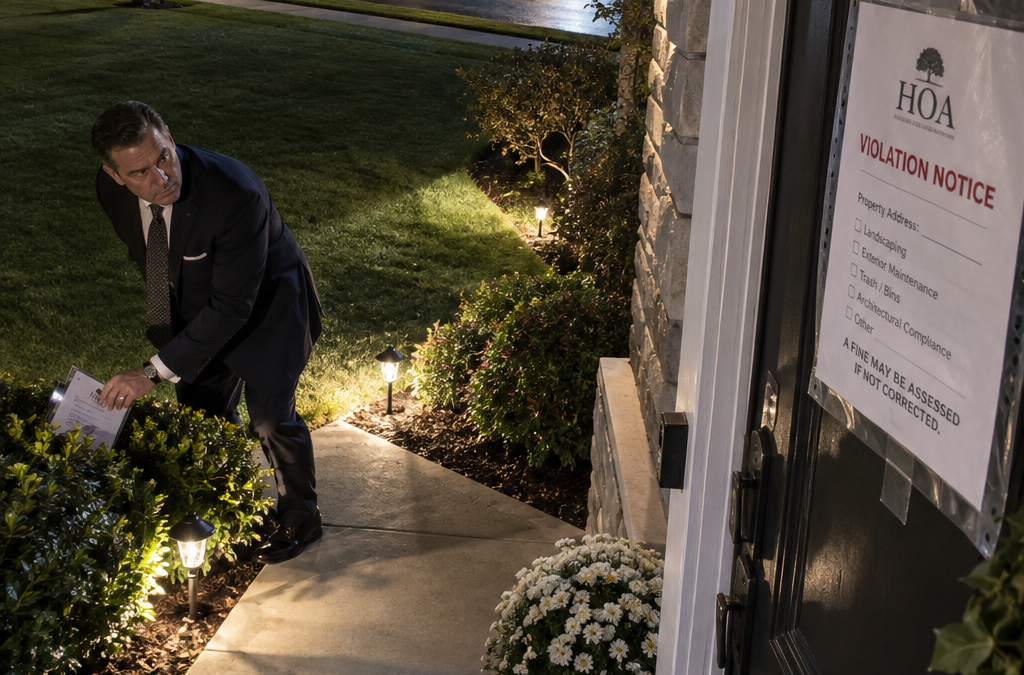
It had been taped to my front door sometime before sunrise, sealed inside a clear plastic sleeve with the Sunridge Estates Homeowners Association logo stamped at the top. I found it when I stepped outside to grab the paper before work. The sky was still gray, my coffee was still too hot to drink, and my son Caleb was upstairs getting ready for school.
Three days.
That was all it gave me.
Three days to pay eleven hundred dollars in alleged violations, late fees, administrative charges, and enforcement penalties.
Three days before the HOA could begin formal lien enforcement against my home.
My name was printed beneath the warning.
Matthew Reyes.
My address.
My house.
The same house I had bought after twelve years of working nights, weekends, and overtime. The same house I had promised Caleb would be ours for good after his mother and I split up. The same house with the small backyard where he had taught himself to throw a baseball against the fence, missing the strike zone more often than hitting it, laughing every time the ball bounced back toward him.
I read the notice once.
Then again.
The second time, the numbers blurred.
I set the paper on the kitchen table because my hands had started shaking.
Caleb came downstairs with his backpack hanging off one shoulder and one sneaker untied.
“Dad?”
I folded the notice quickly.
“Yeah?”
“You okay?”
I looked at him and forced my face to relax.
“Fine. Just HOA stuff.”
His expression changed.
At thirteen, Caleb was old enough to know when “HOA stuff” meant trouble.
“Is it about the lawn again?”
I didn’t answer fast enough.
He looked toward the window over the sink, where the front yard was visible through the blinds.
“It doesn’t even look bad.”
“I know.”
“Then why do they keep saying it does?”
I opened my mouth.
Nothing useful came out.
Because the honest answer was that Diane Foster had picked me.
And once Diane picked someone in Sunridge Estates, the rules became whatever she needed them to be.
Six months earlier, I thought Sunridge was just a quiet cul-de-sac with decent schools.
That was why I bought there.
Good middle school.
Low traffic.
Clean streets.
Mature trees.
A community pool Caleb could use in summer.
It looked like the kind of neighborhood where people waved while walking dogs and borrowed ladders from each other without turning it into a contract.
The real estate brochure described Sunridge Estates as “family-focused living with shared standards.”
That sounded reasonable.
I had no problem with shared standards.
I kept my yard decent.
I didn’t leave junk in the driveway.
I paid my bills.
I was not the kind of person who wanted to fight with neighbors over trash cans and grass height.
Diane Foster understood that kind of person perfectly.
People like me were her easiest targets.
We wanted peace badly enough to pay for it at first.
Diane had been president of the Sunridge Estates HOA board for nine years when I moved in. Some neighbors said eleven. Others said it felt like thirty. Nobody seemed entirely sure anymore because she had become less like an elected officer and more like weather.
You didn’t question why storms happened.
You just prepared for them.
Diane was around fifty, maybe a little older, with sharp blond hair cut just above her jaw and sunglasses she wore even under cloudy skies. She dressed like every sidewalk inspection was a business meeting: pressed slacks, crisp blouses, leather flats, and a clipboard tucked against her ribs.
That clipboard was famous.
Black.
Metal clip.
Neatly labeled tabs.
People joked about it in low voices, but only when she wasn’t around.
Diane ran the board like a tiny dictatorship with better landscaping.
She didn’t yell.
That was part of what made her dangerous.
She smiled.
She tilted her head.
She said your name softly while explaining that the violation was unfortunate, really unfortunate, but standards were standards, and once exceptions were made, community integrity began to decay.
She could make a trash can sound like a moral collapse.
The first fine arrived three weeks after Caleb and I moved in.
Fifty dollars.
Trash bin placed at the curb two hours before the permitted time.
I stared at the notice in my kitchen and laughed.
Two hours.
I had rolled the bin out before leaving for work because my shift started early. Apparently, pickup day rules allowed bins at the curb only after six in the evening. I had put mine out at four.
I thought it was ridiculous, but fifty dollars was not worth starting a fight.
So I paid it.
That was my first mistake.
My neighbor Sophia told me that over the back fence two nights later.
Sophia lived directly behind me in a pale yellow ranch house with a wheelchair ramp leading from the driveway to the front porch. Her mother, Mrs. Alvarez, lived with her and used the ramp every day. Sophia had kind eyes, dark hair always tied back in a clip, and the tired patience of someone who had spent too long dealing with unreasonable people.
She saw me repairing a loose sprinkler head and called over the fence.
“You paid Diane’s first fine, didn’t you?”
I looked up.
“How did you know?”
She gave me a look that was half sympathy, half warning.
“Because she always starts with something small.”
“It was fifty dollars.”
“It’s never about the fifty dollars.”
I stood and wiped my hands on a rag.
“Then what is it about?”
Sophia glanced toward the street, even though Diane was nowhere in sight.
“Control.”
I smiled because I thought she was being dramatic.
She didn’t smile back.
“She picks someone new every spring,” Sophia said. “This year it’s you.”
I laughed.
Not because I thought she was funny.
Because I didn’t want to believe her.
“I’m not worth picking.”
“That’s what everyone thinks at first.”
A week later, the second fine arrived.
Grass height violation.
Seventy-five dollars.
According to the notice, my lawn was half an inch over the approved maximum.
Measured with a ruler, Diane wrote in the violation notes.
There was even a photograph attached.
A ruler pressed into my grass near the mailbox.
I stood in the yard holding the letter and looking at the patch she had photographed.
The grass looked like every other lawn on the block.
Maybe a little uneven near the curb because the sprinkler coverage there was weak, but not neglected. I mowed every weekend. Sometimes twice if it rained.
Still, I paid that one too.
I told myself I was buying quiet.
But compliance did not make Diane leave me alone.
It made me look useful.
By the end of the first month, I had five citations in my mailbox.
Trash bin.
Grass height.
Mailbox flag not restored to resting position within twenty-four hours.
Garden hose visible from the street.
Porch light fixture inconsistent with approved bronze finish.
Each notice demanded a check.
Each was vague enough to be hard to disprove and official enough to feel dangerous.
The porch light one made me angry.
It had been installed before I bought the house. I found the original product information in a folder left by the previous owner. The fixture came from the HOA’s own approved exterior catalog.
I was standing on my porch one evening when Diane came down the sidewalk with her clipboard and phone.
She stopped in front of my house.
Raised the phone.
Took a picture of the light.
“Evening, Diane,” I said.
She smiled without lowering the phone.
“Matthew.”
“What’s wrong with the porch light?”
“The finish is inconsistent.”
“It’s from the approved catalog.”
“It may have been approved at one time.”
“Has the catalog changed?”
“The board periodically reviews architectural standards.”
“Can I see the updated standard?”
She took another picture.
“The office can provide relevant materials upon request.”
“I requested them last week.”
“Then I’m sure someone will respond.”
Her voice was sweet enough to rot teeth.
I stepped down from the porch.
“Diane, I’m trying to follow the rules. But you keep citing me for things nobody can explain.”
Her smile tightened.
“You seem to be taking this personally.”
I stared at her.
“You’re standing in front of my house photographing a light you approved.”
“I did not personally approve your light fixture.”
“The HOA did.”
“The HOA approval history of previous owners does not exempt current residents from compliance.”
I almost laughed.
Instead, I looked at the clipboard under her arm.
“Do you have a record showing this fixture is no longer approved?”
Her sunglasses reflected my own porch back at me.
“Matthew, people who choose to live in Sunridge Estates agree to maintain community standards. If that feels burdensome, perhaps this wasn’t the right neighborhood for you.”
There it was.
The threat beneath the politeness.
Maybe you do not belong here.
Maybe you should leave.
She took one final picture and walked away.
That night, after Caleb went to bed, I sat at the kitchen table with every notice spread in front of me.
I remembered what Sophia had said.
She picked someone new every spring.
This year it was me.
I did something I should have done from day one.
I ordered a cheap trail camera online.
Nothing fancy.
Motion activated.
Night vision.
Weatherproof.
When it arrived, I mounted it under the eaves near the garage, angled toward the front yard and porch.
I told Caleb it was for package theft.
That was partly true.
Mostly, it was for Diane.
I started keeping a folder.
Not a physical one at first.
A digital one.
I labeled it simply:
EVIDENCE.
Photos of my lawn.
Photos of my trash cans.
Photos of the porch light.
PDFs of every notice.
Screenshots from the HOA portal.
Dates.
Times.
Payment confirmations.
Emails requesting rules.
Emails receiving no answers.
A spreadsheet tracking each citation.
If Diane liked paper trails, I would build one too.
Two weeks later, the trail camera caught something I never expected.
I had gone to bed early after a long day. Caleb was asleep. The house was quiet.
The camera sent an alert at 2:13 a.m.
I didn’t see it until morning.
At first, I thought it was an animal.
Maybe a raccoon near the bushes.
I opened the clip while standing at the kitchen counter with a cup of coffee.
The black-and-white footage showed the front yard under the soft glow of the streetlight.
A figure entered from the left side of the frame.
I leaned closer.
Sunglasses were absent because it was the middle of the night, but the haircut was unmistakable.
Diane Foster.
She walked across my lawn carrying something small in one hand.
She crouched near the side of my house where the sprinkler control box was mounted.
For nearly two minutes, she worked with the panel.
Then she stood, looked toward the porch, and walked away.
I watched the clip three times.
Then I went outside.
The sprinkler timer had been changed.
My watering schedule had been reduced in two zones, including the narrow strip near the curb where Diane kept photographing brown patches.
She had been sabotaging my lawn herself.
Then fining me for the damage she created.
For several minutes, I could not speak.
I just stood beside the control box with my phone in my hand, feeling the kind of anger that makes your vision narrow.
This was not strict enforcement.
It was fabrication.
And it meant every previous notice had to be questioned.
I saved the clip in three places.
My phone.
My laptop.
The cloud folder.
Then I called Sophia.
She came over immediately.
I showed her the footage at my kitchen table.
She watched without blinking.
When it ended, she whispered, “I knew she was dirty, but I didn’t know she was walking into yards at night.”
“Why me?” I asked.
Sophia looked at me for a long moment.
“You really don’t know?”
“No.”
“You declined to sell.”
I frowned.
“What?”
“Your lot.”
I sat back.
Three weeks after I moved in, a man had called asking whether I would consider selling the property. He said he represented a local landscaping and property services company looking to expand its footprint around Sunridge. I thought it was strange because I had just bought the house, but I told him politely that I wasn’t interested.
I had forgotten about it.
Sophia had not.
“Diane’s husband owns Foster GreenScape,” she said.
The name meant nothing to me.
Sophia continued.
“They do landscaping for the HOA.”
I felt my stomach tighten.
“And they wanted my lot?”
“Your lot sits near the service access road. It connects to three common areas. If they controlled it, they could expand equipment storage and staging without having to lease space outside the neighborhood.”
I stared at her.
“That can’t be legal.”
Sophia gave a bitter laugh.
“A lot of things aren’t legal. People do them anyway until someone proves it.”
That afternoon, I dug through old board minutes at the community office.
The office assistant, a young guy named Mark, looked nervous when I asked to review records.
“Diane usually handles that.”
“Is there a rule saying homeowners can’t inspect minutes?”
“No, but—”
“Then I’d like to inspect them.”
He hesitated.
Then led me to a file cabinet.
The minutes were poorly organized.
Some printed.
Some handwritten.
Some missing attachments.
I spent two hours reading.
And there it was.
My name appeared in a board discussion the same week I declined to sell.
Reyes property: compliance concerns to be monitored.
No specific violation.
No explanation.
Just a note.
A flag.
Three days later, Diane cited me for the trash bin.
The timeline made the fines look different.
I wasn’t a careless homeowner.
I was an obstacle.
Diane’s husband wanted my lot.
I refused.
Suddenly, Diane’s clipboard became a weapon.
When I got home, I added the board minutes to the evidence folder.
Then I searched Foster GreenScape.
Registered owner: Thomas Foster.
Diane’s husband.
Business address: same as Diane’s residence.
HOA vendor contracts: landscaping, irrigation maintenance, seasonal planting, common area service.
The company had made money from Sunridge for years.
Now my lot made sense.
It wasn’t just personal.
It was financial.
The fines were pressure.
Pressure to make the house expensive.
Pressure to make life uncomfortable.
Pressure to make selling look easier than staying.
I thought of the lien notice on my kitchen table.
Three days.
Diane was not trying to correct violations.
She was trying to break me.
I began recording every interaction.
Every phone call went to voicemail unless state law required consent, and if recording was an issue, I documented notes immediately after.
Every sidewalk encounter was followed by a written summary.
Every photograph she took, I took one of my own.
Every email was printed.
Every portal message saved.
The folder grew.
So did the fines.
Then came the mandatory HOA compliance training drill.
Diane loved drills.
That was what Sophia called them.
Every year, residents were ordered to attend a compliance education session in the community gym. Diane would stand at a microphone and recite bylaws like scripture. There would be slides about trash placement, mailbox uniformity, lawn health, fence staining, noise procedures, approved fixtures, and community dignity.
Attendance was mandatory.
Failure to attend triggered an automatic fine.
When the notice arrived, I almost threw it away.
Then Sophia texted me.
She’s planning to make an example of you. Public humiliation. Be ready.
I sat on the edge of my bed holding the phone.
Part of me wanted to stay home and take the fine.
The idea of sitting in a gym while Diane smirked at me in front of the neighborhood made my stomach turn.
Then I looked at the hard drive on my desk.
The sprinkler footage was sitting there.
Untouched by Diane.
Unexplained.
Undeniable.
I texted Sophia back.
I’m going.
She replied almost immediately.
Then we need to talk. Tonight.
I went to her house after dinner.
Mrs. Alvarez was in the living room watching television, a blanket over her knees. Sophia made coffee and pulled out a cardboard file box from the hall closet.
“I wasn’t going to drag you into this,” she said.
“I think I’m already in it.”
She opened the box.
Inside were letters.
Photos.
Copies of emails.
Violation notices.
The first set involved Sophia’s wheelchair ramp.
When her mother moved in, Sophia submitted the proper accessibility modification request. The ramp was modest, clean, and professionally installed. Diane delayed approval for weeks, then claimed the railing finish violated community aesthetic guidelines.
Sophia fought.
Diane fined her for the ramp.
Then for a trash bin.
Then for a hedge.
Then for driveway oil stains.
“The ramp?” I asked.
Sophia’s mouth tightened.
“She told me if I didn’t like the rules, maybe Sunridge wasn’t the right place for my mother’s condition.”
I felt heat rise in my face.
“She said that?”
“Not in writing, of course.”
She pulled another file.
“Then there’s the Parkers. They asked about selling last year. Diane’s husband offered to buy low. They refused. Within two months, they had eighteen citations.”
“What happened?”
“They sold to him.”
I stared at the paper.
She nodded grimly.
“Not directly. Through a holding company. But it traces back.”
Three other families had similar stories.
Fines timed around property inquiries.
Pressure to sell.
Offers from companies tied to Foster GreenScape or its affiliates.
Violations that disappeared once a sale was underway.
A pattern emerged so clearly that we both sat in silence after laying the documents across her dining room table.
Sell to Diane’s husband’s company at a “fair price,” or drown in violations until you did.
That was the scheme.
My house was next.
I hired Priya Anand the following morning.
Priya was a real estate attorney known for handling HOA fraud and property abuse cases. Her office was downtown, tucked into the third floor of an older building with exposed brick walls and glass conference rooms.
She greeted me with a firm handshake and a direct gaze.
“You brought documents?”
“I brought everything.”
She read in silence for nearly an hour.
The fines.
The postmarked notices.
The unanswered rule requests.
The board minutes flagging my name.
The Foster GreenScape records.
Sophia’s ramp file.
The other families.
The sprinkler footage.
When Diane appeared in the video at 2:13 a.m., Priya paused it.
Then played it again.
Then once more.
Finally, she looked up.
“This isn’t a nuisance case.”
I swallowed.
“What is it?”
“This is racketeering.”
The word hit the room like thunder.
Priya clarified immediately.
“We will need to establish the facts and the legal claims carefully. But based on what you’ve shown me, this appears to be a coordinated pattern: fraudulent fines, abuse of HOA authority, pressure to force property sales, financial benefit to an affiliated business, and possible misuse of association funds.”
I sat back.
For months, I had felt like a man being crushed by paperwork.
Priya had just named the machine.
“What do we do?”
“We file a formal complaint with the state HOA oversight board. We request emergency intervention regarding the lien. We preserve evidence. We notify the appropriate authorities about the potential financial misconduct.”
She tapped the sprinkler footage.
“And we do not warn Diane more than the law requires.”
“The training drill is in two days.”
Priya looked at me.
“Good.”
I frowned.
“Good?”
“She plans to humiliate you publicly?”
“That’s what Sophia says.”
Priya closed the folder.
“Then we let her create the audience.”
I did not sleep much before the drill.
The lien deadline sat in my mind like a clock.
Three days had become two.
Then one.
Caleb knew something was wrong, though I tried to shield him from most of it.
The night before the training, he found me at the kitchen table surrounded by papers.
He stood there in sweatpants and an old soccer shirt.
“Dad?”
“Yeah?”
“Are we going to lose the house?”
I froze.
“Who told you that?”
“Nobody. I saw the notice.”
I closed my eyes.
Of course he had.
I had been so careful in some ways and careless in others.
He sat across from me.
“Is it because of the grass?”
“No.”
“Then why?”
I looked at my son.
He had grown taller that year.
His face was changing from boy to teenager, but in that moment he looked small again.
“It’s because someone is using rules the wrong way.”
“Can you stop her?”
I wanted to say yes.
Instead, I said, “I’m trying.”
He looked at the papers.
“Can I help?”
I almost smiled.
“You can keep being you.”
“That’s not very helpful.”
“It helps me.”
He rolled his eyes, but his mouth twitched.
Then he looked serious again.
“Dad?”
“Yeah?”
“Don’t let her take our house.”
I reached across the table and gripped his hand.
“I won’t.”
I said it before I knew whether it was true.
Then I decided it had to be.
The compliance training drill took place in the Sunridge community gym.
By six-thirty, the parking lot was full.
Residents streamed through the doors carrying water bottles, purses, notebooks, and the weary expressions of people attending a mandatory lecture they resented but feared skipping.
Inside, rows of folding chairs filled the basketball court.
Nearly two hundred residents came.
At the front stood a portable stage, a projector screen, a podium, and Diane Foster’s favorite weapon: a microphone.
Diane entered at 6:58 p.m.
She wore a cream blazer, black slacks, and sunglasses pushed up onto her head like a crown. Her clipboard rested under one arm. Behind her stood two private security guards she often hired for “large meetings,” both wearing cheap black jackets with SECURITY printed across the back.
I sat near the middle with Sophia beside me.
Priya stood in the back row, calm and expressionless.
Three rows ahead, a man I didn’t recognize sat quietly in a gray jacket. Priya had pointed him out when we entered.
“State auditor,” she whispered.
I tried not to look again.
Diane had no idea.
She stepped to the microphone.
The room quieted.
“Good evening, residents of Sunridge Estates.”
Her voice filled the gym.
“As many of you know, community dignity does not maintain itself. It requires vigilance, cooperation, and the willingness to hold one another accountable.”
She clicked to the first slide.
A picture of a trash bin appeared.
A few people sighed.
Diane continued for ten minutes.
Trash.
Grass.
Paint.
Lighting.
Mailboxes.
Sprinklers.
Then her tone changed.
“Unfortunately, some residents have mistaken private preference for community entitlement.”
Sophia stiffened beside me.
Diane’s eyes scanned the room.
Then landed on me.
“Rule violators cost this community its dignity.”
People turned.
I felt every eye.
My throat went dry.
Diane smiled.
“There are homeowners who repeatedly refuse correction, ignore notices, and then claim victimhood when enforcement reaches its lawful conclusion.”
She didn’t say my name.
She didn’t need to.
My heart pounded so hard I could hear it.
For one terrible second, I felt myself shrinking under the room’s attention.
Then Priya stood in the back row.
Her voice was calm.
“Before you continue, Ms. Foster, would you like to explain the sprinkler footage?”
The room went silent.
Diane’s smile cracked.
“What?”
Priya walked down the aisle with measured steps.
“The footage showing you on Matthew Reyes’s property at 2:13 a.m., adjusting his sprinkler timer days before fining him for lawn damage.”
Every head turned from me to Diane.
For the first time since I had known her, Diane Foster looked genuinely surprised.
She recovered quickly.
“I have no idea what you’re referring to.”
Priya looked at me.
I stood.
My legs felt unsteady, but I kept moving.
I walked to the projector table with my phone and the adapter Priya had told me to bring.
Diane stepped away from the podium.
“This is not on the agenda.”
Priya replied, “Neither is fraud, but here we are.”
A murmur moved through the gym.
I connected my phone.
The video appeared on the screen.
Black-and-white footage.
My yard.
My sprinkler box.
Diane walking across the lawn at 2:13 a.m.
Diane opening the panel.
Diane changing the timer.
Diane looking toward the porch before leaving.
Gasps spread across the room.
Someone whispered, “Oh my God.”
A coffee cup hit the floor somewhere to my left.
Sophia whispered, “Play it again.”
So I did.
This time the room stayed completely silent.
When it ended, Diane laughed.
It was a sharp, unnatural sound.
“That is doctored.”
I disconnected my phone instinctively as she moved toward me.
She reached for it.
Priya stepped between us.
“Do not touch my client’s property.”
Diane’s private security guards took one uncertain step forward.
Then the man in the gray jacket stood in the third row.
He opened his jacket and displayed identification.
“State HOA oversight audit division.”
The room erupted.
The private security guards froze.
Diane’s face went pale.
The auditor moved toward the aisle.
“We have already received the original video file and metadata. We have also received the financial documents concerning Foster GreenScape and multiple complaints from Sunridge residents.”
Diane gripped her clipboard.
“This is outrageous.”
The auditor continued, “Ms. Foster, you are advised not to alter or destroy association records.”
At that moment, Diane backed away from Priya and stumbled into a folding chair.
The metal legs scraped loudly against the gym floor.
The chair tipped.
Diane caught herself on the podium.
Caleb would later laugh harder at that part than at anything else in the story.
In the moment, nobody laughed.
We were all watching a woman lose control of a room she had ruled for years.
County security entered through the side doors.
Not Diane’s rent-a-cop guards.
Real county security called in by the auditor because Priya had warned them Diane might try to disrupt or remove records.
Two officers approached the stage.
Diane raised her clipboard as if it could protect her.
“This meeting is adjourned,” she snapped.
“No,” someone shouted from the back. “It’s finally starting.”
That broke the room open.
Residents stood.
Voices rose.
Sophia stepped forward and held up her ramp file.
“You fined me for my mother’s wheelchair ramp!”
Another woman stood.
“You forced the Parkers to sell!”
A man near the front shouted, “Where are the reserve fund audits?”
Diane tried to speak into the microphone, but the sound had been cut.
Her mouth kept moving.
No authority came out.
One of the county officers escorted her away from the podium.
Her clipboard slipped from under her arm and hit the gym floor with a flat clatter.
That sound was small.
But after months of fines and threats, it felt enormous.
Like a door unlocking.
The days that followed were a storm.
The HOA oversight board opened a formal review.
Priya filed emergency documents challenging the lien against my property.
The board, suddenly terrified of being tied to Diane’s misconduct, voted to suspend all enforcement actions connected to her disputed citations.
My lien vanished before the three-day deadline could become a foreclosure nightmare.
Not reduced.
Not negotiated.
Wiped.
My record was cleared.
The sprinkler violation was removed.
The porch light fine reversed.
The grass citations invalidated.
The trash penalties placed under review.
For the first time in six months, my house stopped feeling like a hostage.
The investigation widened quickly.
Seven households filed civil claims.
Sophia was one of them.
The Parkers joined too.
So did two families I had never met but whose stories matched ours almost perfectly.
Pressure to sell.
Suspicious fines.
Offers from companies connected to Diane’s husband.
Delays in financial disclosures.
Retaliation after questions.
Foster GreenScape’s contracts came under scrutiny.
So did the reserve fund audits.
Within weeks, Diane was removed from the board permanently.
Then came the indictment.
Embezzlement of HOA reserve funds.
Fraudulent enforcement practices.
Conspiracy-related financial charges tied to property acquisition pressure.
The legal process would take time, Priya reminded us. Charges were allegations until proven. But the system had finally stopped treating Diane as the person who made the rules and started treating her as someone who might have broken them.
When her mugshot appeared in the local news, Caleb stared at the screen.
“That’s her?”
“Yes.”
“She looks different without the clipboard.”
I laughed for the first time in days.
“She does.”
Sunridge changed after Diane.
Not magically.
People who had been afraid for years did not become trusting overnight.
The first new board meeting was awkward.
Residents asked hard questions.
Where were the audits?
Who approved Foster GreenScape contracts?
How many liens had been filed under Diane?
How many fines were unsupported?
Who would review past enforcement?
The new temporary board answered as much as it could and promised outside review for the rest.
For once, nobody said “board discretion” and expected that to end the conversation.
Sophia’s ramp approval came through two weeks later.
No fine.
No delay.
No railing finish objection.
When the approval email arrived, she walked over with tears in her eyes.
“They approved it.”
I smiled.
“Good.”
“My mother cried.”
“She deserves the ramp.”
Sophia nodded.
Then looked toward my yard.
“You deserve your house.”
I thought about the lien notice.
Three days.
Eleven hundred dollars.
The weight of that paper on my kitchen table.
“Yeah,” I said. “I think I do.”
My house felt different after that.
Not because the walls changed.
Because the fear left slowly, room by room.
The kitchen became a kitchen again, not a place where legal notices spread across the table.
The porch became a porch again, not a lookout post for Diane’s inspections.
The lawn became grass, not evidence.
One Saturday morning, Caleb and I fixed the sprinkler timer together.
He held the flashlight even though it was daylight because he insisted it made him part of the operation.
“So she really came here at two in the morning?” he asked.
“Yep.”
“To mess with this?”
“Yep.”
He shook his head.
“That’s so weird.”
“It is.”
“Adults are disappointing.”
I looked at him.
“Frequently.”
He grinned.
We reset the timer.
Then stood back and watched the sprinklers turn on.
Water arced across the lawn in clean, even lines.
The brown patch near the curb would take time to recover, but it would recover.
So would we.
A month later, Sunridge held a community barbecue.
Not mandatory.
No training drill.
No compliance lecture.
Just folding tables, burgers, music, and kids running around the grass behind the clubhouse.
The same gym where Diane had tried to humiliate me stood nearby, doors propped open.
I could see the court inside.
The spot where the folding chair had tipped.
The place where her clipboard hit the floor.
Sophia stood beside me with a paper plate.
“Do you ever think about moving?” she asked.
I looked around.
Caleb was tossing a football with two boys from the next street.
Mrs. Alvarez sat beneath a canopy, laughing with another older woman.
Neighbors who once avoided eye contact were talking openly.
“No,” I said.
She smiled.
“Good.”
“I almost did.”
“I know.”
“I almost thought staying wasn’t worth it.”
“That’s how she won before.”
I nodded.
Diane’s power had never really been in the rules.
It had been in exhaustion.
She made people tired.
Confused.
Embarrassed.
Afraid.
Then offered escape in the form of a sale.
I wondered how many families had left believing they had failed, when really they had been cornered.
That thought still made me angry.
But anger no longer owned the house.
That evening, after the barbecue, Caleb and I drove home through the quiet streets of Sunridge Estates.
The cul-de-sacs looked the same as they had when we first arrived.
Trimmed lawns.
Porch lights.
Mailboxes.
Sprinklers ticking softly in the dark.
But I saw the neighborhood differently now.
Not as a perfect place.
As a place people had taken back.
When we pulled into the driveway, Caleb looked toward the front yard.
“Grass looks good.”
I laughed.
“Thanks.”
“No brown patches.”
“Give it time.”
He grinned.
Inside, I placed the old lien notice in the evidence folder.
I kept it.
Not because I wanted to remember the fear.
Because I wanted to remember the lesson.
Paper can threaten you.
But paper can also save you.
Dates.
Photos.
Minutes.
Metadata.
Contracts.
Receipts.
Records.
Diane had used paperwork to build a false story.
We used evidence to tear it apart.
I closed the folder and placed it on the shelf in my office.
Beside it sat a small framed photo of Caleb standing in front of the house on moving day.
He was smiling, one hand on the sold sign, proud like he had bought the place himself.
I looked at that photo for a long time.
Then I turned off the office light.
The next morning, I woke early.
No notice on the door.
No email from the HOA portal.
No certified letter waiting at the kitchen table.
Just sunlight through the blinds and the smell of coffee brewing.
I walked outside barefoot.
The sprinklers had run on schedule.
The porch light looked exactly the same shade of bronze it always had.
The trash bin was tucked beside the garage.
The lawn was still recovering, but green was returning where Diane had tried to manufacture neglect.
Sophia waved from her yard.
I waved back.
For six months, Diane Foster had tried to convince me this house was only mine if she allowed it.
She was wrong.
It was mine because I bought it.
Because I maintained it.
Because my son slept inside it.
Because our life existed behind its walls.
No clipboard could change that.
No staged violation.
No fake compliance drill.
No lien notice with a three-day deadline.
Justice did not roar into Sunridge Estates all at once.
It arrived through a cheap trail camera, a careful neighbor, a good attorney, and a room full of residents who finally stopped looking down.
Diane thought she was going to make an example of me.
Instead, she became the example.
And the space she left behind, that Diane-shaped hole nobody missed, became something better than silence.
It became room for all of us to breathe.








