𝗙𝗨𝗟𝗟 𝗦𝗧𝗢𝗥𝗬 The HOA President Called 911 the Moment She Saw My Classic Car Sitting Inside My Garage
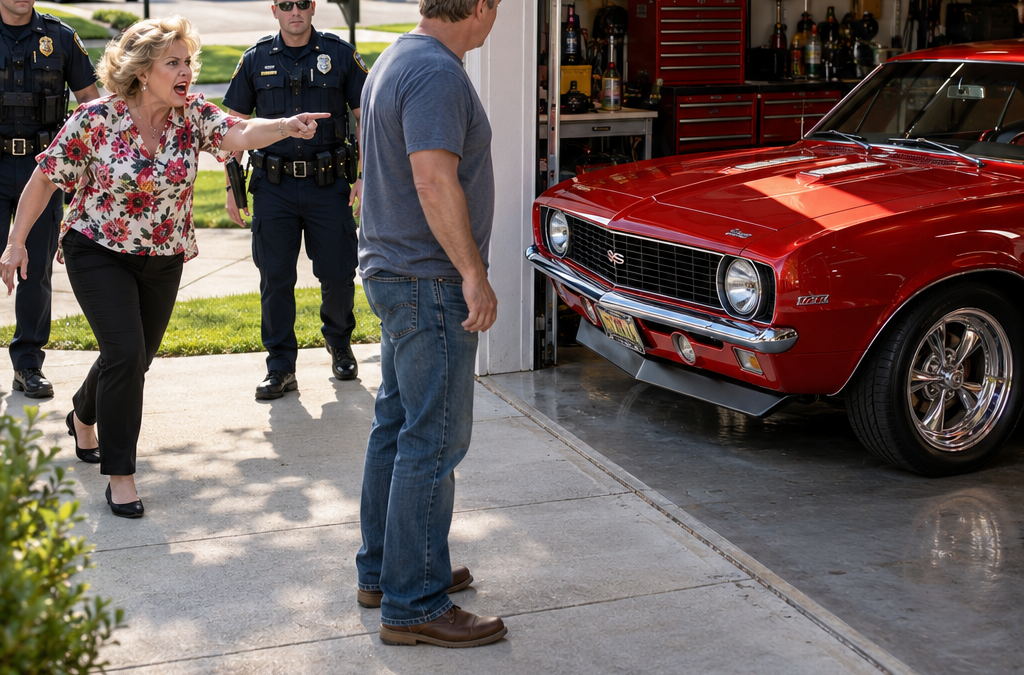
𝗙𝗨𝗟𝗟 𝗦𝗧𝗢𝗥𝗬
Part of me wanted to walk inside and close the garage door.
Another part understood immediately how that would look.
Woman accuses neighbor of possessing stolen vehicle.
Neighbor closes garage.
Refuses discussion.
Potentially hides evidence.
No.
I wasn’t giving the situation that shape.
So I stood there while Linda called 911.
She told the dispatcher someone had stolen her recently purchased vehicle.
She gave my address.
Described the car.
Red.
Classic muscle car.
Inside the garage.
Then she looked directly at me while saying:
“Yes, I can see it right now.”
I folded my arms.
She continued.
“The person who has it is standing here.”
Person.
Not neighbor.
Not man who had owned the car for years.
Person who has it.
That was how quickly a story could change someone’s identity.
When she ended the call, I said:
“You know I’m your neighbor.”
“I know exactly who you are.”
“Then maybe you should think for five seconds.”
“I don’t need to.”
“Apparently.”
She glared.
“You’re going to regret being smug when they run the vehicle.”
I almost laughed.
That was the one thing I wanted.
“Please let them.”
She seemed confused by that.
Good.
I walked toward the garage.
Linda stepped forward.
“Don’t touch it.”
I stopped.
“Excuse me?”
“Don’t move the vehicle.”
“I’m not moving anything.”
“You were going toward it.”
“I’m getting the VIN.”
She folded her arms.
“They’ll do that.”
“Fine.”
I stayed outside.
A few neighbors had noticed.
Of course they had.
Nothing draws attention in a quiet neighborhood like someone loudly accusing another person of grand theft auto.
A woman across the street stood near her mailbox.
A teenager slowed his bicycle.
Somebody farther down opened a front door and didn’t close it.
I hated that part immediately.
I didn’t care about arguing with Linda.
I cared about the way an accusation traveled before facts.
Nobody knew what happened.
But they could see her anger.
My open garage.
The red car.
They could hear the word stolen.
That was enough to create curiosity.
Curiosity quickly becomes speculation.
I kept reminding myself:
The VIN will settle it.
Not my voice.
Not hers.
The VIN.
A few minutes later, the first patrol car turned onto our street.
Then another.
Two officers stepped out.
One introduced himself as Officer Reed.
The other was Officer Miller.
Neither approached like television cops expecting danger.
No weapons drawn.
No shouting.
They looked at the car.
Then Linda.
Then me.
Officer Reed said:
“Who called?”
“I did.”
Linda stepped toward him.
“That’s my car.”
He held up a hand.
“Okay. Let’s slow down.”
She pointed.
“I bought that vehicle this week. He somehow has it inside his garage.”
Officer Miller looked at me.
“Sir?”
“I’ve owned that vehicle for years.”
“Do you have paperwork?”
“Inside.”
Linda interrupted.
“I have mine right here.”
She reached into her purse and pulled out a thick envelope.
Her confidence returned immediately.
That was what fascinated me later.
Until that moment, her entire accusation rested on visual similarity.
But the second she touched the paperwork, she became almost triumphant.
She genuinely believed the documents would end the discussion.
Maybe that’s why I stopped feeling angry for a moment.
I started feeling curious.
What exactly had she bought?
Officer Reed took her papers.
Bill of sale.
Purchase agreement.
Vehicle description.
He scanned the first page.
Then asked:
“When did you purchase this?”
“Tuesday.”
“From a dealership?”
“Private specialty seller.”
“Vehicle delivered yet?”
Linda hesitated.
“Not exactly.”
That was the first detail that sounded strange.
Officer Reed looked up.
“What does that mean?”
“It was supposed to be transported.”
“So you never took physical possession?”
“I inspected a similar vehicle.”
“Similar?”
Her expression tightened.
“The vehicle I bought.”
Officer Reed glanced at the red car inside my garage.
“You personally inspected this one?”
“Yes.”
“Here?”
“No.”
“Where?”
“At the seller’s property.”
I looked at her.
That alone should have ended the certainty.
If she had inspected a car somewhere else, how could she know mine was the same car based only on paint and body shape?
But people don’t abandon conclusions easily after announcing them loudly.
Officer Reed flipped through the paperwork.
Then asked:
“Where’s the VIN?”
Linda immediately pointed.
“There.”
Seventeen digits.
Officer Reed wrote them down.
Then looked toward me.
“Can we check the VIN on your vehicle?”
“Absolutely.”
I opened the garage farther.
“Go ahead.”
Linda followed two steps.
Officer Miller asked her to remain outside the garage until ownership was sorted.
She looked offended.
“It’s my vehicle.”
“That’s what we’re determining.”
Officer Reed leaned toward the windshield.
Checked the VIN plate.
Then the paperwork.
Then looked again.
I watched his face.
Neutral.
Professional.
He didn’t react dramatically.
Didn’t announce anything.
He simply asked:
“Ms. Harper, can I see the purchase document again?”
She handed it over.
“What?”
He compared.
Then said:
“The VIN numbers don’t match.”
Silence.
Linda blinked.
“What?”
“The VIN on this vehicle is not the VIN listed on your paperwork.”
“That’s impossible.”
He read the last six digits from her purchase document.
Then indicated the number on my car.
Different.
Completely.
Not one typo.
Not a transposed digit.
Different vehicle identification number.
Linda shook her head.
“No. The seller must have entered it incorrectly.”
Officer Reed remained calm.
“Possible.”
She relaxed slightly.
“But it means your paperwork does not identify this vehicle.”
Her confidence returned to irritation.
“It’s the same car.”
“Ma’am, the VIN exists specifically to identify the individual vehicle.”
“I understand what a VIN is.”
“Then you understand why this matters.”
She looked at me.
“He changed it.”
That accusation was so outrageous that even Officer Miller’s expression shifted.
I stared.
“Changed what?”
“The VIN.”
I almost laughed.
“You think I replaced a federal vehicle identification number because you bought a red car on Tuesday?”
“I don’t know what you’ve done.”
Officer Reed stepped in.
“Let’s not make additional accusations without evidence.”
Linda threw up her hands.
“I’m telling you, that’s the car.”
Officer Miller asked:
“Do you have photographs from the sale?”
Linda began searching her phone.
While she did, Officer Reed turned to me.
“You said you have title and registration?”
“Yes.”
“Can you bring them out?”
“Of course.”
I went inside.
Walking away from the driveway felt strange.
Not because I worried they would take the car.
Because this absurd accusation had made me suddenly aware of every piece of evidence I possessed.
I entered my office.
Opened the drawer.
Pulled out the vehicle folder.
Original title.
Current registration.
Insurance.
Maintenance invoices.
Old registration renewals.
Inspection records.
Receipts for tires.
Brake service.
Cooling-system work.
Transmission fluid change.
Battery purchase.
Everything.
I stood there holding the folder and thought:
This is ridiculous.
Then another thought followed.
Ridiculous accusations can still create serious problems if nobody checks.
So I took everything.
When I returned, Linda was showing Officer Miller a photograph on her phone.
Red muscle car.
Same generation.
Same general body style.
Even similar wheels.
I understood the mistake immediately.
At a glance, they looked extremely similar.
But classic-car owners notice differences ordinary buyers don’t.
Mirror style.
Interior trim.
Wheel design.
Badging.
Small paint variations.
My car had a tiny chip near the driver’s-side headlight.
The photographed vehicle didn’t.
Linda pointed at the image.
“Tell me that isn’t the same car.”
I looked.
“It isn’t.”
She laughed.
“Of course you’d say that.”
Officer Miller looked between the photograph and my garage.
“Very similar.”
“Yes.”
I held out my folder.
“But not the same vehicle.”
Officer Reed took my title.
Read the VIN.
Walked to the car.
Compared.
Perfect match.
Then registration.
Match.
Insurance record.
Match.
Maintenance invoice from four years earlier.
Same VIN.
Another from three years earlier.
Same VIN.
Emissions record.
Same VIN.
The history went backward years.
Long before Linda’s Tuesday purchase.
Officer Reed placed the documents on the hood of his patrol car and organized them chronologically.
I appreciated that.
No performance.
No immediate verdict.
Just records.
Linda watched.
Her expression changed slowly.
Not defeat yet.
Confusion.
“How long have you owned it?” Officer Reed asked me.
“Years.”
“Title transferred when?”
I gave him the approximate year.
He checked.
Consistent.
“Any recent transfer?”
“No.”
“Vehicle ever stolen?”
“Never.”
“Any title dispute?”
“No.”
He nodded.
Then turned to Linda.
“His title matches this VIN.”
She crossed her arms.
“Then something is wrong with the seller’s paperwork.”
“That’s possible.”
“But this still could be my car.”
“No.”
Officer Reed said it more firmly this time.
“The vehicle physically present here matches his title, registration, insurance, and years of maintenance records.”
“But the seller—”
“Your purchase document identifies a different VIN.”
Linda stared.
Officer Miller asked:
“Ms. Harper, where is the car you bought supposed to be right now?”
She looked at him.
“The seller arranged delivery.”
“When?”
“This weekend.”
That detail changed everything.
Officer Miller’s eyebrows rose.
“So your vehicle hasn’t even been delivered?”
“I thought it had been taken.”
“From where?”
“The seller’s lot.”
“You were told it was stolen?”
“No.”
“Then why did you think this vehicle was yours?”
Linda opened her mouth.
Then looked toward mine.
“It looks exactly like it.”
Officer Reed said:
“That isn’t enough.”
“I paid for a red car just like that.”
“Many vehicles can share make, model, year, and color.”
“Not classics like this.”
I stepped in.
“Especially classics like this.”
She snapped:
“Stay out of this.”
“It’s my driveway.”
Officer Reed held up a hand.
“Everyone relax.”
I stopped.
Linda paced once.
Then said:
“Call the seller.”
Officer Miller replied:
“That’s what I was going to suggest.”
She looked annoyed that he made it sound like his idea.
She dialed.
Put the call on speaker after Reed asked.
A man answered.
Linda identified herself.
Then immediately said:
“The car I purchased has been found at my neighbor’s house, but police are saying the VIN doesn’t match.”
There was a pause.
The man said:
“Ms. Harper, your car hasn’t been shipped yet.”
Nobody spoke.
Linda’s face went blank.
“What?”
“Transport pickup is scheduled tomorrow morning.”
“That’s impossible.”
“No, ma’am.”
“I’m standing in front of it.”
“No, you’re not.”
Officer Reed looked at me.
I looked away.
The seller continued:
“Your vehicle is still here.”
Linda turned slightly from us.
“But it’s red.”
“Yes.”
“Same body.”
“I assume there are many similar examples.”
“You showed me photos.”
“Of the vehicle you bought.”
“What’s the VIN?”
He read it.
It matched Linda’s paperwork.
Not mine.
Officer Miller wrote it down.
Then asked:
“Sir, can you confirm the vehicle with that VIN is physically in your possession?”
The seller hesitated.
“Who is this?”
“Officer Miller. Local police.”
Another pause.
“Yes. The vehicle is here.”
Linda looked like someone had pulled the ground away.
She said:
“But why does his look identical?”
The seller replied:
“Because it’s the same year and color combination.”
“It even has the same wheels.”
“Those aren’t rare wheels.”
“I thought—”
The man sighed.
“Ms. Harper, your vehicle has a black interior.”
She looked at mine.
My driver’s window was partly open.
Tan interior.
That should have been obvious.
But certainty changes what people see.
Linda ended the call without thanking him.
For several seconds, nobody spoke.
Then Officer Reed said:
“All right.”
He turned toward me.
“Your ownership checks out.”
“Thank you.”
Then to Linda.
“The vehicle you purchased is apparently still with the seller.”
She didn’t respond.
“There is no evidence this vehicle was stolen from you.”
Still nothing.
Officer Miller added:
“And there is no evidence he committed any theft.”
Linda’s cheeks had gone red.
She looked at my car.
Then at her phone.
Then at the officers.
“I made a mistake.”
It was the first reasonable sentence she had said since walking into my driveway.
I thought that would end it.
It should have.
Instead, she looked at me.
“But you can understand why I thought it was mine.”
I almost admired the instinct.
Not:
I’m sorry I accused you of theft.
Not:
I’m sorry I called 911.
Not:
I’m sorry I suggested you altered the VIN.
But:
You can understand.
She wanted shared responsibility for her certainty.
I chose not to give it.
“I understand the cars look similar.”
She nodded quickly.
“Exactly.”
“I don’t understand calling me a thief before checking the VIN.”
Her face tightened.
“Well, I was upset.”
“I noticed.”
Officer Reed returned my documents.
“Everything looks in order.”
I took them.
“Thank you for checking.”
“Keep these secure.”
“I will.”
He looked at the garage.
“Beautiful car.”
That was the first normal thing anyone had said about it all afternoon.
“Thanks.”
Officer Miller spoke quietly with Linda.
I couldn’t hear every word.
Probably reminding her to verify facts before making future reports.
She nodded.
Not happy.
Not defiant anymore.
Just embarrassed.
The officers wrote down incident information.
Then they left.
One cruiser first.
Then the other.
The neighborhood slowly returned to pretending it hadn’t been watching.
The teenager rode away.
The woman near the mailbox went inside.
A curtain moved across the street.
Linda stood at the edge of my driveway.
I expected an apology.
Maybe that was naive.
She said:
“I hope you understand I had every reason to be concerned.”
I looked at her.
“No, Linda.”
Her face hardened slightly.
“You don’t?”
“You had reason to ask.”
“I did.”
“You didn’t ask.”
She opened her mouth.
“You shouted that I stole your car.”
“I believed—”
“Then called 911.”
“The vehicles looked identical.”
“And after the VIN didn’t match, you suggested I changed it.”
She looked away.
“That was frustration.”
“That was another accusation.”
She said nothing.
I lowered my voice.
“I’m not trying to make this worse.”
“Then why are you lecturing me?”
“Because next time you decide you’re certain about something, somebody else might not have twenty years of paperwork sitting in the house.”
That stopped her.
For a moment.
Then she said:
“There won’t be a next time.”
I hoped she was right.
She crossed the street.
I watched her go.
Then I closed the garage.
The door lowered slowly.
Red hood.
Chrome.
Windshield.
Gone behind metal.
The silence afterward felt heavier than before.
I went inside.
Put every document back into the folder.
Then stopped.
No.
I pulled them out again.
Title.
Registration.
Insurance.
Maintenance records.
I scanned everything.
Saved copies to an encrypted drive.
Uploaded another copy to secure cloud storage.
Took photographs of the VIN.
Windshield plate.
Door-jamb label.
Engine-stamp documentation.
Not because I expected Linda to return with another patrol car.
Because the afternoon taught me how quickly proof can become necessary.
I also wrote down what happened while it was still fresh.
Time I opened the garage.
Approximate time Linda approached.
911 call.
Arrival of officers.
VIN comparison.
Seller’s confirmation.
Officer names.
Everything.
It may sound obsessive.
Maybe it was.
But I work better when chaos becomes documentation.
Once it is written down, it stops moving around in your head.
That evening, I sat in my office with the car folder open.
The oldest maintenance invoice was from years earlier.
Oil service.
Nothing special.
VIN printed at the top.
I smiled.
That boring line had more authority than every accusation Linda made.
Seventeen characters.
That’s what a vehicle identification number is.
A sequence most people never memorize.
Yet those characters are the difference between:
A red classic car.
And:
This specific red classic car.
Ownership depends on specificity.
So does truth.
The next morning, I opened the garage again.
Nobody shouted.
Good start.
Sunlight reached across the hood.
I took out a microfiber cloth and started polishing.
Mostly because it calmed me.
Wax on old paint forces patience.
Small circles.
Light pressure.
No rushing.
I worked across the hood.
Checked chrome.
Then opened the driver’s door.
Tan interior.
I laughed remembering the seller telling Linda hers had black upholstery.
How had she missed that?
Then I stopped laughing.
Because I knew.
She hadn’t really looked.
She had recognized a pattern.
Red body.
Same generation.
Similar wheels.
Then her mind did the rest.
Once she decided the car was hers, every similar detail became proof.
Every difference became something to explain away.
VIN doesn’t match?
Dealership mistake.
My title matches?
Maybe I changed something.
Her car hasn’t been delivered?
Confusion.
That is how certainty protects itself.
It doesn’t ask:
What if I’m wrong?
It asks:
How can I reinterpret this fact so I can remain right?
That lesson bothered me more than Linda’s accusation.
Because I’ve done smaller versions of it myself.
Most people have.
We see something.
Make a conclusion.
Then start collecting evidence that supports the conclusion instead of testing it.
Usually the consequences are minor.
An argument.
Misunderstanding.
Embarrassment.
Linda’s version brought police to my house.
I heard footsteps.
Looked up.
Linda was walking past.
No clipboard.
No HOA binder.
No dramatic pace.
Just walking.
She glanced at the open garage.
Then at me.
Our eyes met.
She gave a small nod.
I nodded back.
No words.
At the time, I thought that would be the end.
It wasn’t completely.
The HOA board became involved because Linda had described the incident to someone as a “vehicle-security issue.”
That phrase found its way into a neighborhood email.
Not accusing me directly.
But close enough.
The email reminded residents to report suspicious activity and mentioned “recent confusion involving a classic vehicle.”
I read it twice.
Then emailed the board.
Short.
Professional.
I asked that the record reflect that police had confirmed my ownership and that there had been no stolen vehicle on my property.
I included the incident number.
No insults.
No attack on Linda.
Just correction.
The board secretary replied the next day.
She apologized for the ambiguous wording.
A corrected email went out:
The recent vehicle matter was determined to be a case of mistaken identification. No theft occurred. The vehicle involved was confirmed to belong to its longtime owner.
Good.
That mattered.
I didn’t need the neighborhood told Linda was foolish.
I needed the neighborhood not thinking I had somehow been involved in a suspicious car dispute.
Reputation can be damaged indirectly.
Nobody has to write:
He stole something.
Sometimes:
There was an incident.
is enough.
So I corrected it early.
Linda didn’t object.
Maybe she had learned something.
A few days later, Dale Peterson from across the street stopped while I was washing the car.
He had lived in the neighborhood almost as long as I had.
“Quite a show the other day.”
I groaned.
“You saw?”
“Everybody saw.”
“Wonderful.”
He smiled.
“I didn’t know Linda had bought a classic.”
“She hasn’t taken delivery yet.”
“Yeah, she told my wife.”
I looked at him.
“What did she say?”
“That the seller gave her confusing paperwork.”
I stopped spraying.
“Confusing?”
Dale shrugged.
“Something like that.”
Of course.
The paperwork wasn’t confusing.
The VIN was right there.
But I didn’t need to chase every version Linda told people.
The corrected HOA email existed.
Police report existed.
My documents existed.
Eventually facts become less exhausting when you stop trying to control every conversation.
Dale walked around the front of my car.
“Her picture did look similar.”
“It did.”
“Same year?”
“Close.”
“Color?”
“Very close.”
He nodded appreciatively.
“Still. Calling police before checking?”
I looked at him.
“That’s the part.”
He smiled.
“Classic Linda.”
Then walked home.
That phrase irritated me.
Classic Linda.
It made the behavior sound harmless.
Quirky.
A personality trait.
Maybe most of the time it was.
But authority changes the cost of personality.
Linda wasn’t just an impulsive neighbor.
She was on the HOA board.
People listened when she spoke.
Police responded because she made a theft report.
A loud assumption from someone with perceived authority can travel farther than an ordinary mistake.
That was why I had insisted on the HOA correction.
Not revenge.
Record.
About a week later, Linda’s new car finally arrived.
I knew because I heard a transport truck outside.
Curiosity won.
I stepped onto my porch.
The transporter lowered a red muscle car.
From a distance?
Yes.
Very similar.
Same general body.
Similar paint.
Similar wheels.
I could see exactly why Linda’s brain had jumped.
Then the driver’s door opened.
Black interior.
Different hood badge.
Different mirror.
Different rear spoiler.
Once you looked for more than five seconds, the differences became obvious.
Linda stood near the truck smiling.
For the first time since our argument, I saw genuine happiness on her face.
She had probably dreamed about buying that car for months.
Maybe that explained some of her panic.
Not excused.
Explained.
The transporter handed her paperwork.
She looked at the VIN.
Then checked the windshield.
Then looked again.
I almost laughed.
Lesson learned.
She noticed me watching.
Our eyes met across the street.
For a second, I considered going inside.
Instead, I walked over.
Her smile faded slightly.
“Nice car.”
She looked surprised.
“Thank you.”
“Seller get the VIN right this time?”
I couldn’t resist.
Her mouth tightened.
Then unexpectedly she laughed.
A real laugh.
“I deserved that.”
“Probably.”
She walked around the car.
“I’m sorry.”
I wasn’t expecting it.
“For what?”
She looked at me.
“For accusing you.”
I said nothing.
“I was certain.”
“I know.”
“Too certain.”
“Yeah.”
She looked toward my garage.
“From the listing photos, I thought it was exactly yours.”
“You mean exactly yours.”
She smiled awkwardly.
“Right.”
Then more seriously:
“I should have checked before calling.”
“Yes.”
“I embarrassed you.”
That was the part she had not acknowledged before.
“Yeah.”
“I’m sorry.”
I nodded.
“Thank you.”
That was enough.
No lecture.
No demand that she apologize to the neighborhood because the HOA already corrected the record.
No punishment.
Just recognition.
She opened the driver’s door.
Black seats.
I pointed.
“Different interior.”
“I know.”
“Now.”
She laughed again.
Maybe that was the actual end of the conflict.
Not the police leaving.
Not the VIN match.
The moment both of us could stand between two red cars and acknowledge that similarity hadn’t made them the same.
Linda became almost obsessive about her paperwork afterward.
I know because she told everybody.
At an HOA meeting a month later, a discussion came up about resident parking permits.
Someone proposed identifying registered vehicles by make, model, and color.
Linda interrupted.
“Add VIN or plate number.”
Several people laughed.
She looked at me.
I was sitting near the back.
I didn’t say anything.
She continued:
“Trust me.”
The board added plate numbers.
Not VINs.
Probably wise.
But the principle was correct.
Specific identification matters.
I kept driving my car.
Not daily.
Weekends.
Good weather.
Occasional local shows.
Sometimes Linda drove hers too.
The first time we passed each other coming out of the neighborhood, she waved.
I waved back.
Two red classics.
Different cars.
No police.
Progress.
The story became neighborhood folklore.
I hated that at first.
Then accepted it.
People exaggerate.
According to one version, Linda had tried to have the car towed.
Never happened.
Another claimed police nearly arrested me.
Also false.
Someone said our cars were the exact same model year.
Wrong again.
Stories simplify because details are inconvenient.
That’s another reason I keep records.
Memory isn’t reliable.
Especially community memory.
Years later, if anyone asked, I could still point to the incident report.
No theft.
Ownership verified.
But mostly, nobody asked anymore.
Life moved on.
The neighborhood found new drama.
A fence dispute.
Someone painted a front door an unauthorized shade of blue.
Sprinkler complaints.
Normal HOA life.
The car remained in my garage.
Still red.
Still mine.
Every year, the folder grew.
Registration.
Insurance.
Maintenance.
I added one more page to the front.
A sheet with the VIN printed in large type.
Make.
Model.
Year.
Title number.
Emergency insurance contact.
Not because I expected another Linda.
Because organization is useful.
One afternoon, my nephew came over.
He was seventeen.
Loved the car.
Wanted to learn how engines worked.
We opened the hood.
He stared like he was looking into a museum display.
“Can I drive it?”
“No.”
“I have a license.”
“Congratulations.”
“How old do I have to be?”
“Forty.”
“You’re impossible.”
“Correct.”
I showed him where the VIN was stamped.
He asked why there were multiple identification marks.
I told him the story.
Not the dramatic version.
The real one.
Neighbor buys similar car.
Sees mine.
Assumes theft.
Calls police.
VIN settles it.
He laughed.
“She called cops without checking?”
“Yep.”
“That’s insane.”
“Easy to say afterward.”
“I would’ve checked.”
“Maybe.”
“I would.”
I looked at him.
“People always believe they’d be more rational when they already know the answer.”
He rolled his eyes.
“You sound old.”
“I own a classic car. It’s contractual.”
He laughed.
Then asked:
“So the VIN is like a fingerprint?”
“Closer to a serial identity.”
“Can’t somebody change it?”
“Tampering creates serious legal issues. But more importantly, ownership isn’t one number alone. Title history, registration, service records, insurance, physical identifiers—they all support each other.”
He nodded.
“Like evidence.”
“Exactly.”
That afternoon reminded me what actually protected me.
Not one magical document.
A chain.
VIN.
Title.
Registration.
Insurance.
Maintenance history.
Years.
Linda had one recent purchase agreement tied to another car.
I had a consistent record tied to mine.
Evidence becomes strongest when independent pieces tell the same story.
That’s true for cars.
Property.
Contracts.
Almost anything.
The event changed the way I reacted to accusations in general.
Before, if someone told me:
He did this.
She stole that.
That car belongs to me.
I might instinctively choose the version that sounded most confident.
Now I ask:
What identifies the thing?
What record exists?
What can be verified?
Not because everyone lies.
Most don’t.
Because people can be sincerely wrong.
Linda was sincerely wrong.
That made her accusation no less dangerous.
Maybe more dangerous.
A liar sometimes hesitates because he knows the truth exists somewhere.
A person who genuinely believes a mistake can speak with absolute confidence.
That confidence is persuasive.
Officer Reed didn’t care.
He didn’t argue with her confidence.
He checked the VIN.
That is professionalism.
Reduce emotion.
Find the identifying fact.
Compare.
I appreciated him more over time.
He could have arrived and treated me as suspicious simply because Linda called first.
He didn’t.
He separated claim from evidence.
Asked her for documents.
Asked me for documents.
Compared.
No speeches.
No assumptions.
That is how authority should work.
The person who speaks first doesn’t own the truth.
The louder person doesn’t receive extra facts.
Everyone gets checked.
Years later, I saw Officer Reed at a gas station.
I recognized him.
He didn’t recognize me until I mentioned the red car.
Then he laughed.
“Oh, yeah.”
“I figured you’d remember.”
“Hard to forget two people arguing about one car when there were actually two cars.”
“Eventually.”
He asked how things ended.
I told him Linda received hers.
No more dispute.
He smiled.
“Good.”
Before leaving, he said:
“You’d be surprised how often people identify property by appearance.”
“Really?”
“Tools. Bikes. Cars. Phones.”
“Instead of serial numbers.”
“Exactly.”
Then he added:
“Everybody thinks recognition is proof.”
That sentence stayed with me.
Recognition is not proof.
It feels like proof.
That’s the problem.
Linda recognized what she expected to see.
A red car she had just purchased.
The shape matched.
Color matched.
Her brain completed the pattern.
Then every action after that became defense of recognition.
I think about that whenever I open the garage.
The car is old enough now that keeping it pristine takes more work.
I replaced weather stripping.
Rebuilt part of the carburetion system.
Had a section of chrome restored.
New tires.
Same VIN.
Same title history.
Same car.
Linda eventually sold hers.
Only kept it three years.
Apparently classic ownership was more maintenance than she expected.
The buyer came with a trailer.
Before they loaded it, Linda checked his paperwork three times.
She saw me outside.
“Learned my lesson.”
I laughed.
“Good.”
Then she handed over the keys.
A week later, another SUV occupied her garage.
Much newer.
Probably easier.
Our relationship remained civil.
Not friendly exactly.
But normal.
She still served on the HOA board for another term.
To her credit, she became more cautious.
At least around evidence.
Someone once complained that a resident’s trailer was illegally parked in a shared area.
Linda’s first question was:
“Whose land is it actually on?”
I nearly applauded.
People can learn.
That matters.
If every mistake permanently defines someone, there is no reason for anyone to improve.
Linda made a serious mistake.
She accused me publicly.
She involved police.
She suggested evidence was wrong when it contradicted her.
Then eventually, she acknowledged it.
Apologized.
Changed behavior.
That doesn’t erase the afternoon.
But it changes what the afternoon means.
It became a lesson rather than a lifelong feud.
I’m glad.
I didn’t want an enemy three houses away.
I wanted my property respected.
Those are different goals.
The strongest moment of the entire incident wasn’t Linda becoming embarrassed.
It wasn’t Officer Reed announcing the VIN mismatch.
It wasn’t the seller confirming her car was still hundreds of miles away.
For me, it was quieter.
Officer Reed returned my title.
Placed it in my hand.
Said:
“Everything matches.”
That’s it.
Everything matches.
When you’re falsely accused, there is something powerful about reality becoming orderly again.
For nearly half an hour, Linda’s story tried to rearrange my own history.
She had bought the car.
Therefore maybe mine was hers.
Maybe my title was suspicious.
Maybe the VIN was wrong.
Maybe something had happened.
Then the records lined up.
Vehicle.
VIN.
Title.
Registration.
Insurance.
Maintenance.
Years.
Reality clicked back into place.
Everything matches.
I think that’s why I felt more relieved than angry when the officers left.
Truth didn’t need me to perform outrage.
It just needed verification.
I closed the garage.
The car remained exactly where it had been before Linda started shouting.
Nothing physically changed.
But I changed a little.
I became less impressed by certainty.
More impressed by consistency.
Anybody can sound certain.
Documents that agree across years are harder to fake.
That’s not exciting.
But dependable things rarely are.
The old maintenance folder isn’t dramatic.
Mostly invoices.
Oil.
Filters.
Belts.
Tires.
Brake pads.
Insurance cards.
DMV forms.
Yet that boring history defeated an accusation faster than anger ever could.
That is why I still keep it.
Not as a trophy.
As a reminder.
Before accusing someone of taking what belongs to you, identify what actually belongs to you.
Before calling police, check the number.
Before treating resemblance like proof, slow down.
And if you’re the person being accused, don’t let somebody else’s panic drag you into panic.
Find the fact that doesn’t care how angry either person is.
For us, it was seventeen digits.
One afternoon, Linda believed a red body and familiar shape told the whole story.
It didn’t.
The VIN did.
Years after that day, I was standing in the garage polishing the same hood when a new neighbor walked past.
He stopped.
“Beautiful car.”
“Thanks.”
“What year?”
I told him.
He looked impressed.
“Original?”
“Mostly.”
“How long have you had it?”
“Years.”
He smiled.
“Bet you’ve got some stories.”
I looked at the windshield.
At the little metal VIN plate near the dash.
Then toward Linda’s old house across the street.
“One or two.”
He laughed.
Then kept walking.
I stayed there for a while.
Garage open.
Red paint glowing under late-afternoon light.
No shouting.
No police.
No accusation.
Just an old car and the quiet satisfaction of knowing exactly what was mine.
That afternoon with Linda had begun because she trusted what she thought she recognized.
It ended because two officers trusted what they could verify.
Between those two things sits a lesson I never forgot.
Facts don’t need to yell.
They just need to match.
𝗧𝗛𝗘 𝗘𝗡𝗗
The HOA President Called 911 the Moment She Saw My Classic Car Sitting Inside My Garage
The moment my garage door lifted high enough to reveal the red muscle car inside, Linda Harper came charging across the street shouting that I had stolen it from her.
Ten minutes later, two police officers were standing in my driveway, and the only thing separating me from her accusation was a seventeen-digit number stamped into a car I had owned for years.
I had expected an ordinary afternoon.
Nothing dramatic.
Nothing complicated.
I had been away from home for several days, and when I pulled into my driveway, the neighborhood looked exactly the way it always did.
Trimmed lawns.
Identical black mailboxes.
A few cars parked along the curb.
Sprinklers clicking somewhere farther down the street.
The kind of quiet suburban afternoon where nothing seems important enough to remember later.
I carried my bag inside, dropped my keys on the kitchen counter, and stood there for a moment listening to the silence.
Then I thought about the car.
My car.
A red classic muscle car that had occupied the left side of my garage for years and probably received more careful attention than anything else I owned.
I wasn’t one of those people who bought a classic vehicle because I wanted strangers staring at me at traffic lights.
The car meant more than that.
I had spent years keeping it alive.
Not restoring it from nothing.
It had already been in good condition when I bought it.
But anyone who owns an older vehicle knows “good condition” is not a permanent state.
Rubber dries.
Seals fail.
Wiring ages.
Chrome pits.
Small noises become expensive noises if you ignore them long enough.
So I maintained it carefully.
Every service record.
Every part receipt.
Every insurance renewal.
Every registration.
Everything went into one folder in my home office.
Not because I expected anyone to accuse me of stealing my own vehicle.
Because old cars create paperwork.
And I had learned years earlier that paperwork becomes valuable precisely when nobody thinks it will matter.
I walked through the house and pressed the garage-door button.
The motor hummed.
The door began rolling upward.
First the tires appeared.
Then the chrome bumper.
Then the hood.
Deep red paint catching the afternoon light.
I smiled.
It sounds ridiculous, but I always did.
Then someone screamed.
“STOP!”
The word came from behind me.
I turned.
Linda Harper was marching across the street.
Linda lived three houses down.
She also served on our HOA board and had somehow developed the personality of someone who believed that title extended far beyond landscaping complaints and meeting agendas.
I had never had a serious problem with her.
Annoyances, yes.
She once complained that my recycling bin remained visible from the road until almost six in the evening after collection day.
Another time she left a warning about a faded patch of grass near my mailbox.
But those were normal HOA inconveniences.
Petty.
Nothing worth fighting about.
That afternoon was different.
Linda wasn’t holding an HOA notice.
She was pointing at my garage.
More specifically, at the car.
“You!”
I stared at her.
“What?”
“Where did you get that?”
I looked over my shoulder.
“My car?”
“Don’t play stupid.”
She reached my driveway breathing hard.
Her face was flushed.
“That car is mine.”
For a second, I honestly believed she was making a joke.
Not a good joke.
But something had to explain the absurdity.
I smiled slightly.
“Linda, what are you talking about?”
“That red car.”
She pointed.
“You stole it.”
The smile disappeared.
“No, I didn’t.”
“I just bought that car.”
“Then you bought another car.”
“It’s the same one.”
“No.”
She stepped closer to the garage.
I moved slightly between her and the entrance.
Not aggressively.
Instinctively.
“Don’t go inside my garage.”
Her eyes widened.
“Your garage?”
“Yes.”
“With my stolen vehicle inside it?”
I stared at her.
“This car has been mine for years.”
“That’s a lie.”
She said it immediately.
No hesitation.
No question.
Just accusation.
There is something disorienting about being accused of something so ridiculous that your brain keeps waiting for the other person to recognize the mistake.
I thought she would look at the license plate.
Or the interior.
Or simply listen to herself.
Instead, she reached into her purse.
Pulled out her phone.
“What are you doing?”
“Calling the police.”
“Linda.”
“I paid for that car this week.”
“I don’t care what you bought this week. That isn’t it.”
“I have paperwork.”
“So do I.”
“Good.”
She tapped the screen.
“Then you can explain it to the police.”
Part of me wanted to walk inside and close the garage door.
Another part understood immediately how that would look.
Woman accuses neighbor of possessing stolen vehicle.
Neighbor closes garage.
Refuses discussion.
Potentially hides evidence.
No.
I wasn’t giving the situation that shape.
So I stood there while Linda called 911.
She told the dispatcher someone had stolen her recently purchased vehicle.
She gave my address.
Described the car.
Red.
Classic muscle car.
Inside the garage.
Then she looked directly at me while saying:
“Yes, I can see it right now.”
I folded my arms.
She continued.
“The person who has it is standing here.”
Person.
Not neighbor.
Not man who had owned the car for years.
Person who has it.
That was how quickly a story could change someone’s identity.
When she ended the call, I said:
“You know I’m your neighbor.”
“I know exactly who you are.”
“Then maybe you should think for five seconds.”
“I don’t need to.”
“Apparently.”
She glared.
“You’re going to regret being smug when they run the vehicle.”
I almost laughed.
That was the one thing I wanted.
“Please let them.”
She seemed confused by that.
Good.
I walked toward the garage.
Linda stepped forward.
“Don’t touch it.”
I stopped.
“Excuse me?”
“Don’t move the vehicle.”
“I’m not moving anything.”
“You were going toward it.”
“I’m getting the VIN.”
She folded her arms.
“They’ll do that.”
“Fine.”
I stayed outside.
A few neighbors had noticed.
Of course they had.
Nothing draws attention in a quiet neighborhood like someone loudly accusing another person of grand theft auto.
A woman across the street stood near her mailbox.
A teenager slowed his bicycle.
Somebody farther down opened a front door and didn’t close it.
I hated that part immediately.
I didn’t care about arguing with Linda.
I cared about the way an accusation traveled before facts.
Nobody knew what happened.
But they could see her anger.
My open garage.
The red car.
They could hear the word stolen.
That was enough to create curiosity.
Curiosity quickly becomes speculation.
I kept reminding myself:
The VIN will settle it.
Not my voice.
Not hers.
The VIN.
A few minutes later, the first patrol car turned onto our street.
Then another.
Two officers stepped out.
One introduced himself as Officer Reed.
The other was Officer Miller.
Neither approached like television cops expecting danger.
No weapons drawn.
No shouting.
They looked at the car.
Then Linda.
Then me.
Officer Reed said:
“Who called?”
“I did.”
Linda stepped toward him.
“That’s my car.”
He held up a hand.
“Okay. Let’s slow down.”
She pointed.
“I bought that vehicle this week. He somehow has it inside his garage.”
Officer Miller looked at me.
“Sir?”
“I’ve owned that vehicle for years.”
“Do you have paperwork?”
“Inside.”
Linda interrupted.
“I have mine right here.”
She reached into her purse and pulled out a thick envelope.
Her confidence returned immediately.
That was what fascinated me later.
Until that moment, her entire accusation rested on visual similarity.
But the second she touched the paperwork, she became almost triumphant.
She genuinely believed the documents would end the discussion.
Maybe that’s why I stopped feeling angry for a moment.
I started feeling curious.
What exactly had she bought?
Officer Reed took her papers.
Bill of sale.
Purchase agreement.
Vehicle description.
He scanned the first page.
Then asked:
“When did you purchase this?”
“Tuesday.”
“From a dealership?”
“Private specialty seller.”
“Vehicle delivered yet?”
Linda hesitated.
“Not exactly.”
That was the first detail that sounded strange.
Officer Reed looked up.
“What does that mean?”
“It was supposed to be transported.”
“So you never took physical possession?”
“I inspected a similar vehicle.”
“Similar?”
Her expression tightened.
“The vehicle I bought.”
Officer Reed glanced at the red car inside my garage.
“You personally inspected this one?”
“Yes.”
“Here?”
“No.”
“Where?”
“At the seller’s property.”
I looked at her.
That alone should have ended the certainty.
If she had inspected a car somewhere else, how could she know mine was the same car based only on paint and body shape?
But people don’t abandon conclusions easily after announcing them loudly.
Officer Reed flipped through the paperwork.
Then asked:
“Where’s the VIN?”
Linda immediately pointed.
“There.”
Seventeen digits.
Officer Reed wrote them down.
Then looked toward me.
“Can we check the VIN on your vehicle?”
“Absolutely.”
I opened the garage farther.
“Go ahead.”
Linda followed two steps.
Officer Miller asked her to remain outside the garage until ownership was sorted.
She looked offended.
“It’s my vehicle.”
“That’s what we’re determining.”
Officer Reed leaned toward the windshield.
Checked the VIN plate.
Then the paperwork.
Then looked again.
I watched his face.
Neutral.
Professional.
He didn’t react dramatically.
Didn’t announce anything.
He simply asked:
“Ms. Harper, can I see the purchase document again?”
She handed it over.
“What?”
He compared.
Then said:
“The VIN numbers don’t match.”
Silence.
Linda blinked.
“What?”
“The VIN on this vehicle is not the VIN listed on your paperwork.”
“That’s impossible.”
He read the last six digits from her purchase document.
Then indicated the number on my car.
Different.
Completely.
Not one typo.
Not a transposed digit.
Different vehicle identification number.
Linda shook her head.
“No. The seller must have entered it incorrectly.”
Officer Reed remained calm.
“Possible.”
She relaxed slightly.
“But it means your paperwork does not identify this vehicle.”
Her confidence returned to irritation.
“It’s the same car.”
“Ma’am, the VIN exists specifically to identify the individual vehicle.”
“I understand what a VIN is.”
“Then you understand why this matters.”
She looked at me.
“He changed it.”
That accusation was so outrageous that even Officer Miller’s expression shifted.
I stared.
“Changed what?”
“The VIN.”
I almost laughed.
“You think I replaced a federal vehicle identification number because you bought a red car on Tuesday?”
“I don’t know what you’ve done.”
Officer Reed stepped in.
“Let’s not make additional accusations without evidence.”
Linda threw up her hands.
“I’m telling you, that’s the car.”
Officer Miller asked:
“Do you have photographs from the sale?”
Linda began searching her phone.
While she did, Officer Reed turned to me.
“You said you have title and registration?”
“Yes.”
“Can you bring them out?”
“Of course.”
I went inside.
Walking away from the driveway felt strange.
Not because I worried they would take the car.
Because this absurd accusation had made me suddenly aware of every piece of evidence I possessed.
I entered my office.
Opened the drawer.
Pulled out the vehicle folder.
Original title.
Current registration.
Insurance.
Maintenance invoices.
Old registration renewals.
Inspection records.
Receipts for tires.
Brake service.
Cooling-system work.
Transmission fluid change.
Battery purchase.
Everything.
I stood there holding the folder and thought:
This is ridiculous.
Then another thought followed.
Ridiculous accusations can still create serious problems if nobody checks.
So I took everything.
When I returned, Linda was showing Officer Miller a photograph on her phone.
Red muscle car.
Same generation.
Same general body style.
Even similar wheels.
I understood the mistake immediately.
At a glance, they looked extremely similar.
But classic-car owners notice differences ordinary buyers don’t.
Mirror style.
Interior trim.
Wheel design.
Badging.
Small paint variations.
My car had a tiny chip near the driver’s-side headlight.
The photographed vehicle didn’t.
Linda pointed at the image.
“Tell me that isn’t the same car.”
I looked.
“It isn’t.”
She laughed.
“Of course you’d say that.”
Officer Miller looked between the photograph and my garage.
“Very similar.”
“Yes.”
I held out my folder.
“But not the same vehicle.”
Officer Reed took my title.
Read the VIN.
Walked to the car.
Compared.
Perfect match.
Then registration.
Match.
Insurance record.
Match.
Maintenance invoice from four years earlier.
Same VIN.
Another from three years earlier.
Same VIN.
Emissions record.
Same VIN.
The history went backward years.
Long before Linda’s Tuesday purchase.
Officer Reed placed the documents on the hood of his patrol car and organized them chronologically.
I appreciated that.
No performance.
No immediate verdict.
Just records.
Linda watched.
Her expression changed slowly.
Not defeat yet.
Confusion.
“How long have you owned it?” Officer Reed asked me.
“Years.”
“Title transferred when?”
I gave him the approximate year.
He checked.
Consistent.
“Any recent transfer?”
“No.”
“Vehicle ever stolen?”
“Never.”
“Any title dispute?”
“No.”
He nodded.
Then turned to Linda.
“His title matches this VIN.”
She crossed her arms.
“Then something is wrong with the seller’s paperwork.”
“That’s possible.”
“But this still could be my car.”
“No.”
Officer Reed said it more firmly this time.
“The vehicle physically present here matches his title, registration, insurance, and years of maintenance records.”
“But the seller—”
“Your purchase document identifies a different VIN.”
Linda stared.
Officer Miller asked:
“Ms. Harper, where is the car you bought supposed to be right now?”
She looked at him.
“The seller arranged delivery.”
“When?”
“This weekend.”
That detail changed everything.
Officer Miller’s eyebrows rose.
“So your vehicle hasn’t even been delivered?”
“I thought it had been taken.”
“From where?”
“The seller’s lot.”
“You were told it was stolen?”
“No.”
“Then why did you think this vehicle was yours?”
Linda opened her mouth.
Then looked toward mine.
“It looks exactly like it.”
Officer Reed said:
“That isn’t enough.”
“I paid for a red car just like that.”
“Many vehicles can share make, model, year, and color.”
“Not classics like this.”
I stepped in.
“Especially classics like this.”
She snapped:
“Stay out of this.”
“It’s my driveway.”
Officer Reed held up a hand.
“Everyone relax.”
I stopped.
Linda paced once.
Then said:
“Call the seller.”
Officer Miller replied:
“That’s what I was going to suggest.”
She looked annoyed that he made it sound like his idea.
She dialed.
Put the call on speaker after Reed asked.
A man answered.
Linda identified herself.
Then immediately said:
“The car I purchased has been found at my neighbor’s house, but police are saying the VIN doesn’t match.”
There was a pause.
The man said:
“Ms. Harper, your car hasn’t been shipped yet.”
Nobody spoke.
Linda’s face went blank.
“What?”
“Transport pickup is scheduled tomorrow morning.”
“That’s impossible.”
“No, ma’am.”
“I’m standing in front of it.”
“No, you’re not.”
Officer Reed looked at me.
I looked away.
The seller continued:
“Your vehicle is still here.”
Linda turned slightly from us.
“But it’s red.”
“Yes.”
“Same body.”
“I assume there are many similar examples.”
“You showed me photos.”
“Of the vehicle you bought.”
“What’s the VIN?”
He read it.
It matched Linda’s paperwork.
Not mine.
Officer Miller wrote it down.
Then asked:
“Sir, can you confirm the vehicle with that VIN is physically in your possession?”
The seller hesitated.
“Who is this?”
“Officer Miller. Local police.”
Another pause.
“Yes. The vehicle is here.”
Linda looked like someone had pulled the ground away.
She said:
“But why does his look identical?”
The seller replied:
“Because it’s the same year and color combination.”
“It even has the same wheels.”
“Those aren’t rare wheels.”
“I thought—”
The man sighed.
“Ms. Harper, your vehicle has a black interior.”
She looked at mine.
My driver’s window was partly open.
Tan interior.
That should have been obvious.
But certainty changes what people see.
Linda ended the call without thanking him.
For several seconds, nobody spoke.
Then Officer Reed said:
“All right.”
He turned toward me.
“Your ownership checks out.”
“Thank you.”
Then to Linda.
“The vehicle you purchased is apparently still with the seller.”
She didn’t respond.
“There is no evidence this vehicle was stolen from you.”
Still nothing.
Officer Miller added:
“And there is no evidence he committed any theft.”
Linda’s cheeks had gone red.
She looked at my car.
Then at her phone.
Then at the officers.
“I made a mistake.”
It was the first reasonable sentence she had said since walking into my driveway.
I thought that would end it.
It should have.
Instead, she looked at me.
“But you can understand why I thought it was mine.”
I almost admired the instinct.
Not:
I’m sorry I accused you of theft.
Not:
I’m sorry I called 911.
Not:
I’m sorry I suggested you altered the VIN.
But:
You can understand.
She wanted shared responsibility for her certainty.
I chose not to give it.
“I understand the cars look similar.”
She nodded quickly.
“Exactly.”
“I don’t understand calling me a thief before checking the VIN.”
Her face tightened.
“Well, I was upset.”
“I noticed.”
Officer Reed returned my documents.
“Everything looks in order.”
I took them.
“Thank you for checking.”
“Keep these secure.”
“I will.”
He looked at the garage.
“Beautiful car.”
That was the first normal thing anyone had said about it all afternoon.
“Thanks.”
Officer Miller spoke quietly with Linda.
I couldn’t hear every word.
Probably reminding her to verify facts before making future reports.
She nodded.
Not happy.
Not defiant anymore.
Just embarrassed.
The officers wrote down incident information.
Then they left.
One cruiser first.
Then the other.
The neighborhood slowly returned to pretending it hadn’t been watching.
The teenager rode away.
The woman near the mailbox went inside.
A curtain moved across the street.
Linda stood at the edge of my driveway.
I expected an apology.
Maybe that was naive.
She said:
“I hope you understand I had every reason to be concerned.”
I looked at her.
“No, Linda.”
Her face hardened slightly.
“You don’t?”
“You had reason to ask.”
“I did.”
“You didn’t ask.”
She opened her mouth.
“You shouted that I stole your car.”
“I believed—”
“Then called 911.”
“The vehicles looked identical.”
“And after the VIN didn’t match, you suggested I changed it.”
She looked away.
“That was frustration.”
“That was another accusation.”
She said nothing.
I lowered my voice.
“I’m not trying to make this worse.”
“Then why are you lecturing me?”
“Because next time you decide you’re certain about something, somebody else might not have twenty years of paperwork sitting in the house.”
That stopped her.
For a moment.
Then she said:
“There won’t be a next time.”
I hoped she was right.
She crossed the street.
I watched her go.
Then I closed the garage.
The door lowered slowly.
Red hood.
Chrome.
Windshield.
Gone behind metal.
The silence afterward felt heavier than before.
I went inside.
Put every document back into the folder.
Then stopped.
No.
I pulled them out again.
Title.
Registration.
Insurance.
Maintenance records.
I scanned everything.
Saved copies to an encrypted drive.
Uploaded another copy to secure cloud storage.
Took photographs of the VIN.
Windshield plate.
Door-jamb label.
Engine-stamp documentation.
Not because I expected Linda to return with another patrol car.
Because the afternoon taught me how quickly proof can become necessary.
I also wrote down what happened while it was still fresh.
Time I opened the garage.
Approximate time Linda approached.
911 call.
Arrival of officers.
VIN comparison.
Seller’s confirmation.
Officer names.
Everything.
It may sound obsessive.
Maybe it was.
But I work better when chaos becomes documentation.
Once it is written down, it stops moving around in your head.
That evening, I sat in my office with the car folder open.
The oldest maintenance invoice was from years earlier.
Oil service.
Nothing special.
VIN printed at the top.
I smiled.
That boring line had more authority than every accusation Linda made.
Seventeen characters.
That’s what a vehicle identification number is.
A sequence most people never memorize.
Yet those characters are the difference between:
A red classic car.
And:
This specific red classic car.
Ownership depends on specificity.
So does truth.
The next morning, I opened the garage again.
Nobody shouted.
Good start.
Sunlight reached across the hood.
I took out a microfiber cloth and started polishing.
Mostly because it calmed me.
Wax on old paint forces patience.
Small circles.
Light pressure.
No rushing.
I worked across the hood.
Checked chrome.
Then opened the driver’s door.
Tan interior.
I laughed remembering the seller telling Linda hers had black upholstery.
How had she missed that?
Then I stopped laughing.
Because I knew.
She hadn’t really looked.
She had recognized a pattern.
Red body.
Same generation.
Similar wheels.
Then her mind did the rest.
Once she decided the car was hers, every similar detail became proof.
Every difference became something to explain away.
VIN doesn’t match?
Dealership mistake.
My title matches?
Maybe I changed something.
Her car hasn’t been delivered?
Confusion.
That is how certainty protects itself.
It doesn’t ask:
What if I’m wrong?
It asks:
How can I reinterpret this fact so I can remain right?
That lesson bothered me more than Linda’s accusation.
Because I’ve done smaller versions of it myself.
Most people have.
We see something.
Make a conclusion.
Then start collecting evidence that supports the conclusion instead of testing it.
Usually the consequences are minor.
An argument.
Misunderstanding.
Embarrassment.
Linda’s version brought police to my house.
I heard footsteps.
Looked up.
Linda was walking past.
No clipboard.
No HOA binder.
No dramatic pace.
Just walking.
She glanced at the open garage.
Then at me.
Our eyes met.
She gave a small nod.
I nodded back.
No words.
At the time, I thought that would be the end.
It wasn’t completely.
The HOA board became involved because Linda had described the incident to someone as a “vehicle-security issue.”
That phrase found its way into a neighborhood email.
Not accusing me directly.
But close enough.
The email reminded residents to report suspicious activity and mentioned “recent confusion involving a classic vehicle.”
I read it twice.
Then emailed the board.
Short.
Professional.
I asked that the record reflect that police had confirmed my ownership and that there had been no stolen vehicle on my property.
I included the incident number.
No insults.
No attack on Linda.
Just correction.
The board secretary replied the next day.
She apologized for the ambiguous wording.
A corrected email went out:
The recent vehicle matter was determined to be a case of mistaken identification. No theft occurred. The vehicle involved was confirmed to belong to its longtime owner.
Good.
That mattered.
I didn’t need the neighborhood told Linda was foolish.
I needed the neighborhood not thinking I had somehow been involved in a suspicious car dispute.
Reputation can be damaged indirectly.
Nobody has to write:
He stole something.
Sometimes:
There was an incident.
is enough.
So I corrected it early.
Linda didn’t object.
Maybe she had learned something.
A few days later, Dale Peterson from across the street stopped while I was washing the car.
He had lived in the neighborhood almost as long as I had.
“Quite a show the other day.”
I groaned.
“You saw?”
“Everybody saw.”
“Wonderful.”
He smiled.
“I didn’t know Linda had bought a classic.”
“She hasn’t taken delivery yet.”
“Yeah, she told my wife.”
I looked at him.
“What did she say?”
“That the seller gave her confusing paperwork.”
I stopped spraying.
“Confusing?”
Dale shrugged.
“Something like that.”
Of course.
The paperwork wasn’t confusing.
The VIN was right there.
But I didn’t need to chase every version Linda told people.
The corrected HOA email existed.
Police report existed.
My documents existed.
Eventually facts become less exhausting when you stop trying to control every conversation.
Dale walked around the front of my car.
“Her picture did look similar.”
“It did.”
“Same year?”
“Close.”
“Color?”
“Very close.”
He nodded appreciatively.
“Still. Calling police before checking?”
I looked at him.
“That’s the part.”
He smiled.
“Classic Linda.”
Then walked home.
That phrase irritated me.
Classic Linda.
It made the behavior sound harmless.
Quirky.
A personality trait.
Maybe most of the time it was.
But authority changes the cost of personality.
Linda wasn’t just an impulsive neighbor.
She was on the HOA board.
People listened when she spoke.
Police responded because she made a theft report.
A loud assumption from someone with perceived authority can travel farther than an ordinary mistake.
That was why I had insisted on the HOA correction.
Not revenge.
Record.
About a week later, Linda’s new car finally arrived.
I knew because I heard a transport truck outside.
Curiosity won.
I stepped onto my porch.
The transporter lowered a red muscle car.
From a distance?
Yes.
Very similar.
Same general body.
Similar paint.
Similar wheels.
I could see exactly why Linda’s brain had jumped.
Then the driver’s door opened.
Black interior.
Different hood badge.
Different mirror.
Different rear spoiler.
Once you looked for more than five seconds, the differences became obvious.
Linda stood near the truck smiling.
For the first time since our argument, I saw genuine happiness on her face.
She had probably dreamed about buying that car for months.
Maybe that explained some of her panic.
Not excused.
Explained.
The transporter handed her paperwork.
She looked at the VIN.
Then checked the windshield.
Then looked again.
I almost laughed.
Lesson learned.
She noticed me watching.
Our eyes met across the street.
For a second, I considered going inside.
Instead, I walked over.
Her smile faded slightly.
“Nice car.”
She looked surprised.
“Thank you.”
“Seller get the VIN right this time?”
I couldn’t resist.
Her mouth tightened.
Then unexpectedly she laughed.
A real laugh.
“I deserved that.”
“Probably.”
She walked around the car.
“I’m sorry.”
I wasn’t expecting it.
“For what?”
She looked at me.
“For accusing you.”
I said nothing.
“I was certain.”
“I know.”
“Too certain.”
“Yeah.”
She looked toward my garage.
“From the listing photos, I thought it was exactly yours.”
“You mean exactly yours.”
She smiled awkwardly.
“Right.”
Then more seriously:
“I should have checked before calling.”
“Yes.”
“I embarrassed you.”
That was the part she had not acknowledged before.
“Yeah.”
“I’m sorry.”
I nodded.
“Thank you.”
That was enough.
No lecture.
No demand that she apologize to the neighborhood because the HOA already corrected the record.
No punishment.
Just recognition.
She opened the driver’s door.
Black seats.
I pointed.
“Different interior.”
“I know.”
“Now.”
She laughed again.
Maybe that was the actual end of the conflict.
Not the police leaving.
Not the VIN match.
The moment both of us could stand between two red cars and acknowledge that similarity hadn’t made them the same.
Linda became almost obsessive about her paperwork afterward.
I know because she told everybody.
At an HOA meeting a month later, a discussion came up about resident parking permits.
Someone proposed identifying registered vehicles by make, model, and color.
Linda interrupted.
“Add VIN or plate number.”
Several people laughed.
She looked at me.
I was sitting near the back.
I didn’t say anything.
She continued:
“Trust me.”
The board added plate numbers.
Not VINs.
Probably wise.
But the principle was correct.
Specific identification matters.
I kept driving my car.
Not daily.
Weekends.
Good weather.
Occasional local shows.
Sometimes Linda drove hers too.
The first time we passed each other coming out of the neighborhood, she waved.
I waved back.
Two red classics.
Different cars.
No police.
Progress.
The story became neighborhood folklore.
I hated that at first.
Then accepted it.
People exaggerate.
According to one version, Linda had tried to have the car towed.
Never happened.
Another claimed police nearly arrested me.
Also false.
Someone said our cars were the exact same model year.
Wrong again.
Stories simplify because details are inconvenient.
That’s another reason I keep records.
Memory isn’t reliable.
Especially community memory.
Years later, if anyone asked, I could still point to the incident report.
No theft.
Ownership verified.
But mostly, nobody asked anymore.
Life moved on.
The neighborhood found new drama.
A fence dispute.
Someone painted a front door an unauthorized shade of blue.
Sprinkler complaints.
Normal HOA life.
The car remained in my garage.
Still red.
Still mine.
Every year, the folder grew.
Registration.
Insurance.
Maintenance.
I added one more page to the front.
A sheet with the VIN printed in large type.
Make.
Model.
Year.
Title number.
Emergency insurance contact.
Not because I expected another Linda.
Because organization is useful.
One afternoon, my nephew came over.
He was seventeen.
Loved the car.
Wanted to learn how engines worked.
We opened the hood.
He stared like he was looking into a museum display.
“Can I drive it?”
“No.”
“I have a license.”
“Congratulations.”
“How old do I have to be?”
“Forty.”
“You’re impossible.”
“Correct.”
I showed him where the VIN was stamped.
He asked why there were multiple identification marks.
I told him the story.
Not the dramatic version.
The real one.
Neighbor buys similar car.
Sees mine.
Assumes theft.
Calls police.
VIN settles it.
He laughed.
“She called cops without checking?”
“Yep.”
“That’s insane.”
“Easy to say afterward.”
“I would’ve checked.”
“Maybe.”
“I would.”
I looked at him.
“People always believe they’d be more rational when they already know the answer.”
He rolled his eyes.
“You sound old.”
“I own a classic car. It’s contractual.”
He laughed.
Then asked:
“So the VIN is like a fingerprint?”
“Closer to a serial identity.”
“Can’t somebody change it?”
“Tampering creates serious legal issues. But more importantly, ownership isn’t one number alone. Title history, registration, service records, insurance, physical identifiers—they all support each other.”
He nodded.
“Like evidence.”
“Exactly.”
That afternoon reminded me what actually protected me.
Not one magical document.
A chain.
VIN.
Title.
Registration.
Insurance.
Maintenance history.
Years.
Linda had one recent purchase agreement tied to another car.
I had a consistent record tied to mine.
Evidence becomes strongest when independent pieces tell the same story.
That’s true for cars.
Property.
Contracts.
Almost anything.
The event changed the way I reacted to accusations in general.
Before, if someone told me:
He did this.
She stole that.
That car belongs to me.
I might instinctively choose the version that sounded most confident.
Now I ask:
What identifies the thing?
What record exists?
What can be verified?
Not because everyone lies.
Most don’t.
Because people can be sincerely wrong.
Linda was sincerely wrong.
That made her accusation no less dangerous.
Maybe more dangerous.
A liar sometimes hesitates because he knows the truth exists somewhere.
A person who genuinely believes a mistake can speak with absolute confidence.
That confidence is persuasive.
Officer Reed didn’t care.
He didn’t argue with her confidence.
He checked the VIN.
That is professionalism.
Reduce emotion.
Find the identifying fact.
Compare.
I appreciated him more over time.
He could have arrived and treated me as suspicious simply because Linda called first.
He didn’t.
He separated claim from evidence.
Asked her for documents.
Asked me for documents.
Compared.
No speeches.
No assumptions.
That is how authority should work.
The person who speaks first doesn’t own the truth.
The louder person doesn’t receive extra facts.
Everyone gets checked.
Years later, I saw Officer Reed at a gas station.
I recognized him.
He didn’t recognize me until I mentioned the red car.
Then he laughed.
“Oh, yeah.”
“I figured you’d remember.”
“Hard to forget two people arguing about one car when there were actually two cars.”
“Eventually.”
He asked how things ended.
I told him Linda received hers.
No more dispute.
He smiled.
“Good.”
Before leaving, he said:
“You’d be surprised how often people identify property by appearance.”
“Really?”
“Tools. Bikes. Cars. Phones.”
“Instead of serial numbers.”
“Exactly.”
Then he added:
“Everybody thinks recognition is proof.”
That sentence stayed with me.
Recognition is not proof.
It feels like proof.
That’s the problem.
Linda recognized what she expected to see.
A red car she had just purchased.
The shape matched.
Color matched.
Her brain completed the pattern.
Then every action after that became defense of recognition.
I think about that whenever I open the garage.
The car is old enough now that keeping it pristine takes more work.
I replaced weather stripping.
Rebuilt part of the carburetion system.
Had a section of chrome restored.
New tires.
Same VIN.
Same title history.
Same car.
Linda eventually sold hers.
Only kept it three years.
Apparently classic ownership was more maintenance than she expected.
The buyer came with a trailer.
Before they loaded it, Linda checked his paperwork three times.
She saw me outside.
“Learned my lesson.”
I laughed.
“Good.”
Then she handed over the keys.
A week later, another SUV occupied her garage.
Much newer.
Probably easier.
Our relationship remained civil.
Not friendly exactly.
But normal.
She still served on the HOA board for another term.
To her credit, she became more cautious.
At least around evidence.
Someone once complained that a resident’s trailer was illegally parked in a shared area.
Linda’s first question was:
“Whose land is it actually on?”
I nearly applauded.
People can learn.
That matters.
If every mistake permanently defines someone, there is no reason for anyone to improve.
Linda made a serious mistake.
She accused me publicly.
She involved police.
She suggested evidence was wrong when it contradicted her.
Then eventually, she acknowledged it.
Apologized.
Changed behavior.
That doesn’t erase the afternoon.
But it changes what the afternoon means.
It became a lesson rather than a lifelong feud.
I’m glad.
I didn’t want an enemy three houses away.
I wanted my property respected.
Those are different goals.
The strongest moment of the entire incident wasn’t Linda becoming embarrassed.
It wasn’t Officer Reed announcing the VIN mismatch.
It wasn’t the seller confirming her car was still hundreds of miles away.
For me, it was quieter.
Officer Reed returned my title.
Placed it in my hand.
Said:
“Everything matches.”
That’s it.
Everything matches.
When you’re falsely accused, there is something powerful about reality becoming orderly again.
For nearly half an hour, Linda’s story tried to rearrange my own history.
She had bought the car.
Therefore maybe mine was hers.
Maybe my title was suspicious.
Maybe the VIN was wrong.
Maybe something had happened.
Then the records lined up.
Vehicle.
VIN.
Title.
Registration.
Insurance.
Maintenance.
Years.
Reality clicked back into place.
Everything matches.
I think that’s why I felt more relieved than angry when the officers left.
Truth didn’t need me to perform outrage.
It just needed verification.
I closed the garage.
The car remained exactly where it had been before Linda started shouting.
Nothing physically changed.
But I changed a little.
I became less impressed by certainty.
More impressed by consistency.
Anybody can sound certain.
Documents that agree across years are harder to fake.
That’s not exciting.
But dependable things rarely are.
The old maintenance folder isn’t dramatic.
Mostly invoices.
Oil.
Filters.
Belts.
Tires.
Brake pads.
Insurance cards.
DMV forms.
Yet that boring history defeated an accusation faster than anger ever could.
That is why I still keep it.
Not as a trophy.
As a reminder.
Before accusing someone of taking what belongs to you, identify what actually belongs to you.
Before calling police, check the number.
Before treating resemblance like proof, slow down.
And if you’re the person being accused, don’t let somebody else’s panic drag you into panic.
Find the fact that doesn’t care how angry either person is.
For us, it was seventeen digits.
One afternoon, Linda believed a red body and familiar shape told the whole story.
It didn’t.
The VIN did.
Years after that day, I was standing in the garage polishing the same hood when a new neighbor walked past.
He stopped.
“Beautiful car.”
“Thanks.”
“What year?”
I told him.
He looked impressed.
“Original?”
“Mostly.”
“How long have you had it?”
“Years.”
He smiled.
“Bet you’ve got some stories.”
I looked at the windshield.
At the little metal VIN plate near the dash.
Then toward Linda’s old house across the street.
“One or two.”
He laughed.
Then kept walking.
I stayed there for a while.
Garage open.
Red paint glowing under late-afternoon light.
No shouting.
No police.
No accusation.
Just an old car and the quiet satisfaction of knowing exactly what was mine.
That afternoon with Linda had begun because she trusted what she thought she recognized.
It ended because two officers trusted what they could verify.
Between those two things sits a lesson I never forgot.
Facts don’t need to yell.
They just need to match.








