𝗙𝗨𝗟𝗟 𝗦𝗧𝗢𝗥𝗬 The HOA President Called 911 Because I Wouldn’t Give Her Free Gas From My Private Fuel Pump
𝗙𝗨𝗟𝗟 𝗦𝗧𝗢𝗥𝗬
That ended the conversation.
Or so I thought.
Months passed.
No emergency.
No requests.
Then came that afternoon.
I was fueling my truck when a silver SUV turned into the driveway.
I recognized it immediately.
Karen.
She drove past the PRIVATE PROPERTY sign.
Past the boundary marker.
Past the small NO PUBLIC FUEL SALES placard I had added after delivery drivers mistakenly asked whether they could fill up.
She stopped approximately ten feet from me.
Engine running.
Window down.
“Michael.”
I put the nozzle back into the pump cradle.
“Karen.”
“Good. You’re here.”
Those were never promising words.
She got out.
Her fuel light must have been on because before saying anything else, she tapped the side of her SUV.
“Fill it.”
I stared at her.
“What?”
“My tank.”
She pointed toward the pump.
“I need gas.”
For a second, I waited for the rest of the sentence.
There wasn’t one.
“There’s a station three miles east.”
“I know where the station is.”
“Then what’s the problem?”
“I’m already here.”
I looked at the SUV.
Then at her.
“You’re asking to buy some fuel?”
“No.”
She said it as if I were being deliberately difficult.
“This is HOA-related travel.”
I didn’t understand.
“What does that have to do with me?”
“I’m conducting association business.”
“Okay.”
“So the fuel should be covered as a community resource.”
I actually looked around.
Sometimes absurd statements make you check whether another person is present, because surely the conversation cannot be meant for you.
“Karen, this isn’t a community fuel pump.”
She crossed her arms.
“We’ve discussed shared emergency infrastructure.”
“We discussed whether I might help during a weather emergency.”
“This qualifies as association use.”
“No, it doesn’t.”
“I’m nearly empty.”
“Still not an emergency.”
Her eyes narrowed.
“I’ve driven all morning dealing with community matters.”
“I sympathize.”
“Then fill the vehicle.”
“No.”
She looked genuinely shocked.
Not offended yet.
Shocked.
As if nobody had explained that demands occasionally produce refusal.
“What do you mean, no?”
“I mean I’m not giving you free gasoline.”
“It’s not free.”
“Who’s paying?”
“The community benefits.”
“That’s not payment.”
“The association has rights regarding infrastructure serving Cedar Ridge.”
“This pump doesn’t serve Cedar Ridge.”
“It is located within the neighborhood service area.”
“No.”
“Your property is surrounded by our community.”
“That doesn’t make it community property.”
She pointed at the pump.
“You use the same access road.”
“The county road.”
“The neighborhood maintains nearby drainage.”
“Still not your pump.”
Her voice rose.
“You’re being incredibly uncooperative.”
I leaned against the truck.
“Karen, you drove onto private property and ordered me to put gasoline in your SUV.”
“I asked.”
“No.”
“I absolutely asked.”
“You said, ‘Fill it.'”
“You’re arguing semantics.”
“No. I’m explaining boundaries.”
She looked toward the pump.
Then the sign.
I saw her eyes pass directly over PRIVATE PROPERTY — AUTHORIZED USE ONLY.
She ignored it.
“I am president of Cedar Ridge.”
“I know.”
“That position gives me authority to enforce community rules.”
“Where they apply.”
“They apply here.”
“No.”
She took out her phone.
“I don’t have time for this.”
“Neither do I.”
“I’ll give you one more opportunity.”
I almost smiled.
“To do what?”
“Provide the fuel.”
“No.”
Her jaw tightened.
“Then I’m calling the police.”
The sentence was delivered like a winning card.
I straightened slightly.
Not because I was worried.
Because I wanted to be certain I’d heard correctly.
“You’re calling the police because I won’t give you my gasoline?”
“I’m calling because you’re obstructing association access to community-serving infrastructure.”
I stared at her.
“Karen.”
“What?”
“Listen to yourself.”
“Don’t patronize me.”
“Then don’t turn a fuel request into a criminal complaint.”
She began dialing.
I could have stopped the absurdity right there by telling her exactly who I was.
I didn’t.
Not because I wanted some dramatic reveal.
Because my job had nothing to do with whether she had a right to my fuel.
If I had been a plumber, accountant, retired teacher, or unemployed homeowner, the answer should have been exactly the same.
Private pump.
Private fuel.
No permission.
End of issue.
I also knew that announcing my position while she was angry could make the entire situation worse.
She might accuse me of using rank.
Threatening her.
Interfering with her report.
So I let her call.
“911, what’s your emergency?”
I couldn’t hear the dispatcher clearly, but I heard Karen.
“I’m the president of Cedar Ridge Estates HOA. We have a property owner refusing to comply with association access requirements.”
Pause.
“Yes, fuel infrastructure.”
Another pause.
“No, he hasn’t threatened me, but he’s being obstructive.”
That part almost made me laugh.
Not threatening.
Obstructive.
Because I wouldn’t pump gas.
She gave the address.
Then said:
“Please send someone. I want this documented.”
When she hung up, she looked satisfied.
“You could have avoided this.”
“So could you.”
“You think everything belongs to you just because it’s on your deed.”
I stared at her.
There are statements so perfect you don’t improve them by responding.
She realized what she’d said approximately two seconds later.
Her expression changed.
I said:
“Yes, Karen. That’s generally how private ownership works.”
She looked away.
I picked up the fuel nozzle again.
She stepped forward.
“What are you doing?”
“Finishing my truck.”
“Don’t touch the pump until the officers arrive.”
I froze.
Then looked at her.
“Excuse me?”
“This is now disputed equipment.”
I put the nozzle back deliberately.
Not because she had authority.
Because I didn’t want gasoline involved in an escalating argument.
Safety mattered more than proving a point.
I shut off the pump.
Locked the cabinet.
Then stood beside the truck.
Karen interpreted that as compliance.
I could tell.
She straightened.
Confidence restored.
She started photographing the pump.
The sign.
My truck.
Even me.
“What are those for?”
“Documentation.”
“Good.”
She looked suspicious.
“Good?”
“Please document everything.”
A neighbor named Tom Avery had been walking his dog along the road.
He slowed near the entrance.
Didn’t enter.
Just watched.
Two other residents appeared near the corner.
News moved quickly in Cedar Ridge.
Within minutes, a quiet fuel dispute had an audience.
Karen seemed to enjoy that.
She moved closer to the boundary so people could hear.
“I’ve repeatedly tried to work cooperatively with this property owner.”
I said:
“Karen.”
She continued.
“The HOA has community-access responsibilities.”
“Karen.”
“And some residents refuse—”
“If you’re going to perform for the neighbors, at least tell them what you asked for.”
She turned.
“I requested access to shared fuel infrastructure.”
“No. You demanded free gas for your SUV.”
Tom’s eyebrows rose.
Karen flushed.
“That’s a gross mischaracterization.”
“How much did you offer to pay?”
Silence.
“Did you ask how much fuel cost?”
No answer.
“Did you ask whether I could sell it legally?”
She tightened her mouth.
“That’s not the issue.”
“It is exactly the issue.”
Then we heard sirens.
No.
Not sirens.
Engines.
Two marked cruisers turned into the driveway without emergency lights.
Good.
That told me dispatch had correctly interpreted Karen’s call as low priority.
Officer Daniel Reed stepped out of the first car.
Officer Mason Clark from the second.
I knew both men.
Of course I did.
Neither showed any visible sign of recognizing me beyond what professionalism required.
That was exactly what I wanted.
Reed approached Karen first.
“Ma’am, did you make the call?”
“Yes.”
“I’m Karen Whitmore, Cedar Ridge HOA president.”
He took out a notebook.
“What happened?”
Karen pointed at me.
“This property owner is refusing the association’s lawful use of community fuel equipment.”
Reed looked toward the pump.
Then at me.
“Sir, stay there for a moment.”
“Of course.”
Karen continued.
“This pump has been discussed as part of Cedar Ridge’s emergency infrastructure.”
“Is there an emergency?”
She hesitated.
“No, but—”
“What were you trying to do today?”
“I needed fuel while conducting HOA business.”
“Did he agree to provide it?”
“He’s refusing to cooperate.”
Reed asked again:
“Did he agree to provide it?”
“No.”
“Do you have an agreement stating the HOA can use the pump?”
“We have community authority over shared resources.”
“Can I see the agreement?”
Karen’s confidence weakened slightly.
“It’s in the HOA rules.”
“Do you have those?”
“Not physically.”
“You called police over access to equipment without bringing the document that gives you access?”
“I know our rules.”
Reed nodded.
Didn’t argue.
He turned toward me.
“Sir, your side?”
“The pump, storage tank, fuel, driveway, and surrounding land are privately owned.”
“Commercial pump?”
“No.”
“Do you sell fuel?”
“No.”
“Anyone in the HOA have authorized access?”
“No standing access.”
“Any emergency arrangement?”
“I told the association in the past that if there were a genuine emergency, residents could contact me and I would decide what assistance was safe.”
Karen interrupted.
“Exactly.”
Reed raised a hand.
“Let him finish.”
I continued.
“That was never an agreement transferring access. Today she drove in, ordered me to fill her SUV without payment, and called you when I refused.”
Karen said:
“I am performing community duties.”
Clark finally spoke.
“That doesn’t explain why another person is obligated to provide your fuel.”
Karen looked at him.
“Because this equipment benefits the neighborhood.”
“How?”
“It is available in emergencies.”
“According to him, only if he grants permission.”
“He can’t arbitrarily withhold a community resource.”
I almost responded.
Didn’t.
The officers didn’t need help.
Reed asked:
“Sir, can you show me property records?”
“Yes.”
I pulled out my phone.
I kept digital copies of the parcel map and deed information because property-line questions had happened before.
I opened the county parcel viewer.
Showed him the recorded boundary.
The driveway sat comfortably inside.
So did the barn.
Fuel tank.
Pump.
He zoomed.
Checked location.
Then handed the phone to Clark.
Karen stepped closer.
“The HOA maps don’t show it that way.”
Reed looked at her.
“Do you have a recorded easement?”
“Not with me.”
“Deed?”
“No.”
“Written permission from him?”
“He knows the HOA considers the pump community-support infrastructure.”
That wasn’t an answer.
Reed asked:
“Do you have written permission?”
Karen looked at me.
Then back at him.
“No.”
“Okay.”
She started:
“But our association—”
“Ma’am, HOA rules can apply to property legally subject to the HOA. They don’t automatically turn privately owned equipment into community equipment.”
Karen’s face tightened.
“He’s adjacent.”
“That isn’t ownership.”
I stayed silent.
There was no reason to pile on.
Reed walked toward the pump.
Read the sign.
PRIVATE PROPERTY. AUTHORIZED USE ONLY.
He pointed.
“How long has this sign been here?”
“Years.”
Karen said:
“The sign doesn’t override community rules.”
Clark asked:
“What community rule specifically grants you access?”
She looked at him.
“It’s broader than one rule.”
“Then show us whatever grants access.”
“I told you, I don’t have the binder.”
“That’s a problem for your claim.”
Karen folded her arms.
“This is unbelievable.”
Reed inspected the installation from a distance.
Then asked me:
“Who owns the storage tank?”
“I do.”
“Pump?”
“Me.”
“Fuel?”
“Me.”
“Property underneath?”
“Me.”
“Any HOA contribution toward installation or maintenance?”
“No.”
“Insurance?”
“Mine.”
“Permit records in your name?”
“Yes.”
Karen interrupted again.
“The pump benefits the entire community.”
I finally spoke.
“By existing?”
She turned on me.
“In an emergency.”
“Your empty fuel tank isn’t a community emergency.”
She flushed.
Reed looked down to hide what might have been a smile.
Then he asked Karen:
“Did you run out of gas?”
“No.”
“Vehicle currently disabled?”
“No.”
“Medical emergency?”
“No.”
“Evacuation?”
“No.”
“So you wanted him to put gasoline into your vehicle because you’re association president.”
She stared.
“When you say it like that—”
“I’m asking what happened.”
She didn’t answer.
The entire scene became quieter.
Tom and the others were still watching from the road.
The breeze moved leaves near the barn.
My truck sat half fueled.
Everything looked absurdly ordinary for an incident requiring two police cruisers.
Then Reed asked:
“Sir, identification please.”
I reached for my wallet.
This was routine.
Property dispute.
Police response.
Document everyone.
I handed him my driver’s license.
He looked down.
Then paused.
Not dramatically.
Just long enough that Clark noticed.
Reed read the name again.
Michael Grant.
Then looked at me.
I knew what was coming.
“Can you confirm your full name?”
“Michael David Grant.”
He glanced at the address.
Then at me.
“Position?”
I almost sighed.
There it was.
I would have preferred the issue end without it.
But lying or dodging would have been worse.
“Chief of Police.”
Karen frowned.
Reed looked at me.
“Chief?”
“Yes.”
Clark’s posture changed by maybe half an inch.
Not deference exactly.
Recognition.
They had known me professionally, but I wasn’t in uniform, hadn’t introduced myself by rank, and Reed had clearly been focused on handling the complaint neutrally.
That was good policing.
Karen looked from Reed to me.
“What?”
Nobody answered immediately.
She stared.
“You are what?”
“Police chief.”
Her face lost color.
“No, you’re not.”
I almost laughed.
Reed said:
“Ma’am, yes, he is.”
Karen’s mouth opened.
Closed.
Then:
“Why didn’t you say that?”
I looked at her.
“Why should it matter?”
She had no answer.
“Would you have acted differently if I had introduced myself as Chief Grant?”
Her face tightened.
“Of course.”
“That’s the problem.”
Silence.
Reed and Clark stayed quiet.
I continued, calmly.
“My job doesn’t change who owns this pump.”
“I didn’t know.”
“You didn’t need to.”
“I thought you were just—”
She stopped.
“Just what?”
Her cheeks reddened.
“A homeowner.”
I nodded.
“Exactly.”
That sentence landed harder than any badge reveal could have.
Just a homeowner.
As if a homeowner needed a title before private property became private.
Karen tried to recover.
“I was enforcing HOA responsibilities.”
“No. You were demanding something you had no written right to use.”
“I didn’t understand the ownership arrangement.”
“The sign was five feet from you.”
“I thought the HOA had broader rights.”
“Then check before calling police.”
She looked toward the officers.
Reed said:
“Chief’s correct about one thing. His position doesn’t decide this.”
I appreciated that.
“The property documents do.”
Clark nodded.
“Your claim doesn’t show legal access.”
Karen looked humiliated now.
I didn’t enjoy it.
Humiliation makes people defensive.
And defensive people rarely learn.
So I stepped back.
Let the officers continue.
Reed explained the issue plainly.
Cedar Ridge could enforce valid rules where those rules legally applied.
If the HOA believed it had some easement or contractual right to use my fuel system, it could produce the document and address the dispute through proper civil channels.
But absent permission or some legal right, Karen could not demand fuel.
She could not remain on my property after being asked to leave.
And she certainly couldn’t treat a privately owned pump as public merely because she considered it useful.
Karen said:
“So you’re ordering me off the property?”
Reed answered carefully.
“The owner has not given you permission to remain. I’m advising you to leave.”
She looked at me.
“Are you asking me to leave?”
“Yes.”
Her jaw tightened.
“Fine.”
She turned toward the SUV.
Then stopped.
“What am I supposed to do about fuel?”
I pointed toward the county road.
“Station’s three miles east.”
Tom actually laughed from near the road.
Karen heard.
Her shoulders stiffened.
She got into the SUV.
Started it.
Then remained sitting there for several seconds.
Maybe deciding whether to make another statement.
Finally she reversed.
Drove out.
No gasoline.
No HOA victory.
No arrest.
No dramatic confrontation.
Just an expensive lesson delivered at idle speed.
After she left, Reed handed my license back.
“Sorry, Chief.”
“For what?”
“This whole thing.”
“You didn’t call yourselves.”
Clark smiled slightly.
Reed asked:
“Want an incident report?”
“Yes.”
That surprised him.
“Formal?”
“Absolutely.”
He nodded.
I explained why.
Not because I intended to punish Karen.
Because a 911 response involving an HOA president, a private fuel system, and disputed property rights needed a clean written record.
Today it was gasoline.
Six months later, somebody might remember it as an HOA access dispute.
A year later:
Community fuel station.
Memory drifts.
Paper doesn’t.
Reed documented the call.
Statements.
Property map.
Sign.
No threats.
No fuel transfer.
No evidence of criminal conduct by me.
Karen advised to leave private property.
Simple.
Factual.
Exactly what I wanted.
Before the officers left, Clark looked at the pump.
“Nice setup.”
“Useful.”
“Apparently very popular.”
“Don’t start.”
He laughed.
Then both cruisers pulled away.
The neighbors remained.
Of course.
Tom walked over with his dog.
He looked toward the road where Karen had disappeared.
“Did she seriously come here for free gas?”
“Yes.”
“And called police?”
“Yes.”
“On the police chief?”
I sighed.
“That’s not the important part.”
“It’s definitely the funny part.”
I couldn’t argue.
Tom looked at the sign.
“Authorized use only.”
“Been there for years.”
“She walked past it?”
“Straight past.”
He shook his head.
“Karen sees signs as suggestions.”
“Apparently.”
Another neighbor, Linda Perez, approached.
“Is the pump really yours?”
I looked at her.
“Yes.”
“I always assumed the HOA helped install it.”
“Why?”
She shrugged.
“Karen mentioned once that Cedar Ridge had access to emergency fuel.”
There it was.
Language again.
I asked:
“Exactly what did she say?”
“Something about community emergency resources.”
“Did she say residents could just use it?”
“Not exactly.”
“Good.”
Linda frowned.
“So what’s the arrangement?”
“No arrangement.”
“What about emergencies?”
“If somebody genuinely needs help during a storm or outage, they can ask me.”
“That’s it?”
“That’s it.”
She smiled.
“Seems simple.”
It was.
Until someone decided asking wasn’t enough.
The neighbors left.
I reopened the pump cabinet.
Finished filling my truck.
The meter clicked.
Fuel flowed.
No crowd.
No shouting.
No HOA.
Just the original task I had been trying to complete nearly an hour earlier.
That normality felt good.
I shut the pump down.
Logged the gallons.
Locked the cabinet.
Then stood beside the truck for a moment.
I thought about what Karen had said.
I thought you were just a homeowner.
I heard statements like that sometimes in police work.
People behaved one way with someone they believed had no institutional power and another way the moment they learned a title.
It always bothered me.
Law doesn’t work that way.
Or at least it isn’t supposed to.
A person’s rights don’t become more real because he wears a badge.
Police officers are supposed to protect the property rights of the man in work boots just as seriously as those of a mayor, judge, attorney, or chief.
If the officers had sided with me only because they recognized my position, I would have been more disturbed than satisfied.
But they didn’t.
They checked first.
Boundary.
Ownership.
Permission.
Only then did my identity become relevant to their surprise.
That distinction mattered.
The next morning, I received an email from Cedar Ridge management.
SUBJECT: COMMUNITY INFRASTRUCTURE CLARIFICATION.
I almost laughed before opening it.
The message said the board had become aware of “a misunderstanding regarding emergency fuel access.”
Misunderstanding.
Good word.
Flexible.
Nobody had demanded anything.
Nobody called police.
Just misunderstanding.
The email stated that Cedar Ridge would review its emergency-preparedness documents to ensure private resources were not described as association-controlled assets without a written agreement.
That was good.
Then I reached the last paragraph.
Residents were reminded not to enter adjacent private property without owner permission.
Even better.
No mention of my position.
Exactly right.
I replied to the management company.
Thank you.
Then added:
For clarity, no HOA member or officer currently has standing permission to use the fuel pump, storage tank, or associated equipment. Any future emergency-assistance arrangement must be made in writing.
Short.
No anger.
The manager responded:
Understood.
I printed the exchange.
Added it to the property file.
Maybe excessive.
But I had learned something during years in law enforcement.
A conflict resolved verbally can resurrect later with completely different details.
Documentation prevents resurrection.
Karen didn’t contact me for a week.
Then she arrived again.
This time she parked near the entrance.
Not beside the pump.
Progress.
She walked up carrying a thin folder.
I was fixing a hinge on the barn door.
“Michael.”
I looked over.
“Karen.”
“Can we talk?”
“Sure.”
She stopped several feet away.
Didn’t cross farther until I nodded.
More progress.
“I’m here on behalf of the HOA.”
“Okay.”
“We reviewed the emergency-preparedness notes.”
“And?”
“You were right.”
I set down the wrench.
“About?”
“There is no written agreement granting Cedar Ridge access to the fuel system.”
“I know.”
She frowned slightly.
“I came to apologize.”
That surprised me enough that I said nothing.
She continued.
“I misunderstood what had been discussed at the emergency meeting.”
“You were at that meeting.”
“I know.”
“You asked for formal access. I said no.”
“I remembered it differently.”
“That’s possible.”
She looked toward the pump.
“I remembered you agreeing the fuel would be available during emergencies.”
“I did.”
“So I interpreted that as community access.”
“It was an offer to help.”
“I see that now.”
I nodded.
“Those aren’t the same thing.”
“No.”
She looked uncomfortable.
Then:
“I’m also sorry I called the police.”
“Why did you?”
She frowned.
“Because I thought you were refusing an HOA obligation.”
“That’s not criminal.”
“I know.”
“Did you then?”
Long pause.
“Probably.”
At least she was honest.
“Then why call?”
She looked toward the neighborhood.
“I wanted somebody with authority to settle it.”
That was the answer I expected.
“And you thought they’d make me comply.”
“Yes.”
“Because you were president.”
She met my eyes.
“Yes.”
There it was.
No elaborate excuse.
No reinterpretation.
She had expected institutional authority to reinforce her own.
Then discovered authority has boundaries too.
She handed me a page.
The HOA had formally removed references to my fuel system from its emergency-resource list.
At the bottom, Cedar Ridge acknowledged that the pump, storage tank, fuel, and land were privately owned and that no access existed without my permission.
I read it twice.
“Good.”
Karen shifted.
“There is one more thing.”
“What?”
“Would you consider an actual emergency agreement?”
I almost laughed.
But this time, she was asking.
That mattered.
“What kind?”
“Something limited. Severe weather. Extended outage. Evacuation.”
“Who pays?”
“The HOA.”
“Who operates the pump?”
“You.”
“Who decides whether conditions qualify?”
“We agree on criteria.”
“Liability?”
“Association counsel drafts it.”
“Fuel quantity limits?”
“Yes.”
I thought.
This was the conversation we should have had months earlier.
Not:
Give me gas because I’m president.
But:
Would you be willing to establish terms?
I said:
“Send me a proposal.”
Her eyebrows rose.
“Really?”
“I never said I wouldn’t help neighbors.”
She glanced at the sign.
“I suppose there’s a difference between helping and being required.”
“Big one.”
She nodded.
Then looked at me with the faintest smile.
“I still can’t believe you’re the chief.”
I shook my head.
“Karen.”
“I know. It shouldn’t matter.”
“Exactly.”
She looked embarrassed.
“I told my husband I called 911 on you.”
“What did he say?”
“I’m not repeating it.”
I laughed.
That broke the tension.
Not completely.
Enough.
The HOA eventually drafted an emergency fuel-support agreement.
I had my own attorney review it.
Not because I distrusted every word.
Because clarity protects relationships.
The final document was narrow.
Activation only during officially declared local emergencies or significant road closures.
Fuel supplied subject to available inventory.
Priority to medical, emergency, and essential household needs.
HOA reimbursed actual cost.
No resident operated equipment directly.
No general access.
No permanent easement.
No commercial rights.
No ownership interest.
Either party could terminate with written notice.
Simple.
Useful.
Fair.
I signed.
So did Cedar Ridge.
The first time the agreement was actually used came the following winter.
Ice storm.
Power out.
Road partially blocked.
Two homes had residents using oxygen concentrators.
Portable generators needed fuel.
Karen called.
Not drove in.
Called.
“Michael, we’re activating the emergency agreement if you agree conditions qualify.”
That sentence almost made me smile.
“They qualify.”
“How much can you spare?”
“Enough.”
“We’ll send payment authorization.”
“Bring the cans.”
Residents arrived.
One at a time.
I dispensed fuel.
Logged amounts.
Karen stood nearby organizing deliveries.
No demands.
No ownership claims.
No police.
At one point she looked at me.
“This is how it should’ve worked.”
“Yes.”
“I know.”
We supplied enough gasoline to keep several generators running until the county road reopened.
Nothing dramatic.
No headlines.
No conflict.
Just neighbors helping one another through a bad night.
The fuel was still mine.
The pump was still private.
The agreement did not make generosity less meaningful.
It made expectations clear enough that generosity could happen without resentment.
That changed the way I thought about the original confrontation.
At first, the lesson seemed simple.
Know your rights.
Have documents.
Stay calm.
All true.
But there was another lesson underneath it.
People often mistake access for ownership and cooperation for obligation.
You allow something once.
Someone remembers it as a policy.
You help voluntarily.
Someone later describes it as a duty.
If nobody writes down the difference, memory slowly expands the permission.
Karen had taken my willingness to help during emergencies and turned it, in her own mind, into HOA authority.
Then she tried to exercise that imaginary authority on an ordinary afternoon because her SUV needed fuel.
The absurdity made the mistake easy to see.
But the underlying pattern isn’t rare.
That’s why I document agreements now.
Not because I want every neighborly interaction turned into a contract.
Because repeated access to valuable property needs clarity.
Fuel.
Roads.
Parking.
Equipment.
Land.
Once people depend on something, the temptation to call it communal grows.
Sometimes dependence deserves a formal arrangement.
It never creates ownership by itself.
The Cedar Ridge board learned that.
Karen did too.
To her credit, she changed more than I expected.
At the next annual meeting, according to Tom, a resident suggested the HOA treat a privately owned drainage pond as a “community stormwater asset.”
Karen stopped him.
“Who owns it?”
Apparently the room got quiet.
The resident said:
“Mr. Henson.”
Karen asked:
“Do we have an easement?”
Nobody knew.
She said:
“Then we’re not calling it a community asset until someone checks.”
Tom told me that story with enormous satisfaction.
“Look what you created.”
“I created nothing.”
“You traumatized her with property law.”
“Good.”
He laughed.
Maybe people can learn.
I think that’s important.
It’s easy to enjoy stories where an unreasonable HOA president is humiliated and disappears forever.
Life usually isn’t that clean.
Karen had been arrogant.
Entitled.
Wrong.
She also apologized.
Corrected the records.
Changed behavior.
Helped create a legitimate emergency agreement.
I didn’t need her destroyed.
I needed the problem solved.
Those are not the same thing.
Years later, the fuel pump still stands beside the barn.
The sign has been replaced once because sunlight faded the lettering.
Same words.
PRIVATE PROPERTY
AUTHORIZED USE ONLY
I could probably remove it.
Everyone nearby understands now.
I keep it because signs are cheaper than misunderstandings.
The orange pickup is older.
Still running.
Barely, some mornings.
Every time I pull beside the pump, I think of Karen’s silver SUV sitting there.
Fill my tank.
The confidence still makes me laugh.
But what I remember most is not her face when she learned I was police chief.
People always assume that’s the satisfying moment.
The reveal.
Chief?
Yes.
Shock.
Embarrassment.
I understand why.
But that wasn’t the important moment to me.
The important moment came earlier.
Officer Reed standing beside the pump.
Property map in his hand.
Asking Karen:
“Do you have written permission?”
And Karen saying:
“No.”
Everything was settled right there.
Before my title mattered professionally.
Before anyone knew rank.
No permission.
Private property.
End.
That’s how the encounter should have ended for anyone.
My being chief added irony.
It did not add property rights.
Sometimes people ask why I didn’t tell Karen immediately.
Wouldn’t that have saved time?
Maybe.
It also would have taught the wrong lesson.
If I had said:
I’m the police chief.
and she backed down, the story becomes:
Don’t bully important people.
That’s not what I wanted.
The lesson is:
Don’t invent authority over anyone’s property.
The homeowner whose rights you ignore shouldn’t need an impressive title before you respect them.
That’s why I remained calm.
Partly training.
Partly personality.
Mostly because facts were enough.
I owned the land.
I owned the pump.
I bought the fuel.
No HOA document granted access.
No emergency existed.
Karen could be president of Cedar Ridge for twenty years and none of those facts would change.
Authority works best when the person exercising it knows where it ends.
That applies to HOA presidents.
Police officers.
Police chiefs.
Everyone.
My authority ended at the limits of my office.
Karen’s ended at the limits of her association.
My property rights began at the recorded boundary.
None of those lines needed shouting.
They needed respect.
One summer evening, long after the incident, I was filling the mower when Karen drove past.
She slowed.
Rolled down her window.
“Need me to supervise?”
I stared at her.
“What?”
“The community fuel pump.”
Then she smiled.
I laughed.
“Keep moving, Whitmore.”
She waved.
Drove on.
That was when I knew the feud was actually dead.
Not because we forgot what happened.
Because we could acknowledge it without anger.
I finished fueling the mower.
Locked the pump.
Walked toward the house.
Cedar Ridge lights came on one by one beyond the trees.
My property remained quiet.
The fuel tank remained full enough for the week.
Nobody was standing in my driveway demanding anything.
Exactly the way I liked it.
The entire conflict had begun because Karen saw something useful and decided usefulness created entitlement.
She had a title.
A rulebook.
Confidence.
Then two police cruisers.
None of those things converted private gasoline into community property.
The answer had been visible before anybody arrived.
Printed in plain letters beside the pump.
AUTHORIZED USE ONLY.
Karen ignored the sign because she believed her authority was stronger.
The officers read the documents.
The documents said otherwise.
That is why the part about being chief eventually became almost irrelevant to me.
The badge was never the strongest thing I had that afternoon.
The strongest thing was much more ordinary.
A deed.
A boundary.
A receipt for the equipment.
A fuel tank I had paid to fill.
And one simple word Karen had forgotten she still needed before taking something that belonged to another person.
Permission.
𝗧𝗛𝗘 𝗘𝗡𝗗
The HOA President Called 911 Because I Wouldn’t Give Her Free Gas From My Private Fuel Pump
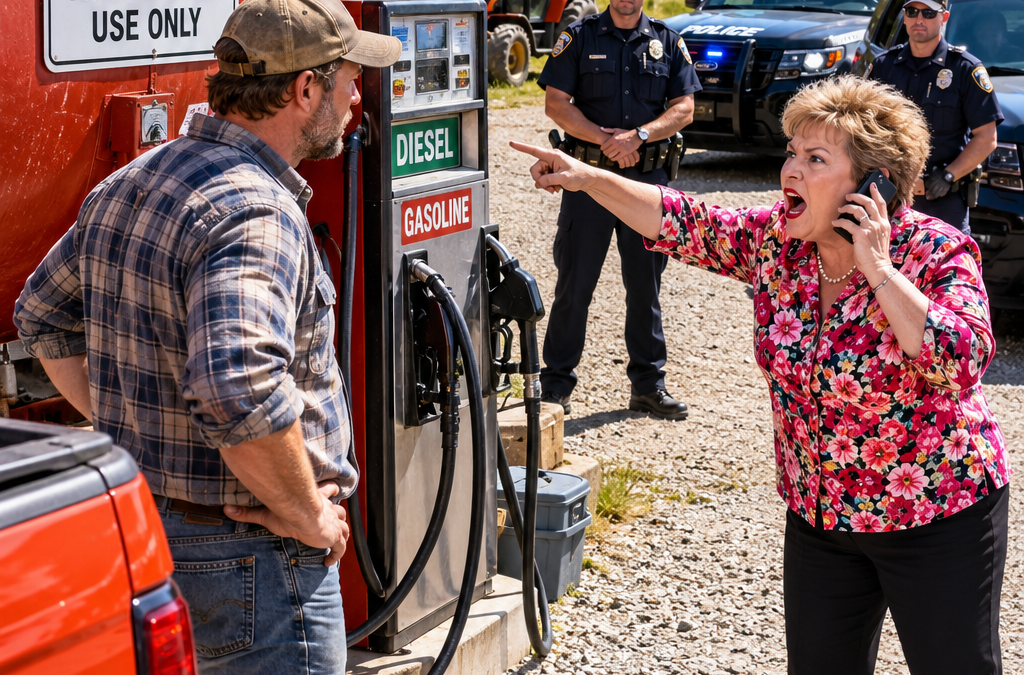
Karen pulled into my driveway, pointed at the fuel pump beside my barn, and ordered me to fill her SUV as if the gasoline, the equipment, and the land beneath her feet belonged to the HOA.
When I refused, she called the police and told them I was obstructing community property, never realizing that the officers she expected to intimidate me worked in the same department I commanded.
I was standing beside my orange pickup when Karen Whitmore drove onto my property.
Until that moment, the afternoon had been exactly the kind I liked.
Quiet.
Predictable.
Warm enough that I had left my jacket in the house.
I had backed the truck beside the fuel tank near my equipment barn because I needed to fill it before hauling fencing supplies the next morning.
There was nothing unusual about the pump.
At least not to me.
I had installed the system years earlier because the property was large enough that constantly driving equipment into town for fuel made no sense.
The setup consisted of an aboveground storage tank, an electric pump, a metered hose, emergency shutoff equipment, and a weatherproof cabinet where I kept the maintenance log.
It supplied diesel and gasoline for my own vehicles and machinery.
Truck.
Tractor.
Mower.
Generator.
Utility vehicle.
Everything was inspected and maintained according to the requirements that applied to it.
It wasn’t a commercial station.
There were no prices posted.
No credit-card reader.
No sign saying WELCOME.
Quite the opposite.
Mounted beside the pump was a large metal sign.
PRIVATE PROPERTY
AUTHORIZED USE ONLY
You could read it from twenty feet away.
Maybe thirty.
Karen apparently couldn’t.
My name is Michael Grant.
I owned twelve acres on the outer edge of Cedar Ridge Estates, though saying “in Cedar Ridge” would have been inaccurate.
The distinction mattered.
My property bordered the subdivision.
It did not belong to it.
Cedar Ridge had been built long after my parcel was established.
Its streets curved around two sides of my land before reconnecting with the county road.
From certain angles, especially near the southern entrance, my barn and driveway looked almost like part of the neighborhood.
Legally, they weren’t.
No HOA declaration attached to my deed.
No community covenants.
No shared-amenity agreement covering the fuel equipment.
Nothing.
For years, that didn’t create much conflict.
Most Cedar Ridge residents understood where the boundary ran.
I wasn’t hostile to them.
I knew many by name.
One neighbor borrowed my post-hole digger once.
Another bought eggs from a small chicken coop I kept near the back field.
During a winter power outage, I let two elderly residents charge medical equipment from my generator.
I wasn’t interested in turning twelve acres into a fortress simply because an HOA existed next door.
But Cedar Ridge had recently elected Karen Whitmore president.
Karen had a particular interpretation of community leadership.
If something was useful to residents, she believed the association should somehow control it.
If something was visible from the subdivision, she believed it should conform to HOA standards.
And if anyone disagreed, she interpreted disagreement as defiance.
Our first conflict had been almost comically small.
She sent me a notice about my orange truck.
Apparently, the color did not comply with Cedar Ridge’s preferred exterior vehicle appearance standards.
I thought the notice had been mailed to the wrong address.
I called.
Karen answered personally.
“Mr. Grant?”
“Yes.”
“You received our vehicle-compliance notice?”
“I did.”
“Then what seems to be the problem?”
“My truck.”
“Correct.”
“It isn’t subject to your rules.”
Long silence.
“You reside adjacent to Cedar Ridge.”
“Correct.”
“Your driveway is visible from Cedar Ridge.”
“Also correct.”
“Then exterior appearance affects neighborhood standards.”
I laughed.
I shouldn’t have.
Karen didn’t appreciate it.
“What’s funny?”
“The idea that you can regulate the color of a truck parked on property outside your HOA.”
“We can regulate nuisances affecting community aesthetics.”
“Orange paint isn’t a nuisance.”
“The board can make that determination.”
“Not on my parcel.”
She sent two more notices.
I ignored them.
Eventually, someone in the HOA’s management company apparently explained the boundary problem because the letters stopped.
I thought that would be the end of Karen’s interest in my property.
I underestimated persistence.
A few months later she asked whether Cedar Ridge residents could use my fuel pump during emergencies.
That request was reasonable enough that I considered it.
We’d had a winter storm the previous year that closed the county road for nearly a day.
Several residents ran portable generators.
Fuel became difficult to get.
Karen brought up the possibility at a neighborhood emergency-preparedness meeting.
I wasn’t a member, but a resident invited me because I owned equipment that could help if roads became blocked.
Karen said:
“Since you maintain bulk fuel on site, perhaps the association could establish community access.”
I answered:
“For a genuine emergency, call me.”
She frowned.
“We’d prefer formal access.”
“I wouldn’t.”
“Why?”
“Liability. Inventory. Safety.”
“We could have designated users.”
“It’s private equipment.”
“We’d reimburse usage.”
“In an actual emergency, we can discuss what people need.”
She wasn’t satisfied.
“That isn’t a reliable plan.”
“It’s my tank.”
That ended the conversation.
Or so I thought.
Months passed.
No emergency.
No requests.
Then came that afternoon.
I was fueling my truck when a silver SUV turned into the driveway.
I recognized it immediately.
Karen.
She drove past the PRIVATE PROPERTY sign.
Past the boundary marker.
Past the small NO PUBLIC FUEL SALES placard I had added after delivery drivers mistakenly asked whether they could fill up.
She stopped approximately ten feet from me.
Engine running.
Window down.
“Michael.”
I put the nozzle back into the pump cradle.
“Karen.”
“Good. You’re here.”
Those were never promising words.
She got out.
Her fuel light must have been on because before saying anything else, she tapped the side of her SUV.
“Fill it.”
I stared at her.
“What?”
“My tank.”
She pointed toward the pump.
“I need gas.”
For a second, I waited for the rest of the sentence.
There wasn’t one.
“There’s a station three miles east.”
“I know where the station is.”
“Then what’s the problem?”
“I’m already here.”
I looked at the SUV.
Then at her.
“You’re asking to buy some fuel?”
“No.”
She said it as if I were being deliberately difficult.
“This is HOA-related travel.”
I didn’t understand.
“What does that have to do with me?”
“I’m conducting association business.”
“Okay.”
“So the fuel should be covered as a community resource.”
I actually looked around.
Sometimes absurd statements make you check whether another person is present, because surely the conversation cannot be meant for you.
“Karen, this isn’t a community fuel pump.”
She crossed her arms.
“We’ve discussed shared emergency infrastructure.”
“We discussed whether I might help during a weather emergency.”
“This qualifies as association use.”
“No, it doesn’t.”
“I’m nearly empty.”
“Still not an emergency.”
Her eyes narrowed.
“I’ve driven all morning dealing with community matters.”
“I sympathize.”
“Then fill the vehicle.”
“No.”
She looked genuinely shocked.
Not offended yet.
Shocked.
As if nobody had explained that demands occasionally produce refusal.
“What do you mean, no?”
“I mean I’m not giving you free gasoline.”
“It’s not free.”
“Who’s paying?”
“The community benefits.”
“That’s not payment.”
“The association has rights regarding infrastructure serving Cedar Ridge.”
“This pump doesn’t serve Cedar Ridge.”
“It is located within the neighborhood service area.”
“No.”
“Your property is surrounded by our community.”
“That doesn’t make it community property.”
She pointed at the pump.
“You use the same access road.”
“The county road.”
“The neighborhood maintains nearby drainage.”
“Still not your pump.”
Her voice rose.
“You’re being incredibly uncooperative.”
I leaned against the truck.
“Karen, you drove onto private property and ordered me to put gasoline in your SUV.”
“I asked.”
“No.”
“I absolutely asked.”
“You said, ‘Fill it.'”
“You’re arguing semantics.”
“No. I’m explaining boundaries.”
She looked toward the pump.
Then the sign.
I saw her eyes pass directly over PRIVATE PROPERTY — AUTHORIZED USE ONLY.
She ignored it.
“I am president of Cedar Ridge.”
“I know.”
“That position gives me authority to enforce community rules.”
“Where they apply.”
“They apply here.”
“No.”
She took out her phone.
“I don’t have time for this.”
“Neither do I.”
“I’ll give you one more opportunity.”
I almost smiled.
“To do what?”
“Provide the fuel.”
“No.”
Her jaw tightened.
“Then I’m calling the police.”
The sentence was delivered like a winning card.
I straightened slightly.
Not because I was worried.
Because I wanted to be certain I’d heard correctly.
“You’re calling the police because I won’t give you my gasoline?”
“I’m calling because you’re obstructing association access to community-serving infrastructure.”
I stared at her.
“Karen.”
“What?”
“Listen to yourself.”
“Don’t patronize me.”
“Then don’t turn a fuel request into a criminal complaint.”
She began dialing.
I could have stopped the absurdity right there by telling her exactly who I was.
I didn’t.
Not because I wanted some dramatic reveal.
Because my job had nothing to do with whether she had a right to my fuel.
If I had been a plumber, accountant, retired teacher, or unemployed homeowner, the answer should have been exactly the same.
Private pump.
Private fuel.
No permission.
End of issue.
I also knew that announcing my position while she was angry could make the entire situation worse.
She might accuse me of using rank.
Threatening her.
Interfering with her report.
So I let her call.
“911, what’s your emergency?”
I couldn’t hear the dispatcher clearly, but I heard Karen.
“I’m the president of Cedar Ridge Estates HOA. We have a property owner refusing to comply with association access requirements.”
Pause.
“Yes, fuel infrastructure.”
Another pause.
“No, he hasn’t threatened me, but he’s being obstructive.”
That part almost made me laugh.
Not threatening.
Obstructive.
Because I wouldn’t pump gas.
She gave the address.
Then said:
“Please send someone. I want this documented.”
When she hung up, she looked satisfied.
“You could have avoided this.”
“So could you.”
“You think everything belongs to you just because it’s on your deed.”
I stared at her.
There are statements so perfect you don’t improve them by responding.
She realized what she’d said approximately two seconds later.
Her expression changed.
I said:
“Yes, Karen. That’s generally how private ownership works.”
She looked away.
I picked up the fuel nozzle again.
She stepped forward.
“What are you doing?”
“Finishing my truck.”
“Don’t touch the pump until the officers arrive.”
I froze.
Then looked at her.
“Excuse me?”
“This is now disputed equipment.”
I put the nozzle back deliberately.
Not because she had authority.
Because I didn’t want gasoline involved in an escalating argument.
Safety mattered more than proving a point.
I shut off the pump.
Locked the cabinet.
Then stood beside the truck.
Karen interpreted that as compliance.
I could tell.
She straightened.
Confidence restored.
She started photographing the pump.
The sign.
My truck.
Even me.
“What are those for?”
“Documentation.”
“Good.”
She looked suspicious.
“Good?”
“Please document everything.”
A neighbor named Tom Avery had been walking his dog along the road.
He slowed near the entrance.
Didn’t enter.
Just watched.
Two other residents appeared near the corner.
News moved quickly in Cedar Ridge.
Within minutes, a quiet fuel dispute had an audience.
Karen seemed to enjoy that.
She moved closer to the boundary so people could hear.
“I’ve repeatedly tried to work cooperatively with this property owner.”
I said:
“Karen.”
She continued.
“The HOA has community-access responsibilities.”
“Karen.”
“And some residents refuse—”
“If you’re going to perform for the neighbors, at least tell them what you asked for.”
She turned.
“I requested access to shared fuel infrastructure.”
“No. You demanded free gas for your SUV.”
Tom’s eyebrows rose.
Karen flushed.
“That’s a gross mischaracterization.”
“How much did you offer to pay?”
Silence.
“Did you ask how much fuel cost?”
No answer.
“Did you ask whether I could sell it legally?”
She tightened her mouth.
“That’s not the issue.”
“It is exactly the issue.”
Then we heard sirens.
No.
Not sirens.
Engines.
Two marked cruisers turned into the driveway without emergency lights.
Good.
That told me dispatch had correctly interpreted Karen’s call as low priority.
Officer Daniel Reed stepped out of the first car.
Officer Mason Clark from the second.
I knew both men.
Of course I did.
Neither showed any visible sign of recognizing me beyond what professionalism required.
That was exactly what I wanted.
Reed approached Karen first.
“Ma’am, did you make the call?”
“Yes.”
“I’m Karen Whitmore, Cedar Ridge HOA president.”
He took out a notebook.
“What happened?”
Karen pointed at me.
“This property owner is refusing the association’s lawful use of community fuel equipment.”
Reed looked toward the pump.
Then at me.
“Sir, stay there for a moment.”
“Of course.”
Karen continued.
“This pump has been discussed as part of Cedar Ridge’s emergency infrastructure.”
“Is there an emergency?”
She hesitated.
“No, but—”
“What were you trying to do today?”
“I needed fuel while conducting HOA business.”
“Did he agree to provide it?”
“He’s refusing to cooperate.”
Reed asked again:
“Did he agree to provide it?”
“No.”
“Do you have an agreement stating the HOA can use the pump?”
“We have community authority over shared resources.”
“Can I see the agreement?”
Karen’s confidence weakened slightly.
“It’s in the HOA rules.”
“Do you have those?”
“Not physically.”
“You called police over access to equipment without bringing the document that gives you access?”
“I know our rules.”
Reed nodded.
Didn’t argue.
He turned toward me.
“Sir, your side?”
“The pump, storage tank, fuel, driveway, and surrounding land are privately owned.”
“Commercial pump?”
“No.”
“Do you sell fuel?”
“No.”
“Anyone in the HOA have authorized access?”
“No standing access.”
“Any emergency arrangement?”
“I told the association in the past that if there were a genuine emergency, residents could contact me and I would decide what assistance was safe.”
Karen interrupted.
“Exactly.”
Reed raised a hand.
“Let him finish.”
I continued.
“That was never an agreement transferring access. Today she drove in, ordered me to fill her SUV without payment, and called you when I refused.”
Karen said:
“I am performing community duties.”
Clark finally spoke.
“That doesn’t explain why another person is obligated to provide your fuel.”
Karen looked at him.
“Because this equipment benefits the neighborhood.”
“How?”
“It is available in emergencies.”
“According to him, only if he grants permission.”
“He can’t arbitrarily withhold a community resource.”
I almost responded.
Didn’t.
The officers didn’t need help.
Reed asked:
“Sir, can you show me property records?”
“Yes.”
I pulled out my phone.
I kept digital copies of the parcel map and deed information because property-line questions had happened before.
I opened the county parcel viewer.
Showed him the recorded boundary.
The driveway sat comfortably inside.
So did the barn.
Fuel tank.
Pump.
He zoomed.
Checked location.
Then handed the phone to Clark.
Karen stepped closer.
“The HOA maps don’t show it that way.”
Reed looked at her.
“Do you have a recorded easement?”
“Not with me.”
“Deed?”
“No.”
“Written permission from him?”
“He knows the HOA considers the pump community-support infrastructure.”
That wasn’t an answer.
Reed asked:
“Do you have written permission?”
Karen looked at me.
Then back at him.
“No.”
“Okay.”
She started:
“But our association—”
“Ma’am, HOA rules can apply to property legally subject to the HOA. They don’t automatically turn privately owned equipment into community equipment.”
Karen’s face tightened.
“He’s adjacent.”
“That isn’t ownership.”
I stayed silent.
There was no reason to pile on.
Reed walked toward the pump.
Read the sign.
PRIVATE PROPERTY. AUTHORIZED USE ONLY.
He pointed.
“How long has this sign been here?”
“Years.”
Karen said:
“The sign doesn’t override community rules.”
Clark asked:
“What community rule specifically grants you access?”
She looked at him.
“It’s broader than one rule.”
“Then show us whatever grants access.”
“I told you, I don’t have the binder.”
“That’s a problem for your claim.”
Karen folded her arms.
“This is unbelievable.”
Reed inspected the installation from a distance.
Then asked me:
“Who owns the storage tank?”
“I do.”
“Pump?”
“Me.”
“Fuel?”
“Me.”
“Property underneath?”
“Me.”
“Any HOA contribution toward installation or maintenance?”
“No.”
“Insurance?”
“Mine.”
“Permit records in your name?”
“Yes.”
Karen interrupted again.
“The pump benefits the entire community.”
I finally spoke.
“By existing?”
She turned on me.
“In an emergency.”
“Your empty fuel tank isn’t a community emergency.”
She flushed.
Reed looked down to hide what might have been a smile.
Then he asked Karen:
“Did you run out of gas?”
“No.”
“Vehicle currently disabled?”
“No.”
“Medical emergency?”
“No.”
“Evacuation?”
“No.”
“So you wanted him to put gasoline into your vehicle because you’re association president.”
She stared.
“When you say it like that—”
“I’m asking what happened.”
She didn’t answer.
The entire scene became quieter.
Tom and the others were still watching from the road.
The breeze moved leaves near the barn.
My truck sat half fueled.
Everything looked absurdly ordinary for an incident requiring two police cruisers.
Then Reed asked:
“Sir, identification please.”
I reached for my wallet.
This was routine.
Property dispute.
Police response.
Document everyone.
I handed him my driver’s license.
He looked down.
Then paused.
Not dramatically.
Just long enough that Clark noticed.
Reed read the name again.
Michael Grant.
Then looked at me.
I knew what was coming.
“Can you confirm your full name?”
“Michael David Grant.”
He glanced at the address.
Then at me.
“Position?”
I almost sighed.
There it was.
I would have preferred the issue end without it.
But lying or dodging would have been worse.
“Chief of Police.”
Karen frowned.
Reed looked at me.
“Chief?”
“Yes.”
Clark’s posture changed by maybe half an inch.
Not deference exactly.
Recognition.
They had known me professionally, but I wasn’t in uniform, hadn’t introduced myself by rank, and Reed had clearly been focused on handling the complaint neutrally.
That was good policing.
Karen looked from Reed to me.
“What?”
Nobody answered immediately.
She stared.
“You are what?”
“Police chief.”
Her face lost color.
“No, you’re not.”
I almost laughed.
Reed said:
“Ma’am, yes, he is.”
Karen’s mouth opened.
Closed.
Then:
“Why didn’t you say that?”
I looked at her.
“Why should it matter?”
She had no answer.
“Would you have acted differently if I had introduced myself as Chief Grant?”
Her face tightened.
“Of course.”
“That’s the problem.”
Silence.
Reed and Clark stayed quiet.
I continued, calmly.
“My job doesn’t change who owns this pump.”
“I didn’t know.”
“You didn’t need to.”
“I thought you were just—”
She stopped.
“Just what?”
Her cheeks reddened.
“A homeowner.”
I nodded.
“Exactly.”
That sentence landed harder than any badge reveal could have.
Just a homeowner.
As if a homeowner needed a title before private property became private.
Karen tried to recover.
“I was enforcing HOA responsibilities.”
“No. You were demanding something you had no written right to use.”
“I didn’t understand the ownership arrangement.”
“The sign was five feet from you.”
“I thought the HOA had broader rights.”
“Then check before calling police.”
She looked toward the officers.
Reed said:
“Chief’s correct about one thing. His position doesn’t decide this.”
I appreciated that.
“The property documents do.”
Clark nodded.
“Your claim doesn’t show legal access.”
Karen looked humiliated now.
I didn’t enjoy it.
Humiliation makes people defensive.
And defensive people rarely learn.
So I stepped back.
Let the officers continue.
Reed explained the issue plainly.
Cedar Ridge could enforce valid rules where those rules legally applied.
If the HOA believed it had some easement or contractual right to use my fuel system, it could produce the document and address the dispute through proper civil channels.
But absent permission or some legal right, Karen could not demand fuel.
She could not remain on my property after being asked to leave.
And she certainly couldn’t treat a privately owned pump as public merely because she considered it useful.
Karen said:
“So you’re ordering me off the property?”
Reed answered carefully.
“The owner has not given you permission to remain. I’m advising you to leave.”
She looked at me.
“Are you asking me to leave?”
“Yes.”
Her jaw tightened.
“Fine.”
She turned toward the SUV.
Then stopped.
“What am I supposed to do about fuel?”
I pointed toward the county road.
“Station’s three miles east.”
Tom actually laughed from near the road.
Karen heard.
Her shoulders stiffened.
She got into the SUV.
Started it.
Then remained sitting there for several seconds.
Maybe deciding whether to make another statement.
Finally she reversed.
Drove out.
No gasoline.
No HOA victory.
No arrest.
No dramatic confrontation.
Just an expensive lesson delivered at idle speed.
After she left, Reed handed my license back.
“Sorry, Chief.”
“For what?”
“This whole thing.”
“You didn’t call yourselves.”
Clark smiled slightly.
Reed asked:
“Want an incident report?”
“Yes.”
That surprised him.
“Formal?”
“Absolutely.”
He nodded.
I explained why.
Not because I intended to punish Karen.
Because a 911 response involving an HOA president, a private fuel system, and disputed property rights needed a clean written record.
Today it was gasoline.
Six months later, somebody might remember it as an HOA access dispute.
A year later:
Community fuel station.
Memory drifts.
Paper doesn’t.
Reed documented the call.
Statements.
Property map.
Sign.
No threats.
No fuel transfer.
No evidence of criminal conduct by me.
Karen advised to leave private property.
Simple.
Factual.
Exactly what I wanted.
Before the officers left, Clark looked at the pump.
“Nice setup.”
“Useful.”
“Apparently very popular.”
“Don’t start.”
He laughed.
Then both cruisers pulled away.
The neighbors remained.
Of course.
Tom walked over with his dog.
He looked toward the road where Karen had disappeared.
“Did she seriously come here for free gas?”
“Yes.”
“And called police?”
“Yes.”
“On the police chief?”
I sighed.
“That’s not the important part.”
“It’s definitely the funny part.”
I couldn’t argue.
Tom looked at the sign.
“Authorized use only.”
“Been there for years.”
“She walked past it?”
“Straight past.”
He shook his head.
“Karen sees signs as suggestions.”
“Apparently.”
Another neighbor, Linda Perez, approached.
“Is the pump really yours?”
I looked at her.
“Yes.”
“I always assumed the HOA helped install it.”
“Why?”
She shrugged.
“Karen mentioned once that Cedar Ridge had access to emergency fuel.”
There it was.
Language again.
I asked:
“Exactly what did she say?”
“Something about community emergency resources.”
“Did she say residents could just use it?”
“Not exactly.”
“Good.”
Linda frowned.
“So what’s the arrangement?”
“No arrangement.”
“What about emergencies?”
“If somebody genuinely needs help during a storm or outage, they can ask me.”
“That’s it?”
“That’s it.”
She smiled.
“Seems simple.”
It was.
Until someone decided asking wasn’t enough.
The neighbors left.
I reopened the pump cabinet.
Finished filling my truck.
The meter clicked.
Fuel flowed.
No crowd.
No shouting.
No HOA.
Just the original task I had been trying to complete nearly an hour earlier.
That normality felt good.
I shut the pump down.
Logged the gallons.
Locked the cabinet.
Then stood beside the truck for a moment.
I thought about what Karen had said.
I thought you were just a homeowner.
I heard statements like that sometimes in police work.
People behaved one way with someone they believed had no institutional power and another way the moment they learned a title.
It always bothered me.
Law doesn’t work that way.
Or at least it isn’t supposed to.
A person’s rights don’t become more real because he wears a badge.
Police officers are supposed to protect the property rights of the man in work boots just as seriously as those of a mayor, judge, attorney, or chief.
If the officers had sided with me only because they recognized my position, I would have been more disturbed than satisfied.
But they didn’t.
They checked first.
Boundary.
Ownership.
Permission.
Only then did my identity become relevant to their surprise.
That distinction mattered.
The next morning, I received an email from Cedar Ridge management.
SUBJECT: COMMUNITY INFRASTRUCTURE CLARIFICATION.
I almost laughed before opening it.
The message said the board had become aware of “a misunderstanding regarding emergency fuel access.”
Misunderstanding.
Good word.
Flexible.
Nobody had demanded anything.
Nobody called police.
Just misunderstanding.
The email stated that Cedar Ridge would review its emergency-preparedness documents to ensure private resources were not described as association-controlled assets without a written agreement.
That was good.
Then I reached the last paragraph.
Residents were reminded not to enter adjacent private property without owner permission.
Even better.
No mention of my position.
Exactly right.
I replied to the management company.
Thank you.
Then added:
For clarity, no HOA member or officer currently has standing permission to use the fuel pump, storage tank, or associated equipment. Any future emergency-assistance arrangement must be made in writing.
Short.
No anger.
The manager responded:
Understood.
I printed the exchange.
Added it to the property file.
Maybe excessive.
But I had learned something during years in law enforcement.
A conflict resolved verbally can resurrect later with completely different details.
Documentation prevents resurrection.
Karen didn’t contact me for a week.
Then she arrived again.
This time she parked near the entrance.
Not beside the pump.
Progress.
She walked up carrying a thin folder.
I was fixing a hinge on the barn door.
“Michael.”
I looked over.
“Karen.”
“Can we talk?”
“Sure.”
She stopped several feet away.
Didn’t cross farther until I nodded.
More progress.
“I’m here on behalf of the HOA.”
“Okay.”
“We reviewed the emergency-preparedness notes.”
“And?”
“You were right.”
I set down the wrench.
“About?”
“There is no written agreement granting Cedar Ridge access to the fuel system.”
“I know.”
She frowned slightly.
“I came to apologize.”
That surprised me enough that I said nothing.
She continued.
“I misunderstood what had been discussed at the emergency meeting.”
“You were at that meeting.”
“I know.”
“You asked for formal access. I said no.”
“I remembered it differently.”
“That’s possible.”
She looked toward the pump.
“I remembered you agreeing the fuel would be available during emergencies.”
“I did.”
“So I interpreted that as community access.”
“It was an offer to help.”
“I see that now.”
I nodded.
“Those aren’t the same thing.”
“No.”
She looked uncomfortable.
Then:
“I’m also sorry I called the police.”
“Why did you?”
She frowned.
“Because I thought you were refusing an HOA obligation.”
“That’s not criminal.”
“I know.”
“Did you then?”
Long pause.
“Probably.”
At least she was honest.
“Then why call?”
She looked toward the neighborhood.
“I wanted somebody with authority to settle it.”
That was the answer I expected.
“And you thought they’d make me comply.”
“Yes.”
“Because you were president.”
She met my eyes.
“Yes.”
There it was.
No elaborate excuse.
No reinterpretation.
She had expected institutional authority to reinforce her own.
Then discovered authority has boundaries too.
She handed me a page.
The HOA had formally removed references to my fuel system from its emergency-resource list.
At the bottom, Cedar Ridge acknowledged that the pump, storage tank, fuel, and land were privately owned and that no access existed without my permission.
I read it twice.
“Good.”
Karen shifted.
“There is one more thing.”
“What?”
“Would you consider an actual emergency agreement?”
I almost laughed.
But this time, she was asking.
That mattered.
“What kind?”
“Something limited. Severe weather. Extended outage. Evacuation.”
“Who pays?”
“The HOA.”
“Who operates the pump?”
“You.”
“Who decides whether conditions qualify?”
“We agree on criteria.”
“Liability?”
“Association counsel drafts it.”
“Fuel quantity limits?”
“Yes.”
I thought.
This was the conversation we should have had months earlier.
Not:
Give me gas because I’m president.
But:
Would you be willing to establish terms?
I said:
“Send me a proposal.”
Her eyebrows rose.
“Really?”
“I never said I wouldn’t help neighbors.”
She glanced at the sign.
“I suppose there’s a difference between helping and being required.”
“Big one.”
She nodded.
Then looked at me with the faintest smile.
“I still can’t believe you’re the chief.”
I shook my head.
“Karen.”
“I know. It shouldn’t matter.”
“Exactly.”
She looked embarrassed.
“I told my husband I called 911 on you.”
“What did he say?”
“I’m not repeating it.”
I laughed.
That broke the tension.
Not completely.
Enough.
The HOA eventually drafted an emergency fuel-support agreement.
I had my own attorney review it.
Not because I distrusted every word.
Because clarity protects relationships.
The final document was narrow.
Activation only during officially declared local emergencies or significant road closures.
Fuel supplied subject to available inventory.
Priority to medical, emergency, and essential household needs.
HOA reimbursed actual cost.
No resident operated equipment directly.
No general access.
No permanent easement.
No commercial rights.
No ownership interest.
Either party could terminate with written notice.
Simple.
Useful.
Fair.
I signed.
So did Cedar Ridge.
The first time the agreement was actually used came the following winter.
Ice storm.
Power out.
Road partially blocked.
Two homes had residents using oxygen concentrators.
Portable generators needed fuel.
Karen called.
Not drove in.
Called.
“Michael, we’re activating the emergency agreement if you agree conditions qualify.”
That sentence almost made me smile.
“They qualify.”
“How much can you spare?”
“Enough.”
“We’ll send payment authorization.”
“Bring the cans.”
Residents arrived.
One at a time.
I dispensed fuel.
Logged amounts.
Karen stood nearby organizing deliveries.
No demands.
No ownership claims.
No police.
At one point she looked at me.
“This is how it should’ve worked.”
“Yes.”
“I know.”
We supplied enough gasoline to keep several generators running until the county road reopened.
Nothing dramatic.
No headlines.
No conflict.
Just neighbors helping one another through a bad night.
The fuel was still mine.
The pump was still private.
The agreement did not make generosity less meaningful.
It made expectations clear enough that generosity could happen without resentment.
That changed the way I thought about the original confrontation.
At first, the lesson seemed simple.
Know your rights.
Have documents.
Stay calm.
All true.
But there was another lesson underneath it.
People often mistake access for ownership and cooperation for obligation.
You allow something once.
Someone remembers it as a policy.
You help voluntarily.
Someone later describes it as a duty.
If nobody writes down the difference, memory slowly expands the permission.
Karen had taken my willingness to help during emergencies and turned it, in her own mind, into HOA authority.
Then she tried to exercise that imaginary authority on an ordinary afternoon because her SUV needed fuel.
The absurdity made the mistake easy to see.
But the underlying pattern isn’t rare.
That’s why I document agreements now.
Not because I want every neighborly interaction turned into a contract.
Because repeated access to valuable property needs clarity.
Fuel.
Roads.
Parking.
Equipment.
Land.
Once people depend on something, the temptation to call it communal grows.
Sometimes dependence deserves a formal arrangement.
It never creates ownership by itself.
The Cedar Ridge board learned that.
Karen did too.
To her credit, she changed more than I expected.
At the next annual meeting, according to Tom, a resident suggested the HOA treat a privately owned drainage pond as a “community stormwater asset.”
Karen stopped him.
“Who owns it?”
Apparently the room got quiet.
The resident said:
“Mr. Henson.”
Karen asked:
“Do we have an easement?”
Nobody knew.
She said:
“Then we’re not calling it a community asset until someone checks.”
Tom told me that story with enormous satisfaction.
“Look what you created.”
“I created nothing.”
“You traumatized her with property law.”
“Good.”
He laughed.
Maybe people can learn.
I think that’s important.
It’s easy to enjoy stories where an unreasonable HOA president is humiliated and disappears forever.
Life usually isn’t that clean.
Karen had been arrogant.
Entitled.
Wrong.
She also apologized.
Corrected the records.
Changed behavior.
Helped create a legitimate emergency agreement.
I didn’t need her destroyed.
I needed the problem solved.
Those are not the same thing.
Years later, the fuel pump still stands beside the barn.
The sign has been replaced once because sunlight faded the lettering.
Same words.
PRIVATE PROPERTY
AUTHORIZED USE ONLY
I could probably remove it.
Everyone nearby understands now.
I keep it because signs are cheaper than misunderstandings.
The orange pickup is older.
Still running.
Barely, some mornings.
Every time I pull beside the pump, I think of Karen’s silver SUV sitting there.
Fill my tank.
The confidence still makes me laugh.
But what I remember most is not her face when she learned I was police chief.
People always assume that’s the satisfying moment.
The reveal.
Chief?
Yes.
Shock.
Embarrassment.
I understand why.
But that wasn’t the important moment to me.
The important moment came earlier.
Officer Reed standing beside the pump.
Property map in his hand.
Asking Karen:
“Do you have written permission?”
And Karen saying:
“No.”
Everything was settled right there.
Before my title mattered professionally.
Before anyone knew rank.
No permission.
Private property.
End.
That’s how the encounter should have ended for anyone.
My being chief added irony.
It did not add property rights.
Sometimes people ask why I didn’t tell Karen immediately.
Wouldn’t that have saved time?
Maybe.
It also would have taught the wrong lesson.
If I had said:
I’m the police chief.
and she backed down, the story becomes:
Don’t bully important people.
That’s not what I wanted.
The lesson is:
Don’t invent authority over anyone’s property.
The homeowner whose rights you ignore shouldn’t need an impressive title before you respect them.
That’s why I remained calm.
Partly training.
Partly personality.
Mostly because facts were enough.
I owned the land.
I owned the pump.
I bought the fuel.
No HOA document granted access.
No emergency existed.
Karen could be president of Cedar Ridge for twenty years and none of those facts would change.
Authority works best when the person exercising it knows where it ends.
That applies to HOA presidents.
Police officers.
Police chiefs.
Everyone.
My authority ended at the limits of my office.
Karen’s ended at the limits of her association.
My property rights began at the recorded boundary.
None of those lines needed shouting.
They needed respect.
One summer evening, long after the incident, I was filling the mower when Karen drove past.
She slowed.
Rolled down her window.
“Need me to supervise?”
I stared at her.
“What?”
“The community fuel pump.”
Then she smiled.
I laughed.
“Keep moving, Whitmore.”
She waved.
Drove on.
That was when I knew the feud was actually dead.
Not because we forgot what happened.
Because we could acknowledge it without anger.
I finished fueling the mower.
Locked the pump.
Walked toward the house.
Cedar Ridge lights came on one by one beyond the trees.
My property remained quiet.
The fuel tank remained full enough for the week.
Nobody was standing in my driveway demanding anything.
Exactly the way I liked it.
The entire conflict had begun because Karen saw something useful and decided usefulness created entitlement.
She had a title.
A rulebook.
Confidence.
Then two police cruisers.
None of those things converted private gasoline into community property.
The answer had been visible before anybody arrived.
Printed in plain letters beside the pump.
AUTHORIZED USE ONLY.
Karen ignored the sign because she believed her authority was stronger.
The officers read the documents.
The documents said otherwise.
That is why the part about being chief eventually became almost irrelevant to me.
The badge was never the strongest thing I had that afternoon.
The strongest thing was much more ordinary.
A deed.
A boundary.
A receipt for the equipment.
A fuel tank I had paid to fill.
And one simple word Karen had forgotten she still needed before taking something that belonged to another person.
Permission.








