𝗙𝗨𝗟𝗟 𝗦𝗧𝗢𝗥𝗬 The HOA President Built a Garage in My Backyard Before I Found the Signature She Forged
𝗙𝗨𝗟𝗟 𝗦𝗧𝗢𝗥𝗬
My neighbor Frank warned me before I was ready to listen.
Frank lived behind me, his backyard sharing a fence line with mine. He was a retired electrician with a gray beard, bad knees, and a habit of watering tomato plants while wearing old college sweatshirts.
One evening, while I was trimming shrubs along the fence, he leaned over and said, “She’s building a case file.”
I looked up.
“Who?”
He gave me a look.
“Come on, Rebecca.”
I lowered the clippers.
“Diane?”
“She’s not enforcing rules. She’s building a case file. I’ve seen her do it before.”
I tried to smile.
“She’s annoying, sure. But I don’t think it’s that dramatic.”
Frank shook his head.
“That woman doesn’t write a letter unless she plans to use it later.”
“She just likes control.”
“That’s what people said the last time.”
I frowned. “The last time what?”
He glanced toward Diane’s house, three streets over.
“Ask Harold someday.”
“Harold?”
“Older guy on Willow Court. Quiet. Keeps every scrap of paper. Diane hates him.”
“Why?”
“Because he remembers things she wants forgotten.”
I laughed a little, still trying to keep the conversation light.
Frank did not laugh.
“I’m serious. Document everything.”
That word landed differently coming from him.
Document.
I spent my life documenting pain scores, medication times, wound measurements, patient complaints, physician calls, family updates. Documentation was how truth survived after everyone got tired, scared, confused, or angry.
That night, I opened a folder on my laptop.
Then I opened another in cloud storage.
I named both of them Maple Ridge.
I scanned the notices. I photographed the envelopes. I saved every email. I took pictures of my mailbox, my fence, my trash cans, my yard.
At first, it felt excessive.
Then the boundary adjustment notice arrived.
It came by mail on a Wednesday.
Official letterhead. HOA seal. Diane’s signature at the bottom.
NOTICE OF BOUNDARY ADJUSTMENT AND SHARED IMPROVEMENT ZONE
I read the first paragraph twice and still didn’t understand it.
According to the notice, twelve feet of my backyard now fell within a “shared HOA improvement zone” established by a survey amendment. The language was dense, almost deliberately hard to follow, but the meaning was clear enough.
The HOA was claiming control over a strip of my backyard.
Twelve feet deep.
Across the rear edge of my property.
I called the county recorder’s office during my lunch break.
A clerk named Melanie answered.
“I’m trying to understand whether a boundary adjustment has been filed on my property,” I said.
She asked for my parcel number.
I gave it to her from my deed.
Keys clicked on her end.
“Yes,” she said slowly. “There is a survey amendment recorded against that parcel.”
My stomach tightened.
“When?”
She gave me a date.
I froze.
“That’s before I bought the house.”
“Yes.”
“What does it say?”
There was a pause.
“It references a shared improvement zone and includes an acknowledgment from the property owner.”
“That’s impossible.”
“I can send you a copy.”
“Please.”
The photocopy arrived by email twenty minutes later.
I opened it at the nurses’ station between medication rounds.
There, at the bottom of the amendment, was my name.
Rebecca Hale.
Signed in a handwriting that was not mine.
For a moment, I could not breathe.
I had never signed an HOA boundary document.
Not once. Not at closing. Not after. Not ever.
Someone had forged my name onto a document that reshaped the legal edge of my property before I had even moved in.
I printed it and stared at it in the break room until one of the other nurses asked if I was all right.
I said yes.
I was not.
That was the first twist.
Diane was not just fining me.
Someone had used my name to change the recorded understanding of my land.
I did not confront her.
Not then.
That was hard.
Every instinct in me wanted to march to her house, shove the paper in her face, and demand she explain how my signature appeared on a document I had never seen.
But nurses learn restraint.
You do not panic in a code. You do not scream when blood hits the floor. You do not accuse before you assess.
You chart.
So I charted.
I created a timeline.
Closing date.
Fence fine.
Mailbox notice.
Trash notice.
Boundary adjustment notice.
Survey amendment date.
County email.
Photocopy of forged signature.
I photographed every page. Saved duplicates. Forwarded copies to a separate email account. Uploaded them to cloud storage. Printed hard copies and placed them in a folder.
Then I began recording my interactions with Diane where legally permitted, keeping my phone in my scrub pocket whenever she approached.
Three weeks later, construction trucks rolled onto my grass.
It was 7:03 in the morning.
I had worked the night shift and had been asleep for less than two hours when the grinding sound of diesel engines snapped me awake.
At first, I thought there had been an accident.
Then I looked out my bedroom window and saw two white construction trucks backing toward my backyard.
Men in work boots were unloading concrete pillars, lumber, and metal framing.
On my grass.
Twelve feet past the old survey stakes.
I ran outside in pajama pants and an oversized T-shirt, hair loose, barefoot on wet grass.
“What is this?” I shouted.
One of the workers looked up from a stack of forms.
“Ma’am?”
“What are you doing in my yard?”
He turned toward the driveway.
Diane was standing there with a Starbucks cup in one hand and her clipboard in the other.
Sunglasses on her head.
Calm as Sunday church.
“Good morning, Rebecca.”
“What is this?”
“Community garage.”
I stared at her.
“What?”
“A shared improvement structure. Board approved.”
“On my property?”
She sipped her coffee.
“On the shared improvement zone.”
My hands clenched.
“That is my backyard.”
“According to your opinion.”
“According to my deed.”
“County records now show otherwise.”
The workers kept unloading.
I stepped toward them.
“Stop. Do not pour anything.”
Diane raised one hand.
“They have authorization.”
“I want to see the vote.”
Her smile sharpened.
“Minutes are still being finalized.”
There it was.
HOA code for: we never held one.
“You’re building a garage in my yard without approved minutes?”
“It was approved.”
“By whom?”
“The board.”
“Then show me.”
Her voice lowered.
“Rebecca, you’re emotional. I understand change can be difficult, but this improvement benefits everyone.”
“Get off my property.”
Her eyes turned cold.
“Be careful. Interfering with HOA-approved work may result in additional penalties.”
I almost laughed.
Additional penalties.
A stranger was unloading concrete onto my lawn under a forged boundary document, and Diane was threatening another fine.
“Diane,” I said, keeping my voice steady, “if they pour concrete today, you are going to regret it.”
She tilted her head.
“Sweetheart, you’ll thank me when property values rise.”
She called me sweetheart like a slap.
I went inside, locked the door, and called the county.
Then I called an attorney.
His name was Marcus Bell, a real estate lawyer recommended by another nurse whose brother had been through a boundary dispute.
I sent him everything.
The deed. The survey. The forged amendment. The notices. The photos of construction trucks.
He called me back less than an hour later.
“Rebecca,” he said, “this is not a normal boundary dispute.”
“I know.”
“No, I mean legally. If your signature was forged on a recorded amendment, and they’re using that amendment to build on your land, we may be looking at criminal document fraud.”
I sat on the edge of my bed, still in pajamas, shaking from exhaustion and anger.
“What do I do?”
“Do not physically interfere with the workers. Keep documenting. I’m filing for an emergency injunction.”
“Can they keep building?”
“Not if a judge stops them fast enough.”
By the end of that day, Diane’s crew had poured concrete footings.
By the next morning, Marcus had filed the emergency injunction.
By the end of the week, Diane retaliated.
A lien notice arrived.
Nearly six thousand dollars in unpaid violation fees, administrative charges, and enforcement costs.
I stood in my kitchen holding the letter while the backyard glowed orange through the window at sunset.
A garage frame sat where my grass had been.
A lien sat against my house.
A forged signature sat in county records.
And Diane Whitfield was still walking around the neighborhood with a clipboard like she was the injured party.
The next HOA meeting was packed.
Diane had called it to address “resident obstruction of community progress.”
Everyone knew she meant me.
I sat in the third row with my phone recording from my scrub pocket.
Marcus sat beside me.
The room smelled like coffee, carpet cleaner, and tension.
Diane stood at the front in a pale blue blazer, voice syrup-sweet, eyes like ice.
“We have always been a community committed to improvement,” she said. “Unfortunately, certain homeowners resist shared progress while benefiting from the very standards they seek to undermine.”
Forty residents sat silently.
Nobody wanted to be next.
Diane went on.
She called me difficult. She said I had refused reasonable compliance requests. She said the shared improvement garage had been properly approved and would increase community value.
I did not speak.
I let her talk.
Every confident sentence was a gift.
Every lie had a timestamp.
Then Harold stood.
I knew him immediately from Frank’s description.
Older, thin, with white hair and wire-framed glasses. He held a folder against his chest.
“Diane,” he said, voice quiet but steady, “why did my storage shed disappear from the minutes six years ago?”
The room shifted.
Diane’s smile faltered.
“I’m sorry?”
“My shed approval. It existed. Then it didn’t. You claimed there was no vote, but I have the signed approval.”
Diane laughed softly.
“Harold, people misremember old board actions. It happens with volunteer boards.”
“I don’t misremember paperwork.”
A murmur moved through the room.
Then another neighbor stood.
“I was fined for driveway repairs that had already been approved.”
Then another.
“I paid twice for a fence review fee that never appeared in the ledger.”
Then a third.
“My violation notice referenced a board meeting nobody remembers attending.”
Diane’s mask flickered.
Just for a second.
Then she smoothed it back into place.
“I understand everyone has concerns, but this is not the proper forum for old grievances.”
Harold held up his folder.
“I’ve kept copies for eight years.”
That sentence changed the room.
For years, Harold had been dismissed as difficult.
Too detailed. Too suspicious. Too slow to let things go.
Now he looked like the only man who had understood Diane before the rest of us caught up.
After the meeting, Marcus and I stood with Harold near the parking lot.
He opened his folder on the hood of Marcus’s car.
Inside were approvals, receipts, letters, meeting notes, and copies of old minutes with handwritten corrections.
“Why didn’t anyone listen to you?” I asked.
Harold looked tired.
“Because Diane knew how to make one person sound unreasonable.”
Marcus scanned the documents.
“This goes back years.”
“Eight that I can prove,” Harold said.
That night, Marcus and I compiled everything.
My forged survey amendment.
Harold’s missing minutes.
The other neighbors’ fines.
Phantom votes.
Board approvals nobody remembered.
Money that appeared in homeowner accounts but not in ledgers.
A pattern stretching farther back than any of us imagined.
Marcus filed discovery requests for full HOA financial records.
We expected resistance.
Instead, the treasurer resigned the next morning.
No explanation.
Just an email to the board.
Effective immediately, I resign from all Maple Ridge HOA financial duties.
His name was Elliott Crane.
By noon, Marcus received a call from him.
Elliott wanted to talk.
Off the record.
Marcus agreed to meet him with one condition: if Elliott had evidence of a crime, there would be no promise to bury it.
Elliott showed up at Marcus’s office pale, sweaty, and terrified.
I was there because Marcus insisted I had a right to hear what concerned my property.
Elliott sat down, looked at the floor, and said one word that made Marcus go completely still.
“Skimming.”
Marcus leaned back.
“Start from the beginning.”
Elliott swallowed.
“Diane has been routing violation fees.”
“To where?”
“An account connected to her husband’s construction company.”
The room went silent.
I felt my pulse in my throat.
“What construction company?” I asked.
“Whitfield Construction Services,” Elliott said. “Officially, they’re a vendor. Maintenance, storage, small improvement projects.”
Marcus’s eyes sharpened.
“The garage.”
Elliott nodded.
“It was never a community garage.”
I stared at him.
“What?”
“It’s inventory storage. For Diane’s side business. Materials, tools, staging equipment. She needed space close to the subdivision. Your backyard was convenient.”
My hands went cold.
The garage on my property was not infrastructure.
It was storage for Diane’s private operation, built on land she had quietly claimed through a forged amendment.
Elliott kept talking.
For years, Diane had used violation fees to fund payments to Whitfield Construction under vague vendor descriptions. Some projects were inflated. Some never happened. Some were tied to enforcement against homeowners who complained.
“She told me it was how HOAs work,” Elliott said. “Small communities. Flexible accounting.”
Marcus’s voice was flat.
“That is not how accounting works.”
“She had emails,” Elliott whispered. “On me. I approved things I shouldn’t have. She said if I talked, she’d make sure I took the fall.”
Diane had stolen land.
Stolen money.
Forged documents.
And trapped her own board members into silence.
All stitched together by one arrogant woman who never imagined a “difficult homeowner” would fight back with records.
The court date arrived faster than I expected.
Marcus said HOA fraud cases moved quickly when the county prosecutor smelled easy, well-documented headlines.
I barely slept the night before.
My backyard was half construction site, half crime scene. Concrete footings. Framing materials. Tire marks in the grass. Orange safety fencing where my lemon balm used to grow.
At 5 a.m., I made coffee and sat at my kitchen table reviewing my file.
Not because I didn’t trust Marcus.
Because I needed to remember I wasn’t crazy.
That is what people like Diane do to you.
They bury you under official language until you start doubting obvious reality.
Your fence looks fine, but the notice says it isn’t. Your mailbox is white, but the letter says it’s wrong. Your deed says one thing, but the HOA says another. Your backyard is yours, but the trucks show up anyway.
Documentation becomes oxygen.
Diane arrived at court in a black blazer sharp enough to cut glass.
Pearls. Lipstick. Hair flawless.
She walked in like a woman who had never once faced real consequences.
Marcus laid it out plainly.
Forged signature.
Altered survey.
Improper construction.
Unlawful lien.
Six years of missing funds.
Sworn statements from Harold and two other residents.
Financial disclosures from Elliott.
Payments routed to Whitfield Construction.
Diane’s attorney tried to frame it as a misunderstanding.
A volunteer board error.
A boundary confusion.
A bookkeeping issue.
The judge listened with a still face.
Then Marcus introduced the forged amendment.
My signature on a document I had never signed.
The county’s original 1987 boundary maps.
My deed.
The construction plans signed by Diane.
The lien notice issued after I challenged the garage.
The judge’s expression hardened page by page.
Then came the third twist.
The judge looked down at another file and said, “Counsel, before we proceed further, this court has been informed that there is already an open fraud investigation involving Ms. Whitfield related to a previous homeowners association two towns over.”
Diane’s composure cracked.
Not tears.
Not panic.
Just a stunned, hollow stare.
As if she genuinely believed her clipboard had made her untouchable everywhere she went.
Marcus turned slightly toward me.
He had not known either.
The courtroom seemed to hold its breath.
The judge granted my injunction immediately.
Construction was ordered stopped.
The garage was to be demolished at Diane’s personal expense, subject to further proceedings.
My full twelve feet of land was restored as undisputed according to my original deed and county records.
The lien was voided that same afternoon.
Erased like it had never existed.
My name was clean on every record again.
I walked out of court into bright afternoon sunlight and nearly collapsed against the courthouse wall.
Marcus stood beside me.
“You’re okay,” he said.
I nodded, but tears were already running down my face.
“I didn’t think she could actually take it,” I said. “But then the trucks came.”
“I know.”
“She made me feel like I was trespassing in my own yard.”
“She can’t do that anymore.”
I looked at him.
“No.”
For the first time in months, I believed it.
Diane was removed from the board within the week.
Her HOA email account was deactivated before sunset.
The board, under pressure from residents and county authorities, voted to suspend all projects tied to Whitfield Construction. Financial records were turned over. Elliott cooperated. Harold became the most popular quiet man in Maple Ridge.
Diane faced felony fraud and forgery charges.
More residents came forward.
Some had paid fines they never should have owed. Others had old approvals vanish. A few had been pressured into expensive “corrections” performed by Diane’s preferred vendors.
The pattern became impossible to deny.
She had built her kingdom one intimidated homeowner at a time.
And for years, it worked because each person thought they were alone.
Six months after the sheriff’s letter first ordered me to vacate a garage I never built, Harold and I sat in my restored backyard watching a demolition crew haul away the last of Diane’s stolen concrete dream.
The workers broke the slab into chunks.
Loaded it into a truck.
Pulled up the last of the framing.
Filled the torn ground with soil.
The noise was ugly.
Beautifully ugly.
Harold sat in a folding chair beside me, wearing his wire-framed glasses and a cardigan even though it was warm.
“I told them for years,” he said quietly.
“I know.”
“They said I was obsessed.”
“You were right.”
He looked at the torn-up yard.
“I would have preferred being wrong.”
I understood that.
Being right about corruption doesn’t feel good when it means people were hurt.
Frank came by with lemonade.
Rosa from Willow Court brought cookies.
Neighbors drifted in and out through the afternoon, not like spectators at a disaster, but like people reclaiming a place.
Someone joked that we should install a plaque where the garage stood.
SITE OF FAILED KINGDOM
I laughed harder than I had in months.
By evening, the concrete was gone.
My twelve feet of land looked rough, scarred, and uneven, but it was mine again.
All of it.
I walked barefoot across the grass after the crew left.
The old survey stakes were back in place.
The true boundary, untouched since 1987, stood exactly where it always had.
Diane had tried to move it with paper.
With forged ink.
With false minutes.
With trucks and concrete and threats.
But the land had never moved.
Only the story had.
And we had finally corrected the story.
I never asked to be a fighter.
I became one because Diane Whitfield mistook exhaustion for weakness.
She looked at a nurse coming home from night shifts and saw someone too tired to push back. She saw a single woman with a quiet house and thought she could drown me in paperwork. She saw a backyard and imagined storage space. She saw my signature as something she could copy, my deed as something she could bend, and my silence as something she had already purchased.
She was wrong.
I did not win because I shouted louder.
I won because I charted.
Every notice.
Every call.
Every timestamp.
Every contradiction.
Every forged line.
Every lie she told in a meeting while my phone recorded quietly from my scrub pocket.
In the hospital, we say documentation protects patients.
In Maple Ridge, documentation protected my home.
When the last truck pulled away, Harold stood slowly and brushed grass from his pants.
“What will you plant here?” he asked.
I looked at the strip of yard Diane had stolen and lost.
“Something with roots.”
He smiled.
“Good.”
The following weekend, I planted lavender along the restored boundary.
Not because it was approved.
Because it was mine.
And when Diane’s old clipboard kingdom finally collapsed into court filings, criminal charges, and demolition dust, I learned something I will never forget.
A person can forge a signature.
They can alter a survey.
They can invent fees, threaten liens, and pour concrete where they have no right to stand.
But the truth has boundaries too.
And once you mark them clearly enough, even the most powerful bully in the neighborhood has to step back.𝗧𝗛𝗘 𝗘𝗡𝗗
The HOA President Built a Garage in My Backyard Before I Found the Signature She Forged
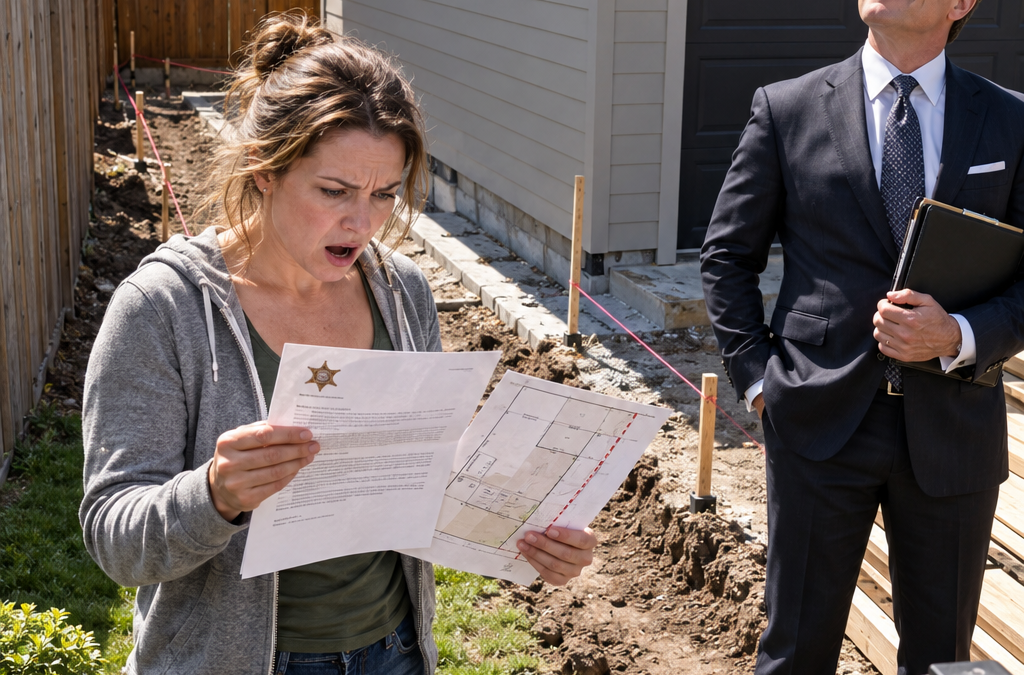
The sheriff’s letter said I had to vacate a garage I had never built.
Then I saw where it stood, and I realized someone had tried to move the legal edge of my home without me noticing.
My name is Rebecca Hale, and six months before the sheriff’s letter landed on my porch with my name misspelled across the envelope, I was just a nurse who loved her quiet cul-de-sac.
That was the whole dream.
Quiet.
After twelve-hour shifts at St. Anne’s Medical Center, after alarms and charting and families crying in hallways, I wanted a house where the loudest thing at night was a sprinkler ticking in the dark. I wanted a backyard where I could drink coffee in my robe on Sunday mornings. I wanted one stable place that belonged to me, where no one could page me, rush me, or tell me what crisis needed solving next.
Maple Ridge Estates looked like that place.
The neighborhood sat on the edge of a small Ohio town, where the streets curved around maple trees and the homes were modest but carefully kept. Most had white trim, trimmed hedges, and small front porches. Kids rode scooters after school. Retired couples walked dogs before sunset. On trash day, everyone dragged their bins back before noon like some invisible bell had rung.
The HOA packet at closing was annoying but not alarming.
Fence height. Mailbox color. Trash can timing. Exterior paint. Lawn maintenance. The usual suburban scripture written by people who believed harmony could be measured in inches.
I read it because I’m a nurse.
Documentation matters.
You learn that fast in a hospital. If it isn’t charted, it didn’t happen. If the time is wrong, the medication might as well be wrong. If one word is missing, someone can twist the entire story later.
So yes, I read the rules.
I signed the closing documents.
I moved in on a Saturday in early spring, exhausted, hopeful, and too tired to notice the woman standing at the end of my driveway with a clipboard.
Her name was Diane Whitfield.
She was HOA president, although she introduced herself as if the title came with a badge and a gun.
Diane was in her late fifties, sharp-featured, with pale blond hair sprayed into a smooth helmet and sunglasses perched on top of her head even when she stepped indoors. She wore crisp blouses, fitted cardigans, and thin gold bracelets that clinked every time she tapped her clipboard.
That clipboard became part of the neighborhood’s weather.
If Diane was walking with it, someone was about to get fined.
The first time she spoke to me, I was unloading boxes from my car.
“You must be Rebecca,” she said.
I turned with a lamp in my arms. “That’s me.”
“Diane Whitfield. HOA president.”
“Nice to meet you.”
She gave me a smile that didn’t warm her face.
“We’re pleased to have you in Maple Ridge. We take community standards very seriously here.”
“I noticed.”
Her eyes moved past me toward the side yard.
“Is that your fence?”
I glanced over.
The cedar fence had been installed by the previous owner. It was clean, sturdy, and one of the reasons I bought the house. My backyard sat on a slight slope, and the fence gave it privacy without making it feel boxed in.
“Yes,” I said. “It came with the house.”
She walked toward it without asking.
I set the lamp down and followed.
Diane pulled a tape measure from her clipboard like a surgeon selecting an instrument.
She measured one section, then another.
“Your fence is two inches over the approved height.”
I stared at her.
“Two inches?”
“Yes.”
“It was here when I bought the house.”
“That doesn’t make it compliant.”
“The sale closed last week. The HOA documents didn’t mention any fence violation.”
She folded the tape measure back into place.
“Sometimes violations are missed during transitions.”
“That sounds like a problem for the HOA.”
Her smile thinned.
“Homeowners are responsible for their property, Rebecca.”
I had been awake since 5 a.m. I still had boxes in my car. My back hurt. My scrubs were folded in a duffel bag somewhere in the front seat because I had a shift the next morning.
I did not want my first week in the neighborhood to become a war over two inches of cedar.
“How much is the fine?” I asked.
“Fifty dollars if corrected or paid within ten days.”
I should have pushed back.
I should have asked for the original approval records. I should have checked the county permits. I should have demanded proof that the fence had ever been noncompliant.
Instead, I paid the fine.
Who wants trouble over two inches?
That was my first mistake.
Diane learned from it.
Her visits did not stop.
Next came my mailbox post.
According to Diane, it was the wrong shade of white.
I stood beside it with a paint chip from the HOA’s own packet, comparing the post to the approved color. It looked identical. Diane disagreed.
“It’s slightly too cool,” she said.
“It’s white.”
“It’s not approved white.”
“Diane, it’s a mailbox.”
“It’s a community standard.”
I repainted it.
Then came the trash cans.
A photo arrived with the violation notice, printed on HOA letterhead and slipped under my front door like a threat wearing a smiley face sticker.
My trash cans had been visible for eleven minutes past the permitted hour.
Eleven minutes.
The photo had a timestamp circled in red.
I remember standing in the foyer, still in scrubs, hair falling out of my ponytail, reading that letter while my feet ached from a double shift.
Fifty dollars.
Again.
I paid that one too.
Then another came.
Then another.
Each one small enough to make fighting seem exhausting. Each one official enough to make ignoring it feel dangerous.
By the second month, I had a drawer full of Diane’s notices.
By the third month, I had stopped laughing.
My neighbor Frank warned me before I was ready to listen.
Frank lived behind me, his backyard sharing a fence line with mine. He was a retired electrician with a gray beard, bad knees, and a habit of watering tomato plants while wearing old college sweatshirts.
One evening, while I was trimming shrubs along the fence, he leaned over and said, “She’s building a case file.”
I looked up.
“Who?”
He gave me a look.
“Come on, Rebecca.”
I lowered the clippers.
“Diane?”
“She’s not enforcing rules. She’s building a case file. I’ve seen her do it before.”
I tried to smile.
“She’s annoying, sure. But I don’t think it’s that dramatic.”
Frank shook his head.
“That woman doesn’t write a letter unless she plans to use it later.”
“She just likes control.”
“That’s what people said the last time.”
I frowned. “The last time what?”
He glanced toward Diane’s house, three streets over.
“Ask Harold someday.”
“Harold?”
“Older guy on Willow Court. Quiet. Keeps every scrap of paper. Diane hates him.”
“Why?”
“Because he remembers things she wants forgotten.”
I laughed a little, still trying to keep the conversation light.
Frank did not laugh.
“I’m serious. Document everything.”
That word landed differently coming from him.
Document.
I spent my life documenting pain scores, medication times, wound measurements, patient complaints, physician calls, family updates. Documentation was how truth survived after everyone got tired, scared, confused, or angry.
That night, I opened a folder on my laptop.
Then I opened another in cloud storage.
I named both of them Maple Ridge.
I scanned the notices. I photographed the envelopes. I saved every email. I took pictures of my mailbox, my fence, my trash cans, my yard.
At first, it felt excessive.
Then the boundary adjustment notice arrived.
It came by mail on a Wednesday.
Official letterhead. HOA seal. Diane’s signature at the bottom.
NOTICE OF BOUNDARY ADJUSTMENT AND SHARED IMPROVEMENT ZONE
I read the first paragraph twice and still didn’t understand it.
According to the notice, twelve feet of my backyard now fell within a “shared HOA improvement zone” established by a survey amendment. The language was dense, almost deliberately hard to follow, but the meaning was clear enough.
The HOA was claiming control over a strip of my backyard.
Twelve feet deep.
Across the rear edge of my property.
I called the county recorder’s office during my lunch break.
A clerk named Melanie answered.
“I’m trying to understand whether a boundary adjustment has been filed on my property,” I said.
She asked for my parcel number.
I gave it to her from my deed.
Keys clicked on her end.
“Yes,” she said slowly. “There is a survey amendment recorded against that parcel.”
My stomach tightened.
“When?”
She gave me a date.
I froze.
“That’s before I bought the house.”
“Yes.”
“What does it say?”
There was a pause.
“It references a shared improvement zone and includes an acknowledgment from the property owner.”
“That’s impossible.”
“I can send you a copy.”
“Please.”
The photocopy arrived by email twenty minutes later.
I opened it at the nurses’ station between medication rounds.
There, at the bottom of the amendment, was my name.
Rebecca Hale.
Signed in a handwriting that was not mine.
For a moment, I could not breathe.
I had never signed an HOA boundary document.
Not once. Not at closing. Not after. Not ever.
Someone had forged my name onto a document that reshaped the legal edge of my property before I had even moved in.
I printed it and stared at it in the break room until one of the other nurses asked if I was all right.
I said yes.
I was not.
That was the first twist.
Diane was not just fining me.
Someone had used my name to change the recorded understanding of my land.
I did not confront her.
Not then.
That was hard.
Every instinct in me wanted to march to her house, shove the paper in her face, and demand she explain how my signature appeared on a document I had never seen.
But nurses learn restraint.
You do not panic in a code. You do not scream when blood hits the floor. You do not accuse before you assess.
You chart.
So I charted.
I created a timeline.
Closing date.
Fence fine.
Mailbox notice.
Trash notice.
Boundary adjustment notice.
Survey amendment date.
County email.
Photocopy of forged signature.
I photographed every page. Saved duplicates. Forwarded copies to a separate email account. Uploaded them to cloud storage. Printed hard copies and placed them in a folder.
Then I began recording my interactions with Diane where legally permitted, keeping my phone in my scrub pocket whenever she approached.
Three weeks later, construction trucks rolled onto my grass.
It was 7:03 in the morning.
I had worked the night shift and had been asleep for less than two hours when the grinding sound of diesel engines snapped me awake.
At first, I thought there had been an accident.
Then I looked out my bedroom window and saw two white construction trucks backing toward my backyard.
Men in work boots were unloading concrete pillars, lumber, and metal framing.
On my grass.
Twelve feet past the old survey stakes.
I ran outside in pajama pants and an oversized T-shirt, hair loose, barefoot on wet grass.
“What is this?” I shouted.
One of the workers looked up from a stack of forms.
“Ma’am?”
“What are you doing in my yard?”
He turned toward the driveway.
Diane was standing there with a Starbucks cup in one hand and her clipboard in the other.
Sunglasses on her head.
Calm as Sunday church.
“Good morning, Rebecca.”
“What is this?”
“Community garage.”
I stared at her.
“What?”
“A shared improvement structure. Board approved.”
“On my property?”
She sipped her coffee.
“On the shared improvement zone.”
My hands clenched.
“That is my backyard.”
“According to your opinion.”
“According to my deed.”
“County records now show otherwise.”
The workers kept unloading.
I stepped toward them.
“Stop. Do not pour anything.”
Diane raised one hand.
“They have authorization.”
“I want to see the vote.”
Her smile sharpened.
“Minutes are still being finalized.”
There it was.
HOA code for: we never held one.
“You’re building a garage in my yard without approved minutes?”
“It was approved.”
“By whom?”
“The board.”
“Then show me.”
Her voice lowered.
“Rebecca, you’re emotional. I understand change can be difficult, but this improvement benefits everyone.”
“Get off my property.”
Her eyes turned cold.
“Be careful. Interfering with HOA-approved work may result in additional penalties.”
I almost laughed.
Additional penalties.
A stranger was unloading concrete onto my lawn under a forged boundary document, and Diane was threatening another fine.
“Diane,” I said, keeping my voice steady, “if they pour concrete today, you are going to regret it.”
She tilted her head.
“Sweetheart, you’ll thank me when property values rise.”
She called me sweetheart like a slap.
I went inside, locked the door, and called the county.
Then I called an attorney.
His name was Marcus Bell, a real estate lawyer recommended by another nurse whose brother had been through a boundary dispute.
I sent him everything.
The deed. The survey. The forged amendment. The notices. The photos of construction trucks.
He called me back less than an hour later.
“Rebecca,” he said, “this is not a normal boundary dispute.”
“I know.”
“No, I mean legally. If your signature was forged on a recorded amendment, and they’re using that amendment to build on your land, we may be looking at criminal document fraud.”
I sat on the edge of my bed, still in pajamas, shaking from exhaustion and anger.
“What do I do?”
“Do not physically interfere with the workers. Keep documenting. I’m filing for an emergency injunction.”
“Can they keep building?”
“Not if a judge stops them fast enough.”
By the end of that day, Diane’s crew had poured concrete footings.
By the next morning, Marcus had filed the emergency injunction.
By the end of the week, Diane retaliated.
A lien notice arrived.
Nearly six thousand dollars in unpaid violation fees, administrative charges, and enforcement costs.
I stood in my kitchen holding the letter while the backyard glowed orange through the window at sunset.
A garage frame sat where my grass had been.
A lien sat against my house.
A forged signature sat in county records.
And Diane Whitfield was still walking around the neighborhood with a clipboard like she was the injured party.
The next HOA meeting was packed.
Diane had called it to address “resident obstruction of community progress.”
Everyone knew she meant me.
I sat in the third row with my phone recording from my scrub pocket.
Marcus sat beside me.
The room smelled like coffee, carpet cleaner, and tension.
Diane stood at the front in a pale blue blazer, voice syrup-sweet, eyes like ice.
“We have always been a community committed to improvement,” she said. “Unfortunately, certain homeowners resist shared progress while benefiting from the very standards they seek to undermine.”
Forty residents sat silently.
Nobody wanted to be next.
Diane went on.
She called me difficult. She said I had refused reasonable compliance requests. She said the shared improvement garage had been properly approved and would increase community value.
I did not speak.
I let her talk.
Every confident sentence was a gift.
Every lie had a timestamp.
Then Harold stood.
I knew him immediately from Frank’s description.
Older, thin, with white hair and wire-framed glasses. He held a folder against his chest.
“Diane,” he said, voice quiet but steady, “why did my storage shed disappear from the minutes six years ago?”
The room shifted.
Diane’s smile faltered.
“I’m sorry?”
“My shed approval. It existed. Then it didn’t. You claimed there was no vote, but I have the signed approval.”
Diane laughed softly.
“Harold, people misremember old board actions. It happens with volunteer boards.”
“I don’t misremember paperwork.”
A murmur moved through the room.
Then another neighbor stood.
“I was fined for driveway repairs that had already been approved.”
Then another.
“I paid twice for a fence review fee that never appeared in the ledger.”
Then a third.
“My violation notice referenced a board meeting nobody remembers attending.”
Diane’s mask flickered.
Just for a second.
Then she smoothed it back into place.
“I understand everyone has concerns, but this is not the proper forum for old grievances.”
Harold held up his folder.
“I’ve kept copies for eight years.”
That sentence changed the room.
For years, Harold had been dismissed as difficult.
Too detailed. Too suspicious. Too slow to let things go.
Now he looked like the only man who had understood Diane before the rest of us caught up.
After the meeting, Marcus and I stood with Harold near the parking lot.
He opened his folder on the hood of Marcus’s car.
Inside were approvals, receipts, letters, meeting notes, and copies of old minutes with handwritten corrections.
“Why didn’t anyone listen to you?” I asked.
Harold looked tired.
“Because Diane knew how to make one person sound unreasonable.”
Marcus scanned the documents.
“This goes back years.”
“Eight that I can prove,” Harold said.
That night, Marcus and I compiled everything.
My forged survey amendment.
Harold’s missing minutes.
The other neighbors’ fines.
Phantom votes.
Board approvals nobody remembered.
Money that appeared in homeowner accounts but not in ledgers.
A pattern stretching farther back than any of us imagined.
Marcus filed discovery requests for full HOA financial records.
We expected resistance.
Instead, the treasurer resigned the next morning.
No explanation.
Just an email to the board.
Effective immediately, I resign from all Maple Ridge HOA financial duties.
His name was Elliott Crane.
By noon, Marcus received a call from him.
Elliott wanted to talk.
Off the record.
Marcus agreed to meet him with one condition: if Elliott had evidence of a crime, there would be no promise to bury it.
Elliott showed up at Marcus’s office pale, sweaty, and terrified.
I was there because Marcus insisted I had a right to hear what concerned my property.
Elliott sat down, looked at the floor, and said one word that made Marcus go completely still.
“Skimming.”
Marcus leaned back.
“Start from the beginning.”
Elliott swallowed.
“Diane has been routing violation fees.”
“To where?”
“An account connected to her husband’s construction company.”
The room went silent.
I felt my pulse in my throat.
“What construction company?” I asked.
“Whitfield Construction Services,” Elliott said. “Officially, they’re a vendor. Maintenance, storage, small improvement projects.”
Marcus’s eyes sharpened.
“The garage.”
Elliott nodded.
“It was never a community garage.”
I stared at him.
“What?”
“It’s inventory storage. For Diane’s side business. Materials, tools, staging equipment. She needed space close to the subdivision. Your backyard was convenient.”
My hands went cold.
The garage on my property was not infrastructure.
It was storage for Diane’s private operation, built on land she had quietly claimed through a forged amendment.
Elliott kept talking.
For years, Diane had used violation fees to fund payments to Whitfield Construction under vague vendor descriptions. Some projects were inflated. Some never happened. Some were tied to enforcement against homeowners who complained.
“She told me it was how HOAs work,” Elliott said. “Small communities. Flexible accounting.”
Marcus’s voice was flat.
“That is not how accounting works.”
“She had emails,” Elliott whispered. “On me. I approved things I shouldn’t have. She said if I talked, she’d make sure I took the fall.”
Diane had stolen land.
Stolen money.
Forged documents.
And trapped her own board members into silence.
All stitched together by one arrogant woman who never imagined a “difficult homeowner” would fight back with records.
The court date arrived faster than I expected.
Marcus said HOA fraud cases moved quickly when the county prosecutor smelled easy, well-documented headlines.
I barely slept the night before.
My backyard was half construction site, half crime scene. Concrete footings. Framing materials. Tire marks in the grass. Orange safety fencing where my lemon balm used to grow.
At 5 a.m., I made coffee and sat at my kitchen table reviewing my file.
Not because I didn’t trust Marcus.
Because I needed to remember I wasn’t crazy.
That is what people like Diane do to you.
They bury you under official language until you start doubting obvious reality.
Your fence looks fine, but the notice says it isn’t. Your mailbox is white, but the letter says it’s wrong. Your deed says one thing, but the HOA says another. Your backyard is yours, but the trucks show up anyway.
Documentation becomes oxygen.
Diane arrived at court in a black blazer sharp enough to cut glass.
Pearls. Lipstick. Hair flawless.
She walked in like a woman who had never once faced real consequences.
Marcus laid it out plainly.
Forged signature.
Altered survey.
Improper construction.
Unlawful lien.
Six years of missing funds.
Sworn statements from Harold and two other residents.
Financial disclosures from Elliott.
Payments routed to Whitfield Construction.
Diane’s attorney tried to frame it as a misunderstanding.
A volunteer board error.
A boundary confusion.
A bookkeeping issue.
The judge listened with a still face.
Then Marcus introduced the forged amendment.
My signature on a document I had never signed.
The county’s original 1987 boundary maps.
My deed.
The construction plans signed by Diane.
The lien notice issued after I challenged the garage.
The judge’s expression hardened page by page.
Then came the third twist.
The judge looked down at another file and said, “Counsel, before we proceed further, this court has been informed that there is already an open fraud investigation involving Ms. Whitfield related to a previous homeowners association two towns over.”
Diane’s composure cracked.
Not tears.
Not panic.
Just a stunned, hollow stare.
As if she genuinely believed her clipboard had made her untouchable everywhere she went.
Marcus turned slightly toward me.
He had not known either.
The courtroom seemed to hold its breath.
The judge granted my injunction immediately.
Construction was ordered stopped.
The garage was to be demolished at Diane’s personal expense, subject to further proceedings.
My full twelve feet of land was restored as undisputed according to my original deed and county records.
The lien was voided that same afternoon.
Erased like it had never existed.
My name was clean on every record again.
I walked out of court into bright afternoon sunlight and nearly collapsed against the courthouse wall.
Marcus stood beside me.
“You’re okay,” he said.
I nodded, but tears were already running down my face.
“I didn’t think she could actually take it,” I said. “But then the trucks came.”
“I know.”
“She made me feel like I was trespassing in my own yard.”
“She can’t do that anymore.”
I looked at him.
“No.”
For the first time in months, I believed it.
Diane was removed from the board within the week.
Her HOA email account was deactivated before sunset.
The board, under pressure from residents and county authorities, voted to suspend all projects tied to Whitfield Construction. Financial records were turned over. Elliott cooperated. Harold became the most popular quiet man in Maple Ridge.
Diane faced felony fraud and forgery charges.
More residents came forward.
Some had paid fines they never should have owed. Others had old approvals vanish. A few had been pressured into expensive “corrections” performed by Diane’s preferred vendors.
The pattern became impossible to deny.
She had built her kingdom one intimidated homeowner at a time.
And for years, it worked because each person thought they were alone.
Six months after the sheriff’s letter first ordered me to vacate a garage I never built, Harold and I sat in my restored backyard watching a demolition crew haul away the last of Diane’s stolen concrete dream.
The workers broke the slab into chunks.
Loaded it into a truck.
Pulled up the last of the framing.
Filled the torn ground with soil.
The noise was ugly.
Beautifully ugly.
Harold sat in a folding chair beside me, wearing his wire-framed glasses and a cardigan even though it was warm.
“I told them for years,” he said quietly.
“I know.”
“They said I was obsessed.”
“You were right.”
He looked at the torn-up yard.
“I would have preferred being wrong.”
I understood that.
Being right about corruption doesn’t feel good when it means people were hurt.
Frank came by with lemonade.
Rosa from Willow Court brought cookies.
Neighbors drifted in and out through the afternoon, not like spectators at a disaster, but like people reclaiming a place.
Someone joked that we should install a plaque where the garage stood.
SITE OF FAILED KINGDOM
I laughed harder than I had in months.
By evening, the concrete was gone.
My twelve feet of land looked rough, scarred, and uneven, but it was mine again.
All of it.
I walked barefoot across the grass after the crew left.
The old survey stakes were back in place.
The true boundary, untouched since 1987, stood exactly where it always had.
Diane had tried to move it with paper.
With forged ink.
With false minutes.
With trucks and concrete and threats.
But the land had never moved.
Only the story had.
And we had finally corrected the story.
I never asked to be a fighter.
I became one because Diane Whitfield mistook exhaustion for weakness.
She looked at a nurse coming home from night shifts and saw someone too tired to push back. She saw a single woman with a quiet house and thought she could drown me in paperwork. She saw a backyard and imagined storage space. She saw my signature as something she could copy, my deed as something she could bend, and my silence as something she had already purchased.
She was wrong.
I did not win because I shouted louder.
I won because I charted.
Every notice.
Every call.
Every timestamp.
Every contradiction.
Every forged line.
Every lie she told in a meeting while my phone recorded quietly from my scrub pocket.
In the hospital, we say documentation protects patients.
In Maple Ridge, documentation protected my home.
When the last truck pulled away, Harold stood slowly and brushed grass from his pants.
“What will you plant here?” he asked.
I looked at the strip of yard Diane had stolen and lost.
“Something with roots.”
He smiled.
“Good.”
The following weekend, I planted lavender along the restored boundary.
Not because it was approved.
Because it was mine.
And when Diane’s old clipboard kingdom finally collapsed into court filings, criminal charges, and demolition dust, I learned something I will never forget.
A person can forge a signature.
They can alter a survey.
They can invent fees, threaten liens, and pour concrete where they have no right to stand.
But the truth has boundaries too.
And once you mark them clearly enough, even the most powerful bully in the neighborhood has to step back.








