𝗙𝗨𝗟𝗟 𝗦𝗧𝗢𝗥𝗬 The HOA President Built a Fence Across My Driveway Before I Found the Fake Survey Hidden Behind It
𝗙𝗨𝗟𝗟 𝗦𝗧𝗢𝗥𝗬
Then came the trash-bin fine.
Two hundred dollars for leaving my bins out one hour past the allowed removal window.
I had been at Mia’s school conference.
I paid the fine because I was tired, and because arguing over trash bins felt like letting Deborah drag me into the kind of life I did not want.
I remember telling myself, She just likes control.
That was my rookie mistake.
Deborah did not stop at reminders.
Control was not her hobby.
It was her method.
The next letter came three weeks later.
It claimed my driveway technically crossed into common HOA land based on a decades-old survey.
I read the sentence twice.
Then I walked outside and stared at the driveway.
It was the same driveway that had been there when I bought the house.
Same asphalt.
Same garage entrance.
Same narrow strip leading from the public street to my property.
I had parked there for three years.
The previous owners had parked there for years before me.
Nothing had changed.
I called the HOA office.
Deborah answered herself.
“This is Ashley Bennett,” I said. “I received a letter saying my driveway crosses common land.”
“Yes,” Deborah replied, already sounding pleased with herself. “That matter came to the board’s attention during a review.”
“What review?”
“A property-boundary review.”
“Can I see the survey?”
“It’s on file.”
“Where?”
“With the association.”
“I need a copy.”
There was a pause.
Then she said, “Rules are rules, sweetie.”
I closed my eyes.
From Deborah, sweetie never meant kindness.
It meant something ugly was coming.
“I’m not arguing with a rule,” I said. “I’m asking for proof.”
“The board has reviewed the matter.”
“Which board?”
“The HOA board.”
“That doesn’t answer my question.”
Her voice cooled.
“Ashley, your tone is becoming unproductive.”
“My driveway is being questioned. I think my tone is reasonable.”
“The association has the authority to protect common areas.”
“Not by claiming parts of my driveway without documentation.”
Another pause.
Shorter this time.
Sharper.
“You will receive further notice.”
She hung up.
Two days later, contractors showed up.
I was making coffee before taking Mia to school when I heard metal posts hitting pavement.
At first, I thought a utility crew had arrived.
Then I looked through the front window and saw three men unloading fence panels from a flatbed truck.
They were standing at the mouth of my driveway.
My driveway.
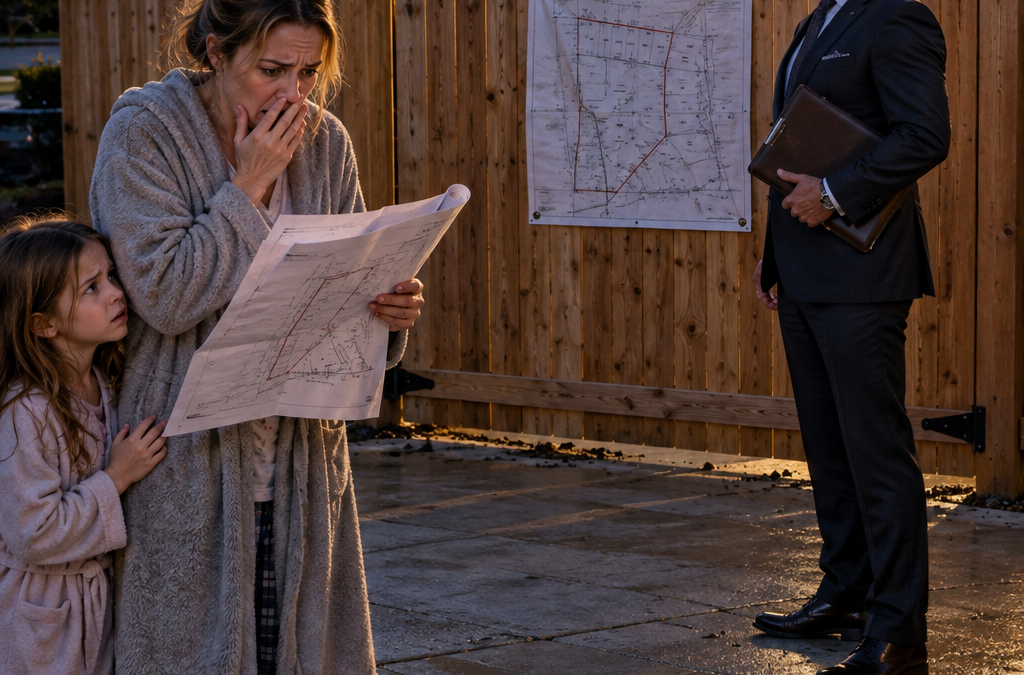
I ran outside in my robe, coffee shaking in my hand.
“What are you doing?”
One of the men turned. He was wearing a gray hoodie and work gloves, and he looked like he already hated the job.
“Fence installation.”
“Across my driveway?”
He glanced at a paper in his hand.
“HOA work order.”
I stared as another worker carried a six-foot privacy panel toward the asphalt.
“No. Stop.”
The man lowered the panel slightly.
“We were told this was common property.”
“It is the entrance to my garage.”
He looked past me toward the closed garage door.
I saw discomfort cross his face.
Then Deborah’s white SUV pulled up behind the truck.
She stepped out wearing sunglasses, a pale blue blouse, white slacks, and that clipboard tucked against her chest like a shield.
“Good morning, Ashley.”
“What is this?”
She looked toward the workers.
“Board decision.”
“To fence off my driveway?”
“To protect HOA common land from unauthorized private use.”
“My car is in that garage.”
“That is unfortunate timing.”
I turned, half expecting her to laugh.
She didn’t.
Mia appeared behind me on the porch in her backpack.
“Mom?”
I forced my voice steady.
“Go inside, honey.”
“But school—”
“Inside.”
Her eyes moved from me to the fence panels.
She knew something was wrong.
That was the part that hit hardest.
Not Deborah.
Not the contractors.
Not even the posts being drilled into asphalt.
It was my daughter standing barefoot on the porch, realizing adults could do things that made no sense and still call them rules.
I looked back at Deborah.
“You’re blocking legal access to my home.”
She smiled.
“You’ll thank me later for protecting property values.”
“By trapping a single mom’s car in her own garage?”
Her smile thinned.
“No one is trapping you. You are free to park elsewhere while this matter is resolved.”
“My car is already inside.”
“Then you should have addressed the notice when you received it.”
“I asked for proof.”
“And the board reviewed it.”
I looked at the contractors.
“Do not install another panel.”
Deborah lifted her chin.
“If you interfere with an approved HOA vendor, additional fines will apply.”
My hand tightened around the coffee mug.
For one second, I wanted to throw it.
Instead, I set it carefully on the porch rail and pulled out my phone.
I started recording.
Deborah’s expression changed.
Only slightly.
But I saw it.
“Recording is unnecessary,” she said.
“It feels very necessary.”
The men installed the fence anyway.
By 8:15 a.m., a six-foot wooden barrier stood across my driveway entrance.
Mia missed school.
I missed work.
My car sat trapped behind my garage door like the punchline to a joke written by someone who hated me.
That afternoon, I called a tow company and asked if there was any way to get my car out through the backyard. The man laughed, then realized I was serious.
“Ma’am, not without tearing up half your property.”
I thanked him and hung up.
Then I opened my laptop.
That night, after Mia fell asleep, I started digging through public records.
County property maps.
Recorder’s filings.
Old subdivision plats.
HOA documents.
Survey references.
The letter Deborah sent had cited an old survey number, but when I searched the county archive, that survey did not exist.
Not under that number.
Not under my parcel.
Not under the HOA’s common areas.
For two hours, I thought I was searching wrong.
Then I found a private filing.
It had been submitted not by the county, not by the original developer, and not by a licensed municipal survey office.
It was attached to a company name.
Whitfield Development Holdings LLC.
My hands went cold.
I clicked the filing.
The boundary line shown in Deborah’s letter matched the private filing almost exactly.
A line had been drawn through the edge of my driveway and labeled as HOA common access area.
It was not part of the original recorded plat.
It was not in my closing documents.
It was not in the survey from when I bought the house.
It had appeared later.
Submitted through Deborah’s own LLC.
I sat back slowly.
This was not about a mailbox.
Not about trash bins.
Not about common land.
It was personal, calculated, and buried under fake paperwork with Deborah’s fingerprints all over it.
Then I remembered the letter from six months earlier.
I had nearly forgotten it.
At the time, it had seemed like just another annoying piece of mail from some developer.
Whitfield Development Holdings LLC had offered to buy a backyard easement across my property.
The letter said the company was assembling land for a possible private access corridor tied to a small commercial development near the main road.
I said no.
I did not even think about it long.
My backyard was small. The easement would have cut across the only green space Mia had. I bought the house for stability, not to let some developer carve a path through it.
I never heard back.
And Deborah never mentioned that she was the developer.
Now the mailbox warning, the trash fine, the sudden driveway claim, and the fence all lined up in my head.
She was squeezing me.
Not randomly.
Not because she cared about rules.
Because I had refused to sell something she wanted.
I barely slept.
The next morning, I called a real estate attorney named Priya Desai.
Her office was twenty minutes away in a brick building beside an insurance agency and a dentist. She was a sharp woman with dark hair, precise questions, and no patience for dramatic exaggeration.
I brought everything.
The HOA letters.
Photos of the fence.
Video of the contractors.
The public records.
The private filing.
The old plat.
The easement offer from Whitfield Development Holdings.
Priya read without interrupting.
Every page.
Every line.
When she finished, she looked up.
“This is fraud, Ashley.”
The word knocked the air out of me.
“Fraud?”
“If the HOA used a false or altered boundary claim to obstruct your legal access, and that claim ties back to the president’s own development company, yes, we are in serious territory.”
I swallowed.
“My car is still trapped.”
“We move fast.”
“How fast?”
“Today.”
Priya filed for an emergency injunction to remove the fence, citing obstruction of legal ingress and egress to my property.
Ingress and egress.
Those words became my lifeline.
They meant I had a legal right to get to and from my own home.
A right Deborah had fenced off while smiling through sunglasses.
The court scheduled an emergency hearing.
Meanwhile, Deborah escalated.
A certified letter arrived two days later.
I opened it at the kitchen table while Mia did homework beside me.
The letter demanded payment of $4,000 in violation fees within ten days or the HOA would proceed toward placing a lien on my home.
A lien.
On my home.
Over a fence Deborah had built illegally.
For a moment, the audacity nearly knocked the wind out of me.
Then I laughed.
Genuinely laughed.
Mia looked up from her math worksheet.
“Mom?”
I covered my mouth.
“I’m okay.”
“You don’t sound okay.”
“I’m just—”
I looked at the letter again.
Absurdity was the only thing keeping me from crying in my kitchen.
“She built a fence across our driveway,” I said, more to myself than to Mia, “and now she wants us to pay fines because the fence she built is causing problems.”
Mia frowned.
“That’s dumb.”
“It is extremely dumb.”
“Can she do that?”
I looked at my daughter.
I wanted to say no.
I wanted to promise her adults could not just make up rules, block driveways, and threaten homes.
But I had learned enough by then to know the truth was more complicated.
“She can try,” I said. “But we’re going to stop her.”
That evening, my neighbor Tom leaned over the hedge.
Tom was in his late sixties, retired, and fixed lawnmowers in his garage for fun. He had a cigarette voice though I had never seen him smoke, and he wore suspenders even when mowing.
“I saw the fence,” he said.
“Hard to miss.”
“That woman fined me for a garden gnome once.”
Despite everything, I almost smiled.
“A garden gnome?”
“Said it violated community harmony.”
“What did you do?”
“Paid it. Then she fined me for the replacement because the color was more disruptive.”
I stared at him.
“She did it twice?”
Tom nodded toward the street.
“You aren’t the first one.”
That sentence changed everything.
The next morning, after borrowing Rosa’s car to take Mia to school, I started knocking on doors.
At first, people were cautious.
They opened doors a few inches.
They glanced over my shoulder as if Deborah might be standing behind me with a clipboard.
But once I explained what happened, folders started appearing.
A couple on the next street had received foreclosure threats over a fabricated fence-height violation.
An elderly man had been cited repeatedly after refusing to sign an access agreement near his side yard.
Tom had years of strange, inconsistent fines.
Rosa, who lived around the corner, had paid nearly $3,000 after disputing a landscaping assessment tied to land behind her house.
One by one, the pieces came together.
Deborah had been running the same playbook on at least four other residents.
All of them owned property adjacent to or useful for her development plans.
One elderly couple, the Petersons, had already sold their home in fear after months of threats over a fence-height violation that no one could verify.
They had moved in with their son.
Their house had later been purchased by an LLC.
Another LLC connected to Deborah’s development network.
That was twist number two.
Deborah Whitfield was not merely a control freak board president.
She was quietly building an empire off other people’s panic.
She used the HOA like a pressure machine.
Fine them.
Threaten them.
Confuse them with paperwork.
Make the legal costs look unbearable.
Then offer a way out through a sale, an easement, or surrender.
I brought everything to Priya.
She spread the documents across her conference table.
Fake surveys.
LLC filings.
Harassment timelines.
Violation letters.
The lien threat.
The recorded conversation from the morning the fence was installed.
A separate recording from a board meeting where Deborah had said, clear as day, “The board rubber-stamps whatever I bring them because I do the work no one else wants.”
Priya listened to that line twice.
Then a third time.
“She said this publicly?”
“At an HOA meeting. I recorded it.”
“Was recording allowed?”
“The meeting notice said homeowners could record.”
Priya smiled slightly.
“Good.”
She submitted everything to the court.
Then she filed a formal complaint with the state attorney general’s consumer protection division.
That was when Deborah realized the pressure had shifted.
So she did what people like Deborah always do when control starts slipping.
She called an emergency HOA meeting.
The notice said the board would consider disciplinary action related to my standing as a homeowner and member in good standing.
In plain English, Deborah wanted to vote me into public disgrace before the court could rule.
Priya told me not to speak unless necessary.
“Let the documents work,” she said.
But I knew there was one question the whole neighborhood needed to hear.
The clubhouse was packed that night.
I had never seen so many residents at an HOA meeting.
Some came because they were angry.
Some came because they were curious.
Some came because the fence across my driveway had scared them. If Deborah could do it to me, she could do it to anyone.
Deborah stood at the front wearing a cream blazer, black trousers, and pearls. Her hair was perfect. Her clipboard lay on the table in front of her. She looked calm, but there was a stiffness in her shoulders I had not seen before.
The board sat beside her.
Three people who had spent years nodding when she spoke.
Deborah opened the meeting with a speech about harmony, standards, and the danger of misinformation.
Then she looked at me.
“Some residents,” she said, “choose to interpret enforcement as persecution.”
Murmurs moved through the room.
I sat still, folder on my lap.
She continued.
“Maple Ridge Hollow cannot function if individual homeowners decide they are above the rules.”
That was enough.
I stood.
Priya, seated beside me, gave me a warning glance.
I kept my voice steady.
“I have one question.”
Deborah’s smile sharpened.
“You’ll have an opportunity during homeowner comment.”
“This concerns the property line you used to justify fencing off my driveway.”
The room quieted.
Deborah tilted her head.
“Those documents are part of the board’s review.”
I held up the filing.
“Can someone explain why the disputed property line was submitted through your LLC?”
The room went dead silent.
For the first time since I had met her, Deborah’s smile cracked.
Not fully.
But enough.
A tiny fracture.
A flash of fear.
One board member turned toward her.
“What LLC?”
I looked around the room.
“Whitfield Development Holdings.”
Whispers started.
I continued.
“The same company that offered to buy my backyard easement six months ago.”
Someone gasped.
Tom leaned forward.
Rosa covered her mouth.
Deborah’s voice came out too sharp.
“This is an administrative matter being distorted by a disgruntled homeowner.”
I held up another document.
“The original county plat does not show the line Deborah used. The county archive does not contain the survey number cited in my violation letter. The line appears in a private filing connected to her development company.”
A board member stared at Deborah.
“Is that true?”
Deborah swallowed.
“It’s an administrative oversight.”
The whispers became louder.
“An oversight?” I said. “You built a six-foot fence across my driveway based on it.”
I saw faces change across the room.
Neighbors who had avoided eye contact with me now leaned forward.
People began recognizing the shape of the thing.
Their own fines.
Their own threats.
Their own pressure letters.
I had already emailed the documents to every homeowner on the list an hour before the meeting.
Phones came out.
People opened attachments.
Whispers turned into gasps.
Tom stood.
“She did the same thing with my side-lot boundary.”
Rosa stood too.
“And my landscaping dispute.”
Another man raised his hand.
“The Petersons sold because of that fence issue.”
Deborah lifted her clipboard.
“This meeting will remain orderly.”
But order was gone.
Not chaos.
Truth.
There is a difference.
Then Priya stood.
Her voice cut through the room.
“The county clerk’s office confirmed this afternoon that the survey submission in question was backdated.”
Deborah turned pale.
That was twist number three.
The date stamp.
Filed the same week Deborah proposed her development bid.
Not years earlier.
Not decades old.
Not some forgotten boundary problem.
The same week.
That single timestamp became the nail in the coffin.
Undeniable.
Recorded.
Impossible to spin as a mistake.
The board members stared at Deborah as if seeing her for the first time.
She tried to speak.
“I can explain—”
But no one wanted her explanation anymore.
The room had already understood.
The next morning, the judge granted the injunction.
The fence had to come down within forty-eight hours.
No exceptions.
No delays.
No appeals before compliance.
The order was short, direct, and beautiful.
The HOA had obstructed legal ingress and egress to my property based on a disputed and unsupported boundary claim. The fence was to be removed immediately, and the HOA was barred from further interference pending full review.
I read the order three times.
Then I handed it to Mia.
She was thirteen, smart, quiet when worried, and far too aware of how much I had been trying not to cry for the past two weeks.
“What does it mean?” she asked.
“It means they have to take the fence down.”
Her eyes widened.
“Really?”
“Really.”
“When?”
“Within forty-eight hours.”
She smiled for the first time in days.
“Can I watch?”
I laughed.
“Yes.”
Two days later, the same contractors who had built the fence returned.
This time, a police officer stood nearby to keep the peace.
I watched from my porch with Mia beside me.
Panel by panel, post by post, the fence came apart.
The drill screamed.
Boards dropped onto the grass.
Dust lifted from the asphalt.
My driveway slowly reappeared.
Deborah was not there.
She sent an assistant.
A young woman who stood near the sidewalk with a tablet, clearly wishing she had chosen a different career.
Neighbors gathered quietly outside their homes.
No one cheered.
No one needed to.
The sound of the fence coming down was enough.
When the last post was removed, Mia ran down the driveway on her bike.
Just once, from the garage to the street and back.
A simple loop.
Something she had done a hundred times before.
But that day, I stood on the porch and cried.
Not loudly.
Not dramatically.
Just enough.
Because for two weeks, I had been staring at that fence like it was the physical shape of every fear I had as a single mother.
That I could work for years and still have someone take stability from my child.
That paperwork could overpower truth.
That money and position could turn a homeowner into prey.
Watching Mia ride through the cleared driveway felt like breathing again.
The attorney general’s office opened a formal fraud investigation into Deborah’s LLC filings and the HOA’s financial records the following week.
Once investigators began pulling documents, more problems surfaced.
Questionable fine patterns.
Undisclosed development interests.
Boundary disputes tied to the same group of targeted properties.
Pressure letters issued without proper support.
HOA records that appeared altered after the fact.
Priya kept me updated, but carefully.
“Investigations move slowly,” she said. “Do not expect instant punishment.”
“I’m not expecting instant.”
“Good.”
“I just want her stopped.”
“She is being stopped.”
Within a month, Deborah resigned from the board for personal reasons.
That was the phrase in her resignation letter.
Personal reasons.
Everyone in Maple Ridge Hollow knew exactly what those reasons were.
She did not attend the next meeting.
For the first time since I had lived there, the clubhouse felt different.
Lighter.
Still tense, but no longer suffocated.
Three other residents joined a class action suit demanding refunds for years of bogus fines and reversal of two threatened liens. Priya coordinated with additional counsel, and the documents we had gathered became the foundation of a broader case.
The Petersons, the elderly couple who had sold under pressure, came back to one meeting.
Mrs. Peterson stood beside her son, fragile but furious, holding a folder of letters Deborah had sent them.
“I thought we were alone,” she said.
The room went silent.
That sentence could have belonged to any of us.
I thought we were alone.
Deborah had counted on that.
Isolation was part of the plan.
Keep each homeowner dealing with their own fine, their own threat, their own shame. Make everyone think they were the problem. Make them too embarrassed or exhausted to compare notes.
The moment we compared notes, her system started collapsing.
Local news picked up the story after the attorney general’s investigation became public.
The headline was blunt.
HOA President Accused of Fraud Targeting Neighbors in Development Scheme.
For two days, reporters parked outside the neighborhood entrance.
Deborah stopped answering her door.
Her white SUV disappeared from the driveway.
Curtains stayed closed.
The woman who had once patrolled the cul-de-sac with a clipboard now hid behind the same windows she had used to watch the rest of us.
I did not feel sorry for her.
Maybe that makes me harsh.
I do not care.
There is a particular cruelty in threatening someone’s home when you know exactly how hard they worked to get it.
Deborah looked at single mothers, elderly couples, quiet neighbors, and ordinary families, and saw leverage.
She saw fear as a tool.
She saw fake paperwork as a strategy.
She saw our homes as pieces in her development plan.
If consequences felt heavy when they finally reached her door, that was because she had stacked them herself.
The new HOA board was elected six weeks later.
For the first time, people actually volunteered.
Tom ran.
Rosa ran.
A younger father named Brian ran on a platform that was basically, “No more secret nonsense.”
I did not run.
I had no desire to govern anything.
I wanted my driveway clear, my daughter safe, and my evenings back.
But I attended the meeting.
Mia came with me and sat beside Rosa.
The first vote passed unanimously.
No enforcement action without a specific rule citation and documented evidence.
Second vote.
No property-line claims without county-verified records.
Third vote.
No HOA contract, filing, or development-related communication involving a board member’s private entity without full disclosure and homeowner review.
Fourth vote.
Full transparency for all legal expenses and fines.
Simple rules.
Obvious rules.
Rules that should have existed before Deborah ever touched a clipboard.
My driveway is clear now.
The asphalt still has marks where the fence posts were bolted down. I could have paid someone to patch them perfectly, but I have not done it yet.
Part of me wants them gone.
Another part of me looks at those marks and remembers that they are not scars from losing.
They are proof that something was removed.
Mia rides her bike down the driveway every evening when the weather is good. She loops into the cul-de-sac, circles the maple tree near the center island, then comes back toward the garage with her hair flying behind her.
The first week after the fence came down, she did it constantly.
I think she needed to prove to herself that nothing would stop her.
I understood.
For months after Deborah resigned, I still checked my mailbox with a little dread.
Fear does not disappear just because a judge signs an order.
It lingers in small habits.
Saving every letter.
Photographing every notice.
Reading every HOA email twice.
Watching unfamiliar cars at the curb.
Then slowly, the house became a home again instead of a legal file.
I planted mums by the porch.
Repainted the mailbox the same color, mostly out of stubbornness.
Had the garage door serviced because it had started groaning from weeks of being trapped shut.
One Saturday morning, I drove my car out of the garage just because I could.
I backed down the driveway slowly, stopped at the street, then pulled forward again.
Mia watched from the porch.
“Mom, what are you doing?”
“Enjoying my legal ingress and egress.”
She stared.
“You’re weird.”
“I’m legally weird.”
She laughed.
That laugh was worth every document, every hearing, every sleepless night.
Justice did not come fast.
It never does.
It came through folders, filings, timestamps, injunctions, neighbors finally speaking, and one date stamp Deborah could not explain away.
It came through a judge’s order and a contractor’s drill.
It came through Mia’s bike tires rolling over asphalt Deborah tried to steal from us.
It came full.
Undeniable.
More satisfying than anything I could have planned.
One evening near the end of summer, I stood at the end of my driveway as the sun dropped behind the trees.
The cul-de-sac was quiet.
Tom was in his garage working on another lawnmower.
Rosa was watering flowers.
Mia was riding in slow circles near the center of the street.
For the first time in months, I actually felt sleepy.
Not exhausted.
Sleepy.
The peaceful kind.
The kind that comes when your body finally believes the threat has passed.
I looked down at the faint marks in the asphalt.
Then toward the place where the fence had stood.
Three weeks before it appeared, I would have told anyone that my neighborhood was quiet.
Three weeks after it came down, I understood quiet can mean two different things.
Sometimes quiet is peace.
Sometimes quiet is fear waiting for someone to break it.
Deborah had ruled Maple Ridge Hollow by keeping people quiet.
A fine here.
A threat there.
A fake survey.
A backdated filing.
A fence across a single mother’s driveway.
She thought nobody would connect the pieces.
She thought I would panic, pay, and surrender.
She thought my home was just another obstacle between her and profit.
She was wrong.
My home was not a line on her development map.
My driveway was not her bargaining chip.
My fear was not her property.
And the strip of asphalt she tried to steal became the place where her whole plan began falling apart.
Mia rode past me, laughing.
“Watch this!”
She lifted both feet off the pedals for two seconds, then dropped them back down, proud of herself.
I clapped.
The sky turned gold behind the rooftops.
The driveway was open.
The garage was open.
The street was open.
And for the first time since the fence went up, I walked back into my house, locked the door behind me, and slept through the night.
𝗧𝗛𝗘 𝗘𝗡𝗗
The HOA President Built a Fence Across My Driveway Before I Found the Fake Survey Hidden Behind It
The fence appeared before sunrise, six feet high and bolted across the only way out of my garage. By the time my daughter asked how we were supposed to get to school, I already knew this was not a mistake.
My name is Ashley Bennett, and I was thirty-four years old when a strip of asphalt outside my house turned my quiet Ohio cul-de-sac into a courtroom battlefield.
I never expected my first real fight as a homeowner to involve survey fraud, a backdated filing, and a woman with a clipboard who thought rules were only useful when they helped her take something from someone else.
I bought my house in Maple Ridge Hollow three years earlier.
It was small, but it was mine.
Two bedrooms upstairs, a tiny office off the kitchen, a half-finished basement, a one-car garage, and a backyard that sloped gently toward a line of old trees behind the cul-de-sac.
To some people, it would have looked ordinary.
To me, it looked like the result of twelve years of restraint.
I had started saving when I was twenty-two. Back then, owning a home felt so far away it might as well have been a story somebody told to keep me from giving up. I was working hourly jobs, sharing apartments with roommates, and counting every dollar twice before spending it.
Then my daughter, Mia, was born.
Everything got harder.
Everything also became clearer.
I stopped imagining a perfect house. I just wanted one stable place where she could grow up knowing the same front door, the same bedroom window, the same streetlights outside at night. I wanted a driveway where she could learn to ride her bike and a kitchen table where we could eat dinner without hearing footsteps from the apartment upstairs.
Maple Ridge Hollow gave me that.
Or at least I thought it did.
The neighborhood sat outside Columbus, tucked into a quiet pocket of winding residential streets and maple trees. The houses were modest but clean, the lawns carefully edged, and the cul-de-sac where I lived felt almost protected from the rest of the world.
Kids rode bikes in looping circles.
Neighbors waved from porches.
On trash day, every bin seemed to appear and disappear by invisible agreement.
The HOA paperwork came with the closing documents.
I read it the way exhausted first-time buyers read paperwork. Carefully enough to recognize the important parts, not deeply enough to anticipate every trap.
The dues were manageable.
The rules looked standard.
Mailbox color.
Lawn maintenance.
Exterior changes.
Trash bins.
Parking.
Nothing terrifying.
Nothing that suggested the HOA president might one day put up a fence across my driveway.
Her name was Deborah Whitfield.
She lived at the other end of the cul-de-sac in a large brick house with black shutters, perfect boxwoods, and a flagpole that always looked freshly polished. Deborah was in her late fifties, sharp-featured, always dressed as if a real estate photographer might arrive at any second. Her hair was an expensive shade of blond-gray, shaped into a smooth bob that never seemed affected by rain or heat.
She carried a clipboard everywhere.
Not sometimes.
Everywhere.
At mailbox clusters.
At community picnics.
At HOA meetings.
Even once at a child’s birthday party, where I watched her tell a man that his folding chair was technically blocking common lawn access.
Her smile was sharp as glass.
People called her strict.
Then they lowered their voices and called her worse.
When I first moved in, Deborah came to my door with a welcome packet and a basket of local jam, coffee, and HOA-approved paint samples.
I thought that was thoughtful.
Now I understand it was more like a warning.
She stood on my porch, looking past me into the entryway.
“Welcome to Maple Ridge Hollow,” she said. “We like to keep things orderly here.”
“I noticed. It’s beautiful.”
“It is,” she said. “Because we protect it.”
At the time, I thought she meant the neighborhood.
Later, I realized she meant her control over it.
For the first two years, I mostly stayed out of her way.
I worked, took Mia to school, cooked dinner, paid my dues, and tried to keep the lawn decent. I was not the kind of person who wanted conflict with neighbors. I did not attend meetings unless something directly affected me. I did not complain when someone’s dog barked or when leaves blew into my yard.
I wanted peace.
Deborah wanted obedience.
It started small.
A friendly reminder about my mailbox color.
Apparently, the black paint had faded into what Deborah called an “unapproved charcoal tone.” I stood at the curb holding the notice, staring at the mailbox, trying to understand how black could become unacceptable by aging in sunlight.
I repainted it.
Then came the trash-bin fine.
Two hundred dollars for leaving my bins out one hour past the allowed removal window.
I had been at Mia’s school conference.
I paid the fine because I was tired, and because arguing over trash bins felt like letting Deborah drag me into the kind of life I did not want.
I remember telling myself, She just likes control.
That was my rookie mistake.
Deborah did not stop at reminders.
Control was not her hobby.
It was her method.
The next letter came three weeks later.
It claimed my driveway technically crossed into common HOA land based on a decades-old survey.
I read the sentence twice.
Then I walked outside and stared at the driveway.
It was the same driveway that had been there when I bought the house.
Same asphalt.
Same garage entrance.
Same narrow strip leading from the public street to my property.
I had parked there for three years.
The previous owners had parked there for years before me.
Nothing had changed.
I called the HOA office.
Deborah answered herself.
“This is Ashley Bennett,” I said. “I received a letter saying my driveway crosses common land.”
“Yes,” Deborah replied, already sounding pleased with herself. “That matter came to the board’s attention during a review.”
“What review?”
“A property-boundary review.”
“Can I see the survey?”
“It’s on file.”
“Where?”
“With the association.”
“I need a copy.”
There was a pause.
Then she said, “Rules are rules, sweetie.”
I closed my eyes.
From Deborah, sweetie never meant kindness.
It meant something ugly was coming.
“I’m not arguing with a rule,” I said. “I’m asking for proof.”
“The board has reviewed the matter.”
“Which board?”
“The HOA board.”
“That doesn’t answer my question.”
Her voice cooled.
“Ashley, your tone is becoming unproductive.”
“My driveway is being questioned. I think my tone is reasonable.”
“The association has the authority to protect common areas.”
“Not by claiming parts of my driveway without documentation.”
Another pause.
Shorter this time.
Sharper.
“You will receive further notice.”
She hung up.
Two days later, contractors showed up.
I was making coffee before taking Mia to school when I heard metal posts hitting pavement.
At first, I thought a utility crew had arrived.
Then I looked through the front window and saw three men unloading fence panels from a flatbed truck.
They were standing at the mouth of my driveway.
My driveway.
I ran outside in my robe, coffee shaking in my hand.
“What are you doing?”
One of the men turned. He was wearing a gray hoodie and work gloves, and he looked like he already hated the job.
“Fence installation.”
“Across my driveway?”
He glanced at a paper in his hand.
“HOA work order.”
I stared as another worker carried a six-foot privacy panel toward the asphalt.
“No. Stop.”
The man lowered the panel slightly.
“We were told this was common property.”
“It is the entrance to my garage.”
He looked past me toward the closed garage door.
I saw discomfort cross his face.
Then Deborah’s white SUV pulled up behind the truck.
She stepped out wearing sunglasses, a pale blue blouse, white slacks, and that clipboard tucked against her chest like a shield.
“Good morning, Ashley.”
“What is this?”
She looked toward the workers.
“Board decision.”
“To fence off my driveway?”
“To protect HOA common land from unauthorized private use.”
“My car is in that garage.”
“That is unfortunate timing.”
I turned, half expecting her to laugh.
She didn’t.
Mia appeared behind me on the porch in her backpack.
“Mom?”
I forced my voice steady.
“Go inside, honey.”
“But school—”
“Inside.”
Her eyes moved from me to the fence panels.
She knew something was wrong.
That was the part that hit hardest.
Not Deborah.
Not the contractors.
Not even the posts being drilled into asphalt.
It was my daughter standing barefoot on the porch, realizing adults could do things that made no sense and still call them rules.
I looked back at Deborah.
“You’re blocking legal access to my home.”
She smiled.
“You’ll thank me later for protecting property values.”
“By trapping a single mom’s car in her own garage?”
Her smile thinned.
“No one is trapping you. You are free to park elsewhere while this matter is resolved.”
“My car is already inside.”
“Then you should have addressed the notice when you received it.”
“I asked for proof.”
“And the board reviewed it.”
I looked at the contractors.
“Do not install another panel.”
Deborah lifted her chin.
“If you interfere with an approved HOA vendor, additional fines will apply.”
My hand tightened around the coffee mug.
For one second, I wanted to throw it.
Instead, I set it carefully on the porch rail and pulled out my phone.
I started recording.
Deborah’s expression changed.
Only slightly.
But I saw it.
“Recording is unnecessary,” she said.
“It feels very necessary.”
The men installed the fence anyway.
By 8:15 a.m., a six-foot wooden barrier stood across my driveway entrance.
Mia missed school.
I missed work.
My car sat trapped behind my garage door like the punchline to a joke written by someone who hated me.
That afternoon, I called a tow company and asked if there was any way to get my car out through the backyard. The man laughed, then realized I was serious.
“Ma’am, not without tearing up half your property.”
I thanked him and hung up.
Then I opened my laptop.
That night, after Mia fell asleep, I started digging through public records.
County property maps.
Recorder’s filings.
Old subdivision plats.
HOA documents.
Survey references.
The letter Deborah sent had cited an old survey number, but when I searched the county archive, that survey did not exist.
Not under that number.
Not under my parcel.
Not under the HOA’s common areas.
For two hours, I thought I was searching wrong.
Then I found a private filing.
It had been submitted not by the county, not by the original developer, and not by a licensed municipal survey office.
It was attached to a company name.
Whitfield Development Holdings LLC.
My hands went cold.
I clicked the filing.
The boundary line shown in Deborah’s letter matched the private filing almost exactly.
A line had been drawn through the edge of my driveway and labeled as HOA common access area.
It was not part of the original recorded plat.
It was not in my closing documents.
It was not in the survey from when I bought the house.
It had appeared later.
Submitted through Deborah’s own LLC.
I sat back slowly.
This was not about a mailbox.
Not about trash bins.
Not about common land.
It was personal, calculated, and buried under fake paperwork with Deborah’s fingerprints all over it.
Then I remembered the letter from six months earlier.
I had nearly forgotten it.
At the time, it had seemed like just another annoying piece of mail from some developer.
Whitfield Development Holdings LLC had offered to buy a backyard easement across my property.
The letter said the company was assembling land for a possible private access corridor tied to a small commercial development near the main road.
I said no.
I did not even think about it long.
My backyard was small. The easement would have cut across the only green space Mia had. I bought the house for stability, not to let some developer carve a path through it.
I never heard back.
And Deborah never mentioned that she was the developer.
Now the mailbox warning, the trash fine, the sudden driveway claim, and the fence all lined up in my head.
She was squeezing me.
Not randomly.
Not because she cared about rules.
Because I had refused to sell something she wanted.
I barely slept.
The next morning, I called a real estate attorney named Priya Desai.
Her office was twenty minutes away in a brick building beside an insurance agency and a dentist. She was a sharp woman with dark hair, precise questions, and no patience for dramatic exaggeration.
I brought everything.
The HOA letters.
Photos of the fence.
Video of the contractors.
The public records.
The private filing.
The old plat.
The easement offer from Whitfield Development Holdings.
Priya read without interrupting.
Every page.
Every line.
When she finished, she looked up.
“This is fraud, Ashley.”
The word knocked the air out of me.
“Fraud?”
“If the HOA used a false or altered boundary claim to obstruct your legal access, and that claim ties back to the president’s own development company, yes, we are in serious territory.”
I swallowed.
“My car is still trapped.”
“We move fast.”
“How fast?”
“Today.”
Priya filed for an emergency injunction to remove the fence, citing obstruction of legal ingress and egress to my property.
Ingress and egress.
Those words became my lifeline.
They meant I had a legal right to get to and from my own home.
A right Deborah had fenced off while smiling through sunglasses.
The court scheduled an emergency hearing.
Meanwhile, Deborah escalated.
A certified letter arrived two days later.
I opened it at the kitchen table while Mia did homework beside me.
The letter demanded payment of $4,000 in violation fees within ten days or the HOA would proceed toward placing a lien on my home.
A lien.
On my home.
Over a fence Deborah had built illegally.
For a moment, the audacity nearly knocked the wind out of me.
Then I laughed.
Genuinely laughed.
Mia looked up from her math worksheet.
“Mom?”
I covered my mouth.
“I’m okay.”
“You don’t sound okay.”
“I’m just—”
I looked at the letter again.
Absurdity was the only thing keeping me from crying in my kitchen.
“She built a fence across our driveway,” I said, more to myself than to Mia, “and now she wants us to pay fines because the fence she built is causing problems.”
Mia frowned.
“That’s dumb.”
“It is extremely dumb.”
“Can she do that?”
I looked at my daughter.
I wanted to say no.
I wanted to promise her adults could not just make up rules, block driveways, and threaten homes.
But I had learned enough by then to know the truth was more complicated.
“She can try,” I said. “But we’re going to stop her.”
That evening, my neighbor Tom leaned over the hedge.
Tom was in his late sixties, retired, and fixed lawnmowers in his garage for fun. He had a cigarette voice though I had never seen him smoke, and he wore suspenders even when mowing.
“I saw the fence,” he said.
“Hard to miss.”
“That woman fined me for a garden gnome once.”
Despite everything, I almost smiled.
“A garden gnome?”
“Said it violated community harmony.”
“What did you do?”
“Paid it. Then she fined me for the replacement because the color was more disruptive.”
I stared at him.
“She did it twice?”
Tom nodded toward the street.
“You aren’t the first one.”
That sentence changed everything.
The next morning, after borrowing Rosa’s car to take Mia to school, I started knocking on doors.
At first, people were cautious.
They opened doors a few inches.
They glanced over my shoulder as if Deborah might be standing behind me with a clipboard.
But once I explained what happened, folders started appearing.
A couple on the next street had received foreclosure threats over a fabricated fence-height violation.
An elderly man had been cited repeatedly after refusing to sign an access agreement near his side yard.
Tom had years of strange, inconsistent fines.
Rosa, who lived around the corner, had paid nearly $3,000 after disputing a landscaping assessment tied to land behind her house.
One by one, the pieces came together.
Deborah had been running the same playbook on at least four other residents.
All of them owned property adjacent to or useful for her development plans.
One elderly couple, the Petersons, had already sold their home in fear after months of threats over a fence-height violation that no one could verify.
They had moved in with their son.
Their house had later been purchased by an LLC.
Another LLC connected to Deborah’s development network.
That was twist number two.
Deborah Whitfield was not merely a control freak board president.
She was quietly building an empire off other people’s panic.
She used the HOA like a pressure machine.
Fine them.
Threaten them.
Confuse them with paperwork.
Make the legal costs look unbearable.
Then offer a way out through a sale, an easement, or surrender.
I brought everything to Priya.
She spread the documents across her conference table.
Fake surveys.
LLC filings.
Harassment timelines.
Violation letters.
The lien threat.
The recorded conversation from the morning the fence was installed.
A separate recording from a board meeting where Deborah had said, clear as day, “The board rubber-stamps whatever I bring them because I do the work no one else wants.”
Priya listened to that line twice.
Then a third time.
“She said this publicly?”
“At an HOA meeting. I recorded it.”
“Was recording allowed?”
“The meeting notice said homeowners could record.”
Priya smiled slightly.
“Good.”
She submitted everything to the court.
Then she filed a formal complaint with the state attorney general’s consumer protection division.
That was when Deborah realized the pressure had shifted.
So she did what people like Deborah always do when control starts slipping.
She called an emergency HOA meeting.
The notice said the board would consider disciplinary action related to my standing as a homeowner and member in good standing.
In plain English, Deborah wanted to vote me into public disgrace before the court could rule.
Priya told me not to speak unless necessary.
“Let the documents work,” she said.
But I knew there was one question the whole neighborhood needed to hear.
The clubhouse was packed that night.
I had never seen so many residents at an HOA meeting.
Some came because they were angry.
Some came because they were curious.
Some came because the fence across my driveway had scared them. If Deborah could do it to me, she could do it to anyone.
Deborah stood at the front wearing a cream blazer, black trousers, and pearls. Her hair was perfect. Her clipboard lay on the table in front of her. She looked calm, but there was a stiffness in her shoulders I had not seen before.
The board sat beside her.
Three people who had spent years nodding when she spoke.
Deborah opened the meeting with a speech about harmony, standards, and the danger of misinformation.
Then she looked at me.
“Some residents,” she said, “choose to interpret enforcement as persecution.”
Murmurs moved through the room.
I sat still, folder on my lap.
She continued.
“Maple Ridge Hollow cannot function if individual homeowners decide they are above the rules.”
That was enough.
I stood.
Priya, seated beside me, gave me a warning glance.
I kept my voice steady.
“I have one question.”
Deborah’s smile sharpened.
“You’ll have an opportunity during homeowner comment.”
“This concerns the property line you used to justify fencing off my driveway.”
The room quieted.
Deborah tilted her head.
“Those documents are part of the board’s review.”
I held up the filing.
“Can someone explain why the disputed property line was submitted through your LLC?”
The room went dead silent.
For the first time since I had met her, Deborah’s smile cracked.
Not fully.
But enough.
A tiny fracture.
A flash of fear.
One board member turned toward her.
“What LLC?”
I looked around the room.
“Whitfield Development Holdings.”
Whispers started.
I continued.
“The same company that offered to buy my backyard easement six months ago.”
Someone gasped.
Tom leaned forward.
Rosa covered her mouth.
Deborah’s voice came out too sharp.
“This is an administrative matter being distorted by a disgruntled homeowner.”
I held up another document.
“The original county plat does not show the line Deborah used. The county archive does not contain the survey number cited in my violation letter. The line appears in a private filing connected to her development company.”
A board member stared at Deborah.
“Is that true?”
Deborah swallowed.
“It’s an administrative oversight.”
The whispers became louder.
“An oversight?” I said. “You built a six-foot fence across my driveway based on it.”
I saw faces change across the room.
Neighbors who had avoided eye contact with me now leaned forward.
People began recognizing the shape of the thing.
Their own fines.
Their own threats.
Their own pressure letters.
I had already emailed the documents to every homeowner on the list an hour before the meeting.
Phones came out.
People opened attachments.
Whispers turned into gasps.
Tom stood.
“She did the same thing with my side-lot boundary.”
Rosa stood too.
“And my landscaping dispute.”
Another man raised his hand.
“The Petersons sold because of that fence issue.”
Deborah lifted her clipboard.
“This meeting will remain orderly.”
But order was gone.
Not chaos.
Truth.
There is a difference.
Then Priya stood.
Her voice cut through the room.
“The county clerk’s office confirmed this afternoon that the survey submission in question was backdated.”
Deborah turned pale.
That was twist number three.
The date stamp.
Filed the same week Deborah proposed her development bid.
Not years earlier.
Not decades old.
Not some forgotten boundary problem.
The same week.
That single timestamp became the nail in the coffin.
Undeniable.
Recorded.
Impossible to spin as a mistake.
The board members stared at Deborah as if seeing her for the first time.
She tried to speak.
“I can explain—”
But no one wanted her explanation anymore.
The room had already understood.
The next morning, the judge granted the injunction.
The fence had to come down within forty-eight hours.
No exceptions.
No delays.
No appeals before compliance.
The order was short, direct, and beautiful.
The HOA had obstructed legal ingress and egress to my property based on a disputed and unsupported boundary claim. The fence was to be removed immediately, and the HOA was barred from further interference pending full review.
I read the order three times.
Then I handed it to Mia.
She was thirteen, smart, quiet when worried, and far too aware of how much I had been trying not to cry for the past two weeks.
“What does it mean?” she asked.
“It means they have to take the fence down.”
Her eyes widened.
“Really?”
“Really.”
“When?”
“Within forty-eight hours.”
She smiled for the first time in days.
“Can I watch?”
I laughed.
“Yes.”
Two days later, the same contractors who had built the fence returned.
This time, a police officer stood nearby to keep the peace.
I watched from my porch with Mia beside me.
Panel by panel, post by post, the fence came apart.
The drill screamed.
Boards dropped onto the grass.
Dust lifted from the asphalt.
My driveway slowly reappeared.
Deborah was not there.
She sent an assistant.
A young woman who stood near the sidewalk with a tablet, clearly wishing she had chosen a different career.
Neighbors gathered quietly outside their homes.
No one cheered.
No one needed to.
The sound of the fence coming down was enough.
When the last post was removed, Mia ran down the driveway on her bike.
Just once, from the garage to the street and back.
A simple loop.
Something she had done a hundred times before.
But that day, I stood on the porch and cried.
Not loudly.
Not dramatically.
Just enough.
Because for two weeks, I had been staring at that fence like it was the physical shape of every fear I had as a single mother.
That I could work for years and still have someone take stability from my child.
That paperwork could overpower truth.
That money and position could turn a homeowner into prey.
Watching Mia ride through the cleared driveway felt like breathing again.
The attorney general’s office opened a formal fraud investigation into Deborah’s LLC filings and the HOA’s financial records the following week.
Once investigators began pulling documents, more problems surfaced.
Questionable fine patterns.
Undisclosed development interests.
Boundary disputes tied to the same group of targeted properties.
Pressure letters issued without proper support.
HOA records that appeared altered after the fact.
Priya kept me updated, but carefully.
“Investigations move slowly,” she said. “Do not expect instant punishment.”
“I’m not expecting instant.”
“Good.”
“I just want her stopped.”
“She is being stopped.”
Within a month, Deborah resigned from the board for personal reasons.
That was the phrase in her resignation letter.
Personal reasons.
Everyone in Maple Ridge Hollow knew exactly what those reasons were.
She did not attend the next meeting.
For the first time since I had lived there, the clubhouse felt different.
Lighter.
Still tense, but no longer suffocated.
Three other residents joined a class action suit demanding refunds for years of bogus fines and reversal of two threatened liens. Priya coordinated with additional counsel, and the documents we had gathered became the foundation of a broader case.
The Petersons, the elderly couple who had sold under pressure, came back to one meeting.
Mrs. Peterson stood beside her son, fragile but furious, holding a folder of letters Deborah had sent them.
“I thought we were alone,” she said.
The room went silent.
That sentence could have belonged to any of us.
I thought we were alone.
Deborah had counted on that.
Isolation was part of the plan.
Keep each homeowner dealing with their own fine, their own threat, their own shame. Make everyone think they were the problem. Make them too embarrassed or exhausted to compare notes.
The moment we compared notes, her system started collapsing.
Local news picked up the story after the attorney general’s investigation became public.
The headline was blunt.
HOA President Accused of Fraud Targeting Neighbors in Development Scheme.
For two days, reporters parked outside the neighborhood entrance.
Deborah stopped answering her door.
Her white SUV disappeared from the driveway.
Curtains stayed closed.
The woman who had once patrolled the cul-de-sac with a clipboard now hid behind the same windows she had used to watch the rest of us.
I did not feel sorry for her.
Maybe that makes me harsh.
I do not care.
There is a particular cruelty in threatening someone’s home when you know exactly how hard they worked to get it.
Deborah looked at single mothers, elderly couples, quiet neighbors, and ordinary families, and saw leverage.
She saw fear as a tool.
She saw fake paperwork as a strategy.
She saw our homes as pieces in her development plan.
If consequences felt heavy when they finally reached her door, that was because she had stacked them herself.
The new HOA board was elected six weeks later.
For the first time, people actually volunteered.
Tom ran.
Rosa ran.
A younger father named Brian ran on a platform that was basically, “No more secret nonsense.”
I did not run.
I had no desire to govern anything.
I wanted my driveway clear, my daughter safe, and my evenings back.
But I attended the meeting.
Mia came with me and sat beside Rosa.
The first vote passed unanimously.
No enforcement action without a specific rule citation and documented evidence.
Second vote.
No property-line claims without county-verified records.
Third vote.
No HOA contract, filing, or development-related communication involving a board member’s private entity without full disclosure and homeowner review.
Fourth vote.
Full transparency for all legal expenses and fines.
Simple rules.
Obvious rules.
Rules that should have existed before Deborah ever touched a clipboard.
My driveway is clear now.
The asphalt still has marks where the fence posts were bolted down. I could have paid someone to patch them perfectly, but I have not done it yet.
Part of me wants them gone.
Another part of me looks at those marks and remembers that they are not scars from losing.
They are proof that something was removed.
Mia rides her bike down the driveway every evening when the weather is good. She loops into the cul-de-sac, circles the maple tree near the center island, then comes back toward the garage with her hair flying behind her.
The first week after the fence came down, she did it constantly.
I think she needed to prove to herself that nothing would stop her.
I understood.
For months after Deborah resigned, I still checked my mailbox with a little dread.
Fear does not disappear just because a judge signs an order.
It lingers in small habits.
Saving every letter.
Photographing every notice.
Reading every HOA email twice.
Watching unfamiliar cars at the curb.
Then slowly, the house became a home again instead of a legal file.
I planted mums by the porch.
Repainted the mailbox the same color, mostly out of stubbornness.
Had the garage door serviced because it had started groaning from weeks of being trapped shut.
One Saturday morning, I drove my car out of the garage just because I could.
I backed down the driveway slowly, stopped at the street, then pulled forward again.
Mia watched from the porch.
“Mom, what are you doing?”
“Enjoying my legal ingress and egress.”
She stared.
“You’re weird.”
“I’m legally weird.”
She laughed.
That laugh was worth every document, every hearing, every sleepless night.
Justice did not come fast.
It never does.
It came through folders, filings, timestamps, injunctions, neighbors finally speaking, and one date stamp Deborah could not explain away.
It came through a judge’s order and a contractor’s drill.
It came through Mia’s bike tires rolling over asphalt Deborah tried to steal from us.
It came full.
Undeniable.
More satisfying than anything I could have planned.
One evening near the end of summer, I stood at the end of my driveway as the sun dropped behind the trees.
The cul-de-sac was quiet.
Tom was in his garage working on another lawnmower.
Rosa was watering flowers.
Mia was riding in slow circles near the center of the street.
For the first time in months, I actually felt sleepy.
Not exhausted.
Sleepy.
The peaceful kind.
The kind that comes when your body finally believes the threat has passed.
I looked down at the faint marks in the asphalt.
Then toward the place where the fence had stood.
Three weeks before it appeared, I would have told anyone that my neighborhood was quiet.
Three weeks after it came down, I understood quiet can mean two different things.
Sometimes quiet is peace.
Sometimes quiet is fear waiting for someone to break it.
Deborah had ruled Maple Ridge Hollow by keeping people quiet.
A fine here.
A threat there.
A fake survey.
A backdated filing.
A fence across a single mother’s driveway.
She thought nobody would connect the pieces.
She thought I would panic, pay, and surrender.
She thought my home was just another obstacle between her and profit.
She was wrong.
My home was not a line on her development map.
My driveway was not her bargaining chip.
My fear was not her property.
And the strip of asphalt she tried to steal became the place where her whole plan began falling apart.
Mia rode past me, laughing.
“Watch this!”
She lifted both feet off the pedals for two seconds, then dropped them back down, proud of herself.
I clapped.
The sky turned gold behind the rooftops.
The driveway was open.
The garage was open.
The street was open.
And for the first time since the fence went up, I walked back into my house, locked the door behind me, and slept through the night.








