𝗙𝗨𝗟𝗟 𝗦𝗧𝗢𝗥𝗬 The HOA President Built a Beautiful Fence Across My Cattle Gate—Then 120 Head of Cattle Showed Her What That “Ugly Entrance” Was Really For
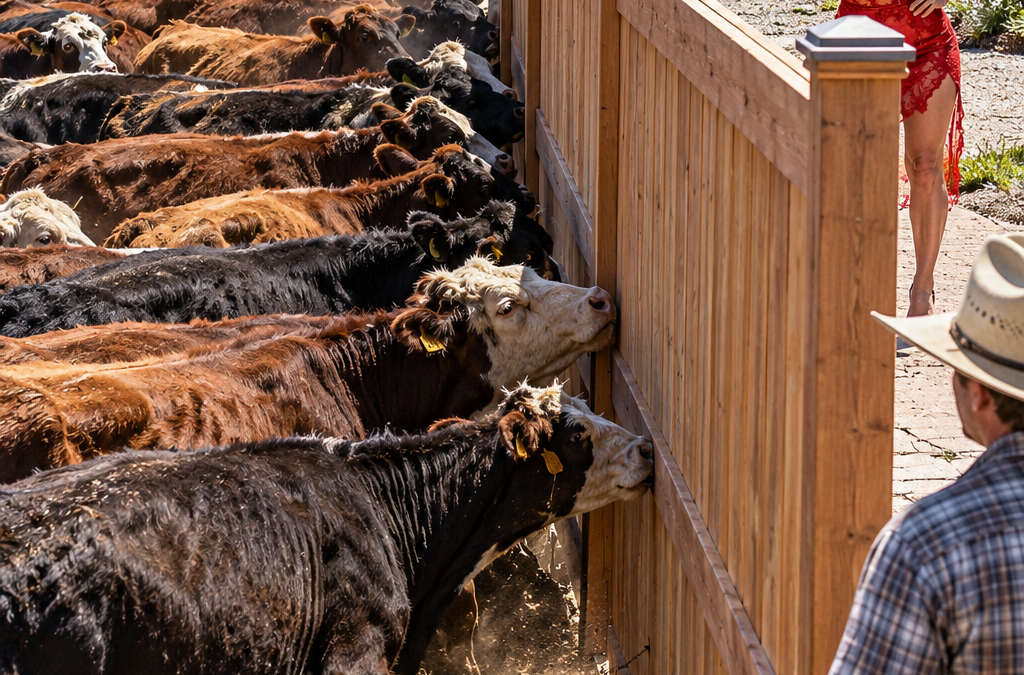
𝗙𝗨𝗟𝗟 𝗦𝗧𝗢𝗥𝗬
For a moment, neither of us spoke.
Then we heard cattle.
Lowing.
Not distressed yet.
But gathering.
The herd was scheduled to move that morning.
One hundred twenty head.
Our pasture rotation had been planned for weeks.
The lower grazing area was ready to rest.
The next pasture had better forage.
The weather window was good.
Tom was already riding the fence line farther west, preparing to bring the herd through.
Linda looked toward the sound.
“What’s that?”
“The reason this gate exists.”
The first cattle appeared beyond the hill.
Then more.
Slow-moving bodies.
Black Angus mostly.
A few mixed cows.
Calves following their mothers.
They weren’t running.
They knew the route.
They had walked it before.
Tom rode up on the utility vehicle, saw the wooden fence, and stopped so hard dust kicked up around the tires.
He climbed out.
“What the hell is this?”
Linda frowned.
“Watch your language.”
Tom looked at her.
Then me.
“She do this?”
“HOA did.”
Tom stared at the fence.
Then laughed in disbelief.
“You’re kidding.”
Linda’s expression hardened.
“It improves the community frontage.”
Tom walked toward the blocked gate.
“Lady, that’s a cattle lane.”
“I’m aware livestock uses this area.”
“No. You’re not.”
He pointed.
“That’s the main transfer gate.”
Linda shrugged.
“Use another one.”
Tom looked at me.
I looked at him.
Then both of us looked back at Linda.
“What?” she demanded.
I spoke slowly.
“Cattle don’t move like cars on a city street.”
“Don’t patronize me.”
“I’m explaining the operation you just blocked.”
“Drive them around.”
Tom actually laughed.
“Drive them around.”
Linda turned on him.
“Yes.”
“One hundred twenty head?”
“If that’s necessary.”
“Through which route?”
She gestured vaguely toward the west side of the ranch.
“Whichever one you normally use.”
“This is the one we normally use.”
“Then use the alternate.”
Tom looked at me again.
“She thinks this is GPS.”
I almost smiled despite myself.
Linda caught it.
“Stop making this into theater.”
I pointed toward the herd.
“This is not theater.”
By ten o’clock, nearly all 120 cattle had gathered near the blocked corridor.
They stood fifty yards back from the fence line, clustered in a broad group.
The older cows knew where the opening should have been.
Several walked forward, stopped, turned, and circled back.
Calves pressed close to their mothers.
Dust rose slowly beneath hooves.
We kept the herd calm.
That mattered more than arguing with Linda.
A stressed herd is dangerous.
Animals bunch.
They push.
They test weak points.
They can injure each other.
They can injure people.
The worst thing we could have done was try to force them through some improvised opening.
Tom walked beside me.
“We slow everything down.”
I nodded.
“No pressure.”
“We’ll keep water on them.”
“Feed if we need to.”
“Yep.”
Linda watched from beside her SUV.
Arms crossed.
Almost bored.
She looked at the cattle.
Then at me.
“This is ridiculous.”
I turned.
“What is?”
“You’re making them stand there to prove a point.”
For a second, I couldn’t believe what I’d heard.
“You think I’m staging this?”
“You knew the fence was there this morning.”
“I discovered it this morning.”
“You could have redirected them sooner.”
“To where?”
“The other route.”
Tom spoke.
“We’re checking it.”
Linda rolled her eyes.
“Good.”
He drove away to inspect the alternate lane.
Linda watched him leave.
“There. Problem solved.”
“No.”
She sighed dramatically.
“You ranch people make everything sound impossible.”
“You HOA people make everything sound like paperwork can change physics.”
Her face hardened.
“Careful.”
“With what?”
“Your tone.”
I looked at the cattle.
Then back at her.
“Your board built a fence across my private livestock corridor, and you’re worried about my tone.”
“You could be cooperating.”
“By doing what?”
“Using another route.”
“We don’t know if that’s viable yet.”
“Then figure it out.”
Her contempt was becoming clearer by the minute.
The ranch operation meant nothing to her.
Not the cattle.
Not the schedule.
Not the grazing plan.
All she cared about was that the subdivision side looked prettier.
Tom returned twenty minutes later.
His face told me the news before he spoke.
“West lane’s blocked too.”
I stared at him.
“How?”
He pointed toward the new fencing.
“They extended it farther than we saw from here.”
Linda frowned.
“What do you mean?”
Tom looked at her.
“I mean your fence contractor kept going.”
He drew a rough line in the dirt with his boot.
“Main gate blocked here.”
Then another.
“Normal lane blocked here.”
He looked at me.
“They boxed off the entire corridor.”
My stomach dropped.
“How far?”
“Enough.”
Linda shrugged.
“So use the north route.”
Tom’s face went flat.
“The north route means taking 120 cattle around nearly the entire property, through terrain we didn’t prepare, across two smaller crossings, and past the equipment yard.”
“So?”
“So it’s unsafe.”
“It’s inconvenient.”
“No.”
Tom’s voice hardened.
“Unsafe.”
Linda gave him the same patient expression she used when dismissing homeowners at meetings.
“I think you’re exaggerating.”
Tom stared at her.
“You’ve moved how many cattle?”
She said nothing.
“One?”
Nothing.
“Ever?”
Her face flushed.
“I don’t need to be a rancher to recognize stubbornness.”
Tom laughed once.
“No. Just stupid decisions.”
“Tom.”
I said his name before Linda could explode.
He backed off.
Barely.
Linda pointed at him.
“You don’t speak to me that way.”
Tom looked at the cattle.
“You don’t build across our lane.”
“My contractor followed the community plan.”
“This isn’t your community.”
She turned toward me.
“Are you going to control your employee?”
Tom’s eyes narrowed.
I said, “Tom works with me. He doesn’t belong to you either.”
That ended the conversation.
I called the county land office.
Not because I doubted my survey.
Because I wanted independent documentation.
Karen—or Linda—types like her survive by turning every disagreement into “your document versus mine.”
I wanted something she couldn’t easily dismiss.
The county clerk pulled the parcel.
Confirmed the boundary.
Confirmed the ranch tract.
Confirmed that the HOA subdivision stopped before the cattle access corridor.
I requested certified copies.
The clerk asked why.
I looked at the wooden wall across my gate.
“Because my neighbor built a fence where my cows are supposed to walk.”
There was silence.
Then:
“Excuse me?”
“Long story.”
I drove to the county office while Tom stayed with the herd.
By the time I returned, the cattle had settled somewhat.
Portable water had been brought out.
Tom had shifted the herd back enough to reduce pressure on the blocked entrance.
Linda was gone.
For a moment, I was relieved.
Then I saw an HOA violation notice zip-tied to the new fence.
I tore it off.
UNAUTHORIZED LIVESTOCK CONGESTION ADJACENT TO COMMUNITY PERIMETER
I read it twice.
Then laughed.
Tom looked over.
“What?”
I handed him the notice.
He read it.
His face went blank.
“She fined us because her fence blocked our cows?”
“Apparently.”
“How much?”
“Two hundred fifty.”
Tom looked toward the subdivision.
“She’s insane.”
I folded the notice.
“No.”
I put it into the binder.
“She’s documenting her own stupidity.”
That afternoon, I hired a licensed surveyor.
He agreed to come the following morning.
I also emailed the HOA board directly.
Not Linda.
Every member.
Subject:
UNAUTHORIZED FENCE CONSTRUCTION ON PRIVATE RANCH PARCEL — CATTLE ACCESS BLOCKED
I attached the survey.
County map.
Photos.
Video.
The violation notice.
And a written timeline.
Linda responded before anyone else.
Of course.
Your characterization is inaccurate and inflammatory. The perimeter enhancement was properly approved and installed. Any operational inconvenience is the ranch owner’s responsibility to mitigate.
Operational inconvenience.
One hundred twenty cattle.
A blocked rotation corridor.
Reduced to inconvenience.
I wrote back:
Please provide the recorded document authorizing HOA construction on my parcel.
No response.
Twenty minutes later:
The board will address this through proper channels.
I replied:
Then stop issuing fines until the property boundary is verified.
Nothing.
At sunrise the next morning, the surveyor arrived.
His name was Ethan Cole.
Older guy.
Quiet.
The kind of surveyor who treated every marker like it was sacred.
I walked him through the situation.
He looked at the fence.
Then at the cattle beyond it.
“That’s new?”
“Yesterday.”
“HOA?”
“Yes.”
He shook his head.
“People love building before measuring.”
He worked for hours.
Located recorded monuments.
Checked distances.
Ran lines.
Compared the gate location with the original survey.
At one point, Linda’s white SUV appeared.
Then two more vehicles behind it.
Board members.
She had brought an audience.
She stepped out in the red lace dress and walked toward us like she was arriving at a ribbon cutting.
“Good morning.”
Nobody answered enthusiastically.
Linda looked at Ethan.
“And you are?”
“Licensed surveyor.”
“Who hired you?”
“I did,” I said.
She smiled.
“Of course.”
Ethan continued working.
Linda watched him for a minute.
Then turned to the board members.
“This is exactly what I’ve been dealing with. Every community improvement becomes an excuse for obstruction.”
One board member, Susan, looked toward the cattle.
“Are they supposed to go through there?”
“That’s what he claims.”
I laughed.
“Claims?”
Linda ignored me.
“The contractor followed our approved community plan.”
I held out my hand.
“Show me.”
She sighed.
“We’re not doing this again.”
“Yes, we are.”
I pointed toward the fence.
“Show me the recorded document giving you permission to build there.”
“The board approved it.”
“That’s not ownership.”
Susan looked at Linda.
“Do we have an easement?”
Linda’s head turned.
“The perimeter plan was vetted.”
“By who?”
“The architectural committee.”
Susan frowned.
“That’s not what he asked.”
For the first time, Linda looked irritated with her own side.
“The association has maintained the visual boundary for years.”
“Maintaining something doesn’t mean owning it.”
Another board member spoke.
“Do we have a survey?”
Linda’s tone sharpened.
“The contractor had plans.”
“Recorded survey?”
Silence.
I looked at Susan.
“Mine is being checked right now.”
Ethan returned from the far marker.
He looked at me.
Then at the fence.
“My measurements match your original survey.”
Linda crossed her arms.
“Meaning?”
Ethan pointed.
“Fence line is inside his parcel.”
She stared.
“How far?”
“Varies by section.”
“You’re saying the entire fence is wrong?”
“I’m saying the sections I measured cross into the ranch parcel and obstruct the recorded access area.”
Linda laughed sharply.
“That’s impossible.”
Ethan looked at her.
“Measurements don’t usually care what’s convenient.”
Tom turned away because he was smiling.
Linda flushed.
“You were hired by him.”
“Correct.”
“So you’re not independent.”
Ethan’s expression didn’t change.
“My license is independent.”
Susan looked at the map.
“Can we get a copy?”
“Yes.”
Linda snapped.
“We don’t need to legitimize this performance.”
Susan turned.
“Linda, if our fence is on somebody else’s land, we need to know.”
“Our contractor followed instructions.”
“Whose instructions?”
Linda didn’t answer.
That was when I saw the first real crack.
Not fear.
But loss of control.
Her board members were asking questions she couldn’t shut down by calling them difficult.
She turned toward me.
“You’ve made your point.”
“No.”
I pointed toward the cattle.
“My point moves when that gate opens.”
Linda’s face hardened.
“The fence isn’t coming down today.”
“It needs to.”
“No.”
“Then the cattle stay blocked.”
“That’s your choice.”
Tom stepped forward.
“No.”
His voice was calm.
“That’s your fence.”
She looked at him with contempt.
“Don’t insert yourself.”
He held out the ranch logbook.
“This is our pasture rotation schedule.”
“I don’t care.”
The words came out too fast.
Everyone heard them.
Susan looked at her.
Linda tried to correct.
“I mean the association is not responsible for private agricultural scheduling.”
Tom opened the book.
“One hundred twenty head scheduled through this gate yesterday morning.”
Linda waved it away.
“Plans change.”
“Cattle don’t care about your landscaping plan.”
“Then adapt.”
Tom’s jaw tightened.
I stepped between them slightly.
“Enough.”
Not because Linda deserved protecting.
Because the cattle mattered more.
We spent the rest of the day managing the herd.
Water.
Feed.
Spacing.
No pushing.
No unnecessary noise.
We moved some animals farther back to reduce crowding.
The routine grazing rotation was broken.
The cattle were confused but calm.
That was a win.
Still, every hour mattered.
Pasture rotation isn’t a decorative ranch tradition.
It’s management.
Forage utilization.
Soil recovery.
Parasite control.
Animal condition.
Water access.
Movement planning.
The longer the corridor remained blocked, the more the disruption spread through the operation.
Linda treated it like we were complaining about traffic.
By that afternoon, the HOA board sent a message saying the matter was under review.
No removal.
No apology.
No access restoration.
Just review.
I replied with three words.
Cattle remain blocked.
No answer.
The next morning, a sheriff’s cruiser arrived.
I wasn’t surprised.
I was angry.
Linda had called law enforcement.
She came behind the cruiser in her SUV.
Of course she did.
Deputy Robert Hayes stepped out.
Tall.
Calm.
He looked toward the cattle.
Then the wooden fence.
Then me.
Then Linda.
Linda got to him first.
“Deputy, thank you.”
Hayes held up a hand.
“Let’s slow down.”
She pointed at me.
“He is refusing to comply with HOA perimeter requirements and has threatened to dismantle approved community property.”
I stared at her.
“I never threatened anything.”
She ignored me.
“His livestock are creating a nuisance because he refuses to use alternate access.”
Hayes looked at the cattle.
“They’re on his side of the fence.”
“Yes, but the congregation is affecting community safety.”
“Congregation?”
“They’re gathering.”
Tom muttered, “They’re cows.”
Hayes looked at him.
Tom shrugged.
“Just clarifying.”
Linda’s face tightened.
“Deputy, this man has been hostile since the fence was installed.”
Hayes looked at me.
“Your turn.”
I handed him the binder.
“Recorded survey.”
County map.
Licensed surveyor’s field report.
Photos.
Pasture rotation records.
The HOA notice.
Hayes read quietly.
Then walked toward the fence.
I followed.
Linda followed too.
She kept talking.
“The HOA approved this.”
Hayes didn’t respond.
“The contractor followed the community plan.”
Still nothing.
“The old gate was deteriorated and visually inconsistent with neighboring property values.”
Hayes stopped.
Looked at her.
“This was a functioning livestock gate?”
She hesitated.
“It was an unattractive access structure.”
Tom stared at her.
Hayes looked back at the cattle.
“How many?”
“One hundred twenty,” I said.
“They move through here?”
“Yes.”
“Scheduled when?”
“Yesterday.”
He nodded.
Then located the survey marker.
Compared it with the fence.
Walked the line.
Checked the county map.
Linda became quieter.
That was the thing about documents.
They didn’t care how confidently she spoke.
Hayes returned.
“Ms. Mercer.”
“Yes?”
“Based on what I’m looking at, the fence doesn’t appear to be sitting where you’re claiming.”
Her face changed.
“That’s one survey.”
“Two.”
He held up the county map.
“And the county parcel record.”
“The HOA has its own plan.”
“Do you have it?”
She looked toward her SUV.
“Not with me.”
Hayes nodded.
“Then I can’t rely on something I can’t see.”
Linda crossed her arms.
“Are you saying he can destroy association property?”
“No.”
“I’m saying I’m not ordering him to accept your property claim.”
Her mouth tightened.
“We called you for enforcement.”
“Of what?”
“HOA rules.”
Hayes looked at me.
“Are you a member?”
“No.”
Linda interrupted.
“His ranch is adjacent to us.”
Hayes looked back at her.
“That’s not the same answer.”
“It falls within our visual perimeter.”
Hayes stared.
“Your what?”
I almost smiled.
Linda realized how absurd it sounded outside a board meeting.
“Community interface area.”
Hayes looked at the fence.
Then the cattle.
“Ma’am, I deal with deeds and boundaries, not visual perimeters.”
Tom coughed into his hand.
Linda glared at him.
Then another car arrived.
Dark sedan.
The HOA attorney.
His name was Martin Hale.
He stepped out carrying a leather briefcase.
Unlike Linda, he didn’t look excited.
He looked tired.
Very tired.
He introduced himself to Hayes.
Then me.
Then reviewed the documents.
For nearly ten minutes, nobody spoke much.
Martin studied the survey.
The county map.
The licensed measurements.
Finally, he exhaled.
“I think there is enough here to justify temporary preservation of the status quo while the boundary issue is reviewed.”
I stared at him.
“Status quo?”
“Meaning the fence remains temporarily until the parties confirm final placement.”
“No.”
He looked at me.
“Excuse me?”
“Temporary fencing is still blocking the cattle.”
“We understand there’s some inconvenience.”
Tom laughed.
Martin looked toward him.
Tom opened the ranch records.
“Not inconvenience.”
Martin sighed.
“All right. Explain.”
Tom laid the rotation schedule on the hood of my truck.
“One hundred twenty head.”
He pointed.
“Moved in groups through this gate as part of scheduled pasture rotation.”
Martin looked.
Tom continued.
“Lower field gets rested after movement.”
Another page.
“Water allocation.”
Another.
“Feed supplementation.”
Another.
“Veterinary management.”
Martin’s expression changed.
“This is all tied to the gate?”
“The corridor.”
I pointed toward the extended HOA fence.
“Which they blocked in two places.”
Martin looked at Linda.
She shrugged.
“They can use another route.”
Tom flipped to an aerial layout.
“North route adds a major loop around the ranch.”
He pointed.
“Uneven ground here.”
Another.
“Equipment crossing here.”
Another.
“Narrow passage here.”
He looked at Martin.
“Moving cattle isn’t about finding any open road.”
Martin looked back at the herd.
For the first time, the cattle weren’t scenery to him.
They were operational evidence.
“What happens if you move them through the north route?”
I answered.
“More stress.”
“Greater handling risk.”
Tom added, “Potential injury.”
“To animals?”
“And people.”
Martin looked toward Linda.
She had gone quiet.
I continued.
“The normal corridor is designed for this.”
Martin looked again at the fence.
“How long can you manage them where they are?”
“We can keep them safe.”
“That’s not the same question.”
“No.”
I looked at him.
“It’s not.”
Tom closed the record book.
“This fence disrupted the entire operation.”
The word entire landed.
Martin rubbed his jaw.
Hayes stood beside him.
“Counsel, your client’s fence appears to be on private property according to multiple records.”
Martin nodded reluctantly.
“We’re reviewing that.”
Hayes continued.
“And the fence is actively blocking livestock movement.”
“Apparently.”
“Then keeping it indefinitely during review isn’t neutral.”
Martin looked at him.
That was the turning point.
Neutral.
Linda had framed leaving the fence in place as temporary.
As harmless.
As preserving the status quo.
But the status quo before the HOA acted was an open cattle gate.
Their fence was the disruption.
Martin understood.
He looked at Linda.
“Who approved the exact placement?”
She crossed her arms.
“The board approved the perimeter improvement.”
“Exact placement?”
“The contractor followed the plans.”
“Who gave the contractor the plans?”
“The management office.”
“Who gave them the boundary?”
She hesitated.
“I assume the architectural committee.”
Martin’s eyes narrowed.
“Linda.”
“What?”
“Did anyone order a survey before construction?”
She stared at him.
“We didn’t need one.”
Every person standing there went quiet.
Martin closed his eyes briefly.
“Why?”
“Because the fence followed the established visual line.”
I nearly laughed.
Martin didn’t.
“The visual line isn’t the legal boundary.”
Linda snapped.
“I know that.”
“Then why didn’t we survey?”
“Because the old gate was obviously part of the subdivision edge.”
I said, “Obviously wrong.”
She turned.
“This isn’t your conversation.”
“It is literally my land.”
Hayes stepped between the tension.
“Let’s keep this civil.”
Linda looked at Martin.
“You’re supposed to be representing the association.”
“I am.”
“Then represent us.”
“I am trying to stop the association from making the problem worse.”
Her mouth fell open.
That was the first time someone on her own side said it plainly.
Problem.
Worse.
Linda pointed toward me.
“He caused this.”
Martin stared at her.
“How?”
“He refused to cooperate.”
“With what?”
“The improvement plan.”
Martin lowered his voice.
“On property we may not own.”
Linda’s face flushed.
“You are letting him dictate terms.”
“No.”
Martin looked toward the documents.
“The survey is dictating terms.”
Tom looked at me.
I could see the satisfaction in his face.
Not victory.
Validation.
For two days, Linda had acted like the ranch schedule was a tantrum.
Now even the HOA attorney was using the words property we may not own.
Martin asked for an hour.
He called the board.
The management company.
The contractor.
The surveyor who had supposedly prepared the HOA site plan.
That last call got interesting.
No licensed surveyor had prepared the site plan.
It had been based on a landscaping sketch.
A landscaping sketch.
Someone had converted a decorative concept drawing into a construction boundary.
I stood beside the cattle while Martin walked back toward us.
His expression told me everything.
“We’re going to relocate the fence.”
Linda snapped around.
“What?”
Martin didn’t look at her.
“The association will instruct the contractor to remove the sections crossing the ranch access and restore the cattle gate pending final replacement at the lawful boundary.”
“No.”
Martin finally turned toward her.
“This isn’t optional.”
“I am on the board.”
“You’re one board member.”
“I approved this project.”
“I know.”
The way he said it made her go quiet.
Susan and two other board members arrived soon afterward.
Apparently Martin had requested them.
They reviewed everything.
The mood changed quickly.
Susan looked at Linda.
“You told us the fence stayed inside association property.”
“It follows the planned boundary.”
“You told us the contractor verified it.”
“They did.”
Martin corrected.
“They verified the landscaping plan. No survey was performed.”
Susan stared at Linda.
“Why?”
Linda became defensive.
“Because there was no reason to waste association money surveying a fence line everyone already knew.”
I laughed.
She spun toward me.
“You think this is funny?”
“No.”
I looked at the blocked gate.
“I think you spent association money building the wrong fence because you didn’t want to spend money checking where the property line was.”
Susan’s face tightened.
“How much did this fence cost?”
Linda said nothing.
“Linda?”
“That isn’t relevant.”
“It is now.”
Another board member stepped forward.
“You pushed this through as an appearance improvement.”
“It was necessary.”
“For property values?”
“Yes.”
“Did you tell us it crossed an active livestock route?”
Linda hesitated.
“I said the existing gate was agricultural.”
“That’s not the same thing.”
“I assumed everyone understood.”
Susan looked toward the 120 cattle.
“I didn’t understand that.”
Nobody had.
That was part of Linda’s trick.
She used euphemisms.
“Unsightly gate.”
“Visual inconsistency.”
“Perimeter enhancement.”
If she had said:
I want to build a wooden privacy fence across a working ranch corridor used to move 120 cattle
the vote might have gone differently.
Instead, she made the gate sound decorative.
A rusty object spoiling a view.
I looked at her.
“You knew.”
She stared back.
“Knew what?”
“What the gate was for.”
“I knew cattle used it.”
“Then you knew blocking it affected the ranch.”
“I didn’t know you were so dependent on one opening.”
Tom laughed.
“That’s because you never asked.”
Linda pointed at him.
“I don’t answer to ranch employees.”
Tom’s expression hardened.
I stepped forward.
“No.”
I looked directly at her.
“You don’t answer to anyone. That’s the whole problem.”
The contractors arrived that afternoon.
Same crew that had installed the fence.
They looked embarrassed.
The foreman approached me.
“Sorry about this.”
“Did they tell you the boundary was verified?”
He nodded.
“We were given a plan.”
“Survey?”
“No.”
“Did you ask?”
He looked ashamed.
“Not enough.”
Fair answer.
They began removing the sections crossing my access.
Linda stood beside her SUV watching every board come down.
The first post came out.
Then another.
Then another.
Fresh cedar stacked beside the road.
The opening slowly returned.
Tom watched the crew.
“Need the steel gate back.”
The foreman nodded.
“We have it.”
I stared.
“You kept it?”
“It’s at our yard.”
Linda had apparently ordered it removed, not destroyed.
That surprised me.
Maybe she had expected to use it somewhere else.
Maybe the contractor simply hadn’t disposed of it yet.
Either way, by sunset, the old cattle gate was back.
Same steel.
Same scratches.
Same ugly, practical structure Linda hated.
The foreman secured it.
Checked the swing.
Checked the latch.
Tom opened it fully.
For the first time in three days, the corridor was clear.
The cattle noticed almost immediately.
The older cows lifted their heads.
Movement went through the herd like a current.
Not panic.
Recognition.
Tom looked at me.
“Ready?”
I nodded.
“Slow.”
“Always.”
We positioned carefully.
No yelling.
No pushing.
No unnecessary pressure.
Tom opened the route.
The lead cows began moving.
One.
Then several.
Then the herd.
Hooves stirred dust.
Calves followed mothers.
The familiar line formed naturally.
Exactly why we had protected the gate.
Linda stood beside the white SUV.
Arms folded.
The first cattle passed within thirty yards of her.
She stepped backward.
Then another group.
And another.
The sound filled the corridor.
Hooves.
Breathing.
Lowing.
The steady movement of 120 animals following the route Linda had dismissed as an ugly opening in a fence.
I stood beside the restored gate.
Tom was farther down the lane guiding the flow.
Susan and two board members watched from the roadside.
Even Martin remained.
Nobody spoke for several minutes.
They didn’t need to.
The ranch explained itself.
No PowerPoint.
No legal letter.
No HOA slogan.
Just cattle using infrastructure built for cattle.
Linda finally said, “They could have gone another way.”
Susan looked at her.
“Why would they?”
Linda’s face tightened.
“The alternate route existed.”
Tom heard.
He called from the lane.
“Not safely.”
Linda ignored him.
Susan crossed her arms.
“You cost the HOA twice for this fence.”
Linda’s eyes flashed.
“Don’t start.”
“We paid to build it.”
Susan pointed at the contractor.
“Now we’re paying to move it.”
“It was approved.”
“Based on incomplete information.”
“I gave the board what it needed.”
“No.”
Susan’s voice hardened.
“You gave us what you wanted us to hear.”
Linda stared at her.
I almost felt the entire power structure shift in that moment.
This wasn’t just me versus Linda anymore.
Her own board had seen how she operated.
Reduce working infrastructure to aesthetics.
Hide the practical consequences.
Call opposition difficult.
Then blame the victim when reality interfered.
The last cattle passed through.
Tom closed the gate behind them.
The herd began spreading across the next pasture.
Heads dropped.
Grazing.
Calves settled.
The tension that had hung over the ranch for two days disappeared almost immediately.
Tom walked back.
“Damn ugly gate.”
I laughed.
Linda glared at him.
He smiled.
“I like it.”
She got into her SUV without saying goodbye.
Dust rose behind her as she left.
I thought that was the end.
It wasn’t.
The next HOA meeting became the real reckoning.
I didn’t plan to attend.
Susan asked me.
“Please come.”
“Why?”
“Because the board needs the record clear.”
So I went.
The clubhouse was packed.
Apparently word had spread about the cattle.
People had seen videos.
Photos.
The blocked herd.
The sheriff.
The contractor removing the brand-new fence.
Linda sat at the front.
Red lace dress.
Perfect hair.
Perfect makeup.
Same armor.
But this time, people weren’t looking at her with admiration.
They were waiting for answers.
Susan opened the meeting.
The fence project came up quickly.
Linda spoke first.
“This situation has been grossly exaggerated by a ranch owner who refuses to cooperate with reasonable community improvements.”
Murmurs.
I stayed quiet.
She continued.
“The association attempted to beautify an unattractive perimeter area.”
A man in the audience raised his hand.
“Was it his land?”
Linda’s jaw tightened.
“We’re reviewing exact boundary issues.”
Susan interrupted.
“No. We reviewed them.”
Silence.
She held up the licensed survey.
“The installed fence crossed the ranch parcel.”
Linda looked furious.
“Marginally.”
I laughed.
She turned.
“You think this is funny?”
I stood.
“You blocked the gate completely.”
“Because your gate was positioned on the visual boundary.”
“There is no legal visual boundary.”
People murmured.
Linda raised her voice.
“The HOA has a responsibility to protect property values.”
I looked around the room.
“Does that include building on property the HOA doesn’t own?”
No answer.
Someone asked, “Why didn’t we get a survey?”
Susan looked toward Linda.
Exactly.
Linda stiffened.
“The project was straightforward.”
Martin, the HOA attorney, sat near the board.
He spoke.
“It was treated as straightforward. That was the error.”
Linda turned.
“Martin.”
He continued.
“A property-line improvement should not have proceeded without boundary verification where private ranch property was adjacent.”
Linda looked betrayed.
Again.
She hated facts most when they came from people she expected to control.
Another resident spoke.
“Did we pay for the correction?”
Susan answered.
“Yes.”
“How much?”
Linda interrupted.
“That isn’t relevant to the ranch owner.”
The resident looked at her.
“I’m an HOA member. It’s relevant to me.”
Applause.
Linda’s face flushed.
Susan disclosed the cost.
Construction.
Removal.
Reinstallation.
Legal review.
Survey consultation.
The total was far higher than anyone expected.
Someone shouted, “All because you didn’t like a cattle gate?”
Linda slammed her hand on the table.
“It was not about one gate!”
The room went quiet.
She stood.
“It was about standards.”
There it was.
Her favorite word.
“The subdivision entrance looked unfinished. That rusted livestock gate made the entire community look cheap.”
I stared at her.
Finally.
The truth.
No safety.
No access issue.
No legal necessity.
She thought my gate made her neighborhood look cheap.
“You blocked a ranch operation for appearances.”
Linda pointed toward me.
“Your ranch benefits from our property values.”
“No.”
“It absolutely does.”
“My cattle don’t care what your houses appraise for.”
A few people laughed.
She turned toward them.
“This isn’t funny!”
I continued.
“The gate wasn’t built for you to look at.”
“Everything visible from the subdivision affects us.”
“Then close your curtains.”
More laughter.
Susan tried to restore order.
Linda’s face was bright red.
“You’ve been hostile since day one.”
“Because you keep trying to control land you don’t own.”
“We were trying to improve the area.”
“You were trying to erase anything that looked like a working ranch.”
She went quiet.
I stepped closer to the front.
“You saw steel fencing and called it ugly.”
No response.
“You saw cattle infrastructure and called it an eyesore.”
Still nothing.
“You saw a working gate and treated it like decoration.”
Her eyes narrowed.
“You don’t understand residential property management.”
“And you don’t understand cattle.”
“Exactly why we should have stayed out of each other’s property.”
That drew applause.
Linda looked around the room.
For the first time, she realized the crowd was against her.
Not because they suddenly loved cattle gates.
Because they were paying for her arrogance.
She changed tactics.
“You all approved the project.”
Susan shook her head.
“We approved a perimeter beautification concept based on your representation that it stayed within HOA property.”
Linda’s expression changed.
“I never said that.”
Susan reached for the meeting minutes.
“You did.”
She read aloud.
President Mercer confirmed the proposed fence would remain entirely within association-controlled perimeter space and would not interfere with private agricultural operations.
The room went dead silent.
I looked at Linda.
She stared at Susan.
“Those minutes lack context.”
Susan almost laughed.
“You approved them.”
That was brutal.
Not dramatic.
Not loud.
Just precise.
Linda sat down.
The board voted that night to require professional survey verification for any future boundary construction.
They also adopted a new rule prohibiting HOA projects from entering adjacent private parcels without written owner consent or documented easement authority.
Simple rules.
Obvious rules.
Rules that shouldn’t have needed to exist.
But sometimes organizations need written reminders not to behave like Linda.
The association reimbursed the county and survey costs I had incurred because of the dispute.
They withdrew the livestock-congestion violation.
That one still made Tom laugh.
He framed a copy and hung it in the tack room.
UNAUTHORIZED LIVESTOCK CONGESTION
He wrote underneath:
COWS FOUND STANDING WHERE FENCE BLOCKED COW GATE. INVESTIGATION ONGOING.
Every ranch hand who saw it laughed.
I left it there.
The fence was rebuilt properly several feet away, entirely on HOA-controlled property.
It looked beautiful.
I’ll admit that.
Fresh cedar.
Straight line.
Decorative caps.
Linda got her pretty fence.
She just didn’t get my gate.
The working cattle corridor remained untouched.
The steel gate stayed exactly where it had always been.
Ugly.
Scratched.
Practical.
Mine.
Months passed.
Pasture rotation continued.
The cattle moved through the opening without drama.
That’s the thing about infrastructure.
When it works, nobody notices.
Nobody gathers around applauding a gate for opening.
It just does its job.
That’s why people like Linda underestimate it.
They mistake invisibility for unimportance.
A cattle gate looks simple.
Until it’s gone.
Then 120 animals show you what it was doing.
One evening, Tom and I stood beside the fence after moving a smaller group.
He looked toward the HOA’s new cedar barrier.
“Pretty.”
“Yeah.”
Then at our steel gate.
“Ugly.”
“Very.”
“Think Linda still hates it?”
“Definitely.”
Tom nodded.
“Good.”
I laughed.
The sun dropped lower.
The herd spread across the pasture.
No crowding.
No pressure.
No trucks.
No attorneys.
No sheriff.
Just cows grazing where they were supposed to graze.
Tom leaned against the gate.
“You know what bothered me most?”
“What?”
“She kept saying another route like we were too dumb to find one.”
I nodded.
“Yeah.”
“People do that with ranching.”
“Do what?”
“Think because they can see land, they understand how it works.”
That was exactly it.
Linda saw acres.
Fence.
Cattle.
Gate.
To her, everything was movable.
Use another road.
Move the animals around.
Build somewhere else.
She never saw the systems.
Rotation.
Water.
Forage.
Stress.
Terrain.
Handling.
Timing.
The physical relationship between one pasture and another.
The gate existed because generations of experience had put it there.
Not because somebody liked how it looked.
That difference mattered.
And maybe that was the biggest lesson the HOA learned.
A property line isn’t just ink on a map.
It determines who gets to make decisions.
A cattle gate isn’t just an opening.
It can be the difference between a controlled livestock movement and a dangerous improvisation.
A ranch isn’t vacant land waiting to be beautified.
It’s an operation.
Every fence.
Every trough.
Every road.
Every gate.
Every pasture.
They connect.
Months after the meeting, Susan stopped by.
She parked outside the ranch gate and walked over.
“I wanted to tell you something.”
“Okay.”
“The board reviewed the other perimeter projects Linda approved.”
I looked at her.
“And?”
“We found two that crossed slightly onto neighboring private parcels.”
I wasn’t surprised.
“Fixed?”
“Being fixed.”
She sighed.
“We should have checked sooner.”
“Yes.”
She nodded.
“No argument.”
We stood quietly.
Then she looked at my cattle gate.
“I used to think that thing was ugly too.”
I laughed.
“It is.”
She smiled.
“That isn’t the point, is it?”
“No.”
She nodded.
“I understand that now.”
That meant more than an apology.
Not because I needed Susan to admire the gate.
Because she finally understood that whether something looked good from the subdivision wasn’t the only value that mattered.
I pointed toward the pasture.
“You see that group over there?”
She nodded.
“They moved through here this morning.”
“All of them?”
“About eighty.”
She looked surprised.
“That fast?”
“Because they know the route.”
Susan studied the gate.
“Huh.”
Exactly.
Huh.
A functioning system is impressive only when you understand what you’re looking at.
The following spring, we repainted the steel gate.
Tom wanted bright orange just to annoy Linda.
I said no.
He suggested neon green.
Also no.
We settled on plain black.
Not HOA black.
Not architectural-review black.
Just weather-resistant ranch paint.
While we worked, Linda drove past.
Her SUV slowed.
She looked toward us.
Then toward the gate.
For a moment, I thought she might stop.
She didn’t.
Tom raised the paintbrush.
“Think she likes the color?”
“Don’t start.”
“I’m serious. We should have submitted a sample.”
I laughed.
Linda accelerated away.
That was the last direct interaction we had for months.
I didn’t miss her.
The ranch went back to ordinary problems.
Broken water line.
A cow that refused to stay inside the right pasture.
Fence repair after a storm.
Mud.
Feed prices.
Real problems.
I preferred all of them.
Sometimes visitors ask about the cedar fence running beside our old steel cattle gate.
The contrast is obvious.
New suburban perfection beside scratched ranch utility.
I tell them the story.
Usually they laugh when I get to the part where Linda told us to “use another route.”
Ranchers especially.
They understand immediately.
One old cattleman looked at the gate, then the subdivision fence, and said:
“Pretty fence doesn’t move cows.”
Exactly.
That’s the whole story.
Linda believed appearances created value.
On her side of the line, maybe they did.
That’s fine.
Her subdivision could have matching fences, matching lights, matching mailboxes.
I didn’t care.
The problem began when she decided her standards gave her authority beyond the land the HOA actually controlled.
That’s when aesthetics became trespass.
That’s when preference became interference.
That’s when a pretty fence became a serious operational problem.
I kept the county map in my ranch office.
The licensed survey too.
Tom joked that we should laminate them and hang copies on every gate.
I almost did.
Instead, we placed new boundary markers where they were easier to see.
No ambiguity.
No assumptions.
No “visual perimeter.”
Just property.
Mine on one side.
The HOA’s on the other.
Simple.
That’s all I had wanted from the beginning.
One year after the fence dispute, the same 120-head rotation came around again.
Not exactly the same animals.
Some calves had grown.
A few cows had been sold.
New calves were beside their mothers.
But the movement plan remained.
Tom opened the gate.
The herd approached.
No hesitation.
Lead cows passed through.
The rest followed.
Dust rose.
Hooves crossed the exact spot Linda had blocked.
I stood beside the gate watching.
The HOA’s cedar fence remained several feet away where it legally belonged.
No conflict.
No confrontation.
Two systems existing beside each other.
Subdivision.
Ranch.
Neither needed to destroy the other.
It had never been complicated.
Linda made it complicated because she couldn’t tolerate something she didn’t control.
I closed the gate after the last cow passed.
The steel latch dropped into place.
Same sound I’d heard hundreds of times.
Metal against metal.
Simple.
Reliable.
Tom walked back.
“All clear.”
I nodded.
“Yep.”
He looked toward the subdivision.
“No Karen.”
“Best improvement they ever made.”
He laughed.
We walked toward the truck.
Behind us, the cattle settled into the new pasture.
The same operation Linda once dismissed as something that could simply “use another route” continued working exactly as designed.
That evening, I returned alone.
Sunset stretched orange across the ridge.
The herd was quiet.
A few calves lay in the grass.
The cedar fence caught the light and looked almost golden.
It really was beautiful.
Linda had been right about that.
She had just been wrong about everything that mattered.
Beauty didn’t create ownership.
A board vote didn’t move a boundary.
A community plan didn’t override a recorded survey.
And an HOA president couldn’t block a working cattle corridor simply because steel gates offended her sense of style.
I rested one hand on the old gate.
Scratched metal beneath my palm.
Nothing elegant about it.
Nothing expensive.
Nothing a subdivision brochure would ever feature.
But it belonged exactly where it stood.
Because that gate wasn’t decoration.
It was part of the ranch.
Part of the movement plan.
Part of the land.
And after everything Linda had done to erase it, watching 120 cattle pass through that opening had made the truth clearer than any argument ever could.
Property lines matter.
Operations matter.
And my cattle gate was staying exactly where it belonged.
H𝗧𝗛𝗘 𝗘𝗡𝗗
The HOA President Built a Beautiful Fence Across My Cattle Gate—Then 120 Head of Cattle Showed Her What That “Ugly Entrance” Was Really For
I knew something was wrong before I reached the south pasture.
From the kitchen window, the fence line looked different.
Too clean.
Too straight.
Too new.
For nearly twenty years, that stretch of ranch had been defined by weathered cedar posts, steel cattle panels, and one wide gate connecting our lower grazing field to the pasture beyond the ridge. Nothing about it was decorative. It wasn’t supposed to be.
It worked.
That was the only thing that mattered.
The cattle gate was twelve feet wide, reinforced twice over the years, and positioned exactly where our pasture rotation required it to be.
Every spring and fall, we moved the herd through that gate.
Every ranch hand knew it.
Every truck driver who had ever delivered feed knew it.
Every cow on the property knew it too.
Animals remember patterns.
Routes.
Pressure points.
Water.
Shade.
Openings.
A working ranch develops its own geography over time, and that gate was part of ours.
That morning, I walked toward it carrying coffee in one hand.
Then I stopped.
A brand-new wooden privacy fence ran straight across the opening.
Not beside it.
Not near it.
Across it.
Fresh cedar boards.
Matching posts.
Decorative caps.
Perfectly spaced.
From the subdivision side, it probably looked expensive.
Elegant.
Clean.
From my side, it looked like someone had built a wall across the artery of my cattle operation.
I stood there for several seconds trying to understand what I was seeing.
The old gate was gone.
My steel posts had been removed.
The opening had been sealed completely.
I set the coffee on a fence post.
Then I walked closer.
Fresh concrete surrounded several of the new posts.
Tire tracks ran across my soil.
Someone had entered my ranch while I was asleep or away the evening before, pulled out working livestock infrastructure, and installed an HOA-style wooden barrier directly across my cattle access.
I touched one of the boards.
Still slightly damp from morning dew.
New.
Very new.
Behind me, I heard an engine.
White SUV.
Of course.
Linda Mercer rolled down the ranch road slowly, polished vehicle shining in the early sun.
She didn’t park near the house.
She drove directly toward the new fence.
That told me everything.
She knew it was there.
She wanted to see my reaction.
Linda climbed out wearing her usual fitted red lace dress, high heels completely inappropriate for ranch dirt, and sunglasses large enough to hide half her expression.
She was forty years old, strikingly beautiful, and fully aware of it.
Blonde hair styled perfectly.
Makeup flawless.
A dramatically curvy figure emphasized by the low-cut red lace dress she seemed to wear anytime she wanted to be noticed.
Linda had perfected two ways of getting what she wanted.
Charm first.
Authority second.
If charm failed, contempt usually followed.
She looked at the fence.
Smiled.
Then turned to me.
“Much better.”
I stared at her.
“What did you do?”
Her smile widened.
“You like it?”
“No.”
She removed her sunglasses.
“Give it a chance. Once the wood ages a little, it’ll blend beautifully with the subdivision entrance.”
I looked at the fence again.
Then at her.
“Who authorized construction on my cattle gate?”
“The HOA.”
She said it instantly.
No hesitation.
As though those three letters were a deed, a court order, and divine permission all at once.
I laughed once.
Not because anything was funny.
Because the arrogance was almost too clean to process.
“The HOA authorized construction on my ranch.”
“Don’t be dramatic.”
“This is my cattle access.”
“It’s an eyesore.”
My jaw tightened.
“That wasn’t the question.”
Linda stepped closer to the fence and ran one manicured hand over the cedar boards.
“The old gate ruined the entire visual line from Birchwood Drive.”
“Birchwood Drive is on the subdivision side.”
“Exactly.”
“And this is my ranch side.”
She sighed.
“Property values don’t stop at your fence line.”
“Neither does my ownership.”
Her eyes sharpened.
“There you go again.”
“Again what?”
“Acting like your ranch exists in some bubble where the surrounding community doesn’t matter.”
I stared at her.
“My ranch was here before the subdivision.”
“That doesn’t mean it gets to look neglected forever.”
I felt my anger rise.
“That gate wasn’t neglected.”
“It was rusted.”
“It was steel.”
“It looked agricultural.”
I almost laughed again.
“It is agricultural.”
Linda folded her arms.
“That’s exactly the problem.”
That sentence told me more than the fence did.
This wasn’t about safety.
Not about property lines.
Not about access.
Linda hated that my working ranch existed beside the polished neighborhood she treated like a showroom.
To her, cattle gates, livestock trailers, hay equipment, and steel fencing weren’t infrastructure.
They were blemishes.
Things lowering the aesthetic value of her kingdom.
I looked at the new fence.
“Take it down.”
Her eyebrows rose.
“No.”
“Linda.”
“It’s already installed.”
“On my property.”
“We approved it.”
“You do not own this gate.”
“The board voted.”
“The board can’t vote itself ownership of someone else’s land.”
Her face tightened.
“You need to stop talking to me like I’m ignorant.”
“Then stop acting like a vote changes a deed.”
She stepped closer.
Her perfume cut through the smell of dust and cattle.
“Let me explain something to you.”
“No.”
Her eyes widened.
“No?”
“I know what a property line is.”
“You clearly don’t understand community standards.”
“I don’t live under your standards.”
“Your ranch borders our community.”
“So?”
“So what happens here affects everyone there.”
She pointed toward the subdivision.
“Families spend hundreds of thousands of dollars on homes. They deserve not to look at rusted cattle infrastructure.”
I stared at her.
“Then they shouldn’t have bought next to a ranch.”
Linda’s face flushed.
“That attitude is why people complain about you.”
“Who?”
“Residents.”
“Names.”
“I’m not violating their privacy.”
“Convenient.”
Her voice hardened.
“You should be thanking us. The HOA paid for this.”
“You paid to block my cattle operation.”
“We improved an ugly section of your fence.”
“You removed my gate.”
“Because it was visually unacceptable.”
I walked to my truck, opened the back seat, and pulled out the property binder I kept there.
Linda rolled her eyes before I even opened it.
“Not this again.”
“Yes. This again.”
I spread the survey across the hood.
The parcel boundaries were clear.
The cattle gate sat entirely inside my ranch.
The subdivision boundary stopped beyond it.
I pointed.
“Here.”
Linda glanced down.
“Maps can be interpreted.”
“This is a recorded survey.”
“The community plan shows a different treatment area.”
“What treatment area?”
“Aesthetic transition corridor.”
I looked at her.
“That’s not a property category.”
“It’s recognized by the board.”
“That’s meaningless.”
Her eyes narrowed.
“It isn’t meaningless to people who live here.”
“It is meaningless on my deed.”
She looked back at the survey, then pushed it away with two fingers.
“You’re obsessed with technicalities.”
“Ownership is not a technicality.”
She laughed.
“Everything is a technicality with you.”
I stared at her.
“No. Everything becomes a technicality to you when it proves you’re wrong.”
For a moment, neither of us spoke.
Then we heard cattle.
Lowing.
Not distressed yet.
But gathering.
The herd was scheduled to move that morning.
One hundred twenty head.
Our pasture rotation had been planned for weeks.
The lower grazing area was ready to rest.
The next pasture had better forage.
The weather window was good.
Tom was already riding the fence line farther west, preparing to bring the herd through.
Linda looked toward the sound.
“What’s that?”
“The reason this gate exists.”
The first cattle appeared beyond the hill.
Then more.
Slow-moving bodies.
Black Angus mostly.
A few mixed cows.
Calves following their mothers.
They weren’t running.
They knew the route.
They had walked it before.
Tom rode up on the utility vehicle, saw the wooden fence, and stopped so hard dust kicked up around the tires.
He climbed out.
“What the hell is this?”
Linda frowned.
“Watch your language.”
Tom looked at her.
Then me.
“She do this?”
“HOA did.”
Tom stared at the fence.
Then laughed in disbelief.
“You’re kidding.”
Linda’s expression hardened.
“It improves the community frontage.”
Tom walked toward the blocked gate.
“Lady, that’s a cattle lane.”
“I’m aware livestock uses this area.”
“No. You’re not.”
He pointed.
“That’s the main transfer gate.”
Linda shrugged.
“Use another one.”
Tom looked at me.
I looked at him.
Then both of us looked back at Linda.
“What?” she demanded.
I spoke slowly.
“Cattle don’t move like cars on a city street.”
“Don’t patronize me.”
“I’m explaining the operation you just blocked.”
“Drive them around.”
Tom actually laughed.
“Drive them around.”
Linda turned on him.
“Yes.”
“One hundred twenty head?”
“If that’s necessary.”
“Through which route?”
She gestured vaguely toward the west side of the ranch.
“Whichever one you normally use.”
“This is the one we normally use.”
“Then use the alternate.”
Tom looked at me again.
“She thinks this is GPS.”
I almost smiled despite myself.
Linda caught it.
“Stop making this into theater.”
I pointed toward the herd.
“This is not theater.”
By ten o’clock, nearly all 120 cattle had gathered near the blocked corridor.
They stood fifty yards back from the fence line, clustered in a broad group.
The older cows knew where the opening should have been.
Several walked forward, stopped, turned, and circled back.
Calves pressed close to their mothers.
Dust rose slowly beneath hooves.
We kept the herd calm.
That mattered more than arguing with Linda.
A stressed herd is dangerous.
Animals bunch.
They push.
They test weak points.
They can injure each other.
They can injure people.
The worst thing we could have done was try to force them through some improvised opening.
Tom walked beside me.
“We slow everything down.”
I nodded.
“No pressure.”
“We’ll keep water on them.”
“Feed if we need to.”
“Yep.”
Linda watched from beside her SUV.
Arms crossed.
Almost bored.
She looked at the cattle.
Then at me.
“This is ridiculous.”
I turned.
“What is?”
“You’re making them stand there to prove a point.”
For a second, I couldn’t believe what I’d heard.
“You think I’m staging this?”
“You knew the fence was there this morning.”
“I discovered it this morning.”
“You could have redirected them sooner.”
“To where?”
“The other route.”
Tom spoke.
“We’re checking it.”
Linda rolled her eyes.
“Good.”
He drove away to inspect the alternate lane.
Linda watched him leave.
“There. Problem solved.”
“No.”
She sighed dramatically.
“You ranch people make everything sound impossible.”
“You HOA people make everything sound like paperwork can change physics.”
Her face hardened.
“Careful.”
“With what?”
“Your tone.”
I looked at the cattle.
Then back at her.
“Your board built a fence across my private livestock corridor, and you’re worried about my tone.”
“You could be cooperating.”
“By doing what?”
“Using another route.”
“We don’t know if that’s viable yet.”
“Then figure it out.”
Her contempt was becoming clearer by the minute.
The ranch operation meant nothing to her.
Not the cattle.
Not the schedule.
Not the grazing plan.
All she cared about was that the subdivision side looked prettier.
Tom returned twenty minutes later.
His face told me the news before he spoke.
“West lane’s blocked too.”
I stared at him.
“How?”
He pointed toward the new fencing.
“They extended it farther than we saw from here.”
Linda frowned.
“What do you mean?”
Tom looked at her.
“I mean your fence contractor kept going.”
He drew a rough line in the dirt with his boot.
“Main gate blocked here.”
Then another.
“Normal lane blocked here.”
He looked at me.
“They boxed off the entire corridor.”
My stomach dropped.
“How far?”
“Enough.”
Linda shrugged.
“So use the north route.”
Tom’s face went flat.
“The north route means taking 120 cattle around nearly the entire property, through terrain we didn’t prepare, across two smaller crossings, and past the equipment yard.”
“So?”
“So it’s unsafe.”
“It’s inconvenient.”
“No.”
Tom’s voice hardened.
“Unsafe.”
Linda gave him the same patient expression she used when dismissing homeowners at meetings.
“I think you’re exaggerating.”
Tom stared at her.
“You’ve moved how many cattle?”
She said nothing.
“One?”
Nothing.
“Ever?”
Her face flushed.
“I don’t need to be a rancher to recognize stubbornness.”
Tom laughed once.
“No. Just stupid decisions.”
“Tom.”
I said his name before Linda could explode.
He backed off.
Barely.
Linda pointed at him.
“You don’t speak to me that way.”
Tom looked at the cattle.
“You don’t build across our lane.”
“My contractor followed the community plan.”
“This isn’t your community.”
She turned toward me.
“Are you going to control your employee?”
Tom’s eyes narrowed.
I said, “Tom works with me. He doesn’t belong to you either.”
That ended the conversation.
I called the county land office.
Not because I doubted my survey.
Because I wanted independent documentation.
Karen—or Linda—types like her survive by turning every disagreement into “your document versus mine.”
I wanted something she couldn’t easily dismiss.
The county clerk pulled the parcel.
Confirmed the boundary.
Confirmed the ranch tract.
Confirmed that the HOA subdivision stopped before the cattle access corridor.
I requested certified copies.
The clerk asked why.
I looked at the wooden wall across my gate.
“Because my neighbor built a fence where my cows are supposed to walk.”
There was silence.
Then:
“Excuse me?”
“Long story.”
I drove to the county office while Tom stayed with the herd.
By the time I returned, the cattle had settled somewhat.
Portable water had been brought out.
Tom had shifted the herd back enough to reduce pressure on the blocked entrance.
Linda was gone.
For a moment, I was relieved.
Then I saw an HOA violation notice zip-tied to the new fence.
I tore it off.
UNAUTHORIZED LIVESTOCK CONGESTION ADJACENT TO COMMUNITY PERIMETER
I read it twice.
Then laughed.
Tom looked over.
“What?”
I handed him the notice.
He read it.
His face went blank.
“She fined us because her fence blocked our cows?”
“Apparently.”
“How much?”
“Two hundred fifty.”
Tom looked toward the subdivision.
“She’s insane.”
I folded the notice.
“No.”
I put it into the binder.
“She’s documenting her own stupidity.”
That afternoon, I hired a licensed surveyor.
He agreed to come the following morning.
I also emailed the HOA board directly.
Not Linda.
Every member.
Subject:
UNAUTHORIZED FENCE CONSTRUCTION ON PRIVATE RANCH PARCEL — CATTLE ACCESS BLOCKED
I attached the survey.
County map.
Photos.
Video.
The violation notice.
And a written timeline.
Linda responded before anyone else.
Of course.
Your characterization is inaccurate and inflammatory. The perimeter enhancement was properly approved and installed. Any operational inconvenience is the ranch owner’s responsibility to mitigate.
Operational inconvenience.
One hundred twenty cattle.
A blocked rotation corridor.
Reduced to inconvenience.
I wrote back:
Please provide the recorded document authorizing HOA construction on my parcel.
No response.
Twenty minutes later:
The board will address this through proper channels.
I replied:
Then stop issuing fines until the property boundary is verified.
Nothing.
At sunrise the next morning, the surveyor arrived.
His name was Ethan Cole.
Older guy.
Quiet.
The kind of surveyor who treated every marker like it was sacred.
I walked him through the situation.
He looked at the fence.
Then at the cattle beyond it.
“That’s new?”
“Yesterday.”
“HOA?”
“Yes.”
He shook his head.
“People love building before measuring.”
He worked for hours.
Located recorded monuments.
Checked distances.
Ran lines.
Compared the gate location with the original survey.
At one point, Linda’s white SUV appeared.
Then two more vehicles behind it.
Board members.
She had brought an audience.
She stepped out in the red lace dress and walked toward us like she was arriving at a ribbon cutting.
“Good morning.”
Nobody answered enthusiastically.
Linda looked at Ethan.
“And you are?”
“Licensed surveyor.”
“Who hired you?”
“I did,” I said.
She smiled.
“Of course.”
Ethan continued working.
Linda watched him for a minute.
Then turned to the board members.
“This is exactly what I’ve been dealing with. Every community improvement becomes an excuse for obstruction.”
One board member, Susan, looked toward the cattle.
“Are they supposed to go through there?”
“That’s what he claims.”
I laughed.
“Claims?”
Linda ignored me.
“The contractor followed our approved community plan.”
I held out my hand.
“Show me.”
She sighed.
“We’re not doing this again.”
“Yes, we are.”
I pointed toward the fence.
“Show me the recorded document giving you permission to build there.”
“The board approved it.”
“That’s not ownership.”
Susan looked at Linda.
“Do we have an easement?”
Linda’s head turned.
“The perimeter plan was vetted.”
“By who?”
“The architectural committee.”
Susan frowned.
“That’s not what he asked.”
For the first time, Linda looked irritated with her own side.
“The association has maintained the visual boundary for years.”
“Maintaining something doesn’t mean owning it.”
Another board member spoke.
“Do we have a survey?”
Linda’s tone sharpened.
“The contractor had plans.”
“Recorded survey?”
Silence.
I looked at Susan.
“Mine is being checked right now.”
Ethan returned from the far marker.
He looked at me.
Then at the fence.
“My measurements match your original survey.”
Linda crossed her arms.
“Meaning?”
Ethan pointed.
“Fence line is inside his parcel.”
She stared.
“How far?”
“Varies by section.”
“You’re saying the entire fence is wrong?”
“I’m saying the sections I measured cross into the ranch parcel and obstruct the recorded access area.”
Linda laughed sharply.
“That’s impossible.”
Ethan looked at her.
“Measurements don’t usually care what’s convenient.”
Tom turned away because he was smiling.
Linda flushed.
“You were hired by him.”
“Correct.”
“So you’re not independent.”
Ethan’s expression didn’t change.
“My license is independent.”
Susan looked at the map.
“Can we get a copy?”
“Yes.”
Linda snapped.
“We don’t need to legitimize this performance.”
Susan turned.
“Linda, if our fence is on somebody else’s land, we need to know.”
“Our contractor followed instructions.”
“Whose instructions?”
Linda didn’t answer.
That was when I saw the first real crack.
Not fear.
But loss of control.
Her board members were asking questions she couldn’t shut down by calling them difficult.
She turned toward me.
“You’ve made your point.”
“No.”
I pointed toward the cattle.
“My point moves when that gate opens.”
Linda’s face hardened.
“The fence isn’t coming down today.”
“It needs to.”
“No.”
“Then the cattle stay blocked.”
“That’s your choice.”
Tom stepped forward.
“No.”
His voice was calm.
“That’s your fence.”
She looked at him with contempt.
“Don’t insert yourself.”
He held out the ranch logbook.
“This is our pasture rotation schedule.”
“I don’t care.”
The words came out too fast.
Everyone heard them.
Susan looked at her.
Linda tried to correct.
“I mean the association is not responsible for private agricultural scheduling.”
Tom opened the book.
“One hundred twenty head scheduled through this gate yesterday morning.”
Linda waved it away.
“Plans change.”
“Cattle don’t care about your landscaping plan.”
“Then adapt.”
Tom’s jaw tightened.
I stepped between them slightly.
“Enough.”
Not because Linda deserved protecting.
Because the cattle mattered more.
We spent the rest of the day managing the herd.
Water.
Feed.
Spacing.
No pushing.
No unnecessary noise.
We moved some animals farther back to reduce crowding.
The routine grazing rotation was broken.
The cattle were confused but calm.
That was a win.
Still, every hour mattered.
Pasture rotation isn’t a decorative ranch tradition.
It’s management.
Forage utilization.
Soil recovery.
Parasite control.
Animal condition.
Water access.
Movement planning.
The longer the corridor remained blocked, the more the disruption spread through the operation.
Linda treated it like we were complaining about traffic.
By that afternoon, the HOA board sent a message saying the matter was under review.
No removal.
No apology.
No access restoration.
Just review.
I replied with three words.
Cattle remain blocked.
No answer.
The next morning, a sheriff’s cruiser arrived.
I wasn’t surprised.
I was angry.
Linda had called law enforcement.
She came behind the cruiser in her SUV.
Of course she did.
Deputy Robert Hayes stepped out.
Tall.
Calm.
He looked toward the cattle.
Then the wooden fence.
Then me.
Then Linda.
Linda got to him first.
“Deputy, thank you.”
Hayes held up a hand.
“Let’s slow down.”
She pointed at me.
“He is refusing to comply with HOA perimeter requirements and has threatened to dismantle approved community property.”
I stared at her.
“I never threatened anything.”
She ignored me.
“His livestock are creating a nuisance because he refuses to use alternate access.”
Hayes looked at the cattle.
“They’re on his side of the fence.”
“Yes, but the congregation is affecting community safety.”
“Congregation?”
“They’re gathering.”
Tom muttered, “They’re cows.”
Hayes looked at him.
Tom shrugged.
“Just clarifying.”
Linda’s face tightened.
“Deputy, this man has been hostile since the fence was installed.”
Hayes looked at me.
“Your turn.”
I handed him the binder.
“Recorded survey.”
County map.
Licensed surveyor’s field report.
Photos.
Pasture rotation records.
The HOA notice.
Hayes read quietly.
Then walked toward the fence.
I followed.
Linda followed too.
She kept talking.
“The HOA approved this.”
Hayes didn’t respond.
“The contractor followed the community plan.”
Still nothing.
“The old gate was deteriorated and visually inconsistent with neighboring property values.”
Hayes stopped.
Looked at her.
“This was a functioning livestock gate?”
She hesitated.
“It was an unattractive access structure.”
Tom stared at her.
Hayes looked back at the cattle.
“How many?”
“One hundred twenty,” I said.
“They move through here?”
“Yes.”
“Scheduled when?”
“Yesterday.”
He nodded.
Then located the survey marker.
Compared it with the fence.
Walked the line.
Checked the county map.
Linda became quieter.
That was the thing about documents.
They didn’t care how confidently she spoke.
Hayes returned.
“Ms. Mercer.”
“Yes?”
“Based on what I’m looking at, the fence doesn’t appear to be sitting where you’re claiming.”
Her face changed.
“That’s one survey.”
“Two.”
He held up the county map.
“And the county parcel record.”
“The HOA has its own plan.”
“Do you have it?”
She looked toward her SUV.
“Not with me.”
Hayes nodded.
“Then I can’t rely on something I can’t see.”
Linda crossed her arms.
“Are you saying he can destroy association property?”
“No.”
“I’m saying I’m not ordering him to accept your property claim.”
Her mouth tightened.
“We called you for enforcement.”
“Of what?”
“HOA rules.”
Hayes looked at me.
“Are you a member?”
“No.”
Linda interrupted.
“His ranch is adjacent to us.”
Hayes looked back at her.
“That’s not the same answer.”
“It falls within our visual perimeter.”
Hayes stared.
“Your what?”
I almost smiled.
Linda realized how absurd it sounded outside a board meeting.
“Community interface area.”
Hayes looked at the fence.
Then the cattle.
“Ma’am, I deal with deeds and boundaries, not visual perimeters.”
Tom coughed into his hand.
Linda glared at him.
Then another car arrived.
Dark sedan.
The HOA attorney.
His name was Martin Hale.
He stepped out carrying a leather briefcase.
Unlike Linda, he didn’t look excited.
He looked tired.
Very tired.
He introduced himself to Hayes.
Then me.
Then reviewed the documents.
For nearly ten minutes, nobody spoke much.
Martin studied the survey.
The county map.
The licensed measurements.
Finally, he exhaled.
“I think there is enough here to justify temporary preservation of the status quo while the boundary issue is reviewed.”
I stared at him.
“Status quo?”
“Meaning the fence remains temporarily until the parties confirm final placement.”
“No.”
He looked at me.
“Excuse me?”
“Temporary fencing is still blocking the cattle.”
“We understand there’s some inconvenience.”
Tom laughed.
Martin looked toward him.
Tom opened the ranch records.
“Not inconvenience.”
Martin sighed.
“All right. Explain.”
Tom laid the rotation schedule on the hood of my truck.
“One hundred twenty head.”
He pointed.
“Moved in groups through this gate as part of scheduled pasture rotation.”
Martin looked.
Tom continued.
“Lower field gets rested after movement.”
Another page.
“Water allocation.”
Another.
“Feed supplementation.”
Another.
“Veterinary management.”
Martin’s expression changed.
“This is all tied to the gate?”
“The corridor.”
I pointed toward the extended HOA fence.
“Which they blocked in two places.”
Martin looked at Linda.
She shrugged.
“They can use another route.”
Tom flipped to an aerial layout.
“North route adds a major loop around the ranch.”
He pointed.
“Uneven ground here.”
Another.
“Equipment crossing here.”
Another.
“Narrow passage here.”
He looked at Martin.
“Moving cattle isn’t about finding any open road.”
Martin looked back at the herd.
For the first time, the cattle weren’t scenery to him.
They were operational evidence.
“What happens if you move them through the north route?”
I answered.
“More stress.”
“Greater handling risk.”
Tom added, “Potential injury.”
“To animals?”
“And people.”
Martin looked toward Linda.
She had gone quiet.
I continued.
“The normal corridor is designed for this.”
Martin looked again at the fence.
“How long can you manage them where they are?”
“We can keep them safe.”
“That’s not the same question.”
“No.”
I looked at him.
“It’s not.”
Tom closed the record book.
“This fence disrupted the entire operation.”
The word entire landed.
Martin rubbed his jaw.
Hayes stood beside him.
“Counsel, your client’s fence appears to be on private property according to multiple records.”
Martin nodded reluctantly.
“We’re reviewing that.”
Hayes continued.
“And the fence is actively blocking livestock movement.”
“Apparently.”
“Then keeping it indefinitely during review isn’t neutral.”
Martin looked at him.
That was the turning point.
Neutral.
Linda had framed leaving the fence in place as temporary.
As harmless.
As preserving the status quo.
But the status quo before the HOA acted was an open cattle gate.
Their fence was the disruption.
Martin understood.
He looked at Linda.
“Who approved the exact placement?”
She crossed her arms.
“The board approved the perimeter improvement.”
“Exact placement?”
“The contractor followed the plans.”
“Who gave the contractor the plans?”
“The management office.”
“Who gave them the boundary?”
She hesitated.
“I assume the architectural committee.”
Martin’s eyes narrowed.
“Linda.”
“What?”
“Did anyone order a survey before construction?”
She stared at him.
“We didn’t need one.”
Every person standing there went quiet.
Martin closed his eyes briefly.
“Why?”
“Because the fence followed the established visual line.”
I nearly laughed.
Martin didn’t.
“The visual line isn’t the legal boundary.”
Linda snapped.
“I know that.”
“Then why didn’t we survey?”
“Because the old gate was obviously part of the subdivision edge.”
I said, “Obviously wrong.”
She turned.
“This isn’t your conversation.”
“It is literally my land.”
Hayes stepped between the tension.
“Let’s keep this civil.”
Linda looked at Martin.
“You’re supposed to be representing the association.”
“I am.”
“Then represent us.”
“I am trying to stop the association from making the problem worse.”
Her mouth fell open.
That was the first time someone on her own side said it plainly.
Problem.
Worse.
Linda pointed toward me.
“He caused this.”
Martin stared at her.
“How?”
“He refused to cooperate.”
“With what?”
“The improvement plan.”
Martin lowered his voice.
“On property we may not own.”
Linda’s face flushed.
“You are letting him dictate terms.”
“No.”
Martin looked toward the documents.
“The survey is dictating terms.”
Tom looked at me.
I could see the satisfaction in his face.
Not victory.
Validation.
For two days, Linda had acted like the ranch schedule was a tantrum.
Now even the HOA attorney was using the words property we may not own.
Martin asked for an hour.
He called the board.
The management company.
The contractor.
The surveyor who had supposedly prepared the HOA site plan.
That last call got interesting.
No licensed surveyor had prepared the site plan.
It had been based on a landscaping sketch.
A landscaping sketch.
Someone had converted a decorative concept drawing into a construction boundary.
I stood beside the cattle while Martin walked back toward us.
His expression told me everything.
“We’re going to relocate the fence.”
Linda snapped around.
“What?”
Martin didn’t look at her.
“The association will instruct the contractor to remove the sections crossing the ranch access and restore the cattle gate pending final replacement at the lawful boundary.”
“No.”
Martin finally turned toward her.
“This isn’t optional.”
“I am on the board.”
“You’re one board member.”
“I approved this project.”
“I know.”
The way he said it made her go quiet.
Susan and two other board members arrived soon afterward.
Apparently Martin had requested them.
They reviewed everything.
The mood changed quickly.
Susan looked at Linda.
“You told us the fence stayed inside association property.”
“It follows the planned boundary.”
“You told us the contractor verified it.”
“They did.”
Martin corrected.
“They verified the landscaping plan. No survey was performed.”
Susan stared at Linda.
“Why?”
Linda became defensive.
“Because there was no reason to waste association money surveying a fence line everyone already knew.”
I laughed.
She spun toward me.
“You think this is funny?”
“No.”
I looked at the blocked gate.
“I think you spent association money building the wrong fence because you didn’t want to spend money checking where the property line was.”
Susan’s face tightened.
“How much did this fence cost?”
Linda said nothing.
“Linda?”
“That isn’t relevant.”
“It is now.”
Another board member stepped forward.
“You pushed this through as an appearance improvement.”
“It was necessary.”
“For property values?”
“Yes.”
“Did you tell us it crossed an active livestock route?”
Linda hesitated.
“I said the existing gate was agricultural.”
“That’s not the same thing.”
“I assumed everyone understood.”
Susan looked toward the 120 cattle.
“I didn’t understand that.”
Nobody had.
That was part of Linda’s trick.
She used euphemisms.
“Unsightly gate.”
“Visual inconsistency.”
“Perimeter enhancement.”
If she had said:
I want to build a wooden privacy fence across a working ranch corridor used to move 120 cattle
the vote might have gone differently.
Instead, she made the gate sound decorative.
A rusty object spoiling a view.
I looked at her.
“You knew.”
She stared back.
“Knew what?”
“What the gate was for.”
“I knew cattle used it.”
“Then you knew blocking it affected the ranch.”
“I didn’t know you were so dependent on one opening.”
Tom laughed.
“That’s because you never asked.”
Linda pointed at him.
“I don’t answer to ranch employees.”
Tom’s expression hardened.
I stepped forward.
“No.”
I looked directly at her.
“You don’t answer to anyone. That’s the whole problem.”
The contractors arrived that afternoon.
Same crew that had installed the fence.
They looked embarrassed.
The foreman approached me.
“Sorry about this.”
“Did they tell you the boundary was verified?”
He nodded.
“We were given a plan.”
“Survey?”
“No.”
“Did you ask?”
He looked ashamed.
“Not enough.”
Fair answer.
They began removing the sections crossing my access.
Linda stood beside her SUV watching every board come down.
The first post came out.
Then another.
Then another.
Fresh cedar stacked beside the road.
The opening slowly returned.
Tom watched the crew.
“Need the steel gate back.”
The foreman nodded.
“We have it.”
I stared.
“You kept it?”
“It’s at our yard.”
Linda had apparently ordered it removed, not destroyed.
That surprised me.
Maybe she had expected to use it somewhere else.
Maybe the contractor simply hadn’t disposed of it yet.
Either way, by sunset, the old cattle gate was back.
Same steel.
Same scratches.
Same ugly, practical structure Linda hated.
The foreman secured it.
Checked the swing.
Checked the latch.
Tom opened it fully.
For the first time in three days, the corridor was clear.
The cattle noticed almost immediately.
The older cows lifted their heads.
Movement went through the herd like a current.
Not panic.
Recognition.
Tom looked at me.
“Ready?”
I nodded.
“Slow.”
“Always.”
We positioned carefully.
No yelling.
No pushing.
No unnecessary pressure.
Tom opened the route.
The lead cows began moving.
One.
Then several.
Then the herd.
Hooves stirred dust.
Calves followed mothers.
The familiar line formed naturally.
Exactly why we had protected the gate.
Linda stood beside the white SUV.
Arms folded.
The first cattle passed within thirty yards of her.
She stepped backward.
Then another group.
And another.
The sound filled the corridor.
Hooves.
Breathing.
Lowing.
The steady movement of 120 animals following the route Linda had dismissed as an ugly opening in a fence.
I stood beside the restored gate.
Tom was farther down the lane guiding the flow.
Susan and two board members watched from the roadside.
Even Martin remained.
Nobody spoke for several minutes.
They didn’t need to.
The ranch explained itself.
No PowerPoint.
No legal letter.
No HOA slogan.
Just cattle using infrastructure built for cattle.
Linda finally said, “They could have gone another way.”
Susan looked at her.
“Why would they?”
Linda’s face tightened.
“The alternate route existed.”
Tom heard.
He called from the lane.
“Not safely.”
Linda ignored him.
Susan crossed her arms.
“You cost the HOA twice for this fence.”
Linda’s eyes flashed.
“Don’t start.”
“We paid to build it.”
Susan pointed at the contractor.
“Now we’re paying to move it.”
“It was approved.”
“Based on incomplete information.”
“I gave the board what it needed.”
“No.”
Susan’s voice hardened.
“You gave us what you wanted us to hear.”
Linda stared at her.
I almost felt the entire power structure shift in that moment.
This wasn’t just me versus Linda anymore.
Her own board had seen how she operated.
Reduce working infrastructure to aesthetics.
Hide the practical consequences.
Call opposition difficult.
Then blame the victim when reality interfered.
The last cattle passed through.
Tom closed the gate behind them.
The herd began spreading across the next pasture.
Heads dropped.
Grazing.
Calves settled.
The tension that had hung over the ranch for two days disappeared almost immediately.
Tom walked back.
“Damn ugly gate.”
I laughed.
Linda glared at him.
He smiled.
“I like it.”
She got into her SUV without saying goodbye.
Dust rose behind her as she left.
I thought that was the end.
It wasn’t.
The next HOA meeting became the real reckoning.
I didn’t plan to attend.
Susan asked me.
“Please come.”
“Why?”
“Because the board needs the record clear.”
So I went.
The clubhouse was packed.
Apparently word had spread about the cattle.
People had seen videos.
Photos.
The blocked herd.
The sheriff.
The contractor removing the brand-new fence.
Linda sat at the front.
Red lace dress.
Perfect hair.
Perfect makeup.
Same armor.
But this time, people weren’t looking at her with admiration.
They were waiting for answers.
Susan opened the meeting.
The fence project came up quickly.
Linda spoke first.
“This situation has been grossly exaggerated by a ranch owner who refuses to cooperate with reasonable community improvements.”
Murmurs.
I stayed quiet.
She continued.
“The association attempted to beautify an unattractive perimeter area.”
A man in the audience raised his hand.
“Was it his land?”
Linda’s jaw tightened.
“We’re reviewing exact boundary issues.”
Susan interrupted.
“No. We reviewed them.”
Silence.
She held up the licensed survey.
“The installed fence crossed the ranch parcel.”
Linda looked furious.
“Marginally.”
I laughed.
She turned.
“You think this is funny?”
I stood.
“You blocked the gate completely.”
“Because your gate was positioned on the visual boundary.”
“There is no legal visual boundary.”
People murmured.
Linda raised her voice.
“The HOA has a responsibility to protect property values.”
I looked around the room.
“Does that include building on property the HOA doesn’t own?”
No answer.
Someone asked, “Why didn’t we get a survey?”
Susan looked toward Linda.
Exactly.
Linda stiffened.
“The project was straightforward.”
Martin, the HOA attorney, sat near the board.
He spoke.
“It was treated as straightforward. That was the error.”
Linda turned.
“Martin.”
He continued.
“A property-line improvement should not have proceeded without boundary verification where private ranch property was adjacent.”
Linda looked betrayed.
Again.
She hated facts most when they came from people she expected to control.
Another resident spoke.
“Did we pay for the correction?”
Susan answered.
“Yes.”
“How much?”
Linda interrupted.
“That isn’t relevant to the ranch owner.”
The resident looked at her.
“I’m an HOA member. It’s relevant to me.”
Applause.
Linda’s face flushed.
Susan disclosed the cost.
Construction.
Removal.
Reinstallation.
Legal review.
Survey consultation.
The total was far higher than anyone expected.
Someone shouted, “All because you didn’t like a cattle gate?”
Linda slammed her hand on the table.
“It was not about one gate!”
The room went quiet.
She stood.
“It was about standards.”
There it was.
Her favorite word.
“The subdivision entrance looked unfinished. That rusted livestock gate made the entire community look cheap.”
I stared at her.
Finally.
The truth.
No safety.
No access issue.
No legal necessity.
She thought my gate made her neighborhood look cheap.
“You blocked a ranch operation for appearances.”
Linda pointed toward me.
“Your ranch benefits from our property values.”
“No.”
“It absolutely does.”
“My cattle don’t care what your houses appraise for.”
A few people laughed.
She turned toward them.
“This isn’t funny!”
I continued.
“The gate wasn’t built for you to look at.”
“Everything visible from the subdivision affects us.”
“Then close your curtains.”
More laughter.
Susan tried to restore order.
Linda’s face was bright red.
“You’ve been hostile since day one.”
“Because you keep trying to control land you don’t own.”
“We were trying to improve the area.”
“You were trying to erase anything that looked like a working ranch.”
She went quiet.
I stepped closer to the front.
“You saw steel fencing and called it ugly.”
No response.
“You saw cattle infrastructure and called it an eyesore.”
Still nothing.
“You saw a working gate and treated it like decoration.”
Her eyes narrowed.
“You don’t understand residential property management.”
“And you don’t understand cattle.”
“Exactly why we should have stayed out of each other’s property.”
That drew applause.
Linda looked around the room.
For the first time, she realized the crowd was against her.
Not because they suddenly loved cattle gates.
Because they were paying for her arrogance.
She changed tactics.
“You all approved the project.”
Susan shook her head.
“We approved a perimeter beautification concept based on your representation that it stayed within HOA property.”
Linda’s expression changed.
“I never said that.”
Susan reached for the meeting minutes.
“You did.”
She read aloud.
President Mercer confirmed the proposed fence would remain entirely within association-controlled perimeter space and would not interfere with private agricultural operations.
The room went dead silent.
I looked at Linda.
She stared at Susan.
“Those minutes lack context.”
Susan almost laughed.
“You approved them.”
That was brutal.
Not dramatic.
Not loud.
Just precise.
Linda sat down.
The board voted that night to require professional survey verification for any future boundary construction.
They also adopted a new rule prohibiting HOA projects from entering adjacent private parcels without written owner consent or documented easement authority.
Simple rules.
Obvious rules.
Rules that shouldn’t have needed to exist.
But sometimes organizations need written reminders not to behave like Linda.
The association reimbursed the county and survey costs I had incurred because of the dispute.
They withdrew the livestock-congestion violation.
That one still made Tom laugh.
He framed a copy and hung it in the tack room.
UNAUTHORIZED LIVESTOCK CONGESTION
He wrote underneath:
COWS FOUND STANDING WHERE FENCE BLOCKED COW GATE. INVESTIGATION ONGOING.
Every ranch hand who saw it laughed.
I left it there.
The fence was rebuilt properly several feet away, entirely on HOA-controlled property.
It looked beautiful.
I’ll admit that.
Fresh cedar.
Straight line.
Decorative caps.
Linda got her pretty fence.
She just didn’t get my gate.
The working cattle corridor remained untouched.
The steel gate stayed exactly where it had always been.
Ugly.
Scratched.
Practical.
Mine.
Months passed.
Pasture rotation continued.
The cattle moved through the opening without drama.
That’s the thing about infrastructure.
When it works, nobody notices.
Nobody gathers around applauding a gate for opening.
It just does its job.
That’s why people like Linda underestimate it.
They mistake invisibility for unimportance.
A cattle gate looks simple.
Until it’s gone.
Then 120 animals show you what it was doing.
One evening, Tom and I stood beside the fence after moving a smaller group.
He looked toward the HOA’s new cedar barrier.
“Pretty.”
“Yeah.”
Then at our steel gate.
“Ugly.”
“Very.”
“Think Linda still hates it?”
“Definitely.”
Tom nodded.
“Good.”
I laughed.
The sun dropped lower.
The herd spread across the pasture.
No crowding.
No pressure.
No trucks.
No attorneys.
No sheriff.
Just cows grazing where they were supposed to graze.
Tom leaned against the gate.
“You know what bothered me most?”
“What?”
“She kept saying another route like we were too dumb to find one.”
I nodded.
“Yeah.”
“People do that with ranching.”
“Do what?”
“Think because they can see land, they understand how it works.”
That was exactly it.
Linda saw acres.
Fence.
Cattle.
Gate.
To her, everything was movable.
Use another road.
Move the animals around.
Build somewhere else.
She never saw the systems.
Rotation.
Water.
Forage.
Stress.
Terrain.
Handling.
Timing.
The physical relationship between one pasture and another.
The gate existed because generations of experience had put it there.
Not because somebody liked how it looked.
That difference mattered.
And maybe that was the biggest lesson the HOA learned.
A property line isn’t just ink on a map.
It determines who gets to make decisions.
A cattle gate isn’t just an opening.
It can be the difference between a controlled livestock movement and a dangerous improvisation.
A ranch isn’t vacant land waiting to be beautified.
It’s an operation.
Every fence.
Every trough.
Every road.
Every gate.
Every pasture.
They connect.
Months after the meeting, Susan stopped by.
She parked outside the ranch gate and walked over.
“I wanted to tell you something.”
“Okay.”
“The board reviewed the other perimeter projects Linda approved.”
I looked at her.
“And?”
“We found two that crossed slightly onto neighboring private parcels.”
I wasn’t surprised.
“Fixed?”
“Being fixed.”
She sighed.
“We should have checked sooner.”
“Yes.”
She nodded.
“No argument.”
We stood quietly.
Then she looked at my cattle gate.
“I used to think that thing was ugly too.”
I laughed.
“It is.”
She smiled.
“That isn’t the point, is it?”
“No.”
She nodded.
“I understand that now.”
That meant more than an apology.
Not because I needed Susan to admire the gate.
Because she finally understood that whether something looked good from the subdivision wasn’t the only value that mattered.
I pointed toward the pasture.
“You see that group over there?”
She nodded.
“They moved through here this morning.”
“All of them?”
“About eighty.”
She looked surprised.
“That fast?”
“Because they know the route.”
Susan studied the gate.
“Huh.”
Exactly.
Huh.
A functioning system is impressive only when you understand what you’re looking at.
The following spring, we repainted the steel gate.
Tom wanted bright orange just to annoy Linda.
I said no.
He suggested neon green.
Also no.
We settled on plain black.
Not HOA black.
Not architectural-review black.
Just weather-resistant ranch paint.
While we worked, Linda drove past.
Her SUV slowed.
She looked toward us.
Then toward the gate.
For a moment, I thought she might stop.
She didn’t.
Tom raised the paintbrush.
“Think she likes the color?”
“Don’t start.”
“I’m serious. We should have submitted a sample.”
I laughed.
Linda accelerated away.
That was the last direct interaction we had for months.
I didn’t miss her.
The ranch went back to ordinary problems.
Broken water line.
A cow that refused to stay inside the right pasture.
Fence repair after a storm.
Mud.
Feed prices.
Real problems.
I preferred all of them.
Sometimes visitors ask about the cedar fence running beside our old steel cattle gate.
The contrast is obvious.
New suburban perfection beside scratched ranch utility.
I tell them the story.
Usually they laugh when I get to the part where Linda told us to “use another route.”
Ranchers especially.
They understand immediately.
One old cattleman looked at the gate, then the subdivision fence, and said:
“Pretty fence doesn’t move cows.”
Exactly.
That’s the whole story.
Linda believed appearances created value.
On her side of the line, maybe they did.
That’s fine.
Her subdivision could have matching fences, matching lights, matching mailboxes.
I didn’t care.
The problem began when she decided her standards gave her authority beyond the land the HOA actually controlled.
That’s when aesthetics became trespass.
That’s when preference became interference.
That’s when a pretty fence became a serious operational problem.
I kept the county map in my ranch office.
The licensed survey too.
Tom joked that we should laminate them and hang copies on every gate.
I almost did.
Instead, we placed new boundary markers where they were easier to see.
No ambiguity.
No assumptions.
No “visual perimeter.”
Just property.
Mine on one side.
The HOA’s on the other.
Simple.
That’s all I had wanted from the beginning.
One year after the fence dispute, the same 120-head rotation came around again.
Not exactly the same animals.
Some calves had grown.
A few cows had been sold.
New calves were beside their mothers.
But the movement plan remained.
Tom opened the gate.
The herd approached.
No hesitation.
Lead cows passed through.
The rest followed.
Dust rose.
Hooves crossed the exact spot Linda had blocked.
I stood beside the gate watching.
The HOA’s cedar fence remained several feet away where it legally belonged.
No conflict.
No confrontation.
Two systems existing beside each other.
Subdivision.
Ranch.
Neither needed to destroy the other.
It had never been complicated.
Linda made it complicated because she couldn’t tolerate something she didn’t control.
I closed the gate after the last cow passed.
The steel latch dropped into place.
Same sound I’d heard hundreds of times.
Metal against metal.
Simple.
Reliable.
Tom walked back.
“All clear.”
I nodded.
“Yep.”
He looked toward the subdivision.
“No Karen.”
“Best improvement they ever made.”
He laughed.
We walked toward the truck.
Behind us, the cattle settled into the new pasture.
The same operation Linda once dismissed as something that could simply “use another route” continued working exactly as designed.
That evening, I returned alone.
Sunset stretched orange across the ridge.
The herd was quiet.
A few calves lay in the grass.
The cedar fence caught the light and looked almost golden.
It really was beautiful.
Linda had been right about that.
She had just been wrong about everything that mattered.
Beauty didn’t create ownership.
A board vote didn’t move a boundary.
A community plan didn’t override a recorded survey.
And an HOA president couldn’t block a working cattle corridor simply because steel gates offended her sense of style.
I rested one hand on the old gate.
Scratched metal beneath my palm.
Nothing elegant about it.
Nothing expensive.
Nothing a subdivision brochure would ever feature.
But it belonged exactly where it stood.
Because that gate wasn’t decoration.
It was part of the ranch.
Part of the movement plan.
Part of the land.
And after everything Linda had done to erase it, watching 120 cattle pass through that opening had made the truth clearer than any argument ever could.
Property lines matter.
Operations matter.
And my cattle gate was staying exactly where it belonged.








