𝗣𝗔𝗥𝗧 𝟮 The HOA President Built a $1.8 Million Clubhouse on My Ranch—Then Threatened to Destroy Me When I Demanded My Land Back
𝗣𝗔𝗥𝗧 𝟮
The new subdivision eventually became a large residential community with expensive homes, manicured lawns, decorative entrances, and an HOA that promised residents a prestigious lifestyle.
Their property bordered part of my ranch.
A wooded rise and an older farm access track separated the developed lots from one section of my land.
That separation mattered.
The ranch was large enough that I didn’t spend every day patrolling its remote corners.
My work usually kept me around the barns, main pastures, and livestock areas.
The section near the subdivision wasn’t an active building site or a place I needed to visit daily.
It was still my property.
But it was quiet.
And that quiet apparently convinced the HOA that nobody would object if they helped themselves to it.
I first heard rumors of the clubhouse during an ordinary conversation near the road.
A resident mentioned that the association was constructing a major community facility.
Something impressive.
A place for neighborhood meetings, celebrations, and recreation.
I didn’t pay much attention.
The HOA had talked about improving its amenities before.
As long as the project remained inside its boundaries, it wasn’t my concern.
Over the following months, construction activity increased near the subdivision.
Delivery trucks came and went.
I occasionally heard heavy machinery beyond the trees.
From the main ranch road, I could see portions of the activity, but the wooded rise and the direction of the construction access made it appear connected to the HOA’s land.
I assumed the development was finally building its promised clubhouse.
And I had no reason to believe anyone would be reckless enough to construct an eight-figure-looking luxury facility without checking the parcel it occupied.
The project continued.
Then one afternoon, I went to inspect an older fence line near the subdivision boundary.
I drove my ranch truck along the lower access road.
The sun was bright.
The ground was dry.
I planned to spend an hour checking posts and clearing fallen branches.
Then I came around a bend.
And stopped.
There was a building where no building belonged.
At first, my mind refused to make sense of it.
The structure was massive.
Stone walls rose from an extensive foundation.
Large windows reflected the surrounding trees.
A covered entrance faced toward the subdivision.
Workers had landscaped the grounds with ornamental shrubs, newly planted trees, and smooth decorative pathways.
It looked finished.
Or nearly finished.
And it stood directly in the area where my family’s ranch land extended toward the wooded boundary.
I parked and stepped out.
For a moment, I simply stared.
I knew the land.
I knew the terrain.
The low rise behind the clubhouse was part of my parcel.
So was the open ground extending toward the ranch track.
The location was wrong.
Not a little wrong.
Not six inches across a survey line.
The entire building appeared to be situated well inside the area I understood to be mine.
I walked toward it.
A large sign near the entrance celebrated the HOA’s new clubhouse.
There were decorative stone planters, a broad set of steps, and expensive exterior lighting.
I could see furniture through the glass.
A chandelier hung in the main hall.
I felt my stomach turn.
Someone had spent an enormous amount of money here.
And I was increasingly certain they’d spent it on my land.
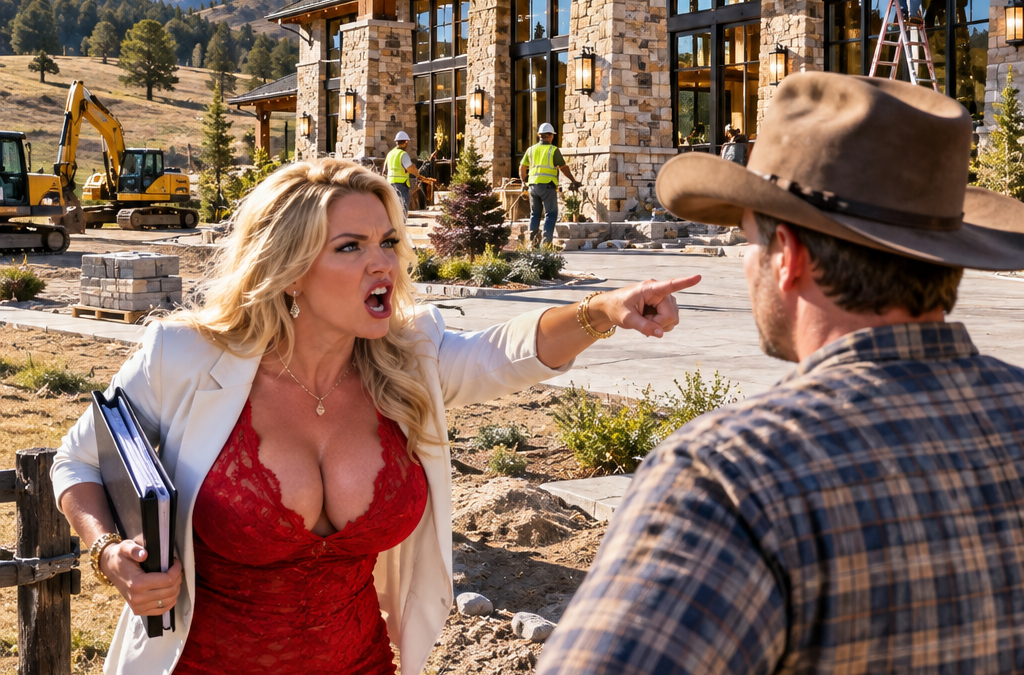
That’s when Linda appeared.
She came out of the entrance with two representatives following her.
She looked delighted until she saw me.
Then her smile tightened.
“Can I help you?”
I pointed toward the clubhouse.
“What’s this doing here?”
She tilted her head.
“Our new community clubhouse.”
“Here?”
“Obviously.”
I glanced toward the ranch road.
“Linda, this is inside my property.”
She laughed.
The kind of laugh meant to make other people feel stupid.
“Oh, don’t start.”
I stared at her.
“Did the HOA purchase this parcel?”
She folded her arms.
“The HOA owns this entire area.”
I felt a slow tightening in my chest.
“Since when?”
“The land acquisition was handled years ago.”
“From whom?”
She blinked.
“What?”
“Who sold you this land?”
Her expression hardened.
“That’s internal association business.”
“No. If somebody sold part of my ranch, I need to know.”
She smiled coldly.
“You’re being ridiculous.”
I looked at the clubhouse again.
The building sat where my family’s boundary records placed private ranch land.
I knew I couldn’t settle the issue simply by arguing beside a construction site.
I needed the actual documents.
So I said, “I’ll check the records.”
Linda’s expression changed.
“You can check whatever you want. But stay away from the building.”
I looked back at her.
“You’re ordering me off my own land?”
She raised her voice.
“I’m protecting a $1.8 million community asset from interference.”
I felt anger rising.
“Then I hope the HOA has proof it owns the ground beneath that asset.”
She stepped closer.
“Are you threatening the association?”
“I’m asking whether you bought my property.”
She leaned toward me.
“Keep pushing, and I’ll make sure every attorney in this county knows what a nuisance you are.”
I looked at her.
“Linda, this isn’t about being a nuisance.”
She smiled.
“Everything becomes a legal problem when you refuse to cooperate.”
I stood there for another moment.
Then turned and walked back to my truck.
She called after me.
“And don’t come back onto HOA property without permission!”
I didn’t answer.
But my hands were shaking when I started the engine.
Not because I believed her.
Because I knew exactly how much trouble a woman like Linda could cause before somebody finally forced her to acknowledge the truth.
That night, I spread my property records across the farmhouse dining table.
I started with the deed.
Then the recorded plat.
Then the older survey.
The legal description was clear.
I traced the boundaries with my finger.
Checked the measurements.
Compared the physical landmarks against the location where the clubhouse stood.
Then I checked again.
The building wasn’t on the HOA’s parcel.
It was completely inside mine.
I leaned back in my chair.
The farmhouse was silent.
Outside, the ranch was dark.
I could hear the faint sound of wind against the windows.
For several minutes, I simply stared at the documents.
How did something like this happen?
How did an HOA spend $1.8 million without making sure it owned the site?
How many people had signed off on those plans?
How many contractors had been paid?
How many invoices had been approved?
How many board meetings had been held?
And not one person had thought to confirm that the association held title to the land?
I thought back to Linda’s expression.
The instant confidence.
The refusal to show a deed.
The way she’d told me to stay away.
That was the part that angered me most.
She wasn’t behaving like someone who’d discovered a potentially serious construction mistake.
She was behaving like someone who believed her title entitled her to take whatever the association wanted.
I opened the old survey again.
The boundary line ran exactly where I remembered.
I placed a finger on the portion of the parcel containing the clubhouse.
My grandfather had owned that land.
My father had maintained it.
I had inherited responsibility for protecting it.
And now the HOA president was telling me I wasn’t even allowed to walk near it.
I closed the folder.
The next morning, I called a licensed surveyor.
I explained that a substantial clubhouse had apparently been constructed inside my ranch parcel and that I needed the legal boundary independently verified.
The surveyor asked whether I had the original deed and recorded survey.
I told him I did.
He agreed to inspect the property.
A few days later, the survey crew arrived.
They brought professional measuring equipment and copies of the relevant land records.
I met them near the main ranch gate.
We drove toward the disputed area.
When the clubhouse came into view, the lead surveyor slowed.
He studied the building through the windshield.
Then he glanced at me.
“That’s the structure?”
“That’s it.”
He looked back at the clubhouse.
“That’s a substantial investment.”
“One point eight million, according to the HOA.”
He exhaled slowly.
“Then somebody should have been very careful with the boundaries.”
I nodded.
“That’s what I thought.”
The crew began working.
They located the recorded reference points.
Compared the historical survey information with the current parcel records.
Checked the physical markers.
And measured the relevant boundary lines from multiple positions.
I stayed nearby without interfering.
Every time a measurement was completed, I felt the tension in my chest increase.
I wasn’t hoping to be right.
Being right meant a huge building had been constructed on private land without authorization.
I would have preferred to discover a simple misunderstanding.
A mistaken landmark.
An old survey I’d misread.
A harmless discrepancy.
But the results kept pointing in the same direction.
The clubhouse was on my ranch.
Completely.
Not halfway across the line.
Not merely an overhanging roof or misplaced walkway.
The land beneath the building belonged to my parcel.
The surveyor placed official boundary markers around the relevant area.
One marker stood directly beside the clubhouse.
I looked at it.
Then up at the stone wall rising above it.
The contrast was almost absurd.
A modest survey marker.
A $1.8 million structure.
And one very expensive mistake.
When the lead surveyor finished reviewing the measurements, he approached me.
“The recorded boundaries support your documents.”
I swallowed.
“So the clubhouse?”
“It’s within your ranch parcel.”
“All of it?”
“Yes.”
I looked toward the building.
He continued.
“The association would need a valid recorded ownership interest or other legally sufficient authorization to justify its use of this land. The boundary itself is clear.”
I took a slow breath.
“Thank you.”
He nodded.
“I’ll provide the completed report.”
I stood beside the marker for a long time after that.
I’d hoped the professional survey would eliminate uncertainty.
It had.
But it also confirmed that the HOA had done something almost impossible to comprehend.
They had built an entire luxury clubhouse on land they didn’t own.
And their president had threatened to punish me for pointing it out.
Linda arrived before the crew left.
I heard her SUV approaching along the access road.
She stopped near the landscaped entrance.
Stepped out.
And immediately marched toward us.
Her red lace dress showed beneath a fitted white blazer, and her expression was already furious.
“What is going on here?”
I turned.
“Good morning, Linda.”
She ignored me.
She pointed at the survey crew.
“Who authorized these people?”
I looked at her.
“I did.”
Her eyes narrowed.
“You don’t have authority to bring contractors onto HOA property.”
The lead surveyor looked up from his equipment.
“We’re surveying the recorded boundary of this parcel.”
Linda folded her arms.
“The HOA purchased this land years ago.”
The surveyor nodded.
“Do you have the recorded deed for that purchase?”
She blinked.
“Excuse me?”
“A deed or other recorded transfer establishing the association’s ownership.”
Karen’s—Linda’s—expression became icy.
“Why would I provide confidential association documents to you?”
The surveyor remained calm.
“If a transfer was recorded, it should be identifiable through the property records.”
Her jaw tightened.
“The board already reviewed this.”
I stepped forward.
“Then show us the transfer.”
She glared at me.
“I am not going to be bullied on my own property.”
I stared at her.
“That’s exactly what you’ve been trying to do to me.”
Her cheeks reddened.
“Watch your mouth.”
The surveyor glanced at the boundary marker beside the clubhouse.
“Ma’am, the recorded line places the structure inside the ranch parcel.”
Linda spun toward him.
“You’re wrong.”
He remained composed.
“You’re welcome to have the records independently reviewed.”
She pointed toward the clubhouse.
“Do you have any idea what that building cost?”
He nodded.
“I understand it’s expensive.”
“One point eight million dollars!”
He glanced at the survey.
“That doesn’t change the measurements.”
For a moment, she looked stunned.
Then she turned toward me.
“This is your doing.”
I stared at her.
“My doing?”
“You brought these people here to manufacture a dispute.”
“No. I hired them to verify the boundary.”
She stepped closer.
“You think you can wave a few papers and steal the community’s clubhouse?”
I felt my anger rise.
“Linda, you built the clubhouse on my land.”
Her eyes flashed.
“That building belongs to the association!”
I took a slow breath.
“Then you should have built it on association property.”
She went silent.
Only for a moment.
Then she pointed at me.
“You are going to regret this.”
I looked toward the survey marker.
“Not as much as the person who approved that construction without checking the deed.”
Linda’s face turned bright red.
She opened her mouth.
Then closed it.
For the first time, she seemed to understand that shouting wasn’t going to move the boundary.
But I also knew she wasn’t finished.
Not remotely.
Linda was the kind of woman who would rather drag an entire neighborhood into financial disaster than publicly admit she’d been wrong.
And I was about to discover just how far she’d go to protect the $1.8 million monument she’d built on somebody else’s property.
The surveyor’s report arrived two days later.
I read it in my office with the original deed beside me.
The findings were precise.
The recorded parcel boundary was consistent with the older ranch survey.
The clubhouse, its foundation, and the developed area immediately surrounding it were within my property.
There was no uncertain strip of land.
No disputed corner.
No overlapping boundary that required anyone to guess where ownership began.
The building was standing on my ranch.
But I understood there was still another question to answer.
Linda had repeatedly claimed that the HOA purchased the land years earlier.
A survey identified the boundary of a parcel. It didn’t necessarily tell me whether a lawful ownership transfer had occurred after the records in my possession were prepared.
If the association had somehow acquired the property, there should be a recorded chain of title.
I needed to establish that beyond argument.
So I went to the county records office.
I brought the parcel number, deed information, and survey.
I explained that a homeowners association was claiming ownership of part of my ranch and that I wanted to verify every recorded transfer affecting the property.
The clerk helped me search the records.
We began with the current parcel information.
Then worked backward.
We examined the relevant deeds, conveyances, and recorded property documents.
I paid close attention to every reference describing the portion of land near the new clubhouse.
I wasn’t looking for evidence that supported my preferred answer.
I was looking for the actual ownership history.
If my family had signed away part of the ranch, I wanted to know.
If someone had created a legally enforceable interest, I wanted to see it.
If the HOA had bought the property, there should have been a transfer somewhere.
But the more records we examined, the clearer the answer became.
There was no deed transferring that land to the HOA.
No partial conveyance covering the clubhouse site.
No recorded sale removing that section from my ranch parcel.
Nothing.
I looked at the clerk.
“Could there be another transfer filed under the association’s name?”
We checked the relevant records.
Still nothing.
“An older transaction?”
We examined the earlier documents.
Again, nothing.
Finally, I leaned back.
“So according to the county records, this land has never been conveyed to the homeowners association?”
“The records we’ve reviewed don’t show a transfer,” the clerk confirmed.
I looked down at the parcel description.
For years, the land had remained part of my family ranch.
Linda hadn’t bought it.
Her board hadn’t acquired it.
And the $1.8 million building didn’t change the ownership history.
I felt a strange mix of relief and disbelief.
Relief because the documents supported my rights.
Disbelief because the HOA had apparently committed nearly two million dollars to construction without acquiring the land underneath the project.
Then I asked about the permits.
Surely a clubhouse of that size required construction approvals.
There would have been building plans.
Permit applications.
Inspections.
Official paperwork.
Maybe somewhere in that file was the explanation Linda kept refusing to provide.
The permits existed.
The HOA had obtained authorization for the construction work through the relevant process.
The project had a paper trail.
Contractors had filed documents.
The building had gone through the applicable reviews.
But the permits didn’t establish that the HOA owned the property.
A building permit addressed permission to perform construction subject to its terms.
It wasn’t a deed.
It wasn’t proof that the applicant had purchased the site.
And it didn’t transfer another person’s land to whoever wanted to build.
I sat with that distinction for a long time.
Linda had obtained permission to construct a building.
Then treated that permission as proof that she owned the ground beneath it.
Those were two entirely different questions.
And the recorded title documents answered the ownership question against her.
I requested certified copies of the relevant materials.
When I left the county office, my folder was considerably thicker.
The clubhouse was still standing.
Linda was still telling people it belonged to the HOA.
But now I had the deed history, the official parcel information, the construction permits, and a licensed survey supporting the same conclusion.
The association had built on land it didn’t own.
I wasn’t going to allow Linda to bury that fact beneath another speech about community improvement.
That afternoon, I contacted a property attorney.
I explained the situation.
He listened.
Then asked whether the clubhouse was still in use.
“It appears to be nearly finished and already being treated as an HOA facility,” I said.
“Have you given the association permission to occupy the site?”
“No.”
“Any written agreement?”
“None.”
“Any lease?”
“No.”
“Any sale?”
“Absolutely not.”
He asked me to send the documents.
I did.
We met shortly afterward.
He reviewed everything carefully.
The deed.
The survey.
The title records.
The permits.
The photographs.
My correspondence with Linda.
Then he looked up.
“Based on these records, the HOA has a serious encroachment problem.”
I rubbed my forehead.
“Can I demand they remove it?”
“We can formally notify them and pursue an appropriate legal resolution.”
I leaned forward.
“I want my land back.”
“Understood. But we need to handle this through the proper procedures.”
I nodded.
He continued.
“Don’t damage the clubhouse. Don’t interfere with utilities. Don’t try to remove anything yourself. Give the association formal notice, preserve the evidence, and let the applicable legal process determine the next steps.”
I looked at the photographs.
The building was enormous.
“I can’t believe someone approved all this without checking ownership.”
My attorney studied the file.
“That is one of the questions the association will need to answer.”
I was still angry.
But he was right.
If I acted recklessly, Linda would use it against me.
She’d portray me as a dangerous ranch owner destroying a beloved community facility.
She’d turn the entire neighborhood into witnesses against me.
I could already imagine the headlines.
Angry Farmer Threatens Luxury Clubhouse.
Homeowner Demands Demolition of Community Asset.
HOA President Fights to Protect Neighborhood Investment.
Linda had the personality to make every one of those stories sound plausible.
So we moved carefully.
My attorney prepared a formal notice identifying the encroachment.
It included the property description, the survey evidence, and the absence of any recorded transfer authorizing the HOA’s occupation.
The notice demanded a lawful resolution, including removal of the unauthorized structure.
It also gave the association an opportunity to negotiate before more severe action became necessary.
I was willing to hear a legitimate proposal.
But I was not willing to pretend the land belonged to the HOA.
That distinction was important.
I didn’t oppose every possible compromise simply because Linda had been insulting.
If the association wanted to propose purchasing land, it could make an offer.
If it wanted to explore another lawful resolution, we could review it.
But ownership couldn’t be taken for granted.
And Linda needed to stop treating my property as if it had already been transferred.
The notice was delivered.
For approximately twenty-four hours, nothing happened.
Then Linda called.
I answered from the farmhouse kitchen.
“What?”
Her voice was icy.
“Have you completely lost your mind?”
I closed my eyes.
“Good afternoon, Linda.”
“Don’t you dare patronize me.”
“What do you want?”
“I just received your outrageous demand.”
I leaned against the counter.
“The notice identifies the property issue and gives the HOA an opportunity to resolve it.”
“Resolve it?”
Her voice rose.
“You are demanding that we remove a one-point-eight-million-dollar clubhouse!”
“From land you don’t own.”
She let out a sharp laugh.
“We are not demolishing that building.”
“Then have your attorney propose a lawful alternative.”
Her voice became low.
“Let me explain something to you, because apparently nobody has managed to get through that thick skull of yours.”
I stared out the window.
The barn stood beyond the yard.
“Go ahead.”
“That clubhouse belongs to the community. Hundreds of homeowners have invested in it. We have approved budgets, contractors, construction plans, and legally issued permits.”
“None of those documents transferred my land.”
“Stop repeating that!”
I took a breath.
“It’s the central issue.”
“No. The issue is that you’re trying to extort money from an entire neighborhood.”
I went still.
“Extort?”
“That’s right. You’re holding our investment hostage.”
I felt my face grow hot.
“Linda, you built on my property without asking.”
“And now you’re trying to profit from a technicality.”
“A technicality?”
She continued before I could respond.
“Do you think a judge is going to force hundreds of innocent homeowners to lose a beautiful clubhouse because one selfish rancher refuses to cooperate?”
“I think a judge is going to read the deed.”
She laughed viciously.
“Then get yourself a good lawyer, sweetheart. Because I have an entire association behind me.”
I looked down at the formal notice on my table.
“You have an association with a building on land it doesn’t own.”
She stopped laughing.
Then she whispered, “I will bury you in legal costs before I let you touch that clubhouse.”
I felt a chill.
Not because I believed she had the right to do it.
Because I knew she was willing to try.
“Have your attorney contact mine,” I said.
“That’s all you have to say?”
“Yes.”
She raised her voice again.
“You’re going to regret humiliating me!”
I ended the call.
For several seconds, I stood motionless.
Then I saved a note describing the conversation and forwarded the relevant information to my attorney.
Linda had just rejected an opportunity to negotiate.
And she’d made one thing clear.
She wasn’t defending the deed.
She was defending her pride.
The HOA called an emergency board meeting the following week.
I received a notice describing an urgent threat to community assets and neighborhood finances.
My attorney and I attended.
The clubhouse itself was already being celebrated as the association’s greatest achievement.
Residents had seen the stone walls.
The enormous windows.
The expensive interior.
They’d been told the project represented years of planning and a major investment in their property values.
Many were excited to use it.
Some had already imagined birthday celebrations, weddings, meetings, and holiday gatherings inside.
I understood that.
It was an impressive building.
But none of those plans changed the land ownership.
When I entered the meeting room, Linda was standing behind a table filled with glossy photographs.
She wore a fitted white blazer over her red dress.
Her hair was perfectly styled.
She greeted homeowners with an expression of profound concern.
Then she saw me.
The smile disappeared.
She leaned toward one of the board members and whispered something.
I took a seat near the back with my attorney.
Linda called the meeting to order.
“Thank you all for coming on such short notice.”
Her voice was solemn.
“As many of you know, this association has invested $1.8 million in a beautiful new clubhouse for our families.”
Several residents nodded.
She gestured toward photographs of the building.
“This facility represents years of planning, sacrifice, and responsible financial stewardship.”
I almost laughed at the last phrase.
Responsible financial stewardship.
She’d spent nearly two million dollars without acquiring the land.
But Linda continued.
“Unfortunately, we are now facing an aggressive challenge from a neighboring ranch owner who believes he can force us to destroy the entire project.”
Heads turned toward me.
I remained still.
Linda looked almost pleased.
“He’s demanding demolition.”
A woman near the front gasped.
“Demolition?”
Linda nodded sadly.
“Yes. Complete removal.”
A man raised his hand.
“Why?”
Linda placed a hand against her chest.
“Because he claims the land belongs to him.”
I stood.
“Because the recorded deed says it belongs to me.”
Linda struck the table.
“You will have an opportunity to speak.”
My attorney touched my arm.
I sat down.
Linda continued.
“The association has construction permits. We have professional plans. We have legal documentation supporting the project.”
She gestured toward the glossy photographs.
“Imagine explaining to your children that their clubhouse has to disappear because one man refuses to consider the greater good.”
I felt anger rise sharply.
She wasn’t addressing the property records.
She was using families as emotional leverage.
She wanted homeowners to picture the loss before they examined who had caused it.
A woman near the back raised her hand.
“Did we actually buy the land?”
Linda’s smile tightened.
“The acquisition was handled through the appropriate channels.”
The woman frowned.
“Can we see the deed?”
Linda’s eyes narrowed.
“All relevant information has been reviewed.”
My attorney stood.
“Then we’d be happy to compare the association’s recorded deed with the county title records.”
The room became quiet.
Linda looked toward him.
“Who are you?”
He introduced himself.
Then explained that he represented me in the property dispute.
Linda folded her arms.
“This is a board meeting, not a courtroom.”
He nodded.
“Understood. But ownership is directly relevant to the issue being discussed.”
One of the board members leaned forward.
“Linda, did the HOA acquire the parcel?”
She turned toward him.
“We’ve been through this.”
He looked uncomfortable.
“I know. I’m asking whether there’s a recorded transfer.”
Linda’s face reddened.
“The construction was permitted.”
My attorney opened the folder.
“A building permit is not a deed.”
A murmur passed through the room.
Linda glared at him.
“Don’t lecture this board.”
He remained calm.
“The relevant county records do not show a conveyance from my client to the association.”
Another board member spoke.
“Then who owns the land?”
I stood.
“I do.”
The room went silent.
I opened the survey.
Then placed the official parcel map beside it.
“This is my ranch.”
I pointed toward the clubhouse location.
“And this is where the HOA built.”
A man in the second row leaned forward.
“Wait. The entire building?”
“Yes.”
He looked toward Linda.
“Not just the landscaping?”
“No. The building.”
Several homeowners began whispering.
Linda struck the table.
“Order!”
I kept my voice calm.
“The survey confirms the entire clubhouse sits inside my recorded parcel.”
She pointed at me.
“You’re deliberately misleading everyone.”
I opened another document.
“Then show the deed proving otherwise.”
She stared at me.
I waited.
So did the room.
Then she said, “The community has already invested too much money for this nonsense.”
I looked directly at her.
“How much money you spent doesn’t change who owned the land before construction began.”
A man near the front raised his hand.
“If the HOA didn’t own the site, why did we approve construction?”
Linda snapped.
“Because the project had gone through all the appropriate reviews!”
My attorney replied, “The title records are available for inspection. They don’t show the ownership interest being claimed.”
The board member looked at Linda.
“Did you verify the title?”
Her eyes flashed.
“I am not going to be interrogated by people who have no understanding of development projects.”
The man leaned back.
I could see the concern spreading through the room.
Residents weren’t simply angry that the clubhouse might be removed.
They were beginning to realize that the board might have approved an enormous expenditure without confirming a fundamental legal requirement.
Land ownership.
Linda could feel the room changing.
So she did what she always did when facts stopped supporting her.
She attacked me personally.
“Let’s talk about the ranch owner for a moment.”
I looked at her.
She smiled coldly.
“He has more land than he needs. Acres and acres. But instead of cooperating with a community project, he wants to deny families access to a facility that could serve this neighborhood for decades.”
I felt my jaw tighten.
She continued.
“He’s not being harmed by the clubhouse. The land was sitting there unused.”
I stood.
“My land doesn’t become yours because I’m not standing on every square foot of it.”
Linda’s face hardened.
“Sit down.”
I didn’t.
“Would you accept someone building a house in your backyard while you were away?”
She stared at me.
“That’s different.”
“How?”
She opened her mouth.
Then closed it.
I looked around the room.
“I understand why residents are upset. You paid for a clubhouse. You were promised an improvement.”
Several people nodded.
“But I didn’t make that promise. I didn’t sell the HOA this property. And I didn’t authorize construction.”
The room became quiet.
“I gave the board a chance to negotiate. Linda rejected it.”
Linda slammed her hand against the table.
“Because we are not surrendering a $1.8 million investment!”
I looked at her.
“Then you should have secured the land before spending the money.”
For a moment, nobody spoke.
Linda’s face turned crimson.
Then she pointed toward the door.
“Get out.”
I stared at her.
“What?”
“This meeting is for HOA members.”
My attorney calmly gathered the documents.
“We’ve presented the relevant information. The association can direct further communications to my office.”
Linda looked furious.
She wanted one more argument.
One more opportunity to humiliate me.
But we were already leaving.
As I reached the door, she shouted across the room.
“THE CLUBHOUSE IS NOT COMING DOWN!”
I stopped.
Turned.
And looked at her.
“That decision isn’t yours alone anymore.”
Then I walked out.
The next stage involved the county.
My attorney submitted the relevant title and survey information through the appropriate process, along with the dispute concerning the clubhouse’s unauthorized location.
The county reviewed the parcel records and the documented construction site.
The association had its opportunity to present its position.
Linda continued insisting the HOA owned the building and that the project had received permits.
But those arguments didn’t establish ownership of the land.
The recorded deed had not changed.
The survey had not changed.
There was still no recorded transfer from my ranch to the association.
Eventually, the county issued its determination.
The clubhouse occupied private property without the owner’s authorization.
The association was given a deadline to resolve the unauthorized occupation.
I read the notice in my attorney’s office.
Then read it again.
For months, Linda had treated my ownership as an opinion.
Now the county had formally recognized the problem.
The clubhouse was occupying land the HOA did not own.
The determination wasn’t an instant demolition order.
The association still had an opportunity to resolve the situation lawfully.
I understood that.
My attorney made sure I understood the distinction.
“We follow the process exactly,” he told me.
I nodded.
“No shortcuts.”
“Correct.”
I looked at the county notice.
“And if they refuse?”
“Then we’ll pursue the authorized remedy available after the deadline and required procedures.”
I sat quietly for a moment.
Part of me still hoped Linda would finally reconsider.
The building was enormous.
Demolition would be expensive.
The project had consumed community money.
Surely the board would understand the seriousness now.
Surely someone would insist on negotiation.
But Karen-style arrogance has a way of turning a mistake into a catastrophe.
Linda responded to the county determination with another angry message.
She accused me of trying to destroy the community.
She claimed the HOA was being unfairly targeted.
And she announced that the clubhouse would remain standing because the board refused to surrender its investment.
I forwarded the message to my attorney.
He replied with three words.
Preserve the correspondence.
I did.
Then I waited.
The deadline approached.
The association still hadn’t produced a deed.
It hadn’t secured an agreement with me.
It hadn’t removed the structure.
And it hadn’t reached a negotiated resolution.
Linda continued telling homeowners that everything was under control.
I knew because several residents contacted me.
One man stopped his truck near my gate.
“Linda says the county can’t make the HOA remove the clubhouse.”
I looked at him.
“Has she shown you the determination?”
He hesitated.
“No.”
“Then ask to see it.”
He frowned.
“She says her attorneys are handling everything.”
I nodded.
“My attorney is handling my side too.”
He looked toward the wooded section where the clubhouse stood.
“Is that building really going to have to come down?”
I took a slow breath.
“I’d prefer that the association resolve the situation without further damage. But I can’t allow it to occupy my land indefinitely.”
He looked unhappy.
I understood.
No ordinary homeowner wanted to see $1.8 million disappear.
But I hadn’t put that money at risk.
The board had.
And Linda was still acting as though acknowledging my ownership would be more humiliating than losing the building.
On the final day of the compliance period, I checked with my attorney.
No resolution had been reached.
The deadline expired.
And after the required process, I received authorization for removal.
I sat at my desk holding the paperwork.
It felt strange.
For months, Linda had insisted that I had no right even to approach the clubhouse.
Now there was official authorization for the structure to be removed from my property.
I didn’t celebrate.
I looked through the window toward the ranch.
Then down at the documents.
The authorization was serious.
Demolition of a building that size wasn’t something to do casually.
There were safety requirements, equipment concerns, debris, utilities, and environmental considerations.
The work needed to be performed by qualified professionals under the approved process.
I contacted a licensed demolition contractor.
We reviewed the authorization.
Discussed the site.
Examined the building.
Considered access routes and the need to protect the surrounding ranch land.
The crew planned the operation carefully.
The clubhouse couldn’t simply be attacked with heavy machinery because I was angry.
The relevant utilities had to be addressed safely.
The demolition zone had to be controlled.
The work had to remain within the approved scope.
And nobody could be allowed into dangerous areas during removal.
The contractor understood.
So did I.
I wasn’t interested in revenge disguised as demolition.
I was interested in getting my land back.
The day before the work began, I walked to a point overlooking the clubhouse.
The building stood beneath the afternoon sun.
Its stone walls looked solid.
The windows reflected the trees.
The roofline rose above the surrounding landscape.
For a moment, I felt the weight of the situation.
The association had spent $1.8 million.
Families had probably imagined using the clubhouse for years.
Workers had spent months constructing it.
There were real resources embodied in those walls.
And all of them were about to be lost because the board had proceeded on land it did not own.
I didn’t enjoy that thought.
But I also remembered Linda ordering me off my own property.
Her threats.
Her refusal to provide a deed.
Her claim that unused ranch land was available for community purposes.
The opportunity to negotiate.
The county determination.
The deadline.
The refusal to comply.
We hadn’t arrived at demolition because there were no other choices.
We’d arrived there because the association repeatedly refused to resolve the unauthorized occupation.
I went home and prepared for the following morning.
The demolition crew arrived shortly after sunrise.
The first truck carried equipment.
Another brought workers and additional supplies.
A large excavator approached the site along the planned access route.
I watched from a safe location as the crew established the work area.
Safety barriers were placed.
The approved demolition zone was marked.
The site supervisor reviewed the day’s work with the operators.
Everything was organized.
Controlled.
Professional.
No one rushed.
No one treated the building casually.
The structure had to come down without creating unnecessary danger or additional harm to the surrounding property.
I stood beside the contractor reviewing the final documentation when I heard an SUV approaching.
I knew who it was before I turned.
Linda.
She stopped so abruptly that gravel scattered beneath her tires.
She stepped out in her fitted red lace dress and white blazer.
For several seconds, she stared at the excavator.
Then at the safety barriers.
Then at the crew.
Her face changed.
“What the hell is this?”
I looked at her.
“Good morning, Linda.”
She pointed at the equipment.
“WHY IS THAT HERE?”
I took a slow breath.
“The county-authorized removal is beginning.”
She stared.
Then laughed.
It was a strained, almost hysterical sound.
“No.”
I didn’t answer.
She shook her head.
“No. Absolutely not.”
She marched toward the work area.
The site supervisor stepped forward.
“Ma’am, you need to remain outside the safety barrier.”
Linda rounded on him.
“Do you know who I am?”
He remained calm.
“Ma’am, this is an active demolition site.”
“I AM THE HOA PRESIDENT!”
He nodded.
“I understand.”
“Then stop that machine!”
He looked toward me.
Then back at Linda.
“We’re working under the approved authorization and site plan.”
Her face reddened.
“I don’t care what he told you. That’s a $1.8 million clubhouse!”
The supervisor glanced toward the building.
“I understand the value is substantial.”
“THEN WHY ARE YOU DESTROYING IT?”
He kept his voice level.
“Because the authorized work is removal of the structure from this property.”
Linda looked toward me.
Her eyes were blazing.
“You did this.”
I stared at her.
“I warned you months ago.”
She pointed at my face.
“You spiteful son of a bitch.”
I didn’t respond.
She stepped closer.
“You really think you’re going to destroy everything I’ve worked for?”
I took a breath.
“Linda, the HOA had a deadline to resolve the encroachment.”
“WE WERE HANDLING IT!”
“You didn’t resolve it.”
“YOU CAN’T DO THIS!”
I held up the relevant authorization.
“The county has approved the removal process.”
She stared at the document.
Then looked toward the excavator.
For a moment, she seemed unable to comprehend that her refusal hadn’t stopped the process.
Then she turned toward the crew.
“Nobody touches that building! I am personally ordering every one of you to stop!”
The workers looked toward their supervisor.
He remained composed.
“Ma’am, we have verified the authorization. For your safety, please remain behind the barrier.”
Linda’s face turned dark red.
She turned toward me.
“If you let them proceed, I will sue you for every dollar that building cost.”
I looked at her.
“That decision belongs to you and your attorney.”
She leaned forward.
“I will take this ranch away from you.”
My stomach tightened.
Not because she had proved she could.
Because she was still willing to threaten my family’s land after everything the records established.
I met her eyes.
“You don’t own this property, Linda.”
She hissed, “You’ll wish I did.”
Then she turned toward the excavator and screamed again.
“STOP!”
The operator waited for the supervisor’s signal.
The site was controlled.
Unauthorized people remained outside the work zone.
The crew completed its safety checks.
Then the excavator moved.
Its steel tracks rolled slowly across the prepared working area.
The machine positioned itself beside the clubhouse.
For a moment, everything seemed still.
The building stood beneath the morning sunlight, its windows reflecting the surrounding trees.
Then the excavator’s attachment reached toward the first authorized section.
There was a deep mechanical rumble.
A sharp cracking sound.
And the first portion of the structure gave way into the controlled demolition zone.
Linda screamed.
“NO!”
The sound echoed across the ranch.
She stepped toward the barrier.
The supervisor immediately warned her to stay back.
She stopped.
Then turned toward me.
“YOU MONSTER!”
I didn’t move.
The excavator continued.
Another section came down.
Stone facing broke apart.
Framing became visible.
Dust rose inside the controlled area.
The expensive clubhouse that Linda had treated as proof of her authority was beginning to disappear.
She looked toward the machinery.
Then back at me.
“YOU’RE DESTROYING OUR INVESTMENT!”
I felt my jaw tighten.
“No, Linda. You’re watching the consequences of building on land you didn’t own.”
Her expression twisted.
She pointed toward the structure.
“That building was supposed to be the pride of this neighborhood!”
I looked at her.
“Then it should have been built inside the neighborhood’s legal boundary.”
She went silent.
Only briefly.
Then she began shouting at the crew again.
The supervisor didn’t argue with her.
He simply directed the operation and maintained the safety perimeter.
The work continued methodically.
The stone walls came down in planned sections.
Large windows disappeared.
Structural elements were separated and removed according to the approved process.
The covered entrance collapsed into the demolition area.
The massive roofline, which had once towered above the landscape, gradually lost its support as the crew dismantled the building.
Linda watched in disbelief.
At one point, she sank onto a low retaining edge outside the barrier.
Her expensive heels were covered with dust.
Her hair had begun falling out of its perfect arrangement.
She clutched her phone.
I saw her making calls.
To board members.
To the association’s attorney.
To anyone she thought might be able to stop what was happening.
But the deadline had passed.
The removal had been authorized.
And the contractor was doing the work lawfully.
Linda’s calls couldn’t rewrite the deed.
They couldn’t move the recorded boundary.
And they couldn’t make the county determination disappear.
More people arrived as word spread.
A few HOA residents gathered outside the work area.
Some looked horrified.
Others seemed stunned.
One man stared at the collapsing clubhouse and whispered, “Oh my God.”
A woman near him asked why the project hadn’t been moved before construction.
Another wanted to know whether the HOA had insurance.
Someone asked how the board could have approved the building without owning the land.
Those were fair questions.
And they should have been asked long before the first foundation was poured.
I stood beside my attorney, who had come to observe the authorized process.
He looked toward the building.
“You all right?”
I nodded slowly.
“I think so.”
He studied my face.
“This isn’t easy to watch.”
“No.”
I looked at the excavator.
“I wanted my ranch back. I didn’t want the neighborhood to lose nearly two million dollars.”
He nodded.
“The association was given opportunities to resolve the issue.”
“I know.”
“And the process matters. That’s why we’re following the authorization.”
I took a long breath.
He was right.
The work wasn’t happening because Linda had insulted me.
It wasn’t happening because I wanted revenge.
It was happening because a structure occupied my property without authorization, the county had required the matter to be resolved, and the association had allowed the deadline to expire.
The lawfully authorized removal was the result.
Linda didn’t see it that way.
She saw only the collapse of the building she’d spent years promoting.
And she was determined to make me pay for it.
By afternoon, the clubhouse had been dismantled.
What had stood that morning as an enormous luxury facility was now a controlled demolition site filled with materials awaiting removal.
The stone walls were gone.
The large windows were gone.
The sweeping roof was gone.
The expensive entrance that had once announced the association’s grandest achievement no longer existed.
Years of planning had disappeared into a single afternoon of authorized demolition.
But the work wasn’t entirely finished.
Debris still needed to be removed.
The site needed to be cleared.
The ground had to be restored.
The contractor’s cleanup plan would continue after the structure was down.
I stood behind the safety barrier looking at the empty space where the clubhouse had stood.
For the first time, I could see the land beyond it without an enormous building blocking the view.
The old ranch terrain was beginning to reappear.
It wasn’t restored yet.
But the structure was gone.
Then Linda approached.
She was carrying a folder.
Her expression was strangely calm.
That worried me more than the shouting.
She stopped in front of me.
“Here.”
She held out a paper.
I looked at it.
“What is this?”
“An invoice.”
I stared at her.
“An invoice?”
She smiled coldly.
“One million eight hundred thousand dollars.”
For a moment, I thought I’d misunderstood.
I took the paper.
The HOA’s name appeared across the top.
Below it was a demand for reimbursement of the clubhouse’s construction value.
I read the number.
$1,800,000.
I looked up.
“You’re sending me a bill?”
She folded her arms.
“You destroyed association property.”
I stared at her.
“Linda, your clubhouse was built on my land.”
“That doesn’t mean it belonged to you.”
I felt a slow, almost unbelievable wave of anger.
She had watched the county-authorized removal.
She had seen the demolition crew working under formal approval.
She knew the property records.
And now she wanted me to reimburse the HOA for the building it had constructed without permission.
“Let me get this straight,” I said.
Linda lifted her chin.
“I’m listening.”
“You built a clubhouse on my ranch.”
She rolled her eyes.
“We’ve already discussed—”
“Without buying the land.”
Her lips tightened.
“Jake—”
“My name still isn’t Jake.”
She stared at me.
I continued.
“You refused to negotiate. You ignored the county deadline. The building was removed under official authorization.”
I held up the invoice.
“And now you want me to pay you $1.8 million?”
She smiled.
“Actions have consequences.”
I looked at her for a long moment.
Then I asked one simple question.
“Why would I pay for your building?”
Her smile vanished.
“What?”
“Why should I reimburse you for a clubhouse you chose to construct on land you didn’t own?”
She stepped closer.
“Because you destroyed an association asset.”
“The authorized demolition removed an unauthorized structure from my property.”
“That building cost one point eight million dollars!”
I looked down at the invoice again.
Then back at her.
“That sounds like an expensive mistake.”
Her cheeks flushed.
“You arrogant bastard.”
I handed the invoice back.
“My attorney can review any formal claim your association wants to make.”
She refused to take it.
“You owe us every penny.”
I placed the document on the nearby table where the site paperwork was being reviewed.
“Then have your attorney explain why.”
Linda pointed at me.
“I WILL SUE YOU!”
I held her gaze.
“You’ve been threatening that since the day I discovered the clubhouse.”
“This time I’m serious.”
“So am I.”
She stared at me.
I continued.
“You were given the deed. The survey. The county records. The chance to negotiate. A deadline. And an authorized removal process.”
Her eyes narrowed.
“That doesn’t give you the right to destroy our investment.”
I took a slow breath.
“The association didn’t have the right to put it there.”
She opened her mouth.
Then closed it.
For several seconds, we stood facing each other.
Then Linda grabbed the invoice and walked away.
I watched her go.
I thought that would finally be the end of her threats.
I was wrong.
The HOA’s attorney contacted mine.
The association was claiming that the removal of its clubhouse created liability equal to the building’s construction value.
Linda had apparently convinced at least part of the board that the HOA could recover the $1.8 million by demanding reimbursement from me.
I couldn’t believe they were still pursuing that argument.
But the legal process required taking formal claims seriously.
My attorney gathered the relevant documents again.
The recorded deed.
The county title history.
The licensed survey.
The county’s determination.
The compliance deadline.
The demolition authorization.
The contractor’s records.
Everything.
The HOA’s attorney finally undertook a detailed review of the ownership evidence.
And that’s when the association’s position collapsed for the second time.
The clubhouse had been built entirely on my ranch parcel.
There was no recorded transfer establishing HOA ownership of the land.
The construction permits didn’t change that.
The county had determined that the structure occupied private property without authorization.
The association had been given an opportunity to resolve the matter.
The deadline had passed.
The removal had proceeded under official authorization.
The facts were devastating.
But they were not complicated.
The HOA had paid to build a structure on land it didn’t own.
Then it had tried to bill the actual owner for the consequences.
During the review, my attorney walked the association’s counsel through the records.
The HOA’s attorney examined the deed first.
Then the parcel map.
Then the independent survey.
He compared the property description with the clubhouse site.
The line was unmistakable.
The building had been entirely inside my ranch.
I watched his expression change.
He looked toward the HOA documents.
Then at the county records.
Then back at the survey.
For several moments, nobody spoke.
Finally, he said, “The association does not appear to have held title to this parcel.”
I leaned back.
My attorney nodded.
“That’s what we’ve been explaining.”
The HOA attorney continued reviewing the documents.
He asked about the transfer Linda claimed had occurred years earlier.
There wasn’t one.
He asked about the construction permits.
They existed, but they didn’t convey ownership.
He examined the county’s determination.
Then the removal authorization.
The paper trail was complete.
The HOA had made an enormous mistake.
And it hadn’t become my financial responsibility simply because Linda wanted someone else to pay.
The attorney finally acknowledged the central problem.
The association’s records did not support the claimed ownership.
The $1.8 million reimbursement demand had no demonstrated foundation under the property evidence and authorized removal process.
Linda looked stunned.
She had spent months promising that the HOA’s lawyers would destroy me.
Now the association’s own attorney was explaining that its documents supported my ownership.
Her face reddened.
She leaned forward.
“But the clubhouse belonged to us!”
The attorney looked at her.
“The issue is that it was constructed on land the association didn’t own or have authorization to occupy.”
She shook her head.
“We spent one point eight million dollars!”
He nodded.
“That doesn’t establish title to the land.”
Linda stared at him.
Then she looked at me.
“You planned this.”
I felt my jaw tighten.
“What?”
“You wanted that building demolished.”
“I wanted my property returned.”
Her voice rose.
“You knew how much it was worth!”
I took a breath.
“Linda, I gave your association an opportunity to negotiate.”
She opened her mouth.
I continued.
“You refused.”
Her face hardened.
“The clubhouse was a community asset.”
“On my land.”
She struck the table.
“STOP SAYING THAT!”
The attorney looked up sharply.
Linda froze.
I stared at her.
The room became completely silent.
Then the attorney continued.
“There may also be additional costs for the association to address.”
Linda turned toward him.
“What additional costs?”
He explained that the HOA needed to account for the financial consequences of the unauthorized project.
Demolition-related expenses.
Cleanup.
Restoration.
The unresolved property dispute.
Any properly supported financial obligations arising from the association’s decisions.
Linda looked as though she couldn’t breathe.
She had sent me a demand for $1.8 million.
Now her own attorney was explaining that the association might face further expenses rather than recover the construction cost.
I didn’t feel victorious.
I felt exhausted.
Because none of it had been necessary.
The association could have checked the title before construction.
Linda could have responded reasonably when I first discovered the building.
The board could have reviewed the survey.
They could have negotiated before the county deadline.
Instead, Linda had treated every opportunity to correct the mistake as an insult to her authority.
And she’d dragged the entire HOA along with her.
Her original invoice meant nothing.
I didn’t owe the association $1.8 million for the clubhouse it had constructed without my permission.
The building was gone.
And the board had to deal with the consequences of how it had been approved.
Linda stared down at her folder.
For once, she wasn’t smiling.
She wasn’t threatening.
She wasn’t telling anyone to stay away from her property.
She was looking at documents that had been available long before the first contractor arrived.
Documents she’d dismissed because they contradicted her assumptions.
And those documents had finally become impossible to ignore.
The cleanup continued over the following days.
The demolition contractor removed debris from the authorized work area.
Materials were handled and hauled away according to the approved plan.
The site was inspected.
The ground was graded and restored as required.
Temporary safety barriers remained until the work was complete.
I visited the area regularly.
Not to celebrate.
To make sure the ranch was being treated carefully.
The land beneath the clubhouse had been changed dramatically by construction.
There had been excavation, foundation work, utility installation, and landscaping.
Returning it to its prior condition required more than hauling away broken stone.
The site needed proper restoration.
The ground had to be stabilized.
The remaining construction materials removed.
The area returned to a condition appropriate for the ranch.
I worked with the relevant professionals to ensure the restoration was completed.
The process took several days.
But gradually, the last traces of the clubhouse disappeared.
The piles of debris were removed.
The heavy equipment left.
The temporary barriers came down.
And the open section of ranch land began looking familiar again.
I stood near the edge of the cleared area one afternoon, looking across the property.
For months, an enormous luxury building had occupied that space.
Now the view opened toward the trees and pastures beyond.
It wasn’t a resort.
It wasn’t an HOA amenity.
It was ranch land.
My ranch land.
The same land my grandfather had owned.
The same property my father had maintained.
The same parcel described in the deed I’d been keeping for years.
I let out a slow breath.
Finally.
The land was mine again in the most practical sense.
I could walk across it without being told to leave.
I could maintain it without asking permission from an HOA.
I could decide how it would be used, subject to the laws and recorded restrictions that actually applied.
No clubhouse blocked the way.
No association representative stood at the entrance demanding that I stay away.
No luxury stone walls occupied the property without authorization.
The ranch was quiet.
And that quiet felt extraordinary.
A few residents from the neighboring development eventually spoke with me.
Some apologized.
Others were angry about losing the clubhouse.
I understood both reactions.
One man stopped near the ranch road and looked toward the cleared site.
“That’s where it stood?”
I nodded.
He shook his head.
“I still can’t believe the board spent that much money without owning the land.”
“Neither can I.”
He looked toward the subdivision.
“Linda kept telling us everything was legally approved.”
I nodded.
“The construction permits were issued. But that didn’t mean the HOA owned the property.”
He was quiet for a moment.
Then he said, “I guess nobody thought to ask.”
I looked across the open land.
“That’s the expensive part.”
Another homeowner approached me a few days later.
She had attended one of the emergency board meetings.
“I owe you an apology.”
I looked at her.
“For what?”
“I believed Linda when she said you were trying to take something away from us.”
I didn’t answer immediately.
She continued.
“She made it sound like you hated the neighborhood.”
I looked toward the ranch.
“I don’t hate the neighborhood.”
“I know that now.”
She hesitated.
“She never told us the association didn’t have a deed.”
I took a slow breath.
“I asked for it from the first day.”
She nodded.
“I remember.”
Then she looked toward the cleared site.
“I wish the board had listened.”
“So do I.”
We stood quietly for a moment.
Then she left.
I appreciated the apology.
But I didn’t need every resident to agree with me.
The deed was enough.
For months, Linda had relied on the assumption that homeowners would value the clubhouse so much they’d ignore the ownership issue.
She’d portrayed me as selfish.
Unreasonable.
A threat to community finances.
She’d used the building’s enormous price tag to make surrender sound like the responsible choice.
But I hadn’t sold my land.
And the HOA hadn’t bought it.
That remained true regardless of how many residents wanted to use the clubhouse.
I sometimes thought about the first confrontation.
Linda standing at the entrance in her red dress.
Pointing at me.
Telling me I wasn’t authorized to be there.
I remembered the way she’d laughed when I asked for a deed.
The confidence in her voice.
The contempt in her expression.
She’d looked at my family ranch and seen unused land she could claim.
She’d assumed that if she spent enough money, built something impressive enough, and gathered enough homeowners behind her, the question of ownership would become irrelevant.
But land doesn’t stop belonging to someone because another person builds something expensive on it.
And the right to use private property doesn’t materialize out of a construction budget.
I thought about the old surveys.
The recorded boundaries.
The county title history.
Those documents weren’t exciting.
They weren’t impressive to look at.
They didn’t have glossy photographs, stone facades, or chandeliers.
But they had something Linda’s clubhouse never possessed.
A valid record of ownership.
That was the difference.
Her building was enormous.
My deed was a few sheets of paper.
And in the end, the few sheets of paper mattered more.
One evening, after the cleanup was complete, I walked across the restored section of land.
The sun was low.
The trees cast long shadows.
Beyond the cleared area, the pasture stretched toward the wooded rise.
There was a light breeze.
I could hear cattle in the distance.
Everything felt familiar again.
I stopped near the place where the clubhouse entrance had once stood.
I remembered the first time I saw it.
The shock.
The disbelief.
The way Linda had ordered me to stay away.
I remembered sitting at the farmhouse dining table late that night, tracing the property boundary with my finger.
I remembered hiring the surveyor.
Watching him place the markers.
Finding no deed transfer at the county office.
Learning that construction permits didn’t establish ownership.
Sending the formal notice.
Hearing Linda laugh when I demanded removal.
Then watching the board choose confrontation instead of correction.
Every step had made the situation more expensive.
Every refusal had reduced the available options.
And by the time the county’s deadline expired, the association had left itself facing a consequence that could have been avoided.
The clubhouse was gone.
The $1.8 million was gone.
And Linda’s attempt to make me reimburse the HOA had failed when its own attorney finally examined the actual records.
I looked down at the ground.
There was no dramatic monument marking what had happened.
No plaque.
No sign announcing a victory.
Just restored ranch land.
That seemed appropriate.
I hadn’t wanted to make my property famous.
I hadn’t wanted a fight with hundreds of homeowners.
I hadn’t wanted a demolition crew working where cattle had once grazed.
I wanted the ranch to remain mine.
And I wanted anyone planning to build on it to ask permission first.
That should have been the simplest part of the entire story.
But Linda had turned it into a $1.8 million disaster because she couldn’t accept one basic limitation on her power.
Being HOA president didn’t mean she owned the surrounding countryside.
A board vote didn’t replace a deed.
A building permit didn’t transfer land.
A completed clubhouse didn’t make unauthorized occupation permanent.
And an invoice didn’t turn someone else’s construction mistake into my debt.
I began walking back toward the farmhouse.
The familiar ranch road curved through the trees.
Beyond it, the barns stood where they’d always stood.
The property was quiet.
For the first time since discovering the clubhouse, I wasn’t wondering what new threat Linda might send.
I wasn’t waiting for another demand letter.
I wasn’t trying to explain a boundary that had never changed.
I was simply walking through my own ranch.
And nobody was telling me to leave.
When I reached the porch, I looked back one last time.
The clubhouse was gone.
The land was clear.
The county records still showed the same property line.
And the ranch was finally mine to enjoy without a $1.8 million HOA building sitting in the middle of it.
Linda had started the dispute by telling me the association owned everything in sight.
She ended it watching the clubhouse disappear and discovering that her own paperwork couldn’t support the claim.
Then she tried to hand me a bill for the building she’d put on my land.
But the answer had been there from the beginning.
In the deed.
In the survey.
In the county records.
I didn’t owe the HOA $1.8 million.
I never had.
They had built their expensive dream on property they didn’t own.
And when that dream came down, the land underneath it still belonged to me.
I stepped inside the farmhouse and closed the door.
Outside, the ranch settled into the evening silence I’d known my entire life.
No clubhouse.
No demolition equipment.
No Linda screaming that I wasn’t allowed on my own property.
Just open land, familiar fences, and the quiet certainty that the boundary had finally been respected.
The HOA had lost its $1.8 million clubhouse.
I had gotten my ranch back.
And the most expensive lesson Linda Parker ever learned was the one she could have understood for free:
Before you spend millions building on a piece of land, make sure you actually own it.








