𝗙𝗨𝗟𝗟 𝗦𝗧𝗢𝗥𝗬 The HOA President Brought Two Police Officers to My Private Lake Cabin and Ordered Me Out of the Only Place I Had Left to Call My Own
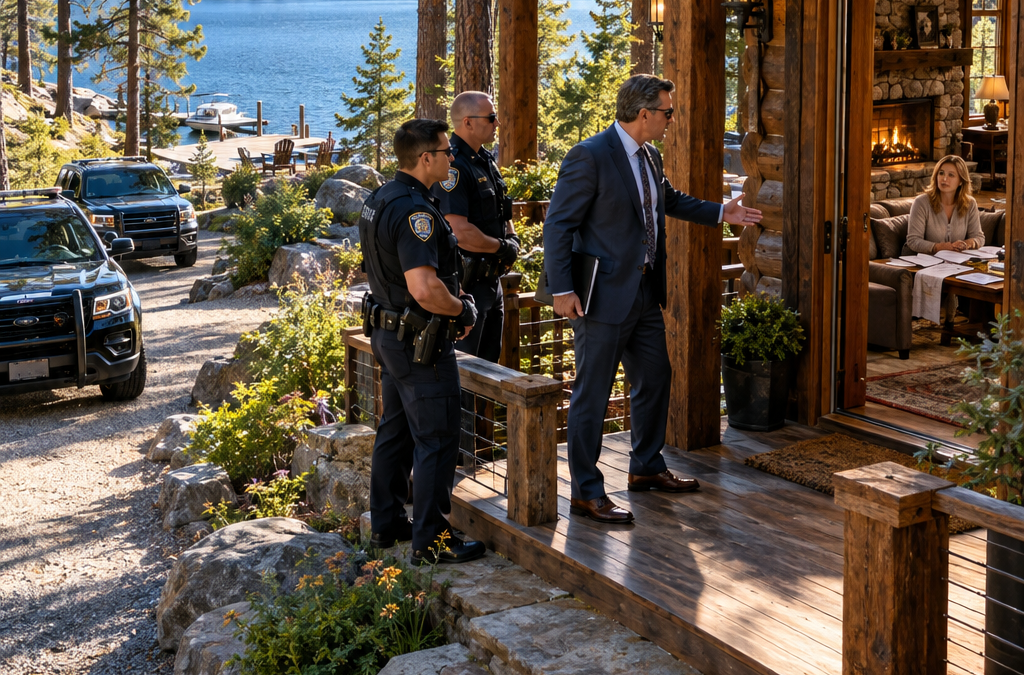
𝗙𝗨𝗟𝗟 𝗦𝗧𝗢𝗥𝗬
His jaw tightened.
It was a small movement, barely noticeable, but I saw it.
Karen wasn’t accustomed to being corrected.
“Mr. Whitmore,” I said, keeping my voice calm, “I checked the recorded boundaries when I purchased this place. If there’s something I’ve missed, you’re welcome to show me.”
He removed his sunglasses.
“I’ve been president of this association long enough to know what falls within our interests.”
“Interests and legal authority aren’t the same thing.”
For several seconds, he stared at me.
Then he put his sunglasses back on.
“I suggest you cooperate before this becomes unnecessarily complicated.”
He drove away without another word.
At the time, I thought he was simply an arrogant man who had wandered outside his jurisdiction.
I was wrong.
Karen wasn’t wandering.
He was expanding.
The first letter arrived eleven days later.
It was printed on thick paper with the association’s logo at the top. Beneath a formal heading, it identified my cabin as a property subject to community exterior-maintenance standards.
The notice instructed me to schedule an inspection.
I read it twice.
Then I pulled my recorded deed, survey, and title documents from the cabinet where I kept important papers.
Nothing had changed.
My property was still outside the association’s boundaries.
I wrote a short, respectful response explaining that I wasn’t subject to its inspection rules. I included a copy of the relevant survey page and asked that the notice be withdrawn.
I thought that would be the end of it.
Instead, Karen sent another letter.
This one described my refusal to schedule an inspection as a failure to cooperate with community safety procedures.
It mentioned potential penalties.
I called the number at the bottom of the letter.
After being transferred through the association’s administrative line, I reached Karen directly.
“I received your latest notice,” I said.
“I assumed you would.”
“You seem to have overlooked the documents I sent.”
“I reviewed them.”
“Then you know this cabin isn’t association property.”
He gave a short laugh.
“You’re making this far more adversarial than it needs to be.”
“I’m asking you to respect the recorded boundary.”
“And I’m asking you to recognize that your property’s condition affects the surrounding neighborhood.”
“What condition?”
There was a pause.
“Excuse me?”
“Your letter says I haven’t complied with an inspection. It doesn’t identify an actual hazard. What exactly are you concerned about?”
“That’s what an inspection would establish.”
“So you’re demanding access to determine whether you have a reason to demand access.”
His voice cooled.
“I don’t appreciate your tone.”
“I don’t appreciate receiving penalties from an organization I don’t belong to.”
“Then perhaps you should think more carefully about the consequences of refusing to cooperate.”
He hung up.
I stood in the kitchen holding my phone, looking out at the lake.
I hadn’t raised my voice.
I hadn’t insulted him.
But somehow, by asking him to explain his authority, I had turned myself into the problem.
That was the beginning of a pattern I would come to recognize.
Every time I answered one demand with evidence, Karen responded with another demand.
When I pointed out the survey boundary, he claimed the association had broader responsibility for neighborhood conditions.
When I explained that responsibility didn’t create inspection rights, he cited sections of the HOA’s governing documents.
When I asked him to identify the covenant binding my specific parcel, he sent another notice warning of possible enforcement.
He never answered the question directly.
He simply increased the pressure.
At first, I told myself it wasn’t worth worrying about.
A letter wasn’t a court order.
An HOA president couldn’t create jurisdiction by printing an accusation on official-looking stationery.
I knew that.
But there was a difference between knowing your rights and living under the constant threat of somebody trying to violate them.
Before long, I found myself checking the mailbox with a tightening stomach.
Every envelope bearing the association’s logo made me wonder what Karen had invented next.
Inspection demand.
Compliance warning.
Potential penalty.
Final notice.
The wording became increasingly severe.
Some letters suggested that failure to cooperate could result in further enforcement procedures. Others warned that my continued resistance interfered with the association’s responsibility to protect the community.
None identified a legitimate source of authority over my cabin.
I began keeping everything.
Every envelope.
Every letter.
Every email.
Every date and time.
I made copies of the survey and marked the boundary separating my property from the association’s common areas.
I saved the original purchase documents and organized the correspondence in chronological order.
I wasn’t building a case for revenge.
I was trying to protect myself against a man who seemed determined to turn a disagreement into an exercise of personal power.
And the more carefully I documented his actions, the more aggressive he became.
One afternoon, Karen appeared at my gate again.
This time, he parked his SUV in a way that partially blocked my driveway.
I walked down from the cabin.
He was standing beside the vehicle, immaculate in a charcoal jacket and cream-colored trousers.
His shoes gleamed against the dusty gravel.
“You’re becoming quite difficult to work with,” he said.
“I wasn’t aware we were working together.”
He smiled without warmth.
“That’s exactly the attitude I’m talking about.”
I stopped a few feet away.
“What do you need?”
“Access to the cabin.”
“For what?”
“An inspection.”
“No.”
The answer was simple.
I didn’t shout.
I didn’t offer an excuse.
I just said no.
Karen’s expression hardened.
“You don’t get to decide which community standards apply to you.”
“Actually, the recorded documents decide that.”
“You’re not listening.”
“I’ve listened for months.”
He stepped closer.
“I’m trying to keep this civil.”
“Then stop sending me demands you can’t legally enforce.”
For an instant, something ugly moved behind his polished expression.
His eyes narrowed, and his voice dropped almost to a whisper.
“You seem to believe that being outside the main development means you’re untouchable.”
“No. I believe it means your board doesn’t govern this parcel.”
“People who take that position usually regret it.”
I felt my stomach tighten.
“Is that a threat?”
He adjusted his watch.
“It’s advice.”
Then he returned to his SUV and drove away.
I stood beside the gate long after his taillights disappeared.
The lake was still there.
The mountains were still there.
But the peace I had bought the property to find was getting harder to reach.
That evening, I sat on the porch with my documents spread across a small table.
I tried reading a book afterward.
I couldn’t concentrate.
Every sound from the road made me look toward the trees.
I hated that.
I hated that a man who didn’t own a single square foot of my property had managed to change how I felt standing on it.
For the first time, I understood that intimidation doesn’t always begin with violence.
Sometimes it begins with an envelope.
Sometimes it sounds like a polite warning.
Sometimes it wears an expensive jacket and insists it is only trying to help.
And sometimes, if you allow it to go unanswered, it slowly teaches you to behave as though someone else owns the life you’ve built.
I wasn’t willing to learn that lesson.
So I kept the documents.
And eventually, those documents became part of a much larger conversation.
The opportunity to meet Elena came after I began asking broader questions about HOA enforcement practices.
I had originally intended to resolve the dispute privately. I didn’t want publicity, retaliation, or a prolonged legal battle. I wanted Karen to read the same property records I had read, acknowledge their meaning, and leave me alone.
But after months of unanswered questions and increasingly threatening notices, I began wondering whether my experience was part of something larger.
The problem wasn’t that the association had rules.
The problem was that its president appeared to believe those rules gave him authority over people who had never agreed to them.
I submitted copies of my correspondence and the recorded property documents to the appropriate state office as part of an inquiry into HOA property disputes.
That was how the documents eventually reached Elena.
Elena was the state attorney general.
I knew how unusual it was to have someone in her position personally reviewing a private property disagreement. Our meeting was not a courtroom proceeding, and she had made no promises about what her office could do. The broader discussion concerned association authority, recorded boundaries, and complaints involving property outside established HOA jurisdiction.
My cabin provided a useful example because the underlying records were unusually clear.
When Elena suggested we review the material together, I offered the cabin as a quiet location where she could see the boundaries and compare them against the paperwork.
I never imagined Karen would choose that exact morning to appear.
By nine o’clock, the coffee was ready, the folders were arranged on the dining table, and sunlight was spilling across the wooden floor.
Elena arrived without ceremony.
She wore dark slacks, a simple jacket, and practical shoes. She carried a leather document case and spoke with the calm precision of someone who had spent years distinguishing what people believed from what they could actually prove.
She seemed genuinely interested in the property.
“This is beautiful,” she said, looking through the windows toward the lake.
“That’s why I bought it.”
“I can see why you’d want to protect it.”
I smiled faintly.
“I’d settle for being allowed to enjoy it.”
She looked at me.
“That’s what we’re here to examine.”
We sat at the table near the fireplace.
I had arranged the papers in three groups.
The first contained my deed, title information, and recorded survey.
The second contained the association’s governing documents and boundary maps.
The third held Karen’s correspondence.
Elena opened the first folder.
“Before we discuss the notices,” she said, “I want to understand the property itself.”
I pointed to the survey.
“This is my parcel.”
She leaned forward.
“The cabin is here?”
“Yes. The driveway runs down from the county road, and the shoreline is along this eastern boundary.”
“And the neighboring development?”
I moved my finger to the adjoining area.
“Over here.”
She studied the map.
“You’re outside the recorded association boundary.”
“Completely.”
“Any recorded agreement giving the HOA inspection access?”
“None that I could find in the title records.”
“Any covenant binding this parcel to the association?”
“No.”
She looked through the supporting pages.
“And you’ve asked the association to identify one?”
“Repeatedly.”
“What did they provide?”
I slid the correspondence folder toward her.
“Everything in there.”
She opened it.
For several minutes, the only sounds were paper moving and the faint crackle of the fire.
Elena read the first notice.
Then the second.
Then the third.
I watched her expression.
It didn’t become dramatic.
She didn’t slam anything on the table or announce that Karen had committed a crime.
She simply grew more attentive.
“These notices become progressively more severe,” she observed.
“Every time I challenged one, he sent another.”
“Did the association ever provide a recorded instrument connecting your parcel to its inspection authority?”
“No.”
“Did you refuse access in writing?”
“Yes.”
“Do you have copies?”
I handed them over.
She read my responses carefully.
I had wondered, more than once, whether I should have softened some of the language.
Perhaps I had been too direct.
Perhaps I should have used more conciliatory words.
Elena reached the end of one letter.
“This is a reasonable request for clarification,” she said.
I felt an unexpected rush of relief.
It wasn’t that I needed someone powerful to tell me I had been right.
I needed to hear that asking for evidence wasn’t an act of aggression.
“Karen treated it like insubordination,” I said.
Elena looked up.
“That word is interesting.”
“What word?”
“Insubordination. You’re describing the relationship as though he believes you answer to him.”
“That’s exactly how he behaves.”
“An association president isn’t a public official simply because he’s elected to a board. His authority comes from the applicable governing documents and law. It isn’t unlimited.”
I looked toward the lake.
“I’ve been telling him that for months.”
“Then let’s see what the records establish.”
She spread the recorded property map across the table.
I brought over a small magnifying glass because some of the parcel labels were difficult to read.
Together, we traced the boundaries.
The association’s common areas were clearly identified.
So were the privately owned parcels within its development.
My cabin stood beyond them.
No amount of interpretation could move it across the recorded line.
Elena took several notes.
“Has anyone from the association entered the property without your permission?”
“Not inside the cabin.”
“Has Karen tried?”
“He’s demanded inspections. He came to the gate once.”
“Did you allow him through?”
“No.”
“And he knows that?”
“Very clearly.”
She nodded.
“That distinction matters.”
I leaned back.
“I’ve started feeling ridiculous about all this.”
“Why?”
“Because it’s a cabin. I come here to sit beside a lake. I didn’t expect to spend my weekends organizing evidence against a homeowners association.”
Elena closed the folder for a moment.
“People often think property disputes are just arguments about lines on a map. But those lines determine who can enter, who can make demands, and who has the right to say no.”
I looked at the documents.
“I’ve been saying no for months. It doesn’t seem to matter.”
“That’s why proper documentation matters.”
She reopened the folder.
We continued.
At one point, Elena asked me to explain the progression of Karen’s notices.
I described the original inspection request, my written refusal, the warning about community safety, and the later threats of penalties.
She wrote down the dates.
Then she asked whether Karen had identified a specific hazard.
“He hasn’t,” I said.
“Not once?”
“Not once.”
“And his argument is that an inspection is necessary to determine whether a hazard exists?”
“That’s the argument he keeps making.”
Elena set down her pen.
“That doesn’t answer the threshold question of whether the association has authority to enter.”
“Exactly.”
I was beginning to feel something I hadn’t felt in months.
Hope.
Not the foolish hope that Karen would suddenly become reasonable.
The more I learned about him, the less likely that seemed.
It was the quieter hope that the situation could finally be examined on evidence rather than intimidation.
At approximately ten that morning, we stopped for more coffee.
I had just returned from the kitchen when I heard tires crunching along the gravel driveway.
I looked toward the window.
A glossy black SUV was approaching the cabin.
My stomach dropped.
I knew that vehicle.
Karen Whitmore.
Even through the glass, I could recognize the deliberate way he drove, slowing near the gate as though inspecting property he believed belonged to him.
“Something wrong?” Elena asked.
I didn’t answer immediately.
Karen stopped beside the driveway.
For a moment, he remained in the vehicle.
Then he stepped out.
He was wearing a navy jacket over a white open-collar shirt, tailored gray trousers, and polished brown shoes. His hair looked freshly combed. His sunglasses reflected the trees around him.
He scanned the cabin, the porch, and the driveway.
Then he took out his phone.
“That’s him,” I said.
“Who?”
“Karen Whitmore.”
Elena turned toward the window.
“The association president?”
“Yes.”
“Was he invited?”
“No.”
Karen stood beside his SUV, speaking into the phone.
His free hand moved sharply as he talked.
I couldn’t hear the conversation, but I recognized the gestures.
He pointed toward the cabin.
Then toward the gate.
He seemed angry.
Elena watched without commenting.
“Maybe he’ll leave,” I said.
Even as the words came out, I knew how unlikely that was.
Karen ended the call but didn’t return to his vehicle.
Instead, he stood near the driveway, checking his watch and looking toward the road.
A few minutes later, another vehicle approached.
This one belonged to the police.
My chest tightened.
“He’s called the police,” I said.
Elena looked at me.
“Have you done anything that would justify police involvement?”
“No.”
“Then don’t assume you’ve done something wrong.”
“That’s easy to say when you haven’t spent months dealing with this man.”
Her expression softened slightly.
“Fair point.”
The police vehicle stopped behind Karen’s SUV.
Two uniformed officers stepped out.
Karen immediately walked toward them.
I watched through the window as he began talking before either officer had fully closed a door.
He pointed toward my cabin.
Then he pulled papers from a leather folder.
One officer examined the documents. The other looked toward the property.
Karen spoke rapidly, making broad gestures with his hands.
The scene was silent from where I stood, but the meaning was unmistakable.
He was presenting himself as the person in charge.
And he had brought law enforcement to make certain everyone else recognized it.
My mouth went dry.
I knew the paperwork was wrong.
I knew the boundary was recorded.
But seeing uniformed officers standing beside Karen changed the emotional weight of the situation.
A letter could be ignored until I had time to answer it.
A police officer at my front door demanded an immediate response.
Karen understood that.
I could almost see the satisfaction in the way he straightened his jacket.
“He’s going to try to force an inspection,” I said.
Elena rose from her chair.
“Let’s hear what he’s claiming.”
“I don’t want this turning into a confrontation.”
“Neither do I.”
“He’s not reasonable.”
“Then we’ll focus on the documents.”
Karen led the officers toward the porch.
He moved ahead of them as though they were his employees.
His shoes struck the wooden steps.
He stopped at my front door.
Then he began pounding.
Not knocking.
Pounding.
Three hard blows that echoed through the cabin.
“Open this door!”
I felt anger rise through my fear.
He hadn’t asked permission.
He hadn’t scheduled an appointment.
He had no emergency to report.
Yet there he was, shouting orders at the front door of my home.
Elena calmly closed the folder in front of her.
“Let him come in,” she said.
I looked at her.
“Are you sure?”
“I want to hear him explain his position.”
Karen pounded again.
“Open up! HOA compliance inspection!”
I walked toward the door.
My hand paused on the lock.
For a second, I remembered the first time I had opened that door after purchasing the cabin.
The rooms had been empty.
The air had smelled of cedar and old wood.
I had stood in the doorway imagining peaceful mornings, quiet evenings, and a life in which I no longer had to explain myself to anyone.
Now a man who wasn’t even supposed to govern my property was outside demanding that I surrender it.
I unlocked the door and opened it only partway.
“Karen,” I said, “what is this about?”
He didn’t greet me.
He didn’t even pretend to be polite.
“Move aside.”
“You’re not authorized to enter.”
He lifted a sheet of paper.
“This property is subject to immediate inspection.”
“No, it isn’t.”
“I am not having this argument again.”
One officer stepped closer.
“Sir, we’re here to determine what’s going on.”
I looked toward him.
“This is private property outside the association’s jurisdiction. I’ve already provided the recorded survey.”
Karen cut me off.
“He’s been obstructing compliance for months.”
“Karen, you know that’s not true.”
His face reddened slightly.
“Don’t interrupt me.”
I felt something cold settle in my chest.
He had brought two police officers to my home, and he was still speaking to me like a child being disciplined.
“I’m the homeowner,” I said. “You don’t get to order me around.”
Karen stepped forward.
I had not moved far enough to give him a clear path.
He pressed against the partially opened door and pushed past me.
The sudden movement forced me backward.
My shoulder brushed the wall.
“Karen!”
He ignored me.
He was inside.
Without my permission.
The moment was so abrupt that I almost couldn’t process it.
After months of warnings, letters, and threats, the man had finally crossed the physical boundary I had repeatedly told him not to cross.
The officers remained near the doorway.
One of them raised a hand.
“Mr. Whitmore, hold on.”
Karen continued into the living room.
“This inspection is happening, and the owner needs to leave the premises until we’re finished.”
I stared at him.
“Leave?”
“Immediately.”
“You’re ordering me out of my own cabin?”
His expression was triumphant.
“You’ve had ample opportunity to cooperate. We’re past that point.”
He held up the notice as though it were a warrant.
“You can collect your personal belongings afterward.”
I looked toward the officers.
Neither had drawn a weapon. Neither had ordered me outside.
But Karen stood between them and me, holding his paperwork with the confidence of a man who expected the uniformed officers to make his words real.
My hands began to shake.
Not dramatically.
Just enough that I noticed.
I curled them into fists.
“Karen,” I said slowly, “put that notice down and get out.”
He smiled.
“Now you’re going to learn that there are consequences for defying the association.”
Then he turned toward the fireplace.
And saw Elena.
She was sitting calmly in the chair beside it.
Her document folder rested on the table.
Her coffee was untouched.
She looked at Karen with a composed expression that seemed to irritate him almost immediately.
Karen stopped.
For one second, the entire room went still.
Then his gaze narrowed.
“Who are you?”
Elena didn’t answer immediately.
She looked at me first.
“Is this the notice he has been sending you?”
“One of them.”
Karen snapped his fingers.
“Excuse me. I asked you a question.”
I saw Elena’s eyes return to him.
She remained perfectly calm.
“Yes, you did.”
Karen straightened his jacket.
“This is a private compliance matter between the association and the property owner. Unless you’re a legal representative, you need to identify yourself.”
Elena stood.
She wasn’t physically imposing, and she didn’t raise her voice.
But something about the measured way she moved changed the atmosphere.
“My name is Elena,” she said.
Then she gave her full name and official title.
“I’m the state attorney general.”
Karen blinked.
At first, I thought he hadn’t understood.
His expression remained fixed somewhere between irritation and disbelief.
Then his eyes moved toward the document case.
He looked back at Elena.
“You’re what?”
Elena opened her case, removed her official identification, and held it where Karen could examine it.
“I’m the attorney general. I’m here reviewing documents concerning HOA property disputes.”
The silence that followed felt enormous.
One officer immediately looked at Elena’s identification.
The other turned toward Karen.
Karen’s mouth opened slightly.
Nothing came out.
He stared at the identification as though the words printed on it might rearrange themselves into something less disastrous.
Then he adjusted his watch.
I had seen him do that whenever he felt challenged.
This time, his fingers fumbled with the clasp.
“Well,” he said finally, “I wasn’t informed that a state official would be present.”
Elena returned the identification to her case.
“That wasn’t information you were entitled to receive.”
Karen swallowed.
“I certainly didn’t mean to interrupt an official proceeding.”
“This is a document-review meeting,” Elena replied. “And you’ve interrupted it by entering private property after the owner told you not to.”
Karen glanced toward the officers.
Then back at her.
“There appears to be a misunderstanding.”
I couldn’t help myself.
“A misunderstanding?”
He ignored me.
“Attorney General, I’m sure you appreciate that homeowners associations have responsibilities to their communities.”
Elena nodded once.
“They do.”
Karen seemed to seize on the answer.
“Exactly. And one of those responsibilities is ensuring that properties within our oversight remain compliant with community standards.”
“Is this property within your oversight?”
His expression tightened.
“That’s what we’re here to address.”
“No,” Elena said. “You arrived demanding an immediate inspection. You ordered the owner to leave. Those actions suggest you believe the question has already been settled.”
Karen shifted his weight.
“Based on the information available to me, yes.”
“Then let’s examine that information.”
For the first time since I had met him, Karen looked uncertain about who controlled the conversation.
And I realized something important.
Elena hadn’t threatened him.
She hadn’t used her title to silence him.
She had simply asked him to explain himself.
That was apparently enough to make him uncomfortable.
Karen lifted his folder.
“I have the association’s governing documents right here.”
“Good,” Elena replied.
She gestured toward the dining table.
“Please show me the legal authority that gives your association the right to enter this cabin.”
Karen stared at her.
Then he looked at me, as though expecting me to intervene.
I said nothing.
He approached the table reluctantly.
The officers remained nearby. After I invited them to review the matter inside, they moved into the living room but kept a respectful distance from the documents.
Karen opened his folder.
He placed several sheets on the table.
“These are our community rules.”
Elena looked down.
“Which provision grants access to this property?”
Karen pointed to a paragraph.
“This section authorizes inspections to determine compliance with established maintenance standards.”
Elena read it.
“Inspections of which properties?”
“Properties subject to association oversight.”
“Does it say all neighboring properties?”
Karen frowned.
“It refers to community property.”
“Is this cabin defined as community property?”
“The cabin affects the community.”
“That wasn’t my question.”
He looked irritated.
“You’re interpreting the language too narrowly.”
Elena turned the document toward him.
“Then please read the relevant section aloud and explain how it applies to this parcel.”
Karen hesitated.
He began reading.
The language described inspections concerning properties governed by the association’s covenants and maintenance provisions.
He reached the end.
There was a pause.
Elena asked, “Where does it say the association may enter privately owned land outside its recorded boundaries?”
Karen flipped to another page.
“There’s also a provision concerning common-area protection.”
“Please show me.”
He pointed again.
She read.
“This section concerns maintenance of association common areas.”
“Yes, but the shoreline—”
“Is the shoreline of this cabin recorded as association common area?”
Karen took a breath.
“The lake environment affects everybody.”
“That may be true. But ecological or aesthetic interests do not automatically create a right of entry. What recorded instrument are you relying on?”
His face flushed.
“With respect, you’re overlooking how community governance works.”
Elena folded her hands.
“Then explain it.”
Something passed across Karen’s face.
For months, he’d been able to end difficult conversations by raising his voice, introducing another rule, or threatening a penalty.
Now each attempted explanation led to a more specific question.
And each question brought him closer to the answer he had been avoiding.
He couldn’t show authority because he didn’t have it.
I could see that realization beginning to frighten him.
But Karen’s arrogance wasn’t finished.
He turned toward me.
“This owner has been deliberately obstructive from the beginning.”
I felt my anger rise again.
“I answered every notice.”
“You refused an inspection.”
“Because you had no right to conduct one.”
“You’ve been creating unnecessary conflict.”
Elena spoke before I could respond.
“Mr. Whitmore, the owner’s personality is not relevant to whether your association has legal authority over his property.”
Karen stiffened.
“I’m not questioning his personality.”
“You’ve described him as obstructive and difficult. Neither description establishes jurisdiction.”
He looked toward the officers again.
“Surely you understand that I have an obligation to protect our residents.”
One officer answered carefully.
“We understand you have association responsibilities, sir. But we’re trying to establish what legal authority applies here.”
Karen stared at him.
It was the first sign that the two officers were not going to serve as an extension of his HOA board.
And I watched his confidence fracture a little further.
Elena opened my survey.
The paper was large enough to cover much of the table.
“Let’s start with the recorded property boundary,” she said.
Karen looked down.
His expression changed.
He recognized the document.
I knew he did because I had sent him the same survey months earlier.
Elena pointed toward the development.
“These are the association’s recorded boundaries?”
Karen hesitated.
“Those appear to be the boundaries shown on this map.”
“And these parcels are included in the association?”
“Yes.”
She moved her finger.
“Where is this cabin?”
Karen looked at the map.
His eyes followed the shoreline.
Then he found the cabin parcel.
It sat beyond the association boundary.
A clean line separated it from the development.
He said nothing.
“Can you identify the association’s property interest here?” Elena asked.
Karen cleared his throat.
“There are overlapping community interests.”
“That isn’t a recorded property interest.”
“Boundary maps don’t always capture every operational responsibility.”
“Then produce the document establishing the additional responsibility.”
He flipped through his folder.
The sound of paper became almost painfully loud.
He checked one section.
Then another.
He rearranged the pages.
He opened the folder’s interior pocket.
Nothing.
Elena waited.
I stood near the fireplace, scarcely breathing.
For months, I had repeated the same basic fact.
My cabin was outside the association.
Karen had treated that fact as an inconvenience.
Now the recorded map lay in front of him, and he was being asked to produce something stronger than his own opinion.
Finally, he looked up.
“I don’t have every supporting document with me.”
Elena nodded.
“Then you cannot establish the authority you’re claiming from the documents you’ve brought.”
Karen’s face hardened.
“That doesn’t mean it doesn’t exist.”
“No. But an unsupported assertion doesn’t give you the right to enter somebody’s home.”
He glanced at me.
“This is ridiculous.”
I stepped forward.
“What’s ridiculous is that I’ve been asking you for that document for months.”
Karen pointed at me.
“You’ve been hostile throughout this process.”
“Because you keep threatening me.”
“I’ve been enforcing community standards.”
“On property you don’t control.”
His voice rose.
“You don’t get to determine the limits of my authority!”
The words came out louder than he seemed to intend.
For a second, nobody moved.
Then Elena looked directly at him.
“Actually, Mr. Whitmore, the law and the governing documents determine the limits of your authority. Neither your personal preferences nor your position as HOA president changes that.”
Karen’s mouth tightened.
The officers exchanged a glance.
I looked at the survey spread across the table.
For the first time in months, I didn’t feel like I was defending an opinion.
I felt like I was standing beside a fact.
Karen wasn’t ready to accept it.
He gathered several pages.
“There are safety considerations you haven’t addressed.”
Elena looked at him.
“What safety considerations?”
“Potential hazards.”
“Specifically?”
“Structural concerns. Unauthorized property modifications. Conditions affecting neighboring residents.”
“Have you documented any actual hazard at this cabin?”
“We haven’t been permitted to inspect.”
“Have you observed an emergency requiring immediate intervention?”
Karen paused.
“Not an active emergency, necessarily.”
“Then why did you bring police officers here?”
The question landed heavily.
Karen looked toward the officers.
“They’re here to assist with a compliance matter.”
One officer spoke.
“Mr. Whitmore, you contacted dispatch and reported a property-access dispute involving a location you described as subject to your association’s control.”
“That’s correct.”
“You also represented that police assistance was necessary because the owner was refusing a required inspection.”
“That’s also correct.”
The officer looked at the survey.
“But we haven’t seen documentation establishing that the inspection was legally required.”
Karen’s expression grew rigid.
“That’s an interpretation.”
“It’s a question we need clarified before taking any action.”
Karen crossed his arms.
“I have residents expecting me to enforce our standards. I can’t have every homeowner deciding the rules don’t apply to them.”
I spoke before Elena could respond.
“I’m not one of your homeowners.”
He turned sharply.
“You live directly beside our development.”
“Yes.”
“You benefit from the surrounding community.”
“I own my own property, pay my own expenses, and maintain my own shoreline.”
“Your property affects our property values.”
There it was.
The statement seemed to escape before he could stop it.
Elena looked at him.
“Are property values the reason you demanded entry?”
Karen hesitated.
“Community safety and property values are interconnected.”
“That may be an association concern. It still doesn’t establish the right to inspect a nonmember’s cabin.”
I watched him.
His hands had begun to move restlessly across the papers.
He looked less like the polished executive who had marched through my door and more like a man realizing that his usual intimidation tactics were failing in front of witnesses.
But what frightened me was that he still hadn’t admitted he was wrong.
He was cornered.
And people like Karen sometimes became more dangerous when they felt cornered.
He turned to the officers.
“I want it noted that this owner has refused to comply with a lawful inspection request.”
The nearer officer answered.
“We can document that you’ve made that claim. We can’t call it a lawful requirement without a basis for doing so.”
Karen’s eyes narrowed.
“Are you refusing to assist the association?”
“We’re not here to enforce HOA rules unless there’s an appropriate legal basis for police action.”
For a moment, I thought Karen might finally stop.
Instead, he said something that made my blood run cold.
“Then perhaps the owner should be removed temporarily while the matter is sorted out.”
I stared at him.
“Removed?”
Karen didn’t look at me.
“He has been interfering with necessary oversight.”
Elena straightened.
“On what legal basis would he be removed from his own property?”
Karen lifted his chin.
“Failure to comply.”
“With a rule you haven’t established applies to him?”
“With a valid association notice.”
Elena’s voice remained steady.
“A notice issued by a private association is not, by itself, a court order authorizing the removal of a property owner.”
Karen’s jaw clenched.
“I understand that.”
“Then why did you order him to leave?”
He looked away.
For a moment, I felt a wave of exhaustion so strong it almost overwhelmed my anger.
I had spent months proving the same thing.
I had sent documents.
I had made phone calls.
I had answered accusations.
Now Karen was standing inside my home, asking police officers to remove me because I had refused to let him exercise authority he couldn’t prove he possessed.
It wasn’t just the possibility of losing access to my cabin that frightened me.
It was the ease with which he had tried to make that happen.
A few words to dispatch.
A folder of official-looking paper.
A confident explanation.
Two officers arriving at my door.
I looked at the uniforms.
What if Elena hadn’t been there?
What if I had been alone?
What if I had become angry enough to shout?
Would Karen have used my frustration as further evidence that I was dangerous or uncooperative?
I didn’t know.
And the fact that I didn’t know made my hands feel cold.
Elena turned toward me.
“You mentioned that you have security cameras.”
I nodded.
“At the gate, along the driveway, and covering the porch.”
“Are they recording?”
“Yes.”
“Do they store the footage?”
“Everything is time-stamped.”
She glanced toward the officers.
“I think it would be useful to review the sequence of events that brought everyone here.”
Karen immediately objected.
“That’s unnecessary.”
Elena looked at him.
“Why?”
“Because the dispute concerns the inspection.”
“It also concerns how the police were called and what happened when you entered this property.”
“I’ve already explained that.”
“Then the footage should help confirm your explanation.”
Karen looked at me with open hostility.
For a moment, I was afraid he would demand that I surrender the recordings to the HOA.
He had no right to them.
But I had grown so accustomed to his demands that I almost expected another one.
I walked into the small office beside the living room and retrieved my laptop.
My fingers were unsteady as I entered the password.
The security system opened.
A timeline appeared.
I selected the driveway camera.
The footage showed Karen’s SUV arriving.
The timestamp was visible.
He stopped near the cabin.
He stepped out.
He looked around.
Then he took out his phone.
The image was clear enough to show that he had arrived before the police.
I switched to the gate camera.
It confirmed the same sequence from another angle.
Karen stood beside his vehicle, made his call, and waited.
The police vehicle arrived several minutes later.
The officers stepped out.
Karen approached them with the folder.
I paused the video.
“That’s when he spoke to you,” I said.
One officer nodded.
“Yes.”
Elena looked at Karen.
“Was there any emergency when you arrived?”
Karen’s eyes remained fixed on the screen.
“There were ongoing compliance concerns.”
“Was there an immediate threat to anyone’s safety?”
He didn’t answer.
Elena waited.
Finally, Karen said, “Not that I personally observed.”
“Had the property owner called for police assistance?”
“No.”
“Had you attempted to make an appointment for today?”
“No, because—”
“Had the owner given you permission to enter?”
Karen’s face tightened.
“He opened the door.”
I felt anger surge through me.
“Because you were pounding on it with two police officers standing behind you.”
Karen turned toward me.
“You could have cooperated.”
“I told you not to come in.”
“You stood in the doorway.”
“Because it was my doorway.”
Elena raised one hand slightly.
“Let’s review the entry.”
I selected the porch camera.
The video showed Karen approaching the door with the officers behind him.
He pounded on it.
He shouted.
The microphone captured his demand for an immediate inspection.
Then the door opened.
My voice could be heard telling him he wasn’t authorized to enter.
Karen pushed forward.
The camera recorded the movement clearly.
I stepped backward as the door swung wider.
Karen crossed the threshold.
He hadn’t waited for permission.
He hadn’t been invited in by me.
He had simply decided that the warning didn’t matter.
I watched the footage in silence.
Seeing it from the outside was different from remembering it.
On the screen, I looked smaller than I had felt.
Not physically smaller.
Less certain.
I saw myself trying to remain calm while a man carrying a folder and the implied authority of two police officers pressed into my home.
For months, I had wondered whether I was overreacting.
The video answered that question in a way I hadn’t expected.
I wasn’t imagining the intimidation.
It was right there.
Karen cleared his throat.
“That footage doesn’t show the entire context.”
Elena looked at him.
“What context would justify entering after the owner explicitly refused permission?”
“I believed I was exercising my responsibilities.”
“Belief alone doesn’t establish legal authority.”
He folded his arms.
“I acted in good faith.”
Elena didn’t respond immediately.
Instead, she looked toward the officers.
“Can we review what was reported to dispatch?”
The officers consulted the information available to them.
One read through the complaint details.
His expression became more serious.
He looked at Karen.
“You described the cabin as association-controlled property.”
Karen stiffened.
“Yes.”
“The recorded documents we’ve reviewed don’t support that description.”
“I was relying on our community information.”
The officer continued.
“You also indicated that the inspection was required under association rules.”
“It was.”
“Mr. Whitmore, we still haven’t seen a governing document showing those rules apply to this parcel.”
Karen drew himself up.
“I am president of the homeowners association. I am not some random person making accusations.”
The officer’s answer was quiet.
“We understand your position. We’re asking for the basis of the complaint.”
Karen’s face darkened.
Elena looked at the papers.
“The official property records identify this parcel separately from the development’s governed lots and common areas.”
Karen said nothing.
“Your complaint identifies it as association-controlled property.”
“I was operating from the information available.”
“The owner sent you the recorded survey months ago, correct?”
His eyes shifted toward me.
“He’s sent a great deal of material.”
“Did that material include this map?”
Karen hesitated.
“I believe so.”
“Did you review it?”
“Yes.”
I felt my heartbeat quicken.
Elena’s expression remained unreadable.
“Then help me understand why your complaint described the property as association-controlled.”
Karen opened his mouth.
Then closed it.
He looked at the officer.
Then at the map.
Then toward the lake.
“I was acting to protect the community.”
Elena nodded slowly.
“That explains your stated motive. It doesn’t establish the accuracy of your statements.”
Something shifted in the room.
It wasn’t dramatic.
Nobody shouted.
Nobody threatened an arrest.
But the officers were no longer looking at me as the person whose refusal had created the problem.
They were looking at Karen.
And Karen knew it.
He tried again.
“You’re treating an administrative dispute like a criminal matter.”
Elena replied, “I’m examining the documents and the circumstances of an entry into private property. The legal consequences, if any, would require appropriate review. But whether this cabin is under HOA authority is not a question we can answer by simply accepting your title.”
Karen’s voice sharpened.
“I don’t need to be lectured about governance.”
Elena looked at him.
“Then explain the recorded authority.”
He fell silent.
I was standing beside the table when Elena turned to me.
“You said you brought the previous notices.”
I nodded.
“All of them.”
“May I see them in chronological order?”
I looked at Karen.
For a moment, he looked almost relieved.
As though the conversation might finally move away from what had happened that morning.
He didn’t yet understand that the documents were the reason Elena had been sitting in my cabin in the first place.
I went to the cabinet and retrieved the folder.
It was thicker than it should have been.
I placed it on the table.
Then I removed the first notice.
“This was the beginning,” I said.
Elena checked the date.
“Explain what happened.”
I told her about Karen’s first visit to my gate.
His demand that I submit exterior changes to the architectural committee.
My explanation that the property was outside the association.
His warning that I should cooperate.
I kept my voice steady.
Karen interrupted.
“That’s a distorted version of our conversation.”
I looked at him.
“Which part?”
“You make it sound threatening.”
“You told me I should cooperate before things became complicated.”
“That was practical advice.”
I slid the next letter forward.
“Then this arrived.”
Elena read it.
I explained my response.
I showed her the survey page I had included.
Then the second notice.
Then the third.
Each time I described a document, I showed the corresponding reply.
I didn’t embellish the encounters.
I didn’t need to.
Karen’s own correspondence supplied most of the language.
The further we moved through the folder, the more uncomfortable he appeared.
At one point, Elena paused over a warning.
“This refers to possible penalties.”
“Yes,” I said.
“What penalties?”
“Karen never explained how an association I don’t belong to could fine me.”
She looked at him.
“Mr. Whitmore?”
He adjusted his jacket.
“The board has enforcement procedures.”
“Against properties covered by its governing documents?”
“Yes.”
“Where is the document establishing that this property is covered?”
Karen let out a frustrated breath.
“We’ve already discussed that.”
“We have. The question remains unanswered.”
He looked toward the officers.
“This is becoming repetitive.”
I spoke quietly.
“Imagine how it felt receiving these notices for months.”
Karen turned toward me.
“Perhaps if you hadn’t been so difficult—”
“No.”
The word came out harder than I intended.
He stopped.
I looked directly at him.
“No, Karen. You’re not going to stand in my home and tell me this happened because I was difficult.”
Elena watched without interrupting.
I could feel my pulse in my throat.
“I answered you. Every single time. I sent the records. I explained the boundary. I asked you to show me why you thought your rules applied. And every time I tried to resolve it, you threatened me with something worse.”
Karen’s face tightened.
“I never threatened you.”
“You warned me about penalties.”
“Standard enforcement language.”
“You said I would regret refusing to cooperate.”
“That was a general observation.”
“You came to my gate and told me I wasn’t untouchable.”
He looked away.
I swallowed.
“You’ve spent months trying to make me feel like a trespasser on land I own. And now you’ve brought police officers to my front door and ordered me out of my own cabin.”
My voice cracked slightly on the last words.
I hated that.
Karen noticed.
His expression shifted toward the familiar contempt I had seen before.
But I kept speaking.
“Do you know what that does to a person?”
He didn’t answer.
“I bought this place because I needed peace. I worked for it. I paid for it. I checked every document because I wanted to be certain nobody could tell me how to live here.”
I pointed toward the windows.
“That’s my lakefront. Those are my trees. That driveway is mine to use. And I’ve spent months wondering whether every car coming up it was going to bring another threat from you.”
Karen opened his mouth.
I raised my hand.
“I’m not finished.”
He stared at me.
“I shouldn’t have to feel afraid to open my own front door because a man with an HOA title doesn’t understand the word no.”
Silence settled over the room.
My chest rose and fell.
I hadn’t planned to say any of it.
I’d intended to remain detached, produce the documents, and allow the facts to speak for themselves.
But sometimes the facts include what a person has done to your life.
Sometimes the damage doesn’t fit neatly into a property map.
Elena waited until I sat down.
Then she turned toward Karen.
“Do you understand what he’s describing?”
Karen looked irritated.
“He’s making this personal.”
“He owns the property. Your demands have been directed at him personally.”
“I’ve never had anything against him.”
I almost laughed.
The words were so absurd that I didn’t know what else to do.
Elena glanced at the letters.
“Regardless of your feelings toward the owner, Mr. Whitmore, an HOA cannot establish authority over unrelated property simply by repeatedly asserting that authority.”
Karen’s jaw worked.
“There’s an obligation to preserve standards.”
“Within the association’s lawful scope.”
“And what happens when an outside property harms those standards?”
“Then any legitimate complaint must be addressed through whatever legal process actually applies. The association doesn’t acquire an automatic inspection right because it dislikes a neighboring owner’s refusal.”
Karen stared at her.
She continued.
“The recorded boundary matters. The governing documents matter. The owner’s refusal of consent matters.”
His hands were clenched.
“You’re telling me I have no power to protect my community?”
“I’m telling you that your power has limits.”
He looked furious.
Not merely annoyed.
Furious.
I could see that he wanted to interrupt, to accuse, to threaten, to do something that would restore the familiar balance in which his demands ended the discussion.
But the officers were watching.
And the attorney general was waiting.
There was nowhere for his bluster to go.
Elena placed the survey directly in front of him.
Then she spoke with the same calm precision she had used all morning.
“This property isn’t part of your association’s authority.”
Karen looked at the map.
He didn’t touch it.
Elena continued.
“The documents presented here establish that the cabin and its shoreline are privately owned outside the association’s recorded jurisdiction. You have not identified a covenant, easement, court order, or other legal basis permitting the entry you demanded.”
The room was completely still.
“You cannot treat a private property boundary as though it disappears whenever you decide an inspection would be convenient.”
Karen’s face had gone pale beneath the carefully maintained tan.
For the first time, he looked older than fifty.
He stared at Elena.
Then at the papers.
Then at me.
I could almost hear the argument he wanted to make.
He had been president for years.
He had protected property values.
He had maintained standards.
He had demanded compliance from countless homeowners.
How could one cabin owner refuse him?
But the question he couldn’t escape was painfully simple.
What gave him the right?
And he still had no answer.
One officer broke the silence.
“Mr. Whitmore, we can’t treat this cabin as HOA-controlled property based on what you’ve provided.”
Karen turned sharply.
“You’re taking his side?”
“We’re not taking sides.”
“Then why are you refusing to enforce the rules?”
“Because we don’t have a legal basis to enforce the HOA inspection demand here.”
Karen opened his mouth.
The officer continued.
“If there is a separate legal dispute, it will need to be addressed through the proper process. But we’re not removing the property owner or compelling an inspection.”
Karen stood motionless.
The officer glanced toward the open folder.
“And the information provided in the original complaint needs to be accurately documented.”
That last sentence seemed to affect Karen more than anything else.
He looked down.
For months, his notices had contained accusations about me.
My supposed noncompliance.
My obstruction.
My refusal.
Now his own statements were being examined.
And the police were no longer willing to accept his version without checking it.
Karen gathered his documents.
He moved quickly at first, stacking them with sharp, irritated gestures.
Then he slowed.
The papers wouldn’t align properly.
One corner bent beneath his hand.
He looked at it with an expression of almost helpless frustration.
I remembered all the times he had stood at my gate with that same folder.
How confidently he had held it.
How effortlessly he had used it to turn an ordinary conversation into a confrontation.
Now it looked like what it had always been.
Paper.
Nothing more.
He slipped the folder beneath his arm.
“I’ll be consulting with the board,” he said.
Elena nodded.
“That is your choice.”
“And our legal counsel.”
“You’re entitled to seek legal advice.”
He straightened.
“The association reserves all appropriate rights.”
“Of course,” Elena replied. “Any actual rights can be evaluated under the applicable documents and law.”
Karen looked at me.
His eyes were hard.
“This could have been handled differently.”
I felt a familiar urge to defend myself.
To list the months of unanswered letters.
To explain that I had tried to handle it differently.
To remind him that he had chosen to bring officers.
But I stopped.
I didn’t need to persuade him anymore.
I looked at the door.
“You’re right, Karen. You could have left me alone after I sent you the survey.”
His mouth tightened.
He didn’t answer.
One of the officers addressed him.
“Mr. Whitmore, we’re finished here. There’s no basis for us to compel the inspection.”
Karen looked from the officer to Elena.
Then to me.
For a second, I expected another threat.
A warning about fines.
A promise of legal action.
Some polished statement meant to convince everyone that he was still in charge.
Instead, he adjusted his watch.
Straightened his jacket.
And walked toward the door.
His steps sounded different now.
When he’d entered, his polished shoes had struck the floor with deliberate confidence.
On the way out, the sound seemed hurried and uncertain.
He paused at the threshold.
His hand rested on the doorframe.
He looked back toward Elena.
“I trust my position will be represented fairly.”
“It will be documented accurately,” she said.
He nodded once.
Then he stepped outside.
The officers followed him onto the porch.
I remained inside, watching through the window.
Karen descended the steps.
He walked toward his SUV without looking back.
The officers stopped near their vehicle.
One spoke briefly with the other.
Karen opened his driver’s door, climbed inside, and sat for several seconds before starting the engine.
I watched him through the glass.
He looked down at his steering wheel.
Then he took off his sunglasses and rubbed a hand across his face.
The man who had arrived as though the entire lake belonged to him seemed suddenly uncertain of what he controlled.
Finally, the engine started.
The SUV backed down the driveway.
It disappeared between the pines.
The police vehicle left shortly afterward.
And the cabin became quiet.
Not immediately peaceful.
Just quiet.
I stood near the window, listening until the sound of both engines faded.
Then I realized I had been holding my breath.
I let it out slowly.
My hands were still trembling.
Elena remained by the table.
She gave me a moment before speaking.
“Are you all right?”
I turned toward her.
I wanted to say yes.
Instead, I sat heavily in the nearest chair.
“I don’t know.”
She nodded.
“That’s understandable.”
I looked at the door.
“He actually told me to leave.”
“Yes.”
“My own cabin.”
“I heard him.”
I shook my head.
“I knew he’d been threatening me for months. But I didn’t think he’d really try something like that.”
Elena sat across from me.
“His conduct today needs to be documented carefully.”
I looked up.
“Does that mean something will happen to him?”
“It means the evidence deserves appropriate review. I won’t promise an outcome before that review is completed.”
I appreciated that answer more than I would have appreciated a dramatic threat of prosecution.
She wasn’t telling me what I wanted to hear.
She was telling me what the process required.
I looked at the folder on the table.
“Do you think he genuinely believed the cabin belonged under his authority?”
Elena considered the question.
“I can’t tell you what he believed internally. But he was presented with documents contradicting his position, and he continued asserting it. That’s significant.”
I looked toward the driveway.
“He acted like the survey was an insult.”
“Some people have difficulty accepting that their authority ends where another person’s rights begin.”
I sat silently.
Then I said, “He made me feel like I was the one doing something wrong.”
Elena looked at me.
“You were asking for the basis of a demand made against your property. You were entitled to ask.”
I rubbed my hands together.
“I kept wondering if I should just let him inspect it. Maybe he’d look around, find nothing, and leave me alone.”
“Would he?”
I considered the question.
I thought about the first letter.
The second.
The third.
How each answer had led to another demand.
“I don’t know,” I admitted.
“That’s part of why the legal basis matters,” she said. “Voluntary cooperation is one thing. Being pressured to surrender a right because someone claims authority they haven’t established is another.”
Her words settled slowly.
I had spent months thinking about the cabin in terms of ownership.
A deed.
A survey.
A boundary.
But what Karen had been challenging went deeper.
He wanted me to accept that his position mattered more than my consent.
That his association could define my obligations without proving them.
That a private person could summon officers to support a demand and expect me to comply out of fear.
The documents hadn’t made that conflict emotional.
Karen had.
And now that he was gone, I could feel how much of myself I’d spent resisting it.
Elena looked around the room.
“This meeting turned into something more useful than either of us expected.”
I gave a tired laugh.
“That’s one way to describe it.”
“The documents were already relevant. Today’s incident gives us a firsthand account of how those claims of authority were used.”
I nodded.
“Where do we start?”
“With a precise timeline.”
I rose from the chair.
My legs felt stiff.
I retrieved a fresh notebook and placed it beside the laptop.
Elena opened her case.
We returned to the table.
Outside, the mist had burned away.
Sunlight moved across the lake, catching small ripples that glittered like scattered glass.
Inside, we began documenting what had happened.
First, we established the date and time Karen arrived.
The driveway camera recorded his SUV.
The gate camera provided a second view.
The porch camera showed his approach to the front door.
We wrote down the sequence.
Karen arrived.
Karen made a phone call.
Police arrived afterward.
Karen approached the officers with paperwork.
Karen led them to the cabin.
Karen demanded entry.
I refused permission.
Karen pushed through the doorway.
Karen demanded that I leave my property.
Each entry corresponded to footage or a direct witness account.
We didn’t add descriptions like furious, dangerous, or out of control to the timeline.
Those were interpretations.
The record needed facts.
Elena asked whether I could preserve the original recordings without altering them.
I told her I could.
I exported copies and made sure the timestamps remained intact.
Then we reviewed the property documents.
My deed.
The recorded survey.
The title information.
The association’s boundary map.
The relevant sections of its governing documents.
Everything went into the correct sequence.
Elena reminded me that the records mattered because they allowed the incident to be evaluated without depending solely on what anyone remembered saying.
I thought of Karen’s confident insistence that he had been acting in good faith.
I thought of the officer asking why the complaint described my cabin as association-controlled.
I thought of the moment Karen had admitted receiving the survey.
Then I looked at the map again.
That simple boundary line had existed before the first notice.
It had existed when Karen approached my gate.
It had existed when he threatened penalties.
It had existed when he called the police.
Nothing Karen did had moved it.
He had merely behaved as though it wasn’t there.
Next, we organized the earlier correspondence.
I had saved the envelopes, and several contained dates that helped establish when the notices had been mailed.
We compared those dates with my written responses.
The pattern became clear.
The association had repeatedly demanded access.
I had repeatedly requested proof of authority.
The association had never supplied a recorded document giving it the right to inspect my cabin.
Instead, the warnings became stronger.
Elena paused over one of the later notices.
“This was sent after you provided the survey?”
“Yes.”
“And this one?”
“After my second written request.”
She made a note.
I watched her work.
It struck me how different her approach was from Karen’s.
Karen used documents to end arguments.
Elena used them to answer questions.
Karen treated a title as evidence that he should be obeyed.
Elena treated every claim, including mine, as something that needed to be supported.
One method demanded submission.
The other required accountability.
As the afternoon progressed, the folder grew more organized.
We separated the correspondence into categories without changing its chronology.
Initial demands.
Requests for legal authority.
Responses.
Warnings of penalties.
Inspection notices.
The incident involving the police.
We added the video files to the evidence index.
Elena identified the information that still needed independent confirmation, including the exact details of the police complaint and the complete set of governing instruments on which Karen claimed to rely.
There was no dramatic announcement that Karen would be arrested.
No promise that his association would be dissolved.
No declaration that the dispute was over forever.
There was something better than an empty promise.
There was a documented record.
For the first time, Karen’s conduct existed in a form he couldn’t simply redefine with another letter.
The evidence would speak even when I wasn’t in the room.
Late in the afternoon, I stepped outside onto the porch.
The air smelled of pine needles and lake water.
A breeze moved through the trees.
I leaned against the railing and looked toward the dock.
I hadn’t realized how much I needed a moment alone.
The morning had begun with coffee and paperwork.
It had turned into a confrontation that left me wondering whether I was truly safe in my own home.
Now the driveway was empty.
My gate was still standing.
The cabin hadn’t changed.
Yet everything felt different.
I thought about Karen’s expression when Elena identified herself.
For one brief second, the confidence had vanished.
But what stayed with me wasn’t his embarrassment.
It was the fact that he had believed he could get away with treating me that way.
He hadn’t arrived expecting an argument between equals.
He had arrived expecting obedience.
He believed the police officers would make me surrender.
He believed his title would silence my objections.
He believed the documents in his folder would matter more than the documents recorded with the county.
And perhaps most disturbing of all, he seemed to believe that my resistance justified whatever pressure he chose to apply next.
I closed my eyes.
The wind rustled overhead.
Somewhere in the distance, a bird called.
I remembered the day I signed the cabin’s purchase documents.
I had been tired then.
Tired of noise.
Tired of conflict.
Tired of feeling as though every part of life belonged to somebody else’s schedule.
When the keys were placed in my hand, I had felt something close to freedom.
Not because owning property solved every problem.
It didn’t.
But because I had finally created a place where I could make ordinary decisions without asking permission.
Where to put a chair.
When to open the windows.
Whether to paint the porch.
How long to sit beside the lake doing absolutely nothing.
Karen had tried to turn those ordinary freedoms into privileges requiring his approval.
And I had spent months defending them.
I opened my eyes.
The lake stretched out before me.
I realized that I wasn’t angry in the same way anymore.
The anger was still there, but it had changed.
It was no longer a frantic need to convince Karen that he was wrong.
I had stopped expecting him to be convinced.
Now it was a quieter determination to ensure that the truth was preserved.
I heard the screen door open behind me.
Elena stepped onto the porch.
She stood beside me for a moment.
“Beautiful view,” she said.
“Most days, it makes everything else seem pretty small.”
“And today?”
I considered the question.
“Today I realized how easily somebody can make you feel powerless, even when you know you’re right.”
She rested her hands on the railing.
“Authority can be intimidating, especially when people present their claims confidently.”
I glanced at her.
“He was counting on me being intimidated.”
“His actions certainly put you under pressure.”
I nodded.
“At one point, when the officers were standing behind him, I almost thought about stepping outside just to keep things calm.”
“That would have been your choice.”
“But it wouldn’t have solved anything.”
“Probably not the underlying dispute.”
I looked across the water.
“Every time I gave him an explanation, he demanded more. Every time I sent proof, he threatened another penalty. I kept thinking there must be some perfect sentence that would finally make him stop.”
Elena turned toward me.
“Sometimes the problem isn’t how clearly you’re explaining yourself.”
I swallowed.
“I think I’m beginning to understand that.”
We stood quietly.
After a while, she said, “The important thing now is to preserve the evidence and allow the appropriate process to address it.”
“I can do that.”
“And don’t engage in unnecessary confrontations.”
I smiled without humor.
“I would be delighted never to argue with Karen Whitmore again.”
She returned the smile.
“Then focus on the record.”
We went back inside.
The next few hours passed more quickly than I expected.
We checked dates, reviewed the documents again, and made certain the evidence was organized properly.
At Elena’s request, I wrote a detailed account of the morning while my memory was fresh.
I described Karen’s arrival, his statements, the officers’ presence, and the precise moment he crossed the threshold.
I recorded the words I remembered with confidence and avoided putting quotation marks around statements I couldn’t recall exactly.
I described how Karen had changed his tone after learning Elena’s identity.
I described his attempts to justify the inspection.
I described the boundary map and the conflicting information in his complaint.
Then I described his departure.
When I finished, I read the account again.
The experience felt strange.
While it was happening, the confrontation had seemed chaotic.
I remembered fear, anger, the pounding on the door, Karen’s voice, and the awful moment when he ordered me out.
But on paper, the sequence was clear.
A private property owner refused an unauthorized inspection.
An HOA president repeatedly asserted authority without producing a legal basis.
The president arrived with police officers and entered after being told he wasn’t permitted.
The official property records contradicted his description of the cabin as association-controlled.
The officers declined to enforce his inspection demand.
It was that simple.
And that serious.
Elena reviewed the final evidence index.
“This is a solid record of what occurred,” she said.
I looked at the files.
“Do you need anything else?”
“Keep the originals secure. If additional documentation is requested, provide it through the proper channels.”
I nodded.
“And what should I do if Karen comes back?”
“Don’t invite a confrontation. Make your position clear, preserve any evidence, and contact the appropriate authorities if there’s an immediate problem. This incident doesn’t mean you have to handle everything personally.”
I looked toward the front door.
“I hope he doesn’t.”
“So do I.”
By the time we finished, evening had settled over the lake.
The sky beyond the mountains had turned amber.
The water reflected long streaks of orange and pale gold.
I had forgotten to eat lunch, so I warmed some food and offered Elena a plate.
We ate quietly at the same table where, only hours earlier, Karen had been desperately flipping through his papers.
It felt almost impossible that both scenes belonged to the same day.
Eventually, Elena gathered her belongings.
I walked her to the door.
She paused on the porch and looked back toward the fireplace.
“Quite a meeting,” she said.
I gave a short laugh.
“Not exactly the peaceful Saturday I planned.”
“No.”
She looked at me.
“But it was useful.”
I nodded.
“Thank you for staying calm.”
“Calm doesn’t mean ignoring a problem,” she said. “It means dealing with it carefully.”
I thought about that.
Then she stepped down from the porch and walked toward her vehicle.
I watched her drive away.
When her taillights disappeared beyond the trees, I returned to the cabin.
The documents were organized.
The original video files were preserved.
The front door was locked.
I checked it twice.
Then I walked to the kitchen, washed the coffee mugs, and turned off the overhead lights.
For the first time in months, I didn’t feel compelled to check whether another HOA notice was waiting in the mailbox.
Karen might still send one.
He might consult the board.
He might seek legal advice.
I couldn’t predict what he would do next.
But I knew something had changed.
His claims had been challenged in front of witnesses.
The official boundaries had been examined.
The police complaint had been compared with the available evidence.
And the entire encounter had been documented for proper review.
Karen could no longer expect his version of events to be the only version anyone heard.
That mattered.
I walked into the living room and sat beside the fireplace.
The flames were low.
Their soft glow moved across the stone hearth.
I watched them for a while, listening to the quiet sounds of the cabin settling into the evening.
At some point, I thought about the first time Karen had approached my gate.
He had smiled and told me I needed to submit my exterior changes for approval.
I remembered how casually he had said it.
As though the idea that I might refuse had never entered his mind.
Perhaps that had been the beginning of everything.
Not the letters.
Not the penalties.
Not the inspection demand.
The first moment he decided that my property was something he could control.
And the first moment I told him no.
He hadn’t been able to tolerate that answer.
So he had spent months trying to change it.
Now, when I looked around the room, I felt something I hadn’t expected.
Pride.
Not the loud kind that wants witnesses.
Not the satisfaction of humiliating an enemy.
Just the quiet pride of knowing I hadn’t surrendered something important merely to make a powerful bully stop bothering me.
I had been frightened.
I had doubted myself.
I had considered giving in.
But I had continued gathering evidence and insisting that my property rights mattered.
I hadn’t needed to threaten Karen.
I hadn’t needed to insult him.
And I hadn’t needed to pretend I was more powerful than he was.
I had only needed to remain truthful and prepared.
That night, I slept more deeply than I had in weeks.
When I woke the next morning, sunlight was already coming through the bedroom window.
For several seconds, I lay still.
Then I remembered everything.
Karen.
The officers.
Elena.
The inspection notice.
The property map.
The video.
The words Elena had spoken so clearly.
This property isn’t part of your association’s authority.
I sat up.
The house was silent.
No knocking.
No engines.
No voices demanding compliance.
I walked to the kitchen and made coffee.
Then I opened the back door.
Cold morning air rushed inside.
The lake was covered by a thin layer of mist.
The pine trees stood motionless against the mountains.
I stepped onto the porch and looked toward the driveway.
The gate was secure.
No black SUV.
No police vehicle.
No man in an expensive jacket waiting to tell me what I could and couldn’t do.
Just the gravel road disappearing into the trees.
I carried my coffee toward the railing.
A bird landed on a nearby branch.
The water moved gently against the shoreline.
Everything looked exactly as it had before Karen arrived.
But I knew it wasn’t exactly the same.
The inspection demand had been stopped.
The officers had refused to treat my cabin as association-controlled property.
Karen had left without forcing me out or obtaining access for his inspection.
The documents were preserved, and the conduct that had frightened and exhausted me for months was now part of a record that could be examined.
There were still procedures to follow. Elena had been clear about that, and I didn’t confuse one confrontation with a final court judgment.
But the immediate threat had ended.
My cabin was still mine.
That fact might sound obvious.
For months, Karen had done everything he could to make it feel uncertain.
I looked across the lake.
I thought about all the weekends I’d spent worrying instead of resting.
All the mornings I’d checked the driveway before opening the curtains.
All the evenings I’d read another threatening notice and wondered how much time and money it would take to protect something I’d already legally purchased.
I couldn’t get those hours back.
I couldn’t undo the anxiety.
And I couldn’t make Karen understand how much damage his behavior had caused.
But I could stop allowing his threats to define every moment I spent there.
I had purchased the cabin for peace.
And now, standing in the cold morning air, I finally felt a piece of that peace returning.
I went down the porch steps and walked toward the dock.
The boards creaked beneath my feet.
At the end, I stopped and looked into the water.
The surface was so clear near the shore that I could see smooth stones beneath it.
I remembered the first morning I’d stood there after buying the property.
Back then, I had believed peace meant being somewhere nobody would ever challenge me.
I knew better now.
Peace wasn’t the absence of every possible conflict.
Sometimes peace meant knowing where your boundaries were and refusing to let somebody else erase them.
Karen Whitmore had arrived at my cabin convinced that his title gave him the right to decide what happened on my land.
He had brought two police officers because he expected their presence to make me surrender.
He had held his violation notice like a weapon and ordered me to abandon my own home.
But when someone finally asked him to show the legal authority behind his demands, his confidence had nowhere left to stand.
I could still picture him looking down at the map.
That clean boundary line.
That private parcel.
The cabin and shoreline outside his association.
The truth had been there all along.
It hadn’t changed because he disliked it.
It hadn’t changed because he printed threatening letters.
And it hadn’t changed because he arrived with police officers.
For months, Karen had acted as though saying something forcefully enough could make it true.
That Saturday, he discovered there was a difference between authority and intimidation.
And I discovered there was a difference between being afraid and giving up.
I had been afraid.
I wasn’t ashamed of that.
Standing in my own doorway while a powerful, angry man demanded that I leave had frightened me more than I wanted to admit.
But fear hadn’t made me surrender the documents.
It hadn’t made me agree that my property belonged to the association.
And it hadn’t made me abandon the one place I’d worked so hard to own.
I sat at the end of the dock.
The morning sun warmed my shoulders.
Behind me, the cabin stood among the pines, its windows reflecting the blue water.
It was still imperfect.
The porch step still needed repairing.
The screen door still caught in damp weather.
There would always be maintenance to do, bills to pay, and ordinary problems to solve.
But those were my responsibilities.
My decisions.
My home.
I took another sip of coffee and listened to the water moving softly against the dock.
Karen had come looking for control.
He had expected me to be intimidated by his position, his paperwork, and the officers standing behind him.
Instead, he had been forced to confront the one thing he had spent months ignoring.
My property did not belong to him.
And as I watched the sunlight spread across the lake, I finally understood that the strongest boundary I had defended that weekend wasn’t just the line recorded on the survey.
It was my right to stand on my own land, look an unreasonable man in the eye, and tell him no.
For the first time in a long while, I sat beside the lake without watching the road.
And I stayed there until the coffee grew cold.








