𝗙𝗨𝗟𝗟 𝗦𝗧𝗢𝗥𝗬 The HOA President Brought Three Sheriff’s Vehicles to My Ranch and Ordered the Deputies to Drag Me Off My Own Property
𝗣𝗔𝗥𝗧 𝟮
And she regularly reminded residents that the HOA possessed legal authority over their properties.
Sometimes she was right about the existence of an actual rule.
More often, according to the homeowners who complained to me, she stretched that rule until it barely resembled the original language.
A family received warnings over a children’s basketball hoop.
A retired couple was repeatedly inspected after questioning an assessment increase.
One homeowner told me Karen threatened legal action because he refused to replace a perfectly functional mailbox with a newer decorative model.
I generally stayed out of those disputes.
Being county sheriff didn’t make me responsible for refereeing every HOA disagreement.
And I had no intention of using my office to interfere in private civil matters.
But eventually, Karen began turning her attention toward my ranch.
At first, the complaints seemed almost comical.
She disliked my fencing.
Apparently, traditional ranch fencing didn’t match the upscale appearance Brookstone Estates wanted to project.
Then she complained about my cattle.
She said residents could occasionally smell livestock when the wind shifted.
I told her that was one of the predictable consequences of building expensive houses beside an established cattle ranch.
She didn’t appreciate the answer.
Then she began talking about the ranch access road.
A gravel lane ran from the county road through my main gate and continued toward the barns.
It had been there for decades.
The road existed entirely within my recorded property boundaries.
But it passed near one corner of the subdivision, and Karen decided it could provide convenient access to the open countryside beyond the neighborhood.
One afternoon, she appeared at my gate with two HOA board members.
She stepped out of her white SUV wearing the familiar red dress and pointed toward my road.
“Tom, we’ve been reviewing the community access plan.”
I was replacing a damaged gate hinge.
“What community access plan?”
“The one involving this road.”
I looked at the gravel lane.
“My road?”
She smiled.
“Technically, it’s part of the broader neighborhood access corridor.”
I stopped working.
“According to whom?”
“The HOA planning documents.”
I wiped my hands on a rag.
“Karen, this road has been on my ranch longer than Brookstone Estates has existed.”
“That doesn’t mean it can’t serve a community purpose.”
“It already serves a purpose. It gets me to my barns.”
She folded her arms.
“You’re being unnecessarily territorial.”
I stared at her.
“It’s private property.”
She gave a short laugh.
“Private property isn’t an excuse for refusing reasonable community access.”
I remember looking at the two board members.
Neither seemed particularly comfortable.
One was staring at his shoes.
The other was studying the gate as if he’d suddenly developed a deep interest in hinges.
I turned back to Karen.
“Do you have an easement?”
She frowned.
“What?”
“A recorded easement allowing your association to use this road.”
She raised her chin.
“The HOA has historical access rights.”
“Then show me the document.”
Her expression hardened.
“Everything doesn’t have to become a legal confrontation, Tom.”
“You’re the one claiming a right to use my road.”
She stepped closer.
“Brookstone Estates has hundreds of residents. You cannot expect an entire community to structure its activities around one stubborn rancher.”
I pointed toward the entrance to the subdivision.
“Your community has its own roads.”
“Those roads don’t provide the access we want.”
“Then you’ll need to find another arrangement.”
Her face reddened.
“You are making a very serious mistake.”
I looked at her for a moment.
“Karen, the gate isn’t moving.”
She stared at me.
Then she smiled.
Not a friendly smile.
The kind that tells you somebody is already planning retaliation.
“We’ll see about that.”
Over the following months, Karen repeatedly claimed that portions of my ranch fell within Brookstone Estates’ community boundaries.
She talked about historical agreements.
Planning approvals.
Future development rights.
Community access.
She used impressive-sounding phrases but never produced a recorded deed or easement supporting what she claimed.
I asked for documentation more than once.
Each time, she avoided the question.
Eventually, I received an HOA letter demanding that I stop restricting access to what it called “association-controlled open space.”
The description included land on the eastern side of my ranch.
I read the letter twice.
Then I looked at the property map attached to it.
Something was clearly wrong.
The map showed a broad shaded area extending beyond the subdivision.
A red line surrounded land that included part of my ranch.
But the drawing wasn’t a recorded boundary survey.
It appeared to be an old development planning map.
I recognized the general layout.
Years earlier, when Brookstone Estates was still being proposed, developers had considered several possible expansion areas.
Some of those areas involved land they never acquired.
Planning concepts weren’t ownership records.
A line on a developer’s proposal couldn’t transfer a ranch from one family to an HOA.
I wrote back explaining that the claimed boundary was incorrect.
I included a copy of the relevant county survey.
I asked the HOA to correct its records.
Karen’s response arrived several days later.
It said the board had reviewed my concerns and determined that the HOA’s map remained valid for community planning purposes.
I remember reading that sentence aloud in my kitchen.
Then laughing in disbelief.
Valid for community planning purposes.
That was not the same as owning the property.
I sent another letter.
This time, I explained the distinction more directly.
The ranch was privately owned.
The HOA had no recorded ownership interest in the disputed acreage.
No easement existed where Karen claimed one.
And nobody from the association had permission to enter the ranch without authorization.
I expected that to settle the matter.
It didn’t.
Karen became angrier.
She began telling residents that I was illegally blocking association land.
A neighbor who lived near the subdivision called one evening to warn me.
“Tom, you should know she’s telling people you’re occupying community property.”
I sat up in my chair.
“She’s saying what?”
“That the HOA owns the ranch entrance and you’re refusing to acknowledge the boundary.”
I closed my eyes.
“That’s completely false.”
“I figured.”
He hesitated.
“She’s also saying she intends to bring law enforcement into it.”
I felt a strange mixture of annoyance and disbelief.
“Law enforcement?”
“That’s what she said.”
I looked through the kitchen window toward the pasture.
For a moment, I considered telling him exactly why that threat was particularly foolish.
Instead, I simply said, “I appreciate the warning.”
After we hung up, I reviewed the property records again.
The deed was clear.
The survey was clear.
The county parcel information was consistent.
I wasn’t worried about losing the ranch because Karen had misread an old map.
But I was concerned about what she might do before someone forced her to acknowledge reality.
I had dealt with enough disputes during my law enforcement career to know that a person convinced of their own authority could create a dangerous situation.
Especially when pride became more important than facts.
That’s why I began keeping a separate folder containing every letter Karen sent.
Every map.
Every demand.
Every response.
I also placed copies of the deed and survey in my ranch office.
My father had always insisted that important property documents should be easy to find.
“Arguments are cheap,” he used to say. “Paperwork costs people their excuses.”
I didn’t realize how soon those words would matter.
The morning of the confrontation began quietly.
It was a Saturday in early autumn.
The sky was clear, and a cool breeze moved across the eastern pasture.
I had taken the morning off.
A damaged fence section needed attention, and I wanted to check the cattle before the weather turned colder.
I left the farmhouse shortly after six.
The air smelled of dry grass and damp earth.
A few calves were feeding near the lower fence.
The older cattle moved slowly toward a water trough as I drove past.
I parked near the main gate and began checking the wire.
One of the lower strands had come loose from a post.
Nothing serious.
Just the kind of ordinary maintenance every rancher deals with.
I had been working for perhaps twenty minutes when I heard engines approaching from the county road.
At first, I assumed it was a delivery vehicle.
Then I saw the first patrol SUV.
It slowed near my gate.
A second sheriff’s vehicle followed.
Then a third.
I straightened.
That was unusual.
Very unusual.
We occasionally had deputies stop by the ranch for official conversations or to ask questions about incidents in the surrounding area.
But three sheriff’s vehicles arriving together was something else entirely.
I set the pliers down.
Then I noticed the white SUV following them.
Karen.
My stomach tightened.
The patrol vehicles turned into the driveway and stopped near the gate.
Karen parked behind them.
She climbed out almost before the engines had gone quiet.
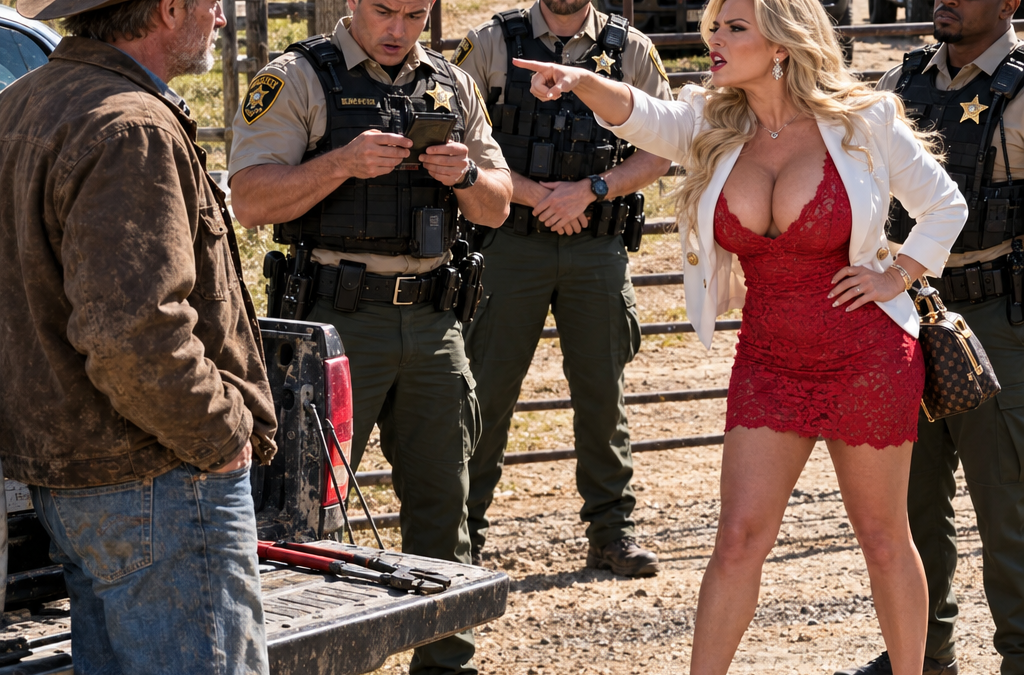
The red lace dress was unmistakable beneath her white jacket.
Her blonde hair moved in the breeze as she hurried toward the deputies.
And she was already pointing at me.
“That’s him!”
I stood still.
She raised her voice.
“That’s the man I reported!”
One deputy stepped away from his vehicle.
Another remained near the open driver’s door.
Karen marched toward the first officer.
“He’s occupying HOA property. I want him removed immediately.”
I stared at her.
For a second, I genuinely wondered whether she was performing some bizarre joke.
Then she shouted again.
“Arrest him!”
The deputies exchanged glances.
The youngest one looked toward me.
I could see that he was trying to process the situation.
He appeared to be a newer deputy I’d seen only briefly around the department.
The senior deputy, a broad-shouldered man named Daniel Hayes, had been standing near the rear patrol SUV.
He hadn’t yet gotten a clear view of my face.
Karen continued talking.
“He’s been warned repeatedly. He refuses to leave. He’s been blocking community access and acting like he owns the entire property.”
I felt my jaw tighten.
Hayes approached.
“Ma’am, slow down.”
Karen rounded on him.
“I’ve already explained everything to dispatch!”
“We still need to establish what’s happening.”
She pointed at me.
“What’s happening is that a trespasser is standing right there, and your department is wasting time instead of arresting him!”
I looked at the patrol vehicles.
Then at the officers.
Then at Karen.
I knew exactly what she was attempting.
She wanted a public display of authority.
She wanted deputies escorting me away from the ranch.
She wanted the neighborhood to see that opposing her could lead to arrest.
And she wanted to do it in front of the very gate she’d been trying to control for months.
One deputy approached me.
He kept his hands visible and his tone professional.
“Sir, can you tell me what’s going on?”
I nodded toward Karen.
“She’s claiming ownership of land that belongs to my family.”
Karen interrupted immediately.
“Don’t let him twist this!”
The deputy raised one hand.
“Ma’am, please let him answer.”
She looked offended.
“He has no right to answer as though this is his property!”
I took a breath.
“This ranch has been in my family for decades. The deed and recorded survey are in my office. The HOA boundary ends well before this driveway.”
Karen laughed.
“That’s a lie.”
The deputy turned toward her.
“Ma’am.”
She pointed at me again.
“He has been using that same excuse for months. The HOA board has already determined the land belongs to the community.”
I looked at her.
“Your board doesn’t determine ownership.”
She snapped.
“Nobody asked you!”
The deputy stepped slightly between us.
“Sir, I’m going to need to see some identification.”
Karen smiled.
There it was.
The moment she’d been waiting for.
She folded her arms beneath her jacket and looked at me with open satisfaction.
“Go ahead, Tom. Tell them how important you think you are.”
I set my fencing pliers on the tailgate.
Then I slowly reached inside my jacket.
The deputy watched carefully.
I understood why.
He was responding to a report, dealing with an angry complainant, and trying to identify someone involved in a property dispute.
He had no reason to assume I would be carrying official identification.
I opened the leather holder.
The badge caught the morning sunlight.
The deputy looked down.
His expression changed almost immediately.
He leaned closer.
Then looked at the identification card.
Then at my face.
“Sir…”
He straightened.
“Sheriff Walker?”
I nodded.
“Morning, Deputy.”
The young deputy froze.
Behind him, Hayes looked up sharply.
His eyes found me.
Then widened.
“Sheriff?”
Karen’s smile vanished.
I looked toward Hayes.
“Morning, Daniel.”
He stepped closer.
“Sir, I didn’t realize this was your property.”
“It is.”
The younger deputy looked from me to Hayes.
Then back at the badge.
His entire posture had changed.
Karen stared at us.
For several seconds, she said nothing.
Then she gave a short, nervous laugh.
“Wait.”
Nobody answered.
She looked toward Hayes.
“What did you just call him?”
Hayes turned toward her.
“Sheriff Walker.”
Karen blinked.
“The sheriff?”
“Yes, ma’am.”
She looked at me.
Then at the badge.
Then back at Hayes.
“That’s impossible.”
I closed the identification holder.
“What’s impossible, Karen?”
Her cheeks flushed.
“You never told me you were the sheriff.”
I stared at her.
“You never asked.”
She opened her mouth.
Then closed it.
For the first time since I’d met her, Karen Whitmore looked genuinely uncertain.
But the silence lasted only a few seconds.
Then she straightened her shoulders.
“That doesn’t change anything.”
Hayes looked at her.
“Ma’am?”
“I don’t care what his job is. He’s still occupying HOA land.”
I felt a slow wave of disbelief.
The woman had just discovered she’d called my own department to remove me from my ranch.
And rather than reconsidering her accusation, she’d decided my badge was irrelevant.
In one narrow sense, she was right.
A badge didn’t prove ownership.
I knew that better than anyone.
So I decided we were going to handle the matter exactly as we would if I were any other landowner.
I turned toward Hayes.
“Deputy, I don’t want my position affecting how you document this call.”
He nodded.
“Understood, Sheriff.”
“Treat the property claim on its evidence. My deed is in the ranch office. Her documents can be reviewed against the county records.”
Hayes looked relieved.
“Yes, sir.”
Karen immediately seized on the exchange.
“See? He’s using his position to influence you!”
I turned toward her.
“Karen, I just told him to verify the records.”
“You called him by name!”
“He works for the county.”
She threw up her hands.
“This is outrageous!”
Hayes stepped forward.
“Mrs. Whitmore, we’re going to establish who owns the property before making any decisions.”
Karen glared at him.
“Your dispatcher told me deputies could remove trespassers.”
“Under the appropriate circumstances, yes.”
“Then remove him!”
“First we need to establish that he’s trespassing.”
She looked as though the answer physically offended her.
“I already told you he is!”
Hayes remained calm.
“Your statement is one part of the information we have. It isn’t the final determination.”
Karen’s face tightened.
She turned toward the younger deputy.
“Are you going to let him talk to me like this?”
The young deputy said nothing.
Karen looked around at the patrol vehicles.
Then back at me.
I could see the calculation happening behind her eyes.
She had expected immediate obedience.
Instead, she was being asked for evidence.
And evidence was the one thing she’d spent months avoiding.
She reached into her designer handbag and pulled out a leather folder.
“Fine,” she snapped. “You want proof? I’ll give you proof.”
She walked to the hood of the nearest patrol SUV and opened the folder.
Inside were several papers.
HOA letterhead.
Meeting summaries.
A printed development map.
And what appeared to be a copy of the same planning drawing she’d sent me weeks earlier.
Karen slapped the map onto the hood.
“There.”
Hayes leaned over it.
The younger deputy stood beside him.
I remained a few feet away.
Karen pointed at the broad red line surrounding the development.
“This is Brookstone Estates.”
Hayes nodded.
Then she moved her finger across the shaded area extending toward my ranch.
“And this belongs to the HOA.”
Hayes studied the drawing.
“Where did this map come from?”
“Our association records.”
“Is it a recorded survey?”
She frowned.
“It’s the official HOA map.”
“Was it recorded with the county?”
Karen’s jaw tightened.
“The board uses it for planning.”
Hayes looked up.
“That’s not what I asked.”
Her eyes flashed.
“Why does everyone keep playing word games with me?”
I said quietly, “Because you’re confusing planning with ownership.”
She spun toward me.
“Stay out of this!”
Hayes raised his hand.
“Mrs. Whitmore, please.”
She ignored him.
“I have spent months trying to resolve this situation peacefully. He refuses to cooperate, he blocks community property, and now he’s hiding behind a badge!”
I looked at the map.
“Karen, that’s not a deed.”
She slapped the paper.
“It proves the HOA controls the area.”
“No. It shows what someone drew on a planning map.”
Her face reddened.
“Do you think I’m stupid?”
I didn’t answer immediately.
That seemed to make her angrier.
“Well?”
I took a breath.
“I think you’re making a serious claim without the documents to support it.”
For a moment, her expression became almost vicious.
Then she turned toward Hayes.
“I demand that you enforce the HOA’s property rights.”
He looked at her steadily.
“Then we need to verify those rights.”
Karen threw both hands into the air.
“This is unbelievable!”
I walked to my pickup.
Behind the seat, I kept a folder containing copies of the most important ranch documents.
I’d started carrying it after Karen’s earlier letters.
At the time, it had seemed excessive.
Now I was grateful.
I pulled out the current official county survey and unfolded it across the patrol SUV’s hood beside Karen’s map.
The difference was immediate.
Her drawing showed an approximate development planning area.
Mine showed recorded boundaries, parcel identifiers, survey references, and clearly marked property lines.
I pointed toward the county road.
“This is the entrance to Brookstone Estates.”
Hayes leaned closer.
I moved my finger along the recorded subdivision boundary.
“This is where the HOA property ends.”
Then I traced the line toward my ranch.
“And this is my western boundary.”
The younger deputy studied the map.
The distinction was unmistakable.
The ranch extended well beyond the area Karen claimed.
There was no shared ownership.
No common parcel.
No HOA-controlled corridor crossing the pasture.
And the main gate stood entirely within my property.
Hayes looked from one map to the other.
“These boundaries don’t match.”
“No,” I said. “They don’t.”
Karen leaned over the hood.
“Your map is wrong.”
I looked at her.
“This is the recorded survey.”
She pointed at her own paper.
“And this is the HOA map.”
Hayes spoke.
“Mrs. Whitmore, we need to determine what each document actually represents.”
She stared at him.
“Mine represents the neighborhood!”
“That doesn’t establish the ownership of the neighboring ranch.”
Karen’s face tightened.
She reached toward my survey.
“How do I know he didn’t have someone draw that up?”
I kept my voice steady.
“Because it’s a licensed survey with county recording information. You can verify it directly.”
Hayes nodded.
“That’s what we’ll do.”
Karen looked stunned.
“You can’t seriously be taking his word over mine.”
Hayes looked at her.
“We’re comparing the records.”
She pointed toward the badge holder in my hand.
“Because he’s your boss!”
I felt the situation becoming more dangerous in a different way.
Karen was trying to turn a straightforward property dispute into an accusation that the sheriff’s department would protect its own regardless of the evidence.
I wasn’t going to give her that opening.
I looked at Hayes.
“Deputy, make the necessary record checks yourself. If you need an outside supervisor or another office to review the complaint, document that request. I’m not making the determination.”
Hayes nodded.
“Understood.”
Karen folded her arms.
“How convenient.”
I turned toward her.
“Karen, I’d prefer that you stop trying to have me arrested long enough for the deputies to establish the facts.”
She smiled coldly.
“Oh, now you’re worried about the facts?”
“I’ve been asking you for the facts for months.”
She leaned forward.
“And I’ve told you that this entire area was purchased for community expansion.”
Hayes looked up.
“Purchased by whom?”
“The HOA.”
“When?”
“Years ago.”
“From whom?”
She hesitated.
“From the original developers.”
I stared at her.
That was a new claim.
Previously, she’d said the land was part of the original HOA boundaries.
Now she was claiming it had been purchased later.
Hayes noticed the change too.
“Mrs. Whitmore, do you have a deed documenting that purchase?”
Karen opened her folder again.
She began flipping through the papers.
One page.
Then another.
Then another.
Finally, she pulled out a typed document on HOA letterhead.
“This is the board’s approval.”
Hayes examined it.
It was a summary of a meeting discussing community access improvements.
There was no property conveyance.
No grantor.
No grantee identification for a ranch parcel.
No legal description transferring title.
No recording information.
Hayes looked at Karen.
“This isn’t a deed.”
She lifted her chin.
“It’s official HOA paperwork.”
“That doesn’t make it a property transfer.”
Her cheeks flushed.
“The board approved the acquisition!”
I stared at her.
“Approved acquiring what?”
“The land!”
“From whom?”
She looked at me.
Then away.
“The developers.”
I pointed toward the ranch.
“Karen, the developers never owned this land.”
She snapped.
“That’s your opinion.”
“No. That’s the recorded chain of title.”
Hayes closed the folder.
“Mrs. Whitmore, we need to verify this with the county property records.”
Karen took a step backward.
Her confidence was beginning to fracture.
But she still had one argument left.
“The HOA purchased access years ago,” she insisted. “Maybe the ranch wasn’t transferred entirely, but we have access rights.”
I looked at Hayes.
“Then we should check for an easement.”
He nodded.
Karen crossed her arms.
“Exactly.”
For a second, she looked relieved.
As though she’d finally found the right legal term to rescue her story.
But an easement wasn’t something you could invent by pronouncing the word.
It had to exist under an applicable legal basis.
And if Karen was claiming a recorded easement, there should be a document establishing it.
Hayes asked the obvious question.
“Where is the easement recorded?”
Karen looked down.
“The HOA files.”
“Do you have the document?”
She began searching again.
Her fingers moved faster.
Papers slid against the hood.
She opened a second folder.
Then a third.
Finally, she looked up.
“I don’t have every association document with me.”
Hayes nodded.
“Then we can’t verify that claim from what you’ve presented.”
Karen slammed the folder shut.
“This is ridiculous. I brought officers here to remove a trespasser, not conduct a legal seminar!”
I felt my patience thinning.
“Karen, you brought officers here because you wanted to use them as leverage.”
She turned toward me.
“Don’t flatter yourself.”
“You knew I’d challenged your map.”
“Because you were wrong!”
“I sent you the county survey.”
“Your little papers don’t override the HOA!”
Hayes stepped between us.
“Enough.”
His voice was firm now.
Both of us stopped.
He looked at Karen.
“We’re going to finish establishing the property boundaries. Until then, nobody is being removed based solely on an unverified HOA map.”
Karen stared at him.
For a moment, I thought she might actually scream.
Instead, she folded her arms and looked toward the other deputies.
“Fine. Go ahead. Waste everyone’s time.”
Hayes turned toward me.
“Sheriff, can you show us the original boundary markers?”
“Yes.”
I pointed toward the fence line.
“The nearest one is just beyond the gate.”
We walked along the gravel road.
Karen followed several yards behind us.
Her high-heeled boots made the uneven ground difficult, but she refused to remain by her vehicle.
I could hear her muttering under her breath.
The deputies carried the survey and compared it with the terrain.
I led them toward a weathered corner post near the western boundary.
Beside it stood a survey marker set into the ground.
“This marker corresponds to the recorded corner,” I explained.
Hayes checked the survey.
The younger deputy looked at the marker.
Then at the map.
“That matches.”
I nodded.
We continued toward the next location.
Another marker.
Another matching reference.
The ranch fence followed the established line.
Nothing about the physical evidence suggested the HOA owned the land inside my gate.
Karen watched the process with growing irritation.
“Those markers could have been moved.”
I turned toward her.
“Survey markers aren’t something you move whenever you dislike the result.”
She crossed her arms.
“People move things all the time.”
Hayes looked at the recorded survey information.
“Mrs. Whitmore, the marker locations appear consistent with the documentation. We can note any challenge you want to make, but you haven’t provided an alternative recorded survey.”
She frowned.
“I already gave you one.”
I shook my head.
“You gave him a development planning map.”
Her expression hardened.
“Stop repeating that.”
“Then stop pretending they’re the same thing.”
The younger deputy moved toward another marker.
He compared the location with the survey.
Then looked at Hayes.
“Everything’s lining up.”
Hayes nodded.
Karen looked toward the subdivision rooftops visible beyond the fence.
“But our neighborhood runs all the way to that ridge.”
I followed her gaze.
“No, Karen. Your neighborhood’s view runs toward that ridge.”
She turned.
“What?”
“Being able to see land doesn’t mean you own it.”
Her face flushed.
“You think you’re very clever.”
“No. I think you haven’t bothered to read the actual boundary.”
She stepped toward me.
“That land should belong to the HOA. It would make far more sense.”
For a moment, I couldn’t believe she’d said it.
Then I realized how much it revealed.
This wasn’t merely about a mistaken map.
Karen had convinced herself that what she wanted the community to own was somehow equivalent to what it legally owned.
I looked at her.
“Should belong and does belong are two different things.”
She glared at me.
“You’re always hiding behind technicalities.”
I looked toward the pasture.
“My family’s ownership isn’t a technicality.”
Her jaw tightened.
I continued.
“My grandfather bought this ranch before your subdivision existed. My father paid taxes on it for decades. I’ve maintained it, insured it, and operated it. You don’t get to erase all of that because the view would look better without a fence.”
She looked away.
Hayes studied the map again.
Then he said, “We should also review the deed and county records before closing out the ownership question.”
I nodded.
“My office is at the ranch house.”
Karen immediately objected.
“You’re going into his private office? That’s hardly impartial.”
Hayes turned toward her.
“Mrs. Whitmore, reviewing a property owner’s deed doesn’t mean accepting it without verification.”
She looked offended.
“Then why not just use my documents?”
“Because your documents don’t establish the ownership you’re claiming.”
That silenced her for several seconds.
We returned to the vehicles.
The younger deputy contacted dispatch to begin checking the available county parcel information.
Hayes gathered the documents.
Then we headed toward the ranch office.
Karen insisted on following.
I stopped at the porch.
“Karen, you don’t have permission to enter my office.”
She stared at me.
“Oh, now you’re going to exclude me from the investigation?”
“You can remain outside. The deputies can review the documents.”
Her eyes flashed.
“I have a right to be present.”
Hayes stepped forward.
“Mrs. Whitmore, we’re not conducting a public hearing. You can provide documents and statements, but the property owner doesn’t have to invite you into his building.”
Karen looked at him in disbelief.
“You are letting him control everything!”
Hayes remained calm.
“I’m explaining the limits of your authority on private property.”
She opened her mouth.
Then closed it.
Finally, she stepped back.
“Fine.”
I entered the office with Hayes and the younger deputy.
The room hadn’t changed much since my father’s time.
A heavy wooden desk stood near the window.
A large steel filing cabinet occupied one wall.
Framed photographs showed generations of cattle, ranch buildings, and family members.
Above the desk hung an old picture of my grandfather standing beside the original ranch gate.
He was wearing a broad-brimmed hat and holding a coil of rope.
Every time I looked at that photograph, I remembered the sound of his voice.
“Know where your line is, Tommy. And respect the other man’s line just as much.”
I opened the cabinet.
The original deed was in a protective folder near the back.
I removed it carefully.
The paper had aged, but the legal description remained clear.
I placed it on the desk.
Hayes examined the document.
The younger deputy compared the information with the survey.
Then I added the later recorded documents establishing how ownership had passed through the family.
The chain was straightforward.
My grandfather had acquired the property.
My father inherited it through the appropriate process.
Eventually, ownership passed to me.
The ranch’s legal boundaries remained consistent with the recorded records.
Hayes studied the dates.
Then looked up.
“This predates Brookstone Estates by decades.”
“Yes.”
He examined the legal description again.
The younger deputy leaned closer.
“There’s no overlap with the subdivision parcel.”
“No.”
Hayes nodded slowly.
“And no recorded shared ownership shown in these documents.”
“Correct.”
The younger deputy checked the information coming back through the department’s record inquiry.
His expression changed.
“The county parcel data is consistent with the deed.”
Hayes looked at him.
“Any easement matching the claimed HOA access route?”
“Nothing matching that description in the available records.”
I felt some of the tension leave my shoulders.
Not because I had doubted the property records.
Because the deputies were confirming independently what I’d been telling Karen for months.
The facts were finally being examined without her controlling the conversation.
Hayes looked toward the office window.
Outside, Karen stood near her SUV with her phone pressed to her ear.
She was pacing.
Every few steps, she gestured angrily toward the ranch house.
I could guess what she was saying.
Probably that the deputies had been intimidated.
Probably that the HOA was being treated unfairly.
Probably that I was using my position to avoid arrest.
I turned back toward the desk.
“There’s something else you should see.”
I opened a second folder.
Inside were the letters Karen had sent over the previous months.
Her demands for access.
Her claims of community ownership.
My written requests for supporting documents.
And the copy of the county survey I’d already supplied to her.
Hayes examined the correspondence.
His expression grew more serious.
“You sent her the boundary information before today?”
“Yes.”
He looked at the date.
“Several weeks ago.”
I nodded.
“And she responded?”
I handed him the HOA letter stating that the board had reviewed my concerns and continued relying on its own map.
Hayes read it carefully.
Then he looked toward the window again.
“She knew there was a disputed boundary claim.”
“She knew I was disputing her interpretation and had provided the county survey.”
He nodded.
“That’s an important distinction.”
I agreed.
I wasn’t going to ask him to draw conclusions about what Karen knew beyond the evidence.
But the documents clearly showed that she hadn’t arrived at the ranch unaware that her map was being challenged.
She had received the official survey.
She had rejected it.
Then she had called deputies and described me as a trespasser.
That sequence mattered.
Outside, Karen had stopped pacing.
She stood beside the patrol SUV, watching the office with narrowed eyes.
When Hayes and the younger deputy emerged, she hurried toward them.
“Well?”
Hayes stopped.
Karen folded her arms.
“Did you find what you needed?”
“We reviewed the deed, survey, and available county records.”
She smiled confidently.
“Excellent. Then we can proceed with removing him.”
Hayes shook his head.
“No, ma’am.”
Her smile froze.
“What?”
“The records identify this ranch as privately owned property belonging to Mr. Walker.”
She stared at him.
“That can’t be right.”
“The recorded information is consistent.”
She glanced toward me.
Then back at Hayes.
“He’s your sheriff!”
“His position doesn’t change the property records.”
Karen’s face reddened.
She raised her voice.
“You are allowing a conflict of interest to corrupt this entire investigation!”
I felt the accusation hit harder than I’d expected.
I’d spent years trying to earn the department’s trust and the public’s confidence.
I knew how damaging it could be if people believed a sheriff used his office for personal advantage.
And now Karen was attempting to create exactly that impression because the documents didn’t support her claims.
I stepped forward.
“Deputy Hayes, document that concern as well. I don’t want the report suggesting I directed the outcome.”
He nodded.
“Yes, sir.”
Karen laughed bitterly.
“Listen to that. He’s telling you what to put in your report!”
Hayes turned toward her.
“Mrs. Whitmore, I’m handling the investigation. The property records are what they are.”
She pointed toward my office.
“He could have forged those documents!”
Hayes looked at her steadily.
“The county’s records match the information.”
Karen froze.
Then she changed direction again.
“Fine. Maybe he owns the ranch itself. But the HOA purchased access years ago.”
I stared at her.
We were back to the easement.
Hayes opened his notebook.
“Mrs. Whitmore, who sold that access right to the HOA?”
“The developers.”
“Which developers?”
“The original development company.”
“When did the transfer occur?”
She hesitated.
“Years ago.”
“Do you have an approximate date?”
Karen looked down at her folder.
“I’d have to check.”
“Was it recorded?”
“It should have been.”
Hayes nodded.
“Do you have a document number?”
“No.”
“A deed reference?”
“No.”
“An easement agreement?”
She looked furious.
“Why are you asking me the same questions over and over?”
“Because you’re claiming a property right and haven’t produced documentation establishing it.”
Her eyes flashed.
“The board approved the access.”
I stepped forward.
“Karen, the board can vote to pursue an easement. It can’t vote one into existence over someone else’s property.”
She turned toward me.
“Would you stop interrupting?”
Hayes raised his hand.
“Mrs. Whitmore, the sheriff is correct about the distinction between a board decision and a recorded property interest.”
She stared at him.
Then at me.
Then toward the ranch gate.
For the first time, she seemed to be realizing that every direction she tried led back to the same missing document.
But Karen Whitmore wasn’t the kind of person who accepted defeat quietly.
She pulled out her phone.
“I’m calling the board.”
Hayes nodded.
“You’re welcome to contact anyone who can provide relevant records.”
Karen stepped several yards away.
She dialed.
Then began speaking loudly.
“Robert? It’s Karen. I need you to confirm the HOA’s ownership of the ranch access property.”
I watched her pace.
A moment later, her expression tightened.
“No, not the clubhouse parcel. The ranch land.”
She listened.
Then frowned.
“The land on the old development map!”
Another pause.
Her voice rose.
“What do you mean you don’t know?”
Hayes glanced toward me.
I said nothing.
Karen continued.
“The board approved the community access project. We discussed this!”
She listened again.
Then snapped, “That’s not the same thing!”
A few seconds passed.
Her face flushed.
“No, I don’t have a deed in front of me. That’s why I’m calling you!”
She turned away from us.
Her voice dropped, but not enough to hide the frustration.
“Robert, I have three sheriff’s vehicles here. I need you to stop being difficult and tell them the HOA owns this land.”
Another pause.
Then she shouted.
“What do you mean the map was preliminary?”
Silence.
Karen stopped pacing.
Her shoulders stiffened.
I watched her stare at the ground.
Then she said through clenched teeth, “That map has been in the association office for years.”
She listened.
Her expression changed again.
“This is not helpful.”
A moment later, she ended the call.
She stood still for several seconds.
Then turned toward us.
Hayes approached.
“Did the board member have any supporting documents?”
Karen slipped the phone into her handbag.
“The board is reviewing its files.”
Hayes nodded.
“Did he confirm a deed or easement?”
She looked away.
“Not immediately.”
I felt my jaw tighten.
That was a carefully chosen phrase.
Not immediately.
As though the document existed somewhere and was merely difficult to locate.
Hayes continued.
“What did he say about the map?”
Karen glared at him.
“It’s an older map.”
“Older in what sense?”
She hesitated.
“It was prepared during the development planning process.”
I stared at her.
Finally.
The truth was beginning to emerge.
Hayes looked at the drawing.
“Was the ranch ever actually purchased by the HOA or the developer?”
Karen’s expression hardened.
“I believed it was included in the community expansion.”
“Do you have a recorded transfer showing that?”
She said nothing.
Hayes waited.
The silence stretched.
Then Karen snapped.
“I am not a surveyor!”
“No one said you were.”
“I’m not a real estate attorney either!”
“Then why did you report the current property owner as a trespasser without verifying the ownership?”
Her face turned bright red.
“Because the map showed the land inside the community boundary!”
I looked at her.
“An old planning map.”
She turned toward me.
“Shut up, Tom!”
The younger deputy stiffened.
Hayes raised his voice slightly.
“Mrs. Whitmore, that’s enough.”
Karen looked around.
Her eyes were wide with frustration.
She seemed genuinely unable to comprehend why her title wasn’t ending the argument.
She had spent years telling homeowners what to do.
Now she was standing in front of deputies who wanted recorded evidence.
And every answer she gave was making her position weaker.
Hayes returned to the patrol SUV.
He spread the maps across the hood one more time.
I stood beside him.
Karen remained on the opposite side.
The younger deputy brought over the county records he had confirmed.
Hayes placed the official survey beside the HOA map.
Then he pointed toward the subdivision.
“This is Brookstone Estates.”
Karen nodded.
He traced the recorded boundary.
“This is the legally identified extent of the development in the records we’ve reviewed.”
Then he pointed toward my ranch.
“And this parcel is separately owned.”
Karen stared at the two maps.
Her lips pressed together.
Hayes continued.
“The HOA map appears to depict a proposed or anticipated development area, not an actual transfer of ownership.”
Karen shook her head.
“No.”
He looked up.
“Mrs. Whitmore?”
“No. That map has been used for years.”
“Using a map doesn’t make it accurate.”
“It came from the association office!”
“That doesn’t make it a recorded deed.”
Her breathing became uneven.
She looked toward the ranch house.
Then toward the pasture.
Then back at the map.
“But all of this was supposed to be part of the community.”
I stared at her.
There it was again.
Supposed to be.
Not owned.
Not purchased.
Not transferred.
Supposed to be.
I took a slow breath.
“Karen, my family never sold this ranch to the developers.”
She looked at me.
“We never sold it to the HOA.”
Her expression tightened.
“And we never granted your association the easement you’re claiming.”
She folded her arms.
“You can’t prove a negative.”
Hayes spoke before I could.
“Mrs. Whitmore, the recorded property records establish the ownership we can verify. If you’re asserting another legal interest, you need evidence supporting it.”
She glared at him.
“So you’re just going to let him keep the land?”
I almost couldn’t believe the question.
Let me keep it.
As though she believed the deputies were being generous by allowing me to remain on property my family had owned for decades.
Hayes looked at her.
“He’s the recorded owner.”
Karen pointed toward the subdivision.
“But the neighborhood needs access!”
“That doesn’t change ownership.”
“We have plans for that area!”
“Plans don’t transfer title.”
She threw up her hands.
“This is insane!”
I looked across the pasture.
The cattle were still grazing.
A few birds moved along the fence line.
The morning sun had risen higher, throwing long shadows across the gravel.
Everything about the ranch was ordinary.
Familiar.
Exactly as it had been before the patrol vehicles arrived.
But Karen had managed to turn a quiet Saturday into a law enforcement response because she refused to accept a property boundary.
Then Hayes closed the survey folder.
“Mrs. Whitmore, I need to ask you some questions about your report.”
Her expression changed.
For the first time, the focus was no longer on me.
It was on her.
She straightened.
“What questions?”
“You reported that Mr. Walker was trespassing.”
“Yes.”
“You told dispatch he had no right to be on the land.”
“Correct.”
“You told us the HOA owned the ranch property.”
She hesitated.
“That’s what our records showed.”
Hayes nodded.
“Which records?”
“The community map.”
“The old planning map?”
Karen’s jaw tightened.
“Yes.”
“Did anyone verify ownership through the county recorder before you made the report?”
She looked away.
“I relied on the association’s information.”
“Who specifically told you the HOA owned this parcel?”
She hesitated.
“The board.”
“Who on the board?”
Her face flushed.
“We discussed the property at meetings.”
“Did anyone provide you with a recorded deed?”
She said nothing.
Hayes waited.
Finally, she shook her head.
“No.”
“An easement?”
“No.”
“A current official survey?”
Her voice became sharp.
“I had the HOA map.”
Hayes made a note.
Then asked another question.
“Had Mr. Walker previously provided you with a copy of the county survey disputing your claim?”
Karen’s eyes widened.
She glanced toward me.
Then back at Hayes.
“He’s been sending hostile letters for months.”
I felt anger rise.
“My letters asked you to verify the boundary.”
Karen snapped.
“You threatened the HOA!”
I shook my head.
“I told you not to enter private property without permission.”
Hayes looked at her.
“Mrs. Whitmore, did you receive the survey?”
She hesitated.
Then nodded stiffly.
“Yes.”
“Did you have it independently checked?”
“No.”
“Why not?”
Her face turned scarlet.
“Because I believed our map was correct!”
Hayes nodded.
He made another note.
Then looked directly at her.
“Mrs. Whitmore, before calling law enforcement to have someone removed from land, especially when ownership is disputed, it’s important to verify the facts.”
She stared at him.
“You think I did something wrong?”
“We’re documenting the circumstances of your report and your conduct on the property.”
Her jaw tightened.
“I was protecting the community.”
Hayes looked toward my gate.
“By entering land that the records identify as privately owned and asking deputies to remove the owner?”
Karen opened her mouth.
Nothing came out.
For a moment, the only sound was wind moving through the grass.
Then she tried a different approach.
“I was given bad information.”
I looked at her.
“By whom?”
She turned toward me.
“Stay out of this.”
Hayes spoke.
“Mrs. Whitmore, that’s what I’m trying to establish. Who gave you the information?”
She looked down.
“The map was in the HOA office.”
“Who told you it was a current ownership record?”
She hesitated.
“I assumed it was.”
The words hung in the air.
I felt something cold settle in my chest.
That was it.
Months of letters.
Threats.
Demands.
Accusations.
And three sheriff’s vehicles arriving at my ranch.
Because Karen had assumed an old planning map represented ownership.
She hadn’t verified a deed.
Hadn’t checked the county records.
Hadn’t obtained a survey.
Hadn’t confirmed an easement.
She had simply decided that the HOA owned the property because an old map showed land the developers once hoped to include.
And when I refused to accept her claim, she’d called law enforcement.
I looked at her.
“Karen, I gave you the actual survey.”
She refused to meet my eyes.
“I thought it was outdated.”
“Then you should have checked.”
She looked at me sharply.
“You don’t understand how complicated HOA management is.”
I took a slow breath.
“No, Karen. I understand exactly how complicated property rights can be.”
She glared at me.
“And that’s why you verify them before trying to have somebody arrested.”
Her face tightened.
For once, she didn’t have a clever response.
Hayes closed his notebook.
“Mrs. Whitmore, based on the records reviewed today, this ranch is private property. You have not established HOA ownership or the easement you claimed.”
Karen stared at him.
“But the board—”
“The board’s approval doesn’t change the property records.”
She opened her mouth again.
Hayes continued.
“You need to stop entering the ranch without the owner’s permission.”
Her expression became furious.
“Are you ordering me to stay away?”
“I’m warning you that you have no authority to enter this private property simply because you believe the HOA should control it.”
She looked toward the gate.
Then back at him.
“And what about community access?”
“Any legitimate access rights would need to be established through the proper legal process.”
She folded her arms.
“So he gets everything he wants.”
Hayes shook his head.
“This isn’t about what either side wants. It’s about what the records establish.”
Karen looked toward me.
Her eyes were full of anger.
For a moment, I expected another threat.
Another promise that the HOA would make me regret this.
Another declaration about lawyers and community power.
Instead, she said something quieter.
“You’ve embarrassed me in front of my own community.”
I stared at her.
I could barely believe she’d said it.
“Karen, you brought the deputies here.”
She looked away.
“You could have cooperated.”
“I cooperated with the investigation.”
“You know what I mean.”
I did.
She wanted me to surrender the ranch boundary dispute so she could go home looking victorious.
She wanted the deputies to remove me because she had demanded it.
She wanted her HOA title to matter more than the deed.
And now she was furious because none of those things had happened.
I stepped closer, keeping my voice level.
“Let me explain something.”
She looked at me.
“I’ve served this county for most of my adult life. I’ve seen property disputes destroy friendships, divide families, and turn ordinary neighbors into enemies.”
She said nothing.
“I’ve also seen what happens when someone starts believing they can use law enforcement to win an argument that should be resolved by documents and proper legal procedures.”
Her face tightened.
I continued.
“You didn’t call these deputies because somebody was threatening your safety. You called them because you wanted me removed from land you hadn’t established any right to control.”
Karen lifted her chin.
“I believed it was HOA property.”
“Then you should have verified that belief before demanding an arrest.”
She looked away.
I glanced toward the patrol vehicles.
“Those deputies came here because someone reported a problem. They could have been handling another call. Instead, they spent their morning reviewing a dispute you refused to verify before involving them.”
Karen’s cheeks reddened.
“You’re making me sound like some kind of criminal.”
“I’m telling you your decisions have consequences.”
She stared at me.
I lowered my voice.
“And those consequences don’t disappear because you’re the HOA president.”
For several seconds, she said nothing.
Then she looked toward Hayes.
“Am I being arrested?”
Hayes answered carefully.
“Not based on what we’ve established here today. We’re documenting the incident and the conflicting statements. You’re being told not to enter this property without permission.”
Karen seemed relieved for half a second.
Then she became indignant again.
“So after all of this, you’re just giving me a warning?”
Hayes looked at her.
“You’re free to pursue any legitimate civil claim through the appropriate channels. But you cannot use an unverified HOA map to direct deputies to remove the recorded owner.”
She stared at him.
Then she looked at me.
I could see the anger still there.
But something else had appeared beneath it.
Uncertainty.
For months, Karen had treated the ranch as a prize she could claim through persistence and pressure.
Now she’d been forced to confront the fact that no amount of shouting changed the legal boundary.
She turned toward her SUV.
Then stopped.
“One more thing,” she said.
Hayes looked up.
“Yes, ma’am?”
“I expect this matter to be reviewed by someone who isn’t personally connected to him.”
She pointed at me.
I nodded.
“That’s a reasonable concern to document.”
Karen looked surprised.
Hayes said, “The report will identify the sheriff’s involvement as the property owner and the records used to verify the boundary.”
I looked toward him.
“Thank you.”
Karen’s expression tightened.
She’d hoped the objection would create a new fight.
Instead, it was being handled like every other part of the incident.
Calmly.
On the record.
Without anyone pretending her accusation was proof.
She looked back toward the ranch.
The barns stood in the distance.
The cattle moved slowly across the pasture.
Beyond them, the hills rose toward the tree line.
For a moment, I wondered what she saw.
Did she see the place my grandfather had worked for decades?
Did she understand that the fences and gates represented real labor and responsibility?
Or did she still see nothing more than open space that her HOA deserved to control?
Then she spoke.
“This land would have been a wonderful community asset.”
I looked at her.
“It already is an asset, Karen.”
She frowned.
“To one man.”
“To a working ranch. To the people employed here. To the families who’ve depended on it. To the livestock raised here.”
She looked unimpressed.
I continued.
“Not every useful piece of land needs to belong to an HOA.”
She folded her arms.
“You’re very proud of yourself.”
I shook my head.
“I’m proud of my family.”
She stared at me.
I gestured toward the old ranch gate.
“My grandfather built that gate. My father maintained it. I’ve repaired it more times than I can count.”
I looked toward the nearest fence line.
“Those property markers were placed according to recorded boundaries. They’re not decorations. They mark the difference between what belongs to us and what belongs to someone else.”
Karen looked away.
I continued.
“You wouldn’t want me walking into Brookstone Estates and claiming your clubhouse just because my grandfather once considered buying land nearby.”
Her eyes narrowed.
“That’s different.”
“How?”
She opened her mouth.
Then closed it.
There was no answer.
Not an honest one.
Hayes stepped toward us.
“Mrs. Whitmore, we’re finished with the immediate investigation here.”
She looked at him.
“And the ranch?”
“It remains private property.”
“The access road?”
“Private, according to the records we’ve verified.”
“The gate?”
“Within the recorded ranch boundary.”
She stared at him.
He continued.
“If the HOA believes it has a valid legal interest not reflected in the records we’ve reviewed, it can present that claim through appropriate procedures. Until then, you have no authority to order people onto this property.”
Karen’s face hardened.
For a moment, she looked ready to argue again.
Then she glanced toward the younger deputy.
He was standing beside the patrol SUV, finishing his notes.
Another deputy was reviewing the call information.
The officers she’d arrived with were no longer treating me as the trespasser she’d described.
They were documenting her complaint, the property records, and the absence of supporting evidence for her claims.
Her entire plan had collapsed.
There would be no handcuffs.
No dramatic removal.
No triumphant photograph of the ranch owner being escorted away.
No story she could tell the HOA board about forcing a stubborn rancher to surrender.
Instead, there was a documented property dispute in which her own paperwork had failed to support her accusation.
Karen reached for her handbag.
She looked toward me one last time.
“This isn’t over, Tom.”
I held her gaze.
“The ownership question is clear in the records.”
She lifted her chin.
“My attorneys will review everything.”
“That’s their job.”
She looked offended by how calmly I answered.
Then she said, “You haven’t heard the last of Brookstone Estates.”
I nodded.
“Then I hope the next communication includes a valid document.”
She stared at me for another moment.
Then turned sharply.
Her high heels struck the gravel as she marched toward her white SUV.
She climbed inside.
The door slammed.
The engine started.
For a few seconds, she sat behind the wheel without moving.
I could see her through the windshield.
Her face was rigid.
Her hands gripped the steering wheel.
She had arrived expecting law enforcement to humiliate me.
Now she was leaving with her own accusations thoroughly examined and rejected by the available evidence.
Finally, she put the SUV into gear.
The tires crunched over the gravel.
She drove toward the county road without looking back.
I watched until the vehicle disappeared beyond the bend.
The deputies remained for several more minutes.
Hayes approached me.
“Sheriff, we’ll complete the incident report and preserve the relevant information.”
I nodded.
“Good.”
He looked toward the gate.
“I apologize for the disruption.”
I shook my head.
“You responded to a call. That’s your job.”
He hesitated.
“Still, I would’ve appreciated knowing who she was accusing before we arrived.”
I gave a tired smile.
“Apparently, so would she.”
He laughed once.
Then became serious.
“I’ll make sure the documentation is handled properly.”
“That’s all I ask.”
The younger deputy approached.
He looked embarrassed.
“Sir, I didn’t recognize you at first.”
I looked at him.
“You asked for identification. That’s appropriate.”
He nodded.
“I just—”
I raised one hand.
“Deputy, you had a job to do. You didn’t know who was standing there. You asked a reasonable question.”
He looked relieved.
I continued.
“Remember this, though. When somebody calls demanding an arrest, don’t confuse their certainty with evidence.”
He nodded.
“Yes, sir.”
“People can sound very convincing when they’re wrong.”
Hayes glanced toward the road where Karen had disappeared.
“She certainly did.”
I looked at the survey folder resting on the patrol SUV.
“That’s why we verify.”
The younger deputy nodded again.
Then Hayes closed his notebook.
“We’re finished here for now.”
I shook his hand.
“Thank you.”
The deputies returned to their vehicles.
One engine started.
Then another.
As they prepared to leave, Hayes lowered his window.
“Sheriff?”
I turned.
“Yes?”
He nodded toward the gate.
“That’s a beautiful ranch.”
I looked across the pasture.
“Thank you.”
He smiled faintly.
“Your grandfather built something worth protecting.”
For a moment, I couldn’t answer.
Then I nodded.
“Yes, he did.”
Hayes drove away.
The other patrol vehicles followed.
Their tires rolled slowly down the gravel road toward the county highway.
I watched the last SUV disappear.
Then the ranch was quiet again.
No shouting.
No accusations.
No red lace dress flashing beside a white luxury vehicle.
Just the sound of wind moving through the grass.
I stood beside my truck for several minutes.
The fencing pliers still lay where I’d set them.
The loose wire still needed repairing.
The cattle were still grazing.
Everything I’d planned to do that morning was waiting for me.
But I couldn’t immediately return to work.
I kept thinking about Karen’s face when the deputy recognized my badge.
The shock.
The disbelief.
The desperate attempt to regain control.
Then the fury when the documents refused to support her story.
I had spent years watching people become angry when facts contradicted their expectations.
But Karen was different.
She hadn’t merely misunderstood the boundary.
She had built an entire campaign around refusing to acknowledge it.
She’d sent letters.
Made threats.
Claimed authority.
Dismissed recorded documents.
And finally called the sheriff’s department to force an outcome she couldn’t obtain through evidence.
I thought about how dangerous that pattern could become.
If the deputies had simply accepted her confident accusations, the situation could have escalated unnecessarily.
A homeowner might have been pressured to leave his own property.
An innocent person could have been humiliated.
A misunderstanding could have turned into a confrontation.
And all because someone with a fancy title and an expensive folder insisted that her opinion was more important than a recorded deed.
I looked toward the ranch house.
My grandfather’s photograph was still hanging above the desk inside.
I could almost hear his voice.
“Know where your line is, Tommy.”
I smiled faintly.
Then I walked toward the gate.
The old metal latch was cool beneath my hand.
I checked the hinges.
The chain.
The lock.
Everything was in place.
I swung the gate closed.
The familiar metal creak echoed across the driveway.
Then I slipped the lock through the chain and secured it.
For a moment, I stood with one hand resting against the gate.
Beyond it lay the county road.
Farther west, Brookstone Estates.
And somewhere inside that neighborhood, Karen Whitmore was probably trying to explain why three sheriff’s vehicles had arrived at my ranch and left without arresting anyone.
I suspected she’d tell the board that she had been misled.
She might blame the old map.
She might blame the developers.
She might claim the deputies had misunderstood her.
Perhaps she’d accuse me of receiving special treatment.
But none of those explanations would alter the basic facts.
The ranch belonged to my family.
The recorded survey established its boundaries.
The HOA had produced no valid deed transferring ownership.
It had produced no recorded easement supporting the access Karen claimed.
And a board vote couldn’t magically turn private land into community property.
I looked back across the pasture.
The afternoon sun had begun warming the hills.
A calf moved toward its mother near the lower fence.
The barn roof caught the light.
I thought about how much had changed since my grandfather first walked this land.
The valley had become busier.
The roads were paved.
New neighborhoods had arrived.
Property values had risen.
And people who’d never known the land as open country now viewed it through the expectations of modern subdivisions.
I didn’t resent them for that.
Change was inevitable.
What I resented was the belief that change gave people permission to erase someone else’s rights.
My grandfather hadn’t worked this ranch so that a neighboring board could claim it decades later because it appeared on an old planning map.
My father hadn’t maintained the fences and paid the taxes so Karen could announce that the land should belong to her HOA.
And I hadn’t spent my life serving the county only to discover that protecting my own family’s property would be treated as a violation of someone else’s imagined authority.
That afternoon, I returned to the fence repair.
It took another forty minutes.
I replaced the loose wire, tightened the staples, and checked the neighboring posts.
Ordinary work.
Honest work.
The kind of work that never appears in a homeowners association’s glossy community brochure.
When I finished, I loaded the tools into my truck and drove slowly toward the barn.
I stopped once near the ridge overlooking the ranch.
From there, I could see almost the entire property.
The pastures.
The creek.
The old farmhouse.
The cattle moving through the grass.
And the gravel road leading back to the locked gate.
I sat behind the wheel, letting the engine idle.
For a moment, I thought about Karen again.
She had arrived believing she could command the law.
She had demanded that deputies drag me away.
She had smiled when an officer asked for my identification.
She had been absolutely certain that the sight of sheriff’s vehicles would finally force me to surrender.
But the thing that stopped her wasn’t simply the badge in my jacket.
The badge changed the mood.
It exposed how little she knew about the man she’d been trying to intimidate.
But it didn’t decide the ownership question.
The deed did.
The survey did.
The recorded boundaries did.
And the independent verification of those records made the result impossible to dispute merely by shouting.
That distinction mattered to me.
Because if Karen had called those deputies against an ordinary rancher with no badge, the property records should have protected him just the same.
A person’s rights shouldn’t depend on whether he wears a uniform.
They shouldn’t depend on whether he has powerful friends.
And they certainly shouldn’t disappear because an HOA president wants a more convenient access road.
I turned off the engine.
For a while, I sat in silence.
Then I stepped out and looked toward the distant subdivision.
Karen had been right about one thing.
Brookstone Estates was a community.
Hundreds of families lived there.
They had legitimate interests.
Legitimate concerns.
And legitimate reasons to expect their HOA to manage shared property responsibly.
But managing shared property wasn’t the same as acquiring everything nearby.
Community authority had boundaries.
Just like land.
And crossing either one could have consequences.
Karen learned that lesson the hard way.
Not in a courtroom.
Not through a dramatic arrest.
But standing beside my truck while a senior deputy examined the very documents she’d spent months dismissing.
She’d called the sheriff’s department because she thought law enforcement would make her word final.
Instead, the deputies asked for proof.
And once they did, her entire story began collapsing.
The old map.
The nonexistent deed.
The unsupported easement.
The claim that the board had approved ownership.
Every explanation led to another question she couldn’t answer.
By the time the deputies prepared to leave, Karen was no longer demanding my arrest.
She was trying to explain why she’d made the accusation in the first place.
And that was the part I would remember most.
The woman who had screamed that I was trespassing had finally been warned that she was the one with no authority to enter the ranch.
I took one last look toward the gate.
Then I turned back toward the farmhouse.
There was still work to do before sunset.
Cattle needed checking.
Equipment needed servicing.
And the ranch would need more fence repairs before winter.
Life didn’t stop because an HOA president embarrassed herself.
But that morning changed something.
Karen could no longer pretend she’d never been shown the correct boundary.
She could no longer claim that nobody had questioned her map.
And she could no longer insist that sheriff’s deputies would automatically enforce her demands.
The incident had been documented.
The deed had been reviewed.
The survey had been confirmed.
And the warning had been given.
My family ranch remained exactly where it had always been.
Outside the HOA.
Behind its own gate.
Protected by the same recorded property lines that had existed long before Brookstone Estates was built.
I walked into the office and placed the deed back in its protective folder.
Then I returned it to the steel cabinet.
Above the desk, my grandfather stared out from his old photograph.
I looked at him and smiled.
“Still ours, Grandpa.”
Then I closed the cabinet.
Outside, the afternoon light stretched across the pastures.
The cattle moved quietly beneath the hills.
The ranch gate remained locked.
And somewhere down the road, Karen Whitmore had an extraordinary story to explain to her HOA board.
She’d arrived with three sheriff’s vehicles, convinced they would arrest a stubborn rancher who refused to surrender his land.
She left after discovering the rancher was the county sheriff himself.
But the real lesson was bigger than her embarrassment.
A badge doesn’t create ownership.
An HOA title doesn’t create ownership.
And an old planning map doesn’t create ownership.
Recorded property rights don’t disappear because someone refuses to respect them.
Karen had called law enforcement expecting to take my ranch away from me.
Instead, she watched her own claims fall apart.
And when I locked that gate behind the departing deputies, I knew one thing with absolute certainty.
The land my grandfather had protected was still ours.
And no HOA president was going to take it with a folder full of imaginary authority.








