𝗙𝗨𝗟𝗟 𝗦𝗧𝗢𝗥𝗬 The HOA President Brought an Excavator to Tear Down My Family’s Lake Cabin—She Smiled Until Federal Vehicles Came Down the Road
𝗙𝗨𝗟𝗟 𝗦𝗧𝗢𝗥𝗬
I stared at her.
“I’m not a homeowner in your association.”
“You’re inside our community influence area.”
“There is no such legal category.”
“There is when the neighborhood infrastructure supports your access.”
“That road is county-maintained.”
Her lips tightened.
“You’re missing the larger point.”
“No, Linda. The larger point is that you’re standing on my property with demolition equipment.”
She glanced toward the foreman.
“Proceed.”
My stomach dropped.
The foreman hesitated.
“Ma’am—”
“You have the work order.”
He looked at me.
Then back at Linda.
“She says she owns the property.”
Linda’s voice hardened instantly.
“The HOA has authorized removal. Your company was retained by the association. Please do the job we hired you to do.”
I stepped between them.
“Do not touch that cabin.”
Linda laughed.
“Move.”
“I’m serious.”
“So am I.”
I pulled out my phone.
“I’m documenting everything.”
Her smile returned.
“Please do.”
That confidence bothered me.
She wasn’t nervous.
She wasn’t behaving like someone testing a questionable boundary.
She genuinely believed the HOA logo on her paperwork could transform trespassing into authority.
The foreman approached me.
“Sir, I don’t want a confrontation.”
“Then don’t demolish my building.”
“We were told ownership had been resolved.”
“By whom?”
He looked toward Linda.
There was my answer.
I turned to her.
“What did you tell them?”
“The truth.”
“Which version?”
Her eyes narrowed.
“That the association had obtained the authority necessary to remove a noncompliant structure.”
“What authority?”
“You’re repeating yourself.”
“Because you haven’t answered.”
She crossed her arms.
“The unpaid fees changed the situation.”
“Unpaid fees don’t transfer ownership.”
“They resulted in enforcement.”
“That doesn’t mean demolition.”
“You should have thought about that before ignoring the association.”
The excavator engine came alive.
The sound rolled through my chest.
I looked toward the machine.
Its metal arm lifted.
“Stop.”
Linda didn’t even turn.
“Proceed.”
I stepped toward the excavator.
The foreman moved between us.
“Sir, don’t approach the machine while it’s operating.”
“Then shut it down.”
“Please step back.”
“This is my property.”
“I understand what you’re saying.”
“No, you don’t.”
My voice cracked.
“That cabin belongs to my family.”
Linda spoke behind me.
“It belonged to you.”
I turned so quickly that even she took half a step backward.
“What did you say?”
She recovered immediately.
“I said you’ve been given enough opportunities.”
The excavator moved.
The bucket swung toward the front wall.
I heard myself shout.
The operator hesitated for one second.
Then the bucket struck wood.
The sound is difficult to describe.
A deep crack.
Then splintering.
Then something heavy collapsing.
Part of the front wall buckled inward.
Two logs tore free.
The porch railing snapped.
Glass shattered inside.
I stopped breathing.
It was as though somebody had hit a living thing.
That cabin had existed longer than Linda’s subdivision.
Longer than the HOA.
Longer than I had been alive.
I could see the room beyond the broken wall.
The old stone fireplace.
Part of the kitchen.
A framed photograph on the far shelf.
My mother.
My father.
Rebecca and Michael as teenagers.
Me standing between them holding a fish almost as long as my arm.
The excavator reversed.
Dust rose.
Linda checked her phone.
Checked her phone.
While my family’s cabin was being destroyed.
Something in me changed.
Until that moment, I had been angry.
Now I became quiet.
Linda noticed.
She smiled.
“There. See? Fighting doesn’t help.”
I looked at her.
“What?”
“You’ve been arguing with the association for months.”
She gestured toward the damaged cabin.
“All it accomplished was making this more expensive.”
“You think you’ve won.”
She tilted her head.
“I think you’ve learned what happens when people refuse to cooperate.”
That sentence stayed with me.
Because it wasn’t about unpaid fees.
It wasn’t about bylaws.
It was punishment.
Linda wanted me to understand that saying no to her carried consequences.
She wanted humiliation.
She wanted me standing there helpless while machinery tore through something I loved.
I stepped away from the workers.
Linda called after me.
“Where are you going?”
I didn’t answer.
I walked behind my truck, where the engine noise wasn’t quite as overwhelming.
Then I called my family.
Rebecca answered first.
“Hey.”
“Where are you?”
There must have been something in my voice because hers changed instantly.
“What’s wrong?”
“They’re demolishing the cabin.”
Silence.
“What?”
“The HOA.”
“Which HOA?”
“Linda’s.”
Another crash sounded behind me.
Rebecca heard it through the phone.
“Tell me exactly what’s happening.”
I did.
Construction trucks.
Excavator.
Linda claiming unpaid fees had authorized demolition.
No paperwork.
The first wall already damaged.
Rebecca became frighteningly calm.
“Do not sign anything.”
“I wasn’t planning to.”
“Do not physically interfere with the equipment.”
“They’re tearing it down.”
“I know.”
Her voice softened for half a second.
“I know.”
Then the professional tone returned.
“Record everything.”
“I am.”
“Faces. Vehicles. License plates. Company names. Any document they’ll show you. Get timestamps.”
“Rebecca—”
“Listen to me.”
I stopped.
“I’m checking the property records right now.”
I heard keyboard noise in the background.
“Call Michael.”
“I was about to.”
“Do it.”
“Can you come?”
“Yes.”
“How soon?”
“As soon as I can.”
I ended the call and dialed Michael.
He answered on the second ring.
“What’s up?”
“They’re demolishing the cabin.”
He laughed once because the sentence sounded impossible.
Then he realized I wasn’t joking.
“Who is?”
“The HOA.”
A pause.
“What authority?”
“Linda claims unpaid fees.”
“That isn’t authority.”
“I know.”
Another section of timber crashed.
Michael heard it.
His voice changed.
“What federal jurisdictional records are tied to the parcel?”
“I don’t know.”
“Rebecca will.”
“She’s checking.”
“Send me everything you have.”
“What are you going to do?”
“Make calls.”
Our family had never advertised what Rebecca and Michael did.
That was intentional.
They both worked in federal service.
Not celebrities.
Not elected officials.
Not people who wanted their professional lives discussed at neighborhood barbecues.
Rebecca’s work involved records, ownership disputes, compliance, and federal property issues often enough that she knew exactly where to look when documents didn’t match claims.
Michael’s position brought him into contact with federal investigative personnel and agencies that handled fraud, records manipulation, and interstate or federally connected misconduct.
I had always stayed outside that world.
That morning, I was grateful they hadn’t.
Michael ended the call with one sentence.
“Keep Linda talking.”
I looked back toward the work site.
“That won’t be difficult.”
I returned.
Linda was standing near the excavator taking photographs.
Photographs.
Of the demolition.
Like a proud homeowner documenting a renovation.
“What are those for?”
She looked over.
“Association records.”
“Make sure you get the damage clearly.”
“I am.”
“Good.”
Her eyes narrowed.
“Why?”
“No reason.”
She studied me.
“You seem much calmer.”
“I made a phone call.”
“To a lawyer?”
“Family.”
She smiled.
“Call whoever you want.”
Another section of wall came down.
“I mean that,” she continued. “Call an attorney. Call the county. Call the sheriff. This has already been approved.”
I looked at her.
“By whom?”
“The association.”
“You keep saying that like it answers the question.”
“It does.”
“Who signed the demolition authorization?”
She looked toward her folder.
“The board.”
“Which board members?”
“That’s confidential.”
“Board votes are confidential?”
“Certain enforcement matters are.”
“Who verified title?”
“We did.”
“Who?”
“The management company.”
“Which title report?”
Her patience finally cracked.
“Stop interrogating me.”
“I’m standing beside my cabin while you destroy it.”
“Not your cabin anymore.”
There it was again.
I held my phone slightly higher.
“Say that again.”
She noticed the camera.
For the first time, her confidence shifted.
Only a fraction.
She adjusted her hair.
“The structure is subject to association enforcement.”
“That isn’t what you said.”
“Don’t put words in my mouth.”
“I don’t need to. It’s recording.”
Her eyes hardened.
“You think a phone is going to save you?”
“No.”
I looked toward the lake.
“But I think records might.”
She laughed.
“Records are exactly why we’re here.”
I almost told her my sister was already reviewing them.
I stopped myself.
Michael had said keep her talking.
So I did.
“What records?”
She sighed.
“Your unpaid assessments.”
“Assessments don’t establish membership.”
“Your address appears in the association service map.”
“Service map isn’t title.”
“Your access road connects to our neighborhood.”
“That doesn’t transfer ownership.”
“The cabin is within the community development area.”
“According to what recorded boundary?”
Linda’s face tightened.
“You sound like a broken record.”
“Because title doesn’t change every time your argument does.”
The foreman approached.
“Ms. Brookke?”
“What?”
“We’re going to need somebody to confirm whether you want the chimney taken down with the structure.”
I stared at him.
“The chimney isn’t going anywhere.”
Linda barely glanced toward it.
“Everything.”
The word came out casually.
Everything.
That chimney had stones my grandfather carried by hand.
My father had repointed the mortar with Michael one summer.
Rebecca had carved our initials into one of the rear stones where nobody could see them from the porch.
Everything.
“Linda.”
She looked at me.
“If that machine touches the chimney, add it to your record.”
She smiled.
“Threatening me?”
“No.”
“Because I will have you removed from the site if you become hostile.”
“My site.”
She turned to the foreman.
“Continue.”
He hesitated.
Good.
Doubt was beginning to spread.
Not enough to stop them.
But enough that he no longer looked comfortable.
I kept filming.
The excavator hit another wall.
The upstairs corner collapsed.
I could see insulation and broken framing.
A mattress dropped halfway through the floor.
The bed had belonged to my parents.
For one terrible moment, I remembered being ten years old and waking before sunrise because my father was making pancakes downstairs.
The smell of coffee.
Wood smoke.
Maple syrup.
Gone now beneath dust.
I lowered the phone.
My hands shook.
Linda saw.
“You could have avoided this.”
I turned toward her.
“How?”
“By paying.”
“Fees I don’t owe.”
“That’s your opinion.”
“By joining an HOA my property isn’t part of?”
“You benefited from the neighborhood for years.”
“I didn’t.”
“Property values.”
“Not membership.”
“Roads.”
“County road.”
“Security patrol.”
“I never asked for it.”
“Lake maintenance.”
“My family holds separate lake rights.”
She waved a hand.
“Technicalities.”
That word almost made me lose control.
Technicalities.
Ownership.
Title.
Boundaries.
Recorded rights.
To Linda, anything that limited her authority was a technicality.
“Property law is a technicality now?”
“Don’t be dramatic.”
I stared at the missing wall.
“You’re demolishing my cabin.”
“Because you refused compliance.”
“You’re enjoying this.”
That caught her.
Her expression changed.
Then she smiled.
“I enjoy seeing problems resolved.”
I stepped closer.
“You think you’re teaching me a lesson.”
“Maybe you needed one.”
The camera caught that too.
My phone buzzed.
Rebecca.
A message.
STOP THEM IF YOU CAN WITHOUT PHYSICAL INTERFERENCE. PARCEL NEVER ANNEXED. NO HOA AUTHORITY FOUND. FEDERAL CONTACTS EN ROUTE WITH MICHAEL. I’M COMING.
I read it twice.
My heartbeat changed.
Not slower.
Stronger.
I looked toward Linda.
“Shut it down.”
She laughed.
“Excuse me?”
“Stop the demolition.”
“We’ve already discussed this.”
“I just received confirmation.”
“From your sister?”
“Official records.”
Linda rolled her eyes.
“Your family doesn’t override association authority.”
“The property was never annexed.”
Her face changed.
Just slightly.
Then she recovered.
“That’s incorrect.”
“How do you know?”
“We have maps.”
“Recorded maps?”
“Yes.”
“Great. Show them.”
“Not here.”
“Then shut the equipment down until you can.”
“No.”
I looked at the foreman.
“Sir, I am formally notifying you that official records indicate this property is not part of the HOA authorizing your work.”
The foreman’s expression tightened.
Linda stepped between us.
“Do not interfere with my contractor.”
“Your contractor is demolishing my building.”
“He has a signed work order.”
“From someone who may not own or control the property.”
The foreman removed his hard hat.
“Ms. Brookke, if there’s a title dispute—”
“There isn’t.”
“He’s saying there is.”
“He’s been saying that for months.”
The foreman looked at me.
“Do you have documentation?”
“My sister is bringing it.”
Linda laughed.
“His sister.”
The foreman didn’t laugh.
That worried her.
She moved closer to him.
“The HOA hired your company. Your payment is guaranteed. Finish the contracted work.”
“Payment isn’t the issue.”
“Then what’s the problem?”
“The problem is demolishing property without authorization.”
“You have authorization.”
“From the HOA.”
“Exactly.”
“If they don’t control the property—”
Linda’s entire demeanor changed.
The flirtatious softness appeared.
She stepped closer.
Touched his forearm.
“Mark, you’re overthinking this.”
So the foreman’s name was Mark.
“We’ve worked with your company before. You know we’re legitimate.”
He looked uncomfortable.
She smiled.
“Finish the job.”
I watched the manipulation happen in real time.
The hand.
The lowered voice.
The reassurance.
Then I spoke.
“Mark.”
He looked at me.
“My family is preserving every second of this.”
Linda’s hand dropped.
“We’re not threatening the crew.”
I pointed toward the cabin.
“But everybody here is now on notice that ownership is disputed.”
Mark looked toward the excavator operator.
Then Linda.
“I want confirmation from the office.”
She snapped.
“You have a work order!”
“I want title authorization.”
“You are being paid to demolish a noncompliant structure, not practice law.”
There she was.
The charm disappeared the second she heard no.
Mark’s face hardened.
“Then we’ll pause.”
Linda stared at him.
“No.”
“Until I speak to my boss.”
“I said continue.”
“You don’t command my employees.”
The excavator engine dropped to idle.
For the first time since that morning, the destruction stopped.
The silence felt enormous.
Linda’s face turned red.
“You have fifteen minutes.”
Mark walked away to make a call.
Linda turned on me.
“You think you’ve accomplished something?”
“I stopped the machine.”
“Temporarily.”
“Good enough.”
She stepped close enough that I could see the tiny crease between her eyebrows.
“You have no idea what you’re doing.”
“I think I do.”
“You are exposing yourself to enormous liability.”
“For protecting my cabin?”
“For interfering with authorized enforcement.”
“Show me the authorization.”
She nearly shouted.
“Stop asking me for the same document!”
“Produce it once and I’ll stop.”
Her jaw clenched.
My phone buzzed again.
Michael.
20 minutes. Do not leave.
I put the phone away.
Linda noticed.
“More family rescue?”
“Something like that.”
“You people think you’re important.”
There was contempt in the way she said you people.
I looked at her.
“What people?”
“People who think they can ignore community obligations because they know somebody.”
“You came here with an excavator.”
“Because you forced enforcement.”
“No. You chose demolition.”
“Same thing.”
“No.”
I stepped closer.
“You could have filed a civil claim.”
She said nothing.
“You could have gone to court.”
Silence.
“You could have sought a judgment.”
Her expression tightened.
“You didn’t.”
I pointed toward the damaged cabin.
“You skipped every neutral process and brought machinery.”
“We were entitled to act.”
“Then why didn’t you get a court order?”
For the first time all morning, Linda had no immediate answer.
I saw it.
So did Mark, who had finished his call and was walking back.
He looked from Linda to me.
“My office says we should hold until the ownership issue is clarified.”
Linda exploded.
“I hired you!”
“Your association hired us.”
“And I’m the president!”
“That doesn’t answer the title issue.”
She pointed toward the excavator.
“Start that machine.”
“No.”
Her face went white.
“What did you say?”
“We’re pausing.”
“You will never receive another contract from this association.”
Mark shrugged.
“Better than demolishing the wrong property.”
Linda stepped toward him.
“I can destroy your company in this county.”
I lifted my phone.
“Keep going.”
She spun toward me.
“You shut that off!”
“No.”
“You do not have permission to record me.”
“We’re standing outside on my property.”
She looked around.
And for the first time, I think it hit her.
My property.
Not metaphorically.
Not according to an HOA map.
Legally.
Maybe.
Possibly.
Enough uncertainty now existed that everyone except Linda had stopped behaving as though her authority were obvious.
Then we heard engines.
Not construction engines.
Vehicles.
Several.
Coming quickly down the lake road.
Linda looked toward the entrance.
Three dark government vehicles appeared around the bend.
Another SUV followed.
No flashing lights.
No sirens.
They didn’t need them.
They drove directly onto the property and stopped behind the construction trucks.
Doors opened.
Michael stepped out of the first SUV.
Rebecca exited the second.
Several federal personnel came with them.
Rebecca was dressed simply.
Dark pants.
Jacket.
Hair pulled back.
No theatrics.
No clipboard.
She walked toward us with the expression she used whenever someone had made a serious mistake and had not yet understood exactly how serious it was.
Linda looked from Rebecca to the vehicles.
Her face changed.
Not dramatically.
But the color left it.
Rebecca stopped in front of me first.
She looked at the cabin.
The missing wall.
The shattered windows.
The debris.
Her professional composure slipped.
Just for a second.
“Oh my God.”
I nodded.
“I’m sorry.”
She swallowed.
Then hugged me.
Hard.
When she stepped back, she was different.
Cold.
Focused.
She pulled out her credentials.
The workers went quiet.
Linda stared.
Rebecca approached her.
“Linda Brookke?”
Linda lifted her chin.
“Who are you?”
Rebecca showed the credentials.
Linda read them.
Her mouth tightened.
“This is an HOA enforcement matter.”
Rebecca’s voice remained calm.
“I’m aware of what you’re claiming.”
“Then you understand we’re acting under association authority.”
“That’s what I’m here to verify.”
Linda crossed her arms.
“Federal authorities don’t regulate neighborhood bylaws.”
Rebecca nodded.
“Correct.”
Linda seemed briefly relieved.
Rebecca continued.
“But federal personnel do become interested when records, ownership claims, financial representations, and potentially fraudulent documentation cross certain lines.”
The relief disappeared.
Michael walked toward the foreman.
“Who hired your company?”
Mark pointed toward Linda.
“The association.”
“Do you have a copy of the demolition order?”
He retrieved paperwork from his truck.
Michael began reading.
Rebecca looked at Linda.
“Who authorized demolition?”
“The board.”
“Name the individuals.”
Linda’s eyes narrowed.
“The entire board.”
“Date of the vote?”
“Last month.”
“Meeting minutes?”
“At the HOA office.”
“Recorded lien?”
Linda hesitated.
“There were unpaid fees.”
“That’s not what I asked.”
Rebecca’s tone never changed.
“Recorded lien?”
“I’m not the association attorney.”
“Court order authorizing demolition?”
“Association enforcement doesn’t always require—”
“Court order?”
Linda looked away.
“No.”
“Recorded deed giving the HOA ownership?”
“That isn’t how this works.”
“Then explain how it works.”
Linda became defensive.
“The cabin sits inside our neighborhood influence area.”
Rebecca almost smiled.
“There is no recorded property category called neighborhood influence area.”
“It’s on our association map.”
“Your internal map doesn’t transfer title.”
Linda looked toward Michael.
Then the vehicles.
Then back at Rebecca.
“You don’t know the full history.”
Rebecca opened a folder.
“I know the recorded history.”
That sentence landed.
Hard.
She removed a certified parcel map.
Then the deed.
Then prior title documents.
She handed me one copy and gave another to Mark.
“This tract predates the association.”
Linda said nothing.
Rebecca pointed.
“It was never annexed.”
“That’s disputed.”
“No.”
Rebecca’s voice remained quiet.
“It isn’t.”
Linda looked at the map.
“The subdivision boundary was revised.”
“Show me the recorded revision.”
“There were amendments.”
“Show me.”
Linda’s lips tightened.
“The management company has them.”
Michael looked up from the contractor paperwork.
“No, it doesn’t.”
Linda turned.
“What?”
Michael held the work order.
“This authorization references an HOA parcel designation that doesn’t correspond to the county tract number.”
Rebecca took the page.
Compared it to the deed.
Then looked at Linda.
“Where did this parcel identifier come from?”
Linda’s confidence finally cracked.
“I don’t prepare these documents.”
“Who does?”
“The management office.”
“Who provided this number to the contractor?”
“I’d have to check.”
“Check.”
“Now?”
Rebecca stared at her.
“Your association just demolished part of private property based on that number.”
Linda’s voice rose.
“Don’t speak to me like I’m a criminal.”
Rebecca didn’t react.
“I’m speaking to you like someone who authorized destruction of a building she may not have had any legal right to touch.”
“I did not personally operate the excavator.”
“You personally represented that the HOA had authority.”
“I believed it did.”
“Based on what?”
“The fees.”
Again.
The fees.
Rebecca closed the folder.
“Unpaid invoices from an organization do not create ownership.”
Linda crossed her arms.
“You people are deliberately oversimplifying association law.”
Michael actually laughed.
Once.
Linda looked at him.
“Something funny?”
He walked closer.
“What association law lets you demolish a nonmember’s building because she didn’t pay invoices from an HOA that doesn’t cover her parcel?”
Linda’s face reddened.
“You don’t understand the governing documents.”
“Then show them.”
Silence.
Every confrontation with Linda eventually reached the same place.
Show me.
Show the deed.
Show the annexation.
Show the lien.
Show the court order.
Show anything.
She had none of it.
The workers had begun looking at one another.
Mark spoke quietly.
“Ms. Brookke told us title had been cleared.”
Rebecca turned.
“Exactly what were you told?”
Mark looked uncomfortable.
“That the association had taken control through unpaid assessments and enforcement proceedings.”
My stomach tightened.
“Taken control?”
Mark nodded.
Linda stepped toward him.
“Be careful.”
Rebecca immediately looked at her.
“Don’t.”
Linda froze.
Rebecca’s voice was quiet but absolute.
“Do not intimidate a witness while federal personnel are standing here.”
“I wasn’t intimidating anyone.”
Mark looked at Linda.
Then Rebecca.
“She told us the prior owner had forfeited rights.”
I stared at Linda.
Prior owner?
I was the current owner.
Always had been.
Rebecca asked, “Did she provide a court judgment?”
“No.”
“Title transfer?”
“No.”
“Foreclosure deed?”
“No.”
“Why did you proceed?”
Mark looked ashamed.
“She gave us association paperwork and said their legal department had cleared everything.”
Linda snapped, “Which it had!”
Rebecca turned.
“Name the attorney.”
Linda hesitated.
“Association counsel.”
“Name.”
“Why does that matter?”
“Because we’re verifying who represented that the HOA had title.”
Linda stared at her.
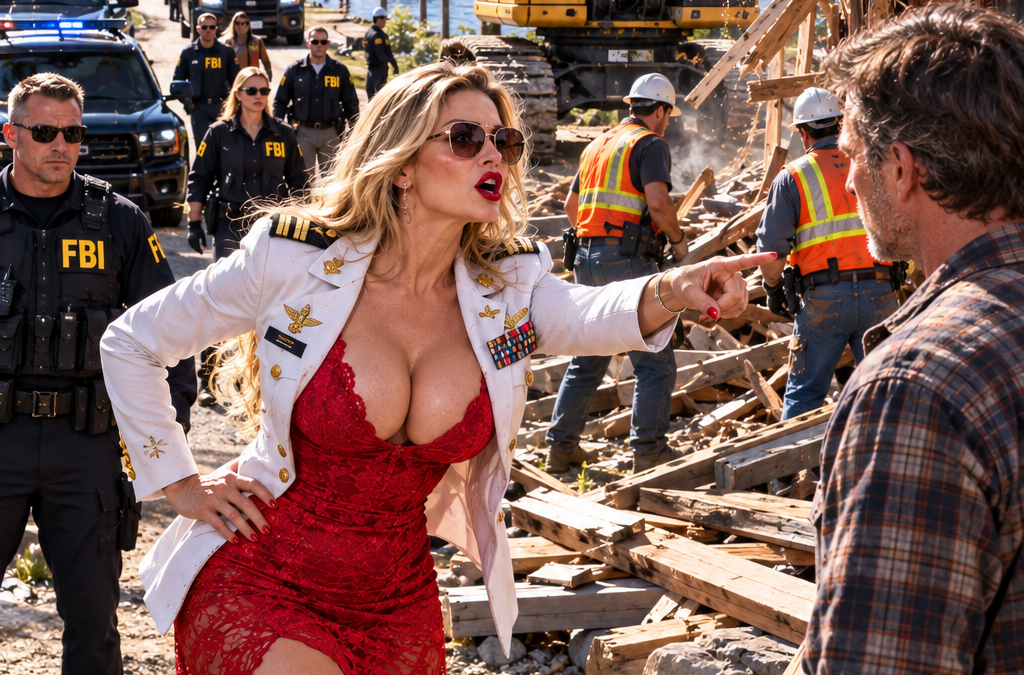
The red lace dress that usually seemed to amplify her confidence now made her look strangely out of place among hard hats, federal jackets, broken timber, and official records.
Her voice became smaller.
“I’d have to check.”
Rebecca nodded.
“Do that.”
Michael walked toward the cabin.
I followed.
He stood in front of the destroyed wall.
For a while, neither of us spoke.
He picked up a piece of timber.
“This was Dad’s section.”
“I know.”
His jaw tightened.
“They hit the bedroom too?”
“Part of it.”
He looked inside.
Then closed his eyes.
Michael was always the calm one.
Even as children, he was the one who separated Rebecca and me when we fought.
Now his hands were shaking.
“They’re going to pay for this.”
I looked toward Linda.
“She still thinks this is paperwork.”
Michael shook his head.
“Not anymore.”
Federal personnel began photographing the property.
They documented the work order.
The construction vehicles.
The damaged structure.
The parcel boundaries.
The workers’ statements.
One worker approached Rebecca voluntarily.
“I want it clear that we were told this was authorized.”
Rebecca nodded.
“Tell me exactly what you were told.”
Another joined him.
Then another.
The workers had believed Linda.
That was becoming obvious.
They weren’t people who had arrived hoping to destroy someone’s family cabin illegally.
They were contractors who had been handed paperwork and assured that a property enforcement process was complete.
Linda had used their trust the same way she used neighborhood authority.
She spoke with absolute certainty and counted on everyone assuming somebody else had verified the facts.
One worker said Linda had insisted the owner had “lost standing” because of unpaid HOA fees.
Another remembered being told the parcel had reverted to association control.
Mark said he had specifically asked whether there was any litigation risk.
Linda had allegedly told him the matter was “fully adjudicated.”
Rebecca looked at her.
“Was it?”
Linda’s face tightened.
“I was repeating what I understood.”
“From whom?”
“The board.”
“Which member?”
“All of us.”
“Then we’ll interview all of them.”
Linda’s eyes widened.
“This is completely unnecessary.”
Rebecca looked at the broken cabin.
“No.”
Her voice remained calm.
“This is exactly what becomes necessary when someone demolishes property based on claims nobody can document.”
Linda glanced at me.
The hatred was unmistakable.
“You called them.”
“Yes.”
“You brought federal authorities into a neighborhood disagreement.”
I stared at her.
“You brought an excavator into my family’s cabin.”
“Because you refused to resolve your debt.”
“What debt?”
She opened her mouth.
I continued.
“Show me where I agreed to HOA membership.”
Silence.
“Show me the covenant.”
Nothing.
“Show me the annexation.”
Nothing.
“Show me the lien.”
Nothing.
“Show me the judgment.”
Her eyes narrowed.
I looked toward the rubble.
“You didn’t come here to collect money.”
Linda said nothing.
“You came here to punish me.”
“That’s absurd.”
“You wanted me standing here when they destroyed it.”
“No.”
“You told the crew to continue after I disputed ownership.”
“You’ve disputed everything from the beginning.”
“You told me this was what happened when people didn’t cooperate.”
Her face changed.
Rebecca looked at me.
“She said that?”
“It’s recorded.”
Linda snapped, “He took it out of context.”
Rebecca extended her hand.
“Let me hear it.”
I played the recording.
Linda’s voice.
Clear.
Cold.
You could have avoided this.
Then:
I enjoy seeing problems resolved.
Then:
Maybe you needed a lesson.
Nobody said anything afterward.
Linda’s face had gone pale.
“I was frustrated.”
Rebecca nodded.
“We’ll note that.”
“This is ridiculous.”
“No.”
Michael spoke from beside the damaged wall.
“What’s ridiculous is pretending this was an administrative misunderstanding.”
Linda looked at him.
“Who are you?”
“My brother.”
“Of course.”
She laughed nervously.
“The whole family comes running.”
I stepped closer.
“That’s what families do when someone tears down the place they grew up.”
Linda’s smile vanished.
Federal personnel continued reviewing the association documents.
Michael had already contacted the relevant county office and obtained confirmation that the property had never been annexed into the HOA.
Rebecca showed Linda the original documentation.
Recorded parcel boundaries.
Prior conveyances.
Survey description.
Lake access rights.
Everything supported one conclusion.
The cabin had always been on a separate private tract.
Linda had no authority to demolish it.
The association had no ownership interest.
No recorded membership requirement.
No legitimate basis for treating unpaid HOA invoices as a mechanism to seize or destroy the property.
The more documents Rebecca laid out, the smaller Linda’s explanations became.
First, she claimed the property appeared on an HOA map.
Rebecca showed the recorded county boundary.
Then Linda claimed the access road placed the property under association control.
Michael produced county maintenance records contradicting her.
Then she claimed prior boards had always considered the cabin part of the neighborhood.
Rebecca asked for a declaration or annexation document.
Nothing.
Then Linda claimed she had relied on the management company.
A federal investigator asked for the name of the employee who provided the title information.
Linda couldn’t give one.
Finally, she returned to the unpaid fees.
Again.
“They never paid.”
Rebecca stared at her.
“That does not matter if the property was never subject to your assessments.”
Linda’s voice rose.
“Everyone around the lake contributes!”
“Not everyone around the lake belongs to your HOA.”
“That’s unfair.”
I almost laughed.
Unfair.
That was Linda’s final legal theory.
Not lawful.
Not recorded.
Not authorized.
Unfair.
Rebecca closed the file.
“Nobody is touching the property again.”
Mark nodded immediately.
The excavator was completely shut down.
The operator climbed out.
Workers stopped moving debris.
The site became still.
The same lake that had seemed peaceful that morning now reflected construction trucks, government vehicles, broken logs, and half of my family’s cabin exposed to the open air.
Linda stood in the middle of it.
For the first time, she looked genuinely afraid.
Not angry.
Not offended.
Afraid.
She walked toward Rebecca.
“Can we talk privately?”
“No.”
“This doesn’t need to become public.”
Rebecca looked at her.
“Your workers demolished a wall in broad daylight.”
“I’m talking about the investigation.”
“Why would that be private?”
Linda lowered her voice.
“I’ve served this community for years.”
“That doesn’t create immunity.”
“I acted in good faith.”
“Then the records will support you.”
Linda’s mouth tightened.
“And if they don’t?”
Rebecca said nothing.
She didn’t need to.
Linda looked toward her SUV.
“I should call association counsel.”
Michael nodded.
“You should.”
She started walking away.
One of the investigators stopped her.
“Ms. Brookke, before you leave, we need contact information and confirmation that relevant HOA records will be preserved.”
“Preserved?”
“Emails, meeting minutes, enforcement records, financial documents, contractor communications, property maps, legal correspondence.”
Linda’s face tightened.
“Some of those records are confidential.”
“Preserved doesn’t mean publicly released.”
“I’ll have to speak with counsel.”
“Do that.”
She looked toward me.
I could see the anger rebuilding now that the first shock had passed.
“This is because of you.”
I stared at her.
“You brought the excavator.”
“You refused to pay.”
“Stop saying that like it changes ownership.”
“You’ve been arrogant from the beginning.”
I stepped toward her.
“No, Linda.”
My voice was quieter than hers.
“I asked you to leave my property alone.”
“You treated the association like it meant nothing.”
“On this property, it did.”
She flinched.
That was the wound.
Not the money.
Not the unpaid invoices.
The fact that I had refused to recognize her authority.
Linda needed everyone around the lake to behave as though her title mattered everywhere she could see.
My cabin had existed outside her control.
She couldn’t tolerate it.
“You think your family connections make you untouchable now,” she said.
“No.”
I looked at the cabin.
“I think the deed made the property mine before you ever met me.”
Rebecca stepped between us.
“That’s enough.”
Linda laughed.
“Of course you’d defend him.”
“I’m defending the records.”
“He’s your brother.”
“Which is why every material conclusion will be independently verified.”
Rebecca nodded toward the investigators.
“That’s what they’re doing.”
Linda’s expression collapsed again.
She couldn’t turn this into family favoritism.
Too many people were there.
Too many documents.
Too many independent records.
The workers had become witnesses.
The cameras had captured the demolition.
Her own words had been recorded.
The cabin was physically damaged.
There was no way to reverse what had already happened and pretend it had been only a misunderstanding.
The afternoon dragged on.
Statements.
Photographs.
Measurements.
Copies.
The demolition crew remained on site while their company consulted lawyers.
Nobody touched another board.
Nobody moved another log.
I walked inside what remained of the cabin.
The front room was torn open.
Dust covered everything.
A framed picture had fallen from the shelf and cracked.
I picked it up.
My father.
Standing on the dock.
Michael beside him.
Rebecca laughing at something outside the frame.
I was behind the camera.
The glass was broken across my father’s face.
I sat down on part of the collapsed wall.
Rebecca came inside.
She saw the photograph.
Then sat beside me.
For a while, we didn’t speak.
“I should have come sooner,” she said.
“You didn’t know.”
“We knew she was sending letters.”
“Letters aren’t excavators.”
She looked toward the broken wall.
“No.”
I ran my thumb across the frame.
“Can we rebuild it?”
Rebecca looked at me.
“Yes.”
“Same place?”
“Based on everything I’ve seen, yes.”
“Better?”
That finally made her smile.
“Much better.”
Michael stepped through the opening.
“Why does it smell like Grandpa’s tools in here?”
I laughed unexpectedly.
“Because half his tools are probably still under the stairs.”
Michael looked around.
Then at the damage.
“We’re rebuilding.”
It wasn’t a question.
“Yeah.”
He nodded.
“Good.”
Outside, Linda was speaking to someone on the phone.
We could hear her voice rising.
She was finally talking to association counsel.
Whatever he told her, she didn’t like it.
“That is not what I was told!”
Pause.
“No. You listen to me.”
Pause.
“I had board authorization.”
Another pause.
“What do you mean no recorded interest?”
Rebecca and I looked at each other.
Michael smiled without humor.
“There it is.”
Linda walked farther away, but the lake carried sound.
“You people approved the contractor!”
Pause.
“Then who was supposed to verify the parcel?”
Pause.
“I am not accepting personal liability for this!”
That sentence said more than anything else she had said all day.
Personal liability.
Now she understood.
The moment consequences moved from abstract HOA authority to her own name, her confidence disintegrated.
The federal review did not magically rebuild the cabin.
It didn’t undo the demolition.
But it stopped the destruction and froze the false story Linda had relied on.
The association could no longer pretend ownership was obvious.
The contractor could no longer rely on Linda’s assurances.
The board had to produce records.
The management company had to explain the parcel number used on the work order.
Every step would now be documented.
No more Linda standing at the edge of the lake saying the board had decided something and expecting everyone to obey.
By evening, the construction crew began securing equipment for removal.
They didn’t haul away the cabin debris.
Rebecca insisted nothing be removed until documentation was complete.
The excavator sat silent.
Mark approached me before leaving.
“I’m sorry.”
I looked at him.
“You believed her.”
He nodded.
“She was very convincing.”
“That’s what she does.”
“We should have required the recorded order.”
“Yes.”
He swallowed.
“I’ve been doing demolition work for seventeen years.”
He looked toward the cabin.
“I’ve never had anything like this happen.”
I believed him.
He wasn’t Linda.
He was another person who had mistaken confidence for authority.
“We’ll deal with everything through lawyers.”
He nodded.
“Understood.”
Then he looked at the broken front room.
“For what it’s worth, if you rebuild, I’d like the chance to help.”
I didn’t answer immediately.
“I’ll think about it.”
“Fair.”
Linda remained until almost everyone else left.
Maybe she didn’t know where to go.
Maybe she couldn’t stand the idea of driving away while my family remained on the property she had tried to erase.
Eventually, she approached one last time.
Rebecca and Michael stood nearby.
Linda no longer smiled.
“I want to clarify something.”
I waited.
“I never intended personal harm.”
I looked at the cabin.
“How would you describe this?”
“Enforcement.”
“Enforcement of what?”
She sighed.
“We’re still reviewing the documents.”
“No.”
I shook my head.
“That excuse is over.”
“Don’t speak to me like—”
She stopped herself.
The old instinct.
Demand respect.
Demand deference.
Demand that everyone remember her title.
Except now the title had become part of the problem.
She tried again.
“I acted on information presented to me.”
“Then who presented it?”
Silence.
“Who told you the HOA owned this property?”
“The records were unclear.”
“No.”
Rebecca stepped forward.
“They were very clear.”
Linda looked at her.
“You’ve had hours to prepare an argument.”
Rebecca almost laughed.
“I didn’t need hours. The parcel record existed before this morning.”
Linda’s jaw tightened.
Michael added, “So did the deed.”
Linda looked trapped.
Then her anger returned.
“Fine.”
She turned toward me.
“You want an apology?”
I stared at her.
“No.”
That surprised her.
“You don’t?”
“I want accountability.”
Her face hardened.
“That’s the same thing.”
“No.”
I looked toward the missing wall.
“An apology is words.”
Then back at her.
“This will cost more than words.”
Linda’s eyes flashed.
“You’re threatening to sue me.”
“I’m telling you the damage exists.”
“The association has insurance.”
Rebecca said quietly, “Insurance isn’t guaranteed to cover intentional misconduct.”
Linda looked at her sharply.
“I acted in my official capacity.”
“That will be evaluated.”
For the first time, Linda looked physically unsteady.
She glanced toward her SUV.
Then the workers.
Then the government vehicles.
Then me.
All morning she had behaved like the most powerful person on the property.
By sunset, she looked like someone desperate to find an exit.
She left without another word.
The lake became quiet again after the final vehicle disappeared.
But it wasn’t the same quiet.
Debris covered the yard.
The cabin’s front room was open to the air.
One upstairs corner leaned dangerously.
A tarp would be needed before nightfall.
Michael found several large ones in the maintenance shed.
The three of us worked together.
Just like when we were kids.
Rebecca held the ladder.
Michael argued that I was tying knots incorrectly.
I told him he had been tying knots incorrectly since 1997.
For ten minutes, we were laughing.
Standing beside a half-destroyed cabin.
Laughing.
Grief is strange that way.
The building was wounded.
But the family wasn’t gone.
The next several weeks were consumed by records and consequences.
The association’s original claim collapsed almost immediately under formal review.
The cabin parcel had never been incorporated into the HOA.
The association had no recorded ownership interest.
No valid authority to demolish.
No legal mechanism allowing unpaid association invoices to convert the cabin into HOA-controlled property.
The parcel designation used in the demolition paperwork did not correspond properly to my land.
What Linda had repeatedly described as “fully authorized” had been built on documents that did not match reality.
The contractor produced its communications.
Linda’s instructions were extensive.
She had assured them there was no ownership dispute.
She had stated the HOA had authority to remove the structure.
She had pressed for a rapid schedule.
That mattered.
So did the fact that I had challenged the association’s jurisdiction before the demolition.
This wasn’t a case where Linda could plausibly say nobody warned her.
I had.
Repeatedly.
Letters.
Emails.
Calls.
She had simply decided my objections didn’t matter.
The HOA board held an emergency meeting.
This time, Linda didn’t control the room.
I attended with Rebecca and legal counsel.
Michael sat behind us.
The meeting room was packed.
Word had spread.
The same residents who had once treated Linda like an unquestionable queen now stared at her with something between anger and suspicion.
She arrived in another red lace dress.
Perfect makeup.
Perfect hair.
But she couldn’t hide the tension in her hands.
The board chair opened the meeting.
Then Linda spoke immediately.
“This incident has been intentionally exaggerated.”
Murmurs began.
She raised her voice.
“There was a legitimate property classification dispute.”
I stood.
“No.”
She stared at me.
I continued.
“There was a property record.”
Someone applauded once.
Linda ignored it.
“The association relied on information available at the time.”
Rebecca spoke from beside me.
“Which recorded document placed the cabin parcel inside the association?”
Linda looked toward the board attorney.
He didn’t answer for her.
That said everything.
One board member asked Linda directly.
“Did we ever have a deed?”
“We had mapping.”
“Recorded mapping?”
“The management office maintained—”
“Linda.”
The member leaned forward.
“Did we have recorded ownership?”
She looked down.
“No.”
The room erupted.
Another board member asked, “Did we have a lien?”
Linda tried to explain assessments.
The question came again.
“Did we have a recorded lien?”
“No.”
“Court order?”
“No.”
“Foreclosure?”
“No.”
“Then why did we demolish someone’s cabin?”
Linda slammed both hands against the table.
“Because he refused to comply!”
The room went dead silent.
There it was.
Not title.
Not law.
Not paperwork.
Compliance.
Linda realized too late what she’d said.
A woman near the back spoke.
“Comply with what?”
Linda looked toward her.
“Community standards.”
“He isn’t in the community.”
Murmurs.
Another resident stood.
“So you destroyed his house because he wouldn’t obey you?”
Linda snapped.
“It was a noncompliant structure.”
I looked at her.
“My family owned that cabin before your HOA existed.”
She turned toward me.
“You enjoyed making the association look powerless.”
I couldn’t believe it.
Even now, she was revealing the real issue.
“I didn’t make you powerless.”
My voice stayed calm.
“You were powerless over that property from the beginning.”
The board attorney closed his eyes.
Linda’s face flushed.
“You knew exactly what you were doing.”
“Owning my cabin?”
“Refusing fees.”
“I didn’t owe them.”
“Refusing inspections.”
“You had no jurisdiction.”
“Refusing every attempt at cooperation!”
“Because you wanted authority you didn’t have.”
She stood.
Her chair scraped backward.
“This is exactly the arrogance I’ve been dealing with!”
A board member interrupted.
“Linda, sit down.”
She turned.
“What?”
“Sit down.”
Her face went blank.
I don’t think anyone on that board had spoken to her that way in years.
She sat.
Slowly.
The attorney then summarized what the available records showed.
The parcel was outside association control.
The demolition authority was unsupported.
The contractor had relied heavily on representations made by HOA leadership.
The matter had created substantial potential civil liability.
Possibly personal liability depending on investigative findings.
Every sentence seemed to make Linda smaller.
Someone asked whether she would remain president during the investigation.
The room erupted again.
Linda protested.
The board went into formal discussion.
For the first time, she couldn’t end the meeting when questions became uncomfortable.
Couldn’t threaten fines.
Couldn’t call objections disruptive.
Couldn’t send everyone home.
She had to sit there.
And listen.
By the end of that meeting, Linda’s authority had been stripped back pending full review.
She wasn’t yet being marched out in handcuffs.
There was no dramatic instant punishment.
Real accountability rarely moves that quickly.
But she no longer controlled the narrative.
That mattered.
The association’s insurer became involved.
Attorneys became involved.
Investigators reviewed the documents.
The contractor’s carrier reviewed its own exposure.
Every entity Linda had once used as a shield began asking the same question I’d asked on the first morning.
Where was the authority?
Nobody found it.
Eventually, responsibility became impossible to deny.
The financial consequences were substantial.
Repair and reconstruction costs.
Damage claims.
Professional fees.
Loss of property use.
Personal belongings destroyed inside the cabin.
The association could no longer pretend this was an ordinary fee dispute.
Linda could no longer pretend she had merely enforced a rule.
She had authorized demolition of private property her organization did not control.
The cabin itself was too badly damaged to simply patch.
One wall was destroyed.
Structural supports had been compromised.
The upper corner was unstable.
Part of the roof had shifted.
The fireplace survived.
So did most of the rear rooms.
But Rebecca, Michael, and I made the decision together.
We would rebuild.
Not replace the cabin with some modern glass house.
Not erase what had been there.
Rebuild.
Same footprint where possible.
Same stone chimney.
Same basic shape.
Salvaged timber incorporated where it was safe.
The old dining table restored.
Photographs repaired.
The cracked frame containing our family picture remained cracked.
I didn’t replace the glass.
I wanted to remember.
Construction began months later.
The first day, all three of us stood beside the foundation.
Michael brought coffee.
Rebecca brought copies of every permit because, as she said, “Apparently we’re a paperwork family now.”
I laughed.
“You were always a paperwork family.”
“You were the irresponsible one.”
“Still am.”
Michael looked at both of us.
“Dad would be furious.”
I nodded.
“At Linda?”
“At us.”
“Why?”
“Because he would’ve rebuilt this himself and complained we were paying contractors.”
We laughed.
Then nobody spoke for a while.
The lake moved quietly behind us.
Workers began unloading lumber.
Different sound this time.
Construction.
Not destruction.
Every new board felt like an answer to the excavator.
Every nail.
Every beam.
Every window.
The place slowly returned.
Better insulated.
Stronger foundation.
Improved wiring.
But still ours.
The porch went back first.
Then the main room.
The chimney remained.
When the upstairs bedroom was framed, Rebecca stood inside it and cried.
She tried to hide it.
I pretended not to notice.
Michael didn’t.
“You crying?”
“No.”
“Looks like crying.”
“Shut up, Michael.”
Some things survive every disaster.
The HOA changed too.
The board began reviewing every claimed boundary.
Every enforcement file.
Every process Linda had treated as personal authority.
Residents demanded records.
Some people apologized to me.
Others admitted they’d always suspected Linda exaggerated her power but had been afraid to confront her.
I understood.
Linda had spent years training people to believe resistance carried consequences.
Fees.
Warnings.
Social pressure.
Threats.
She had built authority partly from rules and partly from fear.
My cabin exposed the difference.
Actual authority survives scrutiny.
Linda’s disappeared the moment people asked for documents.
Eventually, she resigned.
She described it as a personal decision.
Nobody believed that.
The board issued a formal acknowledgment that the cabin parcel had never belonged to the association.
Every supposed assessment was withdrawn.
Every enforcement claim disappeared.
The association accepted that it had possessed no demolition authority.
The remaining legal matters were handled through attorneys, insurers, and the proper agencies.
Linda’s name remained attached to those consequences whether she liked it or not.
The last time I saw her near the lake, she didn’t approach me.
She was standing beside her SUV talking to someone.
Still beautifully dressed.
Still wearing red lace.
Still carrying herself like the neighborhood should stop when she moved.
But something had changed.
People no longer looked toward her for permission.
That was probably the punishment she understood most clearly.
Not the money.
Not the investigations.
The loss of unquestioned control.
Our rebuilt cabin was finished the following spring.
The first night we stayed there, Rebecca cooked dinner.
Michael burned part of it.
I opened an old bottle of whiskey our father had left in the cabinet years earlier.
We sat around the restored kitchen table.
Same burn mark.
Same ridiculous chairs.
New walls around us.
The cracked family photograph sat above the fireplace.
Michael raised his glass.
“To Dad.”
Rebecca lifted hers.
“To the cabin.”
I raised mine.
“To property records.”
They both laughed.
Then Michael said, “Seriously?”
“Those records saved what was left.”
Rebecca nodded.
“Unfortunately, he’s right.”
Outside, the lake was calm.
Almost exactly like the morning Linda arrived.
For a while, I listened for trucks.
Some part of me still expected diesel engines whenever I heard vehicles on the road.
That fear faded slowly.
It didn’t disappear when Linda lost authority.
It didn’t disappear when the paperwork proved I was right.
It didn’t disappear when rebuilding began.
Damage teaches your body lessons faster than the law can correct them.
But eventually, peace returned.
Real peace.
Not ignorance.
The stronger kind.
The kind that exists after you’ve seen exactly how badly things can go wrong and still know the truth survived.
I kept every recording.
Every photograph.
Every piece of correspondence.
Rebecca insisted.
Michael agreed.
The family that once kept its careers private had learned the value of keeping records even more carefully.
Sometimes visitors ask why one section of the old exterior timber is displayed inside instead of discarded.
It’s one of the logs the excavator knocked free on the first strike.
The wood is splintered along one side.
I mounted a small brass plate beneath it.
No dramatic message.
No mention of Linda.
Just the date.
People who know the story understand.
People who don’t usually ask.
Then I tell them something simple.
Someone once believed an HOA title was enough to destroy a building they didn’t own.
They were wrong.
That is the whole story underneath everything else.
Linda thought repeated invoices could become ownership.
She thought an internal map could become a deed.
She thought board approval could replace legal authority.
She thought bringing contractors made her claim real.
Most importantly, she thought confidence could substitute for proof.
For a while, it almost worked.
The excavator struck the cabin.
The wall really came down.
Family memories were genuinely damaged.
Being right did not magically stop the first bucket.
That’s the uncomfortable part nobody likes to talk about.
Sometimes truth arrives after damage.
Sometimes documentation doesn’t prevent the first bad act.
Sometimes the person abusing power moves faster than the people checking it.
But truth still matters because it determines what happens next.
Linda expected me to panic.
To surrender.
Maybe even to believe that because machinery was already operating, her authority must be legitimate.
Instead, I made a phone call.
Rebecca checked the records.
Michael brought in people who could independently verify them.
The workers started asking questions.
The association’s story collapsed.
The machine stopped.
That sequence matters to me.
Because abuse of power depends on momentum.
The person in control keeps moving so quickly that everyone assumes someone else must have verified the last step.
The notice becomes a fine.
The fine becomes enforcement.
Enforcement becomes a work order.
The work order becomes an excavator.
Then somebody finally asks:
Who actually owns the property?
Linda hated that question.
Because the answer never changed.
I did.
My family did before me.
The deed said so.
The parcel map said so.
The historical records said so.
The cabin had never been hers to regulate, seize, or destroy.
All her confidence couldn’t move the boundary one inch.
Sometimes, when I’m on the porch now, I look at the place where Linda stood that morning.
I can still picture her.
Red lace dress.
Sunglasses.
Folder under one arm.
Watching the excavator approach as though she were supervising landscaping.
I remember the smile she gave me when the first wall fell.
The look that said she wanted me to understand who held power.
Then I remember another expression.
The one she wore when the federal vehicles came down the road.
When Rebecca opened the deed.
When Michael compared the contractor paperwork to the real parcel number.
When the workers started explaining what Linda had told them.
When the excavator went silent.
That was the moment she learned the difference between having power and merely being used to nobody challenging it.
Our cabin still isn’t part of the HOA.
It never was.
We pay our own expenses.
Maintain our own property.
Use our own lake rights.
The association boundary still ends exactly where the recorded documents always said it ended.
Nothing legal changed.
Only people’s understanding did.
The funny part is that Linda could have avoided everything by doing the one thing I asked on the first morning.
Show me the paperwork.
If she had looked honestly, there would have been no demolition.
No investigation.
No legal consequences.
No public humiliation.
But looking honestly would have required admitting that there was a place near her neighborhood where her authority stopped.
Linda couldn’t tolerate that.
So she kept pushing.
And pushing.
Until the entire system she used to intimidate people had to examine her instead.
The cabin is stronger now.
New foundation reinforcement.
Better roof.
Improved windows.
The old stone chimney still stands.
Rebecca’s initials are still carved into the rear stone.
Michael insists his are there too, but none of us can find them.
The porch faces the same water.
The dock still creaks.
The mornings are quiet again.
Sometimes I make coffee before sunrise and sit outside watching mist move across the lake.
No trucks.
No excavator.
No red dress.
No clipboard.
Just water.
Trees.
Wood smoke.
Home.
The damage never became a good thing.
I don’t believe every terrible event needs to be turned into a blessing.
I would erase that morning if I could.
I’d take back the original wall.
The old bedroom.
The things we lost.
I’d rather Linda had simply listened.
But since I can’t change what happened, I can decide what it means.
To me, it means this:
Authority should always survive the question, Show me.
Show me the deed.
Show me the boundary.
Show me the vote.
Show me the court order.
Show me the law.
Show me the signature.
Show me the right you claim gives you control over somebody else’s home.
If the answer is anger, threats, intimidation, or an excavator instead of evidence, that’s not authority.
That’s bullying with paperwork.
Linda learned that too late.
My family didn’t.
And every time the morning light catches the rebuilt cabin’s wooden walls, I remember the sound of the first log crashing down.
Then I look at the walls standing now.
Stronger.
Straight.
Ours.
Linda tried to erase my family’s cabin because she thought unpaid HOA fees mattered more than a deed.
She was wrong.
The cabin came back.
My family stood together.
The records held.
And the lake is quiet again.
This time, nobody gets to mistake that quiet for weakness.








